
International Research Journal of Engineering and Technology(IRJET) e-ISSN: 2395-0056
Volume: 13 Issue: 04 | Apr 2026 www.irjet.net p-ISSN: 2395-0072

International Research Journal of Engineering and Technology(IRJET) e-ISSN: 2395-0056
Volume: 13 Issue: 04 | Apr 2026 www.irjet.net p-ISSN: 2395-0072
1Rachita R,2Rohini R, 3Shreya Gopalakrishna ,4Surabhi Kappgal Srinath, 5Dr.Savitha
1Rachita R Department of Computer Science and Engineering RV Institute of Technology and Management Bengaluru, India rvit23bcs035.rvitm@rvei.edu.in
2Rohini R Department of Computer Science and Engineering RV Institute of Technology and Management Bengaluru, India rvit23bcs048.rvitm@rvei.edu.in
3Shreya Gopalakrishna Department of Computer Science and Engineering RV Institute of Technology and Management Bengaluru, India rvit23bcs080.rvitm@rvei.edu.in
4Surabhi Kappgal Srinath Department of Computer Science and Engineering RV Institute of Technology and Management Bengaluru, India rvit23bcs010.rvitm@rvei.edu.in
5Dr.Savitha G Department of Computer Science and Engineering , Associate Professor RV Institute of Technology and Management Bengaluru, India savithag.rvitm@rvei.edu.in
Abstract -An Intrusion Detection Systems (IDS) play a critical role in securing modern network infrastructures, especially in Internet of Things (IOT) environments where resource constraints and heterogeneous devices increase vulnerability to cyberattacks. Traditional signature-based approaches are insufficient against evolving and zero-day attacks, leading to the adoption of machine learning and deep learning techniques for intelligent threat detection. However, challenges such as imbalanced datasets, high false positive rates, lack of interpretability, and scalability issues remain significant. This paper presents a comprehensive study of machine learning and deep learning-based intrusion detection systems with a focus on IoT networks. It analyzes recent advancements, including deep neural networks, autoencoders, generative adversarialnetworks for data augmentation, and federated learning forprivacypreserving detection. Additionally, the paper highlights the importance of explainable artificial intelligence techniquessuch as SHAP and LIME to improve model transparency andtrustworthiness. The study also reviews benchmark datasetsand evaluation metrics, identifying key limitations and researchgaps. The findings emphasize the need for lightweight, interpret-able, and robust IDS models capable of operatingefficiently in real-time IOT environments.
Key Words: IntrusionDetectionSystem,InternetofThings, Machine Learning, Deep Learning, Explainable AI, Cybersecurity,FederatedLearning
1.INTRODUCTION
The rapid growth of the Internet of Things (IOT) has changed how devices interact across domains such as health-care,transportation,andindustrialsystems.While this connectivity improves efficiency, it also introduces newsecurityrisks.ManyIOTdevicesoperatewithlimited computational resources and often lack strong built-in
security,whichmakesthemvulnerable toa widerange of cyberattacks. Because of this, intrusion detection systems (IDS) have become an important layer of defense for monitoring and identifying suspicious network activity. Identify applicable funding agency here. If none, delete this. Recent work has shown that deep learning can significantly improve the performance of intrusion detection systems, especially when dealing with largeand complex network traffic. In particular, Farhan et al. [1] demonstrated that deep learning-based IDS models are capable of achieving higher detection accuracy compared to traditional approaches, making them suitable for modern network environments. Earlier IDS techniques mainly relied on signature-based detection, where known attackpatternsareusedtoidentifythreats.Whileeffective for previously observed attacks, these methods cannot detect new or evolving threats. This limitation led to the development of anomaly-based detection methods, which focus on identifying deviations from normal behavior [2]. The availability of benchmark datasets such as UNSWNB15 has further supported the evaluation and comparison of IDS models [21]. Machine learning (ML) techniques were later introduced to improve detection performance by learning patterns from network data. Methods such as random forests and support vector machines have shown promising results in classifying network traffic [22], [29]. However, these models often depend on manual feature selection and may struggle when dealing with high-dimensional or dynamic data. Deep learning (DL) approaches address some of these limitations by automatically learning feature representationsfromrawdata.Modelsbasedonrecurrent neuralnetworksandautoencodershavebeenwidelyused for intrusion detection due to their ability to capture temporal and nonlinear relationships in network traffic [14], [15]. In addition, advances in deep learning architectures have contributed to improved performance in cybersecurity applications [32]. Generative techniques, such as generative adversarial networks, have also been
International Research Journal of Engineering and Technology(IRJET) e-ISSN: 2395-0056
Volume: 13 Issue: 04 | Apr 2026 www.irjet.net p-ISSN: 2395-0072
explored to handleimbalanced datasets by generating syntheticattacksamples[3].Despitetheseimprovements, several challenge remain. One major issue is class imbalance, where normal traffic dominates the data set and reduces the model’s ability to detect rare attacks [5]. Another concern is the lack of interpret-ability in deep learning models, as their decisions are often difficult to explain. This is particularly important in security applications, where understanding why a decision was made isasimportantas the decision itself. Explainable AI techniques have been proposed to address this issue by providing insights into model behavior [11], [19]. More recently,federatedlearninghasbeenexploredasawayto build intrusion detection systems without sharing sensitive data. By allowing models to be trained across distributed devices, federated learning helps preserve privacywhilemaintainingdetectionperformance[8],[10]. This is especially useful in IOT environments, where data is generated across multiple locations. Considering these developments, there is still a need for IDS solutions that areaccurate,efficient,and interpret-able,whilealsobeing suitable for real-time deployment in IOT networks. This work builds upon the foundation provided by [1] and examines recent advances in machine learning and deep learning-based intrusion detection, with a focus on addressing current limitations and identifying future researchdirections
Intrusion detection has been studied for decades, but the nature of the problem has changed significantly with the growth of modern networks and IOT systems. Earlier approaches were largely rule-driven, where systems depended on predefined signatures to identify malicious activity. While such methods worked reasonably well for known attacks, they struggled in situations where attack patterns evolved or remained unknown. This limitation pushed researchers toward anomaly-based detection, where the focus shifted to identifying deviations from normalbehaviorratherthanmatchingfixedsignatures[2], [30]. As network data became more available, machine learning started to play a central role in intrusion detectionresearch.Classicalmodelssuchasdecisiontrees, supportvectormachines,andrandomforestswerewidely explored. In particular, the work by Zhang et al. [22] showedthat ensemblemethodslikerandomforestscould handle noisy network data more effectively than simpler classifiers. Surveys such as the one by Buczak and Guven [29] further reinforced the idea that data driven methods offer clear advantages over static detection systems. That said,thesemodelswerenotwithoutissues.Inmanycases, performancedependedheavilyonhowwellfeatureswere engineered, which is not always practical in dynamic environments. The transition to deep learning introduced a different way of approaching the problem. Instead of relying on manually selected features, deep learning
modelslearnrepresentationsdirectlyfromraw data.This shiftisnotjusttechnicalbutalsoconceptual.Forexample, Yin et al.[14] demonstrated that recurrent neural networks can capture temporal dependencies in network traffic, which are often overlooked in traditional models. Similarly, Shone et al. [15] explored the use of deep autoencoders and showed that layered feature extraction can improve detection accuracy. Theseapproaches align with the broader understanding of deep learning discussed by Lecun et al. [32], where hierarchical feature learning is considered a key strength. However, improving accuracy alone does not solve all problems. One recurring issue in intrusion detection datasets is imbalance. In most cases, normal traffic dominates, while attack samples are relatively rare. This imbalance can bias models toward predicting normal behavior. Karatas et al. [5] addressed this concern by emphasizing the need for techniques that can better represent minority classes. In a similar direction, Ring et al.[3] explored the use of generative adversarialnetworks to create synthetic attack data. This idea is interesting because it does not just improve trainingdatabutalsochangeshowdatasetsthemselvesare constructed. Another layer of complexity appears when intrusion detection is applied to IOT environments. Compared to traditional networks, IOT systems are more distributed and often operate under strict resource constraints. Hindy et al. [18] highlighted that many existingIDSsolutionsaretooheavyforsuchenvironments. Likewise, Al-Hawawreh et al. [20] showed that even though deep learning modelscan achieve high accuracy, theirdeploymentinindustrialIOTsettingsrequirescareful consideration ofcomputational cost. This suggests that performance metrics alone are not sufficient; practical deployment constraints matter just as much. Interpretability is anotherarea that has gained more attention recently.Asmodelsbecomemorecomplex,understanding their decisions becomes increasingly difficult. This is particularly concerning security applications, where decisionsmayneedtobeauditedorjustified.Workby
Arrietaetal.[11]andGuidottietal.[12]provideabroader view of explainable AI, but their relevance becomes clearer in applied settings such as intrusion detection. Wang et al. [13] attempted to bridge this gap by introducing an explainable framework for IDS, while Latif et al. [19] emphasized that transparency is essential for trust in automated security systems. In practice, this remains an open challenge, as there is often a trade-off between model complexity and interpretability. More recently, privacy has also entered the discussion, particularly with the rise of distributed systems. Federated learning offers one possible solution by allowing models to be trained across multiple devices withoutsharingrawdata.
The concept, introduced by Mc-Mahan et al. [9] and further discussed by Yang et al. [8], has been adapted for
International Research Journal of Engineering and Technology(IRJET) e-ISSN: 2395-0056
Volume: 13 Issue: 04 | Apr 2026 www.irjet.net p-ISSN: 2395-0072
intrusiondetectioninIOTenvironments.Nguyenetal.[10] proposed DIOT, which applies federated learning to anomalydetection.Whilepromising,suchapproachesalso raisequestionsaboutcommunicationoverheadandmodel consistency across nodes. The role of datasets in IDS research should not be overlooked either. Older datasets oftenfail toreflect current network behavior, whichlimits their usefulness. The UNSWNB15 dataset [21] and CICIDS2017 [4] were introduced to address this gap by providingmorerealistictrafficpatterns.Atthesametime, Ringetal.[16]pointedoutthatnosingledatasetcanfully represent real-world conditions, which makes crossdatasetevaluationanimportantbutoftenneglectedaspect. Some researchers have also raised concerns about the broader applicability of machine learning intrusion detection.
Sommer and Paxson [28], for instance, argued that many models perform well in controlled settings but fail to generalize in real deployments. Axelsson’s discussion of the base-rate fallacy [30] further complicates the issue, suggesting that even accurate models can produce misleadingresultsinenvironmentswhereattacksarerare. Against this background, the work by Farhan et al. [1] stands out as an effort to apply deep learning techniques in a more practical intrusion detection setting. Their resultsshowthatdeeplearningmodelscanachievestrong performance when properly trained and evaluated. However, like many existing approaches, there is still room to improve aspects such as interpretability, efficiency,andadaptabilitytoreal-timeconditions.Overall, the literature reflects a gradual shift toward more intelligent and adaptive intrusion detection systems. At the same time, it also makes it clear that no single approach fully addresses all challenges. Balancing accuracy,efficiency,andtransparencyremainsanongoing concern,particularlyinthecontextofIOTnetworkswhere constraintsaremorepronounced.
Theoveralldesignoftheproposedsystemisnotbasedon a single model choice, but rather on a sequence of steps that try to address some of the recurring issues seen in intrusiondetectionliterature.Inparticular,earlierwork includingthedeeplearning-basedapproachin[1] shows that high accuracy is achievable, but often at the cost of reliability or interpret-ability. With that in mind, the method here combines data balancing, feature reduction, and post-processing rather than relying only on the classifieritself.
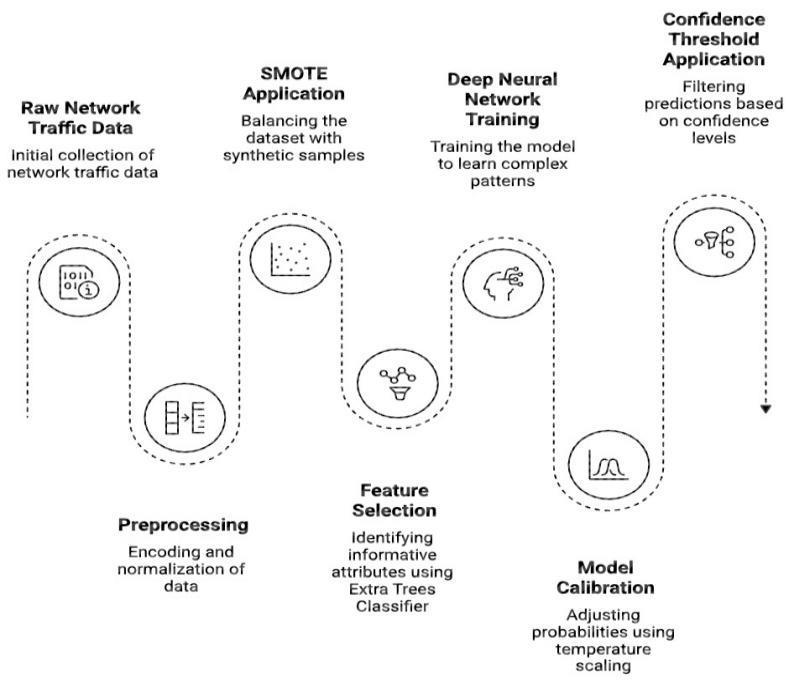
The experiments are conducted on the NSLKDD dataset, whichisstillcommonlyuseddespiteitsknownlimitations.
One reason for using it is that it provides a consistent benchmark across many previous studies [21]. At the same time, it is worth noting that no data set fully representsrealnetworktraffic;somethingalreadypointed outinearlieranalysesofIDSdatasets[16].Beforetraining, thedataiscleanedandtransformed.Categoricalattributes such as protocol type and service are encoded, while numerical features are scaled.Thisstep is fairlystandard, but skipping it tends to createunstable training behavior, especially for neural networks. In practice, even small inconsistencies in pre-processing can lead to noticeable differencesinperformance
One issue that becomes obvious when working with NSLKDD is the imbalance between classes. Some attack categories appear far less frequently, which makes them harder for the model to learn. Instead of leaving the data as it is, SMOTE is applied to generate additional samples for these minority classes. This is not a new idea imbalanced learning has already been discussed in intrusion detection contexts [5] but in practice, it still makes a difference. Without this step, the model tends to biastoward normal traffic, which may lookgoodin terms of accuracy but is not very useful froma security perspective.
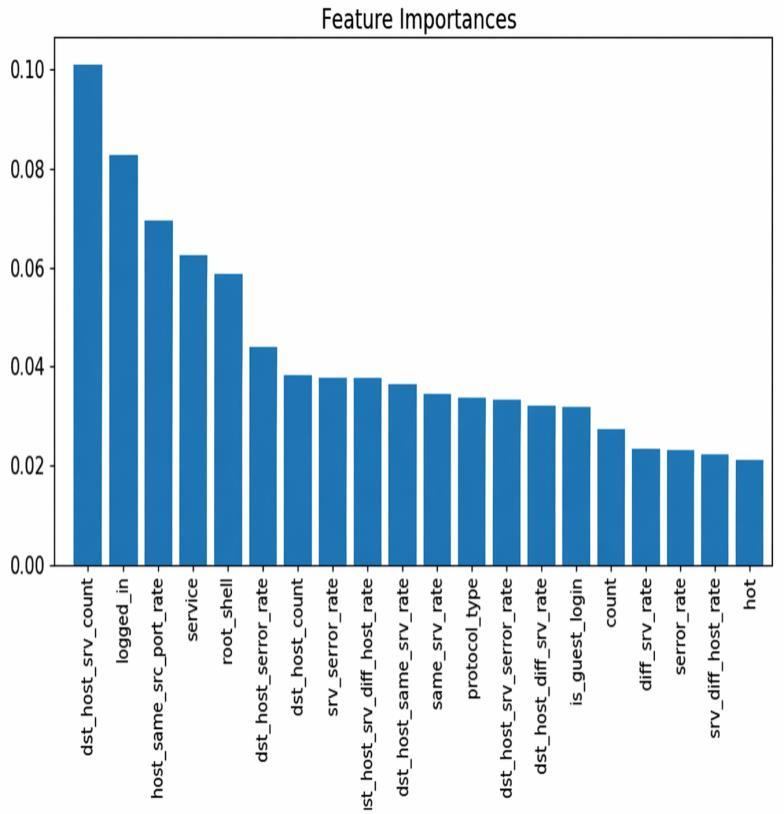
Ratherthanfeedingallavailablefeaturesintothemodel,a feature selection step is introduced. An Extra Trees
International Research Journal of Engineering and Technology(IRJET) e-ISSN: 2395-0056
Volume: 13 Issue: 04 | Apr 2026 www.irjet.net p-ISSN: 2395-0072
Classifier is used to rank features based on importance, and only thetop 20 are retained. This decision is partly practical. High-dimensional input can slow down training andsometimesintroducenoise.
Earlier work using tree-based models has shown that not all features contribute equally to intrusion detection performance [22]. By reducing the feature set, the model becomeseasiertotrainandslightlymorestable,although the exact number of selected features is somewhat empirical.
The core of the system is a deep neural network. Compared to traditional machine learning models, neural networksare betteratcapturingcomplexrelationships in the data, especially when patterns are not linearly separable. This is one of the main reasons deep learning hasbeenwidelyadoptedinIDSresearch[14],[15].
Trainingisperformedovermultipleepochs,andthemodel gradually converges as expected. While the trainingaccuracy reaches a high value, this alone is not taken as a sufficient indicator of performance. Previous studies have already shown that high accuracy does not necessarily translate to reliable predictions in real-world scenarios[28].
One aspect that is often overlooked in IDS models is how confidentthepredictionsactuallyare.Neuralnetworks,in particular, tend to produce overconfident probabilities. This can be misleading, especially when decisions are made based on those probabilities. To deal with this, temperature scaling is applied after training. The idea is simple: instead of changing the predictions themselves, the confidence values are adjusted to better reflect actual likelihoods. This aligns with broader discussions in explainable and trustworthy AI, where reliability is consideredasimportantasaccuracy[11].
After calibration, a confidence threshold is introduced. Predictions above this threshold are accepted, while others a remarked as uncertain. This is a small addition, butitchangeshow thesystem behaves.Insteadofforcing a decision for every input, the model is allowed to admit uncertainty. In real deployment, these uncertain cases couldbeflaggedforfurtherinspection.Similarideashave been explored in IoT-based IDS systems, here reducing falsepositivesisoftenmorevaluablethanmaximizingraw accuracy[18].
The model is evaluated using common metrics such as accuracy,precision,recall,F1-score,andROCAUC.
However,theevaluationdoesnotstopthere.Theeffectof calibrationandconfidencefilteringisalsoconsidered.
This is important because standard metrics alone do not fully capture how a system performs in practice. For example, a model might have good overall accuracy butstill perform poorly on rare attack classes or produce unreliableconfidencescores.
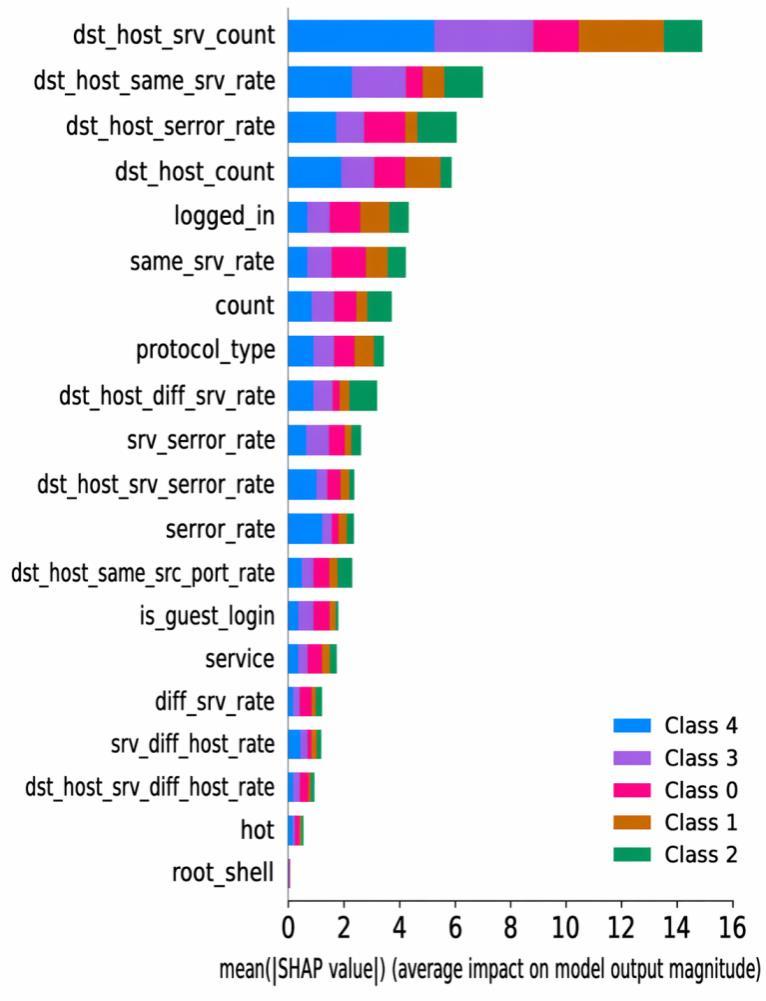
Finally,SHAPisusedtointerpretthemodel’spredictions.
Rather than treating the model as a black box, SHAP providesawaytoseewhichfeaturesinfluenceaparticular decision. This step is partly motivated by the growing interest in explainable AI forcybersecurity applications [11], [19]. In practice, the explanations also help verify whether the model is relying on meaningful features or simply picking up spurious patterns. Overall, the methodology does not rely on a single improvement but combines several smaller adjustments data balancing, feature selection, calibration, and interpretability. Individually, these steps are not new, but their combination makes the system more practical for intrusion detection, especially in scenarios where reliabilitymattersasmuchasaccuracy.
This section presents a detailed evaluation of the proposed intrusion detection system. Instead of focusing only on overall accuracy, the analysis also considers prediction of reliability, calibration effects, and the behaviorofthemodelunderuncertainty.
TheexperimentsareconductedusingtheNSLKDDdataset, which includes five categories of network traffic: Normal, DOS, Probe, R2L, and U2R. After pre-processing and applying SMOTE to balance the dataset, the training set contains 336,715 samples. A deep neural network is trained for 15 epochs. The training shows stable convergence, with accuracy increasing over time. By the final epoch, the training accuracy reaches approximately 97.84%, indicating that the model has learned the underlyingpatternsinthedata.
However, as noted in earlier studies, high training accuracy does not always translate to strong generalization performance in intrusion detection tasks
International Research Journal of Engineering and Technology(IRJET) e-ISSN: 2395-0056
Volume: 13 Issue: 04 | Apr 2026 www.irjet.net p-ISSN: 2395-0072
[28]. Therefore, evaluation of unseen test data becomes critical.
The first evaluation is performed using the uncalibrated model.TheresultsaresummarizedinTable-1.
Table -1: BaselineModelPerformance
At first glance, the ROCAUC value appears strong, suggestingthatthemodelcandistinguishbetweenclasses effectively.
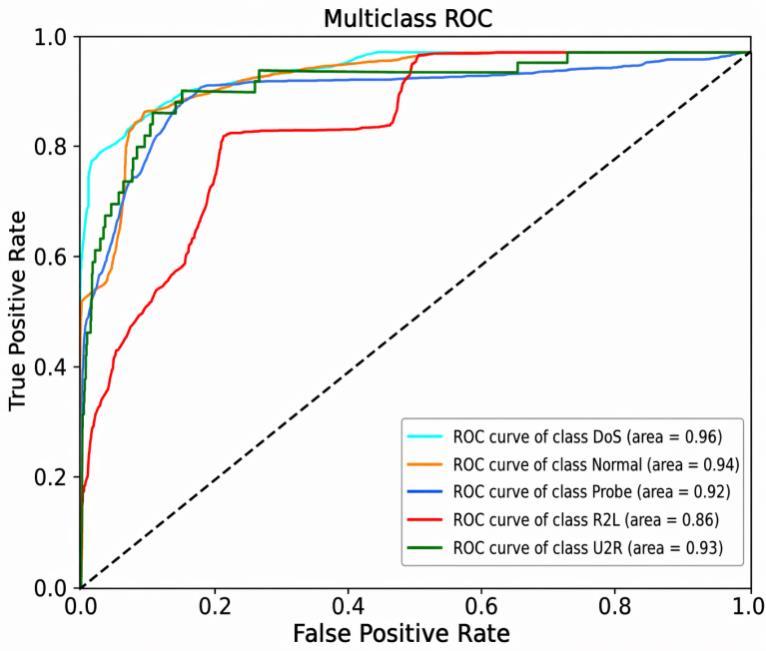
Fig-1: MulticlassROCCurveshowingmodel discriminationabilityacrossallclasses
However, the relatively lower F1 score indicates that performance across different classes is not balanced. One noticeablepatternisthatprecisionishigherthanrecall.
This implies that the model is more cautious when predicting attacks, leading to fewer false positives but potentially missing some actual attacks. In practical
settings,thistradeoffcanbe problematic, especiallywhen undetectedattackscarryhigherrisk.
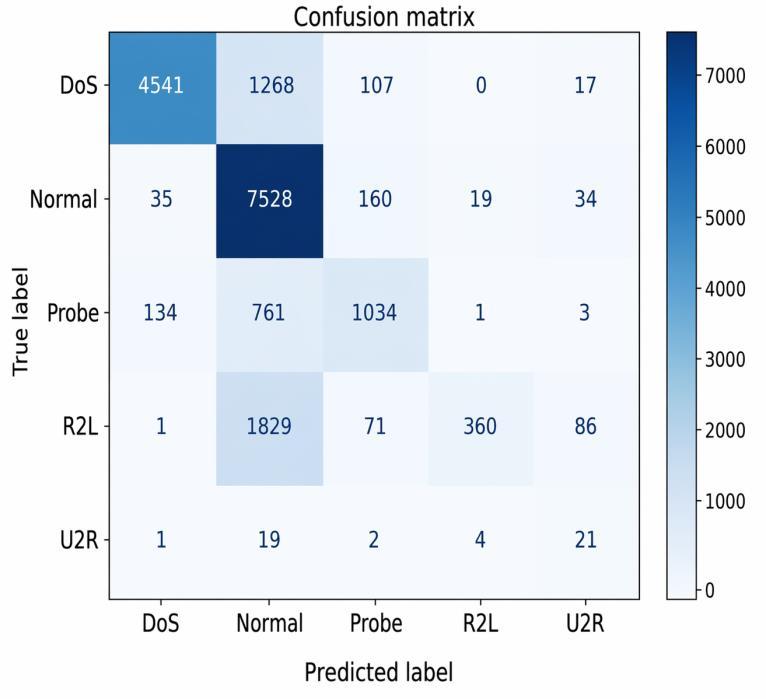
Fig-2: ConfusionMatrixoftheModel
4.3 Effect of model Calibration
To address the issue of unreliable confidence scores, temperaturescalingisapplied. The calibration resultsare showninTable-2.
Table -2: ModelCalibrationResults
The reduction in negative log-likelihood (NLL) is quite significant. This suggests that the model’s predicted probabilitiesarebetteralignedwithactualoutcomesafter calibration. It is important to note that calibration does not aim to improve classification accuracy directly but rathertoimprovethereliabilityofconfidencescores[11]. To verify this, the model is evaluated again after calibration.
TheresultsarepresentedinTable-3.
2026, IRJET | Impact Factor value: 8.315 | ISO 9001:2008
International Research Journal of Engineering and
Volume: 13 Issue: 04 | Apr 2026 www.irjet.net p-ISSN: 2395-0072
Table -3: CalibratedModelPerformance
As expected, the classification of metrics remain almost unchanged. This confirms that calibration improves confidence estimation without affecting prediction outcomes.
In intrusion detection, this distinction is important because decisions are often made based on confidence levelsratherthanrawpredictions.
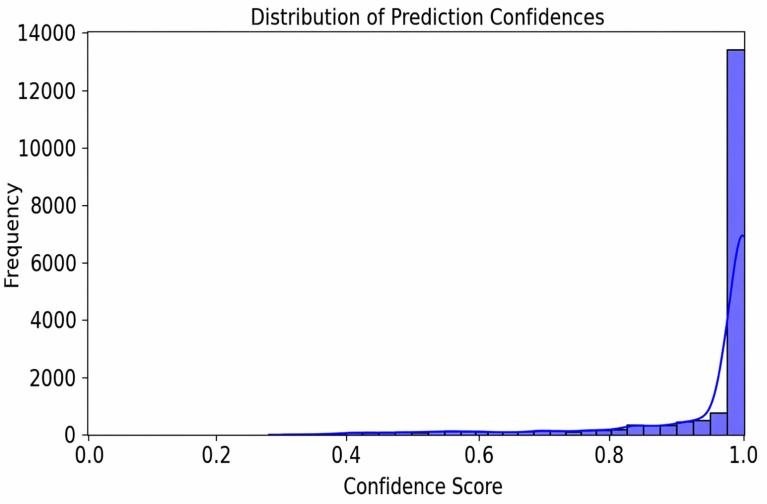
Tofurtherevaluatetheusefulnessofcalibratedconfidence scores,athresholdof0.8isapplied.Predictionsabovethis threshold are accepted, while others are marked as uncertain.TheresultsaresummarizedinTable-4.
Table -4: Confidence-BasedDecisionResults
A few observations stand out here. First, the majority of predictions fall into the high-confidence category. More importantly, the accuracy for accepted predictions increases to nearly 80. At the same time, the uncertainpredictionsshowsignificantlyloweraccuracy.
Fig-3: Distributionofpredictionconfidencescoresafter calibration
This indicates that the model is correctly identifying difficult or ambiguous cases. In practice, this behavior is desirable because it allows the system to flag uncertain instancesinsteadofmakingunreliabledecisions.
Feature selection results show that certain attributes contributemoresignificantlytothemodel’sdecisions.
Featuressuchasdst_host_srv_count,serror_rate,andsame srv_rate appear among the top-ranked features. These features are closely related to connection behavior and errorpatterns,whichareknownasindicatorsofmalicious activity. Previous studies have also highlighted the importance of such features in intrusion detection tasks [22]. The feature importance plot further confirms that a smallersubsetoffeaturescancapturemostoftherelevant information.
International Research Journal of Engineering and Technology(IRJET) e-ISSN: 2395-0056
Volume: 13 Issue: 04 | Apr 2026 www.irjet.net p-ISSN: 2395-0072
Tobetterunderstandthemodel’sbehaviour,SHAPisused to analyse feature contributions. The SHAP summary plot provides insight into how different features influence predictions across multiple samples. The analysis shows that features related to abnormal traffic patterns and connection statistics have a strong impact on attack detection.
This aligns with expectations and provides some confidencethatthemodelislearningmeaningful patterns rather than relying on noise. Explainability plays an importantroleinintrusiondetectionsystems,particularly when decisions need to be validated by security analysts [19].TheuseofSHAPhelpsbridgethegapbetweenmodel performanceandinterpretability.
Overall, the results suggest that the proposed approach performs reasonably well, particularly when confidencebased filtering is applied. While the baseline accuracy is moderate, the system becomes more reliable when uncertainpredictionsareseparated.Atthesametime,the gap between training and testing performance indicates thatgeneralization remains a challenge. This isconsistent with earlier observations that intrusion detection models oftenperformdifferentlyin controlleddatasetscompared to real-world environments [28]. Rather than relying solely on accuracy improvements, the proposed system focuses on improving reliability and interpretability. These aspects are often overlooked but are essential for practical deployment in IOT and network security applications.
This work explored the use of deep learning techniques for network-based intrusion detection, with particular attention to issues that often appear in practical deployments rather than just benchmark performance. While deep neural networks are known to achieve high accuracy, the results in this study suggest that accuracy alonedoesnotfullyreflecthowreliableasystemisinrealworld scenarios. The experimental results show that the
International Research Journal of Engineering and Technology(IRJET) e-ISSN: 2395-0056
Volume: 13 Issue: 04 | Apr 2026 www.irjet.net p-ISSN: 2395-0072
proposedmodeliscapableoflearningmeaningfulpatterns from network traffic, achieving strong training performance, and reasonable test accuracy. However, a noticeable gap between training and testing results indicates that generalization remains a concern, which is consistent with observations reported in earlier studies [28]. One of the more useful outcomes of this work is the effect of calibration and confidence-based filtering. Even though calibration does not improve traditional metrics suchasaccuracyorF1-score,itimprovesthereliabilityof prediction probabilities. When combined with a confidencethreshold, thesystem becomesmoreselective, allowing high-confidence predictions to be trusted while separating uncertain cases. This behavior is often more desirableinintrusiondetection,whereincorrectdecisions can have significant consequences. The inclusion of feature selection and SHAPbased interpretation further adds to the practical value of the system. Reducing the feature set simplifies the model without a major loss in performance, while explainability provides insight into how decisions are made. This is particularly important in security applications, where transparency is often required alongside accuracy. Over- all, the results suggest that combining deep learning with calibration, confidence filtering, and interpretability leads to a more balanced intrusion detection system. Rather than focusing only on improving numerical performance, the approach moves toward making the system more reliable and usable in practice.
Althoughtheproposedapproachshowspromisingresults, thereareseveralareasthatcouldbeexploredfurther.One immediate direction is improving generalization. The current model is trained on the NSLKDD dataset, which, while useful, does not fully represent modern network environments. Evaluating the model on more recent datasets or real network traffic would provide a better understanding of its practical performance. Another area for improvement is handling class imbalances more effectively. While SMOTE helps to some extent, it may introducesyntheticpatternsthatdonotalwaysreflectreal attacks. Alternative approaches, such as cost- sesitive learning or more advanced data generation techniques, couldbeexplored.Thecurrentmodelalsoreliesonafixed confidencethreshold. In futurework,this thresholdcould be made adaptive,allowing thesystemtoadjust based on changingnetworkconditions.Thiswouldmakethemodel more flexible in dynamic environments, such as IOT networks. In addition, the computational cost of deep learning models remains a concern, particularly for resource-constrained devices. Developing lightweight or optimized versions of the model would make it more suitable for deployment in edge or IOT environments. Finally, while SHAP provides useful explanations, integrating explainability more tightly into the decision-
making process could beneficial. Instead of using explanations only for analysis, they could be used to actively guide or validate predictions. These directions suggest that future research should focus not only on improving detection performance but also on making intrusion detection systems more adaptive, efficient, and interpretable
[1] M. Farhan, H. Waheed ud Din, S. Ullah, M. S. Hussain, M.A.Khan,T.Mazhar,U.F.Khattak,andI.H.Jaghdam, “Network-based intrusion detection using deep learningtechnique,” ScientificReports,vol.13,2023.
[2] H.Hindy,D.Brosset,E.Bayne,A.Seeam,C.Tachtatzis, R.Atkinson,andX.Bellekens,“Ataxonomyofnetwork threats and intrusion detection systems,” Future Generation Computer Systems, vol. 103, pp. 247–281, 2020.
[3] M. Ring, D. Schlor, D. Landes, and A. Hotho, “Flowbased network traffic generation using generative adversarial networks for intrusion detection,” Computers& Security,vol.82,pp.156–172,2019.
[4] I. Sharafaldin, A. H. Lashkari, and A. A. Ghorbani, “Towardgeneratinganewintrusiondetectiondataset and intrusion traffic characterization,” in Proc. ICISSP, 2018,pp.108–116.
[5] G. Karatas, O. Demir, and O. K. Sahingoz, “Increasing the performance of machine learning-based IDSs on an imbalanced dataset,” in Proc. IEEE Int. Congr. Big Data,2020,pp.171–176.
[6] S. Ahmed, Y. Lee, S. Hyun, and I. Koo, “Unsupervised machine learning-based detection of covert data integrity assault in smart grid networks utilizing isolation forest,” IEEE Trans. Inf. Forensics Security, vol.14,no.10,pp.2765–2777,2019.
[7] H. Sedjelmaci, S. M. Senouci, and N. Ansari, “Intrusion detection and ejection framework against lethal attacks in UAV-aided networks,” IEEE Trans. Intell. Transp.Syst.,vol.18,no.5,pp.1143–1153,2017.
[8] Q. Yang, Y. Liu, T. Chen, and Y. Tong, “Federated machine learning: Concept and applications,” ACM Trans. Intell. Syst. Technol., vol. 10, no. 2, pp. 1–19, 2019.
[9] B.McMahan,E.Moore,D.Ramage,S.Hampson,andB. A. y Arcas, “Communication-efficient learning of deep networks from decentralized data,” in Proc. AISTATS, 2017,pp.1273–1282.
[10] M.Nguyen,T.T.Nguyen,H.Kim,andH.Kim,“DIoT:A federated self-learning anomaly detection system for IoT,”in Proc.IEEEICDCS,2019,pp.756–767.
[11] A. B. Arrieta et al., “Explainable Artificial Intelligence (XAI): Concepts, taxonomies, opportunities and challenges,” Information Fusion, vol. 58, pp. 82–115, 2020.
[12] R. Guidotti et al., “A survey of methods for explaining black box models,” ACM Computing Surveys, vol. 51, no.5,pp.1–42,2018.
[13] M. Wang, K. Zheng, H. Yang, and X. Wang, “An explainablemachinelearningframeworkforintrusion detection systems,” IEEE Access, vol. 8, pp. 73127–73141,2020.
International Research Journal of Engineering and Technology(IRJET) e-ISSN: 2395-0056
Volume: 13 Issue: 04 | Apr 2026 www.irjet.net p-ISSN: 2395-0072
[14] C. Yin, Y. Zhu, J. Fei, and X. He, “A deep learning approach for intrusion detection using recurrent neural networks,” IEEE Access, vol. 5, pp. 21954–21961,2017.
[15] N. Shone, T. N. Ngoc, V. D. Phai, and Q. Shi, “A deep learning approach to network intrusion detection,” IEEE Trans. Emerg. Topics Comput. Intell., vol. 2, no. 1, pp.41–50,2018.
[16] M. Ring, S. Wunderlich, D. Grudl, D. Landes, and A. Hotho, “A survey of network-based intrusion detection data sets,” Computers&Security, vol. 86, pp. 147–167,2019.
[17] A. Javaid, Q. Niyaz, W. Sun, and M. Alam, “A deep learning approach for network intrusion detection system,”in Proc.EAI Int.Conf.,2016,pp.21–26.
[18] H. Hindy, R. Atkinson, and X. Bellekens, “Machine learningbasedintrusiondetectionforIoTnetworks:A survey,” IEEE Access,vol.8,pp.215–232,2020.
[19] S. Latif, Z. Zou, and J. Qadir, “Explainable artificial intelligenceforintrusiondetectionsystems:Asurvey,” IEEEAccess,vol.9,pp.112125–112147,2021.
[20] M. Al-Hawawreh, N. Moustafa, and E. Sitnikova, “Identification of malicious activities in industrial internet of things based on deep learning models,” J. Inf.Security Appl.,vol.41,pp.1–11,2018.
[21] N. Moustafa and J. Slay, “UNSW-NB15: A comprehensive data set for network intrusion detectionsystems,”in Proc. MilCIS,2015.
[22] J. Zhang, M. Zulkernine, and A. Haque, “Randomforests-based network intrusion detection systems,” IEEE Trans. Syst., Man, Cybern. C, vol. 38, no. 5, pp. 649–659,2008.
[23] S. Mukkamala, G. Janoski, and A. Sung, “Intrusion detection using neural networks and support vector machines,”in Proc.IJCNN,2002,pp.1702–1707.
[24] K. Wang, S. J. Stolfo, and B. Li, “Anomalous payloadbasednetworkintrusiondetection,”in RAID,2004,pp. 203–222.
[25] D. Barbara, N. Wu, and S. Jajodia, “Detecting novel network intrusions using Bayes estimators,” in Proc. SIAMSDM,2001.
[26] T.A.Tangetal.,“Deeplearningapproachfornetwork intrusion detection in software defined networking,” in Proc.IEEE Conf.,2016.
[27] W. Wang et al., “Malware traffic classification using convolutional neural network,” in Proc. IEEE Conf. Inf. Netw.,2017.
[28] R. Sommer and V. Paxson, “Outside the closed world: On using machine learning for network intrusion detection,”in Proc.IEEES&P,2010.
[29] A. L. Buczak and E. Guven, “A survey of data mining and machine learning methods for cyber security intrusion detection,” IEEE Commun. Surveys Tuts., vol. 18,no.2,pp.1153–1176,2016.
[30] S.Axelsson,“Thebase-ratefallacyanditsimplications for intrusion detection,” ACM TISSEC, vol. 3, no. 3, pp. 186–205,2000.
[31] J. Davis and M. Goadrich, “The relationship between precision-recallandROCcurves,”in Proc.ICML,2006.
[32] Y. LeCun, Y. Bengio, and G. Hinton, “Deep learning,” Nature,vol.521,pp.436–444,2015.
[33] T.T.NguyenandG.Armitage,“Asurveyoftechniques for internet traffic classification using machine learning,” IEEE Commun. Surveys Tuts., vol. 10, no. 4, pp.56–76,2008.
[34] A. Abeshu and N. Chilamkurti, “Deep learning: The frontier for distributed attack detection,” IEEE Commun.Mag.,vol.56,no.2,pp.169–175,2018.
[35] M. Conti et al., “Internet of Things security and forensics:Challengesandopportunities,” FGCS,vol.78, pp.544–546,2018.
[36] N. Moustafa et al., “Big data analytics for intrusion detectionsystem,”in Proc.IEEEDSAA,2015.
[37] X. Yuan, C. Li, and X. Li, “DeepDefense: Identifying DDoS attack via deep learning,” in Proc. IEEE ICC, 2017.
[38] M. Zolanvari et al., “DDoS detection using deep learning in software-defined networks,” in Proc. IEEE BigData,2019.
[39] A. Khraisat et al., “Survey of intrusion detection systems: Techniques, datasets and challenges,” Cybersecurity,vol.2,no.1,2019.
[40] N. Moustafa and J. Slay, “Evaluation of network anomalydetectionsystems,”in Proc.MilCIS,2015.
[41] G. Apruzzese et al., “On the effectiveness of machine and deep learning for cyber security,” in Proc. IEEE CyberConflict,2018.