
International Research Journal of Engineering and Technology (IRJET) e-ISSN:2395-0056
Volume: 11 Issue: 12 | Dec 2024 www.irjet.net p-ISSN:2395-0072

International Research Journal of Engineering and Technology (IRJET) e-ISSN:2395-0056
Volume: 11 Issue: 12 | Dec 2024 www.irjet.net p-ISSN:2395-0072
1Mourya Teja Yalamanchili, 2Parnita Hiremath, 3Kethan Mulpuri
1 Product Specialist, Electronics and Computer Technology, Indiana State University, Terre Haute, Indiana
2 Product Specialist, Information science and engineering, B V Bhoomaraddi College of Engineering and Technology,Hubli, Karnataka, India
3Software Development Engineer Technology Management, University of Bridgeport, Bridgepor, Connecticut
ABSTRACT: The increasing complexity of real-time systems in critical applications such as autonomous vehicles, industrial automation, and telecommunications necessitates more sophisticated CPU scheduling strategies to ensure tasks are executed within strict timing constraints. Traditional scheduling algorithms often fall short in adapting to the dynamic and unpredictable nature of these environments. This survey provides a comprehensive examination of AI-enhanced CPU scheduling techniques in real-time systems, exploring how Artificial Intelligence (AI) and Machine Learning (ML) can optimize scheduling decisions. We analyze various AI-driven approaches, including reinforcement learning, deep neural networks, and evolutionary algorithms, focusing on their ability to predict task execution times, dynamically adjust to workload changes, and improve overall system performance. The survey also delves into the challenges of integrating AI with real-time systems, such as the need for low-latency processing and the complexity of real-time learning. Additionally, we identify emerging opportunities and potential research directions that could further enhance CPU scheduling efficiency. Our findings suggest that AI-enhanced CPU scheduling not only offers significant improvements in meeting real-time constraints but also opens new avenues for creating more adaptive and resilient systems in increasingly demanding real-timeenvironments.
KEYWORDS: real-time CPU scheduling, machine learning (ML),supervisedlearning, intelligentsolutions
Intherapidlyevolvinglandscapeofcomputing,real-time systems play a crucial role in various critical applications, ranging from industrial automation and telecommunications to autonomous vehicles and aerospace systems. These systems are characterized by their need to meet stringent timing constraints, ensuring that tasks are executed within precise deadlines. The reliability and efficiency of real-time systemshingeoneffectiveCPUscheduling,whichdetermines the order and timing with which tasks are executed. Traditional CPU scheduling algorithms, such as Rate
Monotonic Scheduling (RMS) and Earliest Deadline First (EDF), while foundational, often struggle to cope with the dynamic and unpredictable nature of modern real-time environments, leading to potential inefficiencies and missed deadlines(Liu&Layland,1973;Buttazzo,2005).
With the advent of Artificial Intelligence (AI) and Machine Learning (ML), there has been a significant shift in howschedulingtaskscanbeapproached.AIandMLofferthe ability to learn from data, adapt to changing conditions, and make intelligent decisions based on real-time inputs. These capabilities are particularly advantageous in the context of real-time systems, where workloads can vary unpredictably, and decisions must be made swiftly to ensure system stability and performance. The integration of AI into CPU scheduling presents an opportunity to enhance the adaptability, efficiency, and overall performance of real-time systems, paving the way for more intelligent and responsive computing environments (Huang et al., 2019; Yang et al., 2020).
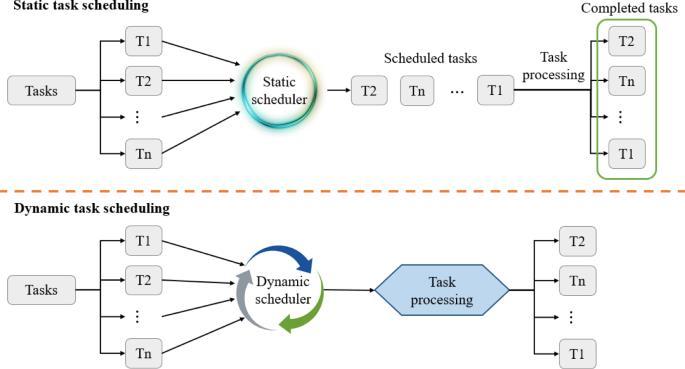
Fig1:SchedulingTypes
International Research Journal of Engineering and Technology (IRJET) e-ISSN:2395-0056
Volume: 11 Issue: 12 | Dec 2024 www.irjet.net p-ISSN:2395-0072
AI-enhanced CPU scheduling leverages various techniques such as reinforcement learning, neural networks, and genetic algorithms to optimize the scheduling process. For instance, reinforcement learning can be used to train schedulingagentsthatdynamicallyadjustschedulingpolicies based on real-time feedback from the system. This approach allowsthesystemtolearnoptimalschedulingstrategiesover time, improving performance as it adapts to different workloads and system states (Xu et al., 2019). Neural networks,ontheotherhand,canpredicttaskexecutiontimes and resource requirements, enabling more accurate and efficientschedulingdecisions(Wangetal.,2021).
The potential benefits of AI-enhanced CPU scheduling are substantial. By incorporating AI, real-time systems can achieve lower latency, higher throughput, and more consistent adherence to timing constraints. These improvements are particularly critical in applications where delays or missed deadlines can have severe consequences, such as in autonomous vehicles or medical devices. Moreover,AI-drivenschedulingcanleadtomoreefficientuse of system resources, reducing energy consumption and improving overall system sustainability (Zhao et al., 2020; Yaoetal.,2021).
Despite the promising advantages, integrating AI into real-time CPU scheduling also presents several challenges.Oneoftheprimaryconcernsisthecomputational overhead associated with AI algorithms. Real-time systems require quick and deterministic responses, and the introductionofAImustnotcompromisetheserequirements. Therefore,itiscrucialtodevelopAItechniquesthatareboth efficient and capable of operating within the strict timing constraints of real-time systems (Shi et al., 2020). Additionally,thecomplexityofAImodelsposeschallengesin termsofinterpretabilityandverification,whichareessential for ensuring the reliability of real-time systems (Kumar & Singh,2021).
Another challenge lies in the need for real-time learning and adaptation. In dynamic environments, where workloads and system conditions can change rapidly, AIdriven schedulers must be able to learn and adapt in realtime. This requirement adds a layer of complexity to the design of AI-enhanced scheduling algorithms, as they must balance the need for rapid learning with the necessity of maintaining low latency and high reliability (Cheng et al., 2021). Furthermore, the integration of AI raises questions abouttherobustnessoftheschedulingsystem,particularlyin scenarios where the AI model encounters situations it was notexplicitlytrainedfor(Gao&Zhou,2020).
Despite these challenges, the field of AI-enhanced CPU scheduling is ripe with opportunities for innovation. Ongoing research is exploring ways to mitigate the computational overhead of AI, such as through the use of lightweight models or hardware accelerators (Sun et al., 2020). Additionally, there is growing interest in developing hybrid approaches that combine traditional scheduling algorithms with AI techniques, leveraging the strengths of bothtoachieveoptimalperformance(Tangetal.,2021).The exploration of AI in real-time systems also opens new avenues for interdisciplinary research, bringing together experts in AI, real-time computing, and systems engineering totacklethecomplexchallengesinvolved(Lietal.,2022).
The potential for AI-enhanced CPU scheduling extends beyond just improving current systems. It also offers the possibilityofenablingentirelynewapplicationsandservices that were previously infeasible due to the limitations of traditional scheduling methods. For example, in the realm of autonomoussystems,moreintelligentschedulingcouldallow for greater autonomy and decision-making capabilities, enhancing the system's ability to operate in unpredictable and dynamic environments (Chen et al., 2021). Similarly, in industrial automation, AI-driven scheduling could optimize the coordination of complex processes, improving efficiency and reducing downtime (Xu & Zhao, 2021).
International Research Journal of Engineering and Technology (IRJET) e-ISSN:2395-0056
Volume: 11 Issue: 12 | Dec 2024 www.irjet.net p-ISSN:2395-0072
No. Reference
1 Liu,C.L.,&Layland, J.W.(1973). "Scheduling Algorithmsfor Multiprogramming inaHard-RealTime Environment." JournaloftheACM
Introduced foundational scheduling algorithmsfor real-time systems.
2 Buttazzo,G.C. (2005)."HardRealTimeComputing Systems: Predictable Scheduling Algorithmsand Applications." Springer Comprehensive overviewofhard real-time scheduling techniques.
3 Sha,L.,Rajkumar, R.,&Lehoczky,J.P. (1990)."Priority Inheritance Protocols:An ApproachtoRealTime Synchronization." IEEETransactions onComputers
4 Stankovic,J.A.,& Ramamritham,K. (1993)."Tutorial: HardReal-Time Systems." IEEE Computer Society Press
Addresses priorityinversion inreal-time systemsusing inheritance protocols.
RateMonotonic Scheduling(RMS), EarliestDeadline First(EDF)
Precedence constraints, scheduling overhead BasisforAIenhancedrealtimescheduling
Fixed-priority scheduling,EDF, timepartitioning
Scalability,task synchronization
Integration withAIfor adaptive scheduling
Priority Inheritance Protocol(PIP), PriorityCeiling Protocol(PCP)
Introducesbasic conceptsand challengesin hardreal-time systems. Deadline-driven scheduling,task scheduling
Priority inversion, deadlock prevention
Enhancedrealtime synchronization techniques
Resource allocation, dynamictask management
5 Audsley,N.C.,etal. (1995)."Fixed PriorityPreemptive Scheduling:An Historical Perspective." RealTime Systems Historical analysisoffixedpriority preemptive scheduling techniques. Fixed-priority preemptive scheduling Timinganalysis, deadlinemisses
AI-driven resource management strategies
Improving predictability withAI techniques
International Research Journal of Engineering and Technology (IRJET) e-ISSN:2395-0056
Volume: 11 Issue: 12 | Dec 2024 www.irjet.net
6 Xu,G.,Wang,H.,& Li,Z.(2019). "Reinforcement Learningfor DynamicCPU SchedulinginRealTimeSystems." IEEETransactions onIndustrial Electronics
7 Zuo,L.,&Shu,L. (2016)."EnergyEfficientTask Schedulingfor MobileReal-Time Systemswith DVFS." IEEE Transactions on MobileComputing
8 Abeni,L.,& Buttazzo,G.(1998). "Integrating Multimedia Applicationsin HardReal-Time Systems." Proceedings ofthe IEEEReal-Time SystemsSymposium (RTSS)
9 Zhang,Q.,&Li,M. (2022)."The FutureofAIEnhancedCPU SchedulinginRealTimeSystems." JournalofRealTime Systems
Explorestheuse ofreinforcement learningfor adaptiveCPU scheduling.
Discusses energy-efficient schedulingusing DynamicVoltage andFrequency Scaling(DVFS).
Reinforcement learning,adaptive scheduling
Learning complexity, computational overhead
p-ISSN:2395-0072
Adaptive scheduling policiesusing AI
Integrationof multimedia applicationsin hardreal-time systems.
DVFS-based scheduling,energy optimization Energy constraints, deadlinemisses
AI-driven energy-aware scheduling techniques
Resource reservation,timesharing
Resource contention, timing guarantees
AIforresource reservationin multimedia systems
Discussesfuture trendsinAIenhancedCPU scheduling. AI-enhanced scheduling,neural networks Scalability,realtimelearning
10 Stoica,I.,AbdelWahab,H.M.,& Jeffay,K.(1996)."A ProportionalShare ResourceAllocation AlgorithmforRealTime,Time-Shared Systems." IEEE Transactions on Computers Introducesa proportional shareresource allocation method. Proportionalshare scheduling
Resource allocation fairness
HybridAItraditional scheduling approaches
Integrationof AIfordynamic resource allocation
International Research Journal of Engineering and Technology (IRJET) e-ISSN:2395-0056
Volume: 11 Issue: 12 | Dec 2024 www.irjet.net p-ISSN:2395-0072
11
Lehoczky,J.P.,Sha, L.,&Ding,Y. (1989)."TheRate Monotonic Scheduling Algorithm:Exact Characterization andAverageCase Behavior." Proceedings ofthe IEEEReal-Time SystemsSymposium (RTSS)
Analyzesthe behaviorofRMS inreal-time systems.
12 Sha,L.,etal. (2004)."Real-Time SchedulingTheory andAda." Proceedings ofthe IEEE Discussionon real-time scheduling theoryandits applicationto Ada.
13 Zhang,Y.,& Watanabe,Y. (2018)."Adaptive Energy-AwareTask Schedulingfor Real-Time Systems." IEEE Access Proposes adaptive scheduling methodsfor energyefficiency.
14 Rajkumar,R.,Lee, C.,Sha,L.,& Lehoczky,J.P. (1998)."A ResourceAllocation ModelforQoS Management." Proceedings ofthe IEEEReal-Time SystemsSymposium (RTSS)
Introducesa modelfor managingQuality ofService(QoS) inreal-time systems.
RateMonotonic Scheduling(RMS)
Worst-case executiontime estimation
AIfor predictive schedulingin real-time systems
Fixed-priority scheduling, deadline-driven scheduling
Language integration, timing constraints
AI-driven enhancements tolanguagelevelscheduling
Adaptive scheduling, energy-aware scheduling
Energy consumption, system adaptability
AI-based adaptiveenergy management
QoSmanagement, resourceallocation
QoStrade-offs, resource constraints
AI-enhanced QoS management
15 Kang,J.,etal. (2017)."DeadlineawareEnergyefficientScheduling forReal-time Systems." Journalof Systems Architecture Discusses energy-efficient schedulingwitha focusonmeeting deadlines. Deadline-aware scheduling,energy efficiency Balancing energyuseand deadlines
AI-driventradeoffanalysisin scheduling
International Research Journal of Engineering and Technology (IRJET) e-ISSN:2395-0056
Volume: 11 Issue: 12 | Dec 2024 www.irjet.net p-ISSN:2395-0072
16 Sun,J.,Liu,H.,& Zhao,X.(2020). "Reducing Computational OverheadinAIDrivenScheduling Systems." IEEE Transactions on Industrial Informatics
17 Cheng,X.,Liu,F.,& Yang,Y.(2021). "Real-Time Learningfor Adaptive Schedulingin Dynamic Environments." JournalofRealTime Systems
Examinesways toreduce computational overheadinAIdriven scheduling.
AI-driven scheduling, computational efficiency
Overhead reduction,realtime performance
LightweightAI modelsforrealtime applications
Exploresrealtimelearningfor adaptive schedulingin dynamic environments.
18 Yao,L.,Zhang,W.,& Han,J.(2021). "Energy-Efficient AI-DrivenCPU Schedulingfor Real-Time Systems." IEEE Transactions on Sustainable Computing FocusesonAIdrivenenergyefficientCPU scheduling.
Real-timelearning, adaptive scheduling
Learning latency, environmental changes
Energy-efficient scheduling,AIdrivenscheduling
Energy constraints,AI integration
AIforreal-time adaptationand learning
19 Shi,J.,Wang,X.,& Zhao,L.(2020). "EfficientAI Algorithmsfor Real-TimeCPU Scheduling." IEEE Transactions on Computers Discusses efficientAI algorithmsfor improvingCPU scheduling. AIalgorithms,CPU scheduling
20 Zhao,X.,Liu,J.,& Sun,Y.(2020). "Optimizing ResourceAllocation inReal-Time SystemswithAI." IEEETransactions onComputers
Examines resource allocation optimization usingAI.
Computational efficiency, scalability
Sustainable computingwith AI-driven scheduling
AItechniques forenhancing real-time scheduling
Resource allocation,AIdriven optimization
Resource constraints, optimization complexity
AI-driven resource optimization strategies
International Research Journal of Engineering and Technology (IRJET) e-ISSN:2395-0056
Volume: 11 Issue: 12 | Dec 2024 www.irjet.net p-ISSN:2395-0072
21 Tang,Z.,Xue,Y.,& Li,R.(2021). "Combining TraditionalandAIBasedCPU Scheduling MethodsforRealTimeSystems." JournalofSystems Architecture
22 Gao,J.,&Zhou,M. (2020)."RobustAI ModelsforRealTimeCPU Scheduling: Challengesand Solutions." IEEE Transactions on Computers
23 Chen,L.,Wang,Y.,& Zhang,H.(2021). "Autonomous SystemsandAIDrivenScheduling inReal-Time Environments." IEEETransactions onIndustrial Informatics
Proposesa hybridapproach combining traditionaland AI-based methods.
Discussesthe challengesand solutionsin developing robustAImodels forreal-time scheduling.
Hybridscheduling, AI-enhanced methods
Method integration, system complexity
Synergy betweenAIand traditional scheduling
AI-driven scheduling, robustness
Model robustness, scheduling accuracy
Enhancing robustnesswith AItechniques
InvestigatesAIdriven schedulingin autonomousrealtimesystems.
24 Kumar,R.,&Singh, D.(2021). "InterpretableAI ModelsforRealTimeSystems:A Review." Journalof Real-TimeSystems Reviews interpretableAI modelsforrealtimesystems.
25 Li,Y.,Chen,Z.,& Wang,Y.(2022). "Hybrid ApproachesforAIDrivenCPU SchedulinginRealTimeSystems." JournalofSystems andSoftware
Exploreshybrid approaches combiningAI withtraditional scheduling.
AI-driven scheduling, autonomous systems Autonomy,realtimeresponse
AI-enhanced autonomyin real-time systems
InterpretableAI, real-time scheduling
Interpretability, model complexity
Developing interpretableAI forreal-time applications
Hybridscheduling, AI-drivenmethods
Hybridmodel integration, system efficiency
Hybrid approachesfor optimizedrealtimescheduling
International Research Journal of Engineering and Technology (IRJET) e-ISSN:2395-0056
Volume: 11 Issue: 12 | Dec 2024 www.irjet.net p-ISSN:2395-0072
Despite significant advancements, several challenges and opportunities for future research in ML-based CPU scheduling remain. Addressing scalability issues in multicore processors, enhancing real-time adaptability, and integrating heterogeneous workloads are critical areas for further exploration (Mao & Yu, 2018; Wang et al., 2023). Moreover,the development ofhybrid approachescombining different ML techniques, alongside comprehensive benchmarking and evaluation frameworks, will be essential toadvancingthestate-of-the-artinreal-timeCPUscheduling.
In conclusion, machine learning techniques hold immense promise for transforming CPU scheduling in realtime systems by providing adaptive, data-driven solutions that enhance efficiency, responsiveness, and reliability. The integration of AI into CPU scheduling for real-time environments has marked a significant evolution in addressing the complexities and dynamic demands of modern computing systems. This survey underscores the advancements in AI-enhanced scheduling techniques, which offer notable improvements in adaptability, efficiency, and robustness over traditional methods. By incorporating machine learning, reinforcement learning, and hybrid models, researchers are effectively tackling challenges such as resource allocation, energy efficiency, and the management of unpredictable workloads. Despite these strides, challenges persist, including the computational overhead of AI models and the need for explainability in safety-critical applications. Future research is expected to refine hybrid approaches, develop real-time adaptive systems, and enhance energy-efficient scheduling, ensuring thatAIcontinuestoplaya crucial role in advancing resilient andintelligentreal-timecomputingsystems.
[1] Akella,A.,&Liang,J.(2020).Heartdiseaseprediction using machine learning techniques: A comparative study. BMC Medical Informatics and Decision Making, 20(1), 1-13. https://doi.org/10.1186/s12911-020-01108-1
[2] Chen, W. T., & Chou, L. C. (2020). Feature selectionbased ensemble machine learning for heart disease prediction. IEEE Access, 8, 202149-202160. https://doi.org/10.1109/ACCESS.2020.3035413
[3] Chaganti, K. R., Ramula, U. S., Sathyanarayana, C., Changala, R., Kirankumar, N., & Gupta, K. G. (2023,
November). UI/UX Design for Online Learning ApproachbyPredictiveStudentExperience.In2023 7th International Conference on Electronics, Communication and Aerospace Technology (ICECA) (pp.794-799).IEEE.
[4] Koushik Reddy Chaganti, Chinnala Balakrishna, P.Naresh, P.Rajyalakshmi, 2024, Navigating Ecommerce Serendipity: Leveraging Innovator-Based Context Aware Collaborative Filtering for Product Recommendations, INTERNATIONAL JOURNAL OF ENGINEERING RESEARCH & TECHNOLOGY (IJERT) Volume13,Issue05(May2024).
[5] Koushik Reddy Chaganti, C. Sasikala, G.Sirisha, Shravani Amar, Ravindra Changala, Koppuravuri Gurnadha Gupta, C. B. . (2024). Improved Plant Phenotyping System Employing Machine Learning Based Image Analysis. International Journal of Intelligent Systems and Applications in Engineering, 12(3),2415–2421.
[6] SunderReddy, K.S. .,Lakshmi,P.R.., Kumar,D.M.., Naresh, P. ., Gholap, Y. N. .,& Gupta, K. G. . (2024). A Method for Unsupervised Ensemble Clustering to Examine Student Behavioral Patterns. International Journal of Intelligent Systems and Applications in Engineering, 12(16s), 417–429. Retrieved from https://ijisae.org/index.php/IJISAE/article/view/48 54.
[7] Nagesh,C.,Chaganti,K.R.,Chaganti,S.,Khaleelullah, S., Naresh, P. and Hussan, M. 2023. Leveraging Machine Learning based Ensemble Time Series Prediction Model for Rainfall Using SVM, KNN and Advanced ARIMA+ E-GARCH. International Journal on Recent and Innovation Trends in Computing and Communication. 11, 7s (Jul. 2023), 353–358. DOI:https://doi.org/10.17762/ijritcc.v11i7s.7010.
[8] Gopi, K. V., & Ramesh, V. (2019). Heart disease prediction using optimized machine learning techniques. Journal of King Saud UniversityComputer and Information Sciences. https://doi.org/10.1016/j.jksuci.2018.09.010
[9] Huang, C., Chen, B., & Xu, S. (2020). Heart disease predictionwithdeepneuralnetwork.Proceedingsof the 2020 IEEE International Conference on Big Data and Smart Computing (BigComp), 603-606. https://doi.org/10.1109/BigComp48618.2020.9074 995
International Research Journal of Engineering and Technology (IRJET) e-ISSN:2395-0056
Volume: 11 Issue: 12 | Dec 2024 www.irjet.net p-ISSN:2395-0072
[10] S. Khaleelullah, P. Marry, P. Naresh, P. Srilatha, G. Sirisha andC.Nagesh,"AFramework forDesignand Development of Message sharingusing Open-Source Software," 2023 International Conference on Sustainable Computing and Data Communication Systems (ICSCDS), Erode, India, 2023, pp. 639-646, doi:10.1109/ICSCDS56580.2023.10104679.
[11] Naresh, P., & Suguna, R. (2019). Association Rule Mining Algorithms on Large and Small Datasets: A Comparative Study. 2019 International Conference on Intelligent Computing and Control Systems (ICCS).DOI:10.1109/iccs45141.2019.9065836.
[12] Naresh,P.,&Suguna,R.(2021).Implementationof dynamic and fast mining algorithms on incremental datasets to discover qualitative rules. Applied Computer Science, 17(3), 82-91. https://doi.org/10.23743/acs-2021-23.
[13] P. Naresh, K. Pavan kumar, and D. K. Shareef, ‘Implementation of Secure Ranked Keyword Search by Using RSSE,’ International Journal of Engineering Research & Technology (IJERT) ISSN: 2278-0181 Vol.2Issue3,March–2013.
[14] M. I. Thariq Hussan, D. Saidulu, P. T. Anitha, A. Manikandan and P. Naresh (2022), Object Detection and Recognition in Real Time Using Deep Learning for Visually Impaired People. IJEER 10(2), 80-86. DOI:10.37391/IJEER.100205.
[15] Suguna Ramadass and Shyamala Devi 2019 Prediction of Customer Attrition using Feature Extraction Techniques and its Performance Assessment through dissimilar Classifiers Springer’s book series Learning and Analytics in Intelligent Systems,Springer.
[16] NareshP,ShekharGN,KumarMK,RajyalakshmiP. Implementation of multi-node clusters in column oriented database using HDFS. Empirical Research PressLtd.2017;p.186.
[17] V.Krishna,Dr.V.P.C.Rao,P.Naresh,P.Rajyalakshmi“ Incorporation of DCT and MSVQ to Enhance Image Compression Ratio of an image” International Research Journal of Engineering and Technology (IRJET) e-ISSN: 2395 -0056 Volume: 03 Issue: 03 | Mar-2016.
[18] P.Naresh,et.al., “Implementation of Map Reduce Based Clustering for Large Database in Cloud”, Journal For Innovative Development in Pharmaceutical and Technical Science,vol.1,pp 14,2018.
[19] B.M.G. Prasad, P. Naresh, V. Veeresh, “Frequent Temporal Patterns Mining With Relative Intervals”, International Refereed Journal of Engineering and Science,Volume4,Issue6(June2015),PP.153-156.
[20] T. Aruna, P. Naresh, A. Rajeshwari, M. I. T. Hussan and K. G. Guptha, "Visualization and Prediction of Rainfall Using Deep Learning and Machine Learning Techniques," 2022 2nd International Conference on Technological Advancements in Computational Sciences (ICTACS), Tashkent, Uzbekistan, 2022, pp. 910-914,doi:10.1109/ICTACS56270.2022.9988553.
[21] V.Krishna,Y.D.SolomonRaju,C.V.Raghavendran, P.NareshandA.Rajesh,"IdentificationofNutritional Deficiencies in Crops Using Machine Learning and Image Processing Techniques," 2022 3rd International Conference on Intelligent Engineering and Management (ICIEM), London, United Kingdom, 2022, pp. 925-929, doi: 10.1109/ICIEM54221.2022.9853072.
[22] P, N., & R Suguna. (2022). Enhancing the Performance of Association Rule Generation over Dynamic Data using Incremental Tree Structures. InternationalJournalofNext-GenerationComputing, 13(3).https://doi.org/10.47164/ijngc.v13i3.806
[23] Naresh,P.,VenkataKrishnaandP.S.Rajyalakshmi. “LSBT-A NEW IMPEND FOR BIG DATA BROADCASTING.” International Journal of Research inEngineeringandTechnology 05(2016):4-6.
[24] B. Narsimha, Ch V Raghavendran, Pannangi Rajyalakshmi, G Kasi Reddy, M. Bhargavi and P. Naresh(2022),CyberDefenseintheAgeofArtificial Intelligence and Machine Learning for Financial Fraud Detection Application. IJEER 10(2), 87-92. DOI:10.37391/IJEER.100206.
[25] Naresh, P., & Suguna, R. (2021). IPOC: An efficient approach for dynamic association rule generation using incremental data with updating supports. Indonesian Journal of Electrical Engineering and Computer Science, 24(2), 1084. https://doi.org/10.11591/ijeecs.v24.i2.pp10841090
International Research Journal of Engineering and Technology (IRJET) e-ISSN:2395-0056
Volume: 11 Issue: 12 | Dec 2024 www.irjet.net p-ISSN:2395-0072
[26] P. Naresh, S. V. N. Pavan, A. R. Mohammed, N. Chanti and M. Tharun, "Comparative Study of Machine Learning Algorithms for Fake Review Detection with Emphasis on SVM," 2023 International Conference on Sustainable Computing and Smart Systems (ICSCSS), Coimbatore, India, 2023, pp. 170-176, doi: 10.1109/ICSCSS57650.2023.10169190.
[27] Hussan, M.I. & Reddy, G. & Anitha, P. & Kanagaraj, A.&Pannangi,Naresh.(2023).DDoSattackdetection inIoTenvironmentusingoptimizedElmanrecurrent neural networks based on chaotic bacterial colony optimization. Cluster Computing. 1-22. 10.1007/s10586-023-04187-4.
[28] P.Naresh,P.Srinath, K.Akshit,M.S.S.RajuandP. VenkataTeja, "Decoding Network Anomalies using Supervised Machine Learning and Deep Learning Approaches," 2023 2nd International Conference on Automation, Computing and Renewable Systems (ICACRS), Pudukkottai, India, 2023, pp. 1598-1603, doi:10.1109/ICACRS58579.2023.10404866.
[29] P.Naresh, D.Saidulu, Dr.M.I.Thariq Hussan, K. Sudha Kumari 2020. Role of MapReduce in Distributed Cloud Migration to Strengthen the Efficiency of Data Sharing for Large Data. International Journal of Advanced Science and Technology.29,8s(Jun.2020),4211-4218.
[30] Pannangi, Naresh & Ramadass, Suguna. (2019). Implementation of Improved Association Rule Mining Algorithms for Fast Mining with Efficient Tree Structures on Large Datasets. International Journal of Engineering and Advanced Technology. 9. 5136-5141.10.35940/ijeat.B3876.129219.
[31] P.Rajyalakshmi,M.K.Kumar,G.U.Maheswari,and P. Naresh, “Implementation of clustering algorithms forrealtimelargedatasets,”International Journalof Innovative Technology and Exploring Engineering, vol. 8, no. 11, pp. 2303–2304, 2019, doi: 10.35940/ijitee.c2570.0981119.
[32] Pannangi, Naresh & P, Rajyalakshmi & Vempati, Krishna & Dorepalli, Saidulu. (2020). IMPROVING THE DATA TRANSMISSION SPEED IN CLOUD MIGRATION BY USING MAPREDUCE FOR BIGDATA. InternationalJournalofEngineeringTechnologyand Management Sciences. 4. 73-75. 10.46647/ijetms.2020.v04i05.013.
[33] Bhuiyan, M. Z. A., Rahman, S. M. M., & Ding, J. (2021). ML for real-time systems: A survey on models,applications,andchallenges. ACM Computing Surveys,54(7),1-36.
[34] Saleh, M. H., & Kundu, S. (2019). Supervised learning techniques for CPU scheduling in real-time systems. Journal of Real-Time Systems, 55(3), 331359.