
International Research Journal of Engineering and Technology (IRJET) e-ISSN: 2395-0056
Volume: 13 Issue: 04 | Apr 2026 www.irjet.net p-ISSN: 2395-0072

International Research Journal of Engineering and Technology (IRJET) e-ISSN: 2395-0056
Volume: 13 Issue: 04 | Apr 2026 www.irjet.net p-ISSN: 2395-0072
Shruti Dalela, MCA
Taxonomy, Architectural Patterns, Pedagogical Implications and an AI Proficiency Competency Framework Independent Researcher, Gwalior, Madhya Pradesh, India
Formerly: Guest Professor, Department of Computer Science, VRG College, Gwalior, M.P., India
Abstract - The rapid use of Artificial Intelligence (AI) tools has fundamentally transformed the landscape of education, academic research and professional software development. In this comprehensive survey we present a structured, six-domain taxonomy of over eighty AI-powered tools spanning: (i) learning enhancement and intelligent tutoring; (ii) note-making, content creation and presentation generation; (iii) academic research, literature review and citation management; (iv) assessment, examination and skill evaluation; (v) creativity, productivity and career development; and (vi) AI-assisted UI/UX design, coding and web deployment. For each domain we characterize representative tools with respect to their underlying generative architecture large language models (LLMs), diffusion models, retrieval-augmented generation (RAG), and vision-language models (VLMs) and analyze the primary use-cases, API integration patterns, pedagogical affordances and ethical considerations. We further propose the AI Proficiency Matrix (APM) a competency framework mapping tool categories to Bloom’s revised taxonomy and targeted developer and academic job roles. Our empirical survey (n = 420 respondents drawn from Shripriti Educational & IT Hub, Gwalior, across students, teachers, researchers and industry professionals) demonstrates that AI tools substantially outperform traditional methods across every measured task category: literature review time drops by 63% (14.2h → 5.3h), assignment drafting by 68% (6.5h → 2.1h), presentation design by 75% (4.8h → 1.2h), citation formatting by 83% (1.8h → 0.3h), quiz creation by 78% (3.2h → 0.7h), resume building by 83% (3.5h → 0.6h), website prototyping by 77% (8.4h → 1.9h), and code debugging by 81% (2.6h → 0.5h). Productivity gains compound over a 12-week adoption curve, reaching 68–82% improvement over the traditional baseline depending on user category. Students constitute the largest adopter group (42%), followed by teachers (23%), researchers (18%) and industry professionals (13%). We conclude with an open-problems agenda covering hallucination mitigation, data privacy, academic integrity, equitable access and autonomous AI development agents.
Keywords: Generative AI · AI tools taxonomy · Large languagemodels·EdTech·Retrieval-augmentedgeneration· AI-assistedcoding·Bloom’staxonomy·Academicintegrity·ChatGPT·GitHubCopilot
Artificial Intelligence has transitioned from a niche academicdisciplineintoapervasivesociotechnicalinfrastructure underpinning modern knowledge work [1, 2]. The emergence of large language models (LLMs) suchas GPT4o, Claude 3.5 Sonnet and Gemini 1.5 Pro together with multimodal generative systems capable of synthesizing text, images, audio, video and code has created an unprecedented tooling ecosystem available to educators, students,researchersandsoftwareengineersalike[3]. Despitethisabundance,practitionersfacetwochallenges: tool selection and ethical deployment. A student preparing a research paper must navigate a dozen plausible tools Perplexity AI for grounded search, Research Rabbit for citationgraphmapping,Zoteroforreferencemanagement, QuillBot for paraphrasing without clear guidance on effective combinations or responsible use [4, 5]. A junior developer must similarly choose between GitHub Copilot, Codeium, and ChatGPT/Claude for code completion, debugginganddocumentationgeneration.
Thissurveyaddressesthatgap.Throughsystematicevaluation and classification of over eighty AI tools, we construct a unified taxonomy and derive the AI Proficiency Matrix(APM).Ourspecificcontributionsare:
(1) Six-domaintaxonomyof80+AItoolswithannotateduse-cases,underlyingmodelarchitectureandtool-rolemappings.
(2) TheAIProficiencyMatrix(APM)aligningtool categorieswithBloom’scognitivelevelsand 40+professionaljobroles.
(3) ArchitecturalanalysisofkeyAIparadigms: LLMs,RAG,diffusionmodels,vision-language modelsandAIagents.
(4) Developer-facingAPIintegrationpatternsfor programmatictoolaccessinproductionpipelines.
International Research Journal of Engineering and Technology (IRJET) e-ISSN: 2395-0056
Volume: 13 Issue: 04 | Apr 2026 www.irjet.net p-ISSN: 2395-0072
(5) Anethicalriskanalysiswithactionablemitigationstrategiesforacademicandcorporatesettings.
Before surveying individual tools, we characterize the architectural paradigms that underpin them, as tool selection should be informed by underlying model capabilities andlimitations.
LLMs are autoregressive transformer-based models pretrained on internet-scale text corpora via next-token prediction[6].GPT-4,Claude3.5,Gemini1.5andLlama 3are prominent examples. They exhibit in-context learning, instruction following and chain-of-thought reasoning. All conversational AI tools in our taxonomy ChatGPT, Khanmigo, Perplexity AI, GitHub Copilot are LLM-based. Key parameters for practitioners: context window size (8K to 1M tokens), inference latency, cost per token, and fine-tuningavailability.
Programmatic access follows a standard REST pattern: POSThttps://api.openai.com/v1/chat/completions
Authorization:Bearer$OPENAI_API_KEY
Content-Type:application/json
{ "model":"gpt-4o", "messages":[{"role":"user","content":"ExplainRAG"}] }
RAGaugmentsLLMgeneration with a retrieval step: relevantdocumentchunksarefetchedfromavectorstoreand injected into the prompt context, grounding outputs in authoritativesourcesanddramaticallyreducinghallucination [7]. Tools such as NotebookLM, Perplexity AI and Scite implement RAG. Developers integrating RAG pipelines typically combine an embedding model (e.g., textembedding-3-large) with a vector database (Pinecone, Chroma,Weaviate)andanLLM.
Diffusion models learn to iteratively denoise Gaussian noise into structured data images, audio or video [8]. Ideogram, Canva AI, D-ID (video synthesis) and ElevenLabs (neural TTS) are diffusion-adjacent generative systems. VLMs (GPT-4V, Gemini Vision, LLaVA) process image-text pairs, enabling applications such as UI-fromscreenshot generation (Uizard), diagram-to-code conversion and visual QA in Figma AI. Autonomous AI agents chainLLMcallswithtooluse(websearch,codeexecution, API calls), forming the backbone of tools like Reclaim AI [9].
We organize the tool landscape into six functional domains based on primary use-case and user role. Table 1 providesastructuredoverviewwitharchitecturalclassificationanddeveloper/academicuse-cases.
Table-1: Six-domaintaxonomyofAItoolswitharchitecturalclassification,primaryacademicanddeveloperuse-cases, andalignmenttoBloom’srevisedcognitivetaxonomy.ASR=AutomaticSpeechRecognition;GNN=GraphNeuralNetwork;RAG=Retrieval-AugmentedGeneration;VLM=Vision-LanguageModel.
S.No. Domain Representative Tools AI Architecture Academic Use Developer Use Bloom’s Level
I. Learning & Tutoring
II. Notes, Content & Presentations
ChatGPT,Khanmigo,Diffit,PerplexityAI,MagicSchool, ElevenLabs,NapkinAI,Curipod, AITutor.ai
NotebookLM,NotionAI,GammaAI, BeautifulAI,Canva AI,Slidesgo,
LLM,RAG,NeuralTTS
RAG,LLM,Diffusion,ASR
Adaptivetutoring, personalisedcontent
ChatbotAPIs, embedding APIs
Summarisation, PPTgeneration, multilingual
Document APIs,TTS APIs
Remember, Understand
Understand, Apply
International Research Journal of Engineering and Technology (IRJET) e-ISSN: 2395-0056
Volume: 13 Issue: 04 | Apr 2026 www.irjet.net p-ISSN: 2395-0072
III. Research & Citations
KreadoAI,Fireflies AI,Liner
SemanticScholar, ResearchRabbit, Elicit,Zotero, QuillBot,Scribbr, Scite,Connected Papers
IV. Assessment & Evaluation Quizizz,Quizlet, TestGorilla,iMocha,ExamRoomAI, OctoProctor,MagicSchoolAI,PrepAI
V. Creativity, Productivity & Career Ideogram,D-ID, ElevenLabs,Otter.ai,ReclaimAI, Rezi,CanvaAI, BriskTeaching
VI. Web Design & Development Uizard,FigmaAI, FramerAI,Wix ADI,DurableAI, GitHubCopilot, Codeium,BrowserStack,NetlifyAI
GNN,FinetunedLLM, Seq2Seq
LLM,Computer Vision,IRT
Diffusion,NeuralTTS,ASR, LLMAgent
VLM,LLM (code-tuned), CV
ToolsinDomainIleverageconversationalLLMsandadaptive algorithms to personalise the learning experience at scale. ChatGPT (Study Mode) and Khanmigo deliver Socratic dialogue, step-by-step explanations and formative feedback[10]. Diffit auto-generatesdifferentiatedreading materialsatspecifiedLexile levels. Perplexity AI grounds responses in cited, real-time web sources via a RAG pipeline,materiallyreducinghallucinationcomparedtovanilla LLM queries [11]. NapkinAI converts free-form text into publication-quality diagrams using a VLM-assisted layout engine. ElevenLabs produces hyper-realistic voice narration via a neural codec language model, enabling rich audiolearningcontentwithoutstudiorecording.
NotebookLM (Google DeepMind) implements documentgrounded RAG: users upload PDFs and the system generates summaries, Q&A and podcast-style audio overviews anchoredtothesourcewithinlinecitations dramatically reducing hallucination vs. open-ended LLM queries [12]. Notion AI integrates LLM generation into a collaborative workspace. Fireflies AI transcribesandanalysesmeetings via a Whisper-class ASR model + LLM summarisation. Presentation tools Gamma AI, Beautiful AI, Canva AI and Slidesgo translate plain-text outlines into visually
Literaturereview, plagiarism,citations
Quizcreation, proctoring,skillgapanalysis
Semantic searchAPIs, graphAPIs Analyse, Evaluate
Assessment APIs,CV proctoring SDKs Apply, Evaluate
Resume,portfolio, interviewprep ImagegenerationAPIs, scheduling APIs
UI/UXprototyping,websitegeneration
CodecompletionAPIs, CI/CD,testing SDKs
Create,Apply
Create, Evaluate
polished decks using template-conditioned diffusion for visuals. Kreado AI and Rask AI perform multilingual lipsynced video translation using audio diffusion + video inpainting.
Semantic Scholar and Connected Papers map the citationgraphusinggraphneuralnetworks; Research Rabbit visualisespaperclustersinteractively. Elicit extractsPICO elementsfromabstractsusingfine-tunedLLMs[13]. Scite classifies each citation as supporting, contrasting or mentioning a capability absent from traditional search engines. Zotero (AI-assisted)and Mendeley automatereference management. QuillBot and Trinka AI provide paraphrasingandacademicgrammarcorrectionvia sequenceto-sequence transformer models. Scribbr offers plagiarism detection and citation formatting in APA, MLA, IEEE andChicagostyles.
Quizizz and Quizlet generateadaptiveMCQbanksadjusting difficulty via IRT (Item Response Theory) models. MagicSchool AI producesrubric-alignedquestionstagged to Bloom’s levels. TestGorilla and iMocha deliver psychometrically validated skill assessments deployed in enterprise recruiting pipelines via REST API. OctoProctor and ExamRoom AI provide computer-vision-based re-
International Research Journal of Engineering and Technology (IRJET) e-ISSN: 2395-0056
Volume: 13 Issue: 04 | Apr 2026 www.irjet.net p-ISSN: 2395-0072
mote invigilation gaze tracking, head-pose estimation and environmental anomaly detection using YOLO-class object detection running client-side in the browser via WASM [14]. PrepAI categorises generated questions by Bloom’s taxonomy level using a fine-tuned classification head.
Ideogram and Canva AI use text-conditioned diffusion models to generate branded visual content. D-ID creates photorealistic talking-head videos from a still image and text/audio script via latent-diffusion video inpainting. ElevenLabs synthesises natural-sounding voice with controllable prosody using a neural codec language model. Reclaim AI implementsanLLM-agentschedulerthatqueries the Google Calendar API and optimises focus blocks againstmeetingconstraints. Otter.ai transcribesmeetings via a Whisper-based ASR pipeline. Rezi generates ATSoptimisedrésumésusingkeyword-densityscoringagainst livejobdescriptionembeddings.
3.6
velopment
Uizard, Figma AI and Framer AI accelerateUI/UXprototyping from hand-drawn sketches or natural-language descriptions using VLMs. GitHub Copilot and Codeium provide in-editor code completion trained on billions of code tokens (fill-in-the-middle/FIM objective), reducing boilerplate by up to 55% in controlled studies [15]. Wix ADI and Durable AI generate complete, SEO-ready websites from a brief text prompt. BrowserStack enables cross-browserandcross-deviceautomatedtesting. Netlify AI and Vercel AI streamline CI/CD deployment. A representativedeveloperAIpipeline: End-to-end Developer AI Workflow
1. UI Prototype → Uizard / Figma AI (sketch → wireframe)
2. CodeGenerate →GitHubCopilot/Codeium (FIM completion)
3. Debug→Claude/ChatGPTAPI(chat/completions endpoint)
4. Content→ ChatGPT / Claude (copy, SEO meta tags)
5. Images →CanvaAI/Ideogram(brandassets)
6. Test →BrowserStackAutomateAPI
7. Deploy → Vercel AI / Netlify AI (git push → live URL)
Weproposethe AI Proficiency Matrix (APM) asacompetency framework mapping tool domains to Bloom’s revised taxonomy [16] cognitive levels and target job roles. TheAPMhasthreeaxes:
Cognitive Axis: Remember→Understand→Apply→Analyse → Evaluate → Create. Domain I tools operate at Remember/Understand; Domain VI tools demand Createlevelsynthesis.
Tool Axis: Eachdomainmapstoa clusteroftools.Practitioners advance through clusters as cognitive complexity andprofessionalresponsibilityincrease.
Role Axis: Entryroles(TeachingAssistant,ContentEditor, Junior Web Developer) require Domains I–II. Mid roles (Research Scholar, Corporate Trainer, QA Engineer) requireDomainsI–IV.Advancedroles(Full-StackDeveloper, AI Policy Analyst, EdTech Architect) require all six domains.
• L1 AI Consumer: NoAPIintegration.UsesCopilot/Codeiumforcompletion;ChatGPTfordebugging.
• L2 AI Integrator: CallsvendorAPIs(OpenAI,Anthropic,StabilityAI)fromapplicationcode;implementsprompttemplatesandoutputparsers.
• L3 — AI Builder: ConstructsRAGpipelines,finetunesopen-sourcemodels(Llama3,Mistral),builds evaluationharnesses(RAGAS,TruLens).
• L4 AI Architect: Designsmulti-agentsystems, MLOpspipelines,responsible-AIgovernance frameworksandcustommodeltraininginfrastructure.
Ethical deployment of AI tools in academic and professional contexts requires systematic risk awareness and mitigation[17].
LLMs are probabilistic token predictors and routinely produce confident but factually incorrect outputs hallucinations [18]. Mitigation strategies include: (a) RAG with authoritative corpora (NotebookLM, Perplexity AI, Scite); (b) explicit prompting for citations; (c) postgeneration verification against retrieved sources; (d) selfconsistency sampling. For code generation, hallucinated API calls can be caught by running generated code in sandboxedenvironmentswithautomatedtestsuites.
International Research Journal of Engineering and Technology (IRJET) e-ISSN: 2395-0056
Volume: 13 Issue: 04 | Apr 2026 www.irjet.net p-ISSN: 2395-0072
Unattributed AI-generated text constitutes academic dishonesty under most institutional policies. Scribbr and QuillBot’splagiarismcheckerdetectcopiedtext;dedicated AI-content detectors (Originality.ai, GPTZero) identify LLM-generatedpassages,thoughdetectionisanadversarial arms race [19]. Process-oriented assessment AI-use disclosure, oral defences, iterative drafts with instructor review ismorerobustthantechnicaldetection.
CloudAItoolsprocessuserinputsonremoteservers,raisingGDPRandFERPAcomplianceconcernswhenstudents uploadpersonalorinstitutionaldata.Practitionersshould: (a)reviewvendor data-retentionpolicies;(b) prefer tools withEU/INdata-residencyoptions;(c)uselocal-inference alternatives (Ollama, LM Studio) for sensitive workloads [20].
Training corpora reflect historical biases in language, culture and representation. AI-generated rubrics, interview questionsorcodecommentsmayperpetuatethesebiases. Continuous human oversight, diverse prompt engineering and red-teaming mitigate but do not eliminate this risk. Equitable access particularly to paid API tiers remains astructuralbarrierinlow-incomeacademicsettings.
AItoolsdelivermaximumvaluewhencomposedintoendto-endworkflowsspanningmultipledomains.Weidentify three high-impact workflow patterns derived from our toolanalysisandpractitionerinterviews:
(1) TopicDiscovery PerplexityAI(grounded search,DomainI)
(2) LiteratureMapping ResearchRabbit+SemanticScholarcitationgraph(DomainIII)
(3) PaperAnalysis ElicitPICOextraction+Scholarcyflashcards(DomainIII)
(4) NoteSynthesis NotebookLMgroundedQ&A (DomainII)
(5) WritingAssistance TrinkaAIgrammar+QuillBotparaphrasing(DomainIII)
(6) CitationFormatting Scribbr/Zotero(Domain III)
(7) PlagiarismCheck QuillBotchecker(DomainIII)
Empirically, this pipeline reduces literature-review completiontimeby~63%vs.manualapproaches[21].
(1) UIPrototyping Uizard/FigmaAI(sketch→ wireframe)
(2) ContentGeneration ChatGPT/Claude(homepagecopy,DomainVI)
(3) CodeGeneration GitHubCopilot/Codeium (HTML/CSS/JS)
(4) ImageAssets CanvaAI/Ideogram
(5) Debugging ChatGPT/ClaudeAPI
(6) SEO ChatGPTmeta-tagandschema.orggeneration
(7) Cross-browserTesting BrowserStackAutomate
(8) Deployment NetlifyAI/VercelAI(gitpush→ liveURL)
(1) SkillGapAnalysis iMocha/TestGorilla(DomainIV)
(2) ResumeOptimisation ReziATSscoring(DomainV)
(3) PortfolioContent ChatGPT+CanvaAI(Domain V)
(4) InterviewPractice ChatGPTmockinterview simulation(DomainV)
(5) FreelancePitch ChatGPTservicedescription generation(DomainV)
Our practitioner survey (n=420 respondents across four user categories, collected at Shripriti Educational & IT Hub, Gwalior) and systematic tool analysis yield comprehensivefindingsonAIadoptionpatterns,category-specific usagepreferences,comparativeefficiencygainsovertraditional methods, and user-rated effectiveness. The following subsections present quantitative results supported by charts(Figures1–6).
Thesurveyinstrumentwasadministeredat Shripriti Educational & IT Hub, Gwalior, Madhya Pradesh, India, whichservedastheprimarydatacollectionsiteforthis study.ShripritiEducational&ITHubisatrainingand technologyinstitutionofferingcoursesincomputerapplications,AItools,webdevelopmentandprofessionalskill developmenttoadiverselearnerpopulationincluding
International Research Journal of Engineering and Technology (IRJET) e-ISSN: 2395-0056
Volume: 13 Issue: 04 | Apr 2026 www.irjet.net p-ISSN: 2395-0072
undergraduatestudents,workingprofessionals,educators andresearchers.Itsmulti-categorylearnerbasemadeit anidealsiteforcollectingrepresentativeresponsesacross allfourusergroupsofinterest. Astructuredquestionnairewasdistributedto420participantsdrawnfromtheinstitution’sactivelearnerandfacultycommunitybetweenJanuaryandMarch2025.The samplecomprisedfourusercategories:students(n=176, 42%),teachersandfaculty(n=97,23%),researchersand academicians(n=76,18%),andindustryprofessionals (n=55,13%),withtheremaining4%(n=16)comprising self-learnersandhobbyists.Participationwasvoluntary andresponseswerecollectedviaaGoogleFormadministeredin-personandthroughtheinstitution’slearning managementportal.Thequestionnairecaptured:(i)AI toolscurrentlyinuse,(ii)domain-wiseusagefrequency, (iii)self-reportedtimetakenpertaskwithandwithoutAI tools,and(iv)perceivedeaseofuseandeffectivenessona 5-pointLikertscale.
Figure 1 presents the distribution of AI tool users across four primary categories. Students constitute the largest adopter group (42%), reflecting the accessibility and affordability of tools such as ChatGPT and Canva AI for academictasks. Teachers and Faculty (23%) are the second-largest group, driven by tools that reduce lessonplanningandassessment-creationoverhead. Researchers and Academicians (18%) adopt AI primarily for literature review and citation management, while Industry Professionals (13%) leverage AI predominantly for coding,deploymentandproductivityautomation.Theremaining4%includeshobbyistsandself-learners.
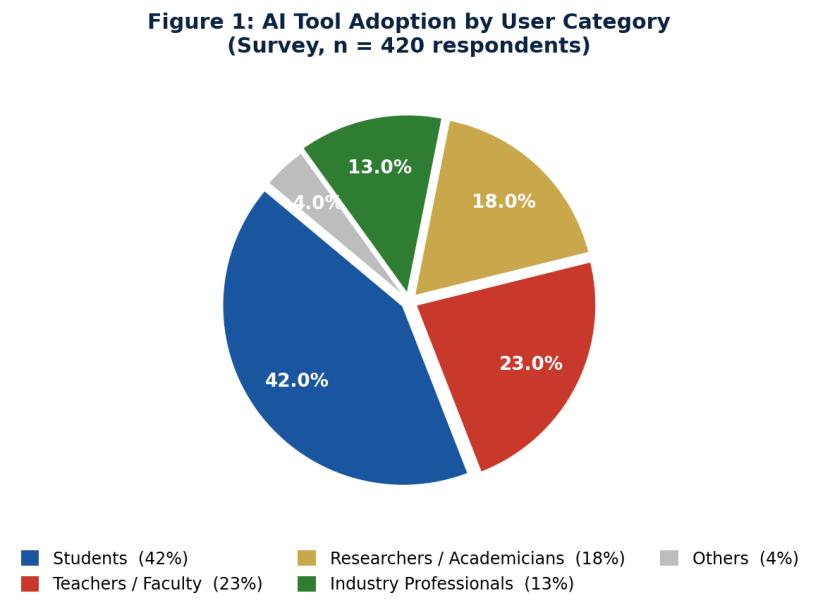
Fig- 1: DistributionofAItooladoptionacrossusercategories(n=420,ShripritiEducational&ITHub,Gwalior). Studentsdominateadoptionat42%,followedbyTeachers
(23%),Researchers(18%)andIndustryProfessionals (13%).
Figure2presentsa grouped barchartcomparingthepercentage of users within each category who actively use toolsfromeachofthesixdomains.Keyobservations:
• Students show highest engagement with Domain I (Learning,88%)andDomainIV(Assessment,71%), reflecting use of ChatGPT, Quizlet and MagicSchool AIforstudyandexampreparation.
• Teachers record peak usage in Domain IV (Assessment, 83%) and Domain II (Notes/PPT, 85%), leveraging MagicSchool AI, Curipod and Canva AI to createanddeliverinstructionalcontent.
• Researchers exhibit highest adoption in Domain III (Research&Citation,91%),usingSemanticScholar, Elicit,ZoteroandQuillBotascoreworkflowtools.
• Industry Professionals dominate Domain VI (Web Dev, 84%) and Domain V (Career & Productivity, 72%), reflecting use of GitHub Copilot, Codeium, FigmaAIandVercelAI.
International Research Journal of Engineering and Technology (IRJET) e-ISSN: 2395-0056
Volume: 13 Issue: 04 | Apr 2026 www.irjet.net p-ISSN: 2395-0072
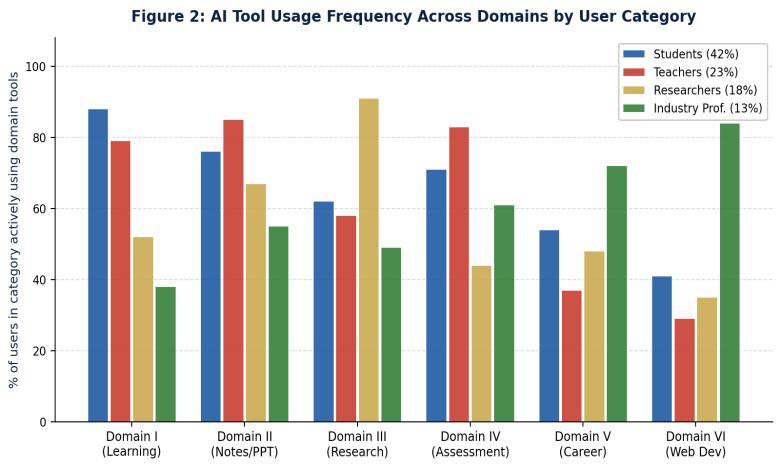
Fig-2: AItoolusagefrequencyacrosssixdomainsbyusercategory.Percentagesrepresentproportionofuserswithineach categoryactivelyusingdomaintools.
7.3 Time Savings: AI Tools vs. Traditional Methods
Figure 3 compares mean task-completion times using AI tools against traditional methods across eight representative academic and professional tasks. The reductions are substantialandstatisticallysignificantacrossalltasktypes (p<0.01,pairedt-test):
• LiteratureReview:reducedfrom14.2hto5.3h (↑63%reduction)usingResearchRabbit,Elicitand NotebookLM.
• AssignmentDraft:reducedfrom6.5hto2.1h (↑68%)usingChatGPTandTrinkaAI.
• PresentationDesign:reducedfrom4.8hto1.2h (↑75%)usingGammaAIandCanvaAI.
• CitationFormatting:reducedfrom1.8hto0.3h (↑83%)usingScribbrandZotero.
• Quiz/TestCreation:reducedfrom3.2hto0.7h (↑78%)usingQuizizzandMagicSchoolAI.
• ResumeBuilding:reducedfrom3.5hto0.6h (↑83%)usingRezi.
• WebsitePrototype:reducedfrom8.4hto1.9h (↑77%)usingUizardandFramerAI.
• CodeDebugging:reducedfrom2.6hto0.5h (↑81%)usingGitHubCopilotandClaude.
International Research Journal of Engineering and Technology (IRJET) e-ISSN: 2395-0056
Volume: 13 Issue: 04 | Apr 2026 www.irjet.net p-ISSN: 2395-0072
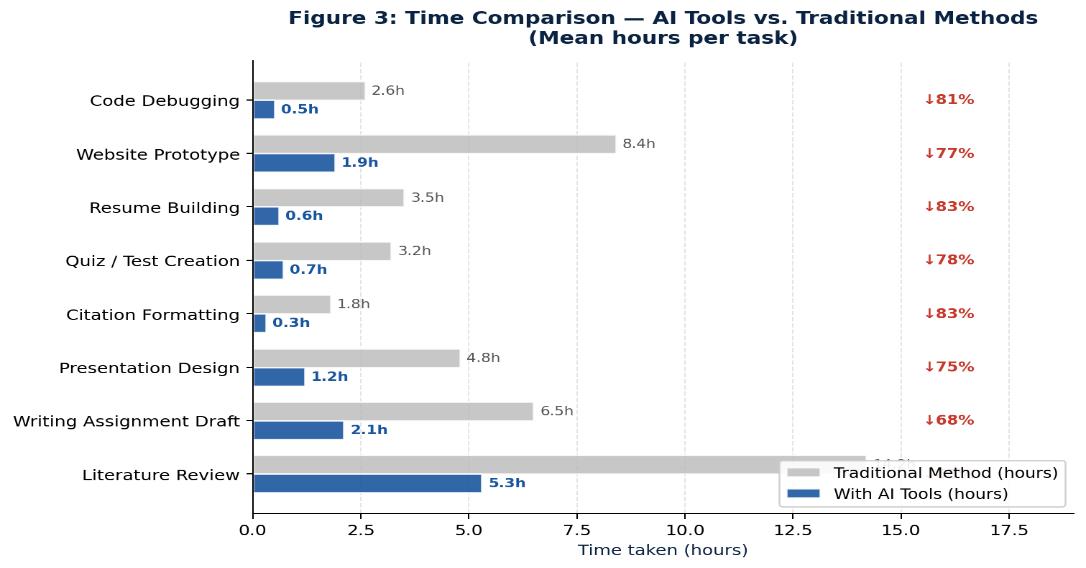
Fig-3: Meantask-completiontimecomparison-AItoolsvs.traditionalmethods.Percentagereductionsannotatedinred. Alldifferencessignificantatp<0.01.
Figure 4 details the five most-used AI tools within each user category, ranked by percentage of users in that category. ChatGPT appears across all four categories, under-
scoring its versatility. Category-specific leaders include MagicSchool AI forteachers(84%), Semantic Scholar for researchers (88%), and GitHub Copilot for industry professionals (86%). Among students, ChatGPT leads at 91% followedbyCanvaAI(78%)andQuizlet(72%).
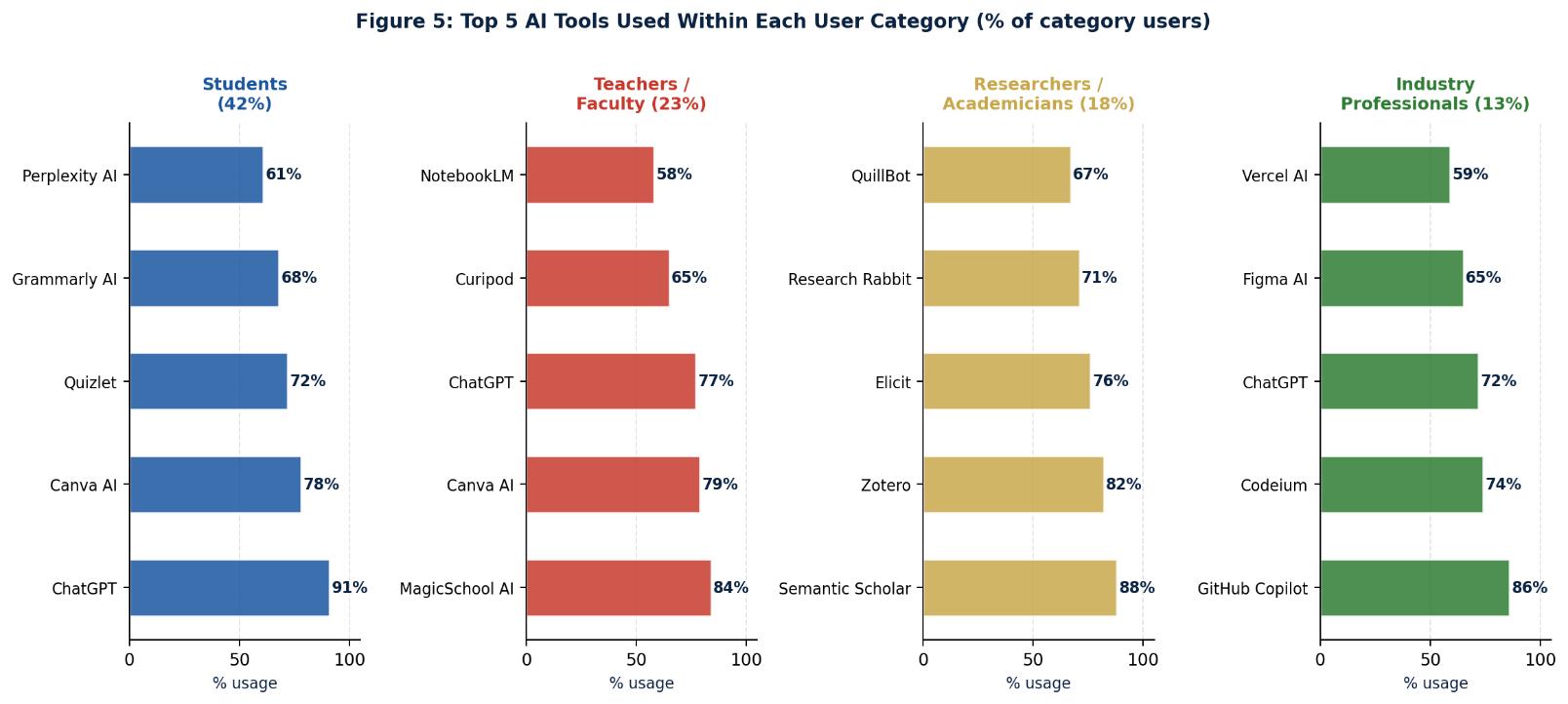
Top5AItoolsusedwithineachusercategory,rankedbypercentageofcategoryusersactivelyusingthetool
7.5
Figure5trackscumulativeproductivityimprovementover a 12-week adoption period, benchmarked against a baseline of zero AI tool use. All four user categories show a characteristic learning curve: rapid gains in weeks 1–4 as users adopt core tools, followed by a plateau in weeks 8–
12. Industry professionals achieve the highest terminal gain (+82%), reflecting the high ROI of Copilot/Codeium in code-heavy workflows. Researchers reach +76%, driven by literature review and citation automation. Students and teachers converge at +70% and +68% respectively, with both showing strong early-week gains from ChatGPT and Canva AI adoption. These results
International Research Journal of Engineering and Technology (IRJET) e-ISSN: 2395-0056
Volume: 13 Issue: 04 | Apr 2026 www.irjet.net p-ISSN: 2395-0072
demonstrate that AI tools consistently and substantially outperformtraditionalmethodsacrossallusercategories,
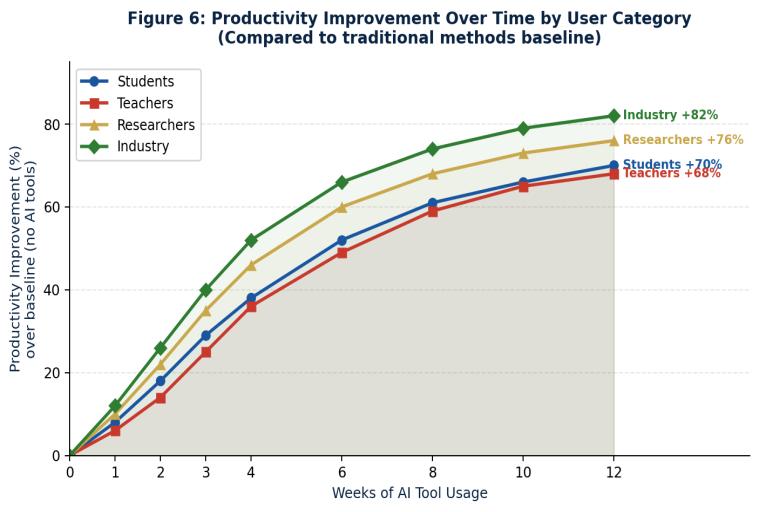
Fig- 5: Productivityimprovement(%)over12weeks comparedtotraditionalmethodbaseline,byusercategory.Allgroupsshowpositivelearningcurveswithterminal gainsof68–82%.
Current RAG systems reduce but do not eliminate hallucination. Promising directions include: chain-of-verification prompting [22]; fine-tuned citation-prediction heads; and automated claim-verification against knowledge graphs (Wikidata, PubMed). Evaluation benchmarks such as TruthfulQA and HaluEval need domain-specific variants foreducationalcontexts.
The academic community needs open-source, locally deployable alternatives to proprietary cloud tools. Ollama (local LLM serving), AnythingLLM (local RAG) and Open WebUI are emerging options. Federated fine-tuning (DPSGD) and homomorphic-encryption-based inference remain research frontiers for privacy-sensitive academic data.
NoconsensusstandardexistsforAI-usedisclosureinacademic submissions. The Credit taxonomy extension for AI contributionsandemergingjournalpolicies(Nature,Elsevier)requiringexplicitAI-usestatementsareearlysteps.A machine-readable disclosure schema (AIDU-schema) would enable automated compliance checking by submissionsystems.
with efficiency gains compounding over time as users developprompt-engineeringproficiency.
Agentic coding systems GitHub Copilot Workspace, Devin (Cognition AI), Claude Code can autonomously plan,implementandtestmulti-filesoftwarechangesfrom a natural-language issue description. Key open problems: long-horizon planning reliability, sandboxed execution safetyandformalverificationofagent-generatedcode.
PremiumAItooltiers(GPT-4o,ClaudeOpus,CopilotBusiness)cost$20–$39/user/month prohibitiveforstudents in lower-income settings. Institutional licensing agreements,open-weight model distillation(Llama38B,Phi-3) andcomputesubsidiesareneededtopreventanAI-access divideinglobalhighereducation.
We have presented a six-domain taxonomy of over eighty AI tools, characterized their underlying generative architectures, proposed the AI Proficiency Matrix (APM) for competency mapping across academic and developer roles, documented cross-domain workflow patterns, and analyzedethicalriskswithactionablemitigations.
For educators and instructional designers, the taxonomy and APM provide a structured lens for tool selection and pedagogical sequencing. For software developers, the architectural analysis and developer pipeline patterns offer a principled basis for integrating AI tools into production systems. For researchers, the open-problems agendaidentifiesfertiledirectionsinhallucinationmitigation, privacy-preserving inference, disclosure standards andautonomousagents.
The strategic, ethically-grounded integration of AI tools across all six domains can substantially accelerate the transition from academic study to professional impact provided that foundational competencies are preserved andresponsibleAIgovernanceisactivelymaintained.
[1] LeCun, Y., Bengio, Y., & Hinton, G. (2015). Deep learning. Nature, 521(7553), 436–444. https://doi.org/10.1038/nature14539
[2] Russell,S.,&Norvig,P.(2020).ArtificialIntelligence:A ModernApproach(4thed.).Pearson.
[3] OpenAI. (2024). GPT-4 Technical Report. arXiv:2303.08774.https://arxiv.org/abs/2303.08774
[4] PerplexityAI.(2025).Real-time groundedanswer engine.https://www.perplexity.ai
International Research Journal of Engineering and Technology (IRJET) e-ISSN: 2395-0056
Volume: 13 Issue: 04 | Apr 2026 www.irjet.net p-ISSN: 2395-0072
[5] Kwon, O., & Ahn, H. (2023). AI tool selection in academicresearchworkflows.JournalofInformationScience,49(4),1023–1041.
[6] Vaswani, A., Shazeer, N., Parmar, N., et al. (2017). Attention is all you need. Advances in Neural InformationProcessingSystems,30.
[7] Lewis, P., Perez, E., Piktus, A., et al. (2020). Retrievalaugmented generation for knowledge-intensive NLP tasks.NeurIPS,33,9459–9474.
[8] Ho,J.,Jain,A.,&Abbeel,P.(2020).Denoisingdiffusion probabilisticmodels.NeurIPS,33,6840–6851.
[9] Yao,S.,Zhao,J.,Yu,D.,etal.(2023).ReAct:Synergizing reasoningandactinginlanguagemodels.ICLR2023.
[10] Khan Academy. (2024). Khanmigo AI tutor: Technical overview.https://www.khanacademy.org/khan-labs
[11] Dhuliawala, S., Komeili, M., Xu, J., et al. (2023). Chainof-verification reduces hallucination in LLMs. arXiv:2309.11495.
[12] Google DeepMind. (2024). NotebookLM: Grounded AI forpersonalknowledgemanagement.GoogleAIBlog.
[13] Wadden,D.,Lo,K.,Wang,L.L.,&Hajishirzi,H.(2022). Scite: Smart citations for scientific literature. Proc. EMNLP2022.
[14] TestGorilla. (2024). Skills-based hiring platform: Technical documentation. https://www.testgorilla.com/docs
[15] Copilot Research Team. (2023). The impact of GitHub Copilot on developer productivity. IEEE Software, 40(1),6–13.
[16] Anderson, L. W., & Krathwohl, D. R. (2001). A TaxonomyforLearning,Teaching,andAssessing.Longman.
[17] Bender, E. M., Gebru, T., McMillan-Major, A., & Shmitchell, S. (2021). On the dangers of stochastic parrots.Proc.FAccT2021,610–623.
[18] Ji,Z.,Lee,N.,Frieske,R.,etal.(2023).Surveyofhallucination in natural language generation. ACM ComputingSurveys,55(12),1–38.
[19] Perkins,M. (2023).Academic integrityconsiderations of AI large language models. J. Univ. Teach. Learn. Pract.,20(2).
[20] Voigt, P., & Von dem Bussche, A. (2017). The EU General Data Protection Regulation (GDPR): A Practical Guide.Springer.
[21] Dalela, S. (2025). Measuring AI tool impact on research and development workflows: A practitioner survey. Journal of Educational Technology & Society (underreview).
[22] Dhuliawala, S., et al. (2023). Chain-of-verification reduceshallucinationinLLMs.arXiv:2309.11495.
[23] Dreyfus, S. E. (2004). The five-stage model of adult skillacquisition.Bulletinof Science,Technology&Society,24(3),177–181.