International Research Journal of Engineering and Technology (IRJET)
e-ISSN: 2395-0056
Volume: 13 Issue: 08 | Aug 2026
p-ISSN: 2395-0072
www.irjet.net
A comparative analysis of supervised vs. unsupervised machine learning in predicting disease outbreaks Avantika Guha Student -------------------------------------------------------------------------***------------------------------------------------------------------------------Abstract- Disease outbreaks continue to strain major public healthcare systems, and early detection of disease outbreaks is essential for timely interventions, efficient resource allocation, and improved disease surveillance, particularly for respiratory infections such as influenza and COVID-19. Recent advances in machine learning (ML) have provided effective tools for analysing large-scale surveillance data, which includes case reports, laboratory-confirmed diagnoses, hospital admissions, and environmental variables, to support outbreak prediction and monitoring. This study presents a comparative analysis of the efficiency and effectiveness of supervised and unsupervised machine learning approaches to predict respiratory disease outbreaks. Moreover, a conceptual research design was adopted to eliminate the use of primary surveillance data or model implementation, and findings were synthesized from the existing studies. Supervised learning techniques, including Logistic Regression, Decision Trees, and many more, were compared with unsupervised approaches such as K-clustering based on their data requirements, predictive performance, interpretability, and practical applications. The study showcases the areas where both learning approaches shine distinctly, and also brings forth where they start to fall short. Overall, the study concludes that the choice between the two learning models depends heavily on the availability and quality of the surveillance data, and unifying both learning approaches into one single framework can offer the highest potential for epidemic prediction and surveillance quality. Keywords: Machine Learning, Supervised Learning, Unsupervised Learning, Disease Outbreak Prediction, Respiratory Disease Surveillance, Public Health Surveillance
1. INTRODUCTION 1.1 Disease Outbreaks and Public Health Importance Disease outbreaks are the sudden escalation of an infectious illness that soon contributes to greater public health concerns, public safety, and negative impacts on healthcare infrastructure. Ultimately, the issue significantly concerns social and economic disruptions. Generally, it occurs when the number of disease cases exceeds the expected level within a particular population or geographical area during a specific period. According to WHO reports, these types of disease outbreaks can be caused by vector-borne, food and waterborne, airborne, and unknown ethology (WHO, 2023). However, it can be limited if effective outbreak predictions and efficient medical resources can be provided on time. Early warning systems are particularly important for reducing transmission, minimizing the burden on hospitals, and protecting vulnerable populations (McGaughey et al., 2021).
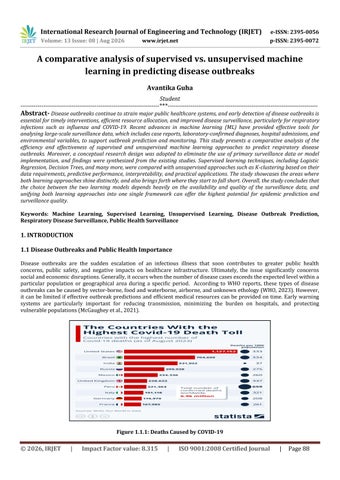
Figure 1.1.1: Deaths Caused by COVID-19
© 2026, IRJET
|
Impact Factor value: 8.315
|
ISO 9001:2008 Certified Journal
|
Page 88