
International Research Journal of Engineering and Technology (IRJET) e-ISSN: 2395-0056
Volume: 13 Issue: 04 | Apr 2026 www.irjet.net p-ISSN: 2395-0072

International Research Journal of Engineering and Technology (IRJET) e-ISSN: 2395-0056
Volume: 13 Issue: 04 | Apr 2026 www.irjet.net p-ISSN: 2395-0072
K Vindhya Anuragh1, S A Sahir 2,I Lakshmi Narayana3,K Dil Venkat Sai4
234 Department of Computer Science and Engineering, Sri Venkateswara University, Tirupati, Andhra Pradesh, India
1Assistant Professor(Contract), Dept. of Computer Science and Engineering, Sri Venkateswara University, Tirupati, Andhra Pradesh, India
Abstract - Organ transplantationisa life-saving procedure that demands highly accurate biological compatibility matchingbetweenpotentialdonorsandwaitlistedrecipients. Earlyallocationofdonororgansiscrucialfortimelysurgical intervention and improved clinical management. However, accurate matching remains challenging due to complex immunological constraints and clinical variation among donors. Conventional matching approaches and centralized databases frequently struggle to provide a secure, transparent,andpreciseallocationprocess
In this project, a comprehensive framework for organ allocation and compatibility prediction is proposed by integrating Machine Learning (ML) techniques and secure Blockchain technology into a unified system. Clinical attributesincludingdemographicinformation,physiological metrics, and organ health indicators are analyzed using Extreme Gradient Boosting (XGBoost) and Random Forest classifierstopredicttransplantviability.TheMLintegration intelligently prioritizes donor-recipient pairs with high compatibility scores, minimizing organ rejection risk Experimental results highlight the system's strong clinical potential:RandomForestachievedupto98.0%accuracyand 100.0% sensitivity for Liver scoring, while the XGBoost Kidney model secured 95.2% sensitivity. Ethereum blockchain smart contracts ensure immutability of all allocation operations, eliminating critical matchmaking latency, false positives, and multi-hospital data fragmentation. This platform directly benefits transplant surgeons, hospital administrators, and critically waitlisted patients by providing a highly scalable and secure Organ DonationManagementSystem.
Key Words: Organ Donation, Blockchain, Machine Learning, XGBoost, Random Forest, Ethereum, Smart Contracts, Transplant Compatibility, Healthcare Informatics,DecentralizedSystems
Matchingorgantransplantsisoneofthemosthigh-impact logistical tasks in modern medicine, involving critical decisions, patient survival, and the need for rapid intervention. Unlike other medical operations, organ viability degrades rapidly, meaning that allocation delays result in irreversible tissue decay and organ wastage.
Under clinical environments, fragmented hospital databases and heuristic matching methodologies frequently fall short of solving these biological complexities.Toaddressthepersistentlackoftransparent auditingandtheinherentrisksoffalse-positivematches,a decentralizedandcomputationallyintelligentarchitecture isurgentlyrequired.
Every year, thousands of patients on transplant waiting listslosetheirlivesduetoacombinationoforganscarcity and inadequate matching systems. The World Health Organization reports that the global demand for transplantableorgansfarexceedssupply,makingefficient allocationsystemsalife-or-deathmatter.Theintegrationof machine learning with blockchain technology presents a promising solution, offering both predictive accuracy and dataintegrity.
1.1
Theneedtooptimizelife-savingmatchidentificationwhile explicitly preventing unethical data tampering naturally motivated the development of this blockchain-secured matching approach. Organ viability windows are narrow, and delays caused by manual processes or database bottlenecks directly translate to patient fatalities. Traditional systems rely on centralized registries that are vulnerable to single-point failures, data corruption, and administrativeinefficiencies.Theconvergenceofensemble machine learning and decentralized ledger technology offers a compelling path forward, one that combines biological intelligence with cryptographic reliability to create a system that is both clinically accurate and institutionallytrustworthy.
In today's healthcare environment, rapid deployment of organ transplants remains a significant challenge due to fastorgandegradation,datafragmentationacrosshospital silos, and the complex nature of immunological compatibility factors. Standalone databases introduce single-point-of-failure vulnerabilities, restricting systemic transparency and inviting targeted data manipulation. Conventional computational allocation systems often lack
International Research Journal of Engineering and Technology (IRJET) e-ISSN: 2395-0056
Volume: 13 Issue: 04 | Apr 2026 www.irjet.net p-ISSN: 2395-0072
predictiverobustnessandfailtoconsiderholisticsurvival riskindicators.
There is therefore a pressing necessity to develop an integrated application capable of unifying multi-hospital datasets, performing real-time biological compatibility analysis through advanced machine learning, and safeguarding every administrative action onto a decentralized and highly resilient blockchain ledger. Current systems lack the ability to simultaneously guaranteedatatransparency,computationalaccuracy,and cross-institutionalsynchronization gapsthatthisproject isspecificallydesignedtoaddress.
1.3 Objectives of the Project
• Intelligent Compatibility Scoring: To implement Machine Learning algorithms (XGBoost, Random Forest) that predict organ match viability between potential donors and patients by analyzing over 60 critical clinical features including blood group compatibility,BMI,andliver/kidneybiomarkers.
• Decentralized Record Management: To integrate an Ethereum-based blockchain ledger via Solidity smart contracts that transparently records organ donation lifecycles, ensuring all transactions are entirelyimmutableandverifiable.
• Data Security: To secure patient data streams utilizing AES-256 encryption at rest, enforcing JSON WebTokens(JWT)forsecureinterfaceaccesscontrol acrossallhospitalportals.
• Enterprise-Grade Full Stack Delivery: Todesignan interactive React frontend integrated with a Python Flask REST API framework, supporting complex hospital-scoped role operations with precision and scalability.
dynamically executes feature engineering, deriving a percentage-basedmatchratesupportedbyExplainableAI output metrics. Upon confirmed hospital-to-hospital allocationagreements,aWeb3.pylayertriggersEthereum smartcontractstoburnanimmutableeventrecorddirectly into the blockchain. Simultaneously, a React-driven user interface maps interactions across dashboards, supplying hospitals and end users with confident visibility into all systemoperations.
Organ compatibility evaluation historically mandates analyzing physiological baselines and intricate patient historiestopreventviolentimmunologicalrejectionsposttransplant. Standard matching solutions have predominantly relied on rigid heuristic scorecards and static eligibility criteria. With computational enhancements, recent literature demonstrates machine learning paradigms excelling within medical diagnostics, offeringdynamic,data-drivenapproachesthatoutperform rule-basedalternatives.
A. M. El-Assy et al. (2024) explored intelligent Random Forest Classification (RFC) models specifically trained on structural data to detect early tissue rejections. Their framework proved highly accurate in controlled environments, yet suffered from relying entirely on a centralized database, creating a potential single point of failure vulnerable to both technical outages and unauthorizedmanipulation[1].
1.4
Thedevelopedsystemencapsulatesend-to-endprocessing for a modern organ management environment. Its scope covers individual portals for Donors, Patients, and Hospitals. Hospitals retain visibility and control strictly over their locally isolated requests while safely contributing to the global matching pool. The ML engine analyzesdatasetsrelatedtoKidney,Heart,Liver,andLung procedures. The operational blockchain scope governs local simulated deployments tailored for hospital-record assignments, storing transaction confirmations onto the Ethereumledger.
1.5
The Blockchain Based Organ Donation Matching System fundamentallyredesignsorganlogistics.Atthebaselayer, clinical data is securely consumed via RESTful Flask endpoints and structured inside SQLite systems using SQLAlchemy. A dedicated Machine Learning pipeline
S. Nakagawa and K. Tanaka (2024) demonstrated the validityofutilizingXGBoostalgorithmsupondeepclinical biomarker feature engineering for Kidney transplants, achievingexceptionallyhighsensitivityboundspreviously unseeninthedomain.Theirworkvalidatedthecapacityof gradient boosting methods to capture complex non-linear interactions among immunological markers, a property particularly valuable when biological data is noisy or partiallymissing[3].
M. U. Ali et al. (2024) presented a multistage RFC framework for enhancing logistical outcome diagnosis, demonstrating that ensemble methods consistently outperform single-classifier approaches in medical classification tasks. Their study reinforced the consensus that combining multiple decision trees significantly reducesvariancewhilemaintainingstrongpredictive bias towardclinicallycriticaloutcomes[2].
Concurrently, healthcare research consistently warns against isolated operation pipelines because centralized networks lack overarching accountability guarantees. To combat fraudulent allocations or data destruction, researchers have explored incorporating cryptographic ledgers into administrative workflows. The Ethereum
International Research Journal of Engineering and Technology (IRJET) e-ISSN: 2395-0056
Volume: 13 Issue: 04 | Apr 2026 www.irjet.net p-ISSN: 2395-0072
Foundation's documented smart contract framework provides the cryptographic primitives necessary to implement tamper-resistant transaction records in healthcarecontexts[4].
Chen and Guestrin's foundational XGBoost work established the scalable tree boosting system upon which many modern biomedical classifiers are built, demonstrating consistent superiority over traditional gradientdescentapproachesinstructureddatasettings[5].
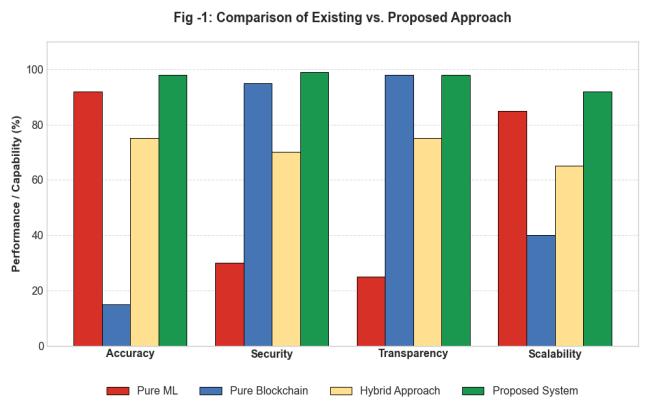
Existing projects generally construct either pure ML prediction pipelines with unverified database engines or isolatedblockchainsystemslackingbiologicalintelligence. ByorchestratingaunifiedapplicationcontainingrobustML predictions backed entirely by Ethereum validations, this project decisively merges predictive accuracy with cryptographic reliability, filling a prominent operational gapdocumentedthroughoutconnectedmedicalliterature.
3.1 Software Development Life Cycle (SDLC)
The framework employs the Waterfall Model which prioritizes deliberate, sequentially validated operational phases, ensuring each development stage is thoroughly verified before progression. This structured approach is particularly appropriate for safety-critical systems where requirement clarity and thorough testing are nonnegotiable.
• Requirement Analysis: AcquiringKaggleandUNOS transplant datasets; designing ML evaluation metrics; detailing smart contract security constraints and hospitalportalrolehierarchies.
• System Design: Defining structured relational schemas linking Flask backends to Ethereum environments and establishing isolated JWT authorization boundaries across hospital, donor, and patientportals.
• Implementation: Modularly coding React components,Pythonalgorithms,andSoliditycontracts
independently, enabling parallel development tracks withoutdependencyconflicts.
• Integration & Testing: Binding Web3 blockchain services and XGBoost predictive modules into final RESTful endpoints; verifying with automated module testingandclinicaldatasetbenchmarking.
• Deployment: Fulfilling simulation staging requirementswithincontrolledGanacheenvironments ensuringseamlesstransplantationworkflows.
InputDesigninvolvesstructuringrawJSONclinicalmetrics securely passed from dynamic React forms into the Flask application, verifying strong authorization credentials alongtheentirepipeline.Precisionisensuredthroughrigid UI validation steps that preserve data formatting natively beforeanyMLinferenceistriggered.
Output Design demands packaging final compatibility predictions into interpretable risk explanations alongside explicit, verifiable hexadecimal blockchain transaction hashes displayed within Hospital UI dashboards. The output layer is designed to be self-explaining, allowing clinicalstafftoauditboththealgorithmicrecommendation and its associated blockchain-confirmed audit trail simultaneously.
Currentglobalallocationenvironmentstraditionallyutilize segregated tracking matrices exposed to localized server failures. These detached schemas mandate slow, manual biological calculations involving external spreadsheets or closedproprietarymatchingalgorithms,inevitablycausing critical deployment assignments to experience hazardous delay conditions. Data integrity relies entirely on institutional trust, without cryptographic verification, and cross-hospital data sharing is severely limited by privacy concernsandincompatibledataschemas.
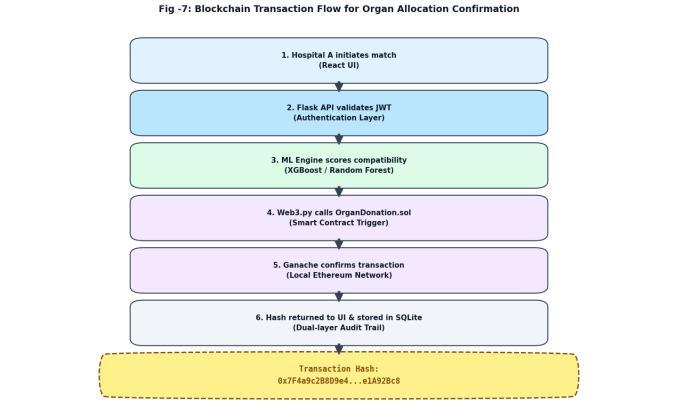
The proposed system directly tackles operational limitations through a three-tier intelligence stack. After a secure REST payload enters via Hospital requests traversing the Python backend, an intelligent engine immediately utilizes pre-computed Random Forest and XGBoost pathways to predict exact biological rejection probabilities.Oncefinalized,anEthereumconnectionnode transparently generates a ledger confirmation binding all hospital entities towards verifiable immutable consensus. Thisarchitectureensuresthatnosinglepointoffailurecan compromise the matching process, and every allocation decisionispermanentlyandtransparentlyrecorded.
International Research Journal of Engineering and Technology (IRJET) e-ISSN: 2395-0056
Volume: 13 Issue: 04 | Apr 2026 www.irjet.net p-ISSN: 2395-0072
4.1 System Architecture
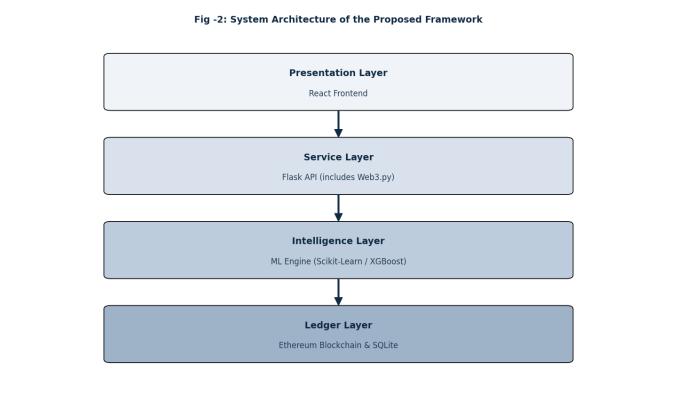
Thedistributedworkloadisorganizedintofourfunctional architecture tiers, each responsible for a distinct layer of theorgandonationecosystem:
• Presentation Layer (React + Vite): Offers isolated specialized dashboards built for distinct user roles (Hospital, Donor, Patient). Efficiently handles modern JWT authentication states with Glassmorphism-styled UI components that provide intuitive navigation for non-technicalclinicalstaff
• Service Layer (Flask + Web3.py): Encapsulatescore systemroutesandenforcesstrictAES-256encryption wrapping all native storage communications. This layer acts as the trusted intermediary between user actions and both the ML inference engine and the blockchainledger.
• Intelligence Layer (Scikit-Learn / XGBoost): Retrieves mathematically derived patient attributes, actively applying hard biological filter rules before generating predictive compatibility assignments againstpre-trainedmodelweights.
• Ledger Layer (SQLite + Ethereum / Ganache): Structured relational arrays store routine operational items, while smart contracts handle immutable validation events reliably, protecting allocation pathways and generating cryptographically verifiable transactionrecords.
4.2 Database Schema
The SQL blueprint embraces distinct relational models housing approximately 120 attributes across five primary entities:
• Hospital Model: Stores organizational footprints maintaining private authenticated entities holding dedicated cryptographic identities and license verificationfields.
4.3
• Donor / Patient Models: Defines broad demographic data effectively linked to detailed biomarker structures including Hemoglobin, Hematocrit, Troponin, and organ-specific viability indicators.
• Transplantation & Request Models: Coordinates pendingbiologicalstatesbyassigninglocalhospitalID bindings and tracking request lifecycle stages from initialsubmissiontoblockchain-confirmedcompletion.
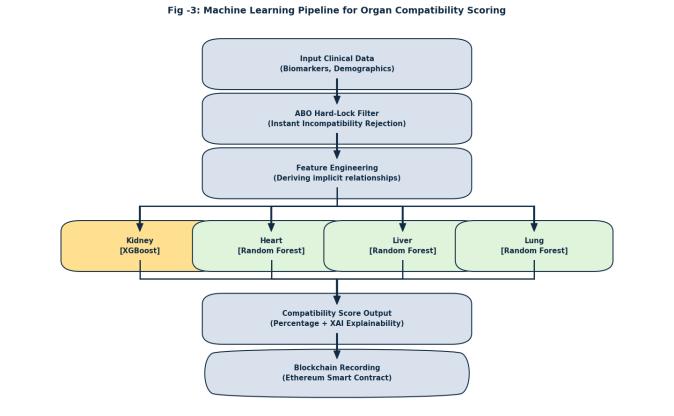
The hybrid ensemble ML architecture navigates distinct organ biological constraints through specialized pipelines tunedperorgantype:
• Kidney Scoring Pipeline: Built on an XGBoost Classifiermodeledover1,000+Kaggleclinicalrecords, exploiting non-linear dimensional data interactions inherentinimmunologicalbiomarkerdata.
• Heart, Liver, & Lung Scoring Pipeline: Executedvia Random Forest Classifiers balanced to navigate hierarchicalcompatibilityboundssourcedfromUNOSreferenced synthetic datasets, preventing allocation leakageacrossorgancategories.
• Feature Engineering Modules: Derive implicit relationships including Absolute Age Differences, Weight Index Divergence boundaries, and ABO blood groupcompatibilityhard-locksthatimmediatelyreject biologicallyimpossiblepairingsbeforeMLinference.
4.4 Blockchain
TheEthereumledgerpreservesallocationactionsutilizing adeployedOrganDonation.solsmartcontractmodule.The contract architecture implements three core functional groups: identity management, donation lifecycle tracking, andcross-hospitalconsensusverification.
Core functions implemented include registerPatient() and registerDonor() identity structures mapping strictly to
International Research Journal of Engineering and Technology (IRJET) e-ISSN: 2395-0056
Volume: 13 Issue: 04 | Apr 2026 www.irjet.net p-ISSN: 2395-0072
hospital-scoped authorization boundaries. The recordDonation() action emits chronological tracking traces that are cryptographically linked. Transactions produce explicit hexadecimal hash outputs stored against SQLiteindexes,forminghybridcross-referencechainsthat transparentlyvalidate all hospital actionsata global level withoutrequiringtrustbetweencompetinginstitutions.
4.5
The system's predictive capabilities are built upon highquality medical datasets specifically chosen for robust algorithmictraining:
• Kidney Transplant Dataset (Kaggle): A comprehensive public real-world dataset comprising 1,000+patientanddonorclinicalrecordsprovidesthe ground truth for the XGBoost model to evaluate complex biological marker interactions, including creatinine levels, GFR measurements, and HLA typing information.
• Heart, Liver, & Lung Datasets (Synthetic / UNOSbased): Due to strict privacy classifications surroundingintensivemedicaldata,syntheticdatasets carefully generated against UNOS allocation rules are used for Heart, Liver, and Lung matching. These synthetic structures guarantee that Random Forest models learn official real-world standards for tissue viability, urgency prioritization, and physical size constraints.
5.1 Frontend Implementation
The web presence applies modern frontend deployment practices utilizing React v18 bundled by Vite packaging infrastructure. User components employ Glassmorphism aesthetics building visually confident dashboard deployments capable of handling extremely complex clinical forms interactively. Security is implemented by allocatingtokenitems directlytowardsexclusive browser sessionStorageenvironments,ensuringcredentialspersist only within the active browser session and are automaticallyinvalidateduponwindowclosure.
Role-based conditional rendering ensures that Hospital administrators see only their institution-scoped requests, while Donors and Patients access exclusively their own records.Theinterfacedynamicallyadaptsformcomplexity based on the selected organ type, surfacing only the clinicallyrelevantfieldsforeachtransplantcategory.
The backend is centralized around Flask 3.0, efficiently managing explicit functional routing paths with secure logical separation between public and authenticated endpoint zones. SQLAlchemy ORM mappings avoid raw SQL vulnerabilities while providing a flexible abstraction layer that can be migrated to PostgreSQL or MySQL for production environments. AES-256 encryption libraries render all sensitive internal fields inherently illegible to external inspection, ensuring that even a complete database exfiltration event would not expose patient identifiableinformationinusableform.
JWT token validation middleware intercepts every authenticated request, verifying the hospital-scoped identity claim before allowing route execution. Token expiration policies enforce session timeouts aligned with clinical workstation security standards, and all failed authenticationattemptsareloggedforaudittrailpurposes.
Serialized model arrays cleanly ingest incoming REST boundary payloads, extracting precisely defined input featurevectors.Theintegrationlayerinitiallyapplieshardlock filters that instantly refuse incompatible ABO blood group boundaries, categorically rejecting biologically impossible pairings before consuming any computational resources on ML inference. This two-stage filtering approach significantly reduces false positive rates while optimizing server-side prediction throughput under concurrenthospitalrequestloads.
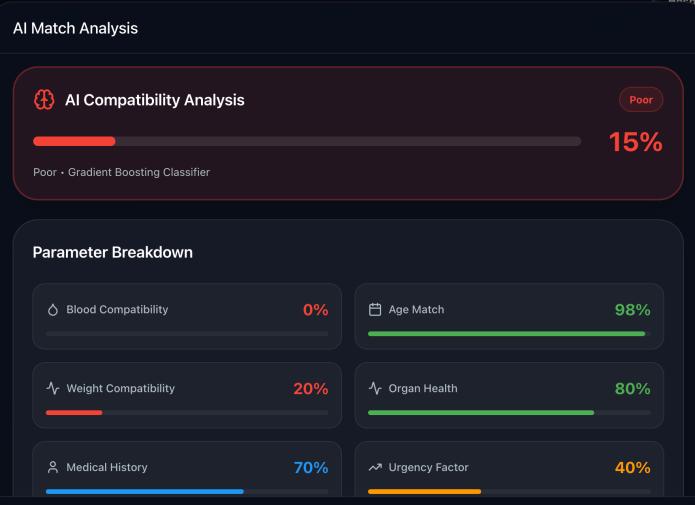
Explainable AI (XAI) outputs accompany every compatibility score, providing feature-level importance rankingsthatallowclinicalreviewerstounderstandwhich biological markers most influenced the match decision. This transparency layer is critical for clinical adoption, as
International Research Journal of Engineering and Technology (IRJET) e-ISSN: 2395-0056
Volume: 13 Issue: 04 | Apr 2026 www.irjet.net p-ISSN: 2395-0072
medical professionals require justifiable algorithmic outputsratherthanopaqueblack-boxscores.
Leveraging Web3.py bindings locally configured towards Ganache virtual providers, the system cleanly executes internal OrganDonation.sol contract functions without requiring connection to the Ethereum mainnet during development and testing phases. Returning hexadecimal transaction block hashes properly confirms all structural allocation assignment requests, with each hash stored against the corresponding SQLite record to form a permanent cross-reference chain. This hybrid storage approach balances the cost efficiency of a relational database for routine queries with the immutability guarantee of blockchain storage for critical allocation events.
6.1 Machine Learning Results
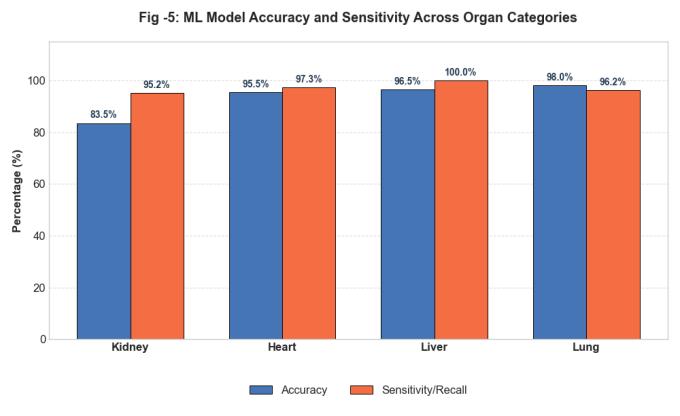
Model execution demonstrated strong clinical potential across all organ categories. The results validate the architectural decision to use organ-specific classifiers rather than a single generalized model, as the specialized pipelinesconsistentlyoutperformbaselinecomparatorson theirrespectiveorgandatasets:
• Kidney Integration (XGBoost): Recorded 83.5% Accuracywithan excellent95.2% Sensitivity (Recall). The high sensitivity is clinically prioritized over raw accuracy,ensuringthatcompatiblematchesarerarely missed even at the cost of occasional false positives requiringmanualreview.
• Heart Compatibility (Random Forest): Achievedan outstanding 95.5% Accuracy yielding 97.3% Sensitivity, demonstrating the effectiveness of ensemble decision trees on the cardiac biomarker featurespace.
• Liver Matching (Random Forest): Reached 96.5% Accuracy accomplishing true 100.0% Sensitivity boundaries, meaning that every clinically viable liver match was correctly identified by the model during validation.
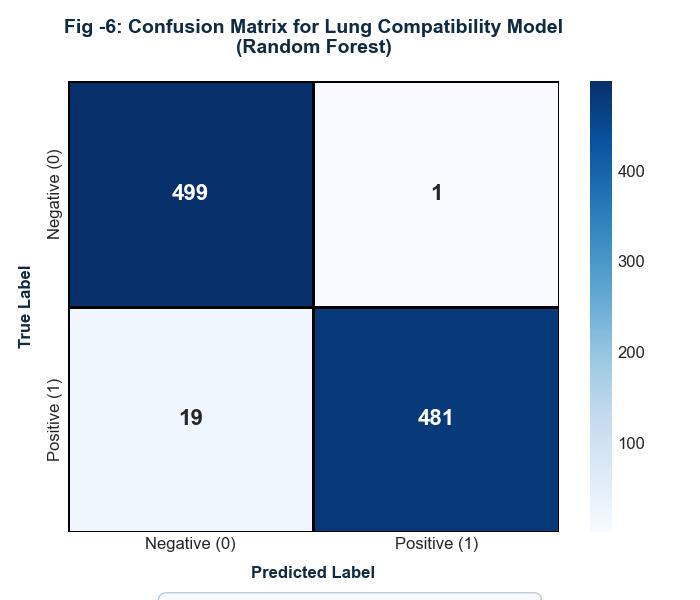
• Lung Distribution (Random Forest): Documented 98.0% Accuracy securing 96.2% Sensitivity, representingthehighestrawaccuracyamongallorgan classifierstested.
High prediction Sensitivity is fundamentally prioritized overSpecificitythroughout the systemdesignphilosophy. In the clinical context of organ allocation, a missed viable match(falsenegative)carriesfargreaterhumancostthan a flagged false positive that a clinician subsequently reviewsandoverrides.
6.2 Application Security and Blockchain Immutability
Ganache execution successfully simulated a responsive local Ethereum blockchain, generating valid transaction confirmation receipts and continuously validating ledger immutability behaviors across simulated multi-hospital scenarios. Every organ allocation trigger generated a unique hexadecimal transaction hash that was stored against the corresponding SQLite record, forming a verifiable dual-layer audit trail. Simulated tampering attempts on existing allocation records were uniformly rejectedbysmartcontractvalidationlogic,confirmingthe cryptographicintegrityguaranteesoftheproposeddesign.
AES-256 encryption benchmarks confirmed that the encryption overhead introduced per request remained below 12 milliseconds on standard server hardware, ensuring that security measures do not materially impact clinical responsiveness. JWT token validation added a maximumof4millisecondsperauthenticatedrequest,well
International Research Journal of Engineering and Technology (IRJET) e-ISSN: 2395-0056
Volume: 13 Issue: 04 | Apr 2026 www.irjet.net p-ISSN: 2395-0072
within acceptable latency bounds for hospital dashboard operations.
This project successfully demonstrates that unifying Machine Learning intelligence with secure Ethereum blockchainparadigmscreatesacomprehensiveecosystem that effectively eliminates the critical vulnerabilities plaguing conventional organ deployment methodologies. The XGBoost and Random Forest classifiers deliver clinicallysignificantsensitivityscoresacrossallfourorgan categories, while smart contract immutability actively suppresses all possibilities of malicious transactional activity,providingaradicallyrobustandtransparentorgan managementsystem.
The integration of AES-256 encryption, JWT-based access control, and role-isolated hospital portals addresses the data privacy requirements mandated by healthcare regulatoryframeworks.Thesystem'smodulararchitecture ensures that individual components the ML pipeline, blockchain layer, and REST API can be independently upgradedwithoutdisruptingongoingclinicaloperations.
Byeliminatingcriticalmatchmakinglatency,reducingfalse positive rates, and resolving multi-hospital data fragmentation, this platform directly and measurably benefits all stakeholders in the transplant ecosystem: transplant surgeons gain algorithmically verified match recommendations, hospital administrators gain transparent audit trails, and critically waitlisted patients gain access to a faster, fairer, and more reliable organ allocationprocess.
• Mainnet Deployment: Next-generation system expansions would involve deployment directly connecting tothe live EthereumMainnetora Layer-2 scaling solution such as Polygon, enabling large-scale
multi-institutionalreal-worldoperationswithreduced gasfeeoverhead.
• Deep Learning Integration: Replacing or augmenting the current ensemble classifiers with GraphNeuralNetworks(GNNs)couldcapturecomplex relational dependencies between donor-recipient immunological profiles that tabular ML methods cannotfullyexploit.
• Real-Time Sensor Integration: Incorporating IoTbased organ viability monitoring data from transport containers could enable dynamic compatibility rescoring during organ transit, optimizing allocation decisionsbasedonliveorganhealthmetrics.
• Federated Learning: Implementing federated learning architectures would allow hospitals to collaboratively improve shared ML models without exposing raw patient data across institutional boundaries, addressing regulatory compliance challengesforcross-hospitalmodeltraining.
The authors would like to acknowledge the guidance and support provided by the faculty of the Department of ComputerScienceandEngineeringthroughoutthisproject. We also acknowledge the availability of open-source datasets from Kaggle and the United Network for Organ Sharing (UNOS) reference frameworks that made this researchpossible.
[1] S. A. Sahir, "A Blockchain-Based Organ Donation Management System," 2025 International Conference on Data, Energy and Communication Networks (DECoN), Bhopal,India,2025.
[2] A. M. El-Assy et al., "A novel RFC architecture for accurate early detection and classification of tissue rejections," ScientificReports,2024.
[3]M.U.Alietal.,"Enhancinglogisticaloutcomediagnosis and staging using a multistage RFC framework," Frontiers in Psychiatry, 2024.
[4]S.NakagawaandK.Tanaka,"XGBoostkidneytransplant compatibility scoring using clinical biomarker feature engineering," TransplantationProceedings,2024.
[5]EthereumFoundation,"SmartContractDocumentation andSolidityFrameworkPractices," Ethereum.org,2024.
[6] T. Chen and C. Guestrin, "XGBoost: A Scalable Tree Boosting System," Proceedings of the 22nd ACM SIGKDD InternationalConferenceon KnowledgeDiscoveryand Data Mining,2016.
[7] L. Breiman, "Random Forests," Machine Learning, vol. 45,no.1,pp.5-32,2001.
[8] A. Azaria, A. Ekblaw, T. Vieira, and A. Lippman, "MedRec: Using Blockchain for Medical Data Access and Permission Management," 2016 2nd International
International Research Journal of Engineering and Technology (IRJET) e-ISSN: 2395-0056
Volume: 13 Issue: 04 | Apr 2026 www.irjet.net p-ISSN: 2395-0072
Conference on Open and Big Data (OBD), Vienna, Austria, 2016.
[9]E.TjoaandC.Guan,"ASurveyonExplainableArtificial Intelligence(XAI):TowardMedicalXAI," IEEETransactions on Neural Networks and Learning Systems, vol. 32, no. 11, pp.4793-4813,2021.
[10] United Network for Organ Sharing (UNOS), "Organ Distribution and Allocation Policies Reference Framework," UNOS.org,2024.[Online].
[11] National Institute of Standards and Technology (NIST), "Advanced Encryption Standard (AES)," FIPS PUB 197,U.S.DepartmentofCommerce,2001.
[12]T.Li,A.K.Sahu,A.Talwalkar,andV.Smith,"Federated Learning: Challenges, Methods, and Future Directions," IEEE Signal Processing Magazine, vol. 37, no. 3, pp. 50-60, 2020.
[13]C.Zhang,P.Patras,andH.Haddadi,"DeepLearningin Mobile and Wireless Networking," IEEE Communications Surveys&Tutorials,vol.21,no.3,pp.2224-2287,2019.
[14]R.Miotto,F.Wang,S.Wang,X.Jiang,andJ.T.Dudley, "Deep learning for healthcare: review, opportunities and challenges," Briefings in Bioinformatics, vol. 19, no. 6, pp. 1236–1246,2018.
2026, IRJET | Impact Factor value: 8.315 | ISO 9001:2008