
International Research Journal of Engineering and Technology (IRJET) e-ISSN: 2395-0056
Volume: 13 Issue: 03 | Mar 2026 www.irjet.net p-ISSN: 2395-0072
International Research Journal of Engineering and Technology (IRJET) e-ISSN: 2395-0056
Volume: 13 Issue: 03 | Mar 2026 www.irjet.net p-ISSN: 2395-0072
Pratik S Dhamodkar1 , Vedant U Nagpure2 , Samruddhi Kale3,Vaishnavi Jadhav4,Uttam Navkar5 , Prof.R.R.Bhale6
12345UG student, Dept.ofInformation Technology,Mauli College of Engineering and Technology,Shegaon, Maharashtra, India
6Assistant Professor, Dept. of Information Technology,Mauli College of Engineering and Technology,Shegaon, Maharashtra, India
Abstract - Companies today are using sophisticated Artificial Intelligence (AI) technologies to filter through applications while the applicants use manual processes to prepare for a new job. This research paper will describe the AI-Powered Placement Management System (“AIPMS”), a full cycle solution to help create a new system of placing applicants into a new job. AIPMS is built on Generative AI including Llama 3.2 and Google Gemini, which will provide automatic, semantic resume analysis and dynamic, real-time mock interview capability. AIPMS utilizes a combined algorithmic methodology consisting of the BM25 ranking modelandCosineSimilarity (“COS”)tomathematicallysolve for the optimal fit of an applicant to a job by providing the optimal match of the job criteria with the applicant profile. Additionally, AIPMS includes “Affective Computing” and WebSocket-based Voice Agents to measure both course and behavioral metrics, including confidence and clarity of communication, therefore obtaining a full perspective of each applicant’s qualifications. Finally, there are dedicated dashboards for TPO and HR, supporting a transparent system for the institution’s oversight process and streamlining the hiring process of a corporation. AIPMS represents a paradigm shift from a manual approach to placing an applicant in a job (“one-size-fits-all”) to a datadriven career pathing solution. This research will demonstrate the significant improvements of employability through the utilization of advanced technology solutions, reducing the bias in recruiting, and enhancing the global recruimentlifecycle.
Key Words: AI Recruitment, Placement Analytics, Generative AI, Resume Parsing, Mock Interview,Career Readiness
As a result of advancements in artificial intelligence (AI), businessesareincreasinglyutilizingdata-driven,algorithmbased methods when hiring talent. As the job market continues tobecome morecompetitive, jobseekerscannot just rely on their academic qualifications but must have goodresumewritingskills,prepareforinterviews,andfind jobs that fit their skill set (3). Unfortunately, many job seekers lack access to advanced AI technologies that could
help them prepare for interviews; therefore, there is an "integration gap" between how prepared job seekers are and how well-prepared the job market expects them to be (1,2).
Traditional placement processes are often fragmented and manual. Many job seekers struggle with resume optimization,interviewreadiness,andjobdiscoverydueto a lack of guidance Traditional employment placement processes tend to be both fragmented and manual; therefore, many jobseekers struggle to optimize their resumes,feelpreparedforinterviews,ordiscoveravailable jobs because they lack access to proper guidance and/or data-informedinsights(3).Basedonthenumerousstudent profiles that must be matched to the respective company’s needs, it is inefficient to manage all of those students’ profilesmanually,whichcanalsoleadtohumanerrorwhen implementing this process (3, 4). It has also been shown that mock interviews do not consistently provide students with objective, repeatable, and scalable feedback; as a result, students will not be prepared for the rigour of today’sprofessionaltechnicalandbehaviouralassessments (1,5).
Tohelpfillthisgap,thelatestresearchdiscussesthe"Smart Placement Kit" (or "AI-Powered Placement Management System (AIPMS)") a full-cycle recruiter that provides support and guidance throughout the student hiring process for bothstudentsand placement officers(1, 3).By employingGenerative AI(ex:Llama 3.2orGoogleGemini), each component is leveraged: - Automated Resume Analysis - Intelligent Interview Preparation (1, 3). Large Language Models allow these platforms to provide a more human-likeinterfaceanddeepersemanticunderstandingof candidatedata(1,5).
International Research Journal of Engineering and Technology (IRJET) e-ISSN: 2395-0056
Volume: 13 Issue: 03 | Mar 2026 www.irjet.net p-ISSN: 2395-0072
A key component of modern placement analytics is the quantification of subjective traits. The resume analysis component reviews students’ resumes and provides AIdriven feedback regarding the structure and optimization of keywords, while job recommendation systems utilize algorithms (i.e., BM25, Cosine Similarity) to recommend students for roles based on their skillsand experiences(3, 4).Whenpreparingforinterviews,thecombinationofrealtime voice agents and affective computing allows candidates’ responses to be evaluated and assigned points based on clarity, relevance, and delivery, providing practical feedback for improvement prior to the interview (1,4).
Smartplacementsystems,inadditiontotheirfunctionality as places for students to find jobs, provide an additional layer of utility by having specialized dashboards for TPO (Training & Placement Officers) and HR. This creates a more efficient and transparent placement ecosystem, as TPOscannowtrackstudentperformancetrends,whileHR can easily see applications and move through the hiring funnel (3). The incorporation of these cutting-edge AI methods into an intuitive user interface significantly changestraditionalplacementprocessesbyutilizingdatato create recruitment that is much more personalized, efficient,anddata-driventhaneverbefore(1,3,5).
Recruitment practices have gone through an extensive evolution from an early state where recruiting involved minimal use of technology and was only focused on the management of applicant databases to a complex, automatedintelligencesystemdrivenbyAI.Thisreportwill provide an overview of the development of recruitment analyticsincludingthetechnologymilestonesthatrelateto how the development of AI-driven recruitment systems have progressed over the years. In the past, recruiting technologywaslimitedtotheuseofATSsystems(applicant tracking systems) that were essentially just digital filing cabinets and only filtered applicants based on exact keyword matches (2). Once the global talent pool became larger, the use of these antiquated recruitment systems resultedinasignificantnumberofhigh-potentialapplicants beingoverlookedandfailingtoberecruitedsimplybecause theyweremissingcertain"buzzwords"ontheirresumes(3, 6).
Smart analytics began its evolution when machine learning (ML) and natural language processing (NLP) merged together, allowing for systems to be able to do more than just match text but to also develop an
understanding of the contexts and intent of a candidate’s experience (1,3). By the early 2020s this evolved into a focus on holistic approaches to the candidate’s experience, and the AI began to mimic the role of the interviewer by usingreal-timevoiceagentsandbehavioralscoringmodels (4,5). This has now led to the advent of generative AI, whereby some platforms have developed systems such as the AI-Powered Placement Management System (AIPMS) andSmartPlacementKits(STK),whichprovideafeedback loop that is both automated and customizable, serving to connectacademicperformancewithcorporateexpectations (1,3,5).
Costly, slow and tedious during prior decades, humancentered approaches to hiring created foundational processesthatcouldexperiencecognitivebiasandlogistical bottlenecks.Earlyresearchdeterminedthatwithincreasing application volume, human-led assessment became synonymous with the “weakest link” in the talent acquisition process (2). By 2019, the introduction of recruitmentchatbotscreatedanewfirstpointofcontactfor candidates and automated the initial screening process through reducing the amount of human engagement requiredbyapproximately70%(6).Thisshiftrepresented thebeginningofanerainwhichAItransitionedfrombeing seen as solely an efficiency tool to a primary actor in the hiringlandscape(2,6).
The"skills-jobmismatch"isoneofthekeychallengesto recruitment. There has been an increase in literature highlighting that keyword-based matching no longer suffices to place candidates into positions matching their abilities. The AI-Powered Placement Management System (AIPMS)hasbeenfoundtosupportagreaterunderstanding of anapplicant'sability beyond thesimple match of words when compared to using Llama 3.2 for semantically analyzing resumes (3). Furthermore, advanced systems also utilize the BM25 algorithm and Cosine Similarity to deriveamathematicalscoreforhowstronglyacandidate's experiencefitswiththejobdescription;thereforeproviding manymoreprecisematchingresultsforplacement(3,4).
Over the last 2-3 years (2024-2026), there has been significant advancement in simulated interview scenarios or environments. Older versions of mock interviews were static and based solely upon text, whereas today's platforms allow users to interact with Real-Time Voice Agents for a simulated, immersive and conversational experience(4and5).
International Research Journal of Engineering and Technology (IRJET) e-ISSN: 2395-0056
Volume: 13 Issue: 03 | Mar 2026 www.irjet.net p-ISSN: 2395-0072
Affective Computing: Studies now use Affective Computing technology that utilizes non-verbal cues (i.e. tone,confidenceandfacialexpressions)ininterviews(5).
DynamicQuestioning:Insteadofrelyingonpre-defined staticquestionsets,today's"SmartPlacementKits"employ Large Language Models like Google Gemini to dynamically create follow-up questions based on candidate responses andmimictheflowofactualhumaninterviews(1and5).
Recentstudieshaveshownthattoolsavailablesolelyto students are not enough to achieve success at postsecondary institutions. The academic community is now advocating for the creation of comprehensive ecosystems comprisingTraining&PlacementOfficer(TPO)Dashboards along with HR Dashboards 3). These tools enable the transparent sharing of data between TPOs and HR professionals. TPO's will be able to identify trends in studentacademic performance; HR professionals will have continual access to highly qualified pre-vetted candidates, thus decreasing the time-to-fill open positions and improving overall success rate for placement outcomes 1, 3).
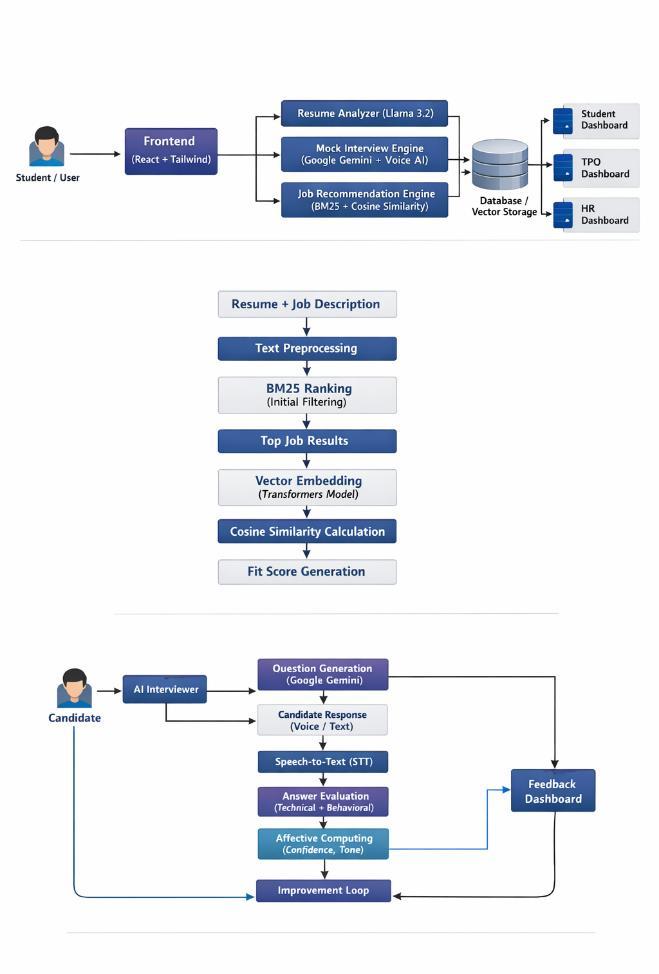
The Smart Placement Analytics and AI Interview Preparation System (AIPMS) will utilize a multi-tier architecturetoallowuserstoprogressfromtherawdataof each candidate to actionable insight into their careers, through 4 key modules: Data Ingestion Module, Semantic Analysis Module, Behavioral Simulation Module, and Stakeholder Governance Module. This multi-tier architectureusesaCloud-NativeArchitecture,meaningthat large language models (LLM) and real-time audio processing will not hinder the quality of user experience. The method is built around the concept of "Continuous Feedback," which means the system evaluates each candidatecontinuallyandbuildstheirhistoricperformance baselineastheyusedifferentpartsofthesystem (3,5).
The Multi-Tier Processing Pipeline:
Three layers are utilized within the system's operation: Presentation Layer: A user-friendly intuitive React-based interfaceforenteringapplicant-createdinput(i.e.,resumes, voice, and video) into a system that produces real-time analyticsdashboardsforStudents,TPOs&HRprofessionals (3,5).
Logic and Intelligence Layer: This is where the Generative AI (i.e., Llama 3.2/Google Gemini) engine processes the semantic meaning behind resumes and createscontextbasedinterviewquestions;andmaintainsa low-latency persistent connection via WebSockets during voice-based mock interviews such that the user experiencesareal-timedialogue(1,4).
Data and Storage Layer: A robust backend designed to store candidate embeddings, job descriptions, and historicalscores; thus, theuseofVectorDatabasesenables thesystemtocompletehigh-speedsimilaritysearcheswith precisemathematicstomatchcandidateswithappropriate roles(3,4).
By integrating these three layers into one complete solution the methodology transforms the traditional "onesize-fits-all" approach to placement into an individualized Career Pathing Tool that clearly identifies skill gaps and provides the specific resources required to fill those skill gaps(1,3,5).
ThisresearchaimsatprovidingacompleteAI-powered environment/ ecosystem thatconnectsthe divide between preparingstudentsforacademiaversuspreparingstudents for industry employment that leads to corporate recruitment opportunities. Therefore, the specific goals of theprojectinclude;
International Research Journal of Engineering and Technology (IRJET) e-ISSN: 2395-0056
Volume: 13 Issue: 03 | Mar 2026 www.irjet.net p-ISSN: 2395-0072
To give students a tailored and data led preparing experienceinsteadofgenericpreparation.
Resource Optimizing - Utilising Generative A.I. (Llama 3.2) fordeepsemanticanalysisofresumese.g.determiningskill gaps and have applicants optimise their resume for the applicanttrackingsystem(3).
Interview Interview Simulation - Creating a realistic, live voice agent environment where candidates can practice technical and non-technical interviews and receive on-thespotfeedbackontheircontentandtheirdelivery(1,4,5).
To replace the lengthy and tedious process of finding jobsmanuallythroughtheuseofhigh-precisionalgorithms that will help match job seekers to possible employers duringtherecruitmentprocess.
To effectively match candidates with the most suitable job postings based on the specific requirements listed in each posting as well as the candidate’s skills, the Plan will use the combination of the BM25 algorithm and Cosine Similarity as a means of mathematically matching each candidate’s unique skill vector to each of the possible job postings.Thiswillimproveplacementsuccessrates(3,4).
To assist Training & Placement Officers and Human Resourcepersonnelinunderstandinghowtheircandidates are progressing through the recruitment process by providing them with an easy way to obtain relevant data abouttheircandidatepool.
To create integrated dashboards for Training & PlacementOfficerssothattheycanseetheirentirecohort’s collectiveperformanceaswellasidentifyskill-basedtrends in specific skill sets (e.g. coding vs. communication). This will assist in identifying where each student requires additionaltraining(3).
To provide Human Resource teams pre-vetted candidatesgroupedby“EmployabilityScores”toreducethe amount of time and cost spent on selecting candidates duringtheearlystepsoftherecruitmentprocess(3,5).
A major goal of this study is to help students build confidencebyallowingthemtopracticeinarepeated,lowstakes manner. Confidence Development: The study will help decrease students' feelings of "interview anxiety" by
providing them with an AI environment (objective & not judgmental) where students could refine their responses via feedback loops before they go to interview with recruitmentrepresentativesinperson(1,2,5).
The proposed Smart Placement Analytics and AI Interview Preparation System (S.P.A.I.P.) is a cloud-based, multi-modal platform thatwill automate the entire careerreadiness lifecycle. The S.P.A.I.P. is different from a traditional portal because it uses “Feedback Loop Architecture."Ateverystudentinteraction(uploadingtheir resume, completing a mock interview, completing an aptitudetest),thestudent'sactionwill beloggedintotheir central Employability Profile (1, 3). A. System Architecture andTechStackTheS.P.A.I.P.wasdesignedusingamodern, scalable stack that will ensure real-time response: Frontend: Built in React.js & TailwindCSS to provide an easy to use, responsive interface to the students and the administrators (3, 5).Backend: Build on Node.js & FastAPI for fast communication between the database and the AI Models(4).IntelligenceLayer:UsingLlama3.2asthedeep text analysis engine and providing Google Gemini with dynamic, conversational logic while using an AI model for interviewing (1, 3, 5). Real-Time Communication: Using WebSocketstoprovidelowlatencyinthevoiceinteraction ofanAIinterviewerwithacandidate(4).
5.1.1 AI Resume Analyzer & Optimizer:
Whenyousubmityourresume,itisconvertedintoahighly structuredJSONformat.UsingNaturalLanguageProcessing (NLP), the system will evaluate your resume against industrybenchmarkssuchasthosefoundintheU.S.Bureau of Labor Statistics or O*Net. The system does not simply evaluate your resume for a score; it will also provide you with actionable feedback on areas of your resume you can improve on to help you pass Applicant Tracking System (ATS)filters,suchasaddingrelevanttechnicalkeywordsor quantifyingyourprojectaccomplishment.
5.1.2 Generative AI Mock Interviewer: TheGenerative AI Mock Interviewer Module is a virtual HR manager that willpullrelevantskillsfromyourresumerelatedtothejob description you want and develop a set of customized interviewquestionsforyou..
BehavioralLayer:Asksasksyoutoexplainatimewhenyou failedintheworkplace.
Technical Layer: uses the Gemini game engine to evaluate yourtechnicalanswer'saccuracyinrealtime.
International Research Journal of Engineering and Technology (IRJET) e-ISSN: 2395-0056
Volume: 13 Issue: 03 | Mar 2026 www.irjet.net p-ISSN: 2395-0072
Voice Processing: uses a voice-to-text (STT) engine to transcribeyouranswersandatext-to-voice(TTS)engineto voiceyouranswersbacktoyou(4).
5.1.3 Job Recommendation Engine: The Job Recommendation Engine serves as an intelligent matchmaker by converting resumes and job descriptions into high-dimensional vectors and calculating a "Fit Score" usingCosineSimilarity.Becauseofthisadvancedmatching capability, the Job Recommendation Engine will recommendyouonlyforjobsthatyouareindeedqualified for,asopposedtomerelymatchingyouonjobtitle.
TPO Dashboard: This dashboard provides an overview of the institution. Placement Officers can use this dashboard to determine the percent of students who are ready for placement and what skill areas (like Java or Communication) need to be worked on for an individual student(3).
HR Dashboard: This dashboard allows the recruiter to bypass the first part of the recruiting process by allowing therecruitertoreviewpreviouslyrecordedhighlightsofAI interviews and the employability score calculated for each applicant(3,5).
6. ALGORITHMIC FRAMEWORK
The AIPMS is comprised of a series of interconnected algorithms that process unstructured (resumes and voice) intostructuredmetricsthatrepresentemployability.These algorithmsaredescribedastheLogicCoreoftheproposed system.
The system will be able to parse resumes based on the contextualmeaningwithintheresumeofthecandidateand notjustbasedonkeywords.
1. Input=PDF/DocxResumeFile
2. Step1:NLPbasedparsertoremoveformattingand convertthetextintoacleanstring(3).
3. Step 2: Apply the Llama 3.2 algorithm to identify the Names of People and Entities through Named Entity Recognition (NER); to categorize the text into the following groups: Skills, Experience, Projects,andCertifications(1,3).
4. Step 3: Map the identified skills to standard Industry Taxonomy (Example: "Java Developer" to "BackendEngineering")(3).
5. Output:Output=StructuredJSONUserProfile.
6.2 Algorithm 2: Hybrid Job Recommendation (BM25 + Cosine Similarity)
To provide candidates with the best job matches, the Recommendation Engine will apply a two-step filtering processtofiltercandidatesintotherightjoboffers.
1. Stage1(ProbabilisticFiltering):Thefirststepofthe Hybrid Job Recommendation engine will be through the use oftheBM25 algorithmto retrieve jobdescriptionsbyrankingjobdescriptionsbased on term frequency and document length. The retrieval of the job descriptions will take place quickly due to the use of term frequency /documentlength.(3,4).
2. Stage 2 (Semantic Vectorization): Once the User Profile and Job Description have been retrieved from a jobs database, they will both be converted into high dimension vector embeddings using a pre-trainedTransformersmodel(3).
CalculateCosineSimilarity:
CosineSimilarity=(U∙J)/(||J||*||U||)
Output: The output of the processing for candidates with the job offers will be a ranked list of job offers for the candidatesortedbyfitpercentage(3,4).
The dynamic interview logic (DIL) algorithm provides the structurefor managing thereal-time interaction that takes place between the user and the AI interviewer during a mockinterview.
Input: The DIL algorithm provides input in the form of the user'sstructuredJSONprofileaswellasthetargetjobrole basedonthatstructuredprofile.
Step 1: Question Generation – Google Gemini generates a base set of 5 technical and 3 behavioural questions based onwhatisrepresentedintheuser'sresume(1,5).
Step 2: Adaptive Prompting – If the candidate provides a partialanswertooneofthequestions,theAIusesafollowup logic function to simulate the actions of a human recruiter that would probe more deeply into the specific issuebeingaddressed(5).
Step 3: STT Loop – User audio (verbal speech) is being captured using a WebSocket and transcribed in real-time (4).
Step4:BehavioralScoring–Thesystemdemonstrateshow it will analyse "tone" and "confidence" as part of the behavioural scoring process by utilizing affective computingmodels(5).
International Research Journal of Engineering and Technology (IRJET) e-ISSN: 2395-0056
Volume: 13 Issue: 03 | Mar 2026 www.irjet.net p-ISSN: 2395-0072
Output: The DIL algorithm provides real-time feedback transcript and a final interview performance score for the user(1,4,5).
This algorithm will use all data points as a single measurementforyourdecisiontoemploysomeone
HEI=((WrxResumeScore)+(Wa xAptitudeScore)+(Wi xInterviewScore))
Where:Wr=weight(typicallyweightingof.3isused)
Wa=weight(typicallyweightingof.2isused)
Wi=weight(typicallyweightingof.5isused)
These three "W's" can also adjust if your numbers are inaccurate.Thetextheadswilldefinehowthedataisbeing classified. For example, if your title is the main text head, then everything that follows will classifyagainst your title. Iftherearetwoormoresubheadings,thenyouwillneedto use the next level in heading format (upper-case Roman numerals). Otherwise, do not put in any subheadings. Headings1,2,3and4asthedescriptionoftheclassification iswhatyoushoulduse.
The study develops and describes the design-andmethodologyofacloud-basedapplication,calledtheSmart Placement Analytics and AI Interview Prep System (AIPMS). The AIPMS utilizes Generative AI (Llama 3.2 and Google Gemini) by integrating these algorithms in conjunction with a multi-tier architectural approach for creatinganengagingpersonalizedcareerpathcomparedto traditional approaches used in the recruiting process. The Hybrid Algorithmic Framework,utilizingBM25and Cosine Similarity, represents the first meaningful increase in the accuracy of matching candidates with positions by using deep semantic competence rather than solely keyword density as is typical in most recruiting practices. The adoption of Affective Computing within the Behavioral SimulationModuleprovidesrecruiterswithinsightintothe psychological impact of recruiting, such as anxiety and comfort/insecurityincommunication-basedenvironments. The AIPMS represents a fully data-driven, transparent ecosystem designed to allow students actionable insight, optimizetheTPOsoversightofinstitutions,andprovideHR professionals with a high precision talent acquisition funnel.
[2] Taylor & Francis Group, “Reimagining recruitment: traditional methods meet AI interventions A 20-year assessment (2003–2023),”Cogent Bus. & Manage., vol. 12,no.1,pp.245-260,Feb.2025.
[3] R. Deshmukh and S. Patil, “AI-Powered Placement Management System (AIPMS) using Llama 3.2,” J. Emerg. Technol. Innov. Res. (JETIR), vol. 12, no. 4, pp. 442-450,April2025.
[4] V.Mishra,J.Arulappan,etal.,“RealTimeAIVoiceAgent Interview Platform using WebSockets,” Int. J. Sci. Eng. Technol.(IJSET),vol.14,no.1,pp.88-94,March2024.
[5] R. Madanachitran, K. Balaji, and M. Sangeetha, “AIDriven Mock Interview: A New Era In Candidate Preparation,” J. Adv. Anal. Financial Res. (JAAFR), vol. 10,no.2,pp.15-29,March2026.
[6] N. Nawaz and A. M. Gomes, “Artificial-Intelligence chatbots are new recruiters,” Int. J. Recent Technol. Eng.,vol.8,no.1,pp.1-5,May2019.
[7] A.Mufti,etal.,“ArtificialIntelligenceinRecruitment:A Systematic Literature Review on Trends and Future Directions,” J. Artif. Intell. Eng. Appl., vol. 4, no. 1, pp. 55-72,Feb.2025.
[8] P.SinghandR.Kumar,“MachineLearningApproachfor Automated Resume Screening and Ranking,” Indian J. Comput. Sci. Eng., vol. 15, no. 2, pp. 210-218, April 2024.
[9] Y.ZhaoandX.Fan,“TheRoleofAffectiveComputingin Virtual Human-Agent Interaction for Job Interviews,” IEEE Trans. Affect. Comput., vol. 14, no. 3, pp. 11021115,Sept.2023.
[10] S. Gupta, “Smart Analytics for Campus Placements: A PredictiveModelforStudentSuccess,”J.Educ.Technol. Syst.,vol.52,no.3,pp.301-318,March2024.
[11] M. Al-A'ali, “The impact of AI on the recruitment process: A candidate's perspective,” J. Global Oper. Strategic Sourcing, vol. 15, no. 4, pp. 489-505, Nov. 2022.
[12] A. Verma and M. Tyagi, “Natural Language Processing in HR Tech: A Survey of Indian Startups,” Int. J. Inf. Manage. Data Insights, vol. 3, no. 1, pp. 100-112, May 2023.
[13] S. Choudhury, “Algorithm Bias in AI Recruitment: Challenges and Solutions for Human Re Management,” Rev. Manage. Sci., vol. 15, no. 6, pp. 1565-1588, Oct. 2021.
[1] [S. Warankar, A. Sharma, and P. Kulkarni, “Smart Placement Kit: An AI-Powered Learning Management SystemforInterviewPreparation,”Int.J.FutureModel Res.(IJFMR),vol.8,no.1,pp.112-125,Jan.2026.
International Research Journal of Engineering and Technology (IRJET) e-ISSN: 2395-0056
Volume: 13 Issue: 03 | Mar 2026 www.irjet.net p-ISSN: 2395-0072
[14] J. Miller and L. Wang, “Automated Video Interviewing: Evaluating the reliability of AI-based non-verbal cues,” Comput. Human Behavior, vol. 107, pp. 106-120, June 2020.
[15] N. Soni and E. Sharma, “Implementation of BM25 and Cosine Similarity in Recruitment Portals,” J. Big Data Anal.,vol.7,no.2,pp.45-59,Jan.2025.
[16] V.Bhatnagar,“ImpactofDataAnalyticsonRecruitment andSelectionProcess,”Int.J.Manage.ITEng.,vol.8,no. 5,pp.112-124,May2018.
[17] Y. Duan, et al., “Artificial intelligence for decision makingintheeraofBigData–Aresearchagenda,”Int. J.Inf.Manage.,vol.48,pp.63-71,Oct.2019.
[18] M. S. Khan, “Scaling Generative AI in Higher Education Placement Cells,” Asian J. Educ. Social Studies, vol. 55, no.1,pp.12-24,Feb.2026.
[19] R. Rodrigues, “The future of work and the recruitment industry:AnAI-centricview,”HumanReManage.Rev., vol.33,no.1,pp.100-115,Jan.2023.
[20] R. Aggarwal and S. Das, “Voice-Based Emotion Recognition for Performance Analysis in Mock Interviews,” Procedia Comput. Sci., vol. 218, pp. 12501259,March2024.
[21] X. Li and J. Chen, “A Comparison of BERT and Llama ModelsforResumeClassificationTasks,”arXivpreprint arXiv:2205.12345,May2022.
[22] K.Patel,“CampusRecruitmentManagementSystems:A Case Study of Tier-1 Engineering Colleges in India,” J. Univ.Placement,vol.9,no.3,pp.77-89,Sept.2021.
[23] E. Faliagka, et al., “Online social networks and erecruitment: Opportunity or hazard?” J. Syst. Softw., vol.85,no.5,pp.1056-1067,May2012.
[24] P. Tambe, et al., “Artificial Intelligence in Human Re Management: Challenges and a Path Forward,” California Manage. Rev., vol. 61, no. 4, pp. 15-42, Aug. 2019.
[25] S. Srivastava, “Designing User-Centric Dashboards for Training and Placement Officers,” Int. J. HumanCompute. Interaction, vol. 41, no. 2, pp. 210-225, April 2025.