
International Research Journal of Engineering and Technology (IRJET) e-ISSN: 2395-0056
Volume: 12 Issue: 08 | Aug 2025 www.irjet.net p-ISSN: 2395-0072
International Research Journal of Engineering and Technology (IRJET) e-ISSN: 2395-0056
Volume: 12 Issue: 08 | Aug 2025 www.irjet.net p-ISSN: 2395-0072
Er. S. Arulselvan1 , Dr. K. Senthil Kumar2 , Ms. M. Sasmita Fatima3
1Project investigator, COO- AIC NIFTTEA & Head Technical NIFTTEA Knitwear Fashion Institute, Tirupur, India
2CEO- AIC NIFTTE, NIFTTEA Knitwear Fashion Institute, Tirupur, India
3 Research Associate AIC NIFTTEA3 , NIFTTEA Knitwear Fashion Institute, Tirupur, India
Abstract - Sustainability has become a widely recognized concept in response to pressing environmental challenges, including global warming, pollution,andthedeclineofwildlife populations. These concerns have ledto the emergence ofecoconscious initiatives, including the development of green products, carbon footprint reduction, use of recycled materials, andproductionof eco-friendly goods. Thisresearch investigates the use of banana pseudostem fibers, which are sourced from agricultural, as sustainable solution for agricultural waste dumping. The banana pseudostem are usually discarded as waste after the fruits are harvest. These stems take 3–4 months to decompose, which farmers are unwilling to wait for, so they dispose of them, often leading to landfill accumulation. This research proposes a solution to help farmers to supplement theirincomebyutilizingthewaste frombanana stems. The banana stemswerecollectedfromthe farmers near Tirupur and Coimbatore. Then the collected banana stems were mechanically processed to extract fiber, and the extracted fiber undergoes an optimization process. The optimized fibers were blended with cotton for better performance and quality. To produce quality yarns, three types of spinning techniques were used, and the resultant yarns were thoroughly tested for overall performance, uniformity, and tensile strength. The best spinning technique was determined by comparative analysis. Then the resultant yarns are prepared for fabrication. The yarns were converted into knitted fabric using circular and flat knitting. These results highlight how agricultural waste fibers can support environmental sustainability andenhancetheeconomicvalue of textile production.
Key Words: Banana fibre, Banana yarn, Sustainable textile,
During the Industrial Revolution, synthetic materials and chemical innovations were developed to enhance efficiency and meet the growing demands of textile production. However, the textile industry has become a major contributor to environmental degradation, particularly through water and soil pollution. Textile manufacturing processes release various chemicals and fumesthatcontaminatenaturalresources.Additionally,the
cultivation of natural fibers from both plants and animals oftenreliesonhazardouspesticidesandchemicalfertilizers toimproveyieldandquality.Manyofthesesubstancesare toxic, non-biodegradable, and disrupt the physical environment.Thisimbalanceinnaturalsystemscontributes todroughtconditions,risingtemperatures,andintensified globalwarming[1].Therefore,thereisanincreasingneed for the environmental protection which pushes for sustainabilityinthetextileindustry.Thus,eco-friendlyand biodegradablefibershaveemergedasavitalalternativeto syntheticmaterials.Whileconventionalnaturalfiberssuch ascotton,jute,andsilkdominatetextileapplications,nonconventional alternatives such as banana, pineapple, and ramie remain underutilized due to limited familiarity and processing challenges. Among these, banana pseudostem fiber shows significant promise owing to its abundance, historicalrelevanceinIndiaandEastAsia,anditspotential forsustainabletextileproduction[2].
Indiastandsastheworld’sleadingproducerofbananas, dedicating approximately 830,000 hectares to their cultivation. This extensive agricultural activity yields approximately 51.18 million metric tons of pseudostem wasteannually.However,thefiberextractedfrombanana plants is notably rigid and lacks cohesion, making it unsuitableforconventionaltextileapplications.Ofthis,an estimated 550,000 tons of agricultural residue could be viably utilized each year for fiber extraction, offering a pathway to enhance both economic growth and environmentalsustainabilityintheagriculturalandtextile sectors. Globally, the textile industry was valued at approximately $1 trillion in 2021, with projections estimating growth to $1.4 trillion by 2030. However, the sector also faces growing scrutiny due to its substantial environmentalfootprintconsuming,93billioncubicmeters ofwaterandemitting1.2billiontonsofgreenhousegases annually [3]. Leveraging this fiber not only addresses environmental waste disposal issues but also offers rural farmersanopportunitytosupplementtheirincome.Despite its current use in cottage industries, banana fiber suffers from poor spinnability and rigidity, which limit its textile applications. This research investigates the feasibility of transformingbananastemwasteintousabletextilefibersby addressingpliabilitychallengesthroughoptimizedspinning
International Research Journal of Engineering and Technology (IRJET) e-ISSN: 2395-0056
Volume: 12 Issue: 08 | Aug 2025 www.irjet.net p-ISSN: 2395-0072
and eco-processing techniques. The study aims to explore banana fiber’s potential to enhance India's rural textile landscape and contribute to the global demand for sustainablefashion
Banana plants rank among the tallest herbaceous perennials globally. Cultivated varieties typically attain heights ranging from 2 to 9 meters, while certain wild species may grow as tall as 10 to 15 meters. These remarkableplantspossessasubterraneanstemknownasa corm, an aerial pseudostem, expansive foliage, and a prominentinflorescence,whichtogethercontributetotheir distinctivebotanicalstructure.[4]
Bananasarenotablenotonlyfortheirsizebutalsofor their utility, especially in the production of banana fiber. Extracted from the pseudostem, banana fiber is a durable and eco-friendly plant fiber composed primarily of αcellulose(61.50%),Hemicellulose(20.30%),Lignin,(15%), andotherconstituents(3.2%) [5].Thehighlignincontent contributestothefiber’shardness,whileitsmoistureregain rate of approximately 13% allows it to absorb ambient moistureeffectively[6].Bananafiberhasanaturalaffinity fordyes,whichmakesitparticularlywell-suitedforcreating vivid and colorful designs. Compared to cotton, it offers enhanced comfort, making it particularly suitable for ecofriendlyknittedchildren’swear.Bananafiberhaslongbeen valuedforitsstrengthandversatility.Traditionally,itisused to create wall hangings, table mats, handbags and purses, yarn and ropes, mats and twines. In modern industries, bananafiberalsoplaysanimportantroleintheproduction of grease-proof paper, sustainable clothing and biodegradablepackaging[7].
Unique Physical and Chemical Traits: Bananafiber possessesdistinctqualitiesthatmakeitahigh-grade textilematerial.
Visual Comparison: Itresemblesbambooandramie fibersinappearancebutofferssuperiorfinenessand spinnability.
Chemical Composition: Itiscomprisedprimarilyof cellulose,hemicellulose,andlignin.
Mechanical Properties: It is exceptionally strong, exhibitslowelongation,andislightweight.
Appearance & Finish: Depending on the extraction and spinning methods used, it can display a subtle sheen.
Moisture Management: Showsoutstandingmoisture absorptionandrelease,makingitidealforbreathable textiles
Eco-Friendly Nature: Fully biodegradable with no harmful environmental impact classified as a sustainablefiber.
Fineness: Hasanaveragefiberfinenessof2400Nm, suitablefordelicatespinningapplications.
Spinning Compatibility: Compatible with various spinningtechniquesincludingringspinning,open-end spinning, bast fiber spinning and semi-worsted spinning[8].
2.1. Materials
This research used banana pseudostem waste, which was collected from farmers and commercially available cotton(MCU5)forfabrication.
2.2. Methods
2.2.1.
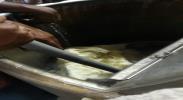
Bananafiberwasextractedmechanicallybyfeedingthe pseudostemlengthwiseintoafiberextractor.Themachine operatedbyremovingtheouterlayersofthepseudostemby scraping, to isolate the fibers. Once separated, the fibers were air-dried at ambient room temperature to remove residualmoisture.
2.2.2.
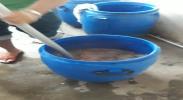
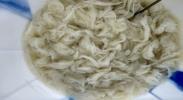
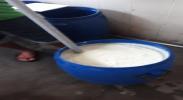
Afterextractingbananafibersfromthepseudostem,theraw material undergoes a purification process using sodium hydroxide (NaOH) to remove impurities. Due to the high lignincontent,whichcontributestothefiber’srigidity,the untreatedbananafibersarenotablyhardandchallengingto process,especiallyforyarnformation.Toaddressthis,two fibersofteningtechniqueswereevaluated,theTROmethod andIndustrialhydrophilicsofteners.Followingcomparative trials,itwasfoundthattheTROmethodissignificantlymore effective in softening banana fibers. In contrast, industrial hydrophilicsoftenersprovedunsuitableduetotheirlimited impact on the fiber's unique structure and composition. Therefore, the TRO method emerged as the optimal approach for enhancing the flexibility and spinnability of bananafiberfortextileapplications.
International Research Journal of Engineering and Technology (IRJET) e-ISSN: 2395-0056
Volume: 12 Issue: 08 | Aug 2025 www.irjet.net p-ISSN: 2395-0072
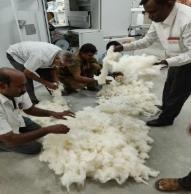
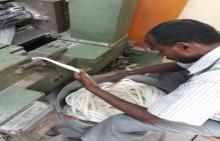
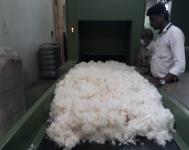
Thesoftenedlongbananafibersweremanuallycuttoa span length of 25 mm for compatibility with the blending process. A cotton variety of similar staple length such as MCU5cottonwasselectedtoenableuniformblending.The blendratiousedwas40:60(banana:cotton),andtheprocess was carried out both manually and mechanically using an oldersketcherlinemachine.ThentheBlendedfiberswere convertedintolabreadyformpriortosliverformation. In Cardingprocess,thefiberswereseparatedindividuallywith an enhanced bending ratio toward the cotton component andcardingmachinesettingsweremodifiedtoensurethe higher density of banana fibers (Flat to cylinder: wider settings applied, Cylinder to licker-in, Licker-in to grid, Cylinder to grid, Cylinder to doffer). These adjustments ensured smoother fiber separation and consistent sliver qualitythroughouttheprocess.
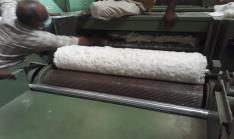
2.2.4. Pre-process of yarn formation
Following carding, the sliver exhibited significant unevenness. To enhance its uniformity, it was fed into a drawing machine, where six individual slivers were combinedandprocessedtogether.Thisdrawingoperation effectivelyleveledoutthevariationsandyieldeda0.91hank sliver,suitableforfurtherrefinement.Thedrawnsliverwas subsequentlypassedthroughthesimplexmachine, where two key actions occurred, the material was thinned down progressivelyandthesliverwastransformedintoroving,a lightly twisted strand ideal for spinning. These steps are critical for improving yarn consistency and preparing the fiberblendforhigh-qualityspinningoutcomes
2.2.5. Yarn conversion (Spinning)
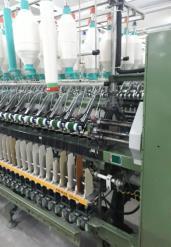
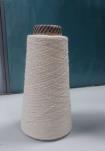
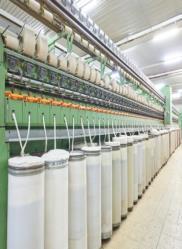
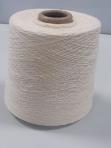
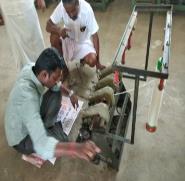
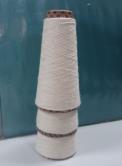
Yarnconversiontrailshaveprogrammedtoidentifythe mostsuitablespinningtechniqueforbanana/cottonblend yarn,three different methodsweretrialed, Ring Spinning, Open-End (OE) Spinning and Charkha Spinning (Khadi Method).Amongthetestedmethods,ringspinningproduced
thehighestyarnquality,offeringsuperiorconsistencyand strength. Although Charkha-spun yarns exhibited deeper fibre penetration and enhanced wrapping, this method required significantly more human effort and longer productiontime.Basedonqualityandefficiencyoutcomes, theringspinningmethodwaschosenforyarnproduction. Approximately 15 kilograms of banana/cotton blend yarn were produced, with a count range of 22s Ne, suitable for varioustextileapplications.
2.2.6.
Banana/cotton yarns exhibit slightly higher hairiness and surface roughness, which impedes their smooth flow duringknitting.Toovercometheselimitationsandenhance yarnperformance,asurfacepre-treatmentwasintroduced, gassingeingandwaxwinding.Gassingeingwasemployedto eliminate protruding fibers by passing the yarn through a controlledflame.Thisprocessenhancestheyarn’ssurface uniformitywithoutcompromisingstructuralintegrity.Wax windingwasappliedtobindanyremainingloosefibersand provide a lubricated surface. This reduces friction during knitting,promotingsmootheroperationandimprovedfabric quality.Developedyarnsunderwentthesetreatments.Post pre-treatment, the yarns demonstrated substantial improvement in surface characteristics and proved to be highlysuitableforknittingapplications.
Following surface pre-treatment, the banana/cotton yarns were utilized for fabric conversion through knitting processes, employing both circular and flat knitting techniques. Multiple trials were conducted, and machine settingswereadjustediterativelytooptimizeperformance and output quality. Circular Knitting was conducted using low-gaugemachines(gauges12and16)todevelopbanana fabricwithappropriatetextureandstructure.Thesesettings ensured better handling of the yarn’s characteristics and enhancedloopformation.FlatKnittingwasexecutedonboth
International Research Journal of Engineering and Technology (IRJET) e-ISSN: 2395-0056
Volume: 12 Issue: 08 | Aug 2025 www.irjet.net p-ISSN: 2395-0072
manualandpower-operatedmachines.Thismethodoffered versatility in fabric design and stitch control, suitable for smaller-scale trials and diversified outputs. The resulting fabricsfrombothknittingtechniquesexhibitedgoodquality and consistency, validating the efficacy of the yarn pretreatment. Adjustments in gauge, tension, and feed rates duringtrialsplayedacrucialroleinachievingbestresults.
2.2.8.
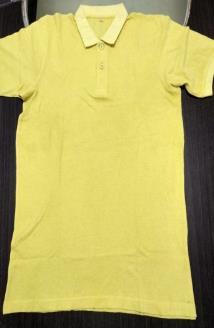
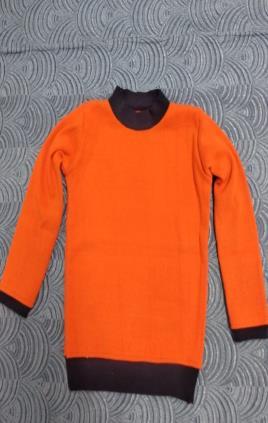
Followingtheknittingstage,thebanana/cottonblended fabricunderwentasequenceofpreparatorytreatmentsto enhancedyeuptakeandoverallquality.Scouringwasdone to remove impurities and natural waxes to ensure better absorbency.Bleachingwasdonetolightenedthefabriccolor andimprovedbrightnessforuniform dyeing.HeatSetting wasdonetostabilizedthefabricstructureanddimensions, makingitreadyfordyeing.Thetreatedfabricwassubjected to both natural and chemical dyeing processes to explore eco-friendly and performance-based color solutions. This dualapproachallowedforversatilityintone,shadedepth, and finish. The fabric received a bio-wash treatment to enhancesurfacesmoothness,softness,andwearercomfort making it especially appealing for garment applications. Finally,acompletephaseofgarmentdesign,patternmaking, and sample sewing were carried out. A total of 6 unique stylesand23garmentsweresuccessfullydevelopedaspart of the project, showcasing the viability of banana/cotton blendedtextilesinmodernfashion
3. RESULT AND DISCUSSION
Theextractedbananafiber,theblendedyarn,and the developed fabric undergo a series of mechanical and physicalteststoassesstheirperformance
3.1.
The test results indicate that banana fiber possesses moderate strength, low elongation, and low to moderate tenacity,highlightingitsstiffandbrittlenature.Additionally, bananafiberisextremelycoarse,whichlimitsitssuitability for fine textile applications. In contrast, cotton fiber
demonstrates high strength, moderate elongation, high tenacity,andexcellentfinesse,makingitidealforproducing soft, durable, and high-quality yarns. It is concluded that blendingbananafiberwithcottonsignificantlyenhancesthe overallperformanceandqualityoftheresultingyarn.The cottoncomponentcompensatesforthelimitationsofbanana fiberimprovingsoftness,flexibility,anddurabilitywhilestill retaining the unique characteristics of banana fiber. This blend offers a promising approach for sustainable textile developmentbyutilizingbananafibermoreeffectively.
Table -1: Fibertest
It is evident that the cotton yarn demonstrates superiorperformanceacrosskeymetrics.Withahigheryarn count, greater lea strength, and elevated Count Strength Product (CSP), the pure cotton sample offers enhanced durability,fineness,andtensileintegrity.ItshigherTwistPer Inch (TPI) further contributes to structural cohesion and resilience.Comparedtopurecottonyarn,thebanana/cotton (40/60)blendshowsslightlylowermechanicalproperties such as strength and CSP. However, it offers notable advantagesincomfort,breathability,andsoftness,makingit ideal for casual wear. The use of banana fiber promotes sustainability by repurposing agricultural waste. Additionally, the blend is cost-effective, providing an affordablealternativeforeco-consciousconsumers.While cottonexcelsindurability,thebanana/cottonblendaligns withmoderndemandsforethicalandcomfortabletextiles.
Table -2: Yarntest
International Research Journal of Engineering and Technology (IRJET) e-ISSN: 2395-0056
Volume: 12 Issue: 08 | Aug 2025 www.irjet.net p-ISSN: 2395-0072
The results indicate that both fabrics are lightweight withsimilarfeelanddrape.Sample2demonstratesbetter dimensional stability and is less prone to spirality. While Sample1shrinksinlengthandexpandsinwidthpotentially distorting garment shape. Sample 2 shrinks uniformly in bothdirections,offeringmorepredictableperformance.In termsofstrength,Sample2 isslightlymoredurable.Both fabrics show acceptable pilling resistance, making them suitable for everyday use. Additionally, Sample 2 exhibits slightlybettercolorfastness,contributingtolonger-lasting appearance.
Table -3: Fabrictest
FABRIC PROPERTIES
/Course
/Wales
Strength (Kpa)
Billingresistance Slightsurface fuzzingand/or partiallyformed pills(4) Slightsurface fuzzingand/or partiallyformed pills(4)
Thisresearchstudyclearlydemonstratesthepromising potential of banana pseudostem fibers an abundant agriculturalwasteasasustainableandeconomicallyviable resource for textile manufacturing. Through targeted mechanical extraction, effective chemical treatment, and optimized blending with cotton, these natural fibers were successfully transformed into spinnable yarn and highperforming knitted fabric. By repurposing post-harvest banana stem waste into value-added textile products, the researchsupportsenvironmentallyresponsibleproduction, fostersruraleconomicdevelopment,andadvancescircular economyprincipleswithinbothagricultureandthefashion industry.
Thisresearchwasconductedwithfullfinancialsupport from the National Bank for Agriculture and Rural Development (NABARD). The authors acknowledge NABARD’s generous funding, which was pivotal to the successfulexecutionofthisproject.Theprojectinvestigator &instituteexpresstheirprofoundgratitudetoNABARDfor its generous sponsorship, which was integral to the successfulcompletionofthisresearch.
Theauthorsgratefullyacknowledgethefinancialsupport providedby NABARD,whosepartnershipwasessentialto the successful execution of this project. We extend our sincerethankstotheManagementof NIFTTEA College for their institutional support and facilitation throughout the research.Specialthankstothe Padiyur Sarvodaya Sangh for enabling the Charka (Khadi) spinning trials, and to Prasanna Spinning Mills and SITRA for their valuable assistance in the yarn manufacturing process. We also acknowledgethecontributionof Free Look Fashion pvt ltd inthegarmentconstructionphase,whichwasintegraltothe completionofthisresearch.
[1] K. Jankeaw, U. Bupachat, V. Simachaya, Environment Issues in Pollution, Thailand Ministry of Education: Bangkok,35-36,1992.
[2] Muwanwella,R.,Nalinda,G.,&Marasinghe,M.(2016). ApplicationOfExistingYarnManufacturingMethodsto ProduceBananaYarns.
[3] Ruangnarong, C., Khojitmate, S., Srivorradatphisan, S., Panyathikun,N.,&Chonsakorn,S.(2024).Evaluationof mechanicallyextractedbananafibersfrompseudostem layers: A sustainable textile raw material. Heliyon, 10(21).
[4] Karamura, D., Karamura, E., & Blomme, G. (2011). General plant morphology of Musa. Banana breeding: progress and challenges. 2nd ed. CRC Press, Boca Raton, FL
[5] Cherian,B.M.,Pothan,L.A.,Nguyen-Chung,T.,Mennig, G.,Kottaisamy,M.,&Thomas,S.(2008).Anovelmethod forthesynthesisofcellulosenanofibrilwhiskersfrom banana fibers and characterization. Journal of agricultural and food chemistry, 56(14),5617-5627.
[6] VishnuVardhini,K.J.,&Murugan,R.(2017).Effectof laccaseandxylanaseenzymetreatmentonchemicaland mechanical properties of banana fiber. Journal of Natural Fibers, 14(2),217-227.
International Research Journal of Engineering and Technology (IRJET) e-ISSN: 2395-0056
[7] Brindha, D., Vinodhini, S., Alarmelumangai, K., & Malathy, N. S. (2012). Physico-chemical properties of fibers from banana varieties after scouring. Indian Journal of Fundamental and Applied Life Sciences, 2(1), 217-221
[8] Eswaran, A., Rathish, R., & Suresh, R. (2017). InvestigationofMechanicalPropertiesonBananaFiber and Silicon Carbide with Epoxy Resin. International Journal of Research in Aeronautical and Mechanical Engineering, 5(6),65-76.
Volume: 12 Issue: 08 | Aug 2025 www.irjet.net p-ISSN: 2395-0072 © 2025, IRJET | Impact Factor value: 8.315 | ISO 9001:2008 Certified