
International Research Journal of Engineering and Technology (IRJET) e-ISSN: 2395-0056
Volume: 13 Issue: 01 | Jan 2026 www.irjet.net p-ISSN: 2395-0072
“EXPERIMENTAL STUDY OF REPLACEMENT OF STEEL REINFORCEMENT WITH BAMBOO”
Tapse S.B, Kadam R.V, Jadhav S.A,Khobre O.B, Sulgadle S.S
Under graduate students of department of Civil Engineering, Shree Tuljabhawani College of Engineering, Maharashtra, India.
Professor Department of Civil Engineering, Shree Tuljabhawani College of Engineering, Maharashtra, India.
ABSTRACT- This paper is study of comparison of cost and flexural strength of bamboo reinforcement with steel reinforcement. The regularly used steel reinforcement technique has many disadvantages like carbon emission, increasing cost, susceptibility of corrosion, weight, environmental impact etc. To overcome these problems we have decided to conduct an experiment by replacing steel with bamboo.
Bamboo is effective material for construction due to its low cost, light weight. So by using bamboo we can achieve our main objective that cost effective construction. Bamboo construction is eco-friendly, does not have any bad effects on environment. Bamboo isknown for its flexibility which is required in structural element like beam, column, and slab.
Keywords: - Cost effective, light weight, environment friendly, flexural strength.
1. INTRODUCTION
Bamboo is one of the strongest and fastest growing plants, reaching heights of over 100 feet. Bamboo is versatile constructionmaterial thatisstrongyetlightweight.Bambooconstructioninvolvestheuseofbambooasbuildingmaterial for scaffolding, bridges, houses and buildings. In recent years, the construction industry has increasingly turned its attentiontowardsustainableandeco-friendlybuildingmaterials.Amongthevariousalternativesbeingexplored,bamboo has emerged as a promising substitute for conventional materials such as steel, particularly in developing regions and environmentally sensitive projects.Knownforitsrapidgrowthrate,renewability,andimpressivemechanicalproperties, bamboo offers a viable solution to many of the environmental and economic challenges associated with steel use in construction.
This project aims to explore the feasibility of replacing steel with bamboo in various structural applications. Steel, while strong and widely used, has several drawbacks including highenergyconsumptionduringproduction,significantcarbon emissions, and cost- related challenges. In contrast, bamboo is lightweight, flexible, renewable, and has a low environmentalfootprint,makingitanattractivealternativeforsustainabledevelopment.
Thestudyinvestigatesthemechanicalproperties,availability,treatmentmethods,constructiontechniques,andlimitations of bamboo, comparing them directly with those of steel. It also assesses real-world examples and experimental data to understand how bamboo can be integrated into modern construction practices without compromising safety and performance.Ultimately,thisprojectcontributestothegrowingbodyofresearchsupportingtheuse ofnaturalmaterials in green construction and seeks to demonstrate that bamboo, when properly treated and engineered, can effectively replacesteelinmanystructuralapplications pavingthewayforamoresustainablefutureinbuildingdesign.
2. MATERIALS AND METHODS
MaterialswerecollectedfromlocalshopsforbothSteelReinforcedandBambooReinforcedconcrete.Materialsneededfor Reinforcementcementconcretearefineaggregate,coarseaggregate,cement,sand,steelrod,bambooandwater.
1)Fine aggregate/sand
It is also called as sand or crushed stone naturally available of small size of 4.75mm. It is used to fill the voids betweencoarseaggregateandimproveworkability.
2) Coarse aggregate
Typicallygravelorcrushedstonehavingsizelargerthan4.75mm.Itisusedtoprovidestrengthtotheconcrete.Makesup largestvolumeintheconcretemix
International Research Journal of Engineering and Technology (IRJET) e-ISSN: 2395-0056
Volume: 13 Issue: 01 | Jan 2026 www.irjet.net p-ISSN: 2395-0072
3)Cement
It is the binding material that holds other components together. It hydrates and hardens when mixed with water. The cementusedintheexperimentalworkisULTRATECHCEMENT.
4) Steel
Steel is used in combination with concrete, for what is known as reinforced concrete. Steel is provided to resist tensile stress-free500steelisusedconformingtoIS456-2000.
5) Bamboo
Bambooiseco-friendlymaterialhavinggoodtensileproperties.ItislargelyavailableinIndia Itcanbeusedafterseasoning asareplacementtosteelreinforcement.BamboousedinthisprojectisBAMBUSAVULGARIS.
6) Water
Itisveryimportantingredientresponsibleforchemicalreaction.Ithelpstoformthestrengthgivingcementgel,waterused mustbecleanandpotable.
3. SPECIMEN PREPARATION
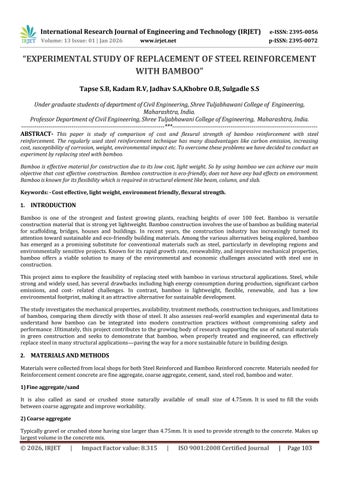
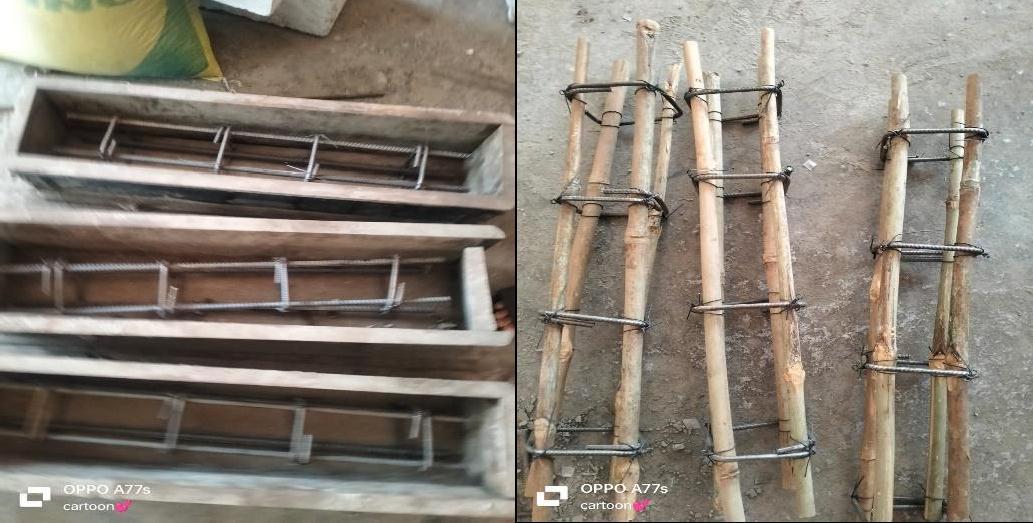
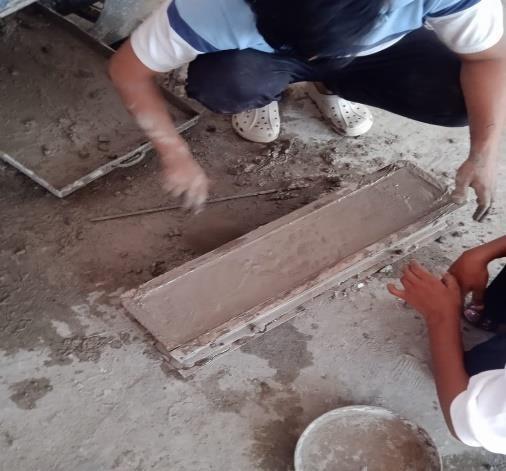
Thebeamsweredesignedhavingdimensions700mminlength,150mminwidth,150mmindepthandcoverof25mm.Bars of12mm,10mmandstirrupsof8mmataspacingof100mmwereusedineach3beams.Thelargerdiameter12mmbars areplacedinthebottomrowtoresistdeflectioneffects.
International Research Journal of Engineering and Technology (IRJET) e-ISSN: 2395-0056
Volume: 13 Issue: 01 | Jan 2026 www.irjet.net p-ISSN: 2395-0072
4. TESTING OF SPECIMEN
After the casting, the specimen was tested for flexural strength. We have to compare both steel and bamboo reinforcementwiththehelpofflexuralstrength.
FLEXURAL STRENGTH TEST:
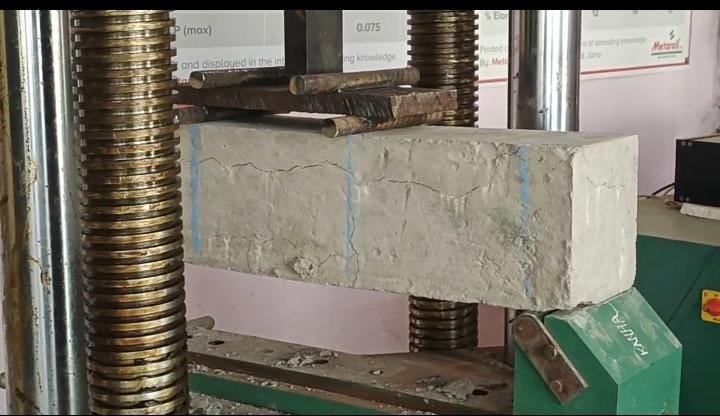
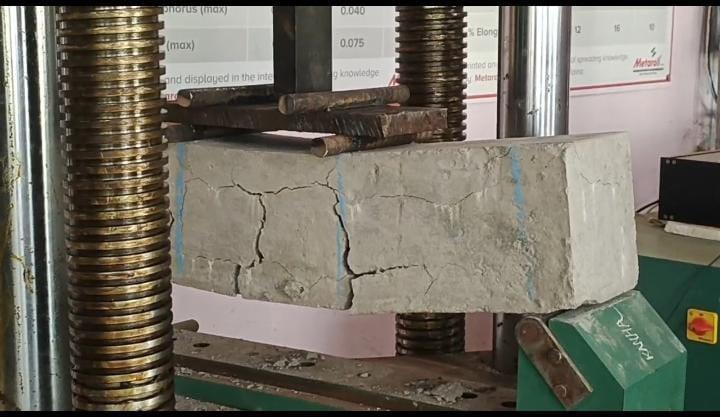
AllthebeamsaretestedintoflexuralstrengthbytheUniversaltestingmachine.Thebeamsweresimplysupportedovera span of 600mm the load were applied 1/3rd of itsspan. Theloadwasappliedcontinuouslyuntilthefirstcrackpointand ultimateloadreadingwerenoted;thebeamwasdeflectedafterapplyingload.
5. RESULT AND ANALYSIS
International Research Journal of Engineering and Technology (IRJET) e-ISSN: 2395-0056
Volume: 13 Issue: 01 | Jan 2026 www.irjet.net p-ISSN: 2395-0072
6. CONCLUSION
The seminar report shows that bamboo can substitute steel satisfactorily but not completely. The structural parts developedandstudiedcouldalsobeutilizedinmanybuildingconstructions.Bambooreinforcementtechnique isusedfor everymainanddistributionreinforcementasaresultofitwasalmostsameearlierindeephasslesteelreinforcement.It's three times cheaper than steel reinforcement technique. While bamboo can be used in specific low-load, temporary, or eco-consciousapplications,steelremainsthepreferredchoiceforlong-lasting,high-performancestructuralreinforcement.
7. REFERENCES
[1] Janssen,J.J.A.(2000).DesigningandBuildingwithBamboo.INBATechnicalReportNo.20. Anessentialsourceon bamboo’smechanicalpropertiesandconstructionapplications.
[2] Ghavami, K. (2005). "Bamboo as reinforcement in structural concrete elements." Cement and Concrete Composites,27(6),637–649.Discusses bamboo's potential asreinforcementandaddressesissueslikedurability andbondbehavior.
[3] Rahman,M.M.,Sultana,S.,&Shafi,M.A.(2011)."FeasibilityofBambooReinforcedConcrete."InternationalJournal ofCivil&EnvironmentalEngineering,11(5),41–45.
[4] Trujillo, D., Leijten, A., & Hunt, D. (2013). "Bamboo reinforced concrete: a critical review." Materials and Structures,47(9),1531–1541.Criticalreviewofbondstrength,durability,andstandardizationchallenges.