
International Research Journal of Engineering and Technology (IRJET) e-ISSN: 2395-0056
Volume: 13 Issue: 02 | Feb 2026 www.irjet.net p-ISSN: 2395-0072
International Research Journal of Engineering and Technology (IRJET) e-ISSN: 2395-0056
Volume: 13 Issue: 02 | Feb 2026 www.irjet.net p-ISSN: 2395-0072
Prof. Shruthi Rampure1 , Keerti2
1Professor, Dept. of Master of computer Application, VTU, Kalaburagi, Karnataka, India
2 Student, Dept. of Master of computer Application, VTU, Kalaburagi, Karnataka, India
ABSTARCT-Accurate identification of melanoma in dermoscopic images is critical for early diagnosis of skin cancer and prevention of disease progression. Reliable classificationofmalignantandbenignlesionsassistsclinicians in making informed diagnostic decisions and reducing unnecessarybiopsies.Thisresearchpresentsadeeplearning–based automated melanoma detection system using dermoscopicimagescollectedfrompubliclyavailabledatasets. A structured classification pipeline is developed using a pretrained convolutional neural network with transfer learning for feature extraction and classification. The network architecture is customized by modifying the final layers for binaryclassification.Modeltrainingisperformedusingbinary cross-entropy loss and optimized using the Adam optimizer. Experimental results demonstrate reliable classification performance and highlight the potential of automated melanoma detection systems as supportive tools for dermatologists.
Key Words: Melanoma detection, dermoscopic images, convolutional neural networks, deep learning, transfer learning.
Adeeplearning–basedframeworkforautomatedskinlesion analysisispresentedtoenhancemelanomadetectionfrom dermoscopic images. The study employs convolutional neural network architectures to perform integrated tasks such as lesion segmentation, feature representation, and classification within a unified system. By utilizing datadrivenfeaturelearninginsteadofconventionalhandcrafted methods, the model effectively captures complex morphological and textural characteristics of skin lesions. Emphasis is placed on preprocessing and precise lesion boundary extraction to improve feature quality and diagnostic performance.Experimental evaluation on large dermoscopicdatasetsdemonstratesimprovedclassification accuracy and model robustness. The proposed approach supports efficient and scalable implementation for computer-aided dermatological diagnosis. Its architecture enables consistent performance across varied imaging conditions and reduces dependence on manual interpretation.Thisworkcontributestothedevelopmentof reliable and clinically applicable automated melanoma detectionsystems.[2]
A comprehensive review of deep learning approaches for automatedskincancerdetectionusingdermoscopicimages
hashighlightedsignificantadvancementsinmedicalimage analysis.Thestudyevaluatedadvancedarchitecturessuchas convolutional neural networks, transfer learning models, andhybridframeworksforaccuratelesionclassification.It demonstrated that deep learning techniques achieve high diagnostic accuracy by extracting complex visual features directly from large-scale datasets. The importance of preprocessing, data augmentation, and optimizedtraining strategies in enhancing model performance and generalizationwasalsoemphasized.Amajorcontributionof the work is the systematic identification of current challenges,includingclassimbalanceandlimitedannotated medical datasets. Overall, the study provides a strong foundation for developing reliable, scalable, and clinically applicableAI-basedmelanomadetectionsystems.[3]
An advanced deep learning–based framework has been developedtoimprovemelanomaclassificationbyaddressing the challenge of class imbalance in dermoscopic image datasets.Thestudyintegratesconvolutionalneuralnetwork architectures with data balancing strategies such as augmentation and resampling to enhance classification performance. By mitigating the effects of imbalanced trainingdata,theproposedapproachsignificantlyimproves modelaccuracyandreducesmisclassificationofmalignant lesions. The research demonstrates that optimized data distributionandfeaturelearningcontributetomorereliable andconsistentdiagnosticoutcomes.Akeyachievementof the work is the successful enhancement of melanoma detectionperformancethrougheffectivehandlingofdataset imbalance.Thiscontributionprovidesastrongfoundation fordevelopingrobustandclinicallyreliableautomatedskin cancerdetectionsystems.[4]
A deep convolutional neural network framework with residual learning has been introduced to enhance the classificationofskinlesionsfromdermoscopicimages.The study employs residual network architecture to address challenges such as vanishing gradients and performance degradation in deep neural models. By enabling efficient feature propagation and deeper network training, the proposedmodelimprovestheextractionofcomplexvisual characteristics associated with skin cancer. Image preprocessing and augmentation techniques were incorporated to strengthen model generalization and classificationaccuracy.Akeyachievementofthisworkisthe significant improvement in diagnostic performance compared to conventional deep learning approaches. The studydemonstratestheeffectivenessofresiduallearning–
International Research Journal of Engineering and Technology (IRJET) e-ISSN: 2395-0056
Volume: 13 Issue: 02 | Feb 2026 www.irjet.net p-ISSN: 2395-0072
based CNN models in developing accurate, robust, and clinicallysupportiveskinlesionclassificationsystems. [5]
Melanomaisarapidlygrowingformofskincancerinwhich earlyandaccuratediagnosisplaysamajorroleinimproving patientsurvival.Conventionaldiagnostictechniquessuchas visual inspection, dermoscopic evaluation, and biopsy are widely used; however, these methods depend heavily on clinical expertise and may lead to variations in diagnosis. Manual examination of dermoscopic images is often timeconsuming and may produce inconsistent results due to differencesinlesionshape, color,andtexture.Inaddition, imageartifactssuchashair,noise,unevenillumination,and low contrast make accurate interpretation difficult, especially during early-stage detection. Limited access to experienceddermatologistsanddiagnosticfacilitiesinmany regionsfurtherdelaystimelyidentificationandtreatmentof melanoma.
Several computer-aided diagnostic systems have been introduced to support melanoma detection, but many existing approaches face challenges related to data imbalance, over fitting, and limited generalization across diverse datasets. Deep learning models, particularly ConvolutionalNeuralNetworks(CNNs),havedemonstrated strong capability in feature extraction and classification; however, variations in dermoscopic image quality and insufficient preprocessing techniques often affect performance.Moreover,thecomplexityoflesionboundaries andsimilaritiesbetweenbenignandmalignantlesionsmake classificationachallengingtaskforautomatedsystems.
Therefore,thereisaneedtodevelopareliableandefficient deep learning–based system that can accurately analyze dermoscopicimagesandassistinmelanomaclassification. Theproblemaddressedinthisprojectistodesignarobust diagnostic framework that incorporates effective preprocessing, segmentation, feature extraction, and classificationtechniquestoimprovedetectionaccuracy.The proposedsystemaimstosupportearlydiagnosis,minimize human error, and provide a dependable decision-support toolfordermatologicalanalysis.
The objective of this work is to develop an accurate classificationmodelusingaConvolutionalNeuralNetwork (CNN)–basedsystemcapableofclassifyingdermoscopicskin lesion images into benign and malignant melanoma categories with an overall accuracy exceeding 95%. The systemisdesignedtoreliablyidentifyandclassifymelanoma bydistinguishingitfromothercommonskinlesions,thereby supportingearlyandprecisedetectionofseriousskincancer conditions. To manage class imbalance in dermoscopic image datasets, techniques such as image augmentation,
transfer learning, and balanced sampling are applied to improve detection performance, especially for melanoma cases that appear less frequently in available data. In addition, visualization approaches are incorporated to highlight the important regions of the skin lesion that influence predictions and to provide meaningful understanding of the classification process, thereby improving clarity and strengthening clinical confidence in theautomatedmelanomadetectionsystem.
Theproposedmethodologybeginswithdatacollectionusing publiclyavailabledermoscopicimagedatasetssuchasISIC, HAM10000, and PH², supplemented by carefully verified skin lesion images annotated by dermatology experts to ensure the inclusion of both benign and malignant melanoma cases with special attention to rare and earlystage lesions. Image preprocessing is performed to standardize the input data through color normalization, resizing to 224×224 pixels, contrast enhancement, and artifact removal, followed by the application of lesionfocusedcroppingmethodstoisolatetheregionofinterest fromsurroundinghealthyskin.Thesepreprocessingsteps help maintain consistency across images and improve the qualityofinputdatausedfortrainingandtesting.
Dataaugmentationtechniquesincludingrotation,horizontal andverticalflipping,brightnessadjustment,zoomvariation, andnoisefilteringareappliedtoimprovedatasetdiversity and strengthen model stability during training. Model development is carried out using Convolutional Neural Networks (CNNs) with transfer learning from pre-trained architecturessuchasResNet50,EfficientNet,andMobileNet, whilebalancedsamplingandcarefultrainingstrategiesare incorporated to manage class imbalance and improve melanomadetectionperformance.Themodelsaretrained using structured validation methods along with tuning of learning rate, batch size, and optimization techniques to achievestableandreliableperformance.
Modelevaluationisconductedusingperformancemeasures suchasaccuracy,precision,recall,F1-score,ROC-AUC,and confusion matrix analysis, with particular emphasis on sensitivityformelanomadetectionduetothehighclinical riskassociatedwithmisseddiagnosisofmalignantlesions. Finally, visual interpretation techniques are applied to highlight important lesion regions influencing predictions and to provide meaningful insight into the classification process,therebyimprovingclarityandstrengtheningclinical confidenceintheautomatedmelanomadetectionsystem.
Tschandl et al. (2019) explored the role of collaboration between artificial intelligence systems and medical professionals in skin cancer recognition. Their research
International Research Journal of Engineering and Technology (IRJET) e-ISSN: 2395-0056
Volume: 13 Issue: 02 | Feb 2026 www.irjet.net p-ISSN: 2395-0072
demonstratedthatAI-assisteddiagnostictoolscanenhance the performance of clinicians by providing supportive predictionsandvisualexplanations.Thestudyemphasized that such collaboration improves diagnostic accuracy, especiallyforlessexperiencedpractitioners.However,the authors also highlighted that the reliability and interpretability of AI systems are essential, as incorrect predictionsmaynegativelyinfluenceclinicaldecisions.The researchconcludedthatcombininghumanexpertisewithAI technology can significantly improve melanoma detection outcomes.[1]
Li, Shen, and Xie (2018) proposed a deep learning-based frameworkforautomatedskinlesionanalysisandmelanoma detection. Their work focused on the application of convolutional neural networks for feature extraction, segmentation,andclassificationofdermoscopicimages.The study addressed challenges such as variations in lesion shape,color,andtexture,whichmakemelanomadetection complex. By using deep learning techniques and large dermoscopic datasets, the proposed system achieved improved performance in identifying skin lesions. The research demonstrated that deep learning models can effectively support early diagnosis and provide accurate classificationofmelanoma.[2]
Naqvi et al. (2023) presented a comprehensive review of deeplearningmethodsusedforskincancerdetection.The studyanalyzeddifferentmachinelearninganddeeplearning models, includingconvolutional neural networks,transfer learning approaches, and hybrid architectures. It emphasized the importance of image preprocessing, data augmentation, and high-quality datasets for improving model performance. The authors also discussed existing challenges such as data imbalance, limited availability of annotated medical datasets, and the need for model interpretability. The review concluded that deep learning hasshownsignificantpotentialinmelanomadetectionbut requires further improvement for practical clinical applications.[3]
Pham et al. (2021) focused on enhancing melanoma classification by addressing the problem of imbalanced datasets in medical imaging. Their research applied deep learning techniques along with data balancing strategies such as augmentation and resampling to improve classification accuracy. The study demonstrated that handlingdataimbalanceeffectivelyreducesmisclassification andimprovesthereliabilityofmelanomadetectionmodels. The results indicated that combining deep learning algorithms with proper data management techniques can significantly enhance the performance of automated diagnosticsystems.[4]
Hosny et al. (2022) presented a deep learning-based approach for classifying skin lesions using convolutional neural networks with residual learning techniques. The study aimed to improve the accuracy and reliability of
automatedskincancerdetectionsystems.Residuallearning was used to overcome challenges such as vanishing gradients and performance degradation in deep neural networks. The proposed model was capable of extracting complexfeaturesfromdermoscopicimages,leadingtobetter classificationresults.Imagepreprocessingandaugmentation techniqueswereappliedtoimprovemodelperformanceand handlevariationsinskinlesionimages.Theresultsshowed that the residual learning-based CNN achieved higher accuracy compared to traditional deep learning methods. Thestudyhighlightedtheimportanceoflargeanddiverse datasets for effective training of deep learning models. Overall, the research demonstrated that deep residual networks can support early melanoma detection and enhanceautomateddiagnosticsystemsinhealthcare.[5]
This project presents the development of an Artificial Intelligence (AI) and Deep Learning–based diagnostic framework for automated melanoma detection and classificationusingdermoscopicimageanalysis.Thesystem employs Convolutional Neural Networks (CNNs) to differentiatemelanomafrombenignskinlesions,enabling earlyandreliableskincancerdiagnosis.Earlydetectionof melanoma is critical in improving patient survival rates; however, traditional diagnostic procedures based on dermoscopicexaminationandbiopsyaretime-consuming, subjective,anddependentondermatologistexpertise.
Theproposedsystemutilizespubliclyavailabledermoscopic datasets such as ISIC, HAM10000, and PH² to train and validate the classification model. Image preprocessing techniques including normalization, resizing, artifact removal, and data augmentation are applied to enhance datasetqualityandimprovemodelgeneralization.ACNNbased architecture with transfer learning from pretrained models such as ResNet, VGG, and EfficientNet is implemented for automated feature extraction and lesion classification.
Themodelistrainedusingoptimizedhyperparametersand evaluated using performance metrics such as accuracy, sensitivity,specificity,precision,recall,F1-score,andROCAUCtoensurereliablediagnosticperformance.Explainable AI techniques such as Grad-CAM are incorporated to generatevisualheatmapshighlightingcriticallesionregions influencing model predictions, thereby improving interpretability and clinical trust. The developed system serves as an efficient decision-support tool for dermatologists, enhancing diagnostic accuracy, reducing manualworkload,andsupportingearlymelanomadetection throughautomateddermoscopicimageanalysis.
International Research
Volume: 13 Issue: 02 | Feb 2026 www.irjet.net
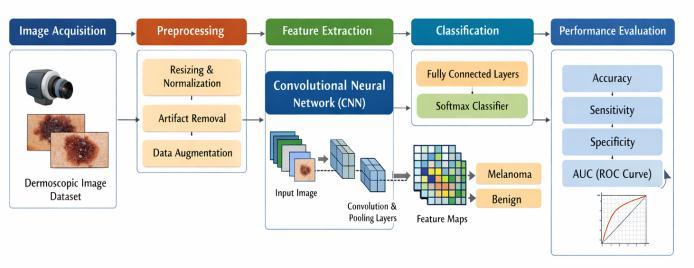
The proposed system is designed as an automated melanoma detection and classification framework using deep learning–based image analysis. The architecture followsastructuredpipelineconsistingofimageacquisition, preprocessing, feature extraction, classification, and performance evaluation modules to ensure accurate and reliablediagnosisofskinlesions.
Thesystembeginswiththecollectionofdermoscopicskin lesion images from publicly available melanoma datasets. These images undergo preprocessing operations such as image resizing, normalization, noise removal, and artifact eliminationtoenhancevisualqualityandensureuniformity. Dataaugmentationtechniquesincludingrotation,flipping, and scaling are applied to increase dataset diversity and improvemodelgeneralizationwhilereducingoverfitting.
Followingpreprocessing,theenhancedimagesarefedintoa ConvolutionalNeuralNetwork(CNN)architecturedesigned for automated feature extraction and lesion classification. The CNN employs multiple convolutional layers, pooling layers,andactivationfunctionstoextracthigh-levelspatial andtexturefeaturesfromdermoscopicimages.Thesedeep featuresenableprecisedifferentiationbetweenbenignand malignant skin lesions. Transfer learning strategies and optimized hyperparameters are incorporated to improve classificationperformanceandcomputationalefficiency.
Theextractedfeaturesarepassedthroughfullyconnected layers and a softmax classifier to categorize lesions into melanomaornon-melanomaclasses.Themodelistrained andvalidatedusinglabeleddermoscopicdatasetstoensure robustnessandreliability.Performanceevaluationiscarried out using standard metrics such as accuracy, sensitivity, specificity, and area under the curve (AUC) to assess diagnosticeffectiveness.
Theoverallsystemdesignprovidesanend-to-endintelligent diagnosticframeworkthatsupportsdermatologistsinearly melanoma detection, reduces diagnostic variability, and enhancesclinicaldecision-makingthroughautomatedand scalabledeeplearningtechniques.
International Research Journal of Engineering and Technology (IRJET) e-ISSN: 2395-0056
Volume: 13 Issue: 02 | Feb 2026 www.irjet.net p-ISSN: 2395-0072
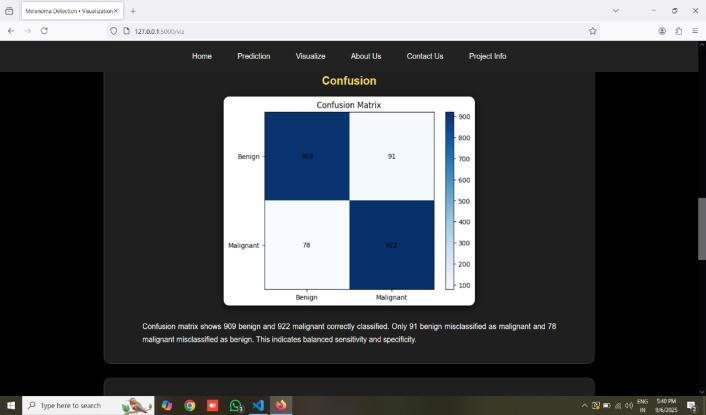
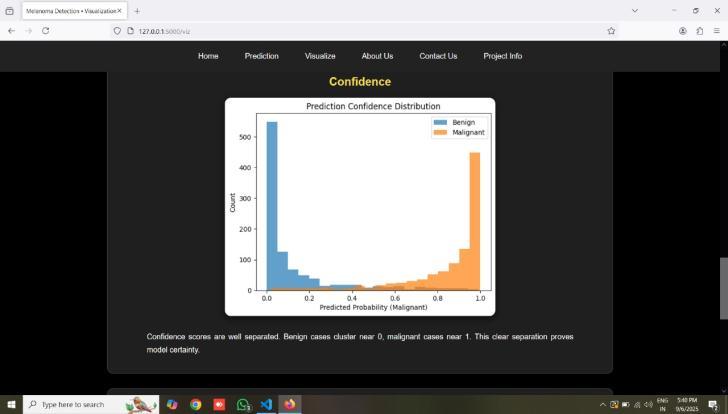
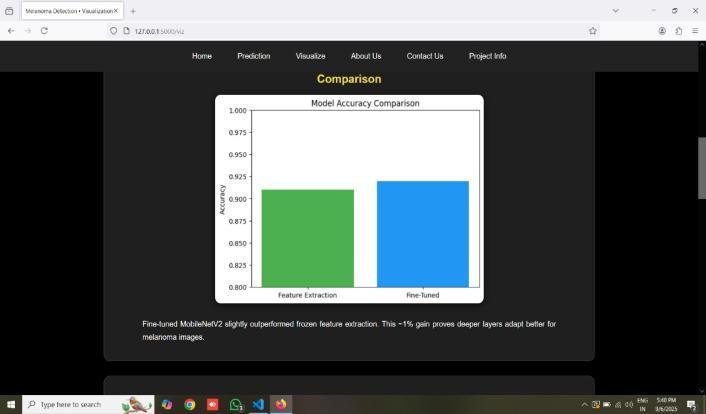
This work presented a deep learning–based diagnostic framework for automated melanoma detection using dermoscopic skin lesion images. The system integrates imagepreprocessing,augmentation,featureextraction,and classification through Convolutional Neural Networks to improve the accuracy and consistency of skin cancer diagnosis. By utilizing publicly available datasets and transfer learning–based CNN architectures, the model demonstrates reliable performance in distinguishing melanoma from benign lesions. Performance evaluation using accuracy, precision, recall, F1-score, and ROC-AUC confirms the effectiveness of the proposed approach in medicalimageclassificationtasks.
The developed system reduces dependency on manual examination and supports dermatologists by providing a computer-aided diagnostic tool for early melanoma screening. In addition, the integration of preprocessing techniques, class imbalance handling, and visual interpretation methods enhances model robustness and clinical reliability. The proposed framework can assist in improvingdiagnosticefficiency,minimizingfalsenegatives,
and enabling timely treatment planning in real-world healthcareenvironments.
Thesystemcanbefurtherenhancedbyincorporatinglarger and more diverse dermoscopic datasets to improve generalization across different skin types and imaging conditions. Integration of advanced deep learning architectures such as Vision Transformers, hybrid CNNTransformermodels,andensemblelearningtechniquesmay further improve classification accuracy and robustness. Futureresearchmayalsofocusonreal-timedeploymentof the model through web-based or mobile diagnostic applications to support remote healthcare and teledermatologyservices.
Incorporating clinical metadata such as patient history, lesion evolution, and genetic information can strengthen diagnostic decision support by enabling multi-modal analysis.Additionalimprovementscanincludeexplainable AItechniquesforbetterinterpretability,automatedlesion segmentationusingadvancedarchitectures,andvalidation through clinical trials. With continued refinement and integration into healthcare systems, the proposed framework has the potential to serve as an efficient and scalablesupporttoolforearlymelanomadetectionandskin cancerdiagnosis.
[1] Tschandl,P.,etal.,“Human–computercollaborationfor skincancerrecognition,”NatureMedicine, vol.25,no. 7,pp.1229–1234,2019.
[2] Li,Y.,Shen,L.,andXie,X.,“Skinlesionanalysistowards melanoma detection using deep learning network,” IEEE JournalofBiomedicalandHealthInformatics, vol. 23,no.2,pp.501–512,2018.
[3] Naqvi, R.A., et al., “Deep learning-based skin cancer detection:Acomprehensivereview,” MDPIDiagnostics, vol.13,no.4,pp.1–25,2023.
[4] Pham,T.C.,etal.,“Improvingmelanomaclassification using deep learning and data imbalance handling techniques,” NatureScientificReports, vol.11,pp.1–12, 2021.
[5] Hosny,K.M.,etal.,“Classificationofskinlesionsusing deep convolutional neural networks with residual learning,” JournalofMedicalSystems,vol.46,no.2,pp. 1–14,2022.
[6] Shafiq, M., et al., “Vision transformer-based deep learning model for melanoma detection with explainableAI,”IEEEAccess,vol.12,pp.1–12,2024.
[7] ISICArchive,“InternationalSkinImagingCollaboration (ISIC)datasetforskinlesionanalysis,”
International Research Journal of Engineering and Technology (IRJET) e-ISSN: 2395-0056
Volume: 13 Issue: 02 | Feb 2026 www.irjet.net p-ISSN: 2395-0072
[8] Cassidy, B., et al., “Analysis of melanoma detection benchmarks using ISIC datasets,” ScienceDirect –ComputerizedMedicalImagingandGraphics, vol.95, pp.1–10,2022.
[9] Giavina-Bianchi, M., et al., “Explainable artificial intelligence in dermatology: Clinical validation and challenges,”PMCDermatologyResearch, vol.9,no.3, pp.1–10,2023.
[10] Salinas, J., et al., “Artificial intelligence versus cliniciansinmelanomadetection:Asystematicreview,”
NatureDigitalMedicine, vol.7,pp.1–14,2024.