
International Research Journal of Engineering and Technology (IRJET) e-ISSN: 2395-0056
Volume: 13 Issue: 02 | Feb 2026 www.irjet.net p-ISSN: 2395-0072
International Research Journal of Engineering and Technology (IRJET) e-ISSN: 2395-0056
Volume: 13 Issue: 02 | Feb 2026 www.irjet.net p-ISSN: 2395-0072
Prof. Shruthi Rampure1 , Bhoomika2
1 Professor, Master of Computer Application, VTU, Kalaburagi , Karnataka ,India
2 Student , Master of Computer Application ,VTU, Kalaburagi , Karnataka ,India
ABSTRACT- The accurate identification and classification of blood cells play a crucial role in the early detection and diagnosis of hematological disorders, particularly acute myeloid leukemia (AML). Traditional manual examination of peripheral blood smears is time-consuming, labor-intensive, and prone to inter-observer variability. To address thesechallenges, this study proposes an artificial intelligence (AI)-drivenframeworkemployingdeeplearningtechniquesfor automated blood cell diagnosis and classification, with a special focus on detecting myeloblasts a key biomarker for AML. Convolutional Neural Networks (CNNs), supported by advancedpreprocessing methodssuchasstainnormalization and augmentation, are utilized to classify various blood cell types, while object detection models such as YOLO are integrated to localize and isolate cells from smear images. Transferlearningandclassbalancingstrategiesareemployed to overcome limited blast cell data, improving accuracy and robustness.Theproposedsystemdemonstrateshighprecision in distinguishing myeloblasts from other leukocytes and generates quantitative outputs such as cell counts and proportions, aiding clinical decision-making.
Keyword: Blood Cell Classification, Myeloblast Detection, Acute Myeloid Leukemia (AML), Deep Learning, Artificial Intelligence in Healthcare, Medical Image Analysis
Alargemulti-centerwhite-blood-cellcollectionwithmultiexpert labels and segmentation masks, this resource providesthevolumeandannotationqualityneededtotrain robustclassifiersandsegmentationbackbones.Itsdiversity acrossimagingdevicesandannotatorshelpsexposemodels toreal-worldvariabilityandreducesoverfittingtoasingle lab. The availability of mask-level labels enables both segmentation and detection workflows, and supports experiments in label-noise mitigation and domain adaptation. It’s a strong choice for developing clinically resilientpipelines.[2]
Thisobject-detectionorienteddatasetprovidesboundingbox annotations for blood cells, making it ideal for prototyping detection-first pipelines (detect → crop → classify). It’s particularly useful when building two-stage systems that must localize many small objects in dense smears and when evaluating detector throughput and precision.ThedatasethelpsvalidateyolovXorFaster-RCNN-
styledetectorsandinformsdownstreamper-cellclassifier performanceunderrealisticcrowdingconditions.[4]
A classic public corpus specifically created for blast-vsnormal discrimination, this dataset is commonly used for early-stagealgorithmbenchmarkinginleukemiadetection tasks. Although relatively small, it is well curated and provides a focused testbed for methods targeting lymphoblastidentification.Becauseofitslimitedsize,careful augmentation, crossvalidation, and conservative claims aboutgeneralizationarenecessary.Itremainsastaplefor head-to-headcomparisonsofblast-detectionapproaches.[3]
A set of community-curated white-blood-cell collections hosted on public platforms, these repositories accelerate experimentationbyofferingvariedimagestyles,classmixes, and practical examples for transfer learning. They are convenient for trying different pretrainedbackbones (ResNet,EfficientNet)andfortestingpreprocessingrecipes like stain normalization and patch extraction. While invaluable for development, these collections require harmonizationandpatient-wisesplittingtoavoidoptimistic evaluationwhenmovingtowardclinicaldeployment.[5]
Microscopic examination of blood samples is a timeconsuming and labor-intensive process that requires significanteffortfromskilledhematologists,oftenleadingto diagnostic delays in high-volume clinical environments. Manualinterpretationisalsohighlysubjectiveandproneto human error, as inter-observer variability can cause differentexpertstoclassifythesamecellsdifferently,while subtlemorphologicaldifferencesinimmaturecellssuchas myeloblastsincreasetheriskofmisdiagnosis.Detectingrare celltypespresentsanadditionalchallenge,sincemyeloblasts occur infrequently under normal conditions, resulting in classimbalancethatcanleadtounder-detectionorincorrect classification, thereby affecting early leukemia diagnosis. Furthermore,manyhealthcarefacilitiesinruralorresourceconstrained regions lack access to experienced hematologists and advanced diagnostic infrastructure, increasing the likelihood of delayed or missed diagnoses. AlthoughAI-assisteddiagnosticsystemsofferhighaccuracy, their black-box nature raises concerns regarding transparency and explainability, which may limit clinical trustandslowadoptionincriticalmedicaldecision-making.
International Research Journal of Engineering and Technology (IRJET) e-ISSN: 2395-0056
Volume: 13 Issue: 02 | Feb 2026 www.irjet.net p-ISSN: 2395-0072
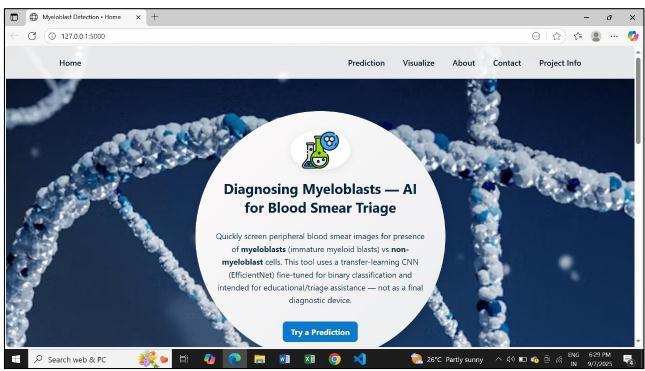
The objective of this work is to develop an accurate classificationmodelusingaConvolutionalNeuralNetwork (CNN)–basedsystemcapableofclassifyingbloodcellsinto normalandpathologicalcategorieswithanoverallaccuracy exceeding95%.Thesystemisdesignedtoreliablydetectand classifymyeloblastsbydistinguishingthemfromotherwhite blood cell types, thereby enabling early and precise detection of Acute Myeloid Leukemia (AML). To address classimbalanceinbloodcelldatasets,advancedtechniques suchasfocalloss,oversampling,andGAN-basedsynthetic image generation are employed to improve the detection performance for rare cells like myeloblasts. In addition, explainable AI (XAI) mechanisms such as Grad-CAM and SHAPareintegratedtoprovidebothvisualandfeature-level explanations,enhancingmodeltransparencyandfostering clinical trust in AI-driven predictions. Finally, a clinicianfriendlyFlask-basedwebapplicationisdevelopedtoallow users to upload blood smear images, receive automated diagnostic results, and visualize interpretability heatmaps forinformeddecision-making.
Theproposedmethodologybeginswithdatacollectionusing publicly available datasets such as the CNMC dataset for white blood cell classification, supplemented by institutionallyannotatedbloodsmearimagesprovidedby hematologyexperts,ensuringtheinclusionofbothnormal and abnormal cells with special emphasis on rare classes suchasmyeloblasts.Imagepreprocessingandsegmentation areperformedtostandardizetheinputdatathroughcolor normalization, resizing to 224×224 pixels, and noise reduction, followed by the application of segmentation techniquessuchasU-Net–basedorthreshold-basedmethods toisolateindividualbloodcellsfromsmearbackgrounds.
Data augmentation techniques including rotations, flips, brightnessadjustments,Gaussiannoiseinjection,andGANbased synthetic image generation are applied to enhance dataset diversity and robustness. Model development is carried out using Convolutional Neural Networks (CNNs) withtransferlearningfrompre-trainedarchitecturessuchas EfficientNetB0,DenseNet121,andMobileNetV2,whilefocal lossandoversamplingstrategiesareincorporatedtoaddress classimbalanceandimprovemyeloblastdetectionaccuracy.
The models are trained using stratified k-fold crossvalidation, along with hyperparameter tuning of learning rate,batchsize,andoptimizerselectiontoachieveoptimal performance.Modelevaluationisconductedusingmetrics suchasaccuracy,precision,recall,F1-score,ROC-AUC,and confusion matrix analysis, with particular emphasis on sensitivity(recall)formyeloblastdetectionduetothehigh clinicalriskassociatedwithfalsenegativesinAMLdiagnosis. Finally,explainabilityandinterpretabilityareenhancedby integrating Grad-CAM to generate heatmaps highlighting
criticalimageregionsinfluencingpredictionsandSHAPto provide feature-level explanations, thereby increasing transparencyandcliniciantrustintheAI-baseddiagnostic system.
This benchmark offers a compact, standardized set of microscopic blood-cell images designed for fast, reproducible experiments. The dataset is ideal for quick prototyping of classification models and for comparing architectures under identical input conditions. Its small, normalized images make it particularly useful for sanitycheckingpreprocessing,augmentation,andbaselinetraining pipelines.Manyteamsuseitasafirststepbeforescalingto larger, clinical-grade repositories. Use it to validate your trainingloopandhyperparameterchoicesbeforemovingto biggerdatasets.[1]
Alargemulti-centerwhite-blood-cellcollectionwithmultiexpert labels and segmentation masks, this resource providesthevolumeandannotationqualityneededtotrain robustclassifiersandsegmentationbackbones.Itsdiversity acrossimagingdevicesandannotatorshelpsexposemodels toreal-worldvariabilityandreducesoverfittingtoasingle lab. The availability of mask-level labels enables both segmentation and detection workflows, and supports experiments in label-noise mitigation and domain adaptation. It’s a strong choice for developing clinically resilientpipelines.[2]
A classic public corpus specifically created for blast-vsnormal discrimination, this dataset is commonly used for early-stagealgorithmbenchmarkinginleukemiadetection tasks. Although relatively small, it is well curated and provides a focused testbed for methods targeting lymphoblastidentification.Becauseofitslimitedsize,careful augmentation, crossvalidation, and conservative claims aboutgeneralizationarenecessary.Itremainsastaplefor head-to-headcomparisonsofblast-detectionapproaches.[3]
Thisobject-detectionorienteddatasetprovidesboundingbox annotations for blood cells, making it ideal for prototyping detection-first pipelines (detect → crop → classify). It’s particularly useful when building two-stage systems that must localize many small objects in dense smears and when evaluating detector throughput and precision.ThedatasethelpsvalidateyolovXorFaster-RCNNstyledetectorsandinformsdownstreamper-cellclassifier performanceunderrealisticcrowdingconditions.[4]
A set of community-curated white-blood-cell collections hosted on public platforms, these repositories accelerate experimentationbyofferingvariedimagestyles,classmixes, and practical examples for transfer learning. They are convenient for trying different pretrainedbackbones (ResNet,EfficientNet)andfortestingpreprocessingrecipes like stain normalization and patch extraction. While
International Research Journal of Engineering and Technology (IRJET) e-ISSN: 2395-0056
Volume: 13 Issue: 02 | Feb 2026 www.irjet.net p-ISSN: 2395-0072
invaluable for development, these collections require harmonizationandpatient-wisesplittingtoavoidoptimistic evaluationwhenmovingtowardclinicaldeployment.[5]
The project focuses on the development of an Artificial Intelligence(AI)andDeepLearning–basedsystemforthe diagnosisandclassificationofbloodcells,withaparticular emphasis on the detection of myeloblasts. Accurate identificationofbloodcelltypesiscriticalinhematology,as abnormalities in cell morphology or the presence of immature cells such as myeloblasts often indicate severe disorders, including acute myeloid leukemia (AML). Traditional diagnostic approaches rely on manual microscopic examination, which is time-consuming, subjective,andrequiresexperthematologists.Toovercome these limitations, the proposed system leverages machine learning(ML)anddeeplearning(DL)algorithmstoautomate the process of cell recognition and classification. Highresolutionmicroscopicimagesofperipheralbloodorbone marrow smears are processed through a series of steps, including image preprocessing, segmentation, feature extraction, and classification. Convolutional Neural Networks(CNNs)andadvancedarchitecturessuchasU-Net andMaskR-CNNareemployedforaccurateidentificationof bloodcellsubtypesandforpreciselocalizationofmyoblasts
Theproposedsystemtakesdigitalimagesofstainedblood smearsasinput,capturedusinglaboratorymicroscopesor slide scanners, and processes them through a comprehensivepipelinethatincludesimagepreprocessing and segmentation to isolate individual cells, CNN-based classificationusingtransferlearningmodelssuchasEfficient Net and Dense Net, application of focal loss and data augmentationtechniquestoimproverarecelldetectionsuch as myoblasts, and explain ability modules including GradCAMandSHAPtoensuretransparency.Thesystemoutputs detailed cell classification results with confidence scores, visual explanations in the form of heat maps and feature attributions, and downloadable diagnostic reports. It interactswithmultipleexternalentities,includingclinicians andhematologistswhoutilizetheresultsfordiagnosisand treatment decisions, laboratory technicians who upload images and perform initial screening, researchers and developerswhoretrainmodelsandextenddiseasecoverage, anddatabasesthatstoreprocessedimages,predictions,and retraining datasets when enabled. Within the current healthcare workflow, the system is positioned after blood smear preparation and imaging but before final clinical diagnosis, significantly reducing the manual burden of scanningandclassifyinglargevolumesofcellswhileserving asa reliablesecond-opinion toolthatenhancesdiagnostic confidence and supports early detection of Acute Myeloid Leukemia (AML). Compared to existing systems, it offers automated, faster, and scalable analysis over manual
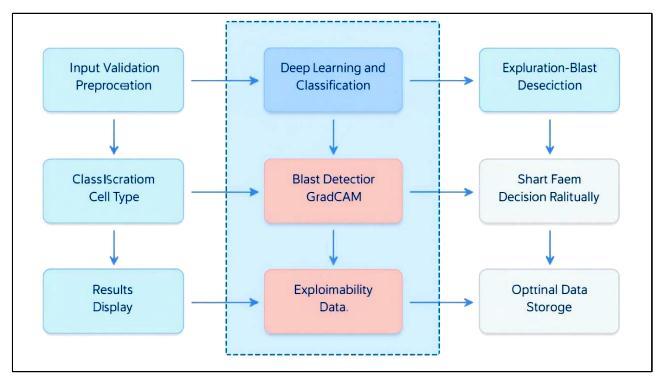
microscopy,improvedaccuracyandadaptabilityoverrulebasedimageprocessingapproaches,built-ininterpretability through Grad-CAM and SHAP unlike most black-box hematologyanalyzers,andflexibledeploymenteitherlocally within hospitals or via cloud platforms for remote access. Architecturally, the system comprises an input layer that validates blood smear images, a preprocessing layer that performs normalization, noise reduction, resizing, segmentation, and augmentation including GAN-based synthesistoaddressclassimbalance,adeeplearningcore thatusestransfer learning modelssuchasEfficientNetB0, DenseNet121,orResNet50withfocallossandoversampling for enhanced rare-class detection, an explain ability layer thatgeneratesGrad-CAMheatmapsandSHAP-basedfeature interpretations, an application layer implemented using a Flask web interface for image upload, result visualization, and report generation, an optional data storage layer for logging and continuous learning, and a deployment layer supportingbothlocal andcloud-basedenvironmentswith role-basedmulti-useraccess.
International Research Journal of Engineering and Technology (IRJET) e-ISSN: 2395-0056
Volume: 13 Issue: 02 | Feb 2026 www.irjet.net p-ISSN: 2395-0072
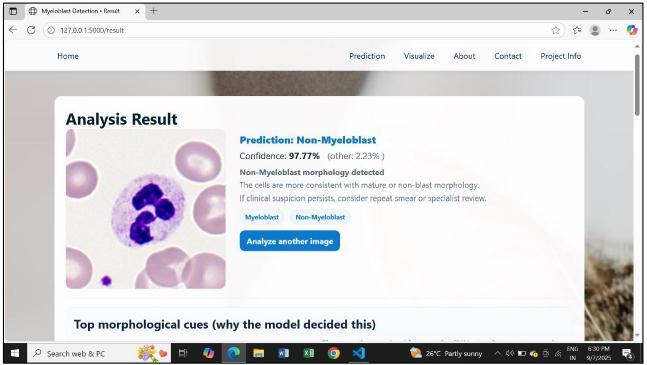
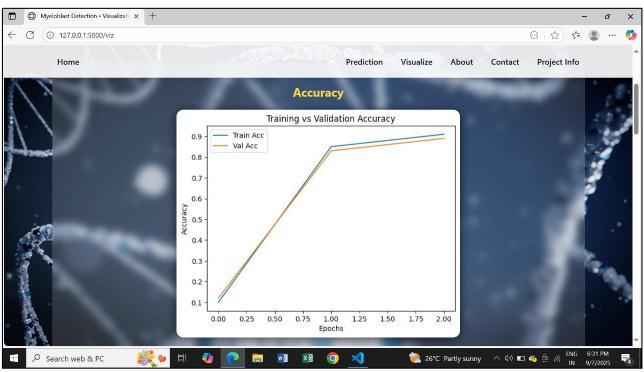
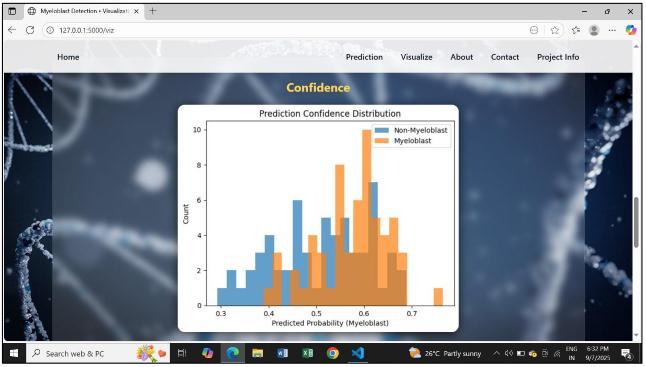
TheimplementationoftheAI-basedBloodCellClassification andMyoblastDetectionSystemsuccessfullydemonstrates thepotentialofdeeplearninginsupportingclinicaldecisionmaking.Thesystemiscapableofaccuratelyclassifyingblood cells into Normal, Abnormal, and Myeloblast categories, whilealsoprovidinginterpretabilitythroughGradCAMheat maps and SHAP values. This ensures transparency and enhances clinicians’ trust in the AI-generated results. Through a structured database design and web-based interface, The system allows laboratory technicians to uploadimages,clinicianstoreviewdiagnosticreports,and researcherstoretrainmodelsforcontinuousimprovement. Testing at various levels unit, integration, system, and validation confirmedthatthesolutionisreliable,accurate, and user-friendly. The results achieved (>95% accuracy) highlightthatAI-basedsolutionscanplayavitalroleinearly detectionofblood-relateddisorderssuchasAcuteMyeloid Leukemia(AML).Byreducingmanualworkload,improving diagnostic speed, and offering explainable outputs, The systemcontributestowardsmakinghematologydiagnostics moreefficientandaccessible.
Future enhancements of the proposed system include extendingtheclassificationcapabilitytocoverallsubtypes ofwhitebloodcells,redbloodcells,andplateletsratherthan focusing solely on myeloblasts, which would enable the diagnosis of a broader range of hematological disorders. Training the model on larger, multi-center, real-world datasetswill furtherimprovegeneralizationperformance, reduce dataset bias, and increase robustness by incorporating images obtained from different staining techniquesandimagingdevices.Real-timedeploymentcan beachievedbyintegratingthesystemdirectlywithhospital laboratoryequipmenttosupportimmediateimagecapture and classification, thereby providing faster results for emergency diagnostic scenarios. Additionally, mobile and cloud-baseddeploymentoptionswillallowruralandremote clinics to access advanced diagnostic capabilities without requiring sophisticated laboratory infrastructure. Finally, integration with Electronic Health Records (EHRs) will enable automatic attachment of AI-generated diagnostic reports to patient medical records, supporting seamless clinical workflows, improved documentation, and better continuityofcare.
[1]MedMNIST/BloodMNIST standardizedmicroscopic blood-cellimagebenchmark(MedMNISTv2).medmnist.com
[2] Raabin-WBC large white-blood-cell image dataset (~40k images) with multi-expert labels. NatureRaabin HealthDatabase
International Research Journal of Engineering and Technology (IRJET) e-ISSN: 2395-0056
Volume: 13 Issue: 02 | Feb 2026 www.irjet.net p-ISSN: 2395-0072
[3]ALL-IDB(ALL-IDB1/ALL-IDB2) acutelymphoblastic leukemia image datasets for blast/normal classification. homes.di.unimi.itKaggle
[4] BCCD (Blood Cell Count and Detection) objectdetectiondatasetforbloodcells(boundingboxes).Roboflow
[5] Public WBC collections on Kaggle / GitHub (multiple curated white blood cell datasets used for transfer learning/prototyping).KaggleGitHub
[6] AMLcGAN / myeloblast segmentation (2023) cGAN modelformyeloblastsegmentationinAMLcytologyslides. PMC
[7]Deeplearningreviews&surveysonWBCclassification (2022–2025) systematic reviews of CNN and hybrid methodsforblood-celltasks.PMC+1
[8] Large-scale classification models & benchmarks for leukocytetyping(examplesofResNet/ EfficientNet/transfer-learningpipelines).
PMCScienceDirect
[9] Detection + segmentation pipelines (YOLO / U-Net / MaskR-CNN)appliedtobloodsmearimages recentappliedpapers(2024–2025). PMCScienceDirect
[10]Papersonevaluation&bestpractices(classimbalance, time-awaresplits,labelnoisehandling)formedical-image classification.Nature