
International Research Journal of Engineering and Technology (IRJET) e-ISSN:2395-0056
Volume: 12 Issue: 08 | Aug 2025 www.irjet.net p-ISSN:2395-0072
International Research Journal of Engineering and Technology (IRJET) e-ISSN:2395-0056
Volume: 12 Issue: 08 | Aug 2025 www.irjet.net p-ISSN:2395-0072
Nyrah Gupta
Abstract - This research paper analyzes the stock price behavior of three major Indian companies State Bank of India (SBI), Maruti Suzuki India Ltd., and Sun Pharmaceutical Industries Ltd. through the application of mathematical modeling techniques. Historical stock price data was studied using Excel-based trendline tools to identify best-fit equations that represent the movement of each stock over time. The analysis revealed that SBI and Maruti stocks followed quadratic trends, reflecting steady growth patterns influenced by macroeconomic factors and sectoral stability. In contrast, Sun Pharma followed a cubic trend, indicating more complex fluctuations shaped by global pharma dynamics, regulatory events, and market cycles. The study further examines the relevance of the Efficient Market Hypothesis (EMH) in the context of these stocks, suggesting that while SBI and Maruti largely align with semi-strong market efficiency, Sun Pharma reflects partial inefficiency due to information asymmetry and event-driven volatility. By combining quantitative modeling with theoretical finance, this paper provides insights into how different sectors behave in the Indian equity market and how mathematical tools can aid in forecasting and investment decisions
Key Words: Stocks,trends,EMH,Mutualfunds
1. INTRODUCTION:
The stock market in India acts as a barometer for the economy and gauges investor confidence. It is one of the fastestgrowing economies in the world, having achieved a remarkable milestone in the capital markets since the economic liberalization in the 1990s. The two principal stock exchanges - Bombay Stock Exchange (BSE) and National Stock Exchange(NSE)serveasIndia'sfinancialsystembackboneastheyfacilitatetheseamlessflowoffunds,liquidityprovision toeverysector,andfostercorporategrowth.India’sstockmarkethastransformedfromfragmentedmanualtradingtoan electronicallylinked,sophisticatedsystemwithglobalintegrationandstringentregulations.
Agencies like SEBI have responsive policies that support enhanced transparency, protective measures for investors, and overall increased efficiency of the market aid greatly to regulating agency effectiveness. As such, diverse categories of investors retail,institutional,andforeign havebeendrawntotheIndianmarkets,whichnowfeaturevariousfinancial instrumentssuchasequities,derivatives,mutualfunds,andexchange-tradedfunds(ETFs).
Inaddition, with the growth ofretail investors,increasedlevelsof digitalization,andintegration intoglobal markets,the Indian stock market is poised for phenomenal growth in the coming years. It still needs to deal with issues related to volatility, the unpredictability of macroeconomic factors, and global financial influences. The focus of this paper stems from a historical and contemporary lens on the Indian stock market concerning its structure, performance, regulatory framework,andemergingtrends,andcoversbothsidesoftheanalysis.
The stock market is a complex system influenced by various factors such as economic conditions, political events, and investor sentiment, making stock price prediction a challenging task. Accurate forecasting, however, is essential for investorsandfinancialinstitutionsaimingtomakeinformeddecisions.
Toaddressthis,mathematical modelshave been developed toanalyzehistorical pricedata and identifypatternssuchas ARIMAorLSTM,whichofferastructuredapproachtopredictingfuturestockpricesbasedonpasttrends.
Thispaperexploresthe effectivenessofthe[insert model]inforecastingstock pricesusinghistorical data.The goal isto understandhowthemodelworksandevaluateitsaccuracyinreal-worldfinancialscenarios.
BankstocksareamajorsegmentoftheIndianstockmarketastheyindicatethelevelofeconomicstabilityandliquidity,as well as credit activity within the country. The stocks signify equity stakes in banking companies and are subdivided into publicsector banks(PSBs) andprivate sector banks. PSBs are state-owned banksincorporatedinIndia, which dominate
International Research Journal of Engineering and Technology (IRJET) e-ISSN:2395-0056
Volume: 12 Issue: 08 | Aug 2025 www.irjet.net p-ISSN:2395-0072
becausetheyhavebeenthemaindriverssincetheywerecreatedtofollowgovernmentpoliciesinlending,particularlyto farmers and in neglected regions. On the other hand, private sector banks are more efficient because of their better management systems, aggressive digital focus, strong profit orientation, and excellent customer care service rivaling internationalplayers.Investorsoftenevaluatebankstocksbasedonindustry-specificbenchmarkslikeNetInterestMargin (NIM),grossandnetnon-performingasset(NPA)ratios,CapitalAdequacyRatio(CAR),alongwithreturnonassetsRoA). The perception of specific bank stocks is shaped by their performance relative to key operational factors, along with broadereconomicelementslikeinterestratetrendsormonetarypolicystance.Somemajorplayersinclude:
● PublicSectorBanks(PSBs):
StateBankofIndia(SBI) BankofBarodaorPunjabNationalBank(PNB)
● PrivateSectorBanks:
HDFCBankorICICIBank AxisBankorKotakMahindraBank
ThesebanksarepartoftheNiftyBankIndex,whichactsasasectoralbenchmarkforbankingstockslistedontheNational Stock Exchange of India (NSE). There have been some meaningful changes in the sector, such as digitalization, stricter recognitionnormsforNPAs bytheReserveBank ofIndia,andtheconsolidationof weak PublicSectorBanks(PSBs)into strongerones.Asaresult,bankequitiesarenotonlyimportantforassessingthehealthoffinancialservicesandservesas an investment opportunity for those looking to hold stocks over a period of time. Due to these investments being longterminnature,theyseekcontinuousspendableincomeindividends. However,duetotheircyclicalnature,regulatoryand economictrendsneedtobecloselymonitored.
The automotive industry is central to India’s industrial development, along with its socio-economic advancement, gross domesticproduct(GDP),employmentopportunities,aswellasearningsfromexports.Itincludesdifferentsegmentssuch as two-wheelers, passenger and commercial vehicles, and auto components. The sector is deemed cyclical due to its dependence on economic activity, fuel prices, interest rates, consumer spending patterns, and overall market sentiment. TherehavebeengreatchangesinIndia’sautomotiveindustryovertheyears.Ithastransformedfromaprotectedlicensedriven system into a modern, competitive, innovation-based industry. Government support through initiatives like Make in India FAME(Mastering Electric Vehicles) program for faster adoption of hybrids or electric vehicles, and productionlinkedincentiveschemesfortheautomobileindustryhaveaidedingrowthandmodernization.Factorsaffectinginvestor interestinautomobilestocksincludesalesdataregionallyorglobally,capacityutilizationmetricsforplants,inputcostsof steeloraluminium,fuelprices,EVtrends,alongotheremergingtechnologiescenteredonautonomousmobility.
KeyplayersintheIndianautomobilesectorinclude:
1. Passenger Vehicles:
● MarutiSuzukiIndiaLtd
● TataMotors
● Mahindra&Mahindra
2. Two-Wheelers and Three-Wheelers:
● HeroMotoCorp
● BajajAuto
● TVSMotorCompany
3. Commercial Vehicles:
● AshokLeyland
● EicherMotors(alsoknownforRoyalEnfieldbikes)
International Research Journal of Engineering and Technology (IRJET) e-ISSN:2395-0056
Volume: 12 Issue: 08 | Aug 2025 www.irjet.net p-ISSN:2395-0072
● BoschLtd
● MothersonSumiSystems
● BharatForge
AgoodportionofthesecompaniesalsoformpartofkeyindicessuchastheNiftyAutoIndexthattracks theperformance oftopautomotivesectorstocks.
Given the accelerated push towards electric-powered mobility (mobility), increased urbanization, accompanied by rising incomelevels,hashadapositivelong-termoutlookforstockpriceappreciation.
The pharmaceutical industry in India is one of the most crucial and strategically important sectors of the economy, significantly enhancing the country’s healthcare ecosystem and contributing to global supply chains. Nicknamed “PharmacyoftheWorld”,Indiaisthelargestsupplierofgenericsandranksthirdgloballyintermsofvolumeproductionof pharmaceuticals. This includes generic medicines, active pharmaceutical ingredients (APIs), OTC drugs, vaccines, biosimilars,andotherhealthcareproducts.ThesectorissupportedbyrobustR&Dinfrastructurewithan effective,skilled workforce, low-cost manufacturing facilities, and supportive policies. There have been advancements within the sector owingtosubsidizedprogramslikePharmaVision2020,PLISchemeforPharmaceuticals,aswellasregulatorybodieslike CDSCO,whichencouragedinnovationthroughsupportiveframeworks.
ThesebusinessesarethekeyconstituentsoftheNiftyPharmaIndex,whichindicateshowwellthelistedcompaniesinthe pharmaceutical sector are performing. During the COVID-19 pandemic, India’s pharma industry helped global public health by producing and exporting vaccines. There is sustained expected growth in Indian pharmaceutical firms due to increased global demand, advancements in biotechnology, increased funding for R&D and clinical trials, and growing investment opportunities. On the other hand, pricing pressure in export markets, compliance issues with regulations on governance systems or business practices, and over-dependence on supply chains excluding China are a few of the challengesthatthesecompaniescouldface.
Pharmaceuticalcompanieshavebeenstrategicallypositionedworldwide,andthus,thepurchasesfromIndia’sspecialized Capsule Pharmacies are not a random occurrence. It has shown stable growth owing to its diverse product range, increased focus on specialty drugs, and robust financials. Their stock price is currently hovering around ₹1,700 with a 21%increaseYoYreturnasofMay2025.
Its revenue is projected to rise at a compound annual growth rate (CAGR) of roughly 20% until FY27. Owing to strong regulatory pressures like the USFDA examination of the Halol facility, Sun Pharma still operates in key markets such as TildrakizumabandSonidegib.WealsoobserverevisionincorporategovernanceviaaddingMDsforNorthAmerica,which letsthemdeepentheirglobalreach.
Lastly,theirtotalrevenuestranslatedinto₹52,578croreandnetprofitsattrackable₹10,980crorebyFY25.SunPharma currently possesses an advanced debt equity ratio alongside an adequate return on equity figure of 0.015 due to recent strategic,heftyacquisitionsthatsupportinnovation,makingitanattractivelong-termholdinIndia’spharmamarket
5.1 Maruti Suzuki Ltd:
Maruti Suzuki, India's biggest carmaker, has been navigating a patchy economic landscape, and its latest results paint a mixedpicture.InthefourthquarterofFY25,thefirmpostedaconsolidatednetprofitof₹3,911crore,downslightly1from ₹3,952 crore a year earlier. Revenue, however, climbed 6.4 and reached ₹40,920 crore, but rising costs squeezed the EBITDAmargin,whichslippedfrom13to12.
ForthefullfiscalyearFY25,MarutiSuzukinettedabout₹14,500crore,a 7.5%increaseovertheprevious year's ₹13,488 crore.Totalrevenuegrewnearly8,reaching₹152,913crore,andthe boardrewardedinvestorswitharecorddividendof ₹135ashare,pushingthetotaloutlaypast₹4,200crore.
International Research Journal of Engineering and Technology (IRJET) e-ISSN:2395-0056
Volume: 12 Issue: 08 | Aug 2025 www.irjet.net p-ISSN:2395-0072
Maruti Suzuki confronted multiple headwinds over the past year. In the fourth quarter, stand-alone profit slipped 4.3 percent to ₹3,711 crore, primarily because the company deepened discounts, stepped up marketing, and incurred prelaunchcostslinkedtoupcomingelectricvehicles.Atthesametime,thepriceofrawmaterialsclimbedroughly20percent, and other operating expenses rose 14.5 percent, placing additional strain on profit margins. As a result, the firm's operationalmargineasedfromabout10.8percentto8.7percent,signallingtighteningcontrolovercosts.
Looking forward, Maruti is pursuing decisive, long-term investments. Suzuki, the group's parent, has pledged to devote roughlyhalfitsworldwidecapitalspendingtoIndia,avoteofconfidencein Maruti'sgrowthstory.Thecarmakerintends to raise annual output capacity to four million vehicles by 2030 and will focus on rural demand, exports, and expanded electric-vehiclesupply.KeyinitiativesincludecommissioninganewHaryanaplantandrollingouta₹7,000-croreroadmap dedicatedtoEVdevelopmentandsupportinginfrastructure.
On the market side, Marutis shares change hands at about 26 times earnings and 4.2 times book value, while return on equitysitsnear16percent.Thefirmcarriesnodebt,furtherreinforcinganalreadysolidbalancesheetandleavingroom forcontinuedlong-termfunding.
State Bank of India (SBI), India’s biggest public lender, delivered a mixed set of numbers for the fourth quarter of FY25. Theheadlinenetprofitcameinat₹18,643crore,downnearly10%from₹20,698crore ayearearlier,mainlybecausethe lendersetasidemoremoneytocoverbadloans.Provisionsjumpedover20%to₹3,964crore,andthenetinterestmargin, orNIM,contracted32basispointsto3.15%.Onabrighternote,netinterestincomerose2.7%to₹42,775crore,thanksto steadycreditoff-takeandacalmrateclimate.Shareholderswillreceiveadividendof₹15.90ashare.
Forthefullfiscalyear,thebankstillchalkeduparecordnetprofitofover₹70,900crore,markingahealthy16%increase fromFY24.Operationalprofitinthefinalquarterclimbed8.8%onayear-on-yearbasisto₹31,286crore.Assetqualityalso improved,withgrossNPAsfallingto1.82%andnetNPAsretreatingtojust0.47%.
MarketexpertsarebroadlypositiveintheiroutlookforSBI.BrokerageslikeMotilalOswalandKotakSecuritieshavegiven "Buy"callswithpricesbetween₹925and₹975,basedonrobustfundamentals,enhancingassetquality,andsteadycredit growth.ICICISecuritiesupgradeditstargetpriceto₹950,suggestingupbeatmedium-termgrowth.UBSismoredownbeat in its assessment, with a neutral call having a target of ₹840. Technical analysts point to a short-term support range between₹793and₹781,withresistancepointsat₹834.
Inthefuture,SBI'sstrategyinvolvesbolsteringitsbalancesheetbyraisingupto₹25,000croreofcapitalthroughqualified institutional placement (QIP) or follow-on public offer (FPO). This capital increase should enable its credit growth and digital drive. Although margin pressure from possible rate cuts and decelerating loan growth are issues of concern, expectedstabilityininterestratesandcontinuousupgradeinassetqualitycanserveaspositivedrivers.Furthermore,the bank'ssolidretailandcorporatebankingunits placeitingoodstandingtocapitalizeontherecoveryintheeconomyand risingcreditdemand.
SunPharmaIndustriesLtd.,India'slargestandmostinternationallyknownpharmaceuticalfirm,postedamixedQ4FY25 performance. Its consolidated net profit fell 19% year-on-year at ₹2,154 crore largely because of higher input costs and exceptionalsonrestructuringofitsUSbusinesses.Onanexceptional item-adjusted net profitgrowth basis,however,the firmactuallyincreased4.8%to₹2,889crore,whichindicatesoperationalstrengthatitscore.Revenueinthequartergrew by about 8.5% year-on-year to nearly ₹12,958 crore due to robust growth in domestic formulation and its specialty productdivision.ThecompanyalsoenhanceditsEBITDAmarginto28.7%,withEBITDAgrowing22.4%at₹3,716crore.
For FY25, Sun Pharma had an adjusted net profit of ₹11,984 crore, with a 19% increase from the last year, and overall consolidated revenue of ₹52,041 crore. Sales in India were the highlight, growing by 13.7% from the previous year to ₹16,923crore.ThespecialtydivisiontoowitnessedgoodperformancewithrevenuesofmorethanUS\$1.2billion,which contributedtoapproximately20%ofthefirm'soverallsales.ExternaActivePharmaceuticalIngredient(API)businessalso saw healthy growth, both on a year-on-year basis and in the last quarter, adding to the revenue diversification of the company.
International Research Journal of Engineering and Technology (IRJET) e-ISSN:2395-0056
Volume: 12 Issue: 08 | Aug 2025 www.irjet.net p-ISSN:2395-0072
Market response to the Q4 performance was subdued. The stock fell by close to 5% in intraday trade after the result announcement, amid fears of a decline in reported profit. Nevertheless, most analysts pointed out the underlying resilienceevidencedinadjustedprofitsandbettermargins.Thegroupdeclaredafinaldividendof₹5.50pershare,taking theFY25totaldividendto₹16pershare,maintainingitstrendofshareholderreturn.
Strategically,SunPharmaisbuildingmoreemphasisonspecialtytreatment,particularlyinoncologyanddermatology.The Checkpoint Therapeutics takeover, which adds the skin cancer treatment UNLOXCYT, should help bolster its oncology pipeline as well as fund its international specialty growth. However, the firm is beset by near-term issues such as more than₹800croreofanticipatedmarketingcosts,increasedtaxoutgo,andpossiblemarginsqueezes.Afewbrokerageshave adjusted their earnings estimates a bit lower based on these considerations, but the long-term perspective remains optimistic.
In short, Sun Pharma remains well-placed in the pharma space with a diversified portfolio, stable specialty growth, and strong R&D investment. Short-term profitability could take some hit from increasing costs and strategic outlays, but the company's long-term fundamentals remain sound. Its steady emphasis on innovation, specialty medicine growth, and internationalfootprintmakeitastalwartplayerindomesticaswellasoverseaspharmamarkets.
TheEfficientMarketHypothesis(EMH)positsthatallavailableinformationisalreadyreflectedinastock'sprice,makingit impossible to consistently achieve returns higher than the market average through technical or fundamental analysis. UnderEMH,stockpricemovementsarelargelyrandomandreactimmediatelytonewinformation.
1. SBI (State Bank of India):
Asapublicsectorbankinggiant,SBIoperatesinahighlyregulatedenvironmentwithsubstantialgovernment influence. Most of its financial data such as quarterly earnings, interest rate impacts, and regulatory changes is publicly available. Under EMH, this transparency means SBI’s stock price quickly incorporates macroeconomic and policy-related information. However, in reality, market overreactions to budget announcements or RBI policy hints suggest that semi-strong efficiency (where prices reflect all publicly availableinfobutnotprivate/internalinformation)maybetterapply.
2. Maruti Suzuki:
Maruti,beingIndia’slargestcarmanufacturer,isinfluencedbyconsumerdemand,inputcosts,fuelprices,and regulatory shifts in the automobile sector. These are typically well-covered in the media and by analysts, so underEMH,itsstockpriceshouldadjustrapidlytosuchchanges.However,investorsentiment,festiveseason sales expectations, and policy speculation sometimes cause delayed or exaggerated price reactions, again aligning more with semi-strong form EMH. Short-term inefficiencies may persist due to behavioural biases andmarketspeculation.
3. Sun Pharmaceuticals:
A company in the pharmaceutical industry, like Sun Pharma, establishes a relationship with EMH that is definitely more complicated. Although the public is disclosed with the financial results and performance, somesignificant eventslike clinical trial outcomes,FDA news,or tradesinthepatentmarketare notalways equallyknown.Theseeventsmayresultinunexpectedpricechangesthatarenotnecessarilypredictedbythe market,thusindicatingweakerefficiencyortransitionalinefficiencyintheshortperiodoftime.Buttheprices usuallyreturntothelevelconsistentwiththemainnewsinthelongrun.
SBI,Maruti,andSunPharmahavebeenselectedasthefocusofthisfinance,economic,andmathematicalresearchpaper due to their significance in India's stock market, their representation of major industry sectors, and the richness of available quantitative data. By analyzing these three companies, valuable insights can be gained into their financial health,sectoraltrends,andbroadermacroeconomiclinkages.
International Research Journal of Engineering and Technology (IRJET) e-ISSN:2395-0056
Volume: 12 Issue: 08 | Aug 2025 www.irjet.net p-ISSN:2395-0072
● SBI representsthebankingandfinancialservicessector,abarometerforIndia’seconomyandcreditenvironment.
● Maruti Suzuki is a leader in automotive manufacturing, indicative of consumer demand cycles, manufacturing trends,andsectoralreforms.
● Sun Pharma stands out in pharmaceuticals, known for its specialty generics and branded formulations leadership,reflectinghealthcaretrends,R&Dexpansion,andexportdynamics.
DiversityandComparativeModelling
● Studying these companies enables cross-sector comparisons banking (SBI), manufacturing (Maruti), and healthcare(SunPharma) allowing analysisofsector-specific financial strategies,growth drivers,and resilience duringmacroeconomicshifts.
● Each company provides year-wise quantitative data, facilitating advanced regression, time-series, and optimizationmodellingcarriedoutusingrealstockprices,balancesheetfigures,andindustryindexes.
DataAvailabilityandAnalyticalDepth
● These stocks are widely tracked in both academic and investment communities, yielding high-quality historical financials,ESGprofiles,andglobal-comparablefinancialratios(P/E,growth,margins,debtlevels).
InsightsintoFinancialHealthandSectorTrends
● By studying SBI, Maruti, and Sun Pharma, researchers can identify how industry leaders respond to market shocks,sectorreforms,policychanges,andglobalsupplychallenges.
● For Sun Pharma, the investigation can highlight the impact of product mix shifts, specialty launches, and cost managementonmarginsandshareprice.
ApplicationofAdvancedMathematicalTechniques
● The data richness supports regression (linear, polynomial), logistics modelling (growth plateaus, carrying capacity),andtime-seriesanalysis(cyclicsalesandpricemovement),allvitalforresearchingeconomiccyclesand stockmarketbehaviours.
ApplicationofAdvancedMathematicalTechniques
● The data richness supports regression (linear, polynomial), logistics modelling (growth plateaus, carrying capacity), and time-series analysis (cyclic sales and price movement), all vital for researching economic cycles andstockmarketprediction.
● Sectoral modelling and optimization (e.g., portfolio construction, risk-reward quantification) become feasible withvarieddatasetattributesfromthesecompanies.
● Thecompanies’performancesareoftencorrelatedwith broadereconomicindicators suchasGDPgrowth,credit cycles(SBI),consumerdemand(Maruti),andhealthcareinfrastructure(SunPharma).
DataAvailabilityandAnalyticalDepth
● These stocks are widely tracked in both academic and investment communities, yielding high-quality historical financials,ESGprofiles,andgloballycomparablefinancialratios(P/E,growth,margins,debtlevels).
● Sun Pharma’s well-documented expansion in specialty products, Maruti’s consumer sales cycles, and SBI’s regulatory-driven financials allow for robust mathematical investigation such as regression analyses, sectoral correlationstudies,andpredictivemodelling.
International Research Journal of Engineering and Technology (IRJET) e-ISSN:2395-0056
Volume: 12 Issue: 08 | Aug 2025 www.irjet.net p-ISSN:2395-0072 © 2025, IRJET | Impact Factor value: 8.315 | ISO 9001:2008 Certified Journal | Page526
a. StockPriceofSBIBank:
AfterdrawinganumberofcurvesonthegraphforSBI.
Curvefittingbytakingvaluesof2012,2013,and2025.
X=3,4,16
Y=210,209,768(roundedoff)
In
Usingacalculator,wecalculated,
Formula:
(And)
Inthegraph,thex-axisasyearsfrom2010to2025,andtheY-axisshowstheSBIBankstockprice(inrupees)
Let’sconsider2010as1,2011as2……..2025as16.
AftermanuallydrawingagraphonExcel
Weconcludedquadraticequationcoversthemaximumnumberofplots,considering
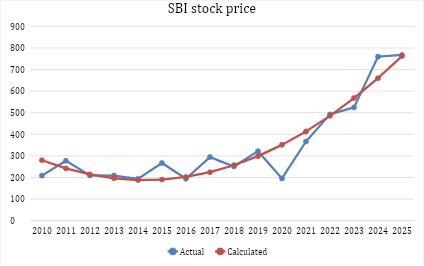
Chart -1:ActualDatavsCalculatedEquationofSBIstockprice
International Research Journal of Engineering and Technology (IRJET) e-ISSN:2395-0056
Volume: 12 Issue: 08 | Aug 2025 www.irjet.net p-ISSN:2395-0072
Formula:
Where “y” represents SBI Bank stock price (in rupees) and “x” represents 1, 2, 3…… (1 represents 2010, 2 represents2011,andsoon)
b. StockPriceofMarutiSuzuki:
AfterdrawinganumberofcurvesonthegraphforSBI.
Curvefittingbytakingvaluesof2012,2013,and2025.
X=4,5,13
Y=1280,1976,7574(roundedoff)
In
Usingacalculator,wecalculated,
Formula:
(And)
Inthegraph,thex-axisasyearsfrom2010to2025,andtheY-axisshowsMarutiSuzuki'sstockprice(inrupees)
Let’sconsider2010as1,2011as2……..2025as16.
AftermanuallydrawingagraphinExcel
Weconcludedquadraticequationcoversthemaximumnumberofplots,considering
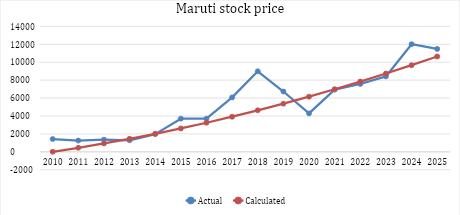
Chart -2:ActualDatavsCalculatedEquationofMarutiSuzukistockprice
© 2025, IRJET | Impact Factor value: 8.315 | ISO 9001:2008 Certified Journal | Page527
International Research Journal of Engineering and Technology (IRJET) e-ISSN:2395-0056
Volume: 12 Issue: 08 | Aug 2025 www.irjet.net p-ISSN:2395-0072
Formula:
Where “y” represents Maruti Suzuki stock price (in rupees) and “x” represents 1, 2, 3…… (1 represents 2010, 2 represents2011,andsoon)
c. StockPriceofSunPharma:
AfterdrawinganumberofcurvesonthegraphforSBI.
Curvefittingbytakingvaluesof2012,2013,and2025.
X=4,5,13
Y=221.15,575,500.9,688.75(roundedoff)
In
Usingacalculator,wecalculated,
Formula: (And)
In the graph, the x-axis as years from 2010 to 2025, and the Y-axis shows Sun Pharmaceutical's stock price (in rupees)
Let’sconsider2010as1,2011as2……..2025as16.
AftermanuallydrawingagraphonExcel.
Weconcludedcubicequationcoversthemaximumnumberofplotsconsidering
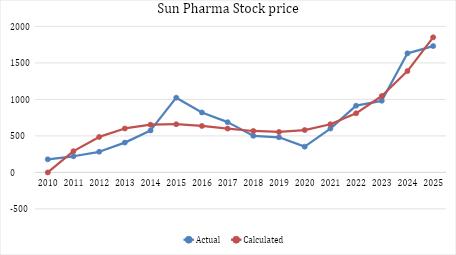
Chart -3:ActualDatavsCalculatedEquationofSunPharmastockprice
© 2025, IRJET | Impact Factor value: 8.315 | ISO 9001:2008 Certified Journal | Page528
International Research Journal of Engineering and Technology (IRJET) e-ISSN:2395-0056
Volume: 12 Issue: 08 | Aug 2025 www.irjet.net p-ISSN:2395-0072
Formula:
Where “y” represents Sun Pharmaceutical's stock price (in rupees) and “x” represents 1, 2, 3…… (1 represents 2010,2represents2011,andsoon).
ThisresearchanalyzedstockpricetrendsofthreemajorIndiancompanies StateBankofIndia(SBI),MarutiSuzuki,and SunPharma usingmathematicalmodelstoidentifyunderlyinggrowthpatternsandinterpretsector-specificbehavior. Byfittingtrendlinestohistoricalpricedata,itwasfoundthatSBIandMarutifollowedquadraticmodels,whileSunPharma exhibitedacubictrend
ThequadratictrendsinSBIandMarutistockssuggestaparabolicgrowthpattern,characterizedbysteadyaccelerationor decelerationovertime.SBI’sperformancealignswithmacroeconomicfactorssuchasinterestrates,governmentpolicies, and financial sector reforms, which influence its stable and structured price movement. Similarly, Maruti’s trend reflects demand dynamics in the automobile sector, consumer confidence, and fuel pricing, which contribute to its predictable growthpatternwithoccasional corrections.Thesestocksdemonstratethatlarge-cap,sector-leadingfirmsin thebanking andautosectorsoftendisplaysymmetricgrowththatcanbemodeledeffectivelybysecond-degreepolynomials.
On the other hand, Sun Pharma’s cubic model implies a more complex, asymmetrical trend with inflection points indicating shifts in momentum. This is characteristic of the pharmaceutical sector, which is influenced by multiple variablessuchasR&Doutcomes,regulatoryapprovals,globalmarketexposure,andpatentlifecycles.Acubicmodelallows for a more nuanced understanding of Sun Pharma’s stock, capturing both upward and downward trends over different periodswithvaryingintensity.
From a theoretical perspective, the study integrates elements of technical analysis and financial mathematics, demonstratinghowpolynomialregressioncanbeusedtoidentifymeaningfultrendsinstockbehavior.WhiletheEfficient Market Hypothesis (EMH) suggests that all known information is reflected in stock prices, the modeling reveals that sector-specificfundamentalsandexternalshockscanproduceidentifiableandstatisticallysignificantpatternsovertime.
Inconclusion,thisstudyhighlightsthevalueofmathematicalmodelinginequityresearch.Byapplyingquadraticandcubic functions, we gain a deeper understanding of how companies from different sectors behave in the market, offering investorsandanalystsatoolforinterpretingpasttrendsandanticipatingfuturemovementwithgreaterprecision.
From modelling data of SBI, Maruti, and Sun Pharma, I learned how different sectors exhibit unique patterns and behaviours. The banking sector (SBI) showed sensitivity to economic indicators, while the automobile sector (Maruti) reflected consumer demand trends. Pharmaceutical data (Sun Pharma) highlighted innovation and regulation impacts. Quadraticandcubicfittinghelpedcapturenon-lineartrendseffectivelyineachsector’sdata.Differentmodelssuitedeach sector differently, showing the importance of choosing the right approach. Challenges included handling noisy and seasonaldataacrosssectors.Themodelsrevealedcorrelationswithinsector-specificvariables.Predictiveaccuracyvaried, withsomesectorsmorepredictablethanothers.Thisworkenhancedmyknowledgeofsectordynamicsandmathematical modellingtechniques.Overall,quadraticandcubicfittingprovedvaluableforunderstandingcomplexmarketbehaviours.
BIBLIOGRAPHY:
1. EconomicTimes
2025 SBI Share Price and Financials. Electronic document, https://economictimes.indiatimes.com/sbi-shareprice,
2. Moneycontrol
2025MarutiSuzukiIndiaLtd.StockOverview.Electronicdocument, https://www.moneycontrol.com/india/stockpricequote/auto-cars/marutisuzuki/MS24,
3. Moneycontrol
2025 Sun Pharmaceutical Industries Ltd. Stock Overview. Electronic document, https://www.moneycontrol.com/india/stockpricequote/pharmaceuticals/sunpharmaceuticalindustries/SPI
4. NSEIndia
International Research Journal of Engineering and Technology (IRJET) e-ISSN:2395-0056
Volume: 12 Issue: 08 | Aug 2025 www.irjet.net p-ISSN:2395-0072
2025HistoricalPriceData–SBI,Maruti,SunPharma.Electronicdocument,https://www.nseindia.com/
5. BSEIndia
2025CorporateFilingsandStockData.Electronicdocument,https://www.bseindia.com/
6. Investing.com
2025SunPharmaHistoricalStockChartandTechnicals.Electronicdocument, https://www.investing.com/equities/sun-pharma-inds-historical-data
7. Statista
2024India:MarketCapitalizationofListedCompanies.Electronicdocument, https://www.statista.com/statistics/971199/india-market-capitalization-of-companies/
8. Investopedia
2024EfficientMarketHypothesis(EMH)Explained.Electronicdocument, https://www.investopedia.com/terms/e/efficientmarkethypothesis.asp
9. TradingView
2025StockChartingToolsforSBI,Maruti,SunPharma.Electronicdocument,https://www.tradingview.com/
10. YahooFinance
2025HistoricalDataandFinancialSummary–SBI,Maruti,SunPharma.Electronicdocument, https://in.finance.yahoo.com/
11. Bloomberg
2025CompanyOverviewandStockPerformance–StateBankofIndia.Electronicdocument, https://www.bloomberg.com/quote/SBIN:IN
12. Bloomberg
2025CompanyOverviewandStockPerformance–MarutiSuzuki.Electronicdocument, https://www.bloomberg.com/quote/MSIL:IN
13. Reuters
2025SunPharmaStockAnalysisandNews.Electronicdocument, https://www.reuters.com/markets/companies/SUN.BO/
14. MarketWatch
2025MarutiSuzukiIndiaLtd.StockPerformanceandAnalystInsights.Electronicdocument, https://www.marketwatch.com/investing/stock/mrut
15. BusinessStandard
2025 SBI Share Price, Corporate Announcements, and News. Electronic document, https://www.businessstandard.com/company/sbi-500247/
16. ZeeBusiness
2025SunPharmaStockUpdatesandPharmaSectorNews.Electronicdocument, https://www.zeebiz.com/market/stocks/sun-pharma
BIOGRAPHIES:
Nyrah Gupta (ClassXII)
⮚ Scored98.6%inGradeXBoardExams.
⮚ ToppedinComputerApplicationsinGradeXBoardExams.
⮚ Scored89.6%inGradeXI.
⮚ HouseCaptainfortheyear2024-25.InternationalFinanceOlympiad(DistrictLevel)
© 2025, IRJET | Impact Factor value: 8.315 | ISO 9001:2008 Certified Journal | Page530
International Research Journal of Engineering and Technology (IRJET) e-ISSN:2395-0056
Volume: 12 Issue: 08 | Aug 2025 www.irjet.net p-ISSN:2395-0072 © 2025, IRJET | Impact Factor value: 8.315 |
Undertheguidanceof:
Dr. Mamta Jain
⮚ M.Sc(Mathematics)(Doublegoldmedalist)
⮚ M.Phil(ComputerApplications)withhonorsFromUniversityofRoorkee(nowIITRoorkee)
⮚ PhD(Mathematics)-Variouspaperspublishedininternationaljournals
⮚ FormerLeadAuditorISO9001,ISO-22000SchoolAccreditationExaminerbyQCI
⮚ 26yearsofteachingexperience
⮚ VariousResearchPaperPublished
Er. Raunaq Jain
⮚ B.EMechanicalEngineeringFromThaparInstituteofEngineeringandTechnology
⮚ DistrictPhysicsTopper
⮚ ContentWriterandgraphicdesigner
⮚ MechanicalMentorfromsession2019-2020
⮚ TechnicalDataAnalystatDeloitte