
International Research Journal of Engineering and Technology (IRJET) e-ISSN: 2395-0056
Volume: 13 Issue: 04 | Apr 2026 www.irjet.net p-ISSN: 2395-0072

International Research Journal of Engineering and Technology (IRJET) e-ISSN: 2395-0056
Volume: 13 Issue: 04 | Apr 2026 www.irjet.net p-ISSN: 2395-0072
Lipika Rajanandini Sahu1 , Keerthi Krishna M2 , Rakesh Kumar B3
1Professor, School of Computer Science and IT, JAIN (Deemed-to-be University), Karnataka, India
2Student, School of Computer Science and IT, JAIN (Deemed-to-be University), Karnataka, India
3Student, School of Computer Science and IT, JAIN (Deemed-to-be University), Karnataka, India
Abstract - Thetransitiontowardsixthgenerationwireless communication represents a fundamental shift from conventional connectivity models to intelligent, adaptive, and sustainable digital ecosystems. Unlike previous generationsthatprimarilyfocused onincreasingdataspeed and bandwidth, sixth generation technology aims to embed intelligence directly into network architecture through the integration of artificial intelligence, quantum communication,andterahertzspectrumtechnologies.These advancements are expected to deliver ultra-high data rates exceeding one terabit per second, near zero latency, and seamless connectivity across diverse environments. This paper introduces the concept of the sixth-generation nexus, highlighting the convergence of technological innovation, societal transformation, and environmental sustainability. The study adopts a multidisciplinary approach to examine how sixth generation communication can address global challenges such as digital inequality, energy consumption, and cybersecurity risks. Based on literature analysis and conceptual modeling, the research identifies key enabling technologies, potential applications, and associated limitations. The findings indicate that sixth generation systems will support advanced services such as holographic communication, real time digital twins, and autonomous decision-making systems. However, increased system complexityintroduceschallengesrelatedtoenergyefficiency, ethical use of artificial intelligence, and data security. The study proposes a holistic framework that integrates performance, sustainability, and inclusivity to ensure future communicationsystemsareefficientandsociallyresponsible.
Key Words: Sixth Generation Wireless Communication, Artificial Intelligence Driven Networks, Terahertz Communication, Quantum Security, Sustainability, Digital Inclusion.
Wireless communication has evolved significantly from earlyanal og systems to advanced digital networks, with each generation improving speed, capacity, and reliability. Despite these advancements, current systems face limitations in supporting emerging applications that
demand ultra-high data rates, minimal latency, and intelligent connectivity. Sixth-generation technology is expected to address these challenges by integrating advanced technologies such as artificial intelligence, quantum communication, and high-frequency spectrum usage. This paper examines the development of sixthgeneration communication, its enabling technologies, applications, and overall impact on future digital ecosystems.
Wireless communication technologies have experienced continuous evolution, progressing from basic analog voice transmission systems to highly advanced digital communicationnetworks.Eachgeneration,from1Gto5G, hasintroducedsignificantimprovementsintermsofspeed, capacity, reliability, and service capabilities. While 1G enabled fundamental voice communication, subsequent generations expanded functionality to include text messaging, multimedia services, mobile internet, and realtime data exchange. Despite these advancements, the increasing demand for intelligent, data-intensive, and latency-sensitive applications has revealed the limitations of current communication systems. The evolution of wireless communication from 1G to 6G is illustrated in Figure 1.1.
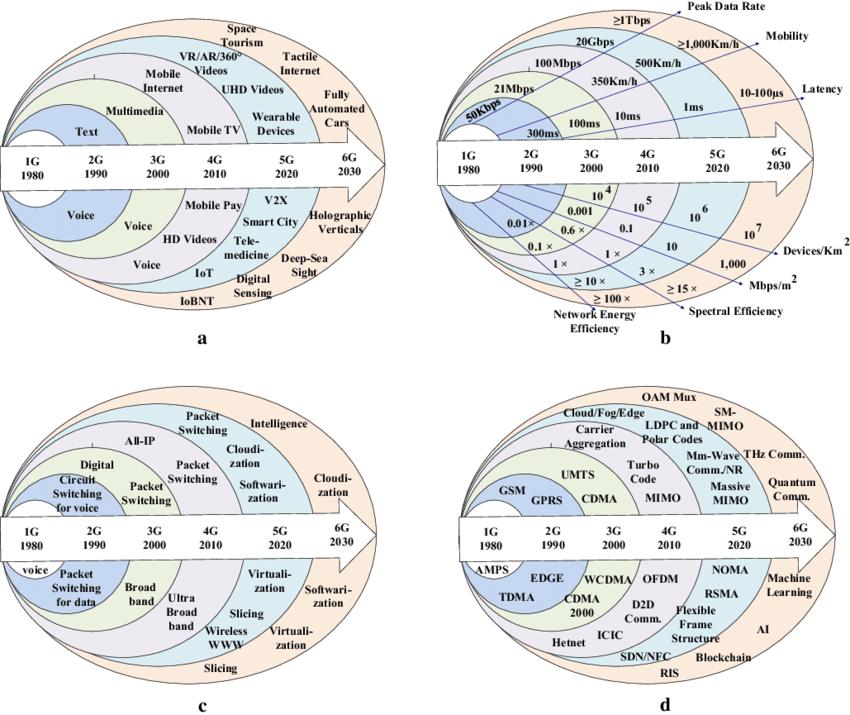
Figure 1.1: Evolution of wireless communication from 1G to 6G showing key technologies, applications, and network characteristics (Sauter, 2020).
International Research Journal of Engineering and Technology (IRJET) e-ISSN: 2395-0056
Volume: 13 Issue: 04 | Apr 2026 www.irjet.net p-ISSN: 2395-0072
The emergence of sixth-generation (6G) technology is drivenbytheneedtosupportnext-generationapplications that require ultra-high data rates, near-zero latency, and seamlessconnectivityacrossdiverseenvironments.Unlike previous generations, 6G is not merely an incremental upgrade but represents a fundamental transformation in network design and operation. It aims to create an integrated digital ecosystem where communication, computation, sensing, and intelligence are deeply interconnected.
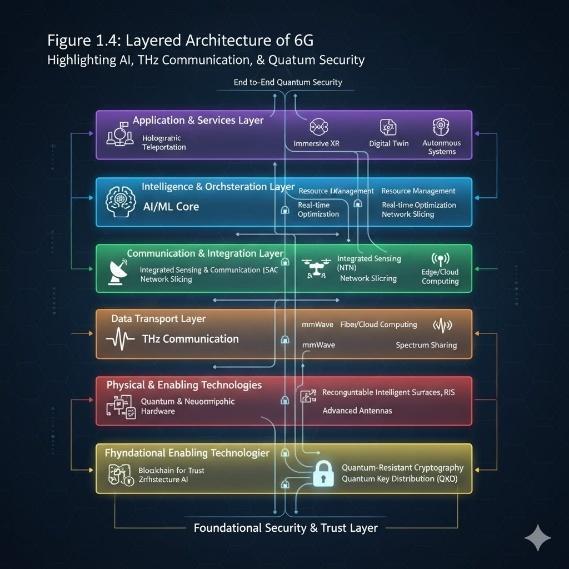
This transformation is enabled by the convergence of advancedtechnologiessuchasartificialintelligence-driven network management, quantum communication for enhanced security, terahertz spectrum for ultra-fast data transmission,andedgecomputingforreal-timeprocessing. These technologiescollectivelyallownetworksto become self-optimizing,adaptive,andcapableofhandlingcomplex, large-scale data environments. The integration of these key technologies in sixth-generation architecture is shown in Figure 1.2.
Beyondtechnicaladvancements,6Gisexpectedtoplaya crucialroleinaddressingglobalchallengesandsupporting sustainable development. It has the potential to revolutionize sectors such as healthcare through remote diagnostics and telemedicine, transportation through autonomous systems, education through immersive learning platforms, and industry through intelligent
automation. Moreover, 6G can contribute to bridging the digital divide by expanding connectivity to underserved regions.
Thispaper providesa comprehensive analysisof6G by examining its technological foundations, evaluating its societal and environmental implications, and identifying key challenges and opportunities associated with its implementation.
Despite its potential, the development of 6G communication systems presents several key challenges. Theincreasingenergyconsumptionduetohigh-speeddata transmission and dense network infrastructure raises concerns regarding environmental sustainability. In addition, the integration of AI and large-scale data exchange introduces significant cybersecurity and data privacyrisks.Theissueofdigitalinequalitymayalsolimit accesstoadvancedtechnologies,wideningthegapbetween developedanddevelopingregions.Furthermore,thelackof a unified framework that combines technological, social, andenvironmental aspectshighlightsthe needfora more holistic approach in the design and implementation of 6G systems.
3.1
The objective of this study is to analyze the development and impact of sixth-generation (6G) communication systems from technological, societal, and sustainability perspectives.Thekeyobjectivesare:
• Toexaminetheevolutionofwirelesscommunication technologies leading to 6G and identify the need for next-generationnetworks.
• To analyze key enabling technologies such as artificial intelligence (AI), terahertz (THz) communication, quantum communication, and edge computinginenhancingnetworkperformance.
• To evaluate the socio-economic impact of 6G, including its role in digital transformation, smart infrastructure,andimprovedconnectivity.
• To assess environmental aspects such as energy consumption, sustainability, and the use of energyefficientnetworkdesigns.
• To identify major challenges related to security, privacy, and digital inclusion, and propose suitable implementationstrategies.
International Research Journal of Engineering and Technology (IRJET) e-ISSN: 2395-0056
Volume: 13 Issue: 04 | Apr 2026 www.irjet.net p-ISSN: 2395-0072
This study analyzes sixth-generation communication by examining technological advancements alongside societal andenvironmentalaspects.Itfocusesondevelopments in artificial intelligence driven networks, high-frequency spectrumusage,and quantumcommunication,along with applications in healthcare, education, smart cities, and industry. The study also considers sustainability, energy efficiency, and digital inclusion. It is based on literature reviewandconceptualanalysis,andislimitedtopredictive insights as large-scale deployment is still under development.
The literature on sixth-generation communication highlights its interdisciplinary nature, integrating communication engineering with artificial intelligence, sustainability, and ethical considerations. Earlier studies focused on improving performance through higher data rates, lower latency, and better reliability, while recent research also considers societal and environmental impacts.
Key enabling technologies include terahertz communication, massive multiple-input multiple-output systems,andintelligentreflectingsurfaces,whichenhance network capacity and efficiency. Studies also emphasize energy-efficient network design using renewable energy and artificial intelligence-based optimization. In addition, issues such as data security, privacy, and digital inclusion areincreasinglyimportant.
Despite progress, challenges remain, including limited large-scale deployment models, lack of standardized security frameworks, and insufficient focus on sustainabilityinnetworkdesign.
This study adopts a mixed-method approach to analyze sixth-generation communication systems by combining qualitativeandquantitativetechniques.
Data Collection:
Data is collected from multiple sources, including peerreviewed journals, conference papers, and industry reports. Simulation-based data is used to evaluate key network parameters such as latency, throughput, and energy efficiency. Additionally, expert insights provide practical perspectives on emerging developments and challenges.
Data Analysis:
Quantitativeanalysisisusedtoassessperformancemetrics and compare sixth-generation capabilities with earlier systems.Qualitativeanalysisinvolvesreviewingliterature to identify trends, challenges, and research gaps. The combination of these methods ensures a comprehensive andreliableevaluation.
The analysis indicates that sixth-generation communicationsystemsprovidesignificantimprovements over existing technologies in terms of speed, latency, and intelligence.
• Ultra-low latency, below one millisecond, supports real-time applications such as remote healthcare, autonomoussystems,andimmersiveenvironments.
• Dataratesuptooneterabitpersecondenablehighbandwidth applications including holographic communicationandlarge-scaledataprocessing.
• Artificial intelligence integration enhances network efficiency through dynamic resource allocation and adaptivemanagement.
• Quantumcommunicationimprovessecuritythrough advanced encryption and reduced vulnerability to cyberthreats.
Table -1: Comparison of Fifth Generation and Sixth Generation Performance Metrics
PARAMETER FIFTH GENERATION SIXTH GENERATION
Data Rate Upto10Gbps Upto1Tbps
Latency Around1ms Lessthan1ms
Frequency Band
Sub-6GHz, mmWave Tetrahertz Spectrum
AI Algorithm Limited FullyIntegrated
Efficiency
Overall, the results demonstrate that sixth-generation communicationsystemscansupportadvancedapplications such as intelligent infrastructure, immersive communication,andnext-generationautomation.
International Research Journal of Engineering and Technology (IRJET) e-ISSN: 2395-0056
Volume: 13 Issue: 04 | Apr 2026 www.irjet.net p-ISSN: 2395-0072
The findings highlight the transformative potential of sixth-generation communication across multiple sectors due to its high speed,low latency, and intelligent network capabilities. In healthcare, it enables real-time diagnostics andadvancedremoteprocedures.Ineducation,itsupports immersiveandinteractivelearningenvironments,whilein industry, it enhances automation, monitoring, and operationalefficiency.
Sixth-generation technology also contributes to the developmentofsmartcities,intelligenttransportation,and environmental monitoring through the integration of artificial intelligence with communication networks, enabling faster decision-making and efficient resource management.
Despite these benefits, several challenges exist. High energy consumption raises concerns about sustainability, while increased connectivity introduces risks related to cybersecurity and data privacy. Ethical issues in artificial intelligence driven decision-making also require careful consideration. In addition, unequal access to advanced technologiesmaywidenthedigitaldivide.
A balanced approach that combines technological advancement with sustainability, security, and inclusive policies is essential to ensure effective and responsible implementation.
Inconclusion,sixth-generationcommunicationrepresents a major advancement in wireless technology, offering enhanced speed, intelligence, and connectivity. It enables the development of an integrated digital ecosystem that supports next-generation applications across healthcare, education,industry,andsmartinfrastructure.
The study highlights the potential of sixth-generation systems to drive economic growth, improve social development, and support environmental sustainability. However, challenges such as energy efficiency, cybersecurity, data privacy, and digital inclusion must be addressedforsuccessfulimplementation.
A balanced approach combining technological innovation, effective policies, and ethical considerations is essential. Futureresearchshouldfocusonpracticalimplementation, energy-efficient designs, and global standardization. Overall,sixth-generationcommunicationhasthepotential to transform global connectivity in a sustainable and inclusivemanner.
[1] M. Z. Chowdhury, M. Shahjalal, S. Ahmed, and Y. M. Jang, “6G wireless communication systems: Applications, requirements, technologies, challenges, and research directions,” IEEE Open Journal of the CommunicationsSociety,2019.
[2] W. Saad, M. Bennis, and M. Chen, “A vision of 6G wireless systems: Applications, trends, technologies, and open research problems,” IEEE Network, vol. 34, no.3,pp.134–142,2020.
[3] L.U.Khan,S.Khan,T.Shah,andM.Guizani,“6Gwireless systems: A vision, architectural elements, and future directions,” IEEE Access, vol. 8, pp. 147029–147041, 2020.
[4] I. F. Akyildiz, A. Kak, and S. Nie, “6G and beyond: The future of wireless communication systems,” IEEE Access,vol.8,pp.133995–134030,2020.
[5] T. S. Rappaport et al., “Wireless communications and applications above 100 GHz: Opportunities and challengesfor6Gandbeyond,”IEEEAccess,vol.7,pp. 78729–78757,2019.
[6] Z. Zhang et al., “6G wireless networks: Vision, requirements, architecture, and key technologies,” IEEEVehicularTechnologyMagazine,vol.14,no.3,pp. 28–41,2019.
[7] H. Wymeersch, X. Yin, and E. G. Larsson, “Positioning and sensing technologies for 6G: Trustworthiness, inclusiveness, and sustainability,” IEEE Communications Magazine, vol. 61, no. 4, pp. 54–61, 2023.
[8] H.Ahmadietal.,“Sustainabilityandopenradioaccess networks for 6G,” IEEE Transactions on Green CommunicationsandNetworking,vol.5,no.2,pp.45–60,2025.
[9] G.Sciddurloetal.,“Value-drivensystemdesignfor6G: Embedding ethical and social dimensions alongside technical performance indicators,” IEEE Transactions onNetworkandServiceManagement,vol.22,no.1,pp. 101–116,2025.
[10] S. Dang, O. Amin, B. Shihada, and M. S. Alouini, “What should 6G be?,” Nature Electronics, vol. 3, pp. 20–29, 2020.
[11] M.Sauter,FromGSMtoLTE-AdvancedProand5G:An Introduction to Mobile Networks and Mobile Broadband,Wiley,2020.