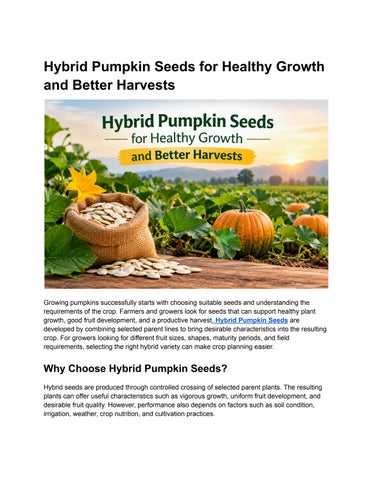
Hybrid Pumpkin Seeds for Healthy Growth and Better Harvests
Growing pumpkins successfully starts with choosing suitable seeds and understanding the requirements of the crop. Farmers and growers look for seeds that can support healthy plant growth, good fruit development, and a productive harvest. Hybrid Pumpkin Seeds are developed by combining selected parent lines to bring desirable characteristics into the resulting crop. For growers looking for different fruit sizes, shapes, maturity periods, and field requirements, selecting the right hybrid variety can make crop planning easier.
Why Choose Hybrid Pumpkin Seeds? Hybrid seeds are produced through controlled crossing of selected parent plants. The resulting plants can offer useful characteristics such as vigorous growth, uniform fruit development, and desirable fruit quality. However, performance also depends on factors such as soil condition, irrigation, weather, crop nutrition, and cultivation practices.
For pumpkin cultivation, variety selection is particularly important because farmers may have different requirements depending on their market, transportation needs, harvesting schedule, and preferred fruit size.
F1 Hybrid Pumpkin Seed Varieties from IRIS IRIS Hybrid Seeds offers several F1 pumpkin varieties with different characteristics. The selection includes varieties suitable for growers looking for different fruit shapes, weights, colors, maturity periods, and transportation qualities.
F1 Pumpkin IHS-205 IHS-205 produces flat-round fruits with dark green skin and white specks. The listed fruit weight is around 2.5–3 kg, with orange-yellowish flesh. Its stated maturity period is approximately 50–55 days after sowing, and the variety is described with high-yield and good shelf-life characteristics.
F1 Pumpkin Bahubali Bahubali is a flat-round pumpkin variety with green color and brown spots. The fruit weight is listed at around 5–6 kg, with orange flesh. It has a maturity period of approximately 78–80 days after sowing and is noted for high yield and good transportation suitability.
F1 Pumpkin IHS-333 IHS-333 produces flat-round fruits with attractive dark green skin and orange flesh. The listed fruit weight is approximately 4–5 kg, while maturity is around 80–85 days after sowing. The variety is also described as having vigorous plants and good transportation characteristics.
F1 Pumpkin Bheema Bheema is another flat-round variety with attractive dark green fruits and orange flesh. Fruits are listed at around 4–6 kg, with maturity approximately 100–110 days after sowing. The variety is described as having vigorous plants and good fruit setting.
F1 Pumpkin IHS-9060 IHS-9060 has an oblong fruit shape with attractive green skin and white specks. The listed fruit weight is around 5–7 kg, with yellowish-orange flesh. Its maturity period is approximately 80–85 days after sowing, and the variety is noted for high yield and transportation suitability.
F1 Pumpkin Lattu-1066
Lattu-1066 produces oblong to long fruits with dark green skin and white specks. The listed fruit weight is approximately 5–7 kg, with yellowish-orange flesh. It has a maturity period of around 75–80 days after sowing and is described as very early, high yielding, and having good shelf life.
How to Select the Right Hybrid Pumpkin Seeds The right variety should be selected according to the grower's cultivation conditions and market requirements. Before purchasing seeds, consider fruit size, expected maturity period, preferred fruit shape, transportation requirements, and local growing conditions. For example, growers looking for relatively early maturity may consider varieties with shorter listed maturity periods, while those requiring larger fruits can compare varieties based on their stated fruit weight. Transportation can also be an important consideration for commercial growers supplying pumpkins to markets away from the farm.
Tips for Better Pumpkin Crop Management
Good seeds are only one part of successful cultivation. Farmers should prepare the field properly, maintain suitable soil moisture, provide balanced nutrition, and monitor the crop regularly.
Proper drainage is important because excessive standing water can negatively affect root development. Irrigation should be managed according to soil and weather conditions rather than applying water unnecessarily. Regular field monitoring can also help growers identify pest, disease, nutrient, or growth-related problems at an early stage. Farmers should also follow region-specific recommendations for sowing time, spacing, fertilizer application, irrigation, and plant protection. Local agricultural experts and experienced growers can provide useful guidance based on the conditions of a particular farming area.
Why Variety Selection Matters for Commercial Pumpkin Farming Commercial pumpkin farming often involves balancing production goals with market demand. Fruit size, appearance, maturity time, shelf life, and transportation characteristics can influence how a variety fits into a particular farming plan. The different F1 pumpkin varieties available from IRIS give growers the opportunity to compare characteristics instead of selecting seeds based only on the crop name. Reviewing variety information before sowing can help farmers make a more informed choice according to their production objectives.
Final Thoughts Choosing suitable Hybrid Pumpkin Seeds and combining them with proper crop management can help growers plan for a healthy and productive pumpkin crop. Explore the available F1 pumpkin varieties from IRIS and compare their characteristics before making your selection. Visit the official IRIS website to explore F1 Hybrid Pumpkin Seeds and other hybrid vegetable seeds: Visit IRIS Hybrid Seeds – F1 Hybrid Pumpkin Seeds
FAQs About Hybrid Pumpkin Seeds 1. What are Hybrid Pumpkin Seeds? Hybrid Pumpkin Seeds are produced by crossing selected parent lines to combine desirable characteristics in the resulting plants. F1 hybrids are the first generation from such a controlled cross.
2. Which F1 pumpkin varieties are available from IRIS?
IRIS lists F1 Pumpkin IHS-205, Bahubali, IHS-333, Bheema, IHS-9060, and Lattu-1066 on its pumpkin seed page. These varieties differ in fruit shape, weight, color, flesh color, maturity period, and other listed characteristics.
3. How long do hybrid pumpkin varieties take to mature? The maturity period varies by variety. On the IRIS page, the listed periods range from approximately 50–55 days after sowing for IHS-205 to around 100–110 days for Bheema.
4. What should farmers consider before choosing pumpkin seeds? Farmers should consider local climate, soil conditions, irrigation availability, desired fruit size and shape, maturity period, market requirements, and transportation needs before selecting a variety.
5. Can hybrid pumpkin seeds be used for commercial cultivation? Yes, F1 pumpkin varieties can be considered for commercial cultivation. The appropriate variety should be selected according to local growing conditions, production goals, and market requirements.