Who Knew Hurricanes Had A Gender? by: Irissa Kai written: 2016
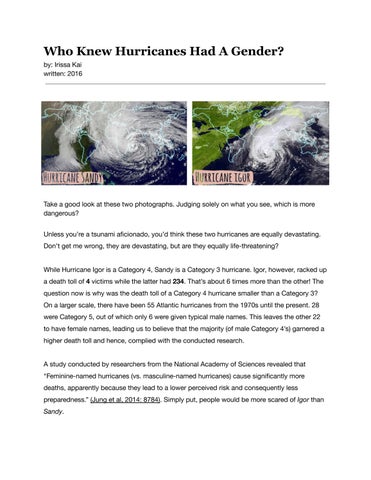
Take a good look at these two photographs. Judging solely on what you see, which is more dangerous? Unless you’re a tsunami aficionado, you’d think these two hurricanes are equally devastating. Don’t get me wrong, they are devastating, but are they equally life-threatening? While Hurricane Igor is a Category 4, Sandy is a Category 3 hurricane. Igor, however, racked up a death toll of 4 victims while the latter had 234. That’s about 6 times more than the other! The question now is why was the death toll of a Category 4 hurricane smaller than a Category 3? On a larger scale, there have been 55 Atlantic hurricanes from the 1970s until the present. 28 were Category 5, out of which only 6 were given typical male names. This leaves the other 22 to have female names, leading us to believe that the majority (of male Category 4’s) garnered a higher death toll and hence, complied with the conducted research. A study conducted by researchers from the National Academy of Sciences revealed that "Feminine-named hurricanes (vs. masculine-named hurricanes) cause significantly more deaths, apparently because they lead to a lower perceived risk and consequently less preparedness.” (Jung et al, 2014: 8784). Simply put, people would be more scared of Igor than Sandy.
If we dig deep, this can be traced to the problem of sexism. Let’s picture the hurricanes as school bullies. Both are intimidating. Both pose a threat. But who would you be more afraid of Igor or Sandy? Exactly. Assuming they were male and female respectively, I’d pick the former. Taking into consideration that the male embodies the qualities of (traditional) masculinity, he’d have the physical strength to leave a lasting negative impact on a victim, whereas the female is usually deemed as less aggressive, and subsequently less able to inflict pain as intensely as a man. Before 1979, all tsunamis were given female names. Why? Because they were ‘unpredictable’. This isn’t uncommon in our daily lives here in Singapore, where a clear distinction is made between males and females. From a young age, girls are taught that they have a duty to the household; that is to know how to cook, clean and serve. Meanwhile, boys lend a helping hand to the father figure when doing handiwork such as building or moving furniture - that is, if they’re not running about doing whatever they want. There’s also the mentality that there must be a “man of the house”, implying that the protector of the family needs to be male due to his presumed physical strength and aggression. This is otherwise known as hegemonic masculinity - a sociological theory that entails how we subtly reinforce the dominant social position of men and the subordinate social position of women in our daily lives (Connell & Messerschmidt, 2005). Think about it: given Singapore’s patriarchal society, is this theory truly far-fetched? Another instance, in some junior colleges, is how male and female students are split during Physical Education (P.E.) lessons. It is as such to carry out two separate sports curricula, in a bid to cater to the different abilities their gender entitles them to. This establishes the clear difference in physical abilities between them, that male workouts are more strenuous and female students may not be able to ‘handle it. Hence, the stereotype that males are stronger than females is perpetuated, when it’s far more complicated than that. Also, it creates pressure for the former to live up to those expectations. For males who don’t fit into traditional stereotypes of masculinity or display even a hint of femininity, they are subject to bullying and more ridicule (a certain gendered slur comes to mind). If this behaviour goes on
in an institution of learning, what more at an isolated camp off the coast of Singapore? (Yes, I’m talking about National Service.) The tsunami trivia would’ve started off as illogical. Trust us, we feel you. How could something so insignificant be quite a topic of heavy discussion? How did hurricanes start off with zero relation to gender end up explaining the basis of sexism? Hopefully, we were able to show that our brains have been indoctrinated with gender biases that we’ve absorbed over time. Let’s work together in getting rid of them - for good. Further reading on sexism and hurricanes (x). Also, Cordelia Fine’s book, Delusions of Gender, talks more about sexism in scientific research.