Environment by Dr Darren Reidy, Ecologist on IRD Duhallow LIFE & EIP Projects Amount:
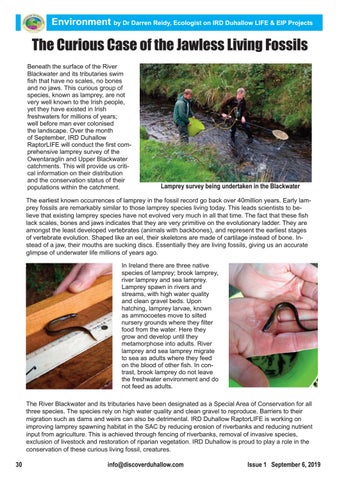
The Curious Case of the Jawless Living Fossils Approved by: Beneath the surface of the River Blackwater and its tributaries swim fish that have no scales, no bones and no jaws. This curious group of species, known as lamprey, are not very well known to the Irish people, yet they have existed in Irish freshwaters for millions of years; well before man ever colonised the landscape. Over the month of September, IRD Duhallow RaptorLIFE will conduct the first comprehensive lamprey survey of the Owentaraglin and Upper Blackwater catchments. This will provide us critical information on their distribution and the conservation status of their populations within the catchment.
Date:
Lamprey survey being undertaken in the Blackwater
The earliest known occurrences of lamprey in the fossil record go back over 40million years. Early lamprey fossils are remarkably similar to those lamprey species living today. This leads scientists to believe that existing lamprey species have not evolved very much in all that time. The fact that these fish lack scales, bones and jaws indicates that they are very primitive on the evolutionary ladder. They are amongst the least developed vertebrates (animals with backbones), and represent the earliest stages of vertebrate evolution. Shaped like an eel, their skeletons are made of cartilage instead of bone. Instead of a jaw, their mouths are sucking discs. Essentially they are living fossils, giving us an accurate glimpse of underwater life millions of years ago. In Ireland there are three native species of lamprey; brook lamprey, river lamprey and sea lamprey. Lamprey spawn in rivers and streams, with high water quality and clean gravel beds. Upon hatching, lamprey larvae, known as ammocoetes move to silted nursery grounds where they filter food from the water. Here they grow and develop until they metamorphose into adults. River lamprey and sea lamprey migrate to sea as adults where they feed on the blood of other fish. In contrast, brook lamprey do not leave the freshwater environment and do not feed as adults. The River Blackwater and its tributaries have been designated as a Special Area of Conservation for all three species. The species rely on high water quality and clean gravel to reproduce. Barriers to their migration such as dams and weirs can also be detrimental. IRD Duhallow RaptorLIFE is working on improving lamprey spawning habitat in the SAC by reducing erosion of riverbanks and reducing nutrient input from agriculture. This is achieved through fencing of riverbanks, removal of invasive species, exclusion of livestock and restoration of riparian vegetation. IRD Duhallow is proud to play a role in the conservation of these curious living fossil, creatures.
30
info@discoverduhallow.com
Issue 1 September 6, 2019
Environment by Dr Darren Reidy, Ecologist on IRD Duhallow LIFE & EIP Projects
Duhallow Farming for Blue Dot Catchments Project Launch Tuesday the 20th of August saw the offical launch of a new five year programme entitled ‘Duhallow Farming for Blue Dot Catchments’. The €1.47million project is co-funded by the Department of Agriculture, Food and the Marine (DAFM) through the European Innovation Partnership for Agriculture Productivity and Sustainability (EIP-Agri). The project will develop a farmer focused approach to supporting local agriculture along with enhancing the freshwater environment which will help restore and protect the high status of the Allow River catchment. IRD Duhallow will lead the project, building upon the wealth of knowledge and experience gained through working with the agricultural community on a wide variety of high profile agri-environment initiatives. IRD Duhallow has previously coordinated two large scale EU Life programmes in the region, SAMOK and Raptor Life. These are focused on the conservation of protected habitats and species and put the Duhallow community at the core of the conservation efforts. These aim to improve the natural ecosystems of the Mullaghareirk Mountains and Blackwater River catchment by working closely with landowners. The IRD Duhallow Life projects have so far seen an excellent suite of results designed to prevent
Michael Doyle, speaking at the launch of the project which was held at the IRD Duhallow offices in the James O’Keeffe Institute in Newmarket erosion, reduce pollution, enhance wildlife habitats and increase biodiversity. Target species which benefit from these actions are the local populations of freshwater pearl mussel, salmon, lamprey, otter, kingfisher and hen harrier. Through engagement with the farmers in the North Cork catchments of the Rivers Allow, Dalua and Owenanare, participating farmers will select a number of actions designed to enhance the river ecosystem by creating sustainable agricultural practices which enhance wetland and freshwater ecosystem services. Participants will be financially rewarded to reflect the success of
Public attending the launch of the Duhallow Farming for Blue Dot Catchments Project
30
info@discoverduhallow.com
their actions. In addition, a network of demonstration farms will be established as case studies of best practice in farming for high status rivers. The project will develop farm specific solutions to water quality and biodiversity issues arising in the catchment. With the essential input of participating farmers, farm plans will develop innovative solutions to mitigate the pressures of agriculture on the rivers. Measures undertaken will be designed in such a way that farm productivity is not compromised, generating an economically and ecologically sustainable model for farming in Blue Dot catchments. The Duhallow Farming for Blue Dot Catchments project is currently open to applications and all those farming in the catchments of the Allow, Dalua and Owenanare rivers are eligible to submit an expression of interest. Further public information evenings will be held in Meelin Community Centre on September 16th, Freemount Community Centre on September 23rd, Glash Community Centre on September 30th and James O’Keeffe Institute, Newmarket on October 7th. Please contact IRD Duhallow on 029 60633 for further details.
Issue 2 September 20, 2019
Environment by Dr Darren Reidy, Ecologist on IRD Duhallow LIFE & EIP Projects
Gudgeon is more than a goujon Only the size of a chicken goujon, this gudgeon (gobio gobio), a widely unknown species of fish, is in fact quite a large example of its kind. Gudgeon are not frequently recorded in Ireland and are often overlooked as part of our freshwater fish communities. This individual of the species was recorded during a river education event held on the Allow River by IRD Duhallow as part of the RaptorLIFE project. Gudgeon forage on sandy and gravelly substrates in both fast and slow moving streams using the barbels on either corner of their mouths to detect their prey. They feed on a variety of invertebrates and have been known to graze on filamentous algae in Ireland. The species is not fished commercially or for sport in Ireland, however in Victorian and Edwardian times it was fashionable to fish for and fry gudgeon. Indeed the word goujon is derived from the French name for the fish. A non-native species, gudgeon is thought to have been introduced to Ireland sometime after the 12th Century, however no documentary evidence of exactly when exists. Indeed, much of what we know about gudgeon in Ireland was derived from research conducted on fish caught in the Allow and Blackwater catchments in 1971, however
River education event on the Allow River
30
A gudgeon from the Allow River
the species has gone largely undetected in the Allow since then. One of a number of species recorded on the day, this specimen of gudgeon brought unexpected excitement to the event because the distribution of the species in Ireland is so poorly documented. Other species recorded on the day included Atlantic salmon, brown trout, brook lamprey and the critically endangered European eel. The river education event was held by IRD Duhallow for farmers participating in the RaptorLIFE project. These landowners on the Araglin and Blackwater rivers voluntarily fenced their sections of the river in order to exclude livestock, with the aim to improve water quality, restore riparian vegetation and stabilise rapidly eroding river banks. Attending farmers had the opportunity to try their hand at casting and angling, but all were absorbed by the wealth of information being given by Andrew Gillespie of IFI on the invertebrates, salmonids and LIFE in the river. It is hoped that through learning and knowledge exchange that farmers will build a greater appreciation for river environments, taking ownership of
info@discoverduhallow.com
river protection in their local area, and encouraging others to do likewise. Inland Fisheries Ireland conducted electrofishing and Duhallow Angling Centre of Excellence assisted on the day. IRD Duhallow RaptorLIFE have fenced off nearly 29km of river in the upper reaches of the Blackwater Special Area for Conservation. Fencing river margins allows the banks to revegetate, thus stabilising areas that are rapidly eroding, further reducing siltation of the river substrate. This in turn will help provide clean gravels for spawning salmonids and brook lamprey, and improve freshwater pearl mussel habitat and that of the critical growing stage of its juveniles known as glochidia. This fenced area in itself becomes a new habitat of biodiversity. Many of these farmers were provided with alternative drinking sources for their stock to restrict them from entering the river – this improves the water quality, eliminating the risk of eutrophication and algae on the riverbed, this too being detrimental to the spawning gravels of salmonids, brook lamprey and the habitat of the freshwater pearl mussel and its juveniles.
Issue 3 October 4, 2019
Environment
Farming for nature highlighted All good things come to an end. On Friday 8th November RaptorLIFE, a €3.2 million EU LIFE Nature project coordinated by IRD Duhallow, held its end of project conference at the James O’Keeffe Institute. The conference brought together the State agencies, NGOs, farmers and other stakeholders to highlight the results of this important project for the Duhallow region. Opening the conference, chaired by journalist and author Paddy Woodworth, were Niall O’Donnchú, Assistant Secretary Department of Culture, Heritage & the Gaeltacht, John Breen, IRD Duhallow board member and Director of Services at Kerry County Council, and Eileen Linehan, IRD Duhallow. The two themes of the conference were the conservation of threatened birds like the hen harrier, river animals like the Freshwater Pearl Mussel and lamprey, and the important role farmers in upland Duhallow play in helping conserve these species. Eileen Linehan, RaptorLIFE project manager, said: “The RaptorLIFE project followed on seamlessly from IRD Duhallow’s previous LIFE project, SAMOK. The successful completion of both LIFE projects shows that a local development company like IRD Duhallow, which is embedded in the local community,
Back row, from left, John Breen, Eileen Linehan, Maura Walsh and Niall O’Donnchú; front row, from left, Dr Sinead Cummins, Paddy Woodworth, Breeda Moynihan Cronin and Michael Doyle is an excellent model to deliver LIFE projects”. The day-long conference saw an exciting line up of speakers, from IRD Duhallow’s RaptorLIFE scientists on hen harriers in Duhallow to farming in the Burren and the Iveragh peninsula. The conference also saw the launch of a book: Duhallow: A Living Landscape for Farming and Wildlife, by Canadian researcher Dr Jodie Asselin and RaptorLIFE scientist Dr Allan Mee. The book gives a farmer’s perspective on the issue of land designation as a Special Protection Area, the challenges and opportunities for farming and local communities, and how farming and
Attendees take a break to mingle during the end of project conference 42
info@discoverduhallow.com
wildlife can and do co-exist to their mutual benefit. Allan Mee said: “Carrying out the RaptorLIFE project would have been impossible without the cooperation of local farmers, whose land many of the project actions were carried out on. IRD Duhallow’s RSS team, all local farmers, were also critical to the success of the project, from removing reseeding forestry to controlling knotweed and balsam, invasive species that threaten the ecology of rivers like the Blackwater. “We hope that the RaptorLIFE project, and indeed the Living Landscape book, will stand as a testament to the farming community in Duhallow despite the many pressures on upland farmers in a fast-changing world.” All in all, the project conference was a great event highlighting the positive impact that farming for nature can make. The idea of a future LIFE project application on the conservation and restoration of bogs in Duhallow was raised by IRD Duhallow CEO Maura Walsh in closing the conference. She said: “IRD Duhallow has submitted an application for a future LIFE project and look forward to extending our successful relationship with the EU LIFE programme into the future.”
Issue 6 November 22, 2019
Environment by Nuala Riordan, RaptorLIFE Project Field Clerical Officer
Decline of mussels alarming Like the canary in the coal mine, freshwater pearl mussels are an indicator of the health of Ireland’s rivers. Their declining numbers should set off alarm bells that there are problems with our rivers. With a lifespan of up to 120 years, the mussels were once widespread, but are now found in only a few catchments. Ireland is estimated to hold around 46% of Europe’s freshwater pearl mussel population, with the Munster Blackwater catchment said to have a large part of the national population. The mussels are an EU protected species and are very sensitive to polluted water. Unfortunately, poor land management has led to excessive levels of erosion and siltation in the River Blackwater, which ends up smothering the mussels. In addition to the silt problem is the discharge of pollutants into the river from poorly maintained treatment plants and other industrial activities. Another damaging element is nutrient enrichment (eutrophication) leading to algae build up on the riverbed, choking not only the juvenile mussels (which would be smaller than the top of a pin), but equally the adults causing them not to survive to their maturity of 120 plus years. This nutrient
Issue 8 December 20, 2019
Freshwater pearl mussel enrichment comes from slurry and cattle access to the river. To help combat this, IRD Duhallow through its LIFE projects has in addition to fencing off the river, supplied participating landowners with alternative drinking sources for cattle, such as nose pumps, solar panels and troughs. Although the issues are numerous and at times complex, they can be tackled. Through the IRD Duhallow RaptorLIFE and following on from the previous
info@discoverduhallow.com
DuhallowLIFE, we have shown that the community can develop and implement simple solutions to complex problems. On the River Allow we have installed silt traps in farm drains which capture the silt before it can enter the river to kill incubating salmon eggs and freshwater pearl mussel. Another example is the flood friendly fencing innovation which allows farmers to fence floodprone land which was previously impossible to fence. This allows the vegetation to grow with the roots helping to stabilise the banks, together with planting the vulnerable banks with trees. These measures, along with the Blue Dot project on the River Allow, provide potential mechanisms to further improve the management of the River Blackwater SAC (Special Area of Conservation – Natura 2000 area). We are working closely with the landowners and many other stakeholders to unlock the benefits of this type of collaborative working for everyone’s benefit.
27