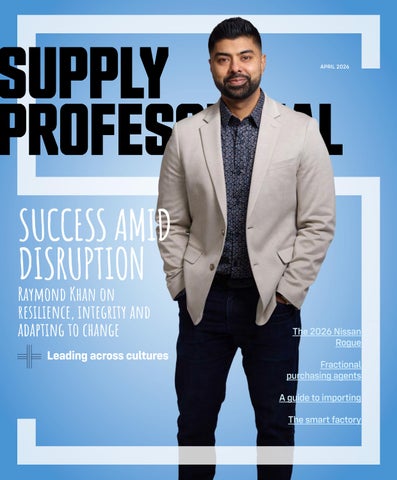
SUCCESS AMID DISRUPTION
Raymond Khan on resilience, integrity and adapting to change
Leading across cultures
The 2026 Nissan Rogue Fractional purchasing agents
A guide to importing
The smart factory



Raymond Khan on resilience, integrity and adapting to change
Leading across cultures
The 2026 Nissan Rogue Fractional purchasing agents
A guide to importing
The smart factory
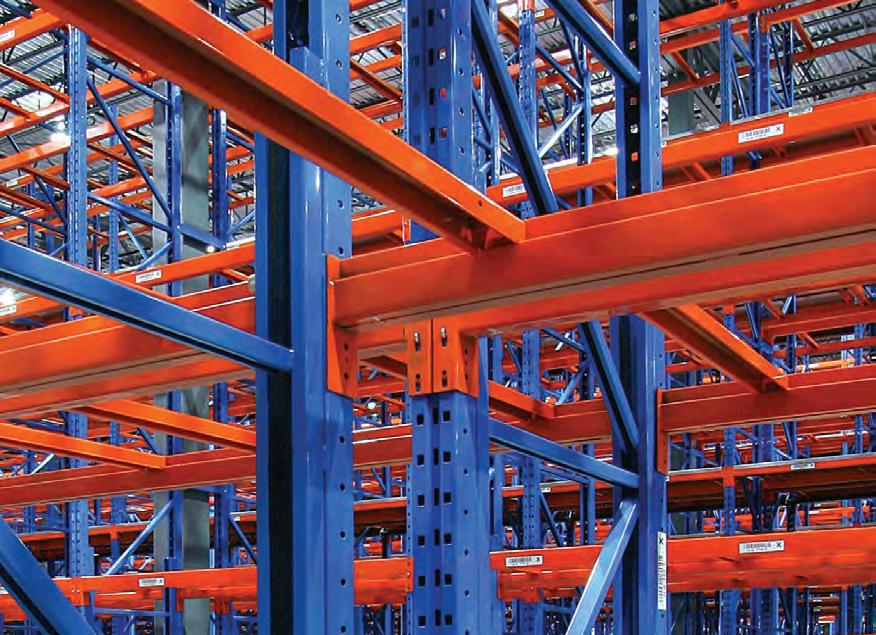
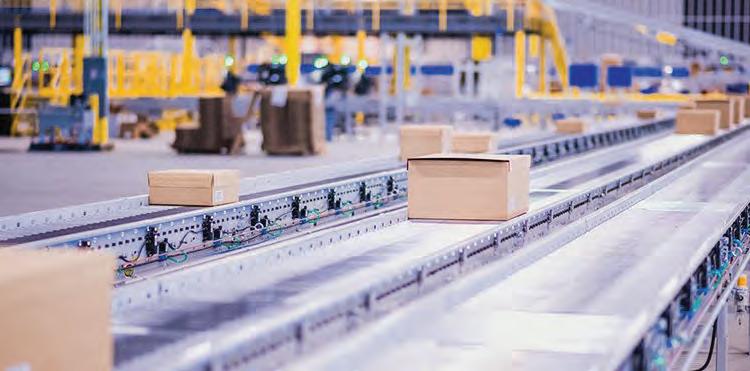
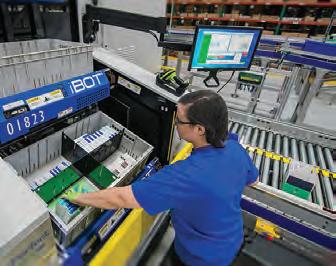
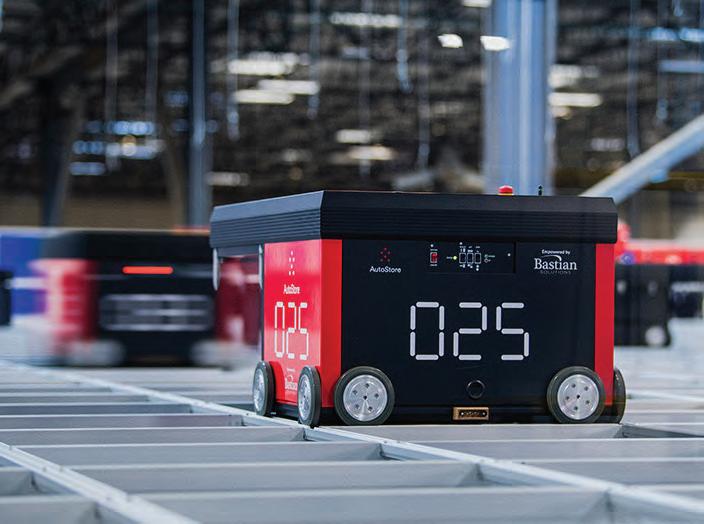
Successful intralogistics is all about building smart and staying agile throughout every stage of facilities management. With our engagement model that helps you ideate, activate and adapt innovative solutions, combined with the power of our family of companies, we can help you optimize your facilities for whatever tomorrow brings. Tackle the challenges of today and make the most of the opportunities of tomorrow.
ONE TRUSTED PARTNER THREE STAGES OF OPTIMIZATION ENDLESS OPERATIONAL ADVANTAGE



There’s little doubt that the crisis surrounding the Strait of Hormuz has resulted in serious effects on global shipping. Recently, when I looked it up, there were over 150 ships anchored nearby, waiting for better conditions to transit through. Major global carriers like Maersk, Hapag-Lloyd, and CMA CGM have suspended operations in the area, worried about crew safety. Container shipping has been disrupted globally due to the escalating military tensions around one of the world’s most critical shipping chokepoints, driving down tanker traffic, raising oil prices and maritime insurance costs, and forcing the rerouting or suspension of container traffic.
Yet perhaps the biggest piece of fallout from the crisis lies not in shipping delays in general, but the energy price shocks that industries must now deal with. Oil prices have surged to over US$100 a barrel as of mid-March. That’s the highest level since 2022. The inflated energy prices that this brings raise inflation, reduce output for industries, and hit small business’s bottom lines. It can mean higher transportation, production, and food costs.
Here in Canada, we also face structural problems like interprovincial trade barriers that compound the hits we suffer from energy shocks. Also, even though we’re a major producer and have the fourth-largest oil reserves in the world, we rely on international – not domestic – pricing for the black stuff.
It means a lot to the Canadian economy. The oil and gas industry accounted for $84 billion worth of our overall GDP in 2024. Oil and gas are also a critical item of export. They make up about 20 per cent of Canada’s balance of trade. The strength of our dollar is also tied to the price of oil.
Higher fuel costs also mean higher freight costs. As diesel prices rise, so too do the costs of rail transport, trucking, and ocean shipping. Farmers can see higher fertilizer and fuel prices, which may mean higher price tags at the grocery store. The annual inflation rate cooled to 1.8 per cent in February. Let’s hope we don’t see a reversal of that progress.
A crisis has a way of highlighting issues and weaknesses that were already there. The COVID-19 pandemic, for example, illustrated a reliance on global supply chains and limited domestic manufacturing ability for some medical products. At the same time, showed opportunities to build resiliency.
The energy crisis we face now provides similar chances. Long term, vehicle electrification where possible, improved fuel efficiency for fleets, and strengthened transportation infrastructure would all help. It may also provide opportunities to expand our oil and gas exports to markets other than the US. Asia, for example, continues to rely on energy shipments through the Strait of Hormuz.
And like any crisis, we can use this one to build the resiliency so crucial to supply chains.

EDITOR
MICHAEL POWER 416-441-2085 x7 michael@supplypro.ca
PUBLISHER
FARIA AHMED 416-441-2085 x 5 faria@supplypro.ca
DESIGN
Art Direction ROY GAIOT Design Consultation BLVD AGENCY
iQ BUSINESS MEDIA INC.
Vice President STEVE WILSON 416-441-2085 x3 swilson@iqbusinessmedia.com
President & Executive Publisher ALEX PAPANOU
PUBLICATION MAIL AGREEMENT NO. 43096012 ISSN 1497-1569 (print); 1929-6479 (digital)
CIRCULATION
Mail: 126 Old Sheppard Ave, Toronto ON M2J 3L9
SUBSCRIPTION RATES
Published six times per year
Canada: 1 Year $ 99.95 CDN
Outside Canada: 1 Year $ 172.95 USD Single price per copy $18.00 CDN
Opinions expressed in this magazine are not necessarily those of the editor or the publisher. No liability is assumed for errors or omissions. All advertising is subject to the publisher’s approval. Such approval does not imply any endorsement of the products or services advertised.
Publisher reserves the right to refuse advertising that does not meet the standards of the publication.
No part of the editorial content of this publication may be reprinted without the publisher’s written permission. © 2021 iQ Business Media Inc. All rights reserved. Printed in Canada.
Supply Professional is the Official Magazine for NISCL

This column was written and submitted on Wednesday, March 11. I need to state this up-front because I am basing my reasoning on where the conflict between Israel and the United States and Iran currently stands. It appears that Iran’s armed forces have been seriously damaged, but the country seems far from surrendering. Oil breached $100 a barrel but has pulled back and hovers between $80 and $90. Oil is still moving through the straits of Hormuz, but this could be shut down at any moment, leading to a huge spike in its price. There is a great deal of uncertainty as to how this war will ultimately be resolved, and I think it’s necessary that I offer my prediction before I go any further.
US President Donald Trump has repeatedly stated that the only satisfactory conclusion is “unconditional surrender.” I think this is highly unlikely.
Has there ever been a conflict where this occurs without “boots on the ground?” The American public would never accept this. There will be an uneasy negotiated settlement and Trump will declare victory. Iran may make some concessions. Or maybe not. The current regime will retain power and it will be more or less the status quo ante bellum, less the degraded military capability.
My interest in the remaining paragraphs is to predict the economic impact and, finally, to offer a very specific suggestion as to how Canada should seize the opportunity that will arise in the aftermath of this war.
The jump in oil prices has already been seen at the pumps. Gasoline has soared 20 per cent in the past month and some commentators believe that the inflationary impact might slow down the interest rate cuts that seemed to be in the works. I’m not so sure. I believe that there will be at least two, and possibly three, interest rate cuts in the US before the year is out, and I would not be surprised to see the Bank of Canada follow suit.
Let me explain why higher energy prices, per se, are not inflationary. According to the data I’ve seen, the average American spent about $200 a month on gas. Therefore, if gas is 20 per cent more expensive and consumption remains the same, that would mean another $480 directed annually towards this single product. But it means that there will be that many fewer dollars deployed to purchase other goods and services. If you believe in the basic laws of supply and demand, lower demand should lead to lower prices for lots of other stuff.
That being noted, I would be surprised if oil pulls back significantly any time soon. There’s a good reason why: uncertainty. Right now, China holds an estimated 1.2 billion barrels of oil in storage, covering about 100 days of imports. Given what I understand about the Chinese regime, I can see that government increasing its reserves. It stands to reason that other countries (like India) that are net consumers will copy this behaviour. Higher oil prices are here for the foreseeable future.
Will this plunge the global economy into recession or something worse? I don’t think so. Between falling interest rates and deficit spending, our economies will pull through. And as bad as high oil prices are for economic growth, there are other countervailing factors, robotics and artificial intelligence (AI). I have said it before and will say it again: the world is on the cusp of the greatest explosion in productivity in human history. We just have to muster the collective wisdom to find ways to peacefully coexist.
Which leads me to the longer run impact of this war. Not only the US, but all the developed and developing countries of the world will focus much more on energy self-sufficiency and more secure supply lines. Donald Trump has just announced that a $300 billion refinery project, backed by India’s Reliance Industries, will be built in Brownville, Texas. It will be the first new US refinery built in the past 50 years.
Canada really should be at the forefront of global energy supply. Currently, both China and India get most of their oil from Russia and the Middle East.
Why not us? There has been a tremendous expansion of our exports to China over the past years, but why can’t we be that country’s primary supplier? There is certainty associated with Canadian supply that is just not there for rival nations. And while we’re at it, how about following the

“Not only the United States, but countries around the world will focus far more on energy self-sufficiency and secure supply lines.”
American example and build new refineries? It is generally acknowledged that AI will eliminate many jobs, but construction and then refinery work will not be threatened by the technology.
War is hell. But it exists and presents both challenges and opportunities. The current conflict is providing Canada with a once-in-a-generation opportunity to vault itself to the forefront of global energy production. Let’s not squander it. SP

Supply chain leadership is more complex, visible, and consequential than ever before. Leaders must navigate volatile demand, labour constraints, geopolitical uncertainty, and rising customer expectations, all while delivering better service with fewer resources.
Across conversations with manufacturing executives and supply chain leaders, a few themes emerge – not about tools or platforms, but about how leadership is evolving. Below are common challenges supply chain professionals face, along with the leadership mindset shifts to tackle them. This ability can separate the firefighter from the best-inclass leader.
For years, supply chain teams have operated in reactive mode. They must constantly respond to shortages, expedite orders, and resolve production issues as they arise. While that approach may keep operations running in the short term, it leaves little room for strategic thinking or longterm improvement.
Today’s leaders are shifting from firefighting to foresight; building systems, processes, and cultures so teams can anticipate issues before they disrupt operations. This means moving beyond static reports and weekly spreadsheets toward dynamic ways of understanding risk, readiness, and opportunity. The goal is predictability. Leaders want to know what can be built, what is at risk, and where attention is most needed.
One of the biggest challenges in modern supply chains isn’t lack of data, it’s too much of it. Most organizations already have access to vast amounts of information across ERP systems, planning tools, supplier portals, and spreadsheets. The challenge is turning that data into clarity.
Leaders emphasize the need for answers to critical questions:
W hat should my team work on today?
Where are we most at risk?
W hat actions will have the greatest impact?
Rather than more dashboards or metrics, leaders need visibility that drives action. The most effective organizations are those that translate complexity into clear priorities for buyers, planners, and production teams. That aligns everyone around what matters most.
Many supply chain leaders describe a disconnect between strategy and execution. Leadership sets targets around inventory reduction, service improvement, or working capital. Yet frontline teams often lack the visibility or guidance to translate those goals into daily decisions.
Closing this gap means operational systems that connect strategy to execution. When teams see how their actions affect outcomes like inventory turns, customer service, or production flow, alignment becomes part of the workflow rather than an abstract goal. Successful leaders focus on shared visibility across
functions, so everyone operates from the same version of reality.
Technology and process are only part of the equation. Supply chain transformation depends on people. Leaders highlight the importance of culture, specifically, building environments that empower teams to act, collaborate across silos, and continuously improve.
This means shifting away from blame and toward problem-solving. When shortages occur or targets are missed, the most effective leaders focus less on assigning fault and more on understanding root causes and preventing recurrence.
It also means investing in skills development. As supply chains become more data-driven, leaders are prioritizing analytical thinking, decision-making, and cross-functional collaboration.
Historically, supply chain leaders were often measured primarily on cost, efficiency, and service levels. Those metrics still matter. Yet today’s leaders are increasingly involved in broader business outcomes, such as financial performance, customer experience, sustainability, and resilience.
This expanded role requires a different mindset. Supply chain leaders are becoming business leaders, not just operational managers. They are expected to contribute to enterprise strategy, manage risk proactively, and help organizations adapt to change.
As a result, the most successful leaders are those who can translate
“Today’s leaders are shifting from firefighting to foresight; building systems, processes, and cultures that allow teams to anticipate issues before they disrupt operations.”
operational realities into business insights, and communicate those insights clearly to executive teams.
The future of supply chain leadership isn’t about having perfect forecasts or eliminating uncertainty. Instead, it’s about building organizations that are resilient, adaptable, and capable of making better decisions faster. Leaders who succeed will be those who:
Create clarity from complexity
Align execution with strategy
Empower their teams with actionable insight
Build cultures that prioritize learning and improvement
Amid disruption, leadership, not just systems, will be the defining factor in supply chain performance. Those who thrive will prioritize predictability, data clarity, alignment between actions and strategy, cultural competency, and an expanded leadership mindset. SP
Industrial AI software provider IFS has acquired Softeon. Operating as IFS Softeon, the move brings together IFS’s Industrial AI capabilities with Softeon’s 20-plus years of warehouse management software (WMS) expertise.
“Joining IFS is the natural next step in Softeon’s journey,” said Jim Hoefflin, CEO of IFS Softeon. “Our customers chose us because we deliver. Now, backed by IFS’s Industrial AI platform and global reach, we can deliver even more—AI-driven warehouse orchestration, robotics interoperability, and predictive inventory intelligence.”
Existing Softeon customers will see continued investment and no disruption; existing IFS customers gain access to best-in-class WMS; and new prospects now have the choice of a single vendor for end-to-end supply chain intelligence.
Fastfrate Group, a Canadian transportation and supply chain provider, has entered an agreement to acquire Omnitrans Inc., a Montreal-based Canadian freight forwarding and customs brokerage firm. The deal includes 100 per cent ownership of Omnitrans Inc. including their subsidiaries, Metro Customs Brokers Inc. and Omnitrans China Ltd.
With Omnitrans’ international freight forwarding operations and offices in China, Fastfrate will support customers moving freight to and from Asia with Canada, the US, and Mexico complementing its existing North American transportation and logistics network.
Fastfrate operates across 46 locations in Canada, the US, and Mexico, providing intermodal, trucking, drayage, warehousing, final mile parcel and package deliveries. Omnitrans will operate as a standalone division within the Fastfrate Group, keeping its leadership team and specialized focus, while working with Fastfrate’s transportation, intermodal, drayage, and warehousing teams. The transaction will close in the spring of 2026.

AI-accelerated cyberattacks are reshaping the North American threat landscape and increasing pressure on Canadian organizations, according to the 2026 X-Force Threat Intelligence Index from IBM. North America is the most attacked region globally, accounting for nearly a third of incidents X-Force responded to last year.
The report highlights a 44 per cent surge in attacks that begin by exploiting public-facing applications, driven by missing authentication
controls and AI-enabled vulnerability discovery. Globally, vulnerability exploitation became the leading cause of cyberattacks in 2025.
In North America, credential harvesting was the most common impact. Cybercriminals have also begun targeting AI platforms directly: infostealer malware exposed more than 300,000 ChatGPT credentials globally in 2025, revealing the risk created when AI tools are deployed without adequate safeguards.
Air cargo enabled the frontloading of US$157 billion in imports in the first quarter of 2025 and transported over two-thirds of global AI-related goods in 2025, says a report from The International Air Transport Association.
These activities supported global trade growth of 2.4 per cent in 2025, above initial forecasts by the World Trade Organization. Global GDP also expanded by 3.2 per cent despite policy headwinds.
In 2025, average applied US tariff rates rose to around 17 per cent.
Export Development Canada’s (EDC) biannual Trade Confidence Index (TCI) shows signs of recovery from a record low, with the index rising four points to 69.7 since the last survey in September 2025. Although confidence remains below the historical average of 72.4, the findings point to a Canadian business community that is adapting, investing, and positioning itself for opportunity amid economic uncertainty.
The survey found that the need to diversify is growing among Canadian exporters, with 65 per cent planning to enter new markets in the next two years. The number of companies beginning exports in multiple markets has more than tripled, from 13 per cent (2015) to 43 per cent (2025).
Europe and Asia-Pacific are the top destinations for Canadian exporters beyond the US, with 28 per cent planning to expand into Europe and 19 per cent to the Asia-Pacific in the next two years.
The survey found 56 per cent of exporters with foreign operations plan to increase those investments in the next six months. Within Canada, 23 per cent of Canadian exporters invest in trade-enabling productivity enhancements.
Many companies used air cargo to pre-empt tariffs by accelerating shipments. Companies also began restructuring their supply chains to reduce tariff exposure. Air cargo also demonstrated its ability to enable the rapid geographical reallocation of trade as a response to policy shocks.
As AI investment surged in 2025, air cargo reliably delivered high-value equipment such as servers, data storage units, and memory chips, the report said.

BY HUGH LAWSON
Self awareness
Social skills
Motivation
Empathy
Self regulation
Today’s supply chain and procurement leaders face an existential challenge. In today’s global marketplace and disruptive times, the ability of these leaders to collaborate across functions is no longer optional – it’s a necessity.
As organizations expand, diversify, and digitize, the complexity of supply networks grows. This requires deeper integration between departments that historically operated in isolation. Chief procurement officers must now conduct themselves as chief “partnership” officers.
Yet silos persist, undermining efficiency and diminishing enterprise-wide value. Drawn from management science literature, the concept of cross-cultural cooperation—collaboration across departmental cultures, global footprints, professional norms, communication styles, and incentive systems—has become a critical leadership capability. Emotional intelligence (EQ) must fuel these efforts. Psychologist and author Daniel Goleman defines EQ as understanding and managing one’s own emotions while influencing the emotions of others.
When supply chain leaders champion collaborative approaches by leveraging their EQ, they unlock faster decision-making, more accurate plan-
ning, stronger supplier performance, and outcomes that benefit the enterprise rather than individual functions.
Despite decades of management literature urging companies to “break silos,” these barriers still thrive due to structural, cultural, and behavioural reasons. Structural separation is a major factor. Supply chain, procurement, finance, engineering, sales, and operations have distinct systems and metrics. Research shows that misaligned systems create fragmented decision-making and make organizations slower to respond.
Incentive misalignment reinforces silos. Performance systems that reward only cost savings, speed, or revenue may help specific departments at the expense of the enterprise as a whole.
Finally, cultural habits and communication norms shape siloed behaviour. Each function develops its own “love language”, rooted in vocabulary, when and how often information is exchanged, tolerance for ambiguity, and decision-making styles. For example, risk-taking in product teams may clash with the risk-mitigation mindset in procurement. Engineering may value precision and long-term
planning, while logistics teams prioritize agility and adaptability. Without human connections to bridge cultural differences, teams can retreat to familiar patterns, limiting cooperation.
The cost of misalignment between supply chain/procurement and other departments is not subtle. Rather, it is quantifiable, enterprise-wide, and often deeply felt.
Silos create enterprise risks: duplicated work, delays, inconsistent data, and reactive crisis behaviour. When supply chain leaders are excluded from early financial planning, cost projections become inaccurate—a phenomenon repeatedly validated in supply chain planning research. Silos also undermine resilience. Studies show that companies with integrated, cross-functional planning outperform others during disruptions.
Modern supply chain executives must be organizational integrators. They are uniquely positioned to unite diverse perspectives because the supply chain touches engineering, finance, marketing, sales, and operations. This begins with cross-cultural leadership grounded in Goleman’s Five Components of Emotional Intelligence:
Leadership research demonstrates that EQ correlates strongly with the effectiveness of collaboration, trust development, and cross-functional cooperation. To do this effectively, leaders must blend hard and soft capabilities: Systems thinking (self awareness): to understand one’s skillsets, responsibilities, and interdependencies across the value chain. Communication clarity (social skills): including shared language and accessible data.
Influence without authority (motivation): persuading cross-functional peers without relying on hierarchy.
Cultural intelligence (empathy): recognizing functional “micro-cultures” and adapting leadership styles to diverse personas and departments.
Sustainable agility and flexibility (self regulation): acknowledging that collaboration requires compromise, experimentation, and sometimes slower short-term decisions for stronger long-term outcomes.
Ultimately, supply chain leaders must play an essential role as harmonizers, enabling cross-functional teams to work together effectively.
Breaking silos requires more than calls for “better teamwork.” Effective cooperation emerges from intentional structures, practices, and tools. Here are five steps that supply chain leaders can take to foster cross-cultural cooperation using their EQ:
Cross-functional work exposes teams to new approaches. Rather than framing differences as obstacles, leaders should emphasize the strengths that diverse perspectives bring. Psychological safety, a concept popularized by Harvard University’s Amy Edmondson, is foundational to collaboration. Creating psychologically safe spaces where teams feel valued and respected
supports stronger collaboration. Leaders can model this behaviour by seeking input, acknowledging uncertainty, and celebrating creative solutions from other departments.
2. Setting effective timelines
Ambiguous timelines lead to individual interpretation, reinforcing silo behaviour. Instead, leaders should engage all stakeholders in developing shared timelines. This collective ownership ensures feasibility, improves accountability, and helps teams understand the downstream impacts of delays. Using visual project tracking tools makes schedules easier to follow and encourages transparency. Clear timelines create a structured communication rhythm that helps to align teams. Research shows that shared scheduling reduces friction and increases performance.
3. Build connection and trust Trust is the heart of effective cooperation. Without it, collaboration becomes mechanical and transaction-
al. Leaders should create opportunities for teams to build relationships. This could involve team-building activities, cross-functional workshops, or moderated discussions that help participants understand each other’s priorities and constraints. When trust is present, communication flows more freely, and teams are more willing to share challenges early, preventing crisis escalation. Cross-functional team research highlights trust as the strongest predictor of performance.
4. Align on goals and metrics
Shared goals dissolve the “us-versus-them” mentality. Rather than using department metrics in isolation, organizations should introduce enterprise-level KPIs, such as total cost of ownership or end-to-end delivery performance. Cross-functional input into goal setting strengthens commitment and increases the likelihood of longterm cooperation. Leaders should also encourage two-way communication and feedback loops to keep teams aligned as circumstances evolve.
5. The right tools to communicate
Digital collaboration tools reduce friction between teams. Shared documents allow for more flexible participation. Chat platforms help maintain rapid communication. Virtual meeting technologies remove geographic barriers. The key is choosing tools that match the organization’s size and needs while ensuring everyone understands how and when to use them. When communication is streamlined, cross-cultural cooperation becomes natural and sustainable. Studies show that organizations with integrated communication platforms outperform peers on agility and responsiveness.
Cross-cultural cooperation in supply chain and procurement requires more than breaking down silos. It means replacing them with humancentric emotional intelligence, structures built for openness, shared ownership, and respect. As organizations operate in increasingly dynamic, transformational, disruptive, and global environments, supply chain leaders must advance this evo-

lution. By encouraging diverse perspectives, clarifying timelines, building trust, aligning goals, and using effective communication tools, they can cultivate integrated teams that deliver enterprise-wide value.
In doing so, they elevate not only the performance of the supply chain, but the effectiveness of entire organizations. SP

BY MICHAEL POWER
“Every day could be a potential for another black swan event,” says Raymond Khan, vice-president of planning, logistics & customer service at SNDL Inc. It sounds like a line from a Ted Talk, but for Khan, it’s been his professional reality for much of his 25-year-plus supply chain career. Whether its dealing with food recalls, pandemic shortages, and now, in his current role, the operational realities of Canada’s cannabis industry, Khan knows that supply chain conditions can change rapidly, and those who flourish are the ones who adapt.
That black swan mindset has helped Khan thrive. One such event came relatively early in Khan’s career, with a listeriosis outbreak in 2008 at Maple Leaf Foods, while he was manager of demand planning – one of several roles during his time at the company. The bacteria came from contaminated slicing machines at a Toronto plant. There were 57 confirmed cases, resulting in 23 deaths. Maple Leafs Foods issued a massive, voluntary recall of over 200 products and shut down the plant. It prompted a widely cited, transparent crisis response. Khan was part of the informal crisis management
team for the recall that happened in August 2009. Multiple departments contributed to the response during the fast-moving situation.
“That was the first time I was exposed to what we now call a black swan event,” he says.
Two years before the crisis, Khan had worked as the production scheduler at the plant that experienced the outbreak. He was, by then, very familiar with the facility, its operations, and food safety protocols. While tragic, the experience illustrated how suddenly supply chain and business can change. Khan was impressed by how the leadership at Maple Leaf Foods handled the crisis. Integrity was paramount and cross-functional team members rallied to provide data and act when needed.
“We didn’t have to, but we did,” Khan says. “My biggest takeaway was, things are going to happen in business, good, bad, or otherwise. But leadership and integrity are more important than short-term business results.”
That experience provided training for his current role at SNDL. The company is Canada’s largest private-sector liquor and cannabis retailer, boasting retail banners that include Ace
Liquor, Wine and Beyond, Liquor Depot, Value Buds, and more. It operates as a licensed cannabis producer, focusing on indoor cultivation, product development, and manufacturing. At just under eight years old, recreational cannabis is a relatively new industry. Yet it’s thriving, contributing $76.5 billion to Canada’s GDP between 2018 and 2024. Khan started there in March 2025. Until then, he had worked in supply chain and operations roles within organizations including Maple Leaf Foods, GlaxoSmithKline, Arla Foods, Wholesome Harvest Baking, PLZ Aeroscience, and Wonderbrands.
Yet supply chain wasn’t his first career choice. Coming out of high school in the Y2K era, Khan considered a career in technology and IT. He got the opportunity to work in a production plant at Canada Bread. The position was a temp operator role at the end of the production line, doing “odds and sods” as a general labourer in the food production facility. His next move was to Maple Leaf Foods, where he spent over 10 years in a variety of roles. Khan moved between areas like production and materials planning, giving him his first exposure to demand, supply, inventory, and ERP systems. Khan moved into customer service, then took on some supply planning duties in a different section of the organization. The role was a combination of supply chain, technology, operations, and required him to use Six Sigma, in which he holds a Green Belt. The Six Sigma methodology involves looking at an issue from three perspectives: people, process, and technology. Break down large problem into those three specific areas as you evaluate your supply chain or performance. Do you have the right structure to support the process? Do you have the right people, skills, and capabilities in the right places? Do you have the right technology? How about the right planning processes or inputs from other parts of the business? Khan still considers these supply chain fundamentals.
While at Maple Leaf Foods, Khan realized his devotion to the operations side meant he lacked some marketing and financial capacity. He began an MBA at York University’s Schulich School of Business, with a focus on marketing and organizational strategy. He completed the degree in three and a half years, working part time in the evenings. The process exposed him to perspectives outside his organization. The program hosted people from many fields and companies, helping him realize that other organizations faced similar challenges. It also prompted him to look beyond Maple Leaf Foods for opportunities to grow and evolve. He joined GlaxoSmithKline (GSK), a Britishbased global biopharma company. As sales and

operations planning lead, Khan created an S&OP process, an overall strategy, and a new approach to how the company operated. He was able to synthesize his experience into a coherent plan. GSK taught Khan that amid data, systems, process, and technology, change management remains a core capability of supply chain business partnering.
“Supply chain is all about collaboration, moving things forward, and working together to creatively solve problems,” he says. “So, change management was the big part of my takeaway at GSK.”
The role sparked Khan’s passion for change management projects. Starting from scratch and working on large change initiatives – rather than supporting existing structures – is energizing. A move to Arla Foods as sales and operations planning & procurement manager offered Khan the chance to move from doer to leader. While he had some smaller management opportunities, this was his first chance to guide a team while pushing for transformational change. He learned that whatever the size or business stage of a company, the core principles remain the
same. “The fundamentals come back to being data driven and having the right KPIs in place to understand how you’re performing, making sure you connect that with the bigger business strategy with your overall leadership team or the ultimate enterprise goals to make sure the supply chain is supporting where the company is going versus being functionally focused,” he says.
Another growth opportunity came in 2020 when Khan began a new position at Canadian company Jamieson Laboratories, the makers of Jamieson Vitamins. There, he took on his first role leading a transportation and warehouse functions directly. It was also at Jamieson that he went from warehouse leader in one business unit to a corporate supply chain leader role.
The position’s timing made it challenging. He accepted the role just as the COVID -19 pandemic began in May 2020. Demand for immune-boosting products like vitamins D, C, and E took off. He and his team had to work
through the warehousing and production aspects of the crisis while staying healthy. Service levels dropped into the 40 per cent range, down from the mid-90s. Yet demand for production, orders, and trucks increased. Khan worked on site every day during the crisis.
The company compressed its five-year manufacturing and warehousing strategy into almost a year, increasing its production capacity and manufacturing footprint while outsourcing two internal warehouses to a 3PL. It involved project management, teamwork, working with government and the company’s HR teams, as well as evolving safety protocols, he says. Jamieson Laboratories enjoyed a record year during the pandemic’s peak. But it took multiple moving parts working together.
“We basically transformed our supply chain during the peak of COVID and we went from low 40s in our service level back to mid-90s by 18 months later while going through COVID,” Khan says. “I’ll always remember where I was during COVID and all those long days but as a team we started somewhere, we went through this crazy thing, but ultimately overdelivered and worked through it together.”
Setting up a joint business venture in China is a project that Khan is especially proud of during his time at Jamieson. He was part of the project team that started a “company within a company,” allowing him to spend time in that country. He set up the international supply chain infrastructure, including contracts with 3PL warehousing, international freight, and being part of the SAP implementation in the company’s Shanghai office. He was involved in building a department from scratch and structuring it to support Chinese market needs. He and his team accomplished this within about eight months.
The project was, predictably, challenging. The set up was from scratch and took place amid high container costs and scarcity. Plus, the roll out coincided with the Chinese Lunar New Year. The holiday routinely causes several weeks of business disruptions due to factory closures, labour shortages, and logistical bottlenecks. Despite this, the project was successful. Jamieson went from about $50 million in revenue through a distributor to well over $100 million in two years. Khan worked as part of a small team in a new office, and the operation grew from two to 50 employees. It involved setting up all supply chain infrastructure, building relationships with local commercial and online e-commerce channels, all in a short time.
The key to success in such projects remains the same: take what you know about supply chain and increase the scope – drastically. “It’s all about ‘learn, adapt, evolve, and getting better and faster,’” he says.
Khan switched last year to his current role of vice-president, planning, logistics & customer service at SNDL Inc.. He is applying best practices from supply chain and the discipline of his CPG experience to scale the organization and transform its supply chain.
“Balancing the agility with efficiency and scale, it’s always part of the challenge of supply chain but it’s definitely part of my current role and that’s what I really enjoy,” he says. “Driving technology, restructuring the team, thinking about global capabilities, and driving some of those best practices, while still being true to support the company’s scrappy, entrepre -
“Things are going to happen in business, good, bad, or otherwise. But leadership and integrity are more important than short-term business results.”
neurial spirit where we need to be agile is part of the journey for us in supply chain.”
Such an environment can isn’t always smooth. Be prepared to pivot and solve problems creatively, Khan says. Stay calm amid challenges while pushing your team to do the right thing and make the right decisions.
Part of Khan’s role is setting up supply chain processes and cadences. His day starts with routine check ins and a KPI review. His dashboards include things like inventory, working capital and projections, open orders, and so on. That helps him answer the question, ‘are we winning the day, or are we losing it?’
“I ask my team members that all the time in jest but sometimes it’s as simple as that,” he says. “Are we on top of the issues or are the issues on top of us?”
One important KPI is the delivery metric on-time in-full (OTIF), and the balance that OTIF must strike with inventory. He considers OTIF “the life blood of supply chain,” since so much rests on delivery. Tracking and filling orders means processes are working. Yet the balance is a sign of efficiency with inventory, which is ultimately what a business wants from its supply chain.
“The challenge with inventory is that sometimes everyone owns it, and sometimes no one owns it,” Khan says. “Inventory management as a competency and capability is very important.”
Managing a diverse, remote team scattered across the country demands a specific skill set, Khan says. SNDL has manufacturing in Toronto and British Columbia and cultivation in New Brunswick. In such an environment, connecting through FaceTime or phone calls is important.
Khan starts each morning speaking with team members to understand what’s going on. It also helps him prioritize the rest of his day. There’s a weekly, Monday morning leadership meeting with his leadership group. Khan checks in by department, addressing a combination of KPIs. There’s an open roundtable discussion. All this lets the team raise issues and allows Khan to jump in and help when needed.
“One of the things that I enjoy the most is when my team steps up or takes a risk, or we’ve
been working on a project and they start delivering and I start getting from cross-functional partners that things are improving,” he says.
Supply chain is a business strategy for many organizations, Khan says. Steps a business takes at the strategic level guide how supply chains are set up and led. Supply chain leaders must strive for a voice at the table. There are also trade-offs. Supply chain leaders must stay open to other functions and concepts while dealing with unclear, grey areas. It’s part art, part science, Khan says.
“We’re very much about the data, about the algorithm, we’re very much about our tools, which is great, because that’s reality. But in some cases, there’s no perfect answer for what you need to do next, or what decision you need to take,” Khan says. “For future supply chain leaders, or those either looking to get into the field or grow into the field, those things are going to be important, because tomorrow could be another black swan.”
Ultimately, you must love solving problems, dealing with issues, and in some cases firefighting, he adds. Practitioners must enjoy supply chain to thrive, as it can be a tough field.
Khan enjoys sports, is competitive, and plays in men’s basketball leagues. Practice, training, and winning and losing as a team are principles that he’s learned from sports. He tries to instill those principles in his son, who also plays basketball. “Making time for competitive sports is something I prioritize and I’m going to keep doing it as much as I can,” he says.
For supply chain leaders, Khan recommends focusing on problem solving, rather than limiting decisions by established norms or what’s considered impossible. It’s less comfortable, but fosters growth and pushes supply chains towards transformation. “It all comes down to thinking on your feet, being agile, but also keeping the realities of supply chain – what you can and can’t do – in mind,” he says.
Khan says he’s open to entrepreneurial pursuits or challenges in his career going forward. The fundamentals that supply chain offers, along with the challenges and problems to solve, help in other functions or opportunities.
“It’s definitely a great gateway to other opportunities and functions that people may be interested in because you’re dealing with so many diverse issues on a daily basis,” he says.
As Khan’s career shows, disruption is inevitable in supply chain. But data, adaptability, and collaboration can help weather any crisis in which the next “black swan” arrives. SP
BY GERALD FORD
Canadian public sector procurement isn’t getting any easier. There are staffing shortages, compliance requirements that seem to multiply overnight, and the constant pressure to do more with less.
Decentralized purchasing might seem like it gives departments flexibility, but it often invites an assortment of challenges (delays, overspending, the potential for favouritism, corruption, and theft).
Enter the fractional purchasing agent, or FPA. Think of it as bringing in a seasoned pro without the full-time price tag. The FPA is a concept that’s gaining traction across Canada, and for good reason. What is a fractional purchasing agent? It is a senior procurement professional you bring on part-time, for a specific project, or on an interim basis. They are not interested in going full-time. They are there to solve your procurement problems and move on.
Or stick around at 20 per cent capacity if that is what works.
These are not brand-new graduates with a steep learning curve. These are individuals who have spent decades navigating strategic sourcing, vendor management, and procurement regulations. Many have retired from full-time roles but want to stay engaged. They have the temperament and experience that you need.
The FPA model is flexibility. Need someone for 20 per cent of their time to overhaul your supplier evaluation process? Want expertise for a six-month contract while you hire a permanent replacement? Can’t justify a full-time executive salary but desperately need procurement leadership? Here’s your answer.
The scope of work for an FPA depends on your organization’s needs, but here’s what you can typically expect them to tackle:
Cost reduction initiatives and spend analysis and finding savings;
Procurement system implementation and optimization and getting these tools working for you; Risk assessment and fraud prevention;
Compliance management across levels of government regulations while navigating red tape;
Contract management and vendor performance monitoring and ensuring you’re getting what you paid for; and Vendor sourcing, evaluation, and contract negotiation.
A recent audit revealed that procurement staff attrition rates in Canadian public sector agencies hit 32 per cent in 2019-2020. That’s nearly one in three people walking out the door due to heavy workloads, limited resources, little career advancement opportunities, and compensation that might not compete with the private sector. If you do find qualified candidates, the public sector’s lengthy hiring process means they’ve often accepted a private-sector offer by the time you’re ready to make one.
As procurement requirements evolve, the FPA model offers a lifeline. You get expert-level procurement support without adding permanent headcount. You get someone who can hit the ground running. And you get the expertise to navigate these complex changes without overwhelming your existing team.
There are also cost savings. Hiring someone part-time or project-based means you are not paying for benefits, pension contributions, vacation time, or office space. You are paying for expertise when you need it.
Second, compliance becomes manageable. With constantly evolving regulations at federal, provincial, and municipal levels, having someone who lives and breathes procurement compliance can save you from costly mistakes and reputational damage.
Third, you get access to strategic thinking. FPAs bring fresh perspectives and best practices from multiple organizations. They can spot inefficiencies you have become blind to and implement solutions that have been tested elsewhere.
Finally, they can help with risk mitigation, identifying vulnerabilities in your procurement processes. They can help to spot those gaps where fraud, waste, or abuse could slip through.
Nothing’s perfect, and the FPA model has considerations. It’s a relatively new concept in Canada, so finding qualified FPAs might take effort.
Cultural fit matters too. Just because someone’s an expert does not mean they will blend well with your organization’s culture. You need to be deliberate about finding the right match and pick someone who understands both the technical requirements and the human dynamics of your workplace.
Knowledge retention and continuity can be tricky. If your FPA is only around 20 per cent of the time, you need robust systems to capture insights and maintain momentum when they’re not on-site, requiring discipline and good documentation.

You might also face internal resistance. People don’t always embrace change, especially when it comes from an outsider, even a part-time one. This is where change management comes into play. Communication, transparency, and team involvement can help to smooth the transition.
Watch for scope creep. An FPA becomes such a valuable resource that their hours keep increasing until suddenly you are paying premium rates for what amounts to a full-time role. Set clear boundaries from the start, monitor hours, and be honest about when it might make sense to convert the arrangement into a permanent hire.
Canadian public sector organizations are facing unprecedented procurement challenges. The traditional approach of hiring full-time procurement professionals is not always viable and muddling through with inadequate resources is even less appealing.
FPAs offer a practical middle ground. They bring executive-level expertise without executive-level overhead. They provide strategic thinking without long-term commitment. And they offer a proven solution to procurement problems. Is the FPA model right for every organization? It depends on your perspective. But for Canadian public sector agencies struggling to maintain procurement excellence in challenging times, it is an acronym worth remembering. SP
BY JAY CHAUHAN
When a line stops, everything downstream wobbles. Inventory swings out of balance. Procurement teams scramble for emergency sourcing. Transportation partners get stuck holding freight they can’t move. Customer service gets flooded. Finance starts calculating losses. And the overtime bill that follows? It’s never small.
Then there’s the reputational bruise. Customers remember missed deliveries. Suppliers remember the chaos. Insurance companies remember the claim.
And internally? The cleanup lasts long after the headlines fade.
There’s a line I heard years ago from a senior cybersecurity expert, one of those people who always looks like he hasn’t slept since 2014. He said, “In supply chains, the danger isn’t what you’re protecting. It’s who you’re up against.” At the time, I shrugged it off. Now? I think about it almost every week.
Because ransomware isn’t just nibbling at the edges of Canadian supply chains anymore. It’s walking right through the front door, shaking hands with your vendors, poking around your production systems, and if you’re unlucky, turning off the lights while it’s at it.
And the part that keeps people up at night isn’t the malware itself. It’s the weak link you didn’t know you had.
If you’ve spent any time in a plant or distribution centre, you know the truth: our systems are stitched together like a quilt made by five different grandmothers. Some patches are
brand new cloud dashboards, IoT sensors, and automated feeders. Others are, well, older than the interns.
Manufacturing floors are full of operational technology that can’t be patched without shutting down production. Logistics networks rely on routing tools, telematics, and customs portals, each of which represents a potential entry point. And because everything talks to everything else now, one compromised system can spread trouble faster than a rumour on a night shift.
Attackers know this. They know downtime is expensive. They know Canadian manufacturers and logistics providers don’t have the luxury of waiting days to rebuild. They know pressure makes people desperate. They’re not guessing. They’re counting on it.
A mid-sized Ontario food manufacturer learned this the hard way last
year. Nothing dramatic, no Hollywood-style hack. Just a compromised vendor portal used for routine order updates. A tiny crack in the door.
And by the next morning, the plant’s scheduling system was scrambled. Warehouse scanners wouldn’t sync. Production reporting froze. The plant manager had to make the call nobody wants to make: shut it down.
Three days offline. Three days of trucks rerouted, retailers irritated, suppliers scrambling. Even after the systems came back, the backlog clung to operations like static. Weeks of cleanup. Weeks of explaining. Weeks of rebuilding trust.
And that was a lucky outcome. It could have been much worse.
People outside the sector sometimes think ransomware is about the ransom note. It’s not. It’s about the hours, every single one of them, that your operation sits idle.
Here’s the uncomfortable part: a lot of ransomware doesn’t come through your systems. It comes through someone else’s, such as a supplier, logistics partner, software vendor, or contractor with remote access.
Supply chains are built on trust. Attackers exploit that trust. They slip in through the smallest vendor with the weakest controls, then ride the connection straight into your environment.
And too many organizations still assume their partners “probably have it handled.” They don’t, at least not always.
If you don’t know where your suppliers store your data, who has access to it, or how they’d respond to an attack, that’s your weakest link, not theirs.
If there’s one lesson the last few years have taught us, it’s this: prevention is great, but recovery is what keeps the business alive.
A lot of companies think they have backups until they try to use them. Too many backups sit on the same network as everything else, which means they get encrypted right along with production systems. Others haven’t been tested since the last reorganization. Some don’t include the systems that matter to operations.
The organizations that bounce back fastest tend to do a few things well: They keep offline or immutable copies of their backups that ransomware can’t touch.
They test recovery regularly, not just when someone remembers. They separate IT and OT networks, so malware can’t jump from an office laptop to a production line.
They limit remote access and watch for strange activity instead of assuming everything is fine. They run cross-f unctional incident drills so operations, procurement, logistics, finance, and communications know their roles before a crisis hits.
And they train everyone, not just IT. Phishing emails don’t care what department you’re in.
“Here’s the uncomfortable part: a lot of ransomware doesn’t come through your systems. It comes through someone else’s.”
None of this is glamorous. But it works.
Ransomware isn’t going anywhere. If anything, it’s getting bolder. But
Canadian supply chains have weathered worse: pandemics, natural disasters, and global shortages. This is just the next challenge on the list.
The organizations that come out ahead will be the ones that treat cybersecurity as part of operations, not a technical side project. They’ll ask harder questions of suppliers. They’ll invest in recovery, not just prevention. They’ll build continuity plans that assume disruption, not hope it never happens.
And they’ll remember that resilience isn’t built in a crisis. It’s built in the quiet months, long before anything goes wrong. SP

BY JESSE MITCHELL
applied. This is called the mostfavoured-nation (MFN) rate. The MFN rate is not special treatment; it’s a standard duty rate that Canada applies to member countries of the World Trade Organization (WTO) when there is no applicable trade agreement.
Many Canadian companies are still feeling blindsided by unexpected duties, taxes, and fees at the border, even if the shipment itself goes smoothly. These unforeseen costs impact margins, pricing, and your competitiveness, especially for mid-market importers. Understanding how trade agreements, duties, taxes, and other trade components work is key to protecting your margins and avoiding surprises and common mistakes when your goods reach the border.
Customs duties are government-imposed charges assessed on goods imported into a country under that country’s tariff schedule. They are separate from domestic sales taxes (such as GST or HST, in Canada) and are determined based on three primary factors:
Tariff classification (HS/HTS code);
Customs value of the goods; and Country of origin.
Duty rates vary widely depending on how a product is classified and whether preferential trade agreements (such as CUSMA) apply.
In most cases, duties are calculated as a percentage of the product’s customs value (known as ad valorem duty). However, some products are assessed using specific rates, for example, per kilogram or per unit, or a combination of both.
Incorrect classification or valuation, even if unintentional, can result in overpayment, reassessments, interest, or penalties by customs authorities.
All imported products are assigned an HS code. This is an internationally standardized classification number. It’s designed to tell customs authorities exactly what the product is, helping them determine the applicable duty rate. Small differences in classification can change the duty applied.
Example: a product labelled as a “finished consumer good” may carry a different duty rate than if it were classified as a “part” or “component.” In some cases, parts are taxed more heavily; in others, finished goods are. The classification determines the duty rate, not the commercial description on the invoice. Even small errors can significantly impact landed cost and may trigger reassessments or penalties later.
A product’s country of origin is not always where it was manufactured, but the country determined under the applicable origin rules. These rules may be non-preferential or preferential and can involve criteria such as substantial transformation, tariff classification shifts, regional value content, or other specific requirements. In Canada, if there is no standing preferential trade agreement for that product and origin, there is a default rate that can be
Example: if goods are under a free trade agreement, a duty rate may be reduced or eliminated. This only occurs when a product meets the agreement’s rules of origin, and proper documentation exists.
Duties aren’t necessarily based on what you paid for the product; they are calculated based on the value for duty, which is the transaction value (the price paid or payable) plus some additions. These additions may include assists, royalties, or certain freight costs. International transportation and insurance costs are generally excluded from value for duty under Canada’s transaction value method.
Example: If a declared value is understated or certain costs are excluded, the Canadian Border Services Agency (CBSA) has the right to reassess the shipment and apply additional duties, interest, or penalties that they see as applicable.
Certain goods, such as steel, aluminum, and other industrial inputs, may be subject to anti-dumping (AD) or countervailing (CV) duties. These are trade remedies applied when goods are believed to be sold into Canada at unfairly low prices (referred to as dumping) or subsidized by a foreign government. These are product- and country-specific measures determined through formal investigations by the Canadian Border Services Agency (CBSA) and Canadian International Trade Tribunal (CITT)
Most commercial goods imported into Canada are subject to five per cent GST at the time of importation, collected by the CBSA. GST is calculated on the value for duty plus any applicable customs duties and certain other charges.
Unlike GST, provincial sales taxes (PST) and the provincial por-
tion of HST are not collected by CBSA at the border. Those taxes apply at the time of domestic sale, depending on the province in which the goods are supplied.
Certain regulated products, such as alcohol, tobacco, cannabis, and fuel, may also be subject to excise duties or excise taxes. These are separate from customs duties and are typically assessed on a per-unit basis under specific federal legislation.
For registered businesses, GST paid on imports is generally recoverable through Input Tax Credits (ITCs). Customs duties, however, are not recoverable and directly impact landed cost. As a result, permanent savings typically come from properly managing tariff classification, origin qualification (e.g., CUSMA), and valuation strategies, not from the tax side.
A trade agreement is a legally binding agreement between two or more nations designed to reduce or eliminate tariffs. Trade agreements only apply to goods that qualify; they don’t automatically apply to all goods. What are the most seen trade agreements in Canada?
Canada-United States-Mexico Agreement (CUSMA): CUSMA governs trade between Canada, the US, and Mexico. For applicable goods, duty rates are reduced to zero. To qualify under CUSMA, the product must meet specific origin rules, including the sourcing of materials and the location of manufacturing. If these rules aren’t met, the MFN rate will apply instead.
Canada-European Union Comprehensive Economic and Trade Agreement (CETA): CETA eliminates or reduces duties on goods traded between Canada and EU member states. Some goods remain subject to tariff-rate quotas or phased reductions. For importers working with suppliers in Germany, France, Italy, and other EU countries, this agreement significantly reduces landed costs. Again, eligibility is dependent on meeting the agreement’s rule of origin.
“A product’s country of origin is not always where it was manufactured, but the country determined under the applicable origin rules.”
Comprehensive and Progressive Agreement for Trans-Pacific Partnership (CPTPP): CPTPP covers trade between Canada and several Asia-Pacific countries, such as Japan, Australia, Vietnam, Singapore, and others. For Canadian importers sourcing these markets, CPTPP can offer reduced or phased-out duty rates on many products. This means that some tariffs are eliminated immediately, whereas others decrease over time. Eligibility is always dependent on meeting the agreement’s rule of origin.
It’s important to note that a valid certificate of origin is needed to confirm a product’s qualification to fall
under a trade agreement. A casual invoice or statement is not enough.
There are a few practical steps you can take to help avoid common unexpected spend pitfalls in trade: Map your top import Stock Keeping Units (SKUs): Identify top spend items, confirm their HS codes, duty rates, and tax treatment to keep as an internal file.
Validate trade agreement usage: Confirm which SKUs qualify for relevant trade agreements and ensure valid certificates of origin are on file and meet regulatory requirements.
Run “what-if” sourcing scenarios: Compare potential duty and tax impacts when sourcing from different countries to meet origin rules.
Tighten custom documentation: Ensure commercial invoices, packing lists, and contracts support accurate classification, value, and origin of products.
Know when to seek expert help: Situations that include frequent audits, complex manufacturing chains, or high-value/high-volume imports can be overwhelming. Consider when a

dedicated customs specialist or broker would add value.
Looking Ahead: Compliance, CARM, and the Role of the Importer. Supply chain and procurement teams can’t treat customs as a back-office function. Data quality and governance are a strategic competitive edge. Treat duties, taxes, and trade agreements as part of your cross-border supply-chain strategy, not as paperwork that comes in at the border. The border shouldn’t be where surprises happen; it should be where preparation pays off. SP
BY JACOB STOLLER
Data may be the new oil in our economy but realizing its potential may not be as easy as it looks. This is especially true in manufacturing environments, where complex interdependencies between machines – often involving diverse vendors and control systems – make each plant unique.
Since profitability ultimately depends on how a plant functions as a whole, context is everything.
“In a large facility you might have many machines and several engineering disciplines involved,” says Paul DeJong, president of Cambridge, Ontario–based systems integrator Northern Dynamics. “Our job is to bring those pieces together so that they actually work as a system.”
While digital devices have become ubiquitous in many plants, successful operation still depends on the physical processes that define production. “Integration is really an engineering exercise,” says DeJong. “You bring together electrical engineering, mechanical engineering, and software disciplines. And at the beginning of a project, you start with a simple question: what do you want the machine to do?”
Including operators in that discussion is critical. They’re the first to know, for example, if an unusual condition arises in a piece of equipment.
“The operator is really important,” says DeJong. “They live with the machines forty hours a week, and they can sense when something isn’t behaving quite right and describe it to you.”
One of the most promising aspects of the digitization of plants is the ability to detect patterns and potential problems in large complex data sets. Bringing such data under a single pane of glass for analytics purposes, however, requires that the data be consistently structured and labelled so that an analytic tool or an AI agent can be applied to it.
“You can collect, for example, force data from a robotic cell at 1000 times per second, but if you look back at that data a week later, what does that mean?” says Fredrik Ryden, CEO of Olis Robotics. “Without context, that data is basically worthless. So, the hard part is not collecting and storing data, it’s labelling and structuring it so that you can make sense of it after the fact.”
Olis solves the integration problem, making diverse industrial data accessible to LLMs like ChatGPT and Claude.
“Modern systems, like Olis Robotics’ remote monitoring and operating software, are being designed to structure and serve machine data in a way that LLMs can consume without confusion,” Ryden wrote in Automation World. “It’s not a data dump, it’s data accompanied by semantic framing, contextual cues and basic interpretation.”
Filling this integration gap makes it practical for companies to utilize the power of AI to extract insights from huge data sets.
“We can collect data from a robot cell over days or weeks,” Ryden explains. “Then an AI agent can sift through that data in seconds and produce insights.”
As an example, Ryden describes a logistics company that used AI agents to analyze a backlog of automation fault data. “What normally would have taken three days of manual analysis was completed in about an hour,” he says.
AI, however, is not a magic bullet. “What we’re doing could be done by a human - it would just take a very long time,” says Ryden. “Being able to do these things quickly and effortlessly is where the real innovation is.”
The challenge of making sense out of data applies in office processes as well as on the plant floor. While the processes in the two environments are vastly different, both share the need for context that is unique to manufacturing companies.
Vancouver-based Site and Toronto-based ForwardPath AI have formed an alliance to provide tools and support services to help manufacturers establish that context in their implementation of AI. Much of this comes from leveraging what people know.
“Our clients tell us that their number one challenge is not the technology, but the people side of the business,” says Site CEO Andrew Hansen. “There’s a lot of talk about AI - these are really good tools, and we know they can deliver value. But the missing piece is, how do you integrate these tools into organizations, into working teams and into working systems?”
The lack of such context is behind the high reported failure rate of AI initiatives, Hansen notes. According to The GenAI Divide: State of AI in Business 2025, a multi-year study by MIT, 95 per cent of AI pilots failed to demonstrate a measurable ROI despite $30-to-40 billion invested in generative AI. “Most fail due to brittle workflows, lack of contextual learning, and misalignment with day-to-day operations,” says the study.
ForwardPath AI recently provided a solution for a facility that had a problem with siloed information that was making it difficult to get project updates. “Knowledge was tied up in different teams, and so to get a status update on a project
they needed to talk to five different people,” says Josiah Shelley, CEO at ForwardPath. “AI is very good at understanding that context and sharing that with someone. So, we built a tool that allows people to ask questions of their data.”
Shelley notes that the solution leverages the ability of AI, in this case Microsoft CoPilot, to handle unstructured data sets such as PowerPoint files.
“This is typical of what we do,” says Shelley. “We meet with teams and ask, ‘What do you want to do, and what is getting in your way?’ So, we’re solving problems for people who are in the weeds. This is a bottom-up approach, not a top-down approach.”
The MIT study shows that firms that are successful with AI are leveraging the “shadow economy” based on the progress that teams and individuals are already making. “Forward-thinking organizations are beginning to bridge this [Gen AI Divide] gap by learning from shadow usage and analyzing which personal tools deliver value before procuring enterprise alternatives.”
“Our clients tell us that their number one challenge is not the technology, but the people side of the business”
While some sectors, such as tech, talk of preemptive layoffs to make room for AI, Hansen notes that this doesn’t appear to be in the works for manufacturing. The industry is bracing for a labour shortage in 2027 or 2028. Accordingly, companies need to find ways to get maximum value from the employees they have.
“AI shouldn’t be autonomously running your business,” Shelley says. “It should enhance human capabilities and allow people to make decisions faster.”
This approach allows people to focus more of their time on value-adding work. “We want people doing the work they’re best at,” Hansen
explains. “AI can process the information, while humans focus on solving the problem.”
Ultimately, the need for people to work together applies whether you’re in the back office or on that plant floor. “The whole idea is getting people together to solve the problem,” says DeJong. “You gather the information, work through it as a team, and figure out how to make the system perform.”
The ubiquity of AI chatbots makes it hard to believe that the era only began in 2022 when ChatGPT was introduced. Ryden compares today’s technology to the early days of the internet.
“We’re basically in the dial-up stage of AI agents,” he says. “As computing resources grow, these tools will become faster, cheaper, and much more widely available.”
“Technology is just another industrial revolution,” says Shelley. “It’s really impressive, and it does amazing things. But this is a people matter, and people are a big part of what makes any of this successful.” SP
Compliance means following procurement rules and norms, including trade agreements, directives, common law, and ethics. It provides legal protection, enhances reputation, generates savings, and offers a strategic advantage. It is not just about meeting regulatory requirements but also trust, transparency, and efficiency.
1. Policies and procedures
Clear procurement policies ensure everyone knows the rules and processes from the simple, like required procurement posting time to the complex such as evaluation, contract award and supplier payment. Internal audits are important in establishing and reviewing processes and detecting fraud.
2. Supplier due diligence
Assessing suppliers’ capabilities, financial stability, and reputation can be done informally through a review of social media, canvassing your network and formally via compliance audits, credit checks, and reviewing financial statements for publicly
traded companies. Supplier due diligence can help to avoid problems by avoiding or minimizing exposure to a supplier.
3. Contract management
Comprehensive contracts minimize misunderstandings, define responsibilities, and protect against liabilities. Contract oversight ensures terms are followed. KPIs and quarterly meetings are aspects of contract management. Such KPIs can include invoice accuracy, on time delivery/pick up and so on.
4. Transparency
The public procurement tenets of openness, fairness, and transparency are major contributors to compliance. Is the procurement open to all, is the evaluation criteria fair (not bias in favour of the incumbent) and is it transparent (no hidden criteria)?
1. Legal protection
A big benefit of following the rules is freedom from criminal and civil lawsuits, which are costly in time, money, and reputational damage.
2. Trust
Compliance builds trust with customers, suppliers, and regulators. This enhances an organization’s reputation and fosters long-term relations. Trust is hard to earn but can be destroyed quickly.
3. Financial impact
Non-compliance can result in legal fees, fines, project delays, cost overruns and reduced competition. It can mean higher input costs from a lack of vendors willing to bid or bidders adding a risk premium to their rates to compensate for anticipated evaluation issues, slow invoice payment or other costs.
4. Strategic advantage
Compliance builds trust which can lead to more bidders and possibly reduced supplier costs. Bidders may reduce their margins to be awarded
a procurement with a leading ethical company. They can then list the company as a client.
1. Global regulations
Operating internationally exposes businesses to laws and standards. Navigating multiple jurisdictions is difficult due to cultural and societal differences. Not all countries operate on the same level of ethics and compliance. Check out the annual Corruption Perceptions Index.
2. Supply chain complexity
Compliance tools include supplier audits and self-reporting. Yet how far down the supply chains should one investigate? Is it Tier 1 and Tier 2 suppliers or is each supplier responsible for auditing its supplier? Where does the buyers’ responsibility stop, and the suppliers start?
3. Changing standards
Laws and industry standards change and falling behind can mean noncompliance. A current example is with tariffs.
4. Resource constraints
Limited resources can hinder the ability to monitor compliance. Such monitoring is a full-time job.
1. Develop robust policies
Ensure procurement policies are comprehensive, updated, and align with goals and legal requirements. Key priorities are ethics, sourcing criteria, and operational procedures. Public sector procurement directives provide a common set of operating guidelines. Further public sector entities have strict guidelines governing ethics such as the Public Service Act of Ontario. Many private sector companies and public agencies also have codes of conduct.
2. Invest in technology
Deploy procurement tools and software to automate compliance

checks, track supplier performance, and maintain records. This minimizes human error and improves efficiency. Automate the mundane, to reduce errors and allow staff to focus on value added activities.
3. Conduct regular audits
Periodic audits of procurement processes and supplier performance can reveal irregularities and foster improvement. Addressing audit findings avoids risks, while failing is not taking corrective action.
4. Hire and train procurement
Training is difficult if you don’t have the right staff. Give employees the knowledge and skills needed to identify compliance issues. Training ensures staff understand regulations and ethical standards.
5. Monitor suppliers
Maintain active engagement with suppliers, ensuring adherence to contractual obligations, quality standards, and ethical practices. Tools like supplier scorecards can streamline performance evaluations.
6. Collaborate across functions
Procurement should work with legal, finance, and operations to implement policies. While it may not be as exciting as supplier development, category management or negotiating a new contract, procurement compliance is key to minimizing risk, managing costs, and boost an organization’s reputation. SP


By Michael Power

The automotive industry has always been fast-paced, constantly changin,g and full of technological innovation. Yet in Canada, it also faces threats. There’s pressure from reshoring south of the border, for example, and there may soon be new players on the field in the form of Chinese electric vehicles.
Those were some of the themes highlighted during a media day event at the 2026 Canadian International AutoShow, held in Toronto in February. The largest automotive expo in Canada, the event hosted over 45 brands and saw a record 374,678 people attend – the highest in the show’s history.
The media day event on February 12 offered an early look at the show’s vehicles while addressing challenges the industry faces. Trade with the US loomed, with speaker Daniel Ross, senior manager, industry insights & residual value strategy of Canadian Black Book noting
the car market had been under “immense pressure” the previous year. In 2025, tariffs were a force for change that had put the car market into a frenzy, derailing affordability. That market may also see new EV models, he said, a reference to the recent easing of the 100 per cent tariffs to just 6.1 per cent on EVs imported from China. The new framework allows 49,000 of the vehicles to enter Canada between March 1 and August 31.
“With the renewed electric vehicle affordability plan that looks to keep EV adoption moving forward, we’ve never been more driven by choice than now,” he added. “It’s an interesting time to say the least.”
Rick Blacker, the auto show’s president, agreed that now was a time of change, challenge, and also opportunities, for the industry. That was
reflected in the variety of vehicles at the show, with everything from EVs, hybrids, ICE models, and others across a range of sizes and capabilities. “Consumers, more than ever, are demanding choice and manufacturers are responding,” he said.
The event also highlighted that the industry was about more than vehicles. It’s also about giving back. There was an update from the Hyundai Hope on Wheels program.
The initiative was launched at last year’s auto show as a charity dedicated to helping children fight cancer in Canada. It supports paediatric oncology centres across the country through research funding.
Despite improvements in the outcomes of many childhood cancers, it remains the leading disease-related cause of death in Canadian children beyond the newborn period, said Dr. Jim Whitlock, Head, Division of Haematology/ Oncology at The Hospital for Sick
Children. Many children suffer serious or life-threatening side effects from surgery, chemotherapy and radiation and other treatments.
Yet research into promising treatments like immunotherapy and precision surgery offer children the possibility of a better cure without side effects. Hyundai Hope on Wheels announced a partnership with the C17 Council, a national council composed of the institutionally appointed heads of the sixteen pediatric hematology, oncology, and stem cell transplant programs across Canada. Hyundai Hope on Wheels also announced a $1 million national childhood cancer research grant program.
“Because these children simply do not have the time to wait,” Dr. Whitlock said.
Åsa Haglund of Volvo took to the stage to talk safety in the compa-


ny’s vehicles. She stressed the importance of seat belts, noting new safety innovations and technology advancements. Volvo’s safety features had saved a million lives, Haglund said, adding these innovations could lead to a million more.
A screen behind her highlighted an accident involving a mother of two driving home on a two-lane road in her Volvo XC60 on a clear July day. The woman’s car flipped through the air and landed upside down. Yet the vehicle’s safety cage and restraint system meant she suffered only superficial wounds. “Stories like this bring us enormous pride, but even more so, motivation to keep pushing the bar for safety,” Haglund said.
Also highlighted was the latest phase of Project Arrow, a collaboration between multiple partners and companies across Canada, with support from the Automotive Parts Manufacturers Association (APMA). The project is an allCanadian, battery-electric prototype concept vehicle that saw two new prototypes revealed at this year’s show: the Project Arrow Vector and Borealis. About 80 suppliers were involved in the vehicles, said APMA president Flavio Volpe, with the federal and Ontario gov-
ernments supporting the project. With trade tension between Canada and the US, as well as new deals involving Chinese EV imports, the vehicles represent a new perspective on Canada’s place in the automotive world, said Volpe.
“These vehicles are an expression of Canadian capability, Canadian intent, and our willingness to continue to lead in technology, for the 500,000 people that continue to depend on this industry’s health every single day,” he said.
Project Arrow Vector is faster, smarter, and lighter than the first rendition of the vehicle to hit the auto show stage in 2023, Volpe said. Meanwhile, Project Arrow Borealis is “a vehicle for smart cities of the future” in which autonomous, zero-emission vehicles dominate.
The project was an example of building and buying in Canada, said Evan Solomon, the minister of artificial intelligence and digital innovation, and the minister responsible for federal economy development agency for Southern Ontario, who also spoke. While keeping the industry here, Canada must also recognize the challenges the industry is facing in a changing world.
“We’ve got to work together to ensure that we stay competitive
These vehicles are an expression of Canadian capability, Canadian intent, and our willingness to continue to lead in technology.
passenger car. AJAC jurors identified its quality, interior ergonomics, and wide consumer appeal as the winning attributes.
The 2026 Canadian Utility Vehicle of the Year is the new Hyundai Palisade – the second year in a row that Hyundai has taken this award after winning with the Santa Fe in 2025. Judges singled out the quality and interior design.
The Porsche Taycan takes home the trophy as the 2026 Canadian Electric Car of the Year. The facelifted sports sedan is more efficient than ever, while judges praised its stylish interior and engaging drive.
despite global trade pressures and attract new investors to the country,” he said.
As always, the Automobile Journalists Association of Canada (AJAC) presented the winners of the 2026 Canadian Car of the Year Awards. Jurors are AJAC writers and must actually drive the vehicles.
The Honda Civic is the 2026 Canadian Car of the Year, retaining its title and scoring a third win in five years for the Canadian-made Civic, also Canada’s biggest-selling
The 2026 Canadian Electric Utility Vehicle of the Year is the Kia EV9, which climbs to the top after being a runner-up in 2024 and ‘25. The exterior design, infotainment system, and safety features won over judges.
The automotive industry is evolving to meet new challenges. Technology is a source of change, while new challenges have emerged as the US redirects manufacturing south of the border.
At the same time, the industry is responding and must continue to do so with made-in-Canada solutions to stay competitive in a volatile environment. FM/S
By Roger Constantin
The phrase ‘artificial intelligence’ has become a buzzword, appearing practically everywhere these days. For fleet managers, AI is a source of data and could represent a way forward in several areas of operations. For example, we can consider AI’s effects on mechanical maintenance, driving, and travel –there are several paths to follow within these areas. In this article, we will look at some aspects that AI influences that represent a significant chunk of the total cost of ownership for vehicles.
To start, how should we define AI? In an interview with The Canadian School of Public Service, Quebec-based researcher Yoshua Bengio offers the following definition: “an intelligent entity that has enough understanding of the world to anticipate what is coming, to predict how things will turn out, and potentially use that understanding to achieve their goals.”
Let’s hold on to that characterization, since aspects of it will prove salient later in this article. Something to keep in mind is the level of security required for AI to function. In fact, going forward, the technology will produce thousands of data points. We therefore need to ensure we’re protected. One precaution is to work with providers that are ISO 27001 certified. That’s the international standard for information security management systems (ISMS). You can read “Canada’s Vehicle Cyber Security Guidance,” developed by Transport Canada. It provides a technology-neutral framework to strengthen cyber resilience across a vehicle’s lifecycle.
Depending on the type of vehicles in a fleet, it can be interesting to look at how AI adoption might
affect driving performance. Obviously, fuel consumption is a performance indicator arising from driving - acceleration, sudden stops, and sharp turns all influence that consumption. AI can contribute by processing the data and isolating the variables that can influence and improve driving. My experiments with telematics tools indicate it’s possible to get a fuel savings of up to 10 per cent. AI will only increase this percentage.
There was a meeting recently organized by a major North American telematics provider that focused on the transportation truck industry. During the event, research presented on AI identified three variables relevant to fleets: environmental factors, personnel driving, and the vehicle itself. By isolating each of these, we can judge the intrinsic performance of the vehicle and focus on the inefficiencies identified by the data that AI collects.

Roger Constantin, M.A.Sc., CAFM, is a lecturer and fleet management expert. Reach him at roger. constantin@conseilsrc. com.
It’s important to remember that the arrival of AI has been gradual. On the website letstalkscience.ca, there’s a description of the level of vehicle automation starting before 2000 and continuing through until 2030. Before the 2000s, there were no connected vehicles. Then in 2000, anti-lock braking systems (ABS) appeared, which were identified at the time as driving aids. Then, between 2013 (partial automation) and 2024 (high automation), automation increased gradually. Also, during this period human intervention has remained a requirement for driving. The website predicts that full automation will be achieved by 2030. When this happens, no actual human intervention will be required to drive.
Recently, Tesla has frequently made headlines with its robot taxis. We can expect that society will use these tools more and more
often. In doing so, AI will of course supervise these robot-taxis, making it possible to manage energy consumption.
Security is another aspect related to AI. That security will likely increase due to AI’s ability to process data in real-time. The personnel operating vehicles will be notified of potentially dangerous situations. A variable, such as the weather conditions, could then signal a potential risk or danger to the vehicle. This would make it possible to take measures in real time to avoid an incident. It will help manage the risk assessment for vehicles. Predicting collisions in real time using an AI-generated driving profile, then avoiding those collisions through appropriate maneuvers, reflects what Bengio mentions in his definition.
Another benefit of the use of AI among fleets is related to the mechanical maintenance of vehicles. Currently, telematics produces an impressive amount of data. The idea is to then process this data to determine whether the performance of the vehicles is acceptable. There are AI tools on the market that can scrutinize a vehicle’s exterior to determine if the tires, wheels, or bodywork require intervention. Since tires are directly related to fuel consumption, we could then take the necessary actions to replace any degraded tires.
Another aspect of AI that will have an impact on vehicle performance is the use of data to predict when mechanical components must be replaced. Currently, we can rely on statistics. But AI will make it possible to combine sever-
AI’s ability to process data in real time allows fleets to anticipate risks and prevent incidents before they happen.
tion values. In addition, these interventions will improve fuel consumption performance and thus reduce operating costs.
al types of data or technical information. By combining maintenance data, driving performance, vehicle technical manuals and information from on-board computers, we will then be able to predict better when mechanical components should be replaced. Fleet managers will certainly appreciate this for vehicles with high acquisi-
Since data will play an important role for fleets going forward, a report card should provide a framework for employees’ conduct using the organization’s vehicles. In addition to real-time alerts while driving, bulletins can be used to identify high-performing employees. This will allow for a transition before the implementation of live AI feedback.
Electric vehicles (EVs) generate and rely on large amounts of data, making data management essential. At the same time, optimizing energy use remains challenging. Managing charging infrastructure is therefore increasingly complex. Currently, charging stations use advanced algorithms to determine the best charging times and locations. These insights can help improve planning and support the efficient expansion of charging infrastructure.
Considering the impact on your employees, ensure that you prepare a change management plan to communicate what you will do with the huge amount of data that gets produced. For example, there are laws to consider when using onboard cameras. The main objective should be security of the employee but also for other users of the road. A good plan should be focusing on that.
AI is here to stay. Fleet managers must focus on the benefits and develop a vision of integration into their operations.. FM/SP
By Howard J Elmer


For 2026 we are seeing a shift in the electric vehicle market. Governments that supported EVs, with legislation and generous rebates are changing their tune. The fullspeed-ahead rush to complete electrification is paused, and in some cases backing up. We are seeing official support for traditional ICE trucks again and rebates for all-electrics are suspended. Still, electric is now integrated into the market in the form of hybrids. This mix of gas and electric is doing well – while all-electric is not. This market shift is best exemplified by the product direction Ram has adopted this year.
Until last year, Ram was promoting the coming of the REV, an all-electric pickup while at the same time killing its gas 5.7L Hemi
engine. This was their future. Not anymore, the REV is permanently cancelled and the 5.7L gas Hemi V8 is back. This has been followed by a host of other “Back to the Future” model changes from all the manufacturers. Electrics are still out there, but for now they are taking a backseat.
Despite this seismic shift in the pickup market, there is not much on offer for 2026. Tariffs, politics, and production issues have created a pause for many previously announced new models. In fact, most auto news is now concerned with 2027. Don’t expect much new in this calendar year.
RAM Ram 1500 features a refreshed design and the return of the Hemi V8 engine, alongside a trio of engine
options including the Pentastar V6 and the Hurricane inline-six.
The 2026 Ram 1500 trucks equipped with the 5.7-liter Hemi V-8 eTorque engine are being built at the Sterling Heights (Michigan) Assembly Plant and are available now.
When the return of the Hemi was first announced Ram also added a new, 10-year/100,000-mile powertrain warranty to the deal. At first it was not available in Canada – however they soon changed their minds. So, the 10-year/160,000-kilometre limited powertrain warranty will cover 2026 model-year Ram 1500, Ram 2500, and Ram 3500.
FORD For 2026, Ford is adding trim packages to its Mavrick, like the Lobo. It’s inspired by the lowered truck era that lasted from the mid-
1980s to the early 2000s. The Maverick Lobo is a new canvas for modern street truck builds. It joins the lineup that includes the off-road capable Maverick Tremor and the Maverick Hybrid. The F-150 is also getting the Lobo treatment.
HONDA This year marks the 20th anniversary of the first-generation Ridgeline launch. New for 2026 is the Ridgeline TrailSport which also gets an exclusive Ash Green Metallic paint. Ridgeline is available in three all-wheel drive trim levels, starting with the wellequipped Ridgeline Sport. Honda says about the vehicle, “Throughout its history, Ridgeline has offered features pickup buyers look for, including payload and towing capacity without compromising

1. New for 2026 is the Ridgeline TrailSport which also gets an exclusive Ash Green Metallic paint.
2. The JAC T9 EV is a Chinese 4x4 electric dual-cab pickup that may end up in Canada, now that tariffs have been reduced from 100 per cent to 6.1 per cent.
3. The Ram 1500 Ramcharger is an extended-range electric vehicle (EREV) that uses electric motors for propulsion.
Tariffs, politics, and production issues have created a pause for many previously announced new models.
the superior ride quality its unique unibody construction offers, setting the standard for overall comfort and capability.”
GM For 2026 Chevy introduces a “Custom” package, a “Plus” package and added features like the Multi-Flex tailgate, and a “Premium” package that includes Super Cruise, head-up display, and a midgate. Chevrolet will also offer its popular off-road Trail Boss trim as part of the 2026 Silverado EV lineup. With a two-inch lift, the Trail Boss has 24 per cent higher ground clearance compared to the base Silverado EV. The coil suspension system is uniquely tuned with a hydraulic rebound control system.
RAM Ram 1500 Ramcharger: This extended-range electric vehicle (EREV) uses electric motors for propulsion and features an engine that acts as a generator. It’s still supposed to arrive in 2026 – however they have dropped the Ramcharger name along with the death of the all-electric REV
FORD Ford’s Lightning, the all-EV truck, is dead. However, in the next 12 months, Ford Motor Company will build the next generation of the F-150 Lightning which (like the RAM) will be an extended range electric truck. The vehicle will utilize a gas engine in order to charge the battery.
This EREV will offer the best of both worlds: the seamless, instant power of an electric powertrain and the freedom of a genera-
tor-backed estimated range of more than 1,126 kilometres.
Unlike a traditional hybrid, the F-150 Lightning EREV is propelled 100 per cent by electric motors. This provides rapid acceleration and quiet operation while eliminating the need to stop and charge during long-distance towing. Like the current F-150 Lightning, the next-gen version will also offer exportable electricity that can power everything from work sites to camp sites to homes during a power outage.
CHINESE PICKUPS If you’ve followed the news, you’ll know that
as of January 2026, Canada has entered a new trade agreement with China that significantly reduces tariffs on Chinese-made electric vehicles (EVs) from 100 per cent to 6.1 per cent. The deal allows for the importation of up to 49,000 Chinese EVs annually. What has not been made clear is what type of electric vehicles are included in this number. China has at least five mid-size pickups in production that could potentially be coming to Canada late this year. Chinese pickups have a significant presence in other world markets with many of them being in full production for a decade or more. They also produce full electric, hybrid and gas/electric models. Going forward, it will be interesting to see what comes in from that country. FM/S
By Stephanie Wallcraft

Compact SUVs are the workhorses of many fleets. And for most scenarios where that’s the case, the Nissan Rogue has a lot going for it. With the lowest fuel economy in its segment for a non-electrified vehicle, it offers a solid combination of frugality and ease of maintenance. It comes with decent safety and reliability ratings, too.
As the new Rogue Rock Creek trim launches for the 2026 model year, fleet managers with off-roading needs may wonder whether this outdoorsy trim’s premium is worth it. We’ll go through the upsides and downsides in detail, but the short answer is: probably not. As well as the Rogue performs otherwise, most of the Rock Creek’s improvements are aesthetic.
The Rogue’s most distinctive feature is its variable-compression turbo (VC-Turbo) engine. It allows the position of the pistons to move within the cylinders, which lets the engine’s output vary between maximum power or efficiency on demand. At peak power output, it produces 201 horsepower and 225 pound-feet of torque, and it feels plenty energetic in most everyday applications. (Unlike the Nissan Pathfinder Rock Creek, however, the Rogue Rock Creek doesn’t come with a power increase over the standard trims. Yet when it’s running at peak efficiency, the Rogue’s VC-Turbo engine can reduce combined fuel consumption to 7.6 litres per 100 kilometres combined. For a non-hybrid compact SUV, that’s an impressive figure.
On the other hand, how the VC-Turbo engine is driven makes a notable difference in how efficient it is. A driver with a heavier right foot will keep a Rogue producing power more often, resulting in higher fuel consumption. On top of that, the Rock Creek’s 17-inch all-terrain tires and the roof rack’s extra weight contribute to making it even thirstier. We averaged 9.4 litres per 100 kilometres over 300 kilometres of driving on a frosty winter week, which is edging into midsize SUV territory.
Other functional features of the Rogue Rock Creek include a 12-volt outlet in the cargo area and a surround-view camera with an offroad mode that can
remain active at speeds up to 19 kilometres per hour. Along with a continuously variable transmission (CVT) to further improve efficiency, all-wheel drive is standard on all Rogues, while the Rock Creek trim supplements it with a hill descent control feature. Otherwise, its add-ons are cosmetic: a blacked-out grille and side mirror caps, red exterior accents, leatherette seats with red stitching, and mountain logos everywhere.
Unfortunately, the Rogue Rock Creek’s tech leaves some to be desired. The software for the 8-inch touchscreen infotainment system is very basic, and both Apple CarPlay and Android Auto require a cable to function. There’s also no wireless charging pad, though that isn’t as crit-
1. The Rogue’s most distinctive feature is its variable-compression turbo (VC-Turbo) engine, which allows the position of the pistons to move within the cylinders.
2. The Nissan Rogue Platinum with its 12.3-inch touchscreen using Google Built-in comes with wireless Apple CarPlay, wireless Android Auto, and a wireless charging pad.
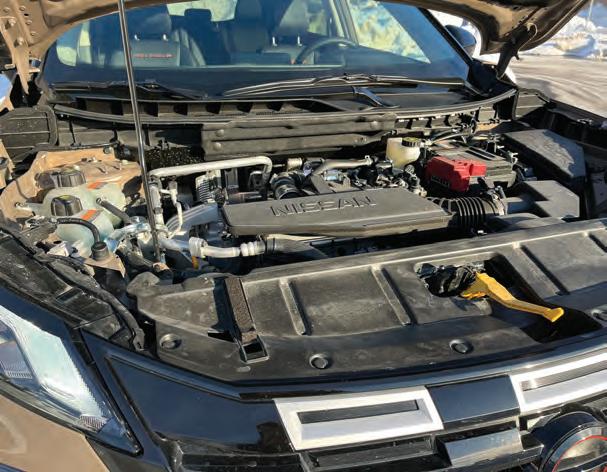

ical given that a phone will need to be plugged in to run its app anyway. Only the Nissan Rogue Platinum with its 12.3-inch touchscreen using Google Built-in comes with wireless Apple CarPlay, wireless Android Auto, and a wireless charging pad. These features are increasingly becoming standard in vehicles in this class, making this one of the few instances where the Rogue’s age is evident since it was last redesigned for the 2021 model year.
If you need your compact SUVs to have plenty of cargo room, the Rogue comes with an asterisk. In the S, SV, and Rock Creek trims, it can handle up to 895 litres of cargo space behind the second-row seatbacks. This is on par with some
competitors such as the Subaru Forester and Mitsubishi Eclipse Cross but well below others like the Toyota RAV4, Honda CR-V, Hyundai Tucson, and Kia Sportage. The Platinum’s Divide ‘n Hide cargo system allows the cargo floor to be dropped, which increases cargo space to 1,033 litres and brings it closer to the space offered by the latter list of alternates.
In its SV and Rock Creek trims, the Rogue comes with Nissan’s basic ProPilot Assist system. This combines adaptive cruise control and lane centring to create a semi-autonomous hands-on highway drive assist system. The Platinum trim upgrades this to ProPilot Assist 1.1, which adds automatic adjustments for speed limit changes.
Standard safety and driver assist features on every Rogue include forward automatic emergency braking, rear automatic braking, intersection collision avoidance assist, blind spot monitoring, rear cross-traffic alert, lane departure warning, and a driver attention monitor. It’s an impressive suite of features available at the Rogue’s price point.
Pricing for the 2026 Nissan Rogue starts at $37,186 for the S trim including destination charges and fees, $40,986 for the SV trim, $44,186 for the Rock Creek, and $48,686 for the Platinum. For fleet applications, we recommend skipping the Rock Creek unless one of its unique features adds significant
“The Platinum’s Divide ‘n Hide cargo system allows the cargo floor to be dropped, which increases cargo space to 1,033 litres.
value for your use case. Stick with the Rogue S, a tried-and-true version of this compact SUV that delivers excellent value. FM/SP
As Tested (2026 Nissan Rogue Rock Creek)
Price (incl. freight and PDI):
$44,186
Engine: 1.5-litre turbocharged I3
Power: 201 hp, 225 lb-ft
Transmission: Continuously variable transmission (CVT)
Rated Fuel Economy (L/100km): 8.7 city/7.2 hwy/8.0 combined
Observed Combined Fuel Economy (L/100km): 9.4

The latest case studies flowing out of public audit reports and legal decisions prove what we have already known for years. They reflect long-standing trends and provide fresh evidence of the chronic and systemic issues that were previously well-documented in Canada’s public procurement system. Sadly, recent case studies serve as a small sampling from the tip of the iceberg. The fact that public audits repeatedly and consistently expose the same systemic issues across multiple public institutions at all levels of government in all regions of Canada cannot be dismissed as a mere coincidence. While there are outlier institutions that operate in an oasis of good governance, many if not most public institutions are an easy target when the auditors come knocking. The same goes for bid protests and other legal battles. While the relative rarity of litigation may result in institutional complacency, the reality is that the absence of litigation does not mean that an institution is properly managing its procurements. The reported cases are a small fraction of actual legal disputes in any given year since most disputes are resolved prior to formal proceedings, or when formal proceedings are initiated, through confidential out-of-court settlements that are rarely made public. Rather than being outliers, recent case studies track true to the reality on the front lines of the public procurement system. Many, if not most, procurement professionals can attest to the fact that the case studies reflect their daily realities, with chronic issues recurring on a regular basis within their organiza-
tions due to structural defects in their institutional practices.
While this may paint a grim picture of the current state of the Canadian public procurement system, recent case studies also offer examples of how public institutions can course correct and forge a path forward towards improving their procurement operations.
For example, in its March 2025 follow-up audit entitled Procurement Processes: Transportation and Economic Corridors, Alberta’s Auditor General confirmed that the government of Alberta rectified prior procurement issues relating to, among other things, posting periods and procurement-records retention in provincial construction tendering. The audit found that the government implemented regular training sessions to “ensure everyone performing procurements is aware of the requirements.” The audit found no new instances of non-compliance with posting periods, which reflected a significant improvement over the 30 percent non-compliance rate found in the prior audit. For record keeping, the audit found that the government “developed a procurement documentation checklist to ensure it retains appropriate records to support all award decisions.” Its review of four major construction projects found that “all required documentation per the checklist was retained on file,” which reflected another significant improvement over the findings of the prior audit.
Further, in its June 2025 report entitled Increasing Efficiency and Cost Savings While Balancing
Other Procurement Objectives and Maintaining Compliance, the Auditor General of Toronto recommended increasing the use of purchasing cards for high-volume-low-value purchases, as well as more staff training, to increase overall process efficiencies and avoid procurement delays. This report serves as a useful reminder to public institutions that adding more rules and red tape to their purchasing procedures is not a victory for the taxpayer. Rather, public institutions need to carefully balance accountability and efficiency when updating their procurement practices by thorough updated procedures and enhancing staff training.
Finally, in its May 2025 study entitled Negotiated Requests for Proposal, Canada’s Procurement Ombud encouraged the federal government to adopt negotiated RFPs as an alternative approach to traditional tendering since flexible formats help improve competition, result in better solutions, and provided greater opportunities to obtain value and money, while also mitigating “many of the legal risks associated with traditional tendering formats.” As the report detailed, many public institutions across Canada have already implemented NRFPs, particularly for more complex projects. This new study offers a path forward out of the current state of inertia as the federal government faces increasing pressure to improve its procurement practices with more agile solutions.
These are just three examples of how public institutions can repair the foundations of their procure-
Paul Emanuelli is the general counsel of The Procurement Office and can be reached at paul.emanuelli@ procurementoffice. com.
“The fact that public audits repeatedly and consistently expose the same systemic issues across multiple public institutions at all levels of government in all regions of Canada cannot be dismissed.”
ment systems. To forge a proper path forward, public institutions need to focus on the fundamentals of good governance, adopt more precise practices for drafting solicitation documents and managing evaluation and award procedures, and expand their use of negotiated RFPs to increase future project success. Moving forward, the choices are clear, a public institution can serve as the next case study on public procurement failures, or it can learn from past case studies and forge a path forward towards improving its procurement operations. SP
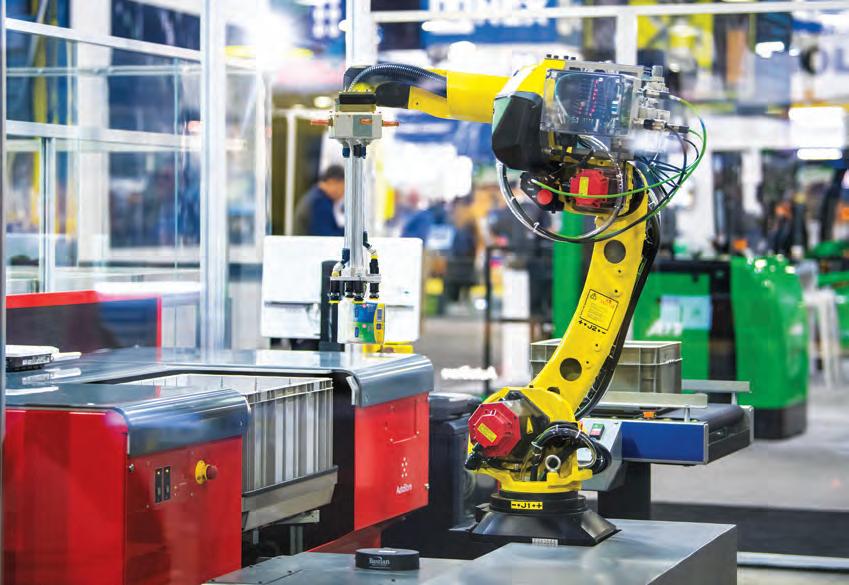

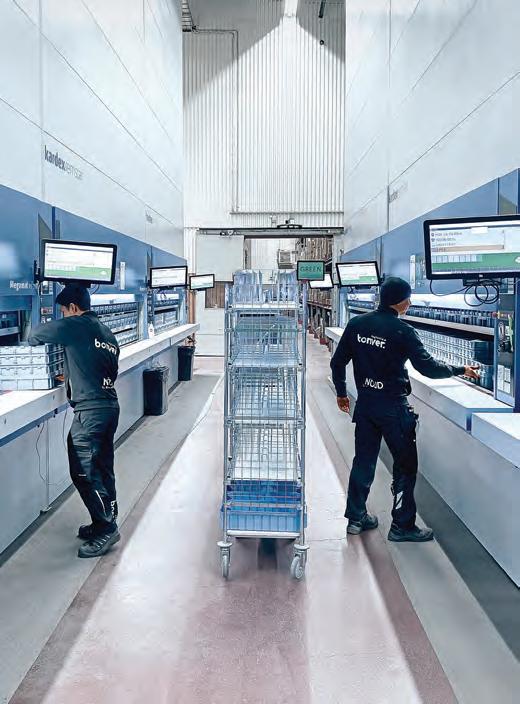
Discover the next step in your automation journey
Automation that’s rooted in strategy—the right technology at the right time for the right application—boosts team productivity, engagement and satisfaction. And that’s good for business. No matter what stage you’re in, GNJ Automation brings years of intralogistics expertise to help evolve your systems and empower your people.
READY TO AUTOMATE, INTEGRATE AND INSPIRE?
Connect with a member of our team and let’s start the conversation.