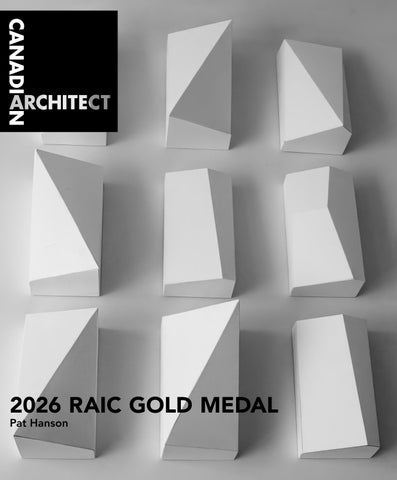
2026 RAIC GOLD MEDAL
Pat Hanson
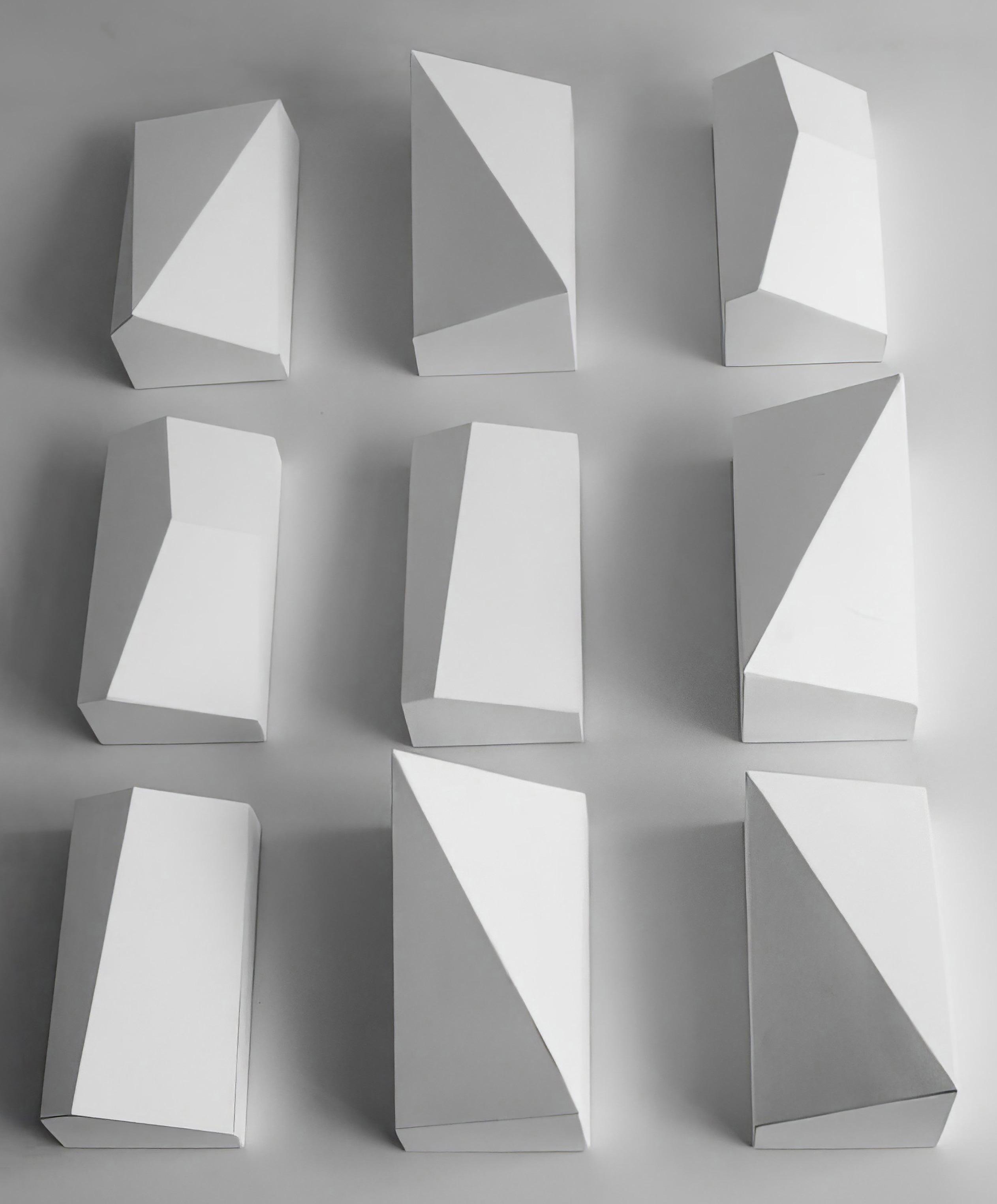
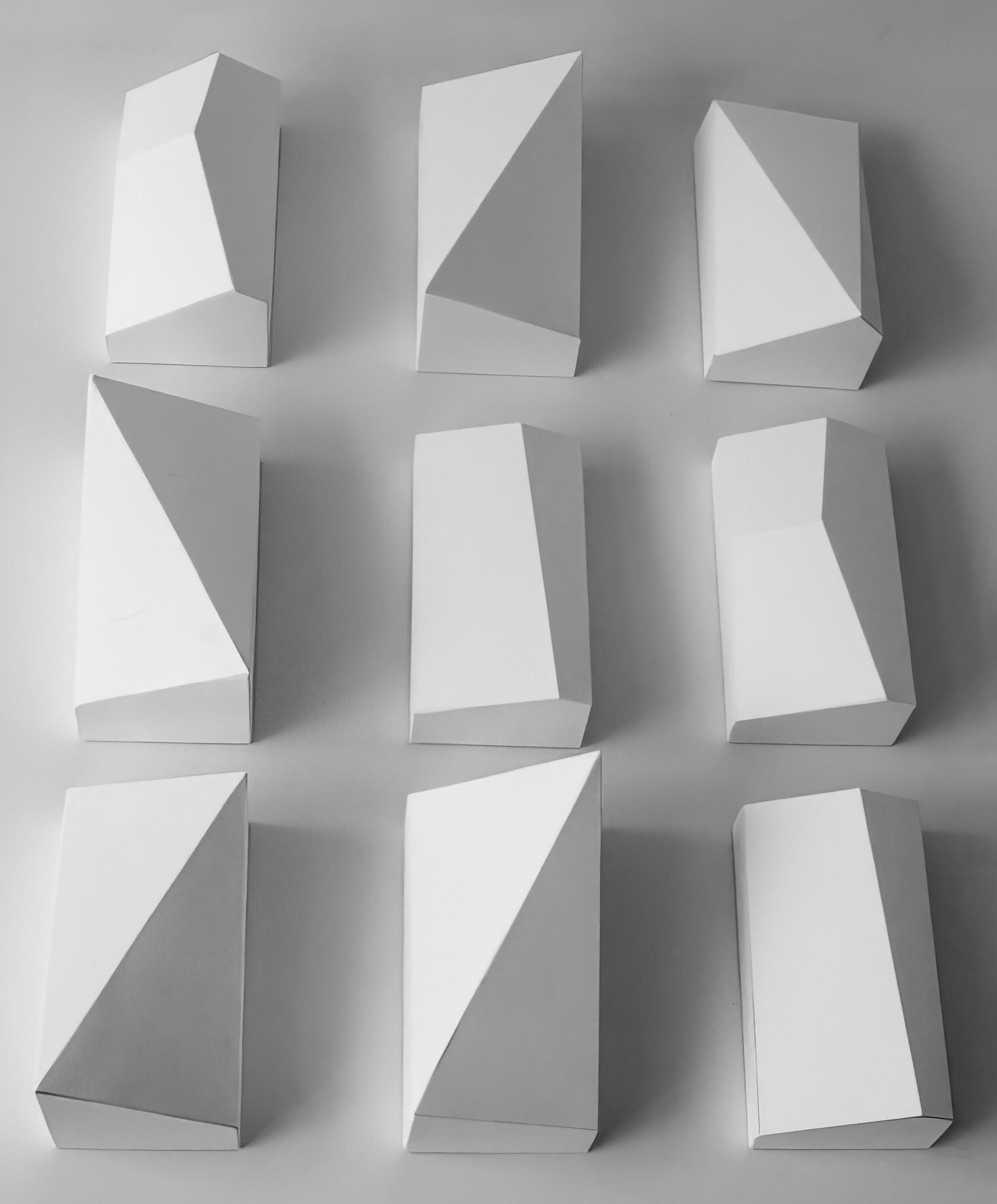
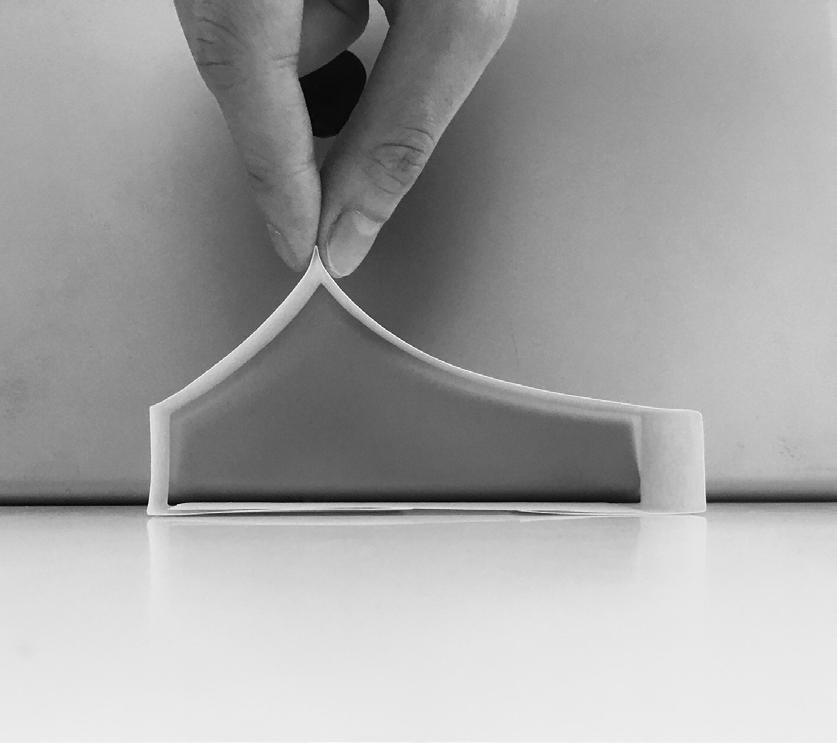
Cover and back cover: A series of study models explores geometric variations for the Stormwater Facility in Toronto, Ontario.
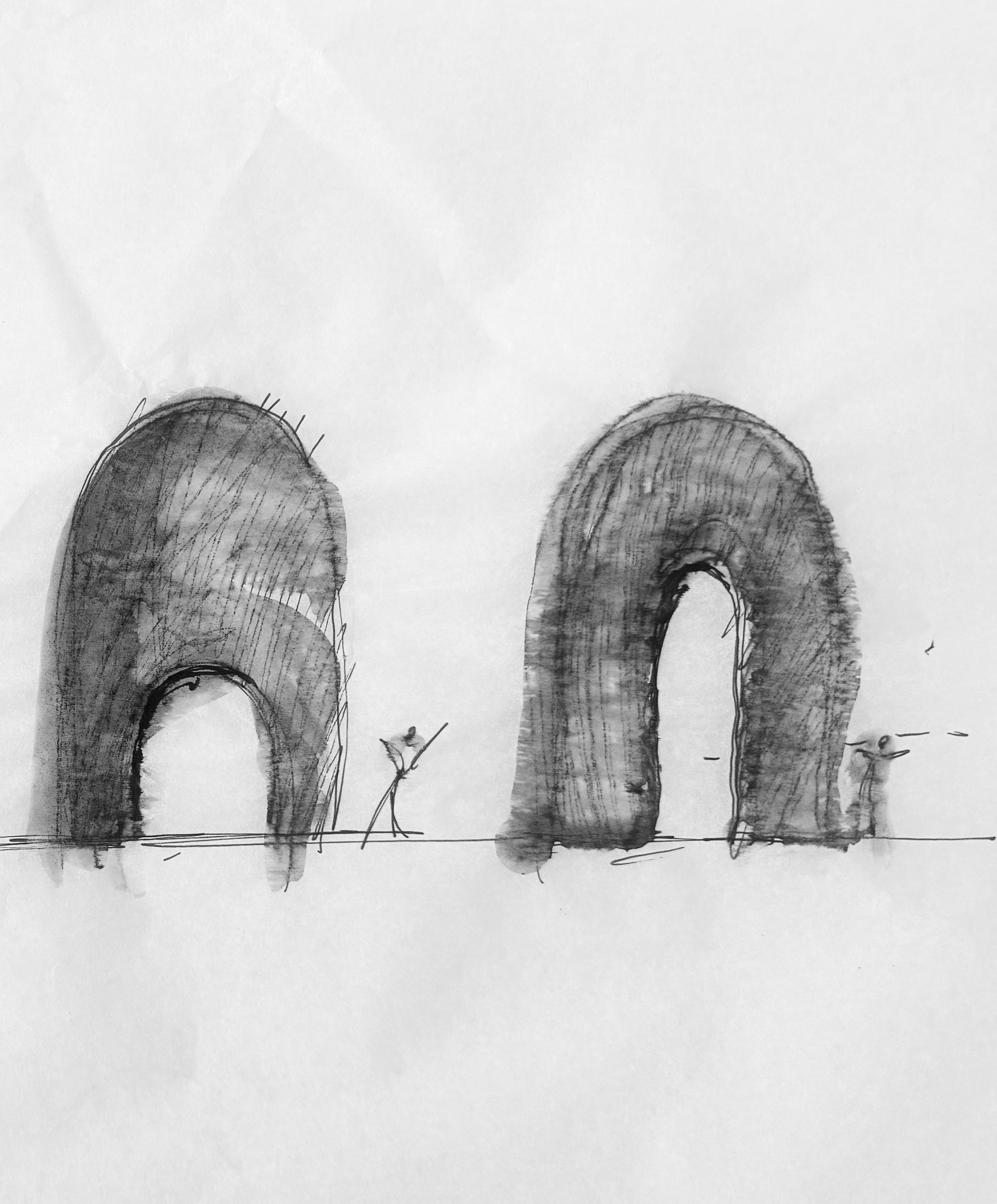
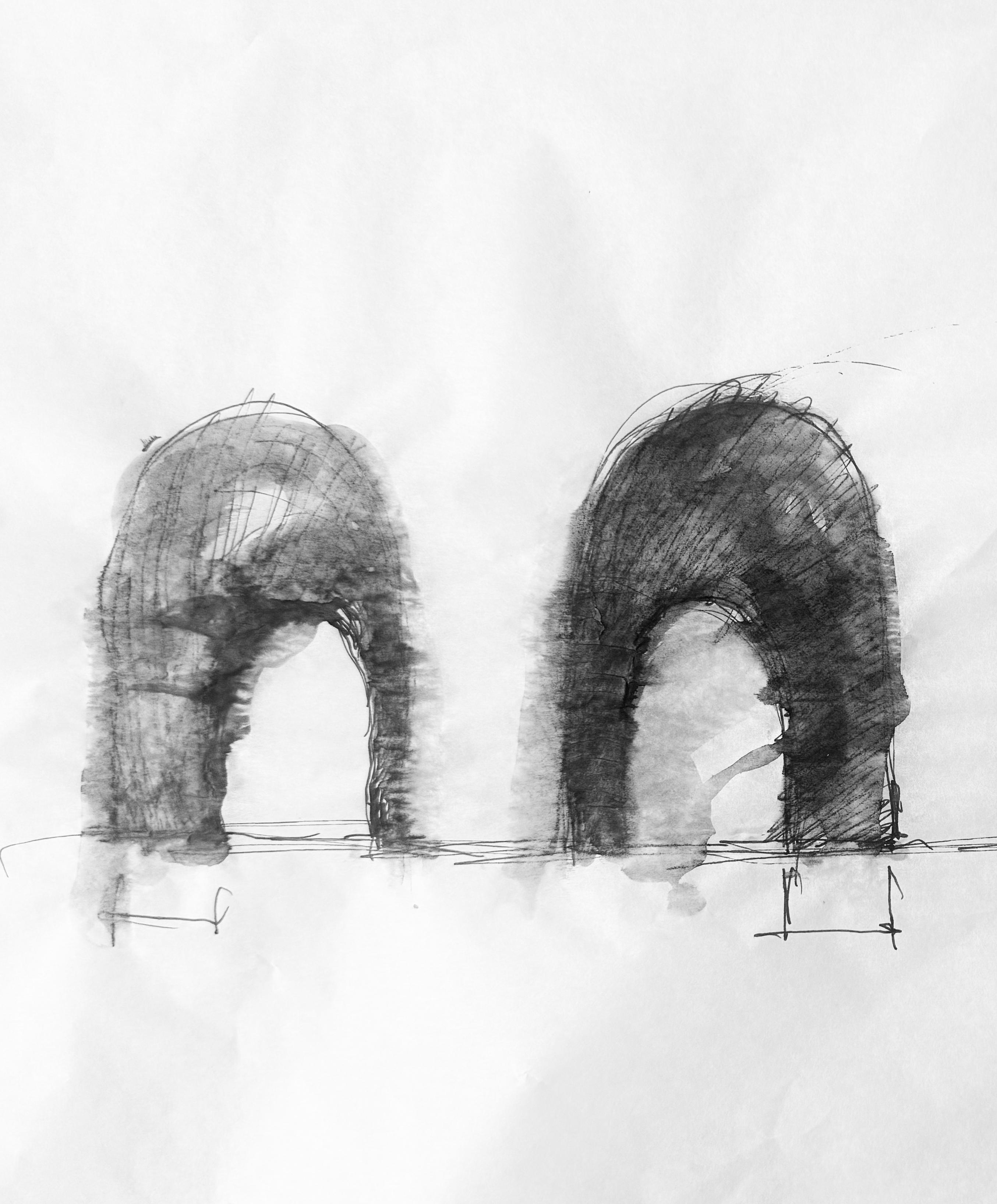
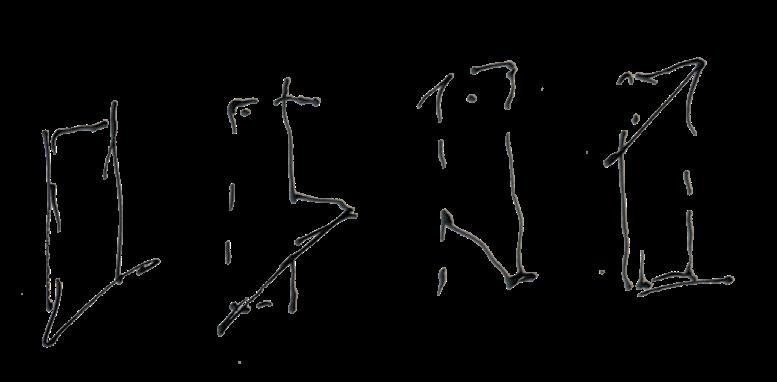
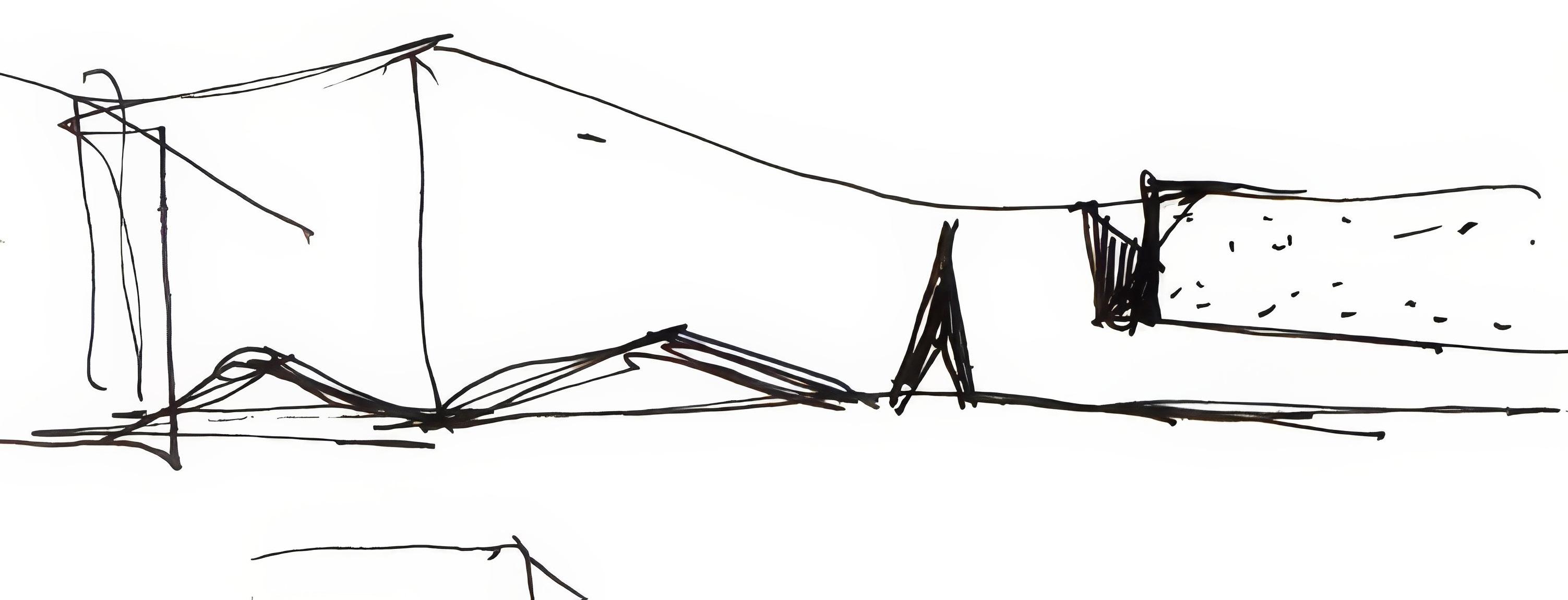
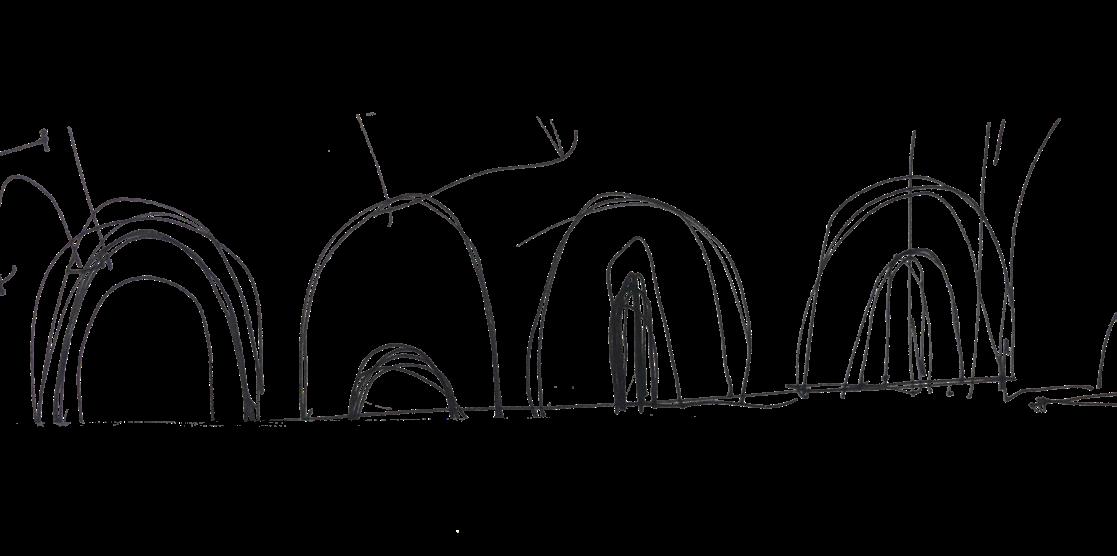
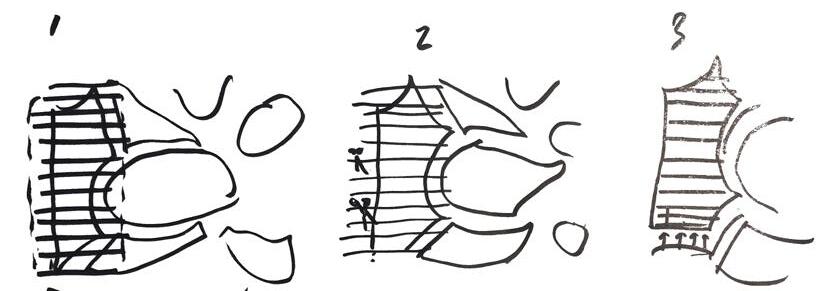
Inside front and back cover: Pat Hanson’s sketches for the Leslie Lookout Tower’s portals facing the cardinal directions—north, south, east and west.
Editorial Viewpoint
This special issue of Canadian Architect celebrates 2026 RAIC Gold Medal winner Pat Hanson, and the work of her firm, gh3*. Hanson’s exceptional design abilities came onto my radar when gh3*—then just a six-year-old-firm—won two of five projects in an open national design competition for park pavilions in Edmonton. On my first visit to Edmonton as a magazine editor, City Architect Carol Bélanger toured me through the construction site at Castle Downs Park, where gh3*’s fun-house-like mirror cladding panels were just being installed, to remarkable effect.
Before receiving the RAIC Gold Medal—the highest career honour bestowed by a Canadian architectural organization—gh3*’s work has been amply recognized. Among many awards, the firm has received five Governor General’s Medals in Architecture, and seven Canadian Architect Awards for future projects.
To me, one of these projects stands out for what is says about Pat Hanson’s creative vision and ethos: the Borden Park Natural Swimming Pool. In its design phase, the project that won a Canadian Architect Award was made of round pools, and used curved cutouts and additions to strategically repurpose two existing mid-century changeroom buildings. The final project—with its rectilinear pools, and pavilions built with gabion basket walls rather than smooth white surfaces—bore little resemblance. This in itself is not unusual. Costs come in too high, value engineering is requested, and projects that dream big in the design phase are often pared back when built.
What is unusual is for the resulting project to be so accomplished that it goes on to win a Governor General’s Award. Hanson says the process wasn’t easy—she and her team put a lot of energy into the initial design—but when a pivot became necessary, she rose to the occasion. “I got another idea,” she recalls of the change.
This is the genius of Hanson, and of gh3*’s work. It is idealistic in its design vision, while being utterly pragmatic about the real conditions by which buildings are made: with tight municipal budgets, locally available materials and labour, and complex stakeholder and client groups. Hanson’s creativity isn’t limited by these constraints: her genius lies in the arguably harder task of working within such parameters, and still finding rich artistic and architectural possibilities.
– Elsa Lam, editor, Canadian Architect
Jury Comments
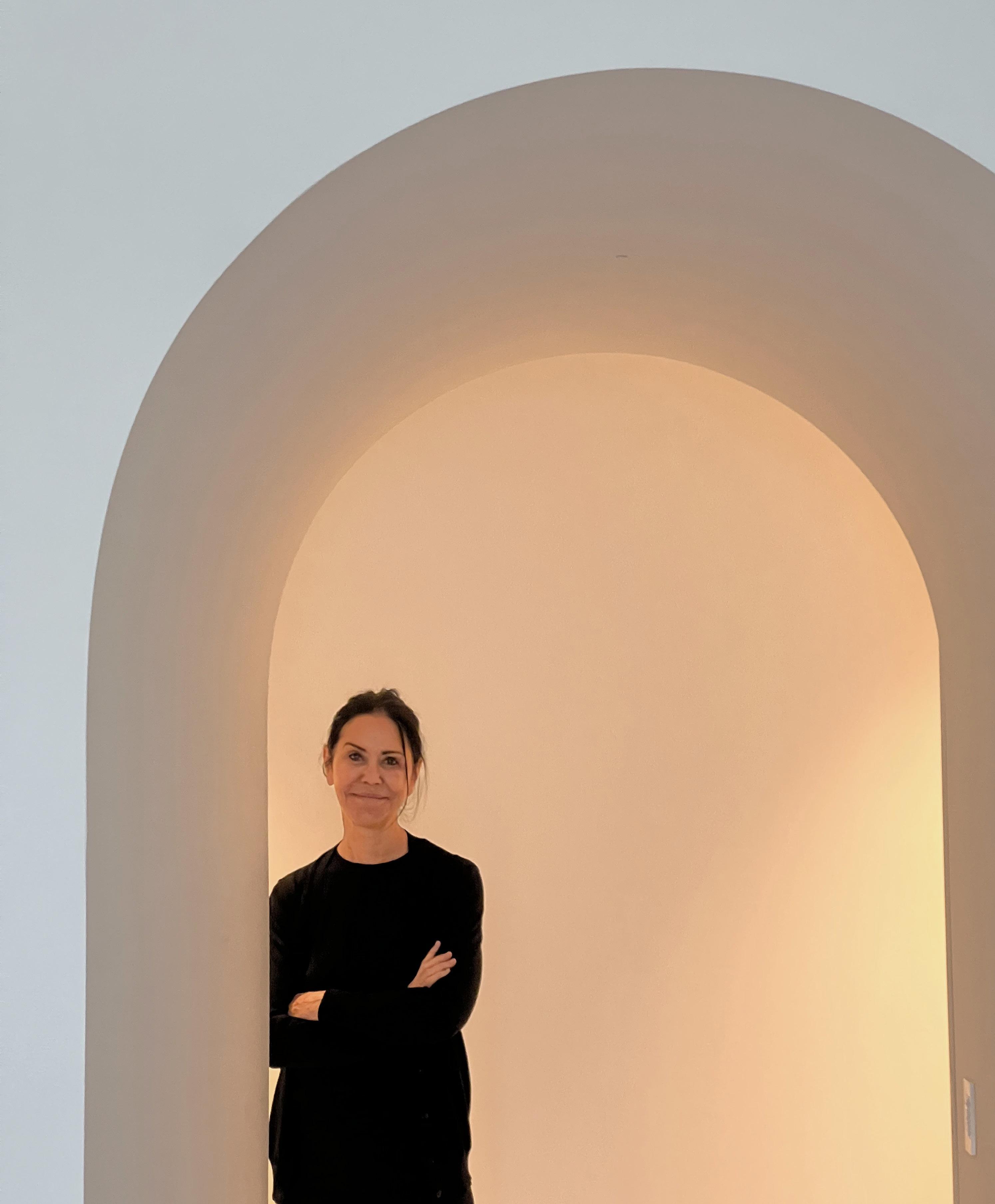
Her work is recognized as a powerful and conceptually rigorous body of architecture that consistently elevates infrastructural and utilitarian typologies into poetic and dignified public spaces. Through pure and expressive forms, refined detailing, and a deep commitment to user experience, her projects transform even the most challenging programs—such as bus terminals, swimming pools, and other public infrastructure—into elegant and inspiring works of architecture. She brings beauty and meaning to the everyday, demonstrating that everyone deserves access to well-designed public space.
– Sumayya Vally, Stephanie Yeung, Chris Woodford, Ted Watson & Wayne Guy, 2026 RAIC Gold Medal jurors
On Receiving the 2026 RAIC Gold Medal
I am truly honoured to receive the Gold Medal from the Royal Architectural Institute of Canada. The practice of architecture has shaped my life in the best possible way, making this award incredibly meaningful to me. I accept it with joy and a deep sense of responsibility.
The story of gh3* is, in many ways, a story of a slow profession and a late bloomer. The daunting challenge of starting a practice later in life would not have been possible without the support of many colleagues. In many cases, their willingness to collaborate has been essential in helping us shape a portfolio of built work.
I would also like to acknowledge public agencies that have embraced design-focused procurement processes, such as the City of Edmonton, Waterfront Toronto, the University of Toronto, and the Calgary Municipal Land Corporation (CMLC). These institutions believe that good design can elevate the public realm. To them—and to our private clients who have trusted us and believed in our work—we are deeply grateful.
My thanks as well to the RAIC for this award, and to all the journalists, critics, and editors who have looked closely at, written about, and published our work. In doing so, they have not only supported gh3*, but also helped advance the profile of the architectural profession.
I really know only one way to work: I start with an idea. That idea might come from an image, a reference, or a particular context. This guiding idea is what I continually return to as the design develops: partly to ensure that it still holds, and, when it does, to use it as a compass for the multitude of decisions required to mature the design. Every project may appear different from its predecessors, but they all begin in the same way.
This process sounds more linear than it actually is. The initial idea often shifts and improves through dialogue and collaboration within the project team and with our clients. Through making, we iterate constantly. Our process is one of testing and refinement, moving from the seemingly ridiculous to the ultimately reasonable. We explore, discard, refine, and return, always in service of the central architectural idea.
We are realists, working within the constraints of the North American design and construction industry. We do not shrink from
the ordinary; instead, we look for ways to reinterpret and elevate it, whether by using standard materials in new ways, simplifying and editing construction details, or, as in the case of the Toronto Stormwater Facility, adjusting the order of structure, insulation and cavity to achieve a monolithic exterior.
I gravitate toward simple, abstract forms, with a focus on spatial qualities and straightforward detailing—no more than necessary to maintain attention on the elemental aspects of the design. We do all of this with the primary ambition of creating buildings that serve their users, with the added hope that the experience of using them is engaging and inspiring.
I have always tried to surround myself with people who can do what I cannot. In the early years of gh3*, Raymond Chow, a recent graduate, and later Joel Di Giacomo, then a student, brought a wealth of talent and digital expertise to the practice. Their ability to bring design proposals to life was a core asset at a time when we had few built works, but aspired to be a credible design force.
I remain constantly amazed by—and appreciative of—the dedication and talent of the people in the office. Over time, I have come to rely on a broader group, including John McKenna, Vanessa Abram, Elise Shelley and a deeply talented studio of architects and designers. Regardless of the stresses of practice, the studio environment at gh3* brings me daily enjoyment and fulfilment.
As gh3* has grown, we have taken on larger and more complex works. Yet we remain equally interested in projects of varying scales and levels of complexity. I have often said that we are happy to design anything, because we see potential in every project. For example, each infrastructure project has prompted us to think more deeply about our environment—particularly the care and management of urban water. That thinking naturally extends into landscape, and into the broader context. We create worlds that do not stop at the building envelope, but instead form a complete conception of site, landscape, and structure.
For this special issue of Canadian Architect, I have selected projects that I believe are representative of this position, and of gh3*’s identity.
– Pat Hanson, founding principal, gh3*
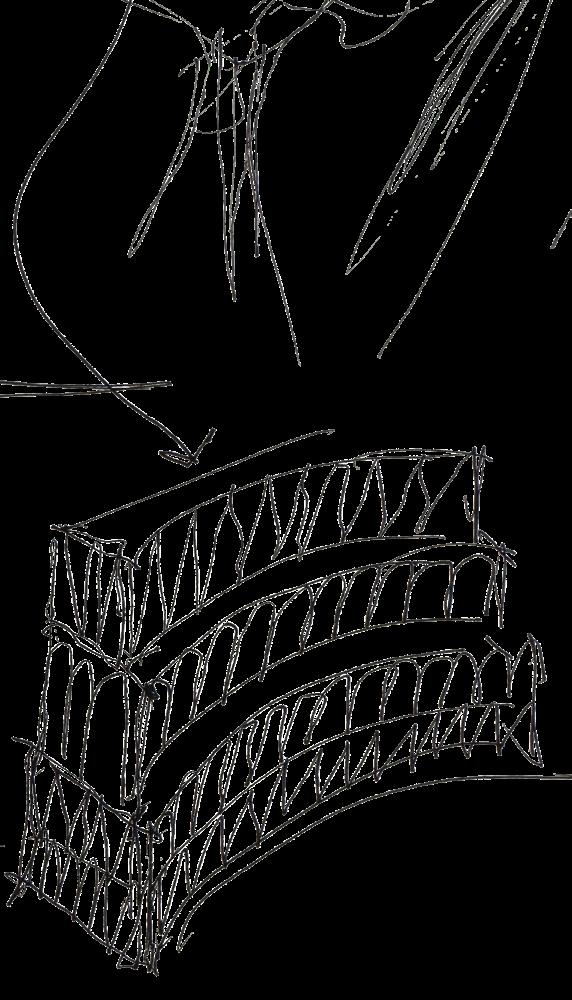
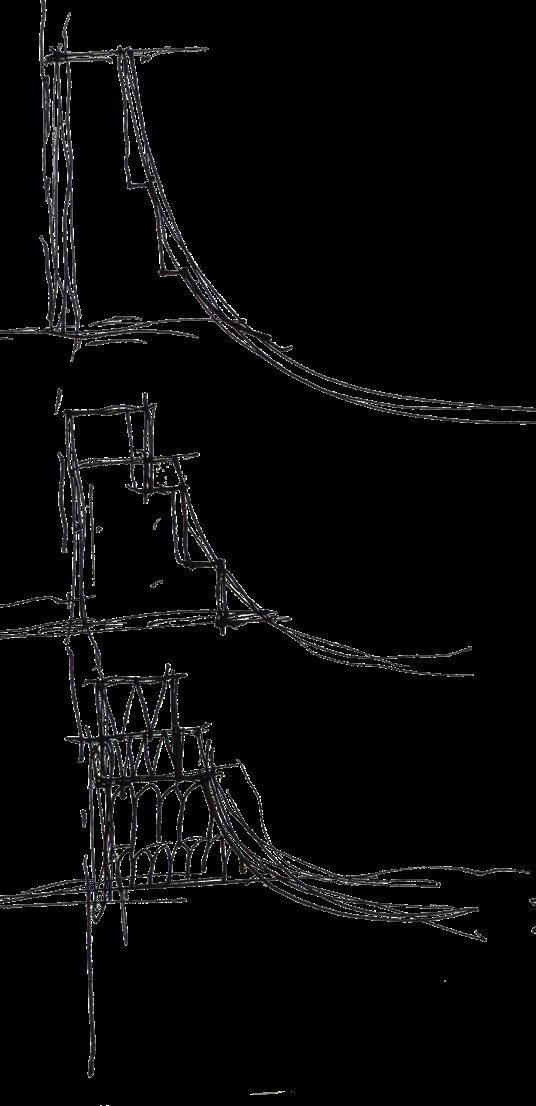
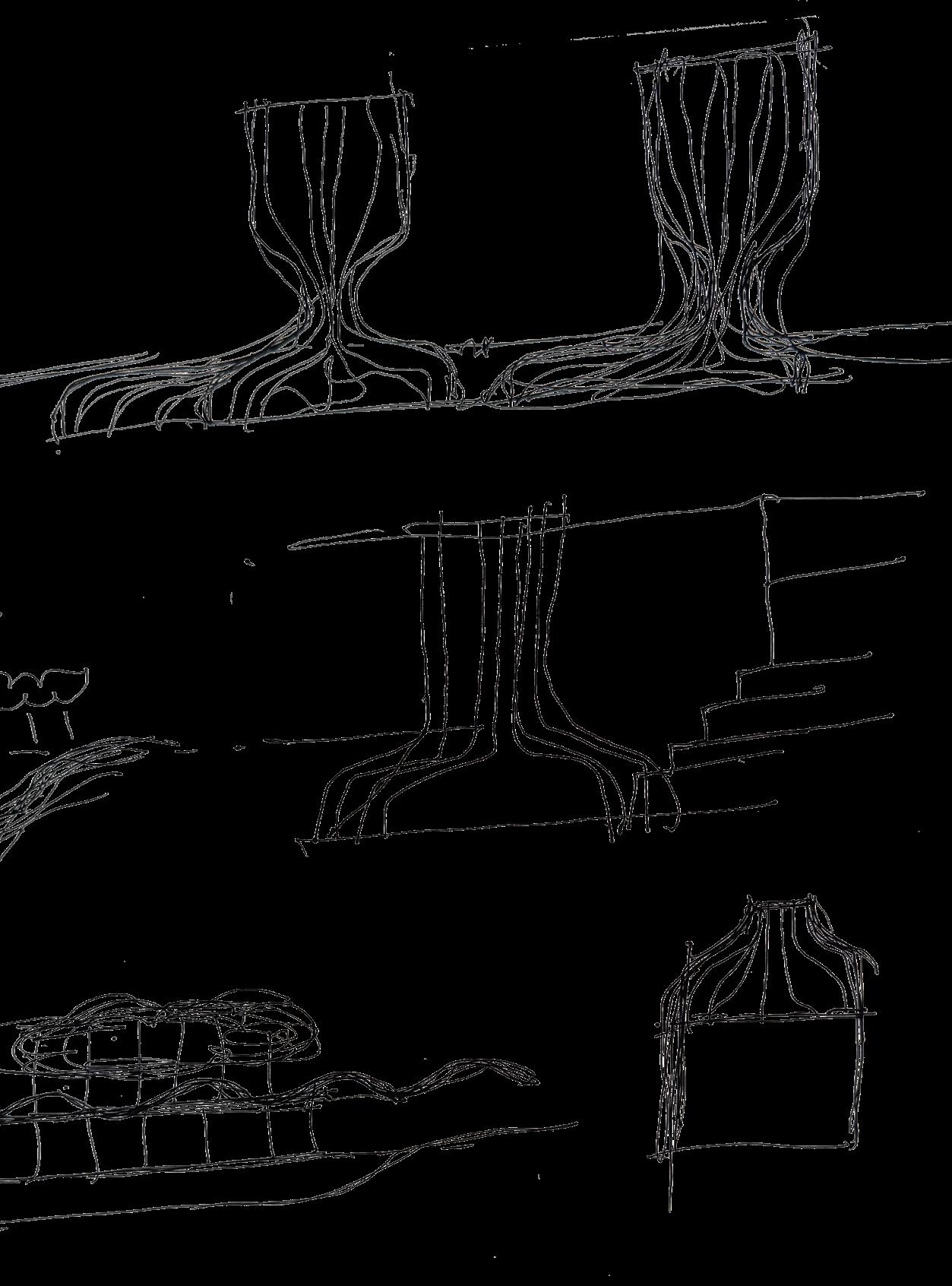
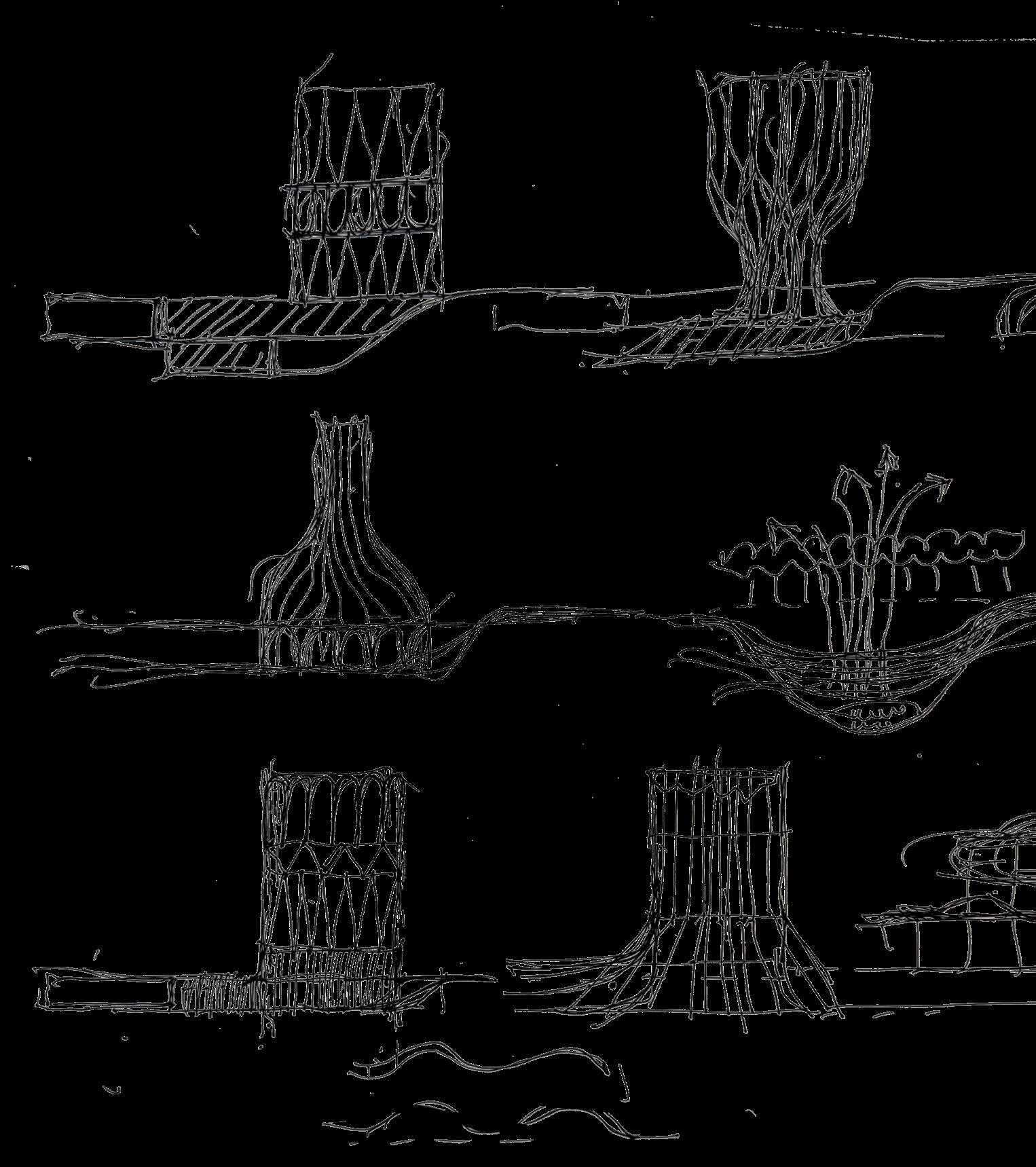
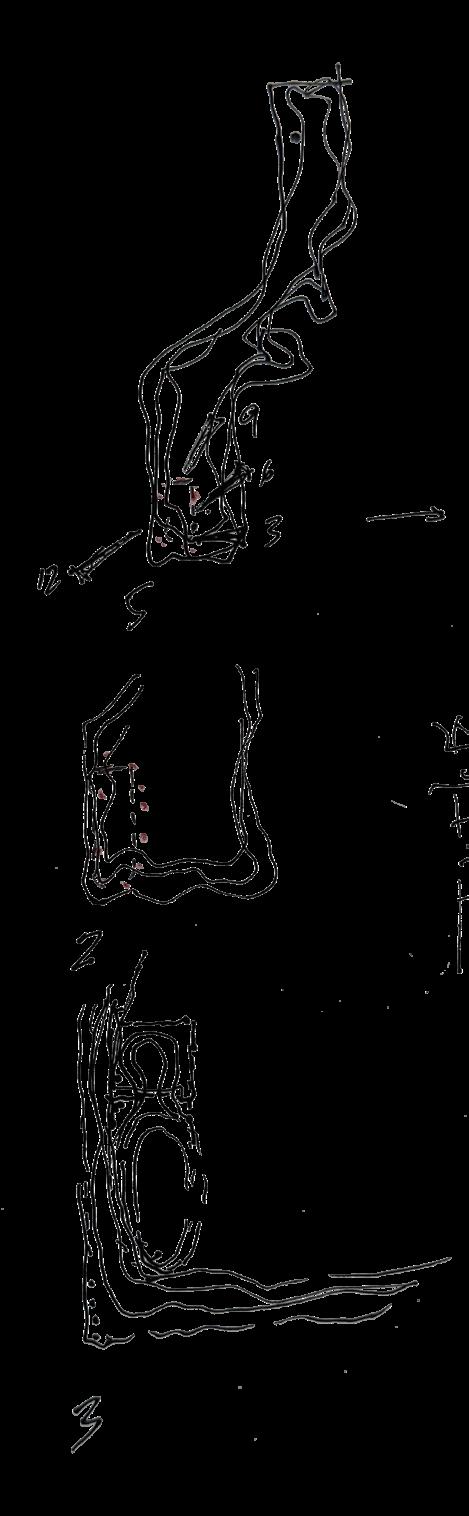
Exploratory sketches for community centre proposal
On Pat Hanson / gh3*
This year’s RAIC Gold Medal recognizes Pat Hanson’s work from the past twenty years at the helm of gh3*, the studio formed in 2006. Rather than an oeuvre developing over time, these projects appear—strikingly—as fully mature works secure in concept, technique, and handling of form and materials.
Through this work, Canada’s highest architectural honour is proudly represented by some of the most utilitarian and technically demanding of programmatic requirements—the kind of programs many might consider banal, as they rarely rank within the auspices of contemporary signature-worthy architecture, let alone evidencing the expertise of a design-focused studio. Yes, there are more familiar types: the elegant and exquisitely detailed Boathouse Studio, for example, one of the first independent projects that enabled Pat to set up shop. But most of the projects are part of everyday working landscapes—infrastructures that are overlooked and often invisible to our distracted, habituated daily lives. There is a stormwater facility in the Toronto Port Lands, a proposed wastewater innovation centre for Barrie, Ontario, a massive transit servicing garage in Edmonton. Whether small in scale—or as in the latter case, a big, complex program on a big, unwieldy site—these are the public face of municipal services. gh3*’s portfolio to-date does not include the kind of high-end institutional work with a robust budget that one normally thinks of as permitting the so-called “art of architecture.” And yet, the realized projects consistently demonstrate an astonishing calibre of execution and clarity of concept that exemplifies the profession of architecture’s highest achievements.
What secures and grounds such confident work? Certainly, Hanson’s two decades of work in various architecture practices, prior to founding gh3*, played a role. What motivates end forms—such as a bright red, thick scalloped roof or the patterning of brickwork for a fire station? Hanson says: a strong architectural concept.
Such concepts, as captured in words, are shorthand for fuller built ideas—and are well understood within the office as potential, not directive. Among the recurring words that come up: the integration of urban systems, working water, working sites, super forest, big roof, landscape, and, of course, place.
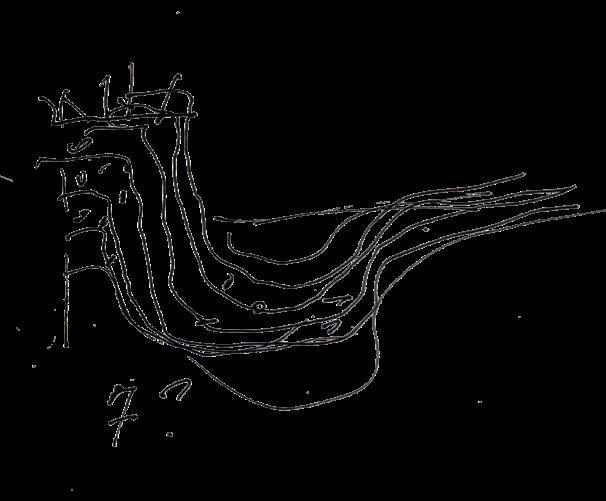
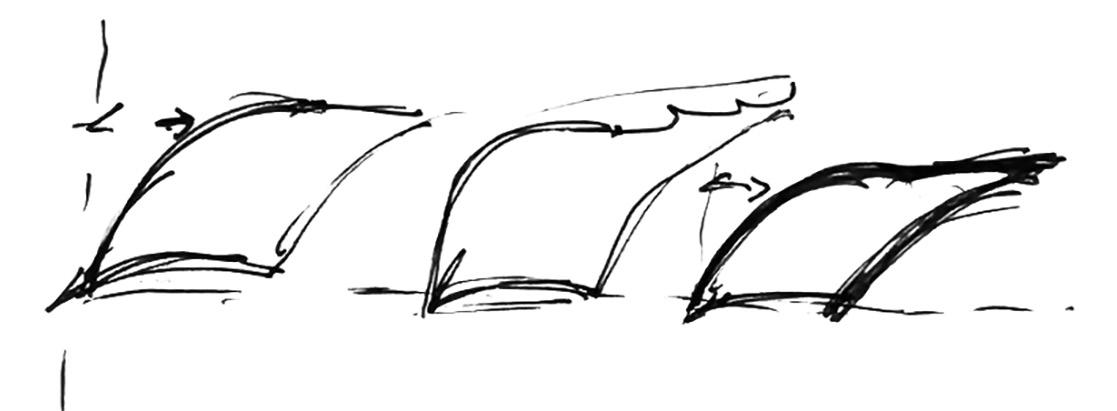
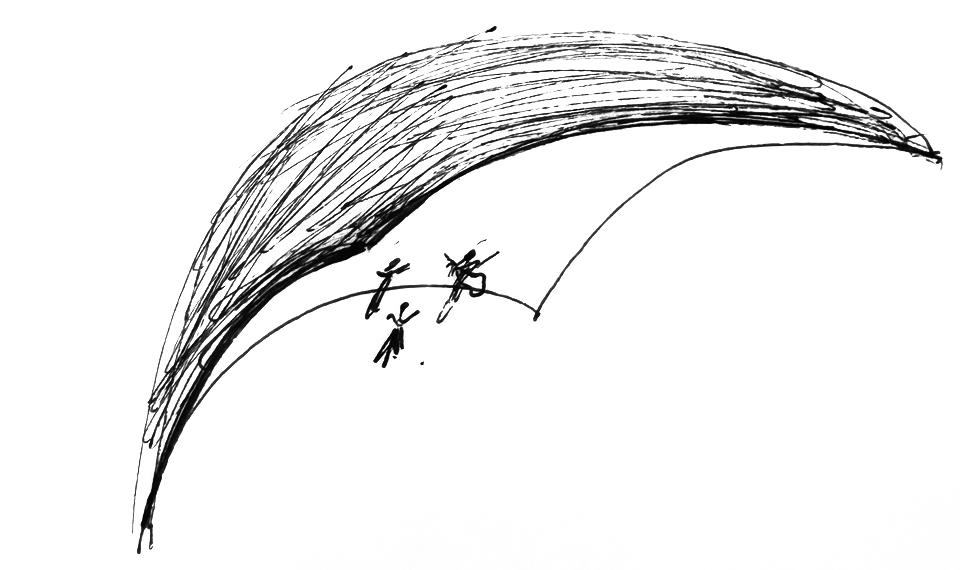
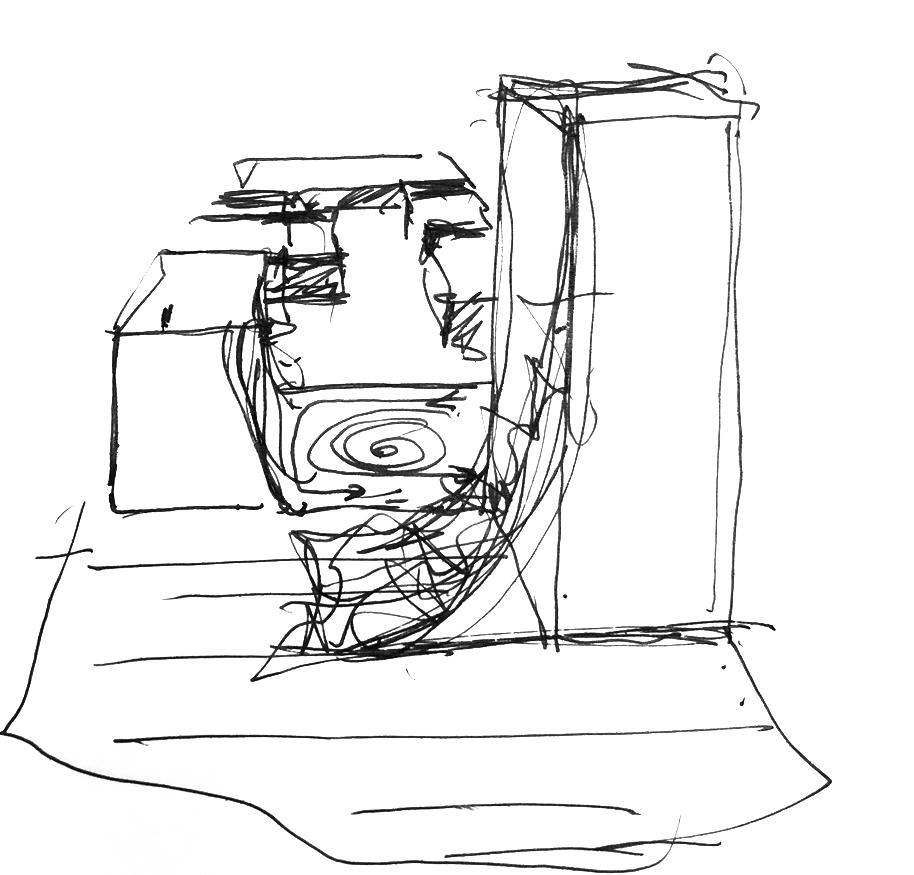
Process is key in understanding how such concepts inform the thousands of design decisions that carry such broad concepts through to built work. When asked for concept sketches, Hanson produces the images seen alongside this essay—the very few ballpoint-pen-on-trace drawings that were scanned before being tossed in the recycling bin. Like the way a few phrases serve as shorthand for complex, unfolding design concepts, Hanson’s drawings are sure, quick gestures that communicate architectural intent—understood without recourse to finicky refinements.
Such sketches aren’t seen as precious. Nor are the studio’s working models. The models of formal variations for Toronto’s Stormwater Facility—seen on this magazine’s front and back covers—are some of the few remnants of older projects that remain at gh3*’s office; the rest have been long discarded.
The gh3* office space itself adds little to the aura of a creative professional practice. It is a working studio, fronted by a floor-toceiling glass plate window and steel door on the bustling lower end of Ossington Street. The door, like an adjacent brick wall, is covered with graffiti, making the studio blend in, rather than stand out, from its neighbouring coffee shops, restaurants and vintage clothing shops. Various objects have occupied the window space. At one point, there were several Day of the Dead skull sculptures brought back after a visit to family in Mexico; more recently, there are stacks of Canadian Architect featuring a gh3* project on its cover.
There has never been a reception desk, there is no celebratory wall of awards (apparently the Governor General’s medals went into a drawer), there is no library displaying books, no showcase of key projects. There certainly is not an archive—much to the dismay of one associate, a former employee at the Canadian Centre for Architecture. Everyone works in the same space, now expanded to a second floor, and sits in the same grey chairs scattered at long tables piled with printouts, notebooks, multiple screens, and swatches of knitting. Pat Hanson’s place is at the back of the studio; associates Raymond Chow, John McKenna, Elise Shelly, Joel Di Giacomo, and Vanessa Abram are dispersed throughout. There are no distinguishing hierarchies, no administration, no promotions department. What is evident in this spare and casual milieu is the focus on an integrated studio, immersed in all the tasks of architecture practice.
Hanson grew up on the suburban fringe of Regina, surrounded by the working landscapes of wheat fields and forests. Does a childhood spent in the Central Prairie underlie Hanson’s straightforward work ethic and pragmatism? Perhaps it accounts for a clear-eyed, unromantic view of the natural world—and a deep respect for changing relations among ecologies of landscape, water, weather, people, materials, and built form. After a brief stint at the University of Regina, Pat transferred to University of Manitoba, completed a B.F.A., and at the suggestion of a life-long friend, applied to the architecture school. In her words, she immediately knew she could do all that architecture called for, and she loved all of it.
Hanson graduated in the 1980s, a time characterized by ‘isms’, often appended by tortuous theoretical arguments: postmodernism, critical regionalism, deconstructivism, along with more nostalgic kinds of contextualism. More direct accounts asked: what comes after late modernism and all the worn-out promises of a better life through design? In some corners of Canada, there was a turn back to the essentials: the land, nature, materials. Hanson’s response was to find liberation from the “isms.” This is not to be confused with an “anything goes” attitude—rather, Hanson found an opportunity to test what constitutes rigour, and what is of value to an architectural concept. She asked: what belongs and matters to architecture, and what is extraneous? This is not to make light of intellectual work, or dismiss all the polemics, then or now. Rather, it is evidence of critical aptitude valuing intention through material execution.
In a first post-graduation job at A. J. Diamond, Hanson was part of an architectural crew cutting their teeth on the design and construction of the Toronto Central YMCA. There were lessons from representation to brickwork, to distribution of program between the spaces of the served and serviced—a legacy from Jack Diamond’s training with Louis Kahn. Hanson’s passion for the work fuelled excellence—from the beginning of design through development, the working drawings, site visits, and all the back and forth that is the business of an architecture practice.
As gh3*’s current portfolio took shape, Hanson deliberately pursued infrastructure projects—seeing them as a largely unrealized arena for serious architecture.
Ultimately, infrastructure is that which supports civic life—and in that sense, is there any difference between architecture and infrastructure? In the earliest use of the term, over a hundred years ago, infrastructure referred to something beneath—for example, not the iron rails, but what lay underneath, supporting the rails. In more recent decades, the term has become more liberally used—whether to refer to bridges, wires, or data-electronics. The interdisciplinary scholarly field of infrastructure studies refers not only to physical and digital highways, but also the organizing systems of social life and civic space, and the interrelated data, politics and poetics of such. Does such elasticity—an infrastructural view of the built environment—render architecture as just one variable among many? It is a perspective that integrates previously displaced questions
of ecology and climate, introducing relations between landscape, architecture and urban systems as vitally integrated and inseparable from all that comprises the built environment.
There is a commonplace repeated among the anthropologists and historians in the field of infrastructure studies: it is only when infrastructure fails that we see it, and that our attention is directed to the technologies and systems that support urban life. A water main bursts, a weather event floods an underpass, a sink hole appears, an unpleasant stench reaches our nostrils. Or more simply, there are no provisions, we can’t find a washroom, there is no diaper change station. Ordinarily, such systems underpinning civic life are rendered invisible by the din and distraction of our screen-frazzled lives. gh3*’s work, on the contrary, celebrates the infrastructural—making visible and prominent what is normally out of sight and out of mind.
It is to some degree a matter of happenstance that infrastructure has played such a formative role in gh3*’s perspective on what is valued in architecture. After the boathouse there were lean times—in one year, Hanson recalls, they submitted thirty proposals, had one interview, and gained zero projects. The beginning of more steady work was marked by the commission by Waterfront Toronto for the Stormwater Facility. Subsequent work came by way of the City of Edmonton, an enlightened client willing to invest in a designed civic presence for new urban systems. There is historic precedent: a century ago, dams, water systems, and hydroelectric substations were more commonly seen as occasions for architectural expression. Edmonton’s goals, if more modest in scale, are free of the colonizing hubris of an earlier time.
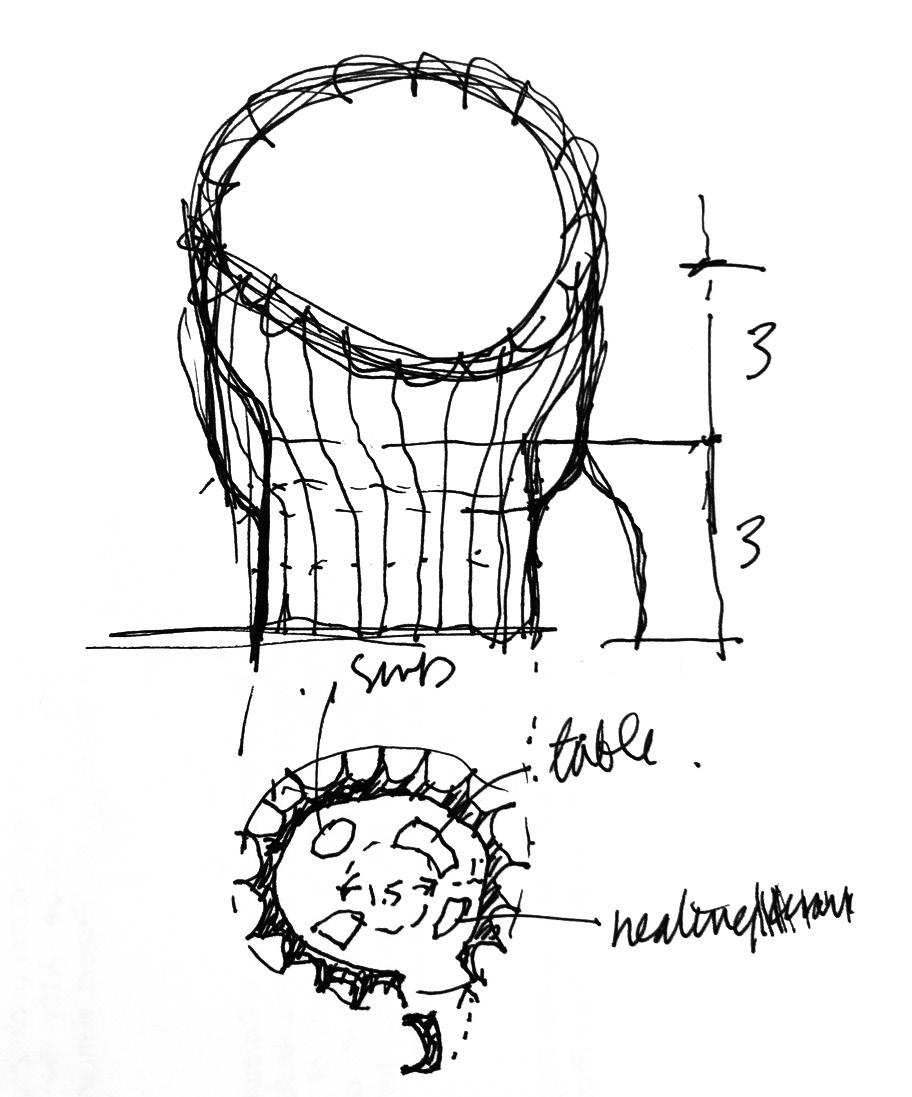
For example, Real Time Control Building #3 makes a compelling argument for architecture’s aesthetic function in contributing to the public awareness of urban stormwater management systems. It calls attention to the ecological complexities of daily experiences within the public realm. The projects for Borden Park—a pavilion and a natural swimming pool—move between background and foreground, as both destinations and part of the ambient environment of day-to-day life. The pool is a stellar example of a practical and ecological approach to pool water treatment. Moreover, its gabion walls—a construction more commonly used for landscape retaining walls—confirms the potential for a poetics of experience and place within the infrastructural. The pavilion, for its part, is more than a passive, jewel-like object sitting prettily on a lawn. Rather, its reflective surfaces are constantly mediating an ever-changing environment, reacting to the dynamic interactions of the foliage, sky, people, birds, and weather. The cylindrical shape and reflections of the beveled surfaces spark curiosity and entertain beyond the pavilion’s utilitarian purpose.
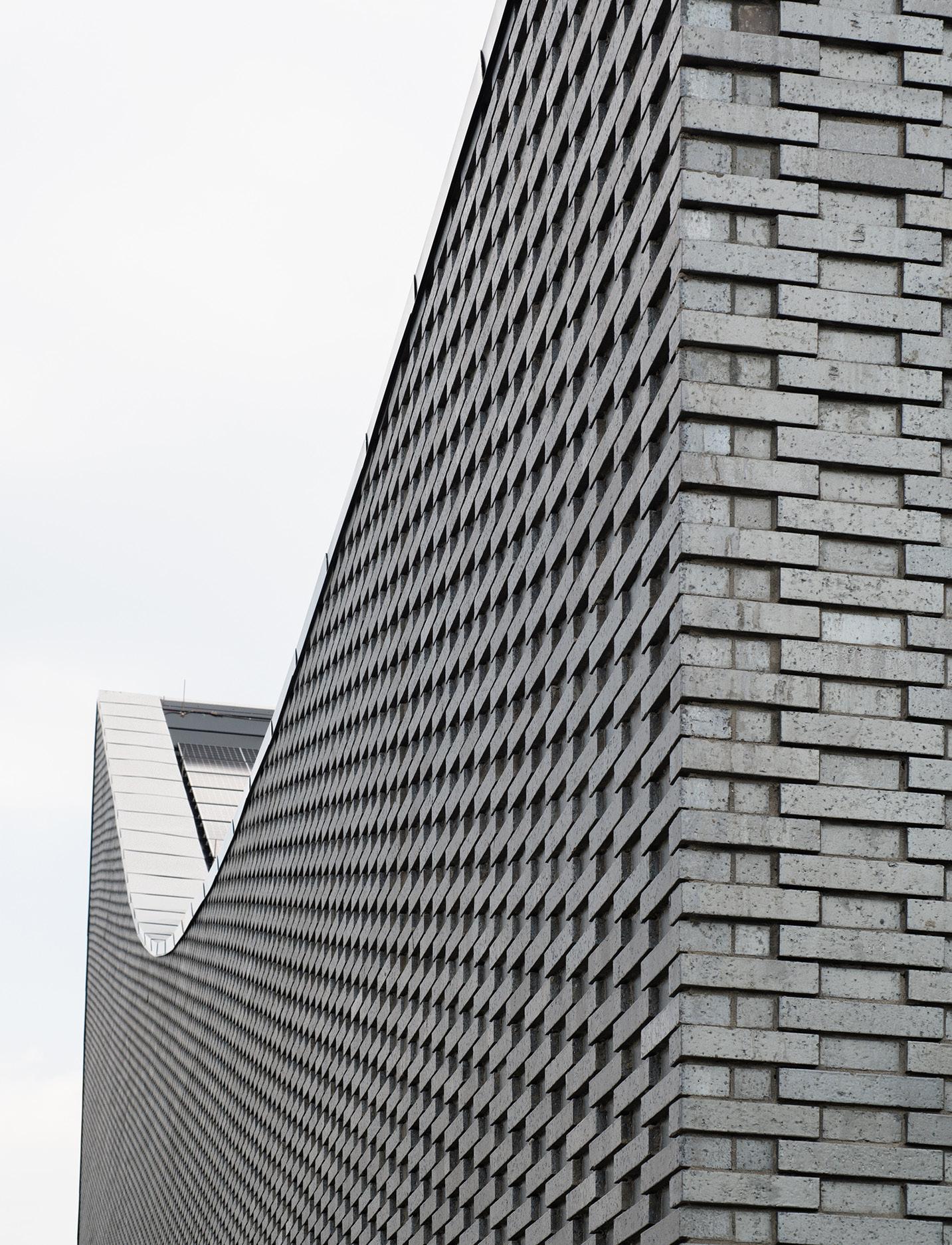
The swooping roof of Windermere Fire Station #31 is optimized for housing the station’s apparatus bay, and for generating solar energy. The resulting front elevation, though, is no ordinary experience. To the left, the roof slopes upward at a conventional angle. On the other side of the peak, the angle changes as it transforms into a relaxed elongating curve. The unusual shape is outlined by a crisp black eave, producing a canvas-like flatness reinforced by the disciplined use of a woven brick pattern throughout the front elevation. There is a kind of tension that makes for a visual frisson—a delightful pushpull between the curved line moving in one direction, and the almost mesmerizing calm of the textile-like plane of brick. Such compositional strategies evidence how architecture can participate within the infrastructural, beyond merely housing functional components.
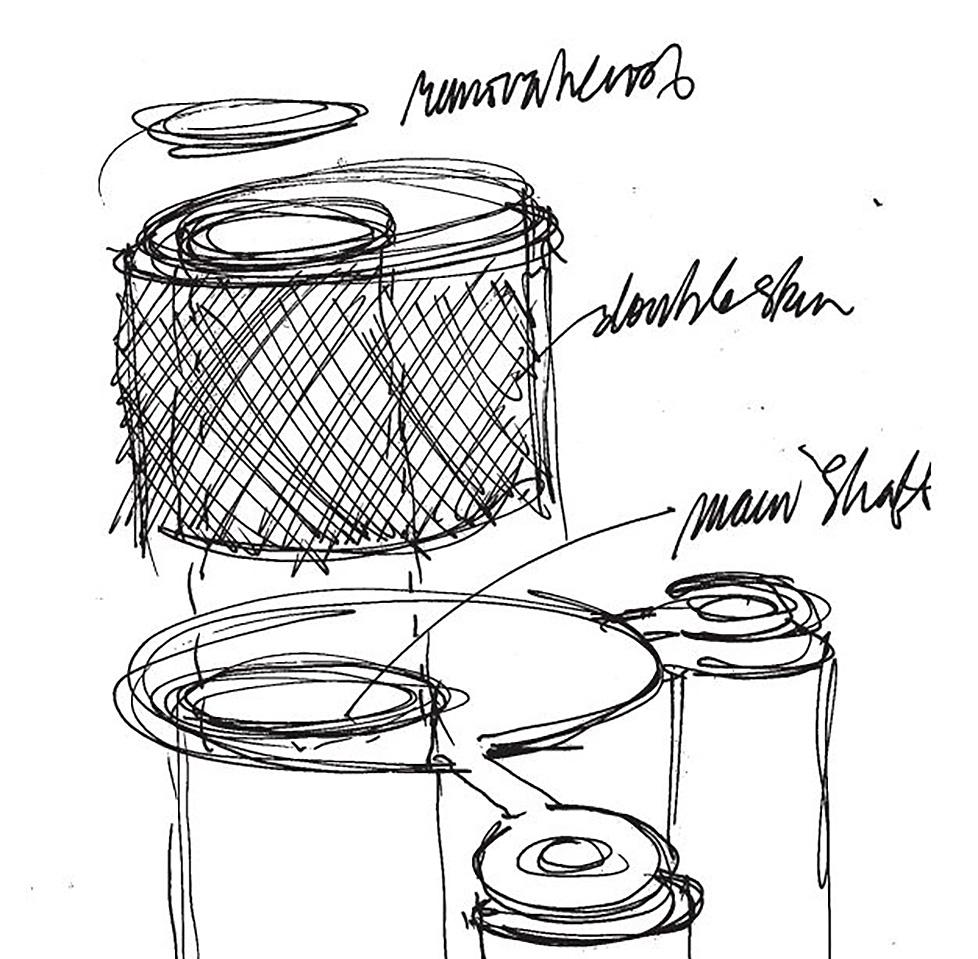
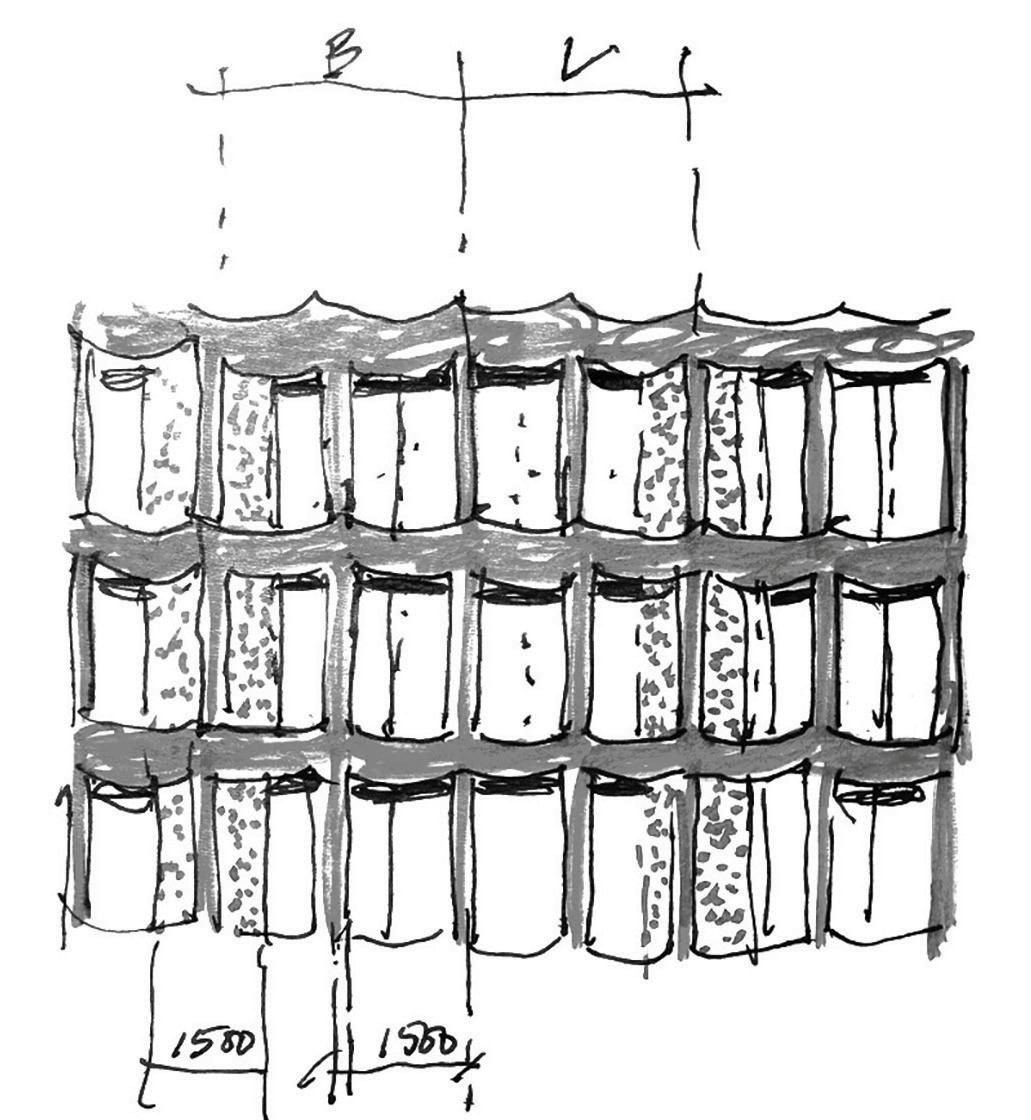
In gh3*’s infrastructural work, relatively familiar and simple architectural shapes are transformed, and realized in a restrained, carefully selected palette of materials that is likewise elevated from the ordinary. The resulting buildings distill the essence of architecture. The Stormwater Facility is the most dramatic example. In this case, an unfamiliar overall shape sits in delightful tension with the faceted geometric planes of its surface. Rather than reinforcing the shape, these planes draw the eye in all directions: an astonishing feat as the eye moves through a push-and-pull of attention over the object. It is an architecture that solves urban infrastructure problems, yes, but that also asks questions and opens space for reflection.
Reflection is a rare activity in our overscheduled daily lives, and all the more delightful for where gh3* has facilitated its occurrence: not in the rarefied realm of a celebrity architect-designed museum, but in urban settings where anyone might wander upon it.
Such projects, of course, are far from simple to create. Work on municipal infrastructure has sharpened gh3*’s knowledge of the possibilities and limits within procurement, their ability to resolve technical exigencies, and their capacity to be nimble when faced with changing scopes, sites, and budgets.
A century ago, film and mass media were challenging the previously singular, unique experience of architecture, art, and place. At that time, philosopher Walter Benjamin suggested that architecture would henceforth be experienced through habit and the tactility of everyday use and this would transpire most often in varied states of distraction. This observation is ever more pertinent in our attention-stealing economy, where our media-saturated lives pivot between pings and disparate visual demands, and the boundaries have been thoroughly blurred between private and public lives. What can we ask of architecture today? How can we expect it to perform?
In this context, gh3*’s approach to what is essential to architecture honed in the competitive demands of working landscapes, and at the margins of architectural thinking may in fact be one of this period’s more significant contributions. There is much to learn about place, when the sites involved may seem devoid of an obvious genius loci. gh3*’s work makes reference to historical memory, but more importantly actively shapes place as an infrastructure of living, a dynamic ecology remade through habit and use. In contrast to the pleas for attention of starchitecture, gh3*’s architectural embodiment of infrastructure is a robust intermediary that mediates place and the ordinary.
This is architecture not as attentionseeking spectacle, but as a grounded counterweight to the cacophony of our image-saturated lives. The taut buildings provide the opportunity to reflect upon what belongs to—and what is extraneous in—the making of the built environment.
Rather than being yet another distraction, this is architecture that has enough iconicity to be experienced within a state of distraction, yet still offers something of substance against distraction’s pull. Perhaps what one learns from working with the overlooked landscapes and utilitarian programs that support urban living is a kind of architectural equanimity where built form holds its own.
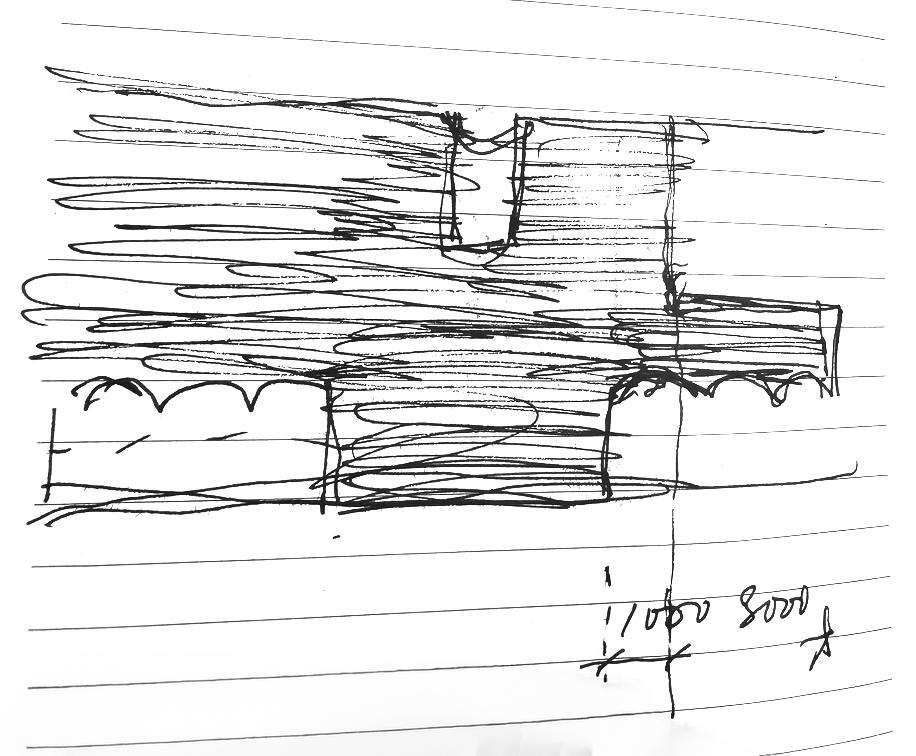
Pat Hanson and gh3*’s work is a timely architecture, an approach for contemporary times. Whether the program is a house or a utility enclosure, her buildings take cues from history, but have nothing to do with nostalgia; they raise questions, but are not about creating sanctified spaces of contemplation. Rather, they respond to the pull and push of the way we view buildings, and to attention and distraction negotiated within the built environment. Ultimately, it is an architecture created through joy Hanson’s love for the work palpable in each judiciously chosen material and painstakingly resolved detail. And that joy resonates in how the architecture is received: as hard-working places that delight, and that, consciously or unconsciously, elevate the daily lives of those fortunate enough to experience them.
– Mary Louise Lobsinger

2006-2026
Themes of land and water infuse gh3*’s portfolio, forged over the past 20 years. These themes, and a distinctive artistic sensibility, weave through Pat Hanson’s upbringing and career journey.
Pat Hanson was born in Lajord, a Norwegian farming community in Saskatchewan, and moved to a new house in a Regina suburb as a child. She took art classes as a child and teenager, and eventually enrolled as an art major at the University of Regina. At this smaller university, the only art classes offered were in art history. Hanson enjoyed them, but craving more hands-on work, she accompanied some friends to visit the University of Manitoba in Winnipeg, and eventually transferred to its fine arts school. As she was completing her degree, Hanson applied to the architecture school at the University of Manitoba, and was accepted into the program, where she thrived.
After working for two summers at a Winnipeg architecture firm during her schooling, Hanson moved to Toronto post-graduation. There, she worked for A.J. Diamond Associates, the firm led by Jack Diamond, on projects including the Toronto Central YMCA building, and Bowmanville City Hall, advancing quickly to an associate position.
In the late 1980s, Adrian DiCastri, a colleague of Hanson’s at A.J. Diamond Associates, invited Hanson to join him at Garwood Jones Van Nostrand. Hanson and DiCastri eventually became partners at the practice, and the firm was renamed Van Nostrand Hanson DiCastri. The practice focused on assisted housing projects, which were supported by the provincial government at the time. This specialization helped the firm stay afloat amidst the soaring interest rates and ensuing recession of the 1990s.
Following a stint at Architects–Alliance, Hanson founded her own firm, in partnership with landscape architect Diana Gerrard (who left the practice in 2017). They imagined a practice that would bridge between architecture, landscape, and urbanism—the three fields that, paired with the initials of their last names, form the name gh3*.
Oversized pivoting steel doors at the Borden Park Natural Swimming Pool in Edmonton, Alberta.
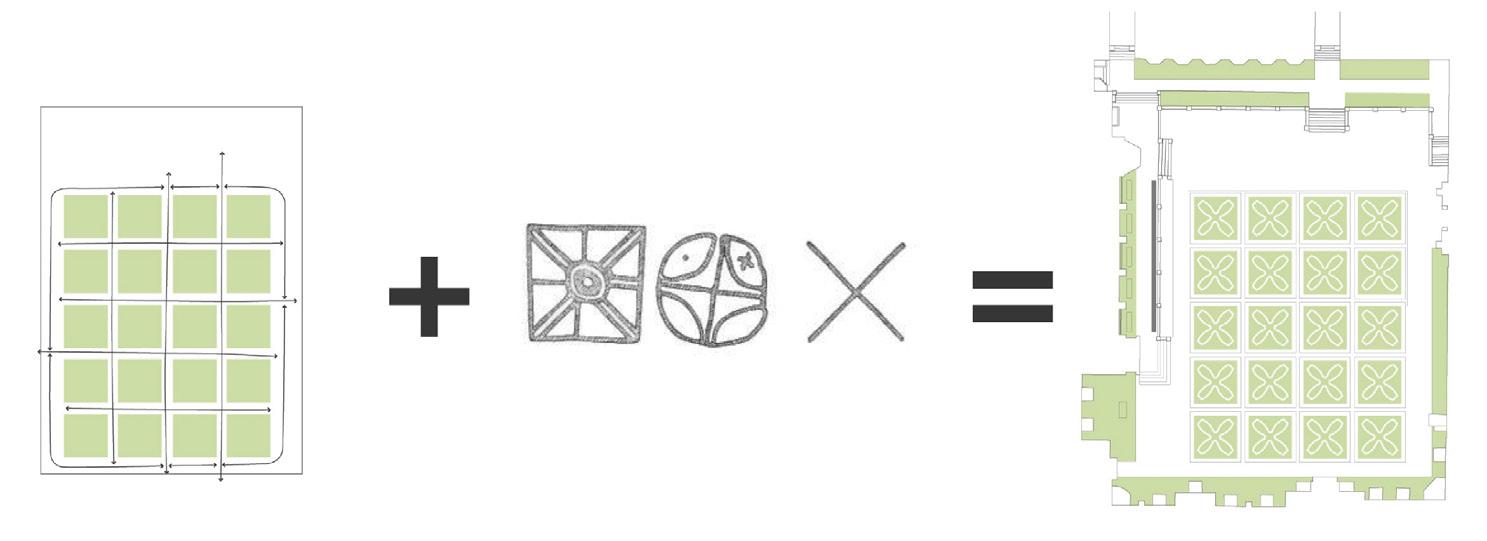
A diagram maps out the idea of a cross-emblazoned matrix that connects between main routes of travel across the quadrangle.
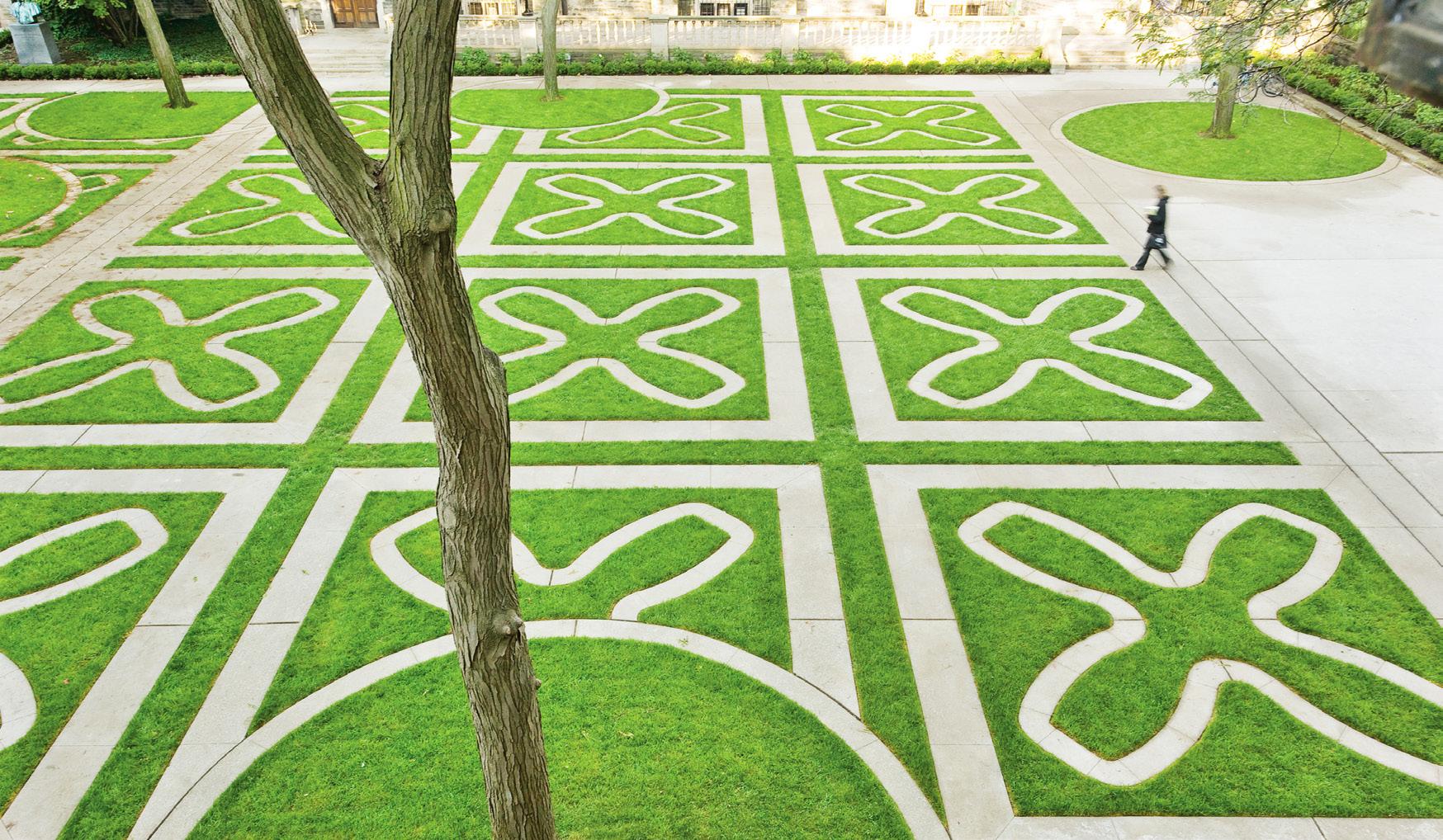
As with many practices starting out, gh3*’s first commissions were for private homes and a few small-scale landscapes. One early work which shows their ability to create a striking result from such programs is the revamped courtyard at the heart of Trinity College, a residential college at the University of Toronto. The design is modern, yet expresses deference to the surrounding neogothic buildings, and to the traditions of medieval courtyards. A Greek cross—a symbol often found in gothic architecture—is chosen as a paving pattern, and used to create an ornamented carpet effect within the central lawn. Six oversized treeprotective rings are overlaid on the pattern, and an east-west walkway and paved perimeter help keep foot traffic off the turf. A small patio to the north end of the site offers a sunny spot for sitting. The design resolves key asymmetries within the site, and allows the quadrangle to serve a multitude of functions—acting as a comfortable outdoor living room for students, inviting shortcuts across the courtyard, and creating a formal garden backdrop to convocation receptions.
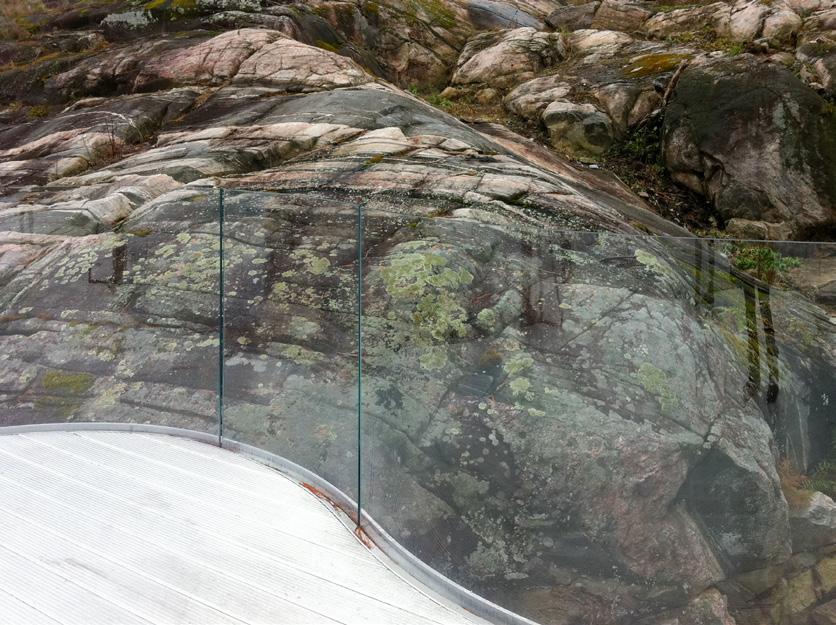
The Stony Lake boathouse sits on Canadian Shield rock outcroppings, seen here through the low-iron slumped glass guard of the clover-shaped platform added to the house for outdoor living.
The Trinity College courtyard uses a Greek cross as a carpet-like paving pattern, overlaid with six oversized tree-protective rings.
One of gh3*’s early residential projects was recognized with the country’s top accolade—a Governor General’s Medal in Architecture. The project comprised a photographer’s live/work studio over a boathouse on Stony Lake. Reimagining the archetypal glass house in the wilderness, Hanson envisaged a compact glazed volume above a black granite plinth, leaving the majority of the site in its glacier-scoured state. The work develops a clear concept and clean form with masterful sophistication in its development and detailing. A large north-facing window bathes the studio in diffuse natural light, while the black granite base acts as a thermal mass. Sliding panes in the glass skin and a recessed, individually automated blind system allow the façade to transform as needed for use.
Details are meticulously considered: interior partitions are clad with seamless white lacquered panels that offer a subtle reflective quality; granite slab joints and bespoke floor-flush utility boxes are carefully aligned with mullions; radiant floors are linked with a deep-water exchange to heat and cool the building year-round. A clover-shaped aluminum platform was later added to the house for outdoor living, lending the composition a curvilinear flourish.
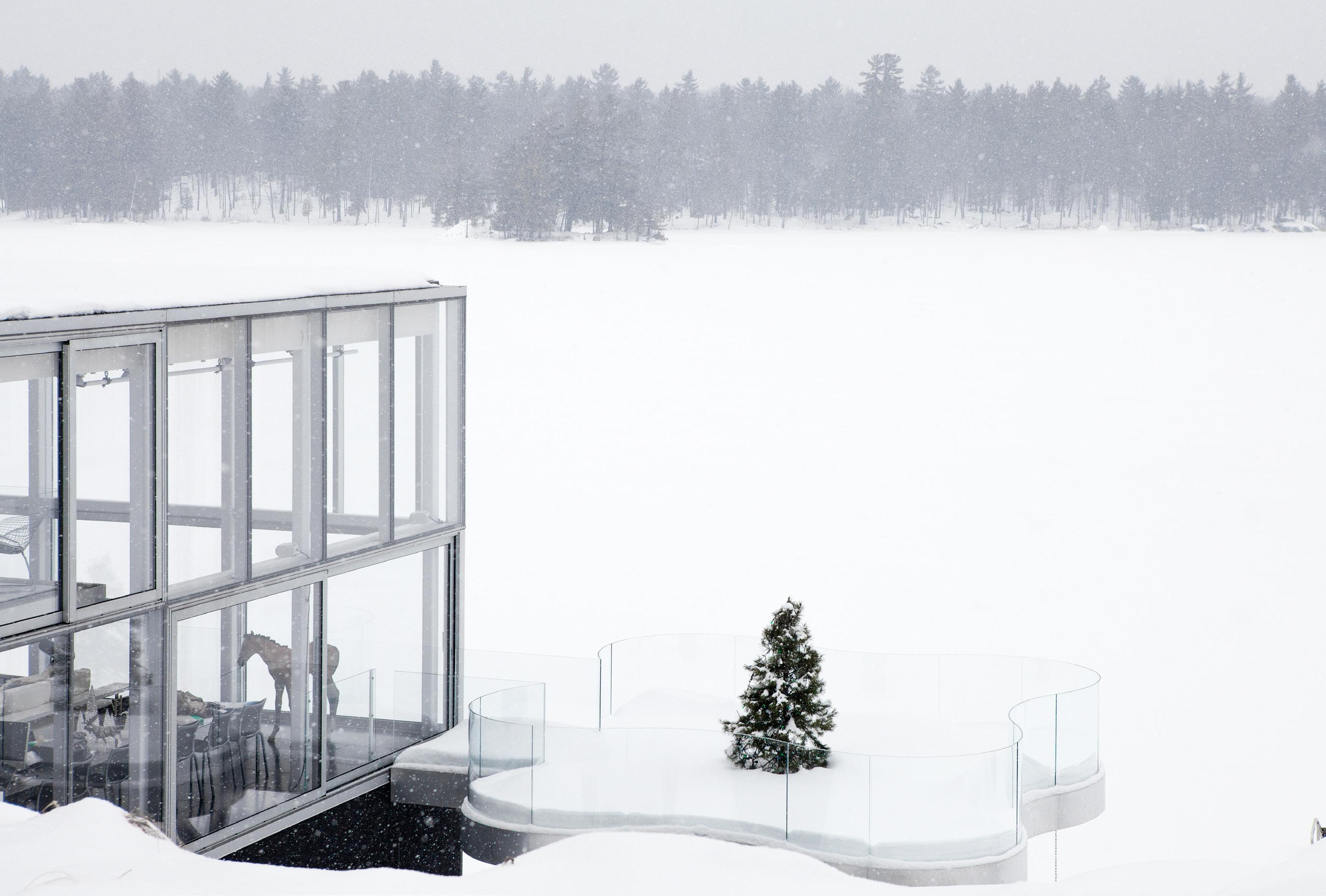
Stony Lake with the snow-clad boathouse (left) and pod (right), adorned with a Christmas tree.
A diagram explores the curvature of the platform, known as the boathouse pod.
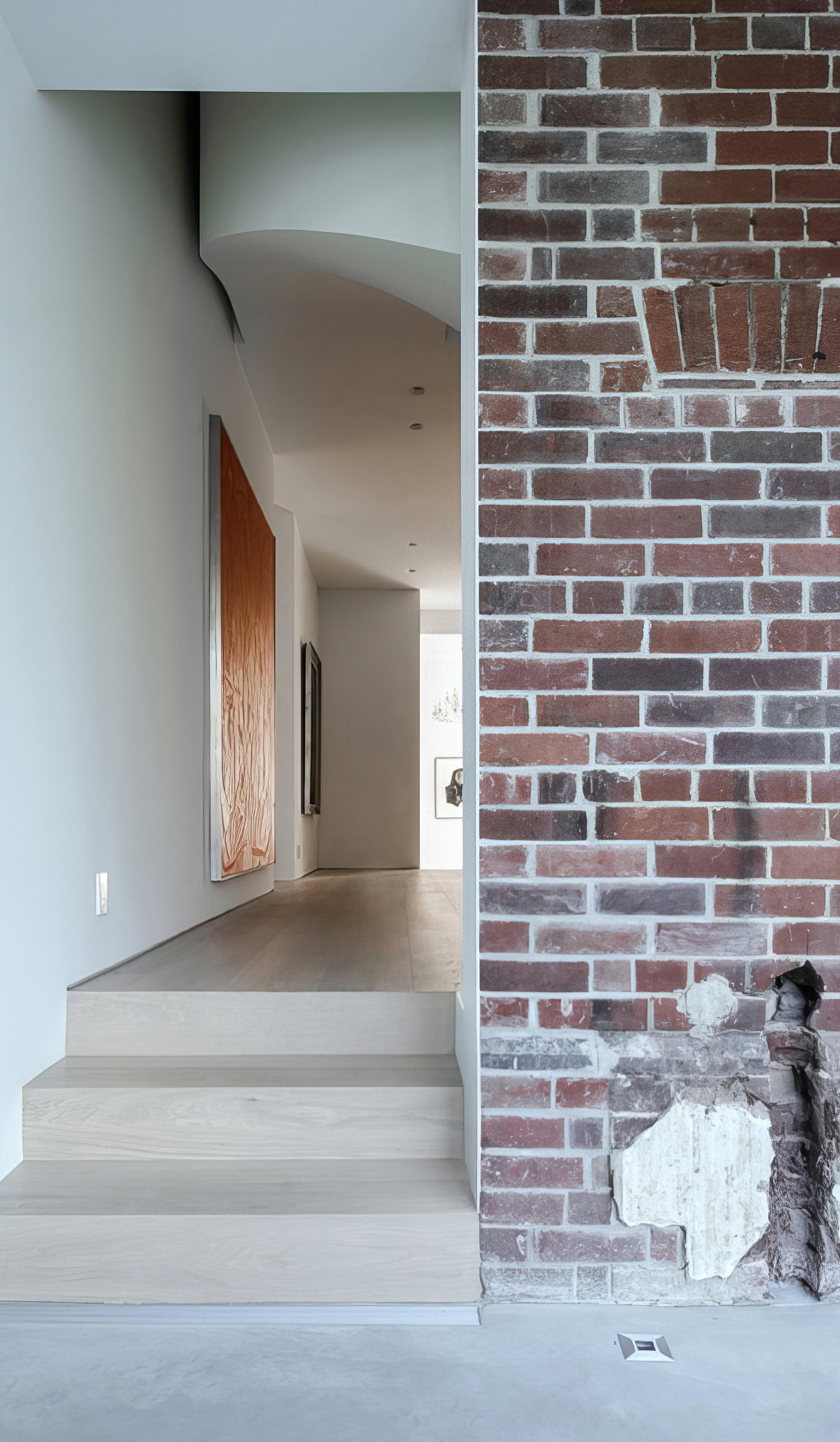
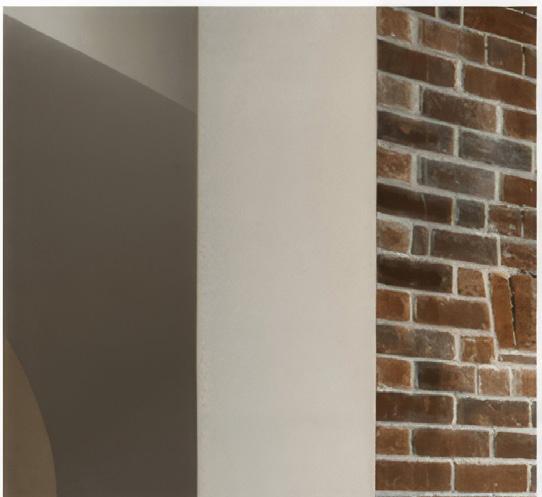
At the rear of Street House, a former exterior wall is now enclosed in a gallery passage. It has been stripped back to reveal layers of the original structure. At the ends of the wall, the brick is mitred to allow the plaster and masonry to meet in a seamless line.
Another residential project, Street House, exhibits Hanson’s adeptness in marrying a minimalist vision with the complexities of a historically designated home. In renovating the Edwardian Street House, designed by William Alexander Langton for Mrs. Elenor Street in 1908, Hanson was asked to reimagine a home with exceptional detailing, but a typically Victorian plan of smaller, hierarchical rooms unsuited to modern living for a family of five.
The building’s heritage designation meant that interventions to the front of the house were severely restricted, and additions to the back could not be visible from the street. Working within these constraints, the design began with a single, bold gesture: shearing off the exterior brick wall at the back of the house, and replacing it with super-scaled glazed walls. This began to unlock the constricted, formal plan, and opened up interior spaces to a new concrete plinth courtyard.
From the exterior, the shearing-off gesture is visually marked by a sharp steel horizontal line between old and new. The chimney and second-floor stair, which float above this datum, are visually resolved with brick soffits that match and extend the materiality of the original building.
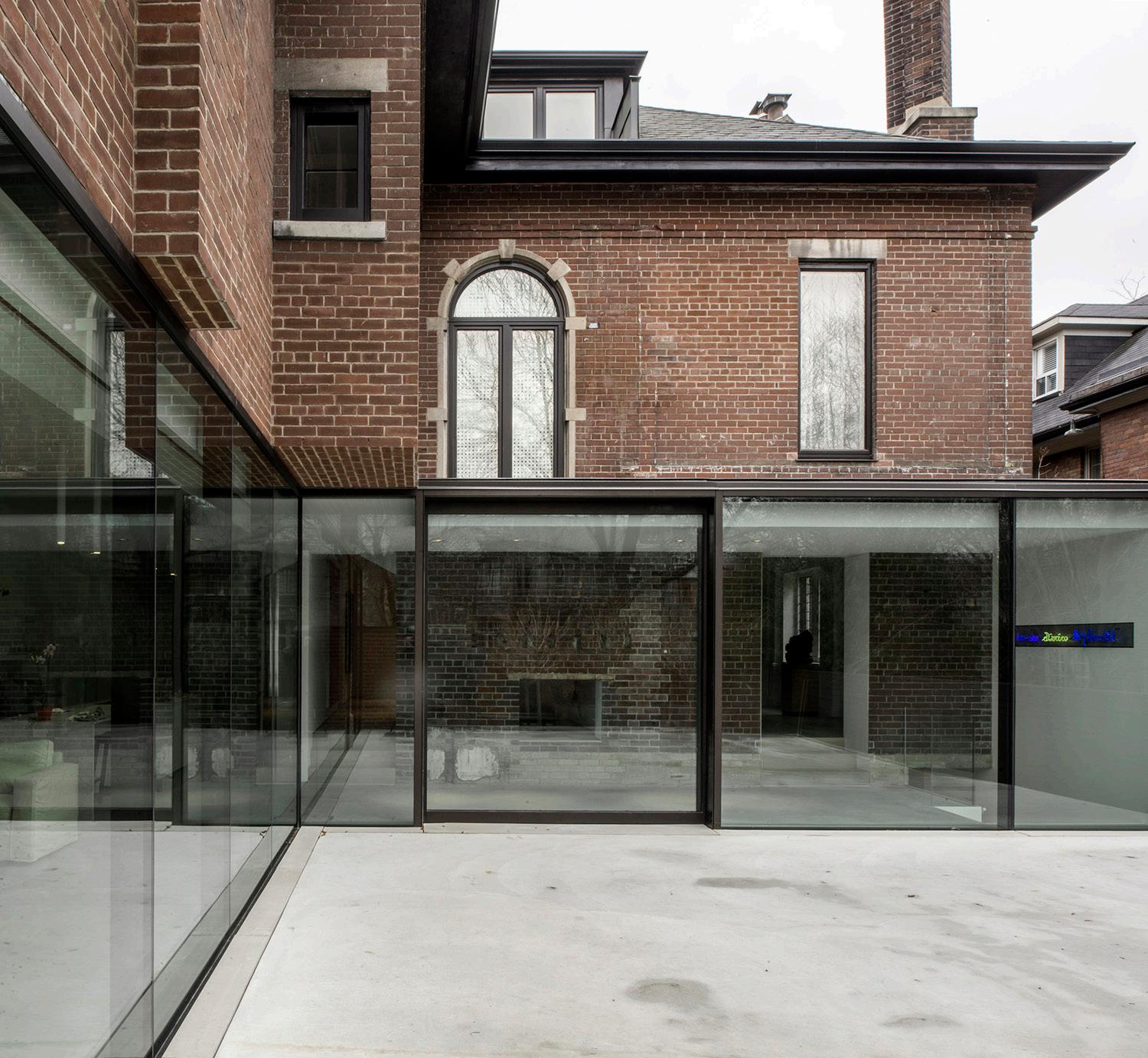
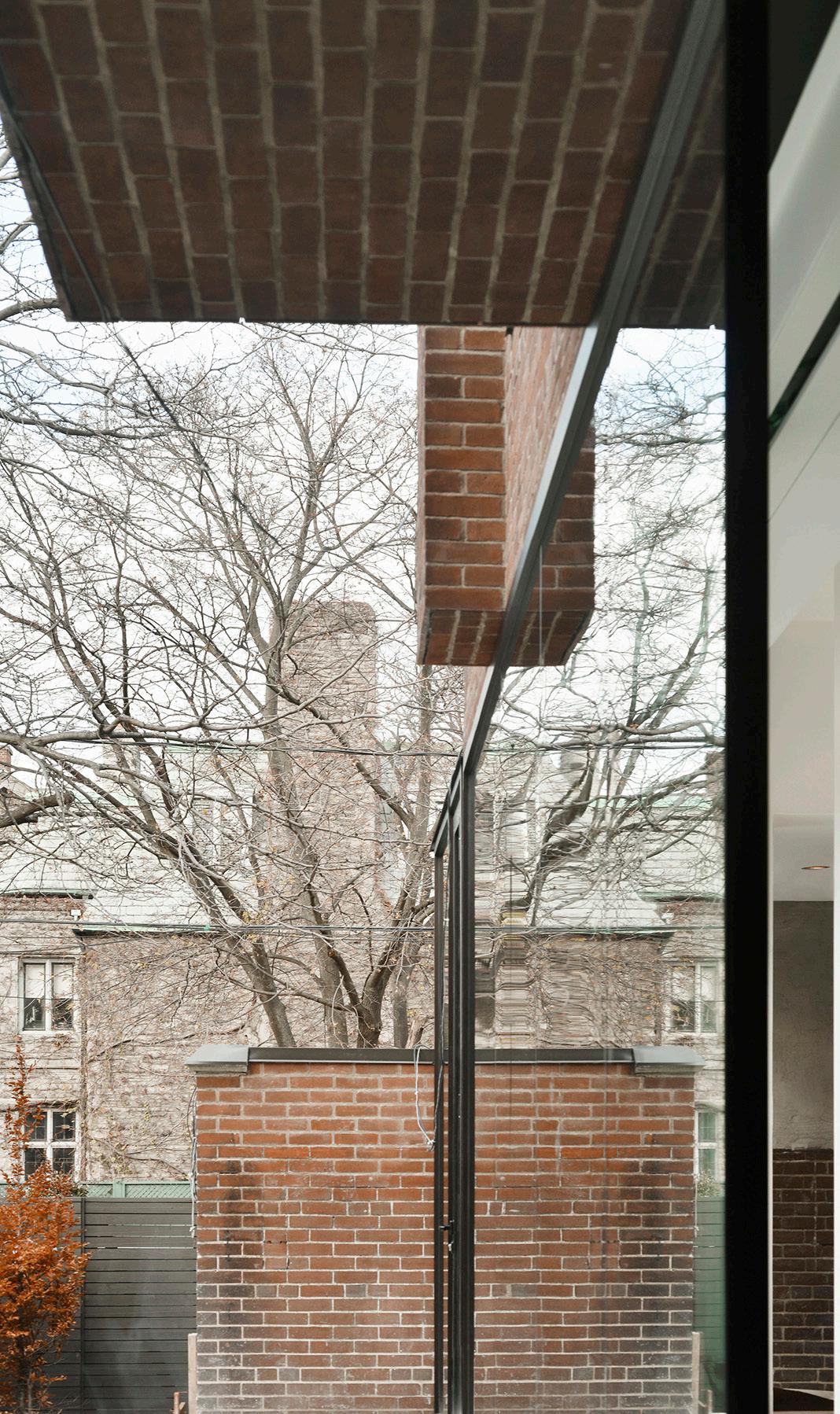
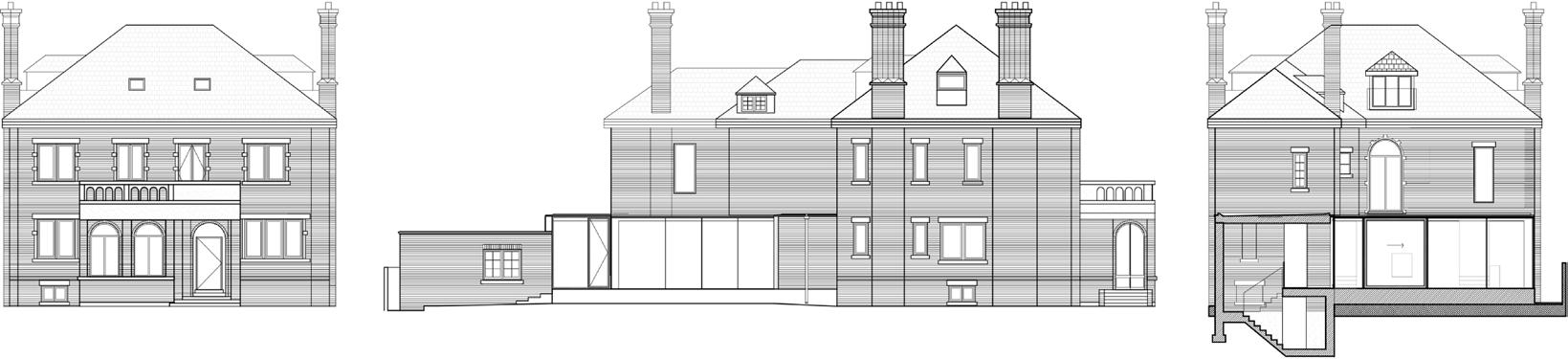
Within the house, the beautifully constructed layers of the original structure are revealed and celebrated. This is especially visible in the north gallery wall, which has been stripped back to expose brick joist pockets, a jack arch, a black brick stringcourse, and yellow brick from an original rising wall. Throughout the ground floor, fullheight openings are framed by thin aluminum fins that notionally cut through restored wainscotting and crown molding, juxtaposing old and new. In another key moment, an arched Edwardian window overlooks a sculptural white staircase that sweeps up to the second floor, replacing a previously modest corridor entry sequence with a light-filled double-height space.
The underside of a second-storey stair and chimney are clad in brick soffits to visually resolve these volumes, following the shearing-off of the heritage home’s rear wall.
The removed rear wall was replaced with superscaled glazed walls, and a concrete-plinth courtyard was added.
Over time, gh3* has perhaps become best known for its ability to transform infrastructural building programs into places of architectural significance. Hanson pursued this project type out of a recognition that infrastructure buildings had unrealized potential for quality design: the sites are often located in dense urban settings and contain windowless programs that could invite a single-material enclosure.
One of their first projects in this vein—and another Governor General’s Award winner—is Real Time Control Centre #3, a building that houses an engineered mechanism for monitoring and controlling the discharge of water from the combined sewer system in an older part of Edmonton to the North Saskatchewan River. Rather than hiding this piece of municipal infrastructure behind a generic enclosure, Hanson celebrates it, contributing to a public awareness of the ecological complexities of urban environments.
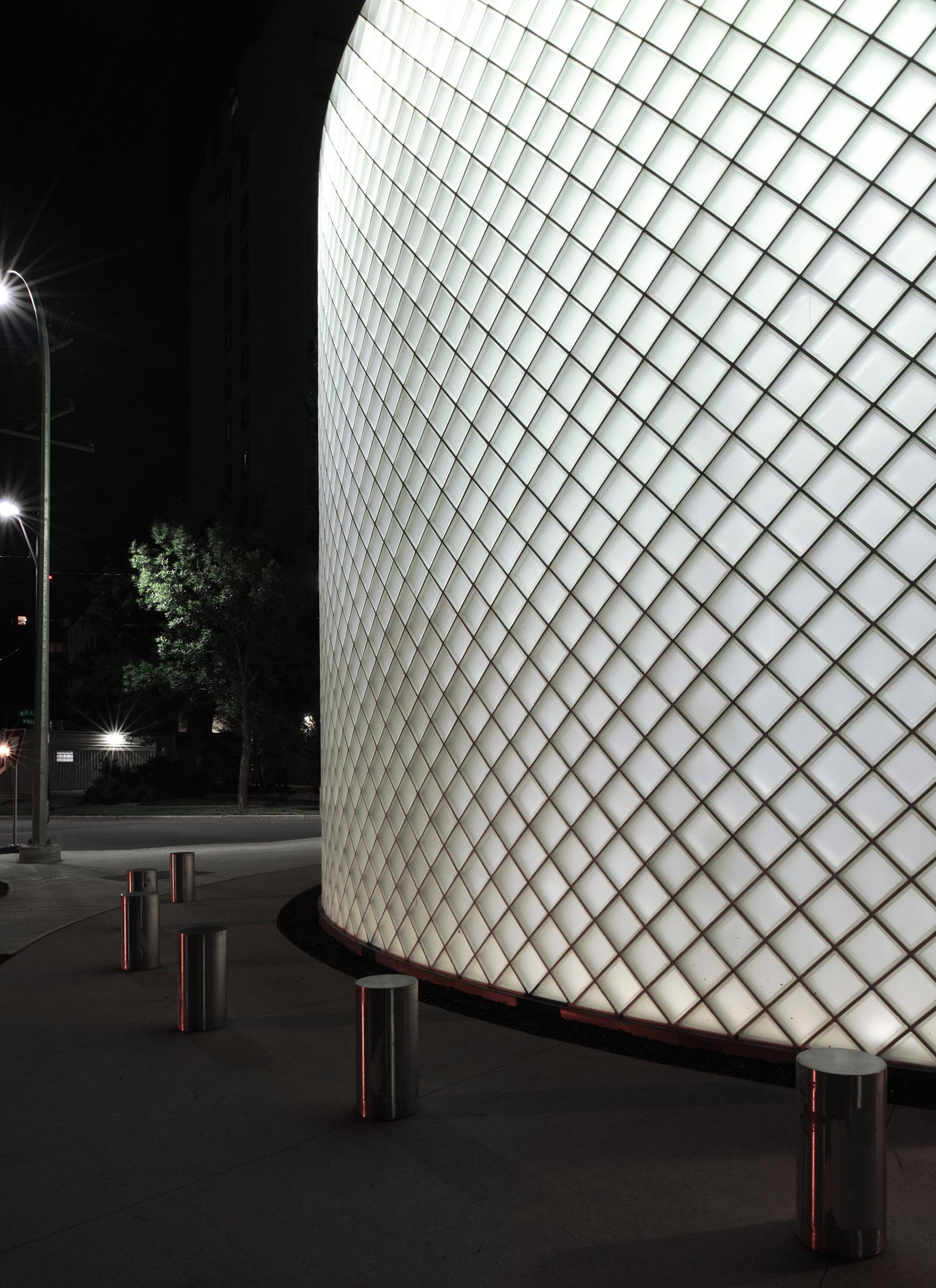
The below-grade plant equipment, along with intake and outtake tunnels, are housed in a six-metre-diameter underground vertical shaft. gh3* extends the shaft aboveground with a cylindrical pavilion that houses at-grade equipment, clad in angled glass blocks. A cavity between the glass block façade and an inner steel structure acts as a thermal plenum, allowing air drawn through ground-level louvres to be vented at the roof edge. The paving of the surrounding plaza telegraphs the location of two additional underground shafts, along with connecting infrastructure.
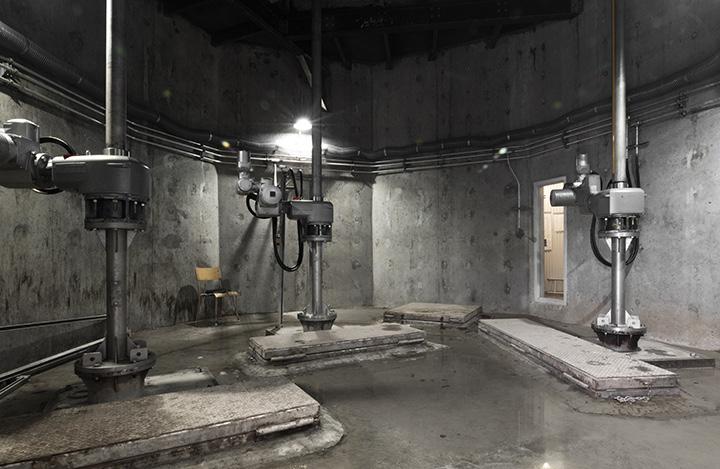
Within its white glass block walls, the Real-Time Control Centre #3 houses an actuator room that monitors and controls the discharge of combined sewer water into the North Saskatchewan River.
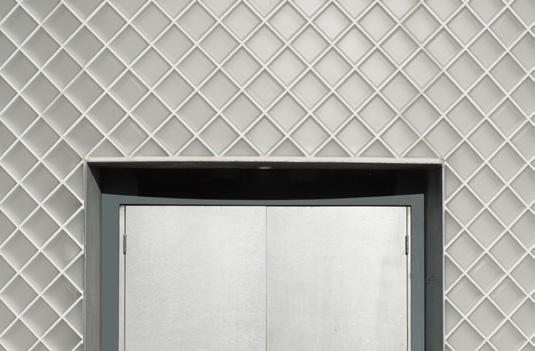
View of the back-lit Real-Time Control Centre #3 at night; detailing was carefully considered at key areas, including the structure’s door header, jambs and base.
An important part of gh3*’s portfolio consists of public projects in Edmonton, commissioned through design quality initiatives led by City Architect Carol Bélanger. In 2011, the City held an open design competition for five park pavilions: gh3* won two of them, at Borden Park and Castle Downs Park.
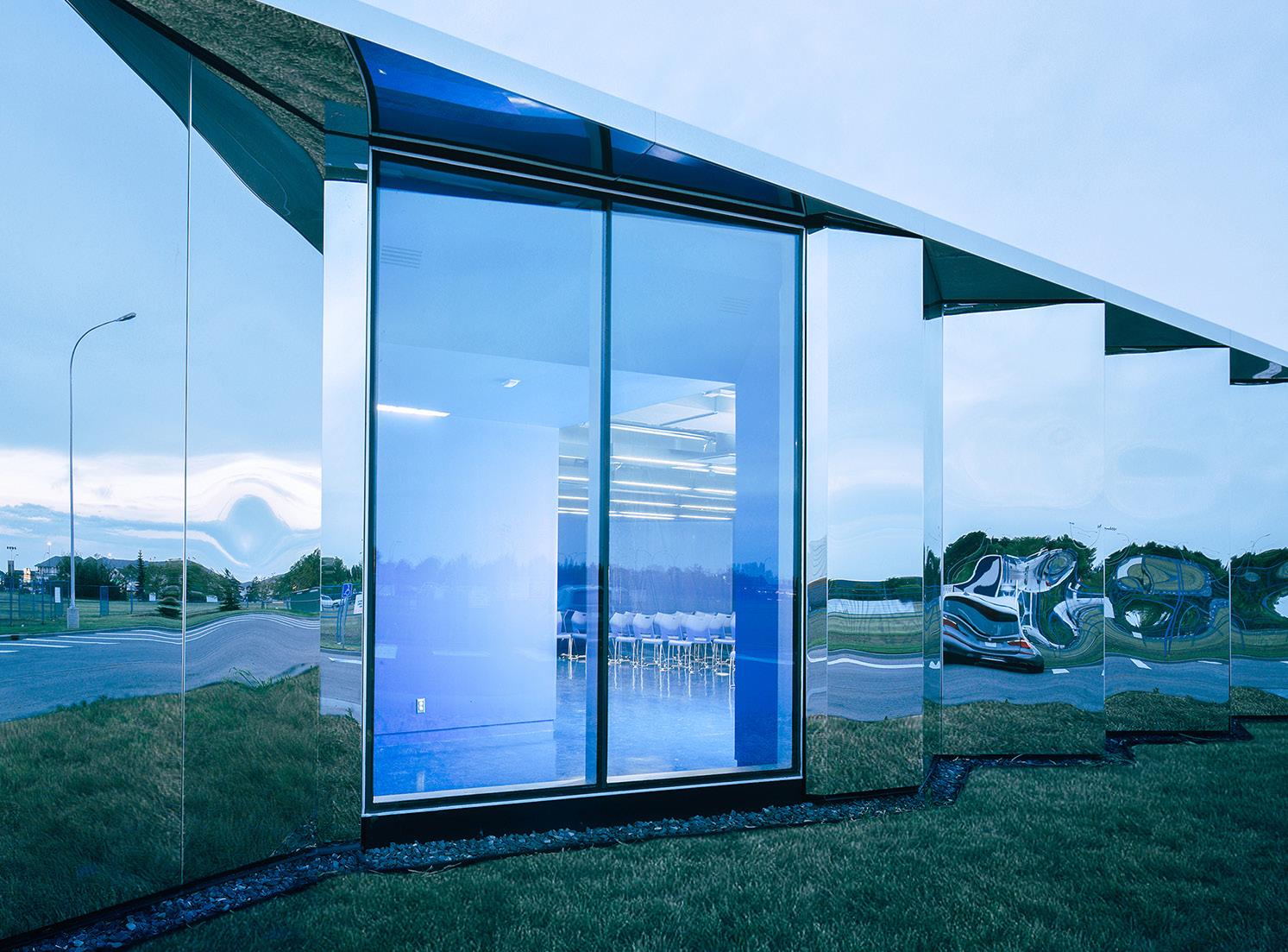
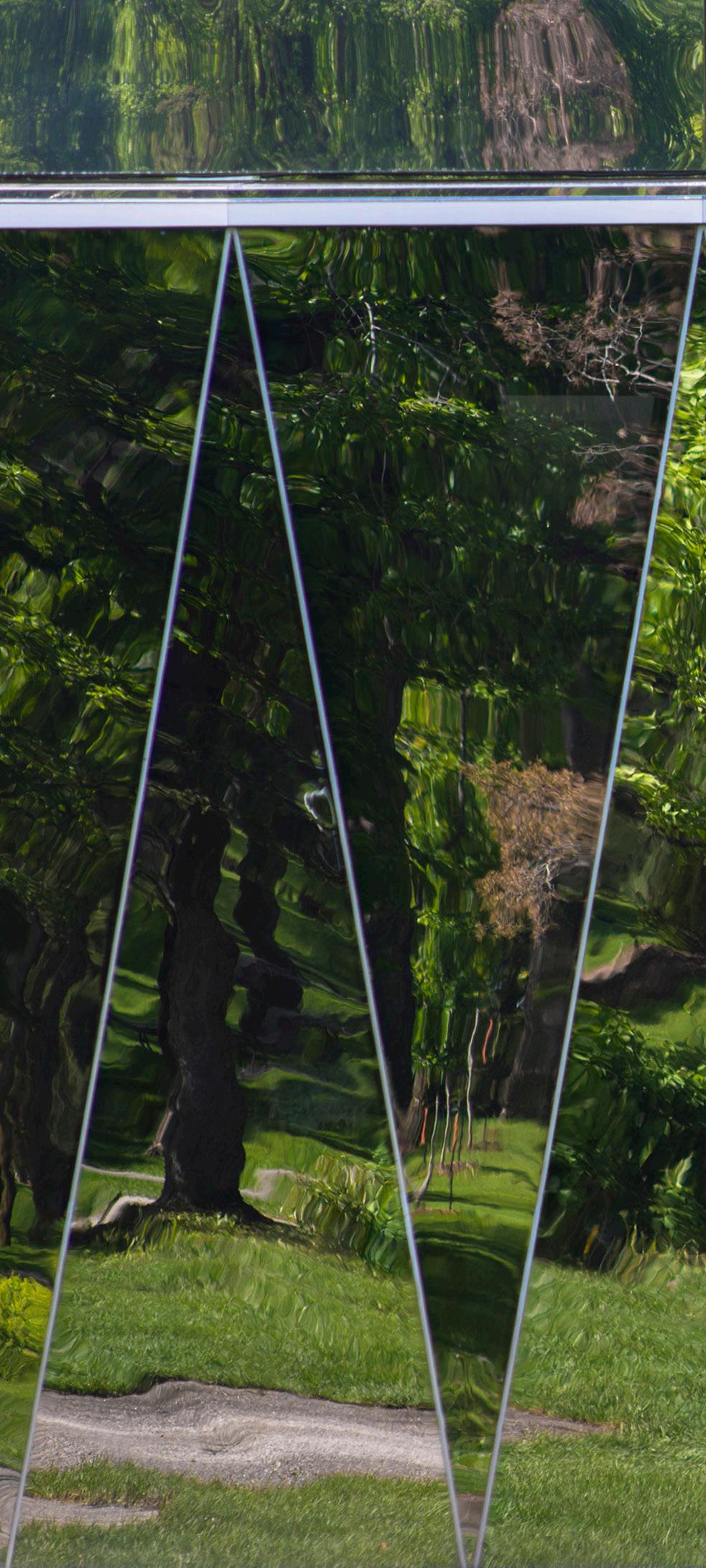
Castle Downs Park Pavilion is a low-slung, linear structure intended to give definition to a vast, flat suburban park. Amplifying the park’s energy, the pavilion is clad in mirrored stainless steel panels, set in a zigzag. The panels are deliberately oversized to produce an oil-canning effect that offers distorted, fragmented views of the surrounding park.
The interior of the pavilion contains three zones: a storage area for the Seahawks soccer club to the east, meeting and multipurpose rooms in the centre, and public facilities and a concession to the west. Entry portals and the interior are finished in a deeply saturated Prairie-sky blue, creating a cocoon-like environment where walls, floors, and ceilings seem to dematerialize.
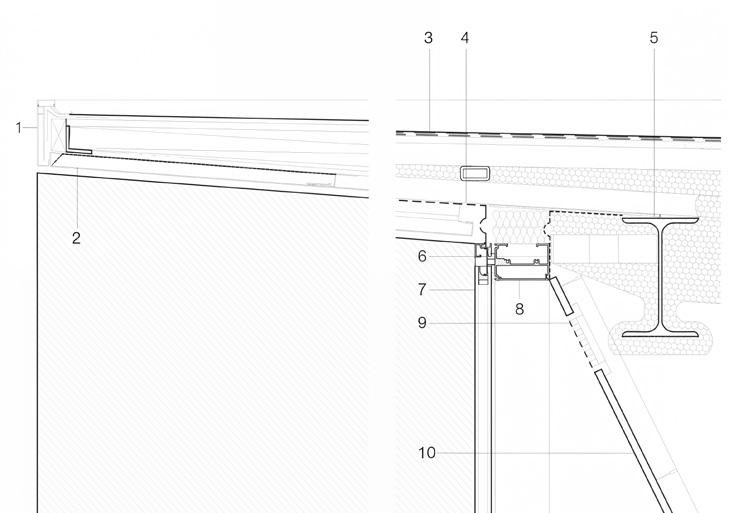
In buildings that focus on a single material, the resolution of details is crucial. For Castle Downs Pavilion, gh3* tapered the roof construction to create as thin a fascia line as possible, and clad it with a stainless steel cap. The bottom of the mirrored walls is also carefully detailed so that the reflective surfaces hover cleanly above the ground surface.
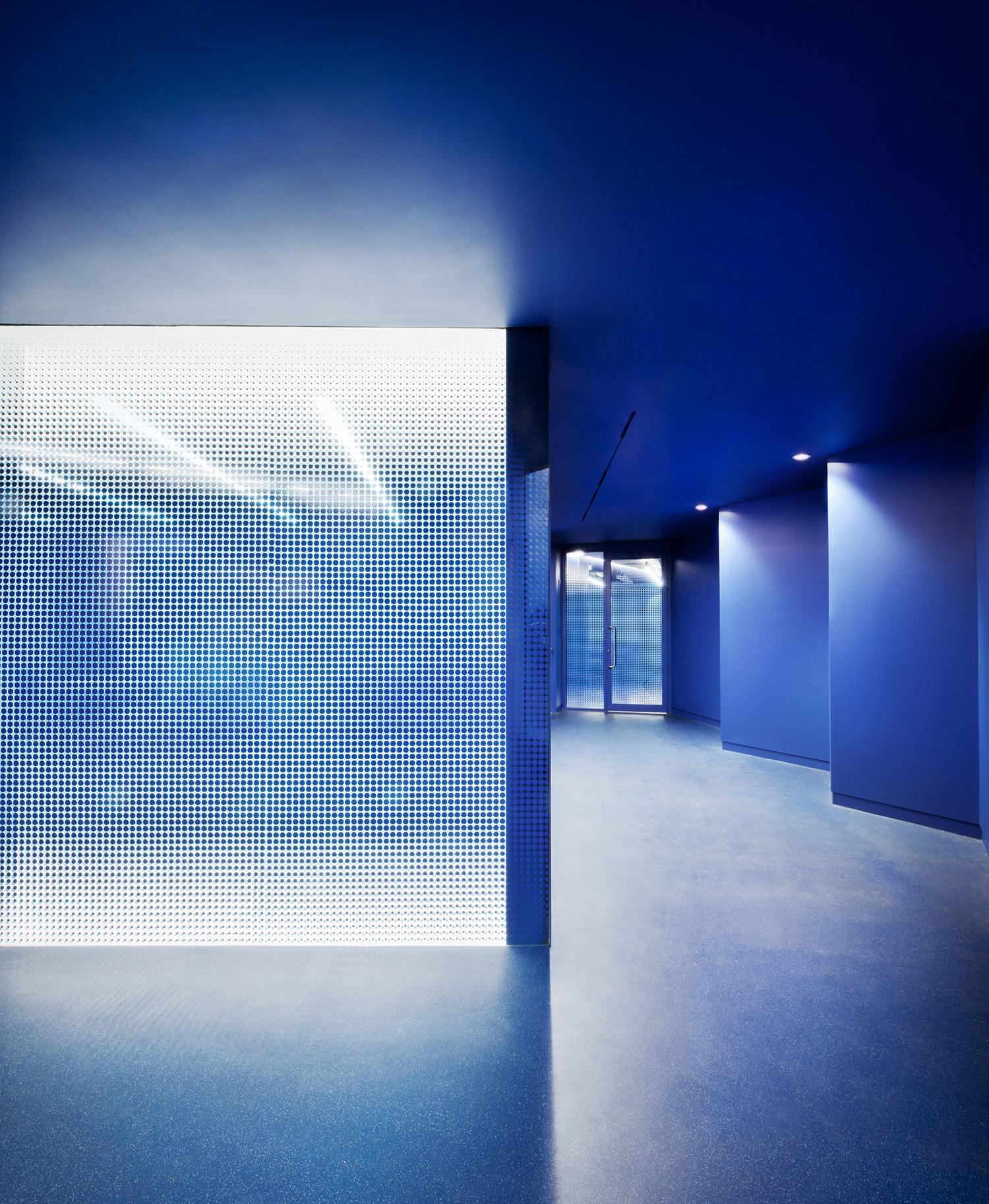
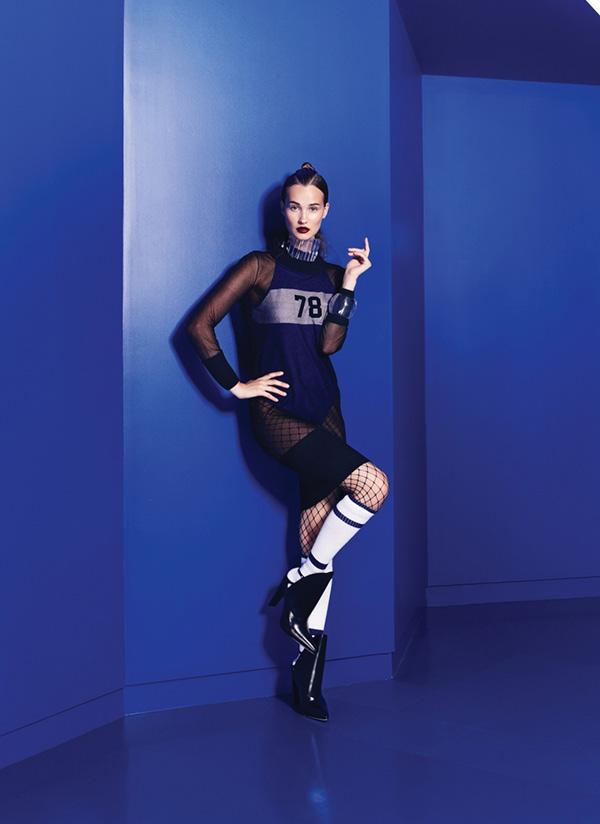

Local lifestyle magazine Avenue Edmonton chose Castle Downs Park Pavilion as the location for a photoshoot in 2015.
The interior of Castle Downs Park Pavilion is finished in a deeply saturated blue; the zigzag pavilion walls are topped with a thin fascia.
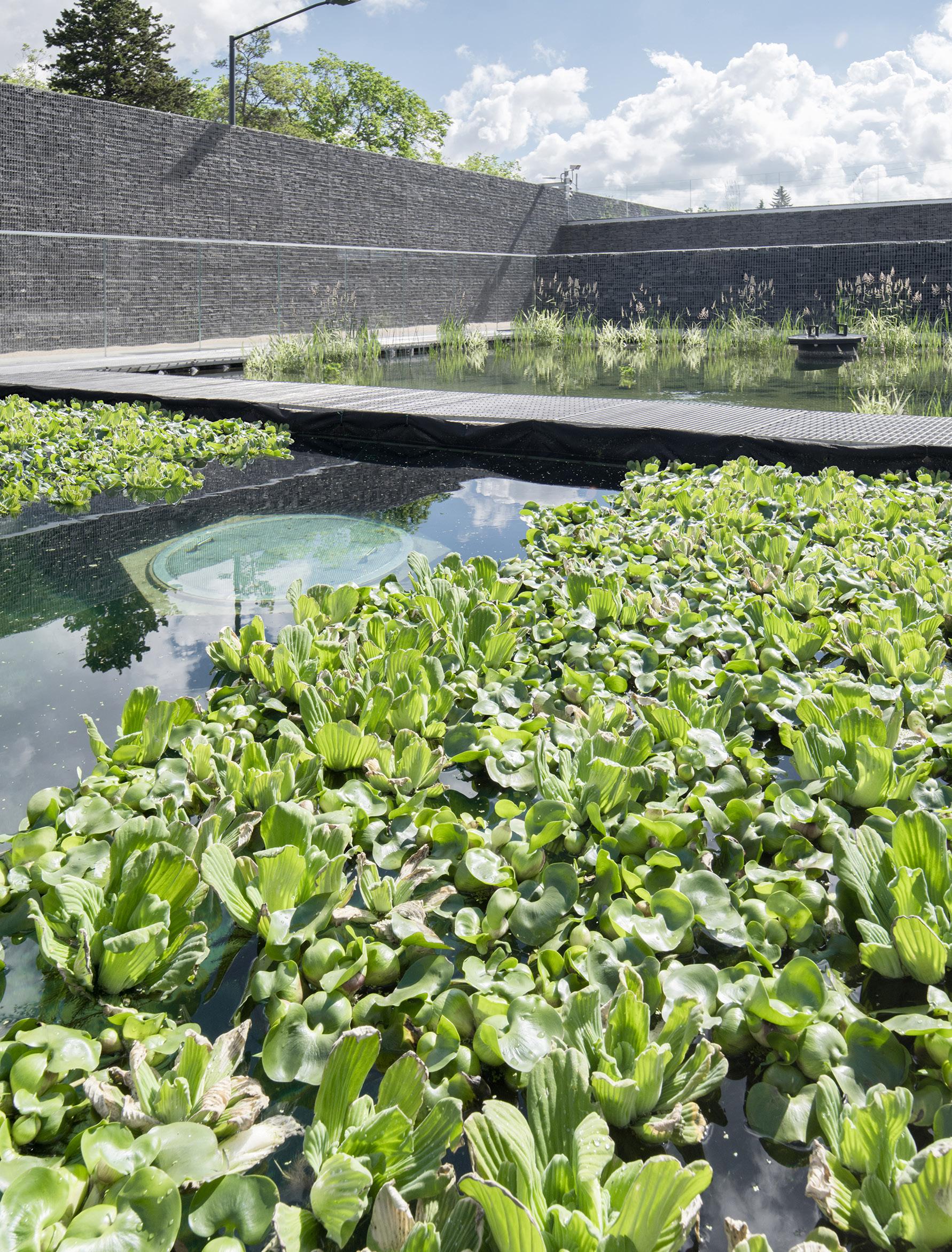
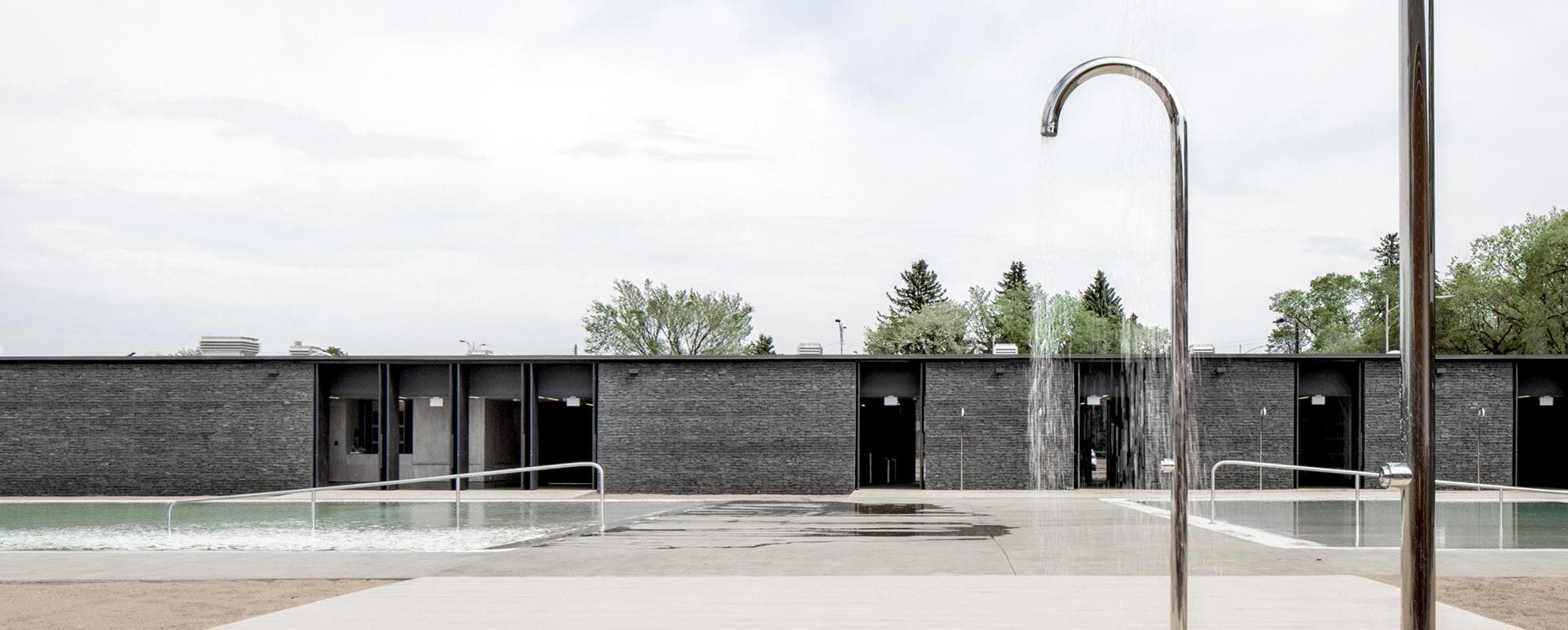
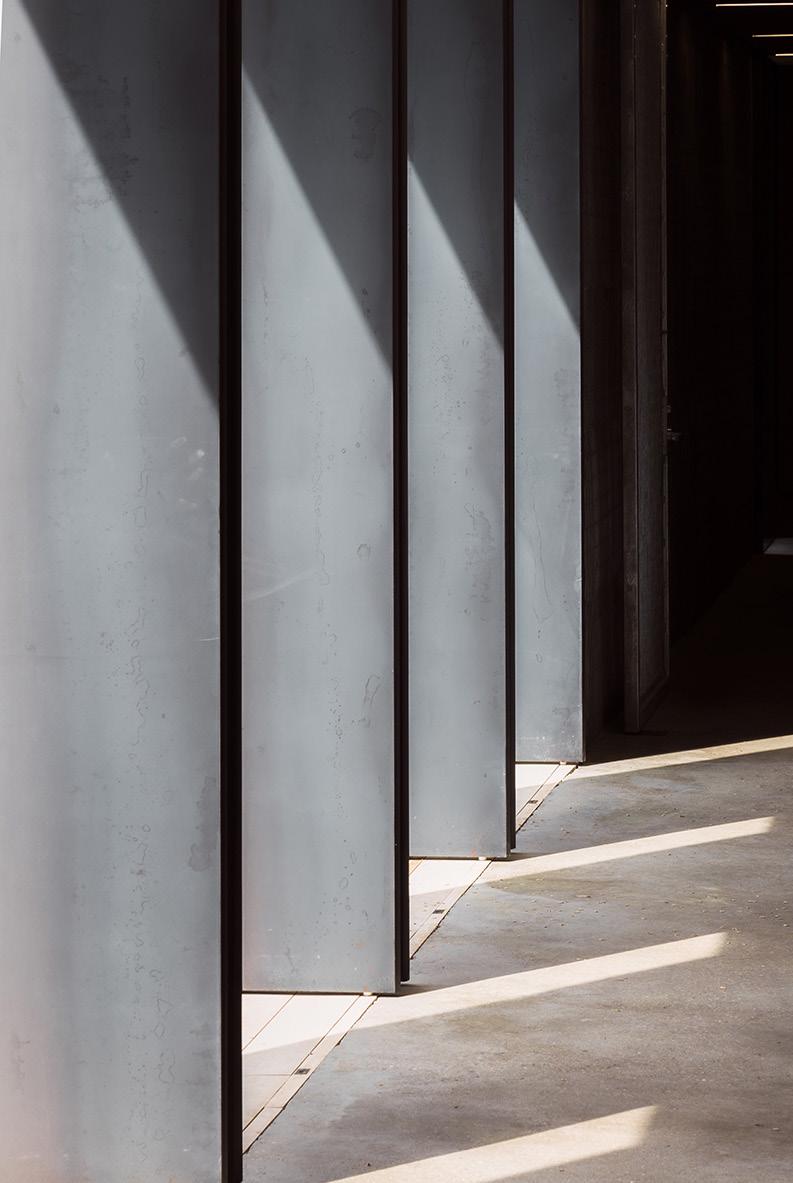
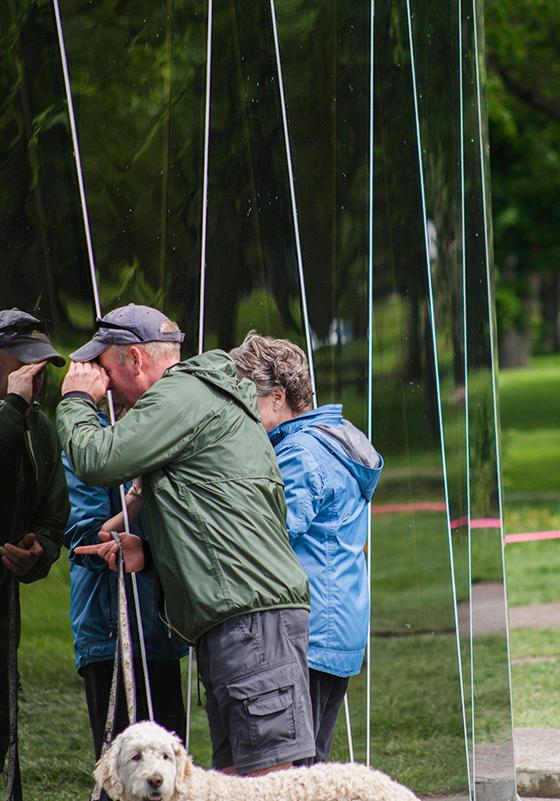
Large steel doors pivot to the outside at the pool’s changeroom; the nearby Borden Park Pavilion is clad in triangulated curtain wall panels, evoking the form of a carousel, bandshell, or child’s drum.
Planted pools are part of the natural water filtration system for Borden Park Pool; the precinct includes a flush-to-surface pool, outdoor shower, beach, and picnic areas.
The Borden Park Pavilion contains a public seating area as well as washrooms. The glulam Douglas fir structural frame is left exposed, lending a sense of drama to the interior. An earlier scheme had envisaged a larger, taller pavilion with glulam ceilings, but prices came in too high. The final pavilion preserves the earlier design’s key qualities by setting the triangular structure to land precisely at the floor, detailing a glulam perimeter beam flush with the ceiling, and aligning the glass mullions to sit directly behind the structure.
Repetition and pattern is a recurring theme in gh3*’s work. Borden Park Pavilion’s circular figure is set within a series of soft and hardscaped rings that serve as entry courts and seating patios, creating an expanded area of influence for the building. The original design also called for the building’s footprint to be replicated as a ring of trees south of the pavilion—a vision that was realized some years following the building’s completion.
Park Pavilion’s glass walls and fascia
gh3* was subsequently commissioned to design a second project at Borden Park: a redevelopment of the park’s 50-year-old pool as Canada’s first chemical-free public outdoor pool. The new pool’s water is naturally filtered through stone, gravel, and sand, and by vegetation in on-deck beds and pools. The design marries these filtering technologies with a materials-oriented concept, achieving a technically rigorous and aesthetically integrated result.
The walls of the pool’s changeroom building are built from gabion baskets, evoking the way stones are used to filter the water; care was taken to use dark limestone in the outer, exposed sections. Steel is a secondary material: large steel doors pivot to the outside, underscoring the one-metre-wide thickness of the exterior walls, while providing long, continuous views through the reception area. The interior is finished with marine-grade plywood walls and ceilings, rubbed first with a black stain, and then with a white stain to create a soft feel suggestive of a natural landscape.
The pool precinct includes a children’s pool, a deep pool, on-deck outdoor showers, a sandy beach, and picnic areas. Glazed barriers offer views to the planted beds and pools used as part of the water filtration process. Flush-to-surface detailing throughout creates seamless interfaces between the beach, concrete pool perimeter, wood decking, and filtration areas.
The design’s materials-rich, clean-lined aesthetic takes cues from two mid-century modernist pool buildings that were retained on-site to house mechanical equipment, and that frame the southwest edge of the pool precinct. And the natural method of water filtration nods to a pond that served as a swimming hole at Borden Park in the 1920s.
Both Borden Park Pavilion and Borden Park Natural Swimming Pool were winners of Governor General’s Medals in Architecture, in 2018 and 2020 respectively.
The glass mullions of Borden Park Pavilion align precisely with the
triangular timber structure.
pavilion’s
Borden
have a reflective coating that renders them mirrored during the day and highly transparent at night.
The distinctive shape of Windermere Fire Station’s roof unites the technical bays for fire trucks with the more domestic spaces that serve as second-homes for onduty firefighters. The project was completed in collaboration with S2 Architecture.
Windermere Fire Station’s bold, mountain-peak-like roof makes it a landmark in its suburban Edmonton context. But it’s also a hardworking form. Its high-to-low sweep unites the fire station’s two main programmatic areas: the tall technical bays for fire trucks, and the more domestic spaces that serve as second homes for on-duty firefighters between emergencies. The south-facing roof also houses an extensive photovoltaic array. This is paired with geothermal piles, and an inner courtyard that brings natural light to workspaces, to allow the building to reach net-zero energy performance.
Woven black masonry adds a handsome, textured cladding to the building—making it a welcome anchor to the neighbourhood, and indeed, a source of civic pride.
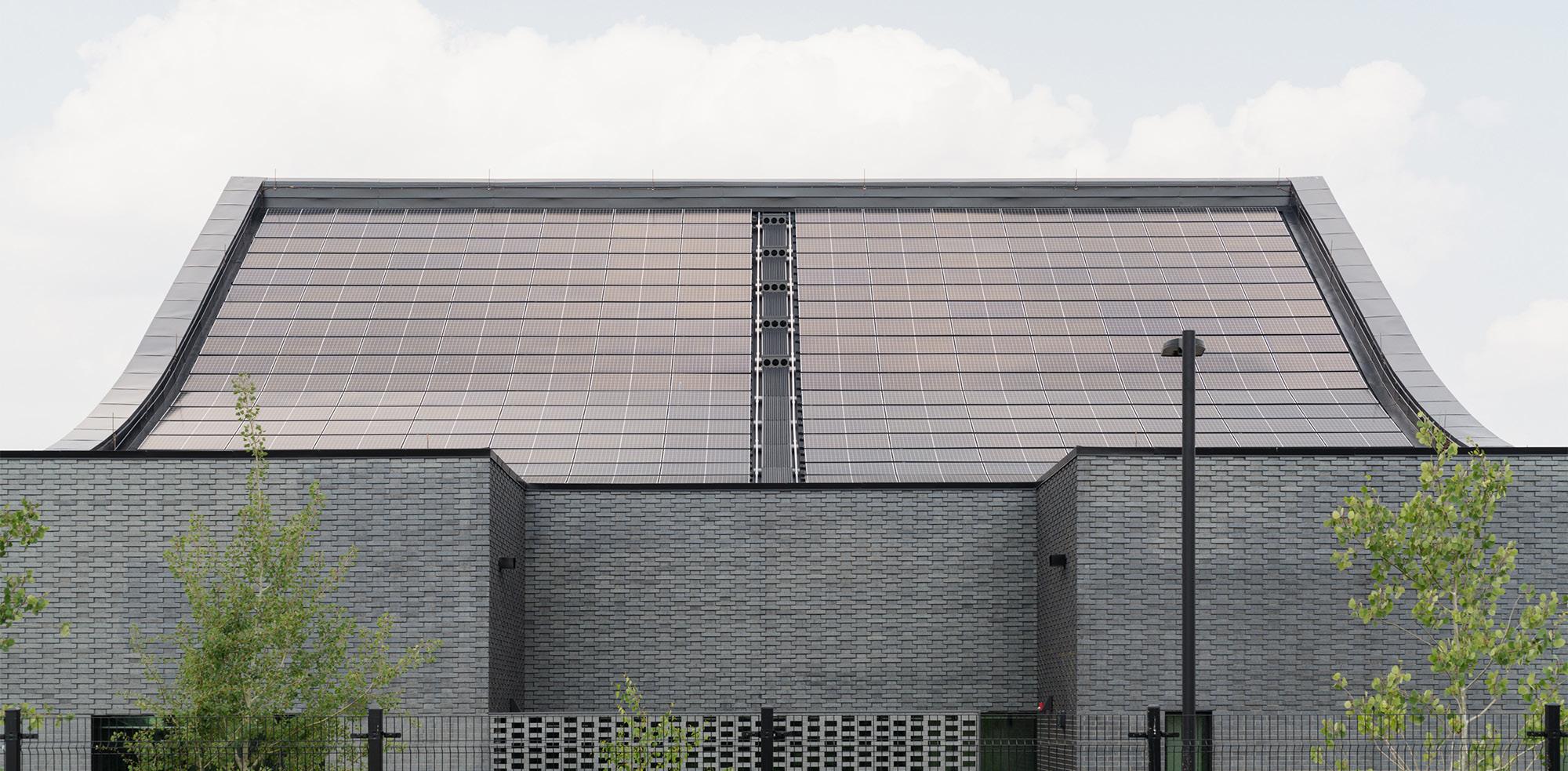
The long sweep of the south-facing roof is optimally angled for a photovoltaic array that contributes to the building reaching net-zero energy performance.
gh3*’s largest project to-date is the 50,000-square-metre Kathleen Andrews Transit Garage. The facility accommodates 320 workers including bus drivers, bus maintenance staff, administration and supervisory staff, daycare, cafeteria, and custodial staff. It houses 300 buses, and includes 35 maintenance bays, including areas where buses are washed and recharged or refuelled.
The design is informed by a subtle reading of history. Eric Arthur’s Canada Packers Plant (1936) formerly sat on the site; its 50-metrehigh smokestack, which was retained through ensuing site transformations, is now the centerpiece of a landscape shaped for ecological greening through bioswales, microclimatic zones, and a dense pattern of new tree planting. The Transit Garage’s striking stainless steel façade, for its part, evokes the ridges of the tin cans filled at the packing plant nearly a century ago.
The building’s glimmering cladding—along with a set of five rooftop light wells and stairs, capped with sculptures by Berlin artist Thorsten Goldberg—gives this large building a distinct urban identity when viewed from the major transportation routes that border the site.
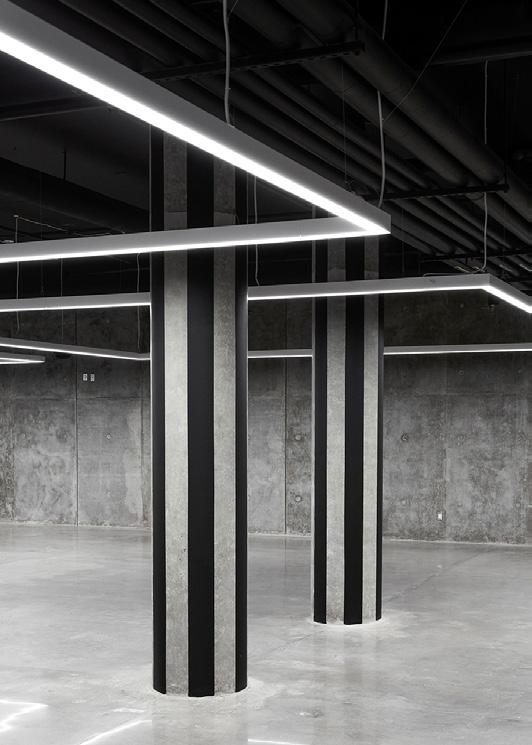
The Transit Garage’s ability to perform at the scale of urban infrastructure is matched by its support for the human workers it houses. A generous atrium with a sculptural stair, located in a section of the building designed to achieve LEED Silver, links administrative spaces with the areas serving bus drivers. Equal care is given to dignified locker areas, change rooms, and meeting spaces for the union and community groups. The garage itself—painted brilliant white, with pops of colour from equipment—is designed first and foremost for the easy maneuvering of buses, both inside and outside of the facility.
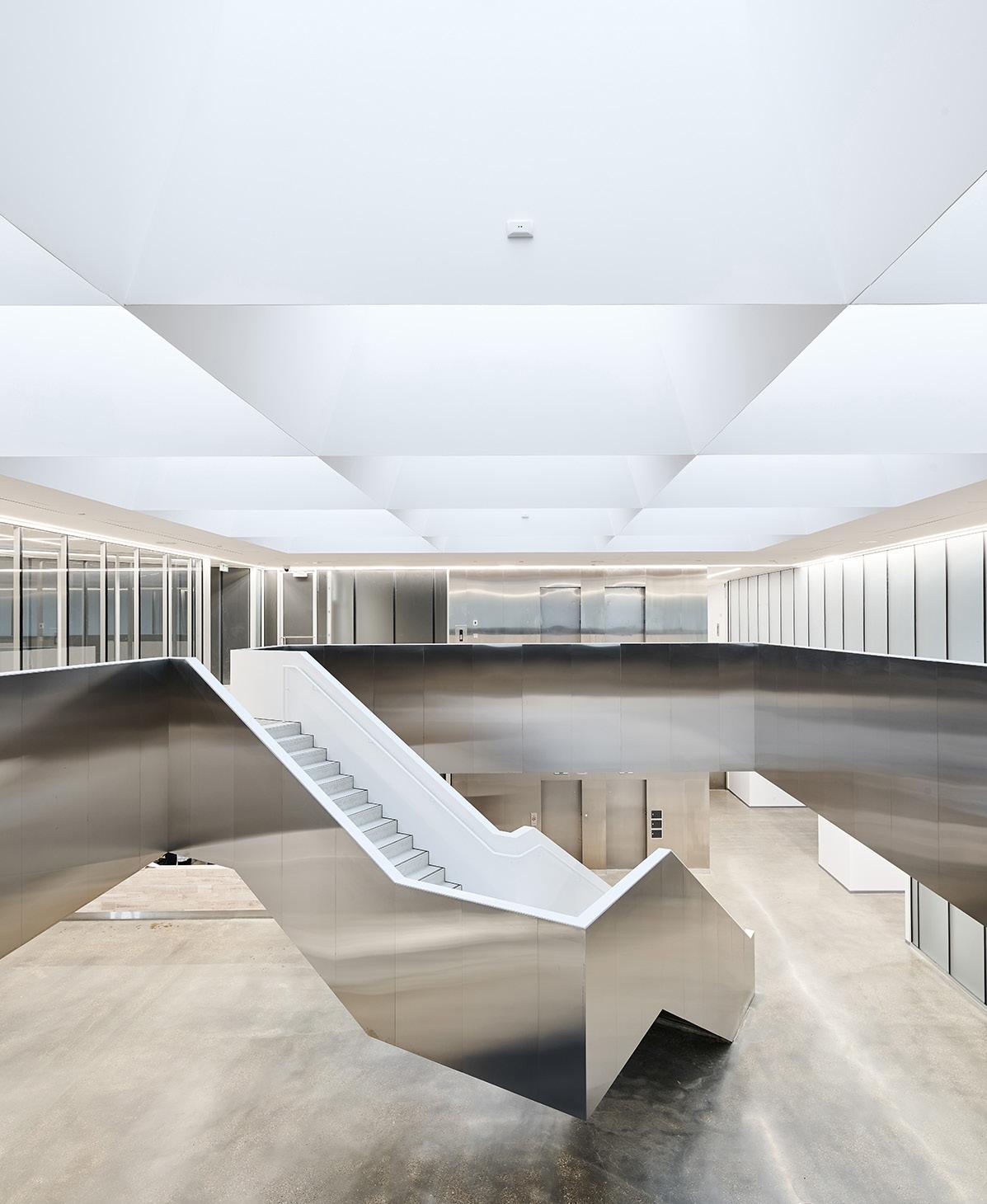
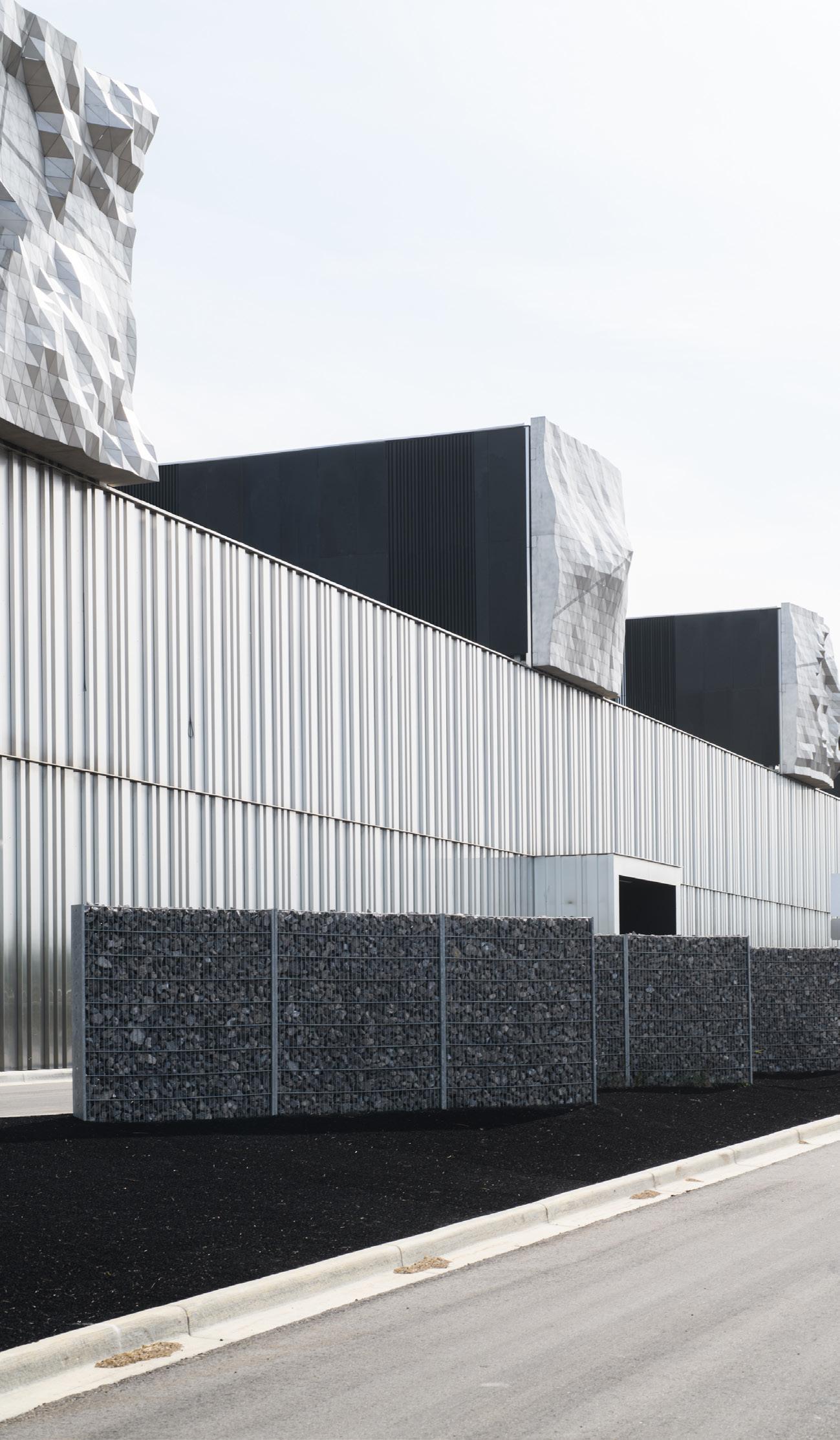
The Kathleen Andrews Transit Garage’s ridged façade refers to the tin cans filled at the packing plant historically located on the site. The project was completed in collaboration with Morrison Hershfield.
The interior of the Transit Garage includes a generous atrium with a sculptural stair, situated in an area that links the administrative spaces with the areas serving bus drivers.
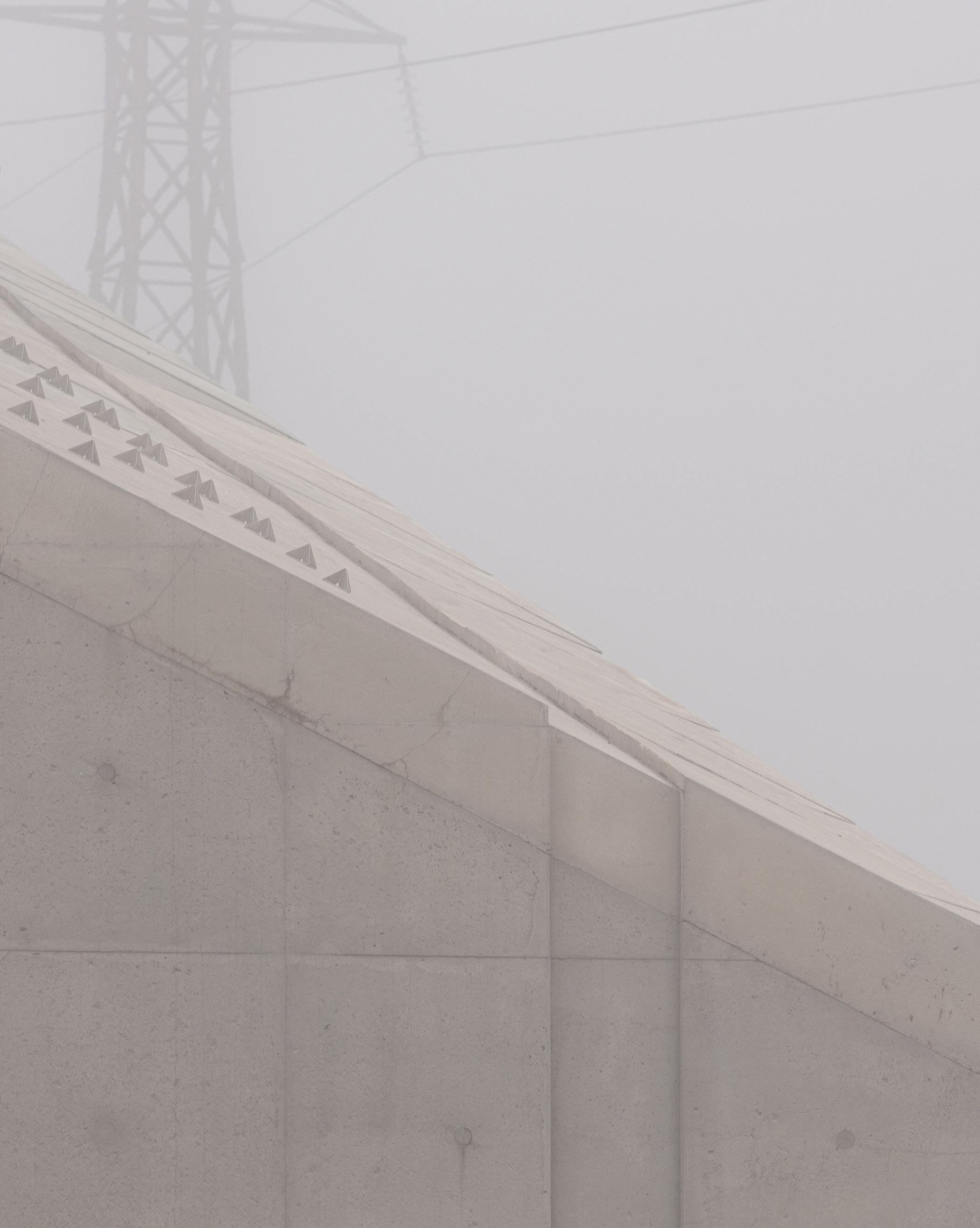
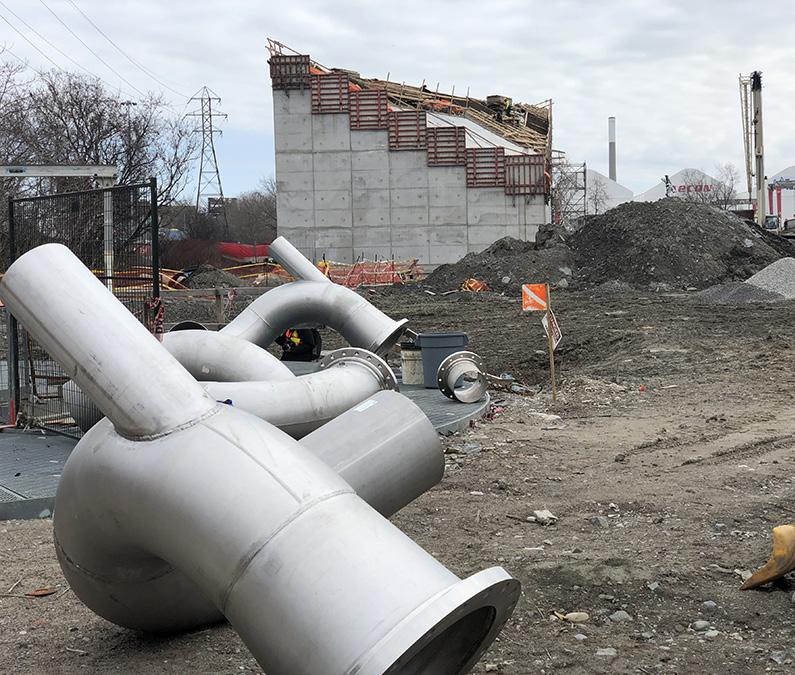
gh3*’s most recent Governor General’s Award winner is a project that has been long in the making. Pat Hanson and her team were awarded the contract to design a stormwater facility on Toronto’s waterfront in 2009—just three years after their firm was established. In the following decade while the design was in progress, the development of the east waterfront area progressed by leaps and bounds. It was determined that a larger facility was required, to not only handle stormwater runoff from the Canary District as per the original remit, but also from the developing East Bayfront and part of the Port Lands.
The City of Toronto Stormwater Facility houses equipment for cleansing urban runoff before it is released into the Keating Channel. The project was completed with R.V. Anderson.
A radial grate marks the location of a large underground shaft that is part of the facility.
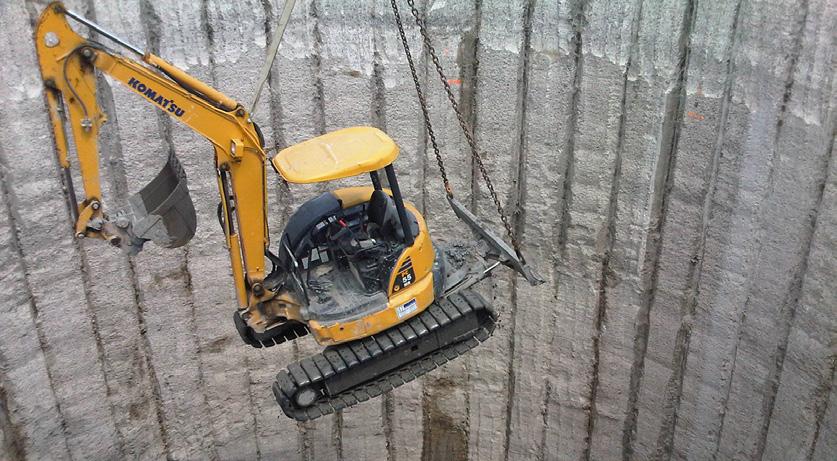
After an initial filtration that removes debris, urban runoff from these areas travels to a 20-metre-diameter, 90-metre-deep shaft at the west end of the site, marked at ground level by a supersized radial grate. From here, it’s siphoned into the main treatment plant—a path visualized by surface paving patterns—then cleansed for a return trip into a separate outer ring in the shaft. The purified water is deposited into the nearby Keating Channel.
The treatment plant itself houses two floors of equipment— flocculation tanks, fine sand filters, UV purification—all wrapped in a sculptural form. An integrated gutter traces the path of rainwater from the roof, down the walls, and into a drain along the building’s perimeter. The canted roof is further accentuated by a triangular skylight and an array of chevron snow guards.
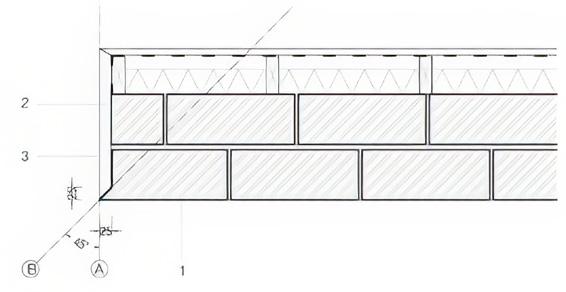
Because the industrial nature of the facility created latitude for experimentation, the construction is the inverse of a typical wall section: the exterior is a 400-mm-thick cast-in-place concrete wall, with insulation and a rainscreen concrete block wall on the inside.
The facility is currently surrounded with chain-link fences and hemmed in by adjacent construction sites. But in a few years, it will develop a public presence. The urban plans for the area include re-routing Lakeshore Boulevard to run directly in front of the site, bringing cyclists, pedestrians, and car traffic alongside a large window that invites views of the machinery inside. A new plinth, planned for the south side of the building, will create a public plaza centered on this sculptural landmark, looking over the road towards Lake Ontario.
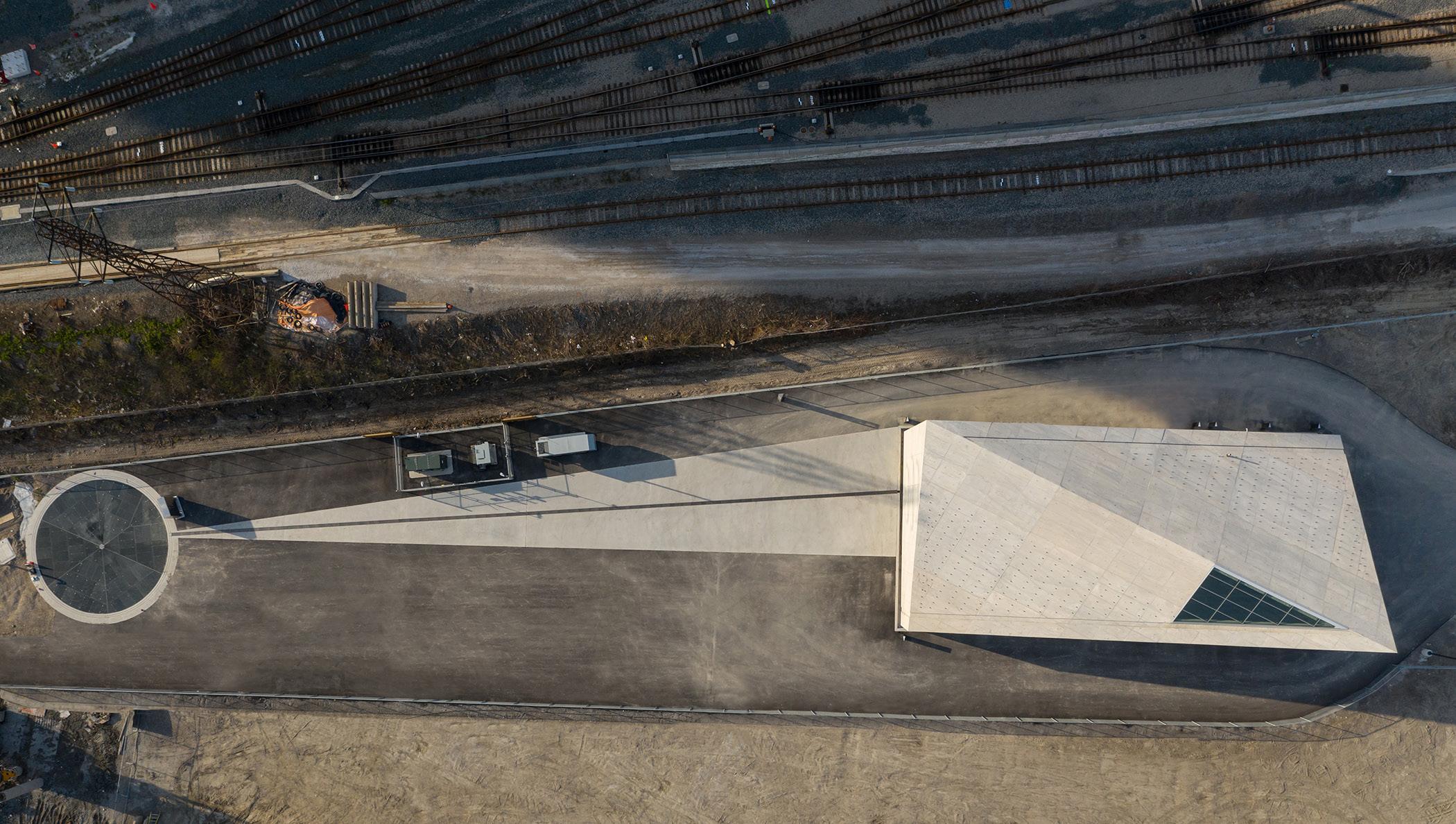
Paving patterns trace the route of the water from the main shaft to the treatment plant, and back to a separate outer ring in the shaft.
The construction inverts a typical wall section, placing insulation and a rainscreen wall on the interior, and a cast-in-place concrete wall on the exterior.
In the past several years, gh3* has collaborated closely with CCx A the landscape architecture firm founded by the late Claude Cormier. The 10-metre-tall Leslie Lookout Tower, designed by gh3*, is located in a park designed by CCx A
The site of Leslie Lookout Park was once a barrier beach sandbar that protected the marsh at the end of the Don River, before the bay was infilled to create the Port Lands over a century ago. In the ensuing decades, landfill and demolition waste from Toronto construction were deposited in a nearby portion of Lake Ontario to create the Leslie Street Spit—a place which has now been reclaimed by emerging ecologies, and has become an important landing ground for migratory birds.
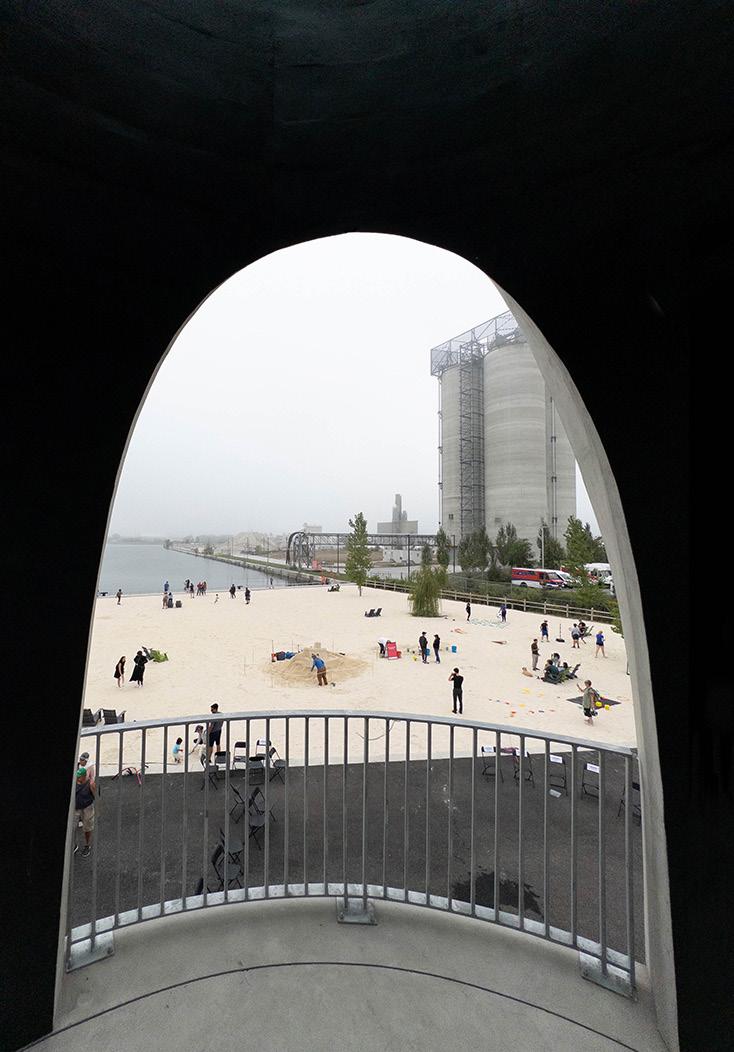
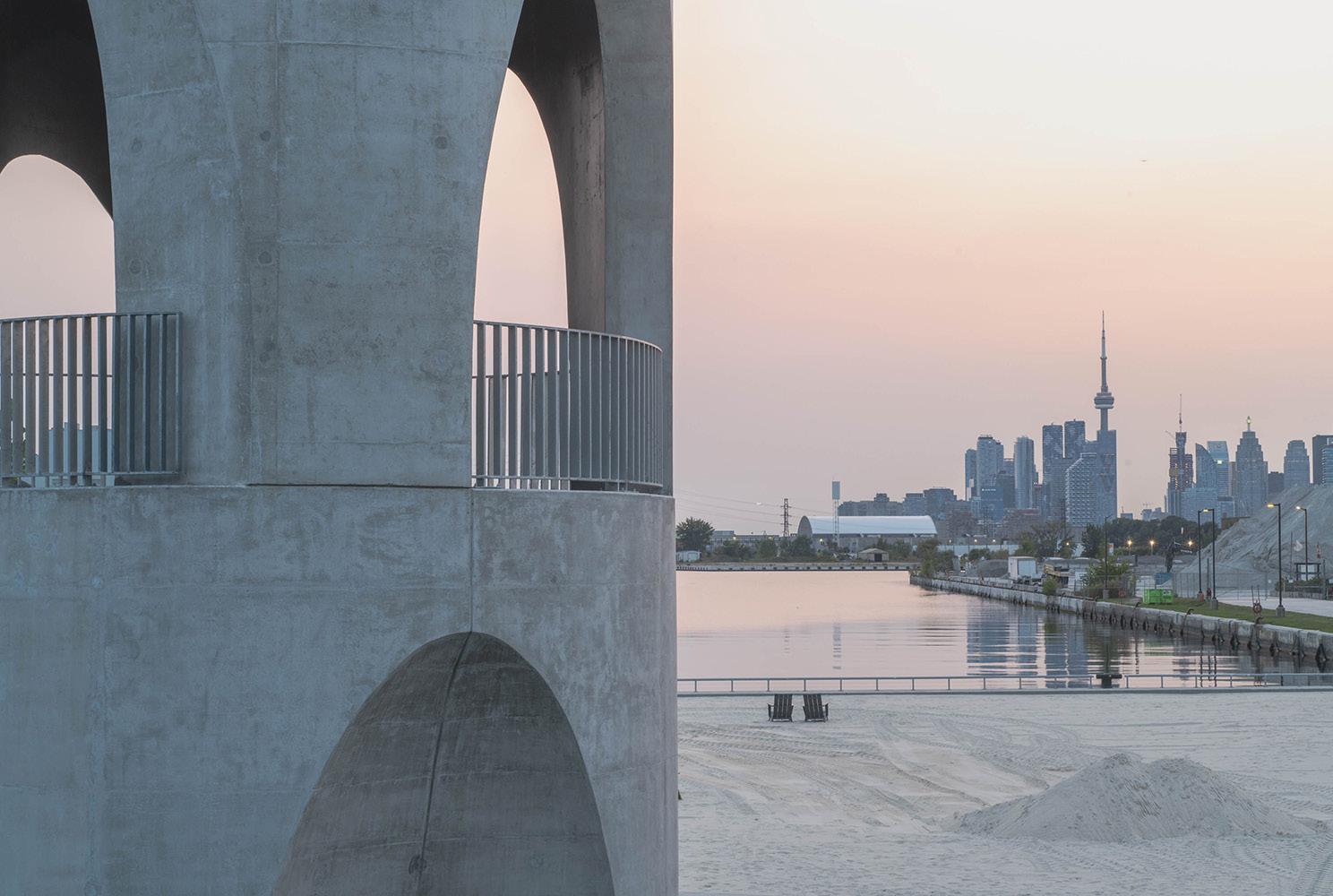
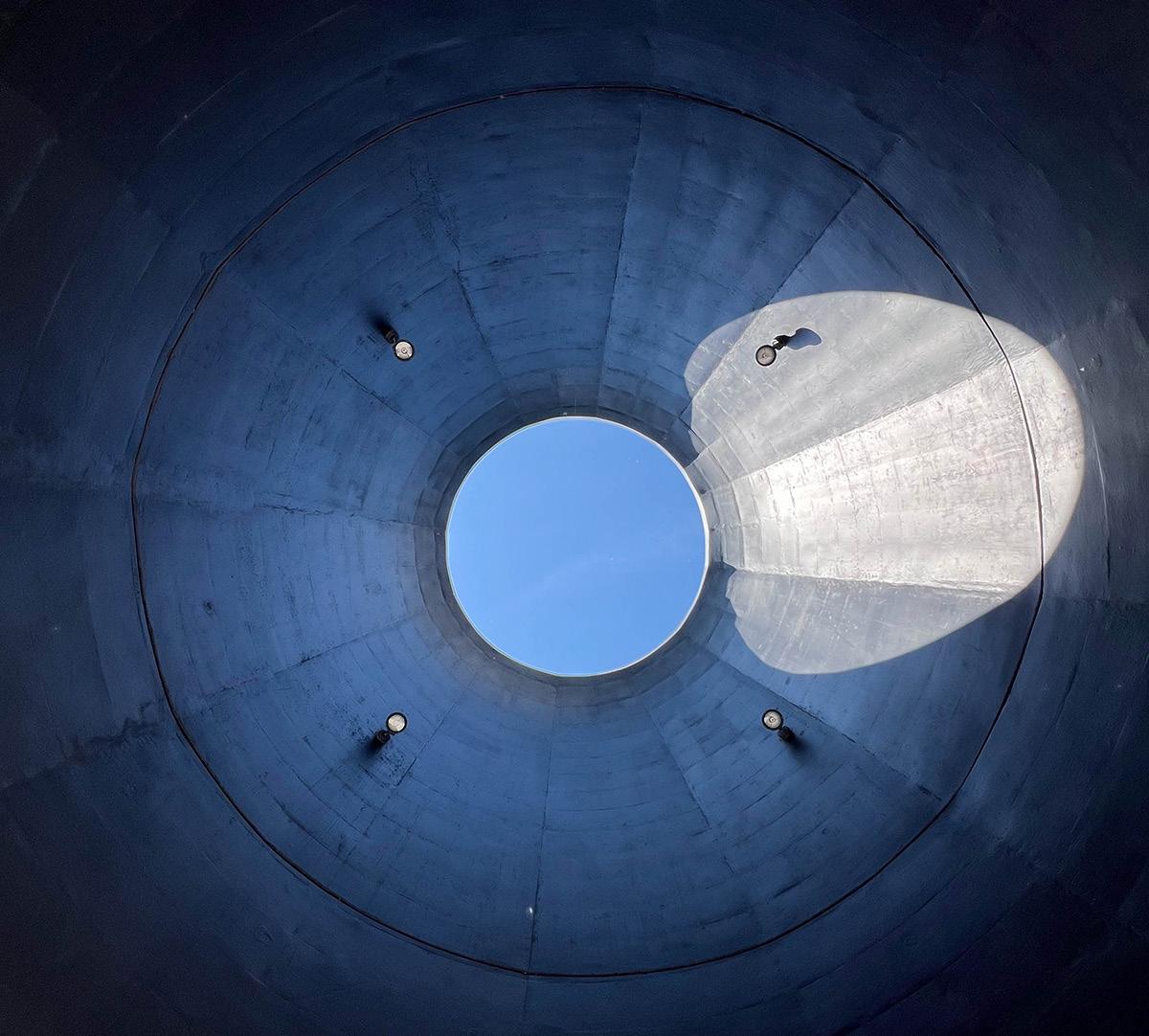
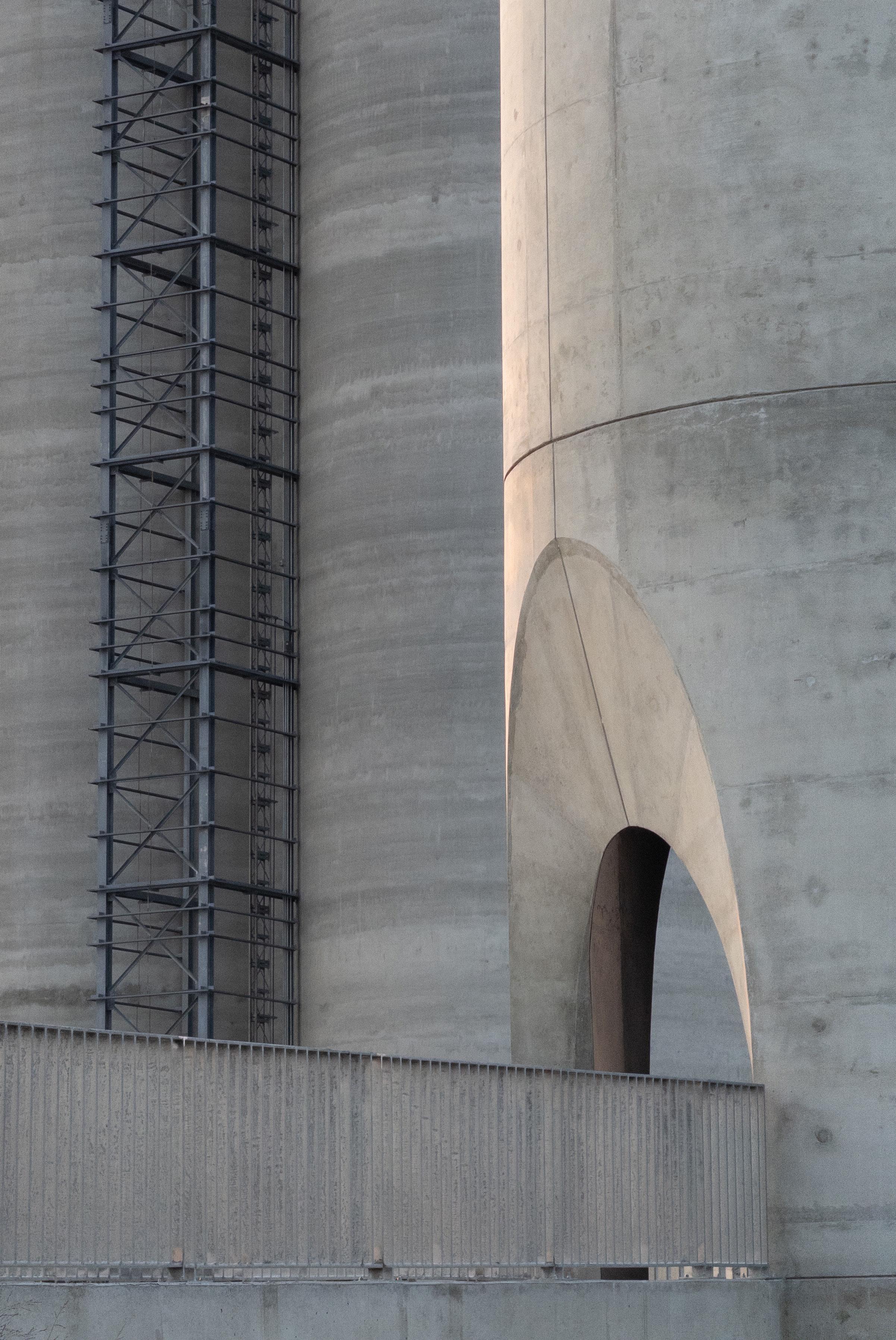
The tower’s tall, concrete form recalls the silos that were key to the Toronto waterfront’s industrial development. A bridge leads visitors to the tower’s second floor, where a series of playful arches—different on each side—allow vantage points overlooking the shipping channel, the Port Lands, Leslie Street Spit, the surrounding developments, and the city skyline. An oculus tops the space, crisply framing views of the changing sky above.
At ground level, the pavilion houses a maintenance room and storage area for park staff. Arched coves around the building’s base create striking backdrops for a drinking fountain and a bicycle repair station.
were used

Arches on the second floor of Leslie Lookout Tower afford vantage points to the harbour and city skyline.
Opposite, the tower is seen with historic grain silos in the background.
The Tower is topped with an oculus that frames views of the sky above. The resulting patch of sunlight traces an ellipitcal path around the interior.
Sketches
to explore the character of the four portals, each of which has a distinctive shape based on the cardinal direction it faces.
gh3*’s latest project adds to the firm’s impressive collection of Edmonton landmarks, and brings together threads from previous work: elevating public infrastructure, conceiving landscape and architecture as an integral whole, and building on historical precedents in unexpected ways.
The pavilion sits in a park designed by CCxA and executed by the two firms in collaboration. The park and the pavilion were seen as part of a single complete design; the pavilion’s footprint directly results from the geometry and structure of the surrounding park.
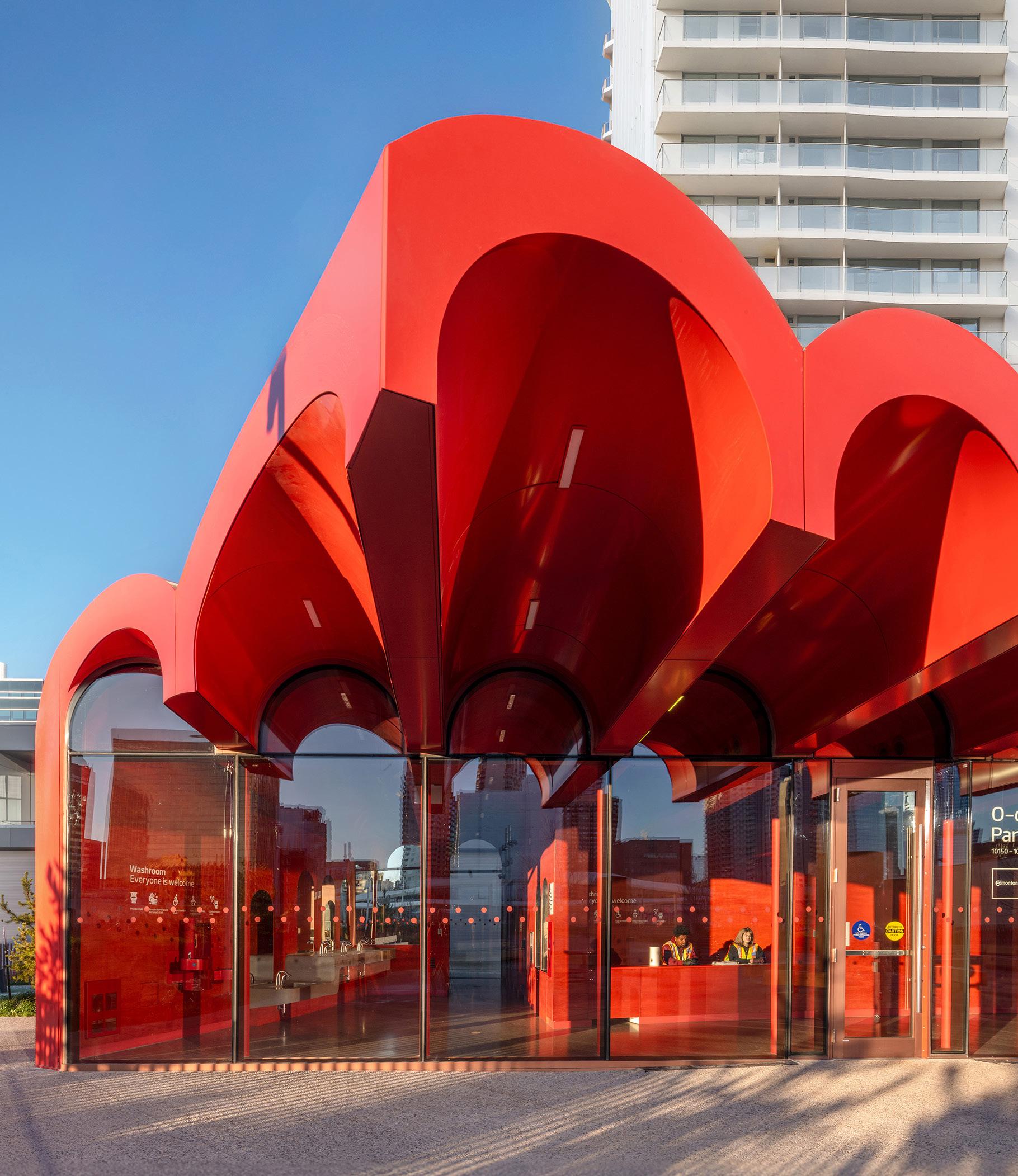
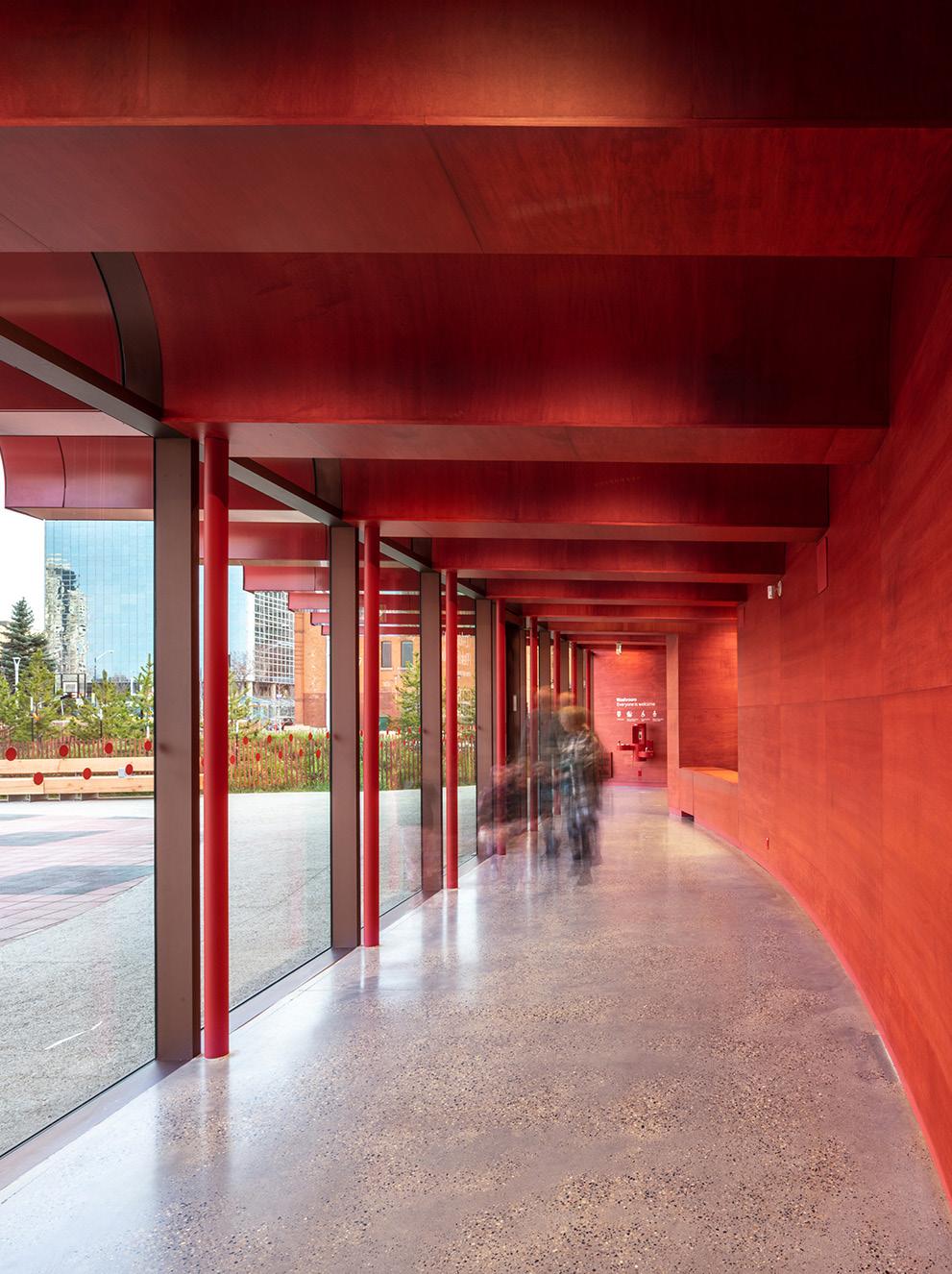
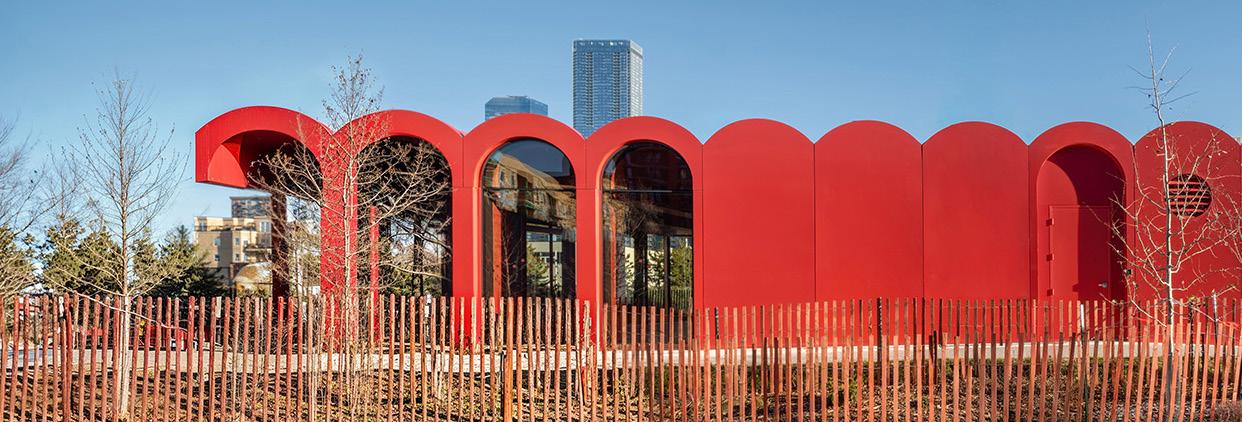
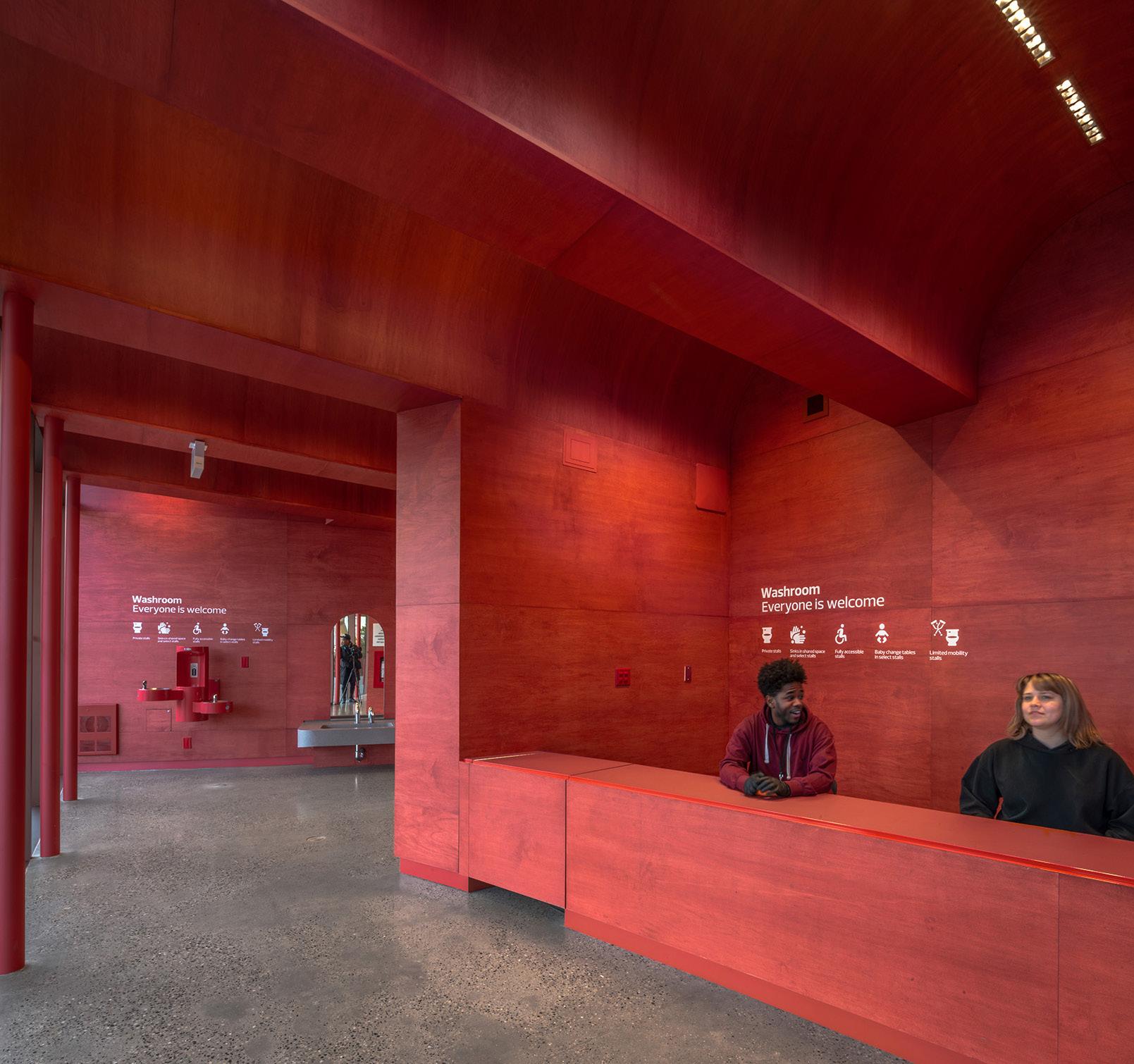
The name of the park and the district in which it sits—O-day’min—was gifted by a local Elder, and means “strawberry” or “heart-berry” in Anishnaabemowin. The berry-red pavilion arcs around a warming plaza, and faces a strawberry-shaped lawn beyond. While the building itself is modest in size—housing washrooms, a community room, and park utility areas—its cantilevered roof extends to create a larger covered plaza.
A barrel-vaulted roof nods to mid-century heritage structures in Edmonton, and gives the building a festive presence amplified by its bright colour. Walls, ceilings, and even bathroom partitions are rendered in red-stained marine plywood—underscoring the pavilion as a place of warmth, welcome, and civic generosity, inside and out.
The barrel-vaulted roof of O-day’min Park Pavilion refers to Edmonton’s legacy mid-century modernist structures.
The berry-red pavilion arcs to embrace a warming plaza, and faces a strawberry-shaped lawn beyond.

The buoyant design and colour reignite a tradition of park pavilions as celebratory civic landmarks.
Since Pat Hanson founded gh3* 20 years ago, her vision, talent, and tenacity have shone through each of her projects. The breadth of this success—from landscapes, to residences, to small and large infrastructure projects—demonstrates an approach that bridges scales and typologies. It sees the essential work of architecture as world-building: creating complete visions for places that are both aesthetically rigorous and joyful to inhabit. Hanson’s work occupies that rare space of being both admired by architects, and beloved by non-architects.
This vision continues in work to come. In its 2025 Awards of Excellence for projects in progress, Canadian Architect recognized gh3* and Lemay’s Tamil Cultural Centre in Toronto, and gh3* and Stantec’s Barrie Wastewater Innovation Centre. The firm is also at work on a pavilion for Calgary’s downtown Olympic Plaza, two residential buildings in Toronto’s Regent Park, and the restoration of a historic artists’ atelier building in Paris.
Pat Hanson’s RAIC Gold Medal recognizes a significant, accomplished body of work—one that continues to expand and evolve, and that promises much for the future of Canada’s infrastructure, public culture, and urban sophistication.
– Elsa Lam
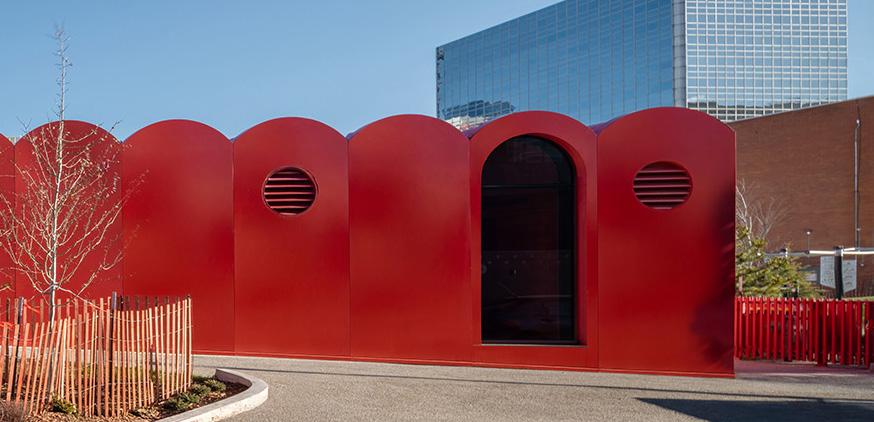
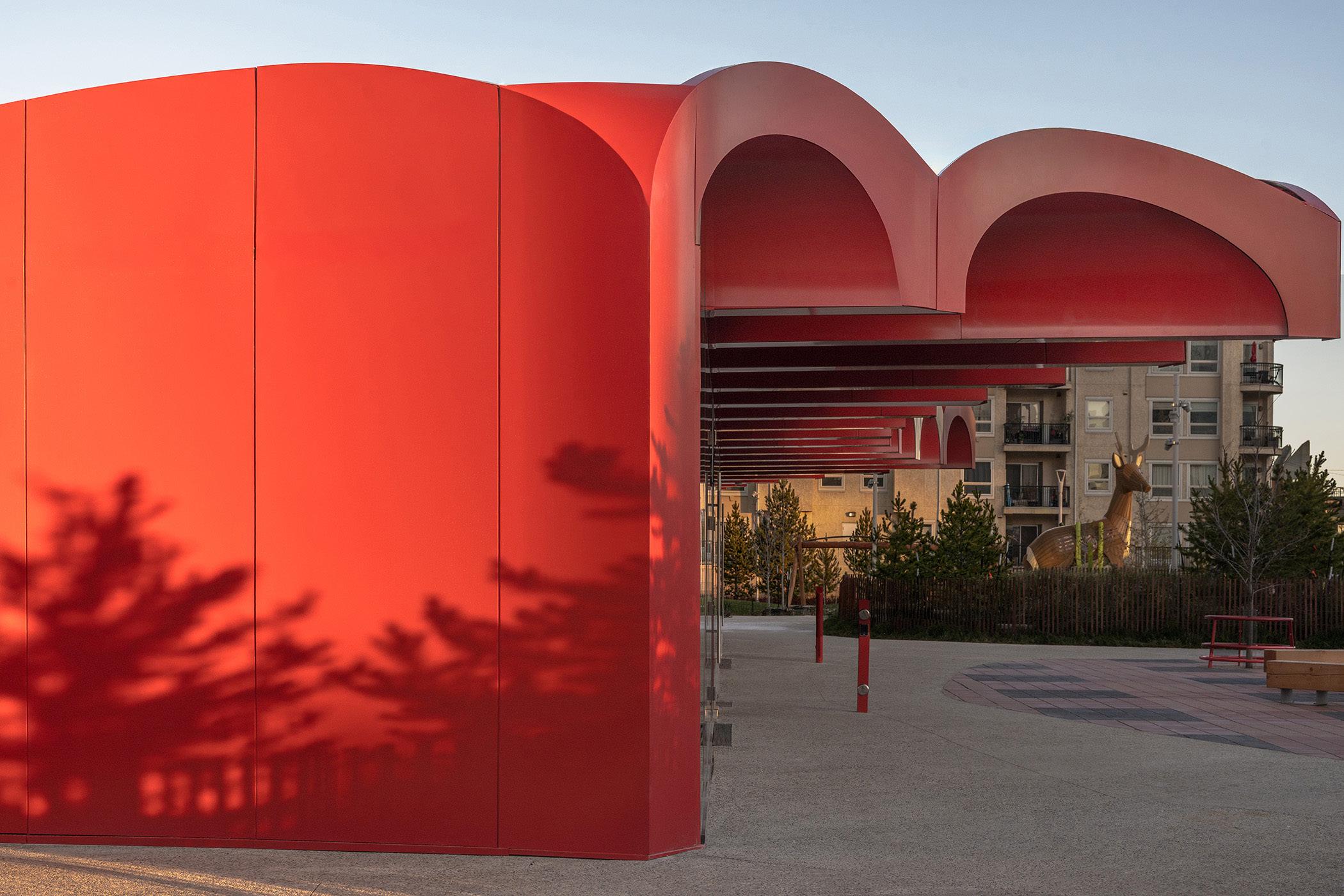
The cantilevered canopy shelters a large outdoor area from rain and sun.
The warm colour continues inside the pavilion, which holds washrooms with attendants, a multi-purpose room, a gathering area, and park utility spaces.
Colleagues share reflections on Pat Hanson’s contributions to architecture—and architectural culture—over the course of her career to-date.
Carol Bélanger FRAIC City Architect, City of Edmonton
Edmonton has always been a city that rewards clarity of purpose. We build in a climate that demands resilience, for communities that value authenticity over pretence. Perhaps that is why Pat Hanson’s work resonates so deeply here. As she receives the RAIC Gold Medal, it feels especially fitting to reflect on the quiet but profound influence she has had on our city. Hanson’s contributions to Edmonton are not defined by simple iconic structures, but by something more enduring: the setting of a new standard. Her work has consistently demonstrated that public architecture can be both rigorous and graceful, that restraint can be powerful, and that design excellence is not a luxury reserved for only art galleries and museums. The Borden Park Pavilion remains one of the most elegant expressions of this ethos. Its quiet geometry and luminous transparency have transformed a simple park amenity into a beloved civic landmark. The subsequent Borden Park Natural Swimming Pool expands that legacy, setting a new national benchmark for sustainable recreation. Pat’s leadership on this project created a facility that is both technically ambitious and profoundly humane, offering Edmontonians a place of rest that feels rooted in nature and crafted with care. Her work extends well beyond parks and recreation. The RTC building a highly specialized drainage facility exemplifies Pat’s belief that even the most industrial program deserves architectural dignity. Through disciplined form, refined detailing, and thoughtful integration into its surroundings, the project demonstrates how infrastructure can contribute meaningfully to the public realm. Similarly, the Windermere Fire Hall and Kathleen Andrews Transit Garage reflect Pat’s commitment to civic architecture that is functional, durable and beautiful. Across all of these projects, Pat Hanson has consistently demonstrated what is possible when a city invests in thoughtful and rigorous design. Her work in Edmonton has strengthened our civic identity, elevated our expectations for public architecture, and left a legacy that will serve generations to come. It has been a privilege to collaborate with her and to witness firsthand the impact her vision and creativity have had on our city.
Marc Hallé Co-President, CCxA
Pat Hanson is a rare talent who creates buildings that are experiences of landscape. She brings an Olmstedian balance to her work add one thing more and it becomes too much, take something away and it becomes too little. Pat has a superpower for transcending the exigencies of buildings and program to deliver experiences that are universal and personal. In the same way that a landscape is the sum of countless finegrained elements, gh3* achieves phenomenal coherence through the accretion of craft, detail, and proportion, shaping a body of work that
is complex without ever being complicated. From the arched portals and niches of the tower perch at Leslie Lookout Park in Toronto, to the rêve-rouge of the barrel-vaulted pavilion at O-day’min Park in Edmonton, Pat misses no opportunity to unleash her creative curiosity. Impatient with the déjà-vu , she steers her practice with playful curiosity beyond the goût-du-jour to revive hidden genius on tired loci. Work that is this gorgeous, glamorous, yet humble and undeniably generous emerges from a practice that is rigorous, responsible, sensitive, and intelligent. Pat’s attitude of practice is one that eschews cookie cutting, choreographing expression and poetry while nailing the pragmatics of program, technic, and budgets. She is a living masterclass on the consummate professional, mobilizing self-respect and dignity in the service of her projects as well as her outreach to the larger design community. She is a design leader attuned to listening more than speaking, her economy of words bringing the greatest punch and momentum. Crafting buildings that land so solidly in their moment like this is hard work. Pat’s poise and judgment make it seem easy. Her flair is fierce, sometimes firm, always fair. Pat Hanson inspires those who work with her to be their best, to treasure the trust she puts in them out of an admiration that is mutual and a loyalty that is heartfelt.
Odile Hénault Architecture critic | Founder of Section A
I am very happy to see Pat Hanson’s bold, yet amazingly elegant work being celebrated through Pat’s selection as the 2026 RAIC Gold Medallist. Her resilience, commitment, and inspired approach transpire especially through her municipal infrastructure projects projects such as the Toronto Stormwater Facility or Edmonton’s Borden Park Natural Swimming Pool, among others. Pat Hanson addresses planning and landscape issues as an architect that is, as someone who understands scale, materials, form and proportions. Whether her projects are made of concrete, brick, metal, or glass, materials are used in a bold, sculptural way, as clearly demonstrated by Toronto’s Stormwater Facility. Her work truly elevates the status of infrastructure buildings to that of important public landmarks. Two Edmonton projects, at opposite ends of the scale in terms of size, reflect this attitude. The small RTC #3 building with its circular shape and translucent skin has a strong presence in the landscape. As does the 50,000-square-metre, metal-clad Kathleen Andrews Transit Garage. Both belong to building types which are essential but rarely make the news for their architectural interest. Hopefully, municipalities across the country and architects will understand the importance of treating utilitarian buildings with the care they deserve.
Peter Busby C.M. FRAIC | RAIC Gold Medallist Global Design Partner, Perkins&Will
I have known Pat for well over ten years, as we shared roles on Toronto’s Waterfront Design Review Panel. Under Pat’s leadership, gh3* has steadily grown in capacity since its inception. Her sustainability knowledge and application is solid and advanced; her project design and detailing is beautiful. Pat’s designs are unique and deeply original; she is not shy to try new ideas! Her overlap between architecture, landscape design, and sustainability is unmatched by any architect in North America. We have had numerous conversations about the roles of architects, and she always has a strong position on the need for female strength much to my agreement! Congratulations Pat!
Johanna Hurme FRAIC Managing Partner, 5468796 Architecture
I’m genuinely thrilled that Pat Hanson has been named the recipient of the 2026 RAIC Gold Medal. For more than three decades, Pat has been a force in Canadian architecture setting the bar high and then calmly raising it again. Her work is fearless yet precise: projects that are rigorous, beautifully coherent, and never afraid to take a stand. I knew Pat’s work long before I knew Pat herself. We finally met properly while serving together on the Canadian Architect Awards of Excellence jury in 2015, and since then I’ve had the privilege of calling on her for advice, commiserating about the trials and absurdities of the profession, and cheering her on as her remarkable body of work continues to grow. Pat is, quite simply, a bit of a badass. She leads a practice of extraordinary design quality, teaches, mentors, and volunteers generously for the profession yet somehow remains refreshingly grounded and unfailingly kind to her colleagues. That combination of sharp intellect, creative courage, and genuine generosity is rare. With five Governor General’s Medals already to her name and, I suspect, many more to come there could not be a more deserving recipient of this honour. And if that weren’t cool enough, she also happens to be a woman.
Meg Graham FRAIC Partner, Superkül
One of the most remarkable things about Pat and there are many, including her tenacity, integrity, and sardonic sense of humour is that no matter how many medals and awards she and her team receive, she remains surprised by the reach and resonance of her work. She is the most understated of the great architects I know, yet among the most uniquely skilled. Over the years, I’ve come to understand more clearly that Pat is, in many respects, a study in contrasts: the impact of her architectural work is prodigious, yet she prefers to sit in the back row, out of the spotlight. She is as self-effacing as her buildings are striking, each of them purely conceived and executed with uncommon precision. Her design, quietly sublime and often monumental, speaks for itself. This Gold Medal win gives us an opportunity to put Pat in the spotlight and reflect back to her just how consequential her work has been in raising the architectural bar in Canada. It is with profound admiration that I congratulate you, Pat, on this fully merited achievement. I will forever be one of your biggest fans.
Bruce Kuwabara O.C. FRAIC | RAIC Gold Medallist Founding Partner, KPMB Architects
What I admire most about Pat Hanson is her consistent control of formal compositions at different scales, in award-winning architecture that accommodates programs outside of the mainstream—including bus garages, park pavilions, municipal utility facilities, and unconventional residences. Pat’s development as an architect has been an evolution of her unique architectural imagination that builds on her education, professional practice, formal experimentation, and technical prowess. In pursuit of the art of architecture, she has realized her poetic vision in exceptional buildings and landscapes, notable for their verve and quality. Her background in fine arts, her rigorous approach to architecture, and her collaborative leadership have helped her forge a body of work that elevates programs of recreation, service, and infrastructure to become architecture that is intellectually exciting and
formally audacious. Her work achieves a unique intersection between site-specific monumentality, pleasurable accommodation, and public service. I have lingered in her pavilion in Love Park. I have attended a party in the minimalist laboratory-kitchen of a house she designed in Rosedale. I have climbed up her silo tower in Leslie Lookout Park in Toronto’s Port Lands. Pat would say that her buildings should speak for themselves. I have heard those messages, and appreciate the meaning and value of Pat’s projects—outcomes of Pat’s insistence on the integrity and excellence of her work.
Beth Kapusta Writer & consultant | Founder, Metrolinx Design Excellence program
Pat was my first mentor: I was a Waterloo architecture co-op student; she was a young partner at Garwood Jones Van Nostrand. Her work there mostly centered on social housing, but she also headed up the firm’s entry to the Kitchener City Hall competition, which won an Award of Merit. This 1990 competition, with its excellent brief and thoughtful documentation of winners and runners-up, would prove a launching pad for an emerging generation of top Canadian designers including Pat. She went on to found gh3*, a small and intensely talented Torontobased studio that quietly won competitions and garnered design awards. In a time where many architectural firms became increasingly specialized, gh3* was an opportunistic generalist, taking on diverse building, landscape and hybrid infrastructure projects. Pat’s considerable contribution to Canadian architecture is a lifetime of exceptional design practice realized through an array of building types not known for elevated architectural expression. Some 20 years after the Kitchener City Hall competition, I had the opportunity to work with Pat from the client side. She became the “secret weapon collaborator” for the Design Excellence team I led at Metrolinx. Pat is one of the most talented natural designers I’ve ever worked with. There is a singularity to her design work, propelled by strategic instincts, lightning-fast decisiveness, an amazing design hand, brilliant visualization skills, and leadership skills that transmit vision and energy to both her team and clients. Her work is formally innovative without being functionally compromised. Her design signature is situational, nuanced, spatially expressive and materially disciplined. Conceptual clarity, formal legibility, and boldness characterize each project without exception. The consistency of this extraordinary achievement, sustained over the span of a career, render Pat a truly deserving recipient of this highest of awards. Congratulations to a brilliant mentor, collaborator and friend.
Brigitte Shim and A. Howard Sutcliffe O.C. FRAIC | RAIC Gold Medallists
Shim-Sutcliffe Architects
Pat Hanson has situated her work at the crossroads between architecture, landscape, and urbanism. Her built work always responds directly to functional requirements, while always reaching far beyond, always contributing to a sense of place. All her projects are defined by her contextually driven view of the world comingled with her innovative approach to architecture. She is continually redefining the boundaries between traditional disciplines and always finding ways to make a difference to our daily lives.
Shirley Blumberg C.M. FRAIC | RAIC Gold Medallist Founding Partner, KPMB Architects
I first met Pat Hanson when we taught together in a design studio at the University of Toronto Daniels School of Architecture, Landscape, and Design. We were both young architects, yet even then, it was clear that Pat was on a path to find her architectural voice by stretching the traditional boundaries of the discipline. As a founding partner of gh3*, Pat established an unusual model of practice that explores the intersection of architecture, landscape, urban design, and sustainability. Her body of work stands as one of the most poetic, rigorous and distinctive contributions to contemporary Canadian architecture. Unique to her work is the focus on typologies that have largely been overlooked by more conventional practices the utilitarian buildings that make up our urban infrastructure. She’s realized the potential of these often anonymous structures to become meaningful urban architecture fire and paramedic stations, a transit garage, stormwater and sewage treatment facilities, and park pavilions. All are designed with minimalist clarity and simplicity, are elegant and generous in spirit, and contribute to public awareness of the human effect on our urban environment. Pat’s leadership in architecture extends beyond her built work. She’s demonstrated a commitment to education and public advocacy and has served as a valued member of key design review panels in the city. Pat also served on the Advisory Committee when I co-founded BEAT (Building Equality in Architecture in Toronto) eleven years ago. Her integrity and the excellence of her work will be a model for generations to come.
Omar Gandhi FRAIC Founding Partner, Omar Gandhi Architects
Pat’s career represents a rare and sustained contribution to Canadian architecture one that seamlessly integrates architecture, landscape, infrastructure, and urbanism, while advancing an ethic of environmental responsibility, civic generosity, and design excellence. Her body of work has not only shaped the physical fabric of cities across Canada, but has also expanded the disciplinary boundaries of architectural practice itself. I first had the privilege of meeting and working with Pat during the Pier 8 competition, where our two teams came together, along with superkül and KPMB Architects. From the very first meeting, Pat’s professionalism, command, and magnetism set a tone that elevated everyone around her. Our entire team was struck by her clarity of vision and the generosity with which she engaged in every challenge an impression that has stayed with all of us.
Herbert Enns
Professor Emeritus of Architecture, The University
of Manitoba
I first met Pat when we were both students at the University of Manitoba; she was a few years above me. I remember the work being taut and obsessively resolved way back then. At the University of Manitoba, comprehensiveness wasn’t necessarily only the articulate wall section although the technical proficiency of Pat’s Boathouse Studio at Stony Lake (one of gh3*’s earliest projects, and a Governor General’s Award winner) and its wall sections are as inspirational as they are informative. It was an education that registered in my mind as an open-door opportunity to take the whole world into consideration. It challenged us
to see design as inclusive, and as a transmission of effort across all the disciplines geology, geography, history, landscape architecture and urban design, hardware, detailed millwork, and furniture design, to name a few. Pat’s work has proved that such a broadminded ambition is possible. Her collective and inclusive practices are remarkable. Gathering disparate voices, she achieves consensus without undermining the intensity of her design intentions. Surrounding herself with similarly dedicated collaborators, she is uncompromising. She has learned how to organize her thoughts and align her ambitions in a way that allows bureaucracies to absorb and celebrate overarching ideals and intimate details alike. Pat’s first degree was in Fine Art, where her creative imagination was honed. I believe this to be one of the sources for so many of the unexpected design deviations in her work. We appreciate and admire this work immensely, as it leads to a wholly unique position of creative competence, authority, whole-world engagement, and in its ultimate resolution, unambiguous detailing. My own career led me to teach at the University of Manitoba for 30 years, including heading its Department of Architecture. I was determined to have Pat here as a role model, and she graciously accepted to be part of studio reviews and lectures over many years. Pat’s work is universally admired by today’s generation of students and faculty alike: for the way it encompasses didactic transparency, principled values, evidentiary knowledge, revelatory diagrams of logic, research as a foundational continuum, the integration of disciplines and inter-disciplinary strengths, and an architectural future for diversity and the inclusion of the whole human habitat.
gh3* team
Working with Pat has been a formative experience for all of us. She is uncompromising in her pursuit of design excellence, creating space for the team to develop ideas independently. She has an innate sense of when to offer guidance, foresight, and support, and a stalwart ability to bring clarity to the indeterminate. Since founding gh3*, Pat has ensured that the work remains extremely varied in typology and sector, with each project firmly attuned to site, context, and circumstance. There is a strong interest in uncovering the latent history of a place through critical engagement rather than preconceived interpretation. The design approach at gh3* is anchored by a trust in the process and a precision of execution, always aiming to find the essential and most coherent architectural expression possible. Pat has shaped the practice as a studio in the traditional sense: it is built for collaborative work and thought. There are no private offices, no physical markers of hierarchy, and hardly any doors. People are constantly moving, mixing, discussing, testing, and creating there is an energy that charges even the most difficult parts of the architectural design process with a sense of fulfillment. Pat has many professional achievements to be proud of, but from our perspective, one of her greatest accomplishments is the culture she has built at gh3*. In addition to being the firm’s creative leader, she is deeply connected to her team on a personal level. She is funny, fully accessible, and attentive to what is going on in people’s lives. It is clear that Pat genuinely enjoys coming to work each day and being with the team, and that feeling is contagious. gh3* is a place people are genuinely grateful to be part of, and a place where many choose to stay for the long term.