What Does the Church Teach about Immigration? BY LEONARDO D. MENDOZA
M
igration has been an enduring aspect of human history, and the Roman Catholic tradition has consistently recognized the dignity, rights, and humanity of migrants. From mid-20th-century teachings such as Exsul Familia (On the Spiritual Care of Emigrants) to the contemporary reflections of Pope Francis and Leo XIV, the church’s stance emphasizes both the moral obligations of host societies and its pastoral responsibilities. These documents collectively articulate a vision of migration rooted in the gospel, the exemplar of the holy family, and the imperatives of justice and solidarity.
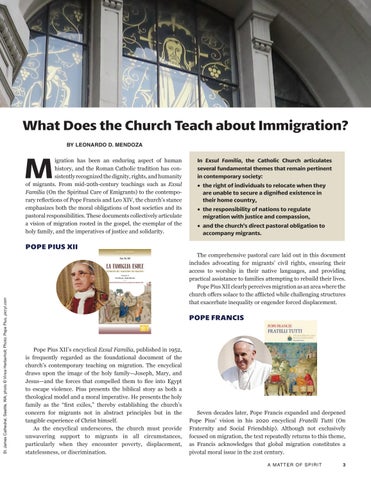
St. James Cathedral, Seattle, WA; photo © Vince Herberholt; Photo: Pope Pius, picryl.com
POPE PIUS XII
In Exsul Familia, the Catholic Church articulates several fundamental themes that remain pertinent in contemporary society:
• the right of individuals to relocate when they are unable to secure a dignified existence in their home country,
• the responsibility of nations to regulate migration with justice and compassion,
• and the church’s direct pastoral obligation to accompany migrants.
The comprehensive pastoral care laid out in this document includes advocating for migrants’ civil rights, ensuring their access to worship in their native languages, and providing practical assistance to families attempting to rebuild their lives. Pope Pius XII clearly perceives migration as an area where the church offers solace to the afflicted while challenging structures that exacerbate inequality or engender forced displacement.
POPE FRANCIS
Pope Pius XII’s encyclical Exsul Familia, published in 1952, is frequently regarded as the foundational document of the church’s contemporary teaching on migration. The encyclical draws upon the image of the holy family—Joseph, Mary, and Jesus—and the forces that compelled them to flee into Egypt to escape violence. Pius presents the biblical story as both a theological model and a moral imperative. He presents the holy family as the “first exiles,” thereby establishing the church’s concern for migrants not in abstract principles but in the tangible experience of Christ himself. As the encyclical underscores, the church must provide unwavering support to migrants in all circumstances, particularly when they encounter poverty, displacement, statelessness, or discrimination.
Seven decades later, Pope Francis expanded and deepened Pope Pius’ vision in his 2020 encyclical Fratelli Tutti (On Fraternity and Social Friendship). Although not exclusively focused on migration, the text repeatedly returns to this theme, as Francis acknowledges that global migration constitutes a pivotal moral issue in the 21st century. A M AT T E R O F S P I R I T
3