We Have Come This Far by Faith- Housing Justice in Action by Cara Williams, Tan Macaraeg, Molly Hard
1990
�� Washington State Growth Management Act (GMA) enacted
�� Requires local governments to create comprehensive plans guiding growth, zoning, and housing development
2015
�� Seattle/King County declare a homelessness state of emergency
�� First LIHI tiny house village established at 22nd & Union, property of the Lutheran Church of the Good Shepherd
17 TINY HOUSE VILLAGES
2015–2020
�� Tiny house village operates on Good Shepherd property
�� Model expands regionally as a response to unsheltered homelessness
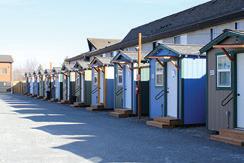
The opening of the first tiny house village at 22nd Ave. and Union St., Seattle, WA in 2015 LIHI’s newest tiny house village, Church By the Side of the Road Village in Tukwila, opened in March 2026. The village sits on churchowned land and was brought to reality in close partnership with Church By the Side of the Road
2021
�� Washington State Substitute House Bill 1377 adopted
�� Requires jurisdictions to allow increased density for affordable housing on religious land
�� Seattle Affordable Housing on Religious Organization Land Ordinance (SMC 23.42.055) goes into force
�� Enables higher-density affordable housing on faithowned property
�� Generates progressive revenue for housing and services, including operating support
We Have Come This Far by Faith
BY CARA WILLIAMS, TAN MACARAEG, AND MOLLY HARDIMAN
On May 29, 2024, the Low Income Housing Institute (LIHI) opened the doors to Good Shepherd House.
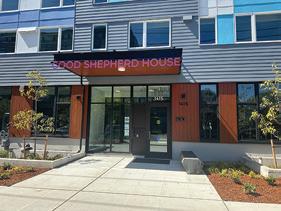
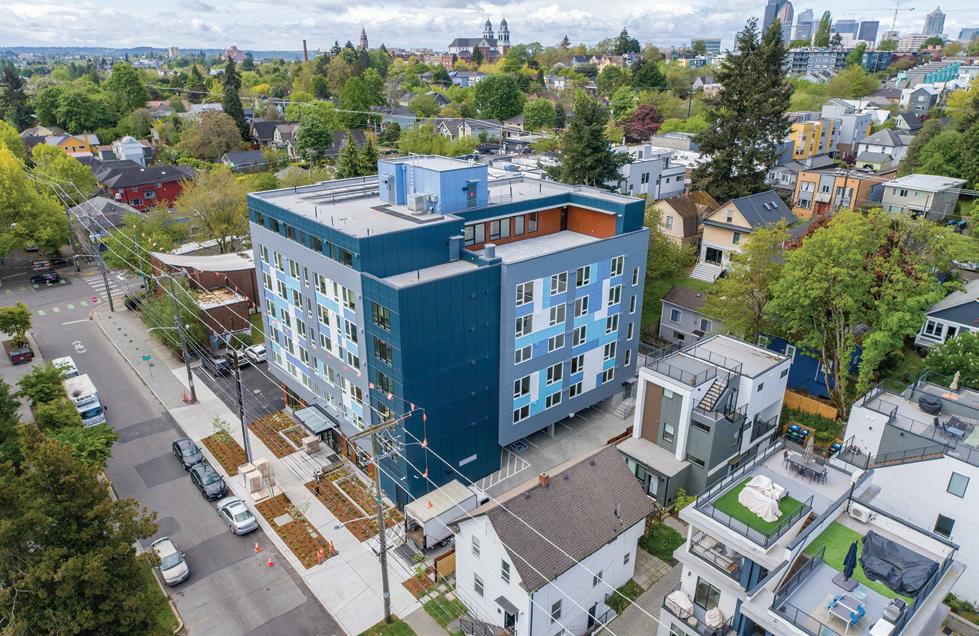
The opening of the seven-story, newly constructed apartment building located behind the Lutheran Church of the Good Shepherd was years in the making. Good Shepherd House is located in Seattle’s Central District and provides permanent supportive housing for formerly homeless singles and couples. Residents pay 30 percent of their income for rent and have access to onsite case management to connect them to supportive services.
THE BEGINNINGS
The lease-up of Good Shepherd House marked a new milestone in the relationship between the Lutheran Church of the Good Shepherd and LIHI. Long before the church agreed to embark on a 16 month-long construction project in its backyard, the site was home to Seattle’s first tiny house village.
In 2015, the city of Seattle and King County declared a state of emergency over the homelessness crisis. At that time, “tent cities” were a common practice to address unsheltered homelessness. The Lutheran Church of the Good Shepherd already sponsored a tent city with Nickelsville—a self-managed group of people
experiencing homelessness who organized tent encampments and shelters—on their vacant lot adjacent to the church.
After the closure of the tent city, which was time-limited, LIHI, the Lutheran Church of the Good Shepherd, and Nickelsville decided to do something new: temporary microshelters that would be cost effective and restore dignity to people who are experiencing homelessness.
The result was the tiny house village at 22nd and Union, a program on the church’s property consisting of 14 tiny houses (the size of small bedrooms), hygiene pavilion, kitchen and dining tent, security office, and storage space. This was the first tiny house village to include a kitchen, running water, hygiene services, or laundry facilities.
Since 2015, LIHI has expanded this model and currently operates 17 tiny house villages, serving thousands of people exiting homelessness. In 2025, LIHI provided shelter to 1,663 individuals, couples, and families with children in tiny houses.
A MORE PERMANENT SOLUTION
The Lutheran Church of the Good Shepherd hosted the tiny house village on its property from 2015 to 2020. Eventually, however, it decided to transition from a tiny house village to an affordable housing development.
The transformation of this site stands as a living reflection of the church’s mission to serve their neighbors and LIHI’s
�� Permanent supportive housing for formerly homeless individuals and couples
2025
�� LIHI reports 1,663 people sheltered in tiny house villages across the region
1,663 PEOPLE SHELTERED
2026
�� Washington State House Bill 2266 passed
�� Limits local governments’ ability to delay or block shelters and supportive housing through zoning/ permitting barriers
�� Among the first projects to utilize the 2021 religious land ordinance
�� Unit count increased from 65 to 86 due to density allowances
UNIT COUNT INCREASED FROM 65 TO 86
HOUSING JUSTICE IN ACTION
steadfast belief that housing is a human right. Today, many of LIHI’s partners are faith-based and play a powerful role in strengthening community within and around tiny house villages.
Embarking on this process, Reverend Nate Whittaker reflected: “We welcome the next step of what our God is doing in this community. We will continue to follow our Lord and serve our community with love. We have come this far by faith and cannot wait to see what the next 100 years brings all of us”.
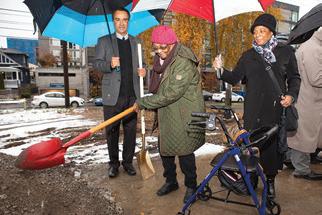
Following a two-year period of development planning, Good Shepherd House broke ground in 2022 thanks to Seattle’s 2021 Affordable Housing on Religious Organization Land Ordinance; it was one of the first developments to rely on this ordinance.
Recognizing the important role of faith-based organizations in Seattle’s network of affordable housing, this piece of legislation allows for increased density in affordable housing developments on property owned by religious organizations. When it went into force in 2021, LIHI was able to increase the scale of the project at Good Shepherd Housing, bringing the total number of units up from the planned 65 to 86 and significantly increasing the number of formerly homeless individuals the building could serve.
THE ROLE OF LEGISLATION
Policies such as Seattle’s Affordable Housing on Religious Organization Land Ordinance shape the landscape of housing. This ordinance was passed to comply with the Washington State Legislature’s adoption of Substitute House Bill 1377, a bill requiring local jurisdictions to allow additional density in affordable housing developments on religious land.
This bill is one of a slew of recent pieces of legislation enacted at the state level that are targeted at easing the lengthy process of developing affordable housing and shelter, which currently cannot keep up with skyrocketing demand. House Bill 2266, for example, passed this year after years of advocacy efforts. The bill will prevent local jurisdictions from using unnecessary zoning and permitting delays to discriminate against prospective shelters, transitional housing, and permanent supportive housing.
Much of Washington’s recent housing policy builds on the Washington State Growth Management Act of 1990. This sweeping legislation requires local jurisdictions to create comprehensive plans to prepare for urban growth that include strategies and zoning laws that determine what types of housing can go where. This provides the legal framework for legislation that either promotes housing for all or hinders it.
Trustee Steve Tucker and members of the church congregation attend the Good Shepherd House groundbreaking event on December 4, 2022 and literally make their mark on the block
While the state can enforce pro-housing policy by enacting mandates for comprehensive plans, local governments can direct more resources for housing and shelter through their comprehensive planning process. Numerous other policy and funding mechanisms interact to impact housing as well. For example, revenue from Seattle’s 2021 JumpStart payroll expense tax, a progressive tax, provided operating funds for Good Shepherd House along with numerous other sources.
INTO THE FUTURE
While historical and present-day policies have directly caused the housing and homelessness crisis we are experiencing today, there are legislative and funding efforts that can significantly reduce the number of people experiencing homelessness. From the first conversations about identifying a parcel to develop to the moment a tenant receives the keys to their new home, local and federal funding and legislation impact LIHI’s ability to provide affordable housing and shelter. To understand where individuals, communities, and faith-based organizations can make an impact to promote housing justice in the rapidly changing policy environment, this paradoxical relationship must be acknowledged.
Because policies come into place with public input, there are opportunities to advocate for housing and homelessness services. This includes legislative initiatives, progressive taxation, land use and zoning changes, and other efforts to increase resources to address housing and homelessness. Pushing for structural change and the need to advance housing justice efforts cannot be overstated.
The partnership between LIHI and the Lutheran Church of Good Shepherd shaped operational principles that continue
to guide LIHI’s work. As a housing and shelter provider, LIHI’s collaboration with faith-based organizations has furthered our progress in restoring humanity to all our neighbors. Within all of LIHI’s programs, churches serve as key providers of community engagement, in-kind donations, volunteer support, and broader networks that help clients feel more connected and supported. Along the journey from site planning and construction, to moving into a tiny house, these efforts help thousands of clients on the path to safe, stable, and secure housing.
Reverend Whittaker voices the importance of religious partnerships in his vision statement asserting that “the more opportunities we can create by opening our doors to neighbors, old and new, the better stewards we will be of the precious gifts God has blessed us with.”
Good Shepherd House is emblematic of the interplay between housing policy, faith-based work, and strong partnerships. Since opening in 2024, Good Shepherd House has served 121 individuals and continues to be uplifted by the Lutheran Church of the Good Shepherd.
Cara Williams, Tan Macaraeg, and Molly Hardiman are all staff members of the Low Income Housing Institute (LIHI), which develops, owns, and operates housing, urban rest stops, and tiny house villages for the benefit of low-income, unhoused, and formerly unhoused people in Washington State. LIHI administers a range of supportive service programs to assist those we serve in maintaining stable housing and increasing their self-sufficiency.
Good Shepherd House is located in Seattle's Central District directly behind the Lutheran Church of the Good Shepherd