Made in the Image of God by Madison Chastain

Page 1


MADE IN THE IMAGE OF GOD

U.S. POLICIES DEHUMANIZE DISABLED PEOPLE AND FAIL TO ACKNOWLEDGE THAT WE ARE ALL PART OF THE BODY OF CHRIST

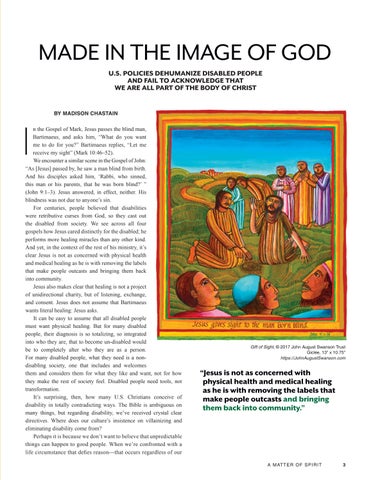
In the Gospel of Mark, Jesus passes the blind man, Bartimaeus, and asks him, “What do you want me to do for you?” Bartimaeus replies, “Let me receive my sight” (Mark 10:46–52).

We encounter a similar scene in the Gospel of John: “As [Jesus] passed by, he saw a man blind from birth. And his disciples asked him, ‘Rabbi, who sinned, this man or his parents, that he was born blind?’ ” (John 9:1–3). Jesus answered, in effect, neither. His blindness was not due to anyone’s sin.

For centuries, people believed that disabilities were retributive curses from God, so they cast out the disabled from society. We see across all four gospels how Jesus cared distinctly for the disabled; he performs more healing miracles than any other kind. And yet, in the context of the rest of his ministry, it’s clear Jesus is not as concerned with physical health and medical healing as he is with removing the labels that make people outcasts and bringing them back into community.

Jesus also makes clear that healing is not a project of unidirectional charity, but of listening, exchange, and consent. Jesus does not assume that Bartimaeus wants literal healing: Jesus asks.

It can be easy to assume that all disabled people must want physical healing. But for many disabled people, their diagnosis is so totalizing, so integrated into who they are, that to become un-disabled would be to completely alter who they are as a person. For many disabled people, what they need is a nondisabling society, one that includes and welcomes them and considers them for what they like and want, not for how they make the rest of society feel. Disabled people need tools, not transformation.

It’s surprising, then, how many U.S. Christians conceive of disability in totally contradicting ways. The Bible is ambiguous on many things, but regarding disability, we’ve received crystal clear directives. Where does our culture’s insistence on villainizing and eliminating disability come from?

Perhaps it is because we don’t want to believe that unpredictable things can happen to good people. When we’re confronted with a life circumstance that defies reason—that occurs regardless of our

“Jesus is not as concerned with physical health and medical healing as he is with removing the labels that make people outcasts and bringing them back into community.”

efforts, prayers, or preoccupations—we invent a reason to reassure and insulate ourselves from the reality that, it’s true, disability could even happen to us. Instead, we say someone must’ve done something wrong.

“America is obsessed with earning human rights through labor. But are they human rights if some people can’t have them?”

In much the same way, U.S. Christians worship the prosperity gospel, the idea that if we just work hard enough, pull ourselves up by our bootstraps, and pray, God will reward our labors.

Combined, these misbeliefs lead us to perceive the disabled—as well as the poor, the unhoused, and the addicted—as people who have somehow earned their suffering and can thereby earn their way out of it. We choose to believe that oppressive social circumstances are individual moral failings, because it is less scary to think that an individual has contracted their own oppression through conscious decision-making than it is to admit that our society’s leaders have designed a system that oppresses in order to make the rich richer.

These beliefs about disability extend far beyond how we behave around the disabled in public, whether we scorn the person moving slowly on the sidewalk or stare at the person with limb differences. These beliefs also motivate policy.

One of the clearest examples is the recent passage of H.R.1, otherwise known as the “Big Beautiful Bill.” Included in H.R.1 are substantial changes to the qualifications for Medicaid.

Medicaid was originally established to enable the poor, of any age and bodily condition, to afford health care. So long as a person could prove their low income, they generally qualified for Medicaid. This was especially important for people who are older and people with disabilities who could not work.

In fact, U.S. disability policy incentivizes the disabled not to work: To qualify for federal disability social security benefits, a disabled person may earn no more than $1,620 a month. That’s a yearly salary of less than $20,000. For context, the United States considers the poverty line to be at $15,000.

Even worse, the government implicitly discourages disabled people from marrying under the same guidelines. If a married couple’s yearly income is above $30,000, the disabled spouse loses their disability benefits. The poverty line for a married couple is $32,000. There can be no other reason for systematically discouraging disabled people from marriage than the fear of how marriage and romance challenge our social narratives around disability: the way we view disability as intrinsically childlike, genetically inferior, even dangerous.

In the United States, the average monthly rent has now risen to $1,700 for a studio apartment. A person with a disability receiving social security benefits from the government cannot afford to live on their own. Add to this the costs of food and health care, which are significantly higher for a disabled person purchasing medications, therapies, and mobility aids, and it becomes clear that the amount from the government is dehumanizingly insufficient.

Medicaid, along with so many other tools that the current administration seeks to roll back, seeks to step into this gap and help provide necessary services. However, instead of fixing government overspending, it is easier to blame those who rely upon government

services and reignite the same old narrative: that the poor and disabled are taking advantage of government charity and should, instead, work their way out.

Starting in 2027, when H.R.1’s changes go into effect, Medicaid will have both age limitations as well as robust work requirements. People who are 19 and older and who do not meet one of the “qualifying exceptions” will have to prove that they have “contributed meaningfully to society” through a minimum of 20 hours of work, volunteering, or education each week. That’s the equivalent of a half-time job.

Although many lawmakers insist that people with severe disabilities fall under those certain exceptions, the fact remains: America is obsessed with earning human rights through labor. But are they human rights if some people can’t have them?

In the Catholic tradition, all people have intrinsic human dignity rooted in the image and likeness of God. The image of God is not a human body with certain limbs and capabilities. The image of God is a deeper reality, a reflection of the Holy Spirit, the creative potentiality of the Divine. The disabled bear the full image and likeness of God, no matter how they may look or how their bodies may function.

Catholics also believe that civil government is a natural extension of human community, that the role of a “higher social institution” like a governmental body is to intervene in a subsidiary fashion that encourages individual human development in alignment with the common good (see, for example, paragraphs 1883–1885, 1894, and 1897–1902 of the Code of Canon Law). The question our lawmakers seem to be asking is: What is a fairly subsidiary government intervention? According to canon law, the answer is: “[One that] offers help with a task that is beyond [one’s] abilities . . . what an individual cannot accomplish from their own initiative and efforts.”

In the United States, the disabled cannot be housed, work, marry, or receive education or health care because of our government. We should be removing barriers, not creating them.

In other parts of the world, universal health care and disability services are considered fundamental, nonpartisan systems. We must press on our “America First” lawmakers to see that, in this area, America is lagging far, far behind.

More importantly, we must uproot the harmful narratives that are at work in American minds and which motivate dehumanizing policies in the first place. We must speak openly in community and online about the dignity of disabled people. We must amplify disabled voices and make intentional efforts to include and accommodate disabled community members.

In short, we must follow the example of Jesus.

Madison Chastain writes about the body, faith, and culture. You can find more of her writing at madisonchastain.com, and on Instagram at @maddsienicole

Turn static files into dynamic content formats.

Create a flipbook