2021–2022
For two years during the COVID-19 pandemic, the American Rescue Plan Act (ARPA) afforded financial support for individuals buying their own health care insurance through the Affordable Care Act’s health care marketplace.
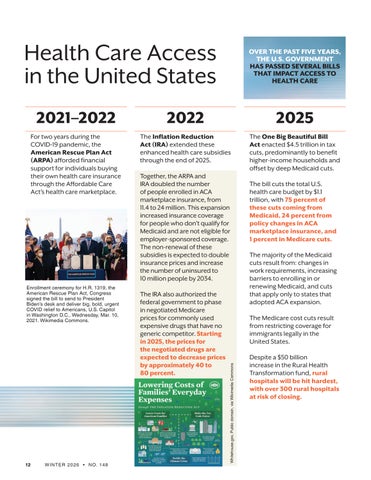
Enrollment ceremony for H.R. 1319, the American Rescue Plan Act, Congress signed the bill to send to President Biden’s desk and deliver big, bold, urgent COVID relief to Americans, U.S. Capitol in Washington D.C., Wednesday, Mar. 10, 2021. Wikimedia Commons.
2022
The Inflation Reduction Act (IRA) extended these enhanced health care subsidies through the end of 2025.
Together, the ARPA and IRA doubled the number of people enrolled in ACA marketplace insurance, from 11.4 to 24 million. This expansion increased insurance coverage for people who don’t qualify for Medicaid and are not eligible for employer-sponsored coverage. The non-renewal of these subsidies is expected to double insurance prices and increase the number of uninsured to 10 million people by 2034.
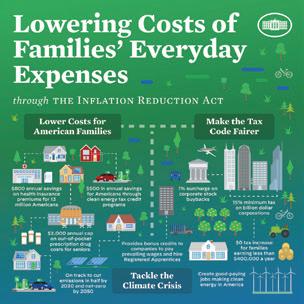
The IRA also authorized the federal government to phase in negotiated Medicare prices for commonly used expensive drugs that have no generic competitor. Starting in 2025, the prices for the negotiated drugs are expected to decrease prices by approximately 40 to 80 percent.


OVER THE PAST FIVE YEARS, THE U.S. GOVERNMENT HAS PASSED SEVERAL BILLS THAT IMPACT ACCESS TO HEALTH CARE
2025
The One Big Beautiful Bill Act enacted $4.5 trillion in tax cuts, predominantly to benefit higher-income households and offset by deep Medicaid cuts.
The bill cuts the total U.S. health care budget by $1.1 trillion, with 75 percent of these cuts coming from Medicaid, 24 percent from policy changes in ACA marketplace insurance, and 1 percent in Medicare cuts.
The majority of the Medicaid cuts result from: changes in work requirements, increasing barriers to enrolling in or renewing Medicaid, and cuts that apply only to states that adopted ACA expansion.
The Medicare cost cuts result from restricting coverage for immigrants legally in the United States.
Despite a $50 billion increase in the Rural Health Transformation fund, rural hospitals will be hit hardest, with over 300 rural hospitals at risk of closing.