Healing as Holy Work by Erica Torres

Page 1


THE MORAL STAKES OF PROTECTING PUBLIC HEALTH PROGRAMS

HEALING AS HOLY WORK

Women religious communities’ health care ministry began long before modern-day hospital systems or health insurance companies that we see and experience today. Their mission is grounded in concrete experiences, a deep understanding of what happens when people are unable to receive adequate care, and an unrelenting commitment to upholding the dignity of all people.

One of the pioneers in health care access was Margaret Anna Cusack, later known as Mother Francis Clare, who was born in Dublin, Ireland in 1829. She didn’t set out to found a healthcare system; her mission was to confront the suffering she saw around her that she believed to be both avoidable and unjust. And yet, her ministry—and her conviction that charity alone can never address the root causes of illness and poverty—has had lasting impacts on Catholic health care and the entire health care system today.

After converting to Catholicism in her late 20s, Cusack became a Poor Clare Sister and was sent to Kenmare, Ireland, to help found a convent there. It was here in Kenmare that she started working for a more equitable society through public ministry. She experienced first-hand the effects of famine, poverty, and the oppression of women and children and dedicated her ministry to feeding the hungry while also fighting for housing rights, education, and for the rights of women.

“If Mother Francis Clare were alive today, she would remind lawmakers that systems that deny care to the poor violate both justice and peace. The well-being of the sick is not expendable; it cannot be simplified to some budgetary line item that can be struck for the sake of saving money.

Eventually, she founded her own community: The St. Joseph’s Sisters of Peace.

Mother Clare was also a prolific writer; many of her books addressing the realities of injustice and calling the church to accountability and action are still available today. It’s evident from both her writing and her work that she understood public health in a strikingly holistic way: as inclusive of not only medical care but also safe housing, adequate wages, education, and equal access.

Across the Atlantic Ocean, at roughly the same time, another woman religious was also building a health-care ministry. Esther Pariseau, later known as Mother Joseph of the Sacred Heart, was born in 1823 in Quebec, six years before Mother Francis Clare. Like Mother Francis Clare, she also entered religious life in her 20s, joining the Sisters of Charity of Providence.

Ten years later, she was sent to what is now Vancouver, Washington to serve in the mission diocese there. Over the

Article photos: Archive of the Congregation of the Sisters of St. Joseph of Peace with permission.

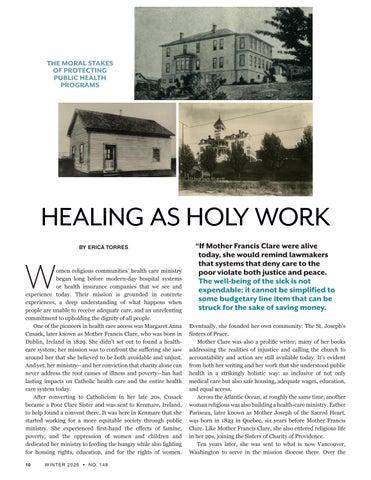
Page 10 left: The first permanent hospital in the Pacific Northwest, 1858, St. Joseph Hospital Vancouver, Washington

Page 10: Original St. Joseph Hospital, Fairhaven (Bellingham), undated.

Below: Second St. Joseph Hospital at Forest Street, undated.

Page 11: Margaret Anna Cusack, “Mother Francis Clare” Circa 1884.

ensuing decades, she played an instrumental role in the area, planning and building some of the area’s first schools and hospitals. Under her leadership, the order founded the Northwest’s first school of nursing in 1892. She helped found and build 17 hospitals, all of which—at least in 2022—continued to operate in some form. Her community also introduced the “Providence ticket,” an early form of health insurance that guaranteed hospital coverage for a fee of $10 per year.

Mother Francis Clare and Mother Joseph of the Sacred Heart are just two examples of how, for generations, Catholic sisters have served as the backbone of American health care. Long before the development of federal safety net programs and before hospitals evolved into complex medical systems, women religious recognized healing the sick as a moral and theological act.

THE SISTERS OF ST. JOSEPH OF PEACE

One way the legacy of these women endures today is through the PeaceHealth system, a not-for-profit health-care system with medical centers, critical access hospitals, and medical clinics located in Washington, Oregon, and Alaska.

In 1890, two Sisters of St. Joseph of Peace—Mother Francis Clare’s community—left their convent in New Jersey to go to the far northwest corner of Washington. Their goal was to build a hospital to care for the loggers, mill workers, fishermen, and

their families that lived in the area. This one hospital grew over time to include medical facilities in Alaska, British Columbia, and Oregon.

Now, more than 120 years later, their ministry continues. In the 1970s, the sisters formed a separate organization to oversee their medical services and in 1994, this became PeaceHealth. The mission, however, is the same as that of Mother Francis Clare and the two sisters who originally brought this mission to the Pacific Northwest: to provide medical care to all who need it and with the understanding that medical care and social justice are integrally connected.

THE PROPHETIC WITNESS OF WOMEN RELIGIOUS

Understanding this history helps us see the moral dimensions of modern policy debates, like the proposed cuts to Medicaid, Medicare, and other public health programs. More than 200 years ago, women religious knew that poverty worsened illness and that the lack of health care devastated families. They understood that health is not a luxury, but rather a human right grounded in the inherent dignity of every person. Somehow, we have lost this understanding today.

If Mother Francis Clare were alive today, she would remind lawmakers that systems that deny care to the poor violate both justice and peace. The well-being of the sick is not expendable; it cannot be simplified to some budgetary line item that can be struck for the sake of saving money. Health care access is a moral and spiritual issue, not merely a political one.

Catholic health care did not begin as a corporate enterprise; it began as a spiritual movement. It was animated by a belief that every person carries the divine image, and that caring for the sick is to touch that sacred presence. Mother Francis Clare shaped a community whose identity rests on the inseparability of healing and justice. Their charism continues in organizations like PeaceHealth, where commitments to charitable care, community health initiatives, and service to rural and underserved regions are not strategic choices but moral imperatives.

Their ministry reminds us that healing is holy work—work that requires just structures, compassionate systems, and the courage to protect the vulnerable. As public health debates intensify, Catholics are called not to neutrality but to advocacy grounded in our values.

To defend strong and accessible health-care systems is to walk in the footsteps of the sisters who built them—women who believed with their whole hearts that peace comes through justice, and that justice demands that every person receive the care they need to flourish.

Erica Torres, PsyD, System Vice President of Mission Integration, PeaceHealth.

Turn static files into dynamic content formats.

Create a flipbook