GOD’S PEOPLE’S NO TO THE STATUS QUO: PROTEST AS LITURGICAL RESPONSE
BY ANNE MCGOWAN
The ritual rehearsal of the reign of God unfolds in the church’s liturgies through a cycle of Advent anticipation, Christmas celebration, Lenten longing, Easter exuberance, and Ordinary Time tempering that recalibrates participants’ listening, looking, and loving to the mind of Christ. Liturgy represents an inflection point between the Church’s connection to Christ as source and sustenance of salvation and the impetus for Christians’ publicfacing work as Christ’s ambassadors. The ones who traverse this holy ground of transformation are liturgists.
At its best, the rhythms of ritual do not dull our senses but retune our sensibilities and reorient our perceptions around our relationships to God, others, and the entirety of the created universe, so it can be received more rightly as fruit of God’s goodness and craft of God’s creatures.
Therefore, with Easter eyes that have beheld both God’s suffering and God’s glory, God’s people may mount a protest that is categorically liturgical whenever there is need for confessing and lamenting injustice, witnessing another way of being present, and praying publicly for the arrival of God’s promised future where people love life in all stages, promote participation, recognize rights and responsibilities, opt for the poor and vulnerable, dignify workers and their work, enact solidarity with the whole human family, and cherish creation carefully.
THE MEANING OF LITURGY
Before the word liturgy took on churchy connotations, the Greek term λειτουργία (leitourgia) appears in the New Testament as a straightforward reference to “service” and, more specifically, service performed by an individual or group on behalf of many others for their flourishing.1
The church’s liturgical life makes us the thankful (i.e., eucharistic) beneficiaries of Christ’s service on our behalf, beholders and receivers of God’s work unfolding in salvation history through Christ and in the Spirit for us and for our salvation. This is work in which we are invited to participate, making all who have been baptized liturgists, people who cannot help but be “doers” of liturgy. The Second Vatican Council’s Constitution on the Sacred Liturgy declares that:
Mother Church earnestly desires that all the faithful should be led to that fully conscious and active participation in liturgical celebrations which is
1 For example, Paul describes the civil authorities to whom taxes are paid as “liturgists of God” (Romans 6:13) for their service, ultimately oriented toward the public good, and himself “poured out as a libation upon the sacrificial service [liturgy] of your faith” (Philippians 2:17). All biblical quotations are from the New American Bible, Revised Edition (NABRE), as found at https://bible.usccb.org/bible
demanded by the very nature of the liturgy. Such participation by the Christian people as “a chosen race, a royal priesthood, a holy nation, a redeemed people” (1 Pet. 2:9; cf. 2:4–5), is their right and duty by reason of their baptism.2
LITURGY BEYOND CHURCH WALLS
But we who have been blessed by Christ’s liturgy are not done with ours when the church’s liturgy concludes. Rather, we are immersed in God’s ongoing mission for the life of the world, where our service contributes to the thriving of all people and all creation. “Go and announce the Gospel of the Lord,” we might hear at the end of Mass, or “Go in peace, glorifying the Lord by your life.” Our identity as liturgists does not stop when the Mass is ended. For, as the standard preface of Eucharistic Prayer II affirms, “It is truly right and just, our duty and salvation, always and everywhere to give [God] thanks.”
This liturgical response of thanks and praise does not benefit God directly, because God’s goodness, glory, and graciousness are neither enhanced nor diminished by anything we have to offer, or by what we have done or failed to do. Rather, the response of our earthly liturgy is fulfilled most visibly and profoundly in what sacramental theologian Louis-Marie Chauvet calls the “liturgy of the neighbor,” where we make a return gift to God on a trajectory running through the revelation of our enfleshed answer to the parable of the Good Samaritan Jesus presents after being asked, “And who is my neighbor?”3
Protesting injustice, therefore, becomes for Christians a viable and vivifying liturgical response. Its broad moves mirror patterns practiced previously in liturgy. A community gathers in solidarity with or as people who are poor, oppressed, fearful, marginalized, persecuted, or made to feel powerless— or on behalf of people who cannot be present, perhaps because they are ill or incarcerated, underpaid or unborn, detained or dead. Sometimes, God’s human children gather on behalf of God’s other creatures experiencing the threat or actuality of degradation or annihilation.
God’s ever-effective Word proclaimed anew into the particularity of a situation invites a fresh reckoning with what God wills and how God keeps working in the world. Making manifest that gap invites protesters while implicating bystanders and perpetrators of injustice toward a response that will begin to redress the situation through remembrance, repentance, reconciliation, redress, and/or revised ways of cohabiting
2 Second Vatican Council, Sacrosanctum Concilium, Constitution on the Sacred Liturgy (Holy See, 1963), no. 14, https://www.vatican.va/archive/hist_ councils/ii_vatican_council/documents/vat-ii_const_19631204_sacrosanctumconcilium_en.html (hereafter cited as SC).
3 See Luke 10:29–37. Developing this concept from the work of the philosopher Emmanuel Levinas, Chauvet discusses the liturgy of the neighbor most extensively in Louis-Marie Chauvet, Symbol and Sacrament: A Sacramental Reinterpretation of Christian Existence, trans. Patrick Madigan and Madeleine Beaumont (Liturgical Press, 1995), 278–89.
as God’s creatures. If a more just resolution is not realized immediately, protesters may disperse to continue their advocacy and activism in less visible ways. They are sent forth to continue collaborating with God on behalf of others for the realization of the reign of God that relentlessly reorients the world.
When prayer is directed to God the Father as Christ taught us to pray—“thy kingdom come; thy will be done on earth as it is in heaven”—the Spirit remains at work in the world while God’s people rest and repeat their protest as necessary, refueled by the liturgy of the church to regain strength for engaging the ongoing liturgy of the world. Gathering, proclamation, response, and sending on mission keep recurring so that the world’s ragged reality comes to resemble more and more the redeemed resonance God promises.
At a minimum, all Christians are called to respond to God’s Word, “exercising the office of their baptismal Priesthood” by offering prayers for the Church’s needs, for those with worldly power and for the whole world’s salvation, for those oppressed and “burdened by any kind of difficulty,” and for the particular needs God has placed around them in their local communities, as in the Prayer of the Faithful (i.e., the baptized) at Mass.4 When we do not know what to pray or how to pray, “the Spirit itself intercedes with inexpressible groanings” (Romans 8:26).
4 The scope and parameters of the Universal Prayer or Prayer of the Faithful are laid out in the General Instruction of the Roman Missal, nos. 69–70; text available at https://www.usccb.org/prayer-and-worship/the-mass/generalinstruction-of-the-roman-missal/girm-chapter-2
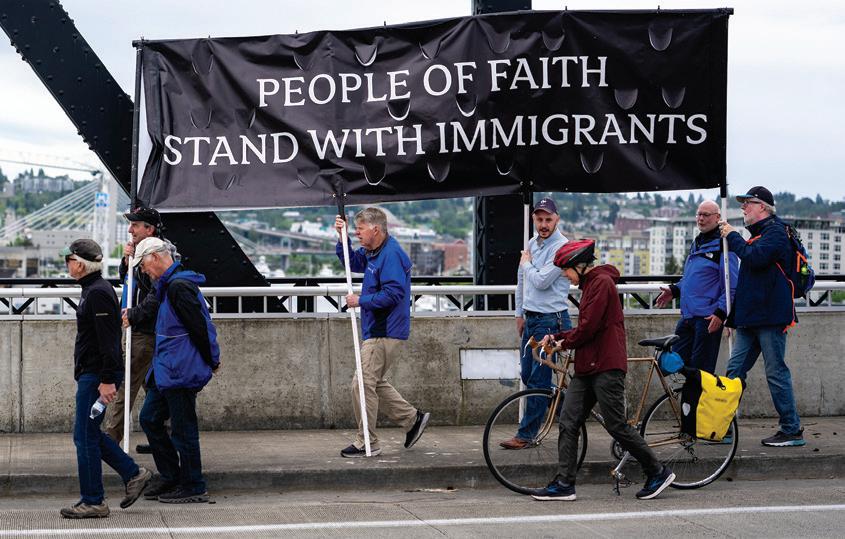
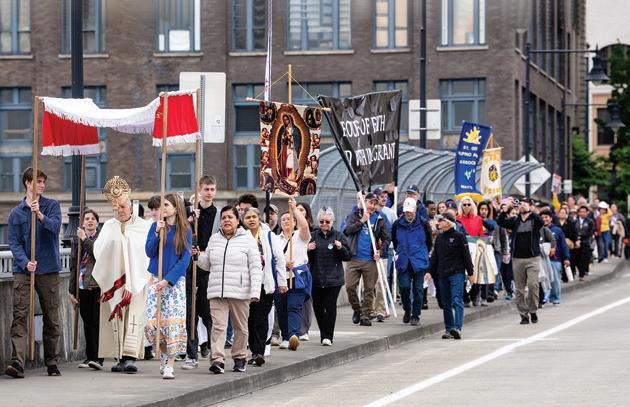
Page 4: Top: Front of the eucharistic procession on the 11th St. bridge
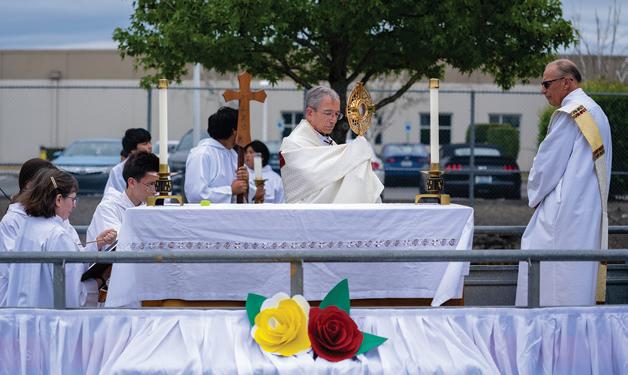
Below: Eucharistic benediction outside the Northwest ICE Processing Center
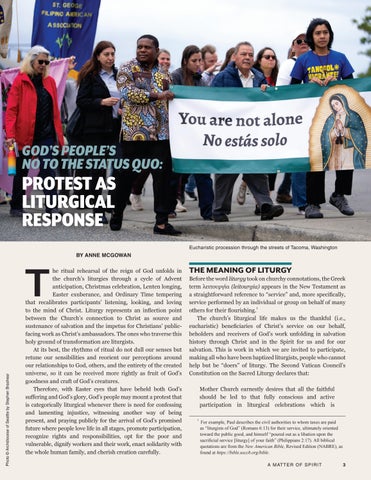
Page 5: Local parishioners make clear that the greater Seattle community stands in solidarity with immigrants and refugees
Beyond prayer, the pastoral liturgical theologian Mark Searle identified three levels of liturgical participation (amounting to embodied engagement, purposeful participation, and total transformation of life) that might fruitfully be applied also to liturgy’s more overt protest potential as the service of God’s people on behalf of others.5
Embodied engagement (level one) entails just going through the motions of protest and trying them on for size. Bring your body to protest injustice, even if only because someone invited you to go or because you know someone directly impacted by an unjust situation. As Jesus’ disciples experienced post-Pentecost, something powerful begins to happen when we leave the safety of our upper rooms and venture into the world free from fear, strengthened by the commitments of the Spirit-saturated community that surrounds us.
At this level, adding words or actions to one’s protest is encouraged but optional; the first step of any liturgy is responding to the Spirit’s summons by showing up. As Jesus demonstrated in his trial before Pontius Pilate in John’s Gospel, even silence serves as a powerful witness when used to problematize the power dynamics presumed in the processes that perpetuate injustice. God’s people know now, as Jesus did then, that the powers of this world “would have no power over me if it had not been given…from above.”6
Second-level liturgical participation would involve practicing protest consciously accepting that it is your cooperation in realizing the reign of God, your participation in the ongoing
5 See Mark Searle, Called to Participate: Theological, Ritual, and Social Perspectives, ed. Barbara Searle and Anne Y. Koester (Liturgical Press, 2006), 15–45.
6 See John 19:10–11.
mission of Christ for the life and love of the world. We who have become God’s adopted children and siblings in the Spirit manifest ourselves as who we are: members of the Body of Christ, sharing the life of the One whose death and resurrection animates us now. Our witness matters to each other and for the wider world as people who live liturgy, who embody the church’s social teaching, who unite our prayer and action with Christ’s ongoing, broadly liturgical prayer and work on behalf of the world.
Protesters who, with the help of God’s grace, become so transparent to the life and love of the triune God that both they and the world cannot help but be transformed because of who they are and what they do to exemplify Searle’s level three: participation in the life of God. They become people whose obedient faith, coupled with active cooperation in God’s ongoing work of salvation, effectively continues God’s self-communication in a world where all creation is groaning for its redemption (Romans 8:22–23).
“Our vocation,” Searle states, “is to cooperate in the mediating work of Christ as links between God and the human world. For that ritual is indispensable, but it is never enough. For that we need holiness, in the sense of a certain Christ-like transparency to the Spirit of God. That openness to God is what we call faith; that transforming self-gift of God to us we call sanctifying grace.”7
God only knows what might happen when we—as God’s people—assemble as a community convoked in God’s name, for God’s purposes. At Mass, “the renewal in the Eucharist of the covenant between the Lord and [humanity] draws the faithful into the compelling love of Christ and sets them on fire” (SC 10).
When massing for peaceful protest, members of Christ’s body let our listening discernment, kindled now to burning conviction, take shape in a visible stance against violence and exploitation of vulnerability. Whether or not we recognize that our service on behalf of others is service for and with Christ,8 our protest liturgy is inspired by the eschatological vision of what a world renewed by God’s Spirit could be, a vision that the church’s liturgies have taught us to long for.
In this time between Pentecost and the Parousia, therefore, such protests will periodically ignite among precarious people in troubling times until conditions have changed so completely that every creature can freely exult in God’s praise.
Anne McGowan is an associate professor of liturgy at Catholic Theological Union in Chicago, where she teaches courses on liturgy and sacraments. She is the mother of two young children.
7 Searle, Called to Participate, 37–38.
8 See Matthew 25:31–46.