From the Editor On a gray November morning outside Chicago’s Broadview Processing Center, an Immigrations and Customs Enforcement detention center, more than 2,000 Catholics gathered for Mass. There were no stained glass, quiet pews, or fonts of holy water. Mass took place in a parking lot, bordered by fencing and barbed wire. Across the street, immigrants sat in detention, cut off from their families and existing in limbo, unsure what would happen to them next. The people standing outside had come to bring communion to those inside; to tell them that they weren’t alone. “On All Saints Day, we affirm that in Christ there is no separation,” a press release promoting the event declared. “The prophets of justice intercede from heaven, those killed by ICE like Silverio cry out for mercy, the detained endure inside, and the people of God stand together outside in prophetic witness.” The people outside were denied entry. The people inside were denied access to the sacraments. And yet, as Cassidy Klein—also an editorial board member for A Matter of Spirit—writes in an article for U.S. Catholic, “Although the delegations were denied entry, they prayed and sang loud enough that they hoped the people inside the facility could hear them.” Klein writes that the organizers of this event—along with other vigils at Broadview and around the country—understood this gathering as an expression of liturgy in its oldest sense: as the “work of the people.” Liturgy, as professor of liturgy Anne McGowan writes in this issue, is not something that only happens within church walls. “Our identity as liturgists does not stop when the Mass is ended,” she writes. “For, as the standard preface of Eucharistic Prayer II affirms, ‘It is truly right and just, our duty and salvation, always and everywhere to give [God] thanks.’”
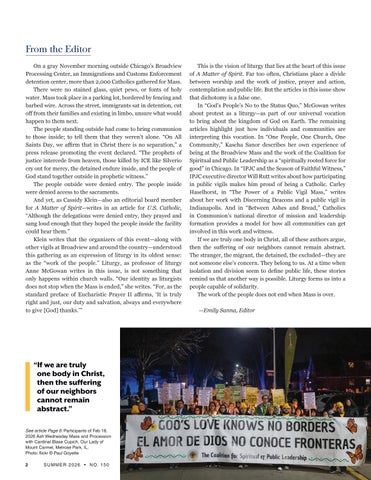
“If we are truly one body in Christ, then the suffering of our neighbors cannot remain abstract.” See article Page 6: Participants of Feb 18, 2026 Ash Wednesday Mass and Procession with Cardinal Blase Cupich, Our Lady of Mount Carmel, Melrose Park, IL. Photo: flickr © Paul Goyette
2
S U M M E R 2 0 2 6 • N O. 1 5 0
This is the vision of liturgy that lies at the heart of this issue of A Matter of Spirit. Far too often, Christians place a divide between worship and the work of justice, prayer and action, contemplation and public life. But the articles in this issue show that dichotomy is a false one. In “God’s People’s No to the Status Quo,” McGowan writes about protest as a liturgy—as part of our universal vocation to bring about the kingdom of God on Earth. The remaining articles highlight just how individuals and communities are interpreting this vocation. In “One People, One Church, One Community,” Kascha Sanor describes her own experience of being at the Broadview Mass and the work of the Coalition for Spiritual and Public Leadership as a “spiritually rooted force for good” in Chicago. In “IPJC and the Season of Faithful Witness,” IPJC executive director Will Rutt writes about how participating in public vigils makes him proud of being a Catholic. Carley Haselhorst, in “The Power of a Public Vigil Mass,” writes about her work with Discerning Deacons and a public vigil in Indianapolis. And in “Between Ashes and Bread,” Catholics in Communion’s national director of mission and leadership formation provides a model for how all communities can get involved in this work and witness. If we are truly one body in Christ, all of these authors argue, then the suffering of our neighbors cannot remain abstract. The stranger, the migrant, the detained, the excluded—they are not someone else’s concern. They belong to us. At a time when isolation and division seem to define public life, these stories remind us that another way is possible. Liturgy forms us into a people capable of solidarity. The work of the people does not end when Mass is over. —Emily Sanna, Editor