From the Editor In January 2026, 2.5 million people living in North Carolina received an unexpected letter: their medical debt, some dating back more than 12 years, had been erased. In an agreement between the state government and hospitals, all 99 hospitals in North Carolina agreed to stop collection on certain debts going back as far as 2014. They also agreed that, going forward, care will automatically be discounted for patients who qualify. For a family of four, that means an annual income of less than $96,000. This is a fantastic step forward for people living in North Carolina. But the rest of the country isn’t that lucky. According to an NPR article, assistance with health care bills is patchy: Arizona and New Jersey use their federal budget to forgive medical debt. Oregon and Illinois screen patients to see if they 1 qualify for financial assistance. Other states, like New York and Colorado, ban medical debt from credit reports. But what about everyone else who isn’t lucky enough to live in one of those states? Even among people with insurance—which currently is the vast majority of Americans—over half of U.S. adults say that 2 it’s difficult to afford health care. According to the Federal Reserve, in 2024 28 percent of adults skipped some sort of 3 medical care because of the cost. In 2025, the government shut down for weeks, in large part because of disagreements over whether to extend the tax credits for the Affordable Care Act (these tax credits were not extended, and the effect it will have on premiums is unclear, with some estimating that they might go up, on average, by 114 percent). What these facts and figures and political machinations fail to reflect, however, is that health care access is not merely a political issue, an economic problem, or even a matter of personal responsibility. It is a moral measure of our society. How we treat our sick—who receives care, who must wait, who is turned away, who goes into debt to receive life-saving care—reveals what we truly believe about human dignity and the value of human life. In the United States, access to health care is increasingly shaped not by need, but by income, employment, disability, immigration status, and geography. These distinctions may be normalized in policy debates, but they are profoundly at odds with the Catholic conviction that every human life bears equal worth. 1
Alex Olgin, “How North Carolina Erased Medical Debt for 2.5 Million People,” NPR, January 21, 2026, https://www.npr.org/2026/01/21/ nx-s1-5678541/north-carolina-undue-medical-debt-erased. 2 Cynthia Cox et al., “Health Care Costs and Affordability,” KFF, October 8, 2025, https://www.kff.org/health-costs/health-policy101-health-care-costs-and-affordability/. 3 “Report on the Economic Well-Being of U.S. Households in 2024 - May 2025 - Income and Expenses,” The Federal Reserve, accessed February 6, 2026, https://www.federalreserve.gov/ publications/2025-economic-well-being-of-us-households-in-2024income-and-expenses.htm. 2
W I N T E R 2 0 2 6 • N O. 1 4 8
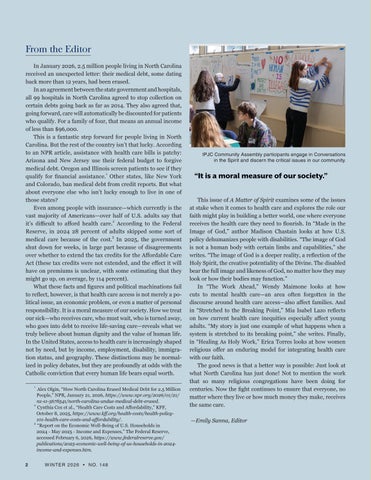
IPJC Community Assembly participants engage in Conversations in the Spirit and discern the critical issues in our community.
“It is a moral measure of our society.” This issue of A Matter of Spirit examines some of the issues at stake when it comes to health care and explores the role our faith might play in building a better world, one where everyone receives the health care they need to flourish. In “Made in the Image of God,” author Madison Chastain looks at how U.S. policy dehumanizes people with disabilities. “The image of God is not a human body with certain limbs and capabilities,” she writes. “The image of God is a deeper reality, a reflection of the Holy Spirit, the creative potentiality of the Divine. The disabled bear the full image and likeness of God, no matter how they may look or how their bodies may function.” In “The Work Ahead,” Wendy Maimone looks at how cuts to mental health care—an area often forgotten in the discourse around health care access—also affect families. And in “Stretched to the Breaking Point,” Mia Isabel Lazo reflects on how current health care inequities especially affect young adults. “My story is just one example of what happens when a system is stretched to its breaking point,” she writes. Finally, in “Healing As Holy Work,” Erica Torres looks at how women religious offer an enduring model for integrating health care with our faith. The good news is that a better way is possible: Just look at what North Carolina has just done! Not to mention the work that so many religious congregations have been doing for centuries. Now the fight continues to ensure that everyone, no matter where they live or how much money they make, receives the same care. —Emily Sanna, Editor