Iordanis Stylidis
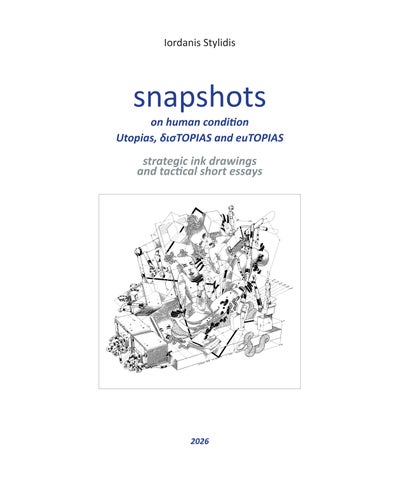
snapshots on human condition Utopias, δισTOPIAS and euTOPIAS
strategic ink drawings and tactical short essays
2026
Iordanis Stylidis Iordanis Stylidis was born in Edessa-Pella in 1959. He is a graduate of the School of Architecture of the Aristotle University of Thessaloniki (19871992). He is also obtain a diploma in Εconomic Theory from the University of Macedonia (Thessaloniki-Greece) (1978-1984). Associate professor at the Department of Architecture at the University of Thessaly-Hellas. He is an experience practitioner in the field of the architectural analysis and composition, active as a solo performer or colaborator (mostly between the years 1992 and 1999) in small and big scale projects (from houses to municipal administration buildings, interior restorations and furniture production). Additionally, he is still participating in national and international architectural competitions. As an artist and a conceptual activist he is the curator of sixteen solo art exhibitions and installations and he has multiple participations to Biennale and Triennale international exhibitions since 1980. Iordanis Stylidis is the writer of many essays, papers, concept manuals for education and six books: 2020 / Uncountable Details, 2019 / Issuing Meaning, 2013 / An Urban Block, 2010 / Transportation of Memories, 2009 / Defecators, 2006 / The Geography of Water, 2004 / INDIA through JORDAN, 2001 / Communication and Design) presenting a huge variety of information and analysis about: 1. the western visual culture, 2. the techniques to create and compose optical information, 3. the stochastic narrations and visual explanations on elements of analysis of the identity in long term voyages to the eastern civilizations, 4. proposals, explanations and directions for the understanding of the landscapes and the habitats, the contemporary urban environment, the multi-cultural ethics and political responces. Enthusiastic practitioner, tutor and writter on cartography, semiotics and the conceptual multi-correlations of the art phenomenon and the sciences into the modern technical and cultural environment. Coinstantaneously he is organizing, directing or participating to : 1. educational voyages (India, Oman, Egypt, Nepal, Germany, Turkey, Syria, Iordan, Italy, Switzerland), 2. documentation and design collective workshops in Greek regional communities and the landscapes of Europe (TuscanyItaly, PortSaid/PortFuad-Egypt) and 3. the unfolding and comprehend of urban spatial details and cultural events (Berlin, Istanbul, Venezia, Cairo, PortSaid) since 2002. The clarification, in depth analysis and in situ research of the fundamental bedrocks of meaning, including the urban and natural landscape, the multi-cultural urban expressions and the co-existence of multiple and collective entities into a constantly changing environment (…forming the vital properties of a robust regional identity..) and, nevertheless, the detection methodologies of the very core of the contemporary urban life, are the tools and the practices used to activate and upload meditation aiming to a profound understanding of these phenomena. Iordanis Stylidis have already launch to the digital continum (2014 – 2015) two art exhibitions under the titles ‘’Topiographia’’ and ‘’Still life’’. The two exhibitions include a major written thesis regarding the critique of these unique art genres, the change of the method of recording and presenting data, the accelaration and enrichment of their thematic field already tightly connected with the contemporary approach of what to choose and how to contemplate with what was a past expressional pattern. He is living in the city of Thessaloniki, the city of Edessa, the city of Volos, occasionally in the city of Feres (Hellenic-Greek borders) Greece. Constantly traveling.
Web www.iordanisstylidis.gr (choose video to connect) https://www.facebook.com/iordanis.stylidis http://issuu.com/stylidis https://www.youtube.com/channel/UCvcUViB6qQh8mXgy80YCryw http://iordanisstylidis.tumblr.com/ http://www.arch.uth.gr/DDW2014/ http://www.arch.uth.gr/PAW2015/ https://www.linkedin.com/in/iordanis-stylidis-40660141/ istylidis@arch.uth.gr https://www.instagram.com/iordanisstylidis
...it is the outcome, the masterpiece, the result of my judgment, my just position of observation. The supevision of the personal past world that sunk in oblivion and immediately recover, element and speciment of a thred curving its presence in space and time...
snapshots
6
7
on human condition, Utopias, δισTOPIAS and EUTOPIAS strategic ink drawings and tactical short essays
preface
After 40 years of dedicated, decisive work in Arts, exploring and presenting multiple design and multi-media research outcomes, aiming to achieve a pedagogic, accurate and sustainable, expression of a robust meaning, a critical social analysis of behavior within the western urban fabric, I found myself exploring a hybrid interrelated system of historically consolidated visual and textual popular forms of expressions. Ink drawings and short essays functioning as policy lessons towards the emergence of a vibrant radical self willing to participate and critically reform contemporary living status. In this edition I present two sets of ink drawings -12SNAPSHOTS and UTOPIAN TERRITORIES OF MEANING- mixed with explanatory notices either to lead the reader into the origin of their visual birth or, in the case of 12SNAPSHOTS, to present the cognitive tactics of text emerging desire to create imaginary realms of space and time relations and, simultaneously, drawings emerging desire for a thorough critical textual investigation. Tactics to activate dialogues, leading to a heroic analytical exploration of self-particles randomly moving into reality. 12 fragments of every day personal stories of women wandering in the contemporary western living condition. Standing on a shore at the Aegean islands, standing on the top of a high-rise skyscraper contemplating with total absence, living into a time fragment regulating the identity of reality of a tiny urban passage, sitting on a bench at a mountain slope in Wales, looking, aesthetically recording the death performance of an old man. 12
fragments of women suffering, falling into the tactics of drag use and medical obedience, staring, crying, deformed trying to activate self, their body, το introduce to an imaginary audience their last possible reaction to survival. Some ten years before a set of 16 drawings were created to illustrate numerous radical political attempts in the history of 19th and 20th centuries to realize/create minor or major Utopian self-sustain communities in Europe and north Amerika. This exceptional
8
9
work includes both imaginary depictions of the metaphysical ideal, such as the Garden of Paradise, and successful operational workers communities, such as the Shaline de Chaux complex of factories and workers residence. Furthermore, the depiction of imaginary worlds where human beings achieve the best in governance and ecological equilibrium, thus the ideal holistic natural economy (Utopia). The depiction of future floated cities and off grid high-end sustainable communities marking a new vibrant tendency of thinking preference. That demanding art work and its written narrative was the starting threshold for the exploration of this hybrid form of visual-textual communicational proposal.
...Εξαιτίας αυτής της ορμής προς το μέλλον που διαμορφώνεται από την ποικιλία των καθημερινών εκδόσεων χρειάστηκε να κοιτάξω με περιέργεια στο παρελθόν που, πλέον, εξαιτίας αυτής της εφεύρεσης, παραμένει και περιέχει την σειρά των ιχνών που διέθεσα. Ιχνη κειμένων, σύντομων ή εκτενέστερων σχολίων, εικόνων, video. Μια αρχαιολογική έρευνα χωρίς άστατα περιθώρια και υποθέσεις, χωρίς κενά σημασίας που πρέπει να καλυφθούν, χωρίς τομές ανίχνευσης που θα προσανατολίσουν το ενδιαφέρον. Τι αντιστοιχεί και επαληθεύει την πρόθεση (το ζωτικό μήνυμα) σε εκείνο το ένα αλλά και κάθε σημείο χρόνου όπου τοποθετήθηκε ένα σημάδι σημασίας; Γιατί χρειάστηκε να εκδοθεί δημόσια αυτή η εκκρεμούς σημασίας εργασία ; Πως ερμηνεύτηκε και τι απέδωσε αυτή η έκδοση των τεκμηρίων για μια διαδρομή δίπλα στη θάλασσα, μια συνομιλία στο κέντρο της πόλης, την παρατήρηση ενός σπαρμένου χωραφιού, τα επεισόδια ενός σύντομου ταξιδιού, την τεκμηρίωση του πολιτικού κοινού λόγου και των διαθέσιμων εύπλαστων σχέσεων. Των σειρών από τις αλλεπάλληλες επισκέψεις στα πρόσκαιρα τοπία διαδηλώσεων ; Είναι απλώς οπτικές και κειμενικές τοποθετήσεις ή σημαντικοί χειρισμοί νοήματος που προκάλεσαν, εντέλει, ένα αποτέλεσμα;...
12
13
on human condition, Utopias, δισTOPIAS and EUTOPIAS strategic ink drawings and tactical short essays
A SHORT, POWERFUL, CONSUMPTION TERRORISM
A textual trailer portraying the idle ethical principles and active combat practices behind the daily, fierce assaults driven by 20th-century telecommunication market policies. A synchronous, online realm of criticism against the destruction of humanitarian tendencies—devoured by naked greed and open-source hostilities.
She stretched her soft hands away from her body—so far that her fingers went numb. Gently, as if stroking the fluff on her belly, she picked up a box wrapped in gold ribbons, filled with red drops of sparkling blood that—she knew—would dull her pain when rubbed onto her flesh. She left her worry and fear in the empty box, collected the blood on her fingers, felt the moisture, and tasted it on her lips... because that’s what she wanted to do. She moved on to the next window, gazing, loving the folds and fluttering of the fabric, the yellow streak of liquid paint that flowed and stained the white. She let their difference ignite her passion. With this or that dress, she would wrap her warm, rosy body—so the body would be restrained. That restriction would enrage those, both men and women,
1
near and far, who would flee and return to the primordial condition, when “it” wants, desires to press against the mouth and suck every drop of her moisture, her scent— drag its existence into the vast, available body that surrenders, wants and doesn’t want, moans and corrects its posture, twists and opens, stretches and covers the flesh with saliva—losing the center of sight as vision narrows in favor of scent and the satiated touch. She desired—and desires now, here—their gaze: the steady, certain gaze that doesn’t address but rushes in, pierces the garment, gently presses the flesh, squeezes the breasts and belly, bites the armpit, nestles between the legs. She stopped thinking when she reached the large plate of sweets, dipped her fingers into the bright syrup, grabbed the fruit, and let the water flood her stomach. She scooped
14
15
warm, dark chocolate into her hands, licking the hues in the mixtures of cherry red and orange that bent her resistance. In the next showcase, the territory of events narrowed even further, as the colorful cloths and small, mature handkerchiefs untied her lips and hands—leaving her body shaking, motionless, and static. Her blood surged, passed through the crystals, and stained the floor, where many young women were testing and commenting on messages about power, capability, and the fate of their futures. She paid only for what she had to pay. A young lady next to her struggled to restrain her hands and eyes. Her hands and eyes ached, but the pain did not become a signal or a cry. Desire held back the instructions of the mind. She raged. To buy, to pay, to wear, to be worn. To burn her flesh with paint and cloth. To cut her skin
on human condition, Utopias, δισTOPIAS and EUTOPIAS strategic ink drawings and tactical short essays
with jewels. To sear her body with the markings of red-hot metal. To be confined and to confine, limiting the comfort of her spectators—those who rushed and stirred her body, sank and perished, sent forth their storm, and uttered their groans of admiration. -She does not want. They do not want. They do not listen to promises, do not constrain nor wish to be constrained. They let the chthonic groans vibrate the atmosphere as they realize and celebrate their knowledge of scale—the distance of the Andromeda Galaxy that rushed eons ago toward the position of their world. She dismissed whatever urgency still resided in her body and mind. She was stained and dirtied by what she had digested and hated, by what she loved and went mad to acquire, by what she grabbed and bit—by those and all the inexhaustible others she approached, seized, and destroyed. No one came to clean her. No one came to erase the traces of color or the scent of her significance. Tomorrow, in this impending universe, she will search for the small, slanted passage. In the depths of her being, there are two or three shops she has never visited. She was blinded by joy as the warmth of moist filth spread over her body.
18
19
on human condition, Utopias, δισTOPIAS and EUTOPIAS strategic ink drawings and tactical short essays
A VISIT TO THE CORE OF A TOTALITARIAN MARKET KINGDOM
A textual journey through a functioning unit embodying all the sinister qualities of a market-driven machine. Focused on a female figure who issues direct orders against human intelligence—a stark, heroic depiction of a serial assault officer deploying the core tactics of a monstrous bureaucracy.
She completed the sentence on her computer screen, holding a temporary but complete idea of her relationship to reality. She moved her body as one does when hungry or in slight pain, when eager to fill the mouth with sweets—fat and sugar. With honey. Like when the sweetest warmth floods the body as the brain releases drops of mood-altering chemicals, forcing the leg muscles to tense, ready to lift the body, the abdominal muscles to quiver, so that the purring activates the sense of smell—the pleasure of baked bread, of meat—neutralizing her significant purpose. The letter was already completed. A sample in an endless series of similar letters. A product of discipline. A marker of submission. A guide to the consistency of her training, to respond to and reinforce a system of thought and behavior: “...which issues daily rewards, lasting and sudden consequences of consumption...”
2
The outcome flashed on the screen and was transferred to the digital continuum. Silence. Silence covered the vast floor space filled with small apartments of threat and violence, of hidden body odors, of liquid stains and moisture that flowed on skin and was quickly removed—leaving intact the regular, brilliant images of behavior. Leaving intact all that is valuable and protected. Those, these, that fuel desire: the dominance of space and time in relationships, the passing hours during which the body is exposed, clean, satiated with desires—with promises and prizes of pleasure. Without spots, stains, or signs of concern. Without discomfort from the moisture that soaks the fabric when, in rare moments, she struggles to push deep into the meaning—the smell—of her actions.
20
21
The screen became covered with the image of a cloudy sky, high above the city. The storm, the rivers of air, the gusts of electricity combed the ground below. The spectacle was delivered to her—the supervising passenger—who traveled to and from destinations in space and time, to moral territories where she managed and could limit both body and mind. A journey to the East, where she had offered her body to the limitless expressions of passion she needed. And a trip to the West, where she was thoroughly cleansed of the consequences of her wild practices. A question mark appeared in the bottom corner of the screen—a signal not to release the next command, not to complete the strike. A moment of hesitation. A reluctance to collect the profit, a subtle shift to discipline her trained self. A drop of sweat rolled down the side of her leg. Moisture overflowed from her pores, dripped, and stained the floor. It did not disturb her will. It did not worry her. She knew that when night came, it would cover the stain—the proof of the most brutal violence she exercises and spreads in her boundless society.
on human condition, Utopias, δισTOPIAS and EUTOPIAS strategic ink drawings and tactical short essays
Killing people with short, polite letters in which life is inspected and extolled through a conventional bond—tethered to obligations and market formalities—restrained and held back. Celebrating each release of a document, each signal and message, with icons and profit-yield numbers that would soon give rise to screams of intense desire—her compensation from hundreds of faceless people, unknown beings scattered in space and time. Kinships of brutal interest. Of demonic passion. That will never be traced. The drops dripped from her body onto the floor. The stains grew. The smell spread as her hand grabbed the vial of pills—then tissues, then a towel to keep up. It had already been two years since the first time—when the first observation about her position, her life, arrived from the team managers. Since then, she has been laying the felt blanket on the floor to contain the flood of written violence that repeats itself, again and again. Those who live in the work flats around her, those who comment and note her passion, come regularly and smell the soaked felt blanket. There are dozens of letters that still need to be sent... The night fell.
24
25
on human condition, Utopias, δισTOPIAS and EUTOPIAS strategic ink drawings and tactical short essays
NARROW PASSAGE : TELEVISION HYPER SHOW
Prime time crucifixion. A synchronous assault model of motivational tactics, broadcast within a precise time window—feeding millions of visual victims in an orchestrated manner too seamless to criticize. A horror show, so intense and boundless, it replaces normalcy itself—ushering in a new daily norm of total social anomaly.
The image of her face appeared on the television screen as the sun was obscured by layers of afternoon clouds. She found herself standing far and near to the scattered bodies lying dismembered on the narrow, wet street, which was now crowded with the unexpected blood-bathed crowd of autumn. Bodies of young, old, helpless people were already digesting their fate. They were digesting the tight, strong, lifeless thighs, the broken arms, the incomprehensible lifeless gaze that aims at the sky, neither limiting, or being limited. They were digesting the whiteness of the belly, the whiteness of the armpit, the whiteness that already bruised and filled the skin with thick spots of death. She reached their end point slowly, following the flood of rumors, the streams of in-
3
structions, the multiple human bodies who were already desiring to define their cause. Pushing, uttering familiar words to every human specimen marked by passion. As far as to the area defended by the frenzied young journalist collecting details from the timely reservoir of awesome interest. Strangely, she wondered, the crowd rippled around her so that the beauty and ugliness of the carcass deposits caused a deep crack of exclamations and gestures. Thus, her figure, her idol, a sample and essence of fear, sent, uncontrollably, to millions of screens, foolish questions. The reporter, hunter of human tactics, spoke sowing her poisonous seed, an unintelligible and unstable seed, boiling in her guts. She laughed.
26
27
Laughed? …perhaps by mistake … perhaps from confusion, perhaps by the power of the extract of the substances that flooded her mind... …it doesn’t matter, this can be corrected, it can be contained... in the incomprehensible depth of the digital file that is already fading, dissolving, calming the mind, the thoughts of her observers. Who, now, in front of and around her, are eating and celebrate their fortune. Drops of red sauce are appropriate, dripping into the pool of blood that quickly darkened watching the sunset. Drops of yellow sauce were spreading across the faces of the ruthless witnesses as they wipe their lips pulling a piece of flesh. Fast, before the cleaning crews arrived. She watched. She remained still, observing the wildest spasm of pleasure on his face, the face of man standing at the opposite of reality, as he fell to his
on human condition, Utopias, δισTOPIAS and EUTOPIAS strategic ink drawings and tactical short essays
knees groaning, soaking the fabric of his pants. Forcing the woman beside him to exhale her words loudly, to mix them with gasps and sobs, justifying her path, the tracking of her route, her decision to come here and get more stained. The crowd was satiated. The crowd thinned out. Followed the sirens of the vehicles as they sped down the boulevard rushing to the field of a new slaughter. She stayed. She will remain until the ceremony of cleansing, the sweeping of the ground, the disinfection. Silence spreads over the enormous material surfaces that stand up and hide the night. A pair of primal beings approached quietly, without hesitation, without terms and definitions of meaning stirring the pool of blood, grabbing, dragging body parts in all directions. Joining the pieces together, blowing into the fresh flesh, shouting cries, asking, waiting for an accurate response. In silence, the power of their performance, the reality pocket was reduced to its essential properties. The smell dissipated, the glossy black surface of the blood was crystalized in its weak composition, the moisture dried up, the red color lost its meaning, the stains on the clothes and fabrics, on the bodies of the witnesses, vanished. Wine and bread were offered so that the blood and flesh would be digested in memory. Chocolates, refreshments, promises of unlimited pleasure were offered, for the exit from this and every subsequent perverse area of meaning, so that the precise void of meaning on the faces of the slaughtered youths could be shared, loot and discovery, into varieties of interpretations and symptoms of speech and image. The correspondent, the hunter tracker, retreated, stumbled, lowered her face, unable to fathom the pace and speed of loss of the center of interest that a moment ago contained
her idol. Something, an invisible something, embroidered a path of pain in her hand. She bent, gained control of her body, saw deep into her future the punishment that awaited her. But, until then, she can continue to rush, to bite, to rage for violence. Her stomach rumbled with hunger. It hurt, her hand wrote a word in the void. The smell stabilized reality, enveloped the women, the men, the pair of primal beings, stimulating their brains. The men had not bath for a long time, the women smelled strong as they left. All of them will live for a long time yet.
28
29
Within the world of odors and secretions ... of whispers not detected by sound sensors, not activating any judgment.
on human condition, Utopias, δισTOPIAS and EUTOPIAS strategic ink drawings and tactical short essays
32
33
on human condition, Utopias, δισTOPIAS and EUTOPIAS strategic ink drawings and tactical short essays
BODY AND BRAIN RECONNAISSANCE : A MELTDOWN IN OBLIVION
Time-bound texts and spatial sentences restrain delicate particles of emotion—depicting a tactical chronology of smooth decline, culminating in cataclysmic bodily failure within the span of a daydream-turned-nightmare.
In the evening and very early in the morning she gazes at her naked body, as if it were a distant landscape of islands in the ocean. She never washes before going to bed. She runs her hands over her belly, down to her pubic area, and then sniffs the ends of her fingers inhaling the residues of her strong juices. Her fingers are covered in a thin crust of sweat, fat and dried saliva. She smells the innermost part of her habits in reality, the agitation of the molecules of matter, as the storm of liquid deposits accompanies her solitary life, restricts her thoughts, and restrains every attempt to thrust into the common world where she aimlessly sways her significance. She guides her body to the bathroom and then wraps herself in dirty sheets. She cries, she stands silence, decides, and judges her passions in the traces that settle every day on the warm surface of her skin. Alone, fat, she exposes the roots of her awareness on her facial expressions. She
4
plunges her hands into reality, gathers and smears her face with dry leaves, with crude half-notes, with pieces of paper where the sown phrases have not blossomed and now mark her anxiety. Noon She devours her friends, the friends she lost when in that sudden unexpected whirl, the trembling of her body, the loss of balance, they burst out laughing. She was shocked, frightened by the incredible size of their mouths, such terrible caverns of darkness, that kill every feeling. She devours small green and pink drops of desire. She drinks the saltiness of the oceans that moistens the crust of the small wooden houses by the sea. The houses that lose their foundations from the force of the waves. She wipes her mouth.
34
35
She collects in her fingers two more drops that glistened on the dirty table. Afternoon Standing up, she follows her memories, follows the suggestion, the instruction for life that was firmly attached to the memory. The ‘’...do it this way, don’t abandon your body, don’t betray your eyes...’’ The ‘’...mind your manners, look there, erase the traces of your voice...’’ She waits, stands by the window and fall in daydreams. Towards the view of the city, towards the view of her body in the mirror. She communes with the birth of desire that, wild and uncontrollable, tears and ravages her body, digests her insides, building, cell by cell, a new body that must smell of barley and wine, bread and blood. She dives deep, collecting her fluids as they slide and rise into the universe, spreading the scent of lavender.
Warm excrement spills down her legs; the saliva builds up and forms a brilliant placenta that overflows, filling the soft hollows nourishing her nature.
on human condition, Utopias, δισTOPIAS and EUTOPIAS strategic ink drawings and tactical short essays
So, this is how things are. Her body limits being and existence, limits the possibility of walking on the muddy path, the rhythmic sliding of her fingers in her vagina, the conversation, the woman’s touch, the man’s bite. Dawn The wet remnants of sleep dry on the bed, their texture, their smell, smashes the walls depriving her of her solitude, exposing her uncontrollable fatness, her nakedness, her stench, the streams of saliva. Terrified, she grabs her belly. Her hands become eyes, her fingers become pink cables, and pills ran out long ago. The mirrors are shattered. Everything that was written and limited her existence was burned, was torn, scattered by the wind, crossed the ocean and momentarily occupied the habits of a small civilization in the center of paradise. Two dirty underwear drag across the sheets of the vast exposed bed. All that remains is the cool breeze, her very brief moment when her gaze is filled with daylight.
38
39
on human condition, Utopias, δισTOPIAS and EUTOPIAS strategic ink drawings and tactical short essays
THE UNDETECTED NAVAL REALITY PASSING
A poetic trace of a fictitious human navigating multiple disciplines in pursuit of singular and plural identity affirmations—on a constantly moving vessel through both real and surreal weather. Life and death, joy and sorrow, fear and instinct—all converge on this floating reconnaissance beacon, pulsing with vital meaning.
At that moment, when fear is released, sample and essence of juices, her body is left helpless in its suffering. She feels the excessive something flooding her belly and swelling her buttocks. It has happened many times in her extraordinary past. When one, the next, the several symptoms, the tremors on her skin and the interior of her pelvis lead her physical state to exhaustion. She cannot get up from the seat where she tried, as much as she tried, to describe in words her reasoning to her partner or the still faithful friends. She cannot get off the bus where she has often found herself unprepared and thus stayed to observe the conventions of life on the long routes through the city. Until her worries were dismissed, her legs and body were freed; she got off somewhere, anywhere, and continued walking. Years ago, at that time, she boarded a ship that would
5
cross a limited region of the Mediterranean Sea. The excessive something escaped her control and wet her buttocks and clothes. She ran into the ship’s holds and stayed there. She came back after a long time. She emerged from the depths of the storehouses of her memory in front of the sailors who left a little more food on the plates but also made time available in the dining rooms so she could collect food. The doors to the holds were left open when the weather was fine so that she could collect clothes and fabrics that fell from the hastily packed parcels when the ship was emptying at distant ports. When the storms thundered and broke all resistance and attention, frightened by the anger of the sea, before Japan, she cried out her mood asking to be released from the suffering. She diligently wiped away the wet traces and remnants of pain, at night, as she walked the dark corridors while the exhausted sailors, washed, clean, naked in their beds con-
40
41
templated her existence. She was very afraid as the brief periods of worry grew, limiting her days. The intensity, duration, and the spread of the symptoms grew, forcing her body into erratic strange movements when the morning sun bathed her metal nest, her sparse unkempt hair, her hands that were now filled with dark marks. Bathed in the sun, rain, snow, and wind, she passed in front of the large stores with books and magazines, cases of trivial and important pleasures, causes and symptoms of style that meet the obligations and demands of the flourishing life. Cases full of symptoms, causes and behaviors. Words, phrases, laughter, postures and positions of trained bodies, sending her words she could no longer use, thoughts she forgot how to define. The sculpted bodies of men and women cooled her mood with drops of juices and perfumes. With smiles full of white healthy teeth, with gestures made by thin long clean hands, with collections of faces that nothing betrays their slow journey towards death. Faces, bodies, rosy smelling flesh, saliva and juices that won’t wet her body, won’t force
on human condition, Utopias, δισTOPIAS and EUTOPIAS strategic ink drawings and tactical short essays
her body into convulsions, moans and screams of desire so that she loses control of her speech, control of her buttocks, control of time and her economy. The years continued to pass. Observing the worlds unfolding around her, defined now the essence of her concerns. She observed many men, many women, bending their bodies slightly when rising from a seat, staying for a brief moment as if questioning their existence, dressing more than necessary in spring and summer, showing their restlessness in the halls of public spectacles, averting their gaze from the interlocutors lest they be asked to stand up, to present a completed or crude thought, before the many quiet apathetic people. Hiding in the shadows of heavy concrete shelters when the vast courtyards of the evenings are filled with joy and music. She remembers, shortly before her death, that morning when the idea and the proof of the population of these people were precisely defined.... the size of this number... as great as the period of her withdrawal from reality.... ...a large number... ...very large number...
44
45
on human condition, Utopias, δισTOPIAS and EUTOPIAS strategic ink drawings and tactical short essays
CRITICIZING THE CHANGING PATTERNS OF A DETERIORATED BODY
An intriguing time-lapse narration capturing every detail of a body in slow transformation. Vital brain signals spring into action to protect the skin, transform behavior, and create an archive of personal expressions—a catalogue of fearful signs tracing the path to life’s final moment.
She forgets Bach’s oratorios. The sounds of nature faded away. Perhaps, momentarily, felt the rustling of the leaves, which, as it activates her mind, instantly produced the illusion that lost youth, whispered a phrase. Forcing her to turn around abruptly to face the spacious room that shelters safety. It contains the clothing, the utensils for the punctuation on her body, which now full of foliage, and varieties of leaves, faded, retreaded, departed from mundane life. For where her hips are, sunflowers have been sown and are growing, a honeysuckle creeps along her sides to her armpits, where it meets and mingles with wild roses. From the moist nests of her body, the first buds of spring pour out. From the neck and nape, delicate branches and colorful flowers unfold, spreading down her back leaving small openings where poppies, lilies, and daffodils have sprouted, covering her legs.
6
However, she never imagined that the moment would come. The need to look back would be overwhelming, to wonder, as a stranger, the manner and mood which directed her passage through concert halls, captivating the gaze of the young, quietly caressing the girls who followed her words, phrases and instructions. The strange and harsh suggestions, the notes on the correct composition of their unripe expressions. She had no idea of how time would come to count her steps as she passed through middle age, displaying everywhere, in public, her unfathomable piano skill. Giving and charging critical technical details in the rhythm of strange works of genius from composers she admired and followed, who she hated, who she stole from and rubbed their music on her blossoming body.
46
47
Now, huddled in her seat, she is constantly thinking about all those events, the notes of her life, which, for some reason, shimmer brightly in her memory. In the first and the many more paradoxical series. She thinks of the embraces of the young boy and the girl where her desire was violently extinguished, the heavy insult of the two girls when her unstoppable, powerful self, squeezed their bodies with words and shouts, in the center of the large group of students. The bows to the enamored girl with as much strength as her trained body and superhuman fingers possessed, in the middle of the night. Her urine flooding the small room where she hid moments before the peak of her glory. The tearing of the remittance with a minimal amount, the contempt, the curses, the tearing and chewing of the score. The soiling of the book with her excess fluids, her rage when her menstrual blood stained her clothes. Her rage at the evidences of her body, the biting of her hands, the awareness, that morning, of her age. The touch of the schoolgirl’s delicate hand and the loathing on her face, the face of the man, the woman, who will never embrace, would never rub against her flesh, would never lick her body. She won’t see their faces twist and redden, leaving deep breaths and groans.
on human condition, Utopias, δισTOPIAS and EUTOPIAS strategic ink drawings and tactical short essays
Unfathomable causes and possibilities are crushed by the relentless awareness that she has spent her years spreading violence, avoiding dead ends, blind and savage. That nothing is in front of her and everything is crashing behind her. No generous failure of natural patterns will allow desire to be unleashed, to see and accommodate in her body the man and the woman. Nothing now, and forever, will rekindle her selfconfidence, will prepare her body for a battle of passion. A journey of pleasures and apprenticeship in delight. At night she wet the sheets of her bed. She drank a lot, alone. Yes, of course, there are friends, girlfriends, who live on the other side of the city. Who call and are interested, promise the celebration and the meeting around a table? She brought her fingers to her nose, spread the moisture over her face. She smelled the heavy scent of her repressions; repulse her body away. Where is her body? In the morning she will try to wash herself but she will remain exhausted in her seat. She moves her body with difficulty, her body is heavy. A large heavy body...
50
51
on human condition, Utopias, δισTOPIAS and EUTOPIAS strategic ink drawings and tactical short essays
CREATING A MAP OF BODY SIGNALS: FROM DAWN TO DEEP NIGHT
A tactical collection of minuscule living expressions forms a time-space behavioral map. Usually undetected incidents coalesce into a system of gross experience. Memory particles of past and present flow together, revealing a powerful methodology of healing—designed for those conditioned to suffer subconsciously, unable to grasp the daily firings of their own nerve cells.
At the square. Leaving the midday road behind, she sat down on the seat beside the small fountain, and quietly, calming down, she rested her hands on her belly. Long ago, walking through the streets, in Middle East, she remembered this pose, a declaration of a calm mood, the promise and the will to defend a new identity, as she watched the woman who, quietly, calming down, rested her hands on her body. Soon after, as she fell asleep, abandoning reality under the warm healing sun, or perhaps because she surrendered to desire, her hands relaxed, resting between her legs. She stayed there, like that, for as long as he gazed at her. As long as he was left, thinking about the meaning of that moment, engulfing the woman already freed from guilt. Just as it surely happens, in the shade of a tree that comforts thought in the evening, in the plain, when friends and relatives are nestled in their sleep, into the two-story stone houses, far from any concern.
7
Bathed in the heat of the minibus, returning, she secretly reads the uncovered notes on the sweaty bodies that surrender to the embrace of the heat or react to every breath of wind, changing postures. She notices the women who are react in discomfort, wiping the edges of their lips, their necks, adjusting their blouses and shirts where the moisture has dampened them. She craves for the wet bodies suffering from obsessions and fear, as their backs become soaked, distressed by the heavy smell of underwear, the mark and trace of time’s step in every long journey. She longs, for as little as it takes or as long as she lives, in autumn, the paradoxical sensation of dry skin, dry washed hands, a sign and symbol of the peaceful mood of that midday love. When her flesh was grabbed and bitten, when her body went mad, from the face, the mouth, that rubbed against her moist hollows. Tomb and monument of judgment and comparison.
52
53
She suffers remembering the despair that she sowed and reaped, at another moment, the anger and the silent violence that ravaged her day, as, in the heat of another afternoon, she said, “wait”. Her sweaty hands counted, for a little while longer, the bewilderment, the despair, the guilt that sprung from the bond of her restless gaze that read, that reads, the aimless expressions of the bodies in this composition of truth and concern. Time passed. Minutes, hours, until the moment she calmed down. Careless, without reason or calculation, she took out the perfumed colored handkerchief from her pocket, dry, folded, and drained the rivulets of sweat behind the ears, dried the stuck black hair, covered the spotted blouse, pushed back the phrases of the passengers who were knocking her body. She dwelt passionately on the timeshare left by the woman in the adjacent space. She approached, at the jolt of the vehicle that threw the body against her body, and smelled her mouth.
on human condition, Utopias, δισTOPIAS and EUTOPIAS strategic ink drawings and tactical short essays
The noise of the engine drew the attention of the passengers ahead and away up to the first two-story stone houses that came into view. She buried her nose in her armpit and retreated, clutching her handkerchief. Midday turned into a purple dusk, the sheet metal of the roof became iridescent and, now transparent, let the sky overwhelm the body. The hands caressed her sweaty back, went down to her belly as her belly relaxed, surrendering to the hands that gripped tightly the inside of her thighs, gathered and spread her legs, at top of the hill, under the cold October sky, there, there, where the sea of life’s fluids sent its storm. She bit down hard.
56
57
on human condition, Utopias, δισTOPIAS and EUTOPIAS strategic ink drawings and tactical short essays
ON THE SYMPTOMS OF STASIS IN A RADICAL PERSPECTIVE VIEWPOINT
A cartography of refined research becomes critical through the adoption of a spatial stance—a sniper’s still perspective. An open-source strategy of observation verifies the presence of rare, raw reality fragments—forming a shortlived, vivid pocket of authentic life.
In that quiet moment, her presence in the indescribable landscape, at the northern edge of the beach, where the closed curve of the cape, the hook of the geography, allowed the passage of light from the strong lighthouse, she remained alone. For the next two hours or, eventually, for days, for as long as she wished while following her therapy. In the heat of the sun and the sand, in the coolness of the early sounds. Following the shivers of the dawn and the desires of the dusk. She does not remember, this is what often happens in the summers, while her hands cut oregano, fennel and capers. When she took off her clothes and freed her body to the sun and the moon. When she rubbed the plants on herself, following all the ancient suggestions describing the assault of gods and animals on the warm and fertile bodies of women and men who endured, comforted, and dragged the dance of their urge.
8
Every caress, every passage of joy and passion over the expanses of her flesh, in her body, well understood and slowly elevated in space and time, affirmed and denied her presence. As she thought, (she thought?) all caresses and desires overflowed and occupied her body from the same source of memory, the same source of juices. She and every previous woman who left behind the essence of her identity. She and every woman who desires and bares her body to the sun and the moon. To the waves and the iridescent sand that the wind throws on the skin. She followed the narrow path on the low slope, between the scrub and the small snakes that slithered away in fear. She reached the stone fence, the vegetable garden. She slowly climbed the steps to the roof and was left alone with her thoughts. Quietly gazing at the boundary of her moment. As far as she could walk, how far she could oversee, how far her desires reached.
58
59
Fear, prelude and result of joy, a guiding consequence of the ceremony leading to the awakening, the arousal, to the ignition of the senses, here in the confined chamber bathed in moonlight, springs from the slight pain low in her belly. The guiding pain that forces the women of history to leave the warm orange interior of the womb, the deep tones of urban sounds, the populations of irregular sounds that dozens of devices send to their confined bodies, the smell of ripe tomatoes and the steaming red sauce that always reminds them of that place, there. To find the space, the narrow, white, shadowy passage built with marble, flooded with water. To kneel with their tongues sticking out, letting their saliva drip. Tightening the hips, recalling the mallows that drip the last drops from all the storms of the planet. Letting organic elements, samples and symptoms of substance that occupy and saturated the body, return to earth. Getting used to posture or changing posture. Crossing the arms, bringing the hands together under the jaw, letting the rivulet of saliva run down the hollow of the rosy flesh.
on human condition, Utopias, δισTOPIAS and EUTOPIAS strategic ink drawings and tactical short essays
On the dark roof that is flooded by the intermittent light of the lighthouse lives the only one and all the women of history. Above the celebration that has already begun with the burst of colors, the overflowing of smells and people’s passions. As the lamps flicker in the breeze, the several chairs are arranged, the table is filled with trays, notes and meanings to be shared, bottles of water and ice. Above, into and out consecutive intervals of shadows, from where she can secretly watch the couple waiting for a small boat, she gazes. She follows their mood as they wait for their desire to be fulfilled. The cycle of the invitation they long ago addressed, to weather and the family people who care and record their actions, to be completed. As they rejoice and quiet down, devoting themselves to their caresses, laying aside manners and worries, now, at dawn, at dusk, in the deep night. The couple was now hidden from her gaze, hidden under the awning that repels the whisper of her body, under the concrete roof, covered by a layer of sand blown by the wind. There, where she now gently drags her anus, sighing with pleasure. What she now needs is a direction to bridge the vast gap that separates the anticipation of the couple from the hot frenzied body quivering in its pleasure. Naming the way in which both express the one and the same.
62
63
on human condition, Utopias, δισTOPIAS and EUTOPIAS strategic ink drawings and tactical short essays
PANDORA’S BOX THOROUGHLY EXPLAINED
A detailed report on the eruption of bureaucratic phenomena and fatal political symptoms. Each sealed parcel, containing hostile directives and approved behaviors, returns carried by its prisoner of agreed contents. A visual metaphor for guilt rituals that strengthen a spider-like web— fortified by mental superiority and ideological affluence.
Every day, all year long, the small colorful package arrived at the distribution office of the company where she worked. Elongated, tightly tied with a colorful ribbon. Her office was always filled with strangers, unfamiliar people, every day of the year. They asked for instructions, regular details, for the continuation of their lives. The way they could continue to hope, to touch, to have, ultimately, those things that so much dazzled their eyes, their thinking. Neatly arranged in piles of frantic desire, in the endless corridors with windows that define, limit, the freedom of millions of people, already for a century. They sought, even more, instructions on the meaning of numbers, the time, the penalty of delay, the barrier, the net of numbers in checks, in payments, that sent or delivered their right.
9
Every day, all year long, locked in her office, she prostituted herself in a series of false reassuring counsels, sly measurements of periods of rights, short stories, short descriptions of possible behaviors that, she believed, she imagine, risked and tested, suited the person, the woman who surrendered to the madness of her thoughts. Without the subtle expression of sympathy, she was taught to use, the semblance of pleasure, taught to unleash in order to reduce the embarrassment of the woman who had surrendered to the madness of her thoughts. Without retreat, use the tactic of therapeutic intimacy, as the woman in front of her accepted, always accepted, to add another period of torment to her life. She watched, surrendering herself to reverie, erasing her guilt when, just before the visit of the next tormented woman, she pierced through the large secured glass windows toward the horizon, the urban triumphant composition of the city that
64
65
contained her case. Of course, at the end of each treatment, she never touched their hands, their shoulders, their backs. In the way she was taught to properly seal the exit, regulating their circle of their perpetual drama. Her apartment, a vast monument, a warehouse, an exhibition, an archive of brilliant objects, is located on the top floor of the building. Way up, in the safety of the tall peaks of the buildings. There, high up, where the wind, the strong wind and the cold, protect, inside the armored glass windows, the idea of her safety. From there, from the safety of the inaccessible heights where the rivers of air rush toward the city below, she looks out into the depths of the urban geography, many kilometers away. The white or black clouds of storm, the waterfalls of rain, the milky line of stars when, if, the weather calms down. Naked, dressed, ready, unprepared, washed, dirty, fed, she took care of or threw away the clothes of the day. A few days ago, in the center of the storm that ravaged the sky of the city, the childhood friend presented activating her desires. She stayed with her. In the afternoon, as she
on human condition, Utopias, δισTOPIAS and EUTOPIAS strategic ink drawings and tactical short essays
drank insatiably what was left of the sweat on her hips, she rested on the spacious chair, and, either as a joking symptom of her words or because of her preparation to unleash her malice there, she described the how and why of the discussions which always contained a unique sequence of phrases. About the surveillance machines monitoring the movement of thousands of people, perpetrators and victims, that spread the moisture of their actions on the polished marble surfaces of the corridors, the waiting rooms, the halls of the sacrifices of every small or prolonged desire that cost days and months of heavy insults and control. The machines that recorded the exit and entry, of assailants and victims, never recorded her presence... When did she try to leave the building? Did she remember? - Do you remember? - Do you remember? The laughter of her companion, full from the sweat of her body, filled the large hall of their meeting. Her companion’s mouth overflowed, her scent cut the desire, killed the first word, pushed the sounds that emerged and immediately rolled onto the polished marble floor. The muffled sounds marked the harsh end of the visit. She looked around, into the depths of the corridors, at the height of her tower. The employees, like her, the solitary woman, disappeared into their apartments. Frightened by their fears, shivering from the fever of their guilt, wiping away the smells when the air conditioning stopped for a few minutes. A few days ago, a young girl, the girl who disappeared into the office marked with the number 6.000, managed to break the large glass window in the room where she was mourning her existence. The giant heavy
frozen air pulled her close as she fell. Into her nothingness. Her lips quivered, her arms curled up and wrapped around her body, her legs clung to her belly as she sprinkled the line of her secretions in the last minute of her time. The contents of the package constantly remind her of the outside world. The outside reality embracing the building. The outside absolute cycle of fearful living. The method, the institution of the destruction of her visitors, the technique of certain but slow, imperceptible destruction, the push toward the humiliation, their brutal erasure. The small elongated colorful boxes are always returned. They are wrapped again in a clean paper, tied, and the same address is printed.
66
67
They contain pieces of bodies. Secretions and blood. Pieces of lost lives. Shadows of human beings who could not bravely face their end.
on human condition, Utopias, δισTOPIAS and EUTOPIAS strategic ink drawings and tactical short essays
70
71
on human condition, Utopias, δισTOPIAS and EUTOPIAS strategic ink drawings and tactical short essays
UNFOLDING THE HIDDEN AESTHETICS OF UNEXPECTED POLICIES
Frantic expressive tactics enacted by two humans confronting unexpected weather atop a natural plateau of environmental calm. Their brief behavioral encounter traces patterns that resolve into sharply defined identities. A precious diary entry—describing ethical proposals on how to quiet the mind in the face of death.
She wrote down ten names, in a row. On a soft, white piece of paper. Next to each name she wrote another word. To describe, to sum up, the behavior of her friends. Their fears, the obsessions, the erratic movements that seize their bodies when they hear these words which, when spoken, ignite their fears and obsessions. She folded it, put it in her pocket. She looked, for a moment, towards the hills, at the shining surface of the sea. A little further away, she saw the old man looking towards the sea. The man stood up, opened his mouth as wide as he could and let out a great cry towards the sky. His clothes became stained. From the secretions, the sweat. From the urine that flowed as he tried to stop, to hold back his hands from violently jerking toward the sky, as he tried to restore his body to the calm upright position of peace, as he tried to limit the delirium. The
10
ground around him darkened, stained by the fluids that sprang from his stomach, from the blood that gushed from his nose. The smell spread and changed the name of the quiet space nearby. Worry flooded her body like never before in her life…she took out the paper with the names, with the words that trigger fears and obsessions. She crumpled it, and threw it into the air. The wind picked it up and dragged it towards the sea. It folded, trembled, and sank as deep as it could into the unspeakable untainted cave of ideas that she considered her home. In that and this hard soft and transparent shell that fit and protected her dreams. Her ideas about the world around her, there – the here and there – the world of coincidences and symptoms that holds and unleashes the series of dreams, of
72
73
assumptions, of her actions. The events which either as strong ideas or as fresh remnants of existence, regulate and are regulated by the functions of the body. Μature and digested by the rhythm of time, when-whenever the expressions of the body manifest and contained within. Until, these and many others, when the moment comes, are thrown out. Blood, vomit, saliva, urine. Fill this ideal outside and inside landscape where she is hosted. She knows and responds to many good examples of her violent and peaceful nature. She knows simple and complex techniques and conventions of meaning that lead to the first and next stages of understanding. Protect herself, protect her body. As she stands and moves in this and all the landscapes of the planet, as she compose the urgent phrases so that her speech may reach and be rightly interpreted, shield and trench of defense, bridge and flight of friendship, beacon and path of exploration, manual of reading the sea, the ocean, the globe’s waters where she sails, dwells, and oversees. All expressional skills used to fascinate her thoughts, singing, speaking, engineering, drawing, ceased. Traveling habits ended. The touch of the flesh no longer fills her palms, her breasts, her
on human condition, Utopias, δισTOPIAS and EUTOPIAS strategic ink drawings and tactical short essays
hips with scents. Only the smell in the hollow of her throat, limited, faint, compels her to speak, to say, now and then, her one and final word. The old man looks towards the sea. He stopped his screaming. Gathered his body, trembling, and sat quietly on the stone bench. His clothes were now soaked, dripping with infinite calm... Slowly, she kept looking at him, as he raised his hand as if addressing someone far away or near him, as if he wanted to attract, to draw the attention of someone at the center of the horizon, in the depths of the content of his life. He tilted his wrist slightly, raised his hand. He took off his coat, took off his shirt, and surrendered his body to the sun. Until his passage to nothingness, many years later...
76
77
on human condition, Utopias, δισTOPIAS and EUTOPIAS strategic ink drawings and tactical short essays
AN ABSOLUTE TRACKING METHOD TO ACHIEVE SELF-AWARENESS
A tactical manual for attaining a balanced, the synergistic understanding of this and that, of the few and the whole— each a signal of human worth. A hierarchical game to navigate the reconnaissance typology of past, present, and future—encoded in a vocabulary of unacknowledged virtues.
What should we do? What do you need? How will you recognize me? Look at me… Look at my face. Am I younger or older than you? What do you think? Look, look at the surface of my palm, the moisture that seeps out and evaporates into the air. Look at me…
11
Look at my clothes, the black blouse, the sweat stain on the back, the map of worries on the skin of the hands. Look at my lips. Now, as I lift the bottle and let the water fall into my mouth, onto my face, onto my body, onto the floor. Look at the images, one by one. The bundles of evidences of meaning that describe the extraordinary steps already been digested into oblivion. Don’t pay attention to my laughter, here, there, on the shore of western Indian coast. Don’t commemorate my darkness, in that brilliant desert, in the south of the Arabian Peninsula. Do not touch your fingers on my printed face as I remain in the shadow of time, under the shed of the factory where large quantities of tea were stored, in the heights of the Himalaya Mountains. Don’t get prepared to comment on my strange pos-
78
79
ture, the opening of my arms, as if it is urgent to burst into a plea for something, someone, who protects the mountain slope in the narrow valley of Syria. Do not memorize names, scratched aimlessly onto colored paper. Names that should have survived, not forgotten, from the ceremony of grace, of peace, in the sanctuary of the city of Katmandu. The hundred photos. Signs and signals from all passages, from the routine stays in places and landscapes, in the near, in the farthest geography, out there and here, even further, in the places I leave, that I left, that we leave out of every travel plan. In the incomprehensible regions, in the gaps of meaning, on the maps where I marked the heat and the dust, the rain and the humidity, the lakes and the mud, the roads and the paths that trained my mood. There and here, present, absent, we will start again a journey, a passage, the passage into yet another area of findings, recommendations of importance, limiting life to the necessary, the essential, as in the morning, every morning and the evening, every evening, time will mark our bodies. I, loaded with fragments of memories and you free from all worries, brave traveler, without cuts and wounds.
on human condition, Utopias, δισTOPIAS and EUTOPIAS strategic ink drawings and tactical short essays
There and here, we will count the significance of every experience, the significance of the sweat that will moisten the clothes, the significance of the water that smells of grass and leaves, the significance of the dark muddy liquid mass of strength that flows from the peaks to the plains. There, in the flood of excitement or in the stagnation of embarrassment we will measure the thin stream of blood that will drip onto your clothes. We will measure the contraction of the body as the mountain cold and rivers of moisture penetrate the clothes and tire our bodies. The glow will be measured, in the faintest light of the evening, spread on the fabrics of the rough prayer roof, in the courtyard of the monastery that received our visit. We’ll grab the scraps of dry bread and the cup of hot water we were able to save as the storm blocked the mountain paths. There, in every there of our days, we will define the importance of the distance from the city where we wish to surrender ourselves. Looking towards the light that colors the mist of the sky. But the nights, the nights in the countryside, the nights in the hot and humid jungle, on the banks of mighty rivers, at the roots of the desert hills, still obstruct our time. They block the washing of the body, the rest in the dry sheets of the shadowy room, the power of the messages of sympathy and passion that turned out to be false, the power of that shared moment when I thought you wanted my embrace, when you embraced me, in the flood of unbearable desert heat, drinking the drops of sweat, squeezing my hand, slipping, losing your balance, nestling into the dirt hollow. I am and remain the nothingness of desire, the everything of momentary disposition. The sound of the name, the mystery of the open hands, the two books on the empty seat of the plane. I am the faint scent that fades across the surface of the neck, between the legs, inside the mouth, in the frenzied biting of the armpit, in the rubbing of the belly, in the grasping of the waist, in the touch of the hips, in the warm breath of the face that trembles and awakes as we travel, we sail in the sky of the East.
You don’t know. I don’t know. The significance, the meaning, the way my thought, your thought, trembled as the small bundled dark body became a hand, the hand a sob, a plea, a giant open palm, a signal, a sign of the destruction of the face we left behind, forgetting the posture and the name of the little Indian driver who asked for everything. That rainy afternoon under the tin roof, on the shore of the mountain lake you became all the girls I knew and wanted to know but I also transformed into the stranger who is
80
81
about to offer his first word.
on human condition, Utopias, δισTOPIAS and EUTOPIAS strategic ink drawings and tactical short essays
84
85
on human condition, Utopias, δισTOPIAS and EUTOPIAS strategic ink drawings and tactical short essays
TRUE LOVING EXPRESSIONS EXPLAINED AND ORDERLY SET
A tactical account of lived moments, expressed while twilight still lingers. A medley of successive experiences— blending reality and imagination, past and present, into frozen snapshots. Preparations made in welcome anticipation of the future’s oncoming strike—a moment suspended in impact.
The sweaty bodies of the girls and the boys who were running, approaching, moving away, bathed in the midday sun, hidden in the shadow of the shed, reveal the direction of yet another series of desires, in the childhood of miracles. When, there, in our time, the free mind mapped the subtle differences of their scent. It connected the breath, the exhalation of the skin, with desire and deprivation, the body’s interest to strike and being struck by the other body, to approach and move away, following the extraordinary instinct of life. Without links, connections, pauses, drops of passion on the ground, on the soil, on the fabric of the fierce boy, looking at the girl who wanted and didn’t want to try. Away from meaning, any meaning, away from false words, any word, of the supervision of civilization, any civilization. I woke up to reality. I threw myself furiously, passionately onto the opposing body, in the center of the dusty arena, in the center of the dark place where the gaze has been
12
excluded and thus the passion is unleashed unbound. I grabbed the head; she grabbed my shoulders. I pressed her cheeks, her mouth, her body that jolted, throbbed violently below and above my body. Her mute roar, my insatiable exhalation raised the storm, the tempest, the waves that crashed in the room, in the space that contained and annihilated all the certainties of life up to the peak of our struggle. The indeterminate void of meaning trembled, transformed into matter, into word, into words, into series of raw sounds that quickly settled into one and many vocabularies of desire leading, leading us, to new tests of tactics. The dust didn’t clear, on the contrary, it thickened, for a while, as more sweat gushed forth, as words, screams welled up, as our hands filled with soil and blood, as I bit into your raw word and you loudly repeated mine.
86
87
I remember. I remember the then and the there where I defined the words of my world and eliminate yours. I remember the joy, the curiosity, the care with which I defined the irrevocable order of the collections of body smells, the order of moisture in the loins, of the marks on the chest, the ribs, the lips. The order of stains on clothes, on the body, on bodies. The order of response to pain, to the strike of the shin on the warm stone of the beach, the interval of silence until the outburst of a fierce cry. The clenching of the body, the holding of tears, the holding of air in the mouth, into the body. The maps of the body and the catalogs of minute details have now been defined, limiting the interest in life, as those girls, the boys, who tamed my wildness, your wildness, have been absorbed into oblivion. I know and identify my hands, the behavior of my skin, the texture of every meaning that shows and hides the reaction to the weather of each season. I know and wash my feet when I wander in the dust of a known civilization. I know and wash my face, my mind, my memory. I know the shape, the manner, of Helen, Mary, Sophia, Electra, Vasiliki. I know the words, I know the phrases that when pronounced correctly Mary will look toward
on human condition, Utopias, δισTOPIAS and EUTOPIAS strategic ink drawings and tactical short essays
the place where I stay safe, Vasiliki will open the door, approach, prepare the meat and the wine, insist, laugh, open the window, limit the sun, extinguish its bright footsteps on the floor while keeping my body in the shadow. I know and pronounce, I describe correctly the misfortune of Helen who ran and fell, hit, bled and the warm blood stained her apron. The power that flooded her will as she pressed her hands on me, the tremendous power of her scream, the jerking of her body. I know and judge time, the way time defines, limits, and regulates the essential and the insignificant to important and certain. As, then, when the warm blood-stained Helen’s apron, Mary’s, Konstantina’s, flooding their will, so that they jerked and writhed on me, their pain persisted, turn their torment into memory, erasing my existence. I know and regret, I know and I am upset, I know and I wonder, I admire the economy of the body, of bodies, of the mind. Which regulates and arranges the orders of dust, blood, the fine and strong perfumes of the body, the saliva, the mouth that rubs and sows its sweat, the day, the afternoon, the night, in that August, that September, the Autumn that has arrived and keeps arriving continually, less and less, smaller, awesome. I know the subtle frequency of the sound of the word that recalls, ever less, the cry of the extraordinary Helen, of Sophia, of Asimenia, of Themis, the smell of their saliva, the moisture of their mouth that disturb my body, captivate the mind so as to generate new words, new compositions of meaning, new hypotheses, new desires, new changes in the weather, in the waves of the sea, in the way the wind grabs the foliage of the trees, in the way the storms roll down the hillsides, marking my limited time. I remember, years ago, when I began to arrange, confident, immature, triumphant and already defeated, the words, the phrases, the meanings of my world, my strong friendship with Georges Bataille, my bond with the woman who in a moment, at that moment she knelt and let her urine name her joy.
UTOPIA
EUTOP
PIA
2
δυσTOPIA
2
UTOPIA EUTOPIA a drift to visual and textual pleasures short narrations for stochasmos and politics
δυσTOPIA the opposite of Utopia
UTOPIA Thomas More, 1477 – 1535 (1516)
UTOPIA Thomas More, 1477 – 1535 (1516)
98
99
Thomas More, a humanist, politician and chancellor of England (1529-1532) was Erasmus friend and trusted consultant of Henry VIII. He was sentenced to prison and later beheaded when refused to pledge to the power of the Church. The very core of his social philosophy reflected in his book Utopia published in 1515, the most known of his writings. The title is a synthesis of the Greek words «ου» and «τόπος» meaning the place that does not exist. The book is influenced by the Greek Classic philosophers as well as the reports of the New World (North America) explorers. It is a detailed recount of sailor’s Raphael Hytholdaeus travels to the ideal society of Utopia, suggesting that Raphael was one of the 24 men Ameriko Vespucci lead to America. According to the narration the isolated and unknown island of Utopia owes its name to King Utopos (in ancient Greek language ‘’nonPlace’’) the man who first approached, conquerred the territory and established the society. The shape of the island is semicircular extending in a circumference of five hundred miles. The entrance to the island’s harbor is possible through a natural bay. There, there were fifty-four identical cities situated around a rural landscape. Hytholdeaus visits the city of Amaurot at the center of the crescent island. The well fortified city’s shape is rectangular two miles long in each side, by the spring of river Anydros (in ancient Greek language ‘’noWater’’). Amaurot is divided in four sections keeping the main market in the center. All residences belong equally to all citizens. Three storey high buildings include a courtyard and garden form a continuous facade along the length of the streets. Importand public buildings such as hospitals and slaughterhouses are situated outside the fortifications. All Utopia citizens have direct access to community commodities. Private property of land and goods is strictly abolished. Communalism is reflected onto the social fabric structured not on the power of individuals but to family units forming the nucleus of
on human condition, Utopias, δισTOPIAS and EUTOPIAS strategic ink drawings and tactical short essays
social life. Agriculture is the bedrock of economy thus land is the source of wealth. All citizens work in the fields. There is no money based market of goods between town and countryside but direct exchange of goods and services. Multiple constrains and commands adjust every day disciplines. For every breach of discipline there is a strict punishment. A political element that destruct the form of the ideal community pictured by More. “…all doors open by touch and close instantly thus every citizen can freely enter every house…’’ ‘’…there is a lot of available time to seek knowledge for this is the way to happiness…’’ Other important political characteristics of Utopia are the welfare communal living, euthanasia after a permission of the communal leaders, collective meals and feasts, worship of natural phenomena (an expression similar to Shintoism), atheism. The book is divided in two parts: a: the Dialogue of Council, b: the Discourse on Utopia. Most academics and political researchers comment on the book as being a satire on the power of Catholicism over every day life in the 16th century. Another interpretation follows the argument of a political theory for commonwealth, achieved only in the absence of private property.
CHRISTIANOPOLIS Johann Valentin Andreae, 1586 - 1654 (1619)
CHRISTIANOPOLIS Johann Valentin Andreae, 1586 - 1654 (1619)
German scholar, Lutheran theologian and humanist, Andreae works express the need of a broad social reformation based on his ideas on the uplifting of societies derived from education, science and technology. His conceptual framework is clearly identified in the book «Christianopolis». Andreae was profoundly influenced by the ideas of More (Utopia) and Campanella (City of sun). His vision of a square based fortified ideal city stands on the monastery like architectural synthesis engulfing a brotherhood, a complete community.
102
103
Christianopolis meant to house four hundred people living in buildings forming rows around a central square where the Temple is situated. The city’s plan is an allegory of a community separated from the ethos of its synchronous standard civilization expressions. To the east side, Andreae propose the family units, to the south, the workshops for baking and producing flour (mills) from the surrounding wheat and corn cultivations, to the north the kitchens and the laundries and finally to the west the workshops for manufacturing ironworks, bricks, glass, pottery, wooden furniture. At each side, there is a huge tower where the communities perform all communal and religius exercises. Within the first rectangular perimeter of working facilities lies the inner section of living quarters. Two rows of houses (264 apartments) separated by a wide road. Balconies, walkways and bridges constitute a network of passages and access to every direction, each and every apartment. Gardens for collective use cover the space between residencies. The last inner system of buildings surrounded by a double row of gardens is the College. Four storey high buildings include departments for Logic, Astronomy, Sciences, Ethics, Arithmetic, Mathematics, Grammar plus Libraries, Laboratories for Chemistry, Anatomy, Pharmacy and Printing. Finally, in the centre of this ideal urban formation stands the Temple where all four hundred citizens can assemble in a superb inner hall where ‘’...everybody’s ears are equally distant from the speaker’s mouth...’’ The detailed accound of the design of the city spring from the narration of a sailor. The governance of the city is the responsibility of three elected men and twenty-four consultants. Religion is the driving force of education.
on human condition, Utopias, δισTOPIAS and EUTOPIAS strategic ink drawings and tactical short essays
The fundamental political bedrock of Christianopolis stands on the obligation of every citizen to exercise concurrently leadership and manual collective work in order to realize the condition of parity in labor and stochasmos. The economy of happiness and welfare embedded in the act of short working efforts to produce as much as the community need. Having no money, land or slaves, while acquiring whatever need for a prosperous living from the communal storehouses. As a genuine intellectual following the principles of Renaissance expresses high importance in the study of natural sciences, Chemistry and Mathematics evaluating most the importance of arts. ‘’...I embarked in the ship of fantasy to expose myself to the thousand risks following the desire of Knowledge…’’
GARDEN OF EDEN
GARDEN OF EDEN
A visual description of an odd space-time entity described in Genesis, the Hebrew mythology, for the creation of Kosmos, carries the ideas of the beginning and the end of reality ‘’as we experience it’’. The ideal territory where knowledge sprang and led man and woman to the suffering of searching the meaning of origin till their final return, the apocalypce, of its identity. Numerous fruitful thinking endeavors to arrange the meaning of this eschatological politically oriented signifier, including paintings, essays and ritual orders (songs) form a symphony of stochastic stabilisers keeping vast numbers of humans submissive to its charm.
106
107
EDEN is a word and a consept born within the Akkadian language from the Sumerian word edin meaning ‘’plain’’ and ‘’steppe’’ which trigger the origin of an Aramaic word meaning ‘’fruitful’’ - ‘’well irrigated’’ that led to a Hebrew word meaning ‘’pleasure’’ translated into the English phrase ‘’paradise of pleasure’’. The fundamental signifiers restraining the variables of meaning of paradise, are the tree of Knowledge, the snake, the garden, the limit (exodus-exit to reality), the dialoque (comprehension technique) between woman and man, the natural bedrock (plants, animals, water, weather) and the communication with the super-naturalistc ethos. This system of consepts form a cluster of interconnected communication trends sustaining the most powerfull mythos in human history. A constand naive dialectic clash between opposites forming and deforming reality, build the conseptual discourse that kept humanity trapped for centuries, till now, in a mythology of origin. All fundamental episodes of living, creating, following and critisising ethos evolved and abandoned whithin this ideal garden scene expressing its powerfull still silence. Its existence as a receptor, a plateau of simple dream-like gestures keep repeated uncountable times to constitude a rigid nucleus of stereotypes for controlled behavior. Garden is the place for a tranquil meditation protected well from everyday violence. A sequence of stochastic accumulations explaining reality to its spatial and time limits. Limits that lose their meaning when woman and man stand under the shadow or cover by the thick fluorescent foliage of the tree of Knoweledge –of good and evil-.
on human condition, Utopias, δισTOPIAS and EUTOPIAS strategic ink drawings and tactical short essays
NEW ATLANTIS Francis Bacon, 1561 – 1626 (1627)
NEW ATLANTIS Francis Bacon, 1561 – 1626 (1627)
Bacon, a pasionate follower of the evolution science, lawyer, philosopher and politician, engaged in the pursuit of means humans could control nature. In his incomplete novel ‘’NEW ATLANTIS’’ (following his work Sylva Sylvarum (forests of materials) he describes his vision for an ideal future standing on discoveries and knowledge, a utopian narration based on the cultural heritage of Plato’s mythology for the mighty island Atlantis as commentated in the books Timaeous and Critias. A castaway reaches the island of Bensalem where the community of New Atlantis thrive. Bensalem in a composition of two words from the Hebrew language, the word ben meaning ‘’son’’ and the word salem meaning ‘’complete’’.
110
111
The core element of communal living in the island is a constand scientific research. The center of all experimental research disciplines is located in the House of Solomon ‘’… the very eye of the Kingdom…’’. An envision of the modern research and applied science university. The head of administration in the college is the ‘’Father’’ and twelve associates who additionally practice their right to travel to wherever their interest lead, in order to seek and collect Knowledge (books, maps, objects, detailed catalogues of experiments). The associates are split into groups of three (four units) to exersize numerous, very delicate stochastic-scientific operations. All over the island there are multiple scattered laboratories either on the surface or under the surface of the sea following research programs for the natural sciences, pharmaceutics, medical therapy. All achivements of research are then applied fullfiling the needs of the society. The community of the scientists constitute a powerful social class acting beyond the power of the king. The state is not the sole carrier of authority but the House of Salomon is in many ways superior to create and apply specific directions and orders. Private property, money market and social division are active while the form of governance, standing on the trandition of patriarchy, is monarchy. In a circle of twelve years two ships sail to the world carrying three men, the ‘’…merchants of light…’’, members of the house of Solomon, obliged to collect information, books and abstracts, patterns of experiments and written reports on the social, scientific and political contition of all countries visited.
on human condition, Utopias, δισTOPIAS and EUTOPIAS strategic ink drawings and tactical short essays
Particularly for the status of sciences, arts, mechanical inventions, innovations. ‘’…this communication discipline is not oriented to trade benefit, gold, silver, any other desirable commodities but the enlightenment. The divine light regenerating the world…’’ The philosophical-political purpose of the foundation as described ‘’…is the knowledge of causes, the secret motion of phenomena, the expansion of the limits of human research effecting all things…’’
SHALINE de CHAUX Claude Nikolas Ledoux, 1736-1806 (1775-1779)
SHALINE de CHAUX Claude Nikolas Ledoux, 1736-1806 (1775-1779)
French Architect Claude Nikola Ledeux who appointed general commissioner at the salt mines of East France at 1771, proposed LUIS XV the construction of a pre-industrial city at the area of Arc-et-Senans. Salt was a crucial commodity used mainly for preserving food (meat and fish). The first plan was designed without any cosncideration regarding the morphology of the natural terrain. All buildings were arranged at the sides of an enormous square connected to each other by porticoes. A system of covered arcades linked the center of adjacent sides creating a second smaller square. All buildings were perfectly situated to house the purpose of production.
114
115
The buildings for the guards for the protection of the factory, the residences, the workshops, the bakery, the salt stores and the gardens to cultivate plants. The project was rejected by the King. Ledoux then designed a new circular shaped complex, following a hierarchical order of work containing all appropriate buildings. The proposal was accepted and its realisation lasted from 1775 to 1779. Ledoux’s suggestion was to create a complete circular city, but eventually half of his design was realized. At the center of the diameter stood the house of the director and alongside the facilities of saltworks and administration buildings. At the periphery there were ten identical building units for the workers and the craftsmen surrounded by plantations and gardens. The city was surrounded by a huge avenue and fortifications. In the countryside, there were scattered mansions connected with the city’s communal life pattern, sustaining the connection between the city and the nature countryside. The production of the factory was enormous at the time, and it was exported to Switzerland. In 1895 all activity was ceased due to the pollution of the nearby wells and the competition coming from imports of sea salt by railway. Ledoux was inspired by utopian theorists and writers to apply ideas for the community’s social structure. The worker’s society was based round the family. All accomodations, housing and meals were provided free. Influenced by the ideas of enlightenment and the writings of Jean Jacques Rousseau (Discourse on the Sciences and Arts, Discourse on the Origin of Inequality) for Equality and Justice, Ledoux attempted to realize his vision for an autonomous self-sufficient ideal city, secure and pleasant for the workers and their families.
on human condition, Utopias, δισTOPIAS and EUTOPIAS strategic ink drawings and tactical short essays
He persued to achive a proper easthetical outcome as an equivalent to a heavy industrial function following the demands of labor and productivity. Eventually, the city at Saline-les-Chaux failed to floorish due to adverse working conditions (fatal accidents and absence of security) disproving all hopes. ‘’…in these charming landscapes everything provide pleasure, love is spread all over, man still manifest his innocence…’’
NEW HARMONY Francis Bacon, 1561 - 1626 (1627)
NEW HARMONY Francis Bacon, 1561 – 1626 (1627)
In the year 1798, Robert Owen, while director of a textile factory at New Lanark, Scotland, advanced to apply innovative radical changes regarding the working conditions and the social life of workers. He initially increased wages, reduced working hours and managed to implement strict production division to boost productivity. He founded schools for the workers’ children keeping them away from labor. The most famous foundation was the Institute for the development of Ethos (personality). Owen advanced to improve the collective social life of workers, their dietary patterns, their quality of dwelling and hygene, demanding their approval to a set of disciplines.
118
119
Along with the social reformations at New Lanark factory, Owen, enriched and promoted ideas for an ideal rural-industrial cooperative society composed of autonomous, selfdirected communities forming Confenderations where the worker’s involvement to decisions would lead all production to the ethos of total welfare. Even though his radical ideas didn’t affect fellow industrialists, in 1824 he bought land in Indiana U.S.A. and activated his plans for a new community called New Harmony. New Harmony consisted of a constellation of villages. Each village followed the shape of a rectangular, sheltering a population of 1.200 people, encircled by gardens, agricultural areas of trees and vegetables. A ring road circumscribed the community indicating the limit of the village and the beginning of the perimeter where farms and industrial fascilities were situated. Public buildings were standing in the interior dividing the square in oblong shape quarters hosting the communal kichen, the school and the library, the assembly halls and edification rooms. The living residences for families with two children were located at the three sides of the rectangular. At the fourth side stood the dormitories for children, the apartments of supervisors, guest houses and the community hospital. These self governed cooperatives are self-sufficient. All members considered equal receiving the proper amound of goods produced in common. The most importand social policy was the education of the young beyond the elementary and basic studies to meticulous technical subjects regarding agriculture and the thorough knowledge of machines.
on human condition, Utopias, δισTOPIAS and EUTOPIAS strategic ink drawings and tactical short essays
Despite the progressive ideas leading to a utopian social philosophy the endeavor of New Harmony lasted only for the next four years. In 1828, not long after Owen’s leaving, successive management difficulties led to its end. «..in order to radically change the living conditions and social behavior of the deprived, we have to isolate them from this place which causes them devastating influence and relocate them to appropriate ideal locations suitable for human vocation…»
Le Phalanstere Charles F.M. Fourier, 1772 - 1838 (1822)
Le Phalanstere Charles F.M. Fourier, 1772 – 1838 (1822)
In 1808 Fourier first presented his ideas for the social condition in his book ‘’La Theorie des quatre mouvements’’. According to his theory, humanity will reach a blissfull ideal state, “Global Harmony”, when and if it will radically reform the social fabric to achive cooperation and collectivity in coordination with the right of every human being to express and exersice its difference and passions. These creative acts and interactions of passions presuppose a brand new form of society and a typology of living. The ideal society will be constituted of harmonius associations of people creating and directing new vibrant istitutions for self-reliant communities integrating urban and rural features.
122
123
These fresh functional social units entitled Phalansteries barracked to a collective house, the Phalanx. The plan of the building follows the shape of the Greek letter Ω (omega) engulfing a central inner court and multiple smaller long shaped atriums. At the center of the building stand the main public services, the religious and administrative functions. At the basement of a wing stand the workshops, the education rooms and the kindergarten. At the opposite wing stand the meeting rooms and the entertainment halls. All along the front of the basement there are wide covered walkways for comfortable circulation despite weather conditions. The buildings are three storey high with a mezzofloor and attic. All living quarters for the young are situated at the mezzofloor. On the first floor stand the administrative and public relations and higher on the second and third floors are the quarters for the elders, the guest rooms and a huge water tank for extinguishing. This huge building was designed to function as a city interconnected with a network of corridors-galleries always full of activity, the most functional unit of the Phalanster. Each Phalanx numbers 1600 people using appropriately an area of land. The primary function is agriculture while industrial production depending on labor division and huge scale production is considered secondary. Fourie described his idea for the grouping of workers to productive units while at the same time asks them to choose the work they like frequently rotating to multiple tasks in order to be protected from the monotony of a working schedule they might dislike.
on human condition, Utopias, δισTOPIAS and EUTOPIAS strategic ink drawings and tactical short essays
Land management and production means should be the responsibility of all Phalanx members who own everything and participate in full in the production schedule. Private ownership is allowed and every member-citizen is given a certain amound of goods, products and services in case they were not working. ‘’…What is happiness if the experience of fulfilment and satisfaction of that tremendous measure of disastrous passions? This will be the destiny of human beings liberated from civilized, barbarous, primitive condition. Their passions will be many, so many. Fiery and diverse. Leading the plethoric man to a life of constant frenzy…’’
Le Familistere Jean Baptiste Godin, 1819 - 1888 (1858)
Le Familistere Jean Baptiste Godin, 1819 – 1888 (1858)
In 1859, inventive French industrialist Godin desided to shelter all workers in the iron industry of Guise by allocating his revenew from the factory to build Fourie’s Phalanstere. The endeveour following Fourier’s syntagmatic principles regarding collective partnership was called Familistere. The main structure of Familistere composed of three buildings four storey high providing residential fascilities shaped in the form of an oblong square covered with a glass iron roof. A variation of the covered public road was proposed by Fourier. The complex was given to use in 1870 shortly after additional buildings for social use were constructed, propably from plans drawn by the Fourierist architect Victor Calland. Schools, Theater, Medical unit and a cooperative association.
126
127
Each family was provided with an apartment with exceptional fascilities regarding hygeine and comfort (running water, heat, private wc and waste unit) total airing and lighting due to full facing of every appartement both to the street and also to the inner courtyard. Godin left aside Fourier’s proposition for a communal living and described an organic shell for social integration based on family. Thus, came the title Familistere, instead of Phalanstere (Phalanx=organized team). Godin’s thory was extensively described in his books ‘’Solutions Sociales’’ (1871) and ‘’La Richesse au service du people – Le Familistere de Guise’’ (1874) (Wealth in the service of the People – Familistere of Guise) where he writes ‘’…to put the workman’s residence in a palace, the Social Palace of the Future…’’. He promoted the principles of common management and mutual distribution of wealth coming from industrial instead of agricultural production. He delivered to the worker’s cooperative the management of he factory and the Familistere shortly before his death. The Guise example for social reformation is still operational represent all ideal principles of Fourier’s model. ‘’…what I have created is not a Phalanstere. In the Familistere springs the desire of the attractive and creative labor. The Familistere does not representing the very essence of blissfulness. It is the realization of my purpose to ease the violence experienced by the labor class. I have tried to orientate the wealth spring from labor to their natural and moral well being…’’
on human condition, Utopias, δισTOPIAS and EUTOPIAS strategic ink drawings and tactical short essays
In 1880 the community of the Familistere transformed the company to a production cooperative. The labor-production wealth was used primarily to finance all necessary social bedrocks, mostly the relief funds, and the remain distributed to the workers in proportion of work provided. The workers are now receiving a surpluce bonus proportional to the profit.
Voyage to Ikaria Etienne Cabet, 1788 - 1856 (1840)
Voyage to Ikaria Etienne Cabet, 1788 – 1856 (1840)
Cabet was involved in the political scene of France from his early youth. He was active in the struggle against Monarchism as a member of secret revolutionary societies. He was convicted for treason in 1834 and sentenced to five years exile in England where he studied the works of Robert Owen, Thomas More and Charles Fourier. He was dedicated to philosophical and economic studies to comprehend the connection between the structure of the state (political structure) and the living conditions (welfare society) expressed in history.
130
131
In 1840 he wrote and published the book Voyage and andventures of Lord William Carisdall in Icaria. A charismatic depiction of a Utopia, a communist society, standing on a governing body of citizens and the family unit. Marx indicated the content of the book and referred to Cabet as the founder of Utopian Socialism. He restarted editing his newspaper Populaire highly known among the workers in France. Between 1843-1847 he published multiple editions of his vision influence thousands of people who follow the ideas of the Icarian School. Cabet attempted to realize his ideas for an alternative economic and social community or a constellation of communities. He led hundrends of followers to the United States of America in 1848 where they established a constellation of egalitarian communities in Illinois, Texas, Iowa, Missouri and California. The last community voluntarily broke off in 1898. Cabet described an isolated and blissfull communist country where everything is communicated under the principles and ethos of total equality. Icaria is split into one hundrend counties divided to ten communities. The capital city, Icara, is build following a circular plan. The river crossing the city form a circular island where a tree-lined square is build in connection with the central administrative building and the huge statue of Icarus. Icara’s urban design is a collection of sixty neighborhoods depicting the architectural style of the most importand cities in the world. Fifty avenues cross the city horizontally and vertically following the river, forming identical urban blocks. There are sixteen residential units to each side of the square and in the middle a public anministrative building. Cabet kept on improving the networks of hygiene and water sewage built underground and the attachment of slaughter houses, byres and hospitals removed at the outskirts. Vast pedestrian lanes and wide roads allow the smooth circulation of citizens and vehicles while enjoying the city.
on human condition, Utopias, δισTOPIAS and EUTOPIAS strategic ink drawings and tactical short essays
Gabet described a vast collection of ethical rules and behaviors. The variety of living disciplines followed by modern people in his times were critisized and forbitten in the fictional world where details of everyday social life met a close scrutiny by experts. Every aspect of social communal living was designed and functioned within multiple acting typologies constituting a strict central programming. This fundamental statism extented in the matters of economy and social planning. All citizens in Icaria were social workers, organized in labour armies and profession branches, oriented to function by the state. Gabet’s ideas met tremendous response. In 1848 a group of followers found the first community in a vast land bought by Gabet in Texas. The progressive breaking off of that first community, followed the creation of new communities smaller in scale. The Icarian community lasted till 1895. In 1880 the community of the Familistere transformed the company to a production cooperative. The labor-production wealth was used primarily to finance all necessary social bedrocks, mostly the relief funds, and the remain distributed to the workers in proportion of work provided. The workers are now receiving a surpluce bonus proportional to the profit.
News from Nowhere Williams Moris, 1834 - 1896 (1890)
News from Nowhere Williams Moris, 1834 – 1896 (1890)
William Morris, a designer, craftsman, architect and painter, was one of the pioneers of the socialist theory and the worker’s movement in the United Kingdom. Following the philosophical principles of Raskin regarding the aesthetics of Romantisicm and the validity of craftsmanship, he participated in a union of artists that gave birth to the Arts and Crafts Movement. While experiencing the social economic conditions of capitalistic alienation in 19th century he protested publicly for the restoration of the direct bond between the worker and product of his work. The right of man to the joy of a creative flourishing labor in contrast to the discipline imposed by the industrial mass production ordinance. Arts and Crafts Movement frequently confronted to the consequences of industrial revolution and progress.
134
135
Morris’s book “News from Nowhere” (where nowhere stands for the consept Utopia), a hybrid-fusion of Marxism and romance tradition, published in consecutive chapters in the newspaper of the Socialist Club is a criticism to the emerging industrialist city. It was written in 1980 following the form of a novel describing life in 1952. Morris’s vision is the report of a regenerated England where the huge urban centers along with their suburbs have long been replaced by multiple scattered farm-fabric pockets of autonomous communities in the countryside. Mass production has already been abandoned and communities produce the exact amound of goods needed. Private property and the monetary system are no longer active but the operating trading system depends on goods-exchange between neighboring agrarian communities. This abandonment of profit desire orientates labor to a wishful fulfilling act, a bedrock for the emergence of multiple handcraft disciplines and the redefinition of correspondence between society and technology. Morris stands against the existence of a central core of power (state) and proposes the self-determined decentralised communities. He stands against the state institutions of court, army and police. Morris’s socialist-anarchist stochastic endeavor aims to complete peoples ideological persuit for personal and collective freedom.
on human condition, Utopias, δισTOPIAS and EUTOPIAS strategic ink drawings and tactical short essays
“…As we recall the past, our common history, we comprehend that the major power for a social change is the desire for freedom. Equality. This unstoppable desire is similar to the irrational passion of a lover… it is beyond doubt that the suppressed social classes are not capable to comprehend contentedness of a free living… gradually they understood the political expressions and material bonds of suppression derived from the class in power and rationally comprehend they can continue living without them… although not knowing the way to realize it…’’
Garden Cities of Tomorrow Ebenezer Howard, 1850 - 1928 (1902)
Garden Cities of Tomorrow Ebenezer Howard, 1850 – 1928 (1902)
Ebenezer Howard, as a young immigrant in the United States in 1870, start learning and soon reacted to the emerging identities of the evolving industrial cities. As soon as he returned to England he studied economics, Kropotkin’s essays on Anarchism, and major theories of contemporary utopian socialists. The perfect example of his thought expressed in the book ‘’Tomorrow: a peaceful path to social reform’’ written in 1898, where he proposed the GardenCity as a model to organize common living.
138
139
Howard thought of the phenomenon of constant flow of people from the country to the cities as a magnetic (powerful) attraction. Cities are forcefully attracting people in the same way that countryside does constituting a bipolar field of antagonism. The idea of Garden cities introduced in this process of fundamental social transformations a third core of attraction combining advandages of both cultural living typologies. Garden city occupies 2.400 acres. 1/6th is supposed to serve all urban fascilities. The rest is the productive territory for agriculture. The city will be surrounded by a belt of gardens for vegetables and plants. The city complies with a sircular planning rule with a huge public park in the center and all pyblic buildings. On the outskirst stand all industrial and trade fascilities and the railway network. The ring road, dividing the residencial area, sustains all major public operations such as schools, playgrounds, churches. Six huge avenues divide the city heading from center to the outscirts producing autonomous districts. When the number of citizens exceed 32.000 a new core city emerges following the same structural-political principles. Thus a network of orbital garden cities evolves around the main city. Howard’s financial program was based mainly on the strengthening of regional self-governance and the idea of time-limit land property (99 years). The proprietor of land is the community holding all rights, not allowing any purchase. Surplus value feed the common fund for public welfare.
on human condition, Utopias, δισTOPIAS and EUTOPIAS strategic ink drawings and tactical short essays
In 1899 Howard constituted the Garden City Association. In 1904 started the building of Letchworth which was gradually completed but functioned for as long as the fundamental planning and directional principles correspond with the collective land ownership. ‘’…The city and the countryside can be seen as lovers attracting population… from their antagonism a new hybrid living entity will emerge drawing properties from both…’’
SEASTANDING Floating Eutopias
SEASTANDING Floating Eutopias
Thousands of years after the proposal for the ideal number of people to constitute a functional political body to govern a city, the ideal philosophical and aesthetical-technical bedrock to ensure a thriving urban evolution, cities exceeded all environmental and administrative limits. Industrial revolution triggered expansion through 19th and 20th centuries and the cities growing in the mainland, by the coasts and river banks, centers of wealth and political power, nevertheless core generators of massive environmental destruction, became the prime territories of philosophical-political malfunction.
142
143
SEASTANDING is a proposal for a long period collective living on floating cities. There are multiple critical properties attached to the concept and its popular narration of how it can be realized. The most popular organization for research and communication on this initiative is the Seastanding Institute for autonomous floating communities operating in the international waters or in high seas where no political authority can intervene. A floating city, paradigm and model of autonomous community, will be the result of a combined inter-disciplinary scientific expertise: aquatic building engineering, architecture, sea biology, aqua farming, blue-green energy, applied socio-political tactics, economics, to achieve coastal nations. Each Seastanding community, proves and accelerates the idea of a startup nation. Emphasizes and declares the colonization of the oceans. For people of science and research. A political shelter to a new wave of immigrants flowing smoothly between governments. The mechanical aesthetics and the structural engineering are long before achieved because of applied building knowledge of cruise ships and offshore drilling industries. Thus providing an emerging market, depended on high end, peaceful, even luxurious, short or long term autonomous communities. Therefore it is reasonable to imagine a gradual transition of million people from land to the endless territories of oceans and open seas on seastanding self-sustain communities either by the coastline following a specific administrative regulation system within a time frame or in the high seas where no political authority can apply. Miniature nations that can temporarily combine/join for a common research or political program, a philosophical or aesthetical virtue, to a specific set of coordinates for as long agreed and separate to follow another venture.
on human condition, Utopias, δισTOPIAS and EUTOPIAS strategic ink drawings and tactical short essays
The vessels carrying such politically orientated communities should be the result of exceptional ecological design. Providing artificial islands, following the principles of sustainability functioning as closed circuits of material flow exercising an economy of zero waste/pollution. Producing and storing abundance of renewable energy, providing a superb political government environment to sustain multiple incubators of living disciplines. From the floating civilizations in Asia, the Metabolism propositions to expand cities towards the sea to the idea of an aquatic Silicon Valley, the construction of solar power plants and stadiums, a dozen mega-industries discover that the idea to investigate, design and produce huge self-sufficient, carbon-negative cities-nations or self orientated societies is going to be the transition threshold to a new perspective of ourselves and the planet.
WALKING CITY the moving δισTOPIA
WALKING CITY the moving δισTOPIA
60 years after the famous proposals of Archigram studio influenced by Fuller’s radical visions of the evolution of human kind within the limits of resources of “spaceship” Earth, the idea of a walking city is still a visual riddle for naive contemplation in Hollywood movies. Although this idea was well presented in Julius Verne’s novel Robur the Conqueror evoking the enthusiasm of readers for a technological outburst that will vividly transform the future it was the visual and ideological narration of Ron Herron in 1964, edition in the Archigram pamphlet that boosted discussion for the incoming future when cutting edge construction technologies and manufacturing power could realize it. The form of Herron’s moving δισ-topia emerges from a shape-outline of the notion-impression picture of the machine and the general shape typology of insects.
146
147
A grotesque interpretation of Corbusier’s perception of house-machine living model. The Walking Cities where more or less parasite vessels move towards any direction to achieve autonomous long term sustainability. Inhabitants could move from city to city depending on the political orientation or simply the direction-route on Geography. Multiple cities could combine to form short-term Metropolis and scatter when no need for such a union exists. The political association of nomads, drifting along the surface of the Earth, is placed into a future scenery of an environmental catastrophe. The conceptual suspension of Archigram delirious fantasies include a set of ideas for total mobility, surviving technologies, time-capsules and uncontrollable consumption of resources. All these naive ideas are far from the synchronous recourses and energy consumption reality and the ongoing climate change, although the hypothesis of a superb thriving industrial capacity is correct. The idea of ‘’walking’’ cities is realized in today’s short term massive transportation and leisure vehicles such as cruise ships, trains and airplanes. Into these high-end machines collective smooth living is autonomous for a short period of time, some ten or more hours or a week, even a month.
on human condition, Utopias, δισTOPIAS and EUTOPIAS strategic ink drawings and tactical short essays
Thus, the concept city is now a limitation of the original hypothesis both in its space and time attributes despite its social-political core meaning. Due to the industrial progress, the global digital blanket covering the planet, the new applied technologies for sustainable energy harvesting, large scale fully automated floating machines will host thousands of inhabitants for long periods of time. The idea is now going to ‘’float’’ in the vast oceans of the planet. Seastanding cities.
e-CITIES the digital all-scale Eutopian settlemens
e-CITIES the digital all-scale Eutopian settlements
The intellectual-technical thresold towards a fully automated city, uniting human stochastic authority, the physical body-brain limitations and the digital multi-layered informational blanket, covering thoroughly the planet Earth, is founded on the ‘’internet of things’’ revolution. This on coming planetary change will uniformly function with the environmental-civilisation principles of local resource sustainability, energy harvest and consumption, collective public traffic, maintenance and communication networks, environmental high-end research and monitoring networks.
150
151
As the global population keeps on accumulating in mega-cities (cities de-forming to dysfunctional non-identity space-time hostile entities) it produces the crucial infrastructure pressure which eventually deteriorates each and all urban properties set two centuries ago, to establish and intensify the triumphal ideas and practices (architecture, urban planning, industry, networks, communications, commerce, agriculture) that support the dream and the reality of a peaceful, joyful, politically sufficient and operational civilization uniformly applied to every citizen. The cities deteriorate when each and all urban achievements (communal living, parks, public squares, neighborhoods, districts identities) rapidly, uncontrollably, spread destroing the surrounding environment (sea, plains, rivers, lakes, woods, crop raising) and the fertile century-long multiplicity of human urban interrelationship. The Internet of Things metamorphosis is emerging. Supporting the new meaning of new ideal political-industrial correlation accurately based on the vast satellite layers around the planet spreading information in real time speed. Sustaining the growing and distribution of content, the fruitful existence of common mutual democratic (unlimitedly accessible) global library uniformly distributing knowledge.
on human condition, Utopias, δισTOPIAS and EUTOPIAS strategic ink drawings and tactical short essays
Thus, the idea of the rational-functional powerful city gradually proposed, designed and applied in 19th and 20th centuries, standing on the ideal shape-form (dimensions, population, labor-employment, recreation and leisure, reproduction and evolution of knowledge, ecology equilibrium), well situated and corresponding with the natural and commerce-traffic network environment, celebrating its magnificence and force of faculties over the surrounding networks of villages, lands of cultivations, and the natural bedrock, is gradually disappearing. Outplaced by the vast constellations of numerous eutopian, (number of citizens, dimensions, natural correlation, and political expression institutions) settlements, spread on the surface of the planet, the seas and the oceans. In valleys, mountains, seashores, lakes, river banks, desserts and the neighboring solar vicinity area. Sharing and protecting a unique, innovative, autonomous, self-sustaining, ecology of deGrowth oriented cells of happiness.
BABEL Death of an ideology paradox
BABEL Death of an ideology paradox
Babel, the word-consept, connects man with a popular narration (carring a linguistic etiology) and a visual (of mythical origin) deployment of meaning aiming to consolidate a set of ideas regarding the genealogy of language (and cultures) multiplicity in spite of the origin of human expression (form-content) variants. It is contensed in multi-layered consept paintings by numerus visual technicians through history from Middle Ages forth. The prime stochastic reasoning strategy appeared to each and all civilizations is the constand setting of questions and, eventually, the collection of limited or longlasting answers aiming to set the perfect relationship of human beings trying to correlate with the environment. Seeking and applying explanations to form guiding rituals to confront with the forceful expressions and properties of nature.
154
155
The incomprehensible phenomenon of the sky spawn the exceptional mystical (unexplained) feeling of envisioning about the endless space appearance-presence at day light or night. Constituting the prime philosophical riddle for all societies to confront. Eventually, in a unique historical moment, the sky, the core essence of the unreachable empty space above, where multiple weather expressions burst and disappear, became the mythical habitat of various deities constituting a poetic hierarchy of power far stranger than man could comprehend. God, the supreme intellectual idea of power, a helpful barrier to protect the emerging societies or the ruthless enforcer of punishment, fill the conceptual gap. That needful emergence of the concept of God was tightly connected, in all pre-historic/prescience mythical narrations, to a series of detailed obedience rituals and fearful narrative punishments preventing a possible, although eventual, destruction of each and every structure of stochastic mental correlation between civilization (science, reason) and myth. Babel was and still is the popular naïve paradigm explaining the instinctive embodied reaction of human beings attempting to reveal, scientifically sustained and criticized, knowledge leading to reason. To overpass each and all barriers confining the idiosyncratic tendency of irrepressible stochasmos exercised to explore the fundamental bond between nature and person.
on human condition, Utopias, δισTOPIAS and EUTOPIAS strategic ink drawings and tactical short essays
Far beyond the primitive representations of many visual technicians (artists) following-obeying the cruel directions of the powerful religious establishments till the reknowned paintings of Pieter Brueghel the Elder and Maurits Cornelis Escher, mankind is thriving in creating science achievements. Technology unites scientists-engineers of multiple origin and languages, using one practical language, English, to penetrate the thin layer of gas that produce and sustain the idea of ‘’sky’’ throughout centuries and extends far beyond the delusional domain of the mythical Gods. Gradually, the idea -mythos- and the symbolic bedrock -visual established ideology- of Babel disappears. The essential ideological paradox is dead.
156
157
on human condition, Utopias, δισTOPIAS and EUTOPIAS strategic ink drawings and tactical short essays
SELECTED WORKS digital editions upload in ISSUU and SCRIBD
• The CASSINI - HUYGENS sculpture https://issuu.com/iordanisstylidis/docs/the_cassini_huygens_sculpture • Ink designs and essays - full collection https://issuu.com/iordanisstylidis/docs/001_ink_designs_full_collection_sm_ • POSTERS 1990 - 2020 visual syntaxis https://issuu.com/iordanisstylidis/docs/issuu_posters_______________________2020 • Transporting Memories https://issuu.com/iordanisstylidis/docs/_issuu_transporting_memories_2008 • BIO 2016 - 2019 https://issuu.com/iordanisstylidis/docs/1_stylidis_iordanis_bio_2016-2019_2sm_ • Sculptural Mechanisms https://issuu.com/iordanisstylidis/docs/001_sculptural_mechanisms_ • DEFECATORS https://issuu.com/iordanisstylidis/docs/deficators_2016_issuu_ • FaceBook excavation https://issuu.com/iordanisstylidis/docs/001_facebook_excavation_2018_sm_ver