Issue 17: Summer 2026
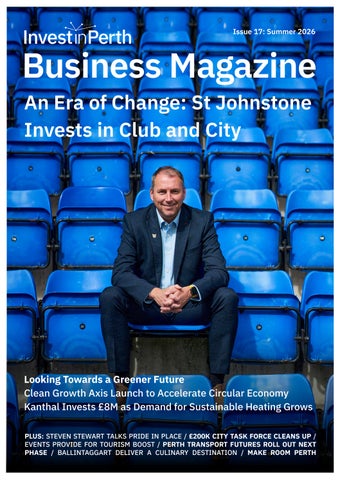
An Era of Change: St Johnstone Invests in Club and City
Looking Towards a Greener Future Clean Growth Axis Launch to Accelerate Circular Economy Kanthal Invests £8M as Demand for Sustainable Heating Grows PLUS: STEVEN STEWART TALKS PRIDE IN PLACE / £200K CITY TASK FORCE CLEANS UP / EVENTS PROVIDE FOR TOURISM BOOST / PERTH TRANSPORT FUTURES ROLL OUT NEXT PHASE / BALLINTAGGART DELIVER A CULINARY DESTINATION / MAKE ROOM PERTH Invest in Perth Magazine
1
WELCOME
ambitions for Perth’s city centre. Elsewhere, our £200,000 City Centre Improvement Taskforce is already delivering fast, visible upgrades across the High Street and beyond, while the former Lakeland building’s redevelopment shows what’s possible when public and private investment work together. Major investments from Kanthal and continued growth at SSEN Transmission underline Perth and Kinross’s appeal to international business, while our Growth Flag win, now in its second year, reflects that momentum.
This issue of the Invest in Perth Business Magazine reflects a region investing in itself, in its city centre, its culture, its infrastructure and its people, and the confidence that comes from seeing that investment translate into visible change.
Sustainability continues to do real work for our economy too, and the launch of the Clean Growth Axis, Perth and Kinross, a new concept we’re proud to introduce to the region, has ambitious aims to accelerate the circular economy and attract new and innovative start-ups to the area.
Our cover story follows St Johnstone’s Chairman, Francis Smith, on the club’s return to the Premiership and its wider
This issue also builds on our culture, and in particular Perth’s status as the UK’s only UNESCO City of Craft and Folk Art, including a look at Make Room, our new pilot supporting local makers in the city centre. None of this happens by accident. It reflects sustained work across the Council, our partners and the businesses who choose to invest here, often over many years before results become visible. As Perth and Kinross continues to grow, that collaborative approach will remain central to how we deliver for the region. I hope this issue gives you a genuine sense of the opportunities ahead. Councillor Eric Drysdale Leader of Perth & Kinross Council
Highlights 4
More Than Football: St Johnstone’s Growing Role in Perth’s Future
7
Restoring City Pride Through £200k in City Centre Improvements
10
UNESCO Status Puts Perth’s Craft Heritage on the Global Stage
12
Kanthal Invest £8M in Expanding Production
14
Ballintaggart’s Next Chapter
16
Driving Tourism with World-Class Events
18
Clean Growth Axis Perth. A New Platform for Low Carbon Investment
22
Perth Transport Futures: Delivering Results
As the inward investment arm of Perth & Kinross Council, Invest in Perth is committed to driving economic growth through continuous business support. How we work, live, and do business is evolving and Perth’s ability to adapt in a changing global marketplace has secured its reputation as an innovative business destination. If you are seeking an ambitious, vibrant city in which to invest your capital, build your start-up or place your headquarters, contact us:
Oliver Johnstone
Economic Development Officer ojohnstone@pkc.gov.uk Perth and Kinross Council, 2 High Street, Perth, PH1 5PH
2
Invest in Perth Magazine
Follow us on LinkedIn
@investinperth investinperth.co.uk
14
12 On the cover:
Francis Smith, CEO, St Johnstone F.C.
Invest in Perth Business Magazine is a Perth & Kinross Council publication. Produced and designed on behalf of PKC by the Red String Agency. Writing: Nicola Martin Design: Cain Martin
VIEWPOINT
What’s critical is that the campaign is developed from the considered reflections and ideas of a wide range of partners across our region. It also has to be authentic. The work undertaken in 2018 was true to our place. It was based on deep local research and engagement around what local people and organisations felt were our stand-out assets. Our location in the heart of Scotland, our high-quality independent retailers, producers and artisans, our incredible natural environment. We listened to their voices and produced a narrative reflecting not just our heritage and the here and now, but our future aspiration as the most sustainable small city in Europe.
Steven Stewart: Viewpoint Why telling our story matters Steven Stewart, Co-Chair of Perth and Kinross Business Partnership, who has lived and worked in the region for most of the past five decades, discusses why having pride in Perth and the story we tell about our wider region matters. Stories have always been part of my life living and working in Perth. My dad was a journalist with the Perthshire Advertiser and growing up I saw first-hand through his reporting the good, the bad and the ugly of the city I’m proud to call home. Yes, proud. I frequently hear and read the same regularly repeated complaints in conversation, on social media or in print. “It’s not what it used to be.” “There’s nothing to do.” “It’s all the fault of the Council.” I’ll guarantee the same phrases have been said and heard in every decade. Being proud of the place where you live or work doesn’t mean you’re blind to its faults, can’t see where it can be improved, or don’t accept the need for change. In my work with the Business Partnership, and my 35-year career in communications and running my own business, I’ve seen the importance of bringing people together to address challenges and leverage opportunities. Just as important as partnership is the story we tell about our city and wider
region – to visitors, potential investors and incoming businesses, and to people in our own communities. You wouldn’t expect to sell a house and have buyers scrambling to make an offer by focusing your marketing on the faults and flaws of the property. Selling our place is no different. Cities across the country are battling for attention as the visitor economy becomes ever more competitive and crucial to their prosperity. As public spending shrinks, regional economies remain fragile and change on the high street accelerates, explaining what makes a place distinctive is critical. Eight years ago, I was one of several partners who worked with place branding experts on a project to develop a new Perth Story. I’m pleased to see Perth and Kinross Council taking the initiative to revive and refresh that important work. A lot has happened in the intervening years, but what remains fundamental is that we need a comprehensive and wellcrafted story to promote the city of Perth and our wider region. It’s about far more than a slogan – and there will always be differing views on what any strapline should be.
Despite the challenges facing our communities here in 2026, Perth remains a fantastic place to live, visit, work and learn. Numerous surveys highlight our quality of life relative to other places in the UK, as well as our leading investment and business growth potential. I’m savvy enough to understand that a marketing campaign alone isn’t a silver bullet and there are other complementary actions needed to chart a better future for Perth and the wider region. That includes how our city looks and the experiences it offers, both for citizens and visitors. How we work together to make our city better. Renewing pride in our city and towns, and getting communities more invested in their future. I often feel those from outside our region are frequently better advocates for Perth, its beauty, and its best qualities than those who live here. They see, appreciate and value what many of us locals don’t. Fresh ideas – whether it’s around the design of our city, new uses for empty properties, or innovative projects like the planned new enterprise, skills and employability hub in Perth – are key to the way forward. The new place campaign is a huge opportunity to reframe the story we tell about our region. If we want a more prosperous future for our communities, it’s the responsibility of us all to get behind that positive campaign, contribute our insights and expertise, and make our voice heard. Invest in Perth Magazine
3
FEATURE
More Than Football: St Johnstone’s Growing Role in Perth’s Future
A
s St Johnstone prepares for its return to the Scottish Premiership, CEO Francis Smith talks about why the club’s ambitions now extend well beyond the touchline.
We sat down with CEO, Francis Smith, to discuss the club’s wider ambitions, the economic impact of football and why he believes St Johnstone’s future is closely tied to the future of Perth itself.
For generations, St Johnstone F.C. – or Saints as the team is affectionately known in the local area – has been part of the identity of Perth. Matchdays at McDiarmid Park have long brought people together, creating memories and instilling a deep sense of local pride.
Q: St Johnstone has always meant a great deal to Perth, but how would you describe the club’s role economically and socially?
Following their recent Scottish Championship title win, and an immediate return to the Premiership for the 2026/27 season, McDiarmid Park is back on Scottish football’s top table, bringing renewed attention and footfall to the team, and the city.
Francis Smith: “I think for me what’s important is our pillars of ‘One Club, One City, One Community’. We are the only full-time professional club in the leagues here and last year we brought over 60,000 away supporters into Perth through attendances alone. Now, with our return to the Premiership, we could easily see over 75,000 visiting supporters coming into the city annually.
In addition to their win, a new ownership era focused on sustainability, commercial growth and community connection, means the club is working hard to position itself as a driver of investment, economic confidence and visitor growth.
“That’s not including home supporters travelling back into Perth. Even if those visitors are spending modestly when they arrive, in shops, pubs, restaurants or transport, that money is going back into the Perth economy.
4
Invest in Perth Magazine
“The journey of the fan starts when they arrive at the train station. They come into Perth, they spend money in the city centre, they use transport links, they go for food and drinks before the game and often afterwards as well. “That’s where I think the club’s economic value can grow even more; by working together to connect the football club with the wider city experience.” Q: The club has also invested directly in Perth city centre. What’s the thinking behind that? “For us, it’s about showing confidence in the city. The club owner, Adam Webb, has invested in properties including the old Blackadders building, which we’re converting into player accommodation, and the old Tolbooth building. “At the moment the club rents properties across Perth for players, but by bringing accommodation together we can manage it more effectively while also freeing up housing stock elsewhere in the city.
“The Blackadders development will eventually provide around 15 rooms and when players aren’t there during the summer months, the accommodation can also be used for short-term visitor stays. “There’s discussion around hospitality opportunities too; potentially a wine bar, restaurant or other community-focused use within the buildings. Really, we’re trying to create something that contributes to Perth more widely, not just the football club.” Q: How important has the High Street presence and wider community engagement become? “It was important to Adam from the beginning that the club had a town centre presence and we’ve delivered that with our High Street Visitor Centre. The visitor centre has become much more than a retail space. People come in to learn about the history of the club, but it’s also become a bit of a community hub. “You’ve got regulars dropping in for a chat, community groups using the upstairs space and Saints in the Community delivering sessions there as well. “That social connection is hugely important. I mentioned the emotional connection between football supporters and their club, and that goes beyond something purely transactional. People want to support businesses and organisations that support the club because they feel connected to it.” Q: Looking ahead, what does successful investment look like for St Johnstone and for Perth? “For me, success is about connection. If the football club succeeds, that helps the city. But equally, if Perth succeeds, that helps the football club. “Football brings people together. It brings visitors into the city, creates jobs, supports businesses and gives people a sense of pride and belonging. “We had someone recently come into the stadium simply because they needed somewhere that felt safe and familiar to sit for a while. That tells you football clubs are about much more than what happens on the pitch. “We want St Johnstone to be part of Perth’s future, economically, socially and as part of the city’s wider identity.” www.perthstjohnstonefc.co.uk
The former Blackadders building on Tay Street and George Street will be converted into 15 player apartments.
image © Google Streetview
Invest in Perth Magazine
5
FEATURE
More Than Sponsorship: Business Partnerships “Football has a social-emotional connection, rather than just a transactional one,” says Francis Smith, CEO. That thinking sits at the heart of St Johnstone F.C.’s growing commercial strategy and its renewed focus on local partnerships. As such, there has been a clear focus on strengthening the club commercially and investing in its long-term future. “We must operate sustainably as a business. Football is emotional, but at the same time if people don’t support the business, the business doesn’t survive. It’s no different to any other organisation in that sense. “What we’ve tried to do is make conscious decisions that bring new investment into Perth and create opportunities outside of matchdays as well. People sometimes forget that the football operation isn’t just a Saturday afternoon. McDiarmid Park operates Monday to Friday too.
Football has a social-emotional connection, rather than just a transactional one The club works with a range of local suppliers and organisations, from food producers and transport providers to hospitality businesses and cultural venues.
“We’ve got five conference and event spaces ranging from around 80 to 150 people, free parking and on-site catering. Perth is a central meeting point between Glasgow, Edinburgh, Aberdeen and Inverness, so we’re actively trying to bring more businesses into the city through conferencing and events.
Smith believes the value of those relationships extends far beyond traditional sponsorship visibility. “When supporters see a business backing their football club, they’re more likely to support that business themselves,” he explains. “For every pound a business spends with the club, they’re getting value back through impressions, awareness and customer loyalty.”
“We’re also looking at the wider potential of the site itself. McDiarmid Park sits on 22 acres and there are opportunities around concerts, events and other activities that can bring more visitors into Perth.”
The club has also developed partnerships offering discounts and incentives through its season-ticket network, helping encourage supporters to spend money with local businesses.
Meanwhile, relationships with organisations such as Perth Theatre, Perth Racecourse and transport providers reflect a wider ambition to connect football with Perth’s broader visitor economy. “There’s an opportunity to make football part of a wider weekend experience,” says Smith. “That could mean football, theatre, racing, golf or other events all working together to encourage people to stay longer and spend more time in Perth.” For Smith, however, the bigger picture is ultimately about confidence. “We’ve invested heavily in the city centre because we believe in Perth,” he says. “If we want people to invest here, we need to show that confidence ourselves.”
Saints in Numbers 60,000+
75,000+
£2 million
£500k
22 acres
away supporters brought to Perth last season
projected annual visiting supporters with Premiership football
potential annual direct visitor spending in Perth’s economy*
invested by the club in Perth city-centre projects
of event and development potential at McDiarmid Park
*Estimate based on VisitScotland-style event visitor spend methodology using projected non-local visitor numbers and conservative average day-visitor expenditure estimates.
6
Invest in Perth Magazine
Perth Museum until September. Visitors exploring the story of the city’s closes and lanes can step out into vennels that reflect that same history.” Michael White, owner at Willows Coffee Shop in the cultural quarter, commented, “It’s the small things that often make the biggest difference. Customers notice when a street is looked after, when pavements are level and streets are dressed well. It’s not just cleaner, it feels considered, like somebody cares about this place. That changes how people feel about their town centre and the businesses in it; I think people linger a little longer because of it.”
Restoring City Pride Through £200k in City Centre Improvements
In addition to janitorial and maintenance issues, vinyl window displays are replacing outdated advertising boards on vacant units, while poster boards on King Edward Street have been updated with a new city centre map highlighting over 150 local, independent businesses.
Perth and Kinross Council has committed £200,000 to a City Centre Improvement Taskforce, delivering a programme of fast, visible upgrades across Perth city centre. Perth’s role at the heart of the region has evolved over recent years, shifting from a retail destination towards a broader mix of events, shopping, hospitality, and culture. The growth of both online shopping and working from home may have changed the way we use our cities, but the businesses who call it home remain committed to nurturing a pride in place as the foundation for sustainable growth. Following discussions with key stakeholders and independent businesses, a cross-council City Centre Improvement Taskforce was established to coordinate and deliver practical, visible improvements across the streets and vennels of the compact city centre. While its initial focus is delivering the Council-backed programme of enhancements approved in early 2026, the Taskforce’s broader role includes improving coordination across Council services, identifying opportunities for further enhancements, and helping shape a joinedup response to the longer-term issues and opportunities. Rather than a single large-scale project, a £200,000 budget has been directed
towards a coordinated package of interventions, selected for their ability to be delivered quickly, with minimal planning requirements, and clear before-and-after results for residents, businesses and visitors. Work has been concentrated on the High Street, South Street and King Edward Street, with the aim of delivering the majority of improvements over summer 2026. At time of going to press, Tayside Contracts has completed a deep clean and repointing of the city’s vennels and closes, including Fleshers, Baxters, Oliphants and North Boat Vennel, alongside a deep clean of the High Street and King Edward Street. Paving and slabs near the award-winning, five-star visitor attraction, Perth Museum, have also been repaired, replacing temporary surfaces and removing damaged posts. Street furniture is being refreshed, street lighting columns repainted, and new fencing and bin storage installed. Helen Smout, CEO of Culture PK, commented, “The timing of this has an added resonance, with the ‘Vennels: Perth’s Little Streets’ exhibition running at
Flowers and greening are playing their part too. Perth has a long-standing reputation for its floral displays, having been crowned Britain in Bloom’s overall Champion of Champions on two occasions, and holding numerous Beautiful Scotland gold medals. Seasonal planting around Perth Museum, alongside additional floral displays in Mill Street, will bring some of that horticultural pride into the heart of the city centre. The city work is also being treated as a test case with lessons learned in Perth expected to become the starting point for effecting visible change in towns across the region. The £200,000 funding was approved at Full Council budget setting on 4 March, proposed by Council Leader, Councillor Eric Drysdale. Invest in Perth Magazine
7
NEWS Screen Production Delivers Over £11m for Tay Region and Fife Screen production across Perth and Kinross, Dundee, and Fife generated an estimated economic impact of more than £11 million over the past two years, according to the latest annual report from FifeScreen+TayScreen, the screen office supported by all three council areas. Productions spent £5.7 million in the region across 2024/25 and 2025/26, recording 826 filming days, an overall increase of 20% compared with 2023/24.
Highland Spring Group Partners with Woodland Trust on Ochil Hills Conservation Highland Spring Group, the Blackfordbased producer of natural source waters, has entered a new partnership with the Woodland Trust, the UK's largest woodland conservation charity, as part of its wider commitment to land and water stewardship. The partnership extends work already under way across the company's 2,500 acres of protected organic land in the Ochil Hills. In its first year, the collaboration will focus on woodland creation and restoration across 1,200 hectares of conservation land at Glen Devon Woodlands in the Ochil Hills, Perthshire, with the aim of enhancing biodiversity and restoring native habitats around the source of Highland Spring water. Funding from the partnership will support woodland management activity including deer exclusion fencing, vole guard recycling, and native woodland restoration intended to support long-term ecological resilience. The agreement also includes volunteering opportunities for Highland Spring employees within the project area. The company reports that more than 2,000 native trees have already been planted within its extended catchment area to support river restoration, with the new partnership extending this work into the wider Ochil Hills.
8
Invest in Perth Magazine
Jim Fairlie MSP for Perthshire South and Kinross-shire said: “This is exactly the kind of partnership we need to see more of; local business working hand in hand with environmental organisations to protect and enhance the landscapes that make Perthshire so special. The Glen Devon Woodlands and the Ochil Hills are an important natural asset for our area, supporting biodiversity, jobs, and communities.”
Highland Spring Group currently bottles approximately 550 million litres of water annually and employs more than 500 staff, producing the Highland Spring and Hydr8 brands alongside private label water products for UK supermarkets and food service retailers.
Perth and Kinross's contribution to that total draws on a genuine screen heritage. Scone Palace's Murray Star Maze featured in Apple TV+'s period drama The Buccaneers, while nearby Drummond Castle has doubled as the Palace of Versailles for Outlander and hosted a Christian Dior fashion event and film shoot during the period covered by the annual report. But the region's screen credentials extend well beyond its palaces and castles. Perth Railway Station provided a filming location for The Railway Man, starring Nicole Kidman and Colin Firth, while Gleneagles Hotel in Perthshire appeared in HBO's Succession. Julie Craik of FifeScreen+TayScreen said the results showed the sustained value of screen production to the region, with each project creating opportunities for local businesses and crew while placing the area's cities, towns and landscapes in front of audiences worldwide. The report also points to the wider tourism value of that exposure, with VisitBritain research showing film and television increasingly influence where people choose to travel. For Perth and Kinross, already home to production-ready venues such as Perth Racecourse, which offers a practical base alongside direct access to Scone Palace's grounds and interiors, that combination of screen credits and visitor appeal continues to strengthen the case for the region as a destination for both productions and the tourists who follow. Over the past decade, filming across the wider region has delivered an estimated £47.7 million in economic impact.
NEWS Grid Investment and Local Economic Development in Perth and Kinross Perth and Kinross occupies a strategic position in Scotland’s transition away from oil and gas, with regional natural resources and existing infrastructure supporting a role in transmission, distribution and storage for renewable energy. SSEN Transmission, headquartered in Perth city, is a central contributor to this activity. The company’s June 2026 economic report, “Re-energising the North: Transforming Scotland”, estimates their £29 billion programme of new and upgraded transmission infrastructure will support up to 24,000 jobs across Scotland. Within Perth and Kinross, SSEN Transmission reports £1.1 billion in spending through the local economy, £840 million of which is spent directly with local businesses, supporting up to 1,500 jobs through local projects and the company’s regional operations. Staff numbers at its Perth office have grown from 485 in 2023 to 688 currently, with projections reaching 1,074 by 2030, alongside 10 graduate roles planned for 2026.
SSEN’s approach includes training through a dedicated Perth training school, earnas-you-learn roles, and investment in biodiversity and peat restoration. The company also reports a projected £600 million contribution to local gross value added, along with a £250,000 community benefit fund supporting regional and local priorities, including health and wellbeing projects. With the region’s working-age population in decline, the employment and training associated with this investment forms part of the Council’s broader approach to workforce retention through 2030.
Perth Embraces Digital Innovation to Drive Business and Tourism Perth and Kinross Council has launched a new website built around emerging technology, aiming to strengthen how the area is discovered by visitors and how local businesses reach customers. The Perth City and Towns platform reflects a shift in consumer behaviour, as more people use search engines, AIpowered tools and voice assistants to plan trips and discover new places. The site has been structured around defined destination themes and evergreen content designed to improve visibility on search engines and make information easier for AI tools to interpret and recommend. A new AI assistant, named Bonnie, has also been built into the platform to help visitors plan day trips, short breaks and holidays, drawing on the site’s content database to generate personalised suggestions. Alongside this, a digital Business Directory allows more than 500 retailers, cafes, restaurants and visitor attractions to manage their own online profiles free of charge, with information
updated directly by businesses rather than through a third party. A self-service events system gives organisations and venues similar control, replacing static listings with a continuously updated what’s-on guide. Council leader Eric Drysdale said the platform was designed to improve how people discover Perth and Kinross online and to give businesses a more direct route to visitors, supporting footfall and longer stays across the area. The Council plans to direct traffic to the site through social media and a mailing list of more than 24,000 subscribers. By consolidating information into a single digital platform and reducing duplicate content, the approach is intended to strengthen the region’s visibility both to search engines and the growing number of AI tools now used in travel planning. The website was delivered through a partnership between Perth-based agencies, Red String Ltd and Inspire Digital. Invest in Perth Magazine
9
FEATURE
In 2021, Perth became the UK’s first and only UNESCO City of Craft and Folk Art, a designation that placed the city within a global network built specifically to recognise creativity as a driver of sustainable urban and economic development. The designation sits within the UNESCO Creative Cities Network (UCCN), founded in 2004 and now comprising almost 350 cities worldwide across seven creative fields, including craft and folk art, design, film, gastronomy, literature, media arts and music. Within its own subnetwork, Perth is grouped alongside internationally recognised craft cities such as Jaipur and Cairo. Membership of the network does not expire, provided a city continues to meet UNESCO’s requirements, giving the designation a long-term, rather than oneoff, value. As a city and region positioning itself for investment, the practical effects of UNESCO status are already visible. The designation has underpinned the successful delivery of a community assets project, whereby a ceramics kiln, a glass kiln and a photography dark room have been made available to local makers in the Creative Exchange in Perth city.
10
Invest in Perth Magazine
Delivery of the designation locally is now supported by a full-time member of staff, Poppy Jarratt, whose role is to build the practical and economic case for craft alongside its cultural value. That distinction matters for how the designation is applied.
Perth’s UNESCO status is not simply a badge of heritage, but a platform for a sector with a genuine route to commercial growth
“The designation itself reflects a heritage of craft production and trade in the city stretching back to the early 1500s, when Perth was known as a ‘Craftis Toun’. Craft is something that is replicable, whereby you can handmake the same thing again and again,” Jarratt explains. “It’s based on teachable skills that can be passed on, differentiating it from fine art, which is more about individual expression.”
image © Ceri White Studios
UNESCO Status Puts Perth’s Craft Heritage on the Global Stage This definition underpins a broader argument for treating craft as a commercial sector rather than a purely cultural one. Skills that are teachable and repeatable can be scaled, taught to new practitioners, and turned into consistent trading businesses, workshop income and retail activity, in the same way any other small manufacturing or service business might grow. Viewed this way, Perth’s UNESCO status is not simply a badge of heritage, but a platform for a sector with a genuine route to commercial growth, employment and footfall. Of course, the profile-raising effect of the designation is also visible in the city’s cultural offer. Perth Museum, which opened in 2024, has built craft into its core programming, and its Summer 2026 exhibition, ‘Vennels: Perth’s Little Streets’, was brought to life through the history of the city’s closes, alleys and lanes, and the craftspeople who worked in them. For investors and businesses considering Perth and Kinross, the designation offers a differentiated identity: a city with an internationally verified creative economy, a growing case for craft as a commercial sector in its own right, and active cultural infrastructure to support it.
Make Room: A New Model for High Street Activation One recent example is Make Room, a pilot scheme using UNESCO-linked funding and profile to bring vacant city centre units back into use for local makers. Developed as part of the Council’s Perth City Centre Development and Design Framework, Make Room responds directly to two priorities: helping creative practitioners scale their businesses and economic impact, and bringing vacant city centre units back into active use. The model itself is straightforward. Selected makers are given free use of a fully equipped unit at 19 Princes Street for six to twelve weeks, with no rental or utility costs. In return, they activate the space as a working retail and studio environment, giving the public opportunities to buy, take part in workshops, and see the creative process first-hand. The scheme also expands on that clear, commercial definition of craft. Jarratt commented, “For the Make Room project, we’re curating an ongoing programme of skilled makers, all of whom have ambitions to develop or grow their
commercial practice. And whilst the space isn’t for hobby-level crafters as a primary use, many of our makers will be providing hands-on workshop experiences for everyone to enjoy.” The first two tenancies included a pop-up trading under the name HARDWEAR – Aileen Sherry of Ayton Clothing and Kristina Merchant of Kmercht Jewellery – and the Kiss My Glass Collective, a group of Perthshire-based artists working in the ancient craft of stained glass.
We’re curating an ongoing programme for skilled makers
Applications remain open on a rolling basis to craft makers across Perth and Kinross. Information about the Make Room project can be found at perthcityofcraft.co.uk Invest in Perth Magazine
11
FEATURE
Perth-Based Kanthal Invest £8M in Expanding Production as Demand for Sustainable Heating Grows Perth-based Kanthal, a division of Swedish materials group Alleima, has expanded its silicon carbide heating element manufacturing facility at Inveralmond Industrial Estate, adding 1,750 square metres of manufacturing area, new equipment, an updated production layout and additional warehouse space. The expansion responds to rising demand from producers of electronics, glass and steel for sustainable high-temperature heating technology. Kanthal’s Globar® silicon carbide heating elements enable electrification of industrial processes up to 1,625°C, replacing fossil fuel-based heating and, according to the company, making production more energy-efficient, cleaner and safer while improving process control and reducing CO₂ emissions. The investment reflects a broader industrial shift. Heavy industry accounts for close to a quarter of global CO₂ emissions, with a substantial share generated by high-temperature heating processes. Governments worldwide are increasing pressure on manufacturers to cut industrial emissions through carbon pricing, tightening regulation and clean-energy incentives, driving demand for electrified alternatives to fossil fuel combustion. Kanthal has operated in Perth for more than 50 years and currently employs 12
Invest in Perth Magazine
around 120 staff at its Inveralmond site. In response to growing demand for its Globar® silicon carbide heating elements portfolio, the company launched an investment initiative in 2023 to expand its Perth facilities. “Perth is a strategically important location where we have produced Globar® silicon carbide products for many years,” said Robert Stål, President of Kanthal. “With this expansion, we strengthen our ability to meet our customers’ needs and reinforce our position as a trusted partner.”
Perth is a strategically important location The increased capacity, operational from this year, is also expected to allow the firm to add to its workforce as demand for its products continues to grow. Alongside the Perth expansion, Kanthal has also established a new service centre for Globar® heating elements at its existing facility in Concord, North Carolina. Together, the two projects represent a total investment of approximately SEK 100
million, around £7.5 million, intended to bring the company closer to its customers and improve lead times. “Both locations are now fully operational, increasing the available production capacity for these products by approximately 40%,” said Simon Lile, President of Kanthal’s Business Unit Heating Systems. “We are not just increasing capacity; we have also added capability which will enable new product and application developments that can cater for larger electrical heating solutions. The total investment will ensure that we can capture the growing global demand.” Kanthal is a world-leading brand in industrial heating technology and resistance material. Its parent company, Alleima, headquartered in Sandviken, Sweden, employs approximately 6,800 people across around 80 countries, and reported revenues of about SEK 19 billion in 2025. The expansion positions Perth as a continuing production base for a company operating at the centre of one of manufacturing’s clearer long-term growth markets, as industrial decarbonisation policy reshapes demand for heating technology across electronics, glass and steel production worldwide.
Why does this matter now? Around the world, governments are ramping up efforts to reduce emissions as part of broader climate commitments, with heavy industry a key focus area for decarbonisation. Policy measures such as carbon pricing, emissions regulations, and clean-energy incentives are pushing manufacturers to rethink how heat is generated and to accelerate the shift towards lower-carbon production pathways. Kanthal’s heating elements enable the electrification of processes up to 1,625°C. They can replace fossil fuel solutions, making production more energy-efficient, cleaner, and safer. This transition also ensures better process control while reducing CO2 emissions. As a world-leading brand in industrial heating technology and resistance material, Kanthal is committed to reducing environmental impact through innovative solutions and strong customer partnerships. With skilled people and pioneering technology, it supports some of the world’s biggest and most exciting projects. Their goal with their expansion in Perth is to capture growth in the global market and to support long-term product and application development. For more information, visit kanthal.com
Invest in Perth Magazine
13
FEATURE
From Farm B&B to Scottish Storytelling Brand: Ballintaggart's Next Chapter As Ballintaggart marks ten years in business, co-founders Chris and Andrew Rowley chat about organic growth, backing local producers, and why now is the right time to invest. Ballintaggart started life in 2015 as a twobedroom bed and breakfast on a farm near Grandtully. Launched by Chris and Andrew Rowley after a move north from London, the business was inspired by childhood holidays to the area and a love of all that Highland Perthshire has to offer. A decade on, the business now includes an expanded Ballintaggart Farm with Restaurant, The Grandtully Hotel, a cook school, catering arm, and retail shops in Aberfeldy and Kenmore.
Invest in Perth Magazine
How important has Highland Perthshire been in shaping the brand and the customer experience?
Chris: "Almost everything we've done has happened organically, in response to what guests asked for. We started with two bedrooms and an evening meal for anyone staying. People began saying they'd heard you could eat up at the farm, so we
Andrew: "Hugely. We talk a lot about a sense of place, and we want guests to really feel where they are. We're 90 minutes from Edinburgh and Glasgow, so it's accessible, but it still feels like getting away. The bit we're proudest of is the producers on our doorstep. Rural Scotland has incredible artisans whose produce often goes straight to the cities, and we wanted to bring that food and drink identity into this area instead.
We want to be the leading modern voice of Scottish food and drink, while championing other Scottish producers as we grow.
Prompting Giles Coren of The Times to say, “I have never been offered a better table anywhere”, Ballintaggart has emerged as market leader in the modern Scottish hospitality scene, and with expansion plans now underway, the team is preparing to write its next chapter, seeking the investment needed to scale sustainably and bring its model of immersive, locally rooted hospitality to a wider audience.
14
Ballintaggart has evolved far beyond a traditional hospitality business. What has driven that growth and ambition?
turned it into a restaurant. Guests used to watch through the kitchen window on their way through, so we turned that into a cook school. A couple got engaged on the terrace and asked to get married there, so weddings began too. Retail came out of necessity during lockdown, and it's grown from there. “
“Aberfeldy and Grandtully were a bit overlooked ten years ago, but we've seen a real regeneration since then, which we're glad to have played a part in." What has demand looked like recently, and what economic impact does Ballintaggart have locally?
Chris: "Demand is outstripping what we can offer. The hotel is booked months in advance, and we're turning away a high proportion of wedding and travel trade enquiries purely on capacity, which is currently around 40 covers. Getting to 80 would transform the number of events and
weddings we could take on, and because guests who stay also eat with us, more rooms means more covers in the restaurant too. We've also seen strong growth in experiential demand with cook school days, wellness and our sauna. Guests want immersive stays that they can build a whole trip around." Andrew: "In terms of economic impact, we employ 70 people and work with well over 100 suppliers, the vast majority Scottish. Beyond direct spend, guests come specifically for the food and drink experience, and we actively promote Highland Perthshire as a destination alongside our own brand, because the two are so closely linked.”
What makes Ballintaggart different from other hospitality or food-led destinations? Chris: "A consistent, real passion for the guest experience, across everything from the farm to the shops. It's not about being a cool hotel for a night. Guests trust us because the standard doesn't waver, whether it's the food, the service or the story behind a product on our shelves. That consistency is what turns a first visit into a repeat guest and repeat guests into people who build Ballintaggart into their calendar." Why is now the right time to seek investment and scale further? Andrew: "Up until now we’ve largely self-invested with annual profits going
back into the business, alongside specific lending for projects such as the farmhouse renovation. This year marks ten years, and 2026 is about putting stronger foundations and structure in place to support the next stage of growth. For instance, we're about to move into a new, custom-built production facility on Perth's Inveralmond industrial estate, allowing us to broaden our distribution network while keeping our supply chain rooted here.” Chris: "Turning ten makes you think about what's next and we want to grow sustainably rather than for growth's sake alone. Running a business can be a lonely place, and we want the accountability, governance and outside expertise that professional investment brings, particularly from people who've scaled hospitality businesses before. Our senior management team is also stronger and more settled than it's ever been, and they're ready to help drive this next stage." What does success look like for Ballintaggart over the next five years? Andrew: "Simply put, we want to be the leading modern voice of Scottish food and drink, while championing other Scottish producers as we grow. We'd also like to help shift perceptions of a career in hospitality to a genuine choice rather than a stop-gap job. And we want to keep promoting the area's reputation as a leading food and drink destination, alongside our own rising profile." Chris: “I say, 'let's give it a go', and Andrew works out how to make it happen." www.ballintaggart.com
Download the Ballintaggart Investor Pitch Deck:
Invest in Perth Magazine
15
FEATURE
Driving Tourism with World-Class Events How national funding is helping Perth and Kinross turn great days out into meaningful economic growth. Tourism is one of Scotland’s most powerful economic engines; visitors spent £11.4 billion in Scotland in 2024, supporting around 239,000 jobs and more than 16,000 tourism businesses. Events play their part by drawing visitors, extending stays and putting money directly into local economies. Recognising this, Scotland’s national events strategy, Scotland the Perfect Stage, was developed in a collaboration between the Scottish Government, the tourism and events industry and other partners. It set out an explicit ambition to use events to strengthen the country’s economy, reputation and communities through to 2035. The strategic focus is very much on supporting all those involved in planning, securing, and delivering events, and on enhancing the country’s status as a worldleading events destination. It is supported by a funding programme delivered by VisitScotland that awards both national and international events. Recent recipients of funding in Perth and Kinross include children’s festival, Wildhood, Clans @ the Croft – the UK’s only team-based mountain bike enduro 16
Invest in Perth Magazine
held at Comrie Croft near Crieff – Heartland Festival, and Solas Festival. This year, Scone Palace International Horse Trials (SPIHT) has been confirmed as a recipient of the International Events Programme which provides funding for events of major national and international
Investing in major events is about creating long-term value for Perth and Kinross. significance. The award will accelerate the ambitions of the four-day August event, allowing it to extend its marketing and broadcasting reach across the rest of the UK and into international markets. Caroline Warburton, Destination Development Director at VisitScotland, said: “Events are a vital part of what makes Scotland an attractive destination. But more than that, they help create a strong sense of place, bringing communities
together while delivering social, cultural and economic benefits to the area. It’s our history, culture and people that draw people to Perth and Kinross and events can bring out the best of what makes this place special. “Scone Palace International Horse Trials is a great example of the wide-reaching benefits that events in Perth & Kinross can deliver. From competitors and visitors drawn to the event and the businesses and suppliers it works with, to the fabulous setting and international profile. It all helps support the local visitor economy.” To help leverage this support, Perth and Kinross Council has committed a further £15,000 in a partnership agreement that will encourage more visitors to turn a trip to the horse trials into a longer stay in Perthshire. Councillor Eric Drysdale, Leader of Perth & Kinross Council, commented, “Scone Palace International Horse Trials directly reflects two of the four priority areas laid out in The Perth and Kinross Tourism Strategy and Action Plan 2025– 2030; area promotion and destination marketing, and market development and internationalisation.”
More than 27,500 spectators attended the inaugural Scone Palace International Horse Trials event in 2025, with visitors travelling from across Scotland, the rest of the UK and overseas. Advance ticket sales showed that almost a quarter of visitors came from outside Scotland, while competitors represented 14 nations including the USA, New Zealand, Ireland, China and Argentina. William Stormont, owner and patron of SPIHT, said the event’s impact locally had exceeded expectations. “ Delivering a Scottish-based international event in 2025 was a major undertaking, and I am delighted to say it was a resounding success. Alongside 27,500 spectators, the event welcomed over 4,000 riders, owners and trainers, and generated almost 12 million digital media impressions.” The event’s first year also delivered international visibility for the region through a partnership with ClipMyHorse.TV, which saw more than 42,000 livestream views, with audiences tuning in from the UK, USA, Australia, New Zealand, Ireland, Germany and Canada. More than 200 Scottish companies traded or exhibited at the event, around one fifth of which were based in Perth and Kinross. Feedback pointed to increased footfall for hotels, restaurants, cafes and other tourism operators, while many spectators chose to extend their stay and explore the wider area. Councillor Drysdale continued, “Investing in major events is about creating longterm value for Perth and Kinross. Through partnerships with successful events such as the Scone Palace International Horse Trials, we can showcase the confidence, ambition and quality that define our region while creating opportunities for local businesses and communities to benefit from increased visitor numbers and growing international interest. “We are committed to supporting initiatives that strengthen our economy and raise the profile of Perth and Kinross as a place to visit, live, work and invest. Events like SPIHT provide a powerful platform to reach high-value audiences and demonstrate what can be achieved when organisations work together with a shared ambition for sustainable growth.”
Invest in Perth Magazine
17
A New Platform for Low Carbon Investment The transition to net zero has become one of the defining growth stories in the UK economy, and one of the fastest moving. Clean technology and low carbon industries are no longer a niche corner of the market; they are now a substantial and rapidly expanding part of it, generating tens of billions in economic value and hundreds of thousands of jobs nationally, with Scotland leading the pace of that growth. For regions able to position themselves within that shift, the opportunity is significant but capturing it depends on having the right infrastructure in place to turn ambition into investable projects. That is the gap Perth and Kinross Council is seeking to close with the Clean Growth Axis (CGA), a project development platform designed to accelerate clean technology, low carbon and circular economy investment across Perth and Kinross and the wider Tay Cities Region. Rather than businesses having to navigate multiple public bodies, funders and support 18
Invest in Perth Magazine
organisations separately, the CGA acts as a single coordinated route connecting entrepreneurs, developers, delivery support and investors through one process. The platform brings together six founding partners: Perth and Kinross Council, the Resource Management Association Scotland (RMAS), Scottish Enterprise,
Zero Waste Scotland, The James Hutton Institute and the Tay Cities Clean Growth Initiative, who have signed a Memorandum of Agreement to support its delivery. RMAS, alongside Binn Group, brings specialist circular economy expertise into the initiative, while The James Hutton Institute contributes research and innovation capacity.
PROJECT LAUNCH John Ferguson of RMAS and Head of Development at Binn EcoPark, who led the Clean Growth Axis project, said the initiative reflected growing emphasis from both the Scottish and UK Governments on clean growth, circular economy development and net zero investment. “The Clean Growth Axis represents a significant step forward in creating the conditions needed to accelerate the delivery of projects at pace and scale,” he said. “By combining industry expertise with coordinated public and private sector support, the initiative aims to turn national policy ambition into real economic and environmental impact locally within Perth and Kinross.” Councillor Richard Watters said Perth and Kinross was well placed to support the growth of clean technology and low carbon industries, citing the region’s central location, transport connections and established research base. “The Clean Growth Axis builds on these strengths by creating a more connected and coordinated approach to project delivery, helping attract investment, support innovation and drive long-term sustainable economic growth across the region,” he said.
Download the Project Partner and Investor Overview Document:
In practice, the CGA is structured around a four-step process. Candidate businesses first complete a short project information report outlining their proposal and support needs, before being introduced to all relevant support organisations together at an introductory meeting. Detailed one-toone meetings with individual bodies follow, before the Perth and Kinross Council CGA team combines the resulting feedback into a single project delivery support plan, which then guides coordinated support through the project’s development stages.
By combining industry expertise with coordinated public and private sector support, the initiative aims to turn national policy ambition into real economic and environmental impact.
The platform is focused on a defined set of priority sectors, including the bioeconomy, materials recycling, micro-renewable energy grids, controlled environment agriculture and remanufacturing, alongside renewable energy and micro-grids, energy storage, sustainable transport, circular economy and resource efficiency, naturebased solutions, carbon management, and digital and data-driven climate innovation. Site availability forms a core part of the offer. Perth and Kinross currently has two key development sites for clean growth projects, Binn EcoPark and The James Hutton Institute, alongside established industrial parks including Castlecroft and Northfield Business Park. The Council’s ongoing review of its Local Development Plan 3 (LDP3) is also expected to open up further opportunities at Scone Estate and Perth Eco- Innovation Park.
On the investment side, the CGA is designed to connect projects with a broad range of capital providers, including development finance institutions, green and climate funds, impact investors, corporate investors, venture capital and greentech VCs, philanthropic and grantmaking organisations, and government programmes and incentives. For Perth and Kinross, the Clean Growth Axis represents an attempt to convert national policy ambition around net zero and the circular economy into a practical, locally coordinated route to project delivery, positioning the region within a UK sector already worth over £83 billion and still growing at pace. Further information on the Clean Growth Axis is available at investinperth.co.uk, or by contacting cleangrowthaxis@pkc.gov.uk. Invest in Perth Magazine
19
FEATURE
Growth Flag: Predicting the Businesses Shaping Tomorrow’s Economy Nathan Shoesmith of Growth Flag explains how quality data and deep understanding can help identify growth potential. Understanding where future growth will come from is one of the most significant challenges facing national and regional economies. Traditional economic data tends to focus on what has already happened, offering useful insight into past trends but limited guidance on where the next wave of opportunity might emerge. Growth Flag, a predictive economic insight and business intelligence platform, aims to change that. Created by social enterprise research and evaluation consultancy GC Insight in collaboration with business intelligence specialists Red Flag Alert, the platform uses advanced data analysis to identify businesses most likely to achieve rapid growth in the coming years. By analysing millions of companies across the UK, the system helps governments, councils and economic development organisations build a clearer picture of their local business landscape. 20
Invest in Perth Magazine
Looking beyond traditional growth models At the core of Growth Flag is a predictive model that assesses every UK business with at least one set of financial accounts. Each company is assessed for a score from one to 100 reflecting the likelihood it will achieve at least 20% growth within the next year. This is a threshold widely recognised as the benchmark for highgrowth firms.
Rather than relying on historic growth patterns, the platform focuses on identifying signals that suggest future growth potential. This forward-looking approach represents a shift in how economic data is used.
Where Growth Flag stands apart, is in the methodology behind the model. Nathan Shoesmith, Insights and Analysis Lead at Growth Flag, explains, “Historically, most datasets used by policymakers have focused on past performance, examining which businesses grew and analysing why. High-growth companies were often defined as businesses that grew by 20% every year for three consecutive years.
To build this predictive view, the platform draws on more than 15 separate datasets, including official sources such as Companies House, Registry Trust and The Gazette, combined with additional commercial datasets.
“What we’re seeing now is that growth tends to be much more episodic. Companies might grow rapidly one year, stabilise the next and then accelerate again later, for example.”
“We wanted to create something that looks ahead rather than backwards.”
The methodology is continually tested and refined. In the three years since it was launched, retrospective analysis has shown that system identifies businesses that subsequently achieve 20% growth with over 90% accuracy.
Supporting smarter economic development Perth and Kinross Council is among a growing number of authorities using the Growth Flag platform. In 2025, leaders commissioned the State of Growth report, resulting in a detailed, dataled overview of the region’s business landscape.
TheAngel’sShare
The report highlights the strength and resilience of the local economy, with over 11% of businesses identified as having high growth potential; for reference, the UK average sits at 9%. The report also explores key sectors driving growth, maps business activity across urban and rural areas, and identifies both opportunities and risks within the local economy. Together, these insights help inform investment, support targeted business growth and reinforce Perth and Kinross’ s position as a high-potential location for enterprise and innovation. “If you can identify the businesses that are most likely to grow, you can have a much bigger impact,” Shoesmith says. “And if you can identify companies that may be struggling, you can step in earlier and point them towards support.” Perth and Kinross Council Leader, Councillor Eric Drysdale, commented, “Perth and Kinross has always had a strong and diverse business community. Working with Growth Flag allows us to better understand that strength and take a forward-looking view of our economy.”
For two consecutive years Perth and Kinross has been recognised through the Growth Flag awards as one of the UK regions with the strongest business growth potential. Download the full State of Growth Report:
The Angel’s Share, developed by Perth and Kinross Council, aims to foster a culture of ambition and entrepreneurship throughout the area. The programme is designed to support entrepreneurial expansion by connecting growth-ready enterprises with certified investors. Based around three live pitching events each year, it supports both entrepreneurs and investors by providing highvalue expertise and coaching, ensuring quality, investment-ready opportunities for all.
Over 2026, the focus for The Angel’s Share has been clear: to support Perth and Kinross businesses to secure funding, accelerate their growth and create high-quality local jobs. Finlay Kerr of Raising Expert, the organisation contracted to deliver The Angel’s Share, commented, “Angel investment is not just about capital. It brings expertise, networks and confidence that can be transformational for early-stage and scaling businesses. Through the programme, PKC is building a stronger local investment ecosystem by ensuring that ambitious businesses can access the backing they need within the region.”
Please get in touch if you fall into any of the following categories: • Perth and Kinross-based entrepreneurs actively seeking investment • Perth and Kinross-based entrepreneurs working to become investment ready • Investors wishing to connect with start-up businesses and opportunities
Contact: Finlay Kerr Founder, Raising Expert finlay@raising-expert.com FIND OUT MORE
Invest in Perth Magazine
21
PROJECT UPDATE
contributions tied to the wider Bertha Park development and is forecast to be delivered within budget. More than £2.1 million of the scheme’s £2.81 million supply chain spend was retained locally, with contractors including Laird Contractors and Breedon Group involved in delivery, and two apprentice groundworkers employed during construction. The project also included engagement with Bertha Park High School through site visits and work experience, upgrades to play facilities at Bertha Park, and planned improvement works at Pitcairn Primary School.
Perth Transport Futures: Delivering Results, One Year at a Time A year on from the opening of Destiny Bridge and the New Kingsway, and with the Bertha Park Link Road now complete, Perth Transport Futures has both real traffic data and a further milestone to show for it. Destiny Bridge and the New Kingsway opened on 31 March 2025. The £150 million project linking the A9, A93 and A94 is the flagship scheme within the wider Perth Transport Futures programme. Its core aim was straightforward: reduce congestion and pollution in Perth city centre by giving traffic an alternative route. One year on, monitoring data confirms the road is delivering on this objective: •
•
Weekday traffic across key city centre routes has fallen by a further 4.8% since the road opened, with Saturday traffic down 3.7% over the same period. The reductions are most pronounced on some of the city’s busiest routes, with weekday traffic down 21.7% on the A94 at Kinmond Court, 17.8% on Dundee Road at Island View, and 13.5% on the A93 at Springlands.
Jillian Ferguson, Roads Infrastructure Manager for Perth and Kinross Council, said the figures showed traffic was being successfully diverted away from some of the busiest routes, helping to create a more efficient and accessible transport network. “By improving connectivity between key routes and reducing congestion in the city centre, the project is helping to create the conditions for a more efficient and accessible transport network, supporting how people and businesses move around the area and contributing to Perth’s wider economic vitality.” That evidence base arrives just as the next phase of the same programme has been delivered. The Bertha Park Link Road, Phase 3 of Perth Transport Futures, opened in summer 2026, five weeks ahead of schedule. The new 1.4km road connects the roundabout at Bertha Park High School with the A9 West Roundabout at Destiny Bridge, improving connectivity to Inveralmond Industrial Estate, and leading Scottish visitor attractions, Perth Racecourse and Scone Palace.
•
The new route itself is seeing substantial use, carrying around 3,600 vehicles in each direction on weekdays and 2,700 on Saturdays between the A9 and A93.
It includes a dedicated 3-metre shared cycleway running from the A85 Crieff Road to the A94 north of Scone, along with signal-controlled crossings and infrastructure to support future public transport services.
•
Traffic on the A9 south of the link road has risen by around 26%, reflecting that shift away from the city centre.
The £15 million project has been frontfunded by Perth and Kinross Council, with costs recovered through developer
22
Invest in Perth Magazine
Serge Merone, Strategic Lead for Economy, Development and Planning at Perth and Kinross Council, said: “Supporting local businesses, creating opportunities for apprentices and delivering lasting social value have been central to the project and we are proud of the legacy it will leave. We are now looking ahead to the next phase of the programme and engaging with residents and businesses to help shape future city centre improvements and maximise the benefits of our wider Mobility Strategy.”
More than £200 million has been invested across the Perth Transport Futures programme to date. Feasibility and design work is now under way on Phase 4, which will focus on Perth city centre improvements, sustainable travel measures and public realm upgrades, informed by continued monitoring of how the earlier phases perform over the longer term. Councillor Eric Drysdale, Leader of Perth and Kinross Council, said: “The Perth Transport Futures Project is a long-term investment in the future of Perth and Kinross. As well as creating better connections for communities and businesses, it offers improved active travel and public transport routes and supports sustainable growth by unlocking opportunities for housing, jobs and investment across the area.” perthtransportfutures.co.uk
£530 Million of Investment Opportunities Announced in the Perth and Kinross Region
FIND OUT MORE:
investinperth.co.uk/investment-prospectus-pdf
Perth Eco-Innovation Park Where Enterprise and Ideas Connect
Substantial Commercial Development Site Phase 1: 11 hectare development site suitable for a variety of uses
To Let / May Sell