About Ninety One
Ninety One is an active, global investment manager managing US$204.8 billion in assets (as at 30.09.25). Our goal is to provide long term investment returns for our clients while making a positive difference to people and the planet.
Established in South Africa in 1991, as Investec Asset Management, the firm began as a small start-up offering domestic investments in an emerging market. In 2020, as a global firm proud of our emerging market roots, we demerged to become Ninety One.
We are committed to developing specialist investment teams organically. Our heritage and approach let us bring a different perspective to active and sustainable investing across equities, fixed income, multi-asset and alternatives to our clients - institutions, advisors and individual investors around the world.

Investment involves risk; losses may be made.
Welcome
Welcome to our inaugural annual transition report for the Emerging Markets Transition Debt strategy. The strategy was created to address a fundamental gap in global climate finance.
The world cannot reach its climate goals unless emerging markets decarbonise at scale. These economies have the fastest growth in energy demand and the highest concentration of emissionsintensive sectors. They also offer some of the most compelling opportunities for long-term investment returns.
At the time of launching our strategy, most climate-aware investors assumed that developed markets would lead the transition. The US and Europe appeared to have the policy support, the capital and the political consensus to move first. Emerging markets were expected to follow at a slower pace as technology costs declined. Investors were often pushed toward low-emitting developed market assets to satisfy portfolio decarbonisation targets, even though the largest real-world emissions reductions would come from financing transition in higher growth economies.
Today the picture has changed. Public sentiment in developed markets has cooled and policy momentum has become more erratic. The early tailwinds that supported the climate narrative no longer feel reliable. But this misses the most important dynamic in the global energy system; as my equity colleagues have noted: “The energy transition has not reversed, it is just taking a different path to the one we expected. Developed markets are going more slowly, but emerging markets are surprising dramatically to the upside.”
If you look beyond the developed market lens, the acceleration in emerging markets becomes clear. Progress is being driven by economics rather than policy. Clean technologies such as solar modules, batteries and electric vehicles have become the cheapest options available for emerging markets’ economic and sustainable development. This cost advantage is rooted in China’s scale in manufacturing and deployment, which has pushed prices down at extraordinary speed. The result is that middle-income economies across emerging markets can now deploy clean technologies at levels and costs that were considered out of reach only a few years ago.
Matt Christ Managing Principal 1

1. Wider portfolio management team: Victoria Harling, Alan Siow, Nathaniel Micklem, Olivia Carballo, Martijn Proos.
The impact on energy systems is already visible. While renewable electricity penetration in the US has stalled in the low 20% range, several of the economies central to the Emerging Markets Transition Debt strategy operate with much cleaner grids. Brazil generates 88% of its electricity from renewable sources, Chile generates 70%, and Colombia 64%. Others have laid out credible pathways to similar progress: China plans to invest close to US$800 billion in grid and generation capacity this decade; India has targeted 50% non-fossil capacity by 2030. These changes mark a structural shift in the centre of gravity for the energy transition2 .
For investors, this matters. Improved economics have expanded the commercial opportunity set in emerging markets. We see potential in renewable generation, energy storage, transmission infrastructure and distributed power. We also see it in the digital and operating infrastructure that supports these systems. These businesses sit at the intersection of scale, growth and return – a combination that is increasingly difficult to find in global credit markets.
A significant part of our work over the past year has focused on where the energy we finance will be consumed. Electricity demand from data centres is expected to increase from c.2% of global consumption today to c.8% by 2040 3 . Ensuring that this load is met cleanly is essential. We favour companies that source their power sustainably and use it efficiently. In transportation we have financed two of the largest producers of electric vehicle batteries. The technologies they support could avoid more than 150 million tonnes of emissions through to 2030. We have also financed a large renewable generator that is expanding into green molecules such as ammonia, hydrogen and sustainable aviation fuel. These technologies aim to provide more efficient long-duration storage solutions for heavy industry and long-haul transportation.
On behalf of the portfolio management team, I would like to thank our foundational investors for catalysing the launch of the Emerging Markets Transition Debt strategy, which today manages over US$600 million. We look forward to another year of demonstrating decarbonisation to be fertile ground for commercial capital and updating investors on the growing pipeline of private-market deals in the portfolio (c. 20% of the portfolio at the time of writing) 4 . We hope you enjoy reading this report – please let us know if there is anything you would like to dig into further.
5.
About Emerging Markets Transition Debt
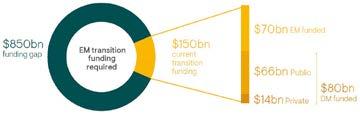
We launched our Emerging Markets Transition Debt (EMTD) strategy because we recognised that there will be no net zero without emerging markets. Not only do EM economies account for over 60% of today’s emissions but they are also on a trajectory to represent 90% of emissions growth by 2030 5 . Compounding this problem is the vast amount of unallocated capital required to alter this trajectory (US$850 billion annually, excluding China) 6 . Our ability to deliver a compelling risk-return profile to investors is essential to our broader focus on mobilising capital to help fill the current financing void.
EMTD integrates public credit, private credit, and infrastructure lending, reflecting our view that transition finance requires a broad set of tools to impactfully follow the carbon. This blend of assets allows us to:
Engage with companies in heavy-emitting industries that are implementing carbon-reduction measures to lower greenhouse gas emissions in the near term (typically via public market credit investments);
Invest in the long-term infrastructure assets that drive multi-generational sustainability; and
Lend to smaller, innovating companies that can help avoid carbon through new solutions (typically via private credit investments).
Our proprietary transition impact assessment framework (described below) ensures each investment promotes real-world transition. To be included in the portfolio, a company or project needs clear and credible short-term plans to reduce and/or avoid emissions by 2030. Investment process Investing at the intersection of return and impact
and origination
We incorporate the Sustainable Markets Initiative’s Transition Categorisation framework to define transitioning companies. Among the three core groups that we focus on for EMTD, the first are those companies providing carbon-avoiding activities (primarily renewable energy) with minimal emissions (‘transitioning’); the second are those that are ‘committed to transition’ in high-emitting sectors and have a credible transition plan (hard-to-abate industries that have mostly been outsourced to EM, like steel and cement production); and the third are the ‘transition enablers’ that provide a good or service that is essential for the decarbonisation of another sector. All investments made by the EMTD strategy must qualify for one of these three categories.
Transitioning/ mitigating Asset
Has a Paris-aligned pathway OR
Contributes significantly to carbon mitigation OR
Emission intensity may be close to or near net zero Is generating ~85% green revenue.
Committed to transition Asset
Is committed to net zero and contributes to carbon mitigation
BUT requires significant transition investment to achieve a Paris-aligned pathway.
Transition enabler
Asset
Is required to enable the transition to net zero for other sectors
May not have a Parisaligned pathway Is committed to net zero
Once an investment is successfully classified, we calculate our expectation of the issuer’s ability to generate carbon avoided and/or reduced before 2030, which we quantify as tonnes of CO₂e mitigated on a gross cumulative basis to 2030.
Carbon mitigation forms the basis of our quantification of company/project impact. The metrics we use are defined as follows:
Carbon avoided
Emissions that would have occurred under a higher-carbon alternative but are avoided through the company or project’s activities, solutions or services. This calculation follows the Carbon Avoided Emission Dataset (CAED), developed by Ninety One in collaboration with the Carbon Disclosure Project (CDP). Example: A renewable energy producer.
Carbon reduced
Expected reductions in emissions based on the company’s reporting, transition plans, and targets. Example: An iron ore producer switching to green energy sources.
Together, these measures provide a forward-looking and evidencebased assessment of an issuer’s climate contribution.
Source: Ninety One. For illustrative purposes only. SMI Transition Categorisation Framework . For further information on investment process, please see the Important information section.
A year in review
After launching the strategy in April 2024, and taking advantage of the public markets to fully invest the strategy, we have since focused on ramping up capital deployment into the private markets. We closed our first private deal in November 2024, with deal activity continuing at a steady pace since then. At the time of writing (end December 2025) we have reached commercial close on 12 private deals within the EMTD portfolio.
November 2024
Project Istanbul Green
Financing clean transportation in Istanbul in line with city’s net zero 2050 commitment.
Project Biscuit
Net zero committed food producer in Turkey; sustainability-linked KPIs. (Exited in October 2025)
February 2025
March 2025
Project Latam Solar
Lending to the largest solar module manufacturer outside of China against 11 projects in Brazil.
Project Connect Brazil
Manufacturing transmission and distribution lines for expanding local grid.
April 2025
For further information on specific portfolio names, please see the Important information section.
June 2025
Project Latam Data
Filling the data-centre gap in Latin America in partnership with a renewable power producer.
Project Towers for Africa
Supporting telecom decarbonisation across frontier markets.
Project India Green
Indian renewables business investing in green molecules.
July 2025
September 2025
Project Frio
Low-carbon cold storage logistics in Latin America.
Project Bessy
Optimising renewable assets in Chile.
Project Globe
Supporting largest renewable developer in Latin America.
Project Scale
Supporting clean digital infrastructure across Chile.
Project Fesi
Essential renewable infrastructure in the Philippines.
December 2025
For further information on specific portfolio names, please see the Important information section.
Foreword to the dashboard
The challenge of measurement in the world of transition finance
This report aims to provide a transparent assessment of the potential impact and sustainability characteristics of the issuers in the EMTD portfolio. Quantitative metrics form an important foundation for this analysis. However, these figures should be interpreted with care. Data limitations remain significant across emerging markets, where sustainability disclosure is still developing and generally lags the standards seen in developed markets. As a result, portions of the information presented rely on estimates derived from available assumptions and company reported data. These inputs are subject to change and may not always capture the full range of underlying emissions or transition activity.
This is particularly evident in carbon-emissions reporting. While almost two thirds of portfolio issuers disclose Scope 1 and Scope 2 emissions, only 37% currently report Scope 3 emissions. Of course, across the carbon reduced holdings, all of those companies report on scope 1 and 2 emissions and this is how we track their progress and hold them to account. These disclosures and modelled emissions form the basis for the carbon avoided and carbon reduced projections referenced in this report, and the associated output should be viewed as indicative rather than definitive.
Despite these constraints, the quantitative metrics provide a useful signal. They help identify the key contributors to portfoliolevel impact at the regional, sector and issuer level, and they support a consistent, direction-of-travel assessment. We intend to update and track these metrics annually to reflect improvements in underlying data, and to monitor how companies are progressing in their contribution to the emerging market energy transition.
Advocacy also plays an important role in improving the quality and consistency of transition-related data. Meaningful progress will require clearer market standards and more comprehensive disclosure from issuers across emerging markets. We are actively engaged in this effort. The advocacy section later in this report outlines the work we have undertaken with industry bodies and peers to support the development of more robust transitionfinance disclosures.
Transition dashboard
The portfolio through the lens of our Transition framework as at 30 June 2025.
Projected gross cumulative carbon mitigated to 2030
817m tCO2e of which:
Proportion of portfolio (ex-cash)7
Sustainable investments8
Carbon reduced investments with approved or committed to science-based targets
tCO 2 e Carbon reduced
Carbon avoided
473 m
344 m tCO 2 e
Portfolio (ex-cash) breakdown by carbon mitigation
Green or sustainability-linked investments
Portfolio (ex-cash) breakdown by transition classification
916 k tCO2e of which:
163 k tCO 2 e Scope 1 and 2
753 k tCO 2 e Scope 3 Financed Emissions9
Breakdown of gross cumulative carbon mitigated to 2030 by transition classification (tCO2e)
7. As at 30 June 2025, cash = 15.3% of portfolio.
8. As defined under Article 2(17) of EU SFDR. The EMTD operates in line with Article 8 with a 51% minimum proportion of Sustainable Investments. Totals may not sum exactly due to rounding.
9. Emissions that are attributable to the capital provided to companies and assets via the portfolio’s investments.
Source: Ninety One. Portfolio holdings as at 30
Advocacy to advance the field of transition finance
Only a few years ago, there was no framework for investors to identify what is and what is not a ‘transition investment’. To tackle this, the Asset Manager and Asset Owner Task Force (under the Sustainable Markets Initiative – SMI – umbrella) established a Transition Finance working group in 2022. As part of this Task Force, Ninety One helped to develop the Transition Categorisation Framework approach, which underpins the Emerging Markets Transition Debt strategy. Published in January 2023 and now referred to as the SMI ‘Transition Categorisation’ framework, the approach helps investors to identify companies that are on a credible pathway to net zero or enablers of transition, thus marking an important milestone in the field of transition finance.
More recently, we contributed to a study commissioned by the UK government to develop recommendations for policymakers, financial institutions and professional services companies on how to scale transition finance in the UK and globally. The Transition Finance Market Review (TFMR) was published in October 2024 and aligns closely to our perspectives; we continue to support the TFMR through participation in two working groups. We have also contributed to the IIGCC report ‘The UK as a climate finance hub: Unlocking Capital from Institutional Investors Towards EMDEs’, which provides recommendations to the UK government for mobilising private finance at scale. As a result of the recommendations from the report, the UK government and leading financial institutions, including Ninety One, launched the Emerging Markets and Developing Economies (EMDE) Investor Taskforce, to accelerate the growth of sustainable and transition investing in emerging markets. Hendrik du Toit, Ninety One’s CEO, serves as the industry co-chair for the Taskforce.
In April 2025, we convened chief investment and risk officers from asset owners and managers across the industry during the IMF/World Bank spring meetings, in collaboration with the Investor Leadership Network and the Rockefeller Foundation. This engagement focused on surfacing and addressing the risk and risk-perception barriers that hold back institutional capital from flowing into emerging markets. By championing capital mobilisation into emerging markets, we are not only advocating for a more equitable transition but also unlocking untapped return potential for our clients.
In the third quarter of 2025, in our response to the UK transitionplan consultation, we supported efforts to improve transparency and credibility in corporate transition planning; we emphasised that asset managers’ primary responsibility is to deliver investment outcomes in line with client mandates, while enabling the realeconomy transition through capital allocation and engagement.
At the time of writing (December 2025), we had just returned from events in Brazil around COP30. While it was light on major announcements, the final text represented a strong commitment to the Paris goals from 195 countries, with notable progress on advancing implementation and an important focus on adaptation and a ‘just transition’. Furthermore, it is very easy to become despondent about progress amid the headlines, but a longer-term perspective can be helpful: at the time of the Paris COP in 2015, the projected temperature increase based on then-current policies was +4 degrees; today it’s +2.6 degrees if NDCs are fully implemented. Regional shifts are also in evidence - while at earlier COPs, the question was whether China would ever seriously tackle climate challenges; now China is the world’s first ‘electrostate’ and (by a wide margin) the world’s biggest clean-tech producer. And outside of COP, we’re seeing rapid adoption of clean/electrotech as it’s cheaper, better and more efficient; as outlined at the start of this report – the investment opportunities around this are really taking off.
Nazmeera Moola Chief Commercial Officer, Private Markets

Daisy Streatfeild Chief Sustainability Officer

Country-level focus: Brazil
Investing in Brazil’s low-carbon economic transition
A transitioning economy
With 88% of its electricity already generated from renewables, Brazil starts from a position of strength. There is also positive momentum on emissions under President Lula, who has prioritised climate commitments. Targeting net zero emissions by 2050, the government has passed a landmark National Energy Transition Law, and positioned itself as a global climate convener in the context of hosting COP30 in Belém in November 2025.
A useful template for transition investors
Brazil provides a neat template for investors in the transition, showcasing how emerging markets can lead the transition and how private and public capital can benefit from and support this. The portfolio’s investment footprint across Brazil – summarised on the following page – illustrates a systems-level approach to transition investing. Generation, transmission, consumption and resource enablement – all within a single economy charting its own course
Offering significant investment potential
Power demand in Brazil is growing fast, driven by a population of over 210 million and a burgeoning digital economy. Under current projections from Enerdata and official government plans, electricity consumption is set to increase strongly over the next 15 years. If these trends persist, we could see a more than 50% power demand increase by 2040, putting pressure on the grid and requiring massive investment in generation, transmission and storage. Yet Brazil is well placed to meet these challenges: solar costs have fallen, onshore wind is abundant and bioenergy remains a viable backup. With a decentralised grid and competitive energy auctions, Brazil’s energy market offers an attractive structural backdrop for transition finance investors.
Brazil
Decarbonising Brazil’s energy value chain; from extraction to consumption
46.8m
EMTD Brazilian issuer cumulative carbon mitigation potential to 2030
1
Low-carbon extraction of transition minerals
Net Zero committed Nexa Resources has an ambition to be a world leader in low emissions zinc production.
0.03m
Carbon reduced to 2030
Transmitting power from source to use 3
Project Connect Brazil is part of the expansion of a more sustainable Brazilian grid by financing a company that manufactures aluminium rods and wirelines for the local transmission and distribution sector.
17.3m
Carbon avoided to 2030
Low carbon data centres 4
Project LatAm Data is meeting the data centre need in Brazil and beyond with a sustainable, long-term solution. The company is committed to 100% renewable power usage across its platform.
0.04m
Carbon reduced to 2030
Generation of low-carbon power 2
Through Project LatAm Solar, we are investing in the largest solar manufacturer outside of China. The company is building out 11 utility-scale solar assets.
2.0m
Carbon avoided to 2030
Top contributors – holdings level
Top 5 contributors to carbon avoided
LG Energy Solution
Leading EV battery manufacturer with annual battery production capacity of about 280GWh. 90% of battery capacity used for EV batteries, the balance for energy storage systems and IT devices. The company has aggressive growth plans and is targeting an expansion to 540GWh/year in the near term. LG Energy Solution seeks to achieve carbon neutrality by 2050. By 2030, the company plans to focus on four key areas of carbon reduction: converting to 100% renewable energy, reusing waste batteries, eliminating human rights risks, and establishing a clean and transparent supply chain for raw materials and batteries that consider environment and human rights. Carbon avoided estimates are based on the company’s plans to expand to 540GWh/year by 2026.
SK On
SK On is the electric vehicle battery business of SK Innovation. SK On is targeting 100% renewable energy sources by 2030, and net zero by 2035. Current capacity is 40GWh, which the company is looking to expand to 220GWh. Carbon avoided estimate is based on the company’s 77GWh/year of battery production capacity, which is forecast to reach 180GWh/year by 2027.
Projected cumulative carbon avoided to 2030 (tCO2e)
118.1m
Projected cumulative carbon avoided to 2030 (tCO2e)
36.8m Risk country South Korea
Transition sector Transportation
JSW Hydro Energy
JSW Hydro operates two large run-of-river hydropower plants in Himachal Pradesh with a combined 1.6 GW of installed capacity. Long-term availability-based purchase-power agreements (PPAs) and a strong operating track record underpin stable renewable generation. With a relatively high grid emission factor and a consistent 50% utilisation rate, the assets deliver meaningful avoided emissions while supporting India’s broader shift from coal to zero-carbon baseload power.
Project Connect Brazil
Alubar is a critical supplier of aluminium rods and wire used in Brazil’s expanding transmission network, providing close to 80% of the conductors installed under current concessions. Its products enable large-scale electrification and the integration of renewable power across the grid. The carbon-avoided estimate accounts for the lifecycle emissions of wire and cable, offset by the significant system-level benefits of modern transmission. The company remains an important enabler of Brazil’s energy transition through its role in strengthening grid infrastructure with sustainable input materials.
Empresas Publicas de Medellin ESP
Projected cumulative carbon avoided to 2030 (tCO2e)
34.6m
Transition sector Power
Risk country
India
Transition classification
Transitioning
Projected cumulative carbon avoided to 2030 (tCO2e)
17.3m
Transition sector Power
Risk country
Brazil
Transition classification
Transition enabler
EPM is one of Colombia’s largest power utilities, with a predominantly hydro-based generation fleet and 3.1GW of capacity in Colombia. Its hydro assets operate at high utilisation levels and displace materially more carbon-intensive thermal generation in the national grid. The portfolio’s contribution to avoided emissions reflects both the scale of EPM’s operations and the relatively low emissions factor of clean Colombian hydro, reinforcing the company’s role in supporting Colombia’s long-term decarbonisation path. Carbon avoided
Projected cumulative carbon avoided to 2030 (tCO2e)
17.3m
Transition sector Power
Risk country
Colombia
Transition classification
Transitioning
Top contributors – holdings level
Top 5 contributors to carbon reduced
Fortescue
Fortescue is one of the world’s largest iron ore producers and has set some of the most ambitious decarbonisation targets in the mining sector, including net zero Scope 1 and 2 emissions by 2030 and net zero Scope 3 by 2040. Its dedicated US$6.2 billion transition capex programme spans full renewable electrification of operations, conversion of haulage and drilling fleets, and expansion into green hydrogen through Fortescue Future Industries. The carbon-reduced estimate reflects both substantial operational abatement and early progress on Scope 3 intensity reduction across the value chain.
Projected cumulative carbon reduced to 2030 (tCO2e)
166.7m
Transition sector
Industrial
Risk country Australia/ China
Transition classification Committed to transition
CEMEX
CEMEX is a global cement producer with SBTivalidated 1.5°C targets, including a 31% reduction in Scope 1 intensity and a 58% reduction in Scope 2 by 2030. The company is deploying lower-carbon clinker technologies, expanding renewable power sourcing and accelerating alternative fuels, while also investing in innovation such as solar-fired kilns and hydrogen-enabled processes. Its planned shift from 520kg to 430kg CO₂ per ton of cementitious material underpins the portfolio’s carbon-reduced contribution and reflects a credible pathway for one of the most emissions-intensive industries.
Projected cumulative carbon reduced to 2030 (tCO2e)
63.0m
Transition sector
Industrial
Risk country Mexico
Transition classification
Committed to transition
Alibaba
Alibaba has committed to achieving carbon-neutral operations by 2030 and reducing Scope 3 emissions intensity by 50% relative to 2020. Given the scale of its logistics, cloud and e-commerce ecosystem, Scope 3 represents the bulk of its footprint; the reduction potential derives from improvements in data-centre efficiency, renewable energy procurement, supplychain decarbonisation and lower-carbon delivery solutions. The company’s reach across the Chinese consumer and digital economy makes these efficiency gains meaningful at system level.
Project Istanbul Green
This project finances the expansion of Istanbul’s electric metro and tram network, supporting the city’s 2050 net zero target. The investment enables the procurement of 100 metro and 34 tram vehicles in a highly congested urban centre. The carbon-reduction contribution reflects avoided combustion-engine kilometres across a transport system where mobility already represents over 20% of Turkey’s emissions. The transaction also benefits from strong municipal credit fundamentals and multilateral support.
CIMA Finance
CIMA Finance is a Chilean industrial issuer whose activities support the decarbonisation of copper production at Minera Escondida, one of the world’s largest mining operations. The structure finances the early termination of legacy thermal PPAs and enables a shift toward significantly lower-carbon electricity sources for the mine. Given Chile’s rapidly greening grid and the scale of Escondida’s energy use, the transition away from fossil-fuel generation delivers substantial system-level emissions reductions. The carbon-reduced estimate reflects the long-dated displacement of higheremitting power and the resulting improvement in the emissions profile of one of Chile’s most energy-intensive industrial assets.
Projected cumulative carbon reduced to 2030 (tCO2e)
32.6m
Transition sector
Other (TMT)
Risk country
China
Transition classification
Committed to transition
Projected cumulative carbon reduced to 2030 (tCO2e)
25.2m
Transition sector
Transportation
Risk country Turkey
Transition classification
Committed to transition
Carbon reduced
Projected cumulative carbon reduced to 2030 (tCO2e)
23.0m
Transition sector
Industrial
Risk country Chile
Transition classification
Transition enabler
Top contributors – holdings level
Top 5 contributors to Financed Emissions
From a sustainability and carbon emissions downside risk perspective, it is also important that we consider the key contributors to carbon emissions across the portfolio holdings.
Alpek
Alpek is a leading petrochemicals producer with exposure across polyester, plastics and related value chains. The company sits in a carbon-intensive segment where both process emissions and downstream product use drive high Financed Emissions per unit of invested capital. We hold Alpek because it operates essential industrial assets and has begun to improve energy efficiency and product mix, creating measurable carbon reduction potential from a high baseline. The company remains under ongoing scrutiny in the portfolio, with progress on decarbonisation a key driver of position sizing over time.
Braskem
Braskem is the largest thermoplastics producer in the Americas, supplying polyethylene, polypropylene and PVC that are critical inputs to modern industry. Its Financed Emissions are elevated because steam cracking and polymer production are energy intensive and it operates a large global asset base across Brazil, Mexico, the United States and Europe. We are comfortable owning Braskem as a high emitting name in transition given its scale, improving balance sheet and ongoing investments in feedstock diversification, energy efficiency and higher value applications. This gives scope to reduce carbon intensity and support lower carbon plastics solutions over time.
6.0m
Transition sector
Industrial Financed Emissions (Scope 1-3) (tCO2e)
Risk country Mexico
Transition classification
Committed to transition
Financed Emissions (Scope 1-3) (tCO2e)
4.4m
Transition sector
Industrial
Risk country Brazil
Transition classification
Committed to transition
FMG Resources
Fortescue is one of the world’s largest iron ore exporters and a core supplier to the global steel industry, which structurally carries very high Scope 3 emissions. Financed Emissions are therefore significant, reflecting both the scale of its mining operations and the downstream emissions from steel production. The holding is justified by Fortescue’s aggressive decarbonisation commitments, including net zero Scope 1 and 2 by 2030 and net zero Scope 3 by 2040, and its dedicated Fortescue Future Industries platform, which is investing heavily in green hydrogen and low-carbon mining technologies. This combination of strong balance sheet, low-cost ore and industry leading climate ambition makes it a credible high emitter in transition.
Sappi Papier
Sappi is a global woodfibre business producing dissolving pulp, packaging and speciality papers and graphic papers across mills in Europe, North America and Southern Africa. Financed Emissions are high due to energy intensive pulp and paper processes and significant use of steam and power across its mills. We are comfortable with Sappi’s inclusion because it has SBTi validated emission reduction targets, is shifting capacity away from declining graphic papers toward more sustainable packaging grades, and is investing around US$60-70 million per year in decarbonisation. Its owned and certified forestry assets, water stewardship commitments and credible pathway to reduce Scope 1 and 2 intensity support a carbon reduction narrative from a high starting point.
SK On
Financed Emissions (Scope 1-3) (tCO2e)
3.5m
Transition sector
Industrial
Risk country
Australia/ China
Transition classification Committed to transition
Financed Emissions (Scope 1-3) (tCO2e)
3.3m
Transition sector
Agriculture
Risk country South Africa
Transition classification Committed to transition
SK On is a top tier global producer of lithium-ion batteries for electric vehicles and energy storage systems, with rapidly expanding capacity in Asia, Europe and the United States. Financed Emissions appear high because battery manufacturing has a complex, energy intensive supply chain and significant embedded Scope 3 emissions from upstream materials. We are comfortable holding SK On because its products are critical to decarbonising road transport and enabling large scale storage of renewable power, generating substantial carbon avoided at system level. The company has also committed to 100 percent renewable electricity by 2030 and net zero by 2035, which should progressively lower the emissions intensity of each unit of battery produced. Carbon
Financed Emissions (Scope 1-3) (tCO2e)
3.0m
Transition sector
Agriculture
Risk country South Korea
Transition classification
Transition enabler
Transition-related resources at Ninety One
Emerging Markets Transition Debt: hidden strengths in overlooked places
A closer look at some of the private loans in the EMTD portfolio.
Tapping into the global energy transition

Managing Principal Matt Christ explains how investments in EM private credit offer both compelling return potential and the chance to make a meaningful contribution to global climate goals.


An introduction to the EM transition finance opportunity.
For more information on this Strategy, please see the strategy profile
Please note that
A deeper dive into the field of private debt investing in emerging markets.
Glossary
Please note that the definitions in this glossary reflect the context in which the terms are used in this report.
Carbon avoided
The volume of greenhouse gas emissions avoided due to products, technologies and services that result in fewer emissions than the status quo products, technologies and services.
Carbon reduced
Investments in companies or countries that are reducing emissions with a credible trajectory towards net zero.
Decarbonisation
The process of transitioning to a lower-carbon economy, including switching to renewable energy, increasing resource efficiency and electrifying transport and industrial processes (i.e., powering machines by electricity instead of higher-carbon power sources).
Financed Emissions
Emissions that are attributable to Ninety One’s investment activities, through the capital it provides to companies and assets.
Green bonds
The issuer commits to allocating all the proceeds to specific green projects, such as renewable energy, green transport, green building or water management, generally complying with a taxonomy such as ICMA’s Green Bonds Principles.
Greenhouse gases
Any gas (including carbon dioxide and methane) that contributes to the greenhouse effect (i.e., they trap heat in the atmosphere)
Net zero
Achieving a balance between the carbon emitted into the atmosphere, and the carbon removed from it.
NDCs
Nationally Determined Contributions (country-level emissions-reductions commitments).
Science-based (emissions/net zero) target
An emissions reduction target (and plan to achieve it) that is aligned with the goals of the Paris Agreement - limiting global warming to 1.5 o C above pre-industrial levels - based on the latest climate science.
Science Based Targets initiative (SBTi)
An organisation that seeks to assist companies to set science-based emissions reduction targets, and that validates whether companies’ emissions targets have met its criteria.
Scope 1, 2 and 3 carbon emissions
Categories of greenhouse gas emissions: Scope 1 - All direct emissions from activities of a business or under its control. This includes fuel combustion on site such as heating boilers and vehicles. Scope 2 - Indirect emissions from energy purchased and consumed by a business. Emissions are created during the production of the energy which is eventually used by the business. Scope 3 - All indirect emissions not in Scope 2 i.e., from a business’s activities, but from sources that it does not own or control. Also known as value chain emissions, this is often the greatest proportion of the carbon footprint and covers emissions associated with business travel, procurement, waste and water.
Sustainability-linked
bonds (SLB)
Rather than attaching proceeds to specific green or social projects, SLBs have set sustainability targets (KPIs) that must be achieved in future, e.g., reducing greenhouse gas emissions in line with the country’s NDCs or increasing the use of renewables. If targets are missed, the issuer incurs a penalty in the form of increased coupon payments.
Important information
The information may discuss general market activity or industry trends and is not intended to be relied upon as a forecast, research or investment advice. The economic and market views presented herein reflect Ninety One’s judgment as at the date shown and are subject to change without notice. There is no guarantee that views and opinions expressed will be correct and may not reflect those of Ninety One as a whole, different views may be expressed based on different investment objectives. Although we believe any information obtained from external sources to be reliable, we have not independently verified it, and we cannot guarantee its accuracy or completeness (ESG-related data is still at an early stage with considerable variation in estimates and disclosure across companies. Double counting is inherent in all aggregate carbon data). Ninety One’s internal data may not be audited. Ninety One does not provide legal or tax advice. Prospective investors should consult their tax advisors before making tax-related investment decisions.
Nothing herein should be construed as an offer to enter into any contract, investment advice, a recommendation of any kind, a solicitation of clients, or an offer to invest in any particular fund, product, investment vehicle or derivative. Investment involves risks. Past performance is not indicative of future performance. Any decision to invest in strategies described herein should be made after reviewing the offering document and conducting such investigation as an investor deems necessary and consulting its own legal, accounting and tax advisors in order to make an independent determination of suitability and consequences of such an investment. This material does not purport to be a complete summary of all the risks associated with this Strategy. A description of risks associated with this Strategy can be found in the offering or other disclosure documents. Copies of such documents are available free of charge upon request.
In the US, this communication should only be read by Institutional Investors (Accredited Investors and Qualified Purchasers), Financial Advisors (FINRA-registered Broker Dealers) and, at their exclusive discretion, their eligible clients. It must not be distributed to US Persons apart from the aforementioned recipients. THIS INVESTMENT IS NOT FOR SALE TO US PERSONS EXCEPT ACCREDITED INVESTORS AND QUALIFIED PURCHASERS. Note that returns will be reduced by management fees and that investment advisory fees can be found in Form ADV Part 2A.
In Australia, this document is provided for general information only to wholesale clients (as defined in the Corporations Act 2001).
In Hong Kong, it is for professional investors only, issued by Ninety One Hong Kong Limited and has not been reviewed by the Securities and Futures Commission (SFC). In Singapore, it is for institutional investors only, issued by Ninety One Singapore Pte Limited (company registration number: 201220398M) and has not been reviewed by the Monetary Authority of Singapore. In the People’s Republic of China (the ‘PRC’), it can be directed only at certain eligible PRC investors as prescribed by applicable PRC laws. In Taiwan, it is for professional institutional investors only. In Indonesia, Thailand, the Philippines and Brunei, it is for institutional investors and other qualified investors only. For Korean and Malaysian clients this material has been issued to you upon your request, without any marketing or solicitation activities conducted by Ninety One. All information contained in this material is factual information and does not reflect any opinion or judgment of Ninety One. The information contained in this material should not be construed as an offer, marketing, solicitation or investment advice with respect to any investment products or services. The website mentioned in this communication has not been reviewed or approved by any regulatory authority in any Asia jurisdictions, and may contain information with respect to investments products that may not be registered in some jurisdictions.
Ninety One Botswana Proprietary Limited, Plot 64289, First floor, Tlokweng Road, Fairgrounds, Gaborone, PO Box 49, Botswana, is regulated by the Non-Bank Financial Institutions Regulatory Authority. In Namibia, Ninety One Asset Management Namibia (Pty) Ltd is regulated by the Namibia Financial Institutions Supervisory Authority. In South Africa, Ninety One is an authorised financial services provider.
Except as otherwise authorised, this information may not be shown, copied, transmitted, or otherwise given to any third party without Ninety One’s prior written consent. © 2026 Ninety One. All rights reserved. Issued by Ninety One, January 2026.
Additional information on our investment strategies can be provided on request.
Investment Process
Any description or information regarding investment process or strategies is provided for illustrative purposes only, may not be fully indicative of any present or future investments and may be changed at the discretion of the manager without notice. References to specific investments, strategies or investment vehicles are for illustrative purposes only and should not be relied upon as a recommendation to purchase or sell such investments or to engage in any particular Fund. Portfolio data is expected to change and there is no assurance that the actual portfolio will remain as described herein. There is no assurance that the investments presented will be available in the future at the levels presented, with the same characteristics or be available at all. Past performance is no guarantee of future results and has no bearing upon the ability of Manager to construct the illustrative portfolio and implement its investment Fund or investment objective.
Specific Portfolio Names
References to particular investments or strategies are for illustrative purposes only and should not be seen as a buy, sell or hold recommendation. Such references are not a complete list and other positions, strategies, or vehicles may experience results which differ, perhaps materially, from those presented herein due to different investment objectives, guidelines or market conditions. The securities or investment products mentioned in this document may not have been registered in any jurisdiction. More information is available upon request.
Australia
Level 28 Suite 3, Chifley Tower 2 Chifley Square
Sydney, NSW 2000
Telephone: +61 2 9160 8400 australia@ninetyone.com
Botswana
Plot 64289, First floor Tlokweng Road, Fairgrounds Gaborone PO Box 49 Botswana
Telephone: +267 318 0112 botswanaclientservice@ninetyone.com
Channel Islands
PO Box 250, St Peter Port Guernsey, GY1 3QH
Telephone: +44 (0)1481 710 404 enquiries@ninetyone.com
Germany
Bockenheimer Landstraße 23 60325 Frankfurt am Main
Telephone: +49 (0)69 7158 5900 deutschland@ninetyone.com
Hong Kong
Suites 1201-1206, 12/F One Pacific Place 88 Queensway, Admiralty Telephone: +852 2861 6888 hongkong@ninetyone.com
Luxembourg 2-4, Avenue Marie-Thérèse L-2132 Luxembourg
Telephone: +352 28 12 77 20 enquiries@ninetyone.com
Namibia
Am Weinberg Estate
Winterhoek Building 1st Floor, West Office 13 Jan Jonker Avenue Windhoek
Telephone: +264 (61) 389 500 namibia@ninetyone.com
Netherlands
Johan de Wittlaan 7 2517 JR Den Haag
Netherlands Telephone: +31 70 701 3652 enquiries@ninetyone.com
Singapore 138 Market Street
CapitaGreen #27-02
Singapore 048946
Telephone: +65 6653 5550 singapore@ninetyone.com
www.ninetyone.com
South Africa
36 Hans Strijdom Avenue Foreshore, Cape Town 8001 Telephone: +27 (0)21 901 1000 enquiries@ninetyone.com
Sweden
Västra Trädgårdsgatan 15, 111 53 Stockholm Telephone: +46 8 502 438 20 enquiries@ninetyone.com
Switzerland Dufourstrasse 49 8008 Zurich Telephone: +41 44 262 00 44 enquiries@ninetyone.com
United Kingdom
55 Gresham Street
London, EC2V 7EL Telephone: +44 (0)20 3938 1900 enquiries@ninetyone.com
United States
Park Avenue Tower, 65 East 55th Street
New York, 10022 US Toll Free: +1 800 434 5623 usa@ninetyone.com
Telephone calls may be recorded for training, monitoring and regulatory purposes and to confirm investors’ instructions. For more details please visit www.ninetyone.com/contactus