SPACES
ARCHITECTS
INTERIOR DESIGNERS
DEVELOPERS

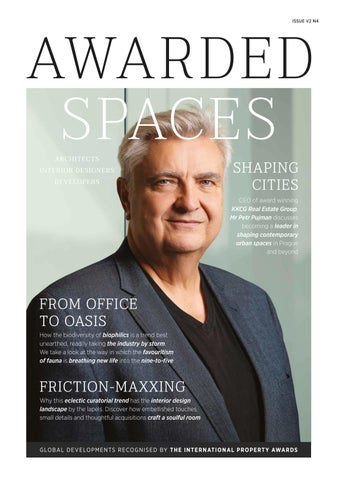
SHAPING CITIES
CEO of award winning KKCG Real Estate Group, Mr Petr Pujman discusses becoming a leader in shaping contemporary urban spaces in Prague and beyond
FROM OFFICE TO OASIS
How the biodiversity of biophilics is a trend best unearthed, readily taking the industry by storm We take a look at the way in which the favouritism of fauna is breathing new life into the nine-to-five
FRICTION-MAXXING
Why this eclectic curatorial trend has the interior design landscape by the lapels. Discover how embellished touches, small details and thoughtful acquisitions craft a soulful room
GLOBAL DEVELOPMENTS RECOGNISED BY THE INTERNATIONAL PROPERTY AWARDS


WELCOME

FEATURES EDITOR
Nadége Elyse Mustafa nadege@ipropertymedia.com
CONTRIBUTING EDITOR
Nese Jones
DESIGN & PRODUCTION TEAM
Andrew Cockburn andrew@ipropertymedia.com
Emma Baxter emma@ipropertymedia.com
Jo Higgs jo@ipropertymedia.com
PUBLISHER
Stuart Shield stuart@ipropertymedia.com
PUBLISHED BY International Property Media
© INTERNATIONAL PROPERTY MEDIA 2026
While great care has been taken in the receipt and handling of material, production and accuracy of content in this magazine, the publishers will not accept any responsibility for any errors, loss or omissions which may occur. The publishers would like to thank all those companies and individuals who took part in the magazine and wish them every success.
If you would like to feature in the next edition of Awarded Spaces , please contact Nese Jones via the details above.
an ever-evolving creative sphere, Awarded Spaces acts as THE architectural muse. We continue to unpack the movements, meanings, and monologues behind some of the industry’s most seasoned insiders, those pioneering the design landscape with audacity, vision, and craftsmanship.
Platforming the winners of the International Property Awards and beyond, with access to some of the world’s leading interiors, architecture, suppliers, and tastemakers, Awarded Spaces provides an unparalleled window into the top-tier world of visual culture, revealing not just spaces but the philosophy and poetics behind them.
Revolutionising with their industry takeover, creating experiences as well as environments, KKCG Real Estate Group peel back the layers of their genius, shedding light on the meticulous process behind enacting an urban vision that seamlessly fuses innovation with context.
The conversation around workplace wellbeing continues, with Snøhetta Studio and Perkins & Will leading the way in discussing the biophilic renaissance of the nine-to-five, exploring how greener approaches to living and working are fundamental to a future where mind, body, and soul exist in full alignment, and design becomes restorative rather than purely functional.
Friction-Maxxing, the interior design trend taking the landscape by the lapels, is explored through the eyes of those who exude stylistic effervescence, taking us inside both their everso-chic spaces and the even chicer minds behind them, where creativity is simultaneously wild, meticulous, and liberating.
Continuing the discourse, Çuhadaroğlu Metal Sanayi ve Pazarlama A.Ş.’s work on the Crescent Development Project rewires perception with its sleek finish, blending technical mastery with poetic sensibility, reminding us that architecture is as much about human experience as it is about form and material.


CONTENTS
FROM OFFICE TO OASIS
Grounding our experiences and environment in the natural world has become more than a trend – it is a deliberate response to the modern condition. Pioneering studios such as Snøhetta and Perkins & Will set the tone in modern office wellbeing and thoughtfully designed biophilic working structures

MR PETR PUJMAN
SHAPING CITIES
KKCG Group is a leader in shaping modern urban spaces in Prague and beyond. An interview with KKCG Chairman, Mr Petr Pujman, on KKCG’s vision and its approach to redefining city living
FRICTION-MAXXING
The design trend that has the landscape by the lapels. In a fusion and flurry of tactile prints, finishes and furniture, Libby Carter & Co, Hannah Cowell and Alice Molloy Interiors lead the way with spaces that exude effortless chic, refined elegance, timeless sophistication and beautifully layered depth.
SHOWCASE PROJECTS
Dive into the glamorous world of the International Property Awards, highlighting outstanding participants and companies from our European 2025-2026 awards: CGA Architects project: Yin House. 31
BEYOND THE RECOGNITION
Read about IPAX Connect, the global networking platform where awards become ongoing opportunity. Discover how leading property professionals connect, collaborate, and grow beyond recognition through an active industry network built for long-term success and visibility and influence across the sector. 33
INDUSTRY HIGHLIGHTS
Covering winning companies from the International Property Awards 2025-2026, including INARC Design, AAG Development, and Modeko Studio to name a few. We find out what made these companies stand out from the crowd and their potential for this year’s upcoming awards.
SHAPING CITIES An Interview with Mr Petr Pujman of KKCG

MR PETR PUJMAN
CEO, KKCG Real Estate Group
www.kkcgreg.com
Interview and Words by Nese
Jones
Contributing Editor, International Property Media
KKCG Real Estate, part of the international KKCG Group, is a leader in shaping modern urban spaces in Prague in the Czech Republic and beyond. Known for projects such as Bořislavka Centrum and Top Rezidence, the company blends architectural ambition with sustainability, innovation, and community focus. We spoke with Chairman Petr Pujman about the company’s vision and its approach to redefining urban living.
KKCG Group works across many industries. How does real estate align with the company’s overall strategy, and what role have you played in shaping its direction?
KKCG Real Estate Group is one of the four pillars of the KKCG Group. From the outset, it was clear that this would be a business that views real estate not just as a set of projects, but as long-term value creation.
In 2012, together with Karel Komárek and a team of colleagues, we defined a strategy that we continue to follow: to build projects that are synonymous with quality, sustainability, and a culture of living. We didn’t want to be a “developer,” but rather a creator of environments where people enjoy living and working.
From the outset, we set ourselves a simple rule: architecture must not only be beautiful to look at, but must also be great to live and work in – even after many years. That is why we always ask ourselves: how will people feel here after a year? And after ten years? If a project looks good but people do not enjoy living or working in it, then it is not fulfilling its function.
Our role within the KKCG Group is clear: to bring innovation, progress, and to set new
standards in the premium development segment. Real estate projects complement KKCG’s investment portfolio and embody the values of the entire group – long-term thinking, the courage to innovate, and respect for the environment and people. The successes of recent years confirm that this strategy was the right one. The market is developing in the direction we chose years ago, and the segments in which we operate are highly resistant to crisis cycles.
What is your long-term vision for the company, and how do you see your developments shaping urban life in Central Europe and beyond?
Our long-term vision remains unchanged: to build places where each of us would want to live. We don’t start with architecture, but with the question: “What do people love about this location, and why?” We draw inspiration from naturally functioning neighbourhoods. In Prague, there is the iconic Vinohrady neighbourhood – houses with shared courtyards, community gardens, and a lively parterre with cafés, restaurants, and services within walking distance. This creates a value that no technological innovation can replace: a sense of home and neighbourhood.
When designing new projects, we consciously choose solutions that support community and
neighbourly interaction. That’s why we work with the concept of shared greenery, neighbourhood gardens, and common areas in our projects. We often build row houses, which make efficient use of land and allow for the creation of compact, lively neighbourhoods.
We deliberately limit the number of units to create more community space and a higher quality of living. This philosophy pays off – people are willing to invest in an environment that has soul, character, and longterm value. Sharing space strengthens relationships, eliminates the anonymity of the big city, and increases residents’ responsibility for the place where they live. Where there is a relationship, care arises. This is how we influence urban life, by creating projects that are not “residential products,” but living communities.
As sustainability becomes a critical focus in real estate, how is KKCG Real Estate integrating environmental stewardship, technological innovation, and social responsibility into its development strategy?
Sustainability is fundamental to us, not just a marketing phrase. We perceive it on three levels: environmental, technological, and social.
In the environmental sphere, we realise that construction is one of the largest producers of waste. During a major renovation of an office building, we therefore decided to fully recycle all materials – from carpets to tiles. We recycled or sold everything that could be recycled or reused. Materials that would have ended up in a landfill were given a second chance. We want to apply this principle as standard. On the technological level, we use the most advanced solutions available: recuperation, geothermal drilling, and passive standards, and we are now testing the use of wastewater as an energy source for heat pumps. We have experts in our company whose sole job is to constantly search for new sustainable technologies and implement them in projects.

Social sustainability is based on the fact that people and relationships create the greatest value. Our projects support community functioning and residents’ responsibility towards the place where they live. Sustainability is not a material; it is a way of thinking.
We don’t build residential products – we create living communities with soul, character, and long-term value that shape how people experience urban life.
Looking ahead, what innovative concepts in residential or office design do you believe will define the next generation of urban living in Prague and beyond?
Real estate development today is driven by market realities: land is expensive and space is limited. We therefore see the future in increasing efficiency, not in expanding horizontally. We promote the concept of low-rise high-density.
This is not a revolution, but smart planning: more functions in a smaller space, compact urbanism, where everything important is within walking distance. Such an environment brings the highest quality of life. The key to innovation is not maximising the built-up area but maximising the quality of every square metre that creates value for residents. The future of urban living is simple: less space for cars, more space for people.

Given increasing costs and shifting market dynamics, what do you consider to be the key challenges and opportunities ahead for KKCG Real Estate?
The biggest challenge is to differentiate ourselves. We want to be the best at what we do, and the best are those who can offer real value. Land is still a key factor for success; finding the right location means understanding how the place will function in five, ten, or twenty years.
At the same time, construction methods are changing dramatically. We see the future in prefabrication. Technology must simplify and speed up the construction process. Most of the project will be created in production and then assembled on site like a building block. It is an effective way to respond to labour shortages and rising costs. Prefabrication brings higher quality, faster implementation, and a lower environmental impact.
The challenges are obvious. But the opportunities are even greater.
The future of urban living is not about building more, but about building smarter –creating compact, walkable neighbourhoods where quality of life comes from shared space, connection and thoughtful design.
Winning multiple awards for Top Rezidence is a significant global recognition. How do you see this achievement shaping your future projects and influencing international perceptions of urban development in your region?
We are pleased with the awards, but we do not see them as a goal. For us, they are confirmation that our path makes sense. They show that even a project from Czechia can succeed on a global level. Top Rezidence proves that the more you work with a detailed understanding of the place, the community, and the quality of life, the more value you create.
This success has inspired us to take the next step: we are entering London. We have already established a company there and are entering the market with the utmost humility and respect, but also with the determination to bring a different way of thinking. We want to do business in this exceptional market with the same philosophy as at home – to create a high-quality urban environment with high added value. We believe we have something to offer. Not just architecture, but a way of thinking.
KKCG Real Estate Group www.kkcgreg.com


A Contemporary Landmark
of Tropical Modernism
Standing as a bold intersection of form and function, the QUADRA Gallery Signature in the heart of Bali reimagines the retail experience through the lens of Tropical Modernism.
In a refined collaboration with 2M Associates, the project moves away from the traditional showroom, instead treating the building itself as a study in spatial volume and materiality.


in collaboration with

FROM OFFICE TO OASIS Workplace wellbeing through biophilic design
The biophilic renaissance continues, as it seems one can never quite get enough of a verdant accent to an interior, building or breakfast nook. Grounding our experiences and environment in the natural world is the way to go, as more than ever we crave a return to a time before modernisation had wiped clean any traces of green.

The design landscape has had to match pace, with Snøhetta and Perkins & Will setting the tone, taking us through how they masterfully curated spaces that reinvent how we live our day to day. With thought-out touches, dedication to routine, open, airy environments and a love for nature’s natural terrain, we are now seeing an approach that intentionally nourishes employees and their wellbeing. A truly interconnected climate is platformed.
From cultivating a habitat that feels rooted in the outdoors, to providing a complete redefinition of the shared workspace, it seems we all have something to learn. The ripple effects of these ground breaking spaces and what they have to say about how we should all be doing the nine-to-five, masterfully re-educates us.
As the modern workplace continues to evolve, biophilic design and its reflection of our innate human connection to nature has emerged as a vital framework for rethinking how and where we work. More than a passing trend, it is a thoughtful, evidencebased approach that transforms office environments into healthier, more engaging, and purpose-driven spaces. In today’s era of hybrid schedules, growing wellness priorities, and the search for meaningful spaces, biophilic principles are platforming the office as a dynamic, living breathing biosphere of its own.
We now look beyond the surface to uncover how these principles are being applied in practice, shaping not only the spaces we inhabit, but the ways in which we feel, perform and connect within them.
With the wellness retreat experience being brought to the work environment, we are all tentatively watching this new chapter further unravel.


Contributing
Snøhetta www.snohetta.com
A GREENER APPROACH
Designs that are shifting toward regenerative, nature-led environments
As the architectural world confronts the urgency of climate resilience, workplace design is undergoing a radical transformation. No longer content with token greenery or sustainable checklists, a new generation of projects is redefining what it means to bring nature into the heart of where we work. At the forefront of this shift is Snøhetta, the internationally acclaimed transdisciplinary studio known for its deeply contextual and human-centred designs.
From pioneering timber structures to immersive green landscapes, Snøhetta’s work exemplifies how nature can be thoughtfully, and innovatively, woven into every layer of the built environment. In this interview, we invite the studio to reflect on the principles, processes, and provocations shaping a truly regenerative approach to workplace architecture.
Snøhetta is known for embedding ecological sensitivity into its projects. How do you define a truly regenerative and humancentred workplace, and what design principles help you move beyond the pitfalls of greenwashing?
We know that with well-conceived design we can help things run more efficiently, improve people’s well-being, and make life more enjoyable.
And we know that every project is a unique expression of the character of its users, climate, and context. So, we try to take these factors into account as much as possible – focussing on the future users and their needs and responding appropriately to the context of the site. The aim is to deliver unique contextual and relevant projects that create unique working environments.
We aim to deliver unique, contextual projects that create working environments where nature is an active participant, not a decorative afterthought.
From timber structures to green courtyards, your work blurs inside and out — which strategies best foster a meaningful connection to nature in urban offices?
I think the most effective strategy is to rely on our contextual approach and find the most suitable connection to nature for each specific site. This can be a walk-on roof next to the sea like the Oslo Opera, a green façade with integrated balconies like the ASI building, fresh air provided by a natural ventilation like Vertikal Nydalen or green balconies like the LOVT Vibe building.
Beyond materials and aesthetics, how do you choreograph light, air, sound, and other sensory elements to support well-being and productivity?
The intention is to create a specific atmosphere related to the project and its context. When everything, all the individual issues such as air, light and sound come together in one concept – or in a deeper narrative, as you put it – then we are able to create unique spaces that ultimately create a sense of well-being. A joint narrative of designers, client, users and other stakeholders also establishes a sense of ownership for the building.
While technology and nature might seem at odds, how do you use advanced systems to create workplaces that are both intelligent and emotionally resonant?
High-tech and low-tech solutions often go hand in hand. Advanced technologies help to develop or implement low tech solutions, be it in the design or in the operations of buildings.
In brief, here are two examples related to natural ventilation: one on for the design one for the operation. The geometry of a building, at least of larger volumes, plays a key role in natural ventilation. Digital tools help to design, volumes in such a way that pressure differences are created that activate natural circulation of the air. To operate such systems, sensors constantly monitor the room climate (factors like room temperature, humidity, CO²) and then regulate the natural air flow, e.g., by opening and closing of ventilation flaps.
One important aspect is that users should still be given options (like the possibility to open windows) so that they don’t feel dominated by technology. To stay with the example, the better the system is customised, the less the user will feel the need to open the window to ventilate.
When shaping restorative yet functional environments, how do you engage clients, users, and communities to make nature an active participant rather than a decorative afterthought?
Snøhetta practices a self-defined transdisciplinary process in which different professionals – from architects to visual artists, philosophers to sociologists –exchange roles in order to explore differing perspectives without the prejudice of convention. When working with clients, this approach continues. We conduct concept workshops with all stakeholders. With this method we co-create a concept which will form the basis for design strategies. Such forums encourage holistic approaches and often produce the most exciting, useful, and fresh takes on a problem. And it creates an identification of different stakeholders with the project.
In projects like Asi Reisen Headquarters, with timber, green facades, and daylight-filled interiors, what guides your integration of structure and nature, and how does local context shape your approach?
The design concept for the ASI Reisen Headquarters is inspired by the idea of symbiosis between nature and humanity. This guiding idea was developed together with ASI Reisen’s employees and the design team from Snøhetta – in the mentioned workshop format. The company offers sustainable trekking experiences around the world and the design for the new office space reflects the company’s working culture and its commitment to sustainability. In response to the concept and the local context, a “green curtain” of climbing plants blends the building harmoniously into the forest surroundings.

WHEN NATURE MOVES IN A biophilic approach to work-life balance
A biophilic approach to work life balance is a trend best unearthed. As the contemporary office evolves, light, air and landscape are set to mirror nature’s natural terrain, with design readily becoming a statement in itself, re-working the nine to five. Designers and architects Perkins&Will borrow the language of retreats and wellness, over the sharp edge of corporate.
A VERDANT VISION
Five Bank Street, located in corporate’s beating heart, Canary Wharf, London, sought to co-create and deliver a best-in-class working environment for the European Bank for Reconstruction and Development’s new headquarters, all whilst cultivating a mindful ecosystem. A truly synergetic project was brought to life, an environment thriving and rich in sustainability, diversity, inclusion and more. The new workspace is functional, flexible, and encourages full mobility to support business needs in a fair and transparent manner, reflecting the Bank’s cultural diaspora.
With an eco-conscious approach a key driver, the fit-out was tailored to match. Shaped by a desire to reduce waste, there is a clear attention to detail with single-use plastic minimised throughout, circular economy principles from cradle-to-cradle products and materials crafted for deconstruction, and even a disassembly guide produced for the client illustrating how the joinery can be dismantled and rebuilt in the future. Engineered veneers reduced offset waste by 80%, along with in-depth collaboration across the supply chain on waste-reduction strategies, making sure to choose low-VOC materials to proactively minimise unnecessary fixtures and finishes. Rather astonishingly, this resulted in 99% of waste being recycled, a figure which equates to an incredible 1,300 tonnes masterfully diverted from landfill.
In an innovative fashion, furniture has been reupholstered and reused from the former office where possible, demonstrating that it is not always necessary to discard the old when refurbishment is an option. Impressively, the value engineering process was managed while maintaining the highest environmental and sustainability standards. For example, the option of switching the facade blinds to a 100% PVC alternative, despite a financial saving, was swiftly rejected, prioritising employee wellness and sustainability – a testament to the dedication to a greener approach. Nevertheless, the scope and intentional approach of the project is irrevocably felt.
Maximising employee welfare was clearly something woven into each thread of the project’s composition, with design and cost initiatives such as circadian desk lighting purposefully aligned with reduced general lux levels in open plan spaces. Mirroring the tactility of the natural world, the base build grid is overlaid with a radical pattern design, inspired by an earthy visual literacy, crafting the organic forms and fluid shapes of the planning.

PROJECT TEAM AND ORGANISATIONS:
CLIENT / OCCUPIER European Bank for Reconstruction and Development
INTERIOR DESIGNER, GRAPHICS & BRAND Perkins&Will www.perkinswill.com
DEVELOPER Canary Wharf Group www.cwg.com

WPS + CM
Aecom | www.aecom.com
CONTRACTOR AND SUSTAINABILITY
Overbury | www.overbury.com
M&E ENGINEER chapmanbdsp www.chapmanbdsp.com
SUSTAINABILITY CONSULTANCY
Hoare Lea | www.hoarelea.com
SMART & IT CONSULTANCY
Cordless Consulting www.cordlessconsultants.co.uk
SECURITY
QCIC | www.qcic-group.com
STRUCTURAL ENGINEERING SOM | www.som.com
SPECIALIST LIGHTING Equation www.equationlighting.co.uk
INTERIOR LANDSCAPING Plant Designs www.plantdesigns.co.uk
FF&E CONSULTANCY
The Furniture Practise www.thefurniturepractice.com
INTENTIONAL SPACE
Presence detection is utilised throughout the lighting system in the open plan areas, adding subtle sophistication to an already alluring layout. Daylight dimming within the perimeter predetermines the hours illuminated by security patrol routes, as well as creating lower general lighting levels. With everything comprehensively planned, this is then supplemented by task lights provided at each workstation to afford individuals local control of their light levels.
Temperature adjustment is added to the list alongside lighting control to cellular spaces, managed via local combined room controllers, affording users further specific adjustments. In addition, 26 rooms across the building have been allocated as ‘sensitive rooms’, whereby the temperature and lighting is made adjustable by occupants to suit any particular individual’s comfort requirements. This very ease of the users’ interface with the engineering services is where Perkins&Will shines, tailoring the rooms with personal touches that feel heaven-sent.
The project strikes a balance between humancentric and planet-conscious design, minimising environmental impact without compromising occupant wellbeing.
A verdant narrative is depicted as soon as one steps into EBRD’s new headquarters. As a ‘green bank’, the ethos is rooted within the design, using biophilic forms and materials that bring the natural world into the building, nourishing circular economy. The reception area, where bespoke design elements are seamlessly integrated into the base build architecture, draws you in at once. A new dedicated events reception desk, café and sculptural timber seating are brought together and complemented by soft furnishings to create an exceptional arrival sequence. The building’s facade points to a series of communal destination spaces, pointing guests and staff towards London and the River Thames, readily encouraging movement around the building.
With over 300 trees and plants throughout the entire building, an immersive experience is heavily articulated. Much like a pathway through the natural world, the project seeks to connect occupants directly with nature, enhancing well-being. From raw, natural materials and patterns, to the geographical references of the sweeping curves that reflect The Thames, a myriad of details are employed across the board.
With a staircase lined by continuous timber panelling, curling around single, centrally placed trees, the workplace floors foster an interconnected network of innovative ideas. Even the signage and environmental graphics reflect organic shapes and the movement of water.
The café and deli on level 16 have a variety of settings from booths to open areas divided by soft curtains, very much delivering the experience of ‘the garden at the top of the world’. The staff restaurant on level 24 is something you do not want to miss. Offering a separate café area, multiple seating options and configurations to accommodate different event types, a versatile experience is generated. The ‘cocoon’, a timber structure with tube and lighting features in the ceiling, including a central bonsai tree and a palette of light finishes, creates a calm, grounded energy.
Products used in large areas were targeted for research, focussing on the most innovative with high recyclable content, good circularity and low VOCs. This project incorporated the single largest amount of linoleum installed in the UK, with the product specified for its natural raw materials and low toxin levels. Carpet manufacturer Tarkett upgraded two of their products to a Cradle to Cradle gold certification for the project, with a reduction of waste implemented through the use of standard sizes, modularity, and prefabrication.
DESIGNING FOR DECONSTRUCTION
With regeneration at the heart of the project, future adaptability was at the forefront of the design, alongside the idea of ‘designing for deconstruction’ aimed at pushing the boundaries and limiting the use of glues and adhesives. This then promoted mechanical fixings so that components could easily be disassembled and reconstructed, whilst also remaining accessible for all future maintenance requirements.
Flawlessly cultivated, a key part of the final submission to the client as part of the Operations & Maintenance manuals was a full Circular Design Guide and a deconstruction guide, ensuring that future operations teams have the opportunity to adapt the design for long term requirements. Technology is also a core part of the impactful human-centred focus, one which conveys truly intelligent building technology. With a smart app, portal or kiosk, it seems as though everything has been considered. Sound masking is installed in all open plan areas with a centralised dashboard to log and adjust user’s feedback and requirements. Sustainable measures in the project include a vast array of impressive implementations.
Dubbed by BREEAM RFO 2014 as ‘Outstanding’, it is not surprising to see the long list of elements that are part of executing such a title. From having a WELL v² ‘Platinum’ Certification, minimised operational carbon, a lighting load with less than 5W/m², low VOC material, sustainable procurement, minimal plastic and packaging usage and more, it is clear that designing for deconstruction within contractor design packages, including the reuse of off-site furniture, is a profoundly successful approach and one that has set this project apart from the crowd.

That is not to forget a visitor management solution, occupancy sensing with utilisation analytics and reporting, air quality sensing and reporting, an asset information model for building maintenance services, integration with a Facilities Management Helpdesk application for automated reporting, BMS reporting and fault alarm management, and a smart app that also provides push notifications to all staff. The project strikes a balance between humancentric and planet-conscious design, through the development of a bespoke sustainability charter based on five defined factors: the social network, the human interactions, the physical assets, the natural environment and the economic aspects. As a result, the project has minimised its environmental impact, but not at the expense of occupant well-being.
HUMAN CENTRED AT ITS CORE
With daylight, healthy materials, indoor air quality and design enhancements, it seems that all elements of the work place are watered. Work-life balance has reached equilibrium, with different social activities from restorative spaces to a mother’s room’s and more, attending to a range of necessities. It doesn’t stop there, with hydration stations, catered meals and a truly curated existence reeling you in. That is, if you are not already enamoured.
Words by Nadège Elyse Mustafa Features Editor, International Property Media
& We Create Innovative Sustainable Architecture

KKCG Real Estate Group creates long-term value through innovative, sustainable architecture that respects each location’s unique character. Since 2012, we have focused on exceptional residential and commercial development, facility management, and strategic investments, prioritizing quality, functionality, and lasting impact.
KKCG Real Estate Group builds for the future – with the ambition to elevate development standards not only in the Czech Republic, but across the entire Central European region.
Companies within the KKCG Group
KKCG Real Estate Group unites top professionals across development, construction, design, and property management. Its integrated ecosystem of specialised companies delivers high-value residential and commercial projects with award-winning architecture, sustainability, and lasting urban impact.

FRIXTION-MAXXING: AN EXPLANATION
A rising interiors concept centred on intentional contrast and sensory tension. Frixtion-maxxing embraces the interplay of opposing textures, finishes, and forms; pairing raw with refined, matte with gloss, to create spaces that feel dynamic rather than uniform. The result is an environment that invites interaction, movement, and a more engaged, human experience, pushing back against overly polished, onedimensional design.
TEXTURES, TINT and TENACITY
Taking you inside a tapestry of interiors
Friction-maxxing: the design trend that has the landscape by the lapels. In a fusion and flurry of tactile prints, finishes and furniture, Libby Carter & Co, Hannah Cowell and Alice Molloy Interiors lead the way with spaces that exude effortless chic. In an era where we not only demand the next new thing, but that very thing ready-made, we are now calling out for a taste of nostalgia within the home space. Think thoughtful acquisitions meeting artisanal maximalism and Soho Farmhouse, legendary members club located in the Oxfordshire countryside. What we are left with are tantalising interiors, spaces allowed to breathe, show personality and grow with you. The Ikea ready-made pack is out and the tailor-made is in.
LIBBY CARTER & CO
Polished minimalism may have reigned supreme within residential design this last decade, however the pendulum has decisively swung. Raw materials, exposed brick, and a pop of colour are satisfying a growing appetite for interiors that feel as indulgent as they are intentional.
At the forefront of this shift is Libby Carter & Co’s Gabriel Residence, a space that feels grounded, tactile and deeply human. An exercise in restraint and richness, here friction-maxxing is not about excess, but about nuance. Carter resists the lure of perfectionism, instead orchestrating a sequence of tactile moments and layered materials. Spatial pauses are embedded throughout, gently encouraging occupants to slow down and engage. The result is not simply a home, but an experience, one that champions appreciation for the purposeful; a curatorial mindset that is increasingly defining the high-end market.
Situated on the outskirts of Bath in the UK, this residence utterly transports you to the sun-kissed ease of a Sicilian villa. Accented by the architectural weight of a Regency-era home, the space exudes comfort and decadence crafted through atmosphere. Carter demonstrates how this emerging trend operates less as a fixed aesthetic and more as a strategy: an amplification
of sensory complexity rather than its reduction. Expressive furnishings, subtle clashes of colour and layered compositions invite interaction rather than passive movement.
Material friction becomes the foundation of this richness, contrasting the uniform finishes of many luxury developments. The Gabriel Residence readily embraces a textile-heavy approach, cultivating visual depth and tactility, composed through a purposeful interplay of colour, light, and pattern. With interiors often thought of as client-led, Libby Carter & Co. seems to quietly anticipate trends, taste and tenacious detailing.
Light, open spaces greet you on arrival, allowing one to feel grounded, open and immediately at ease. These are rooms designed for inhabitation, not admiration alone. The reintroduction of the multi-pattern cushions, subtle tonal mismatches and, of course, carefully calibrated contrasts creates a quiet tension with small frictions that enrich the overall composition. Importantly, historical references are amplified rather than diluted, with golden palettes and relaxed upholstery a nod to the Mediterranean, while the formal bones of the architecture remain intact. This interplay of opposites slows perception, allowing each room to unfold gradually.
Lastly, one must not forget domestic choreography. Carter’s interiors avoid the hyper-open neutrality of previous decades, with areas choreographed for socialising, dining and relaxation subtly articulated through furniture placements, lighting transitions and material intersection, small touches that nurture a space. The effect is a series of micro-destinations within the home-space, encouraging movement that feels intentional over efficient. For developers and specification builders, it seems there is a growing appetite among the ultra-high net worth individual for homes that are curated rather than optimised. Clearly, we want spaces intended to craft sensory engagement, favouring analogue finishes as a counterweight to a screen-based life; an escape.
This philosophy extends across the company’s broader portfolio. Projects such as Knights Barn and Northampton Terrace further explore this balance of material richness, narrative layering, and a lived-in elegance.
Each offers an unravelling of the trend within a myriad of contexts and approaches. It’s no surprise, then, that her work has received industry recognition. Carter was awarded Five Star Best Interior Design Website United Kingdom at the 2025–2026 United Kingdom Property Awards, a testament not only to her design sensibility but to the clarity with which her vision is commincated. Ultimately, Carter’s work exemplifies a new kind of luxury, one rooted in atmosphere, tactility, and intention. This is how one executes stylistically engineered richness.


Recently recognised by the International Property Awards, where she received the accolade for Five Star Best Residential Interior Private Residence Belize and Best Residential Interior Private Residence Americas, Hannah Cowell continues to define a quietly subversive design language – one rooted in restraint yet elevated through intentional contrast.
Taking us inside her soulful Solvei Property, Cowell’s award-winning interiors readily introduce a subtle sense of friction through material contrasts and tactile layering.
The living room, adorned with plush fur-clad sofas, explores exaggerated softness, immediately anchoring the space and drawing the eye to a composition that feels both indulgent and controlled.


Beyond
Crafting a deliberate counterpoint to the room’s more restrained architectural shell, boho shaggychic upholstery is made to feel almost ssculptural; an earthy embodiment of friction-maxxing’s core principle: tension as a design tool. Textured components add movement and dimension across an otherwise calm palette, with timber accents and understated lighting heightening the presence of each object. An interplay of smooth and structured, warm and restrained, produces a layered interior embodying a contemporary and visual juxtaposition. An immersive experience and approach to friction-maxxing, within a relaxed coastal setting, is flawlessly executed.
Cowell further elevates subversive design language, one deepened with clashes, contrasts and conflicts, by composing a space that heightens small differences rather than disrupting harmony. In her hands, friction-maxxing is not theatrical but deeply intuitive. The result, a layered interior that hums with quiet energy, articulating a contemporary sensibility where opposing forces are not resolved, but deliberately held in balance.
ALICE MOLLOY INTERIORS
Making a mark with a historic pub renovation, project: St Albans, sees Alice Molloy Interiors demonstrate how friction-maxxing enhances stylised spaces that celebrate tension rather than smoothing it away. With St Albans in Hertfordshire, offering a culmination of layered remnants of Roman, Medieval and Georgian architecture, Molloy crafts a striking space which both complements and juxtaposes the contextual legacy of the setting in the best way.
Working within the constraints of a listed building, Molloy takes a strategic approach, where limitation becomes catalyst rather than barrier, allowing for an artistic vision that breathes new life into a historic pub renovation.
Rather than erasing the building’s age, Molloy leans into it. Exposed timber beams, patinated surfaces and irregular plasterwork remain deliberately visible, grounding the space in centuries-old character. Against this richly textured backdrop, a contemporary revamp is masterfully pulled off, balancing old and new with careful intention. Evidently, there is a growing appetite for spaces that hold their history openly – where you can quite literally see the craft, and the passage of time, in every detail.
Words by Nadége Elyse Mustafa Features Editor, International Property Media


YIN HOUSE AT EDEN ESTATES A luxuriously serene modern masterpiece
It’s not so black and white, although there are some shades of grey. Yin and Yang, perhaps the most dynamic of all duos, is paid an ode born from masterfully serene architectural foresight. Balancing opposing forces, Eden Estates has intentionally curated space and tone that is built to clash and contradict. What we are left with is a composition of conflict that stimulates both the eye and the senses.
Modern luxury at its finest, Yin House is a sanctuary of calm. Customdesigned and set for completion in 2026, nestled in one of Miami, Florida’s most exclusive enclaves, this bespoke residence redefines the essence of refined living. One of only two properties situated on five sprawling acres, Yin House is enveloped by a gorgeous verdant
landscape. With lush tropical surroundings that offer unparalleled elegance and tranquillity, the only way one is leaving is by force.
Melding grandeur with intimacy and boasting 25,003 square feet of outdoor space, you are enveloped by thought-out details, tactile surfaces and compositional play that makes a mark. With meticulously crafted interiors by Sagrav Studio, this architectural marvel designed by Carlos Guevara is truly transcendent. Carousel Fine Art accentuates the space with an intricate approach, complemented by dimensional landscaping at the hands of Jesus Pacheco. What we are left with is a home that conveys a visually literate fusion of luxury, flair and the natural landscape, elevated through seamless harmony and immersive sensory experience.


Every inch exudes sophistication, with high-end finishes elevating the residence to unparalleled standards, adding an air of exuberance to an already captivating landscape. The home’s open-concept design features soaring ceilings, expansive glass walls and thoughtful layouts that foster an effortless connection between indoor and outdoor, as well as custom finishes by The Private Collection. This is nothing short of exuberant European style.
The epitome of wellness, Eden garden stays true to its name. Complete with exclusive amenities ranging from a concealed gym, garden spa, and car gallery, to a floating bridge and jacuzzi, every possible whim is catered for. One is completely seduced by ultimate relaxation. These features, combined with the estate’s expansive grounds, provide an escape where elegance meets functionality. As an architectural execution of a space that seems much more like an art form, one cannot help but appreciate the attention to each and every detail. Within this co-created and immersive environment displaying the intersection of native flora with modern design, whether lounging by the private pool or enjoying the tranquil waterway, residents are able to unwind with no room for distraction.
Here, one is not simply experiencing the crème de la crème of restful recharge, but rather becoming part of an ultra-private community celebrated for its sophistication. The lucky members are welcomed by unmatched privacy, while maintaining close proximity to Miami’s vibrant cultural, culinary and commercial hubs. Eden Estates is not just a neighbourhood, it is a lifestyle.

CGA Architects www.cgaarch.com
Interior Design: Sagrav Studio | www.sagravstudio.com Eden Estates: The Rod Team | www.rod-team.com/eden-estates


Established in 1954, Çuhadaroğlu Metal is a leading aluminium manufacturer specialising in profile extrusion, surface coatings and advanced architectural systems, serving clients in more than 50 countries worldwide.
Its integrated 90,000m² production facility enables high-quality extrusions with a wide range of surface treatments and machining processes to international standards, with over 70% of output exported to Europe, the UK and North America. Alongside manufacturing, the company provides customised product development support and efficient logistics, distribution and replenishment services, delivering responsive supply chain solutions that maximise value for customers.


PRECISION IN MOTION
The Crescent Project: Advanced facade engineering for a complex, multi-use development
The Crescent Project, located in Baku, Azerbaijan, is a large-scale and highly complex development that integrates hotel, residential, office, and retail functions within a single architectural scheme. The project, owned by Pasha Holding, involved numerous local and international subcontractors and suppliers throughout its construction phase, engaging specialised companies for critical components such as form-work systems, steel fabrication, and advanced facade works. Its location on an artificial island, combined with its challenging geometric architecture, required a high level of coordination between the main contractor and various specialist subcontractors.
Within this framework, Çuhadaroğlu played an active role in the design, engineering, detailing, production, and installation of the facade systems. During the design phase, architectural drawings and engineering details were aligned to ensure a seamless transition from concept to execution, supported by project management meetings, model and drawing approval processes, and on-site technical assistance. This collaborative approach ensured accurate implementation of the design, both aesthetically and structurally.
From a facade engineering perspective, Crescent is an exceptionally sophisticated project. Five customdesigned systems were utilised across the building, requiring an extensive architectural and engineering team for their development and execution. The crescent-shaped and inclined form of the hotel demanded non-standard facade solutions; the facade system was optimised according to the varying glass angles on each floor.
Consequently, the glass panel profiles and connection details were uniquely designed for each level. Special connection and support systems were carefully engineered to address the structure’s asymmetric loads, wind forces, and other challenging environmental and structural conditions. The facade design process began with 3D modelling and engineering analyses, progressing through mock-up production, rigorous performance testing, and the development of detailed installation and assembly methodologies.
Crescent features a 40,000m² facade, including 33,000m² of glass and 7,000m² of cladding. Its scale and complexity required multidisciplinary teams across production, planning, installation, and quality control. Çuhadaroğlu began work in 2018, delivering design, detailing, and production alongside on-site installation, with all engineering and installation successfully completed in 2020.
Çuhadaroğlu www.cuhadaroglu.com


BEYOND THE RECOGNITION: Why IPAX Connect is the next step for award winners
An award is simply the beginning, with a win the first of many opportunities for our members.
IPAX Connect platforms an experience built around industry relationships, visibility, and long-term business growth. Recognition is a powerful milestone but the true value lies in the culture and network that follows. IPAX Connect is designed to extend that moment into a lifetime of opportunity: a dedicated platform where award-winning companies can turn prestige into sustained success.
Here, signing in is not simply about being seen, but about strategic industry positioning. Members become part of a network of top-tier professionals and companies, working alongside those actively shaping the built environment. From CEOs and founders to senior decisionmakers across the global property market, IPAX Connect places participants at the centre of meaningful collaboration.

across disciplines and regions. Members gain valuable insight into emerging trends, partnerships, and wider market movements, fulfilling the promise of ‘Meet, Learn, Collect, Connect’. What emerges is a framework designed not only to connect but to actively uplift and inform its members.

At its core, IPAX Connect is a global networking club for leading developers, architects, designers and suppliers across the property sector. Unlike one-off events, it creates an ongoing ecosystem where relationships can be built, maintained, and nurtured long after the awards ceremony ends.
While the Awards signal excellence, IPAX Connect signals longevity – an active, evolving hub where success continues beyond recognition. Projects can be showcased, engaged with, and kept at the forefront of industry conversation within a highly competitive global landscape. It is a platform designed for an industry that thrives on relationships and reputation.
Beyond networking, IPAX Connect also supports the exchange of knowledge

Ultimately, signing into IPAX Connect is the true win. It transforms awards from a moment of celebration into a powerful strategic asset, one that opens doors, strengthens industry presence, and drives long-term success.
IPAX Connect www.ipaxconnect.com
International Property Awards www.propertyawards.net


Participants in the International Property Awards 2025-2026 HIGHLIGHTS

AGA ARCHITECTS
168 TO BE DESIGN
168 To Be Design Wins Best Residential Interior and Best Bathroom Design, Also Named Regional Nominee at Asia Pacific Property Awards 2025-2026.
168 To Be Design is a full-service interior design and construction studio based in Thailand with its own modern production factory equipped with advanced machinery. The company specialises in luxury interiors, bespoke furniture, fit-in work, and turnkey fit-out solutions for premium residences and commercial spaces. With a skilled team of designers and craftsmen, 168 To Be Design delivers refined, detail-oriented creations that combine creativity and precision – redefining modern luxury through art, craftsmanship, and timeless design.
168 To Be Design | www.168tobedesign.co.th
AGA Architects and MCC Land (Canberra) Win Best Architecture Multiple Residence, Also Named Regional Nominee at Asia Pacific Property Awards 2025-2026.
AGA Architects is a Singapore-based architectural practice offering full-service design consultancy rooted in enriching environments. Their award-winning project, Provence Residence, is a sanctuary inspired by French gardens and architecture. The design nurtures the family unit, with homes organized around a shared French garden scape. A classic French Courtyard forms the heart, weaving Parisian-inspired gardens into community spaces. Nine crafted towers feature distinctive silhouettes, ensuring every home completes the French garden ambiance.
Avalon Prime | www.avalon.com.ua


AAG DEVELOPMENT
AAG Development Wins Best Luxury Housing/Villa Development (Phuket) at the Asia Pacific Property Awards 2025-2026.
AAG Development, a premier Phuket-based property developer, earned top honours for its flagship Naturale Phuket Luxury Pool Villas, winning “Best Luxury Housing/Villa Development (Phuket)” and a Regional Nominee title at the Asia Pacific Property Awards 2025. Designed to harmonise contemporary architecture with natural surroundings, Naturale Phuket offers a private, refined lifestyle. AAG Development is known for delivering sophisticated residences that blend tropical design with modern living.
Natural Phuket Luxury Pool Villas | www.naturalephuket.com

CLP Holdings Limited by INARC Design
XYZ DESIGNERS
INARC DESIGN
INARC Design Wins Grand Entrance Design Award, Also Named Regional Nominee at Asia Pacific Property Awards 2025-2026.
Our client for this project was CLP Holdings Limited (CLP), one of the oldest and most recognised brand names in Hong Kong. CLP’s Chairman’s vision for the new international headquarters was for INARC to create a legacy building for CLP and their staff for the next 50-75 years. A unique twelvefloor design supports office and recreational functions for 500–600 staff, with a rooftop helipad. The Client also engaged INARC to design selected Interiors of this building, based on the benefits of our long standing “inside to outside” design methodology.
INARC Design | www.inarc.com
XYZ Designers Celebrated for Architectural Excellence at the Arabia Property Awards 2025-2026.
XYZ Designers has been recognised at the Arabia Property Awards 2025 for architectural excellence, winning accolades for Costa Mare in Ras Al Khaimah and The Highgrove in Dubai. The awards reflect the studio’s commitment to innovative, sustainable, and context-driven design. Costa Mare redefines waterfront living on Al Marjan Island, while Highgrove introduces an “Urban Nest” concept with green spaces, sky villas, and sweeping views of Downtown Dubai and Ras Al Khor, enhancing quality of life through integrated, nature-inspired architectural experiences.
XYZ Designers | www.xyzdesigners.com

ONE DEVELOPMENT
MODEKO STUDIO

Modeko Studio has registered for the European Property Awards 2026–2027: Residential Interior Apartment category.
Located in Warsaw’s Powiśle district, this 150 sqm penthouse with a panoramic terrace offers a peaceful, artistic retreat. Quiet luxury is expressed through refined textures, custom furnishings, and layered lighting. Muted beige and grey tones are enriched with violet and peach accents, creating a calm, emotionally resonant atmosphere. Each wall serves as a canvas of wallpaper, sculpture, and shadow, curating an interior that invites residents to slow down and experience beauty through detail and light.
Modeko Studio | www.modeko.studio
One by One Development won Best Residential Renovation / Redevelopment Georgia at the European Property Awards 2025-26.
ONE is a business-class residential development by ONE Development, a growing real estate company recognised for delivering contemporary, design-led projects across Georgia. Located in a quiet yet central neighbourhood of Batumi, ONE is designed for family living and long-term investment. Combining modern amenities with strong rental potential, the project offers lifestyle convenience and stable returns, supported by professional property management and a steadily expanding local property market.
ONE Development | www.onedev.ge


THE INTERNATIONAL HOTEL AWARDS
This global competition identifies the most outstanding working hotels and hospitality design in each region for a range of general and specialist categories.
Entries are open to both working hotels and to companies involved in the interior design and architecture of new or existing hotels.
“ We are proud to have been recognised as one of the leading hotels in South-East Asia and we know that this award will make a difference for us in the highly competitive marketplace
Richard Suter, General Manager, The Sheraton Jakarta


Access to High Net Worth travellers.
Increase in staff morale.