Content Managers: Daniel Edwards, Sumana Shankar, Ana Watson
Content Writers:
Medhaj Nair, Baldeb Ram
Business Development
Leo Morgan, Alisha Taylor, Jane Sanders, James Smith, Jason Brown, David Johnson, Stella Grace, John Davis, Nancy Miller, Alex Milo
Graphic Designer Chandan R
Video Editor
C Gidieon Sam Issac
Account Manager
Agnes Wong
Registered Address: Sharjah Media City (Shams), Al Messaned City, Al Bataeh, Sharjah, United Arab Emirates, P.O. Box: 515000
Office Address:
Suite No 502, Al Tawhidi 1 Building, Floor 5, Khalid Bin Al Waleed Road, Bur Dubai, Dubai, UAE.
Email: info@intlbm.com Phone: +971 503211164
From The Editor’s Desk Welcome
Middle East’s Economic Fabric Woven with Diversity and Innovation
The Middle East continues to showcase how diversification and foresight strengthen a region’s economic fabric. International Business Magazine explores this transformation across finance, insurance, forex, technology, and real estate, weaving together a story of resilience and reinvention.
The banking ecosystem illustrates this shift, blending traditional institutions with agile neo-banks and non-banking financial players. Together, they form a layered architecture that serves legacy clients and digital-first generations, ensuring inclusivity in capital flows. Insurance is also evolving, driven by regulatory reforms and rising demand for coverage. With global insurers partnering locally, the Emirates is cultivating a robust risk management culture—vital for infrastructure, trade, and real estate growth.
Forex trading has emerged as a dynamic arena, reflecting the UAE’s stature as a global hub. Enhanced platforms, regulatory clarity, and investor appetite have positioned Dubai and Abu Dhabi as gateways linking regional capital with global markets.
Technology is embedding intelligence into the region’s economic DNA. Artificial intelligence now powers predictive analytics in finance, logistics, and smart city governance, paving the way for an agentic economy where autonomous digital agents transact and optimise processes.
Meanwhile, real estate is shifting beyond iconic skyscrapers toward sustainable communities, smart housing, and mixed-use developments aligned with future-ready urban living.
Together, these threads—finance, insurance, forex, AI, and real estate— form a resilient and innovative tapestry. The Middle East model is not just about growth but reinvention, securing its place as a global hub for commerce, technology, and human ambition.
Despite the rising geopolitical tensions, the Middle East seems to be etching its growth story in Gold Standard.
Happy Reading!
Be sure to check out our website at www.intlbm.com
Connect with us on x: @ibmag_magazine, Facebook:@intlbm and Instagram: @intlbm LinkedIn: @international-business-magazine Youtube: youtube.com/@internationalbusinessmagaz2457
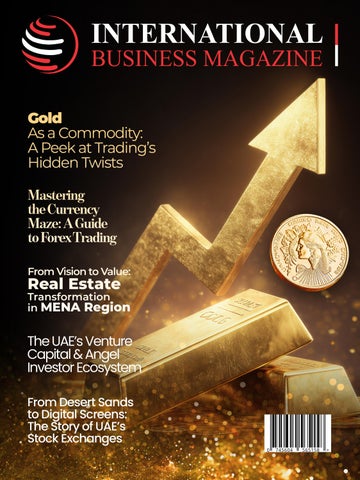
Gold as a Commodity: A Peek at Trading’s Hidden Twists
12 44 26 48 32 52
From Desert Sands to Digital Screens: The Story of UAE’s Stock Exchanges
Insurance Canvas of the UAE: Tradition Meets Transformation Mortgages in the UAE: Unlocking Doors to Ownership
From Vision to Value: Real Estate Transformation in MENA Region
The UAE’s Venture Capital & Angel Investor Ecosystem
Fintech & AI: The Rise of Embedded Finance in Everyday Platforms
Fintech, also known as embedded finance, powered by Artificial Intelligence (AI), is transforming everyday platforms into fully integrated financial ecosystems. This shift is redefining how consumers interact with money, making financial services more accessible, personalised, and invisible.
Like any other sector, the financial services industry is undergoing a profound transformation. Embedded finance (EmFi) is shifting financial services from the exclusive control of banks and specialised institutions into everyday non-financial platforms. Whether it’s paying for accessing credit via a ride-hailing service or buying insurance while booking a flight, embedded finance is reshaping consumer expectations. At the heart of this revolution lies Artificial Intelligence (AI), which enables personalisation, automation, and trust at scale.
Analysts project that by the end of 2030, the global EmFi market will reach US$7 trillion and AI will drive the future of this segment.
At its core, embedded finance integrates payments, lending, insurance and investment tools into nonfinancial platforms.
What
is Embedded Finance?
Embedded finance refers to the integration of financial products—payments, lending, insurance, and investments—into platforms that are not traditionally financial. Instead of visiting a bank or downloading a separate app, consumers can access financial services within the digital ecosystems they already use.
Some examples include E-commerce platforms offering “Buy Now, Pay Later” (BNPL) options, ridehailing apps providing instant micro-loans or driver insurance, travel portals bundling investment opportunities or currency exchange, and retail apps enabling seamless payments and loyalty-linked credit.
This shift in the financial world is not only convenient but also expands financial inclusion, especially
in emerging markets where traditional banking penetration is low.
The Role of AI in Embedded Finance
AI is the engine driving embedded finance from a simple integration model (Embedded Finance 1.0) to autonomous, intelligent ecosystems (Embedded Finance 2.0). Embedded Finance 2.0 represents the next evolution of financial integration, i.e., moving beyond simple “plug-in” services to AIdriven, autonomous ecosystems where payments, lending, insurance, and investments are seamlessly built into everyday digital platforms. This shift represents creating an intelligent, adaptive financial infrastructure that looks invisible yet indispensable. Another key feature of this system is AI-driven personalisation, where Generative AI and Machine Learning (ML) tailor products to individual users in real time.
Key AI elements in the rise of Fintech
The rise of embedded finance in everyday platforms is bundled with some advantages. The Bandwidth of embedded finance stretches from personalisation to predictive analytics. There are four key beneficial areas of AI in Fintech.
1. In the personalisation area, Machine Learning models analyse user behaviour to tailor financial products—offering credit limits, insurance packages, or investment suggestions that match individual needs.
2. The next advantage is in fraud detection, where AI-powered algorithms monitor transactions in real time, reducing risk and enhancing trust.
3. Another advantage is automation. Here, Chatbots and robo-advisors provide instant financial guidance, while AI automates loan approvals and underwriting.
4. Yet another advantage is predictive analytics. Platforms can anticipate user needs—such as suggesting travel insurance when booking flights or offering BNPL during high-value purchases.
How Consumers and Businesses Benefit
The emergence of embedded finance in day-to-day financial activities provides a battery of advantages for both consumers and businesses. This, in fact, has revolutionised the industry and has made this technology adoption a crucial element, sans which the operation may collapse. Here are some key benefits for the consumer:
• Convenience: Financial services are available at the point of need.
• Transparency: Embedded finance reduces friction, making transactions faster and clearer.
Not to be left behind, businesses too have many advantages of embedded finance, which will help them sail smoothly, slicing through the maze of financial business. The benefits the businesses can reap are:
• Revenue Streams: Non-financial companies can monetise financial services.
• Data Insights: AI provides actionable intelligence on consumer behaviour.
Emerging Trends
AI began entering the finance arena in the early 1980s, primarily through the development of the “expert system” designed to replicate human decisionmaking in trading and risk management. Today, it has penetrated deep into the financial world, and new trends are sprouting, such as:
• Generative AI in finance: Creating personalised investment portfolios and insurance policies.
• Cross-industry partnerships: Retailers, tech firms, and banks collaborating to deliver holistic financial experiences.
Embedded finance, supercharged by AI, is blurring the boundaries between financial services and everyday life. It represents a paradigm shift where financial interactions become invisible yet omnipresent, empowering consumers and businesses alike. With platforms advancing into intelligent ecosystems, the emergence of embedded finance will reshape financial interactions and alter the very experience of money.
Future Outlook
Analysts project that by the end of 2030, the global EMFI (Embedded Finance) market will reach US$7 trillion, driven by the transition of traditional financial services into everyday digital routines. As the market looks promising, the analysts project exponential growth in embedded finance adoption, driven by cross-industry partnerships and the integration of decentralised finance and GenAI.
The next phase of embedded finance will be AI-driven ecosystems where financial services are not just integrated but autonomously managed. Imagine a retail app that automatically adjusts your spending limits based on income patterns, or a travel platform that invests your unused funds until your next trip.
As financial services become invisible yet omnipresent, the boundaries between banking and everyday life are expected to blur. For businesses, the opportunity lies in embedding trust, personalisation and innovation directly into customer journeys.
Currently, embedded finance, driven by artificial intelligence, is transforming global financial experiences, shifting from a supplementary feature to a foundational pillar of digital ecosystems.
Representational Image
Gold as a Commodity A Peek at Trading’s Hidden Twists
Gold has been valued for thousands of years, long before modern financial systems evolved. Ancient civilisations such as Mesopotamia, Egypt, and Rome used gold as currency, jewellery, and a store of wealth and security. Its rarity, durability, and malleability made it ideal for trade. By the time of the Roman Empire, gold coins were widely minted and circulated, embedding gold into the foundations of global commerce. Later, during the Gold Standard era (19th–20th centuries), gold became the backbone of monetary systems, with currencies pegged to its value. This cemented gold’s role as a universal trading commodity and a measure of economic stability.
Gold’s journey from ancient coins to modern ETFs (Exchange Traded Fund) has not lost its shine and reflects its timeless appeal. It is more than a shiny metal—it has value, a hedge against uncertainty, and a critical industrial resource. In India, gold is very dear to Indian households, both in the form of jewellery and bullion.
Today, its price responds to tariffs, geopolitical tensions, central bank policies, and currency movements, while its industrial uses in semiconductors, IA systems, and EV batteries ensure continued relevance in the technological age. Gold undergoes all the twists and turns of trade.
For all we know, gold remains a paradox: It is both ancient and futuristic, ornamental and industrial, and financial and scientific. Its enduring significance lies in this duality—anchoring economies while powering innovation.
An analyst’s viewpoint
As geopolitical uncertainty increases, there are signs of growing investor demand for physical assets for Gold. “We see upside risk to our $5,400 Dec26 forecast from private sector diversification. We estimate that every 1bp increase in the gold share of US financial portfolios–driven by incremental purchases–raises prices by 1.5%,’’ according to researchers from Goldman Sachs.
For a better understanding of how the gold trades across exchanges and the retail market, here is a lowdown.
Major Gold Trading Hubs & Markets
Gold today is traded in multiple forms across global markets. The major Global Gold Trading Hubs & Exchanges:
• London Bullion Market Association (LBMA –OTC): The largest global centre for wholesale OTC transactions and the industry standard for physical gold delivery.
Representational Image
• COMEX (CME Group – New York): The world’s largest exchange for gold futures and options, providing high liquidity.
• Shanghai Gold Exchange (SGE – China): The primary physical trading platform in China, facilitating both spot and futures trading.
• Tokyo Commodity Exchange (TOCOM – Japan): A leading Asian exchange for gold futures, popular with regional investors.
• Dubai Gold & Commodities Exchange (DGCX): A major Middle Eastern derivatives exchange.
• Chinese Gold & Silver Exchange Society (CGSE –Hong Kong): A historic venue for gold and silver trading.
• Multi-Commodity Exchange of India (MCX): A key exchange for gold futures in India.
• Zurich Gold Market: A significant physical gold trading and storage hub, though it operates more as an OTC market than a formal exchange.
“Gold has long been the backbone of monetary system, anchoring currencies and financial stability. It is equally prized for its industrial applications.
Key Regional Markets
“
Asia: Shanghai Gold Exchange (SGE), Tokyo Commodity Exchange (TOCOM), Chinese Gold & Silver Exchange (CGSE).
Americas: COMEX, BM&F Bovespa (São Paulo) later merged with CETIP, creating B3.
The global gold market is dominated by the London Over-the-Counter (OTC) market.
Types of Gold Trading
Gold trading has many forms. Here is a walkthrough of the most common forms of trading:
Physical Trading
• Bars, coins, and jewellery.
• Central banks and institutions hold reserves in physical form.
• Trading doesn’t depend on a digital ledger platform.
• Ensures tangible, immediate control of risk.
Futures and Derivatives
• Contracts traded on exchanges like COMEX.
• Allow hedging against price volatility.
Exchange-Traded Funds (ETFs)
• Provide exposure to gold prices without physical ownership.
• Over-the-Counter (OTC) Markets.
• Direct transactions between institutions.
Digital Gold
• Emerging platforms using blockchain to tokenise gold ownership.
• This diversity makes gold accessible to retail investors, institutions, and governments.
• Traded in 24k purity. Often bought in smaller denominations. It can be purchased in grams or in currency. In India, Digital gold can be purchased as currency even in small denominations of 4 AED.
Factors Influencing Gold Price Movements
Gold’s value is decided by a complex interplay of economic, political, and financial factors such as tariff tensions, economic disruptions like during the time of the Covid-19 pandemic, massive buys by Central Banks, defensive positioning due to market volatility when ‘flight to safety’ mode sets in, speculative buying and when industrial demand spikes. Here are some factors:
1. Tariffs and Trade Policies
Tariffs on gold imports/exports can affect local demand and pricing. For example, India’s import duties directly influence domestic gold consumption.
2. Geopolitical Tensions
Wars, sanctions, and political instability drive investors toward gold as a “safe haven.” During this phase, the prices generally shoot up.
3. Purchases by Central Banks (See table)
Central banks are major buyers and sellers of gold reserves. Their actions influence global supply and demand.
4. Institutional Purchases
Major mutual funds and sovereign wealth funds have the potential to move markets with bulk purchases.
5. Currency Movements
Gold is priced and traded in the global market in U.S. dollars; a weaker dollar typically boosts gold demand globally and vice versa. A strong dollar makes gold more expensive for other countries, reducing demand. Conversely, a weak dollar boosts gold prices.
Stock Market Trends
When equities fall, investors shift strategy and buy gold, thereby reinforcing its role as a hedge.
Stock Market Correlation
During times of equity market downturns (e.g., the 2008 financial crisis), gold prices surged. Following the 2008 meltdown, investors rushed to buy gold as a hedge against systemic risk. This dual role—both as a commodity and a financial instrument—makes gold unique compared to other traded assets. Purchases by institutional and Central Banks have a big impact. As of November 2025, Central Banks were collectively holding over 36,000 tonnes of the metal. (See Table).
How Central Banks’ policies affect global markets
Reserve Management
Countries diversify reserves with gold to reduce reliance on foreign currencies.
Purchasing Trends
The emerging economies like China and India have steadily increased gold reserves to insulate against volatility and risk of currency reserves.
Policy Significance
Buying by a Central Bank usually signals long-term confidence in the yellow metal’s potential as a stabiliser.
Institutions such as the IMF also use gold in financial operations, reinforcing its systemic importance.
Industrial Applications of Gold and impact on prices
With the technology and AI going full blast, shaping everything around the ecosystem of doing business and personal lives of people, demand for chip manufacturing is increasing by leaps and bounds. While gold is best known for its financial role, its industrial applications are becoming increasingly vital. In the Information and Automation (IA) industry, Gold’s conductivity and resistance to corrosion make it essential in connectors, sensors, and precision instruments. So, the demand for the metal goes up. Key areas and industrial sectors where gold is used are as follows:
1. Semiconductor Sector
In this sector, gold is used in bonding wires, thin films, and high-performance chips. Its reliability
ensures stable performance in critical electronics. So, the demand for gold by this sector goes up.
2. Electric Vehicle (EV) Batteries
Countries around the world are racing against time to contain any further damage to the environment, and researchers are exploring the use of gold nanoparticles in battery technology. Gold has high potential to improve conductivity and efficiency in advanced battery designs. Here, the gold plays a dual role: not only as a financial hedge but also as a technological enabler. Therefore, the demand rises and as a result prices shoot northward.
Gold for Emerging Technology
1. Space Electronics
As the race for Space competition is gathering thrust, demand for the yellow metal is increasing. Some countries are allowing private sector entry into this segment and India is one of them. Gold, in this area, is needed for developing radiationresistant spacecraft electronics.
2. Medical Nanotechnology
As medical science is embracing hi-tech in drug delivery, robotic surgeries, and deploying AI solutions for health management and diagnosis, it requires gold to develop the latest chips to support various devices. So, gold demand spurts and in
turn makes prices oscillate.
3. AI, Quantum Computing & Cloud Computing
AI applications drive gold use in this segment of technology. Demand in this sector also boosts the prices of gold.
Gold in Times of Crisis
Gold’s reputation as a “crisis commodity” is well known: Some factors that make gold indispensable are:
Inflation Hedge
Gold retains value when fiat currencies lose purchasing power.
Crisis Insurance
During wars, pandemics, or recessions, gold demand spikes.
Universal Value
Unlike currencies, gold is universally recognised and accepted.
Gold, as a true precious metal, is gaining ground in every walk of life, be it personal life, industrial use, as a metal for hedging, a safe haven, as a security instrument and as a cushion in times of crisis. “When you think of gold, it’s the standard that holds value for all time.”
WORLD GOLD HOLDINGS**: 36,520.7 tonnes (As of November 2025)
European Area, including ECB: 10,765.2 tonnes (As of October 2025)
The Importance of Local Banks in the UAE’s Economic Framework
The United Arab Emirates (UAE) has emerged as one of the most dynamic financial centres in the Middle East, with local banks playing a pivotal role in shaping its economic trajectory. These institutions are more than just custodians of deposits; they are engines of growth, resilience, and innovation. By empowering businesses, expanding access to financial services, and accelerating digital innovation, local banks in the UAE contribute significantly to the growth of the economy and further solidify their status as a leading centre for trade and investment.
Within the Middle Eastern region, the United Arab Emirates is the leading banking sector.
The Backbone of Financial Services
As a backbone of financial services, local banks in the UAE provide essential services to individual customers, corporations, and government entities. From savings accounts and personal loans to corporate financing and trade facilitation, they ensure that capital flows smoothly through the economy. Their ability to channel deposits into productive investments sustains liquidity and supports long-term development. A notable feature of the UAE banking sector is its
diverse composition, which includes commercial banks, Islamic banks, and an increasing number of digital-first institutions. This diversity ensures that the needs of different segments—citizens, expatriates, small businesses, and multinational corporations—are met effectively. Local banks are deeply embedded in the country’s economic fabric, making them indispensable to its stability and growth.
Supporting Small and Medium Enterprises (SMEs)
Small and Medium Enterprises (SMEs) are considered the lifeblood of the UAE economy, contributing significantly to GDP and employment. Local banks have been instrumental in nurturing this sector by offering tailored loan programmes, advisory services, and flexible financing solutions. By enabling entrepreneurs to access capital, banks empower innovation and job creation which in turn contributes to the health of the economy that is facing headwinds across the globe due to geopolitical tensions and tariff barriers.
This support aligns with the UAE’s national vision of diversifying its economy beyond oil. As the country invests in sectors such as technology, renewable
Representational Image
energy, and tourism, local banks provide the financial scaffolding that allows SMEs to thrive. Their role in SME development is not just about lending—it is about building confidence and fostering a culture of entrepreneurship, which in turn strengthens the UAE economy. The local Banks provided $22.1bn in financial facilities to SMEs by the end of H1 of 2024, according to the Central Bank of the UAE (CBUAE).
Driving Digital Innovation
As the world is fast embracing digitalisation, and the UAE too is at the forefront of digital transformation, and local banks are leading the charge. They are investing heavily in Fintech partnerships, mobile banking apps, Artificial Intelligence, and Blockchain solutions. These innovations enhance efficiency, reduce costs, and expand access to underserved populations Which are an integral part of a country economic growth.
The UAE’s digital banking services by local banks has become a cornerstone of customer convenience. From instant transfers to biometric authentication, local banks are redefining the way how people interact with financial institutions. Importantly, this digital push is not only about technology—it is about inclusion. The banks also extended services to remote areas and expatriate communities.
“Local Banks and National Development
Local banks in the UAE play a vital role in national development infrastructure finance to global integration.
i) Infrastructure Financing
Local banks finance mega projects in real estate, transport, and energy. Their involvement in initiatives such as Expo 2020 and renewable energy projects demonstrates their commitment to national development. By funding infrastructure, banks help build the physical backbone of the UAE’s future economy. As of 2024–2025, UAE local banks have maintained robust lending activity, with significant, yet moderated, exposure to the real estate sector. Total banking sector loans secured by real estate reached approximately 20% of total loans in 2024. In the energy sector, UAE banks are actively financing renewable energy projects, including solar, wind, and hydrogen energy, to align with climate goals. In 2023, the UAE Banks Federation has committed to providing AED 1 trillion (approx. US$272 billion) in sustainable financing by 2030. The pledge was made during Finance Day at the COP28 climate summit in Dubai.
A unique feature of the UAE banking sector is its diversity. It is a mosaic of commercial banks, Islamic banks, and digital-first institutions.
Capitalisation and Profitability
Local banks are well-capitalised and profitable so that they remain resilient to external shocks. Their strong liquidity ratios safeguard the economy during periods of uncertainty. This financial strength allows them to continue lending and investing even amid global market turbulence. The overall state of the UAE local bank liquidity is robust.
Islamic Banking
Islamic banks add another layer of diversity to the financial system in UAE banking sector. By offering Sharia-compliant products, local banks attract investors seeking ethical finance options. This segment has grown steadily, contributing to financial stability and broadening the appeal of the UAE as a global financial hub which in turn boosts the country’s economic growth. The UAE’s Islamic banks including local banks have facilitated 19.24% of sustainable Sukuk (Sharia-compliant investment certificates) issuances globally, strengthening the UAE’s position as a leading hub for Islamic sustainable finance.
ii) Financial Inclusion
“Local banks have expanded their branch networks and digital platforms to ensure that both citizens and expatriates have access to financial services. This inclusiveness fosters consumer spending and investment, strengthening domestic demand. Financial inclusion goes beyond mere access: it is about empowering people to engage fully in economic activities, and local banks are leading the way in making this positive impact possible.
iii) Global Integration
The UAE local banks facilitate international trade and remittances. Their role in foreign exchange and cross-border financing connects the country to global markets. By supporting trade flows and expatriate remittances, banks reinforce the UAE’s position as a global financial hub aiding the nation’s economic strength. The size of UAE banking sector in consolidated total commercial bank assets stands at AED 4.6 trillion. The combined customer base of top local institutions is massive.
According to the Central Bank of the UAE (CBUAE) the total assets held by UAE banks, which includes both local and foreign banks, reached approximately AED 5.34 trillion (about US $1.45 trillion) as of the end of December 2025. Overall, local banks in the UAE are more than financial intermediaries—they are strategic partners in national development. By financing SMEs, investing in digital innovation, and supporting infrastructure projects, they reinforce the UAE’s economic resilience. As the UAE continues to evolve economically, local banks will remain at the heart of its journey. Their role in strengthening the economy is not just about numbers—it is about building trust, enabling opportunity, and shaping a future where prosperity is shared across society.
The UAE currently has 20 local (national) banks, alongside 28 foreign banks operating in the country. The total assets of the UAE banking sector increased by 12.0% Y-o-Y to AED 4,560 billion by the end of 2024. The number of licensed banks in the UAE remained at 61, comprising 23 UAE national banks and 38 branches of foreign banks operating in the UAE, according to CBUAE.
Major Banks in UAE
Major local banks in the UAE include First Abu Dhabi Bank (FAB), Emirates NBD, Abu Dhabi Commercial Bank (ADCB), Dubai Islamic Bank (DIB), and Mashreq Bank. Other prominent, locally headquartered institutions include RAKBANK, Abu Dhabi Islamic Bank (ADIB), Commercial Bank of Dubai (CBD), Sharjah Islamic Bank (SIB), and Ajman Bank.
• Largest/Top Banks: First Abu Dhabi Bank (FAB), Emirates NBD, and Abu Dhabi Commercial Bank (ADCB) are among the largest by assets.
• Other Local Banks: Mashreq Bank, RAKBANK, Commercial Bank of Dubai (CBD), United Arab Bank (UAB), Bank of Sharjah, and National Bank of Fujairah.
• Key Financial Centres: Many major banks are headquartered in Abu Dhabi (FAB, ADCB) or Dubai (Emirates NBD, DIB, Mashreq).
List of Fully Islamic Banks:
• Abu Dhabi Islamic Bank P.J.S.C (Local)
• Al Hilal Bank P.J.S.C (Local)
• Dubai Islamic Bank P.J.S.C (Local)
• Emirates Islamic Bank P.J.S.C (Local)
• Ruya Community Islamic Bank LLC (Local)
• Ajman Bank P.J.S.C (Local)
• BOK International Bank (Foreign)
• El Nilein Bank (Foreign)
• Sharjah Islamic Bank P.J.S.C (Local)
List of Banks with Islamic Windows:
• Abu Dhabi Commercial Bank P.J.S.C (Local
• Commercial Bank International PLC (Local)
• Emirates NBD Bank P.J.S.C (Local)
• Habib Bank A.G Zurich (Foreign)
• Mashreq Bank P.S.C. (Local)
• National Bank of R.A.K P.J.S.C (Local)
• Samba Financial Group (Foreign)
• United Arab Bank P.J.S.C (Local)
Representational Image
Mastering the Currency Maze: A Guide to Forex Trading
F
oreign Exchange (Forex or FX) trading is the global marketplace where currencies are bought and sold and this activity is known as Forex Trading. It is the biggest and most liquid financial market globally, with daily trading volumes surpassing several trillion dollars. Unlike stock exchanges, forex operates 24 hours a day, five days a week, across major financial centres such as London, New York, Tokyo, and Sydney. Traders participate to make profit from fluctuations in currency exchange rates, driven by economic indicators, geopolitical events, and market sentiment. When it comes to Forex market hours, they are mainly classified in four major trading sessions: Sydney, Tokyo, London and New York. These are the largest trading centres, accounting for nearly 75% of FX daily volume.
Since the forex market is made up of currencies from all over the world, forecasting exchange rates may be challenging due to the numerous factors that might influence price fluctuations. However, supply and demand dynamics control forex market unlike financial markets.
Foreign exchange trading includes a wide range of variants. The following paragraphs give valuable information about them.
Variants of Forex Trading
Forex trading can be categorised into several categories, each suited to different risk appetites and strategies:
1. Spot Trading
In spot trading, financial instruments such as commodities, securities, and currencies are bought and sold for immediate settlement and delivery.Unlike futures contracts, spot trades occur at current market
prices, known as the spot rate. There is immediate exchange of currencies at current market prices. It is the simplest and most common form of forex trading across the markets.
2. Forward Trading
Forward Trading is a system of contracts to buy or sell currencies at a future date and prefixed price. Under this system of trading, contracts are tailored to the specific needs of the buyer and seller regarding quantity, quality, and delivery date. Forward contracts are customised agreements between two parties, traded privately over the counter (OTC).
3. Futures Trading
Futures Forex Trading are standardised contracts traded on exchanges sans obligating parties to transact currencies at a set date and price. This kind of trading offers transparency and proper regulation. Forex, much like most futures contracts, can be traded in an open out-cry system via live traders on a pit floor or entirely through electronic means with a computer and access to the Internet.
4. Options Trading
Forex options are a kind of derivative contract giving the right, but not the obligation, to buy (call) or sell (put) a currency pair at a set price (strike) before a specific expiration date.
This form of trading is often used for hedging and speculation. Options allow speculation with lower capital than spot trading and provides a hedge against volatility.
5. Margin Trading
Under Margin Trading, forex players borrow funds
Representational
from brokers to increase position size (The strategic determination of how much capital to allocate to a single trade based on total account size, risk tolerance, and stop-loss levels). While Margin Trading magnifies profits, it also increases risk. The traders use leverage to control large currency positions with a relatively small deposit, known as collateral or margin.
6. Day Trading & Scalping
Another form of forex trading is short-term strategies where traders exploit small price movements within a single day (Day Trading). Scalping is a high-frequency trading strategy where traders, or “scalpers,” execute numerous, rapid transactions within seconds or minutes to capture minor, incremental price changes. Here trade lasts only for a couple of seconds.
7. Swing & Position Trading
It is a long-term investment strategy where traders take a position in a financial asset and hold onto it over a long period, often disregarding short-term market volatility. Longer-term strategies are based on fundamental and technical analysis, holding positions for days, weeks, or even months.
Tools of Forex Trading
Essential forex trading tools include platforms like MetaTrader 4/5 and TradingView for charting and execution, technical indicators (RSI, MACD, Bollinger Bands, an analysis tool created by John Bollinger in the 1980s to measure market volatility and identify overbought or oversold conditions.) for analysis, and risk management calculators. Other key tools include economic calendars for news, VPS services for uptime, and automated trading advisors. Successful forex trading requires reliable platforms and analytical tools. Some widely used tools include:
Trading Platforms
• MetaTrader 4 (MT4) and MetaTrader 5 (MT5): The platforms developed by MetaQuotes are popular platforms offering advanced charting, automated trading (via Expert Advisors), and real-time data. MT5 is a 64-bit, multi-threaded platform, making it faster and more efficient for back testing than the 32-bit, single-threaded MT4.
• cTrader: Known for transparency and intuitive interface.
• NinjaTrader: Offers advanced analytics and customizable strategies.
Charting Tools
Technical indicators like Moving Averages, Bollinger Bands, RSI (Relative Strength Index), and MACD (Moving Average Convergence Divergence) help traders analyse trends and momentum.
Economic Calendars
Provide schedules of key economic events (GDP
releases, interest rate decisions, and employment data) that influence currency movements.
Risk Management Tools
Stop-loss and take-profit orders allow traders to limit losses and lock in profits automatically.
Automated Trading Systems
Algorithms and bots execute trades based on pre-set conditions, reducing emotional bias.
Security Features in Forex Trading
Security is key element in forex trading due to its digital nature. Leading platforms incorporate multiple safeguards. Here are some of them for our understanding.
Advanced Encryption
This encryption protects sensitive data such as login credentials and financial transactions from cyber threats.
“
“ Forex market is the biggest and most liquid financial market globally, with daily trading volumes surpassing several trillion dollars.
Two-Factor Authentication (2FA)
This requires traders to verify identity through multiple channels (e.g., password + mobile code), adding an extra layer of protection to lower risk factor.
Regulated Brokers
Forex brokers licensed by authorities like FCA (UK), ASIC (Australia), or CFTC (US) or RBI (Reserve Bank of India) must adhere to strict compliance standards, ensuring transparency and client fund protection.
Segregated Accounts
Under this system, client funds are kept separate from broker operational accounts, reducing risk of misuse.
Secure Payment Gateways
To prevent frauds, deposits and withdrawals are processed through verified, encrypted channels only.
Audit Trails & Monitoring
Platforms offering forex trading have to maintain detailed logs of transactions to help detect suspicious activity as quickly as possible.
Insurance Canvas of the UAE: Tradition Meets Transformation
The United Arab Emirates (UAE) has emerged as one of the most dynamic insurance markets in the Middle East region, blending traditional strengths with digital innovation and Sharia-compliant offerings.
With a substantial market size, the UAE stands as the second-largest insurance hub in the GCC, driven by high penetration rates, regulatory reforms, and sectoral diversification.
The UAE’s insurance market is seeing an upward trend and some key factors that are aiding this segments grow are –
1. Increasing awareness of insurance products in the Emirates,
2. Government regulation for insurance coverage,
3. Increasing expat population,
4. Fast pace of urbanisation, and 5. Use of technology in insurance services.
When it comes to coverage, the canvas of the UAE’s insurance market is spread across areas property, liability, motor, health, travel, and marine insurance domain.
There is another category on UAE’s insurance sector i.e., End-User. This segment covers individual consumers, Small and Medium Enterprises (SMEs), large corporations, and government entities.
“The UAE’s insurance market is a canvas of contrasts - traditional yet innovative, local yet global, transactional yet relationship-driven.
“
Market Size and Penetration
Insurance penetration in the UAE is the highest in the GCC, with nearly universal uptake in mandatory lines such as health and motor insurance. The non-life segment dominates, accounting for more than two-thirds of premiums, while life insurance is embryonic compared to global benchmarks. In the health insurance segment, it is buoyed by compulsory coverage in Dubai and Abu Dhabi. It is the single largest contributor, tailed by motor and property insurance. In a report the Middle East Insurance Review has forecast that driven by UAE’s economic growth and increasing expatriate population, the insurance sector is likely to maintain double-digit growth in 2026.
An interesting feature of the UAE’s insurance market is that it is a canvas of contrasts—traditional yet innovative, local yet global, transactional yet relationship-driven. With strong regulatory oversight, high penetration, and sectoral diversity, it is poised for sustained growth. Local champions anchor the market, foreign players bring expertise, takaful operators cater to ethical needs, and insurtechs (InsurTech, short for “insurance technology,” refers to the use of innovative technologies) drive digital transformation. Reinsurance remains indispensable, underpinning the system’s resilience against largescale risks.
As the UAE continues to diversify its economy and attract global investment, insurance sector is all set to play a central role in safeguarding assets, enabling growth, and fostering trust.
According to Statista (2025) report “The market size of the insurance industry in the United Arab Emirates (UAE) was valued at 12.4 billion U.S. dollars, making it the second largest in the Gulf Cooperation Council (GCC) region.” It also notes that the ownership of insurance in the UAE is around 96 percent, which is the highest rate among the Middle Eastern countries. Statista further says the UAE also has the highest insurance penetration rate in the GCC region.
Alpen Capital, a financial advisory services firm based in the GCC region, in its report says ‘The GCC insurance market is expected to grow at an annualised growth rate of 5.3%, reaching an estimated US$ 44.4 billion in 2028 from US$ 34.3 billion in 2023.
Strategies Shaping the Industry
Many factors are shaping the UAE’s insurance industry as the Emirates is fast urbanising and developing at a fast pace to keep abreast with growth of world economy.
Digital Transformation
The pandemic (COVID-19) accelerated digital adoption, forcing insurers to rethink distribution. Mobile apps, online portals, and partnerships with InsurTech firms have become mainstream. Platforms like Bayzat and Policybazaar UAE are redefining customer experience, offering comparison tools and seamless on boarding.
Customer-Centric Models
Insurers are moving away from transactional sales toward relationship-driven strategies. Insurance companies are increasingly prioritizing lifetime value, transparency, and tailored products as core drivers of sustainable growth. Health insurers, for instance, offer wellness programmes, telemedicine access, and preventive care benefits to retain customers in a highly competitive market.
Regulatory Push
The UAE Central Bank (CBUAE) has tightened solvency and capital adequacy requirements, encouraging consolidation. Smaller players are merging or exiting, while larger firms strengthen their positions. The regulatory framework emphasises consumer protection, aligning with international standards to boost investor confidence.
Diversification
As a key strategy, insurers are diversifying to enter into specialty areas such as cyber risk, liability, and trade credit insurance. With the UAE positioning itself as a global business hub, demand for complex risk coverage is rising. Sectors such as Energy, Aviation, and Infrastructure are increasingly looking for bespoke solutions as a result reinsurance is gaining ground.
The Big Players
The UAE insurance market is a blend of local champions, foreign expertise, and takaful operators.
Here is a peak view of the key insurance players in the Emirates.
Local Leaders: Abu Dhabi National Insurance Company (ADNIC), Orient Insurance, and Sukoon Insurance dominate motor, health, and corporate lines.
Foreign Entrants: AXA (now GIG Gulf), Zurich, MetLife, and Cigna bring international expertise, particularly in life and health insurance.
Takaful Operators: SALAMA, Takaful Emarat, and AMAN provide Sharia-compliant products, helping customers seeking ethical and religiously aligned coverage.
Emerging InsurTechs: Bayzat, Policybazaar UAE, and YallaCompare are reshaping distribution, focusing on SMEs and retail customers with digital-first solutions.
Representational Image
Major Sectors Insuring Assets
Insurance in the UAE is closely tied to its key economic pillars:
1. Aviation and Shipping: Emirates, Etihad, and DP World insure fleets, cargo, and logistics operations.
2. Energy and Oil/Gas: ADNOC and related firms insure exploration, refining, and transport assets.
3. Real Estate and Construction: Mega-projects such as Expo 2020 legacy sites, high-rise towers, and infrastructure developments are heavily insured.
4. Healthcare: Hospitals, clinics, and medical professionals insure facilities and staff.
5. Financial Services: Banks and fintech firms insure against operational risks, cyber threats, and employee liabilities.
Reinsurance, the Invisible Backbone
Reinsurance plays a pivotal role in the UAE, allowing local insurers to manage large-scale risks and maintain solvency. Global reinsurers such as Munich Re, Swiss Re, Hannover Re, and SCOR are active in the region, partnering with local firms to spread risk.
Key Areas of Reinsurance
• Energy and Infrastructure – Mega-projects and oil exploration carry risks too large for local insurers alone. So Reinsurance steps in.
• Aviation and Marine – Aircraft fleets, shipping lines, and ports require reinsurance to mitigate highvalue risks.
• Health Insurance – Rising medical costs and pandemic-related (Covid-19) claims necessitate reinsurance support.
• Property and Catastrophe – Fire, natural disasters, and large-scale property losses are reinsured to protect balance sheets.
Emerging Trends to Watch
• AI-driven underwriting and claims automation
• Cyber insurance for financial and tech firms
• Green insurance products tied to sustainability goals
• Consolidation among smaller players
As the UAE continues to diversify its economy and attract global investment, insurance will continue to play a vital role in safeguarding assets, enabling growth, and fostering trust. The canvas is vibrant, layered, and evolving—reflecting the UAE’s broader journey as a hub of innovation, commerce, and resilience.
Five Things You Need to Know About UAE Insurance
1. The UAE has the highest insurance penetration in the GCC.
2. Health insurance alone makes up over 40% of premiums, this is due to mandatory coverage.
3. Over 60 licensed insurers compete in the UAE— leading to price wars.
4. Life insurance uptake is under 10%, despite high incomes.
5. The UAE is positioning itself as a regional reinsurance hub for MENA.
Fast Facts
Market Size: USD 12–15 billion
• Largest Segment: Non-life insurance (motor, health, property)
• Top Local Player: ADNIC – Abu Dhabi National Insurance Company PJSC
• Top Foreign Player: AXA/GIG Gulf
• Top Takaful Provider: SALAMA
Future Watch
• Cyber Insurance: Rising demand from banks and fintechs.
• Green Insurance: ESG-linked products for sustainable projects. AI Claims: Predictive analytics transforming underwriting.
• Property & Catastrophe – Fire, natural disasters, and mega-projects.
Major Local Insurance Providers
1. Abu Dhabi National Insurance Company (ADNIC) – Established in 1972, headquartered in Abu Dhabi. Offers multi-line insurance and reinsurance services.
2. Sukoon Insurance (formerly Oman Insurance Company) – Founded in 1975, one of the largest insurers in the Gulf region, with multiple UAE branches.
3. Orient Insurance – A leading UAE-based insurer with strong regional presence.
4. Dubai National Insurance & Reinsurance (DNIR) –Provides a wide range of insurance solutions.
5. Emirates Insurance Company – Established in Abu Dhabi – offers general and life insurance.
6. Union Insurance Company – Based in Ajmandeals in health, motor, and general insurance.
7. RAK Insurance – Headquartered in Ras Al Khaimah – serves in individuals and corporates sector.
8. Al Wathba National Insurance Company – Abu Dhabi-based- deals in motor, medical, and property insurance.
9. Salama Islamic Arab Insurance Company –Specialises in Sharia-compliant Takaful insurance.
10. Takaful Emarat Insurance – Focuses on life and health insurance under Islamic principles.
11. Watania Takaful Insurance – Another key player in the Takaful sector.
8. Generali (Italy) – Provides life and general insurance products. Chubb (USA) – Known for corporate and specialty insurance.
9. Munich Re (Germany) – Operates mainly in reinsurance.
UAE Insurance Market Overview: Q1 2024–2025
Performance*
Highlights:
1. In Q1 of 2025, gross written premiums, number of insurance policies and gross paid claims increased by 13.8 %, 17.4 %, and 18.3%, respectively.
2. Total technical provisions and total equity showed, respectively, an increase of 18.7% and 10.5% in Q1 2025.
3. The insurance sector remained well capitalised in Q1 2025, with healthy capital adequacy and return on average assets.
In the Quarterly Economic Review June 2025 of the Central Bank of UAE (CBUAE) revealed that the UAE insurance sector continued its growth in Q1 of 2025 in terms of written premiums, technical provisions, claims paid and equity. The report mentioned that the sector demonstrated well-capitalised, with healthy capital adequacy ratios and return on assets. According to it, the number of licensed insurance
companies in the UAE is 59, comprising 23 traditional national and 10 takaful national companies, and 25 branches of foreign insurance companies and one branch of a foreign reinsurance company operating in the UAE. The number of insurance related professions increased to 504.
Key Performance Indicators
The CBUAE, in the review said the Gross Written Premiums (GWP) increased by 13.8% Y-o-Y to AED 23.9 billion in Q1 2025, mostly due to an increase in health insurance premiums by 14.2%, property and liability insurance premiums by 13.9%, and insurance of persons and fund accumulation premiums by 11.1%, resulting primarily from an increase in individual life insurance premiums. Total gross paid claims across all insurance categories rose by 18.3% year-on-year to AED 11.0 billion in Q1 2025. This total included AED 6.0 billion in health insurance claims, AED 4.5 billion in property and liability claims, and AED 0.5 billion related to insurance of persons and fund accumulation.
In Q1 (the first four months of) 2025, the technical provisions (total) increased by 18.7% Y-o-Y to AED 100.1 billion. The volume of invested assets in the insurance sector was AED 71.6 billion (50.4 % of total assets) compared to AED 78.5 billion (53.6 % of total assets) during the same period in 2024.
Over all, the UAE insurance sector remained wellcapitalised. In terms of profitability, the net total profit to net written premiums ratio reached 7.3% in Q1 2025. The return on average assets ratio was 0.8% in Q1 2025 compared to 0.6% in Q1 of the previous year.
From Vision to Value: Real Estate Transformation in the MENA Region
The real estate story across the Middle East and North Africa in 2026 reads like a sweeping narrative of ambition, resilience, and reinvention. In the Gulf, the skyline itself has become a symbol of national aspiration. Today, the MENA’s property market is no longer speculative—it is infrastructural, shaping the nations’ future as much as their skyline. The Realty landscape in MENA region is undergoing transformation from Vision to Value.
According to the Global Real Estate Transparency Index 2024 based on a global survey of JLL and LaSalle the UAE, Saudi Arabia and MENA region have made progress and are focused on enabling higher levels of institutionalisation with a potential to offer strong long-term prospects.
In the UAE’s landscape, the realty sector has transformed from government initiatives to overseas investment flows, the UAE’s property market has evolved into one of the world’s most dynamic sectors, balancing local ambition with international demand. Similarly, North Africa’s real estate markets are shifting from speculative growth to structured, sustainable expansion.
Saudi Arabia’s NEOM (Also known as The Line) project a cognitive city stretching across 170 kilometres, across desert and coast, is an experiment in futuristic living powered by renewable energy, AI-driven infrastructure, and car-free communities. Riyadh is also being reshaped by Vision 2030, with King Salman Park and Qiddiya entertainment city anchoring new cultural and social identities.
Dubai’s realty sector has matured into a hub where luxury meets sustainability, while Doha builds on its post-World Cup momentum to expand residential and commercial offerings. The Emirates has long been recognised as a global hub for innovation, commerce, and lifestyle. At the heart of this transformation lies its real estate sector, which has grown from modest beginnings into a multi-billion-dollar industry that shapes skylines, attracts global capital, and anchors economic diversification. Today, the UAE’s property market is not just about bricks and mortar—it is about policy, vision, and the ability to adapt to global shifts while offering investors stability and opportunity.
The UAE Government Push: Policy as the Foundation
The UAE government has consistently positioned real estate as a pillar of national growth. Strategic initiatives have included regulatory reforms, infrastructure expansion, and incentives for foreign investors. Freehold property zones, first introduced in Dubai in the early 2000s, opened the market to expatriates and overseas buyers, transforming the emirate into a global property hotspot.
The Golden Visa & Residency Rights
More recently, long-term residency schemes such as the Golden Visa have tied property ownership to residency rights, encouraging investors to view the UAE not just as a speculative market but as a home base.
Government support schemes also extend to financing and ownership facilitation. Programmes designed for Emiratis and expatriates alike provide easier access to mortgages, tax benefits, and reduced transaction costs. These policies have created a resilient ecosystem where property ownership is accessible, transparent, and attractive to both individuals and corporations. Expatriates are taking advantage of this scheme and their strategy is to move from a rental house to own house. They are leveraging the reality price dynamics and a long duration stay Visa without bothering to renew it periodically.
Overseas Investment: Individuals and Corporations
For overseas investors, the UAE offers a clear framework. Individuals can purchase property in designated freehold zones across Dubai, Abu Dhabi, and other emirates. These zones include high-profile districts such as Downtown Dubai, Palm Jumeirah, and Yas Island. Ownership rights are secure, with escrow systems and regulatory oversight ensuring transparency.
Representational Image
A Boon for Corporations
Corporations benefit from liberalised policies that allow foreign companies to own property in commercial zones, often tied to free trade areas. This has encouraged multinational firms to establish regional headquarters in Dubai and Abu Dhabi, leveraging real estate as both an asset and a strategic foothold. The combination of residency incentives, tax advantages, and strong legal protections has made the UAE one of the most attractive destinations for overseas property investment.
Population growth, a key driver Dubai continues to attract expatriates, with migration fuelling demand for residential units. Commercial property is buoyed by diversification into finance, tourism, and technology, while industrial real estate benefits from logistics and e-commerce expansion. Each emirate functions as a micro-market, with Dubai leading in luxury and off-plan developments, Abu Dhabi focusing on cultural and sustainable projects, and Sharjah and Ras Al Khaimah carving niches in affordable housing and tourism-linked real estate.
In 2026, the UAE realty market is entering a new phase defined by stability and long-term value. Buyers are becoming analytical, focusing on fundamentals such as rental yields, developer reputation, and sustainability credentials. Emerging hotspots include Dubai South, home to Expo City and Al Maktoum International Airport; Abu Dhabi’s Yas and Saadiyat
Islands, and Sharjah’s Aljada, a master-planned community attracting younger families.
North Africa Realty Moving toward Stability
The real estate landscape in North Africa is also undergoing a dynamic transformation propelled by factors such as urbanisation, demographic growth, and renewed investor confidence. Countries like Morocco, Egypt, and Tunisia are seeing strong demand for residential and mixed-use developments, driven by expanding middle-class populations and infrastructure investments. Commercial real estate is also gaining traction, particularly in Cairo and Casablanca, where international capital is flowing into office spaces, retail hubs, and logistics facilities.
The Egypt Story
Egypt, the land of the Great Pyramid and the legendary Sphinx, is also seeing change in its realty landscape. It’s New Administrative Capital rises east of Cairo as both a solution to congestion and a symbol of renewal, blending government relocation with residential vibrancy. Along the North Coast and Red Sea, coastal developments cater to both domestic demand and tourism, reinforcing Egypt’s dual focus. Key projects focus on smart, mixed-use communities, including the new Administrative Capital, luxury North Coast projects like Ras El Hekma, and Red Sea developments. One of the key realty project in gated community and luxury living led by G Developments, nee New Giza Development, is driving the Egyptian real
Representational Image
estate market with high-quality gated communities. In Egypt the real estate market is driven by private sector growth and foreign investment, notably from the GCC.
Marrakech continues to thrive
Morocco’s Tangier Med expansion is reshaping logistics and industrial real estate, while Casablanca’s finance city and Rabat’s cultural districts attract international capital. Marrakech continues to thrive as a magnet for lifestyle investors, blending heritage with modern hospitality.
Tunisia moving ahead cautiously
Tunisia, after years of turbulence (characterised by a profound economic crisis and the recent catastrophic flooding) is cautiously re-emerging as a Mediterranean hub, with tourism-driven projects and attractive rental yields restoring confidence. At the same time, Algeria and Libya remain markets of latent potential, tied to energy wealth and urban expansion, awaiting political clarity to unlock their promise.
“MENA’s property market is no longer speculative—it is infrastructural, shaping the nations’ future as much as their skyline.
“MENA’s real estate growth story has run through smooth and rough paths and encountered stumbling blocks in its growth trajectory. The growth graph faces issues such as affordability gaps, uneven regulatory frameworks, and geopolitical uncertainties. Despite this, now the MENA real estate sector is evolving from cycles of speculative booms into structured, sustainable growth. Each flagship project—whether NEOM’s futuristic vision, Egypt’s administrative capital, or Morocco’s logistics hub—serves as a blueprint for broader ambitions. Together, they tell a story of transformation, where cities are reshaped to reflect new economic and cultural realities, and where real estate becomes both the stage and the script for the region’s unfolding future.
Uniqueness of diverse geographies
What unites MENA’s diverse geographies is the rise of institutional capital and long-term partnerships. Sovereign wealth funds, private equity, and global developers are embedding themselves in projects that
go beyond speculation, aligning with governments on housing, infrastructure, and industrial zones. Sustainability is no longer a buzzword but a necessity, with green building standards, renewable energy integration, and smart technologies woven into new developments. Real estate in this geography is not merely about bricks and mortar—it is about nationbuilding, about creating spaces that anchor economic diversification, social cohesion, giving boost investors and cultural identity.
Growth forecast for next 7 years
As per Deep Market Insights findings, the overall value of Middle East and Africa’s Luxury Residential Real Estate Market was estimated to be around at US$84.01 Billion in 2024. As per experts, the market can expand to US$148.68 billion by 2033.
• In this year and the next six years – 2026 to 2033, experts expect the market will expand at a CAGR of 6.58%.
• When it comes to Property Type, surprisingly, Penthouses represented the largest segment of the market in 2024
• During the forecast period, Waterfront Estates is anticipated to remain the highest-growth segment within the Property Type category.
THE UAE
Major Players in UAE: Local and Global
The UAE real estate sector is dominated by a mix of local giants and international firms. Among the leading local developers are:
• Emaar Properties – Known for Burj Khalifa, Downtown Dubai, and Dubai Marina.
• DAMAC Properties – Specialises in luxury developments and branded residences.
• Aldar Properties – Abu Dhabi’s flagship developer, with projects on Yas and Saadiyat Islands.
• Nakheel – Creator of Palm Jumeirah and other iconic master-planned communities.
• Sobha Realty – Focused on premium residential projects with high construction standards.
• Aldar Properties PJSC- It is a real estate development company owned by the Abu Dhabi government.
Notable International players
Foreign companies also play a significant role, partnering with local developers or operating independently in sales and property management. They provide advisory, brokerage, and valuation services. The list:
4. Colliers International
5. Deca Properties (Boutique firm)
6. H&S Real Estate(Boutique firm)
Egypt
Top Construction & Contracting Firms in Egypt
1. Orascom Construction PLC: Leading contractor for infrastructure, industrial, and high-end commercial projects.
2. The Arab Contractors (Osman Ahmed Osman & Co.): One of the largest construction firms in the Middle East.
3. Hassan Allam Holding: A major player in engineering, construction, and infrastructure.
4. REDCON Construction: Prominent for commercial and residential construction.
5. GAMA Construction: Specialises in turnkey projects and high-profile clients.
6. Rowad Modern Engineering (RME): Known for large-scale, complex construction.
7. SIAC Construction: Expert in Industrial Construction & Engineering.
1. TGCC (Travaux Généraux de Construction de Casablanca)
2. Somagec
3. Groupe Addoha
4. Alliances Développement Immobilier
5. Groupe Jamai
6. Palmeraie Développement
7. Groupe Aksal
8. CGI (Compagnie Générale Immobilière)
Specialised Players
1. Eco-dome Maroc: Focuses on ecological and sustainable construction using local materials.
2. SMEG (Société Marocaine des Etudes GeoRadar): Pioneer in geophysical exploration and geotechnical studies.
Tunisia
Real estate companies and agencies
1. Optygros Real Estate
2. IQ Smart Building & Business Center
3. Ipalpex
4. Sanibains Real Estate
5. Industrial Land Agency (Agence Foncière Industrielle)
6. Daari
7. TunRooms
8. Regus Carthage Center
UAE’s Non-Banking Financial Institutions
The Silent Engines of Growth
The moment when one thinks of the United Arab Emirates (UAE), the mind often gravitates toward its glittering skylines, oil wealth, and the formidable banking sector that has long anchored its financial system. Complementing its robust financial system is a niche Non-Banking Financial Segment (NBFI) segment that has strong presence in the region.
Non-Banking Financial Institutions are quietly shaping the UAE’s economic growth story. These institutions, ranging from insurance companies, leasing firms to fintech platforms and alternative financing providers, are also the key engines of diversification and resilience. They operate under the regulatory framework and supervision of the Central Bank of the UAE, the Financial Services Regulatory Authority (FSRA) in ADGM, or Dubai Financial Services Authority (DFSA) in DIFC (Dubai International Financial Centre).
“Non-financial institutions in the UAE may not command the headlines like banks or sovereign wealth funds, but their impact is undeniable.
“
The NBFIs are silently acting as the region’s growth engine. This assumption of being the growth engine can be qualified by looking at the UAE Central Bank’s Financial Stability Report 2024. According to the report, the UAE’s Non-Banking Financial Institutions sectors achieved significant positive results at various levels. The report specifically dealt in depth about the insurance sector. According to CBUAE, the sector remained resilient, maintaining strong solvency positions and recording significant growth of 21.4%, which brought total gross written premiums to AED 64.8 billion, thereby strengthening policyholder protection.
Finance companies remained adequately capitalised and improved their liquidity positions, while money exchange businesses demonstrated continued resilience and operational stability. The CBUAE report added that 2024 marked an acceleration in digital transformation, driven by higher uptake of FinTech and digital payments.
A Brief Historical Arc
The UAE’s journey with non-financial institutions began in the late 1970s and early 1980s, when the country’s rapid modernisation demanded support structures beyond traditional banking. Insurance firms were among the earliest entrants, providing coverage for trade, shipping, and construction projects. By the 1990s, leasing and factoring companies emerged, catering to SMEs and businesses that needed working capital but were underserved by banks.
The 2000s marked a turning point. With Dubai positioning itself as a global hub, regulators encouraged the growth of Non-Banking Financial Institutions (NBFIs) to complement banks. The rise of Islamic finance also spurred specialised institutions offering Sharia-compliant insurance (takaful) and leasing services. More recently, fintech startups and crowdfunding platforms have added a digital edge, reflecting the UAE’s ambition to lead in financial innovation.
As this segment is consolidating its foothold in the region, many of the NBFI’s are shifting their focus area toward FinTech-driven solutions, including invoice financing, SME working capital, and consumer “pay later” solutions. These institutions’ clientele include retail customers, startups, and SMEs who are looking for quick alternative financing options compared to traditional banks.
Market Size and Share
According to the UAE Central Bank’s Financial Stability Report, non-bank financial institutions account for a significant but smaller slice of the financial sector compared to banks. The insurance sector alone contributes around 3–4% of GDP, with gross written premiums exceeding AED 23 billion annually. Exchange houses handle billions in remittances each year, reflecting the UAE’s role as a global labour hub.
Leasing and factoring firms’ activities remain niche and growing, with market penetration rising among SMEs.
According to an Ireland based research store, Research and Markets.com, the market value of the UAE FinTech lending platforms based on a five-year historical analysis, is pegged at USD $ 1.5 billion. This growth, the research firm said, is primarily driven by the increasing demand for alternative financing solutions, the rise of digital banking, and the growing acceptance of technology in financial services.
What They Do: Functions and Roles
Non-financial institutions in the UAE span several categories:
• Insurance companies: These companies provide risk coverage for individuals, corporates, and infrastructure projects. Takaful operators play a significant role in aligning with cultural and religious preferences.
• Leasing and factoring firms: These firms deal with asset financing and working capital solutions, particularly to SMEs.
• Investment companies and funds: These companies and funds deal in a variety of areas like managing portfolios, private equity, and venture capital, also focus on real estate, technology, and regional growth sectors.
• Fintech and alternative financing platforms: Platforms under this segment facilitate p2p (peer-to-peer) lending, crowdfunding, and digital payment solutions, expanding access to capital and financial inclusion.
• Exchange houses: Vital for remittances, especially given the UAE’s large expatriate population.
What is unique about these institutions is that their role is not merely transactional. They go beyond to enhance financial inclusion, provide risk management, and act as shock absorbers during economic downturns. For instance, insurance firms shield businesses from volatility, while leasing companies enable SMEs to thrive minimising the risk of reliance on bank loans.
How They Fare against Banks
Banks remain the dominant force in the UAE, controlling the majority of assets and credit. But, nonfinancial institutions complement banks rather than compete directly with them.
Their comparative strengths include:
Flexibility: NBFIs often serve niche markets banks overlook, such as microfinance or specialised insurance.
Innovation: Fintech platforms are more agile in
Representational Image
adopting digital solutions, offering faster and more user-friendly services.
Risk diversification: Insurance firms and investment funds spread risks across sectors, cushioning shocks that banks alone cannot absorb.
Accessibility: Exchange houses and digital lenders provide services to expatriates and SMEs who may not qualify for traditional bank loans.
Banks enjoy stronger regulatory backing, deeper capital reserves, and wider customer trust. Although NBFIs are also under the eagle eye of the regulators, they navigate tighter margins, regulatory scrutiny, and competition from both banks and global entrants.
The Strategic Role in the UAE’s Vision
The UAE’s economic vision—anchored in diversification, innovation, and resilience—places non-financial institutions at the heart of its future. As the country pivots toward knowledge-based industries, green energy, and digital transformation, NBFIs are set to provide the scaffolding: insuring new ventures, financing SMEs, and channelling investments into emerging sectors.
Moreover, their role in financial inclusion is critical. By serving expatriates, small businesses, and individuals outside the banking mainstream, they ensure that growth is broad-based and socially sustainable. In this sense, NBFIs are not just financial actors but social stabilisers.
Non-financial institutions in the UAE may not command the headlines like banks or sovereign wealth funds, but their impact is undeniable. They are the silent partners of the federation’s economic journey—absorbing risks, enabling entrepreneurship, and widening access to finance. As the UAE strides into a future defined by innovation and diversification, these institutions will continue to expand their footprint, proving that in the orchestra of economic growth, the supporting instruments often set the rhythm.
Local and Foreign Players
The UAE’s non-financial landscape is a blend of home grown champions and international entrants:
Local players:
• Dubai Islamic Insurance & Reinsurance (AMAN) and Abu Dhabi National Insurance Company (ADNIC) dominate the insurance space.
• Al-Futtaim Finance and Emirates Leasing are prominent in asset financing.
• Exchange houses like UAE Exchange and Al Ansari Exchange are household names, serving millions of expatriates.
Foreign players:
• Global insurers such as AXA and Zurich have strong footprints in the UAE.
• International FinTech platforms like Funding Circle and LendingClub have tested the waters, though local regulations favour domestic innovation.
Representational Image
• Private equity firms from Europe and North America often use Dubai International Financial Centre (DIFC) as a base for regional operations.
Top 10 financial companies in the UAE
1. Aafaq Islamic Finance
2. Al Ain Finance
3. Amlalc Finance
4. BNP Paribas Wealth Management
5. Deem Finance
6. Finance House
7. Insignia Group of Companies
8. Lombard Odier
9. Mawarid Finance(Shariah compliant)
10. Reem Finance
Top 10 NBFI Lenders (Startups)
1. Tabby
2. Huspy
3. Beehive
4. Souqalmal.com
5. Yalla Compare
6. PRYPCO
7. Cashew Payments
8. Holo
9. Lendo
10. NOW Money
Global Financial Services Provider
1. J.P. Morgan
2. Trinity Group
Global Asset Managers
1. Blackstone
2. PIMCO
3. Allianz Trade
4. Warburg Pincus
5. Brookfield Asset Management
Insurance Companies
1. Sukoon Insurance
2. GIG Gulf
3. Daman Health Insurance
4. Zurich International Life
5. Bayzat
Overall, finance companies continued to maintain sufficient capitalisation with stronger liquidity levels, while money exchange businesses continued to demonstrate their resilience and operational stability. 2024 also witnessed an acceleration in digital transformation, reflected in increased adoption rates of FinTech and digital payments, the expansion of banking services, and the integration of artificial intelligence and data analytics.
Banks v/s Non-Banking Financial Institutions in the UAE
FUNCTIONAL AREA BANKS NBFIs
Market Share
Core Function
Role in Economy
Local Players
Foreign Players
*source:CBUAE
Controls US$1.45 trillion (as of 2025) of total financial assets*
Risk management, financial inclusion, support of SMEs, remittances
ADNIC, Al Ansari Exchange, Dubai Islamic Insurance, AlFuttaim Finance
HSBC, Citibank, Standard Chartered Bank AXA, Zurich Invest, Global private equity firms
From Desert Sands to Digital Screens: The Story of UAE’s Stock Exchanges
The United Arab Emirates emerged as a federation in 1971 when its economy was largely driven by oil revenues. By the late 1990s, the UAE’s leadership recognised that a diversified financial infrastructure was essential to sustain growth. Driven by the need to diversify, the UAE’s modern stock exchanges were created. The trading activities of these exchanges are monitored by the watchdog, Capital Market Authority (CMA). Beyond routine operations, whenever there are geopolitical tensions, CMA acts swiftly to ensure investor protection and stability of the exchanges.
Organised Markets in the Desert Winds
The first formal exchange, the Dubai Financial Market (DFM), was established in March 2000. This was the beginning of organised market in the Desert Winds. It quickly became a cornerstone of Dubai’s strategy to position itself as a regional financial centre. Around
the same time, Abu Dhabi launched the Abu Dhabi Securities Exchange (ADX), reflecting the emirate’s own push to institutionalise capital markets. Both exchanges offered companies a structured way to raise funds and gave investors, from local citizens to global institutions, an avenue to participate in the UAE’s growth story.
Expanding the Landscape
The UAE’s exchanges are not limited to DFM and ADX. In 2005, Dubai introduced Nasdaq Dubai (originally the Dubai International Financial Exchange, DIFX), map out as an international platform for equities, derivatives, Sukuk (Islamic bonds), and structured products. Unlike DFM and ADX, which primarily serve domestic investors, Nasdaq Dubai was built to attract global capital, operating under international standards and regulations.
Representational Image
Together, these three exchanges form the backbone of the UAE’s capital market ecosystem:
• DFM – Retail-driven, with strong participation from individual investors.
• ADX – Larger institutional base, reflecting Abu Dhabi’s emphasis on stability and long-term capital.
• Nasdaq Dubai – International orientation, bridging Middle Eastern issuers with global investors.
Role in the Market
The exchanges play multiple roles in the Emirates capital market:
• Capital formation: Companies list shares to raise funds for expansion, infrastructure, and innovation.
• Wealth distribution: Citizens and expatriates alike can invest.
• Economic diversification: By channelling investment into sectors beyond oil, exchanges support the UAE’s long-term economic strategy.
Global Ties
Nasdaq Dubai is the clearest symbol of the UAE’s global integration. It operates within the Dubai International Financial Centre (DIFC), under English common law (It is a legal system originated in the medieval England after 1066, based on judicial precedents, customs and court decisions rather than strict, codified statutes), making it attractive to international investors. It has hosted listings from companies across the Middle East, North Africa, and even beyond. Moreover, DFM and ADX maintain cooperative ties with other exchanges, sharing expertise and aligning with international standards to attract foreign capital. Cross-listings and partnerships ensure that UAE markets are not isolated but part of a wider global network.
Trading Volumes and Market Size
As of late February 2026, the market capitalisation (Market Cap is calculated by multiplying the current share price by the total number of outstanding shares: Market Cap = Current Share Price × Total Shares Outstanding) of the Dubai Financial Market PJSC (DFM.AE), which refers to the company that operates the exchange, was approximately AED 12.87 billion ($3.5B – $12.87B depending on source/currency). ADX has grown into one of the largest exchanges in the Arab world. Nasdaq Dubai, though smaller in scale, has carved a niche in Sukuk and derivatives, often hosting landmark issuances that attract international investors.
Trading volumes have fluctuated with global and regional conditions. The boom years of 2004–2005 saw surging activity, while the 2008 financial crisis tested resilience. More recently, reforms and digitalisation have boosted liquidity, with ADX in particular recording sharp increases in daily turnover thanks to institutional participation.
Key DFM listed companies include:
1. Financials: Emirates NBD, Dubai Islamic Bank (DIB), Commercial Bank of Dubai (CBD), Ajman Bank, Amlak Finance and Sukoon Takaful.
2. Real Estate & Construction: Emaar Properties, Emaar Development, Deyaar Development, Al Mazaya Holding, Arabtec Holding.
3. Transportation & Logistics: Air Arabia, Gulf Navigation Holding, Aramex.
4. Utilities & Services: Dubai Electricity & Water Authority (DEWA).
“The UAE’s stock exchanges embody the country’s broader narrative: a desert nation transforming itself into a diversified, globally integrated economy.
“
Safeguards: Circuit Breakers and Controls
Like most modern exchanges, UAE markets also use circuit breakers and other mechanisms to contain unrealistic trading swings. These measures temporarily halt trading if prices move beyond set thresholds, preventing panic-driven collapses or speculative bubbles. Both DFM and ADX have adopted such systems, aligning with international best practices. Nasdaq Dubai, operating under global standards, also enforces similar safeguards.
A Narrative of Growth and Ambition
The story of UAE’s stock exchanges is ultimately one of ambition. From humble beginnings in 2000, they have grown into platforms that connect local companies with global capital, empower citizens to invest, and reinforce the UAE’s reputation as a financial hub. They embody the country’s broader narrative: a desert nation transforming itself into a diversified, globally integrated economy.
Looking Ahead
As the UAE positions itself for a beyond-oil future, its stock exchanges have embraced newer technologies and have carved out a path for future adoption of cutting-edge technologies.
Here is a list of technologies the exchanges have embraced.
• Digital transformation – Blockchain settlement, AI-driven analytics.
• ESG standards – Sustainability reporting and green finance.
• Fintech integration – Mobile trading apps and cross-border digital platforms.
Three Exchanges in a Nutshell
The UAE has three key exchanges in the capital market ecosystem driving the growth.
Abu Dhabi Securities Exchange (ADX)
Government backed- listings, industry listing. Focus on industries like energy and banking. Headquartered in Abu Dhabi. It was set up in the year 2000 with 12 listed companies and now has 200 listed securities. In 2025, ADX became the first exchange in the region to cross list two US based ETFs on NYSE. ADX Group has set a financial and investment training lab at Liwa University to advance financial education, develop the future industry-ready financial and investment professionals. ADX attaches importance to sustainability initiatives across finance, disclosures and governance, working with all of our stakeholders.
ADXs’ Market Firsts*:
• Cross-listing U.S. ETFs: ADX was the first exchange in the Arab world to introduce cross-listed ETFs (from New York Stock Exchange), representing roughly USD $10 billion in assets.
• Thematic and Digital Offerings: Introduced thematic ETFs with focus on high-growth sectors like quantum computing and Artificial Intelligence.
• ETF Market Expansion: The total number of ETFs listed on ADX expanded considerably, rising to 21.
Dubai Financial Market (DMF)
Dubai Financial Market is Islamic-compliant financial exchange based in Dubai. Its main focus is on Real Estate and Financial Services. DMF operates as a public joint-stock company and is a subsidiary of Borse Dubai Limited. The DFM is a primary platform for IPOs and listing for regional and international companies. It continues to be a central hub for capital market activity in the region, supporting both individual and institutional investors.
Nasdaq Dubai
International exchange based at DIFC facilitates regional and international listings.
Highlights
• Since its inception, Nasdaq Dubai has facilitated listings exceeding US$245 billion in total bonds and Sukuk issuances, of which US$177 billion are Sukuk. Nasdaq Dubai’s Sukuk market has achieved an eightfold increase since 2013. Supported by robust international issuances, outstanding listings have climbed from US$12.6 billion to over US$100 billion.
• Total value of outstanding debt securities listed across DFM and Nasdaq Dubai reached US$150.9 billion in 2025, with Nasdaq Dubai accounting for US$146.1 billion.
Regulator’s role
In the first week of March 2026, The Capital Market Authority, the regulator of the exchanges in the UAE responding to the geopolitical tensions and keeping in mind how fragile investor psychology is, it temporarily suspended trading for two days on March 2 and March 3, 2026. The UAE, with its financial and logistics hub, is especially sensitive to any war like tremors. This swiftness has demonstrated that the capital market in the UAE is mature and intend to move ahead both in good and troubled times.
To sum it up, the story of the UAE’s exchanges transitioning from desert sands to digital screens, it is a story of ambition. Today, the exchanges stand as pillars of a diversified economy, connecting local investors to global capital flows. Their journey is not just financial—it is cultural, symbolic, and deeply tied to the UAE’s identity as a nation that thrives on reinvention.
Mortgages in the UAE Unlocking Doors to Ownership
In the shimmering skylines of Dubai and Abu Dhabi, where glass towers rise beside traditional souks, the mortgage sector has quietly become one of the most important engines of the UAE’s real estate story. Once dominated by cash buyers and institutional investors, the market is now seeing a steady increase by participation of individual nationals, expatriates, and even non-residents. They are turning to mortgages as their gateway to property ownership in the kingdom.
The Big Picture
The UAE mortgage sector has matured significantly over the past decade. With the Central Bank’s (CBUAE) base rate (Base Rate is the benchmark for overnight market interest rates) currently at 3.65%. The CBUAE typically follows the US Federal Reserve’s interest rate decisions as the UAE dirham is pegged to the US Greenback. The current rate was fixed following a 25-basis-point cut in December 2025. The mortgage products have diversified to cater to both individuals and businesses. Yet, compared to global benchmarks, mortgage penetration remains modest. Many buyers still prefer cash transactions, reflecting the region’s high liquidity and cultural preference for debt-free ownership.
Pointers to the CBUAE’s 3.65% Base Rate
Maintenance: The CBUAE kept the rate at 3.65% at
the end of January 2026, in line with the U.S. Federal Reserve’s stance.
Borrowing Rate: The interest rate for borrowing shortterm liquidity from the CBUAE remains 50 basis points above the base rate.
Context: This follows a 25-basis point cut in December 2025, which lowered the rate to the current 3.65%.
Monetary Policy: The base rate is anchored to the U.S. Federal Reserve’s Interest Rate on Reserve Balances (IORB).
The UAE’s mortgage finance market is valued at US$30 billion. This growth is driven by a robust real estate market, an increasing expatriate population, and favourable government policies. Dubai and Abu Dhabi remain key cities in this segment. While Dubai’s position as a global business hub drives high demand for residential properties, Abu Dhabi, as the capital, benefits from massive government investments and infrastructure projects. In 2023, the UAE government implemented a new regulation aimed at bringing more transparency in mortgage lending. This regulation requires that all mortgage providers disclose full information regarding interest rates, fees, and terms to potential borrowers.
Representational Image
Individual vs. Commercial Mortgages
Individual Mortgages: For residents, loan-to-value (LTV) ratios can reach up to 85% for nationals and 80% for expatriates on properties under AED 5 million. First-time buyers are increasingly active, encouraged by flexible repayment options and competitive rates.
Commercial Mortgages: Businesses can access financing through fixed, variable, or hybrid structures.
Fixed Rate: Stability for 3–5 years, shielding borrowers from market swings.
Variable Rate: Linked to EIBOR (Emirates Interbank Offered Rate), offering flexibility but exposing borrowers to fluctuations.
Hybrid Products: A blend of fixed and floating, allowing companies to lock in certainty before moving to market-linked terms.
Market Dynamics & Buyer Behaviour
The UAE’s property market is designed by a mosaic of local and global factors:
• Nationals: Tend to buy for long-term ownership, often leveraging mortgages for family homes.
• Expatriates: Increasingly view mortgages as a viable path to investment, especially with residency visas tagged to property ownership.
• First-Time Buyers: Motivated by lower entry barriers, affordability in prime districts remains a challenge.
• The golden shift: Golden Visa policies and international investor interest have further boosted demand. Younger buyers are more open to financing compared to older generations who prefer cash.
Regulatory Framework
The Central Bank of the UAE enforces strict rules to ensure stability:
• Debt-to-Income Limits: Borrowers cannot exceed 50% of monthly income obligations.
• Loan-to-Value Caps: Protect lenders and borrowers from over-leveraging.
• Transparency Mandates: Banks must disclose all fees and terms clearly.
• Non-Residents can avail mortgages, though typically capped at 60–70% of property value.
• Income verification and property type restrictions apply, but the door is open—especially for investors eyeing Dubai’s luxury market.
Institutions offering Mortgages
Major Banks
• Typical Rates: Fixed rates around 3.99%–4.19% for 1–5 years, often requiring salary transfer.
• Loan-to-Value (LTV): Up to 80% for expats (properties AED million), 85% for nationals, and 6065% for non-residents. Loan to value is the term used by banks when lending against an asset. The percentage denotes how much a bank is willing to lend against the value of the asset.
“ The UAE’s mortgage finance market is valued at US$30 billion. This growth is driven by a robust real estate market, an increasing expatriate population, and favourable government policies.
“
The Big 8
• Emirates NBD
• First Abu Dhabi Bank (FAB)
• Abu Dhabi Commercial Bank (ADCB)
• Mashreq Bank
• Dubai Islamic Bank
• Emirates Islamic
• HSBC Middle East
• Standard Chartered UAE
Non-Banking Institutions
• Mortgage Finder
• Bayut Mortgage Services
• Independent mortgage consultancies and brokers
These players compete not only on rates but also on speed of approval, digital platforms, and customer service.
UAE mortgages
UAE mortgages offer up to 80% financing for residents (20% down payment) and 50–60% for non-residents (40-50% down payment) for terms up to 25–30 years. Rates typically range from 3.75% to 5.5%, often fixed for 3–5 years before becoming variable. Key costs include a 1% arrangement fee, valuation fees, and a 4% Dubai Land Department (DLD) fee.
Non-residents
Non-residents can obtain mortgages for properties in UAE freehold areas, generally requiring a 40–50% down payment (60% Loan-to-Value) and a minimum income, often around AED 25,000 per month. Key documents include proof of income, 6 months of bank statements, and a credit report from their home country. Major Banks offering this include FAB, ADCB, and Emirates NBD.
Policy Outlook
With the dirham pegged to the US dollar, UAE mortgage rates move in tandem with US Federal Reserve decisions. Analysts expect gradual adjustments rather than sharp cuts in 2026, keeping the market stable.
Banks are innovating with refinancing options and hybrid products, while fintech platforms are
streamlining approvals. The regulatory stance remains cautious but supportive, balancing growth with financial stability.
The Women Power
The UAE’s cosmopolitan and growing gender equality in the realty market is enabling women participation and the growth graph is moving north. This participation of women in this segment is significant and represents a cultural shift for creating assets on their own.
Important factors that are driving UAE women to jump into this segment are:
1. Long-term wealth creation.
2. Asset diversification.
3. Carry forward legacy for family.
4. Inflation-hedge income through this route.
THE RISE OF WOMEN POWER IN THE UAE REALTY LANDSCAPE**
*Estimated | ** Data Source: Dubai Land Development
The Journey Ahead
The UAE mortgage sector is poised for steady expansion. The future blueprint is based on 4 key expectations.
• Digital Transformation: Online applications and AI-driven credit assessments for faster approvals.
• Greater Inclusion: Policies framed to encourage foreign investment may widen access for non-residents.
• Cultural Shift: As younger generations embrace financing, mortgage penetration is expected to rise.
• Challenges: Affordability in prime areas and cautious lending practices may temper growth.
The mortgage segment in UAE is growing steadily and the fundamentals remain strong. With resilient demand, international investor interest, and a regulatory framework that prioritises stability, mortgages are set to play a larger role in shaping the UAE’s real estate future.
In essence, the UAE mortgage market is no longer a quiet corner of finance—it is a dynamic arena where individuals, businesses, and institutions converge. For first-time buyers, seasoned investors, and non-residents alike, mortgages are unlocking doors to ownership in one of the world’s most vibrant property landscapes.
The UAE’s Venture Capital & Angel Investor Ecosystem
The UAE’s Venture Capital (VC) journey is relatively young compared to Silicon Valley, India or European hubs. In the early 2000s, most entrepreneurial activity in Dubai and Abu Dhabi was concentrated in traditional sectors—real estate, retail, and trading. Startups were rare, and funding largely came from family offices or government-backed initiatives.
The turning point came in the 2010s, when Dubai positioned itself as a “startup capital” of the Middle East. This was also the time when Venture Capital started gaining ground in India, although the green
shoots were noticed as early as 2000s. The Venture Capital system in the UAE is not very large as the population size is a limiting factors. But it’s a wellknit market and the players in the market have good bonding. They often exchange views and discuss about the trends in this segment.
In the UAE, the success of Careem (acquired by Uber for $3.1 billion in 2019) and Souq.com (acquired by Amazon for $580 million in 2017) proved that regional startups could scale globally. By the mid-2020s, the UAE has evolved into a sophisticated ecosystem with multi-tiered capital structures supporting companies from seed to exit.
Major Venture Capital Firms & Angel Networks
The UAE hosts a diverse mix of institutional VCs, angel groups, and government-backed funds. Some of the most influential players include:
MAJOR VENTURE CAPITAL FIRMS & ANGEL NETWORKS
INVESTOR/NETWORK
Dubai Angel Investors(DAI)
BECO Capital
Wamda Capital
Shorooq Partners
Global Ventures
Mubadala Ventures (Abu Dhabi)
Hub71 Angel Network (Abu Dhabi)
*These figures are indicative.
FOCUS AREA
Early –stage tech startups
Consumer internet, SaaS, Fintech
Regional scale-ups, cross-border ventures
Fintech, SaaS, deep tech
Healthtech, Edtech, enterprise solutions
Growth-stage, global investments
Early-stage, linked to accelerator
TYPICAL TICKET SIZE*
$100k- $250k per company
$500K–$5million
$1mn–$10mn
$500K–$3mn
$1mn–$10mn
$10mn
$50K–$500K
These firms are complemented by angel groups such as Womena, Emirates Angels Investors Association, and family offices that often act as “silent” backers (investors who provide capital for business or personal ventures without taking part in daily operations or management) of promising ventures.
Who Gets the Capital?
Funding is concentrated in sectors aligned with the UAE’s strategic priorities:
Fintech: Driven by Dubai’s ambition to be a global financial hub.
Healthtech & Biotech: Accelerated by post-COVID demand and Abu Dhabi’s healthcare investments.
Edtech: Supported by the UAE’s focus on future skills and AI/quantum education.
E-commerce & Consumer Apps: Building on the legacy of Souq.com and Careem.
Deep Tech (AI, Quantum, and Space): Aligned with national strategies like the UAE Space Programme and AI 2031 vision.
Founders who demonstrate scalability across MENA region, strong intellectual property, and alignment with government priorities have high potential to secure funding.
The
UAE
Market Size & Investment Volume
By 2026, the UAE’s VC and angel investment market is estimated at $1.5–$2 billion annually, making it the largest in the MENA region. Dubai alone accounts for nearly 60% of deals, while Abu Dhabi—through Mubadala and Hub71—contributes the bulk of largeticket investments.
Success Rate & Notable Exits
Success rates in VC are generally low worldwide, and the UAE is no exception. Roughly 1 in 10 funded startups reach significant scale or exit. However, the region has produced notable success stories:
• Careem (ride-hailing, acquired by Uber)
• Souq.com (e-commerce, acquired by Amazon)
• Anghami (music streaming, listed on NASDAQ via SPAC)
• Kitopi (cloud kitchen unicorn, valued over $1bn)
“ “aims to integrate quantum computing, defence tech, and space startups into its VC pipeline, aligning with national strategies.
Types of Funding
The UAE ecosystem offers a layered funding structure:
Seed Funding: Angels and micro-VCs typically provide $50K–$500K to validate ideas.
Series A/B: Institutional VCs like BECO, Shorooq, and Global Ventures deploy $1mn–$10mn for scaling.
Growth Capital: Mubadala and international funds provide over $10mn for expansion.
Government Grants & Accelerators: Programmes like Hub71, DIFC Fintech Hive, and Dubai Future Accelerators offer non-dilutive support, mentorship, and subsidised office space.
Corporate Venture Arms: Emirates NBD, Etisalat, and ADNOC have begun investing in Fintech, telecom, and energy startups.
This mix ensures startups to progress from ideation to IPO or acquisition without leaving the region.
These exits have validated the ecosystem and attracted global investors to Dubai and Abu Dhabi.
Number of Startups in the VC Network
The UAE had over 5,600 startups as of Q2 of 2024, with around 600–800 companies directly funded by angel investors or VC firms. The density was highest in Dubai Internet City, DIFC Innovation Hub, and Abu Dhabi’s Hub71. The broader ecosystem includes over 1.2 million registered companies, with plans to exceed two million by 2031.
The Growth Graph
The UAE’s VC ecosystem has shown exponential growth.
2015–2020: Early-stage enthusiasm, first major exits (Souq, Careem).
2020–2023: COVID accelerated digital adoption, fintech and healthtech boomed.
2024–2026: Ecosystem matured, focus shifted to deep tech, AI, and global partnerships. Dubai and Abu Dhabi positioned themselves as “innovation capitals” rather than just regional hubs.
Looking ahead, the UAE aims to integrate quantum computing, defence tech, and space startups into its VC pipeline, aligning with national strategies. The growth curve suggests continued double-digit expansion in deal volume and ticket size, with more unicorns expected by 2030.
MAJOR VCs
From Dubai Angel Investors to Mubadala Ventures, the UAE’s capital landscape spans early-stage angels to institutional giants. These firms fuel the region’s most ambitious startups.
STARTUPS BY SECTOR
Fintech, healthtech, edtech, and deep tech dominate the UAE’s startup scene — each aligned with national priorities like AI, future skills, and digital transformation.
FUNDING STAGES
Seed rounds spark ideas, Series A/B scale them, and growth capital propels global expansion. Government grants and accelerators add fuel to the fire.
GROWTH OF VC DEALS
The UAE’s VC market has surged from modest beginnings to over $1.5bn annually — with exponential growth in deal volume, ticket size, and global investor interest.
The Rise and Importance of Neobanks in the UAE
Neobanks in the UAE are fast becoming key financial players, with major digital-first institutions now operating in the market. Their client base spans tech-savvy millennials, expatriates, and SMEs, and transaction volumes are surging as both individuals and corporates embrace cashless ecosystems. The sector’s resilience during crises like pandemics or geopolitical shocks positions Neobanks as vital complements to traditional banking.
The UAE’s banking landscape has always been a blend of tradition and innovation. Over the past decade, however, digital-first banks known as Neobanks have emerged as a distinct force. Unlike conventional banks, Neobanks operate primarily through mobile apps and online platforms, offering streamlined services without the overhead of physical branches.
“ “
The UAE’s banking landscape has always been a blend of tradition and innovation. Over the past decade, however, digital-first banks known as Neobanks have emerged as a distinct force.
According to S&P Global, over the past few years, Neobanks are gaining a foothold in the UAE’s banking network. Neobanks are trying to attract traditional banks’ customers by offering products and services at a lower cost. The regulatory environment for fintechs in the UAE, according to it, is also somewhat supportive of the emergence of Neobanks.
The expansion of the internet, along with rising smartphone adoption and a digitally savvy customer base, has played a major role in driving this trend. What is unique about Neobanks is that they act as a hyphen that bridges the gap between digital and traditional banking. Their distinctiveness is also about their convenience like “here-and-now services”. The Neobanks also enabled unbanked sections of the Emirates population to get into the banking ambit.
By 2024, nearly 89% of UAE residents held digital-first accounts, a staggering leap compared to the regional average of 17% just a few years earlier. This adoption reflects both the country’s tech-forward population and its regulatory encouragement of fintech innovation.
The Central Bank of the UAE (CBUAE) enacted a new law in October 2025 that integrates digital assets and digital finance activities into its banking regulatory framework, bringing these activities under the supervision and licensing authority of the central bank. Parallel to this, the launch of CBUAE’s Digital Dirham (The Digital Dirham is the UAE’s official Central Bank Digital Currency, established as legal tender to enhance secure, instant payments, and reduce transaction costs. It is a direct liability of the CBUAE, offering 1:1 convertibility with physical cash) aims to strengthen the UAE’s position as a regional hub for digital finance by facilitating faster, more costeffective, and inclusive payments, and reinforcing the credibility of the UAE’s monetary framework.
Who Are the Players?
1. E20.
E20 by Emirates NBD is a fully digital business bank with no branches and ATMs.
2. Liv Digital Bank
Liv Digital Bank, targets young and digitally literate customers.
3. Mashreq Neo
Mashreq Neo is a branchless digital bank and caters to connected customers.
4. YAP
YAP is a digital-only bank focused on improving the overall online banking experience. It runs as an independent mobile application and has no physical branches. Headquartered in Dubai, it partnered with
RAK Bank to launch the UAE’s first standalone digital banking platform. YAP does not operate any physical outlets and does not offer traditional banking services such as loans or mortgages.
5. Wio Bank
The banks strategy is to target customers from Small and Medium Enterprises and other entrepreneurs.
6. Zand Bank (local, hybrid model) – Offers both retail and corporate banking.
7. Wise (foreign, UK-based) – Specialises in crossborder payments and multi-currency accounts.
This mix of local champions and foreign entrants ensures diversity in offerings from SME financing to remittance solutions for expatriates. Neobanks rely on AI-driven interfaces, biometric security, and cloudnative infrastructure.
Their services include:
• Instant account opening via mobile apps (Instant, paperless, and mobile-first account opening).
• Real-time expense tracking and budgeting tools.
• Seamless international transfers at competitive FX rates.
• SME-focused credit lines and invoicing solutions.
• High-interest savings rates and cashback on daily spending.
• Global Reach: Quick remittance services to numerous countries.
• Sustainability: Use of eco-friendly, recycled plastic cards, such as those from Mashreq Neo.
Unlike traditional banks, Neobanks enable userfriendly experience and speed, often integrating services such as bill payments, ride-hailing credits, and loyalty programmes.
Client Base
The UAE’s Neobank clientele is diverse:
• Millennials and Gen Z: Digital natives seeking convenience and transparency.
• Expatriates: Over 85% of the UAE’s population are expats, many relying on Neobanks for remittances.
• SMEs and startups: A growing sector that values quick onboarding and flexible financing.
• Corporates: Larger firms increasingly use neobanks for treasury management and crossborder transactions.
Transaction Snapshot
• Individual transactions: Bill payments, remittances, and e-commerce purchases dominate.
• Corporate transactions: SME invoicing and crossborder settlements are rising, with Wise and Wio leading in volume.
• The UAE’s digital banking penetration means billions of dirhams flow through neobank platforms annually, with growth rates outpacing conventional banks.
• Crisis Resilience: Digital-first continuity during pandemic lockdowns.
• Future Outlook: Expansion into MENA markets and integration with Web3.
Crisis Resilience: War or Pandemic
Neobanks proved their resilience during the COVID-19 pandemic, when branchless banking became essential.
In hypothetical war-like or pandemic scenarios, Neobanks offer:
1. Continuity of financial services without physical disruption.
2. Cross-border liquidity for expatriates and corporates.
3. Digital trust ecosystems that reduce reliance on cash.
Their agility makes them better positioned than traditional banks to maintain operations during crises. The Neobanks in the Emirates have demonstrated this ability.
The Future of Neobanks in the UAE
In 2024, according to S&P Global, the UAE Neobanking market is valued at approximately US $1.5 billion. Neobanking adoption in the UAE has shown consistent growth, with approximately 19% of adults having a dedicated Neobank account as of late 2023, a figure projected to rise toward 35%-40% by 2027, the S&P adds.
Regulatory support: The UAE Central Bank continues to encourage fintech innovation.
Integration with Web3 and AI: Expect blockchainbased identity verification and AI-driven financial planning.
Expansion into MENA: UAE Neobanks are poised to export their models to Saudi Arabia, Egypt, and beyond.
Corporate banking growth: As SMEs scale, Neobanks are expected to capture larger transaction volumes.
As the digital footprint in the banking sector gaining ground, Neobanks in the UAE are no longer fringe players, they are central to the UAE’s financial ecosystem. With major institutions leading the charge, their client base spans individuals and corporates, their transaction volumes are climbing, and their resilience in crises makes them indispensable. The future points toward deeper integration, broader regional expansion, and a continued redefinition of what Emirate’s banking means in the digital era.