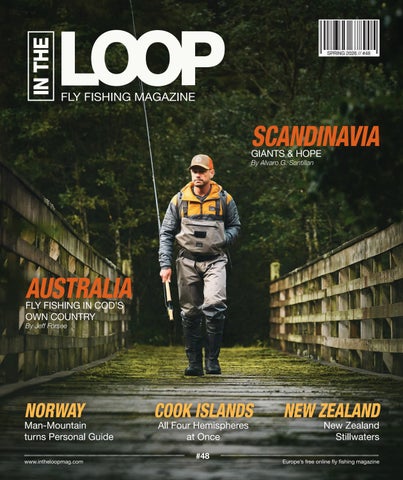
By Jeff Forsee

![]()
By Jeff Forsee

By Alvaro G. Santillan


It’s always great to have a fishing trip to look forward to. But it can also be a constant distraction—and occasionally a source of acute stress. Next week we’re off to Gabon to fly fish for tarpon, jack crevalle, longfin trevally, African threadfin, and more. At the same time, we’ve had a magazine to finish. And the process is rarely characterized by smooth sailing.
Between tying flies, packing gear, planning the trip, producing a magazine (and working our daytime jobs), our grey hairs have probably multiplied over the last couple of weeks. But we’ve finally made it: the March edition is ready, and so are we.
As always, we’d like to thank our contributors for providing inspiring content from near and far. Hopefully it will spark ideas for your own upcoming fishing adventures. This time around, Bessie Hudgens, Tarquin Millington-Drake, David Lambroughton, Alvaro Santillan, Jakub Kanok, Jeff Forsee, Gavin Erwin, Erin Hyde, Barry Ord Clarke, Santillan de Pinto, Bastien Artigas, and many more have shared their stories.
Enjoy the issue—and tight lines.


Giants & Hope by Alvaro
G. Santillan
All Four Hemispheres at Once by Jakub Kanok
Man-Mountain turns Personal Guide
New Zealand Stillwaters
Fly Fishing in Cod’s Own Country


Musings on an Angling Utopia in Remote Northern Australia


the Loop Magazine C/O Cast Away Media
Org no: 999 320 147 www.intheloopmag.com
/ ARTICLES info@intheloopmag.com
info@intheloopmag.com


We choose not to print this magazine and we are happy not to use paper and harmful inks as used in a conventional printing process.
No portion of this magazine may be reproduced without the written consent of the publisher.
Oslo-resident, Rasmus Ovesen, was handed his first fly rod at the tender age of eight, and he has been a borderline fluff chucking fanatic ever since. Rasmus has written articles for some of the world’s most renowned fishing magazines, and his travels take him to re mote areas across the globe in search for fish that will test and challenge his skills to the maximum. He has seen his fair share of ex posed backing in the tropics, but his heart truly belongs to the soulful realm of trout and salmon fishing.
Álvaro G. Santillán is a pho tographer, filmmaker, and founder of Focus on the Fly, a creative studio that bridges fly fishing culture and mod ern brand storytelling. With a background in competitive fly fishing and fly casting and a de gree in Biological Sciences, his work is shaped by rivers and water. Through photography, film, and editorial projects, he collab orates with international brands and publications to craft authentic narratives connecting people, nature, and the culture of fly fishing. https://focusonthefly.com


Jeff Forsee is a flyfishing guide based in Wanaka, New Zea land. Originally from south ern Ohio, he has fully em braced a life down under but still misses largemouth bass and can’t seem to shake that accent. His work and adven tures have taken him around the globe from the remote is lands of the South Pacific to Mongolia, where he has spent many seasons as a guide for Mongolia River Outfitters. These days, when choosing between capturing the moment and capturing the fish, he often favors the lens over the line. His work has appeared in The Fly Fish Journal, Fly Fisherman, FlyLife, The Mission, and many online publications. If you’d like to see more, visit www.jeff-forsee.com.
Bessie Hudgens is a real estate agent in Bozeman, Montana whose passion for the outdoors is rivaled only by her love for her two children, both of whom are aspiring young adventurers (and mischief-makers) themselves. Bessie once worked in the flyfishing industry not only as a guide and trip host but also as the director of New Zealand travel at Yellow Dog Flyfishing Adventures, which gave her the opportunity to chase many exciting fish species around the world on fly. Between career and family demands, she doesn’t have time to travel as much as she used to, but when she does, she always packs a fly-rod… just in case!


David Lambroughton splits his year between British Columbia and New Zealand and lots of stops in between as he gathers his photos for his annual Fly Fishing Dreams Calendar. His calendar comes full of info on the people, places, passion and fly patterns of our sport and is sold all over the world.


w www.alphonsefishingco.com
t +248 422 9700 [GMT+04:00]
m +27 60 980 7316 [GMT+04:00 WhatsApp]
e reservations@alphonsefishingco.com


OUR
Alphonse Island | Astove Atoll | Cosmoled o Atoll | Farquhar Atoll
Amirante Islands | Providence Atoll | Platte Island
Experience the world’s best fly fishing with Blue Safari Fly Fishing, a specialised Seychelles based operator that has spent decades pioneering the fly fishing at these remote Outer Atolls. Our trips are designed to make all your fly fishing dreams come true by providing the best guides, skiffs, lodging and atolls with abundant waters full of trophy fish.
We’ve had the privilige of traveling to some of the world’s premiere fly fishing destinations. Now, it’s your turn! Browse Destinations


By ALVARO G. SANTILLAN

Salmon Fishing in Scandinavia is in a state of crisis – but there is still hope; hope for the giants of the rivers and for the rivers themselves. In this article, Alvaro G. Santillan tells the story of a river giant, and how salmon fishing has evolved over the last few decades to cultivate sustainable conservation- and management principles on behalf of passionate salmon anglers.

By late August, the light shifts. The sun hangs lower, shadows grow longer, and the rivers of Scandinavia settle into their autumn mood.
The bright chrome fish of early summer runs are fewer now, replaced by warriors that have lingered in the river for months - their bodies darkened, their jaws hooked and scarred by the season.
“In the mesh lay a 40lb male, bronze-backed and hook-jawedan old crocodile of a salmon”
by the explosion of happiness from Thomas and the crew sharing the moment with him. In the mesh lay a 40lb male, bronze-backed and hook-jawed - an old crocodile of a salmon.
Thomas would later say: “It is the fish of a lifetime and a true privilege to hold and release it in the company of my friends and colleagues. They still exist and overcome all the problems and difficulties. It brings me hope.”
Together with Espen Myhre, Thomas cradled the fish in the current.
It was in such a moment that Thomas Carlsson, Guideline’s CEO, found himself attached to something heavy and alive at the end of his line. The fight was measured, patient, and relentless - the kind you only get when the fish has seen many battles before. When at last the salmon came within reach, Tellis Katsogiannos, was there with the net. It slid in cleanly. The river fell silent, broken only
The bronze giant heaved, pulsed with power, and then slid from their hands back into the depths, once more to pass on its precious genetics for a brighter future for wild salmon stocks.
Across Norway in 2024, managers faced the brutal arithmetic of low returns and poor early-season counts.
Thirty-three rivers - from Trøndelag south to the Swedish border - were closed outright in late June, with strict rules tightened elsewhere.


The signal was clear: if spawning targets aren’t going to be met, the only ethical choice is to step back.
Those calls were grounded in a national assessments. Norway’s scientific advisory committee reported that the “harvestable surplus” hit a record low in 2024, prompting unprecedented restrictions in rivers and remaining sea fisheries. The biggest recurring pressures they flagged are salmon farming impacts (sea-lice spillover, escapes, and disease) and a warming, less predictable ocean climate.
However, there was a time when salmon were abundant and fish like this were not so rare. Old photos from many Scandinavian rivers, including hidden treasures like this little river along Norway’s West Coast, show men standing stiffly beside salmon as long as themselves, strung from poles or laid on the grass.


In those days, stories of 40–50lb salmon weren’t whispers but expectations.
“A big salmon is more than just a trophy”
The giants were the pride of rivers, the proof of abundance. Today, their presence is far thinner. Every single fish caught - and safely released - feels like a glimpse into the past, a reminder of what these rivers once carried and what, with care, they still might carry again.
A big salmon is more than just a trophy. Biologically, it is a cornerstone of the species’ survival. The biggest fish in the river are also the most valuable due to their genetic resilience and spawning power. Large salmon carry proven survival genetics: they have endured years in the ocean, evaded predators, nets, and parasites, and returned with the strength to spawn. By reproducing, they pass on traits of resilience that future generations desperately need.
Big males dominate on the redds. Their sheer size and strength allow them to fertilize more eggs and defend their territory. Big females are even more critical—capable of laying many times more eggs than smaller hens, and digging deeper into better spawning grounds.
Beyond biology, large salmon anchor our connection to the rivers. They remind us of what these waters are capable of producing. Their presence is both a conservation benchmark and a source of hope. In other words, releasing a giant is not just an act of sportsmanship.
It is a direct investment in the river’s future. Every big salmon that swims away carries within it not just the power of its own life, but the possibility of countless others.
Amidst these pressures, one of the clearest tools for protecting wild stocks has been the adoption of catch and release. Once a controversial idea, it is now woven into the culture of many rivers.


On legendary systems like the Gaula and the Orkla, voluntary and mandatory C&R rates now exceed 90%. This transformation did not happen overnight. It was the product of science, regulation, and a shift in angler values - toward the idea that the opportunity to encounter a salmon is often reward enough. Studies have shown that, when done properly, survival rates for released Atlantic salmon are high. But “properly” is the key word. A salmon released poorly is a salmon lost, and with today’s fragile stocks, every fish counts.
These are the cornerstones for Best Practice Guidelines for C&R. Education is as vital as enforcement:
Use appropriate tackle: Fish with rods, lines, and leaders strong enough to bring salmon in quickly. Long battles deplete energy reserves and lower survival chances.
Keep fish wet: Avoid beaching fish or dragging them onto rocks. The best photos are often taken with the salmon partially submerged.
Limit air exposure: If a fish must be lifted, keep it short and return it immediately.


Gentle handling: Wet hands and rubber nets prevent unnecessary damage to scales and slime.
Recovery time: Hold fish facing upstream in steady current until it kicks away under its own power.
Mind the conditions: High water temperatures (>18–20°C) significantly reduce post-release survival. In such periods, consider refraining from fishing altogether.
It is easy to despair knowing “the numbers”, when you hear the biologists and river managers talk of declines and percentages. But hope often comes in the shape of a fish. A 40-pounder is more than a fish. It is a survivor - proof that resilience still exists, that giants still slip between currents, that rivers still have more to give if we let them.
The old days when every season produced many such fish may be gone - but not entirely. They remain, fewer and harder to find, but still there. And each one returned is more than just a memory for the angler - it is a seed for the future.
On that Scandinavian river, in the company of colleagues and friends, one such giant returned to carry its story forward. For those who were there, and for those who still dream of salmon, it was a reminder: the river still breathes, the giants still run, and hope still swims.

F ROM OCEAN TO RIVER, FROM CITY TO WILD − WE’VE BOTH MADE IT HOME.

E very journey leaves its mark — on flanks of chrome, on worn in wading boots — on souls. But when you finally reach a place that feels like home, all the miles fall away and everything that matters comes into focus. You get one life. Fish It Well.

By JAKUB KANOK

From the very first time my feet touched the sands of the Cook Islands, I had already become emotionally invested. Some connections in life can be this simple and evolve in an instant. Since my initial visit in 2014, I have made a point of returning at least once, sometimes twice, every year. During my visits, I have had the pleasure of meeting and conversing with numerous fly fishermen. We often swap stories over a few beers or two-finger rums at the local Boatshed restaurant.

A common theme among many of the fly fishermen I’ve spoken with during my time in the Cook Islands, particularly those from America, has been the island group of Kiritimati, a small Australian territory located closer to Honolulu than to the rugged and venomous shores of Australia. When the opportunity arose to participate in a hosted trip in August 2024 with five friends, we quickly decided to seize the chance to explore yet another small atoll in the vastness of the South Pacific. Santillan, Shawn, Chris, Klinky and I.
Mauri! “Hello and Welcome” in the Kiribati language
Kiribati is the only country situated in four hemispheres. It is part of the Pacific island division known as Micronesia. Kiribati consists of 33 coral islands divided into three island groups: the Gilbert Islands, the Phoenix Islands, and, most importantly for fly fishermen, the Line Islands.
Zealand and Hawaii. It is well known as a legendary place with a prolific bonefish population. Situated ideally just about a hundred kilometers from the equator, it means good weather all year round.
Christmas Island is serviced by Fiji Airways once weekly from Honolulu, Hawaii (HNL) and Nadi, Fiji (NAN). The approximate flight time when travelling from Nadi, Fiji (NAN) to Kiritimati, Kiribati (CXI) on a Boeing 737-800 is 4 hours and 40 minutes.
As a layover, it is highly recommended to spend a couple of nights in Fiji before embarking on the last leg of the journey to Kiribati, or at least consider the option of staying one night.
Kiritimati Island, the largest atoll in the world, is located in the remote Pacific, equidistant between New
The flight departs Fiji once a week just before midnight and arrives at 6 AM, which will likely be your first day of fishing. Most certainly if your long-awaited itch needs to be scratched post haste. This often means you could be awake for nearly 48 hours unless you have excellent sleeping skills, which I do not.


It’s common to see enthusiastic fly fishermen, fully geared up, wearing flats sneakers, waiting at the departure gate. It was comforting to see eagerly enthusiastic anglers in the noman’s land of the transit area. The fly fishing community is quite small, and as we waited, there were eager nods of recognition exchanged between our group and others who were also preparing to embark on a journey to a place we had held dear in our imaginations. This anticipation formed a crucial part of our mindset as we prepared to explore the corners of the world that had occupied our thoughts for much of the past year.
There is something special about taking the first deep breath of local air when I arrive at any destination. Arriving in a tropical place never disappoints - the heat, humidity, and the immediate scent of the ocean always delight my senses.
After an amusing and underwhelming customs check and bag collection, we met our host, Chris, who beckoned us to a small corner of the
airport where we had obtained our quaint “official” fishing permit issued by a rather large group of men, totally disproportionate to the number of anglers.
We suddenly find ourselves in the back of a truck, not just any truck. A ramshackle and make-shift relic, retrofitted to hold rods and seat anglers. The Patina on the truck and driver were an equal match. Several potholes, pigs tied to palm trees and chicken coops, all of which flashed by in a myriad of bumps and blurs, we arrived at our accommodation.
Sunset Lodge is located directly on the lagoon. There was no questioning whether we would rig up rods and succumb to the draw of several large splashes and the commotion that signalled it was feeding time at the zoo. I am first while others unpack, but many follow within minutes after seeing me hook up immediately. Schools of dart smashing our flies were a great entrée; smaller bluefin trevally were also present in large numbers, and then the first bonefish landed.


“The pristine waters surrounding Christmas Island are a vibrant hub of marine life”
The stoke level is high, and we haven’t even seen the real deal yet! The tone is set. We have arrived.
The pristine waters surrounding Christmas Island are a vibrant hub of marine life, boasting an impressive array of species. This idyllic atoll provides a stunning backdrop for fishing adventures and a vital nursery where juvenile fish find ample food and safe shelter in its lush underwater ecosystems.
Many anglers flock to the island, drawn by its exceptional bonefish population. These fascinating fish typically weigh between 2 and 6 pounds, offering an exciting challenge for fishermen. The waters surrounding the island are teeming with these remarkable creatures, which tend to remain reasonably calm and unstartled in their natural habitat.


This behaviour allows anglers to take advantage of numerous casting opportunities, often at distances of about 20 to 30 feet. The combination of accessibility by outrigger and abundance makes this location a perfect choice for those seeking a thrilling encounter with bonefish.
The bonefishing experience, during our stay, was truly amazing, and I understand how captivating that can be. However, it’s worth noting that Kiribati has so much more to offer beyond just one type of fish.
Triggerfish are known for their distinctive, robust bodies and vibrant colours. They possess a strong jaw that enables them to crush hardshelled prey, making them formidable opponents for fly anglers.
Understanding the behaviour of triggerfish is key to successfully targeting them; they are curious and often aggressive, which can make for exhilarating encounters when fishing. When it comes to casting, accuracy is important.
Fly fishing for triggerfish often involves targeting specific feeding spots, so precise placement of your fly is key.
Effective retrieval patterns, such as steady retrieves or quick strips, can entice fish to take the fly. Patience is crucial; watching for fish behaviour and making quick adjustments to your technique can lead to a successful hook-up. Strategies to entice triggerfish might include using a combination of visual and tactile stimulation, given their aggressive nature.
We’ve all enjoyed various bonefish trips in the past, but none of us had ever had the chance to catch a triggerfish until this adventure. On our first day, we stumbled upon these fascinating creatures, and when Santillan hooked and landed the very first triggerfish we encountered, we were all captivated. The vibrant colours and unique shape of the triggerfish sparked our enthusiasm, and they quickly became our primary target for the remainder of the journey.


Every evening at the lodge, after filling our bellies, we gathered to recount our experiences from the day. Our host would attentively listen to our fishing stories and experiences before announcing who would receive the coveted Fisherman of the Day trophy. On that particular night, it was crystal clear that Santillan was the standout contender.
“We all got smoked on many occasions”
We discovered that many anglers specifically hope to catch triggerfish during their trips, yet so few are successful in doing so. This only heightened our excitement and competitive spirit. The challenge was on, and we were determined to prove our skill against these elusive fish!
Over the upcoming week, we all got smoked on many occasions due to different factors.


I could share the exhilarating moment when I made a perfect cast on the very last day, only for the trigger fish to charge forward, follow and snatch my fly at the last second, just as the leader was reaching my rod tip. However, it might be more relevant to reflect on the countless times we faced rejection, unsuccessful hook-ups, and broken hooks. These experiences have led me to ponder the reasons behind our failures, and my encounters with triggerfish remain vividly etched in my memory.
Kirirtimati is not only renowned for its lush lagoon flats fishing but also offers incredible beachside fishing experiences at the Korean Wreck. This unique and very remote fishing location features waves crashing against the outer reef, located approximately 100 meters from the shore, which in turn flood the inner coral reef, providing ideal fishing conditions right up to the main beach.
The Korean Wreck is accessed via a long drive in trucks. The trucks don’t have much of a suspension, and the road is extremely rough. I highly recommend bringing an inflatable seat or taking a pillow. I decided to record the journey on Strava (173 km return trip, with average speed of 21.6km/h.


The water here is gin clear, showcasing a vibrant underwater ecosystem. The bonefish that inhabit these waters are notably darker, making them easier to spot against the stunning purplish hues of the coral background. This contrast enhances the thrill of the chase, as anglers can observe these fish moving gracefully through their habitat. What truly sets the Korean Wreck apart is the remarkable diversity of species that can be encountered. Schools of bluefin trevally swim energetically in the area, offering thrilling encounters and a delightful challenge for those targeting them.
Additionally, this is an excellent location for hunting the elusive giant trevally (GTs), which often appear in groups and present a violent fight for any angler fortunate enough to hook one.
Beyond these exciting catches, anglers can also reel in a variety of other species, including barracudas, long-nosed emperor (sweetlip),
milkfish, and many more. The Korean Wreck is a premier destination due to its rich marine life and remote location - something I have never experienced before. If there is any chance to organise a camping possibility, I highly encourage you to do it!
What sets Christmas Island apart is its unparalleled appeal to anglers seeking the thrill of targeting multiple species in a breathtaking wade fishing paradise that remains accessible throughout the entire year.
With its crystal-clear waters, abundant marine biodiversity, and captivating landscapes, it is undeniably a remarkable destination brimming with unique fishing opportunities.
I am certain that one day I’ll return, drawn back by the memories and experiences that beckon me. As time passes, I feel an increasing urge to revisit those familiar places, where every corner holds a story, and every sunset reflects a fragment of my past.


By TARQUIN MILLINGTON-DRAKE


In the vast, untamed wilderness of Northern Norway, few know the rivers, fjords, and high plateaus like Geir — a towering figure both in stature and spirit. After years working in the outdoor industry, watching others head off into the Finnmark wilds, he’s finally stepped into the role he was born for: personal guide and guardian of Norway’s great fishing frontiers. From the legendary Stubburselva to the hidden grayling streams of the far north, Geir’s world is one of deep local knowledge, camaraderie, and wild adventure — and now, he’s ready to share it.
I have known Geir some 15 years, and he and I have an inextricable link. We are both honorary members of the same family, the Mikklesen family of Alta boatman fame. He somehow ended up growing up with the youngest son, Vegard, also one of the great Alta boatmen.
My membership follows fishing with one or other of Per and Bjorn Mikklesen since 1991. For the past 20+ years it has been both but on occasion we have had celebrity appearances from Bjørnulf, the Dad, and even more recently Lars, son of Bjorn. Down the generations we have had visits from Maya (Per’s daughter) and Jørgen (Vegard’s son) who come and wait for us to hook grilse so they can wind them in! Naturally, in the summer, Geir’s son
Isak now spends a lot of time with the Mikklesen clan who live on the banks of the Alta river. Randi, the boys’ mother, is ultra-keen and the real power behind the family. When we are having tea and we cannot remember which year we caught a certain fish, Randi checks her diary and always has the answers! Needless to say, I am extremely fond of the whole family. They are truly wonderful people and have been very kind to me over thirty years. Geir, the Man-Mountain is no exception!
Finnmark adventures
It was with great joy when I received a call from Geir to tell me that he was finally fulfilling his dream to become a guide on his home territory.


He has worked in the sports/outdoor industry for his whole career, but it was always other people walking out the door to enjoy the wilderness of Finmark and not him and, over all those years, it had got to him.
This year, he finally made the jump to start his own guiding business covering fishing, shooting and foraging. His home is Finmark, he now lives in Alta, but he has also lived in Hammerfest and Lakselv where his Mum still lives. He would say that his ‘home’ rivers are Alta, Stabburselva, Lakselv and Repparfjordelva.
The first three are famous for their big fish, the last one, the Repparfjordelva, is one of Norway’s most productive rivers with grilse and salmon up to about 25lbs. It is famous for its bomber fishing.


Lakselv is better known than Stabburselva but the Stabburselva is prettier, has beautiful pools and equally big fish. While I was there for a few days this spring (27th to 29th June) three fish of over 120 cms went through the counter –those are all 40lb + fish! Geir’s fishing guiding extends to a great deal more: Sea trout in the fjords, brown trout and grayling on the rivers and lakes, pike, arctic char in the mountain lakes and rivers.
I can hear all the cries of ‘can he get us on Alta and these other rivers?’. The answer is NO… but read on…
Man Mountain’s domain
Alta is a closed shop between the Alta Syndicates, and the local and international lottery but he can take you sea trout fishing on Alta in the first days of September, some of Norway’s biggest sea trout, and on a tributary of Alta - if conditions and time of year are right.
His value is local knowledge, knowing where to go when, how to get there and having the equipment and knowledge to get you there quicker and easier than everyone else! Let me give you a couple of examples. We decided to go to Beat 4 of the Stabburselva right deep in the stunning Stabbursdalen National Park. We drove to the car park, loaded gear and walked for about 15 minutes to one of Geir’s boats.
There we rowed up the lake fishing for pike as we went. On arrival we fished for salmon on two Zone 3 pools (we also had a licence for Zone 3), we saw fish, but a thunderstorm was brewing, and the fish did not seem in the mood.
The other rivers all have purchasable licences, and he can help access those but achieving licences is actually not where his value lies.
We began the next 10-minute walk when the heaven’s opened but surprise, surprise, Geir had a tent just around the corner, so we sheltered there and Geir set his anti-mosquito device off and soon there was not a mosquito to be seen. Then, we fished another Zone 3 pool and then got in the boat and rowed across the lake. Here, we walked about 20 minutes to our destination pool.


There was another fisher there but of course Geir had another boat, so we were able to fish both sides of this stunning tail.
“I did get a stunning 20lbs fish which took off down the rapids and had Geir not been there, I think I would have lost it”
Had Geir not been the guide, this journey would have taken over four hours! Add to the fact that during this trip his ‘Man-Mountain’ act kicked in putting my backpack in his backpack to carry everything and of course when we are there, out comes a frying man, reindeer meat, cream, onions etc to make a reindeer stew onsite! I did get a stunning 20lbs fish which took off down the rapids and had Geir not been there, I think I would have lost it. The rocks where I was wading were unbelievably slippery, but he was able to help me get away from the ‘ice-rink’ and together we chased the fish down the rapids!


Lakselv and Alta
A second example was heading off to catch some trout in a little river up in the hills near the top of the Lakselv river. We loaded on to Geir’s sixwheel Polaris ATV (he is an ambassador for Polaris in Norway) and drove for an hour into the Finmark wilderness where - sure enough - we caught wild brownies on dry fly aplenty!
A third was a further trip we made with a friend by helicopter into an area north of Alta. It was possible to stay there but we flew in for the day and caught some enormous, near record grayling on a beautiful river. We hooked trout but failed to land them!
As we flew over, Geir pointed out various trout rivers that we could access via his ATV. We basically barely scratched the surface of what one can do and enjoy with Geir and his knowledge and access. Then of course there is the sea trout in the Alta and Lakselv fjords, and in the rivers later in the year along with the ptarmigan. Geir is a very keen dog man with two beautiful pointers, Airo and Aya.


Nothing is off the menu so Geir can advise on what there is to do at the time of year you wish to travel. Early season, I would suggest a salmon fishing combo with Stabburselva and Repparfjordelva, maybe three days on each or two days on each and two days of trout, grayling or char.
Geir can advise and even then, the plan is not set in stone if the weather has made the potential plan less positive. Geir will generally pick guests up from Alta airport (2 hours London – Oslo and 2 hours Oslo – Alta – both by jet) and his day rate includes driving you around, guiding, use of his equipment etc. For accommodation there is a very broad choice from a range of hotels to Air B&Bs to self-catering cabins. The choice is yours.


Once a basic plan has been agreed, Geir will quote for his time and your choice of accommodation and will estimate the likely costs of fishing licences which can only be purchased onsite. Geir speaks perfect English, and it is absolutely no problem for Frontiers to arrange for you to chat to Geir directly.
I know that this is not your typical book a fishing lodge at X price scenario but ‘times, they are a changing’ as they say, and in the absence of many fishing lodges in Finmark and the difficulty in getting on to a river like Alta, Geir and his knowledge is a pretty good plan. If, and when you spend time with Geir, you will see that he lives and breathes this land, his depth of affection for where he lives and his desire to share what he loves with others is palpable. He truly is excellent company.
For more info, please reach out to Tarquin:
tmd@millingtondrake.com
tmd@frontierstrvl.co.uk

Engineered for the most extreme conditions, the new Swiftcurrent Expeditions deliver unmatched durability, features and comfort. Advanced materials and innovative patterning reduce bulk, minimize seam stress and enhance maneuverability. They move effortlessly in and out of the water, efficiently carry gear and can easily transition from chest-high to waist-high. Plus, their durable water-repellent finish is made without intentionally added PFAS chemicals.


Working through heart-pounding, “be-ready” water on a British Columbia steelhead river, Asher
unleashes a dry-line Spey cast most of us only see in our dreams.

With New Zealand being so famous for its fine rivers and streams, it is easy to see why the stillwater fisheries have been largely overlooked by visiting anglers. They do, however, have so much to offer. They don’t go out after a weather system passes through like rivers do, they are great for older anglers who don’t want to hike up the rivers or for anyone who would like to rest their legs after a long day of boulder hopping. Also, with some of the famous rivers getting a bit too popular in the summer months, with anglers scrambling in the early mornings to secure a beat well before you would actually want to start fishing, stillwaters are making more sense every year. Besides that, with their fertility and longer feeding/growing seasons, they can often produce the largest fish of your trip or the season. So where are they? Everywhere! The locals love them. There is also a small number of visiting anglers that come to N.Z. just for the lakes and ponds. They will have their annual circuits of their favourites and some will keep a boat here as well.
By DAVID LAMBROUGHTON


For most of us, towing a boat and dealing with motors, etc., is not in the cards. However, a small inflatable can be well worth bringing down. The late Dave Inks, one of the early people behind the WaterMaster Boats, went on to develop the WaterStrider Boats that are outstanding and great for traveling. Check out Waterstrider.com, based out of Hamilton, Montana. His wife Bonnie runs the company now and the perfect model for traveling to New Zealand with, or anywhere, would be their “Traveler” model that comes in the right color; green. It will fit in a suitcase, or you could put two in a duffle bag, complete with oars, pump, and fins and still come in under the usual 52lb bag limit. My whole fishing gang has been using them for decades on Steelhead Rivers, and in Montana, British Columbia, everywhere. With one of these, the Stillwater World opens right up here in New Zealand. But besides this option, there is also a fair amount of flats fishing in some of the better-known lakes as welland on the numerous spring ponds they pretty much are all best fished quietly from the shore.
The most famous lakes would be Lake Waikaremoana in the eastern part of the island, Lake Tarawera and others surrounding the city of Rotorora, and of course the largest lake in New Zealand, Lake Taupo, which is fed by the Tongariro River, besides lots of smaller streams. Of these, like the Waitahanui River would be the most famous for shore fishing and home of the “Picket Fence” which would be anglers spread across the inflow where it drops into Lake Taupo.
Your first stop though should be likely the best lake on the North island, Lake Otamangakau, which is about a 30-minute drive from the Tongariro River Motel. It’s a superb place for a Waterstrider Boat but you can wade fish parts of it, the incoming canal in particular. The rainbows and browns can be BIG. But the “Big O” is closed for fishing during the month of February. However, if you have a Waterstrider or similar inflatable with you, and have some decent rowing skills, floating the Tongariro River is supremely fun, especially when the cicadas are about.


I’ve done this dozens of times from the Blue Pool down to the highway bridge which is a block from the Tongariro River Motel. You can also float from the bridge down to the lake and Ross Baker. The owner of the Tongariro River Motel is super helpful and can help with the logistics of drop offs and pickups, besides all the fishing options of the area.
By and large, with the exception of Lake Brunner near Greymouth, the best lakes are found on the bottom half of the South Island. The Poolburn Reservoir and Lake Onslow have been historic favourites, and the top end of some large lakes like Lake Tekapo, Lake Pukaki on the way to Mt. Cook, and Lake Ohau, closer to Omarama can all be good choices throughout the season.
Paddock Bay on the west side of Lake Wanaka is also a favourite with easy wading along a huge flat, with the usual breeze to your back and decent fish spotting. Another X on your map should be to top end of Lake Dunston where the Clutha River comes in. It’s a Stillwater Heaven; weed beds and good shore fishing and lots of backcast room. You can access it off of Lockar road on the west side of the lake near the confluence. The town of Cromwell would make a nice base for it.


On the West Coast north of the hamlet of Haast is Lake Moeraki, famous for big fish and located in the middle of nowhere and good for camping. Then there’s a personal favourite of mine, South Mavora Lake, about a 30-minute drive north of Mossburn. It’s actually the head of the Mararoa River and has some nice wadable flats on the roadside right up to the top of the lake. Also, while you are there you can cross the outflow of the lake on a swing bridge and take the trail downstream for about 25 minutes and then fish your way back to the lake and it has both browns and rainbows that can be large, especially during the “Mouse Years.” We usually go there when the rivers blow out but the outflow of the South Mavora Lake will run clear.
Some are true Spring Ponds, complete with vents, where fish would spawn in the outflows and others would be old horseshoe river bends that have been cut off and get restocked annually during periods of high water. The watersheds sur-
rounding the towns of Omarama and Twizel contain enough that it would take a good chunk of the summer to sample them all.
You want to hit the ponds early in the day before the common afternoon wind comes up, making the fish spotting more challenging. Probably the best known are found up the Ahuriri Valley south of Omarama. You take the Birchwood Station Road up the valley and it goes right past them both. First is the “Lagoon” and then after another mile or two comes the “Horseshoe Tarn.” So, you can start the day on them and hit the river in the afternoon. Kellands Pond just off the highway near Twizel is another favourite, but you will see lots of blue pond marks on your map all over the place and up towards Lake Ohau as well.
So, what’s the key for success on the ponds? Patience, having the sun to your back for good spotting, long leaders, and small weighted nymphs. Watch for fish slow-cruising their beat and then lay the trap.


When they get within about 10 feet of your fly you can start to twitch it in with little 3-4 pulls. It can be incredibly exciting as you can see the possible take maybe a minute in advance. But my little size 16 foam spiders or beetles can also be lethal, especially if there’s a little ripple on the water to hide the tippet.
You likely already have lots of flies in your boxes that would work just fine and I recall that old politically incorrect saying, “It’s not the arrow, but the Indian.” Patience, observation, and good accurate casts are just as important, if not more so. Also, mayflies and caddis look quite similar all over the trout world and stoneflies are almost irellevant down here and nothing like the bigger versions in North America.
On the North Island you are fishing primarily for rainbows that generally prefer heavier, broken water, and tend not to be very selective. So, larger dries and nymphs (more lead) is generally the ticket on the rivers. On the South Island it’s a bit different
as the browns like smoother, shallower water that give them a better view and more time to make their decision. On the South Island you also run into more hatches, which can kick off very selective feeding at times. So, like anywhere, having some Adams in size 12-18 and the same with Pheasant Tail Nymphs in your box is always wise. However, on the PT’s be sure to vary them with different sized beads (Black Tungsten) to black glass beads that will land almost like a dry on smooth water.
On my fly patch I will also carry “The Closer,” a heavily weighted rubber legged beast in a size 10 for when a nice fish is sitting in heavier/ deeper water and won’t come up for the dry and my normal nymphs are not getting deep enough. Then I put it right through at mouth level and if the fish doesn’t take it on the first drift through, it won’t take it in the next hundred because the chances of a Big Mac coming through the front door twice within a minute or less is zero and they will hear Lassie Barking…. game over!


It’s certainly worth one cast, though, especially if it’s a big fish. It would also be excellent on the North Island rivers at any time.
As for flies that you may need that you would not normally have in your box would be the “Blue Bottle” in a size #12 which imitates the large flies that love the sheep, cow, and deer poop, which is found about everywhere. The other one is the “Willow Grub” a summer favourite on the South Island menu on warm days when they fall off the willows into the water and the fish will line up for them and are easy to spot, like gold bars, just under the surface. They can start in mid-December and keep falling in well into most of February. Their color is usually light green, cream, or yellow in a size 20 or 22. But small hooks don’t work as well in larger mouths, so I tie them on a #16 Kamasan B 160 Hook which is 2X Short. I have the body size of a 20 but the gap of a size 16 hooks and they will put more fish in the net. I use the smallest foam post material I can find but just going to a Dollar Store or a crafts store. You can buy sheets of thin foam for about $1.00 or less and slice thin strips off and tie thousands of them for basically nothing.


Back to the Kamasan B 160 Hooks, I use these 2X Short hooks for lots of other patterns like the Hare & Coppers, Emergers, short little Humpies, and fat little Beetles. So even with thicker bodies you still have lots of gap for the grab. But on my super floaters, my Elk Hair Caddis, in sizes 12 to 16, with their fully palmered bodies, I like the 1X Strong, 1X Wide Gap Tiemco #9300 Dry Fly Hook.
I should also add that I haven’t tied any Elk Hair Caddis without rubber legs in the past 30 years. It’s a no brainer. When you are able to watch the reaction of fish in the clear water; the distance that they see the fly and the speed in which they commit to it, is a fly tiers delight. Rubber legs and black beads on nymphs is a trigger for them.
For the flies tied with the black foam, I love using the Evazote Foam from Rainy’s in Utah. It comes in a variety of colours and thicknesses; 1/8”, 3/16”, and 1/4” that I use on Steelhead Skaters. What makes it so nice to work with it that it com-
presses easily and never rotates on the hook. For practically all my foam ties for New Zealand, I’m using Black in the 1/8” thickness. But you will still need something on top to see them on the water because black disappears. You can use all sorts of things like synthetics, or even a small strip of those inexpensive foam sheets I’ve already mentioned.
On some of the photos of my nymphs, you’ll notice some of them sitting point up and I tie practically all my larger nymphs this way by slightly flattening the lead strip that I tie onto the top of the hook shank and also slip it in the bead, which will raise it bit.
This will flip the fly point up on the drifts which does three things; it will rarely ever hang up or get it’s point dulled on the rocks, will come off the bottom on the stillwaters cleaner if you are setting the “trap” with it, and most importantly it gives you a much higher percentage of those solid top jaw hookups which are much easier on the fish.
This concludes my story on New Zealand. At first it was to be a single stand-alone piece that turned into three parts in issues #46, #47, and now #48.
I wanted to write to help field all the questions I get every year from people planning on coming to N.Z. After publishing so many words and photos over the decades on N.Z. in various magazines and my own Fly Fishing Dreams Calendars, I’ve always felt a responsibility to be helpful, knowing that a little bit of my time could make a big difference for someone’s Dream Trip.
How could I not?
After spending over 5,000 fishing days running around both Islands top to bottom, coast to coast, in the past 45 years, I’ve learned a lot and every year comes a few more tricks and fly pattern tweaks.
I have found my waters to grow old with and now I find great pleasure in helping other to find theirs.
and a bit about Photography…
I’ll get to the comfort-part in a bit, but this photo has much to say. Years ago, one of my photography mentors told me something that really registered with me, “You want to put as much information in your photos as you can” and this photo is crammed with it.
When you shoot upstream you get a bigger view and a feeling for the gradient of the water. You want to see both banks in your framing so you can tell the size of the stream and what the countryside looks like as well. Having something that leads your eye into the photo, like a fly line in this case, and it enhances the three-dimensional aspect.
Also having the anglers’ head clearly defined and not meeting any lines between the sky, foliage, or water. (Sometimes I’ll try and find a shadow for a backdrop for the angler’s head, so it’s clearly defined).


I also shot this photo to work with a square framing for my annual calendar, but I would also take a quick variety of shots for other uses, like a vertical for a possible magazine cover shot.
This photo also ties in nicely with some more New Zealand Info. You can tell that this is a very fertile stream by the colour of the stream bed and it doesn’t work well with fish spotting and you can’t get close to them anyway on such small water without them seeing or hearing you.
So, you fish the water blind which is quicker and easier and just as much fun. You can see the Chomp Zone (the bubble line) here and it’s about 4 feet wide and the fish’ eyes are glued on that. So, you start at the back of the pool with a short cast and slowly lengthen it to about 30 feet, the perfect optimum length to load your rod with ease and accuracy.
Now you make a couple of casts, then move up about 6 feet and repeat and all your casts are now the same length and you find your rhythm; a roll cast pickup, one false cast, and
then drop the #14 Elk Hair Caddis (or whatever) knowing that practically all the takes will come in the first few feet of the drift. So, there’s really no point in having a drift with a dry longer than the length of your leader. Then, if you are fishing with a buddy, have them cover the deeper, heavier water at the head of the pool with a nymph. Then it’s off to the next pool or soft spot that looks fishy. That’s basically how we do it and I fall deeper in love every year with these smaller streams - and for me, a nice fat 4-pound hen is the perfect fish on my favourite Winston Air 2 /4 weight rod, especially on a dry.
Now onto the angler and let’s start at his feet. Lightweight rubber soled wading shoes with no noisy, line damaging, unnecessary studs. He also has foot beds in them that make his wading boots as comfortable as any of his shoes. Most wading boots have terrible arch support. So, after long day hiking up a river and then the long walk back to the car at the end of the day, you might be quite tired, but your feet won’t hurt.
Onto the nylon wading pants. They are an excellent choice for the summer fishing season. They dry in a few minutes as we hike up the streams, and they have none of those worthless line-grabbing cargo pockets.
When I wear them, I go “Commando” because if you wear underwear and get them wet on a crossing, they will stay wet all day and “Larry and the twins” will really get pissed off and uncomfortable from the chaffing by the end of day. You can find them in all kinds of colours; grey, olive, brown, all nice earthy colours that blend in and don’t advertise you to the fish. I also wear shorts about half the time.
Next notice the little waist pack. They are excellent and besides carrying some water bottles and your lunch, they give you nice lumbar support. They are also nice to carry your camera and for me it’s a Fuji X-T5 with a Fuji 16-80 lens.


But if you want to lighten the camera load, the new little Fuji X-E5 with a little Sigma 18-50 lens would be a good choice and this lens also has the ability to shoot almost macro shots with its close focusing ability - and many of my fly photos were taken with it. There’s all kinds of great cameras on the market that will do a great job but I personally don’t have much use for the waterproof cameras that you can submerge. You can’t attach a polarizing filter to them for taking the shine off the water and enhancing the colours… my addiction.
For my cameras I also have little bags made out of some soft poly pile material with a velcro closure to keep them clean and blemish free. I also carry a small plastic bag at the bottom on my waist pack for thunderstorms or tricky river crossings.
Now onto the vest. They are still the best way to carry everything you’ll need and spread the weight evenly over your shoulders and offering easy access to fly boxes, tippet spools, fly floatant, clippers, etc. Vests are also excellent for carrying your landing
net and with the basket up you’ll snag much fewer bushes and fences. For safety I also attach the clip on the net handle to my waist pack.
Finding lost nets along rivers is not uncommon. The McLean nets we buy in N.Z. also have the ability to weigh fish in the handles if that is important to you. I also use a Simms Vest and use their velcro fly patches and when the trip if over and I’m packing things up, I just pull the fly patches off and put them back into the tough little plastic bags that they came in and this saves lots of lost flies floating around.
I also, at the beginning my trips, wax my rod ferules that help prevent wear and rotation, but more importantly prevent sections getting stuck together, a common problem when rods set up at a fishing lodge for your entire stay or for weeks at a time on the porch of my South Island Cottage.
I hope all this helps you have better hassle-free, comfortable fishing trips. I always like to say that I’m not out there to rough it. I’m out there to smooth is.


For over 80 years, we have been at the forefront of innovation. Sharpened by experience. Pushing the boundaries of material science to make our lines stronger and more durable. Then testing in the most demanding environments with the world’s best anglers. Those who demand the best choose Scientific Anglers.


By JEFF FORSEE - jeff@aotearoaanglers.com

I’ve been lucky to spend most of my adult life immersed in New Zealand’s world-class trout fishing and epic landscapes—but I grew up in the U.S., and every now and then, I miss the grit that comes with a continental landmass and a big population. Australia ticks all of these boxes and I love it. It’s raw, it’s real and it made me feel at home the second we hit the road. They even have terrible gas station coffee, which of course was the first stop we made in the face of our eight-hour drive to the north.
I can’t speak highly enough about the trout fishing in New Zealand, it really is in my opinion the best in the world. Australia on the other hand is full of fish, a weird and wonderful variety of both introduced and ancient endemic species spread across an area so great that it takes a few hours of minimal progress on the highway before the scale of the place really starts to set in. My fishing partner Patty Neylon and I had one species in mind: the Murray cod — the largest exclusively freshwater fish in Australia and one of the largest in the world, with the biggest specimen ever recorded weighing in at a whopping 113kg.
I’ve booked longer flights to chase smaller fish so the short threehour jaunt across the Tasman was a no-brainer and, in retrospect, I’m surprised that more Kiwi anglers don’t make the most of their proximity to these world class fisheries. It’s also worth reiterating that the allure does not come from the fish alone, but also its home. Australia is a wild place, full of adventure, curious creatures, and a landscape vastly different to what we have in Aotearoa.


The Murray cod is known by differing names from Aboriginal cultures throughout the Murray-Darling basin. The most commonly used today seems to be Goodoo, which is an undeniably striking name. It could be argued that it is maybe even more appropriate than the popular-name of ‘cod’ - as the fish is quite easily, not mistaken for its namesake from the north Atlantic. Not to mention Aboriginal cultures have been fishing for these fish with refined techniques for 25,000 years or more.
Driving along the Pacific Highway at a comfortable 110kph, I began to understand that these fish are currently represented at a fraction of their natural biomass and range. Which is sadly an all-too-common, story for many species across the globe today. Thankfully, there are still some safe havens that harbour healthy stocks of these fish, and that’s exactly where we were headed. The sun settled into the horizon as we turned off the main highway and it was around this time that nervous mutterings about
kangaroos began coming from Patty. I grew up dodging headlight-stricken whitetail deer in southern Ohio so I thought I knew what I was in for, but I later discovered that there are a lot more kangaroos in Australia than there are deer in Ohio and we were driving a 20-year-old van with one headlight and no “roo-bar”. We had a few near-misses over the last few hours of the trip but safely made it to our camp at about 3 o’clock in the morning. I pitched my tent as Patty shoved the groceries and fishing tackle to one side of the mattress in the back of his van.
We poured a celebratory whiskey into a couple of half rinsed coffee cups from Sydney with the hopes of getting a bit of shuteye. But after only a few hours of sleeping soundly our plan was foiled by my first encounter with a rowdy, early-to-rise bunch of cockatoos accompanied by no shortage of their smaller pink counterparts, the gala. After a bit of frustrated tossing and turning, I quickly realized that my efforts were in vain and it was in my best interest to get up and seize the day.


The reality was, as I began to wake, I became fascinated by the birds. They were beautiful, and part of the wild that I was hoping for in coming to Australia. I reveled in the novelty of it all as I brushed my teeth, made breakfast, and got my first glimpse of a cod stream.
Eastern Australia had been enduring a severe run of drought at the time, which ultimately contributed to the devastating bushfires of 2019 and 2020. The ‘dry run’ was evident during that first day on the river. In fact, ‘river’ almost seemed a generous term. The waterway had almost no flow and exactly suited my definition of ‘frog water.’ But despite the lack of flow, it felt fishy and even though I had never seen a cod before, it felt like they should be there.
“We began wandering through the masses of gum trees”
With a casual start to the day, we began wandering through the masses of gum trees which are about as common as dirt in Australia, but for a visitor, a gum forest is a pretty unique experience.


The forest grew tight to the boulder-strewn stream but there were plenty of places to sneak in and make a cast.
On one such approach, as I emerged from the forest and stepped out onto a large boulder, I spooked a small critter moving just under the surface of the water. It took me a moment of filtering through a lifetime of National Geographic shows and old memories to recall a school report I did in-the 4th grade back in Ohio, the subject of which was the peculiar duck billed platypus. What a bizarre creature and one that my 8-year-old self couldn’t have imagined ever seeing in real life. This must be Australia.
The cod encounter which I had fabricated in my mind was a fish with a big belly, maybe. 12 or 15Ib, engulfing a top-water fly. In hopes of realizing this I started throwing a small Gurgler near to any cover, and I didn’t make half a dozen casts before it happened. The fish was the right size and all, maybe even a little bit bigger (as they often are when they get away.) It ate my fly with an audible
whoomph, I stripped hard, perhaps a bit too hastily, and I watched the fish return to the depths as my fly swirled around in the surface wake.
“I didn’t make half a dozen casts before it happened”
Flabbergasted that the result I was hoping for had at least partially just occurred, I excitedly yelled out to Patty, but he was busy fifty meters downstream looking for his own fish. I gathered myself and my fly line and started making a few more casts into the overhanging bush on the other side of the river, where the fish had appeared to come from. It followed the fly several more times but with less enthusiasm for each cast that I made.
I was desperate, but the fish was onto me, my chance was over. As it turned out this was the largest fish that I would move for the entirety of our trip — it’s always better when you don’t get a good look at them!


We carried on upstream and both managed a couple of smaller cod for the day on a mixture of surface and sub-surface flies. It’s always a fulfilling moment laying hands and eyes on a species that you’ve never seen before but have spent time reading and dreaming about.
Our journey found us on the border of New South Wales and Queensland in a part of the country known as ‘New England.’ New England has a surprisingly high elevation and rugged landscape and is riddled with eucalyptus, red rock gorges, and cod water.
A nearby town proudly displays a sign at the entrance with a painting of our quarry and the welcoming catch phrase ‘Cod’s Own Country.’ It reminded me of the giant brown trout located on the banks of the Mataura River in Gore, NZ, boasting its glory as the ‘World Capital of Brown Trout Fishing.’ These piscatorial tributes are a promising and energizing welcome to visiting anglers. After a couple of days of get-
ting warmed up by way of fishing the water within walking distance of our camp, we decided to take a more Kiwi approach to a nearby system.
We filled our backpacks with tents, camp, stoves, food and fishing gear and hit the red dirt road on our own two feet.
“The anticipation was palpable as the rim of the gorge came into view”
While we made our way through the forest, I was constantly on the lookout for snakes and other Aussie “unsavories”. After living in New Zealand, a land with near no human predators or poisonous critters, I feel my survival sense when it comes to wildlife has numbed, which isn’t great when you’re visiting a place that claims a disproportionate amount of the world’s deadliest snakes, spiders, and probably a few other things.


The anticipation was palpable as the rim of the gorge came into view through the thinning forest. We rounded the top of the canyon, and our emotions went from an all-time high to confusion and disappointment. As the riverbed below came into view, it was seemingly dry, or at least didn’t align with the traditional definitions of a river. We talked seriously about turning back, but the day was late, so we decided we’d carry on, to see if our senses were giving us the full story.
As we journeyed ‘upstream’ the deep stone sided pools began to link up with small amounts of flowing water and our hopes were slowly being restored. We found a nice place to call home for the evening, set up our tents and rigged our rods to explore a bit further.
Once again, after only a few casts we began to move fish. As the sun began to disappear behind the canyon rim, the bite didn’t seem to slow so we kept making casts into the sizable pool in front of our camp well into the night. We had some of the best fishing of our trip during that first evening in the gorge — fishing surface flies and listening for the gulp.


Patty’s prize
The next morning, we decided to explore a few more pools before bearing the weight of our packs and continuing our upriver journey. The fishing was slow, and my interest began to wane from the task at hand and shift to the strange and faraway place that I seemed to have found myself in. The place had a nearly tangible energy, and my suspicion is that you might encounter that same sensation in many parts of the ancient Australian continent. It’s an energy I have only otherwise experienced in the canyonlands and red rock deserts of the southwestern United States, an equally ancient part of the world.
I was swiftly brought back to reality as Patty let out an excited hoot. I was perched high on a rocky slope above the pool that he had been tirelessly fishing and my eyes were quickly drawn to a subtle swirl on the surface of the otherwise calm waters. I didn’t see the flash during my daydream, but I could tell by the tone in Patty’s voice that he had a pretty serious situation on his hands. He flung another cast in front of the small rock island before him and it became very clear very quickly, that Patty was living one of those moments that anglers often dream about but seldom experience.


Patty’s rod was promptly and properly corked, with a deep bend from tip to butt. The battle that ensued was more of a tug-of-war than a fight, with neither Patty nor the fish giving an ounce more than they had to. Everything was maxed out and at breaking point - the rod, the knots, the hook, the will of the fish, Patty’s nerves, my nerves, all of it.
It always seems as though a fight with a big fish lasts longer than reality, but this I believe, was a genuinely long battle. The tenacity of both the fish and angler was admirable. Of course, I always want to be on the fighting end of the rod myself in these scenarios but bearing witness to one of my best buddies laying it to one of the wildest, most impressive fish I’ve ever seen is a damn good consolation prize. Plus, I got to grab the prize by the tail when the time came. We didn’t weigh or measure the fish, but we didn’t need to, we knew it was as big as we could have ever hoped to catch or even witness on this trip. Being in the presence of these largely unobtainable creatures is a real privilege and a big part of what fuels the
fire for me. We laid eyes on that fish for probably only a handful of minutes before it powered off back into its lair, possibly never to be seen again. What a wild encounter for all of us, fish included. For a couple of amateur cod anglers, it was an experience satisfactory enough to fuel a lifetime of cod pursuits. As the saying goes, if you know, you know — and I guess we now knew.
We didn’t catch too many fish after that. It seemed as if the Gods knew that we had filled our cup and it was now time to just enjoy being alive in the place that we were in. We continued our hike through one of the prettiest gorges I’ve ever witnessed, swam in the fresh cool water, basked on the warm sun-soaked rocks and laughed a whole lot about that big ol’ fish that Patty had caught. I’ve since returned to Australia to fish for Goodoo and still haven’t seen another fish like that, but ‘m going to keep going back until I do.
For more info// Website: www.aotearoaanglers.com
Social: @aotearoaanglers and @jeff.forsee


Built from premium and durable quick-drying materials, the Headwaters Vest features highly breathable spacer mesh padding over the shoulders for added comfort when fully loaded. Lined with soft polyester mesh and finished with a cozy rib knit collar, it makes it easy to find your flow and includes four lower pockets specifically sized to accommodate C&F Design Fly Boxes. For more info, please refer to the European distributor – www.flyfisheurope.com/simms/


A true trail-to-river vehicle. Light on weight, heavy on performance. Built with relentless dual Vibram compound in G.O.A.T. construction, this boot offers unmatched stability, unparalleled grip, and next-level comfort. Featuring the industry-leading Vibram IdroGrip Flex zone in the middle of the outsole and Vibram IdroGrip on the outsole edges, the Access Boot delivers gamechanging slip resistance and superior durability. Designed for on-the-go anglers who demand the most from their gear. Prices and additional information: www.flyfisheurope.com/simms/
The new Primal Zone CCC series represents the pinnacle of European-style nymphing rod design, incorporating advanced materials and engineering for superior on-water performance. At the core of each rod is Primal’s proprietary CCC (Compressed Carbon Chain) Technology, which enhances transmission sensitivity through the blank—allowing anglers to detect the most subtle subsurface takes and micro-transmissions during the drift. To address specific tactical requirements, ensuring anglers can maximize efficiency, control, and sensitivity across a wide range of Euro-nymphing scenarios, there are a total of six Zone rods available –ranging from 9,6’ – 11,0’ and #2 - #5. For more, please refer to the European distributor, Flyfish Europe – www.flyfisheurope.com/primal/


The Lamson Litespeed Freshwater- and Marineseries reels are now available in a very limited run in the Wild Child colour scheme; an explosion of high contrast colours for those wild at heart. Available in F5 + F7 sizes along with the M8 + M10. Expect performance combined with a wild finish, able to turn heads and draw double-takes wherever you fish. Pre-order one at your local Lamson dealer now. www.lamsonflyfishing.com

G-Loomis:
To make perfect floating crab imitations for the Mexican Gulf, where the Sargassum weed attracts permit to feed on the surface, Rupert Harvey has come up with an amazing kit. Each set contains 5 sets of legs and claws and 5 pre-cut 3mm Carapaces. Tie the fly and colour it with permanent markers to match the exact conditions you have in mind. For more info, please check out: https://rupertharveysflies.com
Limitied edition, ultra fine and thin tips which allows you to cut and trim with the greatest care and precision. Developed with professional and highlyskilled fly tiers. We’ve tested these for small CDC dry flies and micro nymphs and have gained a new favourite pair of precision scissors. 9cm in length with a slightly bent blade measuring 15mm. For more info: www.renomed.eu
The Asquith series is the culmination of global cooperation in design, materials, and manufacturing techniques. Designed by world casting champion Steve Rajeff, the Asquith is an exploratory step into the future of rod manufacturing technology. With fast actions, generous power levels, titanium guides, and exceptionally light swing weight, all rods in the series excel in situations where developing high line speed and making precise casts are key to success. Two models are currently available in the series: a 9’ 6-weight and a 9’ 7-weight – both four piece configurated. For more info: www.gloomis.com


If you’re looking for the highest abrasion resistance in a shock tippet material look no further. Tried an tested in Africa – at Sette Cama, where massive tarpon are caught in the surf – Scientific Anglers’ Absolute Hard Mono is THE shock tippet material for saltwater behemoths with sharp teeth (or in the case of the tarpon, sandpaper-like jaws). Comes in 50m spools in sizes from 12 – 80lbs (up to 1.14mm). For more info, please refer to www.scientificanglers.com
The Aura series represents a bold refinement of fly reel design engineering — a Guideline exploration into optimized perfection. Instead of overbuilding or oversizing, Aura delivers exactly what is required. No excess. No compromise. Just precision and purpose. Every choice, from weight distribution to finish, serves a clear function: to enhance the angler’s experience. By uniting precision engineering with purposeful restraint, we have created a reel family that elevates performance into beauty — light, strong, and uncompromising, yet elegant in its simplicity. For more info, please visit: www.guidelineflyfish.com

Burly protection meets lightweight construction, the Rock Armor Wading Boot is built to conquer boulder-strewn rivers, briar-choked trails, and every challenge in between. Its durable, quick-drying synthetic upper and comfortable lining pair with an ease-of-entry gusset system that makes slipping in and out with neoprene booties effortless, while a molded, wear-resistant Rock Armor shield protects your feet from stone bruising and abrasion. They feature: Molded, Protective “Rock Armor” Provides Lightweight & Low-Profile Protection, Durable, Quick-Drying Synthetic Upper with Comfortable Lining, Ease-ofEntry Gusset System Allows for Versatile Wear with Neoprene Booties, Corrosive Resistant Hook & Lace Hardware Enables Secure Fit, and High-Grip Grum Rubber Outsole with Rubber Sidewall Wrap at HighWear Zones Provides Excellent Traction & Durability. For more info: www.grundens.com


Newly upgraded for 2026, the iconic G3 Guide™ Wading Jacket is the perfect blend of waterproof protection and wade fishing utility. Lightweight and durable, Guaranteed To Keep You Dry 3-layer GORE-TEX® is constructed with a new ePE PFAS-free laminate and C0 DWR. Among other design elements, it features a 3-point adjustable brimmed storm hood maintains peripheral vision and quickly cinches to seal out the elements, and shingled, internal cinch watertight cuffs prevent line catch and wetout on sleeves when releasing fish or casting. For more info, please refer to the European distributor – www.flyfisheurope.com/simms/

Recon® packs high-end performance into a rod made to be thrown in the back of a truck, strapped to a pack, or stowed in a floatplane pontoon. Using construction techniques inspired by our Helios™ series, we developed an incredibly durable rod series that delivers increased hoop strength for enhanced lifting power, pinpoint tracking for long casts, and smooth loading in close. Recon is built to adapt—whether you’re tucking baitfish patterns up under mangroves or picking pockets in headwater creeks. No unnecessary flair, just relentless go-anywhere versatility, crafted in the USA by anglers who measure success by stories, not likes. Available in 13 new freshwater and six saltwater models. For more info, please visit: www.orvis.com/fly-fishing

Named after Kevin Beach’s battleship of a Freeman, Palehorse is the frame you need to get it done, when the conditions tell you to call it off. With removable side shields, integrated sun shelves, and vented nonslip rubber finishes, this horse was born to run Weekend warriors appreciate the cool, casual everyday style for activities beyond angling, but they also love the sun blocking hidden Sun Ledge™, recessed nose pads, durable barrel hinges and the radical clarity of Palehorse’s polarized, blue light blocking lenses. These versatile shades offer a large fit, but somehow are able to work on most every head size. Cast away in Palehorse and you’re sure to hook up. For more info: www.bajiosunglasses.com


Light in hand, perfectly balanced, and with a silkysmooth drag that clicks symphonically when line is peeled off, Mako’s first freshwater fly reel is a work of art. We’ve had the chance to test the reel and are blown away. The quality and machinery – as expected – is next level, and the design is on-point; made to optimize essentials like line storage, weight-elimination, and tippet-tending smoothness when drag is applied.
This reel fits perfectly on the 4 – 6-weight fly rods we’ve tried it one, it performs flawlessly, and is a beauty to fish. For those, who already own Mako’s legendary saltwater reels, this will be a welcome addition to the arsenal. Highly recommended! For more information, please refer to: www.makoreels.com
Patagonia:
I’ve been really impressed with the River Salt Wading Boots II. The Vibram® Megagrip soles provide excellent traction on both rocks and boat decks, and the lightweight yet tough Cordura® uppers handle rough conditions with ease. The fit is spot on, and the high collar keeps sand out while adding stability. We recently tested them on a trip to Cosmoledo in the Seychelles, and they were absolutely awesome. Tough, durable, and a perfect fit straight out of the box. Despite the harsh coral, heat, and long days wading, they held up flawlessly. Plus, they’re lightweight — which makes a real difference when you’re traveling long distance and trying to keep gear weight down. A boot that truly delivers where it matters. www.eu.patagonia.com


French-born photographer and fly fisherman Bastien Artigas has built a life around two art forms that share a common rhythm - patience, observation, and immersion in nature. Now based in Sweden, Bastien captures the quiet poetry of northern waters and the people who chase fish within them. We caught up with him to talk about how fly fishing and photography intertwine, his journey from the French mountains to the Scandinavian wilds, and what inspires him to keep seeking beauty in both craft and landscape.
By THE EDITORIAL STAFF


How did you get into fly fishing and why?
I was introduced to fly fishing by my dad. We learned together with my brother, and we still go on fishing trips -just the three of us. We grew up fishing trout waters in the French mountains, which is a beautiful place to learn. Even though fly fishing isn’t the most common technique there, there’s a great community around it.
What is it about fly fishing that fascinates and motivates you?
There’s so much to learn about nature and observation - that’s what makes it fascinating. But in the beginning, it’s really that first fish rising to your fly that hooks you, even if you still get stuck in the trees! You never stop learning, and I think that’s what I like most. You can always adapt - whether you’re fishing dries, streamers, or nymphsthere’s always something new to figure out.


You live in Sweden. What’s your favourite species to target there and why?
There are many fish species here, but brown trout and char are my favourites. Even though there’s also salmon, sea trout, and others, I love trout and char because they can be picky, they live in beautiful places, and they’re just stunning fish. I still have a lot to discover about migratory species - that’s quite new to me - and I hope to learn more about them soon.
How did you get into photography?
After moving from France to Scandinavia, I was a bit lonely at one point, living in a small Norwegian village. I bought a camera, thinking I’d capture the northern lights. I quickly got really interested - photography, like fly fishing, has an endless learning curve with so many techniques and styles. I started with landscapes and then began bringing my camera everywhere, capturing people and stories along the way.


How does being a photographer influence how you fly fish?
It changes everything, because I’m not just focused on the fishing anymore - I’m paying attention to everything around me: the light, the atmosphere, the landscape. Often, the best light for photography is also when the fishing is best, like during the long golden hours of the Swedish summer. Luckily, that light lasts for hours up here, so there’s no rush.
Sometimes, when the fishing is slow, I don’t fish much at all - I just go along for the adventure and document the day. It becomes about being present in nature and capturing the feeling, not just the catch. Photography helps me slow down and notice the small details that make the experience special.


Is there anything particular about fly fishing that engages you as a photographer?
Yes, definitely. There’s something peaceful and focused about fly fishing that really inspires me. It’s quiet, and it happens in wild, beautiful places. It’s never just about catching fish - it’s about the pursuit, the patience, the solitude. That calm connection between person and water creates moments that feel real and honest. I love capturing that - the stillness, the waiting, the little details. It tells a story without words.
What has been the most rewarding trip or experience you’ve had as a fly fishing photographer?
Each trip is different and full of surprises, so it’s hard to choose one. But I remember my first time flying in a helicopter - we went deep into the wilderness and walked far from our base camp, fishing all day and night. When we hiked back around 3 a.m., the sun was rising through fog and morning light - it was magical, almost mystical. Moments like that are unforgettable.


Any tips for fellow fly fishers who want to improve their photography?
Even if it’s a bit annoying to carry, always have a camera with you. Keep it simple and ready - don’t overpack. Try to capture the whole feeling and atmosphere, not just the fish.
Are there any drawbacks to being a photographer when on a fly fishing trip? also end up focusing more on photos than fishing. Sometimes you just want to relax, but then something happens, and you feel you need to capture it - there’s always that fear of missing a great shot.
What are your respective future goals as a fly fisherman and as a photographer?
To keep creating new memories and continue experimenting with the camera.
For those who want to see more of your work, where can they go?
You can find me on:
www.instagram.com/bastienartigas and at www.bastienartigas.com


By BESSIE HUDGENS
by COOPER WATSON and JOSHUA HUTCHINS


Have you ever wondered why dogs love to stick theirs heads out the window of a moving car? It’s the same reason I love riding high on a flats boat: the rush of air combined with the scent of saltwater and mangroves overloads my olfactory receptors, which triggers the pleasure sensors in my brain to produce a veritable high. This sensory feast, coupled with my deep-seeded love for all things Australian, made my mid-September trip to Cape York feel especially indulgent.
As we set off on our long morning run to parts north, I smiled as I imagined myself as a dog slobbering in the wind and climbed from my cushioned seat aft of the console to sit up on the Yeti cooler on the casting deck for the duration of the ride.
Sipping my coffee as the sun hovered low in the morning sky, warming my face and gilding the tops of the eucalyptus trees on shore, I was awash with gratitude for this fortuitous opportunity.
Indeed, had I not run into Josh Hutchins at the South Fork Lodge in Swan Valley, Idaho just two months earlier and had I not a selfless mother who was kind enough to watch my two children so that I could get a saltwater fix before heading to a friend’s
wedding in Noosa, this trip would never have materialized. The fact that I was sitting on that cooler in the farflung waters of the Gulf of Carpenteria was a small miracle, which only served to intensify my glorious high.
Within 15 minutes of killing the boat engine, my Exmouth-based guide, Brody Sutton, spotted a school of daisy-chaining permit coming towards us, roughly 150 feet off the bow.
The excitement and anxiety that each permit encounter brings creates its own unique type of rush, and it’s this rush that has cemented saltwater fishing as a hobby of the most addictive kind for many of the world’s most dedicated anglers.
Before children and my robust real estate career, I was fortunate to do a significant amount of travel with a fly rod as the New Zealand program director at Yellow Dog Flyfishing Adventures in Bozeman, Montana. I may be an industry has-been now, but to feel that exhilarating surge of adrenalin in my veins reminded me that I am just as passionate about the sport today as I ever was (if not more, given the relative scarcity of moments like this in my present reality as a chronically overcommitted working mom).
I squint my eyes in attempt to observe any kind of aberration on the otherwise glared-out surface of the water and feel my pulse instinctively quicken as I notice a subtle acceleration of wave movement that could only indicate that a nervous energy had infiltrated the school’s psyche.
But just as quickly as I had allowed these intrusive thoughts to erode my composure, I watched the small gang of permit slow back down to their original happy pace as they swam into casting range. I took two deep breaths before stretching out
50 feet of intermediate line to cast confidently in the direction of the approaching school.
“I
notice a subtle acceleration of wave movement”
I land the fly 6 feet in front of the leading fish—a presentation that elicits the word “shot” from Brody, which is Australian for bloody perfect, in my approximation. He then urges me to wait for what felt like a few days for the fly to sink before asking me to “draw slowly” in his least animated Australian accent.
I feel a nibble on my crab, but out of fear of setting prematurely and spoiling this lay-up opportunity, I exercise an uncharacteristic amount of self-restraint and wait just a second longer for what was the actual, enthusiastic eat. Brody whoops and Josh hollers while I let out a childlike squeal and do an Irish jig on the bow to avoid the flagellating fly line as the fish takes off with the other end of it.


A collective sense of quiet calm comes over the boat as the line meets the reel without issue, but a torrent of giddy commentary from the sole female on board is quick to fill the brief silence.
A few good songs later, that girl was holding a glistening, golden-tailed T. Anak permit in her hands and buzzing with electricity.
More excitement ahead
To my great astonishment, we were able to duplicate this scenario two more times that morning, bringing a total of three permit to the boat. Having caught two others with guide Cooper Watson the day before, I was inclined to keep chasing them in order to add to my lifetime permit tally, but the sight of dark figures in the distance rattled me out of my permit-induced stupor and had me ripping line off my 11-weight rod faster than a rat up a drain pipe.
As we moved closer to the circling shapes on the periphery of my personal range of vision, Brody used his height and sight advantage to
identify them as a bunch of sizeable cobia on a ray. He looked at me with delight, remembering that this was another species that I had hoped to target and talked me through how to feed this new species as I began casting.
Moments later, my red and yellow brush fly landed right in front of the largest one, and he ate it readily. Josh stepped in to attempt a double, but a ravenous golden trevally had won the race to his baitfish pattern, which ultimately made for a hectic sequence of dos-i-dos on the bow.
We landed our fish in succession and marveled at the size of both, but especially that of my cobia, which was a specimen heavy enough to ensure that I looked positively rooted and uncomfortable in every subsequent photo.
The old lunch trick
It was around this time that we decided to eat a bit of lunch, which every seasoned angler does when they secretly want to summon more fish.


And as if on cue, a large bait ball appeared and after a few casts at the large queenfish that were terrorizing them, I found myself hooked up with a large golden trevally while still chewing on my steak wrap.
“I found myself hooked up with a large golden trevally”
I was thrilled to be fighting yet another new species on the Cape York sampler platter and glad when the fish finally relented and came to hand, given that it was nearly 3 pm and I hadn’t eaten since 5:30am because of the non-stop action I’d had as a single angler that day.
We washed down lunch with a few celebratory beers and gradually poked our way back along the coast, with the hopes of finding some barramundi in one of its many estuarine rivers. Our casts went dangerously deep into the mangroves but didn’t yield even the slightest
enquiry, leading us to the obvious conclusion that there were no barras in the entire area.
I looked at the guys and expressed my dismay and started to complain about how unimpressive the fishery was, but they were clearly comfortable enough with me at that point to answer my feeble attempt at sarcasm with a proper roast of my many personal idiosyncrasies and peculiar, yet distinctively American habits.
After some hugs and laughs, we set back in the direction of the mainland with music blasting over the sound of the outboard motor and massive grins plastered on our faces.
By this point, my natural high was approaching overdose territory, so in a gesture of reckless, blissful abandon, I hopped up onto my perch on the Yeti esky, let my hair down and allowed the wind to make an absolute mess of it while I sang along to my own DJ set (having seized control of the Turtlebox in order to showcase my command of the 90’s rap and hip-hop genre).


My face was encrusted with salt, and my fair skin was nice shade of precancerous pink by the time we disembarked, which is, in my unpopular opinion, the greatest indicator of a day well-spent on the water. And just when I thought this day could not get any better, we found that the petrol station store was open in town, which meant ice cream delicacies for everyone. Mint chocolate chip never tasted so good.
Before you go on dismissing this story as eye-roll-inducing permit propaganda, it should be noted that while there are strong numbers of T. Anak permit in the Cape York region, they still behave in a way this is consistent with their capricious reputation amongst fly anglers worldwide (and that provokes just as many expletives). Just like their fickle cousins, T. Falcatus, T. Blochii and T. Africanus, this species is sensitive to a plethora of conditions such as moon phases, tides, atmospheric pressure, human error, and so on. So, before you go on thinking that I am here to gloat about my prowess as a female


angler, it should be noted that I am a mere mortal and am quite capable of making multiple amateur mistakes in rapid succession… which is precisely what I did the following day.
I wanted to blame the pressure of catching the 200th permit for the season for my woeful performance on the bow, but in truth, it was just not my day. No matter how hard I tried to release the tension in my shoulders after a botched cast or ignore the demons that were carrying out a hostile takeover of my subconscious, the notorious T. Anak continued to humble me.
Just as I was about to snap my 10 weight Winston over my thigh in despair, I managed to persuade one careless permit to take a chance on my crab and was more than a little relieved to land it and restore our faith in my angling abilities. That faith was short lived, however. By the time we began the afternoon session, the wind had really picked up and I promptly squandered several opportunities either due to sloppy casting or my deteriorating mental state. Whilst praying for mercy,
I remembered that Josh had a sexy new reel on his rod and, desperately needing a stint in time out so that I could do some soul searching, I did the prudent thing which was to sit down and insist that Josh should take the next shot.
“Joshua immediately came tight with a hefty permit after his first cast”
He hesitantly picked up his rod and, to nobody’s surprise but perhaps his own, he immediately came tight with a hefty permit after his first cast. It was truly only fitting that he should get to hold the one that brought the season total to 201—the highest season total in the history of the fly-fishing operation he dreamed into life in Cape York. His humility was palpable, but for me, being a witness to this moment made for a perfect ending to a damn-near perfect trip.


The Cape Lodge and its associated flyfishing program form an operation that, even in its infancy, reigns supreme in Australia’s wild, largely undiscovered northern frontier. The lodge and accommodations that Josh offers in Weipa are exceedingly comfortable, the food is excellent, the atmosphere is effortlessly cool, and the lodge and guide staff are remarkably good at what they do.
With over 100 miles of coastline, 11 rivers and countless flats, Josh has established a truly legitimate, professional and decidedly elite flyfishing program in a destination that is as intriguing as it is isolated. But if you were to ask me if the long journey is worth it, I would tell you many times over that the juice is absolutely worth the squeeze.
For the species chaser, this region is an actual “all-you-can-eat” buffet, with at least 30 different saltwater species on offer, including giant trevally, queenfish, barramundi, blue bastards, tusk fish, cobia, threadfin salmon, milk-
fish and coral trout—to name a few. But for the permit junkie, this is one of the few places in the world where you can come tight with the most elusive of the “Big Four” permit species: T. Anak. And if you play your cards right, you can do it more than once. Or in my case, six times.
I’m not much for astrology, but after five unforgettable days of fishing with Josh and his guides (and the addition of seven new species to my list) after a happenstance encounter on the banks of the South Fork of the Snake River, I felt like this trip was truly in the stars.
Should you find yourself faced with the choice of whether or not to visit this wild and wonderful wonder of the West Cape, your answer should be not a matter of if, but when. Trust me.
For more information on this unique destination, visit: www.aussieflyfisher.com.
For booking enquiries, contact: travel@aussieflyfisher.com and reference code PERMIT for a complimentary welcome beer on arrival.


Buckle up. As we’ve said - the performance benchmark for a fly reel is retrieve rate per ounce. There’s no downside to high retrieve rate other than the extra weight. Re-imagine what large arbor means, cast out any doubts about swing weight and try to keep up with the Hyperspeed M8 and M10 reels. Coming in only slightly heavier than their Litespeed counterparts, this radical design maximizes line pick up unlike any reel we have ever dreamed up. The Hyperspeed M8 picks up 14” of line and the M10 retrieves a staggering 16” of line per rotation. Every inch of the frame and spool has been meticulously CNC machined with even material distribution along critical load paths. Ensuring unrivaled strength, stability, and lightness despite its impressive size. So light you might forget it’s there, but commanding enough to demand attention. All of that is backed up by our waterproof IPX8 rated Cobalt drag with plenty of stopping power to put you in the drivers seat. Find a new gear with this reel that’s primed to keep pace with even the fastest fish you can find. Manufactured in the U.S.A. and assembled in Boise, Idaho.

TREVALLY, PERMIT,
By IN THE LOOP MAGAZINE
In this film, we explore Alphonse Island in pursuit of permit, giant trevally, bonefish, triggerfish, and batfish. The resort on Alphonse Island is world-class - a serene retreat for guests looking to unwind - but on the flats of nearby St. Francois Atoll, the action is non-stop. Join us as we uncover this prolific fishery and capture some of the first footage ever of batfish taking flies from the surface. Also, watch till the end for Martin’s permit redemption.


Eden Bleu Hotel
Just 5 minutes from the International and domestic airport!

Surrounded by nature and with a father that got him into fly fishing at an early age, it was natural for Gavin Erwin to gravitate towards fish in his artwork. He discovered a strong creative propensity for art at an early age and later in life he would, finally, plunge in and commit his whole professional career to creating fish art. We’ve had the opportunity to sit down with Gavin to better understand his creative passion and process and how it all ties up with being a full-blown fly fishing addict.
By THE EDITORIAL STAFF

Full name: Gavin Erwin
Home Country: South Africa
Web: www.gavinerwin.com
SoMe: www.instagram.com/gavinerwin
Can you tell us a little bit about your background and how you got into doing artwork?
Born and bred South African. Johannesburg. 40 years of age. Surrounded by nature and wilderness, outdoor activities was the natural way of life. Fishing and camping was in our second nature.
I discovered I have an artistic ability unlike others I grew up with and I also had an absolute obsession for fishing, flyfishing in particular. I combined both passions and the result was “Fish Art” and it seemed to work!
The day I matriculated I made my mind up. I was going to become a full-time professional artist. It was a long and financially unstable career don’t get me wrong, but after many years of perseverance I had made a name for myself and I never looked back.


Have you developed a specific painting technique along the way?
My sketching techniques evolved over the many years of art. It was influenced by a number of artists across the world but I would like to think I created something unique that anyone could recognise. tying and fishing.
What has compelled you to paint fish and fly fishing motives?
I have been tying my own fly’s since the age of 16 and grew to love the entomology side of things which I could then translate into my artwork.
How did you get started fly fishing and why?
The passion for flyfishing started at an early age when my father decided it’s time for my first fly rod. I picked it up and never put it down. Practising every day until I had mastered the way of the fly.


What is it about fly fishing that intrigues you?
Fly fishing to me is the romantic side of fishing. Something poetic about creating something out of feathers and fluff in the hopes of fooling a fish into thinking it’s a worthy meal.
How do you split your time between fly fishing and painting?
Being a “Fish Artists” I find getting out on the water gives me the inspiration for the next artwork. They come hand in hand but it is rather difficult dragging myself off the river bank.
What is the South African fly fishing scene like?
Our South African fishing scene is diverse having some of the best trout fishing up in the highlands and our toothy tigerfish in the warmer regions.
In your opinion, do fly fishing and painting complement each other –and if so how?
Flyfishing in my opinion is an art which takes much techniques and skill and I find art is very similar.


Has fly fishing helped you become a better painter – or vice versa?
Fishing and fly tying has definitely given me a better understanding around the finer details involved in my sketches.
What is your take on AI and the future of art?
To be honest AI isn’t a threat for my art because I’ve got a totally different technique which is hard to mimic.
I also find that people also want a unique one-off piece of art that you can physically hang on your wall knowing it was created by a like-minded fly fisherman not a robot.
What are your aspirations as a fly fisher?
I think as most fly fisherman do, the challenge to land as many species of fish on your own hand-tied creations as possible at the same time getting to visit some of the most beautiful places on earth.


In a corner of the fly-tying world where craft meets storytelling, She Ties Flies has carved out a distinctive voice. Blending fiber art, thoughtful design, and beautifully filmed process videos, the project reflects a journey that began not with a fly rod, but with curiosity at the vise. In this interview, we speak about creative influences, collaboration behind the camera, and the evolving relationship between tying, fishing, and visual storytelling - from first experimental patterns to the quiet precision of classic flies.
By THE EDITORIAL STAFF


How did you get into fly tying?
Backwards, honestly. I’ve been an angler most of my life, but I learned to fish with my grandfather on ancient spinning rods, using the wrong tackle, and almost never catching fish. I wouldn’t trade those memories for the world, but it certainly wasn’t the kind of fishing that teaches precision or technique - it was more about time together on the water. Even then, though, it was impossible to get me to quit. I could fish for 12 hours and still need ‘one more cast’.
When I met Alex (the other half of She Ties Flies), he opened up a whole new world of fishing for me. We’d spend long days on his skiff chasing everything Tampa Bay has to offer. Even though I greatly improved on a spinner rod, fly fishing felt a bit mysterious and out of reach. Alex would break out the fly rod and cast occasionally, but I was pretty mystified by the technique. It wasn’t until Alex showed me his clamp vise and a bag of fly tying materials that I really dove into fly tying and fishing.


The moment I sat down at the vise, it clicked. I’ve loved fiber arts for years - knitting, weaving, spinning, felting with natural fibers like wool and silk - and I realized fly tying was basically another form of fiber art. After my first “successful-ish” fly, I was hooked, and She Ties Flies grew from there.
What is it about fly tying that you like so much?
I love how tying is this perfect blend of creativity, problem-solving, and art. It’s incredibly calming to sit behind the vise and turn a handful of feathers and thread into something that comes alive in the water. There’s always something new to learn - a new material, a new techniquewhich keeps it exciting.
Why did you start She Ties Flies?
She Ties Flies grew naturally out of our shared love for fishing and creativity. I wanted to make flies; Alex wanted to film the process; and together we wanted to create something calming, beautiful, and ed-
ucational that other people could enjoy. The community response was beyond what we imagined - people watch our videos to tie along, learn, or simply relax - and that connection keeps us going.
What kind of flies do you most enjoy tying and why?
I really love tying classic, precise patterns like spey flies because they challenge me and require patience and attention to detail. I also love saltwater streamers because of their movement and bold colors. Even though I’m still learning and exploring, those styles excite me the most.
Your images and fly tying videos are beyond impressive. How much time and planning goes into creating your tying videos and content as a team, and what roles does Alex play in the process?
She Ties Flies is very much a two-person collaboration. I’m the one tying, picking out materials, and telling the story of the fly, while Alex is behind the camera capturing every detail.


He’s been creating and editing video professionally for over 13 years, and his eye for composition is a huge part of what makes our content stand out.
Each video takes hours - sometimes days - between planning, filming, and editing to create the slow, relaxing pace that has become our signature style. We want our videos to feel calming and immersive, so viewers can either follow along at the vise or just enjoy them as a creative escape.
What are the most important/ determining factors when you design a new fly pattern?
I think about: Purpose: What species or situation am I tying for? Movement: How will the fly swim or push water?
Durability: Can it hold up to multiple fish? And Aesthetic: Does it look beautiful on the vise and in the water? For me, a good fly balances fishability with artistry.


What’s your favourite fish species to catch and why?
I love targeting redfish, snook, and tarponbut I’m still pretty new to fly fishing, so just being on the water and getting shots at those fish is thrilling for me. Catching a snook on a fly I tied for the first time was unforgettable and made me want to keep growing as an angler.
Do you fish flies that require adapted/alternative fishing techniques?
Yes! Since I’m newer to fly fishing, I see every trip as an experiment. I test flies to see how they behave in the water, and Alex helps me “dunk test” them off the skiff before we fish them. It’s part of what makes tying so funthat immediate feedback loop between the vise and the water.
What’s your all-time favourite fly and why?
For fishing, the EP Peanut Butter is my favorite because it’s so accessible and swims like a dream (and because I caught my first ever fish on fly with an EP Peanut Butter). For tying, though, the Lady Caroline is still my number one because of its heritage and the quiet focus it demands.


Are there any specific fly tyers that have influenced and inspired you?
Megan Boyd and Carrie Stevens have been the most influential for me - both for their artistry and the history they represent. I also admire modern tyers like Barry Ord Clarke, Kelly Galloup, Blane Chocklett, Gabriel Dumitri, Nick Vlahos, Lucas Utrera, the late Bob Popovics and Lefty Kreh, and many others. They each bring something unique to the craft and inspire me (and countless other tyers) to keep exploring and improving.
You visited the EWF in Germany this past year. What did you think of the European fly tying circuit and community?
It was incredible. The level of craftsmanship was inspiring, and the warmth of the community blew me away. People recognized me from our videos and wanted to talk tying which was surreal and so special.
Having Alex there to capture the experience made it even more special, and we came home full of new ideas - from patterns and materials we want to try to ways we might evolve our filming style. It left me feeling even more motivated to keep creating and sharing this craft with others.


There are many patterns known to saltwater seatrout and striper fishermen to imitate sea worms, some better than others, some simple to tie and some, not so simple to tie. The original worm pattern ‘Masken’ from the tying bench of innovative Swedish fly tyer Robert Lai is still - for me - one of the best, but falls into the category of almost impossible to tie!
By BARRY ORD CLARKE

In more recent years, there has been a popularity in tying articulated ‘Game Changers’ on 3, 4, 5 or even more shanks joined together to create an articulated swimming action. Although effective, these patterns are time-consuming to tie and heavy, not to mention expensive.
The pattern I tie here started off, about 25 years ago, as a simpler variant of Roberts original pattern, but over the years I have developed the technique somewhat and it is now easier to tie than ever before. However, the basic original principal is still there. Few worm patterns swim and pulsate in the water quite like this one, imitating the natural swimming worm as closely as humanly possible with fur and steel.
There are a few rules one must follow when tying this pattern. The tail hook should be light in weight. Because the worm has an extremely flexible body, a larger and heavier tail hook has a tendency to “Hang-up” on the body while casting, which results in you fishing a ball of fur with the business end out of-line. A heavier tail hook
also reduces the swimming action of the worm by restricting the tail from lifting when the bead head sinks.
The central core of the fly, the Dyneema loop that you spin the fur into that is also the spine of the pattern and holds the front shank to the tail hook, is Alfa and Omega regarding the success of tying this pattern. If the spine is not strong enough or securely attached to the front hook, you can risk loosing, not only the fish, but also the business end of your worm. So, make sure that you tie this in as well as you can and don’t be afraid to use super glue. If you would like a lighter and even more mobile worm use marabou instead of fur. If you can’t get racoon or opossum in the colours you would like, you can use cross cut rabbit but try and remove some of the under fur first, it will spin better.
The Latin name for the common rag worm is Nereis diversicolor, meaning they are quite variable in colour, but typically reddish brown and turning more on the green/blue side during the spawning season.
So the rule for colour is that there is no rule, you can tie the worm in any colour you like! Personally I have found the two most successful colours for me are the one shown here and bright orange. The spring swarming (often and wrongly called a hatch) is due to the worms spawning season and seems to be triggered by two main factors. A rise in water temperature (6-7 degrees), and the arrival of a new lunar phase, (full moon) from anywhere around mid March and into April. The female ragworm broods her eggs within her long flattened body and as the eggs develop her body becomes brittle and eventually splits, releasing the eggs. The male ragworms are attracted to the egg laying by following pheromones, that are also released by the females. After spawning, both male and female ragworm’s die.
Ragworm swarming can be very local in most situations, and it’s not easy to know where they happen. Then you should look to the sky, because the greedy and forever hungry gulls can show you the way. If you can see that
screaming sea gulls are flocking and circle around an area of coast, this shows you where to fish – just like the pelicans do when tarpon fishing.
Worth targeting are places with dark muddy bottoms that get warmed up by the spring sun. Most seatrout fishermen, including myself, prefer sight fishing during the day looking for rises as you fish systematically, possible holding spots in small bays and inlets as the tide rises and falls. Larger fish are normally wiser and more sceptical about entering the shallower coastal waters during the hours of daylight. These shallow areas, however, retain the day’s heat during the first couple of hours of darkness. It’s during this period that larger sea trout dare to venture into the shallows to feed. As a result, you should fish at least a couple of hours into darkness.
And don’t forget that worms are not only on the saltwater menu. All fish eat worms all year round This has proven a deadly pattern for me, for most predatory fish in both, freshand saltwater!
Hook: Mustad Heritage C49 # 8-10
Tying thread: Dyneema 110 or equivalent GSP thread
Tail: Racoon zonker and Pearl Ice dub
Head Shank: Fish Skull articulated shank 15-20 mm
Head: 4.6 mm slotted Tungsten bead
Body: Racoon zonker and Pearl Ice dub


We proudly introduce Headway Strategic Bellies — a more compact evolution of the widely acclaimed Headway Bellies. The tapers on Headway Strategic feature the same powerful rear-weighted design as the original Headway, ensuring effortless rod loading and smooth Spey casting.
One of our primary goals was to create tapers that eliminate hinging during both the back cast and forward cast. Hinging can sap energy from the loop, diminishing performance during the anchoring of the back cast and the execution of the forward cast. With Headway Strategic, you’ll experience seamless energy transfer and precision with every cast.
Fly dreamers Interview
By THE EDITORIAL STAFF


Behind every memorable fly-fishing trip lies more than wild rivers and expert guides there is a complex web of bookings, availability, and coordination that often happens out of sight. Fly dreamers aims to simplify that side of the experience by building the digital infrastructure that connects agencies, fly shops, lodges, and guides in real time.
Rather than selling trips, the platform focuses on helping the people who create them work more efficiently together. In this interview with Luis San Miguel - Co-founder and CEO, we explore how Fly dreamers is reshaping the way fly-fishing travel is organised - and what that could mean for the future of the industry
For readers discovering Fly dreamers for the first time, how would you describe it in one sentence?
Fly dreamers is the technology partner of the fly-fishing travel industry, connecting agencies, fly shops acting as booking agents, lodges, and guides through a shared platform with real-time information.
Many platforms in this space sell trips directly. Why did Fly dreamers choose a different path?
Because the industry doesn’t need another player selling trips. It needs better infrastructure. Fly dreamers doesn’t sell trips or compete with agencies or destinations - we provide the software that helps them work better together.
One of Fly dreamers’ most talked-about features is the Agency Intranet. What problem does it solve?
It solves the lack of reliable, real-time information. Agencies and fly shops can instantly see availability, rates, updates, and booking status without emails, spreadsheets, or guesswork. The platform is free for agents and fly shops, lowering the barrier to adoption across the industry.


Fly shops play a unique role in the fly-fishing ecosystem. How does Fly dreamers support them?
Many fly shops already work with a network of guides or sell hosted and international trips. Fly dreamers allows them to operate as agencies - managing guides, availability, clients, and bookings from a single platform - at no cost, while keeping full control of their relationships and operations.
On the destination side, what does Fly dreamers offer to lodges and guides?
A booking and operations system built specifically for fly-fishing businesses - calendars, reservations, client management, payments, and reporting - all designed to simplify daily operations and connect destinations directly with booking agents.


What does it practically mean for lodges and guides to be “connected to a network of agents”?
It means managing availability once and sharing it in real time with multiple agencies. A lodge avoids double bookings and manual confirmations, while a guide can be out on the river guiding clients and still receive a reservation at the same time - rather than waiting until the end of the fishing day to respond.
Looking ahead, what is Fly dreamers’ long-term vision for the fly-fishing travel industry?
To become the industry’s standard software infrastructure - connecting all players, respecting existing business relationships, and making fly-fishing travel easier to sell, manage, and operate worldwide.
Learn more
To explore the platform or request
access:
Website: https://flydreamers.com
Email: info@flydreamers.com


Session rods are high-performance hand-crafted fly rods that blend some of our most acclaimed design approaches with our latest materials and technologies.
Scott Fly Rod Company | Handcrafted in Montrose, Colorado


Join the fight to protect our oceans, lakes, and rivers, the pristine aquatic ecosystems across the globe and thei precious fish stocks. It’s an acutely important battle - and one that we simply cannot afford to lose!