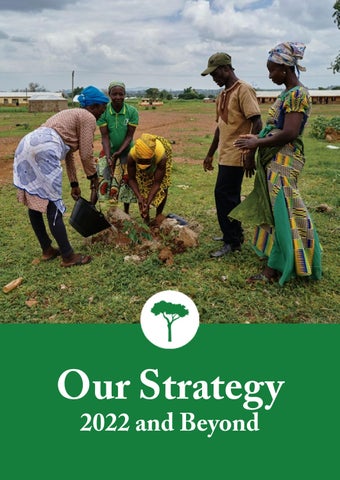
Our Strategy 2022 and Beyond
Contents Our Track Record
3
Our Mission and Vision 4 Our Values 5 Our Approach 6 Our Strategic Aims
9
Our Theory of Change
10
Our Programme
11
Patron HRH The Prince of Wales Charity number 1106269
Our Track Record International Tree Foundation has been inspiring communities to plant trees and restore forests to benefit people and planet since we were founded in 1922. Today, we work around the world with a particular focus on Africa and the UK. For the last 100 years, we have pioneered community-led tree planting and restoration that transforms both landscapes and lives. While we can never know how many trees we have been responsible for growing and protecting over the last century, we have worked with communities to directly plant over five million trees in the last decade while establishing nurseries and equipping people to protect forests. As the oldest international tree planting charity in the world, we have a long history of growing trees and restoring and conserving forests. Yet our work is about much more than tree planting. We know that the relationship between people and forests determines the success of our work. That’s why we are a community-led organisation. Meaning that the people whose livelihoods depend upon local forests are the people who decide which trees to plant, where and why.
3
Our Vision
A world where trees are valued and forests flourish for the benefit of people and planet.
Our Mission
Plant, protect and promote trees in partnership with local communities to transform landscapes and lives.
Our Values
Integrity
We uphold an ethical approach in everything we do.
Respect
We nurture respectful relationships with everyone with whom we work and with the natural world.
Equity
We address issues of social injustice, gender inequality, exploitation and marginalisation.
Partnership
We recognise the crucial importance of working collectively to achieve lasting impact.
Openness
We listen and learn while creating opportunities for sharing experience and valuing local knowledge.
Competence
We value experience and expertise and strive for the highest standards in all that we do.
Our Approach Appreciating the multiple benefits of trees
We recognise the pivotal contribution that trees make in terms of their environmental benefits – providing oxygen, climate regulation, conserving water, enriching the soil and conserving wildlife; and their livelihood value – providing essential food, medicines, tools, shelter and income. And we appreciate trees for their intrinsic value and beauty.
Championing a holistic, sustainable model
With 100 years of experience working with communities around the world, we have developed a community-centred approach that builds on local knowledge to increase environmental sustainability and enhance wellbeing. Our holistic approach is rooted in four key elements: education, environment, livelihoods, and capacity-building.
6
Promoting the right of local communities to make their own decisions
We implement projects based upon self-defined local needs and aspirations and the principles of self-determination, self-help and empowerment, in partnership with local communities, civil society, governments and international agencies.
Building local capacity
We support community organisations and local institutions that promote community-based forestry and agroforestry. We seek to assist them in building their capacity and strengthening civil society.
Upholding environmental and social justice
We support communities to voice their concerns about the economic and environmental effects of the unsustainable demand for forest resources and the misuse and unfair trade of timber and non-timber forest resources. 7
Advancing gender justice
We support the full inclusion of women in natural resource management. We seek to increase women’s leadership in forest management, reforestation and economic empowerment.
Strengthening agroforestry
We support sustainable, regenerative farming systems that improve the well-being of small-scale farmers; create diversity to make food production and forests resilient to a changing and unpredictable climate; produce sufficient nutritious food; enhance biodiversity; improve gender equity and local governance.
Sharing knowledge and learning
We share good practice and encourage learning and exchange, particularly between grassroots organisations. We seek to inspire people of all ages to understand the importance of trees, especially the next generation through our work with schools.
8
Our Strategic Aims Our strategic aims are the cornerstone of our community-centred, holistic model for a transformative, equitable and sustainable relationship with the natural world. We will make a distinctive contribution to the Sustainable Development Goals through this model.
Environment
Livelihoods
Increase global tree cover and reforestation by planting and cultivating appropriate trees.
Communities improve livelihoods by tree cultivation for sustainable and productive landscapes.
Communities Capacity
Education
Support civil society to build its capacity to adovcate for and implement community based forestry.
Create greater understanding of ecological, enviromental social and economic value of trees.
9
Our Theory of Change
Plant, protect and promote trees in partnership with local communities to transform landscapes and lives.
People understand the ecological, social and economic value of trees
Aims
Communities increase global tree cover with appropriate tree cultivation
Communities grow trees to improve livelihoods in sustainable landscapes
Impact
Climate change mitigation
Civil society action to end deforestation and promote reforestation
Community engagement to sustain change
Active citizens for forest friendly consumption and behaviour Restored forests, watersheds and wildlife habitats
Sustainable natural resource management Improved agro-ecological functions and soil fertility
Improved livelihoods
Civil society advocates for and implements communityled forestry
Food security, improved nutrition and health An African movement for trees Improved local and national policies Empowered rural communities and smallholder farmers More women in leadership roles
Outcomes
People have an emotional connection to the natural world
Communities protect and care for local forests
Policy makers increase funding for community-led forestry
Appreciation of the local and global importance of trees
Communities grow trees to improve livelihoods in sustainable and productive landscapes
Smallholder farmers scale-up agroforestry
Communities increase global tree cover with appropriate tree cultivation Local governance of forests improves
Educational programmes for young people
Civil society builds capacity to advocate for and implement community-led forestry
Communities gain skills and experience and implement successful projects Women are leading
Activity
Grants for sustainable community forestry and agroforestry
Forest protection and management
Training for teachers and youth workers
Tree nursery establishment
Capacity strengthening with local partners
Communications to raise awareness
Tree planting for restoration and production
Support for women-led organisations
Skills training Peer to peer learning and networking Advocacy to policy makers and donors Stakeholder partnerships
The Problem
Failure to recognise the importance of trees, disassociation with the natural world, deforestation, consumerism, land degradation, diminishing freshwater, climate change, food insecurity, poor nutrition and health, inequality.
Our Programme As a grant-giving, collaborative and educational foundation we will work to fulfil our strategic aims through the following: A. Environment: Communities increase global tree cover and reforestation with appropriate tree cultivation A.1. In Africa, support grassroots community-led action, through an ecosystem-centred approach, to grow trees, restore degraded landscapes and protect forests in ways that provide sustainable livelihoods, re-establish threatened native tree species and conserve biodiversity and habitats. i. Expand ITF’s high accompaniment approach providing technical and financial support for community-led and participatory forestry, agroforestry, tree planting and sustainable natural resource management. ii. Support community-led forestry and tree planting initiatives through ITF’s Supporting Community Forestry programme A.2. In the four home nations of the UK and in Ireland, support grassroots tree planting – from community orchards and schools to urban spaces and community nurseries.
11
B. Livelihoods: Communities grow trees to improve their livelihoods in sustainable and productive landscapes B.1. In Africa, support long-term, sustainable community forestry and agroforestry projects that restore landscapes and produce locally valued and marketable tree products in line with the priorities of local communities. B.2. Improve local food systems, strengthen resilience and increase food security through the application of locally appropriate tree planting and restoration techniques. B.3. Strengthen positive outcomes for women by supporting women’s leadership in natural resource management, addressing women’s control and access to land and promoting women’s economic empowerment, such as through community enterprises. C. Education: Greater understanding of the ecological, environmental, social and economic value of trees C.1. Advocate for regional and global policies that recognise the role of trees in alleviating poverty, achieving equitable development and promoting ecological functions, landscape restoration and environmental conservation. C.2. Inspire a passion for trees across generations through ITF’s publications, communications, events and educational initiatives and use our social media to raise awareness of ITF and its mission. C.3. In the UK and Ireland, increase young people’s awareness and appreciation of the importance of trees and forests and engage young people as local and global ‘tree guardians’. C.4. In Africa, continue ITF’s tree planting programme in schools involving teachers, parents and pupils – raising environmental awareness, building silviculture skills and creating tangible, long-term benefits. D. Capacity building: Civil society builds its capacity to advocate for and implement community-led forestry D.1. Support local communities to build their capacity to develop and implement their own strategies to use natural resources sustainably and to increase their resilience to environmental degradation and climate change.
12
D.2. Support socially and environmentally appropriate local governance and community by-laws including the effective inclusion of women in decision-making. D.3. Increase opportunities for ITF grantees and partners to come together to share experiences, provide peer-to-peer support and mentoring. Identify and promote best practice and advocate for forestand people-friendly policies at local and national levels. E.
Working with others
E.1. Enhance collaboration with like-minded civil society organisations and relevant government authorities to increase collective impact. E.2. In wider alliances, promote the benefits of transformational tree planting and the risks of transactional tree planting, especially given the increased interest and investment in tree planting for carbon offsetting. E.3. Engage with and participate in a range of relevant strategic fora and networks to share expertise and to advocate for increased investment in community-led forestry and agroforestry, creating space for our local partners to participate and contribute on an equal footing.
(+44) 01865 922 430 info@internationaltreefoundation.org International Tree Foundation 106-108 Cowley Road, Oxford OX4 1JE, United Kingdom