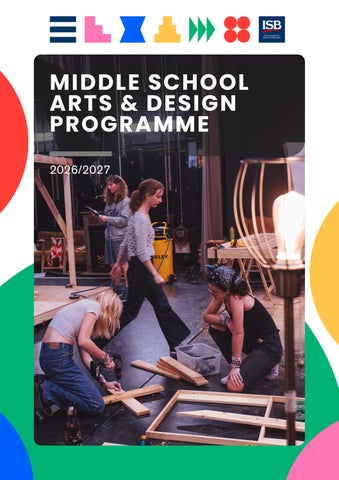
MIDDLE SCHOOL ARTS & DESIGN PROGRAMME


Course offerings are designed for students to delve deeply into an area of passion and also explore a range of interests Advanced courses, languages, STEM, arts, and design opportunities give students real choice, as they can accelerate when ready, go deeper where curious, and still meet the same high academic bar

ARTS & DESIGN PROGRAMME
ISB Middle School offers a comprehensive range of course options that represent our commitment to providing high-quality personalised learning opportunities and choices to our students. Courses offer enrichment and challenge opportunities that extend the core curriculum The focus is on fostering creativity through the arts, STEM, and design. Each course culminates with an authentic demonstration of learning either through a performance to an audience or through a celebration of learning in which the skills learned are applied and showcased to an appropriate audience.
At the time of writing it is our intention to offer the courses detailed here for the coming school year. Courses are open to all students unless otherwise indicated. We ask that students provide us with several choices, and from these we do our best to develop schedules that satisfy student preferences. This is not always possible, but, over the course of a year, all students usually manage to take their preferred courses It is not uncommon for students to take the same course a number of times. Many students, for instance, will always maintain a course in the Performing & Visual Arts and use their other choices to explore various other interests. Thereby, for example, a student can take Concert Band for three years and also take six other courses during their Middle School years


ART
The aim of the Middle School Art Programme is to develop an appreciation for the visual arts as well as a sense of aesthetics, and to expose the students to a variety of challenging art experiences Students are encouraged to thoughtfully create and use materials and techniques to express ideas and feelings, to be inventive in their choices, and to consider the process of creation just as important as the product. They will develop their flexibility, initiative, adaptability, and independent thinking through a series of structured and varied assignments. These assignments are based on a diverse multicultural and international culture heritage, and more specifically on twentieth and twenty-first century art. The students learn drawing skills, colour theory, and a sense of design and form using a wide range of art materials and techniques, both traditional and contemporary, including the new technologies.
Developing visual literacy is an important consideration in this course. Therefore students will be exposed to works of artists and will attempt to place this material within historical, social, cultural, philosophical, and personal frameworks. Crosscurricular links with other areas of the Middle School curriculum such as Social Studies, Language Arts, and Mathematics are implemented
CREATIVE WRITING
Creative Writing is for students with a passion for writing who would like more time to hone their craft. The course follows a writer’s workshop model, in which students are given the power and autonomy to select their own writing projects and to work through the writing process at their own pace
Peer feedback and collaboration are important for any writer, and so another goal of the course is to build a safe community of writers that students can turn to when they want support outside the classroom Perhaps most importantly, students will be encouraged to take risks and to approach their writing with a sense of curiosity and play.

VISUAL ART & MEDIA (YEAR-LONG COURSE)
This year-long course for arts enthusiasts will cover all three design courses over the one year The only essential requirement for this course is a real passion for the visual arts
FASHION DESIGN
For those who like to work with fabric, colour, and unconventional materials and cast a critical eye on the world of fashion. Includes fashion drawing, researching into designers and styles, drawing and printmaking, and basic stitching This course will allow you to sample the three main textile design disciplines of print, knit, and weave
GRAPHIC DESIGN
This course module allows you to explore related subjects including photography, animation, printmaking, typography, and writing. For those who like to make their work communicate a clear idea or message
ARCHITECTURE: SPACES & OBJECTS
This course module explores design for the human environment through the buildings and spaces we inhabit and the objects we use inside those spaces. You will understand how architectural styles came to be, and influence how we might imagine and create the styles of the future.

FILMMAKING
Unit 1: Post Production First
Students will learn to use Adobe Premiere Pro to edit a short original video, and consider how thinking ahead to post production affects the choices made in production and preproduction
Unit 2: First Week Films
Students will work collaboratively to create a short group project that gives a hands-on opportunity to work in all three phases of filmmaking on an accelerated timeline requiring individual and group problem solving to get from one level to the next
Unit 3: 10 Week Films
Students will reflect and build on the lessons of the first week film to develop, critique, and select pitches for longer, more in-depth group projects with higher productions standards and stricter creative constraints
Unit 4: Solo Side Films
As 10-week films progress and students discover that not all group members are needed at all phases of the process, students envision, pitch, and execute a fourth film project which challenges them in some less-familiar skill and allows them to explore content of their individual choosing

UNDERSTANDING FILM
The production and viewing of films occupies a dominant place in society, and because film is such a popular medium, it should be studied seriously In this class, students will find an emphasis on an active form of learning, in which they will develop critical and analytical skills - skills that can be applied to any film. The themes and content of study and analysis will include the viewing and examination of different types of genres using mainly contemporary films. The films that will be viewed in this course have been selected for their educational value Students will be required to submit a review / analysis assignment for at least five of the films viewed.
As a final culminating activity, each student will be required to write and develop their own short script and accompanying movie poster Following this, each student (working in small groups) will be required to perform in/direct, film, and edit a selected script for a final (3-5 min) video/film presentation to the rest of the school, at the end of the semester This course may be most suitable for grade 9 students; nevertheless any Middle School student may take the course provided they have parental permission
YOGA

DRAMA STUDIO
This course is ideal for young aspiring actors who are passionate about the performing arts and eager to explore the craft of acting in a supportive and creative environment. Throughout the semester, students will develop fundamental acting skills and techniques, engage in character development, and gain hands-on experience through performing short scenes and original studentwritten pieces. Students will begin with the basics of acting, focusing on essential techniques such as voice modulation, body language, facial expressions, and movement.
Emphasis will be placed on understanding how these elements contribute to a convincing performance. By engaging in practical, hands-on activities, students will build self-confidence, refine their ability to connect with audiences, and learn to craft and deliver compelling narratives. In the Actor’s Studio, students will develop their confidence and their collaborative skills while engaging in various activities requiring presentation, game play and cooperative exercises
ADVANCED DRAMA STUDIO
This course is an advanced drama class, where students have an opportunity to develop and deepen their skills of performance, collaboration, and creativity In the first semester, the focus is on developing a more comprehensive awareness of the use of body, voice, and technical elements, and how we communicate tension, emotion, atmosphere, and meaning to an audience Then, in semester two, we prepare a performance, which will be performed to an in-school audience at the end of the semester Through this process, we look at techniques for rehearsal, directing, production, and presentation. In addition to increasing confidence and skill on the stage, students will also develop their ability to watch and critique art, through regular in-class performances Students joining the class in the second semester should have some experience of drama, and be prepared to perform as part of the ensemble
This course is intended for students who have prior experience in drama, or have previously taken Drama Studio The class will mainly be composed of grade 9 students, but younger students who meet the prerequisites may join.

THEATRE TECH & DESIGN
This course is open to all students and will cover the basic theory and practical application of lighting and sound in the theatre, project-based construction, painting, and other aspects of scenic construction. Students will be taught about theatre lighting and sound techniques, lighting instruments, colour, and electrical safety, together with regular project opportunities to put this into practice Much of the course will be "hands-on" project-based construction and painting, but the course will also touch on design and the creative process Students are given the opportunity to work on construction, lighting, and sound for ISB theatre productions. Course requirements include at least one after-school or evening crew session outside of regular class time in lieu of other assigned homework
COMMUNITY THEATRE COLLECTIVE

Please note that all band & strings courses require a year-long commitment due to the performance nature of the courses.
CONCERT BAND
(INTERMEDIATE – YEAR-LONG COURSE)
This course builds on the concepts previously covered in the ES instrumental band courses Students should have one or more years of experience playing a wind, brass, or percussion instrument. Instrumental technique, music reading, and musicianship will continue to be developed through the use of workbooks and quality literature culminating with multiple yearly performances A variety of musical styles will be explored, working on the advancement of musical knowledge Students will be evaluated regularly on playing skills and musical concepts Students are required to participate in all performances, which includes the winter and spring Concert Band performances.
Participation in Concert Band makes students eligible to audition for the AMIS European Middle School International Honour Band (grades 7 & 8) If you have any questions about the class, please see the band teacher This is an intermediate level ensemble and the studies and music that will be studied can be, at some times, challenging The expectation will be that students should be practising their instrument outside of class instruction on a regular basis This course is open to 7-9 grade students
SYMPHONIC BAND (ADVANCED – GRADE 8 & 9, YEAR-LONG COURSE)
Students in grades 9-12 are eligible for this class; advanced 8th grade students may also be considered at the discretion of the band director(s) MS students will be accepted with approval from the band director This is an advanced band course for students with a minimum three years playing experience on a wind, brass, or percussion instrument Students of exceptional talent with less experience will still be considered at the discretion of the band director(s). Ensemble playing will focus on further development of musical concepts such as: instrumental technique, music literacy, aural skill development, etc
Students will explore a variety of musical styles to develop their musical knowledge, enhancing their musicianship and appreciation for music Students are required to participate in all performances, which includes the winter Symphonic Band concert, Solo & Ensemble Festival, and 1-2 spring concerts. This is an advanced level ensemble and all musical concepts that will be studied can be, at times, challenging The expectation will be that students should be practising their instrument outside of class on a regular basis If you have any questions about the class, please see the instructor(s)

INTERMEDIATE STRINGS
(YEAR-LONG COURSE)
ADVANCED STRINGS
(YEAR-LONG COURSE)

VOICEWORKS
The VoiceWorks programme is designed to equip young singers with the skills that they need on the contemporary vocal music scene. Students will be immersed in the discipline of music making, by learning, perfecting, performing, and reflecting on their various performance opportunities Creative outlets and explorations will include 3 to 4 part singing, song arranging, rhythmic and pitch exercises, and a deepening of collaborative and artistic skill sets A wide variety of musical styles is explored, introducing the students to classical repertoire as well as to jazz, pop, and show music
Students are challenged at their own level, in the following units of study:
Unit 1: Choral Singing
Unit 2: Solo & Ensemble
Unit 3: Songwriting
Performance opportunities include 3 mandatory concerts per year; 2 as a full choir and one is an open mic evening to encourage the performance of original works. The opportunity to perform at the AMIS Solo and Ensemble Festival in January provides students with an authentic performance opportunity as a soloist and small ensemble member.
Students are eligible to audition for the Middle School International Honour Choir (grades 7 and 8) and the High School International Honour Choir (grade 9)

MUSIC PRODUCTION
The Middle School Digital Music course offers a challenging and rewarding experience for students interested in music and computer-assisted composition. The course covers fundamental concepts such as melody, harmony, rhythm, and timbre Students explore these concepts at their own pace through a highly personalised, project based course. For first-time students, the course structure includes three units:
Unit 1: The Digital Audio Workstation
This unit focuses on equipping students with the fundamental tools and techniques for digital music creation, including software, hardware, and composition techniques.
Unit 2: Picture Project
In this unit, students choose an image of a fictitious world and compose a piece of music that brings the image to life, allowing them to explore the vast instrument library and understand the importance of timbre in music composition.
Unit 3: Video Project
This unit introduces students to scoring film by creating an original piece of music to accompany their favourite TV series' title sequence, developing their understanding of how audio and video combine to convey emotional meaning as well as the importance of structure to control tension
Returning students will explore more complex techniques and tools, maintaining a portfolio of their work to showcase their growth and development as a composer The course is taught using professional-grade software tools such as Presonus' Studio One 5 and Native Instruments' Komplete 14 Ultimate, which provide an extensive library of virtual instruments in all musical styles.

MUSIC TECHNOLOGY
The Middle School Music Technology course offers a creative and technically engaging experience for students interested in how music is designed, produced, and integrated into modern digital environments. The course introduces key concepts such as sound synthesis, audio engineering, and music for interactive media Through a highly personalised, project-based approach, students develop both artistic and technical skills while exploring how music functions in contemporary contexts
For first-time students, the course is structured into three main units:
Unit 1: Sound Synthesis and Design
This unit introduces students to the fundamentals of sound creation using synthesis. Working with tools such as Vital, students learn how to shape and manipulate sound through oscillators, filters, and modulation They explore timbre and texture while designing original sounds for use in their own projects
Unit
2:
Music for New Media
In this unit, students create music for digital platforms such as video games and online content They examine how music supports storytelling and enhances user experience, developing original compositions tailored to specific visual or interactive contexts.
Unit 3: Interactive Audio and Engineering
This unit focuses on the integration of music into interactive systems, alongside an introduction to audio engineering principles Students explore how sound can respond to user input and learn the basics of audio hardware engineering.
Returning students will build on these foundations by exploring more advanced techniques in synthesis, interactive design, and audio production, while developing a portfolio that showcases their further understanding of music technology

MUSIC UNCOVERED: FROM ROOTS TO REMIX
This course allows students to take the lead in exploring the music that shapes our world Through a student-centred approach built on choice, collaboration, and curiosity, they will dive into the sounds and stories behind popular music, past and present From Blues and Folk to Soul, Country, Rock ' n ' Roll, and beyond, students will trace how different genres have influenced the music they hear today. They will have the freedom to follow their interests, ask their own questions, and work with others to uncover what makes music meaningful, powerful, and culturally important.
Their learning will take many forms, giving them the chance to express their understanding in ways that suit their strengths and passions Students will engage in research projects, develop practical performance skills, and experiment with composing and creating their own music, while also building a strong foundation through more structured explorations of popular music history Whether they are analysing lyrics, performing with classmates, or producing original work, this course encourages them to think critically, create confidently, and connect deeply with the music that inspires them

We honour engaged scholarship – close reading, precise writing, careful reasoning – while preparing for what’s next: data and coding, ethical use of AI, sustainability, and service The result is a grounded learner who can navigate change with confidence

BIOTECH STEM
This course explores how biotechnology and sustainable energy shape our world. Students will explore fascinating topics like DNA technologies, forensic science, and how biotechnology applies to the human body They will also discover innovative renewable energy solutions, including solar, wind, and hydroelectric power Additionally, the course introduces sustainable practices such as aquaponics and other eco-friendly systems that help protect the environment Through hands-on experiments, STEM-based projects, and real-world problem-solving, students will develop critical thinking skills and gain a deeper understanding of how science and technology can create a more sustainable future.
DESIGN.CODE.CREATE.
Design Code Create is an exciting and dynamic course designed to introduce students to the world of coding and the basics of artificial intelligence This course aims to build a strong foundation in computational thinking, problem-solving, and creativity through hands-on projects and interactive lessons
Key Learning Objectives:
Understand the fundamentals of coding and its importance in the modern world
Develop problem-solving skills through engaging coding challenges
Explore visual programming using Scratch to create interactive stories, games, and animations
Learn basic programming concepts in languages such as Python
Gain an introductory understanding of artificial intelligence and its real-world applications
Collaborate with peers on coding projects to enhance teamwork and communication skills

ENGINEERING DESIGN
Engineering is the application of science to practical problems. Engineers design and build the products we use every day The Engineering Design class allows students to explore the connections between problem solving, design, teamwork, programming, and machines. Student teams will build projects of their own invention using elements of robotics, electronics, and computer-aided design The focus will be on innovation and creativity. The course is taught in the Middle School Design Studio
FUTURE TECH
In this course, students will embark on a journey of digital exploration, diving into the exciting combination of technology and creativity With a focus on cuttingedge tools and emerging technologies, students will not only master traditional creative software but also delve into the realm of artificial intelligence (AI). Students will unleash their creativity using industry-standard software such as Adobe Creative Suite, including Photoshop, Illustrator, Premiere Pro, After Effects, and more Additionally, they will explore AI-powered tools which integrate seamlessly into their creative process, opening up endless possibilities for innovation. Through hands-on exploration, collaboration, and reflection, students will emerge from Future Tech empowered to navigate the ever-evolving landscape of digital arts and technology with confidence and creativity.

PERSONAL STUDIO
This is an option for students who wish to explore topics of specific interest The idea is simple, but powerful If a student has an independent programme, passion, online course, or challenge enhancement opportunity that they would like to pursue, this is an opportunity for students to build this into their schedule

ROBOTICS
The Middle School Robotics course is an exciting and challenging opportunity for students, whether they are new to robotics or have an interest in exploring the creative possibilities of robotics engineering The course covers fundamental concepts such as programming, mechanical design, and electrical engineering to provide a foundation for students to create their own original robotic devices The highly personalised and collaborative nature of the course allows each student to explore these concepts at their own pace. The course structure for first-time robotics students includes four units
Unit 1: The Speedbot
This unit focuses on building a simple robot using build instructions to understand scale, core build parts, programming tasks, and collaboration
Unit 2: Arena Challenge
In this unit, students build or heavily modify a robot to compete in a robotics game from the official VEX robotics competitions
Unit 3: Task Challenge
This unit involves designing a robot from scratch to surmount a chosen challenge while documenting your design cycle and problem-solving skills.
Unit 4 : Ethics, Robotics and Society
This unit introduces students to the ethical and societal implications of robotics by researching and presenting a case study on a robotics application that has had a significant impact on society.
Returning students will have the opportunity to delve deeper into the creative possibilities of robotics engineering, exploring more complex techniques and tools, such as automation They will also maintain a journal of their work and share their knowledge with their peers. The course uses the latest VEX V5 robotics kits and the Vex coding environment (based on Scratch 3.0) to program robots
The course aims to foster students' skills and knowledge in robotics engineering, problem-solving, and critical thinking, aligned with the Standards for Technological Literacy. These skills are becoming increasingly important to take on the highly automated and technology-driven world of tomorrow

STEM DISCOVERY