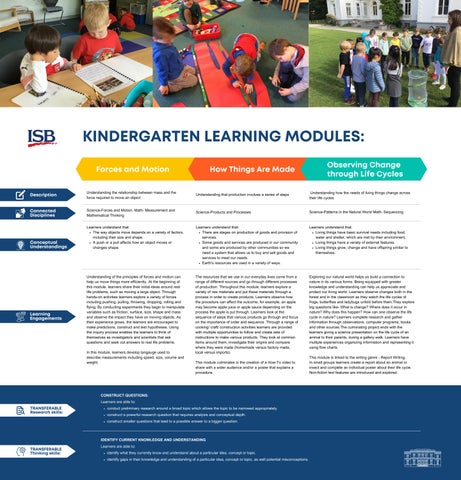
KINDERGARTEN LEARNING MODULES: Forces and Motion
How Things Are Made
Observing Change through Life Cycles
Description
Understanding the relationship between mass and the force required to move an object
Understanding that production involves a series of steps
Understanding how the needs of living things change across their life cycles
Connected Disciplines
Science-Forces and Motion, Math- Measurement and Mathematical Thinking
Science-Products and Processes
Science-Patterns in the Natural World Math- Sequencing
Conceptual Understandings
Learners understand that: The way objects move depends on a variety of factors, including their size and shape. A push or a pull affects how an object moves or changes shape.
Learners understand that: There are stages on production of goods and provision of services. Some goods and services are produced in our community and some are produced by other communities so we need a system that allows us to buy and sell goods and services to meet our needs. Earth's resources are used in a variety of ways.
Learners understand that: Living things have basic survival needs including food, water and shelter, which are met by their environment. Living things have a variety of external features. Living things grow, change and have offspring similar to themselves.
Understanding of the principles of forces and motion can help us move things more efficiently. At the beginning of this module, learners share their initial ideas around real life problems, such as moving a large object. Through hands-on activities learners explore a variety of forces including pushing, pulling, throwing, dropping, rolling and flying. By conducting experiments they begin to manipulate variables such as friction, surface, size, shape and mass and observe the impact they have on moving objects. As their experience grows, the learners are encouraged to make predictions, construct and test hypotheses. Using the inquiry process enables the learners to think of themselves as investigators and scientists that ask questions and seek out answers to real life problems.
The resources that we use in our everyday lives come from a range of different sources and go through different processes of production. Throughout this module, learners explore a variety of raw materials and put these materials through a process in order to create products. Learners observe how the procedure can affect the outcome, for example, an apple may become apple juice or apple sauce depending on the process the apple is put through. Learners look at the sequence of steps that various products go through and focus on the importance of order and sequence. Through a range of cooking/ craft/ construction activities learners are provided with multiple opportunities to follow and create sets of instructions to make various products. They look at common items around them, investigate their origins and compare where they were made (homemade versus factory made, local versus imports).
Exploring our natural world helps us build a connection to nature in its various forms. Being equipped with greater knowledge and understanding can help us appreciate and protect our living world. Learners observe changes both in the forest and in the classroom as they watch the life cycles of frogs, butterflies and ladybugs unfold before them.They explore big questions like- What is change? Where does it occur in nature? Why does this happen? How can one observe the life cycle in nature? Learners complete research and gather information through observations, computer programs, books and other sources.The culminating project ends with the learners giving a science presentation on the life cycle of an animal to their parents, during a gallery walk. Learners have multiple experiences organizing information and representing it using flow charts.
Learning Engagements
In this module, learners develop langauge used to describe measurements including speed, size, volume and weight.
This module culminates in the creation of a How-To video to share with a wider audience and/or a poster that explains a procedure.
CONSTRUCT QUESTIONS: Learners are able to:
TRANSFERABLE Research skills:
conduct preliminary research around a broad topic which allows the topic to be narrowed appropriately. construct a powerful research question that requires analysis and conceptual depth. construct smaller questions that lead to a possible answer to a bigger question.
IDENTIFY CURRENT KNOWLEDGE AND UNDERSTANDING
TRANSFERABLE Thinking skills:
Learners are able to: identify what they currently know and understand about a particular idea, concept or topic. identify gaps in their knowledge and understanding of a particular idea, concept or topic, as well potential misconceptions.
This module is linked to the writing genre - Report Writing. In small groups learners create a report about an animal or insect and complete an individual poster about their life cycle. Non-fiction text features are introduced and explored.