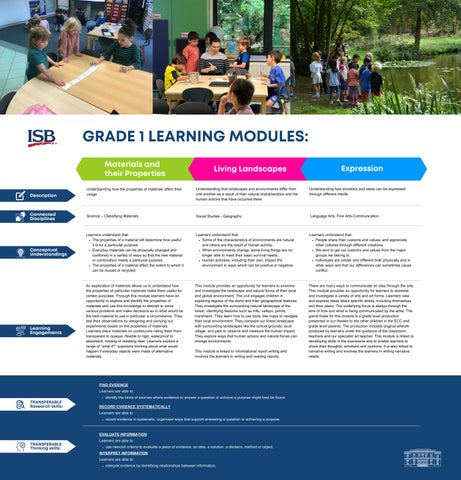
GRADE 1 LEARNING MODULES: Materials and their Properties
Living Landscapes
Expression
Understanding how the properties of materials affect their usage
Understanding that landscapes and environments differ from one another as a result of their natural characteristics and the human actions that have occurred there
Understanding how emotions and ideas can be expressed through different media
Connected Disciplines
Science – Classifying Materials
Social Studies - Geography
Language Arts, Fine Arts-Communication
Conceptual Understandings
Learners understand that: The properties of a material will determine how useful it is for a particular purpose. Everyday materials can be physically changed and combined in a variety of ways so that the new material or combination meets a particular purpose. The properties of a material affect the extent to which it can be reused or recycled.
Learners understand that: Some of the characteristics of environments are natural and others are the result of human activity. When environments change, some living things are no longer able to meet their basic survival needs. Human activities, including their own, impact the environment in ways which can be positive or negative.
Learners understand that: People share their customs and values, and appreciate other cultures through different creations. We tend to get our customs and values from the major groups we belong to. Individuals are similar and different both physically and in other ways and that our differences can sometimes cause conflict.
An exploration of materials allows us to understand how the properties of particular materials make them useful for certain purposes. Through this module learners have an opportunity to explore and identify the properties of materials and use this knowledge to attempt to solve various problems and make decisions as to what would be the best material to use in particular a circumstance. They test their observations by designing and carrying out experiments based on the properties of materials. Learners place materials on continuums rating them fromtransparent to opaque, flexible to rigid, waterproof to absorbent, holding or resisting heat. Learners explore a range of “what if?” questions thinking about what would happen if everyday objects were made of alternative materials.
This module provides an opportunity for learners to examine and investigate the landscape and natural forms of their local and global environment. The unit engages children in exploring regions of the world and their geographical features. They investigate the surrounding natural landscape of the forest, identifying features such as hills, valleys, ponds, marshland. They learn how to use tools, like maps to navigate their local environment. They compare our forest landscape with surrounding landscapes like the school grounds, local village, and park to observe and measure the human impact. They explore ways that human actions and natural forces can change environments.
There are many ways to communicate an idea through the arts. This module provides an opportunity for learners to examine and investigate a variety of arts and art forms. Learners view and express ideas about specific artists, including themselves and their peers. The underlying focus is always through the lens of how and what is being communicated by the artist. The grand finale for this module is a grade level production presented in our theatre to the other children in the ECC and grade level parents. The production includes original artwork produced by learners under the guidance of the classroom teachers and our specialist art teacher. This module is linked to developing skills in the expressive arts to enable learners to share their thoughts, emotions and opinions. It is also linked to narrative writing and involves the learners in writing narrative retells.
Description
Learning Engagements
This module is linked to informational report writing and involves the learners in writing and reading reports.
FIND EVIDENCE Learners are able to: identify the kinds of sources where evidence to answer a question or achieve a purpose might best be found.
TRANSFERABLE Research skills:
RECORD EVIDENCE SYSTEMATICALLY Learners are able to: record evidence in systematic, organised ways that support answering a question or achieving a purpose.
EVALUATE INFORMATION
TRANSFERABLE Thinking skills:
Learners are able to: use relevant criteria to evaluate a piece of evidence, an idea, a solution, a decision, method or object. INTERPRET INFORMATION Learners are able to: interpret evidence by identifying relationships between information.