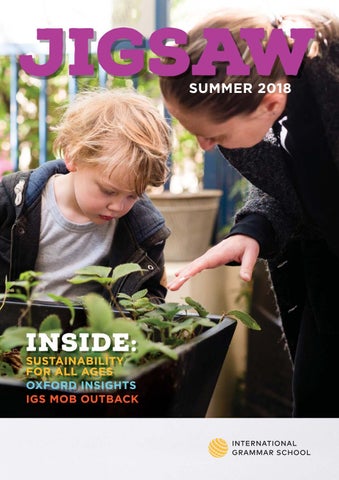
JIGSAW SUMMER 2018
INSIDE: SUSTAINABILITY FOR ALL AGES OXFORD INSIGHTS IGS MOB OUTBACK
JIGSAW | SUMMER 2018
1
FROM THE PRINCIPAL
A SUSTAINABILITY FRAMEWORK FOR IGS 1.
Jigsaw Summer 2018 is published by International Grammar School 4-8 Kelly Street, Ultimo, NSW 2007 Phone +61 2 9219 6700 | Website: www.igssyd.nsw.edu.au
2
Editor in Chief: Editor: Communications: Photography: Design:
Shauna Colnan Alison Handmer Olivia Axford Allison Lee Lisa Perri Design
In 2018 we turned our minds to a sustainable future, which, together with limitless learning and empowered students, are the aspirations of the IGS strategic plan, Into the World 2016-2020. 2.
Humankind has not woven the web of life. We are but one thread within it. Whatever we do to the web, we do to ourselves. All things are bound together. All things connect. These words, attributed to Chief Seattle in 1854, were appropriated by the American environmental movement in the early 1970s. You can see why. They offer an eloquent expression of our place in the world and of our special responsibility to look after it. Their sentiments resonate with us as we turn our minds to sustainability. In 2018 we have taken action to advance this aspiration of the strategic plan. In that context, welcome to the 2018 Summer edition of Jigsaw, our first Sustainability issue. It features our students from Early Learning through to Year 12 expanding their understanding of the planet. In the pages that follow you’ll see our youngest learners enthusiastically recycling paper and other materials. You’ll also see them out and about on excursions to Pocket City Farms, Taronga Zoo and the Royal Botanic Garden, as they come to grips with the natural world. Students explored under-water Sydney through the new Scuba Club, while others in the Gardening Club have been actively greening the campus. In our classrooms, students in Years 4 and 9 have created greener house designs, while two Year 6 students have researched the influences on our planet of the food we eat. Our senior students’ engagement with the world is increasingly taking them far beyond Sydney. Every year, IGS students learn more about themselves and the environment through our Outdoor Education Program. Others learn about the sustainability practices of Indigenous Australians, visiting the APY Lands in the far northwest of South Australia. Just a few short weeks ago, during our unique SAGE program, Year 10 students travelled to Tasmania to trek, to contemplate the island’s history and its pristine environment, and to demonstrate their understanding by Writing the Island. In 2018 the focus was on eco-literature which led to deeper learning experiences for the students as they wrote and created new works within this new literary wave. We know that the international reach of our School and the opportunities open to our students will reap benefits far into the future.
In this context, three of our Year 11 students unleashed their curiosity at Oxford University earlier in the year. Closer to home, the renewal of our campus has offered fresh opportunities to improve our natural lighting, ventilation and building materials and to use the space we have in far more flexible and creative ways. Read on to learn more about our evolving campus in this issue. The Global Learning Centre and The Imaginarium will be launched for the start of the 2019 academic year and we now have concept designs for the Bibliothèque which you can also see here. Nowhere was our community’s commitment to sustainability more evident than on International Day 2018, with its theme of The Global Environment. I want to pay tribute to my colleagues and the PTF for the enthusiasm, energy and expertise they shared with our students on this memorable day. Throughout the year, PTF volunteers have continued to recycle hundreds of textbooks and uniforms at the vibrant Rue Kelly second-hand stall, modelling sustainability for us all. Student voice has taken on a new fire in 2018 and we are glad to empower our students to devise and implement their own sustainability initiatives and actions. As we farewell another impressive group of Year 12 students, I thank the students who pioneered the Sustainable Futures Club for their outstanding achievements, including installing an Energy Monitoring System which will help us reduce our energy use now and into the future. While we are making significant inroads into thinking and acting sustainably here at IGS, we have so much more to do. In that context, we have developed the School’s first sustainability framework, which we launch on page 30 to 33. I welcome your feedback. In case you’re wondering, the ink in the print version of this edition is made of an environmentally friendly soy product. The paper is a renewable resource and is manufactured using low environmental impact FSC certified pulps in a facility that is ISO 14001 Environmental Management System accredited. We hope you enjoy our sustainability issue of Jigsaw! Shauna Colnan Principal Photos: 1. Chloee Schaller (left) with Alice Moss Ractliffe, Alice Russell, Isabella Ninkovic, Elin Schmitz and Principal Shauna Colnan at Speech Night 2018 2. NESA Inspector of Languages Lyn Sully, Principal Shauna Colnan and AIS NSW languages consultant Merryl Wahlin
JIGSAW | SUMMER 2018
3
CHAIR OF THE BOARD
FIRM FOUNDATIONS FOR A SUSTAINABLE FUTURE NEXT YEAR IGS ENTERS ITS 35TH YEAR.
What began as the vision of our founder, Professor Reg St Leon OAM, continues as a vision of a school united by our powerful motto, Unity Through Diversity. Yet the world around us continues to change. When the IGS Board adopted a new constitution early in 2018, we signaled a fresh and firm commitment to a sustainable future for our School. Along with limitless learning and empowered students, a sustainable future is a strategic aspiration articulated in the School’s Strategic Plan Into the World (2016-2020). Our new Board constitution, drafted with the careful assistance of our legal counsel, provides IGS with a robust governance structure, both now and for the future. With the introduction of the Constitution, we also developed a new Board Code of Conduct, new Responsible Person induction processes, and new and improved terms of reference for the Building and Finance Committee, the Governance Committee and the Risk Committee. The development of a comprehensive skills matrix for the Board has also been an important project in 2018. We are now recruiting new directors as we continue to explore how best to complement the current Board skills to add further value to our thriving School. The Directors and I also continue to engage in ongoing governance training with the Association of Independent Schools, the Australian Institute of Company Directors, and the Governance Institute of Australia. Each year the Board holds a strategy day. In 2019, this will take place in late January and is being aligned for the first time with the whole staff conference which takes place before the students arrive for the commencement of the new academic year. We have engaged David Shortland to facilitate a high-level discussion about the key role a Board plays in governing a successful
4
1.
independent school such as ours. David is well known for his work with organisations in addressing risk and governance issues and assisting with the successful execution of strategic plans. David has a financial, legal and corporate affairs background, experience working with domestic and global companies, and the ethos to deliver the right results with rigour and integrity. At the strategy day we are also looking forward to hearing from our Principal, Shauna Colnan, and the Leadership Team on the implementation of the School’s Strategic Plan. They have been hard at work developing and refining an IGS balanced scorecard to track and monitor the implementation of the Strategic Plan, and are using school data in new and effective ways to evaluate the performance of the School in its many facets. It’s bound to be a fruitful and fascinating day. I’m thrilled that this issue of Jigsaw is devoted to showcasing the School’s wonderful progress in raising awareness of and pioneering new sustainable practices. Together with our staff, students and community, we are optimistic and excited about the future of IGS, and actively committed to the key role this special school plays in the education of our children and young people. Dr Marie Leech Chair of the IGS Board
2.
DREAMING UP A BETTER SCHOOL
First came the dream. International Grammar School followed. When IGS founder Professor Reg St Leon OAM established International Grammar School in 1984 he created something unique - a school where children are immersed in another language through their every day classes. “A private school like IGS enables you to put into effect all sorts of innovative ideas that you could never dream of putting into the public system,” Reg has said. The dreaming continues at IGS as the world continues to change, along with expectations and opportunities. “I couldn’t foresee some of the innovations that have been introduced here and it’s just gone from strength to strength,” he said. Under every principal, the School has introduced a wide range of changes and improvements to course offerings, extra curricular opportunities and teaching and learning spaces.
3.
To stimulate the sharing of ideas, Ms Colnan is circulating an IGS book of dreams, The Secret Drawer Society.
Over the past four years, the campus has been reimagined and redesigned and is being improved in keeping with the eight areas of action articulated in the IGS Strategic Plan Into the World 20162020. Who knows what innovations will follow in years to come?
The book was inspired by a visit taken by Principal Shauna Colnan to a beautiful colonial farmhouse in Massachusetts called Perryville Inn. There in the bedside drawer, she found a book that welcomed her to the inn’s Secret Drawer Society. It was filled with messages from fellow travellers from all around the world.
“What I feel particularly pleased about is the fact that the concept took off,” Reg said. “That people enrol their children here because they know that it’s a unique school and that this is what they want for their children… IGS is the consummation of an idea that people originally didn’t believe could be implemented…
In the same way as society members’ thoughts have been sequestered in the inn in various drawers and cupboards, IGS staff are invited to share their dreams of an extraordinary school in the large book which is slowly being circulated.
“It performs well academically and does very well in examinations. But also, from a much broader view of education, what the kids get out of it apart from the academic side is something you can’t put a price on and which I think very few schools offer.”
Photos: 1. IGS Board members 2. An architect’s impression of the new Bibliothèque 3. A page within the School’s book of ideas, The Secret Drawer Society
JIGSAW | SUMMER 2018
5
INTERNATIONAL DAY 2018
PLANET EARTH TAKES CENTRE STAGE 1.
The explosion of colour, taste, sound and culture that was International Day 2018 at IGS revolved around the theme The Global Environment. IGS Parents, Teachers and Friends collaborated to ensure students experienced diverse aspects of culture and broadened their knowledge of the planet, human impacts and ways of minimising environmental damage. Even in the serving of food from many lands, every effort was made to keep waste to a minimum and recycle or compost where possible, and the PTF sold bamboo keep cups. There was a jam-packed program of events. Primary School activities included plastic waste art, a water workshop with IGS parent Katrina Wall, Marine Environments with former Head Boy Maxim Adams (2016), and the planting of new garden beds with Deputy Head of High School Paul Galea. Primary students also enjoyed “Indigenous Infusion” performances by Walangari, a Ligurian Bees workshop with Georgie Watts, a Garage Sale Trail presentation with Andrew Valder, student led discussions, movies and video clips, and a book swap.
High School activities included Science, Geography and marine 1. environment workshops, Green Minds Mining Issues, Ancient Rome and the Natural Environment, the IGS Sustainable Futures Club, Japanese Furoshiki eco cloth wrapping, the French film Tomorrow, and a presentation by Dr Katrina Wall on the Health of Our Water. Activities continued with creative dance with Paulina Quinteros, The Period Project, making beeswax wraps, and the “#I’m in charge of my environment” towards a better future workshop. There were also activities involving SkyJuice Foundation, UN Sustainable Development Goals, The Land on which we Live, Virtual Reality environments, Drama, Waste Not Want Not: The Story of Food, Poo and Worms, OzHarvest, and Philosophy and Campaigning with Greenpeace. A clothes swap built on the successes of the PTF Rue Kelly secondhand uniform and textbook sales. (See more on pages 34 and 35).
IGS Sustainable Futures Club leaders were excited to launch the Energy Monitoring System (EMS) at this year’s International Day. 6
2.
“Sustainability is at the heart of the School culture, and with our new EMS, we hope to increase positive change in energy use.”
3.
5.
Photos: 1. Annika, Elin and Megan Schmitz 2. Aki Niwa Russell and Daniel Lian 3. Kindergarten students with their recycled paper flowers 4. Kindergarten students
4.
5. Academic Mentor - Indigenous Students and Stage 6 Aboriginal Studies teacher Jade Carr with Kallarah Marr and Keith Dunn
JIGSAW | SUMMER 2018
7
A GREAT START AT IGS
SUSTAINABILITY FOR OUR YOUNGEST LEARNERS 1.
I love educating and inspiring our children about sustainability. The IGS Early Years Learning Framework places great emphasis on supporting young children’s emerging understanding of sustainability.
We watched a marvellous video about soft plastic recycling which illustrated how they are collected, broken down, and given a new life.
The underpinning ideals of the Framework not only reinforce the importance of sustainable practices, but strongly recommend that sustainability be “embedded in all daily routines and practices” within early childhood settings, and that early childhood educators need to discuss with children that all “living things are interconnected”.
The students have also enjoyed taking compost to the large IGS compost bins, and exploring the rooftop garden.
To investigate this concept of sustainable practices, we first looked at what it means to recycle and compost.
We also looked at the cultural perspectives of recycling around the world. We watched videos of a little girl in Japan being tutored by her father in the correct way to read the recycling manual that the council gives you, and how to fold, wash and sort all the recycling. We watched a similar one featuring a little French boy.
Recycling is a simple way to teach young children about caring for their environment, whether it be in the classroom, at home, or outside. It also helps children learn where products come from, how they are made, and how they can be reused. We talked about soft plastics, and visited the idea of making disposable materials into something new, to be used again.
8
A parent brought a book in that was written in Chinese about the recycling system in China, and a similar one for Germany. In our room we collect compost, soft plastics, and paper. We collect the plastic tops of the yogurts that the children bring in for their lunches and use them for craft and as toy money in the home corner, for example. Jasmin Flyte Preschool Gold Teacher
2.
YOUNG ACTIVISTS IGS Preschool students have been eager to join in on
3.
the School’s sustainability objectives, taking a strong interest in recycling. Preschool student Filippa Vendramin is among many IGS students considering their impact on our environment.
WHERE DOES FOOD COME FROM? Extending their studies of Living Things, Kindergarten students enjoyed their recent
Filippa has carefully collected any discarded or no longer needed paper around her home, cutting it up with scissors and then storing it in a bag. Filippa’s mother Caroline was at first unsure what her daughter was up to, but Filippa then told her mother about all of the different bins at IGS, explained what they are each for, and that her paper cuttings would be going into the School’s paper recycling bin. “It was impossible to talk her out of bringing her own paper scraps to school, so off she went with her bag,” Caroline said. “Teachers at IGS are making an amazing impact on Filippa. She’s taking it all in.”
Photos: 1. Preschool student Filippa Vendramin with Preschool Gold Teacher Jasmin Flyte
exploration of Pocket City Farms in Camperdown. The visit followed the planting of alfalfa seeds in the classroom where students learnt about how things grow, and what plants need to thrive, including sun, water, soil, air, seeds, food and photosynthesis. At the farm, the students looked at many different kinds of food plants, along with insects such as butterflies, lady beetles, ants and native bees that can promote their healthy proliferation. Students mimed being seeds, squirted natural fertilizer on the soil around many plants, touched worms from a small worm farm, discussed their favourite fruit and vegetables, and planted radishes. Luca: The worms felt kind of slimy. Maeve: They kind of tickle. Hattie: I love the worms.
2. Filippa and friends recycling paper 3. Ava Parker investigating plants at nearby Pocket City Farms
JIGSAW | SUMMER 2018
9
YEAR 4
INSPIRING GREEN DREAM HOMES 1.
This IGS homegrown, cross-curricular, project-based learning unit of work, draws outcomes from English, Mathematics, Science and Technology, with a focus on sustainability. Students begin with the design brief to design and build a sustainable dream home for their family that meets its needs and is based on the principles of Glenn Murcutt and Michael Mobbs. The unit was initiated more than five years ago when a former colleague and I revamped another design unit, grounding it on Glenn Murcutt’s sustainable design principles. That first year we were lucky enough to have a parent connection that allowed us the amazing privilege of having Glenn Murcutt himself come in as a guest speaker. He captivated our students for over an hour. Each year we bring in real life experts from various related fields to further enhance the students’ experience. Highlights include a visit to the Michael Mobbs’ Sustainable House in Chippendale and students designing their own homes. Over the years the unit has evolved to include a collaborative aspect where students work in groups to build homes that accommodate often more than one family.
UTS has supported us over the years with having pre-service teachers and architecture students come and help our students with their designing and/or building.
Many students’ designs incorporate rooftop gardens, rainwater tanks, insulation, passive solar design, recycled materials and emerging technology such as solar energy harvesting photovoltaic cells and battery storage. We are also grateful to parents, caregivers and their associates who are architects and passive solar and sustainability experts who share their expertise. Michelle Sullivan Head of Primary Studies/STEAM Innovator (Primary)
In 2018 we investigated working as a community to be more sustainable, sharing power and water resources.
10
1.
YEAR 9
TINY HOUSING SOLUTIONS 2.
As city planners tackle the challenge of fitting ever larger populations into our cities, Year 9 Design Future students leapt at the chance to research, draft and create their own microhouse models. An excursion to the innovative One Central Park and UTS Faculty of Engineering and Information Technologies (FEIT) buildings nearby stimulated students’ imaginations. “A microhouse is a house or apartment under 40 square metres,” said Lili Digweed. “The microhouse movement is about being more sustainable. It’s about compact living, affordable pricing and creating a smaller environmental footprint.” Light, inclusions, air circulation and choice of materials such as seaweed blocks or recycled plastic were taken into account, according to Alec Burke. “We looked at other microhouses and got inspiration, then created a mood board of all the designs we liked,” Alec said. “Then we did initial sketches, planning what we wanted them to look like. I was looking at a lot of housing in Germany and northern Europe, keeping snow off the roofs and planning for the change of 2. seasons. I looked at passive solar design and how light comes into the house.”
Lili Digweed: “I wanted my house to be really green, with grass on the roof, a vertical garden and space for more gardens.” She added interest inside by including a small split level and a loft. “Then we used the lazer cutter to make a model of our best design. Having so much freedom to build a model gave us a lot to think about. It also showed us how houses are created.” Alec Burke: “My model is very European, designed with a slanted roof and a Juliet balcony. There are eight solar panels and a lot of windows, as natural light makes things feel bigger. It was fun.” Mae Milne: I love architecture, so the microhouse unit was perfect for me. I really enjoyed the challenge of creating a building in such a small space that is both visually appealing and functional. It also helped me further my understanding of sustainability as it allowed me to apply and explore environmentally-friendly initiatives in a realistic setting.
Photos: 1. Isabella Ninkovic with her collaborative creation 2. Lili Digweed and Alec Burke
JIGSAW | SUMMER 2018
11
YEAR 6
RESEARCH EXPANDS SKILLS AND KNOWLEDGE 1.
The IGS Independent Research Task (IRT) is the centerpiece of the Year 6 academic program. It is the culmination of all the skills gained from every learning opportunity that has taken place throughout each child’s Primary School education at IGS. The students begin the preparation for their IRT in late Term 2, ready to begin in Term 3. Each student discovers an area of passion, a topic they know a little about but would like to explore further. In 2018, two students researched food and the environment. See pages 13 and 14. Each project component requires the student to dive into their topic area through a different perspective. • An information report that answers their overriding question through various sub questions • An original narrative based on their topic area • A Fine Arts piece that reflects their research • A thorough bibliography • An IRT journal that contains reflections on their IRT journey • A creative Google Slides presentation • An optional extra task of a book review based on a text connected with their chosen topic. Throughout the term, students meet regularly with their teacher to make sure they are on track with their research and meeting required deadlines. This is excellent preparation for High School.
12
By the end of this process, the student becomes the expert at their chosen topic. Collating all their information to be sequenced appropriately into a final report that answers their overriding question is arduous but also most satisfying when complete.
Working one on one with each student at their own pace requires teachers to be highly organised and very well informed. The Bring Your Own Technology program has allowed for greater ease in researching and constructing findings from this research into a coherent text, and Google Docs allow for live feedback, with teachers and students offering suggestions and comments as a text takes shape. Students gain a wealth of knowledge and enhance their organisational skills considerably. This is my 10th year completing the IRT with a home class and every year the breadth of questions that students want to answer astounds me! Every question is different! The way each student might answer their question is unique and insightful. David Smith Digital Innovator (Primary School) and Home Class Teacher
1.
2.
FOOD FOR THOUGHT A close look at the effects of “meat” on our planet gave Taj Smyth of Year 6 plenty of food for thought during his IRT throughout Term 3. Taj explored the history of agriculture, the world’s most popular foods, effects of animal-based food on deforestation and biodiversity, changes in farming techniques, and much, much more. Influenced by movie Cowspiracy, the Sustainability Secret, Taj became a pescatarian at the start of the year, and threw himself into the research task. His narrative was a short story about a young boy whose pet cow MooMoo disappears, and he discovers her “in a whole shed full of dead cows”. “Deforestation for crops and grass to feed cows, along with making land available to house people, means land 80 times the size of Sydney is cleared every single year, adding to the loss of biodiversity,” Taj said. In his impressive presentation, he explained the distinction between industrial and subsistence agriculture, and traced changes in agricultural methods that mean horses as farm labour are becoming obsolete. His Fine Arts work featured the outline of a cow and facts about the effects of methane, considered twice as destructive as carbon dioxide in terms of global warming.
“Methane comes from rice paddies, coal mines, termites and cows’ stomachs.” Taj said two thirds of the animals on planet earth were now industrialised farm animals, with China and the US the nations farming animals on the greatest scale, and 56 billion farm animals killed each year. “Half of the water in the US goes to food for animals, including soy beans and grains laced with toxic chemicals which are eaten by the cow, and we eat the dead cow. If you were served toxic chemicals at a restaurant, would you like that? “In the future there’s a high chance we will be eating insects. If everyone on earth today ate insects instead of eating meat we would sustain it much longer.
“Industrial animal agriculture is definitely not good for the long term sustainability of the environment. “The earth’s increasing population can’t rely on animal products as we are losing out resources such as water and land.” Taj’s conclusion? Humans need to increase their use of plantbased foods. Photos: 1. Nyree Davison’s Fine Arts piece was one of many on display in the IGS library 2. Taj Smyth presents on his research
JIGSAW | SUMMER 2018
13
“As well, the farmers could be selling these fruits and foods to gain money so they could have more water which they would be able to use not only to grow their crops but to drink! “By educating children with a deeper knowledge of bush tucker, the children of our future can begin to understand the kinds of native food that our country grows. “It would be so much easier right now if we were eating these kinds of bush tucker instead of eating unhealthy food. “We should be eating bush tucker because a lot of fruits that are bush tucker, are high in antioxidants which are good for your heart if you eat them. “So if it’s so good for you why aren’t we eating them?
“Are we deliberately avoiding the fact that bush tucker could honestly be helping so many lives right now?” Nyree recommended that her fellow students start eating bush tucker. “It could affect Australia in such a good way. “People pay attention to what their children are eating, so if children started eating bush tucker it would make such a big difference!
1.
BUSH TUCKER QUEST Nyree Davison of Year 6 surveyed fellow students to explore the popularity of bush tucker in the contemporary Australian diet. In her IRT presentation, Nyree argued convincingly that all Australians should be able to find simple bush tucker in our grocery stores, including kangaroo, crocodile, lemon myrtle, geebungs, honey ants and witchetty grubs. “Considering that bush tucker is one of the first foods in Australia and how long it’s been here, shouldn’t after all this time we be eating it, and eating it regularly?” she asked.
“If Aboriginal people survived on these healthy foods that lasted for thousands of years, shouldn’t we be eating it by now, at least a little bit of this amazing nutritious kind of food? “Currently, there is a lot of drought all around Australia and our farmers are struggling to grow their crops. Bush tucker has adapted to these kinds of temperatures and lack of rainfall since it has been here for thousands of years. “If they were growing these natural Australian plants, the animals would be able to eat them.
14
“Do the adults of Australia understand how much improvement could come from this? Do they know what bush tucker is? If so why hasn’t it crossed any farmers’ minds to do so? Not just farmers but anyone’s mind at all? Maybe it has, but then why aren’t we acting on it right now, if it can change so many people’s lives? I believe we should start now! “Even though bush tucker is just a food or a single fruit, it has the power to change and help Australia so much.”
DO YOU KNOW WHAT BUSH TUCKER IS? 30 Responses
Yes (60%) No (10%) Maybe (23.3%) I think so (3.35%) Yummy food from the outside world (3.35%)
BIOLOGY Year 10 Biologists increased their understanding of advanced Biology ďŹ eldwork, energy in ecosystems and living organisms, at the Advanced Living World excursion at Camp Kedron.
2. 4.
3.
5.
Photos: 1. Nyree Davison and her bush tucker presentation 2. Anastasia Harris examines water life
4. In touch with the earth and other organisms
3. Riu Fukazawa, George Catt, Anastasia Harris and Ella Engelhardt
5. Year 7 students extending their Biology knowledge at Taronga Zoo
JIGSAW | SUMMER 2018
15
YEAR 3
EXPLORING THE WORLD OF PLANTS
Year 3 students recently visited the Royal Botanic Garden as part of their unit of study on rainforests. They investigated a range of native plants and the features that allow them to survive in contrasting Australian environments such as the rainforest and desert. They considered the influence of diverse physical conditions and the growth and survival of plants.
Students also investigated a wide variety of local native plants integral to the life of the first Australians. Aboriginal Education Officers provided a personal perspective of how Indigenous people of the Sydney area used plants for food, medicine, tools and weapons, offering students a unique opportunity to meet and interact with members of our Indigenous communities. 2.
16
1.
James Vantas: I loved smelling the eucalyptus leaves the most because it reminded me of a beautiful ower garden. Charley Hall: On the excursion I learnt that you can use owers from the wattle tree as soap, and you can use paperbark for bandanas and lemon myrtle for colds. Jasper Chin Moody: It was a great excursion, where we learnt lots of things about the rainforest. I especially liked learning about bush medicines.
Photos: 1 and 3. Year 3 considers plants and their uses 2. Alex Walker investigates diverse Indigenous wooden tools
2.
3.
JIGSAW | SUMMER 2018
17
YEAR 8
OCEAN RESEARCH IN FOCUS 1.
Year 8 students have been investigating oceans from diverse perspectives. They visited Bonna Point near Botany Bay to study energy in ecosystems and learn more about Australian flora and fauna, then heard from a leading researcher.
They entered the water of Botany Bay to identify and study marine life in the long seagrass areas just off shore, using nets and buckets. All the organisms were then released unharmed.
Students conducted science investigations that included classification of marine invertebrates and vertebrates, such as native fish and octopi. “The group studied environmental temperature, sampling mangroves, beaches and inlets,” said IGS Head of Science Sian Welch.
“They also studied the unique adaptive features of mangroves, and learnt about the vital contribution they play in supporting the delicate ecosystems within and around the Southern section of Botany Bay. “Students searched for local invertebrates using capture and release techniques in the protected mangrove swamps, and identified the unique features that allow animals and plants to survive in the extremely changeable tidal zones.”
3.
18
2.
“We trust that the Year 8 Science students returned to IGS with new knowledge and a greater appreciation of the mangrove ecosystems that line much of our international global city,” Mr Welch said.
She finished the talk by sharing a range of choices for the future, and gave students a wonderful insight into the life of a research scientist.
Towards the end of the year, the students were privileged to welcome IGS parent and UNSW Dean of Science Professor Emma Johnston, who discussed her ocean research projects with them. “Our students heard about various topics ranging from the tricks for successful ocean research, ocean currents, changing climates, sustainability and the impact of humans on the ocean,” said IGS Human Society and Its Environment (HSIE) Teacher Brendan Gill.
“As an optimist, Professor Johnston’s message to the students was that your choices today will have an impact on tomorrow, especially good choices. Professor Johnston is a leading authority in marine ecology and a former Pro Vice-Chancellor (Research) at UNSW, and has led major research projects for industry, government, the Australian Research Council and the Australian Antarctic Science Program. Her research is conducted in such diverse field environments as Antarctica, the Great Barrier Reef and temperate Australian estuaries.
4.
3. Photos: 1, 3 and 4. Students in the field 2. IGS parent and UNSW Dean of Science Professor Emma Johnston addressing Year 8
JIGSAW | SUMMER 2018
19
YEAR 10
VOICES FROM THE WILD 1.
The Tasmania: Writing the Island SAGE project gave students an array of project-based learning activities in historical, political and untamed environments. With a theoretical focus on ecocriticism and literature in 2018, students examined with fresh eyes the environment and how humans relate and respond to it. “We wanted to build on the environmental focus in 2018, and enrich the students’ cultural, historical and political mindsets,” said IGS Head of Literary Projects Derek Patulny. “Ecocriticism is a well-developed academic discipline, which we are finding very relevant and applicable to circumstances in Tasmania.” This was the third Tasmanian literary expedition. SAGE was introduced by Principal Shauna Colnan, to celebrate and promote Student choice; Authentic learning experiences; Global relevance; and Exhibitions and celebrations of learning.
Photos: 1 and 2. Year 10 students exploring and interpreting Tasmania 3. IGS Principal Shauna Colnan with Hayley Dobbin and Ava Thomas in Tasmania
20
“The premise of Tasmania: Writing the Island is that if you put teenagers from the city into the quiet and beautiful landscapes of Tasmania, they will write and create and connect to nature in ways that they haven’t before,” Ms Colnan said. Students hiked, wrote, made films, created photography and art, depicting diverse aspects of the land they explored. Using artist Andy Goldsworthy as their muse, making patterns and art through the materials they found, students in the Art group on Bruny Island developed a greater appreciation for the environment. “Being immersed in this natural world, I’ve definitely become more conscious of my approach to the environment,” said Bianca Kotoulas. “Seeing a drink bottle left along the natural coastline here, you really notice it, and it just looks so wrong.”
2. 3. From those exploring the coast to those trekking through the relatively untouched terrain of Freycinet National Park, students had their eyes and ears opened to everything around them. “Hiking through this part of the world is something else. It’s really opened my eyes to resources, and how pristine and beautiful the land is,” said Oscar Killick-Dodd. “It doesn’t need to be made into anything else, or transformed. It needs to be preserved as it is, so these thoughts are definitely something I’ll be taking home with me and be more conscious of in our own area.”
Students encountered wildlife, sun, rain and wind, gaining a comprehensive picture of the environment at all hours of the day and night.
No noise, just sound. The wind slowly runs through my hands. The birds sing like gods from the clouds. The peace remains, but slowly the war is continuing. Exploring place, time, history and nature in this secluded part of the world, Ms Colnan confirmed that students like Ryan “found a voice within them that they didn’t know they had”. It is exciting for the School to witness the SAGE program developing each year, and the extraordinary calibre of the School’s staff who lead our students on these journeys and out into the world.
“You gain a surreal sense of time here,” said Mia Thorburn of the East Coast Ramble group. “Everything is so untouched, like we’ve gone back in time. “It’s nothing I’ve ever seen before, the colours are so rich, and it’s interesting to see how they change at each time of day.” During their travels, students were asked to write poems that embodied eco-critical perspectives. The following excerpt is the first stanza of Year 10 student Ryan Kitchin’s poem, The War Rages On, which he wrote while travelling through the west coast of Tasmania, a new entry to the program in 2018.
3.
JIGSAW | SUMMER 2018
21
NEWS
GLOBAL ISSUES FRONT AND CENTRE AT OXFORD 1.
OXFORD OPPORTUNITIES
Abby Mahemoff, Charlotte Howden and Maxine Baker of Year 11 (above) attended a rigorous academic program at The Queen’s College Summer School at Oxford University in the UK during their winter holidays. They made connections with students from all over the world, standing them in good stead for future collaboration. Oxford Royale Academy has a strong tradition in breadth of learning. Students are encouraged to develop their existing interests, but also to discover additional avenues of learning to take with them into the next stages of life.
While demonstrating maturity in pursuit of their learning goals, IGS students were responsible in their engagement with students from all over the world in this centre of global excellence. Our students achieved strong social independence while making important contributions to the social and community atmosphere at Queen’s, their place of residence for the two weeks.
The Academy requires students to exercise discipline and organisation in their prioritisation of tasks and to commit themselves fully to their chosen learning experience.
Oxford is a place where growth and learning occurs within this community which draws strongly on the past in the present to shape the future.
IGS students performed this beautifully, showing strong dedication to their courses and developing deeper, more sophisticated knowledge of global issues and deeper investment in diverse fields of inquiry.
Our students are richer for their learning within a global institution and for their continued direct engagement with current and future members of the global society.
The experience was blessed with perfect weather and a magnificent setting, rich in history and steeped in centuries of learning.
22
Derek Patulny IGS Head of Literary Projects
MY EXPERIENCE OF OXFORD ROYALE ACADEMY The Oxford Royale Academy trip first appealed to me because it looked like an incredibly unique experience. I selected the subjects of experimental psychology and philosophy, and the workshop of global issues. This study was carried out in planned lessons with relevant activities incorporated into them. We were given homework and assignments for each subject which we worked on in our own time, and sometimes in class because I had a group assignment for experimental psychology. The assignments were self-directed, and we had to do one speech and one assignment in each of my classes. My lasting impressions of the trip were excellent. I miss greatly the people I met there, and the lessons I attended. The teachers were fantastic, and I truly miss being able to wake up every day in a unique setting which challenged me to become an independent and self-guided learner. I would recommend this experience to anyone, especially those who would love to discover their independence and have an utterly unbelievable experience. I learnt about sustainability in my global issues workshop, where we were talking about climate change and other global issues that impact countries such as China. 2.
The students said they each met many “amazing international students”, who are now “lifelong friends”. “The teachers were really enthusiastic, informative and engaging, and the campuses were amazingly beautiful, with rich histories and great resources” said Charlotte, who studied journalism, English literature and global issues. “Some afternoons we’d do activities like punting and talent shows. The classes themselves were relaxed but still very focused on learning. We had homework and assessments to complete. “I made so many new friends who live all over the world, and those connections are amazing.” She also appreciated the opportunity to realise other people have different mindsets. “Someone will always have a different thought process and it’s quite difficult to predict that. Cultures share so many similarities and so many differences as well, so you always need to be mindful and respectful around people you don’t know or who don’t share the same views. “It’s one of the best things I’ve ever done and I encourage others to take up the opportunity.”
From this trip, I gained insight into other areas of study, as I would never have studied experimental and psychology at school. Even talking to people while on excursions or in the dining hall, sharing stories of our schools and lives was fascinating. I discovered a lot about humanity in my experimental psychology class. Everyone’s upbringing and reason for being on the trip significantly shaped their character and how they interacted with people from cultures which hold very different religious or political views. The best part of the trip was getting to meet new people from all over the world. I feel I have made long lasting friendships with people internationally. These friendships were strengthened by having organised parties, excursions and classes. The challenging thing for me personally was the independence which I had not experienced before. Ultimately, I was in a country I had never been to before, virtually in my apartment essentially with only basic but obvious restrictions which were set by the Oxford Royale Academy. It meant that I had to become responsible quickly, even from when I arrived at the airport and had to negotiate aspects of life I had not tackled on my own. In the end, my experiences paid off, and it became one of my favourite aspects of this life-changing trip. Abby Mahemoff Year 11
“It was wonderful to meet people from every corner of the world,” Maxine said. “I would definitely recommend the Oxford experience to anyone looking to try new things, meet new people and challenge themselves and their boundaries.” JIGSAW | SUMMER 2018
23
NEWS
IGS MOB OUTBACK
24
1.
IGS offers diverse opportunities for students to leave our inner city campus and head into the world, including to Australia’s Red Centre. A group of Year 9 students recently embarked on the IGS Red Earth Indigenous Immersion Expedition to the Anangu Pitjantjatjara Yankunytjatjara (APY) lands. The community is in the northern part of South Australia, occupied by the Anangu people for many thousands of years and formally recognised in the APY Land Rights Act in 1981. This was the fifth year IGS has been to the Yunyarinji community, otherwise known as Kenmore Park.
I’m very proud of all of them and cannot praise them enough. Lois, one of the Elders, said to me that she loves the IGS mob because we always try everything and give it a go. Thus another new generation comes to understand and value the significance of this ancient culture and how it values the earth and treats it with such sensitivity and care. Lucy Sensei IGS Red Earth Expedition Leader and Language Educator
We were the first school to visit this community through Red Earth in 2014 and we have become firm friends ever since. The IGS Red Earth Indigenous immersion allows our students to experience first hand from the Elders themselves what the land means to them now and what it has meant to them for the last 60,000 years.
Students are not hearing someone tell them in a classroom. They are welcomed into a community, actually experiencing the sustainability of a traditional way of life and an incredible generosity of spirit in sharing it. This then allows our kids to live this experience, treasure it, be changed irrevocably and ultimately bring that information and education back home. The students were fortunate to listen to Aboriginal Elder Donald Fraser talk about his life growing up during the missionary period in nearby Ernabella, before the APY lands were established. They also spent time with Donald’s wife Imuna, who taught the students traditional styles of painting and dance, and sang to the students during a special Inma ceremony. While we visit many incredible natural icons such as Uluru, Kata Tjuta and Kings Canyon, without a doubt the most amazing part of this trip is the chance to stay with the Kenmore mob on their land.
RED EARTH REFLECTIONS Expeditioners agreed their time outback, connecting with elders and the APY community, was an incredible experience which exceeded their expectations. “Our trip didn’t start when we got on the plane. It started at the beginning of Term 2 when we began fundraising every week to reach our goal of $2,000 to contribute to our project work in the community,” Isabel Whitaker said. “We expected our trip to be mainly focused on giving back to the community, but in actual fact the openness and generosity of the Anangu people and immersing ourselves in these cultural experiences meant that we took away a lot more than we gave.” “The ceremony was a very significant part of our trip because it was an amazing way to spend our last night, dancing under the stars with the community, making us feel as if we were a part of the Kenmore mob,” Grace Ardino said. “Aside from staying with the community, a couple of highlights were riding camels, going on the rim walk around Kings Canyon, and seeing the sun set over Uluru, plus sleeping under stars in our swags each night.” They thanked Lucy Sensei and PDHPE Educator Caitlin Cockburn for organising the trip and “making this experience a once-in-alifetime opportunity”.
Unlike the famous tourist attractions in the area, individuals cannot visit the APY lands and their communities without being invited and receiving a permit to do so. This is an extraordinary, first-hand opportunity to give back through the community project and to take part in some amazing cultural activities. Our IGS students are open minded, happy to adapt to some very different ways of life and to take every experience as it comes with great enthusiasm.
Photos:
2.
1. Students lend a hand 2. Students raising funds for their community project earlier in the year. JIGSAW | SUMMER 2018
25
NEWS
GREENER CAMPUS REFITS 1.
The redesign of key aspects of the IGS campus is allowing welcome opportunities to rethink and improve the sustainability of our teaching and learning spaces. The selection of Mongolian cashmere goat hair for the carpets of the IGS Global Learning Centre for the Teaching and Learning of Languages is just one environmentally friendly element of the project. A feature of the refit of the interior of the iconic Kerrie Murphy Building, the Tretford carpets are considered to be heavier duty and longer lasting than sheep’s wool. There are also asthma friendly, reducing airborne dust and allergens and improving indoor air quality. Other features are their natural anti-static and soil resistant properties.
“We are reusing the infrastructure of the existing building,” said BVN Architecture Principal and Director Phillip Rossington. “BVN was one of the first firms to be recognised with a six-star green rating, for student accommodation, office fitouts and for our first building in Australia, Richmond Airbase, which has thermal chimneys.
26
“We’ve just redone our own workplace and recycled our materials.” Where fresh materials are needed for the Global Learning Centre, plywood has been selected, along with the very high quality, long-lasting, natural fibre carpets.
“The building features natural cross ventilation for the staff areas, and this is also possible on the student levels if one classroom door is opened. “We are creating quite different, separated spaces, with minimal work.” For the double storey Bibliothèque, to be created in the heart of the Reg St Leon Building in Kelly Street in 2019, a new air conditioning system will be installed as the old one was at the end of its life. “We will be putting in a much more efficient system,” Phillip said.
2.
“Once again, we will be using plywood and renewable materials. “The wordcloud which formed part of the brief emphasised words like ‘nature’, ‘garden’ and ‘warmth’, and we are incorporating a conservatory with a green wall. “There will be open-able louvred windows, so it feels like a traditional conservatory, with an indoor-outdoor room. “The systems will be upgraded to include more efficient LED lighting, and we are looking at the green ratings of the furniture to be selected.
“The fact we are using the space very efficiently is also relevant, making use of what was formerly corridor space to create more learning spaces. This saves IGS from having to build or buy more space. “In the same vein, the flexible use model saves on materials, with the Colleagues’ Lounge able to be defined within the Bibliothèque space when needed.”
3.
Photos: 1 and 2. Architects’ concept designs for the new IGS colleagues’ lounge and Bibliothèque 3. Principal Shauna Colnan inspecting parts of the campus being reimagined and redesigned
JIGSAW | SUMMER 2018
27
NEWS
QUEST TO LEAVE GREEN LEGACY A team of Class of 2018 students inspired the IGS community to purchase an Energy Monitoring System (EMS) so that efforts to reduce our energy footprint can be measured and improved upon every day. Although Will Salkeld and Hunter Forbes of Year 12 first met in Year 7 when they joined International Grammar School, it wasn’t until they were trekking through Berowra on a silver Duke of Edinburgh’s challenge in Year 11 last year that they discovered a shared determination to leave IGS forever greener. Hunter researched the School’s green footprint for his senior Geography major work, creating an action plan for changing energy use for the better. Although IGS has solar panels on the Wright building, they felt more was needed. As Principal Shauna’s Colnan’s Strategic Vision, launched in 2016, includes “sustainable future”, Hunter sought her support for a system which could measure the School’s energy use, giving real time feedback on improvements.
“We wanted change by the time we left Year 12, a culture change where sustainability is at the forefront of everything we do at IGS, including excursions and events, at the forefront of everyone’s minds,” said Will. “We wanted to cement it.” With Geography teacher Carmelo Fedele as “a great motivator and advisor” Will and Hunter established a Sustainable Futures Club for fellow students which raised $4,000 to purchase a Provecta Energy Monitoring System (EMS), with the help of matching funds from the PTF and School. Both praised the “untapped enthusiasm” around the School. The system is linked to the incoming power cable for the Reg St Leon Building in Kelly Street and shows actual energy use in the building at any one time, comparing it to previous usage. The challenge is to keep making improvements by using blinds to keep out unwanted hot western sun, and turning off unnecessary lights and air conditioning.
28
1.
The challenge has been taken up by Maintenance Supervisor Pramod Mainali who is replacing old lights with more efficient ones as they fail and fine tuning other systems.
Hunter: I’ve had an amazing and very inspiring, empowering time seeing it all come together and getting a chance to take this journey and see where it all goes down the track.
Chris Lowe of Year 11 ran a light audit of High School rooms, and guidelines for being conscious of energy use are being created for every classroom.
Will: It was fantastic to see how support for sustainability skyrocketed once everyone found out what we were doing.
The reins of the Sustainable Futures Club have been handed to three “super passionate Year 11 students” who are planning to build a bush tucker garden on the roof. “It’s all about the future,” said Will. “We are laying the groundwork for others.”
The community of this School is inherently forward thinking and supportive of what students do and makes me hopeful about where it’s taking us in the future. This is a very small beginning. Pramod: We can see how much energy and money we are saving, and where. It’s a very good system. What I have seen is amazing.
He shared a quote from the Tomorrow series by John Marsden. “Live as if it’s your last day on earth, but farm as if it’s forever.” Will has been offered a $7,000 scholarship from ANU to study Politics, Philosophy and Economics after being shortlisted for the Tuckwell Scholarship, based on his academic and leadership potential.
Photos: 1. Head of Year 9 Carmelo Fedele (left) with IGS Sustainable Futures Club founders Will Salkeld, Hunter Forbes, Dilhan Ali and Dylan Jenkin, Principal Shauna Colnan and PTF President Andrea Belunek discussing sustainability at an IGS Community Meeting 2. Pramod Mainali, Will Salkeld and Hunter Forbes with the EMS
2.
JIGSAW | SUMMER 2018
29
NEWS
NURTURING A BETTER FUTURE The first IGS sustainability framework is a succinct document that sets out a vision to work towards and defines a way of being. It outlines areas of action which we are pursuing and explains sustainability education at IGS and in NSW schools as an important cross-curriculum priority of the Australian Curriculum. The framework will help guide us as we push forward with sustainable practices across the school and continue to offer our students high quality education about sustainability. We worked with students across the High School and Primary School to develop the framework and we received helpful feedback from parents at an IGS community event to refine it further. Shauna Colnan Principal
IGS SUSTAINABILITY POLICY FRAMEWORK We cannot just add sustainable development to our current list of things to do but must learn to integrate the concepts into everything that we do. The Dorset Education for Sustainability Network
Photos: 1. Yari Humprheys watering sunflowers that were planted on International Day 2018 2. Principal Shauna Colnan planting sweet peas in The Peace Garden with Gardening Club members
30
SUSTAINABILITY THROUGH TEACHING AND LEARNING AT IGS The Australian Curriculum Assessment and Reporting Authority (ACARA) deďŹ nes sustainability in the following way: Sustainability addresses the ongoing capacity of Earth to maintain all life. Sustainable patterns of living meet the needs of the present without compromising the ability of future generations to meet their needs. Actions to improve sustainability are individual and collective endeavours shared across local and global communities. They necessitate a renewed and balanced approach to the way humans interact with each other and the environment. Education for sustainability develops the knowledge, skills, values and world views necessary for people to act in ways that contribute to more sustainable patterns of living. It enables individuals and communities to reect on ways of interpreting and engaging with the world. Sustainability education is futures-oriented, focusing on protecting environments and creating a more ecologically and socially just world through informed action. Actions that support more sustainable patterns of living require consideration of environmental, social, cultural and economic systems and their interdependence. The Australian curriculum and the NSW Education Standards Authority (NESA) foreground sustainability as a crosscurriculum priority for all schools. The concept of sustainability is woven through relevant content across the eight key learning areas of the NSW curriculum and is part of the classroom experience of all IGS students from preschool to Year 12. 1.
We aim to make this cross curriculum priority informative, engaging and relevant for all students.
2.
JIGSAW | SUMMER 2018
31
NEWS
SUSTAINABILITY AND THE IGS STRATEGIC PLAN
1.
32
In the IGS Strategic Plan Into the World 2016-2020, Sustainable Future is one of three strategic aspirations of the IGS strategic plan, along with Limitless Learning and Empowered Students. VISION FOR A SUSTAINABLE SCHOOL IGS strives to make our campus, our activities and all of our events sustainable. We believe in using the Earth’s finite resources as wisely as we can and continually monitor and evaluate our operations and our efforts. Areas of action We will:
• ensure that the Heads of School raise and maintain environmental awareness among staff, students and parents
• significantly reduce the amount of rubbish we generate by composting, recycling and repurposing
• empower the student body to create and implement initiatives through a sustainability club and/or other platforms of student leadership
• annually audit our cleaning products to find the most environmentally friendly alternatives • consider packaging and recycling in our choice of purchases • build upon our use of low VOC paint, sensor lights, push taps and efficient hand dryers across the campus • use a printing company and other third-party providers that have proven track records of sustainable practice • significantly reduce the use of printing, photocopying and paper across the campus
• adopt accountability and transparency towards our collective energy use via the use of energy tracking technology such as the Energy Monitoring System (EMS) • appoint a sustainability officer to work with stakeholders to achieve this aspiration of the strategic plan
• significantly reduce the use of laminating • provide more bubblers and water stations, not bottled water • encourage and promote the use of public transport for students and staff
• influence our suppliers and supply chains, such as the canteen, uniform shop and contractors, towards sustainable practices.
SS DIV NE ER D E SI T ovation & collabor n n C i atio T ost E Bo
R
ti v ec ’s i eff ol e t o ho im Prom Sc re e e, e th ur Improv c Se
LA CHIE VEMENT
em
m co nt e fid
AU T
TU
NA
ag
al
tw i t i it h l o es cal, iv id ua ls
un
ABLE FU
RS O
Mission: To equip our students to be world ready ST AIN
e, nf end or ur in g m ag ati & e th es in o ical practic nc e omm gy & red unication technolo e si gn t h e ca m p us
S
ng
Y
en
EMP OW E
E
ul e
on &c
NC
lo b
i o us
&g
ire meaningf
national
Grow tenac
VIB R A
U
m
in d
ING RN
TUDENTS DS RE
In s p
LIMITLESS LE A
n mpion excellence Cha c & r e e t a a t n ive Lea ssio pa rn in ite c g In
Y
CO N N
• commit to a constant and diligent search for cleaner energy, such as wind turbines, solar panels, battery technology and exploring options for cleaner energy suppliers
PE
H E N TICIT Y
2.
Photos: 1. Aarush Shah and students out and about at nearby Wentworth Park during the Primary School Cross Country Carnival 2. Early Learning students contemplating recycling
JIGSAW | SUMMER 2018
33
NEWS
RUE KELLY RECYCLING CHAMPIONS 1.
The cheerful Rue Kelly second hand stall, with its atmosphere of a Parisian flea market, provides more than the chance for students, parents and caregivers to pick up bargain IGS uniform items. The regular event demonstrates the warm community spirit at the School, according to its greatest champion, Parents, Teachers and Friends Association (PTF) volunteer Karen Roberts. “It’s lovely having that ‘fair’ feel,” said Karen, who has run the event for nearly a decade.
“It’s where people stop and catch up. It fosters community, and it’s nice to be able to provide the opportunity for people to volunteer, sorting and selling. “It’s up there with the PTF volunteers who cover all the books in our library with contact.” Parents donate uniforms so prices are kept at just $2, $5 or $10 an item.
“It’s about recycling them back into the community, turning them around.” The PTF Sustainability Fair in December raised $2,439.90 in uniform sales, with well over 350 items recycled back into the community and saved from landfill. Donated textbooks sold for $1,360.50 which will be given to the Indigenous Literacy Foundation. Additional books will be passed on to remote schools in Papua New Guinea, while a guitar and some music stands will make their way to Sri Lanka. The PTF also calls for donations of Lego and building puzzles for Science, Technology, Engineering, Arts and Mathematics (STEAM) resources from time to time. In 2018, the PTF ran a popular clothes swap during International Day 2018, and teamed up with the Sustainable Futures Club team to help raise money for the School’s Energy Monitoring System (EMS).
2.
34
3.
2.
Another quiet PTF recycling champion is parent Carmel Kanaley who turns up every Friday during term time to sort lost property and give labelled items to students’ teachers.
4.
Unlabelled items may eventually be recycled via a Rue Kelly stall.
“We want to stop things going into landfill, and we want to give the teachers time to do what they do well, which is teaching our kids,” Karen said. “We ask all parents and caregivers to ‘label it or lose it’.”
RAINFORESTS CAMPAIGN In related news, staff, students and PTF volunteers joined forces to show their support for the world’s rainforest. Inspired by the IGS Sustainable Futures Club and in connection with BeardsOn BraidsOn HalfCut Co-founder James StantonCooke, many students and staff plaited each other’s hair and shaved off half their beards. The campaign helped raise awareness that 50 per cent of the world’s rainforests have been destroyed, and raised $17,158.70 from IGS students, staff and the community to help save Australian rainforests.
5.
Photos: 1. Lola Merten, Alice Bowler and PTF volunteer Karen Roberts taking part in the BraidsOn campaign for rainforests 2. Will Salkeld shaving Deputy Head of High School Paul Galea for the Half Cut campaign for rainforests 3. Rainforests campaigner James Stanton-Cooke (far right) with Alena Belunek, Hunter Forbes, Will Salkeld and Dilhan Ali 4. Keep cups and other green PTF initiatives during International Day 5. PTF volunteers sort text books ahead of another Rue Kelly secondhand sale
JIGSAW | SUMMER 2018
35
NEWS
GROWING A GREENER CAMPUS
36
1.
Stingless native bees have made themselves at home among the frangipani flowers and other plants on the Level 4 balcony garden in the Reg St Leon Building in 2018. The hive is high above students’ heads, but they can watch the bees coming and going as they collect nectar. Gardening Club and other environment enthusiasts are thrilled that Year 6 students raised the funds for the bees. “I think it is fantastic,” said Grace Truman of Year 9, who sometimes eats lunch on the balcony with friends. “The more natural assets at the School, the better.” Donated by last year’s Year 6 students and the IGS “Harriscino” family, they were carefully split from their original hive at Michael Mobbs’ Sustainable House in Chippendale. Therese Briganti, also of Year 9, agreed, adding that she particularly liked the native bees as they do not sting. Gardening Club members are enthusiastic about the fruits of their labours. Romanie Goodwin: “I love being around plants.” Matilda Brown: “I like being outdoors.” Finian Moore: “I love how everyone does their teamwork and works together to make the garden.”
FROM LITTLE THINGS, BIG THINGS GROW The magic of plants has burst forth in our IGS Peace Garden. Garden Club and Sustainability Club members helped Principal Shauna Colnan plant sweet peas and vegetables in new planters there earlier in the year. “Our children want to grow plants and care for them and it’s important that we give them experiences that facilitate their innate desire to care for and to be part of the natural world,” Ms Colnan said. “From little things, big things grow.”
“We want the children of IGS to love their Peace Garden and to redefine it as their own special place.”
Sammy Cairnduff: “I love to see the garden. I like the lemon myrtle. You can crunch it and smell it.” Melody Li: “It’s fun that you get to plant plants and you can help with a lot of things, helping to water.” Mika Kirk: “I like gardening.” Layla Collins: “I like flowers and the fruits that grow there.” Clementine Tait: “I enjoy all the food that you get to eat.” Brooke Venhuizen: “I think Gardening Club is really good because you get to do your own planting. It’s really fun because you learn how to plant them properly. We got some coffee grounds from the cafe across the road and put them in the big black compost bin.” Scarlett Herrera: “Gardening Club’s really fun because you learn about nature. It’s so fun when you get to see all the people making all these areas come alive.” Queenie Colquhoun (2016), who has been assisting: “I like to see all the kids get really involved in something they don’t have much access to. For me, growing up in the city, gardening was something I really didn’t get involved in. It’s wholesome.” Maeve Galea (2016), whose sister Naimh Galea (2013) helped establish the garden: “I really like helping kids take care of the garden. They are very gentle and enthusiastic. We have a lot of clubs where they are engaging with technology. It’s nice seeing them outside engaging with nature.”
2.
Photos: 1. Keen garden club members Finian Moore and Romanie Goodwin 2. Gardening Club members sowed sweet pea seeds in the IGS Peace Garden with Principal Shauna Colnan
JIGSAW | SUMMER 2018
37
NEWS
CONNECTING WITH NATURE 1.
The IGS Outdoor Education Program is a wonderful example of deep, meaningful student learning taking place outside the walls of our classrooms. IGS has an outstanding Outdoor Education Program and one that ties closely to the School’s core values and strategic plan. It is an integral component of a student’s experience at IGS and through the program, students develop resilience, leadership skills, a stronger sense of self and an improved ability to work and communicate with others.
The program begins in Year 5 and continues through to Year 10. Each year group’s activities are designed with progression in mind; building on the skills learned in previous year while preparing students for the challenges of future programs.
38
All camps incorporate a focus on growing confidence and independence, being respectful, contributing to community and encouraging a connection with the natural world. Intrinsically, the sequence requires more from students each year. This may be in the form of longer programs, more demanding personal organisation, changing environments and more effective communication. We see outdoor education as an opportunity for students to face challenges, understand risk, lead and be responsible for each other. Through the outdoor programs we also aim to develop a real love of and respect for nature and Australia’s amazing remote environments.
INTO THE WILD Each year at IGS, a number of students take on the Duke of Edinburgh’s challenge, experiencing nature in 2.
a new way and considering ways of preserving it for future generations.
Each camp provides fantastic opportunities for students to escape our inner-city location, disconnect from technology and connect with nature. Inherent within all experiences is the element of student choice so that they are empowered to manage the challenges at their own pace. As they travel through their Outdoor Education journey at IGS there are also opportunities for students to extend themselves further with programs such as Red Earth, Antipodeans and the Duke of Edinburgh’s Award, all of which have strong links to our Outdoor Education Program. Brian Downton Head of Sport and Outdoor Education (K-12)
“At each stage of the Duke of Edinburgh’s program, students take part in two camps, both a practice journey and a qualifying one, learning navigation, self-sufficiency and teamwork skills,” said Assistant Head of Sport and Outdoor Education Lyndon Kleeman. “In addition, they learn to contribute to the wider community, undertaking 13 hours of service at Bronze level, 26 at Silver level, and 52 hours at Gold level. “Students learn not to leave a footprint.” “They must leave their campsite as they found it. They are not to wash up any closer than 100 metres to a water course, and their toilet arrangements must be at least 200 metres from a river, so as to keep the water clean. “Even launching a canoe, they must not disturb the water’s edge. “Watching students mature throughout the program in their senior years of High School is very rewarding.
Photos: 1. Year 6 outdoors at Crosslands near Hornsby
“Being able to stick at something is challenging, and it’s great to see them finding pursuits they are passionate about.”
2. Year 5 enjoying bushland at Stanwell Tops. See more on page 41
JIGSAW | SUMMER 2018
39
‘The IGS Outdoor Education Program provided me with great opportunities to challenge and expand my outdoor pursuits.’ 1.
PASSION FOR ADVENTURE IGS programs have inspired a number of alumni to pursue adventurous careers in the great outdoors. Hannah Kitchin (2009) is currently living and working in Whistler, Canada. “My best adventure recently would have to be a three-day ski traverse from Whistler Blackcomb all the way to Mount Currie in Pemberton,” Hannah said. “This trip included a total of 3,900m elevation gain over roughly 45km.” “My main memories of outdoor ed at IGS are of the Duke of Edinburgh program. “Similarly, the Antipodeans trip to India in 2007 sparked in me an incredible fascination with mountains. “These two programs were only the beginning of my desire to explore and push myself in the outdoors and especially the mountains. “I loved that they encouraged this desire and gave me some initial skills and confidence.” Callum Hawkins (2013) is an outdoor adventure guide on Vancouver Island in British Columbia. He leads expeditions ranging from mountain trekking to ocean kayaking, canoe portaging and white water kayaking. “It’s a fantastic job that lets me travel and do what I love in one of the world’s most beautiful regions,” Callum said.
2. “My best adventure was in 2016 when I completed the Great Himalaya Trail, a 152-day, 1,700km trek from East to West across Nepal through the Himalayas. I completed the expedition with my mum, sister and her fiancé, and it was an incredibly special, life-changing experience to share with them. “We began the trip in the middle of the 2016 winter where we encountered temperatures as low as -25C and then completed our journey in the midst of the monsoonal summer. “We trekked and climbed, reaching altitudes as high as 6,200m and crossing 15 high mountain passes over 5,000m. “It was a challenging trip, both mentally and physically, and a real feat of endurance. Yet at the same time it was really special to immerse ourselves in the vibrant culture of Nepal where we made lifelong friends. I know I’ll continue to return to Nepal for more extreme adventures in the world’s highest mountain range. “The IGS Outdoor Education Program provided me with great opportunities to challenge and expand my outdoor pursuits. “I took on greater responsibilities and leadership roles in a variety of outdoor activities, providing me with greater confidence, determination and knowledge of my personal strengths. I completed all three Duke of Edinburgh’s Awards. “IGS definitely ignited my passion for the outdoors and led me towards making a career in the outdoor industry.” (See more alumni news on pages 44 to 49) 2.
40
CAMPS BUILD CONFIDENCE AND COLLABORATION IN THE GREAT OUTDOORS Coming to the later part of their Primary School years, students in Years 5 and 6 headed outdoors for some fresh challenges. Year 5 visited Stanwell Tops Convention Centre for a hands-on two-day program. Led by qualified and certified instructors and IGS staff, their adventures included archery, a climbing wall, mountain bike riding, bush walking and additional team-building initiatives. A key outcome of the camp was that students developed further trust in their peers. Students were assigned to groups at random, encouraging them to form new friendships and connections within their year group.
“Camp was very enjoyable because I tried things that I normally wouldn’t have, and I also felt very safe in the activities,” Charley Challis said. “I enjoyed how the camp leaders encouraged us to push beyond our comfort zones, and I learnt about trusting my friends,” Toby D’Arcy added.
3.
Personal achievement was another key outcome for the camp, as well as supporting the achievement of others. “I enjoyed helping people in my group achieve things,” said Maya Isbister. “Outdoor education camp is like a flower blooming, because you bloom with every activity that you do,” added Katerina Mitsis. The camp at Crosslands Convention Centre introduced Year 6 to the School’s Outdoor Education Program for early High School. High ropes, canoeing, flying fox, bush walking and group initiatives featured. “It was really enjoyable to work with different people,” said Tiggy Marchbank. “In the zip lining activity it was great to see people overcome their fears of heights and go beyond their comfort boundaries.” “We had lots of scavenger hunt activities, which tested the teams mentally and physically, but were useful for us all to learn to work together,” added Kai Schlaefle.
Photos: 1. Callum Hawkins (2013) 2. Hannah Kitchin (2009)
4.
3 and 4. Year 5 students tackled high ropes and climbing challenges
JIGSAW | SUMMER 2018
41
NEWS
SCUBA CLUB EXPLORES SYDNEY HARBOUR’S UNDERWORLD 1.
IGS offers a rich range of more than 70 co-curricular and extracurricular activities, including Scuba Club. “I’ve been passionate about diving for many years,” said Head of Year 9 Carmelo Fedele who started the club at IGS last year. “It is an opportunity to explore otherwise inaccessible parts of the aquatic world, to observe the unusual, fascinating and beautiful marine life, and has obvious links to Physics, Biology and Geography.
Jasper White: Scuba diving has influenced my interest in sustaining and learning about the marine world. It is something that is hard to appreciate from pictures. It wasn’t until I had actually gone diving that I understood why marine conservation and sustainability is highly relevant. Amelie Kenney: Partaking in this course has truly given me an experience I never thought I would have.
“Diving gives students a tangible connection to an environment at risk of disappearing and motivates them to be active ambassadors for the world’s oceans.” “Scuba Club gave us a chance to investigate our natural environment during the holidays,” said Visual Arts Teacher Annie Philips. “I observed resilience and genuine learning from our students. I was proud to lead them on the journey!”
2.
42
STANDING UP FOR CHANGE
3. 3.
More than 100 IGS students joined students around Australia to protest against lack of action on climate change. With their parents’ permission and the School’s blessing they gathered in Martin Place with thousands of other students for a midday show of strength to politicians, and demanded action on climate change. “The people who are making decisions about climate change are not going to be affected by it like we will be,” said Allegra Welsh.
“We are the future of Australia,” said Marquis Tropman. “The students’ strike is showing that a lot of students actually care about the political situation and the environment, because climate change is happening, and it’s going to take a lot of effort to do something. The government has the power to do something.”
“I care about the environment,” said Joe Manning. “We need someone to actually do something about this. The government is not getting anything done.” “During the Vietnam War, young people made some of the most impact in getting change from the government,” said Chloe Walsh. “Looking after the economy at the expense of the planet is counter productive. “When you show you care, you are really making a difference.”
Photos: 1. Immersive learning for Charlotte Howden 2. Charlotte Howden and Eliza Brunsdon prepare to dive 3. IGS students heading to Martin Place to join national student action on climate change
JIGSAW | SUMMER 2018
43
COMMUNITY ENGAGEMENT NEWS
CELEBRATING CONNECTIONS 1.
Welcome to this summer edition of Jigsaw. We’ve had a busy semester, with two alumni and staff sporting events, two reunions in Sydney and one in New York! In November, Principal Shauna Colnan and I visited former IGS Principal Dr David Wright in Hobart. It was lovely to catch up with him and his wife Ann, and hear their news. Dr Wright appreciated the opportunity to meet Ms Colnan and said he felt the School was growing “from strength to strength”. “I stand back in admiration of the path that it is presently being followed,” Dr Wright said. “How very blessed the students are. IGS will always be an experience that they will hold dear in their hearts.” It’s exciting to see the evolution of our Alumni Advisory Panel which met in December with consultant Pauline Triggiani and myself to plan activities for 2019 and beyond. Through support from IGS Year 12 students who have fundraised for the project over the years, the students at Gamba School in Malawi now have access to a source of clean drinking water. This is largely in thanks to the dedication of late alumnus Valerio De Simoni’s mother
44
Vittoria, who tirelessly campaigned for the School’s students over the years. In 2018, more than $100,000 was raised for key IGS programs by harnessing the generosity of the School community in a 24-hour Giving Day campaign. This amount was double the original goal we had set for ourselves, and will assist us to continue the IGS Indigenous Scholarship Program and expand our plans for our IGS Bibliothèque, an expanded library, research centre and learning hub at the heart of the School. We have also raised funds to support eligible senior students to take part in an IGS exchange opportunity through the Alumni Language Exchange Scholarship. 2. The result was beyond our expectations, but truly shows the support the community holds for these fabulous initiatives.
VALE RICHARD GILL Vale eminent conductor, musician, music educator and IGS friend Richard Gill AO, who passed away in October 2018 following a battle with cancer. Richard and his wife, Maureen, were active in the founding of our School, and remained intensely interested as they continued to advocate passionately for more music making in the lives of all children. His inspirational influence on music education continues to resound at IGS. “Richard was deeply egalitarian and believed that every child had the right to music in their lives, music that would take them into abstract thought and transcendent experiences,” Principal Shauna Colnan said. IGS dedicated the School’s 2018 Music Showcase to his memory.
1.
We loved the many messages of support for the Giving Day which included: • With much fondness to our favourite school forever.
2.
We enjoyed welcoming the Class of 2017 back to the School for their One Year Reunion! It was exciting to hear what they’ve been up to so far. We invite all alumni to keep in touch with IGS in the years to come.
• Unity comes from our respect and inclusion of diversity. • The library has been a blessing to my son. A precious resource.
Julia Glass (2003) Director of Advancement
• Very proud of our IGS scholars and their mentors. • Always happy to support the IGS community. Keep up the good work! • We are blessed to be part of the IGS Family. • Thank you! I am so proud of the IGS values. • Keep up the good work at IGS. A very different but a vital addition to the range of schools that are available. • I think this is a great initiative. We believe in the school’s core values. • Fantastic causes. Thank you, everyone! • Applause for the Indigenous Scholarship Program – great stuff!
Photos:
• Thank you to the IGS community for your warmth and generosity!
1. Director of Advancement Julia Glass, former Principal Dr David Wright and Principal Shauna Colnan in Hobart
• Vive la Bibliothèque!
2. Luka Mrsnik, Gabriel Wright, Freja Andersson and Pickle Howe from the Class of 2017 at their one-year reunion in the IGS Peace Garden
JIGSAW | SUMMER 2018
45
ALUMNI NEWS
1.
TEACHER AND ALUMNI VOLLEYBALL EVENING The first IGS Teachers and Alumni Volleyball Evening took place in November. It was a great opportunity for IGS alumni to visit the School and catch up with some of their old PE teachers. A team of Year 12 students who had just finished their HSC examinations joined in. A big thank you to James Lee, who has been an amazing Volleyball coach and mentor to everyone who showed up, for more than five years.
TEACHER AND ALUMNI SOCCER DAY On Saturday 27 October we hosted our second annual Teachers and Alumni Soccer Day. 25 former IGS students showed up to play with some current IGS staff (Jonathan White, Derek Patulny). Mirroring the school tradition of Friday afternoon soccer where the Year 12’s get to play against the teachers each week, it served as a great day for everyone to catch up and get active playing some soccer. The day was a great success and everyone is already eager for next year’s event! Noah Armesto (2013)
Photos: 1 and 4. Teacher and Alumni Volleyball Evening 2 and 5. Teacher and Alumni Soccer Day
2.
46
3 and 6. Class of 2008 10 Year Reunion
3.
6. 4.
CLASS OF 2008 10 YEAR REUNION
IGS recently welcomed back members of the Class of 2008 for their 10 Year Reunion. “It was fantastic to see what my classmates have been doing with their lives, and hear about the ones too busy with successful careers overseas to make it,” said alumna Jess Watson Miller. “Artists, technologists, activists and lawyers; our IGS year is, unsurprisingly, an eclectic and passionate bunch!” The former students enjoyed a tour of the School with Deputy Head of High School Paul Galea, before heading across the road to dinner. “They say that the more things change, the more they stay the same,” said alumnus Sam Spence. 5.
“IGS holds true to that, and it was great to see how the School has evolved.”
JIGSAW | SUMMER 2018
47
FLOWER POWER WITH LAUREN HALL
IGS alumna Lauren Hall (2007) discusses her work with UK horticultural shows. Jigsaw: What are some of your fondest memories about IGS? Lauren Hall: My fondest memories are just being with my friends, many of whom are still in my life today. I was lucky enough to form some real and lifelong friendships at IGS. J: And your favourite teachers? LH: One of my favourite teachers was the wonderful Mr Dennehy who was my Geography teacher throughout High School, as well as Lucy Sensei who was equally a fantastic and caring teacher throughout the many years that I was at IGS. J: How did you get involved with flower shows? LH: I had been living in New York for over a year as an Assistant Shoot Coordinator for L'Oreal and decided I wanted to return to my horticultural roots, excuse the pun. I am lucky enough to hold a British passport, so moving to London was an easy adventure. From there, I applied for every job that the Royal Horticultural Society (RHS) was advertising and within three months, I had begun as the Exhibitor and Trade-stand Administrative Assistant for The Chelsea Flower Show. From there, I worked my way through the shows and was eventually selected to be the Deputy Show Manager of The RHS Tatton Park Flower Show.
J: Did you always have a green thumb? LH: My family were never really gardeners. It was my grandmother who tried to keep a beautiful garden in Lane Cove when I was younger. When I first graduated from my Arts Degree, I decided to follow my passion
J: What do you love most about flowers? LH: That is such a hard question! There is never just one thing to love about flowers! They all hold their own special characteristics, so it is too hard to pick why I love them. If I had to choose, their scent is always what makes me stop on the street, such as jasmine, or the beautiful boldness of a bougainvillea. J: What's the most challenging aspect of your role? LH: Weather. The garden designers are required to build their design in a very short amount of time, totally from scratch. The weather on site during this time is something we always have to be on top of. If it's too hot, they run the risk of not being able to complete the build. Similarly if it constantly rains, we then need to 3. make adjustments for our designers that can be quite harrowing and difficult to achieve. J: What advice would you have for anyone who wishes to grow flowers? LH: I would say the best thing you should be growing for yourself and your family are your own fruit and vegetables. There is nothing more rewarding than growing and cooking your own food. This also contributes to reducing your carbon footprint and can help to break the cycle of supermarkets overusing plastic and water to produce and sell their stock. J: What's the most rewarding thing about your role? LH: The end result. We spend almost the entire year planning all areas of the content for our flower show, so once you see it come together in all its glory, it is the most rewarding part of a very long and tiring process.
for floristry, and this is when the true romance
J: How do you find living in the UK?
between myself and horticulture began.
LH: I love it! I used to think I would never be able to deal with the cold (and this, in part, is still true) but the green gardens of London and the city's energy and nightlife make it one of the best places to live in the world. If only it wasn't so expensive!
48
1.
GLOBAL CITIZENS GATHER IN NEW YORK
Earlier in the year IGS alumni of various ages enjoyed catching up with Deputy Principal Staff and Innovation David Hamper in New York. “New York is such an international city,” Mr Hamper said. “All of the alumni who attended are pursuing very different careers, spoke of having a strong sense of internationalism and enjoy living in New York as they are used to the concept of interculturalism, having grown up at IGS.” One of the attendees, Liam Dean-Johnson (2011) currently works in the International Student Admissions team at New York University (NYU). Liam’s attendance at the New York event and interest in returning to IGS to share global insights with our senior students is merely one example of how our alumni remain connected to the School is so many different ways.
Liam is an Associate at JP Morgan and completed a Master of Business Administration (MBA) at Harvard University Graduate School of Business. Like many IGS alumni Liam worked at the School while studying in Sydney, prior to venturing overseas. IGS is proud of our strong school spirit and and we are keen to stay connected with our alumni all over the world.
“He provided great insight for our students into the process of studying in the US, and reinforced how our School encourages a global outlook, and that there are many global opportunities students can strive for,” Mr Hamper said. 2. After the event in New York, a photo was shared by the School on social media, which encouraged alumnus Liam Rowe (2009) to reach out to Mr Hamper, who was transiting to Boston to attend an educational leadership course at the Harvard Graduate School of Education.
Photos: 1. David Hamper with alumni in New York 2. David with alumnus Liam Rowe
JIGSAW | SUMMER 2018
49
GIVING THANKS Thank you to the following members of the community for supporting our School through a donation to our 2018 giving program. We are grateful for your ongoing generosity: A grateful grandmother
Daniel and Monika
Joanna Park
Aboriginal Employment Strategy
Daniela Fin
Joanne Worsley
Adrian Swift
David Hamper
Jon Glass
Aguilera-Mendoza family
David Hugo
Joshua Winestock
Alec Thomas
David Matthews
Julia Glass
Alex and Nicholas Tsiolis
David Starkoff
Julian and Katrin O’Sullivan
Alexander and Caroline Brown
Davis family
Julian Dell
Alexandra Peters
Dean-Story family
Kate and Stefan Perumal
Alexandra Thomas
Denise Ward and Glen Turner
Kate and Tony Langford
Alexis and Michael
DG and LS
Kate Sorensen
Ali family
Diane Gianfelici
Kath and Andrew
Alice Anderson
Katrina Robinson
Alison Handmer
Dr Harry Johnson and Dr Anita LoMascolo
Allgrove/Thom family
Dr Marie D Leech
Kaye Warren
Allison Lee
Eason Yuan
Kelly Mancey
Amanda Ellis
Elliot Hansen-Burns
Kelly Tall and Matt Moore
Andrew Howard
Ellyn and Jerry
Keren
Andriana Young’s family
Eonn and TingTing Yu
Kim
Anna-Lisa Camberis and Sascha Moege
Erica Ahn
Kitchin/Stephenson family
FB
Klug family
Anthony Catering
Fichera family
Kranenburg family
Anthony Wang
Fishies
Kroeger-Higgins family
Antoinette Goninan
Friends/Parents of IGS
Laura Hobbs
Art and Daniela @ the Kopystop Krew
Fusco family
Lee family
Gaffney family
Leonie and Mike
Barbara Shannon
Garrett family
Lette family
Belunek family
Grace
Lewis family
Billy Niu
Graeme and Melinda Gillies
Lindsay Lee
Blacks and Berries
Hamish Rothwell
Linzer family
Blake family
Haydn Tan
Louis and Melanie Shulman
Brand
Haysom-McDowell family
Luke West
Brenda O’Connor
Heather Tropman
McFarlane family
Brian Gillard
Helen Kavadias and George Skarligos
McIntyre family
BVN Architecture – Phillip Rossington
Helen Stamoulis
Madeline Fountain
Holly Kelsall
Margaret Borger
C and P Apostolopoulos
Hugh McIntyre
Marie and Andrew Colangelo
C and A
Ian Dunlop
Marina and Boulos Melki
Cairnduff Gwynne family
International Graphic Arts Training and Marketing
Mark Stone
Carl Rhodes Carl St Leon
Isabel Hess
Martin and Eugenia Biggs
Catriona McNeil
Jacob and Jonah Chan
Mary
Cheryl Hayman
Jacqueline
Mathieson
Chris
Jade Carr
Max Rodie
Claudia Bonifer
Jamye Harrison and Catharine Pruscino
Maxi
Clea Baker Connellan family
Janice and Ming
Melissa Baker and Fernando Gomez
Connor-Gehue
Jennifer Stevens
Menzies
Creek family
Jeremy Horniblow
Mereani Cooke and Jack Dunn
Dagmar Koethe and Markus Leweke
Jessie Chung
Mesiti/Butler family
Dana Rathova and Martin Dunlop
JL
MGg
50
Katya and Maxim
Martell family
Melinda Dolph
Mi-kaisha and Kiki Masella
Sophia Illiadis
Michael Heenan and Toni Baker
Steve and Dan
Michelle and David Barnes
Stuart and Sue Penklis
Mikulandra/Stephan family
Suzana Despotovic
Milli Eichhorn
Suzanne Sherry
Mine Konakci
Sylvie
Mitchell-James family
Tamara Ayache
Mitsis family
Taras Misko
Morehen family
Teheke Hape Knap
Nicola
Teo family
Nicola Walker
The Dus-Adams family
Niki McDonald Noah Armesto Olga Ganopolsky Olivia Axford Olivia Stewart Oppen family Owen Ow and Elaine Chew Pamela Parental unit
Steve Curran
The Miller family Thomas van Gool Tom and Kate Trevor Chaitow Trish Vantas family – Karras Cold Logistics
Paris Neilson
Virginie Matine and Gregory McKinley
Parker/Childs family
Wei Lin
Pei Jin and Shasha
Yanhonh Yu
Perri
Yi Zhang
Peter and Vanessa Paddon
1.
Theresa Calovini
Anonymous (71)
Phillip and Carmel Kanaley PMG Ponjoo family Pressick-Kilborn family Pyrmont Community Bank Qi Qiana Chu Reindorf family Renhu Pan
For further information about how you can make an impact at IGS through giving a gift to the School, please contact Director of Advancement Julia Glass at juliag@igssyd.nsw.edu.au or on (02) 9219 6778.
2.
Rita Fin Roberts/Merten family Robertson family Sara Lubowitz
Names appear as given during our 2018 giving campaign.
Interested in an IGS education for someone you know?
Sarah and Ben Street Schmitz family Seamus Lee Segaran Narayanan Selina McGrath
IGS hosts regular Meet the Principal, Kindergarten and Early Learning Tours. Visit igssyd.nsw.edu.au for details and to book a tour.
Sharpe family Shauna and Michael Colnan Silke Kerwick and Patrick Armstrong Sohani Bitton
Photos: Front cover: Jasper Hodge with IGS Director of Early Learning Rebecca Jensen-Waud 1. and 2. and back cover. IGS Picnic Day at Clifton Gardens
Sonia Favero
JIGSAW | SUMMER 2018
51
4-8 Kelly Street, Ultimo NSW 2007, Australia Locked Bag 1022 Broadway
p: +61 2 9219 6700 e: contact@igssyd.nsw.edu.au CRICOS Provider Code: 02281C