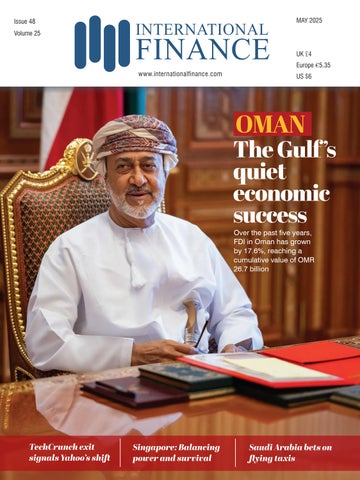
Over the past five years, FDI in Oman has grown by 17.6%, reaching a cumulative value of OMR 26.7 billion


EDITOR’S NOTE
MAY 2025
VOLUME 25 ISSUE 48
![]()

Over the past five years, FDI in Oman has grown by 17.6%, reaching a cumulative value of OMR 26.7 billion


EDITOR’S NOTE
MAY 2025
VOLUME 25 ISSUE 48
The term "debt" has been a major topic in the global economic narrative since the mid-1970s, a period marked by nations facing increasing financial difficulties. There is a growing need not only to lower debt levels but also to change how these issues are managed. The frequency with which this topic is discussed at high-level conferences reflects the deep concern that international policymakers have regarding the dramatic rise in global debt.
At the same time, Latin America's distinctive reserves of rare-earth elements and critical minerals are becoming a strategic battleground, as global powers compete to secure the future of manufacturing and technology supply chains. The region is abundant in copper and lithium, which are expected to see a surge in demand, as well as more specialised minerals like nickel, rareearth elements, and niobium, which are essential for steel and aerospace manufacturing.
Turning to the tech sector, OpenAI, led by Sam Altman, has once again disrupted the industry with the introduction of its new multimodal image-generation capabilities. These capabilities will be integrated directly into the company's GPT-4o AI language model, making it the default image generator within the ChatGPT interface.
The cover story of the May 2025 edition of International Finance will focus on Oman, a relatively quiet nation in the Middle East that has been growing steadily while diversifying its economy away from oil and into services and manufacturing. After a remarkable recovery from the pandemic's effects, Oman achieved a significant milestone by successfully reducing its debt to around 30% of GDP. This positive development has led investors and global financial organisations to have an optimistic outlook on the Gulf nation, further influencing Oman's sovereign credit rating.
editor@ifinancemag.com www.internationalfinance.com

Over the past five years, FDI in Oman has grown by 17.6%, reaching a cumulative value of OMR 26.7 billion

GLOBAL DEBT NOW HITS BREAKING POINT
Debt binges have been increasing for more than fifty years, beginning when the effects of the 'Great Depression' started to subside

SANCTIONS PUT FINANCE ON WAR FOOTING
Unintentionally enabling transactions that breach sanctions is a major concern for financial institutions

STARDUST & GEOENGINEERING: A RISING DEBATE
Experts believe that Stardust will become a go-to provider for countries considering geoengineering

OPENAI'S 4o TOOL SPARKS BUZZ AND DEBATE
OpenAI likely used images found online and licensed from Shutterstock libraries to train DALL-E 3targets
'TECH CONNECTS DONORS TO REAL HUMAN NEEDS'
Aseel has launched another largescale humanitarian initiative to support returnees arriving in Afghanistan

SAUDI ARABIA BETS ON FLYING TAXIS
Saudi Arabia is paving the way for a future of integrated, environmentally friendly, economically feasible mobility solutions 44


Director & Publisher Sunil Bhat
Editorial
Prajwal Wele, Agnivesh Harshan, CL Ramakrishnan, Prabuddha Ghosh
Production Merlin Cruz
Technical Team
Prashanth V Acharya, Bharath Kumar
Business Analysts
Alice Parker, Indra Kala, Stallone Edward, Jessica Smith, Harry Wilson, Susan Lee, Mark Pinto, Richard Samuel, Merl John
Business Development Managers
Christy John, Alex Carter, Gwen Morgan, Janet George
Business Development Directors
Sid Jain, Sarah Jones, Sid Nathan
Head of Operations Ryan Cooper
Accounts Angela Mathews
Registered Office INTERNATIONAL FINANCE is the trading name of INTERNATIONAL FINANCE Publications Ltd 843 Finchley Road, London, NW11 8NA
Phone
+44 (0) 208 123 9436
Fax +44 (0) 208 181 6550
Email info@ifinancemag.com
Press Contact editor@ifinancemag.com
Associate Office
Zredhi Solutions Pvt. Ltd. 5th Floor, Sai Complex, #114/1, M G Road, Bengaluru 560001 Ph: +91-80-409901144

Lei Jun, the founder and CEO of China's Xiaomi, announced that the company intends to invest an additional 200 billion yuan ($27.8 billion) in core technology research and development over the next five years. Lei made the announcement during a Beijing event, where the company is scheduled to introduce a number of products, including its first electric SUV and the cutting-edge mobile chip Xring01. Meanwhile, early leaks suggest that Xiaomi's upcoming flagship, possibly called the "Xiaomi 15s Pro," will have some significant hardware changes, including the possibility of being the first Xiaomi device with an in-house chipset. Technology market registered record growth of more than SR180 billion in 2024, driven by increased private sector investment and heightened innovation, further reinforcing the Kingdom’s position as the Middle East's largest technology market.

The latest iPad Air is the premium tablet to beat, with a new M3 chip to keep it ahead of the pack. The new iPad Air M3 starts at £599 (€699/$599/A$999) and has the same two screen sizes as the M2: 11 in and 13 in. The M3 model is a direct replacement for the M2 model, with no external changes to the tablet. It sits between the base-model £329 iPad A16 and the £999 iPad Pro M4, splitting the difference in price and features.
Top six leading Aquaculture companies and their market share (In Billion US Dollar)
PayPal, the global digital commerce platform, has announced the opening of a new hub in Dubai, which will be the company’s first regional headquarters for the MENA region. The Dubai Internet City site enhances PayPal’s commitment to its customers and partners in the region and its commitment to enabling millions more consumers and businesses to access the global digital economy. PayPal’s expanded presence will provide global commerce capabilities in the region, including seamless payments, robust security, and more access to international payment networks to assist both large enterprises and small businesses.
Al Fanar Gas Group, one of the UAE’s leading gas and energy solutions providers and the energy arm of EHC Investment, has signed a strategic MoU with Siemens Energy to jointly advance decarbonisation and clean energy innovation across the Gulf country. The agreement, signed on the sidelines of the "World Utilities Congress 2025" in Abu Dhabi, supports the "UAE Net Zero 2050 Strategy." The two companies will co-develop clean energy solutions that integrate advanced digital technologies into energy and industrial infrastructure, with a focus on hydrogen, flare gas management, and port and vessel electrification.
Source: Report Prime

Saudi Arabia stood out as the largest digital economy in the Middle East and North Africa (MENA), having made significant strides in artificial intelligence (AI), data centres, digital government, and human capital development, aligning with the goals of the Kingdom's "Vision 2030."
The Gulf major's digital economy is currently valued at over SR495 billion, representing 15% of GDP. This was revealed in a report published on the occasion of World Telecommunication
and Information Society Day, observed annually on May 17. The telecommunications and information technology market registered record growth of more than SR180 billion in 2024, driven by increased private sector investment and heightened innovation, further reinforcing the Kingdom’s position as the Middle East's largest technology market. The Kingdom has already invested over SR55 billion to establish itself as a regional hub for future industries.

OMAR SULTAN AL OLAMA MINISTER OF STATE FOR AI, UAE Omar Sultan Al Olama was featured at Arabia’s “NextGen AI Summit” in Dubai recently, where leaders discussed AI’s impact on business and economies in the region

DEBBIE WEINSTEIN PRESIDENT OF GOOGLE, EUROPE Debbie Weinstein was notable in business circles for leading Google’s strategy across the region, especially during a period of tech and AI growth


ABDULSAMAD RABIU EXECUTIVE CHAIRMAN OF BUA GROUP
Rabiu, the executive chairman of BUA Group, was highlighted in business leader rankings in Africa for his influence in sectors like cement, sugar, and infrastructure
Qatar Airways has also signed an agreement with GE Aerospace for over 400 engines
For Singapore and China, sea transport made up the majority of exports, 83.2% and 65.1%, respectively

Qatar Airways has placed the largest aircraft order in its history with American aviation giant Boeing. The landmark order book went up to 210 Boeing widebody jets (160 firm and 50 option), also creating another record in the process: the largest 787 Dreamliner order in the American aerospace company's history.
Qatar Airways has also signed an agreement with GE Aerospace for over 400 engines, including 60 GE9X and 260 GEnx engines, with additional options and spares, to power the flagship carrier's next-generation Boeing 777-9 and Boeing 787 aircraft. The development also came at just the right time for Qatar Airways, as the company was recently recognised as "World's Best Airline" by Skytrax for an unprecedented eight times. However, not resting on its laurels, the carrier is further investing in its fleet as part of its long-term growth strategy.
"We are happy to announce our agreement with Boeing and our partnership in the largest aircraft order in our history. A critical next step for Qatar Airways on our path as we invest in the cleanest, youngest, and most efficient fleet
in global aviation. This is so we can meet the strong demand in the airline as we seamlessly connect passengers to the world better than anyone," Qatar Airways Group Chief Executive Officer Engr. Badr Mohammed Al-Meer said.
"After two consecutive years of recordbreaking commercial performance and with this historic Boeing aircraft order, we're not simply chasing scale; we're building strength that will allow us to continue to deliver our unmatched products and customer experiences. We thank our Boeing partners for answering the call and look forward to a future of continued smart growth together," the official added.
"We are deeply honoured that Qatar Airways has placed this record-breaking order with Boeing, one that solidifies their future fleet with our market-leading widebody airplane family at its centre," Stephanie Pope, president and CEO of Boeing Commercial Airplanes, said.
"Our team is looking forward to building 787s and 777s for Qatar Airways into the next decade as they connect more people and businesses around the world with unmatched efficiency and comfort," she concluded.


European Union's (EU) exports of transport services to countries outside the continental bloc decreased by 21.5% in 2023 compared with 2022, to €245 billion, mainly due to a decline in sea transport, which accounted for half of the exports (€122 billion, 49.7%) compared with 2022.
This was followed by air transport (€71 billion, 28.8%), other modes of transport (€40 billion, 16.5%), and postal and courier services (€12 billion, 5.0%).
While the value of air transport rose by 8.5% in 2023 compared with 2022, this was the only transport service to do so, with sea-borne services falling by 36.8%, followed by other modes of transport (by 3.5%) and postal and courier services (by 3.3%). In 2023, the largest extra-EU countries to which the EU exports were the United States (€43.1 billion, 17.6% of the total), the United Kingdom (€37.4 billion, 15.2%), Switzerland (€22.4 billion, 9.1%), China (€15.7 billion, 6.4%), and Singapore (€11.3 billion, 4.6%).
For Singapore and China, sea transport made up the majority of exports, 83.2% and 65.1%,
respectively. For EU exports of transport services to American customers, sea transport and air transport were about the same, at 45.7% and 45.6%, respectively.
For trade with the United Kingdom, the distribution was more balanced, with air transport (37.2%), other modes of transport (35.2%), and sea transport (22.2%) dominating. For Switzerland, other modes of transport (43.4%) and sea transport (39.7%) had the largest share of exports of transport services.
Overall, the figures point to a challenging year for EU transport service exports, driven largely by weaker maritime activity amid slowing global trade and lower freight volumes. The sharp fall in sea transport highlights the sector’s sensitivity to economic cycles, energy costs, and geopolitical uncertainty.
In contrast, the growth in air transport suggests continued demand for passenger travel and high-value, time-critical goods. A recovery in EU transport services will depend on improving global demand, stabilising supply chains, and investment in greener, more efficient transport networks to enhance competitiveness.
Over the past decade, the resident millionaire population in the UAE capital went up by 80%
Mubadala, the UAE's ruling family, and US private equity firm Silver Lake hold stakes in G42

European banking giant UBS Group will be opening an office in Abu Dhabi to take advantage of the influx of the ultra-rich moving to the Middle East, due to the region's low-tax environment, said Beatriz Martin Jimenez, president of the bank’s businesses across Europe, the Middle East, and Africa. Jimenez noted that the Middle East has clearly benefited individuals relocating from higher-tax regions, including the UK and other countries. Over the past decade, the resident millionaire population in the UAE capital went up by 80%, according to Henley & Partners. The emirate is also forecast to see its centimillionaire population more than double over the next ten years.
Abu Dhabi alternative investment firm Lunate and Brookfield Asset Management have announced a $1 billion build-to-sell joint venture (JV) that will invest in residential assets across the UAE, Saudi Arabia, and the broader Middle East region. Lunate, which has more than $110 billion in assets under management, will commit a “significant cornerstone investment,” apart from leveraging its regional network to help drive the joint venture's commercialisation and fundraising. The announcement follows Lunate’s March 2024 acquisition of a 24.5% equity interest in ICD Brookfield Place, located in the DIFC. The development comes amid UAE’s residential market reporting robust growth.

Source: Globe News Wire


UAE-based tech firm G42 will partner with Italian artificial intelligence (AI) startup iGenius to develop a major AI supercomputer in Italy. The deal is part of a broader framework announced at a bilateral summit in February, where the UAE pledged to invest $40 billion in the European country. The AI data centre project, called "Colosseum," will be developed in southern Italy, with $1 billion to be spent over five years using Nvidia technology. G42 will be the main financier of the initial phase, to create what the companies call Europe's "largest AI computer deployment." Abu Dhabi sovereign wealth fund Mubadala, the UAE's ruling family, and US private equity firm Silver Lake hold stakes in G42.
Deutsche Bank has secured a license to operate in the Abu Dhabi Global Market (ADGM), the Emirati city’s financial centre, which is also home to multiple sovereign wealth funds. The license now allows the German bank to engage in arranging and advising on investment and credit deals. Jamal Al Kishi, the group's Chief Executive Officer (CEO) for the Middle East and Africa (MEA), said, "Receiving this license is an important step in our strategy to better meet the evolving needs of our clients in the UAE and across the region." The development adds another fruitful chapter in ADGM's operational history, as banks, hedge funds, private equity firms, and asset managers have been making a beeline for the city.
One important aspect of Singapore's economic policy is trade diversification, which can mitigate some adverse effects
Singapore, now in its sixth decade as an independent country, faces many challenges in its pursuit of further growth and development. The most critical challenge is that the international system that underpinned Singapore's economic policy has been undermined by the withdrawal from a multilateral rule-based order, which was compounded by United States President Donald Trump's second term.
Singapore has shifted its attention towards diversifying its economic base through giant investments in frontier industries such as artificial intelligence, biotechnology, and financial technology
Singapore's geopolitical approach is intricately linked to its economic survival, particularly in light of its small population and limited resources. Singapore, being an important hub of international trade and finance, has to contend with the challenge of navigating an increasingly fragmented world, characterised by shifting allegiances and economic uncertainty.
The US, as a key security ally and major investor in Singapore, has a corresponding role. Meanwhile, China's proportion of trade with Singapore makes the nation a key economic partner.
To this end, Singapore has kept its word. The citystate has cultivated close ties with both superpowers and promoted multilateralism through ASEAN and other regional economic frameworks.
Today, geopolitical tensions in the form of South China Sea disputes and the United States efforts to
exit Chinese supply chains have left Singapore in a challenging situation. Counterintuitively, the citystate is extending its trade treaties with emerging markets, as well as working to advance digital trade with other value-hungry nations like Australia, the European Union (EU), and Japan.
Being a small country, Singapore is sensitive to changes in international trade, investment flows, and technological progress. With its policy of globalisation, Singapore's open economy has thrived. However, the global shift away from a rules-based multilateral system due to prevailing protectionist policies poses a threat to Singapore's economic stability.
The pandemic-induced supply chain disruptions and global push toward self-reliance in producing semiconductors have shed light on the middleman vulnerabilities of Singapore. In response, Singapore has shifted its attention towards diversifying its economic base through giant investments in frontier industries such as artificial intelligence, biotechnology, and financial technology.
The government has implemented incentives to attract multinational companies while backing local firms, particularly those involved in green energy and sustainable finance. Additionally, Singapore is going digital, focusing on cross-border e-commerce and fintech products, all to stay relevant in a future where digital commerce is as significant as traditional trade corridors. Despite these strategic initiatives, Singapore is also facing some long-standing issues that could slow down its

economic growth in the future.
“With our population ageing and fertility rates dropping, the labour shortage problem remains a top priority. The government is trying to attract foreign skilled talent while ensuring that domestic workers are able to remain competitive through lifelong learning and retraining opportunities,” says Faizal Bin Yahya, Senior Research Fellow at the Institute of Policy Studies at the Lee Kuan Yew School of Public Policy, National University of Singapore.
However, immigration remains an issue that provokes strong emotions, with individuals voicing growing concerns about how the newcomers fit into society and what it does to our national identity.
“Singapore's limited geographical size restricts its ability to expand its physical footprint. This limitation has resulted in innovative urban planning strategies such as underground infrastructure development and land reclamation schemes. Climate change further compounds our challenges, as the rising sea level and climate-related disasters pose threats to Singapore's long-term sustainability,” Yahya added.
The government has made significant efforts to mitigate this challenge through investment in green technology. The government is introducing renewable energy, funding carbon capture initiatives, and advancing financial instruments tied to sustainability, as the world economy moves towards sustainability.
One important aspect of Singapore's economic
policy is trade diversification, which can mitigate some adverse effects. Beyond strengthening trade relations with its immediate neighbours, Indonesia and Malaysia, Singapore has signed 27 bilateral and regional free-trade agreements.
Moreover, Singapore has further deepened subregional development cooperation with Indonesia and Malaysia. In Batam, Indonesia, for example, Singapore has jointly developed industrial and hightech parks. Furthermore, it is a partner to the "JohorSingapore Special Economic Zone," which aims to open Johor, Malaysia, to Singapore-based companies.
Structural and demographic challenges
Singapore's labour force and resources, particularly its land, limit its ability to grow and develop. The number of foreign workers rose from 1.2 million in December 2021 to 1.52 million in December 2023, despite strict regulations such as the dependency ratio ceiling, which limits the number of foreign workers in relation to the overall labour force.
As of June 2024, the population of Singapore includes 1.86 million non-residents, 3.64 million citizens, and 544,900 permanent residents. The median age of the citizens was 42.8 years old in 2022. As of today, it is 43 years old. It is worrying that 19.9% of its citizens are 65 years and above, and in 2030, this number is expected to rise to 24.1%.
In 2023, 34,491 people were granted permanent residence, and 23,472 people were granted citizenship,

a 1.7% increase from the previous year. To manage the flow of new citizens, social integration, ethnic, and interreligious peace activities have been at the forefront, although the number of new citizens granted has remained stable recently. Immigration and foreign labour have become significant issues, particularly as general elections like the one in 2025 approach. The politicisation of immigration and foreign labour issues draws attention to the importance of maintaining racial harmony and ethnic balance. Racial classification by the Singaporean government is done using the Chinese-MalayIndian-Others model.
During his 2025 budget speech, Singapore Prime Minister and Finance Minister Lawrence Wong presented several measures to aid Singaporeans to ensure that the nation maintains its economic growth and social compact
with its residents.
These policies aim to encourage lifelong learning, offer job assistance, and help with workforce transformation. These included regular training subsidies for certain full-time and part-time courses, and enhanced workfare skills assistance for low-income individuals.
As part of its "National AI Strategy 2.0," which the Singaporean government updated in 2023, Singapore is focusing on building its AI capability alongside leveraging technology to drive economic growth. The aim is to triple the number of AI experts to 15,000 by 2023. Furthermore, by enhancing its connectivity, the state continues to utilise and maximise its locational advantage.
Among the most densely populated countries is Singapore. Singapore's housing market is in a dilemma situation—while it has made many homeowners by providing housing to residents through the
Housing Development Board (HDB), it has also seen escalating property prices that have created giant concerns regarding affordability.
The government has introduced stringent regulations to curb speculation and ensure stability, such as cooling measures, additional stamp duties, and restrictions on loanto-value ratios. However, demand continues to outstrip supply, leading to record resale levels and increasing rental costs.
Increasing foreign investment in luxury homes and a rising tide of expatriates have been pushing housing costs sky-high, posing difficulties for younger Singaporeans and lower-income groups in being able to find housing that they can afford.
The rising price of private flats has contributed to inflationary pressures, and Singapore is now among the most expensive cities to live in globally. The government has taken measures by

increasing the supply of Build-ToOrder (BTO) flats and introducing first-time homebuyers' subsidies. However, the extent of their impact remains uncertain.
The current cost-of-living crisis is not limited to housing alone; it affects our everyday essentials such as food, transport, and healthcare. The global supply chain disruptions and higher energy prices have driven the increasing cost of living. Singapore imports most of its food and products, leaving it exposed to price fluctuations.
The hike in the Goods and Services Tax (GST) from 8% to 9% in 2024 has caused consumer prices to go up, despite the assurance of assistance from the government to lower-income earners.
The government has rolled out schemes such as U-Save rebates, cash handouts, and transport subsidies to alleviate the burden. But concerns about wage stagnation and income inequality persist.
As Singapore attracts increasing numbers of high-net-worth individuals and multinational companies, a means of balancing economic expansion with affordability for residents will be a key issue for policymakers over the coming years. Trade hub, sustainable energy, and AI: Singapore must enhance its global connectedness to consolidate its position as a node within the global value chain.
Changi Airport served over 58.9 million passengers in the aviation sector in 2023. Singapore is now restarting the construction of Terminal Five, which will be larger than Terminals One to Four combined and accommodate 50
Source: Statista
million annual passengers to help it compete with other airline hubs.
The aviation sector supports around 200,000 individuals and contributes to 3% of Singapore's GDP. In its 2025 budget, the government injected S$5 billion ($3.7 billion) into the Changi Airport Development Fund.
The maritime sector supports around 170,000 individuals and contributes 7% of Singapore's GDP. With the development of the Tuas Mega Port, Singapore continues to enhance its geographical benefits.
Singapore's aspiration to be zero-emitting by 2050 means that it will have to rely increasingly on its neighbours because it is resourceconstrained. S$5 billion ($3.7 billion) was allocated to the "Future Energy Fund" in the 2025 budget.
To achieve its target of importing four gigawatts of clean energy by 2035, Singapore would purchase 1.2 gigawatts from Vietnam. Singapore also has deals with Indonesia to import one gigawatt of clean energy and two gigawatts of low-carbon
electricity from Cambodia.
It is enabled by automation and investments in emerging technologies, such as AI, but this strategy must be accompanied by the retraining and education of Singapore's ageing workforce. There must be collaboration with key stakeholders, such as small and medium enterprises, global corporations, and trade unions.
Singapore is employing subregional development and digital trade, including e-commerce, with like-minded partners in a bid to seek alternatives to strengthen multilateral trade. In the transition to a greener economy for more sustainable growth, connectivity also needs to be enhanced, but this has to be paired with cooperation with subregional partners.
Singapore's economy grew faster than expected into the end of 2024. The city-state's economy grew 5.0% in the fourth quarter from a year earlier, higher than both an official advance estimate of 4.3% and economists' forecast of 4.7% growth. However, the government anticipates slower growth in 2025, as trade frictions and ongoing geopolitical conflicts may lead to higher production costs.
Ultimately, the city-state needs creativity, collaborative partnerships, and a relentless policy reform drive to ensure its prosperity as a vital stakeholder in the global marketplace, while the trade war wages on.

IF CORRESPONDENT

Foreign capital flows into Nigeria surged in the first half of 2024 to $5.98 billion, over double the $2.16 billion recorded for the same period in 2023
Nigerians are not doing well economically. In 2023, President Bola Tinubu promised during his election campaign to restore the "renewed hope" he once offered the country, but he only brought despair.
Be it the removal of fuel subsidies (which raised the price of petrol by nearly 500% within one year) or the liberalisation of the foreign exchange market (that resulted in an over 100% depreciation in the value of the domestic currency between October 2023 and October 2024), Tinubu's reforms have met with domestic upheavals.

To rein in inflation, which stood at 24.48% in January 2025, the Central Bank of Nigeria has been pursuing a contractionary monetary policy, an attempt to fend off inflation by reducing the money supply. The apex financial body maintained its benchmark lending rate at 27.50% in its latest meeting.
However, these policies have reduced the living standards of Nigerians. People are now paying higher prices for food, transportation, energy, health, and education. And this benchmark lending rate has also ensured yields and borrowing costs are rising in step with each round of monetary policy tightening, thereby establishing Governor Olayemi Cardoso’s reputation as a fiscal tightening hawk.
However, a rare sweet spot has been the country’s growing yield market, on which the African Banker recently reported: “At a 13th October Treasury
bills auction by the central bank under its open market operations aimed at controlling liquidity, the regulator closed the deal at 24.3%. Dealers said the central bank chose that stop rate to keep the transaction to the ₦500 billion on offer and avoid oversubscription.”
On October 15, Treasury and Open Market Operations bills were trading with yields between 21% and 25.96%, with bills due in June 2025 leading the pack. Yields on federal government bonds have been slightly more subdued, ranging from 16.73% to 23.71%, according to data on the Financial Market Dealers Association’s FMDQ platform.
“Commercial papers, through which companies raise short-term financing for working capital and other uses, have led the way toward higher rates. Dufil Prima
Foods, which manufactures the popular Indomie noodles brand, is among the first companies to sell commercial papers since the latest central bank rate increase. An offer repayable in April 2025, at 27%, opened on 10th October, with subscribers given a week to take up the offer. One of the first issuers to reach the 30% mark for yields is SKLD Integrated Services Ltd., with 270-day notes that closed on 4 September. A separate 180-day duration offer had an interest rate of 28%,” the African Banker stated.
The ₦5 billion, 270-day commercial papers offered by C&I Leasing two days after the Central Bank decision had a yield of 29%. The Lagos-based company, which is engaged in equipment leasing and logistic services in Nigeria and Ghana, closed the offer on 4th October.
Similarly, two tranches of commercial papers issued by investment bank DLM
Capital Group for ₦ 5 billion, with durations of 180 days and 270 days, attracted yields of 26.9% and 29%, respectively. Both offers closed on 26th September, two days after the central bank raised its key rate.
When Dangote Cement, Africa’s largest manufacturer of building materials and one of Nigeria’s most profitable companies, sold 177- and 266-day commercial papers in May 2024 for ₦150 billion, the yield was 5% and 6%, respectively. However, Dangote Sugar, with less formidable credentials in the same group, raised two tranches a month earlier for a total of ₦42.79 billion at 23% for the shorter tenor and 25% for the longer tenor, indicating that less risky issuers can still raise funds more cheaply.
In December 2024, foreign portfolio investments (FPIs) in Nigerian equities reached their highest post-COVID level, as the investments totalled $284 million in the first nine months of the year. This marked a 19% appreciation from the $239.2 million recorded in the corresponding period in 2023, according to the Capital Importation Data for Q3 2024 provided by the National Bureau of Statistics (NBS).
The positive trend also represented the highest level of interest in Nigerian equities since the first nine months of 2020, when foreign portfolio investment (FPI) in the market reached approximately $737 million.
Comparatively, FPI stood at $168.5 million in 2021, declined to $51.7 million in 2022, and rebounded to $239.2 million in 2023. With an FPI of $84.7 million in Q3 2024, it also represented the highest foreign investment in Nigerian equities in the third quarter of the year since 2019.
Before COVID-19, Nigerian equities attracted significant interest from foreign portfolio investors, with FPI inflows reaching approximately $1.89 billion in 2019 and $2.36 billion in 2018. In Q1
2020, before the pandemic-triggered lockdown, FPI in equities stood at $639 million but plunged sharply to $53.2 million in Q2. The FPI in equities in Q3 2024 represented a 912% growth from the $8.4 million recorded in Q3 2023. However, it represented a 43.5% decline from the $149.9 million recorded in Q2 2024.
In 2024, Nigeria’s economy also exhibited characteristics of a “hot money” hub, with foreign portfolio investments accounting for approximately 61% of the country’s total capital importation in the first nine months of the year.
Short-term money market instruments accounted for $3.43 billion of the $4.38 billion in foreign portfolio investments recorded in the first nine months of 2024. In fact, in the same year, the NGX also provided a year-to-date return of 31.34%, underperforming the country’s inflation rate and 2023’s returns.
Despite the African country experiencing its highest inflation since 1996 and benchmark interest rates surging to a record 27.5%, the increased foreign interest in Nigerian equities can be attributed to significant improvements in the country’s foreign exchange system. The current foreign exchange system also offers greater fluidity, enabling investors to seamlessly invest in Nigerian stocks and repatriate their USD returns without the need for lobbying.
The Nigerian market has also offered appealing returns, with stocks like Seplat Energy, which is also listed on the London Stock Exchange (LSE), appreciating by 147% in 2024. Airtel Africa, which also got dual-listed, recorded a 14% return year-to-date, while Oando, listed on the Johannesburg Stock Exchange, posted a remarkable 499% return.
Have foreign investors found a winning formula?
The high yields on debt have proved to
be an effective bait for foreign portfolio investors seeking higher returns. Foreign capital flows into Nigeria surged in the first half of 2024 to $5.98 billion, over double the $2.16 billion recorded for the same period in 2023, according to data provided by the National Bureau of Statistics.
With the first rate hike of 400 basis points in February 2024, there was an inadequate response time for investors, who brought in more than $1 billion by the end of March of that year. Inflows in Q2 reached $2.6 billion, more than double the figures for the preceding three months.
“At least $3.48 billion, or 58.2%, of the funds that came in between January and June of 2024 have gone to portfolio investments, a more-than-threefold increase from the $750 million spent on the same category of items during the comparable period last year. Out of the funds that went into portfolio investments, $2.68 billion went to money market instruments, $598 million went to bonds, and equities attracted $199 million. The money market investments targeted mainly Treasury bills, openmarket-operations bills, and commercial papers,” the African Banker stated.
The naira kicked off 2025 with its strongest rally in 13 years, mirroring an early surge in 2024. Since December 2024, the naira has gained 9%, strengthening from ₦1,662/$ on December 2 to ₦1,509/$ on February 13, the biggest gain among African currencies, according to BusinessDay data.
In January 2025 alone, the currency appreciated 4% (₦63.14), hitting a sevenmonth high of ₦1,478.22/$. The last time such upward movement was seen was in 2012. Although the rally has cooled slightly in February, with the naira stabilising around ₦1,500/$, its strength in the parallel market has continued. It climbed to ₦1,545/$, up from ₦1,620/$
at the start of the month.
As per market insiders, the sharp reversal can be attributed to a decline in dollar supply and profit-taking by foreign investors. Many had entered the Nigerian market at ₦1,600/$, only to exit when the rate dropped to ₦1,300/$, locking in gains. Those who invested in Nigerian bonds, after the CBN adjusted rates to align with inflation, saw even higher returns upon exiting.
Analysts widely expect the currency to remain largely stable throughout 2025. Total foreign exchange inflows into the Nigerian autonomous foreign exchange market (NAFEM) increased by 53% to USD 4.7 billion at the end of January, up from USD 3.1 billion recorded in December 2024, according to data from the FMDQ.
As Nigeria faces threats from severe inflation and exchange-rate pressures, the Tinubu administration has decided to stick to a tighter monetary policy rate while attracting foreign portfolio flows to help ease the pressure on the naira.
Under this approach, the African country sold its first foreign-currency domestic bond in September 2024, a $500 million offer that got a total of $900 million in subscriptions at 9.75%. Nigeria’s foreign reserves jumped 12.74% from the end of June 2024 to $39.12 billion as of 11 October, reversing the depletion of recent years.
Banks have emerged among the major beneficiaries of the current high-interestrate regime. Guaranty Trust Holding, which operates Nigeria’s largest bank by market value, recently reported a threefold increase in net income for the first half of the year to ₦899.9 billion ($543.7 million). In all, the country’s top
Annual inflation rate in Nigeria from 2017 to 2024 (In Percentage)
Source: CPI Reports
12 banks combined recorded a 100% growth in profit before tax in the first six months compared with 2023.
Talking about the African country's first-ever $500 million domestic dollar bond, whose issuance got oversubscribed to $900 million, it had local investors, pension funds, and the Nigerian diaspora as top subscribers and has provided a valuable source of hard currency amid ongoing dollar shortages and naira devaluation pressures. The “landmark transaction” also reflected Nigeria’s strategy to diversify funding sources and reduce reliance on international markets, where borrowing costs are higher.
The proceeds from the transaction are already supporting critical sectors of the economy, with plans to list the bond on local exchanges to enhance tradability. In addition to the annual interest rate of 9.75%, the $500 million bond is eligible for tax exemption for pension funds and other investors. The Central Bank of Nigeria has also granted it liquid asset status, meaning that banks can use it when calculating their liquidity ratios.
Market consensus described the bond pricing as highly attractive, with reports further suggesting the pricing was in alignment with the current yield of Nigeria’s Eurobond of equivalent tenor. Nigeria’s Eurobond of between three
and five years currently yields between 9.662% and 10.03%; thus, the midpoint pricing of 9.75% was considered attractive.
A major advantage of the bond route pursued by Nigeria lies in the fact that the mechanism is the best alternative to borrowing to fund developmental projects and programmes, with no financial obligations on the government.
According to the Trust Deed for the bond, the Federal Government has pledged an irrevocable commitment that it shall keep fidelity to the nature of the bond as a dollar-based issuance, with both the principal and the coupon to be paid in the same currency.
Some five banks have rounded off preliminary documentation and approval processes to raise more than ₦1 trillion ($616.8 million) in the second wave of capital-raising as part of the ongoing banking recapitalisation exercise.
The banks—United Bank for Africa (UBA), Stanbic IBTC Holdings, Wema Bank, Premium Trust Bank, and Jaiz Bank—have reached advanced stages in their pre-offer processes, with the two largest banks within the cluster expected to headline the capital-raising this quarter.
Recently, another five banks raised more than ₦1.5 trillion ($925.2 million) in a momentous opening to the Central Bank of Nigeria’s directed programme. These institutions were Guaranty Trust Holding Company (GTCO), Access Holdings, Zenith Bank International, Fidelity Bank, and FCMB Group.
The African country's Securities and Exchange Commission is already considering applications from the banks. While some six offers are undergoing the

regulatory approval process, UBA, which has its shareholders’ approval for a multiinstrument capital-raising programme, is expected to start with a rights issue, under which the bank plans to raise more than ₦384 billion ($236.8 million).
According to reports, Stanbic IBTC Holdings, which had launched a ₦550 billion ($339.2 million) capital-raising process, has also reached an advanced stage for the first tranche of its multiinstrument capital-raising. The company is also headlining its equity-raising with a rights issue, a favourite method under the recapitalisation programme.
The holding company’s ₦550 billion ($339.2 million) capital-raising includes a rights issue of ₦150 billion ($92.5 million) and a ₦400 billion ($246.7 million) debt instrument. Shareholders of the company also authorised the board “to raise addi-
tional equity capital of up to ₦150 billion ($92.5 million) by way of a rights issue or offer for subscription on such terms, tranches, conditions and dates as may be determined by the directors.”
Wema Bank, with a national banking licence, is concluding its pre-issuance processes to raise ₦200 billion ($123.3 million) in new equity funds, in a bid to preserve the 79-year-old bank as a standalone entity post-recapitalisation. With a share capital and share premium of ₦ 15.13 billion ($9.33 million), the venture reportedly has one of the smallest starting points among Nigerian banks.
“In March 2024, the CBN released its review of the minimum capital requirements for commercial, merchant, and non-interest banks. It increased the minimum capital for commercial banks with an international affiliation,
otherwise known as mega banks, to ₦500 billion ($308 million); for commercial banks with national authorisation, to ₦200 billion ($123.3 million); and for commercial banks with a regional licence, to ₦50 billion ($30.8 million). Other new thresholds apply to merchant banks at ₦50 billion ($30.84 million); noninterest banks with a national licence at ₦20 billion ($12.33 million); and any non-interest bank with a regional licence will now be required to have ₦10 billion ($6.16 million) minimum capital. The 24-month timeline for compliance ends on 31st March 2026,” African Banker concluded.


IF CORRESPONDENT
There is a small nation in the Arabian Peninsula that hardly ever makes headlines. It’s very low profile, unlike its neighbours. It's in the proximity of nations which are either exuberant or in absolute catastrophe. For example, the most rapidly modernising state in the world is arguably Saudi Arabia, and the most devastated nation in the world is perhaps Yemen. There is the exuberance of Dubai and the notoriety of Iran. And amidst all this, the quiet nation of Oman, under the watch of Sultan Haitham bin Tariq Al Said, is steadily diversifying away from oil into services and manufacturing.

It’s a silent nation that likes to mind its own business. The country, like many others, wasn’t doing too well during the COVID-19 pandemic. The economy has shown a resurgence with consistent growth since 2021. In 2023, the real GDP growth reached approximately 1.4%, and it is projected to rise to 1.6% by 2025. This recovery is no coincidence. The sultanate successfully reduced its debt to around 30% of GDP. The country is secure, with sufficient surplus to manage potential crises, which has attracted investors and organisations that have positively influenced its sovereign credit outlook.
You might be wondering, “But many countries have staged a post-pandemic comeback, so why is Oman special?” Well, it’s special because its growth wasn’t fuelled by oil, which is unusual for a GCC nation. Surprisingly, most of the growth came from sectors like tourism and manufacturing. They didn’t make headlines like those of Saudi Arabia
or Dubai, but achieved it all with quiet dignity.
Before the 1960s, Oman was a subsistence society. The quality of life was considered poor by global standards, and the population was dependent on fishing, husbandry, and agriculture. They participated in a trade network connecting East Africa, India, and regional partners, including Iran, Yemen, and Saudi Arabia. A very conventional orthodox society that valued tradition more than progress, it pursued nothing exceptional, until the discovery of black gold and the subsequent oil boom in 1964 at Fahud. Oil attracts empires like stale fruits to flies. The British were invested in the oil in Oman. But the Ibadi Imamate and its elected rulers, who ruled the hinterlands of Oman, were wary of outsiders and foreign influence. The empire backed the Al Said Sultanate, which ruled the coastal

regions of Oman.
Sultan Said bin Taimur defeated the Imamate and unified the country, and oil exports commenced in 1967. He was an isolationist who was against modernising to the point of madness. He famously banned spectacles, sunglasses, radios, bicycles, football, and even umbrellas.
Sultan Said bin Taimur's rule would swiftly come to an end when his son, Sultan Qaboos bin Said, usurped the throne on July 23, 1970, in a bloodless coup. The British-backed usurpation transformed Oman by integrating it into global capitalism, thus ending its isolationist policy. Public administration, banking, public works, health care, and education were all established soon enough.
Before COVID-19, Oman was growing around 3% per year on average from the 2000s. Growth had nothing to do with any tourism initiative or industrial and agricultural efforts. Oman was at
Over the past five years, FDI in Oman has grown by 17.6%, reaching a cumulative value of OMR 26.7 billion
the mercy of global oil and gas prices, as crude exports were its primary source of income. Even in 2020, oil and gas still made up about 60% of merchandise exports and around three-quarters of government revenue.
The collapse of oil prices in 2014-15 jolted the sultanate to a painful realisation that depending on oil alone is not a sustainable economic policy. Oman went from a nation with negligible debt in the 2000s to having public debt which was above 40% of their GDP in 2019. Subsequently, “Vision 2040” was proposed, but the country went into further shock again during the COVID-19 pandemic. In 2020, global oil demand collapsed, causing Oman's GDP to contract by 3.4%. During the same period, debt soared to 64% of GDP. Fiscal reforms were underway. This included subsidy rationalisation, austerity measures, and even the introduction of "Value Added Taxes" in 2021.
Oman is a mid-tier oil producer with crude reserves of around 4.8 to 5.4 billion barrels. It also has tens of trillions of cubic feet of natural gas reserves used for power generation and exports.
Hydrocarbons continue to play a central role in Oman’s economy, though their dominance has gradually declined. In recent years, oil and gas have accounted for roughly one-third of GDP, down from historical levels of 40% to 50%, while still providing the majority of government revenue and export earnings.
The National Centre for Statistics and Information claims that Oman’s GDP grew by 4.7% in the first quarter of 2025 to a total value of OMR 10.53 billion. This might seem trivial until you take into consideration the fact that not even a fraction of this growth was due to crude oil production. In

Gross Domestic Product in current prices in Oman from 2016 to 2025 (In Billion US Dollars)
Source: Statista

fact, crude oil activities had slowed down by 7.5%.
The non-oil productivity was at a whopping OMR 7.13 billion, a figure that reassures that “Vision 2040” is not just empty words on paper. There is more good news, because the service sector grew by 4.2%. This includes finance and tourism as well. Industries contributed around 2.8%.
However, the real deals were the fisheries and agricultural sectors, growing at double digits to a staggering 11.1%. This makes Oman an independent and resilient nation with very little need for imports of basic goods like food.
One of the biggest wins for the government recently has been the return to "investment grade" status. In late 2024, S&P Global Ratings upgraded Oman’s credit rating to BB+, a move that essentially told the global financial community that the Sultanate is a safe and reliable place to put money. This was not an accident.
The Ministry of Finance has been incredibly disciplined, using windfall revenues from pre-
vious years to pay down public debt and build up a safety net. This fiscal prudence cleared the way for a wave of Foreign Direct Investment (FDI).
Over the past five years, FDI in Oman has grown by 17.6%, reaching a cumulative value of OMR 26.7 billion.
They say the Arabs own London. In Oman, the United Kingdom is the major player and accounts for half the FDI that flows into the country. The United States, UAE, and India are trailing behind. The sultanate loves the money flow and has signed aggressive legislation to improve momentum.
Not so long ago, foreigners couldn’t keep ownership of permanent immovable assets in most of the GCC. In Oman today, after the legislation of the “Foreign Capital Investment Law,” anyone can have complete ownership without minimal capital requirements. Corporations are flocking to free zones like Sohar and Duqm, or to the capital city of Muscat, to start their offices.
Oman is wary of inequality and K-shaped growth. They believe in a concept called ICV, or “InCountry Value,” which is part of the Omanization programme. They encourage companies to employ locals, use local resources and suppliers, so that no community or class of Omani people are left behind during the growth.
Also, Oman famously introduced the “Social Protection Fund” to provide free universal child benefits and pensions for the elderly (the first of its kind in the Gulf), thus reaffirming their commitment to welfare, long-term planning, and sustainability.
Total credit is growing by 8.4% and will be OMR 34.1 billion. The banks are healthy, and people are borrowing and investing in their businesses, and the indicators suggest that the economy is humming. They still use oil but are welcoming a new age where prosperity does not depend on global energy markets.
Dubai is pompous, Oman is classy
There is no Burj Khalifa or the Line in Oman. It isn’t building the tallest tower, the longest city, or the most expensive amusement park. It’s not a place for crypto billionaires and oligarchs looking for wild parties. Not a nation committed to
When others build, Oman conserves. And this is the key to their tourism strategy. For example, around 50 km southeast of Oman is Bandar Al Khairan, a beautiful secluded coastline with isolated islands, breathtaking limestone cliffs, and turquoise waters
hedonism, unlike Dubai and, to a certain extent, Saudi Arabia or Qatar. It is not competing with other Arab nations.
Instead, it is leaning into what it does. They are celebrating "Quiet Luxury." Oman doesn’t believe in glitz. It has chosen tranquillity, nature, and authenticity. The keyword here is "hushpitality," a blend of top-tier service and serene landscapes to truly disconnect from the noise of European and other Middle Eastern cities.
High-net-worth individuals are tired of pompousness and decadent displays of wealth. What they seek is peace and meaning. Oman supplies both abundantly with its dramatic mountains, vast deserts, and untouched coastlines.
Even the official position of their “Ministry of Heritage and Tourism” is clear. They are not chasing mass tourism. They prefer quality to quantity and want the type of traveller who spends more and stays longer. Oman is for someone who values the silence of the desert dunes over a loud theme park.
One would imagine that Oman caters to the wealthy European, American, and Arab alone. But in 2025, the Chinese made up the bulk of tourists. This is partly because of the air bridge that Oman built to China. Beijing and Muscat have direct flights thanks to China Eastern Airlines, and this has made a real difference in tourism.
There is already a spike in Chinese visitors by 272% in 2023, and the growth has been astronomical in the first half of 2025. The 14-day visa-free entry for Chinese citizens has made the desert nation a paradise for wealthy Chinese explorers.
This is not to say that Europeans are not coming in anymore. In fact, air traffic capacity from Italy is up 31%, and we have seen a staggering 253% increase from Russia. To house these discerning guests, the hospitality sector is expanding in a
very deliberate way. We are not just seeing more hotel rooms; we are seeing a shift towards luxury, too, as 54% of the new hotel pipeline is in the "upper-upscale" and high-end segments.
Already, there are luxury hotels for the ultrarich set up in Oman. For example, do you want butlers serving you while you lose yourself in a drink, while admiring the beauty of the blue ocean? If so, St. Regis Al Mouj Muscat Resort, established in 2024, is the place to be. It’s the pinnacle of exuberance, just like the Mandarin Oriental hotel. The latter has 150 luxury rooms and 155 branded residences.
When others build, Oman conserves. And this is the key to their tourism strategy. For example, around 50 km southeast of Oman is Bandar Al Khairan, a beautiful secluded coastline with isolated islands, breathtaking limestone cliffs, and turquoise waters. It has now been designated as an "Environmental Tourism Zone." The government could allow builders to encroach on these ecologically sensitive lands and let private developers make some money. But they have made it a protected zone and are choosing sustainability instead.
Minor Hotels runs a very beautiful Anantara resort in this area. They have only 121 keys, including chalets and villas in the mountains, aiming for lower traffic so that visitors can truly experience nature without distraction.
In 2025, eco-tourism and adventure travel are buzzwords. The Environment Authority will use OMR 44 million to develop and manage seven nature reserves, including the "Stars Park Project" in the “Al Hajar Al Gharbi Starlight Nature Reserve,” which capitalises on the growing global interest in stargazing and astro-tourism. Oman’s not just looking for profit; it’s leveraging its uniqueness for sustainability as well.
You cannot run a modern economy on dirt tracks and optimism. Oman knows that goods and passengers cannot move efficiently without high-quality infrastructure. In May 2025, Oman is experiencing a massive construction boom. The focus is on the “Hafeet Rail Project,” a joint railway
network between Oman and the UAE, which is expected to significantly increase visitor traffic in Oman.
The railway project is almost 70% complete as of early 2025, and at present, the crew is drilling a tunnel through the rugged mountains of Al Hajar in Buraimi Governorate. When this project comes to a conclusion, the port of Sohar will be connected to the emirate of Abu Dhabi through the 238-kilometre-long rail line. A person who lands in the UAE will be able to reach Sohar in just 100 minutes on super-fast trains. This helps to package both the UAE and Oman as a single trip for tourists.
The airports are already brimming with tourists, and in January 2025 alone, Muscat International Airport handled over 1.2 million passengers. Even Salalah Airport in the south saw air traffic there jump by 9.3% in the first quarter. It’s proof that efforts to make Dhofar a year-round destination are bearing fruit. Tourists are arriving irrespective of the season. There is the bustle of the usual three-month Khareef monsoon season, and also in winter, for the sun and the pristine southern beaches.
Along with rail lines and air traffic, roads are also being developed across the sultanate. In 2024, the government paved over 16,000 kilometres of roads. It’s incredible because it's not even a halfway milestone, as they plan to pave another 17,000 kilometres.
There is talk about roads in places like Al Jabal Al Akhdar, the "Green Mountain," and Jebel Shams, the highest point in the country. The government is building these arterial roads to connect even remote villages to the tourism economy.
It’s not that Oman has no futurism like Dubai and is only focusing on conservation. It has also carved out a part of its land for such a purpose. "Sultan Haitham City" in Seeb is a futuristic city which will cover 15 million square metres and will house 100,000 people. Contracts worth OMR 228 million have been awarded by the Ministry of Housing and Urban Planning for phase one of infrastructure development. This includes everything from the electricity and water grids

to a smart-city backbone with district cooling and fibre networks.
By May 2025, construction will start in the neighbourhoods of Al Wafa and Wadi Zaha. The city will have 2.9 million square metres of green space and a massive 7.5-kilometre wadi that acts as a natural park. The sultanate is betting big on Omani urbanism as the future of cityscapes. The construction in the area is providing a massive boost to the local economy, and Oman is becoming more connected to itself than ever before.

In May 2025, we are seeing a level of interest from global investors that would have been unthinkable a decade ago. The sector is moving away from old-fashioned stand-alone buildings and toward Integrated Tourism Complexes (ITCs). These are gated, master-planned communities that offer a high-end lifestyle, world-class amenities, and, most importantly, freehold ownership for foreigners.
Buying property in an ITC is currently the most secure way for a non-Omani national to own real estate in the Sultanate. It gives you full title deeds and makes you eligible for an Omani residency visa. This has been a massive draw for expats living in the GCC and for international buyers looking for a stable investment in the region. Al Mouj Muscat remains the market leader in this space.
It is a mature, vibrant community with a marina, a golf course, and now the new St. Regis resort. Rental yields in Al Mouj are some of the strongest in the country. For example, a twobedroom apartment there typically rents for around OMR 709 per month, making it a favourite for "buy-to-let" investors.
It isn’t just Al Mouj; there is also Hawana Salalah in the south, emerging as a potential competitor. Salalah is a popular year-round destination and sees a huge demand for holiday rentals. Investors in Hawana Salalah can often see gross rental yields between 8% and 10%. It’s very competitive compared to other major cities in the Gulf. It offers a different lifestyle, more focused on the beach and nature, and the entry prices are more affordable than those in the capital.
Destination with a purpose
Oman’s growth is just that, and it does not wish to compete with Dubai, Qatar, or Saudi Arabia. It makes no noise and silently goes about making incremental gains. It’s rapidly weaning off oil and is going big on tourism, and has moved towards self-sufficiency through agriculture and fisheries.
Oil is still the major contributor to the economy, but the trend is changing fast, and the return to investment-grade status has opened the doors to global capital. The tourism strategy is working
because it is honest and does not try to be something it is not. By focusing on "Quiet Luxury" and environmental preservation, Oman has carved out a unique and highly profitable niche in the global travel market.
The infrastructure projects we see today, from the tunnels of the Hafeet Rail to the smart grids of Sultan Haitham City, are the physical manifestations of “Vision 2040.” They are the backbone that will support a more connected, urbanised, and modern society. And the real estate market is the primary beneficiary of all this progress. Whether it is a cliffside villa at AIDA or a net-zero townhouse in Yiti, the options for investors have never been more diverse or more compelling.
But perhaps the most important takeaway is the sense of balance. Oman is modernising, yes, but it is not losing its soul in the process. It is building for the future, but it is doing so with a deep respect for its heritage and its natural beauty. For those of us watching from the outside, it is a fascinating case study in how a country can transform its economy without losing its identity. As we move toward 2030 and beyond, the Sultanate of Oman is no longer just a place to visit. It is a place to invest, to live, and to witness the birth of a new Arabian era.
Debt binges have been increasing for more than fifty years, beginning when the effects of the 'Great Depression' started to subside

IF CORRESPONDENT

Since the world's public debt tripled in the mid-1970s, and many nations are currently experiencing financial difficulties, there is an increasing need to lower it and completely alter how we manage it.
The frequency with which the topic is brought up at highlevel conferences is one indicator of how concerned international policymakers are about the extraordinary rise in global debt. It also comes up almost every week. In April 2024, International Monetary Fund (IMF) Managing Director Kristalina Georgieva told the Atlantic Council that she was concerned the current decade would be regarded as “the turbulent 20s.”

Across the world, the primary topic of discussion is debt, which is undoubtedly rising every day. The figures provide cause for concern. Gross borrowing for the 38 member countries that make up the so-called OECD region increased by precisely $2 trillion in 2023, from $12.1 trillion to $14.1 trillion. It will worsen: the OECD projects an additional $1.7 trillion increase in 2024. Even while the United States was the main offender, borrowing almost two-thirds of the $14.1 trillion in 2023, it is evident that this puts pressure on the global debt markets, whose ability to issue debt is limited.
Currently, there is a significant amount of debt in the markets. It is expected that the total borrowings, known as “outstanding marketable debt,” for 38 governments will reach $56 trillion by 2024. If that figure is striking, consider that it has increased by $16 trillion in just the last five years. This will mark a record level of debt.
The average debt-to-GDP ratio is likewise abnormal, which is possibly much more worrisome. From 73% in pre-COVID to roughly 83% in 2023, it has increased in real pre-inflation terms. And by the end of 2024, it will undoubtedly have increased. Meanwhile, interest rates are getting close to 3% of GDP, making new borrowing more expensive.
The performance of emerging markets is suffering. In 2023 alone, around $1 trillion more in sovereign bonds were issued in the so-called EMDEs (emerging market and developing economy) countries, bringing the total to $3.9 trillion.
China has a strong and quickly expanding appetite for this type of debt, even though it is hardly an EMDE. It now accounts for 37% of emerging nations’ bonds, up from 15% in 2021. Many issuers, both inside and outside of China, are alarmed by that figure.
It should come as no surprise that
EMDEs borrow more against less because their economies are not expanding quickly enough, their credit ratings are declining, and the cost of debt is rising in tandem. According to the OECD, there were at least 24 downgrades and six upgrades in the group of low-income and lower-middle-income countries, which includes about 130 countries with an average per capita GDP of $12,300.
The unfavourable outcome is that the amount of outstanding governmental debt has increased to previously unheardof proportions. Even though longer payback periods and inflation appear to improve these ratios, the debt still requires repayment. For many countries, it represents an imminent threat.
The makeup of the debt is just as important as its amount. The United States, the largest economy in the world, could have to refinance at least a third of its public debt by 2024, according to the OECD’s annual analysis of global debt. That is a minor issue of $11.3 trillion. The US Treasury will undoubtedly be in charge of the effort, but as the economic advocacy group Peter G. Peterson Foundation notes, it amounts to around $103,000 for each and every American.
According to the foundation, the cost of an ageing population, underfunded services, and other long-term contributing factors are some of the reasons why America’s debt load has been increasing for years: “a mismatch between spending and revenues.” The United States can at least bear its debt.
The OECD observes that “decisions on debt composition become even more intricate in emerging markets.” The Paris-based organisation characterises this as “exposure to fluctuations in global risk sentiment in an increasingly shockprone world,” which is the reason they must deal with rising volatility.
IMF Deputy Managing Director Gita Gopinath is another policymaker who has often expressed her concerns. At a
Washington conference titled "Fiscal Policy in an Era of High Debt" in late 2023, Gopinath presented concerning statistics regarding the long-term and rapidly rising levels of government debt. Global public debt has tripled since the mid-1970s and accounts 92% of GDP in 2022. Therefore, debt levels had been increasing for a while.
“Rising deficits and debts in countries such as the US have serious ramifications for emerging and developing economies, which are hit by rising rates and weaker currencies,” Gita Gopinath said, in sobering economic terms, presenting a grim picture, particularly for economically weaker nations. Additionally, many economies are already experiencing debt hardship, especially low-income nations.
The old, more convenient regulations have been broken for several reasons, which is one of the numerous challenges involved with lowering global debt. One is the global financial crisis (GFC) of 2008, which overnight resulted in previously unheard-of amounts of quantitative easing, whereby central banks printed money and lent it to the financial sector at extremely low interest rates to support them.
Another issue is that, despite having their own fiscal policies, most countries are finding it increasingly challenging to adhere to them and are resorting to debt issuance to sustain economic activity. The OECD laments the “frequent deviations from the rules.” Since the GFC, few have managed to control their debt.
More discipline, supported by a form of fiscal police, is the OECD’s suggested remedy.
The OECD suggests, “We need rules anchored on spending targets that respond to shocks and have clear mechanisms to correct for noncompliance.”
Independent fiscal councils can also strengthen checks and balances.
Others, meanwhile, believe that a new form of economics is required. Atif Mian, a professor of economics, public policy, and finance at Princeton University, cautions that relying on credit to increase demand endangers the global economy and that the fundamental imbalances must be fixed.
However, until then, we have what he refers to as “a massive debt supercycle that threatens the global economy.” He continues by advocating for a “long-term balance between what people earn and what they spend” in an article published in the esteemed Finance & Development journal. One of the 21st century’s most urgent concerns is to break that loop. Nevertheless, habits must shift before that may occur. The US and other mostly prosperous countries have made government (or sovereign) borrowing all but mandatory. Additionally, citizens who expected ongoing generosity from a country that could barely afford it criticised governments like Britain for using “austerity economics” when they attempted to lower their debt in the wake of the "Great Financial Crisis." When the Macron administration tries to follow other countries and gradually raise the pension payout age, France is running into the same issues—riotous protests, in fact—which are slowly destroying the entire economy.
Debt binges have been increasing for more than fifty years, beginning when the effects of the "Great Depression" started to subside. For instance, the United States’ overall debt more than doubled to 300% of GDP after hovering at 140% of GDP between 1960 and 1980. The American example has also served as a lesson to the rest of the globe.
According to Professor Mian, “Debt’s
Total credit to the non financial sector as percentage of the GDP in June 2024, selected countries
Source: Statista
unrelenting upward trajectory could not be stopped, not even by the Great Recession of 2008 (the outcome of the GFC), which was largely caused by excessive borrowing.”
It would be incorrect to assume that 2008 was just the result of a few regrettable policy errors. Deep structural imbalances in the economy were the cause of the debt accumulation that precipitated the 2008 crisis. Both those inequalities and the risks they pose continue to exist.
However, what is the source of this hazardous imbalance and excessive debt? Most scholars agree that, ironically, the surplus savings of wealthy individuals and nations are a major underlying cause of economic issues. It is undeniable that the wealthy are growing increasingly richer, a trend that has persisted throughout history.
For nearly 40 years, the wealthiest 1% of people have been accumulating wealth at an accelerating rate, with many benefiting significantly from the digital boom. Thus, some nations have become richer than others, most notably China, whose growing wealth is invested far more in local banks and
other savings institutions than in affluent Western countries. They each assert a disproportionately larger amount of the world’s revenue, which leads to financial surpluses that feed the “global debt supercycle.”
Regrettably, due to the banking sector’s failure to meet its objectives, a significant portion of this debt tsunami is being misdirected. A healthy financial sector would direct financial surpluses toward productive investments, like constructing and maintaining infrastructure and developing technology. Since investment returns would cover any debt resulting from such productive lending, it would be organically sustainable.
Mian continues, “The debt supercycle’s inability to fund profitable investment is regrettably one of its main characteristics. Real investment as a percentage of GDP has stagnated or even decreased during the past forty years, despite the fact that total debt as a percentage of GDP has more than doubled. The worrying conclusion is that we are wasting around half of the trillions of dollars in new debt issued in the last two years. Rather than funding investments that might contribute to wealth creation, it has instead been used to finance governments’ and consumers’ wasteful spending.”
Naturally, only falling interest rates fuel this cycle. Long-term memory holders will recall that the US 10-year real interest rate was approximately 7% in the early 1980s. It has recently fallen as low as below zero. Ordinary people are encouraged to spend rather than save as high rates enter the consumer finance system.
Debt-related catastrophes have occurred behind the scenes, virtually invisible to the public.
Central banks, which are responsible


for maintaining financial stability, have had to control disruptions in the quickly expanding non-bank financial sector that could have had disastrous repercussions if they had spread more broadly. Only skilful and mostly anonymous crisis management prevented the worst.
In a recent lecture, Nick Butt, head of the Bank of England’s future balance sheet branch, says that “these non-bank institutions have grown in significance across a range of markets, including those that households, businesses, and governments use to borrow, save, or access financial services.”
About half of all UK financial assets, including corporate loans, have been acquired by non-bank institutions in the last 20 years, essentially from a standing start. Similar events have occurred in other European nations, posing yet another risk to the stability of the financial system.
Why? The reason for this is that nonbanks often utilise the gilt repo market and maintain substantial holdings of gilts, also known as sovereign bonds, both domestically in Britain and internationally. The Bank of England buys and sells gilt-edged securities here, albeit few outside of the financial community are aware of how it operates.
Established in 1996, this massive market witnesses billions of transactions daily to maintain the liquidity of the banking system. As other central banks have noted, Butt asserts that the impact of the rise of non-banks is far from theoretical. They have created new weaknesses and sources of liquidity risk that have an all too real potential to cause financial instability and have an effect on the broader economy.
Some may argue that the current situation is more actual than prospective. During the COVID lockdowns, the UK
government’s bond markets experienced a sharp decline in March 2020 due to a widespread rush for short-dated, cashlike securities. As banks of all kinds tried to fulfil their own liquidity commitments, there was a rush for cash throughout the financial industry. To support the central bank, the major dealer banks contributed almost £50 billion through the gilt market, but it was insufficient, illustrating the anxiety that permeates a heavily indebted economy.
The money markets managed to survive the crisis, despite the pressure. Two years later, Britain experienced another crisis immediately following the abrupt “go-for-growth” economic policy of the short-lived prime minister Liz Truss. This time, the long-dated gilt market was particularly affected, revealing what Butt referred to as “vulnerabilities in liabilitydriven investment funds” that threatened the nation’s financial stability.

Liquidity is crucial, particularly when non-banks receive the dreaded margin call, and their own creditors become alarmed. Central banks and international authorities are currently making significant efforts to close these gaps before they become too large.
Twenty years ago, the US Federal Reserve, the Bank of England, and other major institutions faced a simpler time, when they only had to worry about the large retail and investment banks, and the world’s debt levels were lower.
Positively, the majority of large, systemic banks around the world are safer now than they were before the "Great Financial Crisis." They have
greater capital, the funds that are first in line to absorb losses, and are better positioned to safeguard depositors as a result of the lending excesses made public by that crisis. Although there are regional variances, the majority of nations have implemented the rules created by the Bank for International Settlements, and international regulators are now considerably more at ease with the financial industry’s titans.
The United States, which is meant to be the land of regulation, experienced three bank failures in early 2023 alone: Silicon Valley Bank, Signature Bank, and First Republic. Meanwhile, the Swiss government needed to save the once-dominant Credit Suisse before
it collapsed. The Swiss government planned for rival UBS to purchase the bank for $3.25 billion in June 2023 after a quagmire of poor regulation and incompetent management.
There are worries that a much-feared run on social media will increase the likelihood of bank failures. Prominent European bankers conducted a provocative study that suggests “the sudden withdrawal of bank deposits, celebrated by digital technology, contributed to the failures of these banks,” highlighting the rapid spread of misinformation.
According to the report, “social media and mobile banking apps were unheard of or barely existed” during the catastrophic bank runs that preceded the "Great Financial Crisis."
The tightrope act calls for a gradual reduction in global debt and much more prudent investment, that is, in areas of the economy that will provide the proper growth. The majority of economists still support GDP, but they do it in a more sophisticated and nuanced manner that emphasises what is best for both people and the environment.
In summary, this represents significant progress. However, some argue that the usefulness of growth, particularly debt-funded growth, has outlived itself. The “degrowth lobby,” led by Greta Thunberg, contends that living standards are currently adequate and that modern capitalism has been
mistaken in concentrating on GDP.
Academic circles do not widely accept the concept that “good growth” improves lives. But as the 10th edition of this insightful study, the IMF’s most recent "World Happiness Report," demonstrates, economic growth isn’t everything. Indeed, some of the happiest countries are the poorest.
“It is evident that, although GDP per capita is a strong predictor of happiness, it is not the only element when we compare it with the report’s happiness rankings. Additional factors, including life expectancy, social support, independence, charity, and the lack of corruption, also contribute to the explanation of the disparities in happiness among nations,”

the report stated.
In other words, the relationship between GDP and behaviour is significant. For this reason, despite having a GDP per capita of only $20,000, Costa Rica, which is well-known for its economic philosophy of la pura vida, which aims to consider everyone’s well-being, ranks a high 6.61 on the Happiness Index, while incredibly wealthy Singapore comes in slightly below.
Remarkably, poor countries like Guatemala (6.15 at $8,262), Nicaragua (6.26 at $5,842), and Kosovo (6.37 at $11,690) rank only below Singapore. Afghanistan, ranked lowest at 1.86, and Lebanon, ranked second at 2.39, are unlikely to trail the de-growth winners.
A strategic thinker, IMF Deputy Managing Director Gita Gopinath warns high-borrowing, wasteful countries.
“Debt-financed spending may nevertheless seem alluring in the current climate, where it is politically challenging to reduce expenditure or raise taxes. However, as borrowing costs climb sharply, that would be a serious miscalculation that would put debt on an unsustainable track. What governments can and cannot do needs to be reconsidered. The government cannot serve as the primary safety net for every unforeseen event. Additionally, revenues must match expenditures,” Gita Gopinath remarked.
Saudi Arabia is seeing a boom in the green energy industry, which is helping the Kingdom achieve its sustainability objectives
Saudi Arabia is witnessing a labour market transformation that is lowering its dependency on oil and generating jobs in green energy, construction, and other industries, from cutting-edge technology to thriving tourism.
The growth of the industry is giving Saudis thousands of new jobs, from entertainmentdriven projects like the 'Red Sea Project' to religious tourism initiatives in Makkah and Madinah
The "Saudi Nationalisation Scheme" and the Nitaqat initiative are two examples of government programmes that have significantly influenced the nature of the labour market.
These policies have significantly lowered unemployment rates by incentivising private sector employers to hire more Kingdom citizens in a variety of industries.
While a strategic focus on creating a knowledge-based economy resulted in higher investments in education and vocational training programmes, the dedication to increasing workforce participation has also helped to create a more inclusive job market. These programmes are further increasing employment growth by giving the local workforce the skills they need to succeed in industries like advanced manufacturing, healthcare, and financial services.
Construction boom fuels job creation
According to Kamco Invest's "GCC Projects Market Update," the construction and infrastructure indus-
try has grown rapidly in recent years, supporting the Kingdom's economic expansion. In 2024, contract awards reached a record high of $146.8 billion, surpassing the previous year's $118.7 billion.
More than 53.8% of all project awards in the Gulf Cooperation Council (GCC) in 2024 went to Saudi Arabia, the report stated.
This boom is creating more opportunities for architects, designers, project managers, and many other construction professionals, according to Sachin Kerur, managing partner of Reed Smith's Middle East division, who spoke to Arab News.
“Anyone studying Vision 2030 or visiting the important cities of the Kingdom will be very aware of the construction of large-scale housing, rail and road networks, new airports, infrastructure for major sporting events, and industrial production plants,” Kerur said.
Tourism-related construction has also seen a surge, with new hotels and resorts hiring more Saudi nationals.
“Anyone visiting the Kingdom’s hotels of late will have noticed the number of Saudi nationals employed,” Kerur added.
Rua Al-Madinah and Qiddiya are two major projects that are increasing the need for skilled workers in the industry.
Tourism and tech sectors
As the Kingdom works toward its goal of drawing 150 million tourists a year by 2030, the tourism in-

dustry will continue to expand and play a significant role in forming Saudi Arabia's labour market. Jobs in the hospitality, transportation, and cultural services sectors are therefore in high demand.
“With millions of visitors anticipated to visit Saudi Arabia each year, tourism has one of the fastestgrowing and elastic demands for employment,” Kerur said.
The growth of the industry is giving Saudis thousands of new jobs, from entertainment-driven projects like the 'Red Sea Project' to religious tourism initiatives in Makkah and Madinah. Technology and green energy sectors have also seen expansion.
The government's investments and incentives for international tech companies are driving the Saudi Arabian technology sector's record-breaking growth.
“Foreign investments are driving significant job creation in Saudi Arabia’s emerging industries, particularly technology and innovation, aligning with Vision 2030’s goals of economic diversification and private sector growth,” Faisal Al-Sarraj, Saudi Arabia’s deputy country senior partner at PwC Middle East, said.
“PIF’s focus on technology and innovation has bolstered local employment, particularly in AI,
digital transformation, and data analytics. Its support for startups and partnerships with global tech firms is strengthening local expertise,” he continued.
Projects like NEOM, a smart city initiative, and "Project Transcendence," a $100 billion AI and data analytics initiative, are encouraging high-skilled employment in cutting-edge fields.
“This $100 billion plan positions Saudi Arabia as a global AI and data analytics hub, creating thousands of high-skilled jobs and rivalling regional tech leaders,” citing media outlets Bloomberg and CIO, Al-Sarraj said.
Saudi Arabia is also seeing a boom in the green energy industry, which is helping the Kingdom achieve its sustainability objectives and creating a new wave of job opportunities.
Solar and wind farms are being built across the country, creating thousands of new jobs and giving residents the chance to learn more about clean energy. The food and life sciences sectors have also experienced job growth, according to Kerur.
The government's Saudization efforts, especially the Nitaqat programme, launched in June 2011, have been instrumental in boosting the proportion of citizens working in the private sector.
“Many commentators regard Saudization as having been most successful in the retail, tourism and hospitality sectors. Perhaps less success has been achieved in areas such as life sciences, medicine, and design and construction, where more skilled resources are needed. That is certainly an area of development for the next few years,” Kerur said.
Additionally, the growing emphasis on encouraging female participation in the labour market reflects the push for greater workforce inclusion. Women are taking on roles across several industries as more flexible and remote work arrangements become available, supporting the Kingdom's larger economic transformation objectives.
According to data published by the General Authority for Statistics, the labour force participation rate of Saudi women was 36.2% at the end of the third quarter of 2024. This was significantly higher than the initial Vision 2030 target of 30%, which has since been raised to 40% by the end of the decade.
“Saudi Arabia’s labour market reforms and initiatives are successfully reducing unemployment levels, and so much credit must go to Vision 2030 as economic diversification develops at pace. However, this is not merely labour economics,” Kerur said.
“As with other GCC countries like the UAE, there are social and cultural norms that have to be assessed to ensure they are maintained whilst, at the same time, ensuring unemployment is minimised and the national workforce is equipped for the challenges of the next three decades," he noted.

The success of the Kingdom's regional headquarters initiative, which attracted over 540 multinational corporations to establish offices, was one of Saudi Arabia's greatest achievements in 2024. The goal of this increase in corporate presence is not just to boost numbers, but to make Saudi Arabia a thriving business hub that is teeming with fresh ideas and opportunities. Due to the relocation of regional headquarters by companies like Amazon, Google, PwC, and Deloitte, jobs in professional services, consulting, and administrative roles have been created.
“This achievement is having an employment impetus as more and more companies are employing Saudi nationals in line with the Kingdom’s status as a developing business hub,” Kerur said.
In addition to creating job opportunities, the Kingdom's efforts to draw in foreign investment have
promoted knowledge transfer and skill development among the local workforce.
Saudi nationals are gaining priceless exposure to global business operations thanks to multinational corporations' contribution of global best practices and expertise, which puts them in a competitive position on the job market.
The "Golden Visa," which permits foreign nationals to live, work, and own property in the Kingdom without a sponsor, was another important initiative. To be eligible, applicants must fulfil certain requirements, such as making sizeable real estate or business investments.
According to Al-Sarraj, the visa has increased employment in industries like healthcare, education, and technology and promoted a knowledge-based economy by “incentivising” highly qualified professionals and entrepreneurs to move to Saudi Arabia.
“Reforms like the Labour Reform Initiative improved mobility and flexibility for expatriates, making Saudi Arabia a more attractive job market. This policy also encouraged Saudization, driving the hiring of skilled nationals,” he said.
The road ahead
Even with the advancements, there are still obstacles in closing skill gaps and making skilled trades or manual labour a feasible career choice for Saudis.
“Education and training will be vital all around for the labour market. Indeed, more labour capacity is required to implement Vision 2030 projects, and this provides Saudi nationals a significant opportunity to develop blue-collar skills. Of course, the private sector, both national and international, will have a key role to play in training, developing, and employing nationals. The issue will be the stick or the carrot,” Kerur said.
Kerur added that the Saudi private sector will require support, particularly in areas that demand significant financial investment and where current capacity to operate or expand is limited.
“Saudi Arabia has shown a willingness to enable public-private partnership in their labour market, and more will be expected in this regard,” he said.
According to Al-Sarraj, one of the main challenges is that many employees lack the credentials employers require or the necessary training.
"Despite significant progress, challenges remain, including skill gaps among the workforce, the need for enhanced educational and
Unemployment rate in Saudi Arabia from 2015 to 2024 (In Percentage)
Source: Statista
vocational training programmes, and ensuring sustainable employment opportunities for the growing local population. Employers often cite skill gaps and higher wage expectations as reasons for not hiring Saudis, highlighting the need for enhanced educational and vocational training programmes,” Al-Sarraj added.
Foreign investment, workforce development initiatives, and strategic government initiatives will all play a crucial role in maintaining momentum as Saudi Arabia's labour market continues to change.
With major accomplishments in 2023 setting the stage, the Kingdom is in a strong position to meet its ambitious Vision 2030 goals and develop a vibrant, diverse workforce that can keep up with the demands of the economy.
Meanwhile, according to early government data released recently, Saudi Arabia's economy expanded 11.3% year over year in the fourth quarter of 2024, helped by a rise in non-oil and government operations.
According to data released by
the General Authority for Statistics, non-oil growth increased by 4 percentage points, government activities increased by 2 percentage points, and oil activities decreased by 4 percentage points.
Ongoing pressure from low oil prices on government revenue is expected to keep growth in the Kingdom, the world’s largest oil exporter, modest this year.
To support the market, the Saudiled Organisation of the Petroleum Exporting Countries and its allies, including Russia, have agreed to a series of production cuts since 2022.
The group of oil producers, also known as OPEC+, plans to increase output. The Saudi economy is expected to grow by 1.3% this year, according to a Reuters poll. This is one of the slowest growth rates in the Gulf Cooperation Council bloc and slightly more conservative than the recently updated IMF estimate of 1.5%.
Saudi Arabia’s labour market is changing as new industries grow and reliance on oil falls. Government reforms, investment, and private sector hiring are creating jobs, raising participation, and building skills. While challenges remain, continued training, foreign investment, and policy support are key to sustaining growth and meeting Vision 2030 goals.


At the LEAP conference in Riyadh, industry leaders showcased the possibilities of flying taxis and driverless vehicles, demonstrating Saudi Arabia's leadership in mobility innovation.
According to Yvonne Winter, Co-founder and Chief Operating Officer of FlyNow, a company that develops electric aviation solutions, the firm is preparing to launch a modular helicopter system designed to transport passengers and commodities.
During a panel discussion, Winter stated that “mobility and economic growth are closely related.”
She also added that “air transportation is the way to go to solve traffic issues related to congestion, air quality pollution, and noise pollution. Together, we must find a way to unlock it,” referring to this new sector as “the lowaltitude economy.”
The lack of a workable implementation plan is one of the main obstacles facing foreign governments and regulatory agencies, according to Winter.
FlyNow has addressed this issue with a methodical approach that "is considered to be very safe.”
Before moving on to cargo applications, a regulatory sandbox has been created as part of this strategy to verify various automobiles, ATC systems, and operational data. FlyNow intends to extend testing to metropolitan
Saudi Arabia is paving the way for a future of integrated, economically feasible mobility solutions
environments and passenger transportation after conducting comprehensive cargo experiments over sparsely populated areas.
According to Winter, e-helicopters will shorten wait times and be reasonably priced and available to everyone.
Saudi Arabia is adopting new technology for land, air, and marine transportation, according to Ayman Mesfer, General Manager of the Intelligence and Future Sector at the Ministry of Transport and Logistics Services. The government intends to establish an incubator to offer small and medium-sized businesses developing mobility solutions financial assistance and advice.
Mesfer said, "The ministry will examine the implementation of new and significant technologies from every angle, including AI applications and data utilisation, as well as the skills of the enablers and the infrastructure."
The Transport General Authority’s new "Future Mobility Programme" was presented by Omaima Bamasag, deputy of transport enablement. Twelve governmental and pri-
vate sector parties are involved in the programme, which aims to pinpoint weaknesses in Saudi Arabia’s transportation infrastructure and suggest solutions. Omaima Bamasag serves as the Deputy for Transport Enablement at the Transport General Authority.
Crown Prince Mohammed bin Salman is the head of the "Higher Committee for Transportation," which has approved 216 projects so far and found 16 gaps that need to be filled with alternative projects. A student shuttle at King Saud University, the deployment of scooters during the last two Hajj seasons, the creation of a framework for autonomous vehicle rules, pilot requirements for AVs, and the provision of Jahez food delivery services during Hajj are some of the major achievements.
“All of this is contributing to the achievement of AV goals and confirming the proposed AV policy and legislation. Additionally, be on the lookout for a pilot AV taxi that will soon be seen in Riyadh,” Bamasag remarked.
Partnerships and infrastructure
Mesfer claims that the Ministry of Transport and Logistics Services has collaborated with several organisations to create the infrastructure and legal framework for these technologies.
The ministry has created an advanced air mobility strategy that tracks drone deployment and aviation in collaboration with the General Authority for Civil Aviation.
To evaluate technology in the land, maritime, railroad, and aviation sectors, it has also teamed up with King Abdullah University of Science and Technology to build a new testing facility, dubbed a “living lab.” The Roads General Authority and TGA are other cooperating organisations.
The nation has already demonstrated its commitment to incorporating cuttingedge transportation options by piloting an air taxi in NEOM. In November 2023, TGA created a regulatory sandbox to make it easier to test unregulated mobility innovations. Micromobility, e-scooters,
e-car rentals, ride-sharing, and drop-off and pick-up boxes are the five business concepts that have since surfaced.
Mesfer has gathered all these issues, attempted to address them, and paved the way for the regulation and eventual licensing of these technologies.
“Once licensed, these businesses or innovations will significantly boost GDP and create jobs,” he stated.
Antonio Jara, Libelium’s Chief Security Officer, discussed the company’s efforts to develop digital twins for lowemission zones in Saudi Arabia and Europe in his talk on innovative mobility solutions. These models incorporate noise, air quality, and IoT sensor data.
Antonio Jara is the top security officer of Libelium. Jara stressed the importance of data spaces for normalisation, intelligent modelling, classification, and quality assessment to create a safe space for stakeholders to share data. Data from that source is used by AI models that calculate CO2 equivalents, simulate and predict pollution, create digital twins,
analyse low-emission zones, and group things together by zone.
These models support crowd movement monitoring, sustainability impact evaluations, and pollutant source tracking. One of Libelium’s AI features is data harmonisation, which is already in place in big cities like Paris, Helsinki, and Amsterdam. Other models concentrate on clustering, traffic forecasting, weather information, and an effect assessment model for LEZ services.
Regarding Saudi uses, Jara told Arab News, “Aramco and Johns Hopkins are using these AI models to optimise parking.”
Another actual example is NEOM, which tracks the spread of pollutants from the tunnels in The Line.
“Both real-time data and predictive analysis are used in pollution tracking. We’re also conducting a proof of concept in the Riyadh municipality because they want to know how effective the metro is at lowering pollution from traffic,” Jara added.

In 2024, NEOM, the megaproject, also invested $175 million in German aircraft manufacturer Volocopter to bring urban mobility to life. The partnership focuses on eVTOL aircraft, electric vertical takeoff and landing vehicles, designed to operate across NEOM’s skies.
NEOM CEO Nadhmi Al-Nasr said, "Together with the Kingdom’s General Authority of Civil Aviation, NEOM and Volocopter will make concepts like air taxis an everyday reality for its residents and visitors. Powerful partnerships such as the one that NEOM is cultivating with pioneering companies like Volocopter will fuel giant leaps forward, not just for the benefit of NEOM and the Kingdom, but for all."
From experimental AV taxis in Riyadh to real-time pollution monitoring in NEOM, the nation is developing criteria for efficient and green mobility. Saudi Arabia is paving the way for a future of integrated, environmentally friendly, economically feasible mobility solutions that, by employing data-
driven models, supporting publicprivate partnerships, and implementing forward-looking rules, promise to redefine world norms.
Saudi Arabia is moving fast to build new ways of transport across land, air, and sea. From flying taxis to driverless vehicles, the focus is on safety, testing, and clear rules. Strong support from the government, partnerships with private firms, and the use of data and AI are helping these ideas move forward. Together, these efforts aim to reduce traffic, cut pollution, create jobs, and improve daily travel for people.


Although some of the world's largest reserves of rare-earth elements and essential minerals are found in Latin America, much of this remains unexplored
As global powers compete to secure the future of manufacturing and technology supply chains, Latin America’s unique reserves of rare-earth elements and critical minerals are emerging as a strategic battleground.
Henry Ziemer, an associate fellow at the Centre for Strategic and International Studies (CSIS), says the region is rich in minerals, especially copper and lithium, whose demand is expected to soar, as well as more specialised minerals like nickel, rare-earth elements, and niobium, which are used in steel and aerospace manufacturing.
The International Energy Agency (IEA) predicts that over the next 15 years, the world's demand for lithium will grow by a factor of 40, and by 2028, S&P Global Market Intelligence estimates that it could surpass current worldwide production output.
Additionally, according to the IEA, demand for copper would increase by 40% over the next five years, surpassing current production by 2030.
Demand for lithium is more susceptible to shifting market conditions in the green energy sector, especially if the Trump administration reduces carbon emission targets and withdraws the US from the "Paris Agreement."
However, Ziemer contends that this is not the case for copper, which is "almost certain to remain high in demand as it will be critical for applications ranging from green energy and electric vehicles to the wiring needed to power AI data centres."
According to IEA data, Latin America is home to seven of the top ten most productive copper mines in the world and has about 60% of the world's lithium and 40% of its copper reserves. Furthermore, the region is home to the majority of the world's top producers of the two metals, with Chile and Peru leading the list for copper and Bolivia, Argentina, and Chile leading the list for lithium.
Diversifying mineral supply chains is becoming a major corporate and geopolitical concern as the United States and China compete more fiercely, especially in the

technology sector, and as rising demand further strains global metal supplies.
According to United Nations data, over 40% of the world's capacity for smelting and refining of copper, lithium, rare earths, and cobalt is in China.
The World Bank noted that China was responsible for a staggering 65% of Chile's mineral exports in 2021, which amounted to almost 6% of Chile's GDP in Latin America.
Melissa Sanderson, a board member of American Rare Earths, said, "China's market dominance allows it to exert significant influence over global pricing, whether by increasing or restricting exports of key commodities or by implementing other restrictions on key materials."
Canadian Prime Minister Justin Trudeau recently stated that the nation's mineral and metal resources are a major factor in US President Donald Trump's ambition to annex Canada. Given China's dominance of vital minerals worldwide, he noted, "this is a strategic vulnerability for the US vis-a-vis China, as it is for much of the Western world."
Trump vowed to further divorce from China's midstream supply chain and announced a national energy emergency as one of his first actions as President in his second term. Beijing replied to his announcement of a 10% global levy on Chinese imports by, among other things, limiting the export of minerals that it utilises in its supply chain.
Companies are also being prompted to disengage from their existing mineral supply networks due to the growing threat of a trade war.
Tim Heneveld, country director for Pergolux in North America, said, "Trump's early signals have supply chains on edge, especially in industries that rely on manufacturing and critical materials. Businesses are reconsidering their material sourcing practices; many are trying to find new suppliers or move their operations to areas with lower geopolitical risks."
However, there will be a price to pay for creating more robust mineral supply chains, according to Laura Dow, Business Director at CPG Buying, a company that focuses on buying goods and materials from China.
"Businesses that put a strong emphasis on a supply chain that is balanced and future-proof will be the most successful in the long run. This dynamic has prompted the US and Canada to seek stronger partnerships in Latin America to diversify and secure their critical mineral supplies," says Iggy Domagalski, CEO of Wajax, a Canadian distributor of industrial products and services.
Although some of the world's largest reserves of rare-earth elements and essential minerals are found in Latin America, much of this remains unexplored. Additional expansion might be a crucial remedy for the world's supply networks, which are becoming more stressed.
According to a study co-authored by Economist Impact and JP Morgan Private Bank, "The region, with a few exceptions, has not yet been able to realise its full potential in the value chains for critical minerals, and therefore in those for clean energy and digital components."
“The environmental and physical costs of increasing mining are being borne by many communities. However, given competing local and global geopolitical objectives and growing environmental concerns, boosting the sector may prove to be a challenging task. Furthermore, local interest in creating sourcing networks is also constrained by a historical discrepancy between the region's midstream output and raw material production," CSIS's Ziemer commented.
Isabel Al-Dhahir, senior analyst at GlobalData, parent company of Mining Technology, believes that China has become a major force in the midstream copper and lithium market in Latin
Source: Statista
America over the past 20 years, thriving in the void created by the governments of the region's lack of investment.
She cautions that this reduces Latin America's geopolitical clout and restricts the area to selling raw minerals to the Chinese and other international investors.
As per Economist Impact and JP Morgan Private Bank, this disparity is ascribed to "a multitude of factors, including an increasingly complex regulatory environment, lack of critical infrastructure, and low extraction and processing capacity, to name a few."
"By 2030, global demand is expected to outpace production for key inputs like lithium and copper, making the opening of new mines an ongoing challenge. New projects must be developed as quickly as possible to avoid a global shortage of certain essential minerals, since it can take years or even decades from the time a mining claim is staked to the first output," Ziemer noted.
Due to these conflicts, the local populace mistrusts the industry's efforts to promote regional growth, especially the opening of new mines, which is a crucial prerequisite for increasing output.
Ziemer said that "many communities in Latin America find themselves bearing the environmental and physical costs of increased mining, so the increase in demand (for critical

minerals) has come with a price."
Local governments have responded to this by increasing state support and forming more public-private partnerships, which have led to a diversification of supply chains for production and output.
The largest economy in the region, Brazil, which has the third-largest nickel and rare-earth element reserves in the world, has committed $815 million to supporting projects in the field "in the context of sustainable and technological development," according to a statement made recently by Aloizio Mercadante, president of Brazil's National Development Bank.
In an effort to further domesticate the midstream lithium industry, Chile's government-run copper mining company, Codelco, and lithium manufacturer Sociedad Quimica y Minera de Chile signed a 35-year contract to jointly develop the vast lithium resources in the Salar de Atacama salt flat between 2025 and 2060.
To further diversify the country's long-term sourcing away from China, the government of lithium-rich Argentina recently signed a cooperation agreement with the US.
These actions follow strong opposition to foreign mining ventures in countries such as Bolivia, Chile, and Panama, most notably leading to the recent closure of the Cobre Panama mine amid environmental concerns and Number
widespread public unrest.
"The incident further highlights that countries and their citizens are not willing to accept an unrestricted expansion of mining based solely on demand for critical minerals," Ziemer warns.
The worldwide competition for vital minerals is a complicated geopolitical struggle in addition to an economic one. Latin America, which is caught in the crossfire of geopolitical interests, is significantly impacted by the fierce competition between the US and China.
China has long influenced global pricing and supply chains by using its hegemony in the smelting and refining of minerals. However, the United States and its allies are now looking for alternate sources of vital minerals due to recent trade conflicts and tariffs, including those imposed by the Trump administration. As a result, Latin America, with its vast reserves, has emerged as a crucial theatre in which these superpowers compete for influence.
Many Latin American countries are seeking to exert greater control over their mineral resources in response to growing external demand. Efforts such as negotiating more favourable trade agreements with major economies and forming regional alliances are gaining traction. In an era where political power and resource control are increasingly intertwined, these measures aim to safeguard national sovereignty while securing economic benefits.
Environmental, social, and governance (ESG) factors are becoming important to investors as they assess possible projects. This change poses an opportunity for the mining industry in Latin America.
Global investors are closely monitoring mining companies, demanding responsibility, sustainability, and transparency in their operations. Mining-related social and environmental hazards, including ecological harm, community uprooting, and regulatory uncertainty, can have a big financial impact. Investors now prioritise businesses that integrate strong ESG processes and show a dedication to long-term sustainability above those that only focus on shortterm profits.
For investors, the current geopolitical environment adds another level of risk. The stability of mineral markets can be impacted by trade disputes, shifting alliances, and erratic governmental changes. As a result, many investors are becoming wary about depending heavily on one area or provider.
Diversification is becoming a crucial tactic for reducing these risks, geographically and in terms of production methods. Businesses that make investments in diverse supply chains, local processing capacity, and environmental practices have a better chance of surviving future market turbulence.
We are at a turning point in the search for critical minerals. On one hand, the twin forces of digital transformation and the transition to green energy are expected to drive a global surge in demand for copper, lithium, and other key resources. On the other hand, the race to secure these materials has exposed long-standing challenges related to social inequality, environmental degradation, and geopolitical instability.
Development in Latin America must be sustainable and inclusive if the continent is to reach its full natural riches potential. This entails making
certain that local communities gain from resource exploitation by investing in public services, creating jobs, and sharing revenue.
At the same time, businesses need to embrace more environmentally friendly technologies and follow global guidelines that safeguard human rights and the environment. Long-term success in the area can only be attained by finding a balance between social responsibility and economic progress.
Technological developments present encouraging answers to many of the problems the mining sector faces. Technology may significantly increase operating efficiency and sustainability, from more effective extraction methods to the incorporation of renewable energy and digital monitoring systems. Governments and corporations in Latin America must cooperate to fund R&D, creating an innovation ecosystem that can adjust to changing international norms.
Latin America now plays a crucial role on the world scene as a result of the ongoing US-China conflict. However, by creating its own value chains and regulatory frameworks, the region must also demonstrate its strategic autonomy.
The Latin American nations can reduce their dependence on any single foreign power by strengthening ties with both long-standing partners and emerging markets. Beyond enhancing national security, this balanced approach provides the flexibility needed to navigate an increasingly complex global landscape.
Latin America's mineral wealth is positioned to be a key factor in the world's ongoing transition to a more technologically advanced and connected future. But wisely utilising this potential is the difficult part. The region

can transform this new battlefield into a global paradigm for how natural resources can propel revolutionary economic and social advancement with careful policy-making, inclusive practices, and a dedication to sustainability.
The competition for essential minerals is more than just a matter of supply and demand in a world characterised by swift technological advancements and shifting geopolitical alliances. Environmental stewardship, cultural rights, and economic imperatives interact in a complicated way.
A microcosm of the greater global fight for sustainable development is Latin America's quest to benefit from its mineral wealth while making sure that the expenses are fairly distributed.
A more resilient and responsible future may be modelled after the lessons learnt here, which include investing in cutting-edge technologies, rethinking
conventional resource extraction strategies, and striking a balance between local and global demands.
The stakes have never been higher, yet the road ahead is certainly difficult. Latin America's vital minerals will continue to be at the forefront of this revolutionary change as countries across the world rearrange their supply networks and reevaluate their strategic goals.
The region has a rare chance to change not just its own fate but also the direction of global manufacturing and technology, whether through increased community involvement, progressive regulatory changes, or the adoption of cutting-edge green technologies.
Acquiring raw resources is only one aspect of the conflict over Latin America's vital minerals, while the other is the fair allocation of rewards and obligations. A balanced strategy that incorporates economic, social,
and environmental factors is crucial as the globe moves toward smarter technologies and greener energy.
Only by doing this will Latin America be able to turn its abundant but frequently underutilised resources into a driving force for long-term development, guaranteeing that the promise of mineral wealth is fulfilled in ways that benefit local communities, protect the environment, and strengthen the region's position in a world growing more multipolar.
INDUSTRY FEATURE STARDUST GEOENGINEERING CLIMATE CHANGE


Experts believe that Stardust will become a go-to provider for countries considering geoengineering
IF CORRESPONDENT
In March 2025, reports emerged about US-Israeli start-up Stardust Solutions pitching its plans to develop and commercialise a highly controversial solar geoengineering technology. It immediately faced objection from the Centre for International Environmental Law (CIEL), as the latter cited the experimentation as a likely violation of the de facto moratorium on geoengineering at the "Convention on Biological Diversity."
Stardust is reportedly planning to conduct outdoor tests in Israel, and a governance report commissioned and now endorsed by the start-up disclosed that the company had initiated the process of filing for “relevant intellectual property” rights.
The report further outlined that the company is “developing and testing both a particle and a dispersal system and plans to upgrade the prototype airborne dispersion system to an operational level, enabling dispersion at the required capacity from a future operational aircraft in the coming year.”
The Convention on Biological Diversity, which Israel has been a party to since 2008, has been issuing a series of decisions relating to geoengineering, including a de facto moratorium because of its implications for biodiversity. The moratorium was reaffirmed by consensus at "CBD COP16" in Colombia in October–November 2024, with parties citing concern about the increase in outdoor solar and marine geoengineering experiments.
While the moratorium has an exemption for small-scale research, a commercial factor is a key aspect of determining whether or not a project meets the criteria for this exemption. It now remains to be seen whether Stardust’s experimentation will be “small-scale” or not, because if it is not, then it has all the possibilities of being considered a violation of the Convention on Biological Diversity.
The term represents intentional and large-scale manipulative acts committed on our planet Earth. The term is most commonly discussed in the context of climate change. One such technique, “ocean fertilisation,” is the best-studied technique and is the one that is clearly regulated.
The method deals with adding nutrients to ocean waters to increase the phytoplankton population, with the theory propagating that the plankton will absorb carbon dioxide, just as plants do on land. However, ocean fertilisation has been discredited as a climate change
Average ocean pH level worldwide from 1985 to 2022
response in the scientific literature. Why? Because it is too risky, the effects on the marine food web are unknown, and there is little evidence to prove successful sequestration.
Both the "UN Convention on Biological Diversity" and the "London Convention on Dumping of Waste at Sea" prohibit large-scale, open-ocean and/or commercial ocean fertilisation. Only small-scale, legitimate scientific research is allowed, and that too after the successful completion of environmental assessments.
However, Stardust’s geoengineering goals are more ambitious, developing proprietary geoengineering technology that would help block sun rays from reaching the planet.
The start-up, formed in 2023, has a novel approach to private companies, driving the development and deployment of technologies that experts say could have profound consequences for the planet, while going against the trend of most geoengineering research being led by scientists at American universities and federal agencies, and while keeping public scrutiny out of the picture.
Geoengineering projects, even those led by climate scientists, have previously drawn the ire of environmentalists and other groups. In the words of Ramin Skibba, a space writer whose work covers
space science, environmentalists, politics, conflicts, and industry, “Such a deliberate transformation of the atmosphere has never been done, and many uncertainties remain. If a geoengineering project went awry, for example, it could contribute to air pollution and ozone loss, or have dramatic effects on weather patterns, such as disrupting monsoons in populous South and East Asia.”
Global warming has become a hot topic in the current century. As global temperatures rise, public and scientific sentiments are shifting as well. If those temperature trends continue, governments and private entities may ultimately use geoengineering to alleviate or avoid the worst impacts of extreme weather, including deadly heat waves, firestorms, and hurricanes. Whoever deploys the technology will need to maintain it for decades while pent-up greenhouse gases gradually dissipate or are removed.
“Its approach is novel: Most geoengineering research today is led by scientists in the US at universities and federal agencies, and the work they are doing is more or less accessible to public scrutiny. Stardust is at the forefront of an alternative path—one in which private companies drive the development, and perhaps deployment, of technologies that experts say could have profound consequences for the planet,” Skibba noted.
However, environmentalists are sceptical, as a deliberate transformation of the atmosphere has never been done, and from that angle, geoengineering contains many uncertainties. If a project went awry, for example, it could contribute to air pollution and ozone loss, or have dramatic effects on weather patterns, such as disrupting monsoons in populous South and East Asia.

“Few outsiders have gotten a glimpse of Stardust’s plans, and the company has not publicly released details about its technology, its business model, or exactly who works at the company. But the company appears to be positioning itself to develop and sell a proprietary geoengineering technology to governments that are considering making modifications to the global climate—acting like a kind of defence contractor for climate alteration,” Skibba added.
While Stardust is moving ahead with an experiment that has uncertain
implications for biodiversity, a lack of rules and limited oversight gives it an upper hand. A recent report by the company’s former climate governance consultant, Janos Pasztor, called for the venture to increase its transparency, engagement, and communication with outsiders.
However, Pasztor also told Undark that the company did not meet all of his requests.
He continued, “Stardust still needs to implement his recommendations, be as transparent as possible, be available proactively to respond to questions
people may have, and also engage with other actors, because they do not, or not yet, have a social license for geoengineering activities.”
The company discussed by International Finance is led by its CEO and cofounder, Yanai Yedvab, who is also a former deputy chief scientist at the "Israel Atomic Energy Commission," which oversees the country’s clandestine nuclear programme. When Undark tried to reach out to Yedvab, he issued an emailed statement, which read: “Stardust
is a start-up focused on researching and developing technologies that may potentially stop global warming in the short term. The company is studying and developing safe, responsible, and controllable solar radiation modification, and our goal is to enable informed and responsible decision-making by the international community and governments.”
Yedvab further refused to admit that his company is “secretive,” while adding that the startup is “unwaveringly committed to publishing results as one of the measures to gain public trust.”
While Stardust did not publish any of its research data or reports in March 2025, Yedvab stressed that it would do so once “scientific validation is concluded” on all of its results.
When it comes to solar geoengineering, the most common approach has been flying high-altitude aircraft or balloons to release reflective particles in the upper atmosphere, well above the flight paths of commercial planes. The technique, known as stratospheric aerosol injection, requires deploying tiny, carefully chosen particles in precise amounts. To work effectively, the particles need to be periodically replenished. Scientists have accumulated evidence for this approach by studying natural events that have flung small particles into the atmosphere.
The eruption of Mount Pinatubo in 1991 is a good case study, as sulphur dioxide and hydrogen sulphide generated from this phenomenon hung in the atmosphere and measurably cooled the planet for more than a year.
However, research by a team from NASA’s Goddard Institute for Space Studies (GISS) and Columbia University in New York claimed that the
sunlight-blocking particles from an extreme eruption would not cool surface temperatures on Earth as severely as previously estimated.
Some 74,000 years ago, the Toba volcano in Indonesia exploded with a force 1,000 times more powerful than the 1980 eruption of Mount St. Helens. What happened afterwards, and to what degree that extreme explosion might have cooled global temperatures, remains a mystery. When it comes to the most powerful volcanoes, researchers have long speculated how post-eruption global cooling, sometimes called volcanic winter, could potentially pose a threat to humanity.
Previous studies agreed that some planet-wide cooling would occur but diverged on how much. The GISS and Columbia University researchers used advanced computer modelling to simulate super-eruptions like the Toba event. They found that post-eruption cooling would probably not exceed 2.7 degrees Fahrenheit (1.5 degrees Celsius) even for the most powerful blasts.
“The relatively modest temperature changes we found, most compatible with the evidence, could explain why no single super-eruption has produced firm evidence of global-scale catastrophe for humans or ecosystems,” said lead author Zachary McGraw, a researcher at NASA GISS and Columbia University.
To qualify as a super-eruption, a volcano must release more than 240 cubic miles (1,000 cubic kilometres) of magma. These eruptions are extremely powerful and rare. The most recent super-eruption occurred more than 22,000 years ago in New Zealand. The most famous example is the eruption that devastated Yellowstone Crater in Wyoming roughly 2 million years ago.
Is deliberately strewing sulphates

in the atmosphere a risk worth taking? While some scientists argue that there are indeed risks, they are small in comparison to the health risks from climate change.
“We know that sulphuric acid air pollution causes mortality, and we roughly know how much. There’s more than a century of studies. We’re very unlikely to be wrong about that,” said David Keith, head of the "Climate Systems Engineering Initiative" initiative at the University of Chicago and an advocate of geoengineering research.
Stardust plans to distribute the particles through a machine mounted on an aircraft, according to Pasztor, a veteran climate diplomat and policy expert at the United Nations and elsewhere.
According to Pasztor’s report, the company is engineering the particle and a prototype of the aircraft mount, as well as developing a system for modelling and monitoring the climatic effects. Over the coming year, Pasztor wrote, the company was planning on advancing those technologies and testing those particles

in the stratosphere.
In his emailed reply to Undark, Yedvab confirmed that they are working on the technologies and that experiments would be done in a “contained, nondispersive manner,” meaning that its particles would not be strewn over a wide area.
While reiterating Stardust's commitment to publishing information about any such outdoor geoengineering tests, the CEO further added that the company has not performed any such outdoor experiments, but has done “a few outdoor aerial checks.” That meant that they have tested their dispersal system “under flight conditions,” but they haven’t yet scattered their aerosols in the atmosphere.
According to Yedvab, Stardust is now testing nonsulfate particles. He continued, “The ability to tailor particle properties to meet a broad set of requirements—safety, effectiveness, cost, and dispersibility—is a key advantage of our approach, giving it a distinct edge over sulphates and other candidate particles.”
While the concerns around Stardust's work may seem justified to some extent, there are no international rules or treaties that put obvious limits on experiments like geoengineering, which could affect billions of lives. Pasztor is advocating for a rule-based order in which more informed experts and stakeholders will be involved in decision-making before the experiment proceeds.
He also believes Stardust has a moral obligation to inform the public about what it is doing and ensure it is receiving input from a wide variety of groups before tinkering with the planetary thermostat. In fact, he stated that Stardust agreed to publish a public website, including a copy of Pasztor’s report, and to develop a voluntary code of conduct.
This would have publicly laid out how they intend to conduct their research and development, including agreeing not to be involved in large-scale implementation, which would instead be under the purview of government
agencies. Pasztor expected Stardust to publish this information in September 2024 or soon afterwards. However, the whole plan was “delayed.”
In February 2025, Undark’s website emerged with only three sections to display: Home, Our Principles, and Contact Us. The site also has links to Pasztor’s report and lists seven principles, including “prioritising safety and scientific integrity,” publishing “unfavourable results as well as favourable ones,” and “supporting comprehensive regulation of this emerging field.”
Stardust, however, has not yet released a code of conduct, despite Yedvab stressing that the company complies with all applicable governmental and international regulations.
In Stardust’s portfolio of technologies, Yedvab added, they “could be deployed following decisions by the US government and international community,” suggesting that the start-up's prospective clients will be governments. Even experts believe
FEATURE STARDUST

that Stardust will become a go-to provider for countries considering geoengineering.
The company is attempting to patent its geoengineering technology.
“We anticipate that as US-led geoengineering research and development programmes advance, the value of Stardust’s technological portfolio will grow accordingly,” Yedvab wrote.
Pasztor’s report, however, states that if governments decide not to pursue geoengineering, investors “risk not receiving a return on their investment.”
Other experts have also questioned Stardust’s conduct so far. Among them is Shuchi Talati, founder of "The Alliance for Just Deliberation on Solar
Geoengineering," a Washington–based nonprofit: “When it comes to principles of governance, like transparency and public engagement, they’re not adhering to any of them. Pasztor’s report is the only public thing we know about them.”
In Talati's opinion, the lack of transparency could have consequences for the company, as Stardust’s approach may spark conspiracy theories about what a “secret Israeli company” is doing, and, down the road, it will be much harder for people to trust Stardust.
People at "Friends of the Earth," an environmental group that has long dismissed geoengineering as a “dangerous distraction,” echo Talati’s
concerns and go further with their critiques of Stardust.
“I don’t think it’s compatible to have venture capital funding and to be committed to scientific ideals,” said Benjamin Day, FOE’s senior campaigner on geoengineering.
He believes the problem lies in Stardust’s engineers having a vested interest in finding that stratospheric geoengineering can and should be done.
“If governments choose to use geoengineering, they may become heavily dependent on Stardust if they’re ahead of the competition, of which there currently is none. There’s no private market for geoengineering technologies.

They’re only going to make money if it’s deployed by governments, and at that point they’re kind of trying to hold governments hostage with technology patents,” Benjamin Day added.
Talking about government-level projects, the United States government is developing an early warning system that could detect geoengineering in the stratosphere. Furthermore, deploying geoengineering means using and monitoring it for as long as a century, while any abrupt adjustment or end of that deployment could be disruptive, with “termination shock” potentially triggering dangerous global warming within months.
“Geoengineering research has long been entangled with national defence,” said Kevin Surprise, a professor of environmental studies at Mount Holyoke College who studies the economics and geopolitics of geoengineering.
“Some of the first geoengineering papers in the late 1990s came from institutions with Pentagon ties, like Lawrence Livermore National Lab and the Hoover Institution. High-profile
geoengineering meetings with the George W Bush administration and the Council on Foreign Relations, as well as a mention in a Department of Defence report, soon followed, and the CIA reportedly funded the first geoengineering report from the National Academies of Sciences, Engineering, and Medicine. Because of the long-standing connections between geoengineering research and development, the military, and Silicon Valley, Stardust shouldn’t be viewed as a rogue actor. This isn’t out of the blue,” he noted.
In Stardust’s case, they’ve received an estimated $15 million in venture capital funding, mainly from Awz Ventures, a Canadian-Israeli VC firm, in addition to a small investment from SolarEdge, an Israeli energy company. Despite the start-up claiming that it has received no monetary help from the Israeli Defence Ministry, Awz’s partners and strategic advisers have strong ties to Israeli military and intelligence agencies, as well as the CIA and FBI, according to its website. Awz also invests in AI-based surveillance and security tech in Israel,
such as through the company Corsight, which has provided facial recognition technology for Israel’s war in Gaza.
“Defence scholars and security experts don’t see geoengineering technology as a potential weapon, but they do view it as something a government might use for its advantage, and as something that would disrupt international relations,” said Duncan McLaren, a researcher with the Institute for Responsible Carbon Removal at American University.
Even as she pushes forward on economic reforms, Mulyani Indrawati now faces perhaps her most delicate political test yet
Sri Mulyani Indrawati, Indonesia’s long-serving finance minister, has guided the nation’s economy through crises and transformations with unwavering resolve. Over nearly two decades, Dr. Sri Mulyani Indrawati has become the woman Indonesia cannot do without. She has overseen the country’s finances for around 16 years across three administrations, earning a reputation for tough fiscal management and steady leadership. Today, at 62 years old, she remains at the helm of Southeast Asia’s largest economy. It’s a role she first assumed in 2005 amid national turmoil.
Despite Indonesia’s progress, Mulyani Indrawati has faced persistent, deeply entrenched challenges, returning to office in 2016 to find stalled reforms and newly emerging issues awaiting her
When Mulyani Indrawati was first appointed finance minister in 2005, Indonesia’s economy was in tatters. The country was still reeling from the late-1990s Asian financial crisis and struggling to recover from a devastating tsunami in Aceh and several earthquakes that required massive reconstruction funding. The cost to rebuild Aceh alone was estimated at around $4.5 billion, much of it needing foreign aid.
In Jakarta, the Finance Ministry she inherited was bloated and inefficient, while state institutions were rife with corruption. The nation’s largest bank, Bank Mandiri, had been mired in corruption
scandals, and the banking sector at large was shaky. Poverty and unemployment were stubbornly high. Indrawati’s desk was piled high with urgent reforms from day one.
Facing this crisis, Indrawati moved swiftly. One of her first acts was to clean house. She fired dozens of corrupt tax and customs officers and disciplined thousands more, signalling a zerotolerance stance on graft. She overhauled incentive structures in her ministry by paying honest officials better to remove the temptation of bribes. Backed by reformist President Susilo Bambang Yudhoyono, she slashed wasteful spending and tightened Indonesia’s budget. These efforts restored investor confidence, as foreign direct investment nearly doubled in her first year, from $4.6 billion in 2004 to $8.9 billion in 2005.
In 2008, Indonesia was affected by the global financial crisis, resulting in capital flight and a liquidity crunch. The crisis prompted the emergency bailout of Bank Century, a medium-sized lender, to prevent a widespread bank run. The government injected roughly Rp6.7 trillion (around $700 million) to rescue Bank Century, arguing it was necessary to protect the broader banking system. The bailout soon exploded into one of Indonesia’s longestrunning political scandals. Critics alleged the rescue was mishandled and that some of the Rp6.7 trillion might have ended up in the wrong hands.
A special parliamentary enquiry claimed there were suspicious transactions and potential fraud associated with the bailout. Though Indrawati de-

fended the decision as necessary to avert systemic collapse, the ruckus that ensued in the media and legislature put her under intense pressure.
By 2010, Mulyani Indrawati had made a big impression on Indonesia’s economic trajectory. During her first tenure, growth rebounded (hitting 6.6% in 2007, the highest since the 1997 crisis), and public debt fell dramatically. Indonesia’s debtto-GDP ratio, which had exceeded 90% in the aftermath of the Asian crisis, was brought down to around 30% by 2009, immensely improving the country’s fiscal stability. These achievements earned her international accolades. Euromoney magazine named her “Finance Minister of the Year” in 2006, and she was lauded as "Asia’s Finance Minister of the Year" by Emerging Markets in 2007.
After six years at the World Bank, Indrawati returned to Jakarta in 2016 at the request of President Joko Widodo. Nearly 20 years after her initial appointment, she has now been back in the finance chief’s seat for almost a decade. The economic proof is there for all to see.
Under her stewardship, Indonesia’s economy
was thoroughly overhauled and expanded. Annual growth has generally been robust (typically in the 5–6% range in the late 2010s), and prudent fiscal management has slashed government debt levels. Borrowing costs have fallen, and credit ratings have improved. GDP grew from about $286 billion in 2005 to nearly $1.5 trillion by 2025.
This rapid rise has vaulted Indonesia into the ranks of the world’s 20 largest economies. The once-sprawling Finance Ministry has been slimmed down and modernised, especially in tax collection and customs, which were hotbeds of corruption before. Indrawati’s reforms in those areas, including digitising systems and cracking down on tax evaders, helped boost the number of registered taxpayers from 4.35 million in 2005 to almost 16 million by 2010, and even more in the years since.
For all of Indonesia’s gains, Mulyani Indrawati has also faced an uphill battle against deeply entrenched challenges. Upon returning to office in 2016, she found that some reforms had stalled in her absence, and new issues had emerged. In 2017, an OECD research paper bluntly concluded that Indonesia still had significant room for improvement in public governance.
MULYANI INDRAWATI INDONESIA
“The quality of public governance, as measured by the World Bank estimate of government effectiveness, puts Indonesia well behind countries like the Philippines, Thailand, Malaysia, Vietnam, and Singapore,” the OECD noted.
In other words, Indonesia’s bureaucratic effectiveness lagged many of its regional peers, affecting everything from business licensing to public service delivery. Indrawati has worked to streamline regulations and improve coordination between central and local governments, but changing a large bureaucracy’s culture is a slow process.
A particular sore point has been Indonesia’s inadequate infrastructure, which for years has been a bottleneck to growth. A 2016 World Economic Forum report on competitiveness highlighted that Indonesia’s overall competitiveness (ranked 41st out of 140 economies) was dragged down by the poor quality of infrastructure, which ranked only 60th. The country suffers from chronic shortages of power, congested ports and airports, and overloaded roads and railways.
“Indonesia’s competitiveness is dragged down by the poor quality of its infrastructure (60th),” the WEF report warned, citing factors like frequent electricity outages for industry and inadequate transport networks. For a sprawling nation of over 17,000 islands, building connectivity is a colossal and expensive undertaking.
Mulyani Indrawati has had to juggle demands for new infrastructure spending against the need to maintain fiscal discipline. Under her guidance, infrastructure outlays did increase, especially
Gross Domestic Product in current prices in Indonesia from 2015 to 2024 (In Billion US Dollars)
Source: Statista
during President Widodo’s term, which prioritised new highways, airports, and a subway for Jakarta, but progress sometimes felt slow given the scale of needs.
Nonetheless, Indrawati is undeterred. She sees infrastructure and human capital investment as the keys to unlocking Indonesia’s next level of development.
In the late 2010s, she oversaw innovative financing schemes, such as infrastructure bonds and publicprivate part-nership frameworks, to stretch public funds further in building roads, power plants, and ports. By 2020, such efforts were paying off, with multiple new toll roads and transit projects completed.
She also championed major increases in funding for education and healthcare. Indeed, about 20% of Indonesia’s national budget is now devoted to education, a priority Indrawati has consistently supported. This reflects her belief that long-term growth depends on a skilled, healthy population.
Even as she pushes forward on economic reforms, Mulyani Indrawati now faces perhaps her most delicate political test yet. In late 2024, Indonesia elected a new president. Prabowo Subianto, a retired army general, marked the third administration Indrawati has served under (after Yudhoyono and Widodo). Prabowo campaigned on ambitious populist promises to accelerate growth and tackle inequality. Once in office in 2025, he wasted no time rolling out bold (and expensive) programmes, with expectations of rapid results.
Among his headline initiatives is an “extreme poverty eradication” free meals programme targeting schoolchildren and pregnant women across the country. The plan aims to provide free nutritious meals to more than 80 million young and expectant Indonesians. Indeed, in January 2025, the government quietly launched the first phase, serving meals to some 570,000 students and pregnant women on the first day alone.
Prabowo Subianto envisions scaling up to reach 82.9 million people by 2029 under this programme. While few dispute the merits of fighting child malnutrition, the cost of this free food initiative is enormous. Initial estimates put the price tag at around $28 billion over five years. It’s a figure that alarms many economists, given Indonesia’s commitment to fiscal discipline. In its first year, 2025, the programme is budgeted at 71 trillion rupiah to feed 15 million people. Such sums risk blowing up the deficit unless offset by new revenues or cuts elsewhere.
Prabowo Subianto’s vision isn’t

limited to free meals. He has also touted grand plans for Indonesia to achieve food self-sufficiency by dramatically expanding domestic agriculture. His administration talks of creating vast new rice paddies and even large sugarcane plantations to reduce reliance on imports of staples like rice and sugar.
Unsurprisingly, the markets have reacted nervously to these bigticket promises. Investors worry that Prabowo’s agenda, which includes free meals for tens of millions, largescale farming schemes, and a push for 8% annual GDP growth, could lead to bloated budgets or heavy borrowing. In mid-2024, as his campaign promises became known, Indonesian bond prices wobbled, and the rupiah currency weakened.
Upon Subianto’s election, credit rating agencies signalled concerns that debt and deficits might rise. When he reiterated plans for free
school meals (in a country of 270+ million people) and other subsidies, the rupiah fell as much as 0.4% in a single day, prompting Indonesia’s central bank to intervene to stabilise the currency. Financial markets were essentially firing a warning shot. They view Indrawati as the guardian of fiscal prudence, and any sign that her influence might be sidelined or that spending might spiral is met with anxiety.
This has set up a potential showdown between Prabowo’s expansive social spending agenda and Indrawati’s cautious fiscal approach. Behind closed doors, the technocratic finance minister has reportedly pushed back on some of the more expensive proposals, urging phasing or scaling them down to keep the budget sustainable. Rumours swirled in early 2025 of tensions between the president and his finance minister.
Political gossip even suggested Indrawati might resign rather than sign off on unsound fiscal policies. Prabowo’s own nephew, Thomas Djiwandono, whom Prabowo had installed as a deputy finance minister, could replace her. Such talk hit the news in March 2025, when The Straits Times reported on “whispers” that Indrawati might be replaced. Whether Indrawati and Prabowo will continue to coexist amicably is a question that markets and Indonesians are watching closely. But if it comes to a true showdown, many believe that one of the region’s most capable finance ministers holds considerable cards. Sri Mulyani Indrawati carries the trust of investors, the respect of Indonesia’s civil society, and the hard-won experience of steering through many storms.


To understand the psychological pressures weighing on today’s decisionmakers, one must first quantify the external forces compressing the corporate and personal balance sheet
IF CORRESPONDENT
The economic landscape of 2025 has emerged as a crucible for corporate leadership and organisational resilience, characterised by a "polycrisis" of resurging inflation, aggressive tariff regimes, and soaring consumer debt. It’s beyond market volatility and is in a state of structural unpredictability, fundamentally altering the cost structures of American business and the psychological state of its workforce.
However, the most significant threat to business continuity in this era is not found solely in the "Consumer Price Index" or the Federal Reserve’s interest rate adjustments. Rather, it resides in the psychological toll these stressors exact on the human capital that drives the economy, from the frontline employee to the Chief Executive Officer.
International Finance posits that financial stress has metastasised into a cognitive inhibitor, creating a "Scarcity Mindset" that degrades executive function, reduces fluid intelligence, and promotes short-term "tunnelling" behaviours at the expense of long-term strategic vision. Drawing upon extensive data from the third quarter of 2025, behavioural finance theories, and recent psychological research, we analyse the causal link between financial uncertainty and decision-making efficacy.
Jeffrey Anvari-Clark, Assistant Professor of Social Work, University of North Dakota, noted that the concept of Financial Self-Efficacy (FSE) is not merely a personal finance metric, but a critical business competency.
“Unlike financial literacy, which measures knowledge, FSE measures the belief in one's capacity to exert control over financial outcomes. And this distinction makes all the difference in 2025. Tariffs are disrupting supply chains, and consumer credit default cases are on the rise, so technical knowledge is insufficient without psychological resilience,” he stated.
To understand the psychological pressures weighing on today’s decisionmakers, one must first quantify the external forces compressing the corporate and personal balance sheet. The economic environment of 2025 has defied the "soft landing" narratives of previous years, evolving instead into a landscape defined by friction in trade, credit markets, and household purchasing power. This friction is a lived experience that generates the "fog" in which strategic decisions must be made.
The re-emergence of aggressive protectionist trade policies has fundamentally altered the cost structures of American business.
By the third quarter of 2025, the implementation of new tariff schedules has created a cascading effect on pricing strategies. The Yale Budget Lab notes that the average effective tariff rate faced by American consumers has risen to levels not seen since the early 20th century.
This is not merely an abstract geopolitical manoeuvre but a direct tax on the supply chain that forces executives into a perpetual state of defensive readjustment. The timeline of these
interventions reveals a pattern of whiplash that makes long-term planning nearly impossible.
Administration orders imposing tariffs on imports, only to pause them days later, force supply chain managers and CFOs to operate in a constant state of crisis response, draining cognitive resources that should be allocated to innovation.
The impact varies significantly across sectors. In the apparel and footwear industry, executives express high anxiety regarding holiday season margins. The home improvement sector faces a significant contraction in demand, with executives citing consumer uncertainty as a factor disproportionately impacting demand.
Automotive manufacturers are dealing with increased component costs and a phenomenon of demand pull-forward, followed by stagnation. The tech sector is reeling from the supply chain shock and is emphasising the role of agentic AI to reduce costs. This creates a feedback loop where tariffs raise input costs, companies raise prices, consumer purchasing power erodes, and demand fluctuates wildly.
Inflation has shown signs of cooling, but the affordability baseline has altered significantly since 2020. Convenience prices are rising faster than grocery bills, so the middle class feels like it’s in a recession, even though GDP growth looks positive.
The cumulative psychological impact is "sticker shock fatigue," where a standard grocery bill represents a tangible erosion of wealth. For the business leader, it represents a workforce that is increasingly agitated, demanding higher wages to match the cost of living, while the business itself faces margin compression from the supply side.

Perhaps the most alarming signal in the 2025 data is the rapid deterioration of consumer credit health. The "hockey stick" growth in credit card debt has returned, with total balances surpassing $1.233 trillion in Q3 2025. Rather than productive leverage, this represents distress borrowing aimed at preserving living standards.
Delinquency rates across credit cards, auto loans, and particularly student loans have spiked, suggesting a systemic failure in the financial resilience of the younger workforce.
For the business leader, the implication is twofold. The consumer base is fragile, and the employee base is financially traumatised.
When the majority of employees report that financial stress is negatively affecting their work life, the macro economy has effectively breached the office walls.

To understand why financial efficacy is the critical competency of 2025, we must move beyond economics into cognitive psychology. The prevailing assumption in business is that executives and employees are rational actors who make decisions based on available data. However, behavioural finance research, particularly the "Scarcity" framework, proves that the context of financial stress fundamentally alters neural processing.
The human brain has a finite amount of "bandwidth," a combination of cognitive capacity and executive control. When an individual is preoccupied with scarcity, that preoccupation involuntarily captures attention. This is a biological survival mechanism designed to focus the organism on the immediate threat.
Research indicates that the cognitive load of managing severe financial stress is equivalent to losing a full night’s sleep
or suffering a 13-point drop in IQ. In the context of 2025, a significant portion of the workforce is operating with this "bandwidth tax," which levies a heavy toll on fluid intelligence, which is the capacity to solve novel problems, identify patterns, and adapt to new situations.
The most dangerous byproduct of the scarcity mindset in a business context is "tunnelling." When resources are scarce, the brain narrows its focus to the immediate problem (the tunnel) and ignores everything outside of it. In an executive setting, tunnelling explains why leaders might slash R&D budgets to meet a quarterly earnings target, ignoring the long-term damage to innovation.
They are solving for the immediate scarcity while becoming blind to peripheral risks. In 2025, tunnelling is visible in the corporate response to tariffs; many organisations are obsessively focused on immediate surcharge costs while potentially missing broader shifts in consumer behaviour or opportunities to fundamentally reinvent their supply chains.
Scarcity also accelerates "temporal discounting," the tendency to value immediate rewards significantly more than future rewards.
A financially stressed individual or corporation will accept a high-interest loan today to solve a cash crunch, even if it guarantees disaster next year. This is known as "hyperbolic discounting," where the future is heavily discounted because the present feels so perilous.
Ultimately, scarcity requires constant
Percentage of employees in the United States who stated the following caused them the most work-related stress as of 2022 (In Percentage)

trade-offs. In an abundant environment, a manager can approve several initiatives. In a scarce environment, they must select only one. This ongoing evaluation of trade-offs exhausts executive function, resulting in "decision fatigue." As fatigue sets in, leaders tend to default to the status quo or the path of least resistance. In 2025, the risk is that decision fatigue will lead to corporate stagnation. The organisations that survive will be those that can preserve the cognitive energy of their leaders by creating "slack".
The macroeconomic volatility and resulting cognitive scarcity translate into measurable losses for corporations. In 2025, financial well-being is the engine of productivity. The data gathered from HR leaders and workforce surveys paints a stark picture of the "invisible" costs of financial stress, which are eroding the bottom line just as aggressively as the visible costs of tariffs.
The phenomenon of "presenteeism" (being physically at work but mentally absent) is a primary vector for financial stress-related loss. Employees distracted by financial worries are estimated to lose roughly three hours of productivity per week. When aggregated across the American economy, this distraction costs businesses approximately $250 billion annually. The mechanism is the bandwidth tax. An employee engaging in presenteeism is likely on the phone with creditors or calculating daily expenses rather than focusing on work. Financial stress is a "greedy" cognitive process that demands attention.
In 2025, the primary driver of turnover is financial insecurity. Surveys indicate that financially stressed employees are twice as likely to look for a new job. This creates a paradox for employers. They are cutting costs to survive tariff pressures, but those cost-cutting measures are
triggering expensive turnover.
Furthermore, the "compensation mismatch" has widened, with a majority of employees reporting that their compensation is not keeping up with the rising cost of living. When an employee feels their paycheck is effectively shrinking every month due to inflation, their loyalty fractures. They become "mercenaries," jumping ship for minor pay increases simply to keep up with costs, destroying institutional knowledge in the process.
A significant indicator of this financial stress is the rise of the "Side Hustle Generation." Data reveals that nearly two-thirds of Gen Z and Millennial workers have started or plan to start a side hustle to complement their primary income. While this demonstrates entrepreneurial spirit, it also indicates that the primary employment is failing to meet their financial needs.
For employers, this presents a "split focus" risk. If an employee is reserving their best cognitive energy for their side business because it provides the liquidity they desperately need, the primary employer is receiving a depreciated asset.
Building psychological capital "Financial Self-Efficacy" does not exist in a vacuum. It is considered a component of a broader psychological resource base known as Psychological Capital (PsyCap). For organisations weathering the 2025 storm, investing in PsyCap is as vital as investing in working capital. PsyCap is defined by four distinct dimensions, easily remembered by the acronym HERO: Hope, Efficacy, Resilience, and Optimism.
Hope represents the will to succeed and the ability to identify paths to goals. In the context of 2025, this manifests in scenario planning, believing the firm can survive a tariff hike by diversifying
supply chains. Efficacy is the confidence in one's ability to mobilise cognitive resources to execute tasks, crucial for delegation during a crisis.
Resilience is the capacity to bounce back from adversity, driving a "pivoting" logic rather than freezing in panic. Optimism involves a generalised positive attribution regarding success, allowing leaders to use cognitive reappraisal to view inflation as a driver for efficiency innovation rather than a death sentence.
PsyCap bridges the relationship between stress and performance. People with higher PsyCap perceive environmental stressors differently and engage in problem-focused coping rather than emotion-focused coping. Unlike rigid personalities, PsyCap is a mental state and can be trained.
There are workshops and training courses that can be held, like "Resilience Engineering" and "Hope Training," which create safe-to-fail experiences that improve efficacy. By promoting a culture of learning and debate, organisations increase the collective PsyCap of their workforce, turning the ability to learn rapidly from tariff impacts into a competitive advantage.
Armed with the understanding of FSE and PsyCap, leaders must navigate the specific volatility of 2025 using an "Adaptive Leadership" framework. The antidote to the bandwidth tax is "slack." Organisations designed for maximum efficiency are fragile in 2025. Adaptive leaders prioritise financial slack by holding higher cash reserves to weather shocks without panic.
They cultivate cognitive slack by avoiding back-to-back meetings and scheduling "white space" for strategic thinking to prevent tunnelling. Operational slack is achieved by diversifying suppliers even at a higher cost, viewing redundancy as an insurance premium against chaos.

Leaders must also practice "cognitive reappraisal," identifying negative emotional responses to market news and reframing them. Techniques like "Thought Labelling," simply labelling an anxious thought rather than fusing with it, create the distance necessary for rational decision-making, moving processing from the amygdala to the prefrontal cortex.
To maintain high executive FSE, entrepreneurs must psychologically and legally compartmentalise risk. This starts with asset protection and diversification to ensure the personal portfolio is not correlated with the business industry.
Recognising the "Sleep Well" factor is vital. It may be rational to pay off a lowinterest mortgage if the psychological relief frees up cognitive bandwidth for the business. Finally, adaptive leaders
manage the collective anxiety of their teams by "regulating the distress," being transparent about challenges without inducing panic, and acting as "external prefrontal cortices" for their teams.
The final piece of the puzzle is operationalising these insights. Companies must move beyond generic "wellness" programmes to create a "Financial Efficacy Ecosystem" that systematically builds FSE and PsyCap.
The case is well made. Wellness programmes do reduce absenteeism and ensure employees keep showing up. But in 2025, a simple education in wellness isn’t enough. It’s important to have behavioural nudges, such as autoenrolment in savings plans.
Coaching must replace simple teaching. Surveys highlight a massive
demand for personalised coaching. Employees need a "financial therapist" to help them navigate their specific scarcity anxieties. For the leadership tier, training must integrate "Financial Psychology."
Executive coaching should focus on identifying "Money Scripts" that drive bias and recognising the signs of "tunnelling" in strategic planning. Finally, organisations must destigmatise financial stress to create psychological safety. When leaders model vulnerability and create a culture where it is safe to discuss financial trade-offs, they prevent the shame-spiral that leads to disengagement.
The economic data suggest that volatility is not a transient weather event, but a new climate. The era of "easy money" and predictable supply chains is over. In this environment, capital is necessary but insufficient for success.
The true competitive advantage of the future lies in "Cognitive Capital." Organisations that can protect the "bandwidth" of their people, cultivate “Financial Self-Efficacy,” and build “Psychological Capital” will possess a resilience that their competitors lack. They will not just weather the tariff storms and inflation spikes; they will innovate through them.
The most valuable asset on the balance sheet is the confident, resilient, and efficacious mind. By investing in the cognitive infrastructure of the workforce through FSE training, PsyCap development, and adaptive leadership, organisations can turn the "fog" of 2025 into a strategic advantage.


Unintentionally enabling transactions that breach sanctions is a major concern for financial institutions
IF CORRESPONDENT
Financial institutions are grappling with an increasingly complex network of international penalties as geopolitical tensions rise. The stakes for individuals navigating this perilous landscape are higher than ever, as regulators tighten their grip.
These organisations have been thrust into the forefront by the global spike in geopolitical instability over the past ten years. Due to their lack of preparation, many have suffered significant penalties and harm to their reputation. This has put the industry in a war posture, and armies of new specialists have been brought in to help them navigate the increasingly complicated world of international sanctions.
The severity of some of the fines is staggering, and there are signs that they will continue to grow and delve deeper into the complex fields of banking, insurance, trade finance, and investment.
According to Oliver Brifman of Miami-based card payments company eMerchant Authority, the number, scope, and variety of
sanctions make this a delicate area.
“The main risks for financial institutions about sanctions are regulatory complexity, third-party risks, geopolitical uncertainty, indirect exposure, and reputational risk,” he said.
The regulatory landscape is complicated, and institutions must carefully manage it to avoid penalties, as there are 5,935 companies and over 11,632 sanctioned individuals throughout the US, EU, Canada, and Australia.
The inefficiency of some sanctions, particularly the ways Russia circumvents the oil price cap, has stung regulators worldwide, even though there are thousands of sanctions in place. However, the renewed determination to tighten sanctions against Russia extends beyond the issue of Russian oil.
The fact that so many manufactured goods from the West are entering Russia through nations that support the Putin administration is raising serious concerns. Banking, insurance, foreign exchange management, and trade finance are all under attack.
Financial institutions can anticipate some challenging questions from regulators as the emphasis shifts from following the oil to following the money.
Sir William Browder, the head of the "Global Magnitsky Justice Campaign" and a longtime critic of Putin’s Russia, recently criticised the UK Treasury and its Office of Trade Sanctions Implementation (OTSI) for its poor record in prosecuting sanctions breaches.
Negotiating sanctions against Russia is by no means the only region of the world that poses a complex sanctions challenge, even though it has pushed
RUSSIA TRADE
Total number of list-based sanctions imposed on Russia by territories and organisations worldwide from 2022 to 2024, by target
Source: Statista Individuals 16,037 Companies 9,286 Institutions 3,249
its way into the daily monitoring of transactions in a variety of financial institutions since Russia’s invasion of Ukraine in February 2022.
The swift development of sanctions and the extraterritorial character of US actions are what make them complicated. Penalties have traditionally been used to isolate governments like Iran in the Middle East, and a new round of penalties is expected to be triggered by the fast-intensifying war between Israel, Iran, Hezbollah, and Hamas.
An illustration of how the sanctions war might confront the harsh realities of military combat is Israel’s October 20 attacks on branches of "Al-Qard AlHassan," a banking institution that the United States has sanctioned since 2007 due to its ties to Iran and Hezbollah, in Beirut. Even though it is an extreme example, it serves as a reminder of the complexity and interdependence of geopolitical dangers.
As friendly and unfriendly administrations change, the US occasionally imposes and relaxes the strict sanctions it has had against some of its neighbours in Latin America. The United States is
also aggressively combating organised crime, particularly the global drug trade.
When HSBC was forced to pay $1.3 billion in 2013 for handling transactions on behalf of clients in Cuba, Iran, Libya, Sudan, and Burma—all of which were on the sanctions list—the bank realised how serious they are about this.
Additionally, according to federal investigators, HSBC assisted in the laundering of around $881 million in narcotics revenues via the US banking system.
China comes next. The sanctions that have already been put in place against China, by the US but also by the EU, are insignificant in comparison to what might befall financial institutions that facilitate trade with China if aggression against Taiwan intensifies or the territorial disputes in the South China Sea become unmanageable.
China has firmly established itself in the global economy as a result of the Chinese government’s resolve under Xi Jinping to make this the Chinese century. The swift imposition of sanctions following Russia’s invasion of Ukraine causes global corporations and their financial backers to shudder. In addition to being harsh and disruptive, it would harm sanctioning nations as much as China.
In response to concerns about the potentially disastrous outcomes of in tensifying sanctions wars, David Chmiel, managing director of Global Torchlight, a geopolitical analysis and advisory firm, emphasises the importance of understanding why sanctions are currently the most powerful tool available.
The first is purely geopolitical. According to polling data, people worldwide continue to be extremely hesitant to see

military responses to problems involving foreign policy. Take, for instance, the polls conducted in the US, Europe, the UK, and other countries regarding direct engagement with Russia over Ukraine.
Chmiel went on to add that, although globalisation may be unravelling, numerous economic and financial ties still exist. These ties provide governments with tools to exert pressure on other states, particularly when they face demands to act but encounter resistance to using kinetic military force. For this reason, sanctions have recently gained attention.
“The massive lack of trust is a third factor to consider. The public still has a great deal of mistrust for institutions, whether they be government or industry. Due to the public’s lack of trust in financial
institutions during the global financial crisis, there is very little political capital to be lost by imposing sanctions on businesses. Governments can transfer risk and expense to the private sector in foreign policy crises by imposing sanctions,” Chmiel noted.
Unintentionally enabling transactions that breach sanctions is a major concern for financial institutions.
The message is straightforward. Financial institutions are under attack and probably will be for some time to come. The main actor is the Office of Foreign Assets Control (OFAC) of the US Treasury Department, which maintains extensive databases of individuals and firms that are sanctioned and, more importantly, uses extraterritoriality to reach entities outside of the US.
Dennis Shirshikov, the head of growth at the US property management company Gosummer.com, states that
many institutions have been caught off guard over the past ten years due to rapid changes in regulations. The complexity of sanctions arises from their extraterritorial nature, meaning they can impact institutions located outside the US as well.
The enormous number of crossborder transactions puts banks and asset managers in particular at risk.
As we have seen with major banks in recent years, one of the biggest risks for financial institutions is unintentionally enabling transactions that violate sanctions, which can result in fines of billions of dollars.
“The problem is just as big for insurers, since doing business with sanctioned businesses can result in retroactive fines. As an illustration, consider the $9 billion penalties imposed on BNP Paribas for processing transactions for Iran, Cuba, and Sudan in violation of

FEATURE SANCTIONS
US sanctions. This illustrates how banks are susceptible to harsh enforcement measures even when they try to operate in third-party nations,” Shirshikov added.
According to Michael Feller, a former Australian diplomat who now advises multinational corporations on geopolitical risks, “All those banks in Europe and the UK who are providing trade finance to Turkish exporters selling into Kazakhstan are on notice, and so they will be having serious talks about de-risking from that exposure.”
However, the broad scope of US sanctions can occasionally be confused with locally imposed sanctions and even conflict with local laws, potentially creating a complex situation for businesses.
To assist its members in recognising and avoiding such risks, the International Underwriting Association of London (IUA), a trade association for the insurance industry, regularly updates its members.
Director of public policy, Helen Dalziel, said, "I have been working at the IUA for 12 years, and these updates have changed drastically over the last ten years, highlighting the growing exposures insurers face."
“Every month, we update our members’ sanctions spreadsheet with all the new sanctions. As a result, we closely monitor events, and we have never seen as much activity around sanctions as we do now,” she added.
Getting insurers to look beyond the proximate companies they are insuring, which is what the regulators are now doing, is the largest problem, according to Dalziel.
“All of these financial facilitators aren’t always authorised organisations.
The US and UK enforcement agencies understand that they must pursue the funds to try to stop profit from evading sanctions. What effect does that have on insurance? Following the money is not always simple, since insurance is clearly multi-layered and you have complicated reinsurance agreements,” Dalziel added.
“There is a real risk there that we might inadvertently breach sanctions and then find ourselves, as a relatively small insurer, with an existential sort of sum of money that we have got to hand over,” said David Langran, a specialist aviation underwriter at Hive Underwriting in London, who added that this risk is recognised by many
firms and is further complicated by the lack of detail when so many new sanctions are imposed in rapid succession, like after the Russian invasion of Ukraine.
Secondly, Langran highlighted the political risk that sanctions pose to his clients, potentially putting them in a difficult position.
“The issuance of sanctions against Russia was hasty and largely generic. You are left to try to understand how they affect us and our clients, since they were not explicit, and they were most definitely not specific to aviation insurance. You wind up wondering what this means and corresponding with the US Treasury, the UK Treasury,

or the EU. What does that signify, then? Could you also explain that and this? There is a mismatch, especially when there are several jurisdictions involved, and they are not all imposing the same penalties on the same individuals or organisations,” Langran noted.
“We had a claim for a trading client in Switzerland who, when Belarus was not sanctioned, was doing some metals trades there. But when it came to responding to a claim after Putin’s camping exercise turned into something more serious and sanctions were imposed, we hit problems,” explained Finn McGuirk, political risk underwriter at Mosaic Syndicate Services in London.
“We were making payments to a Swiss customer who had lost money as a result of prepaying for steel that was leaving Belarus. Paying the Swiss client for that loss shouldn’t have presented any problems. However, it was a complete nightmare to get a satisfactory response from the UK authorities that would help persuade the several banks engaged in the money transfer and other activities that everything was legal,” McGuirk added.
Sanctions are divided into two main categories. The prominent one implements asset-freezing policies that impact the distribution of money and other resources to specific organisations or people (designated persons).
Some of these could be rules against giving money to or helping designated people with transactions that aren’t allowed, as well as rules about how designated people can use assets and receive and send money to certain groups of people. There are more than 4,800 people and corporate entities on the UK Treasury’s current list alone.
Then there are trade sanctions. These can be more extensive and
forbid the sale of certain products from impacted nations, typically weapons and commodities like gold, diamonds, lumber, and oil; they also forbid the sale of equipment used in the petrochemical, nuclear, or oil and gas industries. This type of trade may prohibit numerous activities, including construction and transportation.
One of the biggest challenges facing any financial institution is monitoring sanctions. While some rely on outside consultants to keep them informed and highlight the warning signs when they may be in danger of violating sanctions, many have grown their own internal compliance teams.
“For banks, insurers, and asset managers, keeping up with frequent changes to sanctions lists and regulations across multiple jurisdictions can overwhelm compliance teams,” Mosaic said.
Frequently, the tools employed are fairly crude. The high percentage of false positives in sanctions screening is a noteworthy problem that leads to time and resource waste as well as increased operating expenses.
Austin Rulfs, a director of the Australian investment and real estate advice business Zanda Wealth, said, “This is especially problematic in crossborder payments, where each institution in the chain might repeat the same screening processes, causing delays and inefficiencies.”
The sanctions’ ever-expanding reach throughout the banking sector is affecting every component of the global financial infrastructure. In 2021, the European Central Bank fined Clearstream, a Luxembourgbased international central securities depository, which is a member of the Deutsche Borse Group, €9 million for handling payments involving sanctioned
Russian businesses. Russia and Iran, two of the main targets of sanctions, have been progressively removed from SWIFT, the global payments system.
“Although some of these countries do not have much affinity with Russia, they looked at what was happening in the wake of the war in Ukraine and said, ‘I do not want that to happen to me next time I do something bad in my neighbourhood,’” Feller says, highlighting how some of the BRICS economies have banded together to protect themselves against the impact of sanctions.
This has led to the establishment of parallel payment systems, which he says is one example of the perverse way sanctions can work. Therefore, the solution to being banned from SWIFT is to simply create a new SWIFT and include the most vibrant rising markets in the world.
Regulators are closely monitoring cryptocurrencies. As a means of bypassing the US dollar, Chmiel argues, “There have been attempts to start targeting cryptocurrency organisations that were allowing the financing of weapons procurement and terrorist financing.”
US officials have previously targeted Tornado Cash, a company that anonymises normally recorded cryptocurrency transactions. The United States slapped sanctions in 2022 after alleging that these so-called “mixers” were being used to launder bitcoin that had been stolen and illegal money that was being sent to countries like North Korea.
The novel aspect of this was that Tornado Cash successfully generated code that was hosted on multiple cryptocurrency platforms, and the use of the code was authorised. For the first

time, software code was sanctioned instead of just placing people or organisations on the sanctions list. It made it possible that, even if it wasn’t immediately apparent, employing the code would violate sanctions.
Maximillian Hess, the principal of Enmetena Advisory and the author of "Economic War: Ukraine & the Global Conflict Between Russia and the West," asserts that these service providers are encountering a challenging learning curve.
“We are trying to upskill and implement policies that require, for instance, technology and intellectual property owners to bring in the same kind of compliance departments as banks,” Hess says of the fines now in place.
He observes that other participants in the financial system, such as Euroclear, find themselves in a precarious situation where they must freeze assets from Belarus and Russia due to fear of
Russian retaliation. When politicians begin discussing the use of frozen Russian assets to rebuild Ukraine, the problem becomes very delicate.
China remains a vast and uncertain region. Nobody can predict how Xi Jinping’s ambition to retake Taiwan and his belief that this is the Chinese century would turn out. How the West will respond is a mystery. Without a doubt, the US will set the example, but it will even need to carefully consider the effects that severe sanctions, let alone a military response, would have on both its own and its allies’ economies.
“Since any kind of extensive sanctions on China would have a cascading effect on our own economies, and the fundamental principle of sanctions is that you want to hurt the target more than you harm yourself or your allies, it is difficult to imagine that the US and
other nations could take the kind of action we have seen with other nations. If the necessity ever arose, it would be difficult to find a method to do that to a country like China without hurting the economies of the United States and its allies as much as China might,” Smith continued.
It would be irresponsible for any financial institution not evaluate its exposure to China and that of its clients, as the West will not tolerate China’s persistent violations of international law; eventually, it will draw a line. It will happen as quickly and with as much disruption as when the West sanctioned Russia and Belarus in February 2022.
Mark Zuckerberg reportedly agreed to sell Facebook for $1 billion after Yahoo famously declined to buy Google
Jim Lanzone took over Yahoo in September 2021, a corporation whose name once epitomised the internet's go-go attitude but has since devolved into a joke. In disheartening news, the search engine behemoth (once it was) has finalised an agreement to sell TechCrunch, the wellestablished technology news website, to the investment firm Regent. As Yahoo keeps on divesting TechCrunch, the move also aligns with the tech giant's focus on core consumer properties like Yahoo Mail, Yahoo Sports, and Yahoo Finance.
The founders of WhatsApp were among the talented individuals who left Yahoo, which also let promising acquisitions like Flickr, Tumblr, and HuffPost go at fire-sale prices
TechCrunch, founded in 2005, is known as a platform providing extensive coverage of Silicon Valley startups and technology trends. While the digital media outlet saw its ownership change from AOL to Verizon, the acquisition also gives Regent an opportunity to expand its portfolio of tech-focused media outlets. This follows Regent's recent acquisition of Foundry, which encompasses publications such as PCWorld, Macworld, and TechAdvisor.
In a lengthy succession of management changes, Jim Lanzone took the CEO position from the new private-equity owner, "Apollo Global Management," which had purchased the property from Verizon, the most recent and arguably most inexperienced caretaker (high bar alert). When I
see him at the company's New York City offices, I ask him why he accepted the position. He claims, "I adore turnarounds."
Lanzone's resume attests to this. In 2001, he took over AskJeeves, a sinking search property whose share price had dropped from a peak of $196 to less than a dollar. He rebuilt it to the point where Barry Diller's IAC Corp purchased it for $1.85 billion.
He brought the traditional Tiffany network into the era of streaming while he was at CBS Interactive and later CBS's head digital office in the 2010s. This month marks Yahoo's 30th anniversary, which could be its toughest test yet. A public company that was once valued at well over $100 billion was sold to a private equity firm for $5 billion in 2021, partly because of its history of missed chances.
Mark Zuckerberg reportedly agreed to sell Facebook for $1 billion after Yahoo famously declined to buy Google. However, the transaction was cancelled after the then-CEO Terry Semel requested to renegotiate. The WhatsApp founders were among the talented individuals who left Yahoo.
Promising purchases such as Flickr, Tumblr, and Huffington Post were discarded at fire-sale prices. Yahoo was not a top focus for its owner, Verizon, in recent years. Rather than attempting to restore its purple glory, it combined Yahoo's assets with those of another fallen icon, AOL, and called the new brand Oath.

Some people thought Lanzone had no chance. George Bradt, one of those MBA types who write for Forbes, remarked, "It's hard to believe anyone else on the planet wants any part of his role."
Jim Lanzone noticed a change. He considered Yahoo to be an undiscovered treasure.
"If you could remove the name Yahoo from it, you saw billions of dollars in revenue in 2021," he continues.
Jim Lanzone is not very patient with exhuming past mistakes. He claims that the narrative of Yahoo's lost potential is stale. "It's dull." Rather than lamenting over lost search glory, Lanzone focused on making Yahoo better. He claims, "We didn't have to worry about what we weren't."
In order to move Yahoo Sports into the gambling era, he quietly made several purchases to strengthen the greatest properties, such as the sports betting app Wagr, and eliminated moneylosing areas, such as some nonperforming ad tech departments. Additionally, he hired competent executives, such as Ryan Spoon, the current CEO of Yahoo Sports and a former digital head at ESPN.
He claims that Yahoo has produced the fastest return of any Apollo acquisition since he has increased earnings and expanded the company's audience to that extent. Yahoo's exact financials are unavailable due to its private nature.
However, Yahoo's communications team sent a long paper full of information to support Lanzone's assertion that Yahoo still has a lot to offer. Yahoo is ranked number one in news, number one in finance, and number three in sports by trafficmeasuring marketing firm Comscore. In mail, it's ranked second only to Gmail. He states that "hundreds of millions" of people use Yahoo each month in the United States alone.
The launch of ChatGPT, a year after Lanzone took over, completely changed the tech landscape. In past search, social, and mobile transitions, Yahoo has a near-perfect track record of making these mistakes.
Although Lanzone says Yahoo won't be investing $100 billion in data centres or developing its own language models, he still thinks the company will take advantage of the opportunity.
He states, "I want to automate the word 'AI' so I don't have to say it so much."
Yahoo utilises AI technologies developed by other companies while also leveraging its own machine-learning capabilities. For example, it collaborates with the firm Sierra on robot customer support representatives.
Acquiring Artifact, the AI-powered news aggregator developed by Instagram cofounders Mike Krieger and Kevin Systrom, in 2024 was

one of Jim Lanzone's most astute AI strategies. When the couple declared it would close after determining it would not be a profitable venture, Lanzone was one of several bidders fighting for the underlying technology.
Artifact’s mission was focused on delivering the most relevant stories to users through AI, utilising proprietary technology to provide curated news and content experiences. The tech behemoth saw this investment as a gamechanging one, in terms of advancing its commitment to bringing trusted news and information to hundreds of millions of users globally, while accelerating its vision to offer a more personalised experience for discovering news and information across platforms.
"Instagram’s co-founders built a powerful and useful tool for recommending news to readers— but could never quite get it to scale. Yahoo has hundreds of millions of readers—but could use a dose of tech-forward cool to separate it from all the internet’s other news aggregators. And so, the two sides are joining forces," David Pierce, a veteran in covering consumer tech for renowned media houses like The Wall Street Journal and WIRED, commented about the deal in April 2024.
In the words of Kat Downs Mulder, the general manager for Yahoo News, “They put a ton of love and care into the way that their content taxonomy and recommendation systems work. How the content is categorised,
what signals feed into that content, how to identify what’s really working and can connect and is relevant to you, and then the UX of connecting the user with that content—that whole journey is really hard to get right.”
She also noted in 2024 that Yahoo was working on personalisation and recommendations, but Artifact built something "special."
When Yahoo revamped its homepage earlier in 2025, it became the focal point.
"Rather than integrating their technology into our product, we did it the other way around," Lanzone explains.
"Yahoo News is basically now an Artifact. We partnered with Yahoo because they made a compelling
offer, but they also intended to reach millions of people with our hard work," Systrom explains.
Yahoo Finance, the industry leader in consumer financial tools and maybe the company's crown jewel, is the next to undergo an AIdriven makeover.
According to Jim Lanzone, product improvements have already helped him. He claims that Yahoo is now concentrating more on data and is no longer attempting to compete with CNBC in the finance news space. However, a more significant makeover is being planned. He claims that "we will use AI to do that for you, and you're going to make more money and save more money."
Though the corporation still utilises purple in its branding, we are unsure if using a Yahoo service like Finance or Weather indicates an unexpected love for the colour. When people claim that Yahoo is not as good as the sum of its parts, Lanzone responds that a Yahoo Finance user will become enmeshed in the Yahoo-sphere and utilise other services.
A hint to 2025 conduct supports the endeavour. In an effort to position itself as a platform for viral content, Yahoo has agreements with more than 100 influencers. He claims that, in a way, the business is going back to its original goal of making the internet's bounty available to as many people as possible. He recently hosted cofounder Jerry Yang in an all-hands, suggesting a revived legacy and a symbolic reunion.
"What attracted people to Yahoo as a portal? For what reason did

they adore it? What made it so beneficial to them?" he enquires.
You can truly meet the users' everyday needs, which begin with the news and weather as soon as they wake up, followed by their communications tools and other necessities.
The widespread consensus in Silicon Valley is that chatbot agents, not homepages, will soon be able to handle all of those tasks. Using Yahoo's uptrending data, Lanzone warns, "Not so fast."
Regarding his endgame, Jim Lanzone is evasive. He claims that "Yahoo is the same as any latestage pre-IPO company. There are only three possible consequences for that: you get acquired, you go public, or you remain private indefinitely. We're in building mode and don't have anything to announce. But you can handicap such results without a betting programme."
It doesn't seem possible to remain private forever. At the time of Apollo's sale, Reed Rayman, a partner and current Yahoo chair,
stated that Lanzone would "steward Yahoo through a transformational stage."
A short-term initial public offering (IPO) does not appear to be feasible in the current depressed financial climate.
However, if the Trump administration chooses to put off merger oversight, the company might be acquired by one of the giants. Do you recall Microsoft's 2008 attempt to pay over $50 billion to acquire the faltering business? Keep in mind that Yahoo already manages a large portion of its generative AI and its search index.
Jim Lanzone appears content to continue the turnaround for the time being. About ten years ago, Yahoo and the 49ers struck a long-term agreement that required the displays to display the Yahoo exclamation point and lead the audience in the yodel that has been a staple of TV commercials after each touchdown.
Soon after taking over as CEO, Lanzone was in the stands when Christian McCaffrey scored, to the cheers of 80,000 spectators. Lanzone didn't believe that they were considering turnarounds and portals.
"It just struck me," he adds, "that this brand has a lot of latent love." Regional
Many aid efforts tend to be one-off responses, but Aseel is building a longterm pathway for returnees to rebuild their lives with dignity

PRAJWAL WELE
In 2018, Washington-based Aseel started its journey as a tech-driven solutions provider, with a commitment to uplift artisans and underserved communities in Afghanistan and Turkey. The company foresees onboarding all 46 underdeveloped countries to the digital economy, paving the way to connect three billion people excluded from active participation in the digital economy. Aseel remains steadfast in delivering sustainable and innovative ideas that serve a broader audience, yielding a more substantial impact.
Aseel has become an online marketplace that connects the aspiring skilled artisans from developing countries with global buyers who value unique, artistic handmade products. The platform caters to a diverse audience, offering a wide array of products ranging from handmade ceramics, art/ painting, wooden products, bags and accessories, jewellery, and books. Practising the principle of "Buy Good," every item showcases a captivating fusion of timeless and contemporary designs.
Another principle at the core of Aseel's operations is "Do Good," where a transparent and seamless aid platform works to ensure each donated dollar reaches the right hand. It offers its global users various options, from donating emergency packages, launching or exploring the latest Campaigns and Grand Challenges, to allowing Aseel to decide.
Aseel recently introduced an update to its app called "DirectAid Beta," which presents a three-in-one approach: Send Aid, Track Aid, and Receive a Video, aiming to make aid delivery more transparent, engaging, and impactful. Through partnerships with reputable organisations and "Atalan Network," the company delivers crucial humanitarian assistance to vulnerable Afghan families and individuals with registered Omid IDs.
Aseel has launched another large-scale humanitarian initiative to support returnees arriving in Afghanistan. To know more about the campaign,
Aseel has launched another large-scale humanitarian initiative to support returnees arriving in Afghanistan
ASEEL OMID ID

International Finance caught up with Nasrat Khalid, the founder and CEO of Aseel app, who shed further insights into the initiative and “Campaign + by Aseel,” another crowdfunding effort.
Could you share details about Aseel’s recently launched large-scale humanitarian initiative to support returnees arriving in Afghanistan?
At Aseel, we believe the journey doesn’t end with emergency aid—it starts there. Many aid efforts tend to be one-off responses, but we’re building a long-term pathway for returnees to rebuild their lives with dignity. Our approach begins by registering individuals upon arrival and providing immediate support: emergency nutrition packages, trauma care kits for children (including toys), and temporary shelters like tents. But we don’t stop at relief—our work continues as these families return to their home provinces.
A key component of our campaign is the registration of returnee families through our Omid ID system. This digital identification allows us to track families wherever they move within Afghanistan and ensures that aid can be delivered to them consistently, even beyond the border area. Through our Atalan Network—a dedicated group of local humanitarians—we reconnect with each family to ensure they’re not forgotten. This last-mile delivery system helps us offer continued support and reintegration assistance at the community level.
Given the scale of Aseel’s humanitarian efforts, what logistical or financial challenges has the campaign encountered?
Aseel’s humanitarian campaign for Afghan returnees at Torkham has faced several logistical and financial challenges. Torkham is located around one and a half hours
Financially, the increasing number of returnees is placing growing pressure on our resources, and although fundraising takes time, even when we reach our targets the funds usually cover only a small group of those in need
from Jalalabad city, which already makes aid delivery time-consuming. On top of that, some essential supplies, especially shelter items and tents, are not available in bulk in Jalalabad. We often have to transport these items from Kabul, which is about six to seven hours away, adding both time and cost to the process.
While we haven’t faced issues with storage, the short stay of many returnees at the border camp creates an additional challenge. Most families leave shortly after arrival, making it hard to distribute aid directly at the camp. To solve this, we’ve introduced the Omid ID system.
Each family is registered and given an Omid Card, allowing us to locate and assist them once they reach their final destination in any province. This system helps us continue to support them even after they leave the camp and ensures they don’t have to carry heavy aid supplies themselves.
Financially, the increasing number of returnees is placing growing pressure on our resources. Fundraising takes time, and even when we reach our targets, the funds usually cover only a small group of those in need.
Shelter kits and clothing kits are especially costly, so we rely on surveys to prioritise the most vulnerable families. With more funding, we could expand this support to reach many more individuals and provide more comprehensive assistance.
Could you elaborate on the types of support Aseel provides to returnees, and share the measurable impact the initiative has
made so far?
Our campaign has already reached over 800 individuals with emergency food packages delivered directly to their tents. We’re now scaling this effort day by day—aiming to serve 500, then 5,000, and beyond. Every new arrival receives a one-week emergency food package as we assist with their transition back to their home provinces. Our next step is to give them temporary shelters for a week and then arrange transportation to their home province.
Can you provide insights into Aseel’s crowdfunding initiative, “Campaign + by Aseel,” and how it supports humanitarian relief?
Campaign+ is Aseel’s purpose-built crowdfunding tool for humanitarian crises like the current returnee emergency. Unlike platforms based in the world’s 20 wealthiest countries, Campaign+ empowers underserved nations to raise funds transparently. Donors receive clear, verifiable proof of impact through images, videos, and documents, showing exactly how their contributions helped.
Could you tell us about collaborations or partnerships Aseel has formed with international NGOs or global humanitarian organisations?
Aseel has partnered with top global institutions to rethink humanitarian aid from the ground up. Our platform, AidOS, was developed through structured research and collaboration with organisations like USAID and MIT. Additional partnerships with groups like Humanity during Ramadan, and cultural initiatives such as a circus show for children affected by the Herat earthquake, show how we combine relief with dignity, joy, and innovation.
Tell us more about “Aseel Atalan,” and how it connects purpose-driven individuals around the world to those in need.
Atalans, meaning "heroes," are the backbone of our delivery system. They manage the last mile of distribution by picking up care packages from local vendors and delivering them directly

to verified beneficiaries. Like modern logistics networks, they’re equipped to provide donors with proof of delivery, ensuring transparency and accountability in every action.
Additionally, Aseel Atalan is built as a robust network to support artisans who create handmade products. From identifying talented artisans in their communities to facilitating shipping overseas, Atalan's initiatives help transform struggling families into sustainable earners through digital solutions.
Could you explain in detail what “Omid ID” is and how it allows donors to send direct aid to those in need?
Omid ID was recognised as a semifinalist by MIT Solve for its smart approach to humanitarian aid. It’s a special ID card that includes each beneficiary's verified information and a wishlist of what they need. When a donor selects a care package, our system matches it to someone whose wishlist includes that exact item, making sure the help is relevant and
impactful. A powerful example comes from the recent floods in Baghlan.
One affected person shared that he had lost his home and almost everything in it, but he was receiving wheat. What he needed most at that moment was a tent, followed by cooking equipment. This is exactly the kind of gap Omid ID helps to fill. By letting people share what they need, we ensure every donation is useful, timely, and truly life-changing.

It appears that US borders will soon become less welcoming to visitors and even to Americans returning from outside

IF CORRESPONDENT
Ryan Lackey, chief security officer of a bitcoin insurance company and security researcher from Seattle, has taken the following safety measures when visiting nations like China or Russia. Instead of his typical equipment, he brings an iPhone that is configured to sync with a different, nonsensitive Apple account and a lockeddown Chromebook.
Before each journey, he cleans both and loads only the information he will need. Lackey has even gone so far as to maintain separate travel sets for each country to forensically examine the devices upon his return home and look for indications of manipulation.
According to Lackey, the US may also warrant a paranoid approach to travel. This applies not only to Americans like him but also to anyone with a foreign passport who might be subject to the increasingly harsh and unpredictable scrutiny of the United States Customs and Border Protection (CBP).
“All of this applies to America more than it has in the past. If I thought I were likely to be a targeted person, I would go through this same level of protection,” Lackey stated.
The number of foreign visitors to the United States who are denied entrance and sent back to their original destinations or detained appears to have increased since the beginning of the second Trump administration. When trying to enter the United States, citizens from Germany, the United Kingdom, and France have all reported being delayed, sometimes for weeks, or denied admission.
Several of these individuals claim to be legal residents with Green Cards. According to the country’s education minister, a French scientist was refused admission after immigration officers looked through his phone and discovered chats in which “he expressed a personal opinion on the Donald Trump administration’s research policy.”
Officials in Germany and Britain have revised their travel advice in response to the more stringent enforcement of visa and travel permit laws; Britain has warned that the rules are applied “strictly.”
If the Trump administration moves forward with its plan to implement a new “travel ban” on over 40 countries, |that de facto border crackdown is expected to become much more explicit. The ban would reportedly completely bar entry from at least 10 countries and subject visitors from another five to additional scrutiny and automatic interviews at the border. The policy’s implementation would determine the status of another 26 nations, placing them in a third group.
Given all these developments, it appears that US borders will soon become less welcoming to visitors and even to Americans returning from outside. Additionally, there will undoubtedly be aggressive attempts to monitor travellers’ electronic devices in conjunction with these new border enforcement procedures. This poses a threat to digital privacy and free expression for foreigners and US citizens.
And warning signs are already emerging. In May 2025, workers building an apartment complex near the Florida State University campus were detained by agents from the US Homeland Security, the US Marshals Service, and the Florida Highway Patrol. After entering a construction site in Tallahassee, federal and state officials asked workers for identification and separated them into two categories. After that, some were allowed to go, while others were handcuffed and led onto white buses with metal-covered windows to be transported away from the worksite, escorted by the Highway Patrol.
The Trump supporters were not spared either. In Nashville, the restaurant named “Kid Rock’s,” owned by the conservative restaurateur Steve Smith,

where undocumented kitchen staff were asked to go home to avoid rumoured immigration raids. The restaurant, licensed by the right-wing musician Kid Rock, who has also become one of the US president’s highest-profile backers, reportedly found itself struggling to serve post-concert crowds on one Saturday night after the order from managers instructing employees without legal status to leave.
“Around 9.30 pm on Saturday, our manager came back and told anyone without legal status to go home. Events at the Ryman, Ascend, and the Savannah Bananas’ baseball game all let out, and it was crazy busy. But there was no one in the kitchen to cook the food,” an anonymous employee narrated the ordeal to the Nashville Scene.
An aggressive immigration sweep

began on 3rd May, when state troopers and unmarked ICE vehicles significantly increased traffic stops throughout South Nashville. The operation has resulted in at least 196 arrests, including 101 individuals with no criminal history, according to a Department of Homeland Security (DHS) press release. While Trump and the DHS secretary, Kristi Noem, have publicly celebrated “accelerated deportations” nationwide, these actions have created panic among legal residents as well.
Nathan Wessler, deputy director of the "American Civil Liberties Union’s Speech, Privacy, and Technology Project," said, “We’re witnessing incredibly unsettling instances of retaliatory action based on people’s speech and political opinions. People of all political persuasions—as well as those with various citizenship
and immigration statuses—should be especially concerned when that is coupled with extremely broad authority to search through the contents of our phones and laptops, looking at what we have written and what others have sent us.”
Customs and Border Protection (CBP) has long regarded US borders and airports as a Fourth Amendment loophole, granting them broad authority to detain and inspect travellers’ devices. With little official justification or supervision, the agency has long taken advantage of that chance to detain bordercrossers based on the smallest suspicion and seek access to their phones and computers.
Citizens are not immune at all. Agents have confiscated the gadgets of CBP detainees, including journalists, filmmakers, and security experts.
The following tips from legal and security professionals have been compiled to assist in protecting your digital privacy when travelling across US borders, as those incursions become more frequent and forceful under the second Trump administration.
If you suspect you may be stopped or interrogated at the border, notify a lawyer or a loved one who can be contacted before crossing customs.
Then, get in touch with them again after you exit. You may not have access to your devices or other means of communication while in custody. Additionally, you’ll want legal counsel and an advocate for your release in the worst-case event of a protracted imprisonment.
Don’t make it simple for customs officers to steal your electronics. Select a secure passcode and encrypt your hard drive using programmes like Apple’s FileVault, BitLocker, or VeraCrypt. Create a secure PIN on your phone.
The most effective way to secure your phone is to use a hard-to-crack alphanumeric code instead of biometrics or a four-digit PIN. Turn off “Allow Siri When Locked” from the Siri menu in Settings on an iPhone to prevent Siri from appearing on the lock screen.
Don’t forget to switch off your electronics before going through customs. Hard-drive encryption solutions only provide complete safety when a machine is completely shut down. An iPhone is the safest when it’s off because Face ID requires a PIN instead of a face scan when it initially boots up, eliminating any doubt about whether
border officials may force you to unlock the device using your biometrics.
You can now keep sensitive apps separate from other apps on your phone by putting them in a different folder and adding an extra degree of verification. Apple and Google have made this feature possible in recent years.
Private spaces on Android may be enabled through the security and privacy settings menu, and on iOS, you can choose to hide an app by long-tapping on it.
Lastly, Wessler advises visitors to make sure they update the operating systems on their phones and laptops before entering the country.
This is because, in certain situations, CBP might utilise programmes like Cellebrite or GrayKey to take advantage of unpatched flaws in certain devices, gaining access to them without the user having to unlock them.
Wessler said, “Your device may be vulnerable if your operating system is six months out of date.”
Wessler of the ACLU claims that Americans cannot be deported for refusing to disclose the passwords to their encrypted devices or social media accounts.
Accordingly, you may be arrested and have your devices seized, even taken to a forensic facility, if you refuse to give up your passwords or PINs, but you will ultimately escape with your privacy much more intact than if you reveal secrets.
“They can seize your device, even for months, while they try to break into it. But you’re going to get home,” Wessler added.
This protection also extends to green card holders, Wessler notes, notwithstanding the Trump administra-
tion’s startling treatment of foreign permanent residents in certain situations.
However, be advised that refusing entry to customs officers may result in hours of uncertain incarceration in a desolate, windowless CBP office, at the absolute least.
Court rulings have limited the powers of CBP officials at some US airports and states, but these restrictions may not be enforced if border agents have your computer or phone unsupervised.
The CBP distinguishes between two kinds of device searches. Basic, in which the content of a device is examined “manually” by an officer, and advanced, in which a device is linked to other devices and its contents can be examined or copied.
According to CBP, the latter search necessitates a “reasonable suspicion” of criminal activity. The agency’s official advice avoids specifically stating that individuals must turn over passwords by stating that devices should be submitted “in a condition that allows for the examination.”
According to the agency’s website, “If the electronic device is protected by a passcode, encryption, or other security mechanism and cannot be inspected, that device may be subject to exclusion, detention, or other appropriate action or disposition.”
Wessler cautions that non-Americans entering the US with a visa or from a nation that waives visas face a much more difficult situation: you risk being refused entrance if you refuse to provide a passcode or PIN.
According to him, “People have to make a very practical assessment about what’s most important to them: entry into the country at the risk of being turned around at the border, either by sacrificing or by protecting your privacy.”

The best approach to keep customs away from your data is to just not bring it on your trip. This is the obvious option for the most susceptible tourists. Set up travel devices that store the least amount of sensitive data possible, much like Lackey did.
Avoid connecting those “dirty” devices to your personal accounts. If you must, make new accounts with distinct identities and passwords, such as an Apple ID for iOS devices.
“If they ask for access and you can’t refuse, you want to be able to give it to them without losing any sensitive information,” Lackey explains.
Admittedly, social media accounts are difficult to delete. While keeping a more important account secret, some security experts advise developing backup personas that can be presented to customs agents. However, you may face extended detention and, in the case of noncitizens, even refusal of entry if CBP officers connect your name to an account you attempted to conceal.

To prevent border agents from accessing documents or data you store remotely, the Electronic Frontier Foundation also advises shutting down apps and cloud services like Google Drive and Microsoft OneDrive if you are unable to set up a separate travel device. Backing up files or images to cloud services before your trip might facilitate data removal from the phone.
According to Wessler of the American Civil Liberties Union, “The only sure way to protect yourself is to not carry information with you or to carry as little as possible. As long as you have a device and there’s stuff on it, that’s potentially vulnerable to search.”
In light of the current political climate and the increasingly unpredictable nature of US Customs and Border Protection (CBP) scrutiny, travellers are advised to take proactive steps to protect their digital privacy. While the methods outlined above offer some degree of protection, it is crucial to remember that there is no foolproof way to guarantee privacy at the US border.
The erratic and often undocumented practices of CBP mean that any traveller
could be subject to scrutiny, and their electronic devices could be searched without warning. Therefore, it is essential to weigh the risks and benefits of each privacy protection method and choose the ones that best suit your individual needs and circumstances.
For US citizens, the risk of deportation for refusing to divulge passwords is low. However, non-citizens may face more severe consequences, including denial of entry. Therefore, non-citizens must carefully consider the potential repercussions of refusing to cooperate with CBP officials.
Regardless of citizenship status, all travellers should be aware of the potential for lengthy detentions and intrusive searches. By taking steps to minimise the amount of sensitive data they carry and by being prepared for the possibility of a device search, travellers can help to protect their privacy and avoid unnecessary complications at the border.
Ultimately, the responsibility for protecting digital privacy at the US border rests with the individual traveller. By being informed and prepared,
Most common concerns of adults in the United States regarding personal information as of May 2023 (In Percentage)
Companies selling their information to others without them knowing 42%
People stealing their identity or personal information 38%
Law enforcement monitoring what they do online 15%
Source: Statista
travellers can navigate the complexities of border security while minimising the risk to their personal information. While the future of digital privacy at the US border remains uncertain, travellers can take comfort in knowing that they have options to protect themselves and their data.
Remember, the border is a zone of heightened security, and CBP officials have broad authority to search and detain travellers. By understanding your rights and taking proactive steps to protect your privacy, you can ensure a smoother and less stressful border crossing experience. Stay informed, stay prepared, and safeguard your digital privacy.

OpenAI likely used hundreds of millions of images found online and licensed from Shutterstock libraries to train DALL-E 3

IF CORRESPONDENT
On March 25, OpenAI made public its new multimodal image-generation capabilities that will now come directly integrated into the tech startup's GPT-4o AI language model, making it the default image generator within the ChatGPT interface. The integration, called "4o Image Generation," will allow the model to follow prompts more accurately (with better text rendering than DALL-E 3) and respond to chat context for image modification instructions.
The latest image generator, which has gone viral for its ability to generate uncanny recreations of Studio Ghibli art (the creative pattern of the famous Japanese animation studio), has now been made available for everyone.
While the updated tool was initially launched on March 25 and was always planned to be available across the ChatGPT Plus, Pro, Team, and Free subscription tiers, the ChatGPT creator had to delay the product's free rollout, with CEO Sam Altman joking that “our GPUs are melting,” following high demand. At one point, ChatGPT picked up a million new users of the new tool in a single hour.
The arrival of "4o Image Generation" can be easily termed the next big thing after OpenAI's DALL-E 2, which was launched in the spring of 2022. Back then, DALL-E 2 took its users by storm, as the act of text-to-image generation suddenly became accessible to a select group of users, thereby creating a community of digital explorers who experienced wonder and controversy as the technology automated the act of visual creation. The idea of a computer creating relatively photorealistic images on demand based on just text descriptions was something unheard of until then.
However, just like many early AI systems, DALL-E 2 struggled with consistent text rendering, often producing garbled words and phrases within images. It also had limitations in following complex prompts with multiple elements, often missing key details or misinterpreting instructions. These shortcomings forced OpenAI to introduce subsequent iterations, including the 2023 launch of DALL-E 3.
"DALL-E 3, as an AI model, uses a technique called latent diffusion to pull images it recognises out of noise progressively, based on written prompts provided by a user—or, in this case, by ChatGPT. It works using the same underlying technique as other prominent image synthesis models like Stable Dif-
fusion and Midjourney. ChatGPT and DALL-E 3 currently work hand in hand, making AI art generation an interactive and conversational experience. You tell ChatGPT (through the GPT-4 large language model) what you'd like it to generate, and it writes ideal prompts for you and submits them to the DALL-E backend. DALL-E returns the images (usually two at a time), and you see them appear through the ChatGPT interface, whether through the web or via the ChatGPT app," states a report from Ars Technica.
OpenAI likely used hundreds of millions of images found online and licensed from Shutterstock libraries to train DALL-E 3. To learn visual concepts, the AI training process typically associates words from descriptions of images found online (through captions, alt tags, and metadata) with the images themselves.
It then encodes that association in a multidimensional vector form. However, the whole method faces one problem: as the "scraped captions," written by humans, aren't always detailed or accurate, this leads to some faulty associations that reduce an AI model's ability to follow a written prompt.
To address the above-mentioned problem, OpenAI has used the method of using AI to improve the AI model itself. As detailed in the DALL-E 3 research paper, the team at OpenAI trained this new model to surpass its predecessor by using synthetic (AI-
written) image captions generated by GPT-4V, the visual version of GPT-4. With GPT-4V writing the captions, the team generated far more accurate and detailed descriptions for the DALL-E model to learn from during the training process. That made a massive difference in terms of DALL-E's prompt fidelity, accurately rendering what is in the written prompt.
In addition, DALL-E 3 is very good at rendering accurate text compared to DALL-E 2 and some other image synthesis models. This is another effect of the highly detailed captioning created by GPT-4V.
"When building our captioner, we paid special attention to ensuring that it was able to include prominent words found in images in the captions it generated. As a result, DALL-E 3 can generate text when prompted," stated the DALL-E 3 team in its paper.
And now we have "4o Image Generation," which has taken the game to the next level. OpenAI told Ars Technica that the image generation when GPT-4.5 is selected calls upon the same 4o-based image-generation model as when GPT-4o is selected in the ChatGPT interface.
"Like DALL-E 2 before it, 4o IG is bound to provoke debate, as it enables sophisticated media manipulation capabilities that were once the domain of sci-fi and skilled human creators into an accessible AI tool that people can use through simple text prompts. It will also likely ignite a new round of controversy over artistic styles and copyright—but more on that below. Some users on social media initially reported confusion since there's no UI indication of which image generator is active, but you'll know it's the new model if the generation is ultra slow and proceeds from top to bottom. The previous DALL-E model remains

available through a dedicated DALL-E GPT interface, while API access to GPT-4o image generation is expected within weeks," the media outlet stated.
Ensuring multimodal output
"4o Image Generation" also represents a shift to "native multimodal image generation," where the large language model processes and outputs image data directly as tokens. That's a big thing, as it means image tokens and text tokens share the same neural network, thereby leading to new flexibility in image creation and modification.
Even though GPT-4o, which launched in May 2024, included advanced multimodal image-generation capabilities, the "o" in GPT-4o was promoted as representing "omni" to emphasise its ability to understand and create text, images, and audio. However, OpenAI has taken over 10 months to provide this functionality to users.
However, the wait was worth it, as the new AI model can now ostensibly converse using speech in real time, reading emotional cues and responding to visual input. GPT-4o is now operating faster than OpenAI's
previous best model, GPT-4 Turbo. GPT-4o responds to audio inputs in about 320 milliseconds on average, similar to human response times in conversation and much shorter than the typical 2-3 second lag experienced with previous models.
Before launching GPT-4o, OpenAI reportedly trained the AI model on an end-to-end basis, using text, vision, and audio in a way that ensures all inputs and outputs are processed by the same neural network.
By uploading screenshots, documents containing text and images,
or charts, GPT-4o users can hold conversations about the visual content and receive data analysis from the AI model. During a live media demo by OpenAI, the AI assistant also showed its ability to analyse selfies, detect emotions, and engage in light-hearted banter about the images.
Additionally, the tool exhibited improved speed and quality in more than 50 languages, which, as per OpenAI, covers 97% of the world's population. The model also showcased its real-time translation capabilities, facilitating conversations between speakers of different languages with near-instantaneous translations.
OpenAI met its match in the form of Google's Gemini 2.0 Flash. The latter's native image-generation capabilities are now making the experimental feature available to anyone using Google AI Studio. The multimodal technology integrates both native text and image processing capabilities into one AI model. In fact, despite Studio Ghibli art stealing the headlines all over, Google's AI model is now making tech geeks take note of its ability to remove watermarks from images, albeit with artifacts and a reduction in image quality.
In fact, Gemini 2.0 Flash can add objects, remove objects, modify scenery, change lighting, attempt to change image angles, zoom in or out, and perform other transformations, all to varying levels of success depending on the subject matter, style, and image in question.
Senior AI reporter Benj Edwards said, "To pull it off, Google trained Gemini 2.0 on a large dataset of images (converted into tokens) and text. The model's knowledge about images occupies the same neural network
space as its knowledge about world concepts from text sources, so it can directly output image tokens that get converted back into images and fed to the user."
However, "4o Image Generation" has a drawback: it is "extremely slow," taking anywhere from 30 seconds to one minute (or longer) to generate each image.
In the opinion of Edwards, "Even if it's slow (for now), the ability to generate images using a purely autoregressive approach is arguably a major leap for OpenAI due to its flexibility. But it's also very computeintensive, since the model generates the image token by token, building it sequentially. This contrasts with diffusion-based methods like DALL-E 3, which start with random noise and gradually refine an entire image over many iterative steps."
In a blog post, OpenAI positions "4o Image Generation" as moving beyond generating "surreal, breathtaking scenes" seen with earlier AI image generators and toward creating "workhorse imagery" like logos and diagrams used for communication. The AI startup further noted improved text rendering within images, a capability where previous text-to-image models often spectacularly failed, frequently turning "Happy Birthday" into something resembling alien hieroglyphics.
"OpenAI claims several key improvements: users can refine images through conversation while maintaining visual consistency; the system can analyse uploaded images and incorporate their details into new generations; and it offers stronger photorealism—although what conTECHNOLOGY FEATURE

stitutes photorealism (for example, imitations of HDR camera features, detail level, and image contrast) can be subjective. In its blog post, OpenAI provided examples of intended uses for the image generator, including creating diagrams, infographics, social media graphics using specific colour codes, logos, instruction posters, business cards, custom stock photos with transparent backgrounds, editing user photos, or visualising concepts discussed earlier in a chat conversation," Edwards noted.
Shortly after OpenAI launched "4o Image Generation," the AI community on X (formerly Twitter) put the feature through its paces, finding that it is quite capable of inserting someone's face into an existing image, creating fake screenshots, and converting meme photos into the style of Studio Ghibli, South Park, felt, Muppets, Rick and Morty, Family Guy, and much more.

"It seems like we're entering a completely fluid media reality courtesy of a tool that can effortlessly convert visual media between styles. The styles also potentially encroach upon protected intellectual property. Given what Studio Ghibli co-founder Hayao Miyazaki has previously said about AI-generated artwork ("I strongly feel that this is an insult to life itself"), it seems he'd be unlikely to appreciate the current AI-generated Ghibli fad on X at the moment," Edwards continued.
To get a firsthand experience of the true capabilities of "4o Image Generation," Ars Technica ran some informal tests, including some of the usual CRT barbarians, queens of the universe, and beer-drinking cats.
The ChatGPT interface with the new 4o image model is also conversational (as before with DALL-E 3), but the user can suggest changes over time. Ars Technica took the author's (Edwards')
EGA pixel bio and attempted to give it a full body, and in the publication's opinion, Google's more limited image model did a far better job than "4o Image Generation."
"While my pixel avatar was commissioned from the very human (and talented) Julia Minamata in 2020, I also tried to convert the inspiration image for my avatar (which features me and legendary video game engineer Ed Smith) into EGA pixel style to see what would happen. In my opinion, the result proves the continued superiority of human artistry and attention to detail," Edwards stated.
Ars Technica also explored how many objects "4o Image Generation" could fit into an image, inspired by a 2023 tweet from animator Nathan Shipley, who evaluated DALL-E 3 shortly after its release.
"To take text generation a little further, we generated a poem about
barbarians using ChatGPT, then fed it into an image prompt. The result feels roughly equivalent to diffusionbased Flux in capability, maybe slightly better, but there are still some obvious mistakes here and there, such as repeated letters. We also tested the model's ability to create logos featuring our favourite fictional Moonshark brand. One of the logos not pictured here was delivered as a transparent PNG file with an alpha channel. This may be a useful capability for some people in a pinch, but to the extent that the model may produce 'good enough' (not exceptional, but looks OK at a glance) logos for the price of $0 (not including an OpenAI subscription), it may end up competing with some human logo designers, and that will likely cause some consternation among professional artists," Ars Technica remarked, while adding, "Frankly, this model is so slow we didn't have time
IMAGE GENERATOR PROMPTS

to test everything before we needed to get this article out the door. It can do much more than we have shown here—such as adding items to scenes or removing them. We may explore more capabilities in a future article."
Still, limitations exist
too tightly or includes inaccurate information (confabulations) with vague prompts or when rendering topics it hasn't encountered in its training data.
Image Generation produced mostly accurate but flawed electronic circuit schematics," Edwards observed.
Ars Technica's extensive tests with "4o Image Generation" prove that, just like previous AI image generators, the new AI model is not perfect in quality either. While this is one of the most capable AI image generators ever created, OpenAI has also acknowledged significant limitations with its product. For example, the AI model sometimes crops images
"Even with those limitations, multimodal image generators are an early step into a much larger world of completely plastic media reality, where any pixel can be manipulated on demand with no particular photoediting skill required. That brings with it potential benefits, ethical pitfalls, and the potential for terrible abuse. In a notable shift from DALL-E, OpenAI now allows 4o IG to generate adult public figures (not children) with certain safeguards, while letting public figures opt out if desired. Like DALL-E, TECHNOLOGY
"The model also tends to fail when rendering more than 10-20 objects or concepts simultaneously (making tasks like generating an accurate periodic table currently impossible) and struggles with non-Latin text fonts. Image editing is currently unreliable over multiple passes, with a specific bug affecting face-editing consistency that OpenAI says it plans to fix soon. And it's not great with dense charts or accurately rendering graphs or technical diagrams. In our testing, 4o

the model still blocks policy-violating content requests," he continued.
The ability for 4o Image Generation to imitate celebrity likenesses, brand logos, and Studio Ghibli films has also brought another problem for the startup: lawsuits involving copyright or consent from the public.
On X, OpenAI CEO Sam Altman wrote, "This represents a new highwater mark for us in allowing creative freedom. People are going to create some really amazing stuff and some stuff that may offend people; what we'd like to aim for is that the tool doesn't create offensive stuff unless you want it to, in which case, within reason, it does."
"Zooming out, GPT-4o's imagegeneration model (and the technology behind it, once open-sourced) feels like it further erodes trust in remotely produced media. While we've always needed to verify important media
through context and trusted sources, these new tools may further expand the deep doubt media scepticism that's become necessary in the age of AI. By opening up photorealistic image manipulation to the masses, more people than ever can create or alter visual media without specialised skills," Edwards opined.
While OpenAI includes C2PA (Coalition for Content Provenance and Authenticity) metadata in all generated images, that data can be stripped away and might not matter much in the context of a deceptive social media post. But "4o Image Generation" doesn't change what has always been true: people judge information primarily by the reputation of its messenger, not by the pixels themselves.
On the potential misuse of the new tool to generate deceptive social media posts, Altman is ready to take on the risks of releasing the technology into
the world.
"As we talk about in our model spec, we think putting this intellectual freedom and control in the hands of users is the right thing to do, but we will observe how it goes and listen to society. We think respecting the very wide bounds society will eventually choose to set for AI is the right thing to do, and increasingly important as we get closer to AGI. Thanks in advance for the understanding as we work through this," Sam Altman wrote on X.

Meta CEO Mark Zuckerberg recently asserted that artificial intelligence (AI) has the potential to revolutionise the entire creative process, from generating creative content to analysing target audiences before launching ad campaigns.
In an interview with Ben Thompson from Stratechery, Mark Zuckerberg discussed how artificial intelligence has already enhanced ad targeting, and he revealed that Meta is considering an integrated approach to manage the entire advertising process.
"We're going to get to a point where you're a business, you come to us, you tell us what your objective is, you connect to your bank account, you don't need any creative, you don't need any targeting demographic, you don't need any measurement, except to be able to read the results that we spit out. I think that's going to be huge, I think it is a redefinition of the category of advertising," the tech titan said.
through AI analytics to measure the campaigns' reach. If an ad is successful, it will be scaled up and promoted aggressively, encouraging customers to purchase the actual products on Meta's platforms using its systems. Essentially, this solution is a comprehensive, automated AI advertising tool that will revolutionise the entire industry.
"The basic end goal here is any business can come to us, say what their objective is — we get new customers to do this thing, or sell these things — tell us how much they’re willing to pay to achieve those results, connect their bank account, and then we just deliver as many results as we can," he explained during Stripe’s annual Sessions conference in San Francisco.
Meta, known for owning and operating prominent social media platforms and communication services like Facebook, Instagram, WhatsApp, Messenger and Threads, has been investing heavily in AI advertising products to ace the tech market.
creatives.
"In the last six months, improvements to our recommendation systems have led to a 7% increase in time spent on Facebook, a 6% increase on Instagram, and 35% on threads," Mark Zuckerberg remarked during an earnings call.
The tech executive also hinted that advertising will soon be introduced to Meta AI, alongside plans for a forthcoming paid tier.
"I expect that we're going to be largely focused on scaling and deepening engagement for at least the next year before we'll really be ready to start building out the business," Mark Zuckerberg added.
He noted that while Meta AI is currently free, the planned paid tier will unlock additional computing power, enabling faster and more efficient responses.
Mark Zuckerberg believes that Meta will be able to generate photos and videos of clients' products, as well as write compelling copy about those products using artificial intelligence, before publishing them as ads to a targeted audience, which is selected editor@ifinancemag.com
In the last quarter, the company implemented a new recommendation model for reels that has increased conversion rates by 5%. Additionally, over 30% of Meta customers are now reportedly using AI tools to develop
Mark Zuckerberg is betting that AI will run ads better than people, and he might be right. But handing the entire creative process to machines feels risky. Advertising needs human judgment, taste, and ethics. If Meta controls everything, businesses may gain speed, yet lose originality and control.