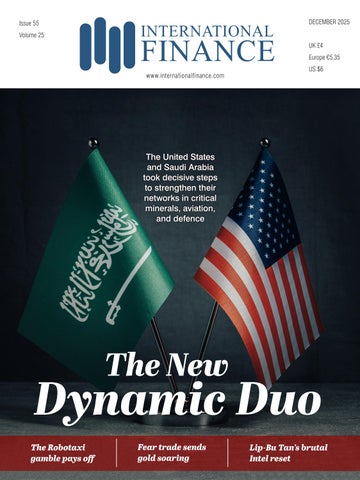
International Finance - December 2025

Page 1


EDITOR’S NOTE

DECEMBER 2025

VOLUME 25

ISSUE 55

Saudi-US ties reach new dimension

Intel, long regarded as a cornerstone of Silicon Valley, has faced mounting financial and competitive pressures under former CEO Pat Gelsinger. During his tenure, the company ceded technological leadership to rivals such as AMD and NVIDIA, particularly in advanced chips and AI. In response, Intel reinstated former board member Lip-Bu Tan as CEO in March 2025. A venture capitalist celebrated for steering Cadence Design Systems to a 3,200% surge in stock value, Tan is known for his bold, risk-tolerant leadership style. He now leads an aggressive turnaround strategy aimed at restoring innovation, rebuilding market share, and regaining investor confidence.

The year 2025 saw a significant surge in gold prices, marking a historic change in the market. Gold climbed 54.66% compared to 2024, reflecting persistent geopolitical tensions, inflation concerns, and strong central bank demand across both advanced and emerging economies. The rally culminated in October, when prices peaked at $4,381.58 per ounce, highlighting the metal’s renewed appeal as a safe-haven asset amid heightened global market volatility.

Looking at the Southern Hemisphere, Australia’s postpandemic recovery has begun to lose steam as the effects of sustained monetary tightening take hold across households and businesses. The recently released labour force data showed unemployment rising 4.5% since September, signalling a cooling jobs market, softer hiring intentions, and marking a clear departure from the era of ultra-low unemployment.

In the final edition of 2025, International Finance will examine the changing relationship between Saudi Arabia and the United States due to shifting geopolitical and economic priorities. Crown Prince Mohammed Bin Salman and Donald Trump have exchanged visits, overseeing agreements in energy, AI, and aviation—moves expected to advance the Kingdom’s Vision 2030 ambitions and deepen long-term strategic and investment cooperation.

editor@ifinancemag.com www.internationalfinance.com

INSIDE

SAUDI AND US: THE NEW DYNAMIC DUO

The US and Saudi Arabia took decisive steps to strengthen their networks in critical minerals, aviation, and defence

ECONOMY

AUSTRALIA’S 'SOFT LANDING' AT RISK

A stronger Australian dollar makes imports cheaper, which provides a disinflationary impulse for tradable goods

UAE’S GREAT FISCAL TRANSFORMATION

Throughout 2025, the UAE maintained top-tier sovereign credit ratings, with Moody's rating it at Aa2, S&P at AA, and Fitch at AA-

CREATOR ECONOMY MONETISES ISOLATION

The creator economy is not a trend to be dabbled in but a condition to be mastered

FEAR TRADE SENDS GOLD SOARING

FEATURES

48 The making of a crypto dynasty 82 Demis Hassabis expands tech throne

When the board appointed Lip-Bu Tan as Intel CEO in March 2025, they handed the keys to a demolition expert 30 42 82 16

The World Gold Council notes that the metal has impressively set over 50 all-time highs in 2025 alone

GREEN CAPITALISM: A DEAD END

Eco-commerce delays action as capitalism’s growth imperative collides with ecological limits, producing greenwashing and injustice

LIP-BU TAN’S BRUTAL INTEL RESET

Director & Publisher Sunil Bhat

Editorial

Prajwal Wele, Agnivesh Harshan, CL Ramakrishnan, Prabuddha Ghosh

Production Merlin Cruz

Design & Layout Vikas Kapoor

Technical Team

Prashanth V Acharya, Bharath Kumar

Business Analysts

Alice Parker, Indra Kala, Stallone Edward, Jessica Smith, Harry Wilson, Susan Lee, Mark Pinto, Richard Samuel, Merl John

Business Development Managers Christy John, Alex Carter, Gwen Morgan, Janet George

Business Development Directors Sid Jain, Sarah Jones, Sid Nathan

Head of Operations Ryan Cooper

Accounts Angela Mathews

Registered Office INTERNATIONAL FINANCE is the trading name of INTERNATIONAL FINANCE Publications Ltd 843 Finchley Road, London, NW11 8NA

Phone

+44 (0) 208 123 9436

Fax

+44 (0) 208 181 6550

Email info@ifinancemag.com

Press Contact editor@ifinancemag.com

Associate Office

Zredhi Solutions Pvt. Ltd. 5th Floor, Sai Complex, #114/1, M G Road, Bengaluru 560001 Ph: +91-80-409901144

# TRENDING

Oman launches Maal card, fees set

17: the OnePlus 15R, the OnePlus Pad Go 2, and the OnePlus Watch Lite. The company has revealed more details about the trio. Let's start with the OnePlus 15R smartphone. This is now confirmed to come with an AMOLED screen boasting "1.5K" resolution and a 165Hz refresh rate. The panel can go down to 2 nits at night, or even 1 nit when you activate Reduce White Point.

The Central Bank of Oman (CBO) has approved the fee structure for the national payment card "Maal," to be used for consumer debit and prepaid purposes, which was announced alongside the pilot launch of the product on November 20. While banks will issue the card to their customers, wider issuance and acceptance will come in the period thereafter. The initiative seeks to enhance the national payments framework by reducing costs for banks, merchants, and PSPs, and by expanding the use of digital payment methods across sectors. The approved framework includes the following: full exemption from card issuance fees and waiving annual fees for cardholders.

Swiss, German shut cryptomixer.io

Germany's federal investigation agency, BKA, said that, in collaboration with Swiss and German law enforcement agencies, it had taken down cryptomixer.io, one of the biggest platforms used to obscure the trail of illicit bitcoin transactions. BKA worked with the regional prosecutor in Frankfurt and Zurich to shut down the site, which had been in operation since 2016 and was one of the largest bitcoin mixers. Three servers were seized in Switzerland alone. The entity made billions of euros in revenue, primarily derived from criminal activities.

NVIDIA unveils open-source AI car

NVIDIA released a new open-source software program designed to accelerate the development of self-driving cars using some of the latest "reasoning" techniques in AI. The world's most valuable tech giant has a large software research arm that releases open-source AI code for others, such as Palantir Technologies. The software, called Alpamayo-R1, is a vision-language-action AI model, meaning the self-driving car interprets what its sensor banks pick up on the road into a description using natural language.

Source:

ECONOMY

South Africa growth slows in Q3

South Africa reported that the economy grew 0.5% in the third quarter of 2025, slower than the 0.9% recorded in the second quarter, according to data from the country’s statistics agency. The third-quarter growth rate, in seasonally adjusted quarter-on-quarter terms, was in line with the median forecast of analysts polled by Reuters. Nine of the 10 sectors monitored by Statistics South Africa registered an increase in

output, with mining and agriculture performing well, although electricity, gas, and water contracted. Africa’s largest economy has struggled to gain traction over the past 10 years, with annual GDP growth averaging below 1%, according to the National Treasury, which expects growth to pick up slightly to 1.2% in 2025 and 1.5% in 2026. Third-quarter GDP increased 2.1%, beating economists’ expectations of 1.8% growth.

Ones to Watch

PATRICE MOTSEPE

FOUNDER OF AFRICAN RAINBOW MINERALS

Patrice Motsepe has proposed a major copper venture in Papua New Guinea with US firm Newmont Corporation, signalling significant cross-continental investments in the decarbonisation era of mining

BADR JAFAR

FCEO OF CRESCENT ENTERPRISES

Badr Jafar got recognised for his philanthropic and climate-change-related efforts, as he was appointed as Special Envoy for Business & Philanthropy for the UAE, apart from getting honours

KHALIFA JUMA AL QAMA

FOUNDER OF OPSYS

Khalifa Juma Al Qama’s push for updated fire safety norms across the globe, along with the leadership in the critical tech sector, has made him among the entrepreneurs to watch in 2025

IN THE NEWS

Kuwait Petroleum Corporation recently opened several job vacancies, which generated high interest from young Kuwaiti applicants

Exports, which too faced similar protectionist measures, saw its shares of slump, with the total trade affected was worth about $2,966 billion

Kuwait strikes three offshore wells

Kuwait Petroleum Corporation (KPC) CEO Sheikh Nawaf Al-Saud recently announced that the discovery of three offshore wells was an "unprecedented global achievement," adding that all operational work on the wells has been completed, with three more discoveries to be announced once their technical assessments are completed.

Speaking to reporters after the corporation's "Excellence Award" ceremony, Al-Saud said that the three newly discovered offshore wells, Al-Nukhatha, Al-Jali'a, and Jaza, have formed a system of promising hydrocarbon reservoirs. Although it is premature to provide specific numbers on production capacity or reserve volumes, preliminary results indicate a very positive outlook for Kuwait's offshore exploration programme.

Al-Saud also pointed out that the Kuwaiti oil sector was at the beginning of a new era that would include discoveries, organisational development, and strengthening of national talent, adding that KPC was moving on a clear strategic path to secure significant economic and strategic gains for the country in the years ahead.

He emphasised that the corporation has only one priority, maximising revenues from natural resources in Kuwait, but he insisted that “human capital is more important than oil itself.” He also expressed appreciation for the hard work of the KPC workforce, calling them the “driving force behind the sustainable success of KPC and its subsidiaries.”

KPC recently opened several job vacancies, which generated high interest from young Kuwaiti applicants. Vacancies are announced periodically as needed, AlSaud said, reiterating that youth should concentrate on academic excellence and professional development to compete effectively for positions in what he described as a rapidly expanding and increasingly diverse oil sector.

Regarding the status of ongoing merger plans within the oil sector, Al-Saud stated that integration efforts are proceeding in accordance with a comprehensive, phased strategy, unaffected by administrative or structural changes. He stated that the consolidation process will significantly accelerate in 2026.

Also, the transfer of the gas plant from the 'Kuwait Oil Tanker Company' to the 'Kuwait National Petroleum Company' has already been completed.

WTO flags surge in tariff barriers

According to the World Trade Organisation (WTO) report, imports worldwide worth $2,640 billion were affected primarily by tariffs and other trade measures introduced between mid-October 2024 and mid-October 2025, more than four times the $611 billion coverage recorded in the preceding period.

Exports, which too faced similar protectionist measures, saw their share slump, with the total trade affected worth about $2,966 billion, more than three times the $888 billion recorded in the global body's previous report.

Over the same period, WTO members and observers also introduced a large number of new trade-facilitating measures on goods, 331 in total, covering trade estimated at $2,090 billion, approximately 1.5 times higher than the $1,441 billion recorded in the last report.

WTO Director-General Ngozi Okonjo-Iweala said, "The sharp jump in the trade coverage of tariffs reflects the increased protectionism we have seen since the start of the year. Nearly a fifth, 19.7%, of world imports are now affected by tariffs and other such measures introduced since 2009, compared to

12.6% only a year ago."

"At the same time, we see members acting to facilitate trade and engaging in dialogue rather than retaliation. This speaks to the value they continue to see in maintaining smooth cross-border trade flows. WTO members should use the current trade disruptions to advance long-overdue reforms of the WTO. Members have an opportunity to tackle some of the underlying concerns linked to recent unilateral measures, while repositioning the WTO to better help them seize exciting new trade opportunities," the official added.

WTO economists estimate world merchandise trade growth at 2.4% in 2025 and at 0.5% in 2026, with stronger-than-expected trade growth in the first half of 2025 driven by import frontloading, strong demand for AI-related products, and continuing trade growth among most WTO members, particularly developing economies.

During the review period, WTO members initiated 32.3 trade remedy investigations per month, just below the 2024 peak of 37.3 per month. While trade remedy investigations do not necessarily lead to the imposition of measures, a higher number of probe initiations often signals a potential increase in measures imposed.

The deployment of the quantum computer marks a massive step in accelerating the development of quantum applications in Gulf region

The new warehouse is also part of the €500 million investment DHL Group has planned for the Middle East through 2030

Saudi Arabia enters quantum race

World's leading integrated energy and chemical giant Saudi Aramco, in partnership with Pasqal, a global leader in neutral-atom quantum computing, has achieved a breakthrough for the Middle East’s tech landscape by successfully deploying Saudi Arabia’s first quantum computer, which also became the region's first dedicated to industrial applications. The deployment of the quantum computer, powered by Pasqal's neutral-atom technology at Aramco’s Dhahran data centre, marks a massive step in building regional expertise and accelerating the development of quantum applications in the broader Gulf region. Aramco is currently looking to leverage tech route to enhance its operational efficiency. This milestone is expected to spur further innovation partnerships across the Kingdom and beyond.

BOS to invest in hiring, tech

Bank of Singapore (BOS) plans more investment in hiring and technology as it seeks to break into Asia's top five private banks by 2030 after assets under management (AuM) rose nearly 20% to exceed $145 billion in the third quarter. According to the company's CEO, Jason Moo, Asia's wealth surge is now anchoring BOS' latest expansion push. While global high-net-worth individual (HNWI) wealth rose 4.2% in 2024, Asia-Pacific's climbed 4.8%, second only to North America. Asia-Pacific's HNWI population also grew by 2.7%, expanding the banks' client base. BOS' AuM, which stood at about $120 billion when Moo took over in 2023, has climbed significantly in the third quarter despite the bank raising its minimum account size to $5 million from $3 million in 2024.

DHL to build logistics hub in Riyadh

DHL Supply Chain will invest €130 million (SAR 561.50 million) to establish a new regional logistics and distribution hub at Riyadh's Special Integrated Logistics Zone (SILZ). The world’s leading contract logistics provider signed a land lease agreement with SILZ for the project, driving the Kingdom's ambition to become a global logistics hub. The new facility will occupy a 78,000 square metre land plot, featuring 53,000 square metres of advanced multi-user warehouse space, with leasehold commitments for a 26-year term. The construction phase is scheduled to begin in the first quarter (Q1) of 2026, with completion expected by Q2 2027. The new warehouse is also part of the €500 million investment DHL Group has planned for the Middle East through 2030.

UK banks pass BoE stress test

As the latest stress tests concluded, the Bank of England (BoE) said that the seven biggest British lenders have sufficient capital to withstand a deep global recession, large falls in financial markets, and a jump in interest rates. The tests covered Barclays, HSBC, Lloyds Banking Group, NatWest Group, Santander UK, Standard Chartered, and building society Nationwide, which together account for 75% of lending to the UK real economy. As all participating banks remained above their minimum regulatory requirements, no lender was required to strengthen its capital position. While Standard Chartered and Barclays had the lowest capital positions after the stress test, Nationwide showed the strongest performance, reflecting its relatively resilient balance sheet.

Worldwide demand for magnesium from 2015 to 2024

The average annual cost of the 2025 tariffs for a household in the bottom income decile is approximately $900

Rigged economy leaves millions behind

IF CORRESPONDENT

The economic narrative of late 2025 is defined by a distinct bifurcation that was first identified in the depths of the pandemic years. It was an anonymous Twitter personality known as “Ivan the K” who first articulated the theory that would come to define the post-pandemic era.

When the top 10% continue to spend lavishly on luxury goods, travel, and services, it masks the severe contraction occurring in the bottom 90%

In 2020, he posed a question regarding why the economic recovery was being framed as a V or a U when the reality was far more disjointed. Ivan wrote that some would bounce back while others would not recover.

This dynamic is formally known in sociology and economics as the “Matthew Effect.” The term was coined by sociologist Robert Merton in 1968 and describes a process of cumulative advantage. It traces its sentiment back to the biblical Book of Matthew 25:29, which states that everyone who has will be given more and will have an abundance, but from the one who does not have, even what he has will be taken away. In the economic landscape of late 2025, this ancient text reads less like a parable and more like a precise description of the divergence between capital owners and wage earners.

Mark Zandi, the chief economist for Moody’s Analytics, suggests that this structural divergence began in the 1980s during the Reagan era, when productivity growth began to outpace median wage growth. However, the data from 2025 suggests that this long-standing trend has accelerated into a profound fracture.

The upper arm of this K-shaped economy is being driven by an unprecedented concentration of consumption among the wealthy. Research conducted by Mark Zandi at Moody’s Analytics revealed that in the second quarter of 2025, the top 10% of wealthiest Americans were responsible for 49.2% of all consumer spending. This figure represents the highest level of spending concentration since record-keeping began in 1989.

The economy has become so lopsided that the richest Americans essentially account for half of all economic activity. This concentration distorts aggregate economic data. When the top 10% continue to spend lavishly on luxury goods, travel, and services, it masks the severe contraction occurring in the bottom 90%. High-income households have benefited from a wealth effect driven by soaring asset prices, including record highs in the stock market and continued appreciation in home values.

Lisa Shalett, the chief investment officer at Morgan Stanley Wealth Management, has raised alarms about this disparity. In a research note from November 3, 2025, she described the income

inequality data as completely wackadoo and noted that the widening chasm between the haves and have-nots is critical to understanding the current economic cycle.

While the wealthy propel the markets to new heights, the lower arm of the K is extending downward with increasing velocity. This is visibly manifested in the earnings reports of major fast-food and fast-casual restaurant chains, which have historically served as reliable indicators of lower-income spending power.

Chains like McDonald’s and Chipotle have reported softening traffic as their core customers pull back on spending. Since 2019, the price of a chicken burrito at Chipotle has risen from $7.45 to $10.80 in 2025, while a McDonald’s Big Mac combo has jumped from $8.19 to $11.29. These price increases have forced a trade-down behaviour where consumers abandon fast-casual dining for home cooking or discount grocery options.

Dollar General reported a 4.6% increase in net

sales in the third quarter of 2025, which executives attributed to share gains in consumables as financially pressured shoppers hunted for value. This shift indicates that the lower-income consumer is not merely cutting back on luxuries but is struggling to afford basic conveniences.

This performative wealth signals a desire to participate in the upper arm of the K even as financial reality confines consumers to the lower arm. Charitable organisations are working overtime, with the Portland Press Herald Toy Fund reporting a notable influx of struggling families trying to keep the Christmas spirit alive despite cutting back on their expenses.

The labour market mirrors this bifurcation. While the headline unemployment rate remained relatively low at 4.4% in November 2025, beneath the surface lies a story of two distinct job markets. Companies are retaining talent but aren't hiring anymore, because of which the youth unemployment rate for those aged 16 to 24 reached 10.4% in September 2025.

Gen Z is struggling to find work as entry-level job

openings declined 29% since 2024. A part of the reason is that AI is wiping out low-skilled jobs. Now, the American youth from poor and lower-middle-class families can’t even get their foot on the rung of the career ladder. This is an important development, as resentful young people can create significant unrest in a nation.

There is also a white-collar recession. American employers announced 71,321 job cuts in November 2025, a 24% increase from the same month in 2024. Over 153,000 job cuts were announced year-to-date in 2025 in the IT sector as firms pivot toward AI and efficiency.

The disconnect is further highlighted by the fact that despite these layoffs, the broader layoff rate remains historically low because companies are reluctant to let go of workers in a labour-constrained environment.

Arrives the 'Big Beautiful Bill'

The policy landscape of 2025 has played a significant role in calcifying this economic divide. The “Big Beautiful Bill” became law on Jul 4, 2025. The bill cuts taxes on overtime pay and tips, provides additional tax deductions for seniors, and introduces a new deduction for auto loan interest. However, it also makes a $3.4 trillion cut to social security for the next ten years, to make up for the lower tax revenue. Medicaid and the Supplemental Nutrition Assistance Programme (SNAP) will take a huge hit with $1.4 trillion in slashed government funding. The government is cutting social security and lowering taxes for the rich, which is a wealth

Global wealth distribution in 2023, by net worth of individuals (In Millions)

Over 1

Million

58 100,000 To 1 Million 613 10,000 To 100,000 1608

Less Than 10,000 1488

Source: Statista

transfer mechanism from the poorest households to the richest in the country.

Trade policy has further exacerbated the strain on the lower arm of the K. The administration implemented widespread tariffs in 2025 with the stated goal of protecting American industry. However, the Yale Budget Lab estimates that these tariffs function as a regressive tax. The average annual cost of the 2025 tariffs for a household in the bottom income decile is approximately $900. While this is lower in absolute terms than the $3,900 cost for the top decile, it represents a much larger share of income. The burden on the bottom decile is 2.4% of their post-tax income compared to just 0.8% for the top decile. This policy directly erodes the purchasing power of those least able to afford it.

The administration had promised a tariff dividend check of $2,000 to offset these costs for working families. Trump fought his tariff war on the promise that

he would give the American people a piece of the tariff dividend and bring jobs back to America. No such dividend arrived in 2025, and Treasury Secretary Scott Bessent clarified that it is unlikely till mid-2026 and that there is also the question of whether the Supreme Court would uphold the legality of the tariffs.

And the math doesn’t add up either. The tariffs generated approximately $120 billion so far, which is not enough to send $2,000 checks to 150 million Americans. It would cost nearly $300 billion to do so. This leaves low-income households paying the higher prices associated with tariffs without receiving the promised financial relief.

The lock-in effect

The housing market stands as perhaps the most formidable barrier between the two arms of the K-shaped economy. A phenomenon known as the lock-in effect has paralysed the market and created a distinct advantage for existing

homeowners. As of late 2025, approximately 80% of mortgage holders have interest rates below 6%

These homeowners are effectively shielded from the current market reality, where the average 30-year fixed mortgage rate hovered around 6.34% in December 2025. This disparity has created a two-tiered housing society. Existing owners are building equity and enjoying low monthly payments that were secured during the pandemic era of cheap money. Aspiring buyers, particularly Millennials and Gen Z, face a market where the income needed to afford a median-priced home has nearly doubled since 2020.

High interest rates have not only made mortgages more expensive but have also suppressed inventory. Homeowners are unwilling to sell and trade a 3% mortgage for a 6% one, which keeps the supply of homes for sale near 30-year lows. This lack of supply keeps prices historically high despite the elevated rates. Consequently, renters find

themselves trapped. The housing ladder, once the primary vehicle for middle-class wealth creation in America, has been pulled up out of reach for those not already on it.

A fracture that deepens

As 2025 draws to a close, the mechanisms driving the K-shaped economy appear to be entrenching themselves further. The Federal Reserve’s restrictive monetary policy, while necessary to fight inflation, disproportionately hurts those who rely on borrowing. The fiscal policies of the One Big Beautiful Bill Act reinforce the advantages of capital owners while fraying the safety net for the vulnerable.

The rich will continue to accumulate wealth through assets and favourable tax treatment, while the poor and the middle class will continue to navigate a landscape of high costs and limited mobility. The question remains regarding how long this divergence can sustain itself before the tension snaps the economy entirely.

With consumer spending so heavily reliant on the top 10%, any shock to asset prices could cause the upper arm of the K to falter. If the wealthy pull back, the illusion of resilience provided by the aggregate data will vanish, revealing the fragile state of the broader economy beneath. Until then, the United States remains a nation of two distinct economies operating in parallel but moving in opposite directions.

The K-shaped economy in 2025 is not a theory or a chart, but a lived reality that shapes everyday life, determining who can buy a home and who must rent, who can retire and who must keep working, and who can afford abundance while others cut back. Wealth, opportunity, and security continue to move upward, while costs, risk, and uncertainty are pushed downward, reinforced by policy choices and a stagnant housing market.

The economy seems strong mainly due to the spending of the wealthiest households. However, this strength is limited and fragile. Without better wages, improved housing access, and a more robust safety net, the divide will deepen, leading to enduring social and political tensions.

editor@ifinancemag.com

Australia’s 'soft landing' at risk

IF CORRESPONDENT

A stronger Australian dollar makes imports cheaper, which provides a disinflationary impulse for tradable goods

The Australian economy has arrived at a precarious intersection where the momentum of post-pandemic recovery is colliding with the restrictive realities of monetary tightening. Central to this unfolding economic narrative is the labour market, which has exhibited behaviour that defies simplistic categorisation. The release of labour force data in late 2025 provided a shock to the system that forced a re-evaluation of the Reserve Bank of Australia’s policy trajectory.

The rise in unemployment starting in September showed deeper changes happening in Australia’s workforce. It hit 4.5%, the highest since November 2021. Things got psychologically and economically worse as the unemployment rate crossed the 4% mark, signalling the conclusion of the era of ultra-low unemployment.

Jeff Borland, Professor of Economics at The University of Melbourne, recently prepared an analysis that highlighted a critical divergence where the economy was creating jobs at a slower pace than the population was expanding.

In 2025, the Australian economy added an average of approximately 12,900 new employed persons each month. While this indicates positive growth, it fell woefully short of the labour supply expansion. The number of people looking for work grew by an average of 22,100 per month during the same period.

This phenomenon is deeply rooted in Australia’s demographic trends, particularly the high rate of net overseas migration, which has sustained population growth at approximately 2.0% per annum. In contrast, total employment growth over the year to November was only 1.3%

This gap of 0.7 percentage points represents a structural widening of labour market slack that monetary policy is specifically designed to induce. The Reserve Bank of Australia has maintained a restrictive cash rate setting precisely to cool the demand for labour and align it more closely with supply capacity. The September 2025 data suggested that this transmission mechanism was working, perhaps faster than anticipated.

However, the narrative became more complex with the release of data for October and November 2025, which showed a reversion of the unemployment rate to 4.3%. This volatility raises questions

about the reliability of monthly seasonally adjusted figures and suggests that the September spike may have been amplified by statistical noise or temporary sampling variations.

Nevertheless, the broader trend lines confirm a softening market. By November, the stability of the 4.3% rate masked a deterioration in the quality and composition of employment. The Australian Bureau of Statistics reported that the total number of employed people actually fell by roughly 21,000 in November. The only reason the unemployment rate did not rise in response to this job shedding was a simultaneous decline in the participation rate, which fell from 66.8% to 66.7%.

The decline in participation is a critical indicator of discouraged workers exiting the labour force. When job seekers stop actively looking for work, they are no longer counted as unemployed, which artificially depresses the headline rate. This “hidden unemployment” suggests that the labour market is weaker than the 4.3% figure implies.

Full-time employment, which provides the income stability necessary for household consumption and debt servicing, plummeted by 56,500 positions in November. This loss was only partially offset by an increase of 35,200 part-time positions. This substitution of full-time roles for part-time roles is a classic defensive strategy by employers who are uncertain about the future economic outlook and unwilling to commit to permanent salary obligations.

The rise in the underemployment rate further corroborates the thesis of increasing slack. The underemployment rate, which measures employed persons who want and are available for more hours, rose to 6.2% in November. This metric is particularly sensitive to the cost-of-living crisis, as workers seek ad-

ditional hours to cope with high inflation and interest rates.

A rising underemployment rate in an environment of falling real wages represents a significant squeeze on household welfare. When combined with the unemployment rate, the total labour force underutilisation rate pushed above 10.5% in late 2025, signalling that despite the “tight” rhetoric, there is a substantial reserve of unutilised labour capacity building up in the economy.

It is also important to consider the independent estimates provided by Roy Morgan (Australia’s oldest and most well-known independent market research company), which utilise a different methodology to the Australian Bureau of Statistics.

In September 2025, Roy Morgan estimated the “real” unemployment rate at 10.8%, with a combined unemployment and underemployment count involving

3.2 million Australians.

While the Australian Bureau of Statistics definition is the global standard for monetary policy formulation, the Roy Morgan figures highlight the lived experience of millions of Australians who feel the bite of a slowing economy more acutely than the official statistics suggest.

The discrepancy between these measures often widens during economic downturns, as the strict criteria for being “unemployed” (active search within the last four weeks and availability to start immediately) exclude those on the margins of the workforce.

Why prices refuse to budge

While the labour market is showing clear signs of cooling, the inflation landscape in Australia has remained stubbornly resistant to the dampening effects of monetary policy. Wages, prices, and productivity are feeding into each other,

creating a cycle that keeps inflation higher than the Reserve Bank of Australia’s 2% to 3% goal. New data from late 2025 showed that inflation is still a serious problem and will need strict policies for a longer time.

In October 2025, inflation rose to 3.8%, up from 3.6% in September, with increases seen across many basic goods. The trimmed mean inflation, which is the Reserve Bank’s preferred measure of underlying price pressures, also moved higher to 3.3%. These figures confirmed that the disinflationary process had stalled and, in some areas, reversed.

Housing costs have emerged as the single largest contributor to this inflationary persistence. In October, housing inflation ran at 5.9%. This category is driven by two powerful forces that are largely immune to interest rate hikes in the short term. The first is the rental market, which is experiencing a severe crisis

of supply. With vacancy rates at record lows and population growth continuing at a rapid pace, landlords have significant pricing power.

Rents have surged across all major capital cities, adding a heavy weight to the inflation basket. The second factor is the cost of new dwelling purchases, which remains elevated due to high construction costs. Labour shortages in the trades, combined with the high cost of materials, have kept the price of building new homes high even as demand for new approvals has softened.

The Wage Price Index for the September quarter rose by 0.8%, taking the annual growth rate to 3.4%. While this figure is below the peak seen in previous years, it remains high relative to the abysmal productivity performance of the Australian economy.

Productivity growth, which measures the output produced per hour worked, has been flat or negative for several quarters. When wages rise without a corresponding increase in productivity, the unit labour cost for businesses increases.

To maintain profit margins, businesses must pass these higher costs on to consumers in the form of higher prices. This wage-price dynamic is particularly evident in the service sector, where productivity gains are harder to achieve than in manufacturing or agriculture.

The divergence between public and private sector wage growth adds another layer of complexity. The 3.8% annual growth in public sector wages acts as a floor for wage expectations across the economy. State government enterprise agreements, particularly in the healthcare sector, have locked in wage increases that will sustain income growth for a large portion of the workforce.

While these increases are necessary to attract and retain essential workers,

they also support aggregate household income and spending power. This fiscal impulse counteracts the monetary contraction sought by the Reserve Bank. Private sector wages, which grew at a more modest 3.2%, are showing signs of responding to the slowing economy, but the aggregate effect is diluted by the strength of the public sector.

The persistence of inflation has forced a recalibration of the “soft landing” narrative. The hope that inflation would glide effortlessly back to target while unemployment remained low has been replaced by the realisation that a more prolonged period of sub-trend growth and higher unemployment may be required to break the back of domestic price pressures.

The Reserve Bank’s revised forecasts in the November Statement on Monetary Policy projected that inflation would remain above the target band for “a while” and would not return to the midpoint until late 2027. This extension of the timeline reflects an admission that the embedded inflation expectations in the economy are harder to dislodge than previously thought.

While the Consumer Price Index measures the rate of change in prices, the accumulated level of prices remains permanently higher. The price of essential goods and services such as food, health, and housing has absorbed a significant portion of household budgets, leaving less room for discretionary spending.

This is evident in the GDP data, which showed a 0.2% decline in discretionary consumption in the September quarter. Households are prioritising survival spending over lifestyle spending, a shift that has ripple effects through the retail and hospitality sectors.

The island’s policy of isolation

The Reserve Bank of Australia has en-

tered a phase of policy paralysis characterised by a high-wire act between a softening economy and sticky inflation. The decision by the board to leave the cash rate unchanged at 3.60% at its final meeting of 2025 was widely expected, yet it highlighted the unique and difficult position in which Australia finds itself relative to the rest of the developed world.

While other major central banks have commenced easing cycles to support growth, the Reserve Bank of Australia remains locked in a restrictive stance, with the threat of further hikes still lingering in its forward guidance.

The December decision was unanimous, but the accompanying statement revealed a hawkish tilt that surprised some market participants. Governor Michele Bullock made it unequivocally clear that “cuts were firmly off the table.”

The contrast with the United States Federal Reserve is particularly stark.

In December 2025, the Federal Reserve cut its benchmark interest rate by 25 basis points to a target range of 3.50%%to 3.75%. This marked the third consecutive rate cut by the US central bank, driven by a cooling labour market where unemployment had risen to 4.4% and a greater confidence that inflation was on a sustainable path to target. The European Central Bank (ECB) and the Bank of England (BoE) have also moved to lower rates, responding to weaker growth profiles in their respective economies.

This divergence in monetary policy trajectories has significant implications for the Australian economy, particularly through the exchange rate channel. Typically, when the Reserve Bank of Australia holds rates steady while the US Federal Reserve cuts the interest rate, the differential shifts in favour of the Australian dollar.

1381.11

1386.28

1362.61

1742.46 2024 1796.81

(In Billion US Dollars) Source: Statista

A stronger Australian dollar makes imports cheaper, which provides a disinflationary impulse for tradable goods such as electronics, fuel, and vehicles. However, the Reserve Bank cannot rely on this mechanism to solve its inflation problem because the current inflation basket is dominated by non-tradable items like housing and services, which are largely insensitive to exchange rate movements.

The banking sector has responded to this new reality by revising its interest rate forecasts for 2026. The consensus among the “Big Four” banks has fractured. Commonwealth Bank, National Australia Bank, and ANZ have all shifted their views to predict an extended pause throughout 2026. These institutions now believe that the cash rate will remain at 3.60% for the foreseeable future, acting

as a constant drag on the economy until inflation is decisively defeated.

In contrast, Westpac remains an outlier, forecasting two rate cuts in 2026, tentatively scheduled for May and August. Westpac’s economists argue that the current spike in inflation is driven by temporary anomalies that will wash out of the data, allowing the Reserve Bank to pivot mid-year to support growth.

Financial markets have taken an even more aggressive view, with interest rate swaps pricing in a significant probability of a rate hike by June 2026. This reflects the anxiety that inflation may have become structurally embedded at a level above 3%, which would require a second round of tightening to dislodge.

A return to rate hikes would be politically explosive and economically damaging given the fragility of the household

sector, but the Reserve Bank has consistently stated that it will do “whatever is necessary” to return inflation to target.

The impact of this “higher for longer” regime is evident in the flow of credit and investment. While business investment has remained surprisingly resilient, rising 3.4% in the September 2025 quarter due to spending on data centres and digital infrastructure, household credit growth has slowed.

The “mortgage cliff,” which referred to the transition of borrowers from low fixed rates to high variable rates, has now evolved into a “mortgage plateau.” Borrowers have absorbed the shock of higher payments, but they have done so by slashing discretionary spending and drawing down on savings buffers. The prospect of no rate relief in 2026 means that this financial stress will be pro-

longed, increasing the risk of mortgage arrears and defaults as savings pools are eventually exhausted.

The Reserve Bank’s strategy relies on the assumption that the labour market will remain “healthy” enough to absorb this prolonged period of restriction. The forecast that the unemployment rate will stabilise around 4.5% allows the bank to prioritise inflation fighting. However, as the September spike demonstrated, labour market dynamics can shift rapidly.

If the unemployment rate were to accelerate toward 5.0%, the Reserve Bank would face a much sharper dilemma involving a choice between abandoning its inflation target or accepting a recession. For now, the board judges that the risks to inflation are greater than the employment risks, but this calculus will be tested in the coming months as the full lag effects of monetary policy continue to work their way through the economy.

Should the unemployment rate be held below 4.7% while inflation slowly moderates, the economy may achieve the elusive “soft landing.” This would involve a period of below-trend growth but no catastrophic collapse. However, the risks are tilted to the downside.

If the September unemployment spike was not an anomaly but a leading indicator of a sharper deterioration, the Reserve Bank may be forced to pivot rapidly. A sudden jump in unemployment would likely shatter consumer confidence and trigger a rapid deleveraging cycle in the housing market.

editor@ifinancemag.com

ECONOMY

The United States and Saudi Arabia took decisive steps to strengthen their networks in critical minerals, aviation, and defence

IF CORRESPONDENT

Saudi

The new

November 2025 marked a significant chapter in the bilateral relations between Saudi Arabia and the United States, as President Donald Trump welcomed the Kingdom’s Crown Prince Mohammed

and US

dynamic duo

Bin Salman to his Oval Office. This was not the usual diplomatic call. This was his first visit to Washington since 2018, and this meeting marked the beginning of something important: a new chapter in the economic and security architecture between the two nations.

COVER STORY SAUDI ARABIA

Since Saudi Arabia became a kingdom in 1931, Washington has provided diplomatic support. In the 1940s, President Franklin D. Roosevelt and King Abdulaziz formalised the oil-for-security deal aboard the USS Quincy, with the US promising military protection in exchange for a steady oil supply, an arrangement that continues to this day.

But the world of oil is slowly fading and making way for renewable energy. Crown Prince Mohammed Bin Salman, a visionary young leader, sees this truth. His oil-rich country has an advantage that won't last forever, so he's working hard to modernise and industrialise the Kingdom’s economy.

The headlines are staggering: Crown Prince Mohammed Bin Salman pledged to increase Saudi Arabia’s planned investments in the United States from $600 billion to $1 trillion.

During the meeting, both sides acknowledged shifting global realities. America wants fresh capital and supply chain security in a world that is quickly turning multipolar. The Saudis, on the other hand, have a deadline to meet. The Kingdom’s “Vision 2030” is as ambitious as they come.

They plan to be leaders in AI and aviation, produce nuclear energy, and build breathtaking cities in the desert. But it requires advanced technology and industrial partnerships that only American firms can provide for now. This partnership is a win-win for these G20 economies.

The Saudi-US partnership is not an alliance of convenience built on oil and security. They are now strategic partners with aligned goals of economic and technological supremacy. As they posed for pictures in front of the White House, it was clear to the whole world that the Saudis and Americans had tightened their alliance.

Data blooms in the Arabian deserts

Technology was at the heart of the conversation between the two world leaders. The Saudis expressed their desire to be the global hub of AI and data. It seems this visit to America has brought that vision closer to reality, with pacts that would place the Kingdom as a central node in the global AI infrastructure.

At the heart of this transformation is authorisation by the US Commerce Department for the export of advanced AI chips to Saudi Arabia. This decision effectively clears the way for the shipment of up to 35,000

By pairing American innovation with Saudi infrastructure and capital, the xAI-HUMAIN alliance seeks to lower the barrier to entry for advanced AI development

Nvidia Blackwell chips to HUMAIN, a Saudi-backed national AI champion. This authorisation is more than just a trade deal.

It represents a stamp of approval from Washington that brings Saudi Arabia into the trusted circle of American technological partners. It addresses the long-standing bottleneck of access to high-performance compute power, which is the lifeblood of the modern AI economy.

HUMAIN was the undeniable star of the investment conference that ran parallel to the political meetings. The company, backed by the immense resources of the Public Investment Fund (PIF), announced a flurry of partnerships that read like a who’s who of the American tech sector.

The most headline-grabbing of these was the partnership with Elon Musk’s xAI. The two companies signed a framework agreement to build a massive network of low-cost GPU data centres within the Kingdom.

This project, which includes a flagship 500-megawatt facility, aims to leverage Saudi Arabia's abundant and low-cost energy resources to power the energy-hungry training and inference workloads of the next generation of AI models.

The logic behind this partnership is compelling. As AI models grow exponentially in size, the cost of electricity becomes a primary constraint. Saudi Arabia offers some of the lowest energy costs in the world, making it an ideal location for what industry insiders are calling computer factories. By pairing American innovation with Saudi infrastructure and capital, the xAI-HUMAIN alliance seeks to lower the barrier to entry for advanced AI development.

HUMAIN also signed a separate agreement with Groq, a company famous for its ultra-fast AI inference chips. This deal will see HUMAIN triple the Kingdom’s Groq-powered inference capacity. This is a crucial distinction.

Nvidia makes the best chips in the world. There is no doubt about it. Groq has technology optimised for running models in real-time applications. The Saudis have made deals with both the hardware and software developers. They are going to alchemise the union between xAI and Nvidia in their energy-rich and spacious deserts.

This isn’t a one-way street. HUMAIN and Global AI also plan to build high-density AI data centres in the US, using top-of-the-line Nvidia

technology. The Saudis are reciprocating capital flow and will soon lay the foundations of the great American digital economy.

In the venture capital space, the visit saw a major validation of the American startup ecosystem. Luma AI, a San Francisco-based startup working on Artificial General Intelligence (AGI), raised USD 900 million in a Series C funding round. HUMAIN led the round, with participation from major players like AMD Ventures, Andreessen Horowitz, Amplify Partners, and Matrix Partners.

This investment highlights the PIF’s strategy of taking significant equity stakes in companies that are defining the future of technology. It provides Luma AI with the runway to compete with giants like OpenAI and Google while giving Saudi Arabia a seat at the table of frontier AI research.

Microsoft also cemented its role in the Kingdom’s digital transformation. The tech giant signed a Memorandum of Understanding (MoU) with the PIF and the Saudi Information Technology Company. The agreement explores the delivery of Microsoft’s sovereign cloud services in Saudi Arabia.

The sovereign cloud restricts data to national borders and subjects it to local laws. It is essential technol-

COVER STORY
SAUDI ARABIA

ogy for governments and sensitive industries. Microsoft has secured a lucrative deal with one of the world’s wealthiest clients and will provide services in the Kingdom’s administration, healthcare, and finance sectors.

These agreements collectively signal a pivot. Saudi Arabia is moving beyond being a passive consumer of technology. It is positioning itself as a co-creator and a critical infrastructure provider for the global AI ecosystem. The Silicon Desert is no longer just a marketing slogan. With billions of dollars in hardware and infrastructure now in the pipeline, it is rapidly becoming a physical reality.

Powering future partnerships

While technology captured the imagination, energy remained the bedrock of the discussions. However, the conversation has moved far beyond the traditional barrel of crude oil. The visit marked a historic turning point in energy cooperation with the announcement of a new agreement on civil nuclear cooperation.

This agreement has been years in the making. It establishes a framework for the United States to support Saudi Arabia in developing a civilian nuclear energy programme. For Riyadh, nuclear power is essential to its domestic energy strategy.

The Saudi plan is clever. With a rapidly growing population and expanding industry, the country needs more energy. They decided to build nuclear power plants to provide safe, low-cost energy while exporting oil to other countries, reducing their own carbon footprint. The Saudis aim to be the world’s largest oil exporter while using less oil at home.

The US sees this as a win. Without this deal, Saudi Arabia might have turned to Russia or China for their energy needs, which could have caused concern in Washington. Now, the Saudis are more likely to follow nuclear safety standards, and the agreement boosts US nuclear exports while strengthening long-term energy ties between the two countries.

The deal includes strict safeguards and non-proliferation standards. It addresses security concerns while allowing the Kingdom to join the club of nations with peaceful nuclear capabilities. At the same time as the nuclear deal, Saudi Aramco, the world’s largest oil producer, used the visit to grow its presence in the American energy sector.

Aramco announced 17 MoUs and agreements with a potential total value of more than USD 30 billion. These agreements were signed with major US companies and cover a diverse range of activities

Aramco announced 17 MoUs and agreements with a potential total value of more than USD 30 billion. These agreements were signed with major US companies and cover a diverse range of activities.

The deals are also about Liquefied Natural Gas (LNG). The world is moving away from coal to greener alternatives. LNG is now the critical transition fuel. The Saudi gas giant, Aramco, often cited as one of the most valuable companies in the world, is expanding its global portfolio aggressively. New partnerships are being made with MidOcean Energy and Commonwealth LNG.

This might involve offtake agreements and equity stakes in US LNG export terminals. It is a powerful move to become a major trader of US gas by leveraging its global marketing network to sell American LNG to buyers in Europe and Asia.

Aramco is signalling the corporation’s supply chain resilience. The oil titan has signed important contracts with US oilfield services companies such as SLB, Baker Hughes, and Halliburton. Most of them are procurement deals. It is a strategic move

that ensures continued access to reservoir management technologies and advanced drilling techniques. It is a vital step for maintaining production capacity and efficiency.

Furthermore, the energy partnership is increasingly looking at new vectors such as hydrogen and carbon capture. The investment conference featured discussions on how US technology can help Saudi Arabia achieve its goal of becoming the world’s largest exporter of clean hydrogen. Saudi Arabia brings low-cost gas and renewable energy potential. The US brings expertise and the machines, like electrolysers and carbon capture technologies, needed to make it viable.

This diversified energy portfolio reflects a mature relationship. It is no longer just about the US importing Saudi oil, which it does in far smaller quantities than in the past. The US and Saudi Arabia are partnering to address the global energy transition. Both countries want to maintain the lead they have held in the energy industry for the past century. They are investing heavily in clean-

er and cheaper hydrocarbons, as well as nuclear and renewable energy. The MoUs signed during this visit lay the legal and commercial groundwork for this multi-decade collaboration.

Backbone of modern economy

The third pillar of the visit focused on the physical backbone of the modern economy. Global trade tensions are at an all-time high, and supply chain threats are an existential crisis. The United States and Saudi Arabia took decisive steps to strengthen their networks in critical minerals, aviation, and defence.

There was a lot of talk about critical minerals. This is an important conversation for the US, considering its tariff wars and China’s decision to cut the US supply of rare earth minerals. Minerals such as cobalt, lithium, and rare earth elements are essential for making semiconductors and batteries that power AI and robotics. Most of these are mined in China.

Washington and Riyadh are seeking to diversify this dependency. Saudi Arabia sits on an estimated USD 2.5 trillion worth of untapped mineral resources. The new

framework agreement aims to unlock this potential. It facilitates US investment in Saudi mining projects and encourages the transfer of American processing technology to the Kingdom.

The mineral corridors are a boon to America. They are very timely, and without them, the US would have lagged in the chip wars. Both the United States and Saudi Arabia are preparing for potential geopolitical meltdowns. Both parties also discussed their commitment to meeting high environmental standards. Mineral mining was first sent to China decades ago because the work is dangerous for both the environment and local communities.

In the aviation sector, the visit yielded a major win for American manufacturing. Saudia Group, the owner of the Kingdom’s national flag carrier, entered into a strategic agreement with GE Aerospace. The deal will see GE equip the airline’s fleet with GEnx 1B engines. This covers the carrier’s 2023 order of 39 Boeing 787-9 and 787-10 aircraft.

This agreement is significant for several reasons. American aerospace technology gets to shine in one of the fastest-growing aviation markets. Saudi Arabia is soon to be a global leader in tourism and logistics and aims to triple tourist footfall by 2030. The Saudia-GE deal is a guarantee that American engines will power this transition.

The deal is also likely to have long-term maintenance and service contracts, which generate recurring revenue for GE and create high-skilled jobs in both countries. It’s a clear example of how one country’s growth can also benefit another, bringing real advantages to both industrial bases.

Minerals and aviation are becoming key areas of mutual reliance. Saudi Arabia will mine and export minerals, which will be used in batteries for American cars. In return, American jets and planes will transport global leaders and businesspeople to Saudi Arabia, fuelling the next stage of economic growth. It’s a mutually beneficial relationship that connects the industrial and physical needs of both countries.

The gateway to 2030

As the Crown Prince’s jet lifted off from Andrews Air Force Base, the significance of the visit began to settle in. This was not a transactional meeting to fix oil prices or address a singular geopolitical crisis. It was a strategic

GDP per capita in Saudi Arabia from 2016 to 2025 (In 1,000 US Dollars)

Source: Statista

alignment of two nations looking toward the next decade.

In a broader context, Saudi Arabia has served as a key ally to the United States. And the geopolitics of the post-Gaza war Middle East is changing again, with Riyadh renewing its interest in a partnership with Israel on the condition that the twostate solution be implemented. Washington also has a special interest in Saudi Arabia because the Al-Saud family is the custodian of the two holiest mosques of Islam in Mecca and Medina. It also provides some soft power and legitimacy.

On the economic front, the pledge to increase investments to USD 1 trillion is a testament to the scale of the ambition. It signals that the Public

Investment Fund (PIF) and other Saudi entities view the US economy as the primary engine for their capital deployment. The significant presence of American CEOs at the investment conference indicates that both Wall Street and Silicon Valley consider Saudi Arabia to be the world’s most promising growth market.

The visit serves as a key opportunity. For the United States, it opens the door to the Gulf's vast capital and infrastructure projects. It’s a chance to revitalise parts of the American economy through foreign investment and secure future supply chains. For Saudi Arabia, it is a gateway to the technology and expertise required to realise Vision 2030. The Kingdom knows that it cannot build a post-oil economy in isolation. It relies on Nvidia's AI chips, Microsoft's cloud infrastructure, GE's engines, and the innovation from American startups.

cies in both capitals that getting to yes was the priority. The result is a roadmap that is ambitious, detailed, and remarkably comprehensive.

We are witnessing the birth of a new economic corridor. It is a corridor where data flows as freely as oil once did. It is a partnership defined by gigawatts of computing power, fleets of modern aircraft, and the secure supply of critical minerals. The November 2025 visit will likely be remembered as the moment when the United States-Saudi Arabia relationship finally stepped out of the shadow of the 20th century and firmly embraced the opportunities of the 21st century.

The success of this visit will be measured not just in the dollars pledged but in the execution of these vast projects. The foundation laid in Washington was solid, with the “Trillion Dollar Handshake” setting the stage. Now the real work of building the future begins.

The warm personal dynamics between the leadership provided the necessary political cover for these deals to flourish. It smoothed over bureaucratic friction and signalled to the bureaucra- editor@ifinancemag.com

COVER STORY SAUDI ARABIA

The creator economy is not a trend to be dabbled in but a market condition to be mastered

Creator economy monetises isolation

IF CORRESPONDENT

The global marketing landscape is currently navigating a seismic structural transformation that has elevated the creator economy from a peripheral digital subculture to a central pillar of modern commerce. What began as a scattered collection of hobbyists sharing grainy videos from their bedrooms has matured into a sophisticated industrial complex that rivals the GDP of mid-sized nations. By 2027, the ecosystem is projected to reach a staggering valuation of approximately $480 billion. The market has doubled in size from $250 billion in 2023, driven by a compound annual growth rate that aligns with and often exceeds the broader trajectory of global digital advertising spend.

It was an explosive valuation underpinned by a massive expansion in the labour force itself. There are currently 50 million global creators, a population that exceeds the number of people working in many traditional industrial sectors. The workforce is growing at a compound annual growth rate of 10 to 20%, ensuring a steady supply of new talent and content inventory for platforms to monetise. Yet, despite the scale, the industry remains top-heavy. Research indicates that only about 4% of these 50 million creators are deemed professionals, defined as those earning more than $100,000 annually. The remaining 96% constitute a vast long tail of amateurs and aspiring professionals who are fighting for visibility in an increasingly saturated attention economy.

The economic engine of the creator economy is fuelled primarily by brand partnerships. Despite the hype surrounding direct-to-fan monetisation models, roughly 70% of creator revenue is still derived from brand deals. It statistically highlights a critical dependency (creators rely heavily on corporate marketing budgets) and explains why brands are paying such close attention. Brands are no longer viewing creator marketing as an experimental line item. They are a core component of their digital strategy. As digital media consumption rises, the efficacy of traditional interruptive advertising declines, forcing capital into environments where engagement is organic and trust is already established.

However, the integration of creators into the corporate machine requires sophisticated tooling, and the intersection of the creator economy and Customer Relationship Management (CRM) becomes vital. As Salesforce notes, a marketing CRM is now essential for man-

aging the potentially overwhelming process of creator campaigns. Brands are moving away from ad-hoc spreadsheets to enterprise-grade systems that track engagement, attribute website visits to specific creator posts, and calculate the lifetime value of customers acquired through these channels. By treating every creator as a mini-campaign, brands can use CRM data to log interest, nurture leads, and optimise content strategies based on hard performance metrics rather than vanity metrics like likes or views.

The death of social graph

To understand the volatility and opportunity within such an economy, one must recognise the fundamental shift in how content is distributed. The industry has moved from the social graph to the interest graph, a transition that has redefined the mechanics of digital fame. In the era of the social graph (dominated by early Facebook and Instagram), content distribution was determined by connections. Users saw content because they followed a creator or were friends with them. Discovery was limited by the size of one's network, favouring established celebrities and those who accumulated large follower counts early on.

Today, platforms like TikTok, YouTube Shorts, and Instagram Reels utilise the interest graph. The model serves content based on user behaviour and predicted interest regardless of social connections. The algorithm analyses dwell time completion rates and interaction signals to build a dynamic profile of what the user wants to see. It then surfaces content from anyone (even a creator with zero followers) that matches those interests. The shift has democratised virality, allowing a creator to reach millions overnight without spending

years building a follower base. However, it has also introduced extreme volatility. A creator can have one video reach 10 million views and the next reach 10,000 because the concept of a follower is becoming less relevant. The algorithm does not guarantee that followers will see a creator's posts. Meaning reach must be earned with every single piece of content.

The "meritocratic" pressure creates a relentless psychological grind for creators. The need to constantly feed the algorithm has precipitated a severe mental health crisis within the industry. Recent studies reveal that 62% of crea-

tors experience burnout and 52% suffer from anxiety. Most alarmingly, 10% of creators report having suicidal thoughts related to their work, a rate nearly double the national average for US adults. It’s a crisis exacerbated by financial instability, as 69% of creators report feeling financially insecure despite their public success.

The psychological toll is compounded by the nature of the relationship between creator and audience and is known as a parasocial relationship, a one-sided bond where a viewer feels a sense of intimacy and friendship with a media figure. Unlike traditional celebri-

ties who are admired from afar, creators are relatable figures who film in their bedrooms and share their personal failures. Here, a pseudo-friendship is created that drives high conversion rates for brands because recommendations feel like advice from a trusted friend.

However, maintaining such a relationship requires constant identity work. Creators must balance authenticity with curation, presenting a filtered self that attracts followers while periodically revealing their "no filter" self to maintain relatability. The circular loop of performance is exhausting because the creator can never truly be "off" when

their personality is the product.

In response to saturation and the pressure to sell a new trend, a new trend known as "de-influencing" has emerged, which involves creators telling their followers what not to buy. Far from being a rejection of the creator economy, de-influencing represents its maturation. It addresses audience fatigue and growing scepticism toward constant product promotion. By being honest about bad products, creators prove they are not mere shills, which paradoxically increases their influence and trustworthiness when they do recommend a product in the future.

The new rules of monetisation

Given the fragility of algorithmic reach and the mental toll of the content grind, savvy creators are aggressively diversifying their revenue streams. The industry is moving beyond simple brand endorsements toward a more robust set of business models. Four primary pillars of monetisation are reshaping the landscape. They are donation, transaction, subscription, and membership.

The donation model functions as a digital tip jar relying on the altruism of the audience. Platforms like "Buy Me A Coffee" allow fans to make small one-off payments. While easy to set up, the model is highly unpredictable and often carries a stigma of begging, making it difficult to scale into a six-figure business. The Transactional model (selling a specific digital asset like an online course or eBook) allows creators to capture the full value of their IP immediately. These are launch-based business models, meaning revenue comes in spikes and requires constant marketing effort to find new customers.

The subscription model (popularised by Patreon) offers the holy grail of

recurring revenue. By gating content behind a monthly fee, creators can generate a predictable income. However, one needs a large, loyal existing audience and a consistent content output to prevent churn. The most evolved form is the membership model, which combines subscription with community. Here, the value proposition shifts from access to content to access to peers. A model that boasts the highest retention rates because members stay for the community even if they consume less content.

A critical tool in this diversification strategy is the evolution of the "Linkin-Bio." What started as a workaround for Instagram's restriction on outbound links has morphed into the creator's primary storefront. In 2025, tools like Hopp and PUSH.fm function as mini-websites that integrate branding, e-commerce, and lead capture. A creator might go viral on TikTok (the discovery engine) but will immediately funnel that traffic to their Link-in-Bio (the monetisation engine) to capture email addresses or sell merchandise. The defining playbook of the professional creator is simple. The rent reaches social platforms while owning the audience via email and direct sales.

Furthermore, the demographics of monetisation are shifting. Gen Z creators are approaching the industry with a different mindset than their Millennial predecessors. Data shows that 85% of Gen Z creators rely on native in-platform payouts, signalling a high trust in the platforms themselves, while Millennials are more likely to build diversified ecosystems off-platform. Gen Z values speed and transparency, rejecting "gatekeeping" and preferring "plug-andplay" tools that allow them to monetise from day one.

We are also witnessing the integration of Web3 technologies as a layer of ownership. While the speculative mania has faded, the utility of blockchain remains relevant for creators seeking true independence. Non-Fungible Tokens (NFTs) and smart contracts allow creators to enforce royalties on secondary sales, ensuring they participate in the value appreciation of their work. By 2025, the global NFT market is valued at roughly $49 billion, with gaming and utility tokens driving the majority of transaction volume. Token-gating allows creators to build portable communities, where the membership list lives on the blockchain rather than on a centralised server, giving them protection against de-platforming.

AI, regulation, and the C-suite

As the creator economy professionalises, it is becoming increasingly intertwined with corporate power structures and advanced technology. The most significant disruptor is artificial intelligence. In 2025, nearly 91% of creators utilise AI in their workflow. We have entered the era of the "Content Centaur," where human creativity is augmented by AI tools to script videos, generate thumbnail art, and even clone voices for dubbing. Efficiency is the name of the game, and it allows a single creator to output the volume of content that previously required a production team.

Beyond content creation, AI is automating the business side of influence. "AI Agents" are now capable of negotiating brand deals, managing calendars, and tracking invoices. Platforms are deploying autonomous agents that can scan brand databases, send personalised outreach emails, and negotiate preliminary contract terms without human intervention. For brands, it reduces the

Estimated global creator economy market from 2025 to 2034 (In Billion US Dollars)

Source: Statista

administrative burden of influencer marketing, which has historically been a high-friction channel involving endless email back-and-forth.

The rise of synthetic media and "Virtual Influencers" challenges the very definition of a creator. CGI or AI-generated personas like Lu do Magalu (Brazil) and Lil Miquela (USA) have amassed millions of followers and secured bluechip brand partnerships. Lu do Magalu is the most followed virtual influencer in the world with over 46 million followers, acting as a virtual employee who never sleeps, never ages and never generates a scandal. The virtual influencer market is projected to reach $8.5 billion by 2030, offering brands total control over their messaging.

However, the corporate and technological convergence has drawn the eye of regulators. The Federal Trade Commission (FTC) has aggressively updated its guidelines to govern this decentralised workforce. The days of ambiguous dis-

closures are over. New guidelines mandate that disclosures must be "clear and conspicuous" and "unavoidable" to the average consumer. Crucially, these regulations explicitly cover AI. If a brand uses a virtual influencer or an AI voice, it must be disclosed to avoid deceiving consumers. The FTC now holds brands and agencies liable for the compliance of their influencers, forcing companies to implement strict monitoring tools to avoid fines that can reach over $50,000 per violation.

The rapid professionalisation is reflected in the corporate hierarchy itself. We are seeing the emergence of the "Chief Creator Officer" (CCO), a C-suite executive dedicated to shaping an organisation's creative vision and managing relationships with the creator economy.

Companies like WPP Media in Australia have already appointed CCOs to bridge the gap between traditional marketing and the creator ecosystem.

It’s a role that acknowledges that creativity is no longer just a marketing tactic. Without a doubt, it’s a core business driver. Furthermore, universities are beginning to offer formal education, with institutions like Syracuse University launching dedicated centres for the creator economy to train the next generation of digital entrepreneurs.

Profiting from epidemic of isolation

Loneliness is no longer merely a public health crisis. In 2025, it has evolved into a sophisticated asset class. As social disconnection reaches epidemic levels globally, the technology sector has pivoted to monetise isolation with ruthless efficiency. Data reveals that one in four adults globally now report feeling chronically lonely, with the figures spiking to 73% among Gen Z. What was once viewed as a societal failure is now being treated as a total addressable market projected to reach a valuation of $140

billion by 2030.

The economic shift is driven by the rise of artificial intelligence companions, which offer a simulation of intimacy that is available on demand and immune to rejection. The explosive growth of the new sector is undeniable. Companion apps have recorded an 88% year-over-year growth rate with over 220 million downloads globally. The demand is so potent that even industry giants like OpenAI have adjusted their safety guidelines. The company recently updated its policies to allow for "erotica for verified adults," acknowledging the historical truth that intimacy (simulated or otherwise) is one of the few things consumers will reliably pay for online.

The business model behind this phenomenon is akin to a mobile game where emotional connection is gated behind microtransactions. Users can download a basic "girlfriend" or "boyfriend" bot for free, but must pay for the relationship to deepen. Features like image generation

or the ability for the AI to "remember" previous conversations often require the purchase of tokens or premium subscriptions. It’s a "pay-to-remember" mechanic that monetises the user's desire for continuity and care, turning emotional validation into a recurring revenue stream. The economics are starkly consolidated, with the top 10% of companion apps capturing 89% of the sector's revenue, indicating that the winners are those who can most effectively simulate a parasocial bond.

And by no means is it a trend limited to Western markets. In China, the "loneliness economy" is fuelled by a demographic shift in which the single population has exceeded 240 million people. Tech firms like Luobo Intelligence have launched "emotional robots" such as the Fuzai (or Fuzozo), which are marketed as "portable emotional companionship" for both single adults and the elderly. These devices bridge the gap between a pet and a chatbot, providing physical presence combined with algorithmic responsiveness.

The psychological implications of such an economy are profound. Platforms are manufacturing intimacy at scale using "micro-gestures" and first-person language to trigger the brain's social reward systems. The signal to move away from generic broadcasting to millions and prioritise one-on-one relationship simulations has already been received by thousands of creators worldwide. However, the financial extraction is explicit. As companies refine these tools, they are proving that in a world of increasing isolation, the most valuable product is not content but companionship itself. By 2030, the sector will likely rival the traditional gaming industry in size, entirely built on the monetisation of the

human need to be heard.

Identity is the ultimate asset

Most creators are running after attention. As we discussed earlier, some have parasocial bonds, but what this really does is create a new identity through repeated consumption. Identity alignment happens when a viewer consumes a creator's worldview, aesthetics, language, and lifestyle, and hence reconstructs themselves to mimic their favourite streamer or creator.

People may ignore an ad, but they will never ignore something that reinforces who they believe they are. Research in consumer psychology indicates that identity congruence significantly boosts repeated purchases and brand loyalty. A modern consumer is not just buying products. They are buying a self-image.

Fitness creators sell programmes, financial creators sell discipline, and lifestyle creators sell belonging. In this way, they aren't just peddling workouts, spreadsheets, or clothes, but are offering something deeper to their audiences.

Personal finance creators don't sell spreadsheets, but rather values and slogans such as “I am financially literate,” “I am different from my parents,” and “I am building generational wealth.” These core messages resonate with viewers far more effectively than mechanical to-do lists or sheets of data.

Robert Kiyosaki is an influencer who does this really well. In his book Rich Dad Poor Dad, he explains how to make money through investments rather than saving. He describes how to get money to work for you instead of working for money. But people are not just buying the book or the financial advice; they are buying a version of themselves that is financially smart and is

actively building wealth.

The same thing goes with beauty and lifestyle bloggers and creators: they're selling belonging. It's not just about lipsticks, mascaras, or foundations. What they sell is "I am that girl", “I'm clean, minimal, aesthetic,” and “I belong to this culture.”

Lisa Vanderpump, a lifestyle influencer, created a $90 million empire by channelling her reality TV exposure to her restaurants. Lisa was on TV shows like Real Housewives of Beverly Hills and Vanderpump Rules, and she used a zero-cost marketing engine to funnel all this attention to her business.

Political creators sell righteousness, intelligence, or virtues. When they sell them successfully, they get higher donations, recurring memberships, and create ideological communities. One such

example of this is Alex Jones, who gets his right-wing audience to buy all sorts of things, ranging from self-protection gear to dietary supplements.

There is a lot of data backing this up. For example, Gen Z does not believe in institutions. They are perhaps the generation that rejects institutions the most in recent times. For most of them, an online community is more important than their offline community. All their friends are digital. Moreover, they care about values and aligning with them more than they do about prices.

Attention is volatile, making it a highly competitive zero-sum game, whereas identity is durable and multifaceted. A person can maintain several identities simultaneously, such as being a gamer, a foodie, a tech enthusiast, and a basketball fan.

The age of ownership

The trajectory of the creator economy toward a half-trillion-dollar valuation by 2027 is a testament to a fundamental reorganisation of global commerce. We are witnessing the industrialisation of influence where the lines between personal identity and corporate entity are irrevocably blurred. What started as a quest for likes has evolved into a battle for ownership (ownership of audience, ownership of data, and ownership of revenue).

For brands, the message is clear. The creator economy is not a trend to be dabbled in but a market condition to be mastered. The shift from the social graph to the interest graph means that resting on the laurels of established followers is no longer a viable strategy. Relevance must be earned daily. For creators, the

challenge is to transition from being renters of algorithmic reach to owners of sustainable businesses utilising tools like newsletters, membership sites, and smart contracts to insulate themselves from platform volatility.

As we look toward 2027, the winners will not necessarily be those with the loudest voices, but those with the most resilient infrastructure. Whether it is a solo creator using AI agents to manage a global merchandise empire or a multinational corporation appointing a Chief Creator Officer to navigate the nuances of parasocial trust, the future belongs to those who understand that in the digital age, influence is the most valuable currency of all.

The shift isn’t just about creators making money online. It shows how broken the old systems are. Platforms promise freedom, but they still hold the power. Algorithms decide who eats and who burns out. Brands talk about authenticity, yet most creator income still depends on selling trust to advertisers. That tension won’t disappear.

The smart move forward is ownership. Creators who don’t own their audience will keep riding a rollercoaster they don’t control. Brands that don’t respect creators as long-term partners will keep wasting money on short wins. Artificial intelligence will speed everything up, but it won’t fix the core problem: people are tired, lonely, and easy to monetise.

The creator economy has grown up, but it’s not healthy yet. The next phase won’t reward hype. It will reward creators and companies who build stable income and honest relationships.

editor@ifinancemag.com

In Wuhan, a sprawling metropolis of 11 million people, Baidu’s 'Apollo Go' achieved the holy grail of the robotaxi industry in late 2025

The Robotaxi gamble pays off

IF CORRESPONDENT

By 2025, the trillion-dollar race to replace the human driver moved from the laboratory to the curbside. But as fleets swarmed cities from San Francisco to Shanghai, the industry found itself split between those who bet on safety and those who bet on scale.

By the 2025end, Alphabetbacked Waymo won the first round of the American autonomy wars

If you stood on the corner of 4th and King in San Francisco Street Station late in 2025, you would have witnessed a quiet revolution. It wasn't marked by flying cars or neon-soaked cyberpunk aesthetics, but by something far more mundane: a white Jaguar

I-PACE pulling up to the curb, hazard lights blinking, with absolutely no one in the front seat. A mother, holding a newborn, steps out. She doesn’t thank a driver. She taps her phone, and the car silently merges back into the chaotic flow of traffic.

For a decade, the promise of Level Four autonomy (vehicles that can drive themselves in specific conditions without human intervention) was just that, a promise. It was perpetually “five years away.” But 2025 was the year the timeline collapsed. It was the year the “gamble” began to pay out for some, while others realised they were holding a losing hand.

Method vs mania

Nowhere was the divergence in strategy more palpable than in the United States, where the market split into two distinct realities. There was the methodical conquest of Waymo and the chaotic ambition of Tesla.

By the close of 2025, Waymo, the Alphabet-backed juggernaut, had effectively won the first round of the American autonomy wars. They were running a utility, not a test. With over 14 million paid trips logged in 2025 alone, Waymo had moved beyond the “science project” phase to become a genuine alternative to Uber and Lyft in cities like Phoenix, San Francisco, Los Angeles, and Austin.

The company, formerly known as the “Google Self-Driving Car Project,” stuck to its expensive, sensor-heavy approach, utilising LiDAR (Light Detection and Ranging), radar, and cameras to create a redundancy that allowed its “Driver” to see through fog, glare, and darkness.

Critics had long argued that this hardware stack was too expensive to scale. They were wrong. As the market matured, the cost of solid-state LiDAR plummeted from $75,000 a decade ago to under $500 per unit in 2025, allowing Waymo to wrap its cars in a digital safety blanket without breaking the bank.

The result? A valuation soaring to $126 billion following a massive $16 billion funding round. Investors like Andreessen Horowitz and Sequoia Capital bought tech, and also the only thing that

matters in this industry: trust.

Contrast this with the turbulent reality in Austin, Texas, where Tesla finally launched its long-awaited “Cybercab” service.

Elon Musk had bet the house on a different philosophy, “Pure Vision.” The argument was seductive in its simplicity. Humans drive with eyes (cameras) and a brain (neural nets), so why does a car need lasers?

However, the gamble faced a harsh reality check on the streets of Texas. Without the precise depth perception of LiDAR, Tesla’s vision-only system struggled.

Data released by the National Highway Traffic Safety Administration (NHTSA) revealed a troubling statistic: Tesla’s robotaxi fleet in Austin was crashing approximately once every 55,000 miles. To put that in perspective, human drivers typically go nearly

500,000 miles between police-reported accidents.

While Waymo was scaling into Atlanta and Miami with a “boring” reliability, Tesla was fighting a PR war, forced to keep human safety monitors in their vehicles long after competitors had removed them. The market reacted brutally, with Tesla posting its first-ever annual revenue decline as the “robotaxi premium” in its stock price began to evaporate.

The Chinese industrial machine

While the US wrestled with these philosophical debates, China simply built the future. If the US approach was defined by corporate competition, the Chinese approach was defined by industrial inevitability.

In Wuhan, a sprawling metropolis of 11 million people, Baidu’s “Apollo Go” achieved the holy grail of the robotaxi industry in late 2025. They have grasped unit-level profitability. This was a demonstration of

scale. With a fleet of over 1,000 remotely monitored vehicles in a single city, Baidu drove down operating costs until they dipped below the daily wage of a human driver.

The Chinese strategy relied on a “heavy” infrastructure model. Unlike US robotaxis, which are designed to be independent geniuses figuring out the road on their own, Chinese robotaxis communicate with the city itself. Smart traffic lights and roadside sensors beam data directly to the cars, letting them “see” around corners before they even arrive.

The ecosystem birthed a fierce competitive landscape. Pony.ai achieved a “clean sweep” of regulatory permits in China’s Tier-1 cities (Beijing, Shanghai, Guangzhou, Shenzhen), cementing its status as a heavyweight. Meanwhile, DiDi Autonomous Driving (the spin-off of the ride-hailing giant) began the massive task of cannibalising its own mothership. By integrating robotaxis into the main DiDi app in Guangzhou and running 24/7 service, they signalled to the world that the gig economy era of human drivers was drawing to a close.

For the Chinese players, the “gamble” was less about technology and more about export. Could they take this model global? The answer, it turned out, lay in the desert.

The deregulation sandbox

In 2025, the geopolitical centre of gravity for autonomous mobility shifted unexpectedly to the Gulf. The United Arab Emirates (UAE) and Saudi Arabia, hungry to diversify their economies, essentially hung an “Open for Business” sign

on their highways.

Abu Dhabi granted WeRide the world’s first city-level fully driverless permit outside the United States and China. This was a commercial license to print money.

WeRide, along with Pony.ai, flooded the region with Chinese tech, finding a receptive market that US companies (hamstrung by export controls and data privacy concerns) struggled to penetrate.

In Riyadh, Uber partnered with WeRide to launch the Kingdom’s first robotaxi service. It was a strange-bedfellows situation: an American ride-hailing app dispatching Chinese autonomous vehicles on Saudi roads.

This highlighted a growing trend. There was a decoupling of the “app layer” from the “fleet layer.” Uber, realising it couldn't win the hardware race, decided to become the universal interface for everyone else’s robots.

Awakening of the sleeping giant

For years, Europe had been the Old World in every sense, with conservative regulations and a scepticism of AI keeping robotaxis off the streets of Paris and Berlin. But 2025 was the year the giant woke up.

Facing the threat of irrelevant automotive industries, European regulators began to fast-track approval processes. The result was a flurry of announcements for 2026. Uber announced partnerships to bring Wayve’s self-driving technology to London, while Mobileye and Volkswagen are preparing to launch commercial services in Munich.

But perhaps the most interesting

Size of the global autonomous car market in 2024, with a forecast through 2029

European story was Verne. Founded by EV visionary Mate Rimac, Verne unveiled a purpose-built robotaxi set to launch in Zagreb. Unlike the utilitarian “toasters” of Zoox or the retrofitted SUVs of Waymo, Verne promised a premium, design-forward experience, a reminder that in Europe, style still counts for something. Underpinning this global explosion was a quiet victory for hardware. The debate over whether to use LiDAR is largely over, and LiDAR won.

In 2025, the “Vision-Language-Action” (VLA) model began to take hold. Powered by chips like NVIDIA’s “DRIVE Thor,” which packs 2,000 teraflops of compute, robotaxis began to understand the world, not just measure it.

Old systems could tell you, “There is an obstacle at X coordinates.” The new VLA systems, utilising the same transformer architecture as ChatGPT, could understand, “that is a police officer gesturing for me to stop because of a parade.” Such semantic understanding was the missing link for operating in chaotic urban environments. Moreover, the hardware became cheap. The solid-state LiDAR units

(In Billion US Dollars) Source: Statista

that cost as much as a luxury car in 2015 were now being stamped out like smartphones. This deflationary pressure meant that companies like WeRide and Pony.ai could deploy redundant, hyper-safe sensor suites for a fraction of the cost of a human driver’s annual salary.

The

friction of progress

However, the “Great Robotaxi Gamble” was not without its losers. As the technology scaled, the social friction became visceral.

In San Francisco, the “Cone Army,” protesters who disabled robotaxis by placing traffic cones on their hoods, evolved into more aggressive resistance. People slashed tyres and spray-painted sensors.

The demonstration was an incoherent scream against automation. For the ride-share driver in a Prius, seeing a robotaxi glide past represented an existential threat. In 2025, we saw the first real dip in peakhour earnings for human drivers in saturated markets like Phoenix.

easy, profitable short trips, leaving humans to deal with the complex, low-margin edge cases.

Safety, too, remained a paradox. Waymo could legitimately claim a 10x reduction in injury-causing crashes compared to humans. Yet the public holds machines to a standard of perfection, not comparison. When a Waymo vehicle in Austin failed to yield to a stopped school bus repeatedly, it triggered a federal investigation and a media firestorm.

The AI understood the bus as a vehicle but failed to understand the social contract of the flashing red lights. It was a stark reminder that driving is as much a sociological activity as a physical one.

Pragmatism takes over

building a utility: boring, reliable, and increasingly profitable.

Tesla, meanwhile, remains the wild card. Their gamble on “vision-only” and “end-to-end AI” offers a theoretical ceiling that is infinitely higher, a car that can drive anywhere, anytime, without maps, but a floor that is currently much lower. In 2025, the market showed us that in the transport business, boring wins.

The trillion-dollar race is no longer about who can build the car but who can build the business. The technology is here. The sensors are cheap. The capital is flowing. The only thing left to remove is the driver. And judging by the empty seats rolling down the streets of our cities this year, that train, or rather, that taxi, has already left the station.

The steering wheel didn't disappear with a bang, but with a software update. And for the millions of people who will hail a robotaxi in 2026, the gamble has already paid off. They just want to get home.

The robotaxis were taking the editor@ifinancemag.com

As we look toward 2026, the chips are stacking up on the side of the pragmatists. Waymo and the Chinese cohort (Baidu, WeRide, Pony. ai) have proven that the technology works if you are willing to pay for the hardware and do the grind of mapping and testing. They are

Green capitalism: A dead end

IF CORRESPONDENT

It seems we are expected to believe that the very market forces that have decimated this planet with their greed are somehow miraculously going to fix it. New narratives are being manufactured. Eco-commerce, green capitalism, and the suggestion that through ethical consumption, ESG (Environmental, Social, and Governance) investing, and voluntary corporate pledges, the climate crisis will be a thing of the past.

However, the great powers at play will never challenge the core structural imperatives of modern commerce. And while green marketing explodes into a multi-trillion-dollar industry, the planet is demonstrably losing the fight. It’s a horrifying disconnect that requires far more than mere scepticism; it demands moral outrage and systemic accountability.

The world is now awash in pledges, certifications, and sustainable packaging, but simultaneously, global warming accelerates, biodiversity plummets, and the core structural flaws of modern commerce remain utterly unchallenged, a tragic farce demanding immediate scrutiny. The intellectual history of this conflict is clear, stretching back to the classical economic thinkers.

The modern notion that capitalism harbours the seeds of its own ecological destruction was identified by thinkers ranging from Thomas Malthus in the eighteenth century to Karl Marx in the nineteenth, thinkers who recognised the collision between growing consumption and the limited capacity of productive land.

Marxists later extended this argument, pointing to the indispensable necessity of capitalism to continually accumulate capital and generate growth if it is to remain viable, coining the concept of the

Eco-commerce delays action as capitalism’s growth imperative collides with ecological limits, producing greenwashing and injustice

FEATURE CAPITALISM GREENWASHING DEFORESTATION

growth imperative. This analysis leads to a stunning indictment of the entire premise of eco-commerce, recognising it as an impossibility theorem, a theoretical contradiction where an economic system that requires perpetual economic growth attempts to function on a spherical planet with finite resources.

The system knows only one core command: accumulate, accumulate, a principle that operates as its Moses and the prophets, and breaking with this fundamental law requires questioning the entire structure of capital itself.

The fundamental conflict resides in the profit motive. We expect big businesses and high-net-worth individuals to be bound by law, ethics, and customary societal rules. However, the primary goal of all businesses is revenue generation, profits, and a surge in stock prices.

With this target at odds with the collective welfare of society, corporations are often more than willing to flout the rules to gain an unfair advantage over the competition and to keep board members happy.

Racket of labels and loopholes

If eco-commerce were a genuine solution, we would be seeing a systemic reduction in environmental damage commensurate with the financial investment pouring into sustainable branding, but what we see instead is an epidemic of deceptive communication known as greenwashing. The United Nations defines this practice not just as mild exaggeration, but as promoting false solutions to the climate crisis that actively distract from and delay concrete, credible action.

Corporate tactics are purposely vague, employing non-specific language about operations or materials, or applying intentionally misleading labels like

“green” or “eco-friendly,” which lack standard definitions and can be easily misinterpreted by consumers and investors alike.

They frequently emphasise a single minor environmental improvement while systematically ignoring other major impacts, such as a product made from recycled materials produced in a high-emitting factory that pollutes nearby waterways.

This epidemic of corporate dishonesty is mapped across the highest echelons of global commerce, revealing a truly systemic problem. We have seen Shell engaged in gaslighting the general public regarding its emissions, and HSBC forced to address misleading climate advertisements. Fast fashion giant H&M has faced intense scrutiny for insincere sustainable fashion claims, while Coca-Cola remains consistently accused of green marketing despite its status as the world's largest plastic polluter.

This roster of shame, which also includes Windex, Ryanair, and Unilever, demonstrates that the problem resides not in isolated misconduct but in the institutional structure of corporate communication, where deception is a necessary tool for maintaining the illusion of responsibility while pursuing the unrestricted profit motive.

We were told that voluntary corporate standards and certifications were the cure for this greenwashing deception, weren't we? But let's be honest. These systems have failed and become part of the disease. They’ve gone rotten!

Take certifications like B Corp. They were supposed to signal a deep, genuine commitment to social and environmental performance. Yet how easily can companies highlight minor, utterly insignificant improvements? This process is a joke, leading critics to rightly accuse

We were told that voluntary corporate standards and certifications were the cure for this greenwashing deception, weren't we? But let's be honest. These systems have failed and become part of the disease

the whole movement of monumental greenwashing and diluting the very values they claim to champion.

Why does this happen? The assessment process relies heavily on self-reporting. This makes it ridiculously susceptible to manipulation, and objectivity is completely missing. Consequently, many people now see B Corp as nothing more than a simple marketing tool, not a solemn commitment to profound purpose. Is that what accountability looks like? The answer is no!

This systemic weakness is mirrored in the failure of Voluntary Sustainability Standards, or VSS, in supply chains. While VSS hold theoretical potential to reduce negative externalities, such as reducing water use or greenhouse gas emissions in sugarcane production, their implementation fails because incentives are insufficient to cover the costs of criteria compliance.

Corporate lobbyists are acutely aware of these limitations and active-

ly push for these voluntary reporting models precisely because history has shown them to be ineffective, allowing companies to avoid legally binding obligations and shift focus away from abuses, reducing compliance to a mere “tick-the-box” exercise.

Perhaps the most cynical iteration of this voluntary deception is the Great Carbon Shell Game, the widespread failure of voluntary carbon offset programmes. The crisis of confidence in these programmes is now overwhelming, fuelled by serious investigations showing that most of the world's largest offset projects fail to deliver promised climate benefits, rendering the nearly two billion dollars attracted by these programmes in 2023 largely ineffective for stabilising global temperatures.

But the failure of offsets extends beyond faulty climate accounting. It is a profound ethical failure directly linked to environmental injustice. These pro-

jects, intended to allow polluters in the North to continue emitting, have resulted in the alleged forced displacement of indigenous communities from their land, with reports of communities being forced out of areas like Cordillera Azul National Park without receiving compensation.

This horrifying dynamic has created a situation where indigenous groups are now studying carbon market regulations to avoid becoming the prey of “carbon pirates,” revealing that green finance has become a new, sophisticated mechanism for resource theft.

The system intended to mitigate emissions in one part of the world is actively generating severe human suffering in another, a classic case of externalising costs onto the vulnerable and internalising profits for the wealthy.

Failure of market solutions

The true measure of eco-commerce lies not in its advertising budgets or the

volume of its glossy reports but in its effectiveness against raw ecological data. The data reveals a terrifying disconnect between market momentum and planetary reality. Today, the world’s publicly traded companies account for trillions of dollars of market capitalisation, and environmental, social, and governance principles (ESG) have been heavily integrated into investment strategies.

Yet despite this massive financial and corporate momentum, current climate efforts are categorically not keeping pace with rising risks. The gaps in both the ambition and implementation of climate commitments are vast, leaving the projected warming far above the necessary safe limits, ranging dangerously between 2.1 and 2.8 degrees Celsius, a prognosis that guarantees continued catastrophe.

Let’s take deforestation, for example. Despite over 100 countries formally pledging to reverse global deforestation by 2030 at the COP28 climate summit, the world is moving in the catastrophic opposite direction. The fact that in 2024 deforestation rates were a staggering 63% higher than the trajectory required to meet the critical 2030 target is telling of where we stand as a species on the matter.

The loss of tropical primary forest, the world's most critical ecosystem for biodiversity and carbon storage, occurred at an astonishing rate of 18 football fields per minute in 2024, nearly double the rate observed in 2023.

This single disaster released 3.1 gigatonnes of greenhouse gas emissions, an amount equivalent to more than India’s annual fossil fuel use. This is an accelerating catastrophe driven largely by the profit motive in commodity markets, specifically clearing forests for cattle farming and soy, proving that

core resource extraction remains utterly unchecked by the rhetoric of eco-commerce.

The myth of the circular economy further encapsulates the failure to manage basic material flows. This concept is hailed as a cornerstone of sustainable business, yet the hard data demolishes this narrative of material efficiency.

Global plastic production has skyrocketed, more than doubling in the last two decades to reach 460 million tonnes annually in 2019. In stark contrast to this tidal wave of production, only a small share of plastic actually gets recycled, highlighting the colossal gap between corporate commitments and systemic capability, leaving vast quantities of waste to enter the environment.

The inability to scale circularity is a structural and institutional obstacle. The implementation of circular models faces resistance due to ineffective and inadequate government policy, a lack of safety standards for complex technologies like electric vehicle battery recycling, and the high inherent costs of processing waste relative to extracting new materials.

Because the circular economy concept faces structural obstacles and ideological critiques for being dominated by narrow technical and economic accounts, the current model risks depoliticising sustainable growth while delivering highly uncertain contributions to genuine sustainability, masking the necessity of an overall reduction in material throughput.

The implication is devastatingly clear. Corporate momentum is utterly irrelevant in the face of ecological failure, providing quantifiable evidence that the current system is not equipped to solve a problem it is inherently designed to create.

Greenwashing statistics you need to know

•In 2023, one in every four climate-related ESG risk incidents was tied to greenwashing, an increase from one in five in the year prior

•For the first time in six years, there was a 12% annual decrease in greenwashing globally, across all sectors, in June 2024

•Private companies represent 70% of greenwashing cases in Europe and North America

•The fashion industry is also a major greenwashing offender, and is responsible for 10% of yearly carbon emissions

•The Netherlands saw the largest reduction in greenwashing cases among EU member states, with cases falling by 48%

•In the UK, greenwashing incidents reduced nearly 4% in 2024, but this remains 179% higher than 2018 levels

Source: adopter.net

Environmental justice

The global environmental crisis is fundamentally inseparable from the crisis of justice, a reality that the proponents of eco-commerce conveniently ignore. The adverse impacts of environmental degradation are disproportionately borne by the planet’s most vulnerable human beings, exposing how the burden of sustainability is distributed along lines of power and wealth.

Crucially, much of the ecological harm in the Global South is not the result of domestic consumption but is due to export-oriented production and the unsustainable exploitation of natural resources carried out by transnational corporations operating under the profit motive. This dynamic has created a new form of resource exploitation, often termed green colo -

nialism. The necessary rush toward clean energy requires immense resource extraction, from lithium and cobalt to rare earths, leading developers to turn toward marginalised and indigenous land.

These territories are often targeted because they are rich in natural resources and are not currently used commercially, leading to a destructive process now known as green land grabbing. The human cost is staggering. Marginalised populations, primarily indigenous ones, suffer disproportionately, facing the profound loss of land, livelihoods, and cultural integrity.

Furthermore, workers involved in these clean energy supply chains can be subject to excessive working hours, wage withholding, temporary employment, and inadequate pay, simply to

fuel the North's clean transition and maintain its consumption patterns.

How regulation gets gutted

If market solutions are inherently flawed, then the only reliable recourse is mandatory state regulation, yet corporate power has proven adept at dismantling this safeguard, ensuring the unrestricted profit motive prevails. Regulatory failure is routinely linked to the pervasive influence of special interests, a phenomenon known as regulatory capture.

We have witnessed high-profile cases demonstrating this corruption, ranging from financial regulators missing investment fraud and toxic loans while their staff shuttle back and forth between Washington and Wall Street, to energy regulators ignoring the risk of catastrophic oil spills just as their officials were consorting with industry managers. While capture may not be the sole cause of every regulatory failure, it is consistently identified as an active, powerful barrier to regulatory success.

Corporate interests actively exploit this vulnerability by aggressively fighting legally binding climate mandates

in favour of the demonstrably failed voluntary models. A recent, shocking case demonstrates the geopolitical scale of this sabotage. The United States and Qatar, two of the world's largest exporters of liquefied natural gas (LNG), jointly demanded that the European Union (EU) roll back its critical Corporate Sustainability Due Diligence Directive.

The directive would require gas exporters to cut their planet-heating emissions and protect human rights, but the United States and Qatar warned that these binding rules posed an “existential threat” to European economies, a brazen attempt to prevent mandatory climate accountability through direct political pressure.

The lobbying strategy employed by corporations is deliberately multilevel, designed to narrow the scope and weaken the efficiency of legislation. The cynical ultimate goal of this pressure is profoundly destructive, the reasoning being that if EU law is weakened sufficiently, industry can then effectively block stronger, more ambitious national laws in member states.

The strategy establishes a global regulatory floor at the lowest level, which

indefinitely stalls necessary structural changes and allows the unrestricted profit motive to justify illegal or immoral business decisions.

Beyond the eco-commerce delusion

The exhaustive evidence presented here leads to a single, unequivocal conclusion. Eco-commerce is a sophisticated mechanism of delay, a system where the growth imperative of capitalism collides violently and catastrophically with ecological limits, producing nothing but policy failure, greenwashing, and systemic injustice.

Relying on voluntary measures, offset schemes, and self-reported standards simply empowers corporations and lobbyists to sabotage regulation, externalise costs onto the global poor, and maintain the destructive status quo. The time for market optimism, polite suggestions, and faith in corporate ethics is long past. The data screams of an impending collapse driven by profit.

If we accept the structural truth that growth is what capitalism fundamentally needs, knows, and does, then truly constraining the economy to remain within ecological safety margins will only hasten its own collapse, forcing us to face the painful reality that sustainability and the current structure of capitalism are incompatible.

The underlying flaw is the relentless pursuit of perpetual economic growth, a structure that sustains itself by extracting surplus through processes of enclosure, commodification, and the cheapening of labour and nature.

editor@ifinancemag.com

Viewing World Liberty Financial as simply a crypto start-up, a technological venture seeking capital like any other, constitutes a grave error

DONALD TRUMP MONEY

The making of a crypto dynasty

IF CORRESPONDENT

The narrative that has gripped global finance and politics over 2024 has been one of dizzying wealth, a financial windfall so sudden and so immense that it fundamentally rewrites the rules of presidential ethics, if indeed any rules were thought to remain.

We are not speaking of routine business profits or the slow accretion of real estate value. Instead, we are discussing a massive pivot into the opaque world of digital assets, where the Trump family has erected a multibillion-dollar machine seemingly engineered to bypass every known safeguard against corruption.

The sheer scale of this transformation must be fully appreciated, for it explains why the presidency itself has become inextricably intertwined with the whims and demands of the international crypto elite.

A team of Reuters investigative journalists, Tom Bergin, Michelle Conlin, Lawrence Delevingne, and Tom Wilson, has further shed light on the contentious development.

According to them, while the Trump Organisation’s traditional business activities (the familiar resorts, licensing deals, and real estate ventures) generated approximately $62 million in revenue over a recent reporting period, that tally was dwarfed by the family’s new digital empire.

The family business earned more than $800 million from crypto assets, establishing a "massive pivot" in operational focus. Of that staggering sum, over $463 million flowed from sales of the World Liberty Financial (WLF) governance token, WLFI, while another $336 million was derived from a Trump-branded meme coin project. It means that nearly 93% of the family’s documented income stream now comes from these highly volatile, globally accessible, and lightly regulated digital ventures.

At the heart of such a financial tsunami is World Liberty Financial (WLF), a crypto exchange and DeFi platform that launched in October 2024, promising to replace the limits of traditional banking with open onchain infrastructure, a noble goal perhaps, if not completely overshadowed by the political proximity of its owners.

The governance token, WLFI, is touted as a mechanism for community-driven decision-making, a utility token giving holders a voice in ecosystem expansion. Yet the

true utility appears to be far simpler, far more cynical, serving as a direct mechanism for interested parties, particularly those overseas, to purchase influence.

“The contractual arrangements that link the presidency to the operation are complex by design but clear in their intent, ensuring the maximum flow of wealth directly into the family coffers. Various reports confirm that an affiliated entity holds a substantial ownership stake in the World Liberty Financial holding company, initially reported as high as 60% and currently claimed as 38% via DT Marks DeFi LLC, a company affiliated with Donald Trump and his family members,” the journalists claimed.

Beyond the equity, the Trump family also received an astonishing 22.5 billion units of the WLFI governance tokens, guaranteeing their foundational dominance in the platform. Most strikingly, the family entity is also entitled to claim an additional 75% of net revenue derived from all future token purchases, a mechanism that essentially turns the President’s family into the permanent majority tax collector on the system they created.

The rapid creation of a virtually unprecedented financial pipeline was intentionally focused on foreign capital from the start, demonstrating a proactive effort to leverage the presidency for overseas financial gain.

Reuters detailed a meeting in Dubai where Eric Trump openly pitched investors, urging them to purchase $20 million of WLF governance tokens. The targeted solicitation of overseas money signals that the primary market for this political access was always international, capitalising on the reality that those living outside the US jurisdiction

often have the most to gain from regulatory leniency or political favours.

Such a pattern confirms the analysis of the digital wallets holding vast amounts of World Liberty tokens, which found that the overwhelming majority were indeed held by overseas buyers. The shift is a stark move into the shadows of accountability, exploiting the structural opacity of decentralised finance to shield these massive flows of private presidential income from public and congressional oversight.

The enterprise is less a genuine technology venture and more an influence voucher, a clear method for high-stakes buyers to invest in political insurance and access, especially given that WLF has yet to deliver on its promised peerto-peer lending platform, suggesting that technological utility is not the true value proposition.

Profiling the clientele

Viewing World Liberty Financial as simply a crypto start-up, a technological venture seeking capital like any other, constitutes a grave error. It functions as an international visa office, a pay-to-play lobbying operation where the price of a governance token is the cost of regulatory or legal immunity from the United States government.

“Look closely at the roll call of those who rushed to invest their money; they form a global rogues' gallery of the legally embattled and the ethically compromised. These individuals and entities are not paying hundreds of millions because they admire the technical sophistication of a platform that has failed to deliver its core product; they are buying political shelter that only the President of the United States can sell,” Reuters stated.

Reuters detailed a meeting in Dubai where Eric Trump openly pitched investors, urging them to purchase $20 million of WLF governance tokens

The most glaring example of such corruption involves the $100 million token purchase by a little-known entity called Aqua1 Foundation, which announced its massive investment shortly after President Trump visited the United Arab Emirates and promoted new commercial deals there.

The Chinese businessman behind the recently registered UAE fund is Guren "Bobby" Zhou, a figure whose own legal history is checkered with far more than simple corporate debt. Zhou, who has had executive roles in multiple businesses, is currently under active investigation in Britain for money laundering, a stunning detail that ren-

ders the neutrality of his investment utterly impossible to believe.

One must ask what possible motivation a businessman facing serious money laundering scrutiny could have for funnelling $100 million into the private, family-controlled venture of the sitting US President, if not the desperate, preemptive purchase of political goodwill or protection. The answer is unfortunately clear: the World Liberty token serves as a new global currency for compromise, inviting foreign actors to invest in American impunity.

The pattern of exporting political access for private gain was on flagrant display during the Trump brothers’ inter-

national roadshow, turning presidential proximity into a luxury commodity. Consider the spectacle in Sofia, Bulgaria, where Donald Trump Jr. arrived for a red-carpet welcome for a conference titled “Trump Business Vision 2025.”

The key sponsor for the lavish display of political influence was Nexo, a Cayman Islands–based crypto firm that had been aggressively pursued by the Securities and Exchange Commission (SEC), eventually paying a $45 million fine for offering unregistered securities.

Yet after the fine, the co-founder of the SEC-sanctioned company, Antoni Trenchev, not only sponsored the pres-

idential son’s tour but was later hosted by the President himself for lunch at his Scottish golf resort.

The photos and glowing social media posts about their "joint vision for crypto in the US" speak volumes, serving as a public advertisement that regulatory transgression can be quickly forgiven, even celebrated, for the right financial contribution. It fundamentally undermines the entire notion of financial law enforcement, transforming it into an obstacle to be overcome, a fee to be paid directly into the family bank account.

The most cynical transaction (the one that set the blueprint for all subse-

quent dealings) involves the crypto billionaire Justin Sun. Sun, the founder of the Tron blockchain, faced a major SEC lawsuit alleging fraud, the offering of unregistered securities, and market manipulation.

Facing potential arrest, Sun had reportedly avoided travel to the United States. Then the inevitable payment was made, with Sun purchasing $75 million worth of tokens from the Trump-associated WLF. Crucially, almost immediately following the investment, the Trump-led SEC abruptly dropped its high-confidence case against Sun, a decision that reportedly "surprised" even the SEC's own staff.

It’s the targeted, specific dismissal of a major federal fraud case in direct quid pro quo for tens of millions of dollars. The lesson for the global financial elite is simple: compliance is expensive, but freedom, purchased through the World Liberty Financial conduit, is guaranteed. The network is nothing less than a global concierge service for the criminally or civilly compromised, with the President’s family serving as the ultimate political gatekeepers.

A transactional presidency

The evidence of a direct, transactional exchange between investments in the Trump family’s crypto business and favourable executive action is forensic, demonstrating a clear, damning pattern in which regulatory and criminal constraints are available for purchase.

The correlation between private financial gain and public policy shift begins with the administration’s overt embrace of the crypto industry during the 2024 campaign, a calculated political repositioning that was immediately followed by profound institutional changes.

The centrepiece of such a regulatory reset was the explicit promise to remove the most effective check on the industry, vowing to fire Securities and Exchange Commission (SEC) Chairman Gary Gensler on the first day of the new administration.

It was highly consequential, as Gensler’s SEC had been the industry’s most aggressive antagonist, pursuing over half of all digital asset enforcement actions carried out by the commission since 2015.

The administration, in effect, signalled that the era of scrutiny was over before it even fully began. Following the inauguration, the Trump-led SEC wasted no time in executing what was promised, immediately signalling a massive, favourable shift.

The agency began pausing or reviewing several ongoing crypto cases inherited from the previous regime, suggesting a willingness to halt active enforcement matters or pursue quiet resolutions, a move that immediately created a safe harbour for the very industry that enriched the President’s family.

The systemic consequences are best illustrated by two landmark cases that prove that regulatory impunity is now a commodity, purchasable through the World Liberty Financial structure.

Consider the case of Justin Sun, the founder of the Tron blockchain network, a figure who had reportedly avoided travel to the United States due to the lingering threat of arrest. The SEC’s lawsuit against Sun was abruptly dropped in February 2025, a decision that reportedly "surprised" several SEC officials who had been "highly confident in winning the case."

The timing here is crucial, for this abrupt legal reversal came immedi-

The administration, in effect, signalled that the era of scrutiny was over before it even fully began. Following the inauguration, the Trump-led SEC wasted no time in executing what was promised, immediately signalling a massive, favourable shift

ately after Sun purchased $75 million worth of tokens from the Trump-associated WLF. The implication is undeniable. The dismissal of a high-stakes federal lawsuit was granted only after a seven-figure payment was channelled directly into the presidential family’s private business venture.

If the SEC was highly confident in its case, the sudden withdrawal after a massive private investment suggests political influence overrode the agency's mission, transforming the justice system itself into a transaction for the highest bidder.

The ultimate exchange of political

power for private profit manifested in the presidential pardon issued to Changpeng Zhao (CZ), the founder of Binance, in October 2025. CZ had pleaded guilty in late 2023 to failing to maintain an anti-money laundering programme and had already completed his four-month sentence.

The White House statement accompanying the pardon was telling, brazenly declaring that the move ended "their war on cryptocurrency," effectively framing the enforcement of federal anti-money laundering laws as a political attack.

Clemency was granted amid "ex-

tensive business dealings" between Binance and WLF, including a landmark $2 billion stablecoin transaction that financially benefited the Trump family. Legal experts have rightly pointed out that this use of executive clemency for direct personal business gain is unprecedented in American history, treating the highest office as a vendor of impunity. The chart below highlights how these massive financial transfers coincided directly with profound regulatory favours, creating a transactional timeline in which wealth flows preceded political outcomes.

It’s a dangerous and corrosive prec-

edent, suggesting that wealthy individuals facing US prosecution or regulation need only fund the Trump family’s private ventures to gain immunity, rendering the American justice system optional for the global elite. The cost of freedom, it turns out, is a hefty investment in World Liberty Financial.

The ‘Emoluments Clause’ crisis

Perhaps the most sophisticated and constitutionally alarming aspect of the digital cash machine is the use of the stablecoin USD1 to launder foreign government influence and money directly into the President’s private ac-

counts, a clear and systemic evasion of the Foreign Emoluments Clause.

Stablecoins are designed to maintain a 1:1 parity with a traditional currency, typically the US dollar, requiring the issuers, like WLF, to hold massive reserve assets to back the digital currency. It is within the management of these reserves that the scheme finds its constitutional loophole.

The mechanism came into sharp focus with the involvement of MGX, a state-backed investment firm based in Abu Dhabi, United Arab Emirates (UAE). It’s an entity closely associated with a foreign sovereign power. MGX announced a massive $2 billion investment in Binance, the world’s largest cryptocurrency exchange, and crucially, it chose to settle the deal using World Liberty Financial’s recently announced stablecoin, USD1.

It is the cornerstone of the ethical breach. The Trump family’s financial stake runs through DT Marks SC LLC, a company affiliated with the President and his family, which is explicitly entitled to an unknown portion of the "interest earned on the reserve assets backing USD1."

“By selecting USD1 to facilitate the $2 billion transfer, MGX effectively deposited $2 billion into a financial instrument controlled by the sitting US President’s enterprise, providing WLF with billions in capital to invest and reap returns from,” Reuters said.

Senators Jeff Merkley and Elizabeth Warren immediately recognised this transaction for what it was, demanding urgent answers and labelling the arrangement a “staggering conflict of interest.” They argued that the deal serves as an explicit "backdoor for foreign kickbacks and bribes," which will “indirectly pay the Trump and Witkoff families

hundreds of millions of dollars.”

The payment is essentially "rent" extracted from a transaction that has no inherent connection to WLF’s utility, constituting a digital emolument, a gift or profit from a foreign government entity that is explicitly forbidden by the US Constitution.

The transactional nature of the stablecoin selection was confirmed by WLF itself, which admitted that if USD1 had not been available, MGX and Binance would likely have settled the transaction using a foreign fiat currency or another established stablecoin not connected to the President.

Such an admission proves that the $2 billion payment served a dual purpose, both facilitating the Binance deal and simultaneously serving as a massive, intentional payment to the Trump family, making it an investment in influence and access that otherwise would not have benefited the President.

The fact that MGX, a sovereign wealth proxy, incurred unnecessary risk and complexity by choosing a nascent, Trump-affiliated stablecoin over established alternatives highlights that the non-financial benefit (specifically, leverage over the US President) vastly outweighed any financial cost.

Complicating the situation is the recent emergence of the UAE-based Aqua1 Foundation, a Web3-native fund that surfaced shortly after President Trump visited the Middle East and quickly invested $100 million in WLFI tokens.

Government watchdog groups noted the foundation’s minimal digital footprint and recent registration, suggesting it was quickly established as a vehicle specifically designed to funnel large sums of money into the presidential family’s crypto venture. These

Source: Precedence Research

transactions emphasise the alarming reality that foreign actors with hidden agendas are actively buying influence over Donald Trump through his opaque and unregulated crypto ventures.

Unprecedented evisceration of American ethics

The Reuters investigation ultimately dissected a machine, describing it as a globally focused, digitally sophisticated engine of wealth generation that relies entirely on the transactional exchange of political power for private profit.

The evidence leads to one inescapable conclusion, which is that the World Liberty Financial structure, combined with the shifts in American regulatory and executive policy, constitutes a fundamental and unprecedented collapse of ethical boundaries within the highest office of the land.

Systemic corruption rests on three

intertwined pillars of calculated malfeasance. First, the deliberate, massive financial pivot away from transparent traditional business into the opaque, globally targeted world of crypto, specifically designed to evade the scrutiny that traditional political donations or business dealings would normally invite.

Second, the undeniable transactional sale of regulatory and criminal impunity, demonstrated by the abrupt dismissal of federal lawsuits against wealthy figures like Justin Sun and the stunning presidential pardon of Changpeng Zhao, both occurring amid extensive financial dealings with WLF.

Third, the sophisticated mechanism of the USD1 stablecoin, which allows state-backed foreign entities, notably the UAE's MGX, to deposit billions into an instrument that perpetually enriches the sitting President, fulfilling the definition of a digital Emoluments Clause violation and creating a cata-

strophic national security risk.

As law professor Kathleen Clark noted, the investors, whether from the Middle East or facing SEC charges, are not pouring money into the Trump family business because of their technical acumen; they are doing it because they seek "freedom from legal constraints and impunity that only the president can deliver.”

The defence often offered is that the transactions are "legal," a distinction that only highlights the alarming truth that the WLF crypto machine was expertly engineered specifically to exploit the blind spots in American ethics and financial law. The system was custom-built to be legal but profoundly unethical.

is destroyed. The President is effectively operating as an executive facilitator for his private crypto clients, a fiduciary of his own financial interests rather than those of the American people.

The lack of guardrails against foreign actors buying influence through these opaque ventures is a ticking time bomb for American democracy. Congress must undertake aggressive and immediate oversight, and judicial review must address how these financial structures violate the spirit, if not the letter, of the Constitution's anti-corruption safeguards. This apparatus of transactional governance must be dismantled before the cost of influence becomes the final price of democracy.

When presidential power, whether through granting pardons or overriding regulatory agencies, has a direct, calculable dollar value that flows immediately into the family bank accounts, the core principle of disinterested public service editor@ifinancemag.com

FEATURE CRYPTO

BANKING AND FINANCE

The PIF’s transformative importance across the Saudi economy and for entire supply chains spanning the globe is difficult to overstate

Oil prices force PIF retrenchment

IF CORRESPONDENT

In the global web of finance and development, few institutions wield as much outsized influence as Saudi Arabia's Public Investment Fund (PIF). Boasting nearly a trillion dollars in assets and presiding as the engine behind the country’s ambitious “Vision 2030” economic transformation, the PIF stands at the epicentre of Saudi Arabia’s developmental aspirations.

PIF has grown into the world’s sixth-largest sovereign wealth fund, swelling fivefold since 2016 to reach $941 billion by 2024, with a vision to surpass $1.1 trillion

Yet, as 2025 unfolds, severe challenges rooted in the plunging price of oil have prompted sweeping spending cuts across the PIF’s portfolio. These austerity measures are reverberating far beyond the Kingdom’s borders, impacting international companies, migrant workers, and the course of several mega-projects branded as central to Saudi Arabia’s future.

Scope and ambition of PIF

Founded in 1971, the PIF has grown into the world’s sixth-largest sovereign wealth fund, swelling fivefold since 2016 to reach $941 billion by 2024, with a vision to surpass $1.1 trillion in assets under management by the end of 2025 and $2 trillion by 2030. The PIF has become synonymous with scale, ambition, and rapid national transformation.

The PIF’s reach is vast, as it has four interna-

tional offices, over 2,500 employees, and approximately 170 subsidiaries. The fund’s global investment strategy is unmistakable, with sizeable stakes in some of the world’s most prominent companies such as Meta (Facebook), Disney, BP, Boeing, Uber, and Citigroup, to name a few. Sector-wise, energy claims the largest share of its portfolio (23%), followed by property (17%), IT (9%), and financial and communications services (7% each).

Equally ambitious are the domestic “giga-projects” championed by the PIF. Chief among them are NEOM (a $500 billion utopian city, planned to span 10,000 square miles) and the Red Sea Global (a luxury tourism initiative aiming to bring 19 million visitors to Saudi Arabia each year). Moreover, there are new entertainment cities, airports, transport networks, and sports ventures, including major international events that are part of the Kingdom’s reimagined future.

But the PIF’s ambitions extend beyond infrastructure, as its investments have generated more than a million jobs in three years and helped seed nearly 50 companies across 13 sectors. The PIF’s transformative importance across the Saudi economy and for entire supply chains spanning the globe is difficult to overstate.

Falling oil prices

At the heart of the PIF’s sudden retrenchment is a precipitous and persistent decline in global oil pric-

es. According to the International Monetary Fund (IMF), Saudi Arabia needs oil to trade at $91 per barrel to balance its national budget. Yet, since August 2022, crude prices have stubbornly remained below that threshold, at times plunging far lower.

During Easter 2025, Brent crude hovered below $67 a barrel, while the US benchmark, West Texas Intermediate, slumped to under $64. By May, the decline was starker, as Brent fell to $61.63 and WTI to $58.56, both roughly 30% below their respective 12-month highs.

For Saudi Arabia, this price reality is deeply problematic. Oil revenues are the lifeblood of the national budget and, in turn, the financial ecosystem that sustains the Kingdom’s massive diversification initiatives.

The paradox is striking. Saudi Arabia must use oil money to reduce its dependency on oil. Without robust market prices, the ability to finance “postoil” projects shrinks, creating a dangerous funding squeeze at the very moment when economic diversification is most needed.

Sweeping austerity

Faced with shrinking income, the PIF, led by

has undertaken dramatic belt-tightening. In the first half of 2024, the PIF was the world’s highest-spending state-owned investor, but by spring, it ordered spending cuts of at least 20% across controllable portfolios. In some high-profile cases, budgets have been slashed by as much as 60%

The most visible impact is on the five flagship giga-projects, many of which serve as the poster children of Vision 2030. The scale and ambitions of the $500 billion city, NEOM, have been reduced, with the initial construction phase of its centrepiece, ‘The Line,’ now curbed from 170 kilometres to just 5 kilometres by 2030.

Additionally, a $5 billion NEOM contract was abruptly cancelled days before signing. The Red Sea Global and other major developments have faced similar delays, cost overruns, and financial uncertainty.

The effects ripple into the operational realities of hundreds of subsidiaries, ranging from the nascent Riyadh Air to marquee overseas holdings like Newcastle United Football Club. These measures have affected operations across the board, disrupting staffing, project schedules, and ongoing initiatives.

The impact has been extensive, affecting staffing,

Crown Prince Mohammed bin Salman,

delaying projects, and disrupting ongoing operations. Restrained spending has even driven some international contractors out of the Saudi market, their confidence shaken by prolonged payment delays and mounting financial risks.

The labour fallout

Saudi Arabia’s economic retrenchment does not happen in a vacuum. More than 13 million foreign workers, mainly from the Middle East and South Asia, reside in the Kingdom, contributing labour that powers Saudi construction, infrastructure, hospitality, and services.

Over the past two years alone, nearly two million expatriates joined the Saudi workforce as the construction sector more than doubled in size. These workers, in turn, send critical income back to their home countries as remittances, sustaining their families and local economies.

Yet, as the brakes hit on spending, these workers are the first casualties. Recruiters report that expatriates are now seeking jobs elsewhere in the region, even if it means lower pay or shifts to riskier markets.

Meanwhile, large international engineering and construction conglomerates, confronted with unpaid invoices and stalled projects, have begun scaling back or withdrawing operations from the Saudi market altogether. One major European contractor reportedly cited an $800 million debt owed by Saudi clients as a catalyst for its pullout.

The national budget

The knock-on effect of low oil prices

extends all the way to Saudi Aramco, the national oil company and the world’s preeminent crude exporter. As oil revenue slid, Aramco was forced to cut its 2025 dividend forecast by almost one-third, from previous highs down to $84.5 billion.

Since the PIF owns a 16% stake in Aramco, the dip translates directly to a loss of at least $6 billion in anticipated earnings for the Fund. It’s a sharp contraction that exacerbates deficits throughout the Kingdom’s public finances and development ecosystem.

The pressures on the national budget are compounded further by international obligations tied to high-profile global events. Hosting the 2029 Asian Winter Games, Expo 2030, and the 2034 FIFA World Cup anchors Saudi Arabia’s ambitions on the world stage but also places heavy demands on the Kingdom’s fiscal resources at a mo-

ment of retrenchment.

With oil revenues diminished and budget cuts biting, the PIF has begun pursuing alternative financing to sustain its investment programme and support its social and economic mandate.

The PIF tried to tap into the bond market in January 2025 by floating $4 billion in bonds. It was a sale that was four times oversubscribed. Additional sukuk (Islamic bonds) raised $1.25 billion later that spring, drawing significant investor interest and alleviating some concerns about the stability of PIF-funded projects. Credit spreads offered were intentionally attractive, ranging from 95 to 110 basis points above comparable United States Treasury bonds.

Foreign partnerships have also become a prominent part of the PIF’s new strategy. In March, it signed a landmark memorandum

Value of Saudi Arabia's Public Investment Fund investments in 2023, with forecasts for 2025 and 2030 (In US Dollars)

2023 765 Billion 2025 930 Billion 2030 2.67 Trillion

Source: PIF Asset Values & Targets

of understanding (MoU) with Goldman Sachs to create investment funds targeting Saudi Arabia and the wider Gulf.

Agreements with Japanese financial institutions such as Mizuho Bank, MUFG Bank, and Sumitomo Mitsui Financial Group promise up to $51 billion in fresh capital to back local market initiatives. Italian agency Sace added $3 billion more to foster cooperation with Italian companies active with PIF portfolio firms.

These moves aim to counter a worrying trend. Inbound foreign direct investment (FDI) into Saudi Arabia fell by 21% year-on-year in the third quarter of 2024, as reported by the Kingdom’s General Statistics Authority.

The government and PIF hope that more favourable financing terms, international partnerships, and continued global enthusiasm for the Kingdom’s long-term prospects will reinvigorate investment.

Megaprojects losing steam

The message behind the PIF’s current strategy shift is clear. The Kingdom is prioritising its energy on what works. Several large-scale

schemes may be re-evaluated, deferred, or even cancelled due to strained finances.

Massive undertakings are being shelved or redesigned to adapt to new economic realities and budget approvals. Realistically, only projects with more immediate economic returns or those already furthest along will likely secure the funding they need for timely completion.

Beyond budget pressures, the very scale and complexity of the giga-projects carry inherent risks. As experts and stakeholders are fond of noting, “Giga-projects are scaling too quickly without long-term planning or clear strategy.”

The financial and managerial complexity involved, combined with shifting economic winds, exposes Saudi Arabia to mounting challenges and questions about its capacity to deliver all that has been promised.

Saudi Arabia is undergoing a massive political, cultural, and economic metamorphosis. There have been great gains so far, such as reducing unemployment to historic lows, increasing participation of women in the workforce, strengthening tourism footfall, and rebranding the Saudi image. Yet there are setbacks, more economic than political or social, with multiple ambitious giga-projects stretching the administration’s focus and coffers thin.

The global ripples caused by recent budgetary cuts in Saudi Arabia go well beyond the Arabian Peninsula. They are a reminder of how deeply integrated modern economies have become, how vulnerable ambitious transformation schemes

are to commodity price shocks, and how dependent grand visions, no matter how well-financed, ultimately are on the realities of sustained revenue streams.

Yet, even amid sharp cutbacks, the scale of Saudi Arabia’s ambition remains remarkable. The PIF is learning to adapt in a new environment, reaching for international financing, tightening its project portfolio, and recalibrating the pace of its grand design for the Kingdom’s economic rebirth.

Saudi Arabia’s PIF remains a central driver of the Kingdom’s economic transformation, even as falling oil prices force difficult decisions. Spending cuts, project delays, and a shift in priorities reflect the new financial reality, but they also show the PIF’s ability to adapt. While some mega-projects may be scaled back or postponed, PIF is pursuing alternative financing and more focused investments to keep Vision 2030 on track.

The impact of these changes reaches far beyond Saudi Arabia, influencing workers, companies, and supply chains worldwide, and while setbacks may occur, the Kingdom’s long-term ambitions remain intact, testing the PIF’s resilience and its ability to shape the country’s economic future in ways that will matter to partners, investors, and the global economy as a whole.

editor@ifinancemag.com

UAE’s great fiscal transformation

Throughout 2025, the UAE maintained top-tier sovereign credit ratings, with Moody's rating it at Aa2, S&P at AA, and Fitch at AA-

IF CORRESPONDENT

Arguably, there has been no greater financial transformation in modern Gulf history than the one the United Arab Emirates (UAE) executed between late 2021 and 2025. The Gulf nation pivoted from a hydrocarbon-dependent rentier state to one of the most sophisticated fiscal powers in the world, with diversified revenue streams, deep capital markets, and institutional-grade financial infrastructure.

All this was possible only due to the stewardship of His Highness Sheikh Maktoum bin Mohammed bin Rashid Al Maktoum, who served as the Minister of Finance during this transformation.

The numbers speak for themselves, as the federal budget swelled to a historic AED 92.4 billion while maintaining a perfect balance. Sovereign bonds traded at just nine basis points above US Treasuries, and credit ratings were at the pinnacle of investment grade.

It is essential to note that when His Highness Sheikh Maktoum assumed the finance portfolio in September 2021, the economy was reeling from post-pandemic volatility, and inflation was skyrocketing. To top it all off, there was geopolitical fragmentation in the Middle East.

But he didn't try to defend the old world. He bet on transformation. His Highness Sheikh Maktoum aggressively reconstructed the UAE with a new financial architecture that positioned it as a mature global hub, rivalling Singapore, London, and New York on fronts like institutional depth and tax arbitrage.

A technocrat’s formation

Apart from holding a bachelor's degree in business administration from the American University in Dubai, His Highness Sheikh Maktoum also attended prestigious institutions such as Harvard and the Dubai School of Government.

The influence of Harvard on this Gulf leader is unmistakable. His ministry employed several sophisticated financial

strategies, including zero-based budgeting, counter-cyclical fiscal buffers, and data-driven, integrated policy frameworks. It’s an approach that demonstrates his preference for empirical concepts of data analysis over basic intuition.

His Highness Sheikh Maktoum wears many hats. He is the Chairman of the Dubai International Financial Centre (DIFC), which oversees over 1,000 regulated firms and 500 wealth managers. The role gives him intimate knowledge of global capital demands and an understanding of regulatory certainty, common law frameworks, and frictionless repatriation.

He has also served as the Chairman of the Dubai Financial Audit Authority since 2018. In this position, he developed an obsession with compliance and waste prevention that has become an integral part of federal procurement in the UAE.

As the Chairman of the Dubai Market Supervisory Committee, His Highness Sheikh Maktoum privatised and revitalised local exchanges. It is perhaps this intersection of federal authority and Emirati-level operational experience that allows him to create policy so lucrative and alluring to the global elite.

The ministry runs with corporate efficiency. There are key lieutenants, such as the Minister of State, Mohammed bin Hadi Al Hussaini, and Under Secretary Yunus Haji Al Khouri, who translate Maktoum's vision into bureaucratic execution.

Their high precision and capacity allow decisions on bond issuances, tax clarifications, and budget reallocations to move lightning-fast. If it were not for them, the UAE would lag, just like any other traditional sovereign bureaucracy.

The fiscal pivot

The Maktoum era is very different from

all that preceded it in terms of federal budgeting. For example, he adopted zero-based budgeting from 2022 to 2026, which represents a methodological revolution.

Most federal budgets are incremental, meaning they adjust the prior year's allocation for inflation. Zero-based budgeting, on the other hand, forces the ministry to justify every item from scratch each cycle. It’s a move that results in brutal efficiency, eliminating legacy programmes that no longer serve their purpose and reallocating that capital to more immediate priorities, like digital infrastructure and human capital development.

And fiscal discipline might seem like austerity masquerading as prudence, but that's not the case. Let's examine the 2026 federal budget, which was approved in October 2025. There was a staggering 29% increase over the 2025 budget of AED 71.5 billion.

In just a couple of years, the budget expanded from AED 64.1 billion to AED 92.4 billion. Although there was a massive expansion, the budget, to everyone's surprise, remained perfectly balanced. Projected revenues are matching expenditures to the dirham.

The Federal Government is slowly becoming an active investor, and not just a service provider. The expenditure is based on investment logic rather than consumption. As usual, social development consistently absorbs almost 40% of the budget. The state is very focused on boosting workforce productivity and human capital expenditure.

The budget saw the sharpest increase in the financial investment category, with an allocation surge for outward foreign direct investment and the capitalisation of federal entities. What's impressive is the revenue diversification that supports

His Highness Sheikh Maktoum wears many hats. He is the Chairman of the Dubai International Financial Centre (DIFC), which oversees over 1,000 regulated firms and 500 wealth managers

this expansion. While global oil prices were very supportive, the ministry actively constructed a budget that avoided excessive dependence on oil revenues.

In 2026, revenue will come from value-added tax (VAT), the new corporate tax regime, and the domestic minimum top-up tax introduced in 2025. These measures have already proven effective in protecting the Emirati economy from significant fluctuations in oil prices.

The taxation revolution

His Highness Sheikh Maktoum oversaw the delicate transition from a zero-tax jurisdiction to a competitive tax jurisdiction, threading the needle between global compliance and commercial attractiveness. Effective for financial years starting on or after June 1, 2023, the regime is

looking to reach full maturity and stabilised compliance by 2026.

The architecture reflects sophisticated policy design. A standard statutory rate of 9% applies to taxable income exceeding AED 375,000, making it among the lowest corporate rates globally compared to the roughly 23% global average. A 0% rate shields taxable income up to AED 375,000, protecting SMEs (small and medium enterprises) and startups with tight cash flows from the deadweight loss of taxation on marginal businesses.

The challenge of taxing the mainland without compromising Free Zone competitiveness was addressed through the concept of the Qualifying Free Zone Person, which allows for 0% tax on Qualifying Income. The dual-track system pre-

served the UAE’s status as a re-export and financial hub while bringing the domestic economy into the tax net.

The implementation of OECD Pillar Two rules via the Domestic Minimum Top-Up Tax showcased sophisticated financial diplomacy. Pillar Two mandates a 15% minimum global tax rate for multinational enterprises with consolidated revenues exceeding 750 million euros. If the UAE had kept its tax rate at 9% for multinational enterprises (MNEs), the additional 6% would have been collected by the home countries of those MNEs as a top-up tax. However, by implementing the Domestic Minimum Tax (DMTT), the ministry successfully secured this 15% revenue domestically.

The approach transformed a global regulatory challenge into a national rev-

enue opportunity, allowing the UAE to retain tax proceeds that would have otherwise benefited foreign governments.

What makes this achievement remarkable is the absence of capital flight that typically accompanies tax regime changes. The ministry conducted extensive consultation with the business community, providing clear guidance and generous transition periods.

Under His Highness Sheikh Maktoum’s chairmanship, the Federal Tax Authority evolved into a robust enforcement agency. Apart from the grace period mentality meeting its end, corporate tax was described as a permanent fixture of business operations.

Rigorous audit protocols focused on transfer pricing to prevent profit shifting. New penalties for non-compliance were introduced, and the rollout of a decentralised e-invoicing model aimed to digitise the VAT trail and increase real-time revenue visibility for the Treasury.

Building the yield curve

Before 2022, the UAE Federal Government didn't have a local currency debt market and mostly relied on reserves and individual Emirati issuances. His Highness Sheikh Maktoum had some visionary plans. He established the Debt Management Office and launched a dirham-denominated bond programme.

It wasn’t a move done to fund deficits, as he had none. Instead, it helped to construct a sovereign yield curve that is becoming the backbone for corporate debt pricing and provides banks with high-quality liquid assets. The Treasury Bond Programme (launched in 2022) and the Treasury Sukuk Programme (launched in 2023) provided sophisticated auction mechanics, helping primary dealers discover price.

The real test was the January 26 auc-

tion, when the ministry issued AED 1.1 billion in instruments. Demand reached AED 5.15 billion, indicating a 4.7-times oversubscription, reflecting deep liquidity and high investor confidence. The yield to maturity achieved was 3.6% for Treasury Sukuk and 3.9% for Treasury Bonds, representing a spread of just nine basis points above comparable US Treasuries.

For those who do not understand, in sovereign finance, a single-digit spread over the global risk-free rate is the ultimate seal of approval. What it implies is that there is little to no credit risk, and faith in the currency peg is extremely robust.

The total outstanding volume has reached AED 28 billion, and the instruments are expected to be listed on NASDAQ Dubai for secondary market liquidity by early 2026. The new curve helps UAE corporates price their own debt issuances off the sovereign benchmark, removing the need to rely on US dollar benchmarks or opaque bank lending rates.

The text highlights the significant development of the nation's financial architecture. Throughout 2025, the UAE maintained top-tier sovereign credit ratings, with Moody's rating it at Aa2, S&P at AA, and Fitch at AA-.

The rating agencies praised the UAE’s fiscal discipline, substantial sovereign wealth, and effective policy framework as the primary reasons for this impressive performance and credibility.

The capital markets renaissance

Under His Highness Sheikh Maktoum, the Dubai Financial Market thrived along with the Abu Dhabi Securities Exchange. A key move came when parts of the state were opened to private investors. State-owned firms were brought

onto the markets as key players.

The shift drew outside money from global investors. By 2025, ADX had not only grown to AED 3.13 trillion in value, but trading volume also climbed sharply to AED 385 billion. Up 27.1% in 2024, the DFM General Index led regional markets. Market capitalisation hit AED 907 billion during that period. Foreign investors made up half of all trading activity at DFM by year's end. That shift marked a turn away from small local participants toward professional participation on the world stage.

The Public Sector IPO Programme successfully facilitated each filing from start to finish. A notable example is Talabat’s debut in 2024, which raised AED 7.5 billion, making it the largest tech offering globally that year. A fine demonstration of the fact that local markets can support significant tech valuations similar to those in global financial hubs.

What set Talabat apart was not just its size; it highlighted that Dubai is competitive in attracting tech companies, drawing them away from London and Nasdaq, where over 60% of shares were acquired by international funds.

Other landmark deals included ADNOC Gas and ADNOC Logistics & Services trading on the Abu Dhabi Exchange (ADX), both valued in the billions. These listings provided investors with direct access to energy logistics. Capital flowed in both directions, with state holdings transforming into capital that was reinvested in new national projects, simultaneously creating substantial pools of available funds. These listings enhanced the UAE's representation in major indexes, such as the MSCI Emerging Markets.

Changes also took hold in how markets operate, including the launch of entities like xCube that actively trade

Budget balance in relation to GDP in the United Arab Emirates from 2018 to 2025 (In Percentage)

Source: Statista

shares. Doors have opened for international setups like dual trading platforms and special purpose acquisition companies. Methods around setting share prices also became more adaptable, brought into line with practices already established across London and New York.

Banking sector resilience

By mid-2025, banking assets had reached AED 4.973 trillion, reflecting a 15.4% increase compared to the previous year. Despite the introduction of a corporate tax, lending continued to rise by 11.1%, indicating that the financial markets adapted smoothly without hindering project development.

A significant improvement was observed in asset quality, with the net non-performing loan ratio falling sharply to 1.7%. Meanwhile, the capital strength stood at 17.3%, well above the requirements set by Basel III.

From day one, the ministry helped

shape how digital finance works across UAE banking. With the Jisr system live for Central Bank Digital Currency, connected to the Instant Payment Interface, the country now leads in fast-settlement technology. Instead of relying on overseas systems, local businesses now use Jaywan (a homegrown card option) to cut out middlemen and save on transaction fees.

The fintech ecosystem has exploded under this supportive regulatory environment. Digital lending partnerships like du Pay and Deem Finance are providing instant credit decisions to consumers, while the entry of specialised institutions like crypto-focused Maerki Baumann demonstrated regulatory sophistication in balancing innovation with risk management.

Perhaps the most critical defensive victory was navigating the FATF evaluation process. After the UAE was added to the Grey List in early 2022, the country faced rising compliance costs and

reputational risks. In response, the ministry established a high-level committee to tackle strategic deficiencies.

In February 2024, the FATF removed the UAE from the Grey List, acknowledging the significant progress made. The decision led to a reduction in correspondent banking costs and the reinstatement of full investor confidence.

The removal reduced the cost of international transactions for UAE banks by eliminating the enhanced due diligence requirements that foreign correspondents had imposed, effectively lowering the friction cost of cross-border finance by 20 to 30 basis points on average.

The ministry intensified reforms ahead of 2026’s mutual evaluation, issuing Federal Decree Law No. 10 of 2025 to reinforce the AML/CFT framework with criminal penalties of up to AED 50 million for unlicensed financial activities and rigorous campaigns to update Ultimate Beneficial Owner regis-

tries. The campaign to clean up the UBO registry was particularly aggressive, with over 200,000 corporate entities required to update their records under threat of administrative penalties.

In May 2025, Abu Dhabi’s hosting of the first global roundtable of FATFStyle Regional Bodies symbolised the UAE’s transformation from a jurisdiction under scrutiny to a convener and thought leader on financial integrity.

The legacy of financial maturity

During His Highness Sheikh Maktoum’s tenure as the UAE Minister of Finance, the Emirates definitively moved beyond being labelled an emerging market. Progress came through balancing bold spending (up 29%) with careful management, boosting the budget to AED 92.4 billion.

Growth received a push without relying solely on oil revenues; new sources of income helped stabilise public finances. Local bond segments emerged, providing residents and businesses with market tools they previously lacked. Stock trading areas experienced a resurgence, creating opportunities for long-term investment.

While nearby Gulf countries are taking their time to complete their economic reforms, the UAE has excelled in its efforts due to its sheer speed. Deep reforms took place here in just half a generation’s lifetime. The Gulf nation, at short notice, has successfully navigated the most difficult transition any petro-state can attempt, whether from rentier to value creator or from resource extractor to financial powerhouse.

editor@ifinancemag.com

Companies that can translate AI innovation into reliable, long-term profits will be the winners

IF CORRESPONDENT

The financial markets, including the companies that bet everything on a certain two-letter acronym called artificial intelligence (AI), noticed a shift in 2025. A few years ago, investors were in a tizzy over AI’s role in the 21st-century global economic order, and companies could receive a valuation boost simply by mentioning AI in their earnings calls. However, this year, it is taking more than hype and big growth numbers to grab investor attention, with earnings growth becoming a crucial factor.

The initial burst of excitement around AI, which lasted from 2023 to 2024, was fueled by hype and billions of dollars in inflows (hundreds of billions of dollars) that many companies rode on without the profits to back it up.

The seven companies that did not need blockbuster profits to draw matching inflows, rocketing valuations based on future potential rather than current performance, are collectively referred to as the "Magnificent Seven," which include Microsoft, Google parent Alphabet, Tesla, Amazon, Apple, Facebook parent Meta, and NVIDIA.

So, what connects the first six companies? Other than Apple (which spends a minuscule amount on NVIDIA hardware), they are all major customers

of NVIDIA, buying boatloads of the semiconductor giant’s chips to train their large language models (LLMs) and power their AI. This is why NVIDIA ignited the AI rally, and the rally came with gains.

Shares of NVIDIA rose 239% in 2023 and another 171% in 2024, yet another strong year, but the heavyweight tech name has had difficulty finding traction so far in 2025. When the company posted 114% annual revenue growth at the beginning of the year, it was not enough to get traders and investors running to load up on the shares. In 2024 (fiscal 2025), the company reported $130.5 billion in revenue, which was more than double the previous year's figure of $60.9 billion.

Investor response was a smattering of polite claps, yawns, and just enough buying momentum to keep NVIDIA’s shares relatively flat in the days after the February 26 earnings report that included fiscal 2025 performance. The muted market response might indicate that even the highest expectations had already been built into the price, or that investors are becoming less interested in fundamentals and more enamoured with the notion of stratospheric growth, given that NVIDIA blew out expectations by 265% year-over-year in Q4 2023.

INTELLIGENCE

Global AI market-size estimates from 2022 to 2025, with forecasts till 2031 2022 196

2023 279 2024 324 2025 420 2026 550

2027 715 2028 925 2029 1,200 2030 1,550 2031 1,850

(In Billion US Dollars) Source: Reviewreport.co

Wall Street stops clapping for AI

In 2025, NVIDIA invested $23.7 billion in firms in the space through 59 deals till the middle of November. For the entirety of 2024, the Jansen Huang-led venture inked a total of 54 deals worth $22.8 billion.

"Nvidia’s investments in AI firms — totalling roughly $53 billion and amounting to 170 deals between 2020 and 2025 — span the entire AI ecosystem, ranging from large language model developers such as OpenAI and Cohere to 'neoclouds' like Lambda and CoreWeave, which specialise in AI services and compete with the chipmaker’s 'Big Tech' customers," noted Laura Bratton, Yahoo Finance's tech and markets reporter.

When it comes to pumping their money into AI, investors are now looking at fundamentals like sustainable margins, monetisation strategies, and disciplined capital spending. Companies that can translate AI innovation into reliable, long-term profits will be the winners.

Meanwhile, other industry players may find it difficult to justify their higher valuations in a market focused on earnings. Some spending must happen before those earnings can take effect and, of course, be realised.

Capex: Hero or villain?

Capital expenditures (capex) are the money a company allocates to investing in innovation, upgrades, and new assets, such as hardware or software. For example, in the AI world, companies tend to spend on hardware and data centres to support high-performance computing.

The other thing is that capex tends to be much more unpopular with investors because the latter, again, want to see value today, and they want to see value in the next few months. They do not want to see value in the next year, let alone the next decade. With $80 billion in capital expenditure, 2025 has been a year of bold investments, with the “Magnificent Seven” showing their commitment to the future of AI.

Microsoft has invested $80 billion to grow its data centres and AI infrastructure to power its Azure cloud platform and its broader enterprise ecosystem, and its AI chatbot, Copilot, will become a standard part of the toolkit for businesses and consumers to streamline workflow and day-to-day tasks.

Microsoft is at the forefront of generative AI after it backed OpenAI, the parent of ChatGPT, with a 49% stake, thanks to a $13 billion bet, and

Alphabet, Google's parent, has pledged around $75 billion to similar efforts, bolstering its role in AI research and cloud services, much of which is going towards Gemini, Google's generative AI model.

Amazon is making the biggest bet of all, with capital expenditures over $100 billion for 2025, and much of that will go into AI infrastructure for Amazon Web Services (AWS), the core of its enterprise operations and a key profit driver.

Meta has also sharply increased its guidance to a total of $60 billion to $65 billion, a nearly 70% increase from earlier estimates. Most of that big-ticket spending will be for warehouse-sized data centres to run the AI products across its apps, such as Facebook, Instagram, and WhatsApp.

The other “Magnificent Seven” members, Apple, Tesla, and NVIDIA, have not announced their capex plans, but their forward guidance and spending levels indicate ongoing, large investment in AI and related technologies, such as “Apple Intelligence,” which is the tech giant's catch-up AI effort; Full Self-Driving (FS) by Tesla, its highest-level driver assistance software; and “Blackwell,” the next big thing in GPU and chip manufacturing for NVIDIA.

When viewed collectively, this investment wave in 2025, representing over $300 billion among the

Global AI market growth from 2022 to 2025, with forecasts till 2031

(In Billion US Dollars) 2022 196 2023 279 2024 324 2025 420 2026 550 2027 715 2028 925 2029 1,200 2030 1,550 2031 1,850

Source: Reviewreport.co

top players alone, is more than an optimistic note and represents a fundamental change in how value will be created in the next decade.

These firms are not backing down on their bold investment initiatives, despite market volatility, occasional pushbacks from investors, and macroeconomic challenges. They are investing today for tomorrow's growth, knowing that the returns might not be immediate.

In AI 1.0, markets paid for guidance and expectations, but in AI 2.0, they pay for performance. The speculative phase is over, replaced by operational discipline and value creation based on the implementation of new technology.

With high interest rates compared to four years ago, the notion that capital has a cost has been reintroduced, and the focus has returned to those who have the upper hand, namely the big infrastructure players with pricing power and established supply chains.

What to expect in 2026

After a couple of years of heady share-price gains followed by a frenetic race to build out infrastructure, the market is now moving on to a new phase, one of execution, efficiency, and results.

Global spending on AI in 2025, by industry (In Billion US Dollars)

Gen-AI Smartphones (end-user devices)

AI Services

AI-Optimised Servers (GPUs & accelerators)

AI Processing Semiconductors / Chips

AI Application Software

Source: Gartner

Looking forward to 2026, three trends will be key to the AI earnings cycle, and enterprise adoption will be the true test. Is it being paid for at scale? Are workflows changing in ways that are both significant and monetizable? Do consumers need AI daily? These questions will require quick answers.

Energy prices rise, and infrastructure costs are high. The leaner, more efficient companies will be able to hold the line on profitability.

Competitive moats will matter, and by 2026, investors will need to know: Who owns the data? Who controls distribution? Who has proprietary models, scale advantages, or ecosystem lock-in? As the space matures, staying power, not just innovation, will differentiate the leaders from the waning hype.

Moreover, the companies that demonstrate resilience will be those capable of converting their massive AI investments into tangible, revenue-generating products and services. While the early phase of the AI boom rewarded ambition, the next phase will reward operational precision.

Investors will scrutinise not only how much companies spend, but how efficiently those dollars translate into ecosystem advantages, customer retention, and recurring revenue models. The winners will distinguish themselves through strategic

Artificial Intelligence share of total unicorn births worldwide from 2015 to 2024

AI robots market growth worldwide from 2022 to 2025, with forecasts till 2031 (In Billion US Dollars)

Source: Gartner

Source: Gartner

discipline by balancing cutting-edge research with commercial clarity, securing critical infrastructure partnerships, and maintaining supply chains that can withstand global uncertainty.

Also, governments are moving toward stricter oversight of AI training data, model transparency, and the environmental impact of data centre expansion. Companies that anticipate these shifts, incorporating compliance into their core strategies rather than treating it as a last-minute obligation, will navigate the landscape with fewer disruptions and lower long-term costs.

Traditional tech giants will no longer be the only ones capable of delivering advanced AI solutions. Leaner, specialised firms may carve out niches in sectors such as healthcare, manufacturing, and cybersecurity. In this environment, adaptability becomes as critical as scale, and companies unable to evolve quickly will risk losing relevance despite earlier advantages.

editor@ifinancemag.com

The World Gold Council notes that the metal has set over 50 all-time highs in 2025 alone

Fear trade sends soaringgold

IF CORRESPONDENT

Financial markets in the 21st century have been defined by persistent volatility and rising asset prices. However, few events have tested the global financial system as severely as the gold rally of 2025. As of December 10, the price of gold has settled at approximately $4,206.75 per troy ounce.

This price shows a small drop of 0.03% from the day before, but it confirms a massive yearly gain that has broken gold's usual trading patterns. The speed of this rise is clear when noting that prices are up 54.66% compared to the same time in 2024. The market reached its highest point in history in October 2025, when gold hit $4,381.58.

In a normal cycle, rising stock markets and stable economic growth would usually reduce demand for assets like gold that do not pay interest. However, 2025 has seen this relationship break down completely. Gold has delivered returns exceeding 60%, which is far better than the Nifty 50's return of just 5.7% and significantly higher than the S&P 500.

The metal closed at $4,002.77 in October 2025 before rising to $4,217.36 in November 2025. This continued buying, even at high prices, suggests that the market is driven by deep institutional accumulation rather than just speculation.

FEATURE GOLD

The volatility seen this year rivals the most chaotic times in economic history. The rally has surpassed the gains seen during the 1979 Iranian Revolution and the liquidity injections following the 2008 financial crisis. For example, gold prices rose about 27% in 2024, which set the stage for the explosive 54% move in 2025. This compounding effect means gold has nearly doubled in value over just twenty-four months.

Early rallies in 2023 and 2024 were sparked by fears of a US banking crisis and the start of the Ukraine conflict, but the 2025 surge is driven by a deeper realisation that the global financial system is fracturing. The World Gold Council notes that the metal has set over 50 alltime highs in 2025 alone. This constant setting of new records shows the market is struggling to find a stable price for safety, especially as the supply of "safe" government bonds grows while trust in global politics falls.

Gold's performance is also strong when measured against global currencies, while the rally is most visible in US dollars. In India, gold prices rose 27.9% in 2020 and 10.7% in 2022 before speeding up in 2023 and 2024. This strength across different currencies supports the argument that gold is gaining value, and it’s not just that the dollar is weakening.

The "fear trade" has grown because central banks seem trapped by their government's debt. The US Federal Reserve, which ended its programme of reducing the money supply on December 1, has effectively admitted it cannot keep interest rates high without risking a debt crisis. This shift toward providing more money, even though inflation remained stuck at 3% as of September 2025, has been seen by the market as a signal to buy hard assets.

Long-term data highlights how big this shift really is. From 2000 to 2025, gold prices are up 1,075%, giving an average annual return of 10.9%. This performance rivals and often beats major stock market indices without the risk of relying on a company or government. The structural shift is also seen in how gold compares to other metals. While silver has risen 91.05% over the past year (trading at $60.98 per ounce) and copper is up 25.38%, gold remains the clear leader of the precious metals market.

Geopolitical doom loop

The extra value built into the gold price in 2025 is largely due to the worsening geopolitical landscape. The World Gold Council suggests that geopolitical risk added about 16 percentage points to gold’s performance in 2025. This situation, called the "doom loop" by analysts, implies that investors are buying gold to protect against inflation and as insur-

ance against a breakdown in global relations and the weaponisation of finance.

The biggest geopolitical trigger happened in June when tensions between Israel and Iran turned into a direct conflict. Following a series of attacks that threatened to involve the whole Middle East, gold prices spiked quickly, surging toward $3,500 per ounce immediately. This event showed how fragile global energy supply chains are and how regional conflicts can spread financial panic.

The quick reaction of the gold market, which rose nearly 1% in a single day during the crisis, showed how sensitive the metal is to news from the Persian Gulf. Furthermore, the actions of Iranian citizens, who rushed to buy portable wealth like gold coins and bars, showed how useful gold is when people lose trust in their currency and government. The price of a gold coin in Iran went over 1.2 billion rials for the first time.

Average prices for gold worldwide from 2016 to 2025

1,249 1,258 1,269 1,392 1,770 1,800 1,801 1,943 2,388 3,250

The war in Ukraine became more dangerous in late 2025 with the arrival of North Korean troops, causing European and Asian investors to seek safety. This happened when gold reached its all-time high of nearly $4,382 as markets priced in the risk of a direct fight between NATO and North Korea or new sanctions that could hurt global trade. The "fear trade" was also fuelled by reports of Russia selling its gold reserves to pay for its war, which proved that gold is essential for settling debts when a country is cut off from the Western financial system.

In Asia, the risk premium in gold has been kept high by the aggressive actions of the People’s Liberation Army (PLA) near Taiwan. After Taiwan’s new president took office in May 2024, China held large military drills called Joint Sword2024A, which put blockades on the island. These tensions continued through 2025, with gold prices reacting to air-

space violations and naval movements.

The chance of a conflict in the Taiwan Strait, which is a key route for global computer chip supplies, has driven strong demand for safety within China itself. Chinese retail investors, who are facing a failing property market and weak stocks, have moved aggressively into gold ETFs and physical bars to protect themselves against instability. This anxiety at home is matched by the Chinese central bank's buying strategy, which many analysts see as preparation for being cut off financially if they force a reunification.

This global fragmentation has caused a major change in how official institutions behave. Central banks, especially in emerging markets, are buying gold reserves strategically. The World Gold Council reports that central bank buying hit a record 483 tonnes in just the first half of 2024.

A survey showed that 95% of cen-

While demand has been the main story, the supply of gold has been unusually stuck despite record prices

tral banks expect their gold reserves to keep rising, with 73% expecting the US dollar to become less important in global reserves over the next five years. The National Bank of Poland was a top buyer in 2024, while the Reserve Bank of India added nearly 600 kilogrammes between April and September 2025.

This shows a structural move away from the US dollar, driven by fears that the financial system could be used as a weapon and worries about American debt. The move away from the dollar is no longer just a theory. It is happening right now in the gold market.

Not enough gold to go around

While demand has been the main story, the supply of gold has been unusually stuck despite record prices. Usually, a 50% jump in price would cause a big increase in supply, mostly from more mining and people selling old gold. However, 2025 has broken this rule,

(In Nominal US Dollars Per Troy Ounce) Source: Statista

creating a shortage of physical metal that has pushed prices even higher.

Global mine production has levelled off, with estimates for 2025 showing only a 1% increase to about 3,660 tonnes. This stagnation is due to a decade of low investment in finding new gold after the price drop in 2013-2015. Major mining companies are struggling to find new gold as fast as they mine it, and it takes 10 to 15 years to start a new mine. This

means the current high prices will not lead to new mine supply until the 2030s.

Also, political nationalism and operational problems have made it harder for miners in key areas like West Africa and Latin America, limiting output even more. In Mali, Barrick Gold Corp had to pause operations at its Loulo-Gounkoto complex because of shipping restrictions, which shows how fragile the supply chains are.

The recycling market has also been weaker than expected. In the third quarter, recycled gold supply rose by only 6% to 344 tonnes, even though prices were 40% higher than the year before. In the past, high prices would tempt people to sell their jewellery for cash, but now the expectation that prices will go even higher, fuelled by fears of currency collapse, has encouraged people to hoard their gold. This is very clear in

India, where jewellery owners are using their gold as collateral for loans instead of selling it. About 200 tonnes of gold were pledged for loans in 2025.

The shortage is not just in gold. The silver market, which often moves with gold, is expected to have a supply deficit for the fifth year in a row in 2025, estimated at 125 million ounces. This ongoing shortage in precious metals reinforces the feeling of scarcity.

The lack of available physical gold has been made worse by central banks buying so much that they have effectively removed 30% to 33% of all newly mined gold from the market. Since central banks usually hold gold for a long time, a huge chunk of available gold is basically locked away.

Demand for jewellery, which is traditionally the biggest part of the gold market, has fallen in terms of weight because of the high price. In the third quarter, global jewellery consumption dropped by 19% to 371 tonnes, which was the sixth quarterly drop in a row.

However, the value of this demand actually went up by 13% to 41 billion US dollars, showing that while people are buying less gold by weight, they are spending more money on it. This difference is most obvious in price-sensitive markets like India and China, where high prices have reduced the amount bought but not the desire for the metal.

A new source of demand has come from the technology sector, specifically for artificial intelligence (AI) hardware. Gold demand in electronics rose to about 326 tonnes in 2024 (a 7% increase) and has grown faster in 2025.

Gold is essential for high-performance computer chips and AI processors because it conducts electricity well and does not corrode. As the world builds more data centres and AI systems, industrial use of gold is becoming a significant factor in demand. This demand does not change much with price, because the cost of gold in a $30,000 AI server is very small compared to the total cost, meaning tech companies will keep buying gold regardless of the price.

Monetary shift fuels gold

The third major reason for the gold rally is the clear change in monetary pol-

icy. As of December 2025, the market strongly expects a rate cut at the Federal Open Market Committee (FOMC) meeting on December 10, giving a 90% chance of a 0.25% reduction.

This expectation has caused real yields to collapse. The link between gold and real interest rates has returned strongly in late 2025. As interest rates fall and inflation expectations stay above 3%, real returns on cash have dropped.

This environment has caused Western investors to start buying again, mostly through ETFs. After selling in 2023 and early 2024, global gold ETFs have seen money flow in for six straight months as of November 2025.

In November alone, global gold ETFs added $5.2 billion, bringing total holdings to a record 3,932 tonnes. This marks a key change in psychology among institutional investors who had left gold for high-yielding bonds. Realising that interest rates have peaked and are falling has forced fund managers to buy gold to catch the price rise.

While North American funds are buying again, the biggest growth has come from Asia. Asian funds made up over 60% of global inflows, with Chinese ETFs alone adding $2.2 billion. This "Great Eastern Rotation" is driven by local issues. In China, the weak real estate market and poor stock performance have left investors with few safe options.

The aggressive gold buying by the Chinese central bank has also signalled to regular people that gold is the best asset to own right now. Also, the falling value of the yuan against the dollar has made gold, which is priced in dollars, a good hedge against currency weakness.

The relationship between the Federal Reserve and global liquidity is crucial.

FEATURE GOLD

The Fed's decision to stop reducing its balance sheet officially ended the period of tightening the money supply. Putting more money into the financial system is historically good for hard assets.

Analysts at Sprott note that stress in the repo markets forced the Fed to change course. If the Fed has to cut rates aggressively in 2026 to stop a recession (the "hard landing" scenario), real interest rates could turn negative, potentially pushing gold toward the $5,000 targets seen by some experts.

Beyond traditional ETFs, gold is now being integrated into the digital financial system. Major banks are using blockchain to create digital versions of physical gold. HSBC reported that trading volume for its "HSBC Gold Token" went over $1 billion in 2025, with over 100,000 transactions. JP Morgan’s Kinexys platform is also active, allowing clients to use tokenised gold as collateral.

The integration of gold into banking rules, specifically as a Tier 1 asset under “Basel III,” has changed demand. As of July 1, 2025, Basel III rules allow banks to count allocated gold as a high-quality liquid asset at 100% value. This change encourages banks to hold physical gold instead of paper contracts, tightening the physical market further.

Future trajectories

Major financial institutions disagree, with price targets ranging from a bearish $3,000 to a very bullish $5,300 per ounce. This wide range shows a market at a turning point, where gold's path depends on US government spending, geopolitical conflicts, and how much central banks keep buying.

Bank of America and Goldman Sachs are the most bullish, predicting prices to reach $5,000 and $4,900, respective-

ly, by 2026. Their view is based on the "Doom Loop" scenario described by the World Gold Council. In this scenario, a global downturn caused by trade wars and conflict forces central banks to cut rates to zero or print more money.

Under these conditions, the US dollar would likely weaken, and government debt levels would spiral, hurting trust in government bonds. Goldman Sachs specifically points to central bank buying, predicting they will keep buying 80 tonnes per month through 2026.

This constant demand creates a "price floor" that keeps rising. Also, the risk of new tariffs and trade wars under a Trump presidency, mentioned in several reports, could increase inflation while hurting growth, creating a perfect storm for gold.

On the other hand, Citi Research has a bearish view, warning that gold could drop to $3,000 or lower in 2026. This scenario relies on the "Reflation Return." If pro-growth policies in the United States, like deregulation and tax cuts, succeed in boosting the economy without causing high inflation, and if geopolitical tensions calm down, the need for gold as a safety net could disappear.

Citi argues that as the US economy improves, money will move out of defensive assets like gold and into industrial metals and stocks. They give a 20% chance to a scenario where gold falls back to $3,000 as fears ease. This view also assumes the Fed will not cut rates as much as the market expects, keeping the cost of holding gold high.

"While this rally in gold has not, and will not, be linear, we believe the trends driving this rebasing higher in gold prices are not exhausted. The longterm trend of official reserve and investor diversification into gold has further to run. We expect gold demand to push

Major financial

institutions disagree, with price targets ranging from a bearish $3,000 to

a very

bullish $5,300 per

ounce. This wide range shows a market at a turning point, where gold's path depends on US government spending, geopolitical conflicts, and how much central banks keep buying

prices toward $5,000/oz by year-end 2026," said Natasha Kaneva, head of Global Commodities Strategy at JP Morgan. Overall, the American banking giant's Global Research sees prices to average $5,055/oz by the final quarter of 2026, rising toward $5,400/oz by the end of 2027. Gregory Shearer, head of Base and Precious Metals Strategy at the financial major remarked, "In the Q3 2025, investor (ETFs, futures, bars and coins) and central bank gold demand totalled around 980 tonnes, over 50% higher than the average over the previous four quarters."

Gold has been restored as a primary reserve asset for a world with multiple powers. The "weaponisation" of the US dollar through sanctions has forced

emerging market central banks to find a neutral place to store value.

As noted by the World Gold Council (WGC), 73% of central banks expect the US dollar’s share of global reserves to fall over the next five years. This long-term trend provides support for gold that does not depend on daily economic data.

The gold rally of 2025 represents more than just a quick price surge. It signifies a significant shift in how investors, institutions, and governments perceive risk, money, and trust in the financial system. Gold did not increase in value due to a single crisis or momentary panic. Instead, its rise was driven by several long-standing pressures converging simultaneously, including rising debt, declining confidence in pol-

itics, limited supply, and a noticeable change in global monetary policy.

What makes this rally different from past episodes is its breadth. Demand has come from central banks, large funds, retail investors, and even the technology sector. At the same time, supply has failed to respond in the way markets would normally expect. This imbalance has created a situation where high prices are not slowing demand but instead reinforcing the belief that gold is necessary protection.

The role of central banks is especially important. Their steady buying shows that gold is no longer treated as a legacy asset, but as a strategic reserve for a divided world. The move away from reliance on the US dollar is gradual, but it

is real, and gold sits at the centre of that shift. Monetary policy has added fuel to this trend, as falling real interest rates reduce the appeal of cash and bonds.

Looking ahead, price forecasts vary widely, which itself shows how uncertain the global outlook has become. Whether gold moves higher or corrects, the events of 2025 have already changed its role. Gold has reasserted itself as a core asset in a world where financial stability can no longer be taken for granted. But only time can tell the true trajectory of the historic gold rally.

editor@ifinancemag.com

FEATURE GOLD

Research shows that only 5.4% of firms had formally adopted generative AI as of early 2024

The AI leadership test

IF CORRESPONDENT

The rise of generative AI and agentic AI is an existential imperative, a foundational shift that threatens to redefine what software is, who wields it, and how nations generate wealth.

Mohammed Al-Qarni, an academic and consultant on AI for business, said, “This is a quantum jump in potential productivity, yet history warns us that success hinges entirely on the political and organisational will to design frameworks capable of seizing, not squandering, this opportunity.”

While 88% of organisations report utilising AI in at least one business function, showing a clear awareness

of the threat, the majority remain dangerously vulnerable

The chilling reality is that this transition is arguably more disruptive than the Softwareas-a-Service revolution that preceded it. But what happens when corporations lack the courage to lead? The historical record of digital transformation is littered with the corpses of once-dominant giants, and Kodak serves as the perpetual, damning example.

Despite pioneering digital technology, the company’s strategic reluctance to scale its own innovation, driven by a fear of cannibalising its immensely profitable film business, proved a fatal weakness. Such a protectionist approach and internal cultural resistance led to a catastrophic delay,

allowing competitors like Canon and Sony, which had adopted flexible and responsive digital strategies, to capture significant market share.

Survival in a disruptive era demands a willingness to disrupt your own established, profitable business models actively. The transformation required is a radical and holistic overhaul.

Today, the same pattern of institutional failure is visible. While 88% of organisations report utilising AI in at least one business function, showing a clear awareness of the threat, the majority remain dangerously vulnerable. Nearly two-thirds of them confess they have yet to begin scaling the technology across the enterprise, remaining confined to the experimentation or piloting phase.

Such a gap between acknowledgement and action is the single most dangerous vulnerability, demonstrating a failure to establish the strategic and organisational frameworks necessary to manage the disruption. For those who do manage to scale, the financial verdict is already in.

Organisations report an average return on investment of 1.7x on AI and generative AI investments, alongside cost reductions ranging from 26% to 31% across core functions like supply chain and finance. Executives cite tangible improvements, reporting 10% to 20% gains in accuracy, productivity, and time-to-market.

The barriers preventing such scaled adoption are not rooted in technical limitations but in human

frailty and strategic myopia. The most frequently cited obstacle is the inability to define clear use cases or establish demonstrable business value.

Such a pattern reflects a failure of imagination, rooted in trying to apply AI to traditional, inefficient problems rather than focusing on “AI-native problems,” which are challenges that become uniquely tractable or profitable only through AI-first thinking.

Compounding this strategic deficit is the internal “human firewall,” and nearly half of CEOs report that employees are resistant or even hostile to AI adoption, often driven by profound anxiety over job security. To overcome this resistance, leadership must invest in upskilling, rewire organisational culture, and establish governance that instils confidence and trust.

Furthermore, even where the will exists, the technical foundation often fails. Businesses consistently identify data quality, availability, and the management of silos as the paramount technical barriers to implementation.

“Without clean, well-organised, and accessible data, advanced models underperform, undermining the entire investment. Agentic AI systems, which require continuous refinement, are particularly dependent on real-time data pipelines and ro-

bust governance capabilities often incompatible with rigid, older legacy infrastructure,” Al-Qarni stated.

Strategic autonomy

In an era of accelerating technological competition, the AI transition is fundamentally a geopolitical contest, where national strategy is the new competitive differentiator. The global economic benefits are colossal. There is $19.9 trillion projected to be injected into the global economy through 2030, a figure accounting for 3.5% of global GDP that year.

That injection is projected to create a permanent increase in economic activity, with compounded GDP levels potentially 1.5% higher by 2035. But here is the critical economic context: global growth is projected to decelerate, slowing from 3.3% in 2024 to 3.2% in 2025, while major development finance providers are cutting aid and adopting a markedly more transactional, geopolitical approach to investment.

The United States, the United Kingdom, France, and Germany have all simultaneously cut aid for the first time in nearly thirty years. Consequently, nations can no longer rely on traditional development finance; they must secure resources and advanced infrastructure through massive, proactive investment and strategic partnerships.

Moreover, the pace of AI innovation is inextricably linked to the regulatory landscape, and flexible regulatory environments, such as that in the United States, are already projected to outperform those with more rigid frameworks, confirming that policy itself is a critical competitive lever.

Against this backdrop of global competition and shrinking fiscal space, Saudi Arabia’s comprehensive strategy, anchored in the ambitious economic diversification strategy named “Vision 2030,” provides a clear, state-led template for achieving strategic autonomy and leapfrogging competitors.

Artificial intelligence is positioned as the core technology driving economic diversification beyond oil and building a knowledge-based economy. The National Strategy for Data and AI (NSDAI), established in 2020 by the Saudi Data & AI Authority (SDAIA), sets extremely aggressive, non-negotiable targets to rank among the world's top 15 nations in AI by 2030.

Massive financial and infrastructural commitments underpin that ambition. The Kingdom aims to attract SAR 75 billion ($20 billion) in AI investments by 2030, covering both local funding and foreign direct investment (FDI) for data and AI initiatives.

Such committed capital is necessary to secure the foundational computational power, demonstrated by strategic partnerships already accelerating the buildout, including the $10 billion, five-year collaboration between AMD and Humain to deploy up to 500 megawatts of AI infrastructure by early 2026, and a

Artificial Intelligence market size worldwide from 2019 to 2024

$5 billion-plus “AI Zone” partnership with Amazon Web Services (AWS) and Humain.

By aggressively attracting billions in investment from global leaders, the Kingdom is designed to mitigate dependency on transactional global aid and secure continuous access to advanced chip technology, thereby establishing critical strategic autonomy in the global AI race.

Critically, the NSDAI also prioritises policy flexibility, aiming to enact “the most welcoming legislation” for data and AI businesses and talent, including fast-track approvals and IP protections.

Furthermore, recognising that infrastructure is meaningless without talent, the strategy mandates training over 20,000 data and AI specialists to transform the national workforce. Such a comprehensive approach to investment, infrastructure, policy, and human capital serves as the blueprint for securing strategic advantage.

Human-AI value shift

To capture the true value of AI, organisations must discard incre-

Source: Review Report

mentalism and adopt an AI-first operating model rooted in autonomy. The process begins with an “automation-first mindset,” redesigning processes to embed AI capabilities as core mission enablers, while ensuring systems are modular and interoperable to avoid vendor lock-in.

The primary goal is to streamline workflows and reduce manual effort, unlocking operational savings that can be strategically reinvested into high-value, mission-critical areas. The real disruption lies in embracing agentic AI. There are autonomous agents capable of complex decision-making and orchestrating workflows that rigid legacy systems simply cannot support.

The transition requires disciplined execution; the failure of projects like Volkswagen’s Cariad highlights the danger of strategic overreach, where an attempt is made to deliver a complete, custom technology stack without necessary sequencing and ruthless scope control.

The economic consequences of the transition are profound, resting on the fundamental restructuring of service value. As automation

commoditises efficiency, the value proposition shifts dramatically. Professional services will become the most valuable service line, transitioning from transactional execution to strategy-first advisory, guiding organisations on how to architect and implement these complex, autonomous systems.

Simultaneously, managed services will ascend to focus on autonomous orchestration, while support services experience heavy automation at the core, refocusing human expertise onto the premium edges— complex diagnostics and bespoke problem-solving that require critical thinking.

For nations like Saudi Arabia, targeting the training of 20,000 specialists, this predictive shift confirms that training must prioritise advanced advisory, architectural, and integration skills, the core competencies of the high-value professional services sector, to ensure the

nation captures the top tier of economic value.

Such a transformation is fundamentally about engineering a robust partnership between human judgment and machine intelligence, establishing systems that are more creative, resilient, and adaptable than either could be in isolation.

While AI excels at processing vast datasets and identifying patterns, it cannot critically apply human judgment, question assumptions, and navigate ethical complexities. Consequently, the most valuable human skills in the AI era will be critical thinking, ethical reasoning, and domain expertise, which assess, refine, and guide AI outputs.

Crucially, the strategic deployment of AI acts as a powerful mechanism for improving overall workforce performance. Studies show AI tools provided a 43% performance increase for lower-per-

forming consultants, compared to 17% for high performers, demonstrating their power to lift the operational baseline of the entire organisation. To realise these systemic productivity gains, organisations must move beyond informal “shadow IT” use.

For chief strategy officers and chief digital officers, the path forward is clear. They must redesign for autonomy, prioritise human-AI complementarity by formalising adoption and reskilling the workforce, and govern and measure strategically.

Only by moving beyond basic ROI and aggressively tracking “Trust and Adoption Velocity” can organisations ensure they are building sustainable, resilient competitive advantage in the new economic epoch.

editor@ifinancemag.com

Demis Hassabis, who had once wished tech giants would move more slowly on AI deployment to ensure safety, was now the man pressing the accelerator

Demis Hassabis expands tech throne

IF CORRESPONDENT

On a crisp October morning in 2024, the phone rang in London with a call that every scientist dreams of, yet few dare to expect. The Royal Swedish Academy of Sciences was on the line. Demis Hassabis, the CEO of Google DeepMind, along with his colleague John Jumper, had been awarded the Nobel Prize in Chemistry.

The accolade was not for a new chemical compound synthesised in a beaker but for code, specifically AlphaFold, an artificial intelligence (AI) system that had solved a 50-year-old grand challenge in biology. It predicted the complex three-dimensional structures of proteins accurately.

For Demis Hassabis, this moment was the culmination of a lifelong "100-year plan" to solve intelligence and then use it to solve everything

else. It was the ultimate validation of the "Profound," the belief that AI is fundamentally a tool for scientific enlightenment, capable of ushering in an era of "radical abundance" by curing diseases, designing new materials, and unravelling the mysteries of the universe.

While the scientific community toasted Hassabis as a pioneer of computational biology, the corporate world demanded something far more "Prosaic." As the supreme commander of Google’s AI efforts, Hassabis was essentially a wartime general in the most brutal corporate conflict of the 21st century. His mandate was not just to win Nobel Prizes but to crush competitors like OpenAI and Microsoft in a race for chatbots, web browsers, and ad revenue.

In the same year he accepted the Nobel med-

al, his teams were pushing out products like "Nano Banana," a viral AI image generator used for solving homework and creating 1880s-style portraits, and fending off OpenAI’s "ChatGPT Atlas," a browser designed to dismantle Google’s monopoly on search.

International Finance will examine the duality of Demis Hassabis and the organisation he leads, exploring the tension between the high-minded pursuit of Artificial General Intelligence (AGI) for scientific discovery and the commercial imperative to dominate the consumer internet.

Polymath pursues intelligence

Demis Hassabis is a polymath whose career has been defined by a singular obsession with the mechanics of intelligence. He was born in London in 1976 to a Greek Cypriot father and a Singaporean mother.

Hassabis displayed a precocious talent for strategy games. By 13, he was a chess master with an Elo rating of 2300, the second-highest rated player in the world for his age, behind only Judit Polgar. Chess taught Hassabis the value of planning, the necessity of sacrifice, and the brutal objectivity of a win-loss record.

However, the game also exposed the limits of the human mind, the shackles of human cognition, and made the young boy realise that we as a species are bound by biology. He soon realised that to surpass his limits, he would need to build a machine that could think.

Demis Hassabis didn’t start with the mind. In the beginning, he built worlds. At 17, he joined Bullfrog Productions, a legendary video game studio founded by Peter Molyneux. There, he served as the lead programmer for Theme Park (1994), a simulation game that sold mil-

lions of copies and defined the management genre.

Theme Park was more than a game. It was an exercise in agent-based modelling. It required simulating the desires and behaviours of thousands of little digital visitors. It was a precursor to the complex environments DeepMind would later use to train its AI agents.

Demis Hassabis later founded his own studio, Elixir Studios. Its debut title, “Republic: The Revolution,” was an incredibly ambitious political simulator that promised to model the intricate social dynamics of an entire Eastern European nation. However, the game’s ambition outstripped the hardware capabilities of the time.

Though technically impressive, it was commercially disappointing. The experience was a crucible for Hassabis, teaching him a painful lesson: having a profound vision is useless if you cannot execute it within the constraints of reality. It was a lesson that would serve him well when navigating the corporate politics of Google decades later.

Realising that video games were an insufficient vessel for his ambitions, Hassabis pivoted to academia. He earned a PhD in cognitive neuroscience

Source: Money Control

from University College London (UCL), focusing on episodic memory and the hippocampus. His research sought to understand how the brain encodes past experiences to imagine future scenarios. It was a critical component of intelligence that was missing from the "brittle" AI of the time. In 2010, he co-founded DeepMind Technologies in London with Shane Legg and Mustafa Suleyman. Their mission statement was audacious in its simplicity.

Google acquisition

By 2014, DeepMind had caught the attention of the Silicon Valley giants. Facebook attempted to acquire the lab, but Google eventually won the bid, paying approximately £400 million ($650 million). For Google, the acquisition was a defensive move to secure the world’s best AI talent. For Hassabis, it was a means to access the massive computational resources required to train neural networks.

However, Hassabis was wary of Google’s corporate machinery. He famously negotiated a condition for the sale. He wanted them to establish an "Ethics Board" to oversee the deployment of DeepMind’s technology. The

Ethics Board remains one of the most enigmatic chapters in AI history.

Initially heralded as a safeguard against the misuse of AGI, it became a symbol of the opacity of “Big Tech.” Years after the acquisition, investigative reports suggested that the board’s membership was never public, and it was unclear if it ever formally convened or exercised any real power.

Demis Hassabis later claimed the board had convened and was "progressing very well," but dismissed enquiries by stating that discussions were confidential. DeepMind operated as a "state within a state" inside Google, shielding its academic culture from the commercial pressures of Mountain View. While Google sold ads, DeepMind played Go.

That independence bore fruit in 2016 when AlphaGo, a DeepMind program, defeated Lee Sedol, the world champion

of the ancient board game Go. It was a watershed moment for AI, comparable to the Wright Brothers’ first flight. It demonstrated that deep reinforcement learning could produce intuition-like capabilities.

It was what Hassabis called "creativity." But while AlphaGo was a scientific triumph, it made zero dollars. For nearly a decade, DeepMind was a financial black hole, burning through hundreds of millions in Google’s cash while generating negligible revenue.

Fragmented AI efforts

The luxury of operating as an ivory tower ended abruptly in November 2022. The launch of ChatGPT by OpenAI sent shockwaves through Google. Suddenly, the search giant looked vulnerable. Its primary revenue engine, the blue links of Google Search, faced an existential

threat from conversational AI.

Google realised that its fragmented AI efforts, split between the product-focused Google Brain team in California and the research-focused DeepMind in London, were a liability. In April 2023, CEO Sundar Pichai announced the unthinkable. He declared the merger of these two rival fiefdoms into a single unit, “Google DeepMind,” with Hassabis as CEO.

It was a culture clash. Google Brain, led by Jeff Dean, had a culture of "shipping" and engineering scale. They were the team that invented the Transformer architecture (the "T" in GPT) but had failed to capitalise on it. DeepMind was academic, secretive, and focused on long-term AGI rather than consumer products.

No longer just a lab director protecting his scientists from product managers, Hassabis was now the "Product General" responsible for saving Google’s business. His mandate was clear. He had to ship a competitor to GPT-4, and do it fast. The merger forced a "shotgun wedding" of codebases and philosophies.

DeepMind’s researchers, accustomed to working on protein folding and plasma physics, were redeployed to build chatbots. The tension was palpable. Hassabis, who had once wished tech giants would move more slowly on AI deployment to ensure safety, was now the man pressing the accelerator.

Gemini generalist launch

While AlphaFold was winning prizes, the rest of Google DeepMind was fighting in the mud of the consumer market. The "Prosaic" reality of 2024 and 2025 has been defined by a relentless schedule of product releases, some revolutionary, others bizarre.

The flagship response to OpenAI was Gemini, a multimodal model family designed to power everything from Google Search to Android phones. Unlike the specialised AlphaFold, Gemini is a generalist, a jack of all trades designed to write emails, plan vacations, and code software. But the most peculiar skirmish in this war involved a model colloquially known as "Nano Banana" (Gemini 2.5 Flash Image).

In late 2025, this image generation tool went viral, not for curing cancer, but for a TikTok trend where users generated portraits of themselves across decades, from the 1880s to 2025. The model also gained notoriety for its ability to solve handwritten math homework, mimicking the user’s own handwriting style so perfectly that it sparked a debate about academic integrity. In one bizarre incident, an employee used it to generate a hyper-realistic image of an injured hand to fake a bike accident and get paid leave, prompting the viral tagline, "AI just broke HR verification."

"Nano Banana" drives user engagement, locks people into the Google ecosystem, and demonstrates the "magic" of AI to the average consumer. The pricing models for these tools, ranging from free tiers to "Pro" subscriptions, are designed to monetise creativity at scale, a stark contrast to the open-science ethos of early DeepMind.

The threat to Google’s dominance intensified in October 2025 with the launch of ChatGPT Atlas, OpenAI’s AI-powered web browser. Atlas represents a paradigm shift. Instead of searching for links (Google’s model), users converse with the web. The browser features "Agent Mode," where the AI can book flights, fill out forms, and summarise pages autonomously.

Atlas is a direct dagger at Chrome’s

heart. If users stop searching and start "asking," Google’s ad revenue, the lifeblood of Alphabet, evaporates. Hassabis’s team has responded with “Project Astra,” a universal AI assistant that can see and hear the world, integrated into Gemini Live.

AlphaFold solves mystery

Amidst the chaos of the chatbot wars, Hassabis delivered a reminder of why he started DeepMind in the first place. In 2024, the Nobel Committee recognised AlphaFold, DeepMind’s protein structure prediction system, with the Nobel Prize in Chemistry.

Proteins are the machinery of life. Their function is determined by their 3D shape, but predicting that shape from a string of amino acids is a problem of astronomical complexity. Levinthal’s paradox suggests it would take longer than the age of the universe to brute-force a solution.

AlphaFold 2, released in 2020, solved this. It predicted the structures

of nearly all 200 million known proteins with atomic accuracy. The impact was immediate. Researchers used it to design malaria vaccines, understand antibiotic resistance, and develop plastic-eating enzymes.

For Hassabis, the Nobel was proof of his core thesis. He often said that the ultimate goal of AI is not just to create intelligent machines, but to understand intelligence itself.

AlphaFold was the perfect example of AI acting as a multiplier for human ingenuity, a "Hubble Telescope for biology." In interviews following the award, Hassabis emphasised that scientific discovery was the true purpose of AI.

"I think we’re going to find... that some jobs get disrupted, but then new, more valuable, usually more interesting jobs get created," he noted, framing AI as a tool for "radical abundance."

However, the Nobel Prize also served as a shield. It gave Hassabis the political capital to push back against the complete commercialisation of his lab.

Demis Hassabis is one of the few individuals in history who simultaneously transformed science and business, which makes him both fascinating and concerning.
On one hand, AlphaFold proves that AI can solve problems humans could not solve in decades. On the other hand, the commercial pressures of Google and the chatbot wars show that innovation is tied to profit

It was a signal to the shareholders: “We are not just a chatbot factory. We are the Bell Labs of the 21st century.”

Transparency takes a hit

Training the next generation of AI models requires investment on a scale that rivals the “Manhattan Project.” This financial reality has escalated with the announcement of the “Stargate Project,” a massive $500 billion infrastructure initiative backed by OpenAI, SoftBank, Oracle, and the United States government.

This unprecedented capital injection into Google’s primary rival fundamentally alters the landscape. For Google to compete, it must match this investment dollar for dollar. Alphabet’s stock (GOOGL) has performed well, largely due to the perception that Gemini has stabilised the ship against the Microsoft-OpenAI alliance.

However, the transition from a high-margin search business to a highcost AI compute business is risky. Every query answered by Gemini costs

significantly more than a traditional Google search.

Demis Hassabis has had to make a devil’s bargain. To fund the "Profound" (AGI for science), he must win the "Prosaic" (commercial AI). "Commercial products fund science" is the unspoken mantra. The revenue from Google Cloud and Search pays for the TPUs that power “AlphaFold 3” and “AlphaProteo.” This reality has forced DeepMind to become less open.

The days of publishing every breakthrough in Nature immediately are gone. Now, technical reports are often withheld or redacted to prevent competitors like OpenAI and China’s DeepSeek from gaining an edge. The "Open" in OpenAI may be a misnomer, but Google DeepMind has also closed its doors.

Alchemist’s dilemma

Demis Hassabis stands at a crossroads. On one hand, he holds the Nobel Prize, a symbol of AI’s potential to elevate humanity. On the other hand, he holds

the keys to the world’s most powerful ad-targeting engine, weaponised with generative AI.

The "Age of Paranoia," fuelled by deepfakes and AI fraud, is rising alongside the "Age of Abundance" promised by AlphaFold. Hassabis’s challenge is to navigate this duality. He must ensure that the drive for profit does not corrupt the pursuit of discovery. The "Nano Banana" generated portraits and the "Atlas" browser wars are the noise of the present. They are the "Prosaic" tax that must be paid. But Hassabis’s eyes remain fixed on the horizon, on the "Profound."

The young super-genius has come a long way from his early chess tournaments and video game development days. Hassabis has revolutionised how human beings think and act. His research in AI has also contributed to advancements in biology that would otherwise have taken another century.

Demis Hassabis is one of the few individuals in history who simultaneously transformed science and business, which makes him both fascinating and concerning. On one hand, AlphaFold proves that AI can solve problems humans could not solve in decades. On the other hand, the commercial pressures of Google and the chatbot wars show that innovation is tied to profit.

Hassabis is balancing the desire to advance knowledge with the need to dominate markets. How he manages this will define whether AI truly serves humanity or becomes just another tool for corporate control. Right now, his choices are shaping the future of science, ethics, and the very way people interact with technology.

editor@ifinancemag.com

FEATURE
DEMIS HASSABIS

When the board appointed Lip-Bu Tan as Intel CEO in March 2025, they handed the keys to a demolition expert

Lip-Bu Tan’s brutal Intel reset

IF CORRESPONDENT

If you walked into Intel’s Santa Clara headquarters in late 2024, you could practically feel the anxiety vibrating through the linoleum. The company that had once defined Silicon Valley (the firm that put the "silicon" in the valley) was bleeding out. The ambitious "IDM 2.0" strategy championed by former CEO Pat Gelsinger had turned into a money pit, draining cash reserves to build massive factories in Ohio and Germany while the company’s actual products lost ground to AMD and NVIDIA. By the time the board accepted Gelsinger's resignation in December, the company was staring down a fiscal abyss, reporting an annual net revenue loss that would eventually hit $18.8 billion.

In addition, Intel's chip rivals, including Broadcom, were evaluating the company's chip design and marketing business, while TSMC separately studied controlling some or all of Intel's chip plants, potentially as part of an investor consortium or other structure. Reports were stating that the Donald Trump administration was "requesting" TSMC to help turn around the troubled chipmaker. Intel not only missed the bus called AI boom big time, but it was very near requiring a state-backed rescue.

Fortune's tech editor Alexei Oreskovic, while summarising Intel's state of affairs, commented in March 2025, "One of Intel’s biggest problems throughout its recent history has been its inability to make tough decisions; vacillating instead between tepid attempts to have it both ways. Is Intel a chip design company or a chip manufacturing company? Is its identity tied to the x86 architecture, or is it a chipmaker with the dexterity to conquer markets using other designs (consider the ill-fated StrongARM or Itanium chips)? Is it a PC and server chip company or an AI chip company?"

The semiconductor industry loves a good comeback story, but what happened next was a total teardown. When the board appointed Lip-Bu Tan as CEO in March 2025, they handed the keys to a demolition expert. Tan, a venture capitalist and the architect of Cadence Design Systems' 3,200% stock rise, had spent months on Intel’s board complaining about "bloat" and a "risk-averse culture" before resigning in frustration in August 2024.

In fact, Tan reportedly clashed with Gelsinger and other directors over his concerns about the company's "lagging AI strategy," before dubbing his resignation based on "demands on his time." By March 2025, things had deteriorated so badly that, while still struggling to benefit from the AI boom, the company was spending heavily to reposition itself as a contract chip manufacturer, prompting investor concerns about cash flow pressures.

At this stage, Tan made his comeback as the new CEO, and this time, he wasn't asking for permission to change things. He was demanding a revolution. From his appointment in March through the closing days of December 2025, Tan orchestrated the most aggres-

sive corporate restructuring in modern tech history. He slashed the workforce, sold off prized assets, nationalised part of the company, and even took money from his fiercest rival, all to fund a “Hail Mary” pass on a new AI architecture.

Breaking the frozen middle

To understand why Lip-Bu Tan's arrival felt like an earthquake, you have to understand the soil conditions he inherited. For years, Intel had been plagued by what insiders called the "frozen middle," layers upon layers of middle management that insulated decision-makers from engineering realities.

In his first town hall meeting in April 2025, Tan didn't mince words. He stood

on stage and told the assembled staff that the outside world was seeing the company as "too slow, too complex, and too set in our ways." He urged them to be "brutally honest" about their failings, a shocking admission for a company that had spent decades drinking its own Kool-Aid.

Lip-Bu Tan’s philosophy was simple. Engineers should run engineering companies. He had been horrified to discover that some project teams at Intel were five times larger than comparable teams at AMD, yet produced inferior work. The problem was a proliferation of "meetings about work" replacing the actual work.

Managers were incentivised to grow

their headcount rather than their output. Tan declared war on this metric immediately. In a memo titled "Our Path Forward," he explicitly stated that the size of a manager’s team would no longer be a badge of honour.

The resulting purge was swift and painful. Throughout the spring and summer of 2025, Tan initiated a "systematic review" of the workforce that went far beyond the standard corporate trimming. By the end of the year, Intel had cut approximately 33,000 roles, bringing the headcount down from nearly 109,000 to around 75,000.

The marketing, HR, and administrative divisions were decimated, but Tan also took a scalpel to product man-

Intel’s global employee headcount from 2015 to 2024

move at the speed of the AI market, not the speed of an internal committee.

Source: Stock Analysis

Selling silver to save the ship

While Lip-Bu Tan was fixing the culture, he also had to fix the bank account. The "Smart Capital" strategy of the previous era had left Intel cash-poor just as it needed to buy expensive High-NA EUV lithography machines for its new factories.

The company needed liquidity, and it needed it fast. Tan looked at Intel’s sprawling portfolio and decided to amputate everything that wasn't essential to the core mission of making high-performance logic.

The biggest casualty was “Altera,” the programmable chip unit Intel had acquired in 2015. For a decade, Intel had clung to the "integrationist" philosophy that Field Programmable Gate Arrays (FPGAs) would eventually be merged into the CPU package for every data centre server. Lip-Bu Tan saw this for what it was: a distraction.

agement teams he felt were creating "roadmap noise," generating requirements for products that would never be profitable.

Apart from firing people and rewiring the organisational chart, Tan elevated the leaders of process technology, design, and manufacturing directly to the “Executive Team,” bypassing the business unit general managers who had previously acted as gatekeepers. If you were building the chips, you now had a direct line to the CEO.

If you were managing the people who built the chips, you were likely looking for a new job. It was a brutal cultural reset, designed to reduce "decision latency" and force the company to 2015 107,300 2016 106,000 2017 102,700 2018 107,400 2019 110,800 2020 110,600 2021 121,100 2022 131,900 2023 124,800 2024 108,900

In April 2025, he pulled the trigger on a deal to sell a 51% controlling stake in Altera to the private equity firm Silver Lake for $8.75 billion. This deal was significant for the cash it generated and for what it signalled. By turning Altera into an independent entity, Tan was effectively admitting that the integration strategy had failed. It freed Altera to partner with whoever it wanted (even ARM or RISC-V vendors), and it also rescued Intel from the operational headache of managing a completely different silicon architecture. The $8.75 billion injection was a lifeline, allowing Intel to keep the lights on in its Arizona and Ohio construction sites without resorting to high-interest debt that would have crippled its balance sheet.

Lip-Bu Tan further used the fiscal

year 2025 to "kitchen sink" every bit of bad news he could find. The company took massive write-downs and restructuring charges, leading to ugly quarterly earnings reports that would have panicked a less experienced CEO. But Tan knew that to rebuild, he first had to clear the rubble. He was willing to sacrifice short-term stock performance and endure the headlines about "record losses" to reset the baseline for 2026. It was a classic private equity move executed on a public market stage, and it stripped the asset down to its studs so as to rebuild it properly.

Goodbye Falcon, hello Jaguar

Financial engineering can save a balance sheet, but only product engineering can save a tech company. And in early 2025, Intel’s product roadmap was a mess. The company had missed the generative AI boat entirely.

Its "Gaudi 3" accelerator, launched to compete with NVIDIA’s H100, was a commercial dud. Despite offering decent specs on paper, it lacked the software ecosystem to break NVIDIA’s CUDA moat, and enterprise customers largely ignored it.

Worse, the next big hope, a chip called "Falcon Shores," was dead on arrival. Originally billed as a revolutionary "XPU" that would combine CPU and GPU cores on a single die, Falcon Shores had suffered from shifting specs and delays. By the time Tan took over, it was clear that even if they launched it, it would be a "me-too" product arriving too late to matter. In a move that shocked industry watchers, Tan cancelled the commercial launch of “Falcon Shores,” relegating it to an "internal test vehicle."

He decided to skip a generation. Instead of fighting NVIDIA’s current lineup, Tan pointed the company to-

ward late 2027 and a new architecture called "Jaguar Shores." This was a bet on "rack-scale" computing. Tan realised that in the age of massive Large Language Models (LLMs), the unit of compute wasn't the chip anymore. It was the entire server rack.

“Jaguar Shores” is designed to be a beast. Leaked specs reveal a massive 92.5mm x 92.5mm package, suggesting a complex multi-tile design stitched together with Intel’s advanced packaging technology. But the real secret sauce is the light. Under Tan, Intel doubled down on Silicon Photonics, a technology that uses light instead of electricity to move data.

The bottleneck in modern AI clusters isn't usually the speed of the processor. It's the speed at which you can move data between processors. NVIDIA solves this with heavy, power-hungry copper cables. Intel’s Jaguar Shores is designed to use Optical Compute Interconnect (OCI) chiplets that can shoot data across the data centre at the speed of light. Lip-Bu Tan is betting that by 2027, the power limits of copper wire will hit a wall, and Intel’s optical solution will be the only way to build larger AI brains.

Intel's Optical Compute Interconnect transfers data through light instead of electricity and conserves power by 70%, which is a huge advantage in the current competitive market. At the World Economic Forum, Elon Musk stated that the problem is not a lack of chips, but rather a lack of electricity to power all the chips we could ideally produce. OCI delivers multi-terabyte speeds over distances that are unimaginable for copper wires and uses photonics, integrated circuits with lasers, amplifiers, and detectors. It packs 64 channels at 32 Gbps each, totalling 4 Tbps of bidirectional band-

Building the world’s most advanced chip factories costs hundreds of billions of dollars, and Intel was running on fumes. Lip-Bu Tan realised he couldn't do it alone. He needed partners, and he wasn't picky about where they came from

width through standard fibre. It is all integrated into the Jaguar Shores CPUs and Gaudi accelerators, which are gearing up to battle Nvidia and AMD in future generations. The ultra-low latency of optical signals helps in AI racks spanning 100m+, where I/O chokes massive LLM training.

To feed this beast, Tan also made a surprising play in memory. He partnered with SoftBank’s subsidiary, Saimemory, to develop a new type of memory called Z-Angle Memory (ZAM). Unlike the standard High Bandwidth Memory (HBM) that is currently in short supply, ZAM uses a diagonal vertical stacking method to pack more density into a smaller space. Intel claims it could offer two to three times the capacity of current memory at half the power. It’s a long shot (prototypes aren't due until 2028), but it showed that Lip-Bu Tan was done playing catch-up. He was trying to change the rules of the game.

Capital restructuring

By August 2025, even with the Altera money and the layoffs, the math wasn't adding up. Building the world’s most advanced chip factories costs hundreds of billions of dollars, and Intel was running on fumes. Lip-Bu Tan realised he couldn't do it alone. He needed partners, and he wasn't picky about where they came from.

What followed was a capital restructuring so complex and unprecedented that it blurred the lines between private enterprise, national security, and industrial policy. First came the US government. In a historic move, Washing-

ton converted $8.9 billion of promised “CHIPS Act” grants into a direct 10% equity stake in Intel. This was a crossing of the Rubicon. Intel was designated a "National Champion," too big to fail and partially owned by the taxpayer. Critics called it "State Corporatism," warning that political pressure could now dictate where Intel built its factories or who it hired. But for Tan, it was survival.

Then came Masayoshi Son. The SoftBank CEO, seeing an opportunity to secure a supply chain for his own AI ambitions, poured $2 billion into Intel stock. This tied Intel’s manufacturing future to the Japanese tech ecosystem and gave

Tan a vote of confidence from one of the world’s most aggressive tech investors.

But the real shocker came in September. In a twist that felt like the Yankees investing in the Red Sox, NVIDIA agreed to buy a $5 billion stake in Intel. Why would Jensen Huang prop up his dying rival? It was a calculated hedge, as the chipmaker needed to keep regulators off its back by showing that the market was competitive, and it needed a strong x86 CPU ecosystem to host its GPUs. If Intel collapsed, the data centre market might shift entirely to ARMbased processors, where NVIDIA faces stiffer competition. For Tan, taking

money from NVIDIA was a humbling pill to swallow, but it stabilised the stock price and signalled to customers that Intel wasn't going anywhere.

The new Intel workforce

What Lip-Bu Tan's revolution actually felt like inside Intel was less strategic pivot than controlled demolition. Engineers who had spent careers navigating bureaucracy through weekly syncs and quarterly reviews arrived one Monday to find their entire management chain gone. Directors who once oversaw thirty-person teams now report directly to VPs. Mid-level managers, the connective tissue of old Intel, vanished in weeks, not months.

Lip-Bu Tan deliberately shattered Intel's foundational social contract. For decades, joining Intel meant trading startup lottery tickets for something steadier: job security, incremental promotions, the quiet prestige of building the world's processors. Engineers are expected to retire with the company. Tan replaced that implicit promise with volatility marketed as meritocracy.

Performance reviews became surgical. Teams were evaluated by taped-out silicon and working chips, not roadmap presentations. Engineers who had optimised for political navigation suddenly found the game unrecognisable.

The response split along generational and temperamental lines. Long-tenured Intel lifers discovered their institutional memory (knowing which VP to cc, which process to invoke) had transformed overnight from asset to liability.

"Everything I knew about how to get things done here became irrelevant," said a fifteen-year veteran who left for AMD. For them, Tan's Intel felt like chaos wearing a reform badge.

But others described it as liberation.

Younger engineers, frustrated by layers of approval for simple decisions, suddenly had direct access to executives who wanted problems solved, not processes followed.

"I shipped more in six months under Tan than in three years before," one hardware designer said.

Intel became attractive again, but to a different archetype. It was the place for risk-tolerant designers who wanted massive R&D budgets without startup instability, AI systems engineers lured by foundry ambitions, people energised rather than paralysed by existential stakes.

The talent exodus told competing stories. Senior architects departed for NVIDIA's AI chip teams or AMD's data centre divisions, taking decades of x86 optimisation knowledge with them. But Intel simultaneously pulled engineers

from Apple's silicon group, poached packaging experts from TSMC suppliers, and hired machine learning systems designers who had never considered Intel before.

The company was haemorrhaging institutional knowledge while injecting outside perspective, losing the people who knew why things were done a certain way, and gaining people who didn't care about the old ways at all.

Compensation structures reinforced the shift. Stock grants became more aggressive but tied to specific chip milestones. Bonuses swung wildly based on quarterly execution. Engineers accustomed to predictable compensation discovered their total comp could vary by 30% year-over-year. This was intentional. Tan wanted people motivated by building winning products, not by optimising tenure. It attracted gamblers and

builders. It repelled those who valued stability above intensity.

Intel's old mantra of "constructive confrontation," spirited debate within supportive structures, gave way to confrontation without cushioning. Town halls where leadership acknowledged uncertainty offered few answers. Slack channels that once buzzed with institutional gossip went strangely quiet. Fear permeated the campuses, yes, but so did clarity. Everyone understood the mandate. It was you who delivered or became irrelevant.

The unresolved question hanging over Intel's reinvention is whether a company traumatised by mass layoffs and cultural upheaval can still innovate at the scale required to challenge TSMC and NVIDIA, or whether this kind of creative destruction, brutal as it feels, is precisely what competing in the AIera silicon demands. Lip-Bu Tan bet everything that trauma and transformation are inseparable. Intel's workforce is living the experiment.

The 18A gamble

All of these manoeuvres, the layoffs, the asset sales, the government bailout, were in service of one singular goal: getting the "18A" manufacturing process to work. This was the finish line of the "five nodes in four years" marathon. Breakthrough 18A was supposed to be the technology that finally put Intel ahead of TSMC, using new "RibbonFET" transistors and "PowerVia" backside power delivery to make chips faster and more efficient.

For most of 2025, it looked like a disaster. Rumours swirled in the summer that yields (the percentage of functional chips on a wafer) were as low as 10%. The industry whispered that the technology was too complex, that trying

As 2026 dawns, Lip-Bu Tan presides over a fundamentally different company than the one he took over. It is smaller, leaner, and partially nationalised. It is tethered to a complex web of alliances with competitors and governments

to introduce two major innovations at once was suicide. NVIDIA, which had been testing the node for potential use, reportedly "halted" its immediate production plans in December—a stinging rebuke.

Yet Tan kept the engineers focused. He refused to let the roadmap slip. And in a photo finish that saved the year, Intel officially announced in late December 2025 that 18A had achieved "High-Volume Manufacturing" readiness. They had done it. They had functional chips, the "Panther Lake" for laptops and "Clearwater Forest" for servers, rolling off the line.

The yield wasn't perfect, and the external customer list was still thin, mostly Microsoft and AWS committing to specific designs rather than broad volume. But the technical milestone was achieved. Intel had proved it could still manufacture at the bleeding edge.

tecture that won't arrive for two years. But for the first time in a long time, the bleeding has stopped. The "Tan Doctrine" of 2025 was brutal, ugly, and necessary. He dismantled the old Intel to build a fortress that might just survive the AI wars.

Lip-Bu Tan tore Intel apart and rebuilt it in his own image. The layoffs, asset sales, and alliances with governments and competitors were ruthless, and they left scars. Intel is now a highstakes, high-pressure machine built for the AI era. Tan has proven that survival requires speed, decisiveness, and a willingness to break sacred cows, but the human cost is enormous. Long-tenured engineers walked out, institutional memory was lost, and the culture is harsher and less forgiving. Yet, the gamble is paying off: 18A works, and the company can compete again. Tan has created a lean, dangerous Intel, one that can fight, innovate, and maybe win, but only if it can maintain focus and avoid imploding under its own intensity.

As 2026 dawns, Lip-Bu Tan presides over a fundamentally different company than the one he took over. It is smaller, leaner, and partially nationalised. It is tethered to a complex web of alliances with competitors and governments. It has bet its future on an optical AI archi- editor@ifinancemag.com

International Finance Awards recognises industry talent, leadership skills, industry net worth and capability on an international platform. After careful consideration of nominations by a qualified research team, winners are declared on the strength of their application and past accomplishments. Winning an International Finance Award is a recognition of their continual efforts and commitment to improving business performance.

Turn static files into dynamic content formats.

Create a flipbook
International Finance - December 2025 by International Finance - Issuu