Cover:
FRANCES HODGKINS
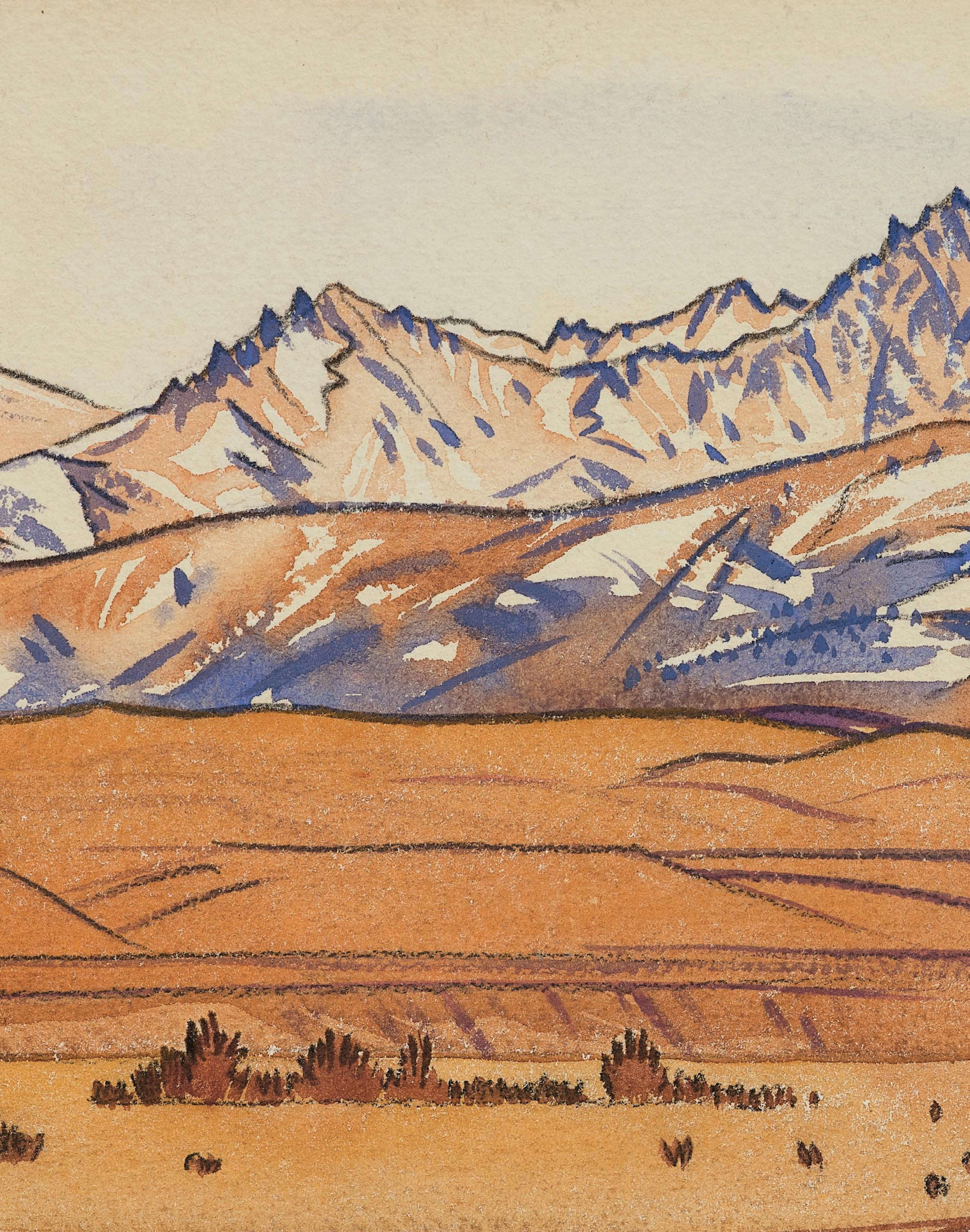
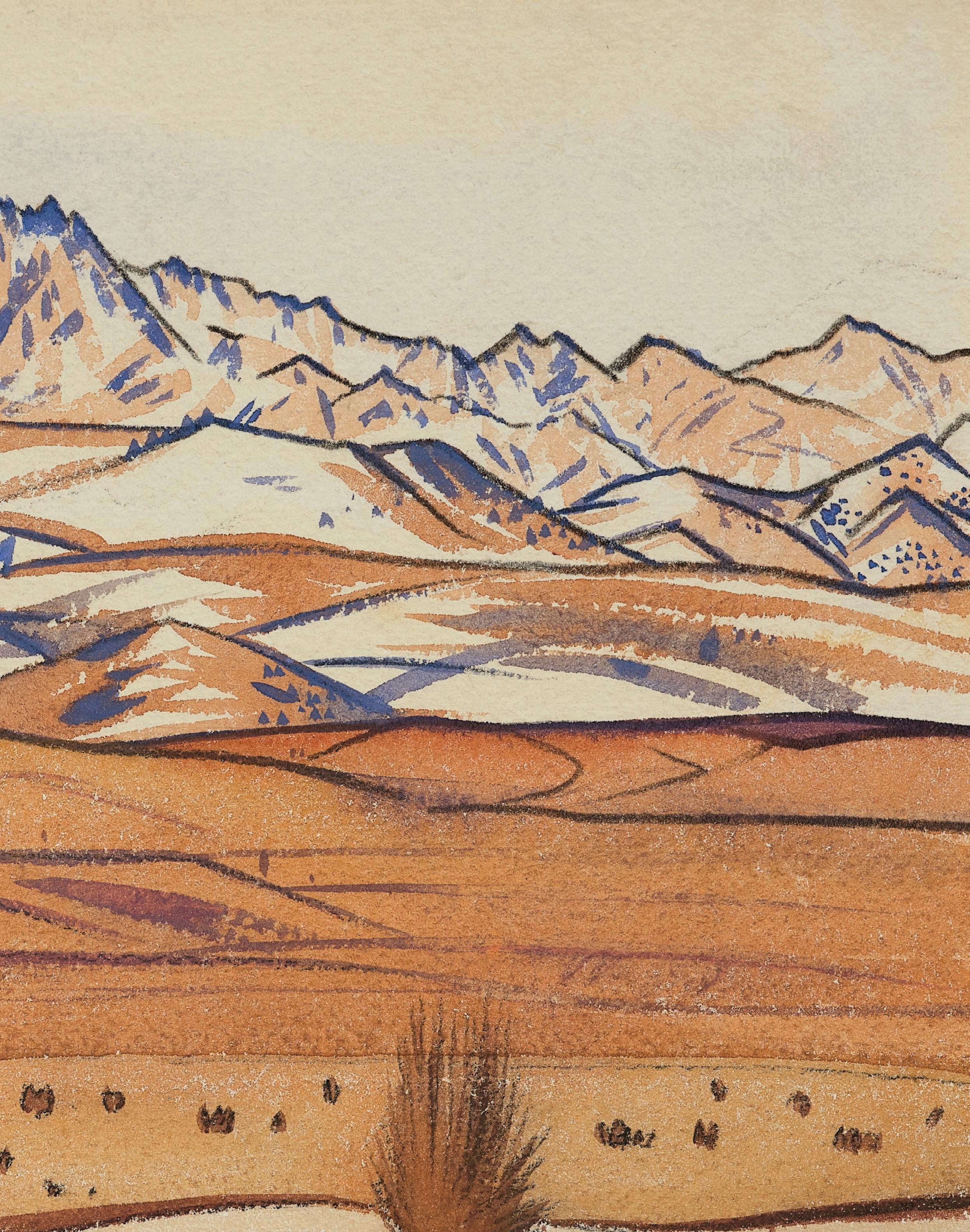
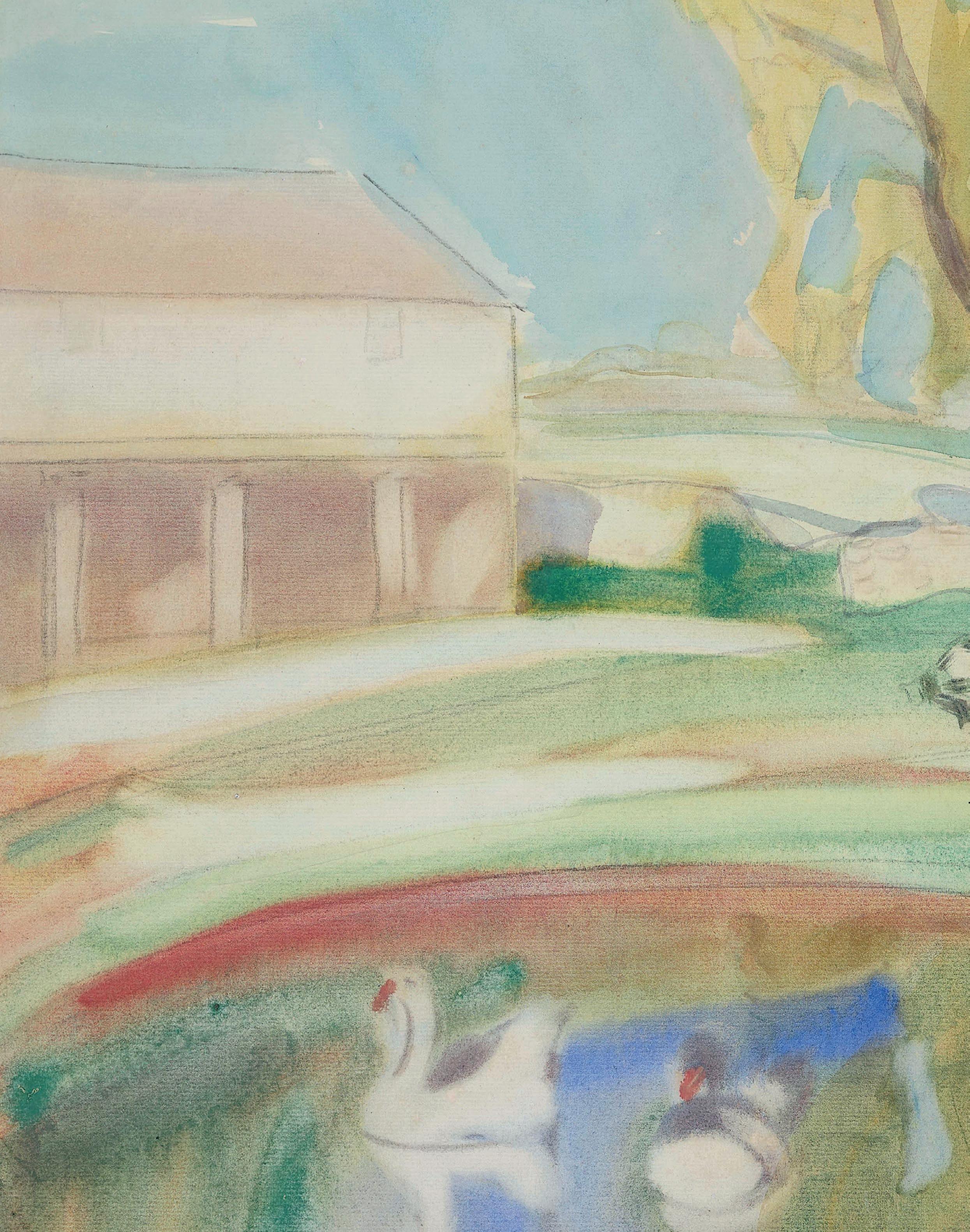
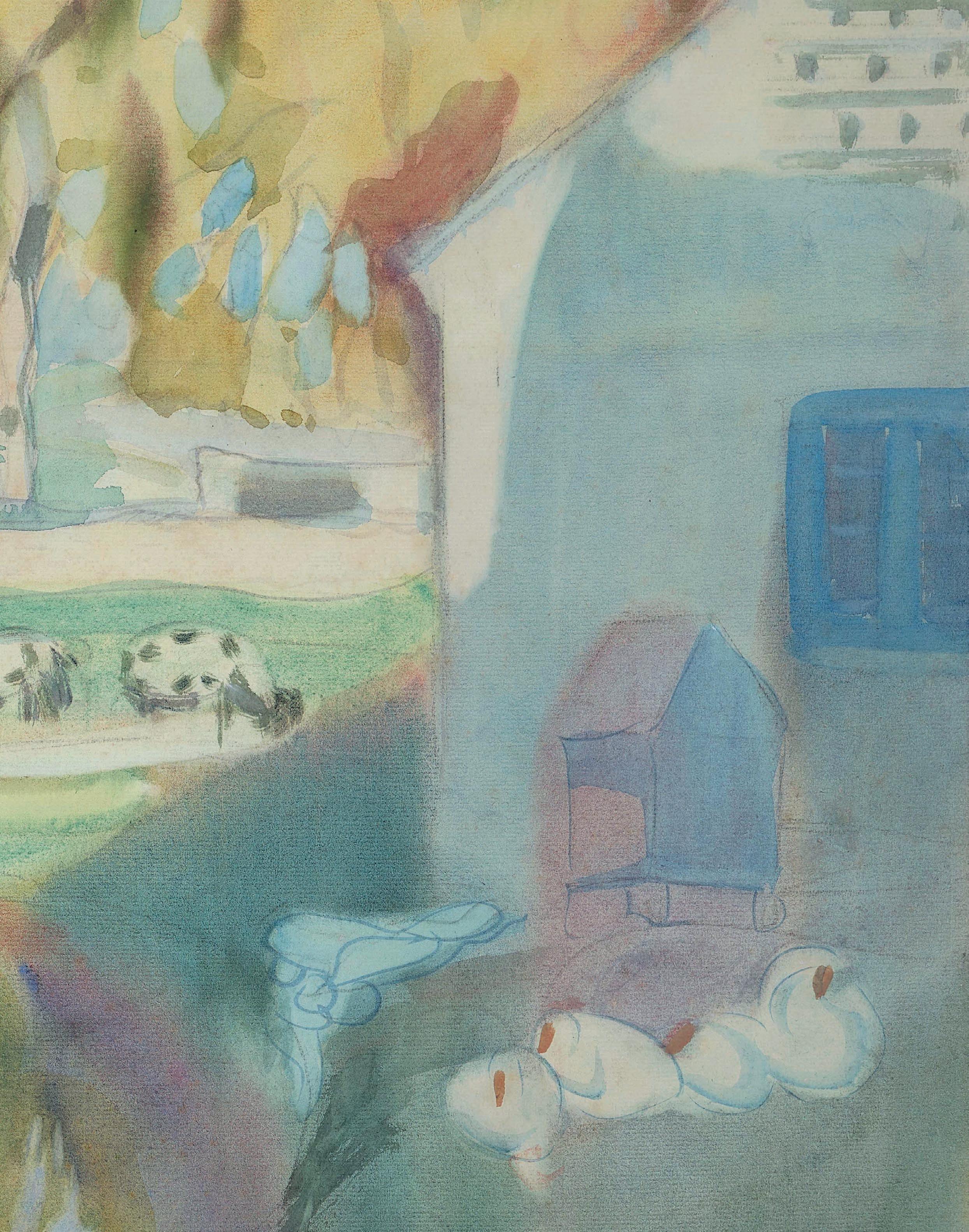
The Pond, 1919 Lot 49
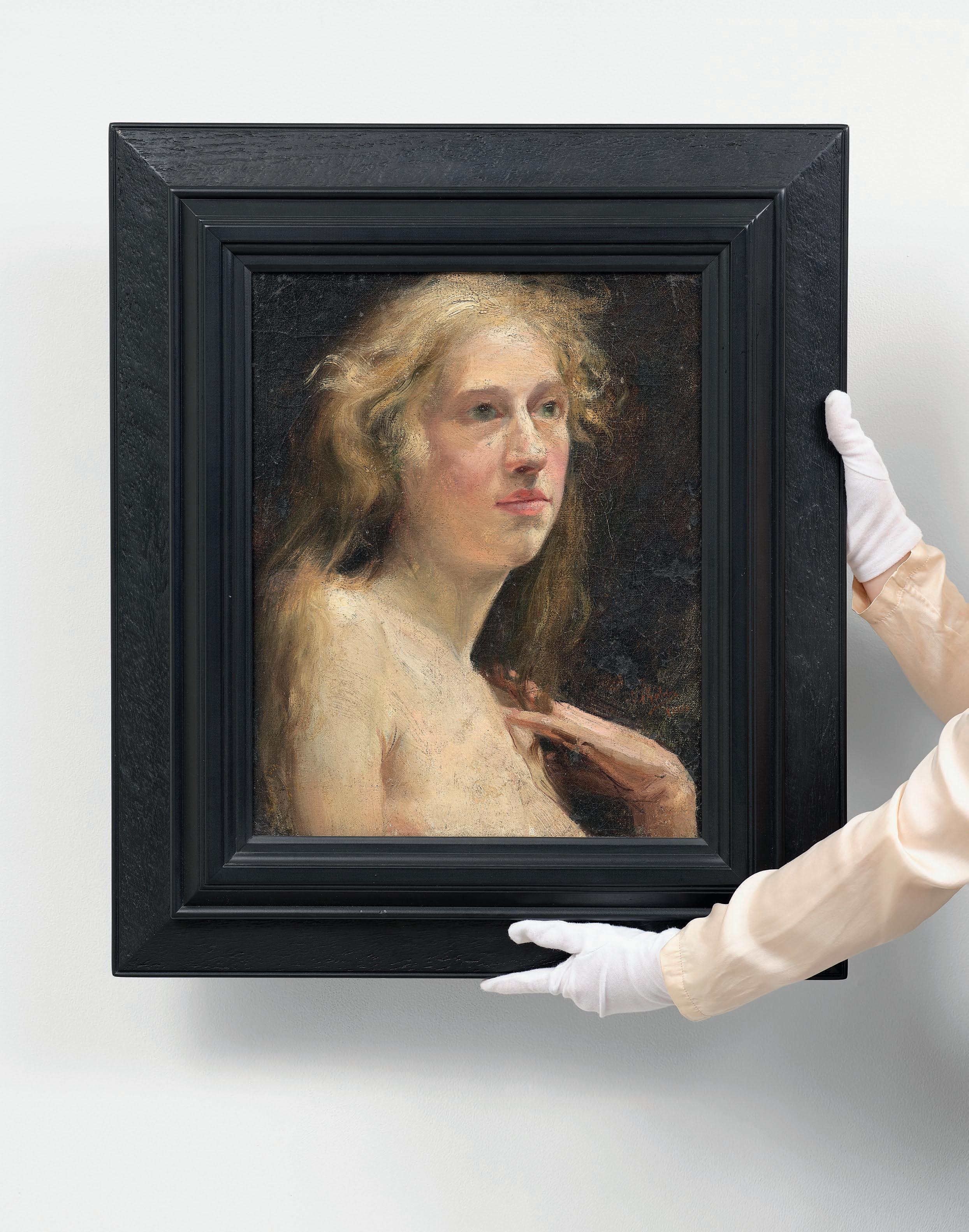
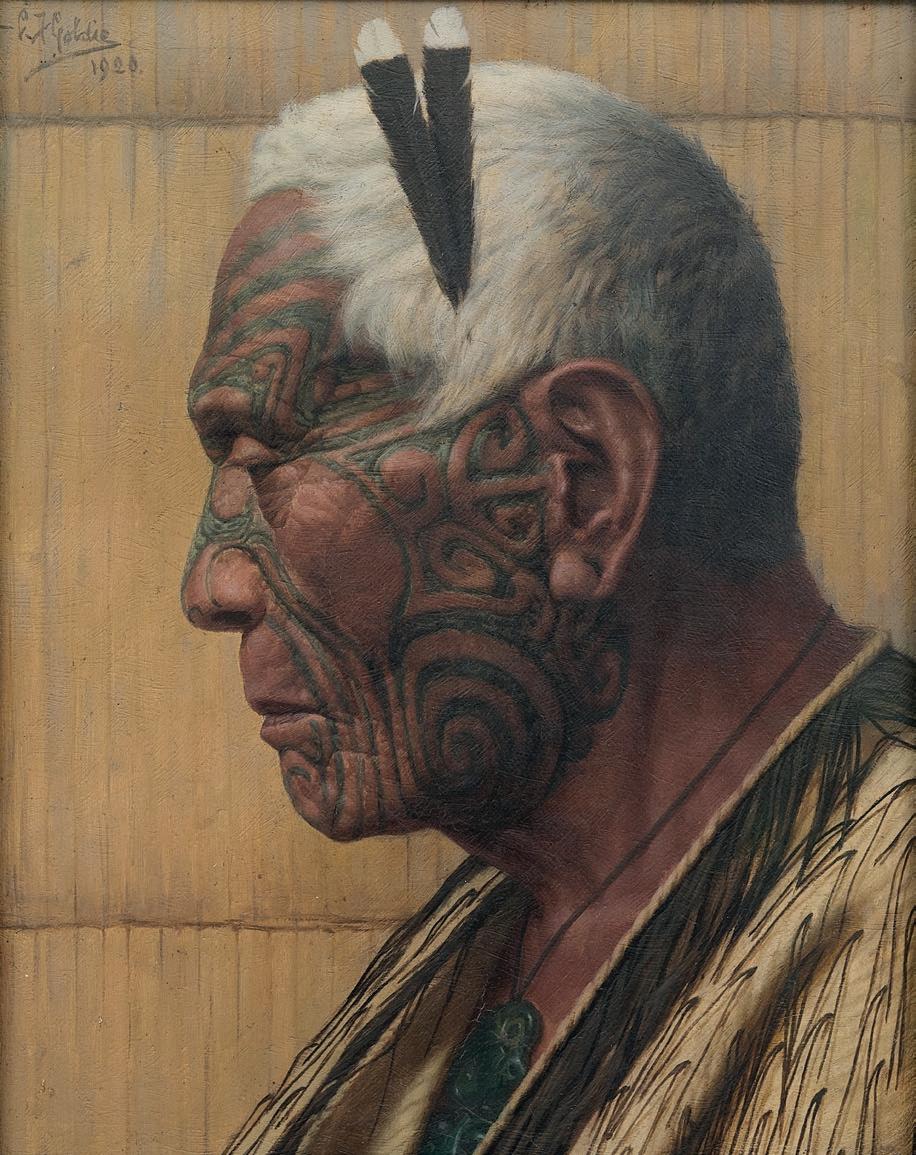
CHARLES FREDERICK GOLDIE
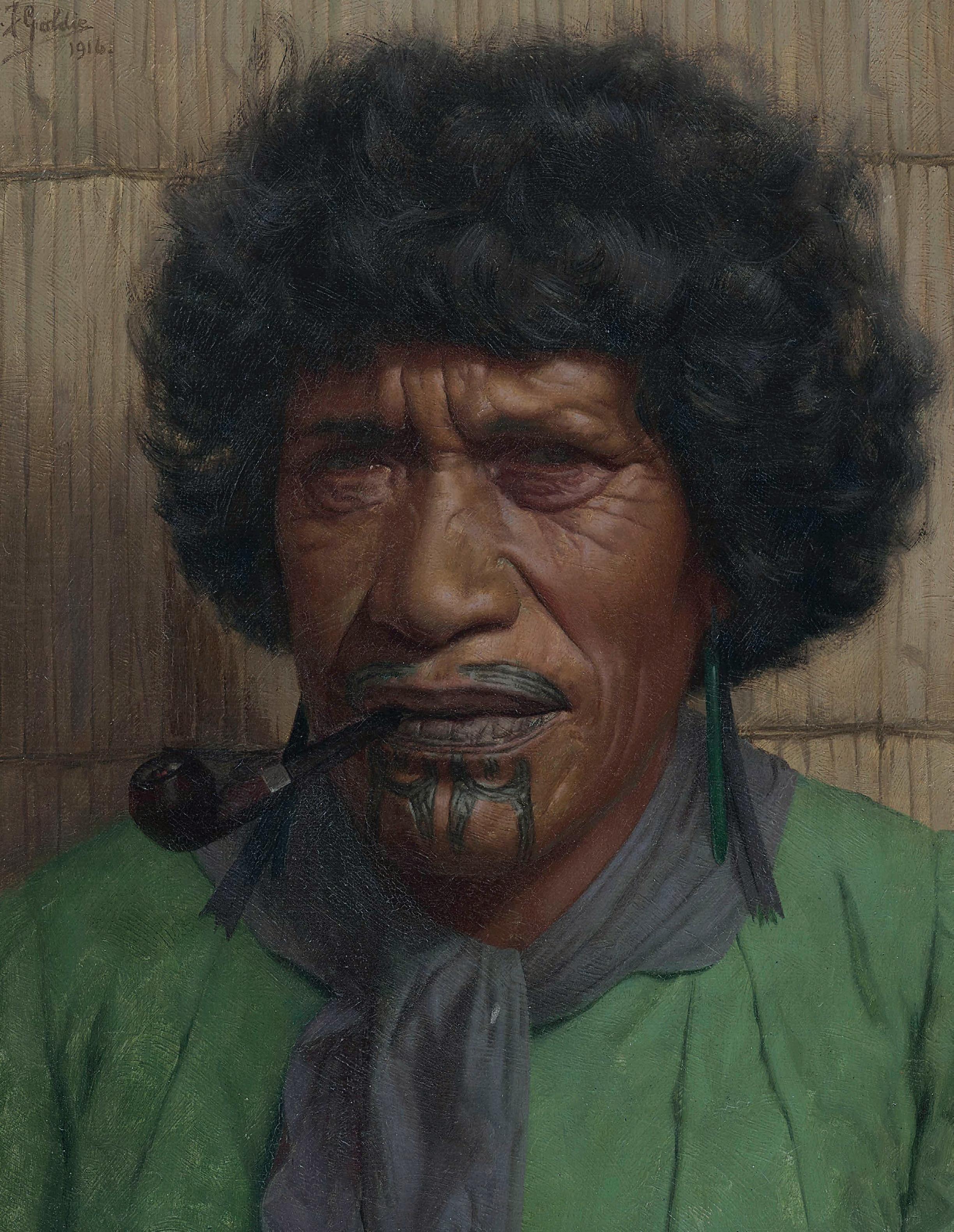
‘In Doubt’ an Arawa Chieftainess Maramena Wiari











15 August – 8 February | Free entry
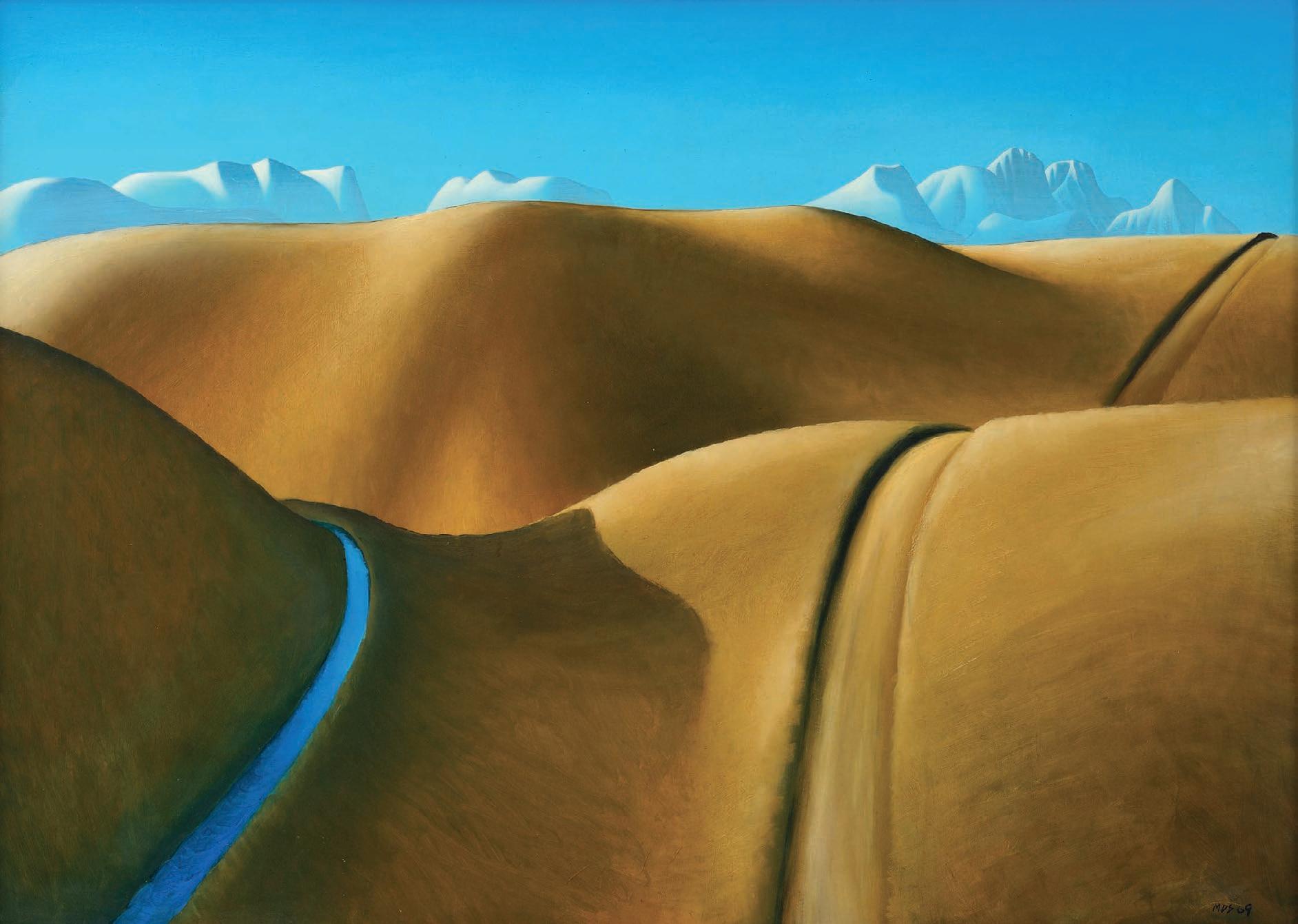
International Art Centre’s first instalment of its flagship Important & Rare Art auction attracted a wide audience of enthusiastic collectors, achieving close to $3m, our strongest result since November 2024. Strong competition from bidders in the room, online and on the telephone saw many works exceed their pre-sale estimates, contributing to an impressive 84% clearance rate. The result reflects the continued strength of the New Zealand art market and the enduring demand for exceptional works of quality and provenance. A particular highlight of the sale was the outstanding interest in the museumquality selection of international works by Fernand Léger, Ben Nicholson, Patrick Caulfield and Barry Flanagan. Among the New Zealand highlights, Don Binney’s Waitangiroto 21-11-1, 2006, realised $388,088, whilst his drawing Kaka Great Barrier soared to $61,850 (including buyer’s premium), while Michael Smither’s Contoured Hills, Water Race and Old Road from Patearoa (1969) generated strong competition throughout the viewing period before realising $327,866 (including buyer’s premium).
Following the success of our March catalogue, International Art Centre’s exclusive third annual Women in Art auction, held on 19 May, attracted enthusiastic participation delivering outstanding results across a broad selection of works. Strong competition throughout the evening reaffirmed the growing recognition of New Zealand’s women artists and the continued strength of this important collecting category.
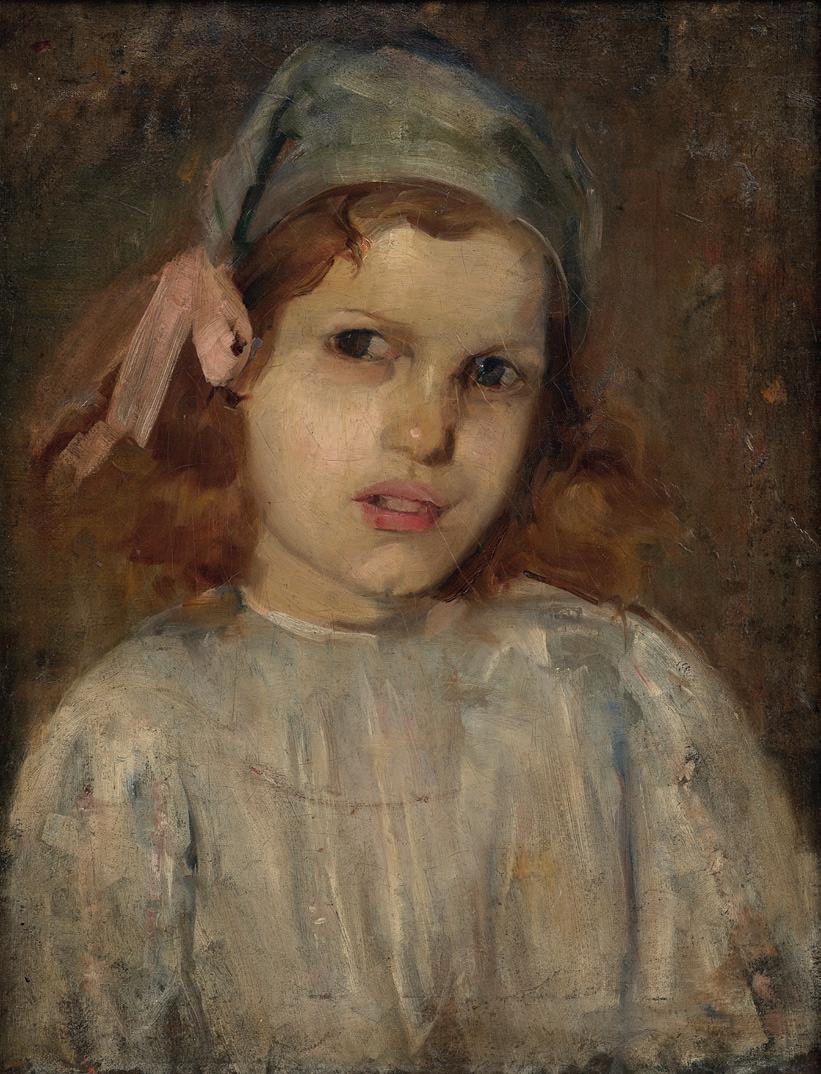
Auction highlights included A. Lois White’s compelling wartime painting Collapse, which realised $266,805. Ivy Copeland’s Morning Gossip, Rotorua established a new artist auction record, selling for $7,760. Competitive bidding also saw Grace Joel’s A Young Girl soar to $18,900 while Louise Henderson’s Garden Party achieved $45,777. Prices quoted include buyer’s premium.
Our team has also been busy with a growing programme of online auctions, an increasingly popular format that continues to attract collectors from New Zealand and abroad. If you haven’t already, download the International Art Centre App to browse and bid with ease. Each sale runs over approximately one week, giving collectors the flexibility to participate from anywhere in the world.
DIRECTOR
Richard Thomson
Ph: 0274 751071
E: richard@artcntr.co.nz
ENQUIRIES
Telephone +64 9 379 4010 / 0800 800 322
E: auctions@artcntr.co.nz www.internationalartcentre.co.nz
6:30pm Tuesday 4 August 2026
International Art Centre
202 Parnell Rd, Parnell, Auckland
Tuesday 28 July 9am - 5pm
Wednesday 29 July 9am - 5pm
Thursday 30 July 9am - 5pm
Friday 31 July 9am - 5pm
Saturday 1 August 10am - 4pm
Sunday 2 August 11am - 4pm
Monday 3 August 9am - 5pm
Tuesday 4 August 9am - 5pm
Telephone +64 9 379 4010 / 0800 800 322
Director: Richard Thomson · richard@artcntr.co.nz
Grace Alty · gracealty@artcntr.co.nz | Grace Harris · grace@artcntr.co.nz www.internationalartcentre.co.nz
We offer live online as well as in room bidding. For guidance on how to bid please visit our website www.internationalartcentre.co.nz
ABSENTEE & TELEPHONE BIDDING
Should you be unable to attend the auction, you may elect to register an absentee or telephone bid. Please contact us to arrange prior the sale.
Visit
https://auctions.internationalartcentre.co.nz to register on our online bidding platform
Our bidding platform enables you to browse catalogues, enjoy auctions in real time and place bids from anywhere in the world
Each lot is subject to 19% + GST buyer’s premium.
ENQUIRIES
Telephone: +64 9 379 4010
0800 800 322
E: auctions@artcntr.co.nz
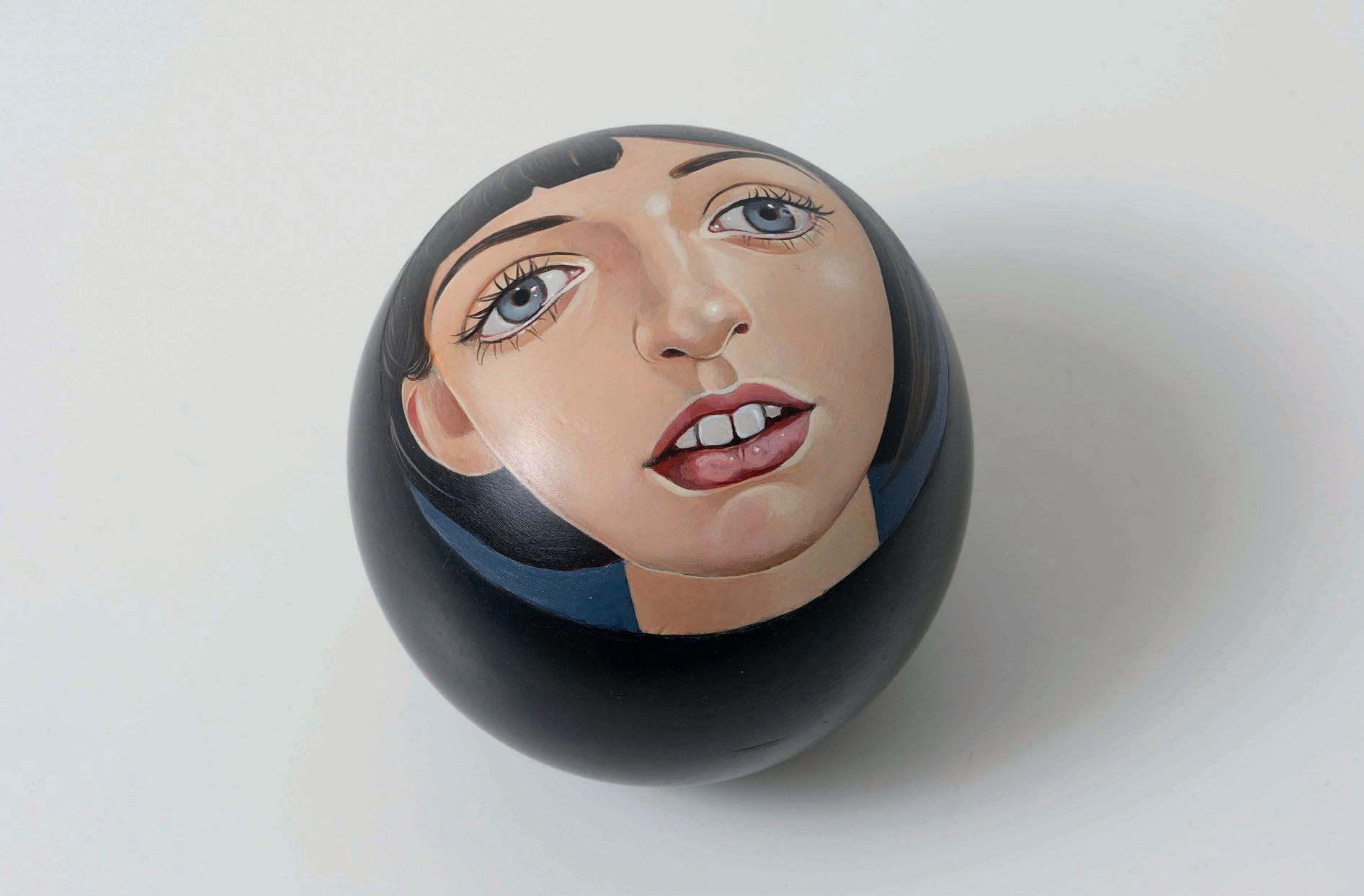
Acrylic and gesso on lawn bowl 11 x 11 x 11 cm
$12,000 – 18,000
PROVENANCE
Private Collection, Auckland
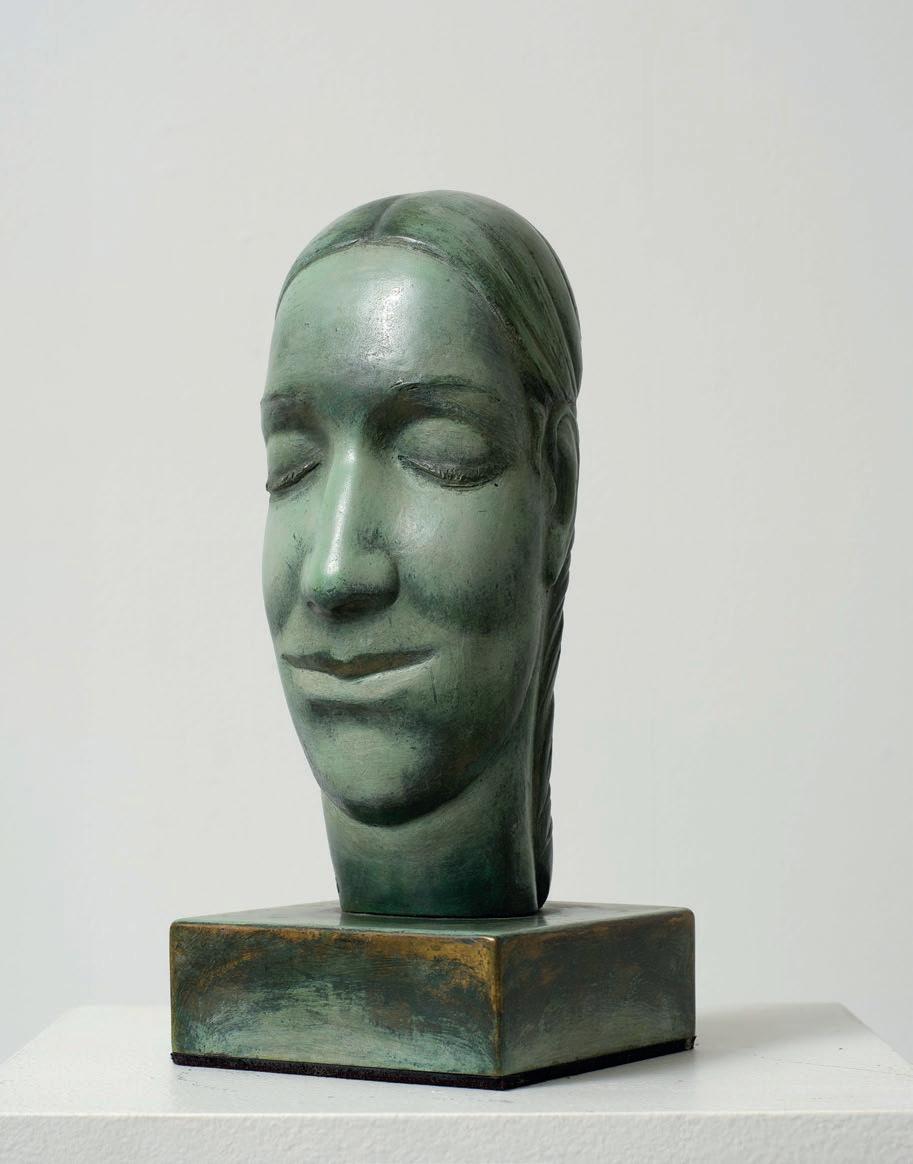
The Birth of the Idea
Bronze, edition 1/3 34 x 15 cm
Signed, inscribed & dated 2003
$8,000 – 12,000
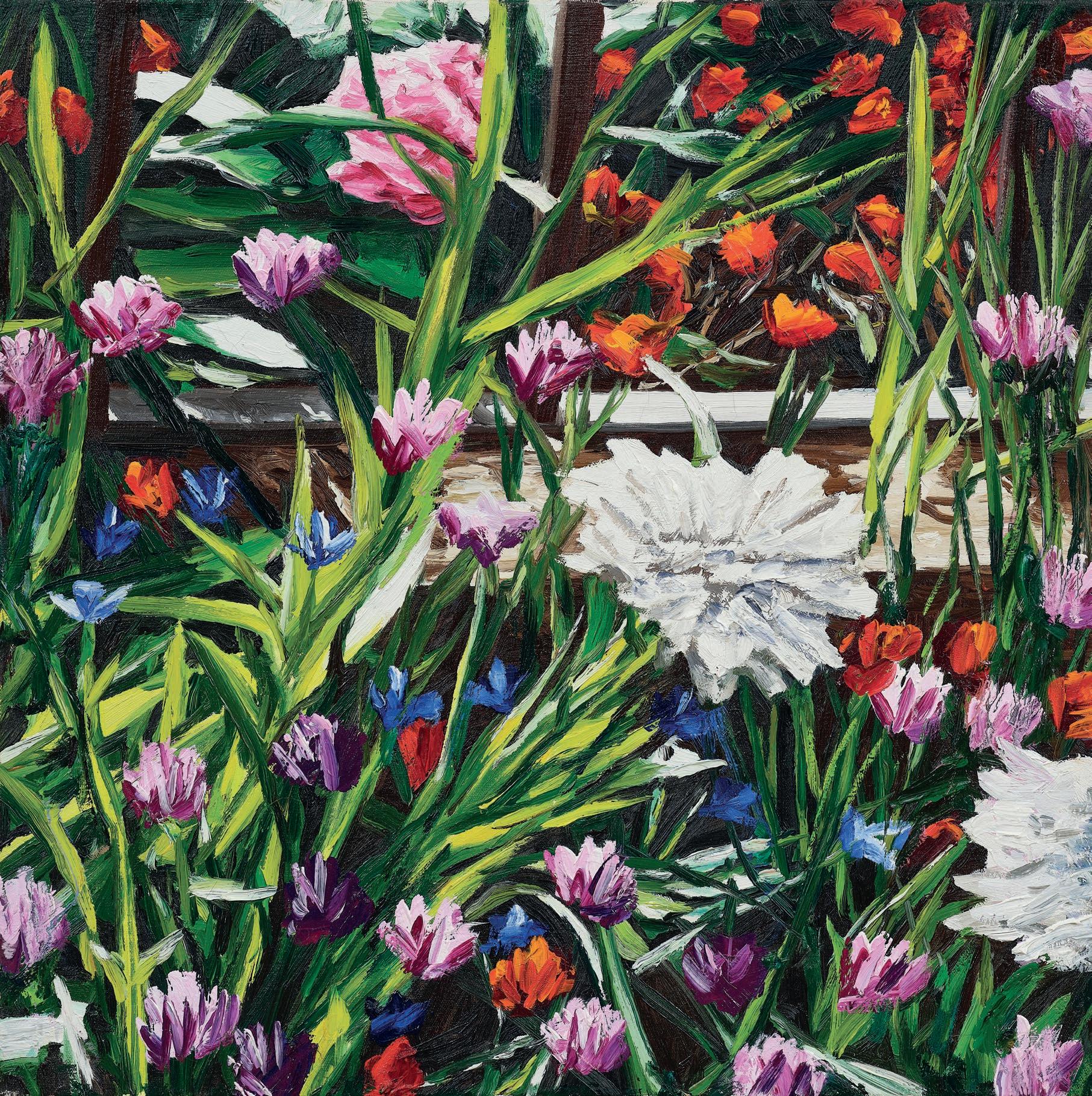
Signed & dated 28/4/92 verso
$8,000 – 12,000
PROVENANCE
Private Collection
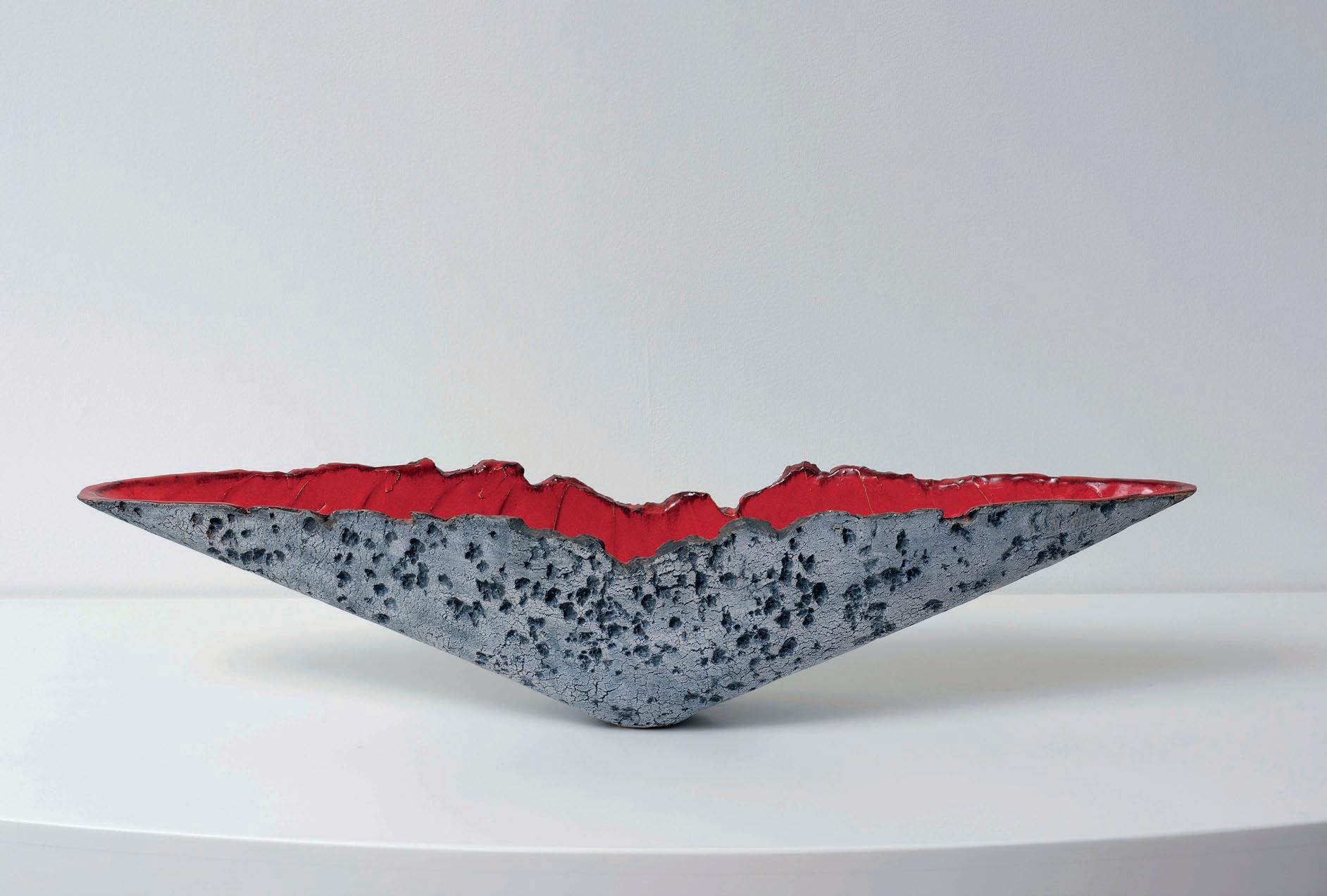
4 LEN CASTLE (1924 - 2011)
Inverted Volcano
Stoneware with red lava glaze
18.5 x 85.5 cm
Signe LC d in impression on base
$10,000 – 15,000
PROVENANCE
Private Collection, Taranaki
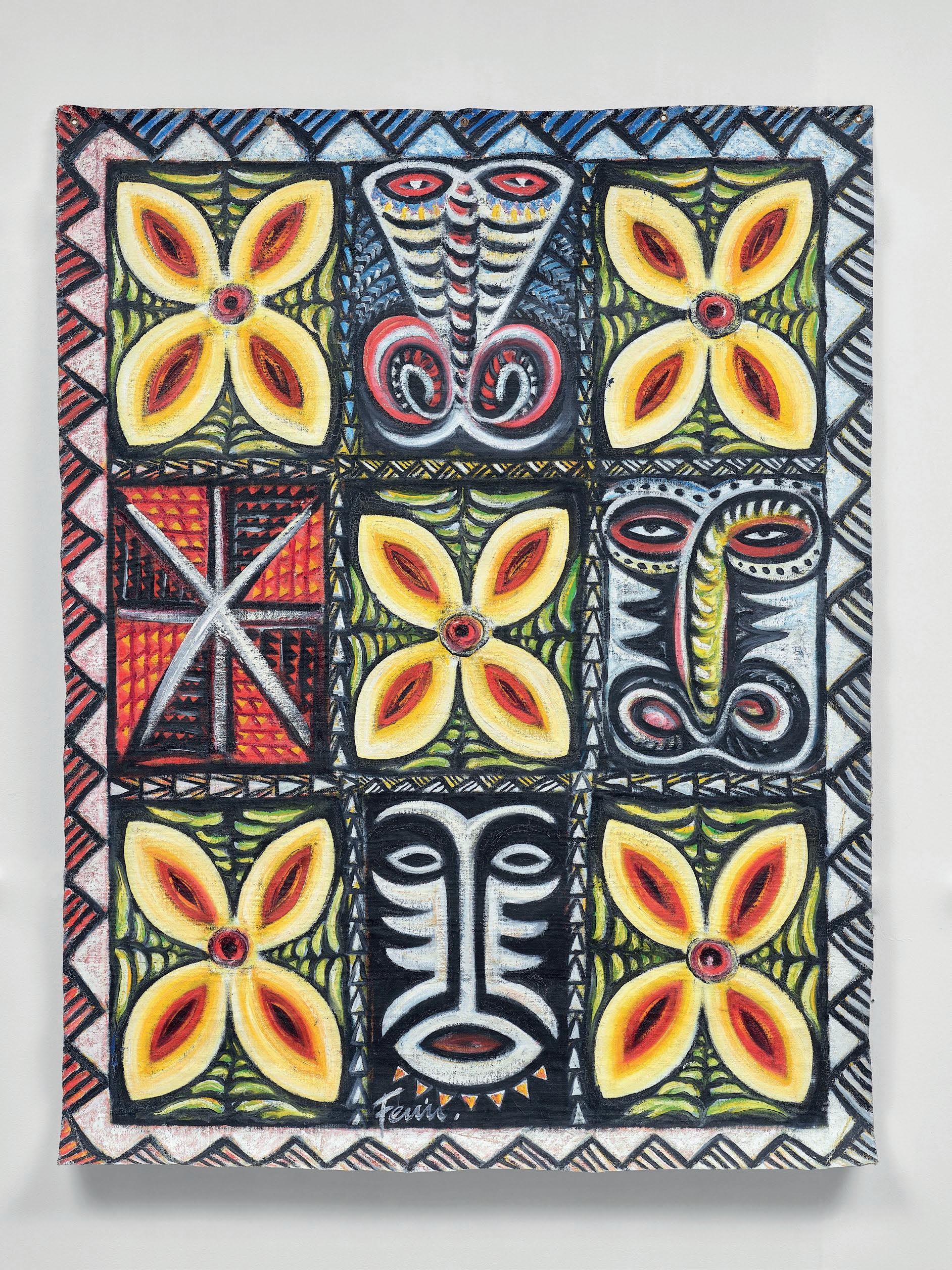
5 FATU FEU’U (b. 1946)
Untitled
Acrylic on unstretched canvas
156 x 119 cm
Signed lower centre
$8,000 – 12,000
PROVENANCE
Private Collection, Auckland
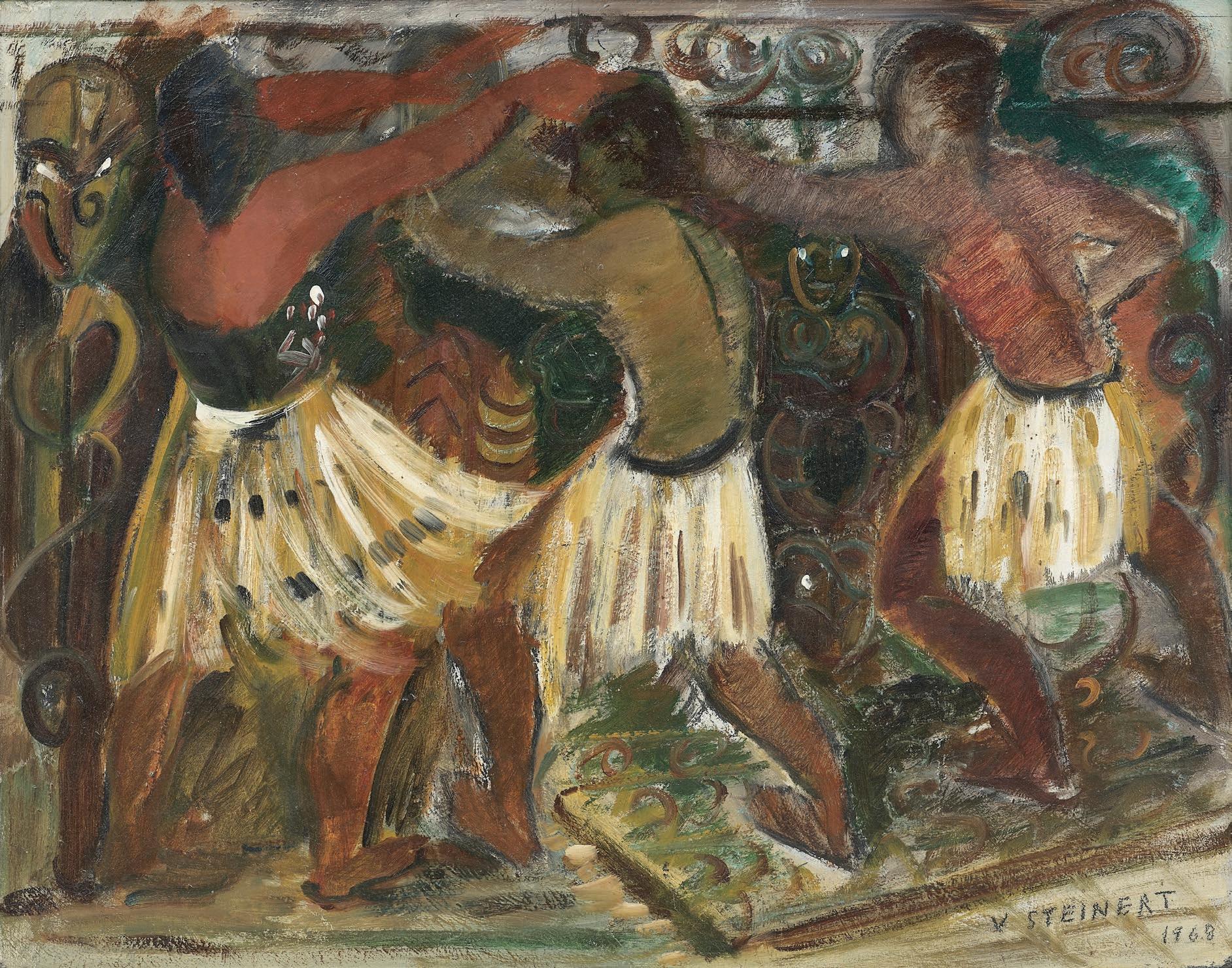
Untitled Oil on board
52.5 x 67 cm
Signed & dated 1968 lower right
Partially signed & inscribed The Old ... verso
$4,000 – 6,000
PROVENANCE
Private Collection, Auckland
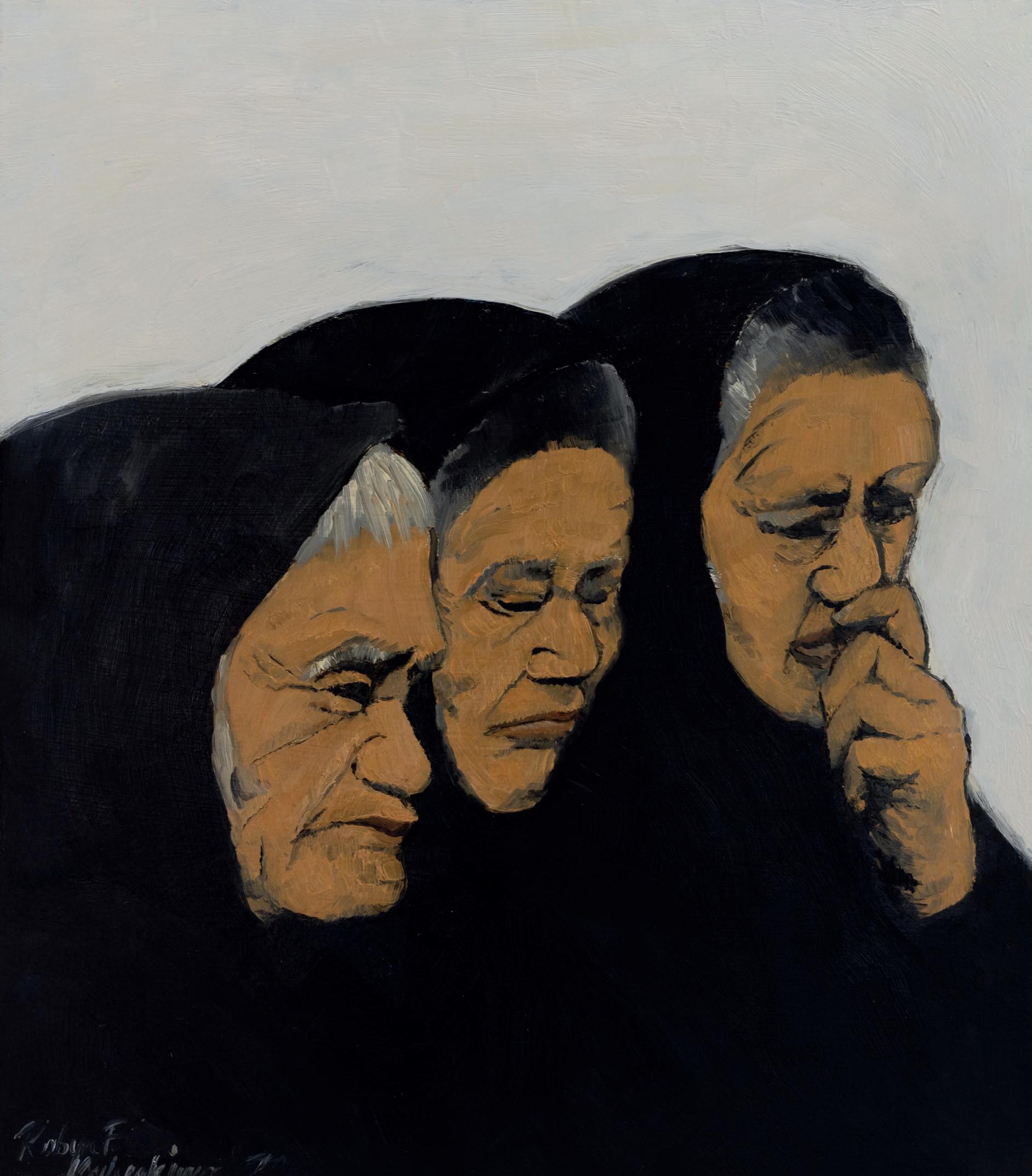
Tangi Oil on board
45.5 x 40.5cm
Signed & dated 70 lower left
Signed & title inscribed verso
$8,000 - 12,000
PROVENANCE
Private Collection, Auckland
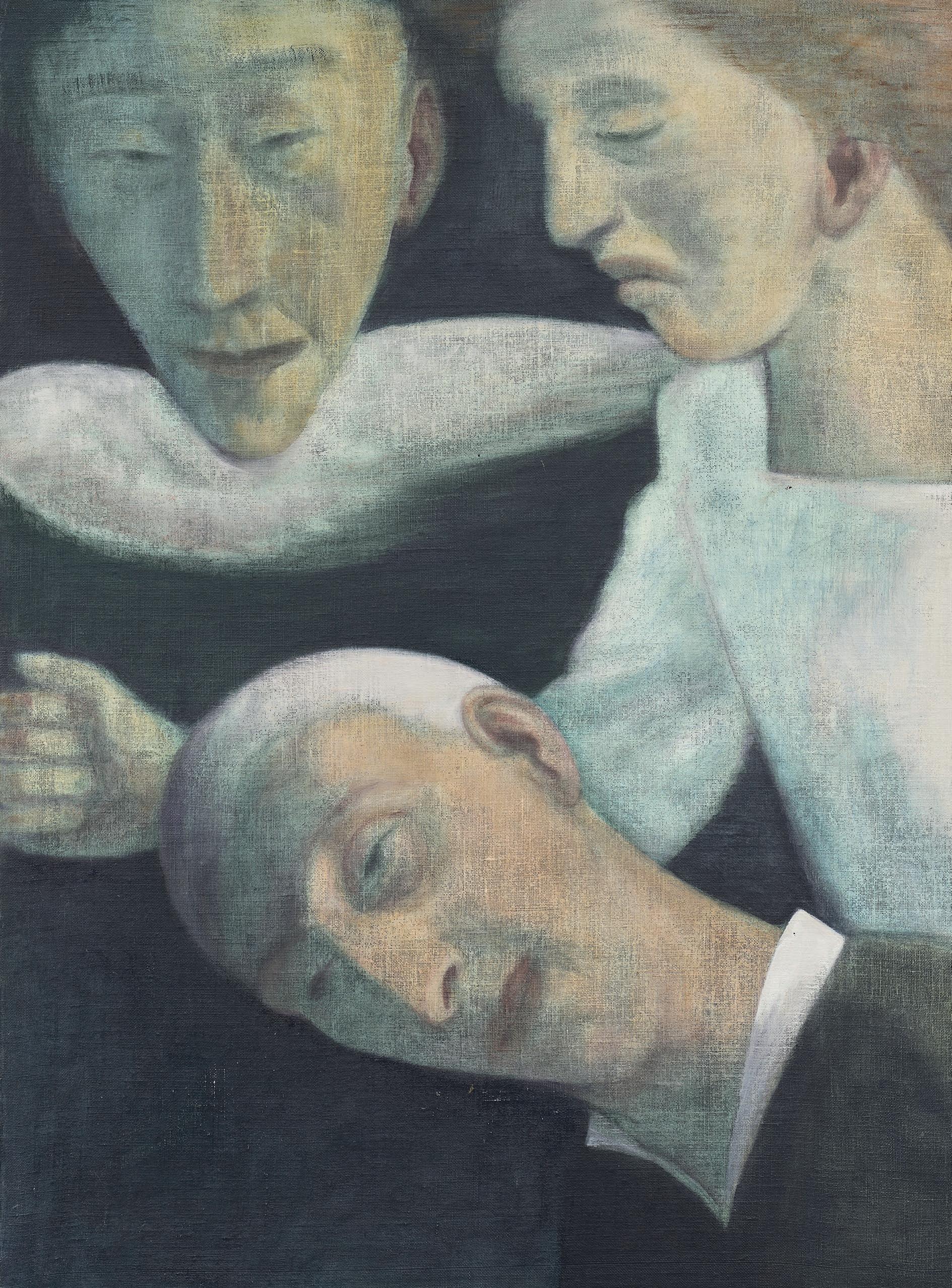
120.5 x 87.5 cm
Signed, inscribed & dated 1991 verso
$8,000 – 12,000
PROVENANCE
Private Collection, Auckland
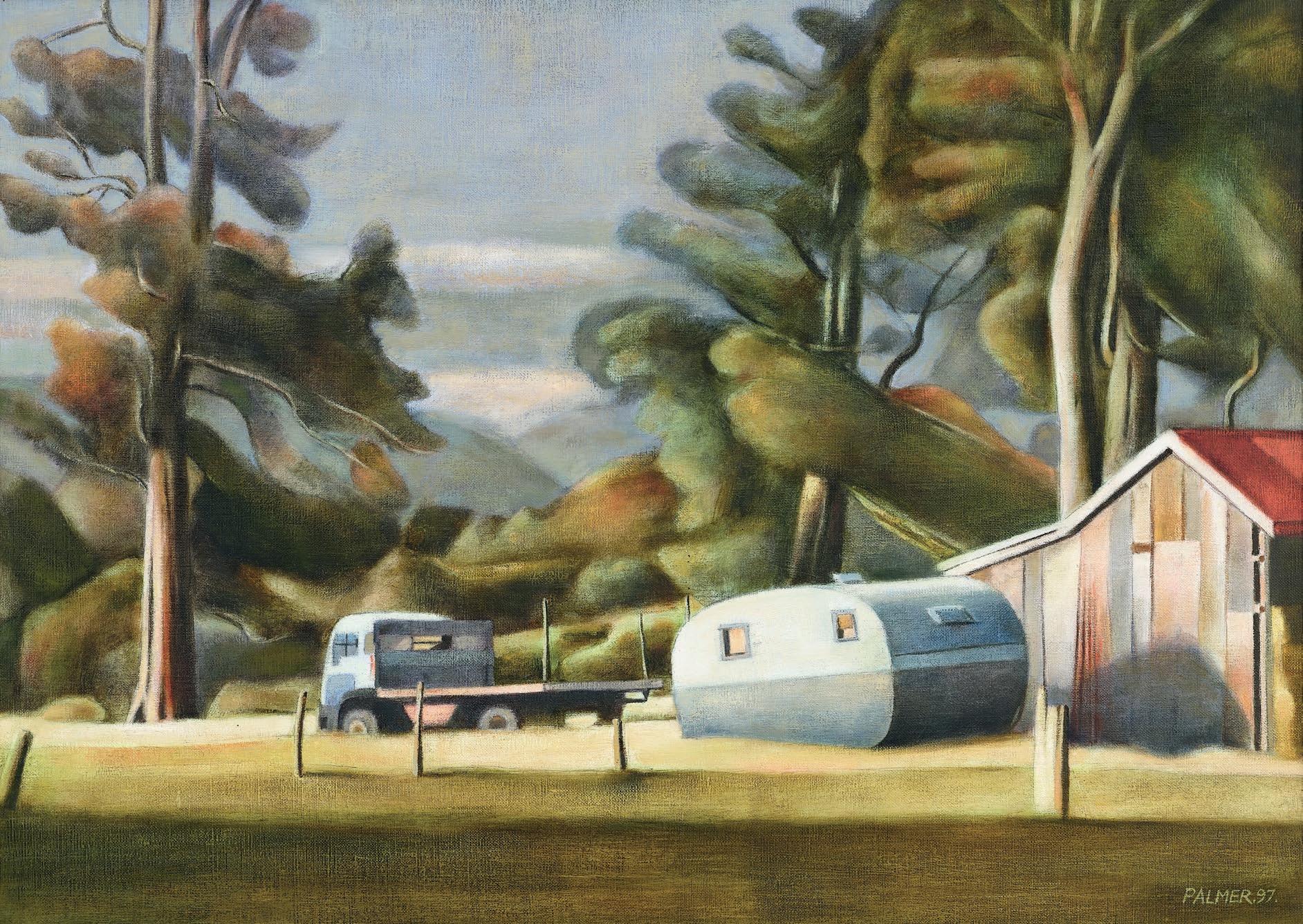
63 x 88.5 cm
Signed & dated 1997 lower right
$15,000 – 20,000
PROVENANCE
Private Collection, Bay of Plenty
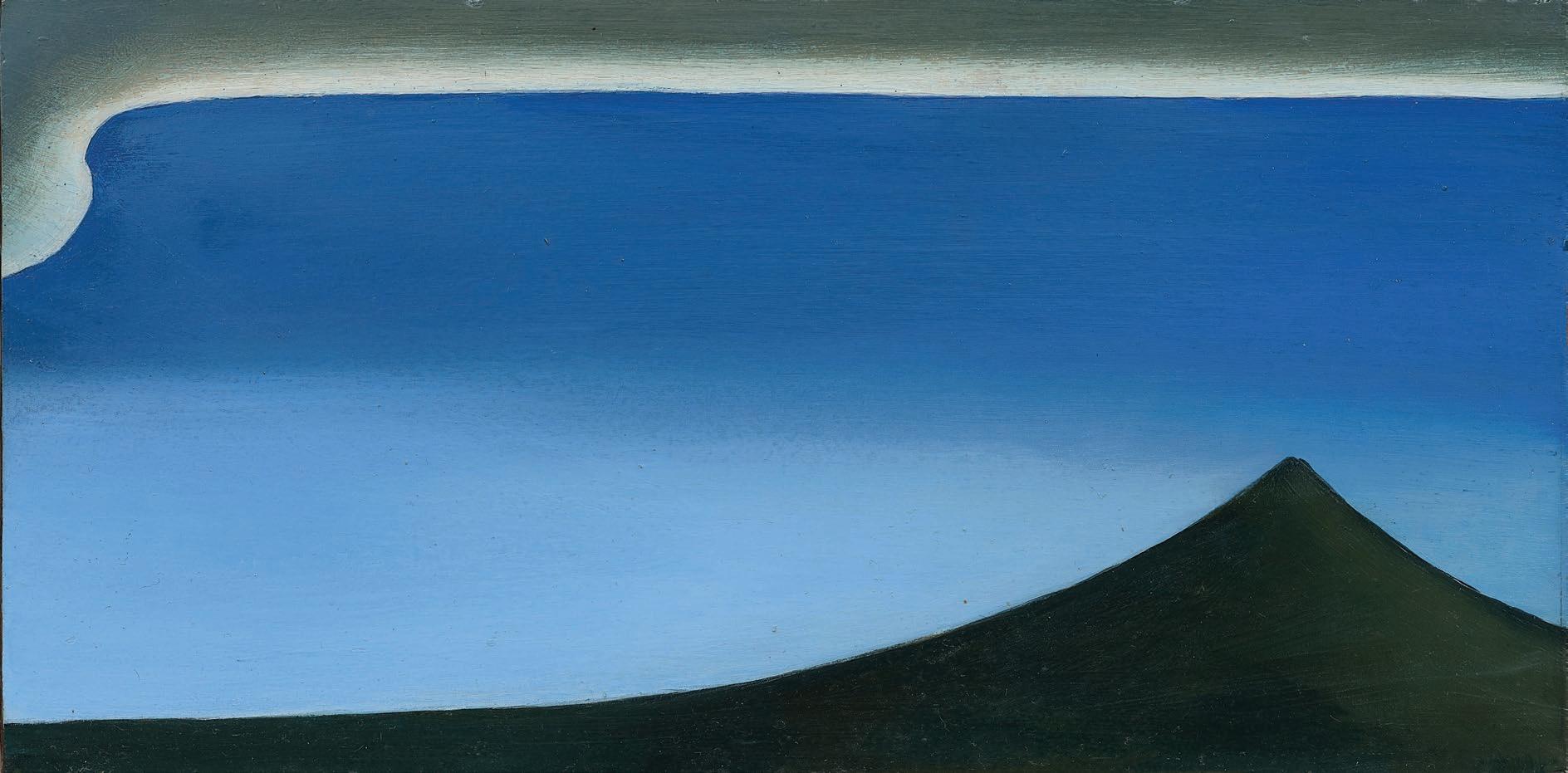
MICHAEL SMITHER (b. 1939)
Egmont & Cloud Oil on board
15 x 30.5 cm
Signed & dated 1972 verso
$15,000 – 20,000
PROVENANCE
Private Collection, Taranaki
Acquired from International Art Centre, The Paul & Kerry Barber Collection with Important & Rare Art, Auckland, 23/10/2019, Lot no. 78
Acquired from the artist, 1972
11
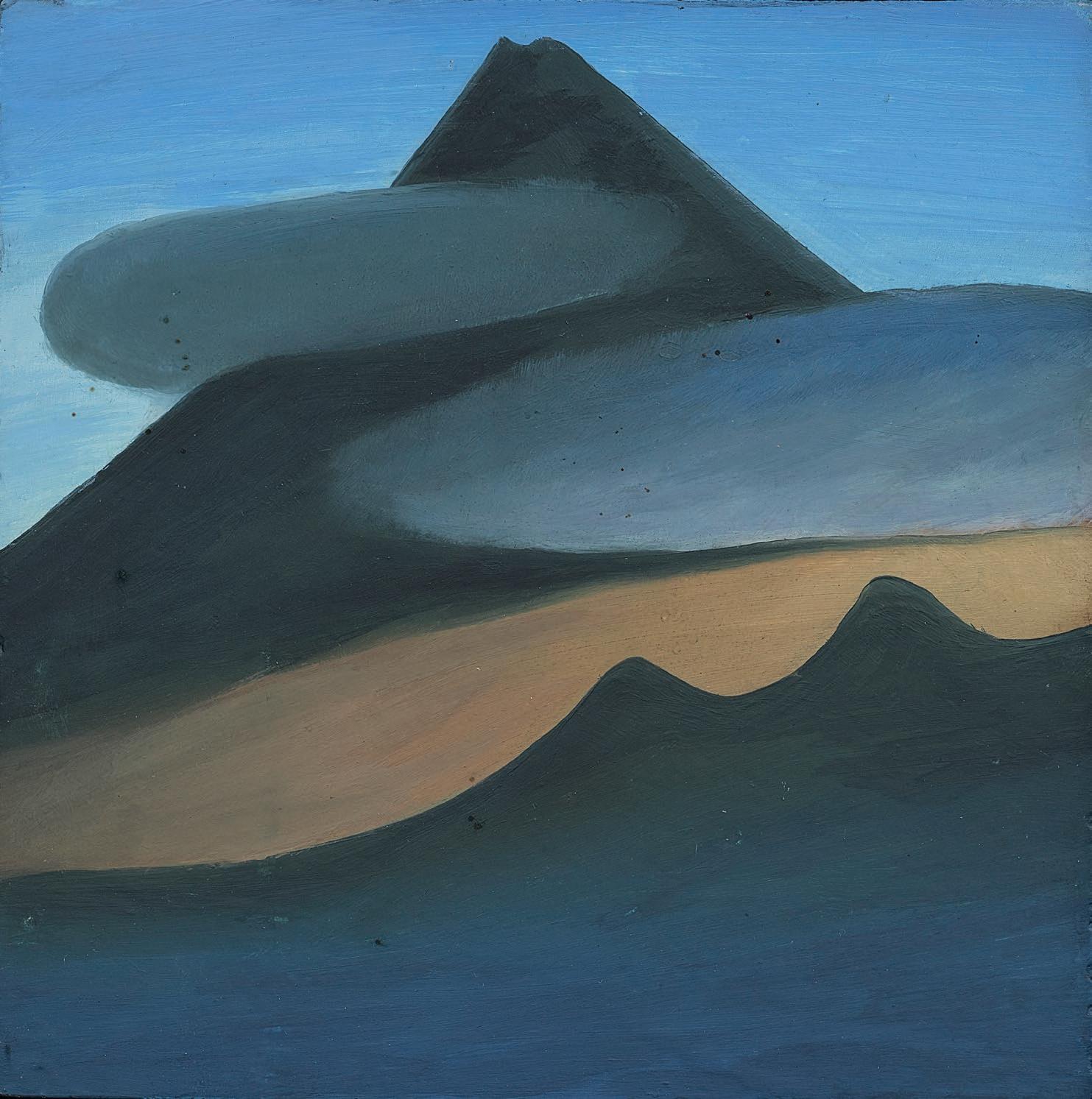
MICHAEL SMITHER (b. 1939)
Mount Taranaki Oil on board
15 x 15 cm
$8,000 – 12,000
PROVENANCE
Private Collection, Taranaki
Acquired from International Art Centre, An Auckland Collection of Contemporary Art with Modern & Contemporary, Auckland, 15/05/2018, Lot no. 87
12
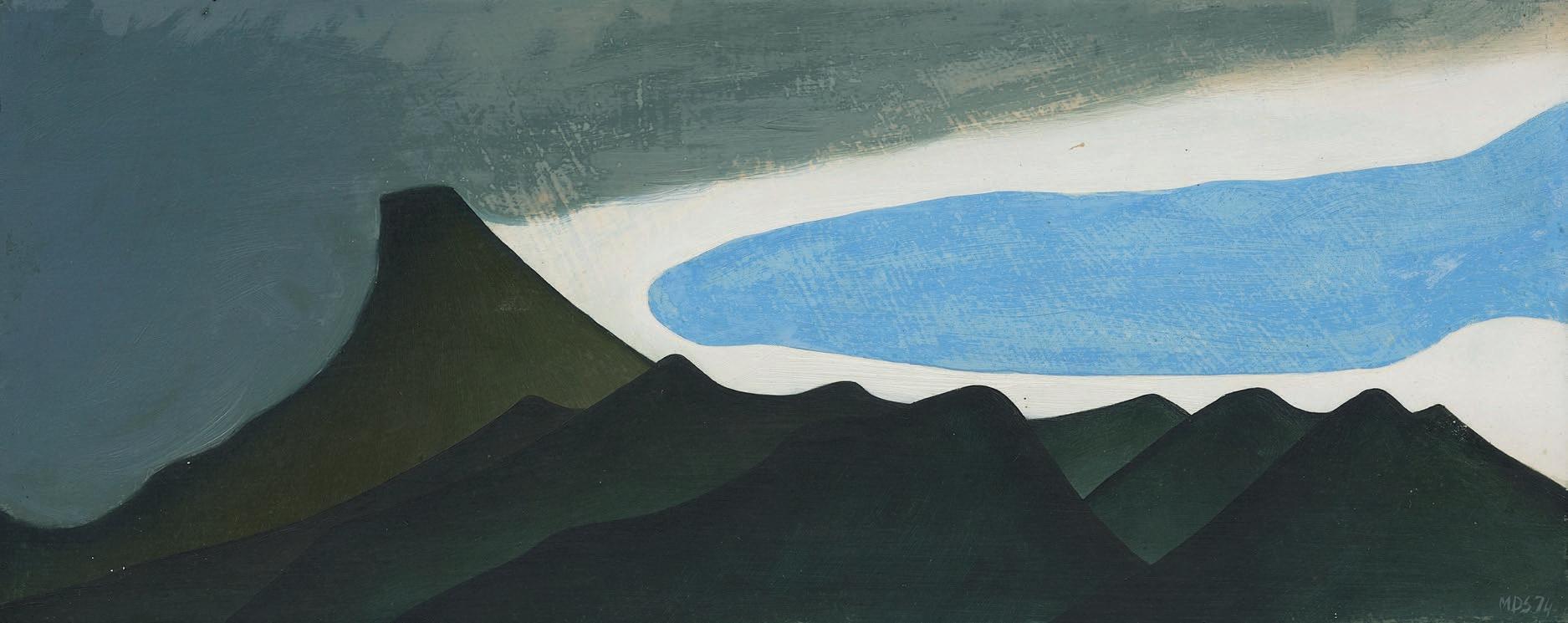
MICHAEL SMITHER (b. 1939)
Taranaki Landscape Oil on board
22 x 54 cm
Initialled & dated 74 lower right
$15,000 – 20,000
PROVENANCE
Private Collection, Taranaki
Acquired from International Art Centre, Important & Rare Art, Auckland, 04/04/2017, Lot no. 2
EXHIBITED
Michael Smither Paintings, Barry Lett Galleries, Auckland, 1974
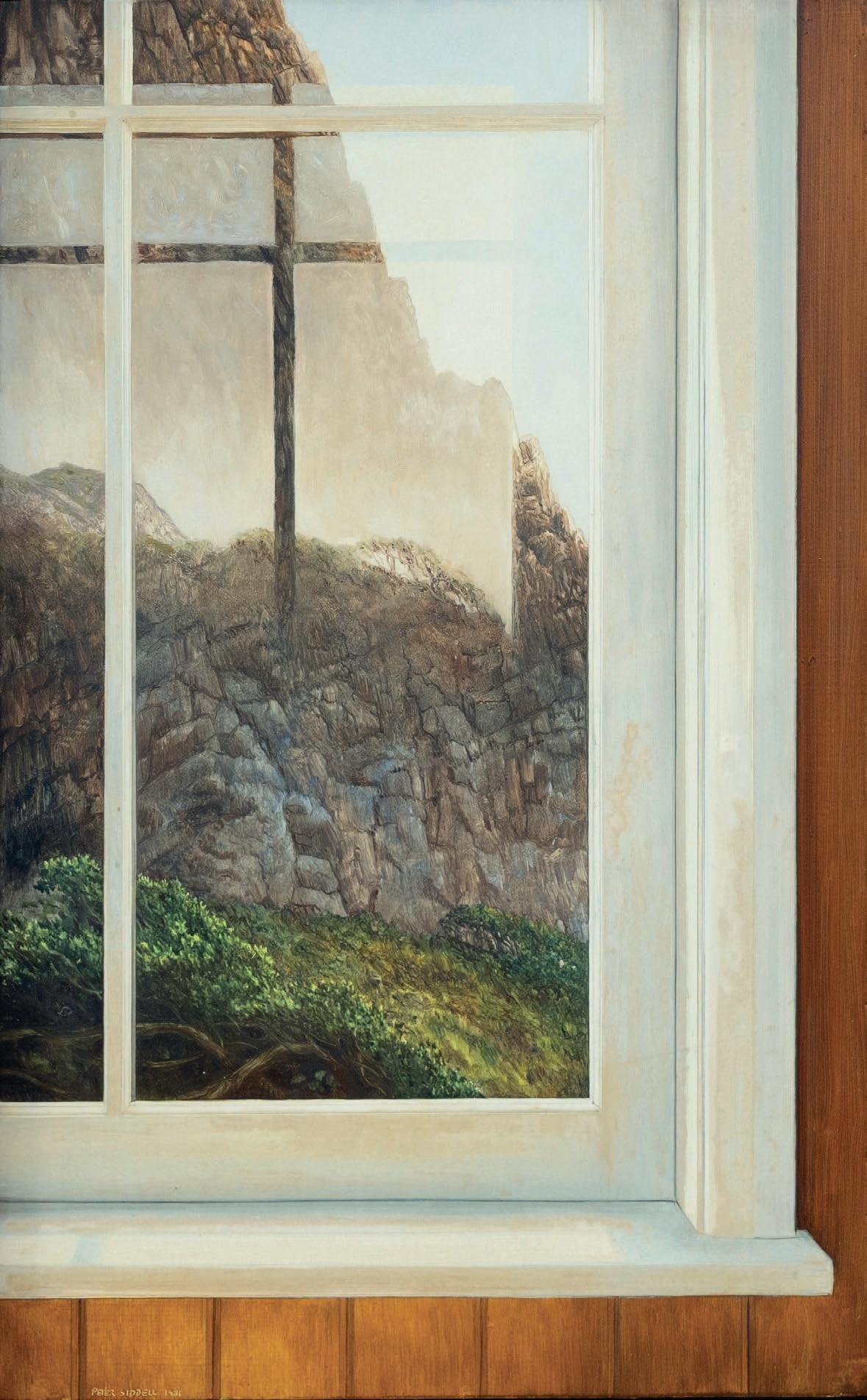
Untitled Oil on board
42 x 26 cm
Signed & dated 1981 lower left
$6,000 – 10,000
PROVENANCE
Private Collection,Whanganui
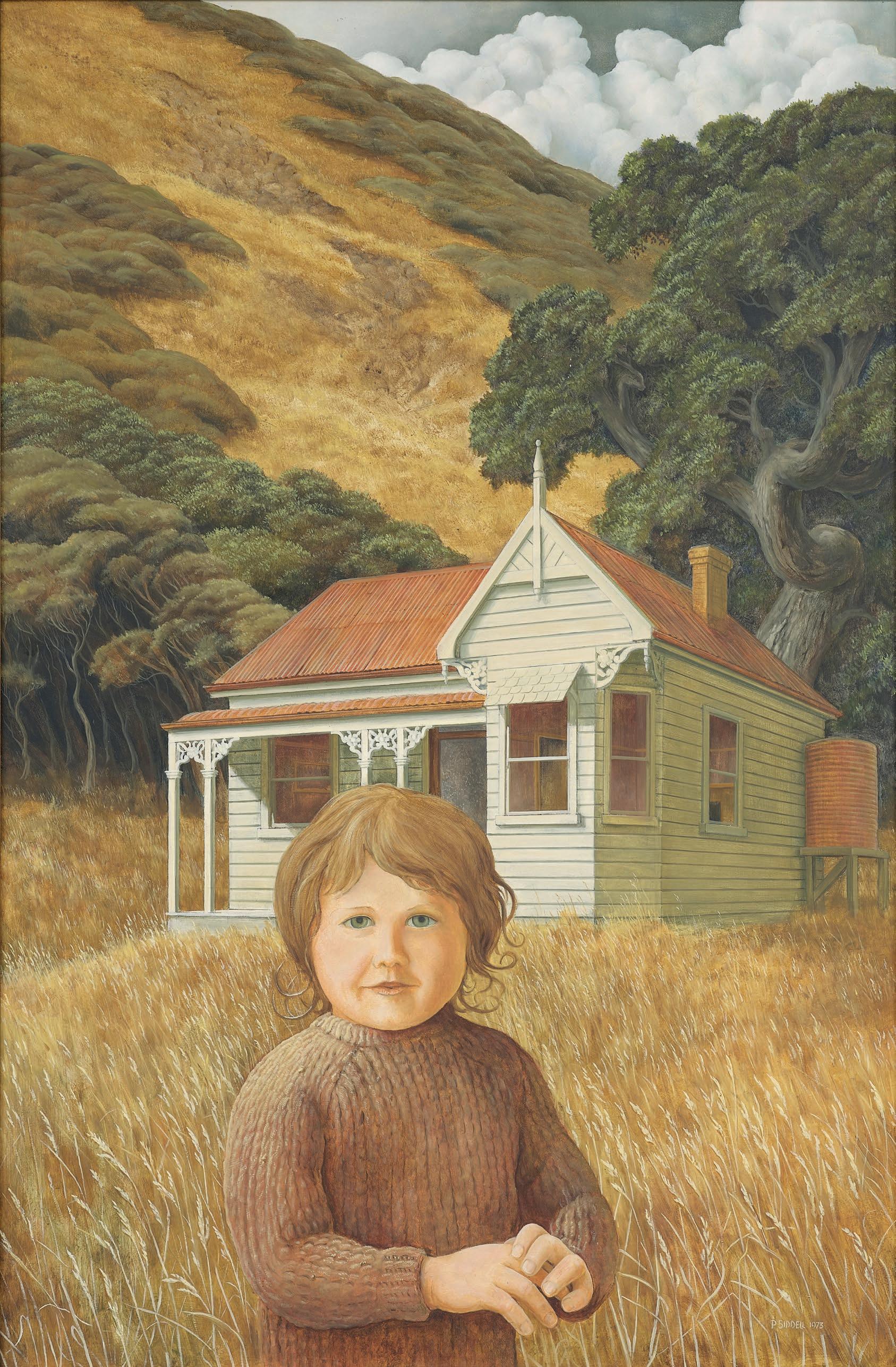
Averil in front of House Oil on board
121 x 79.5 cm
Signed & dated 1973 lower right
$35,000 – 45,000
PROVENANCE
Private Collection, Auckland
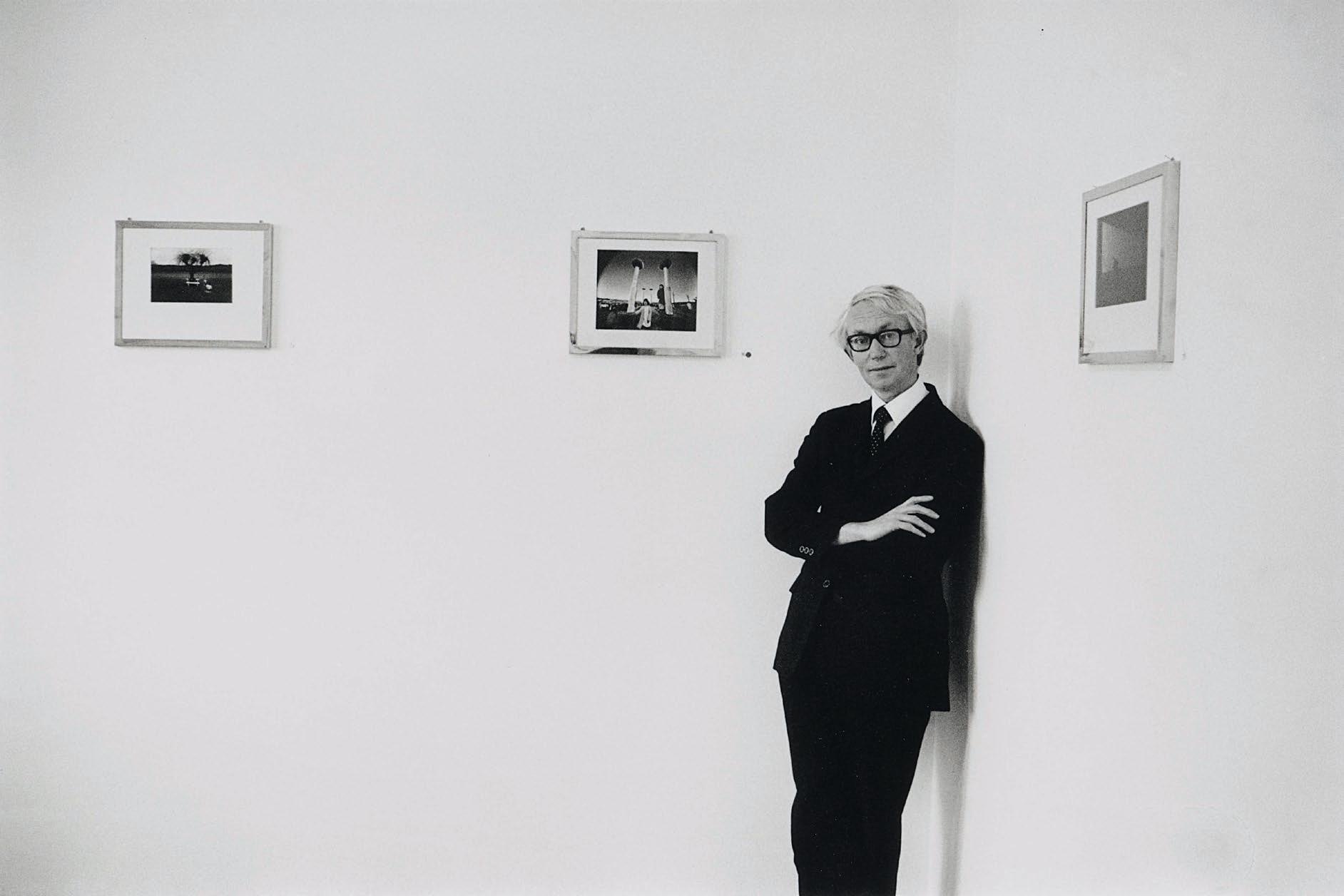
MARTI FRIEDLANDER (1928 - 2016)
Peter McLeavey
Silver gelatin print
16 x 23.5 cm
$5,000 – 8,000
PROVENANCE
Private Collection, Auckland
16
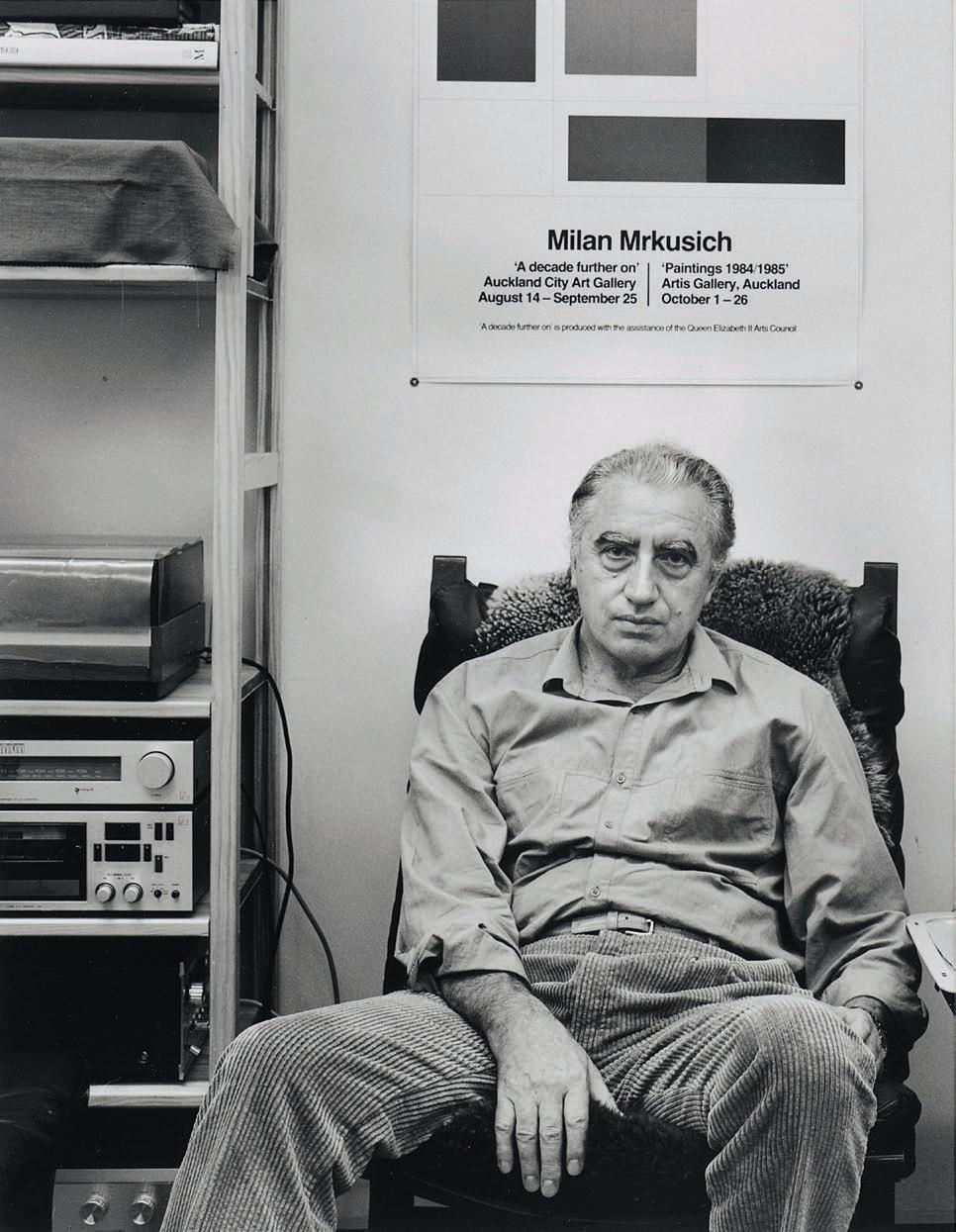
MARTI FRIEDLANDER (1928 - 2016)
Milan MrKusich, Auckland, c. 1986
Silver gelatin print
23.5 x 18.5 cm
$5,000 – 8,000
PROVENANCE
Private Collection, Auckland
ILLUSTRATED
Leonard Bell, Marti Friedlander: Portraits of the Artists, Auckland University Press, Auckland 2020, p. 272
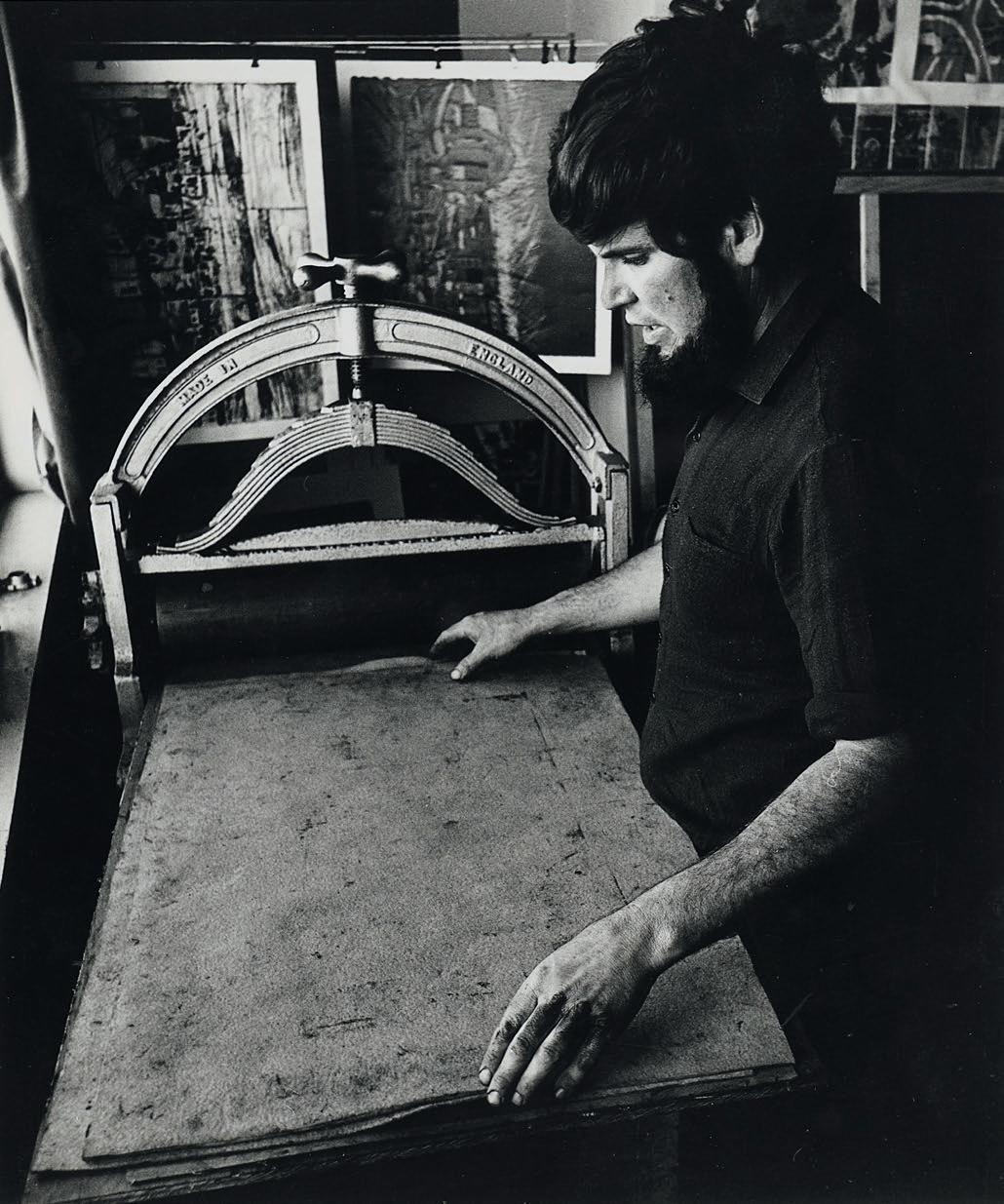
17 MARTI FRIEDLANDER (1928 - 2016)
Stanley Palmer, Auckland, c. 1968
Silver gelatin print
23.5 x 20 cm
$5,000 – 8,000
PROVENANCE
Private Collection, Auckland
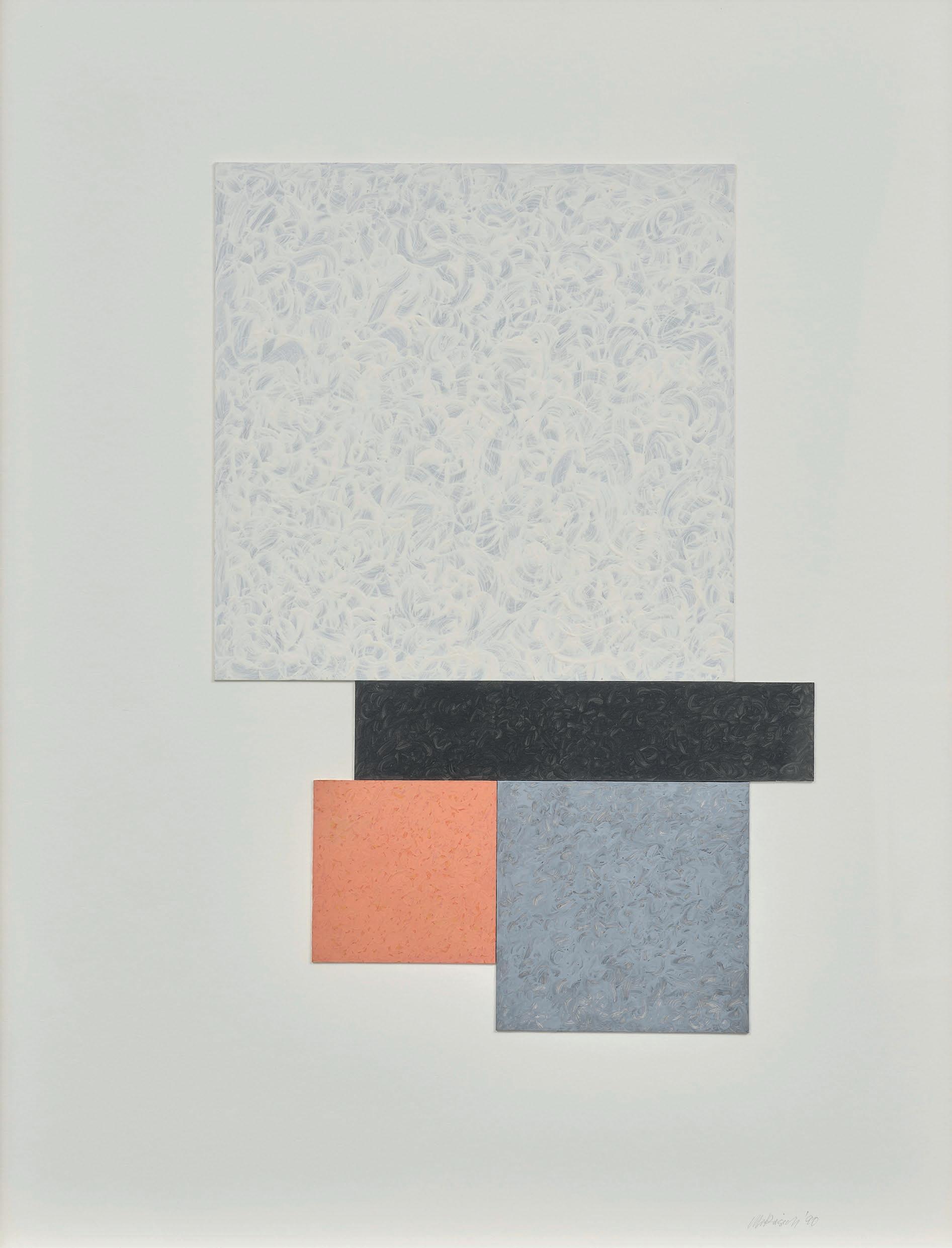
18 MILAN MRKUSICH (1925 - 2018)
Alchemical Spectrum White Version I, 1990
Alkyd on card (illustration board)
82.5 x 64 cm
Signed & dated ‘90 lower right
$15,000 - 20,000
PROVENANCE
Private Collection, Auckland
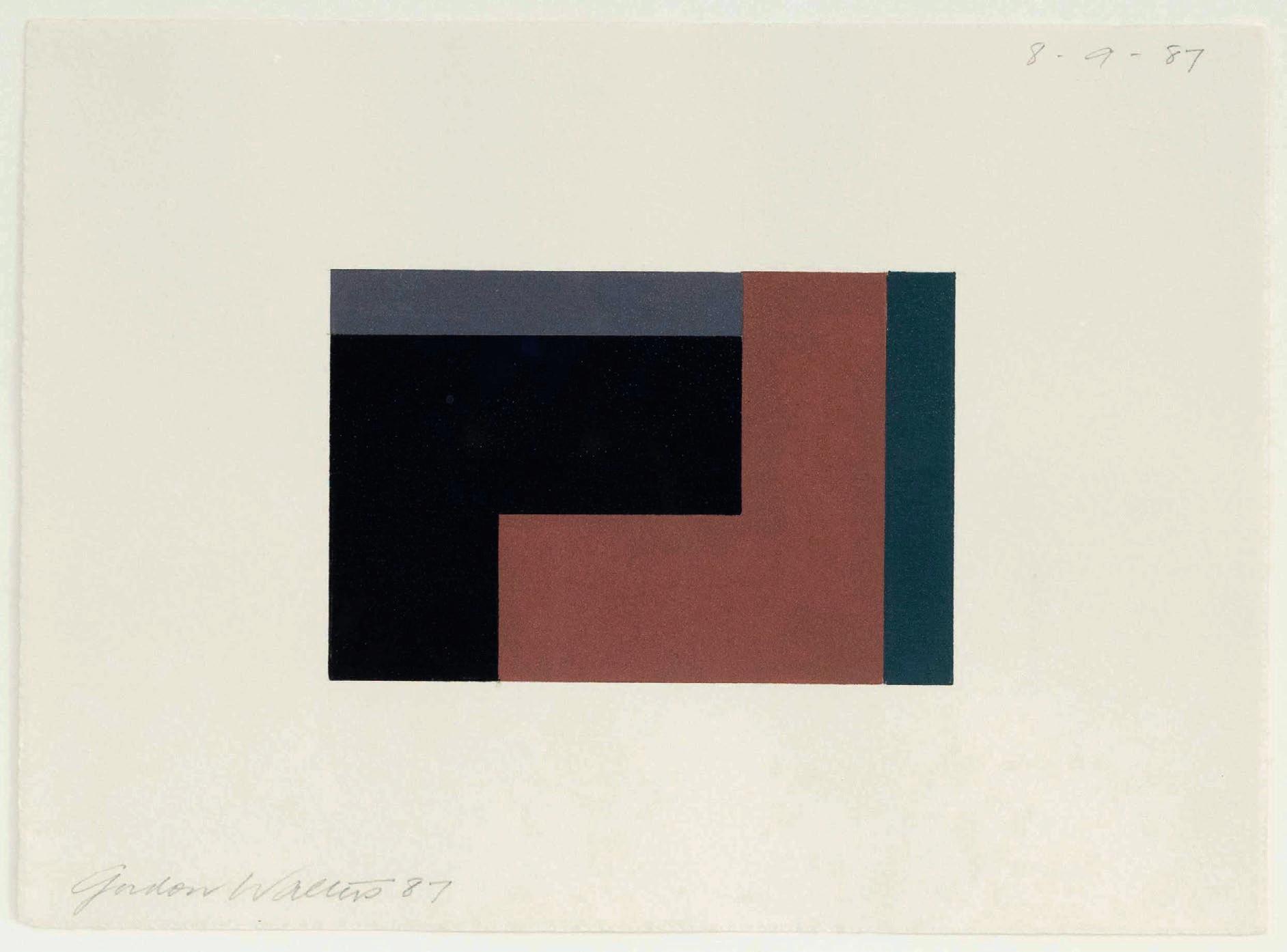
19 GORDON WALTERS (1919 - 95)
Untitled, 1987
Gouache on paper 19 x 26 cm
Signed & dated 87 lower left
Inscribed 8.9.87 top right
$8,000 – 12,000
PROVENANCE
Private Collection, Christchurch
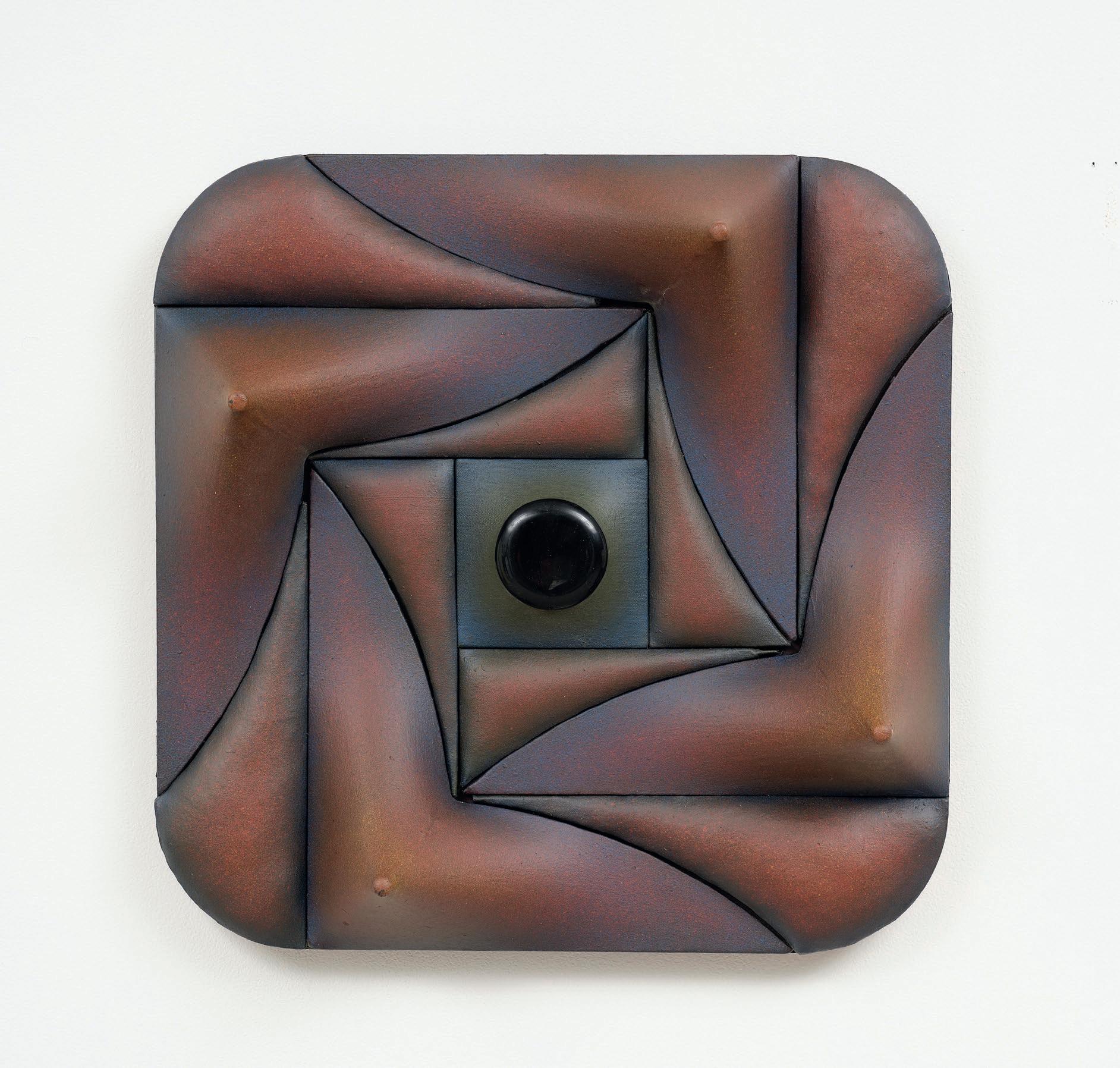
20
EDWARD BULLMORE (1933 - 78)
Icon No 17
Mixed media on moulded canvas on board
49 x 49 cm
Signed & inscribed 70 Pererika Rotorua,
Icon No 17 verso
$10,000 – 15,000
PROVENANCE
Artist Estate Collection
EXHIBITED
The Wellington 61 Group, Hastings Cultural Centre, Hastings, 8 – 24 October 1977
Ted Bullmore Icons, Barry Lett Galleries, Auckland, 23 October – 3 November 1978
Edward Bullmore 1933 – 1978, Rotorua Art Gallery, Rotorua 1979
Edward Bullmore: A Surrealist Odyssey, Tauranga Art Gallery 15 July – 21 September 2008, (touring)
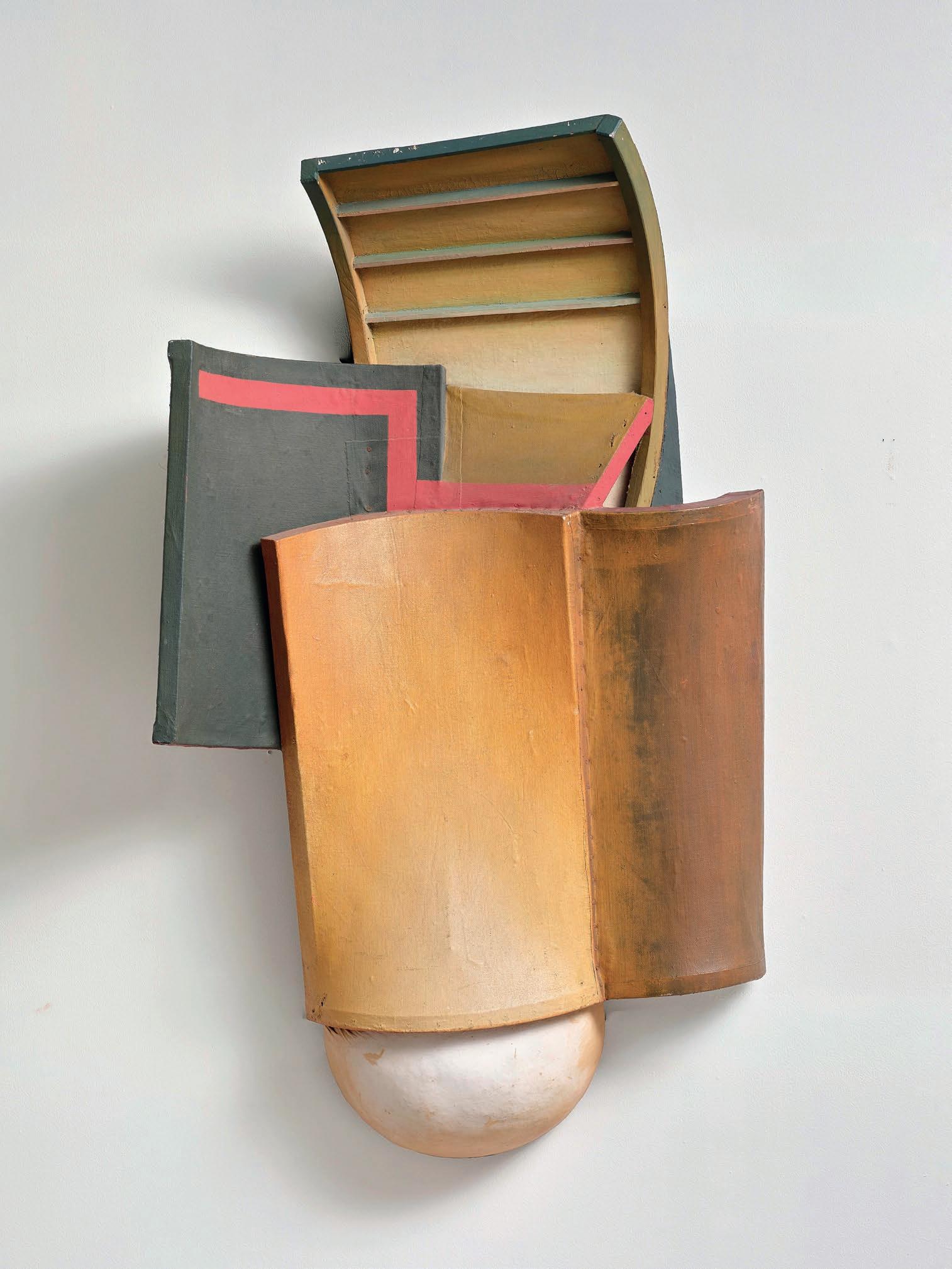
Hikurangi No 17
Acrylic on canvas, fibreglass on wooden structure
136 x 82 cm
Signed, inscribed 117 New Kings Rd, Fulham
SW6, Hikurangi No 17 verso
$15,000 – 18,000
PROVENANCE
Artist Estate Collection
EXHIBITED
One Decade On, The Bath House, Rotorua, 15 November 1988 - 8 February 1989
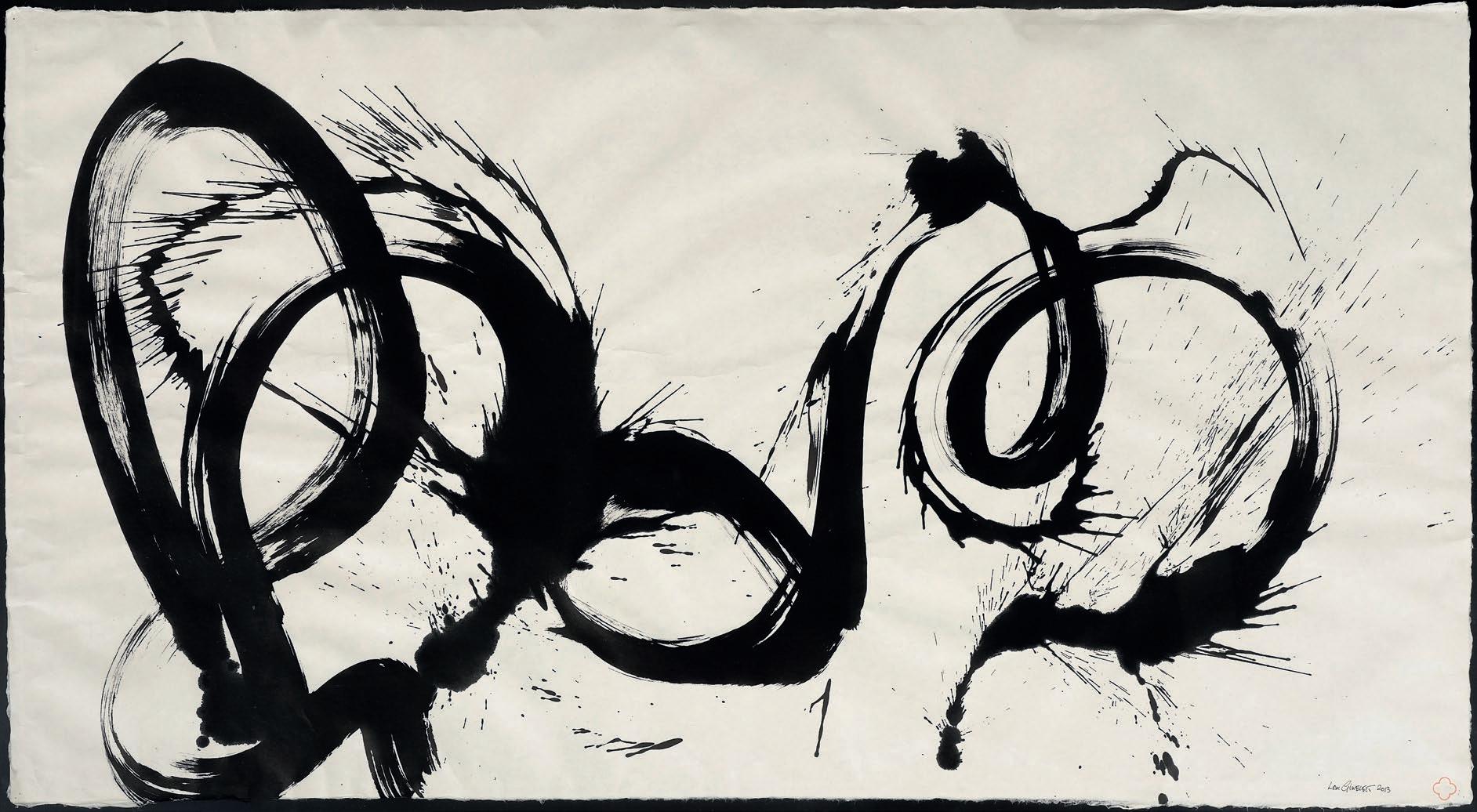
22 MAX GIMBLETT (b. 1935)
Signed & dated 2013 lower right
$10,000 – 15,000
PROVENANCE
Private Collection
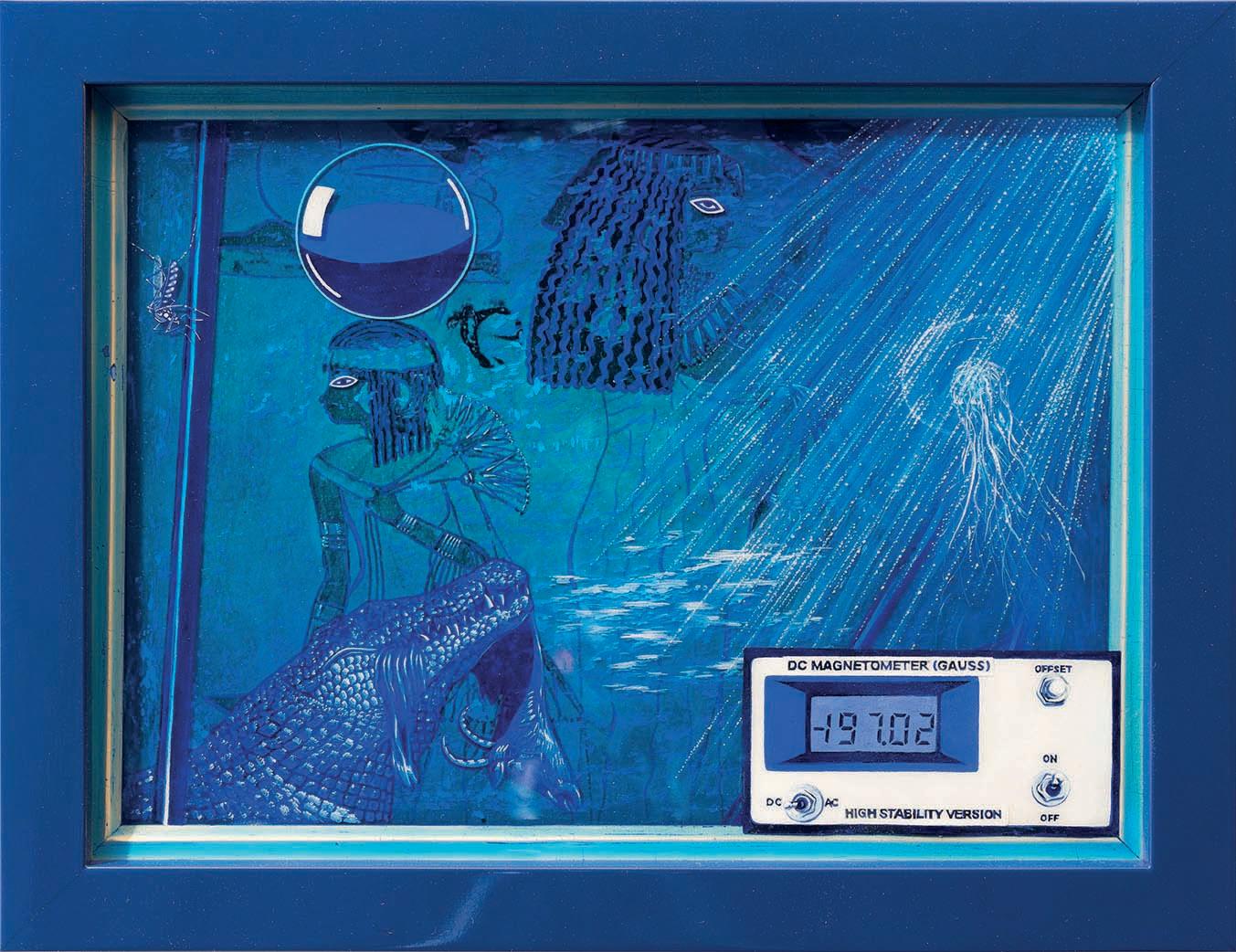
25.5 x 32 cm
$4,000 – 6,000
PROVENANCE
Private Collection, Auckland
EXHIBITED
Liz Maw, The Age Of The Multiverse, Ivan Anthony Gallery, Auckland, 27 June - 18 July 2015
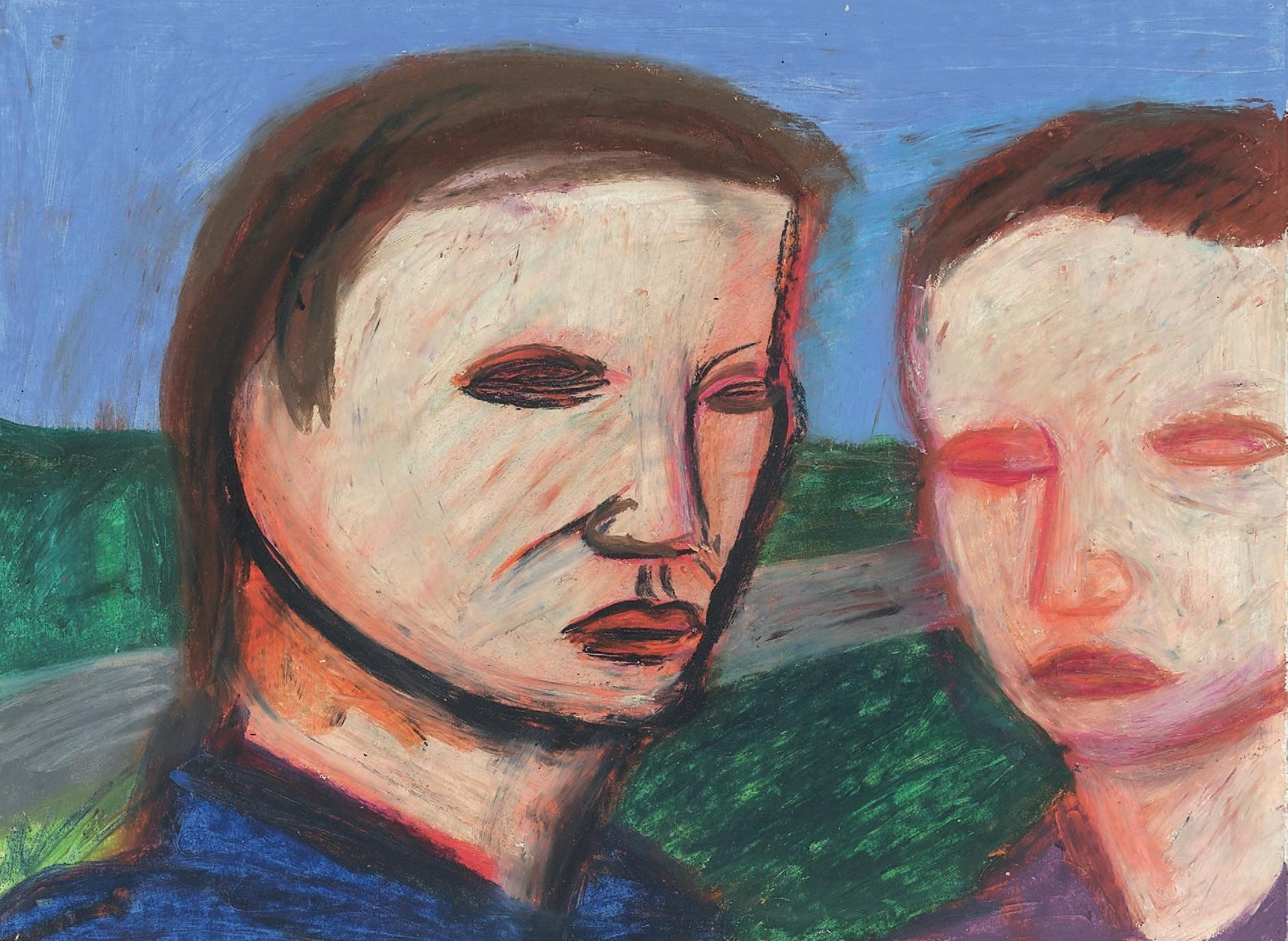
Untitled Oil pastel on paper
27.5 x 38 cm
Signed & dated ‘98 verso
$4,000 – 6,000
PROVENANCE
Private Collection, Otago
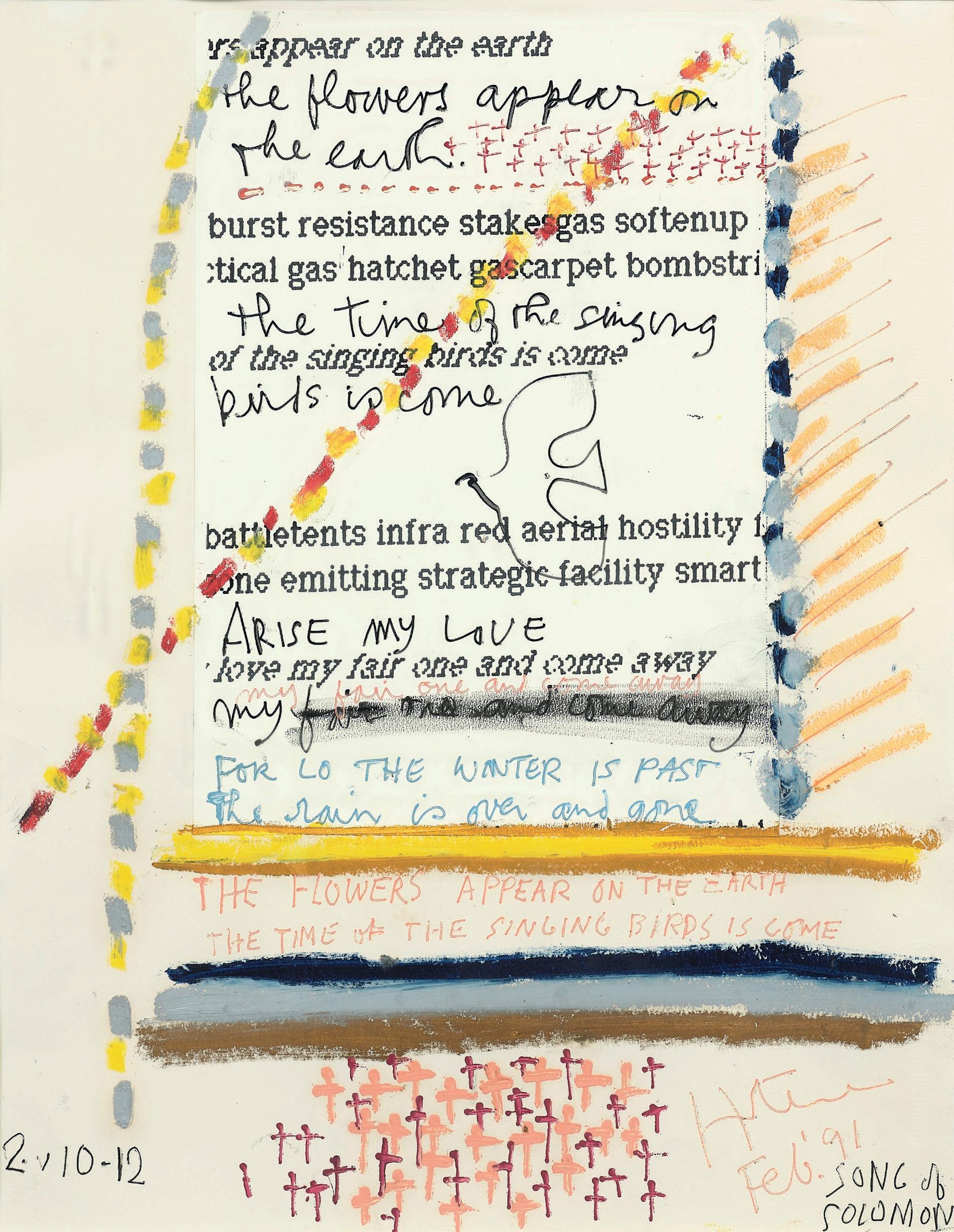
Song of Solomon
Mixed media and collage on paper
62.5 x 49 cm
Signed, inscribed & dated Feb ‘91 lower right
$20,000 – 30,000
PROVENANCE
Private Collection, Auckland
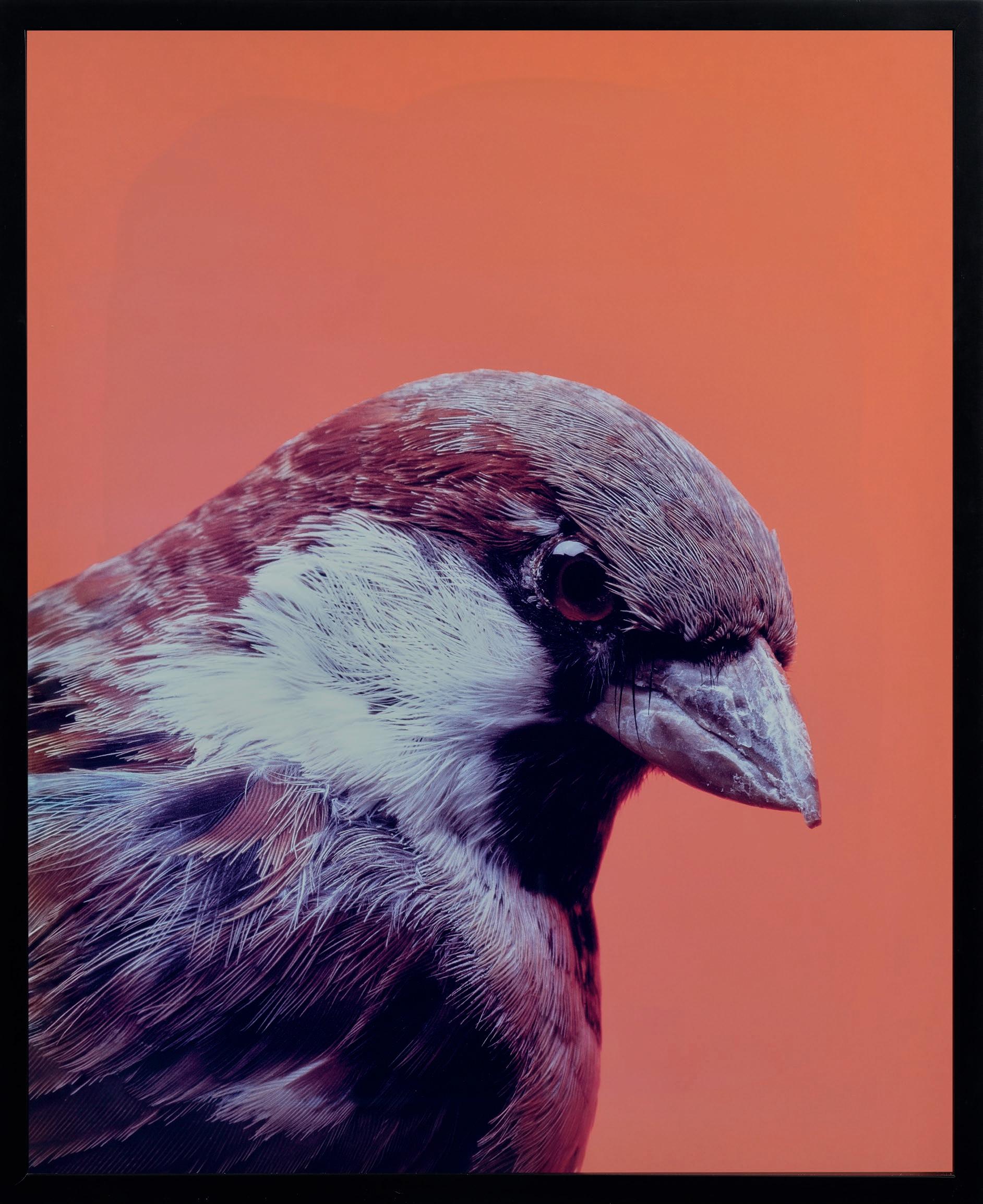
Portrait of Elmer Keith #2, 2004
C-type print, edition of 10
125 x 101 cm
Michael Lett Gallery label affixed verso
$24,000 – 28,000
PROVENANCE
Private Collection, Auckland
Acquired from Michael Lett Gallery, Auckland
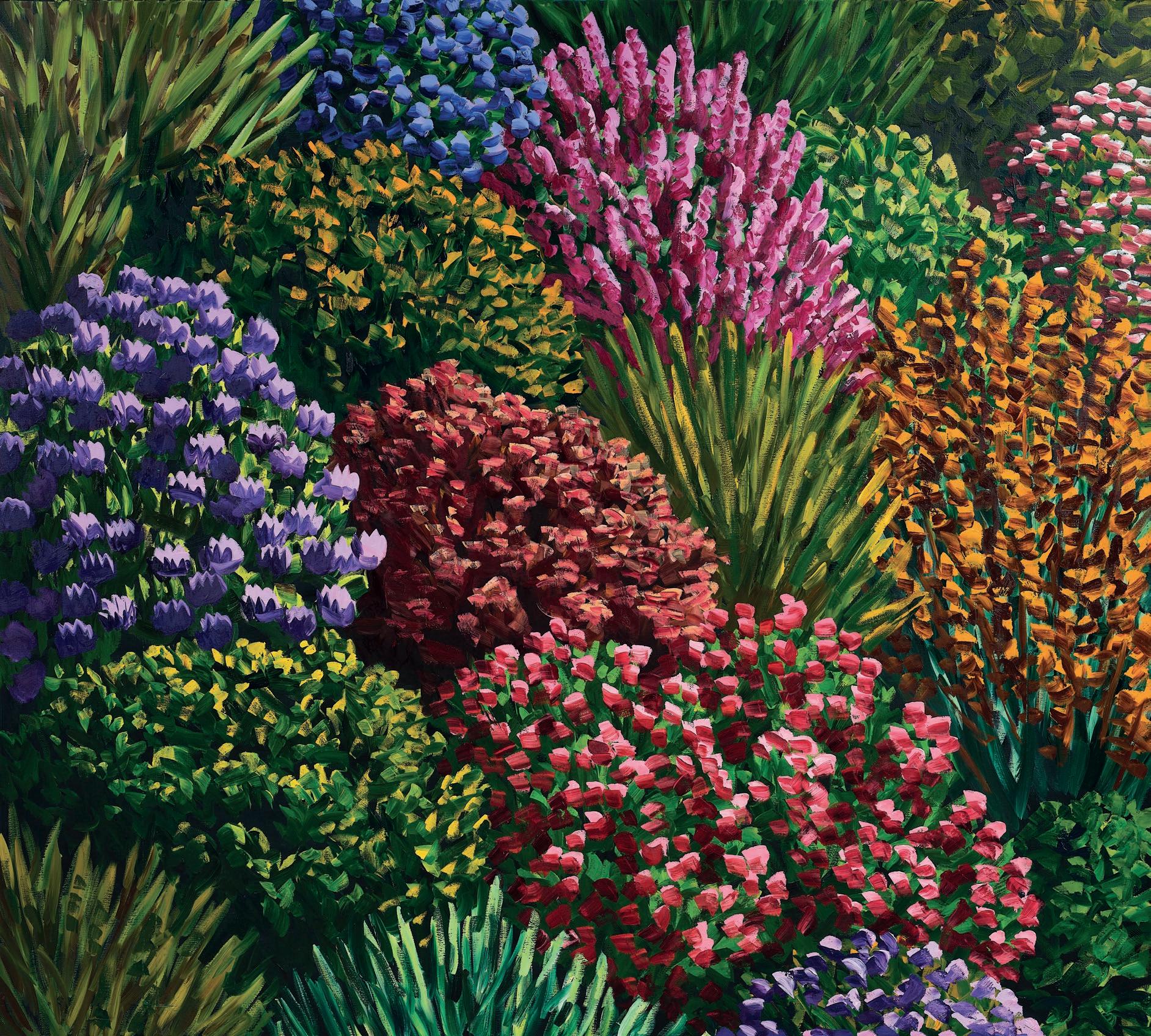
Sentinel Road 2
Oil on canvas
180 x 200 cm
Signed, inscribed & dated 2019 verso
$30,000 – 40,000
PROVENANCE
Private Collection, Auckland
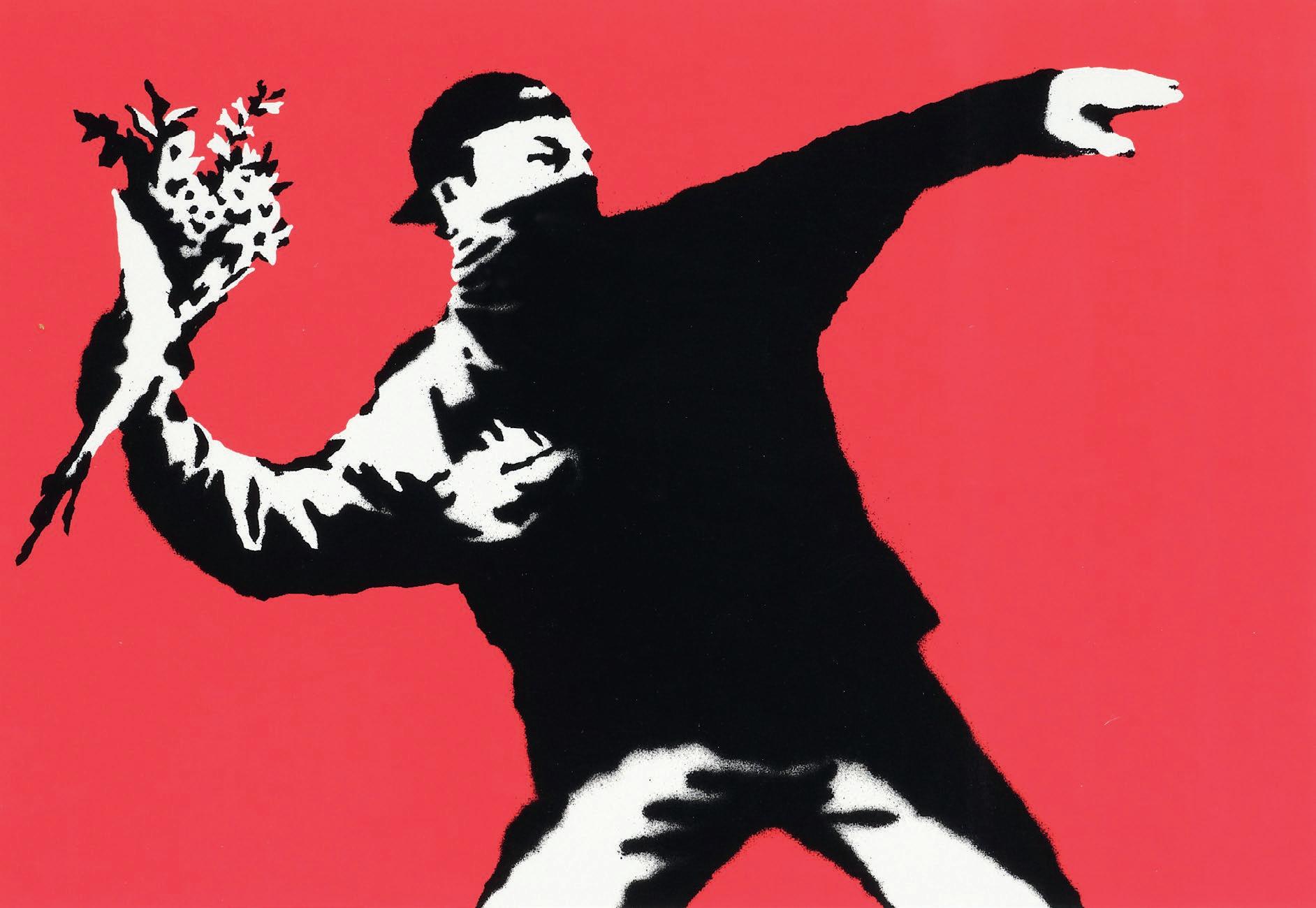
Active since the 1990s Banksy’s satirical street art combines perceptive social commentary with a degree of dark humor. The viewer is often simultaneously challenged and amused by the unexpected appearance of Banksy’s distinctive, finely stencilled graffiti on walls, streets and bridges.
Love Is In The Air, also known as Flower Thrower first appeared in 2003 as large format, stencilled graffiti in Jerusalem shortly after the construction of the West Bank Wall. In Banksy’s iconic and characteristic signature stencilled style, Love Is In The Air depicts a protestor wearing a baseball cap and a bandana to mask the lower half of his face.
The artist adds an inevitable twist, placing a bunch of flowers into the thrower’s hand instead of a molotov cocktail or grenade. Despite what appears to be anger and frustration in the subjects pose, he prepares to launch a universal symbol of love and peace as opposed to a weapon.
Love Is In The Air is one of Banksy’s most iconic and sought after works. It has been reproduced on posters, phone covers, T-shirts and other merchandise all over the world. The image also features across the cover of the 2005 publication Wall and Piece, Banksy. Although completed in 2003, this image with it’s masked subject possesses a powerful relevance.
28 BANKSY (British b.1974)
Love is in the Air
Screenprint, edition 329/500
45.5 x 66 cm
Red Banksy stamp in plate
Accompanied by Pest Control Certificate of Authenticity
$50,000 - 75,000
PROVENANCE
Private Collection, United Kingdom
ILLUSTRATED
Front cover, Wall and Piece, Banksy, Vintage Publishing, United Kingdom, 2005
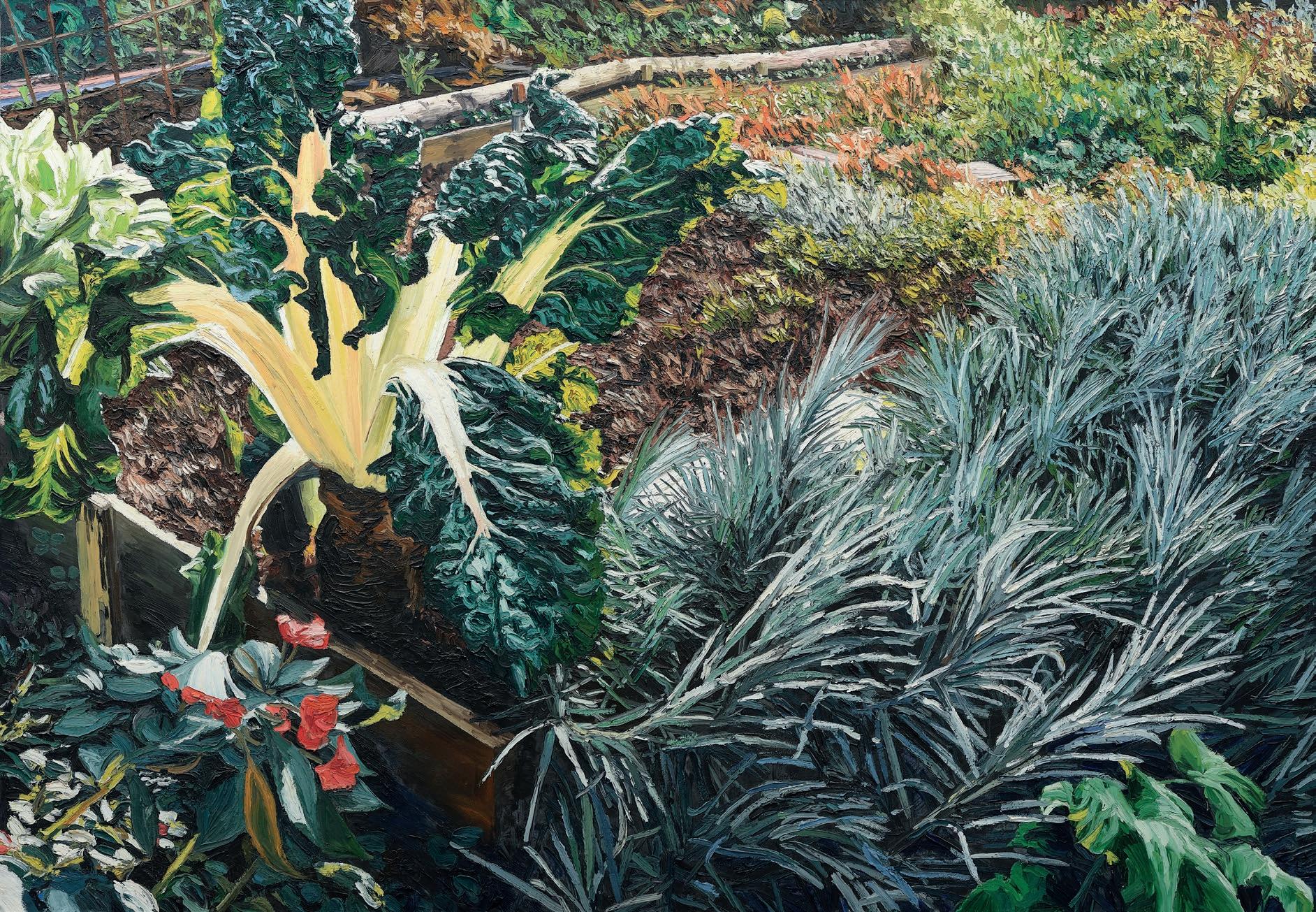
29 KARL MAUGHAN (b. 1964)
Silverbeet
Oil on canvas
137 x 197 cm
Signed & dated 28/7/87 verso
$40,000 - 50,000
PROVENANCE
Private Collection, Hawke’s Bay
ILLUSTRATED
Dick Frizzell, IT’S ALL ABOUT THE IMAGE, Random House, New Zealand, 2011, p.156
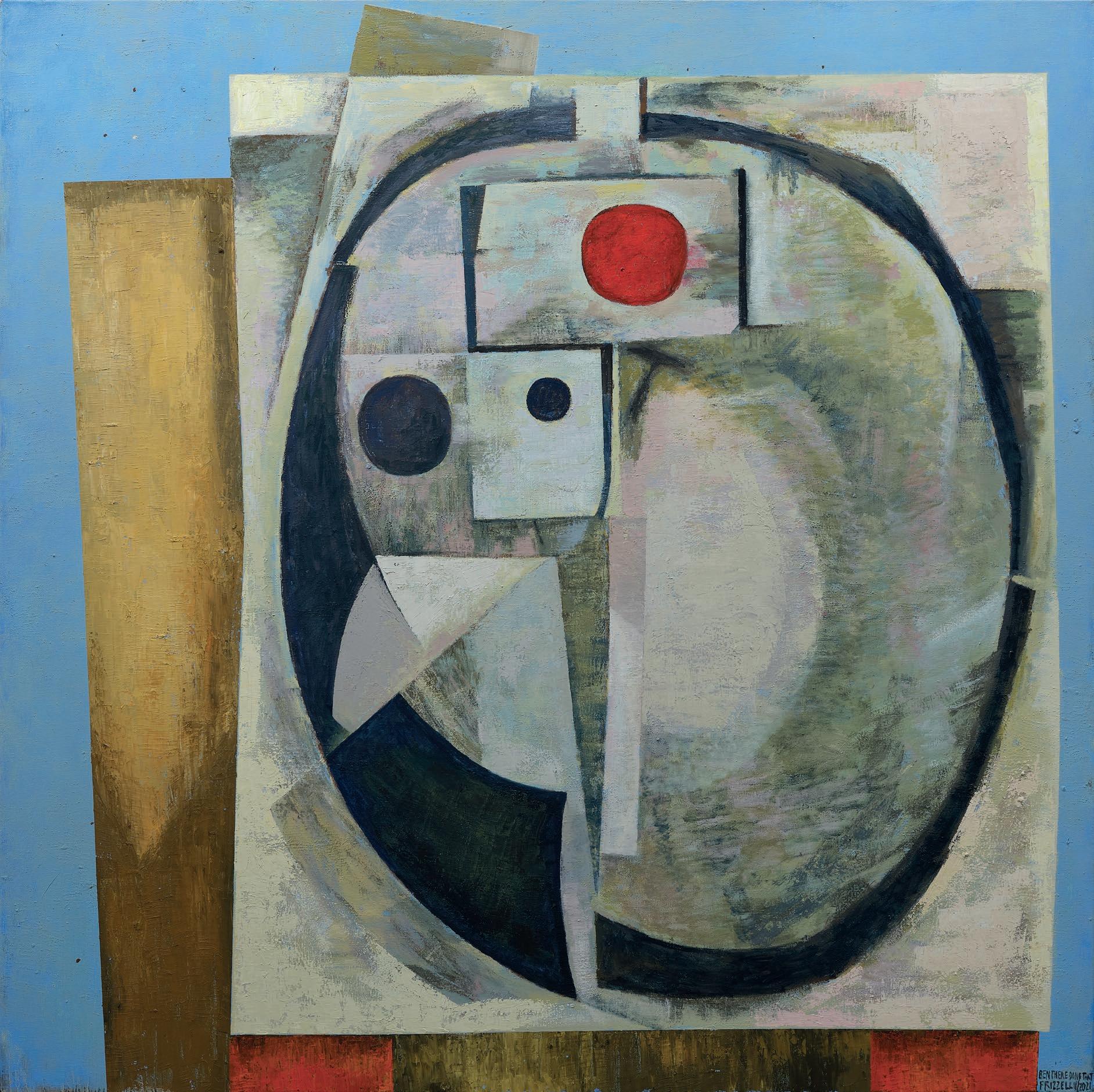
Hitting 60 (2011) Oil on canvas
105 x 103 cm
Signed & dated 11/2021 lower right
Inscribed Ben There Done That lower right
$30,000 – 40,000
PROVENANCE
Private Collection, Auckland
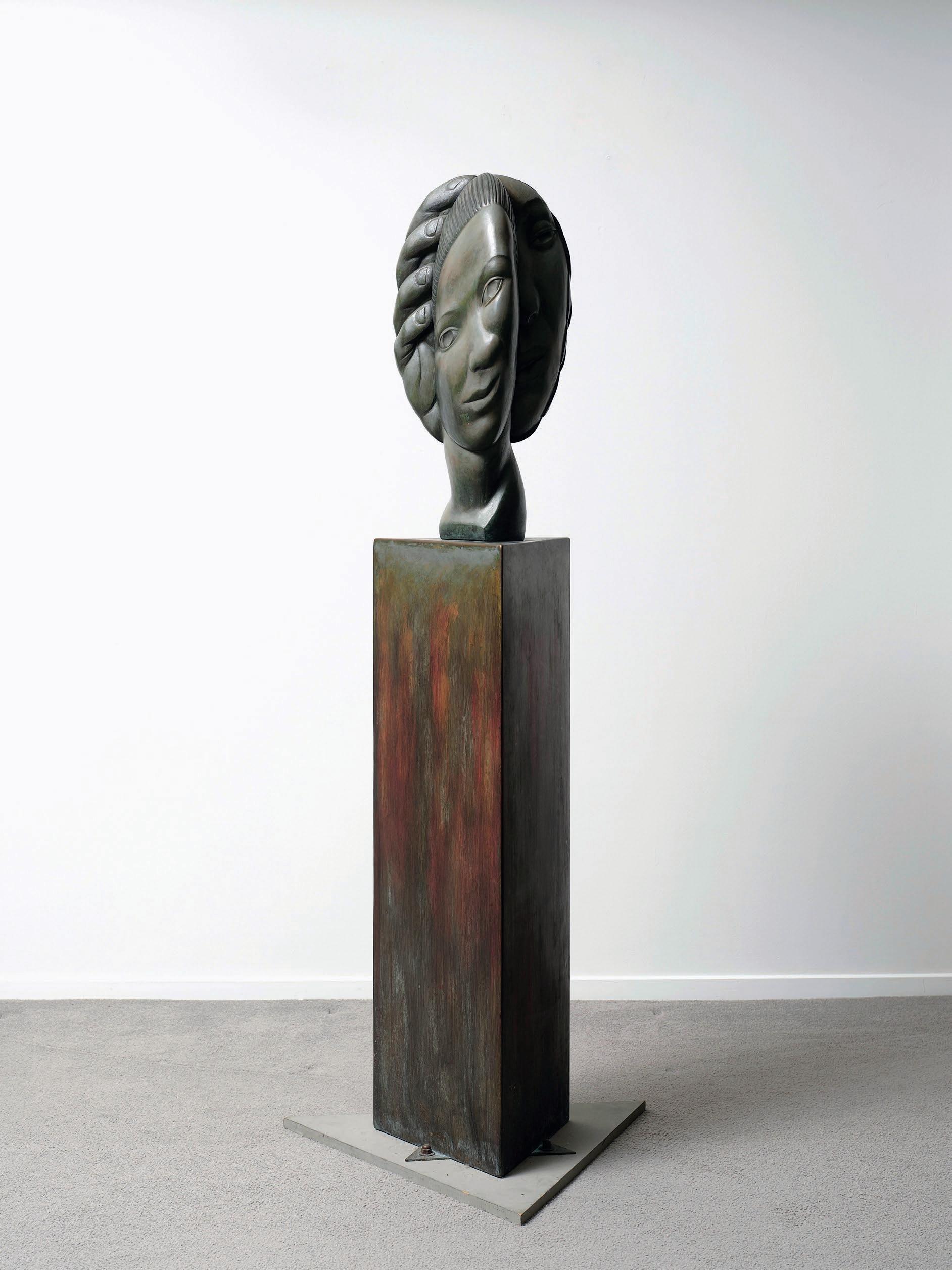
Our Home is Our Childhood Cast bronze, edition 1/3 160 x 33 cm
Signed & dated 2006
$25,000 – 35,000
PROVENANCE
Private Collection, Auckland
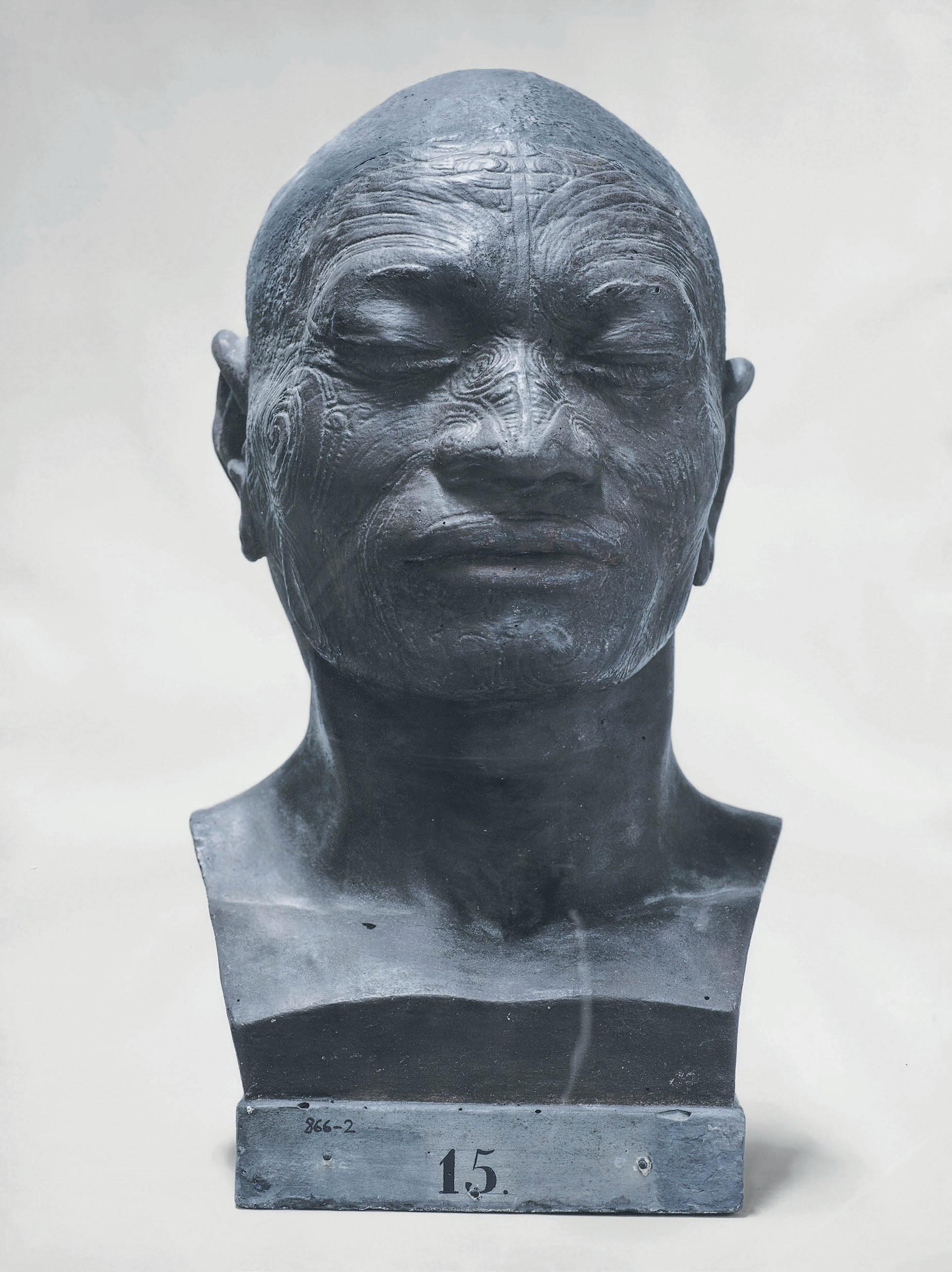
Portrait of a life cast of Matoua Tawai, Aotearoa New Zealand, 2010
Pigment inks on Hahnemühle
photo rag paper
144.5 x 108.5 cm
$15,000 - 20,000
PROVENANCE
Private Collection, Auckland
Acquired from Two Rooms Gallery, Auckland
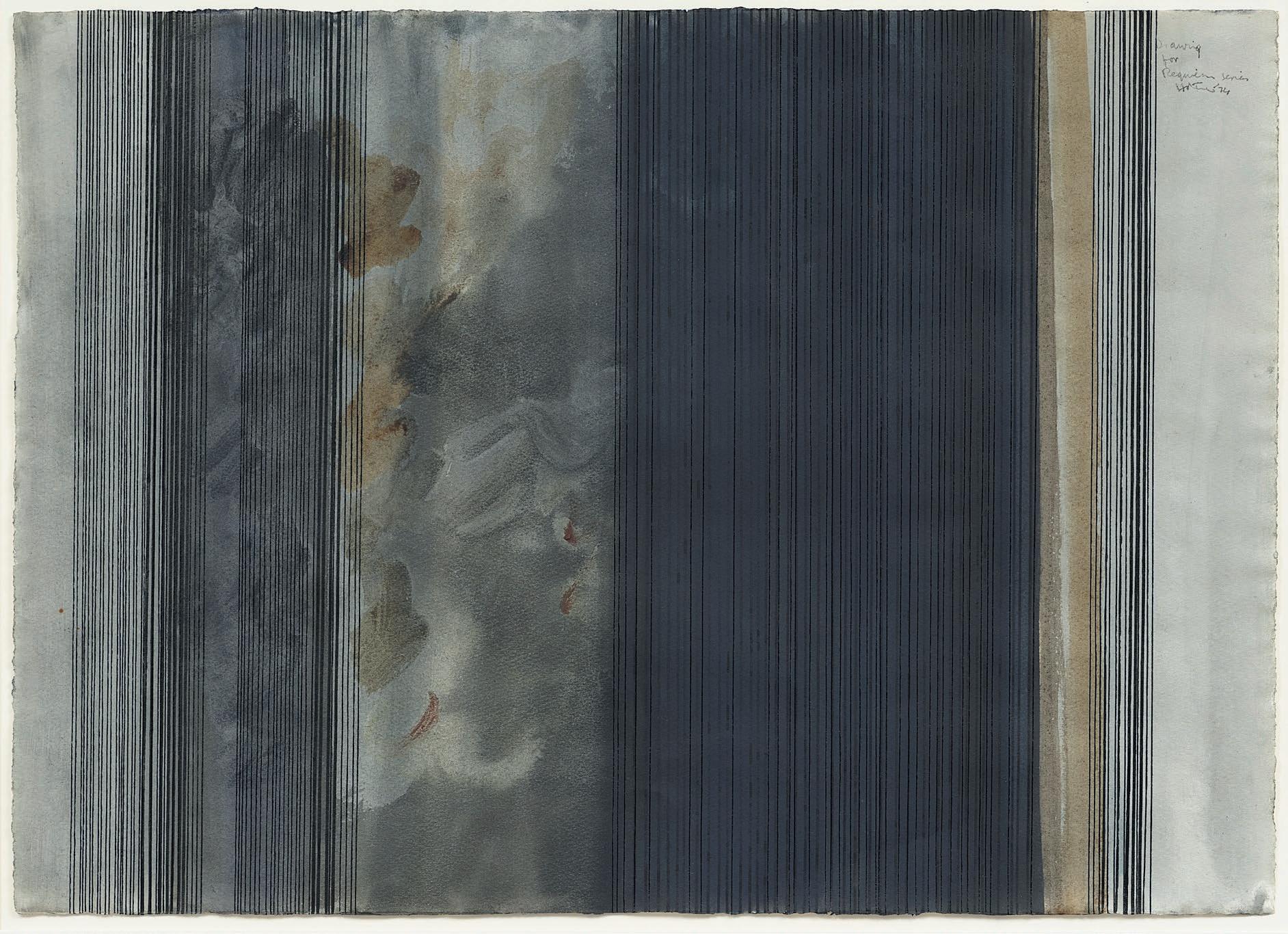
33 RALPH HOTERE (1931 - 2013)
Drawing for Requiem Series
Watercolour
50 x 72 cm
Signed & dated 1974 upper right
$30,000 - 40,000
PROVENANCE
Private Collection, Auckland
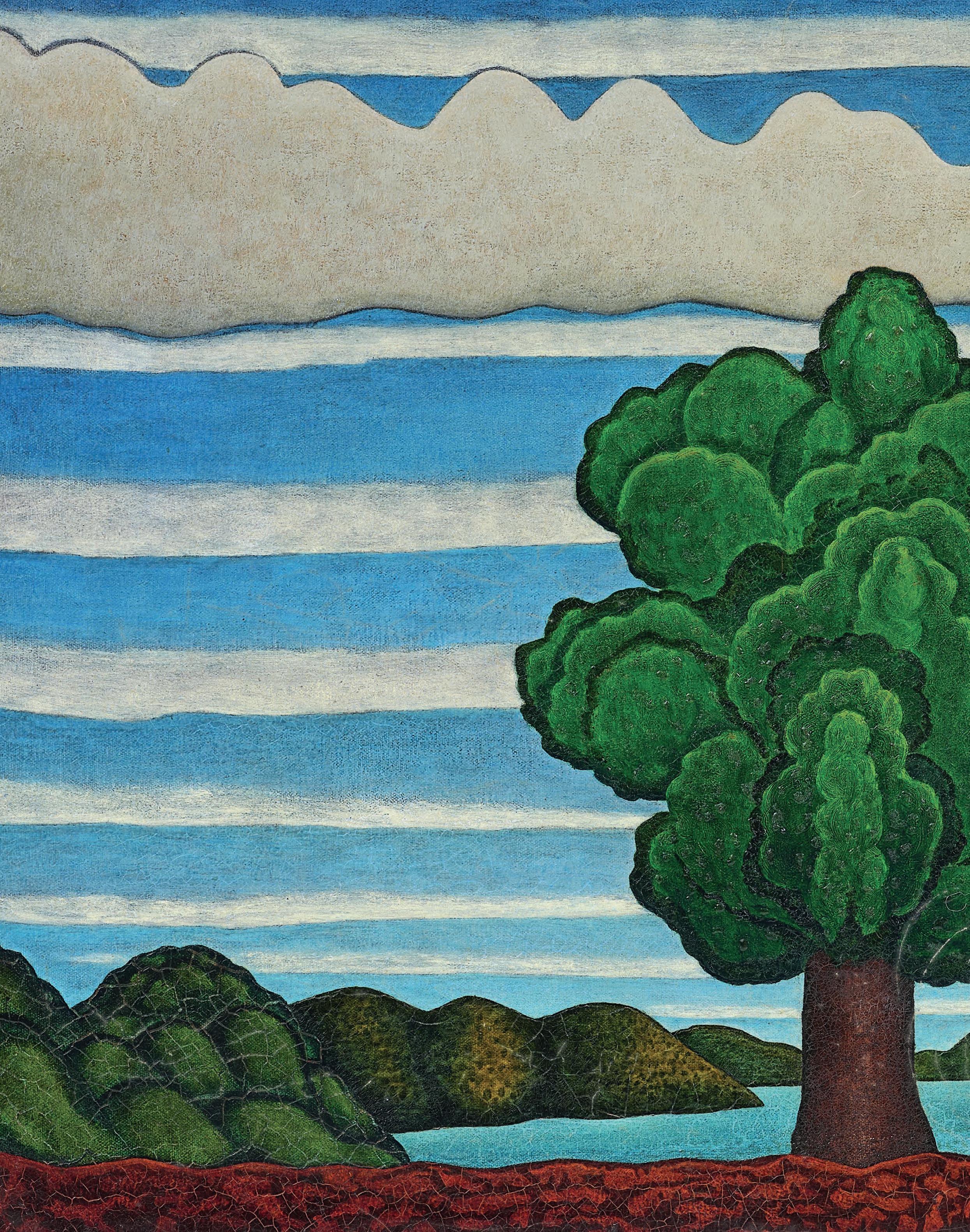
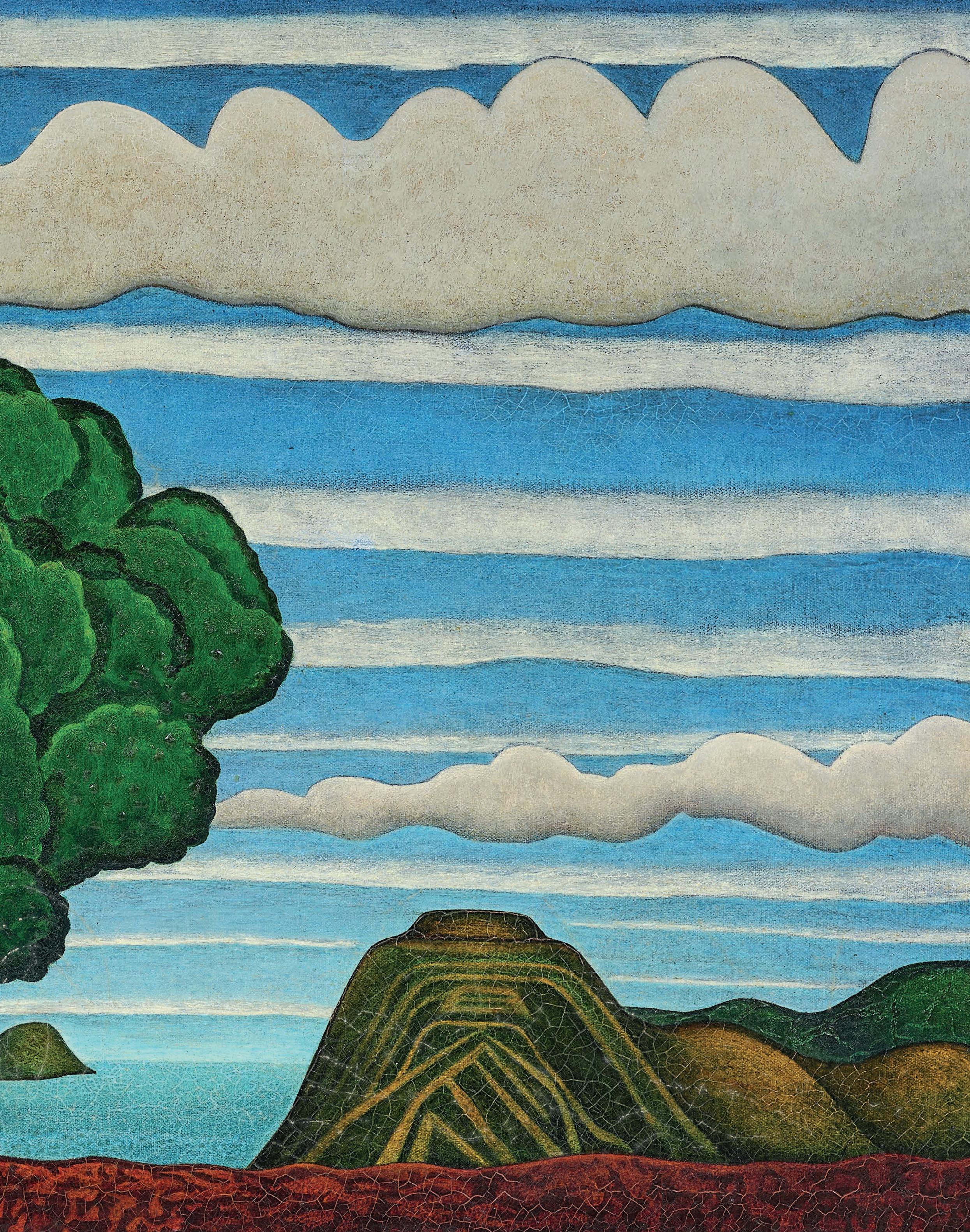
34
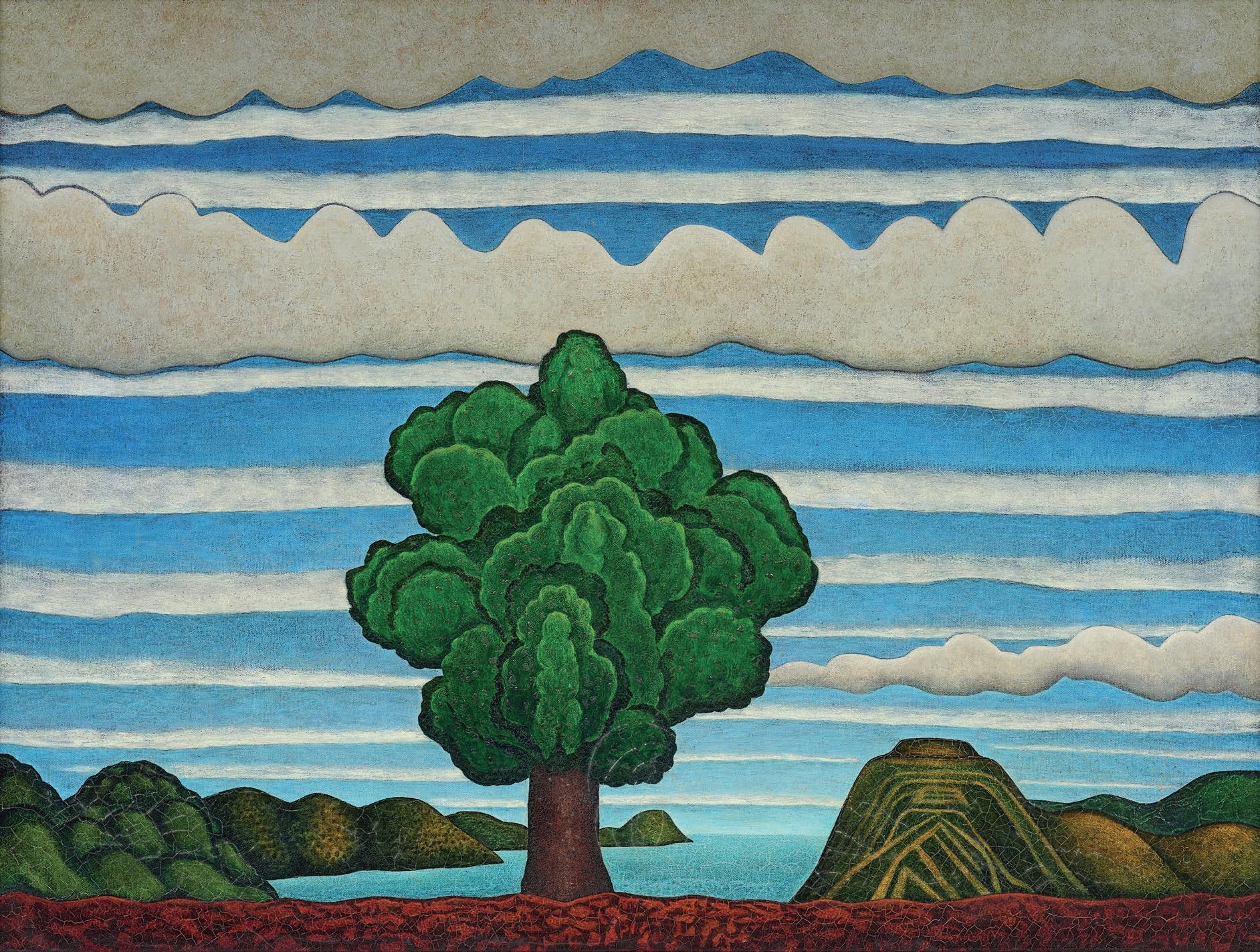
MICHAEL ILLINGWORTH (1932 - 88)
A Tree I Know Near Matauri Bay Oil on canvas
50.5 x 67 cm
Signed, title inscribed & dated 72 verso
$80,000 – 120,000
PROVENANCE
Private Collection, Auckland
Acquired from Webb’s, Fine Jewellery & Watches, Antiques & Decorative Arts, Important Works of Art, 30 June 2008, Lot 518
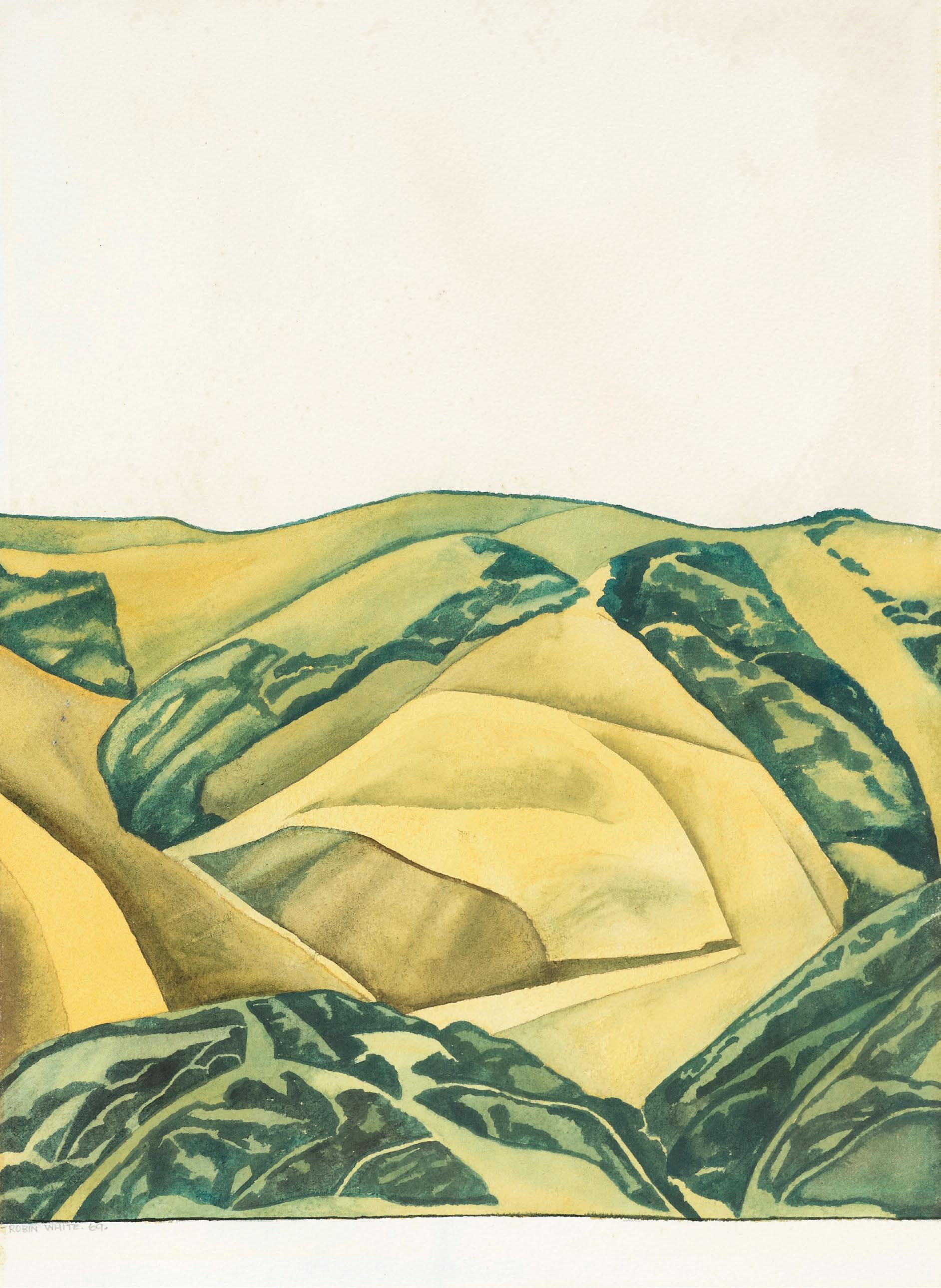
35 ROBIN WHITE (b. 1946)
Bare Hill, Paremata II
Watercolour
44.5 x 32 cm
Signed & dated .69 lower left
$30,000 – 40,000
PROVENANCE
Private Collection, Auckland
EXHIBITED
Moller’s Annual Group Show, Auckland, 1970
REFERENCED
Robin White, Robin White New Zealand Painter, Alister Taylor, 1981, cat no. 10, p. 75
Painted in 1969, Bare Hill, Paremata II belongs to a formative period in Dame Robin White’s career. Following her studies at Elam School of Fine Arts and Auckland Teachers’ Training College, White settled at Bottle Creek, Paremata, where she lived and taught between the late 1960s and early 1970s. These years proved pivotal, as she established the disciplined daily practice that would underpin one of New Zealand’s most distinguished artistic careers.
The landscapes surrounding Paremata and neighbouring Porirua became White’s earliest and most enduring subjects. Rather than seeking dramatic vistas, she focused on the quiet, everyday character of the places in which she lived, finding beauty in their simplicity and understated rhythms. During this period, she also refined her printmaking alongside her painting, developing the economy of line and carefully balanced compositions that would become hallmarks of her work.
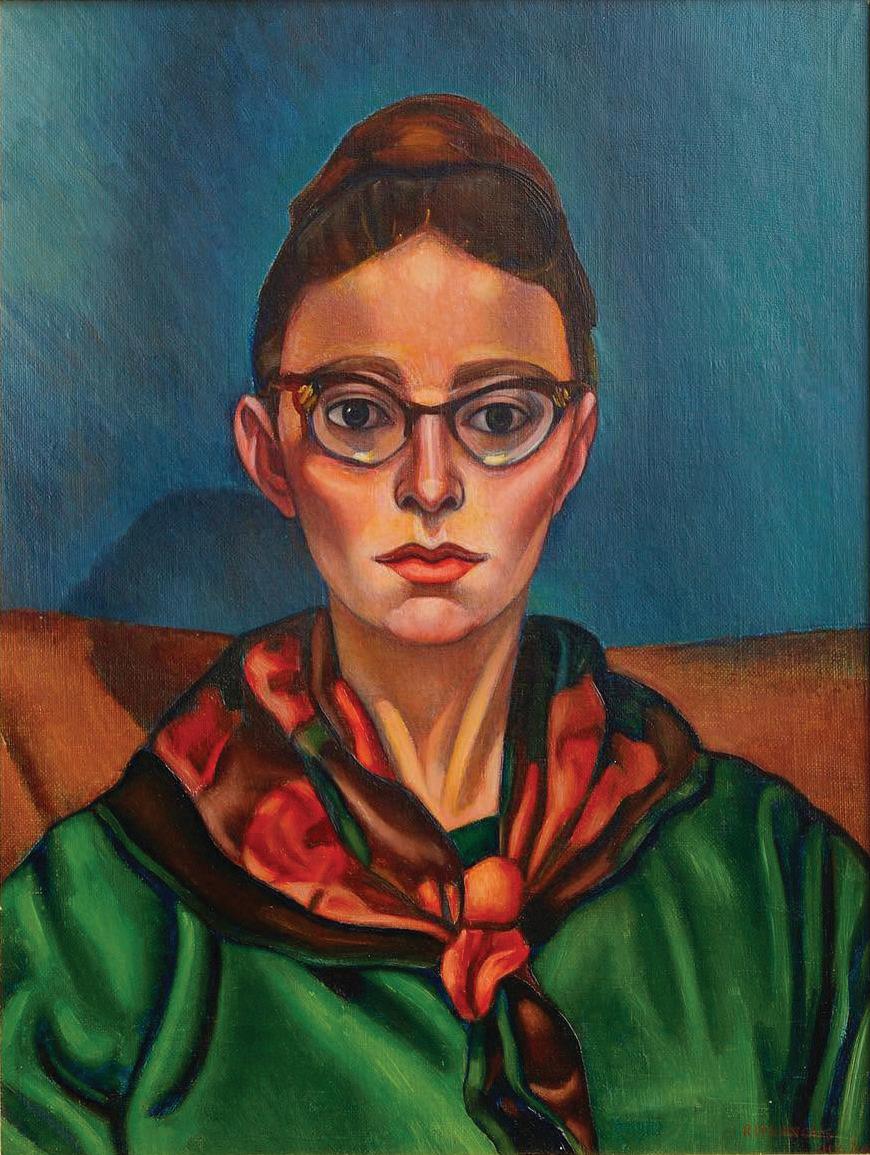
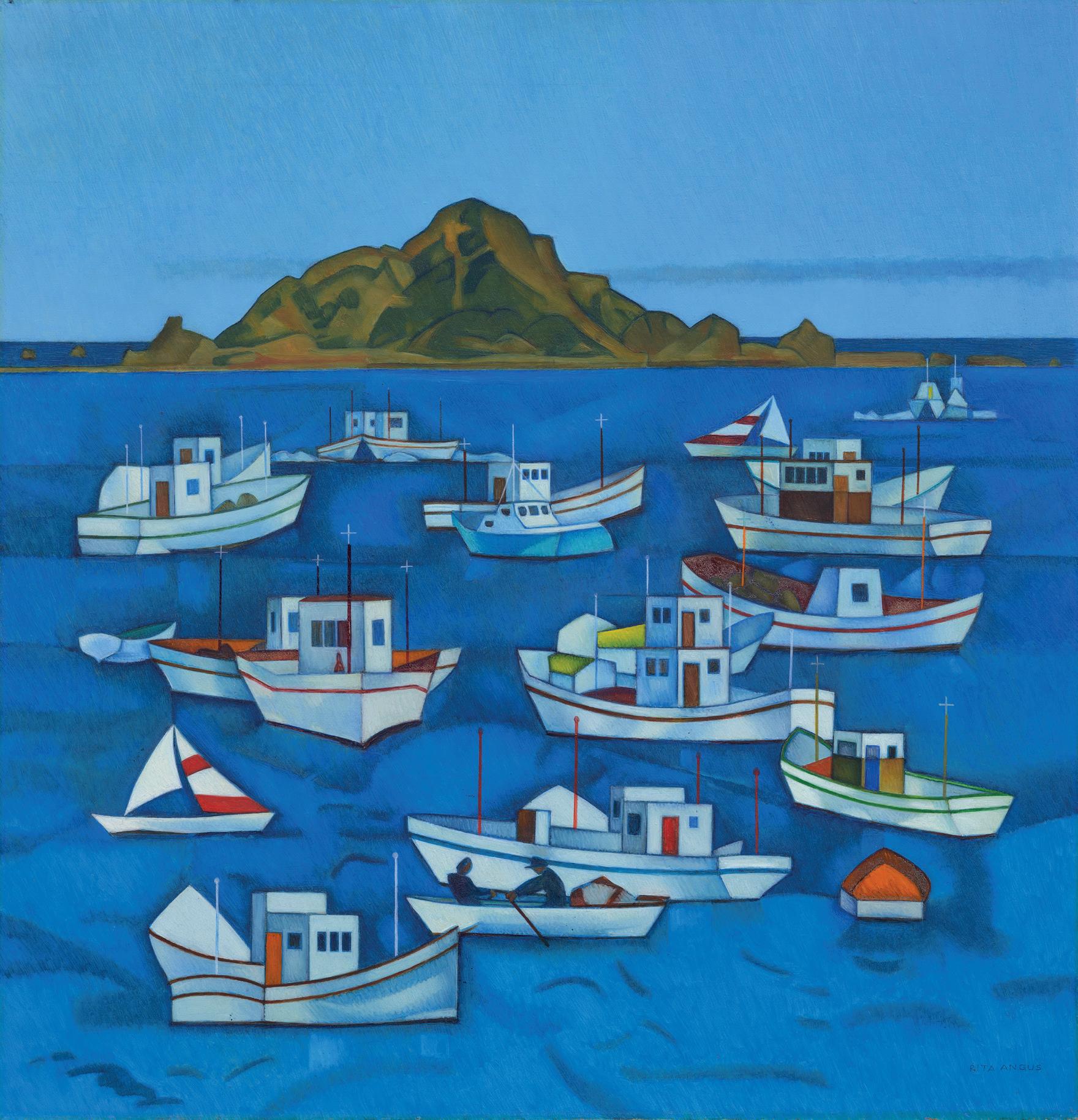
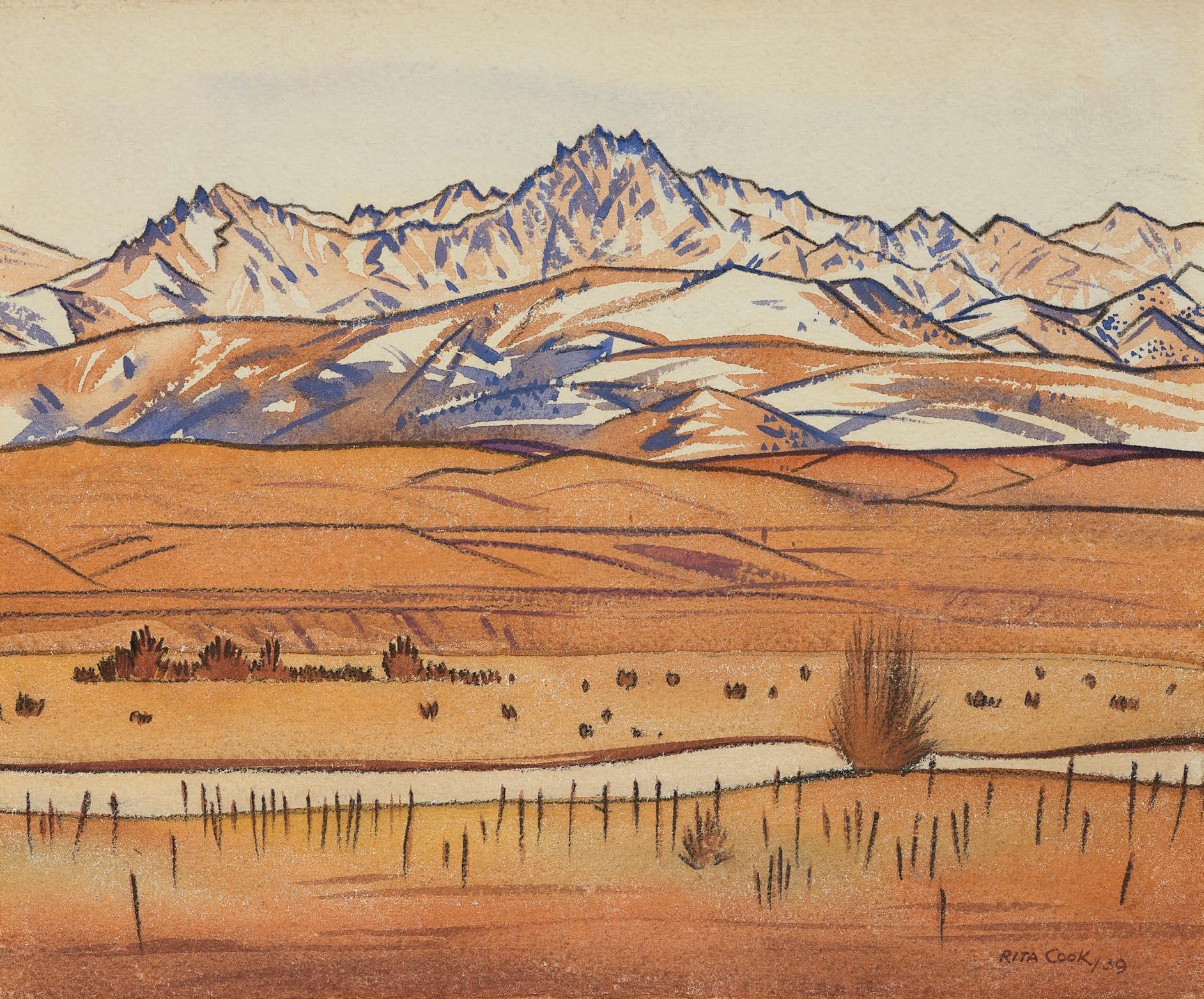
36 RITA ANGUS (1908 - 70)
Gold Range Pembroke
Watercolour
22.5 x 27.5 cm
Signed Rita Cook & dated /39 lower right
$80,000 - 120,000
PROVENANCE
Private Collection
Acquired from Webb’s, Auckland c.1980
Painted in 1939, Gold Range, Pembroke dates from a pivotal period in Rita Angus’ early career. That year she spent four months in Wānaka with her close friends Marjorie and William Marshall. Angus had met Marjorie while studying at the Canterbury College School of Art, and during her stay William, then headmaster of the local school, regularly drove the two artists into the surrounding countryside for weekend painting excursions.
The visit provided Angus with the opportunity to explore the landscapes of Central Otago, whose distinctive light, expansive skies and rugged mountain ranges left a lasting impression. The South Island high country became one of the defining subjects of her work during this period, inspiring a series of watercolours remarkable for their clarity of observation and confident handling of the medium. Created while Angus was exhibiting regularly with both the Canterbury Society of Arts and The Group, this work belongs to a formative period in which Angus’ distinctive artistic voice was becoming firmly established.
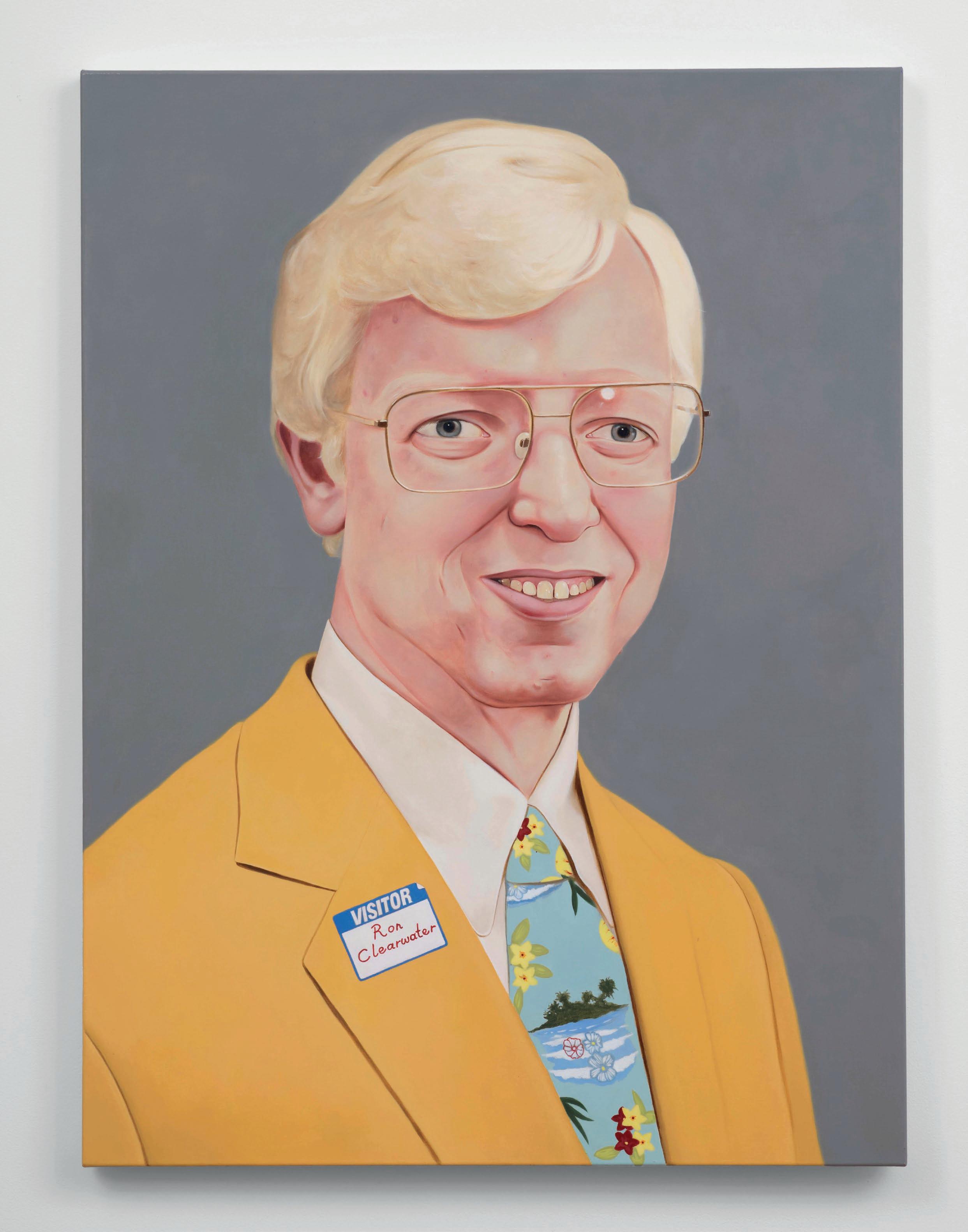
37 PETER STICHBURY (b. 1969)
Ron Clearwater, 2009
Acrylic on canvas
120 x 90 cm
Signed, inscribed & dated 2009 verso
$40,000 - 60,000
Private Collection, Auckland
Private Collection, Wellington
Acquired from Starkwhite, Auckland, 2009
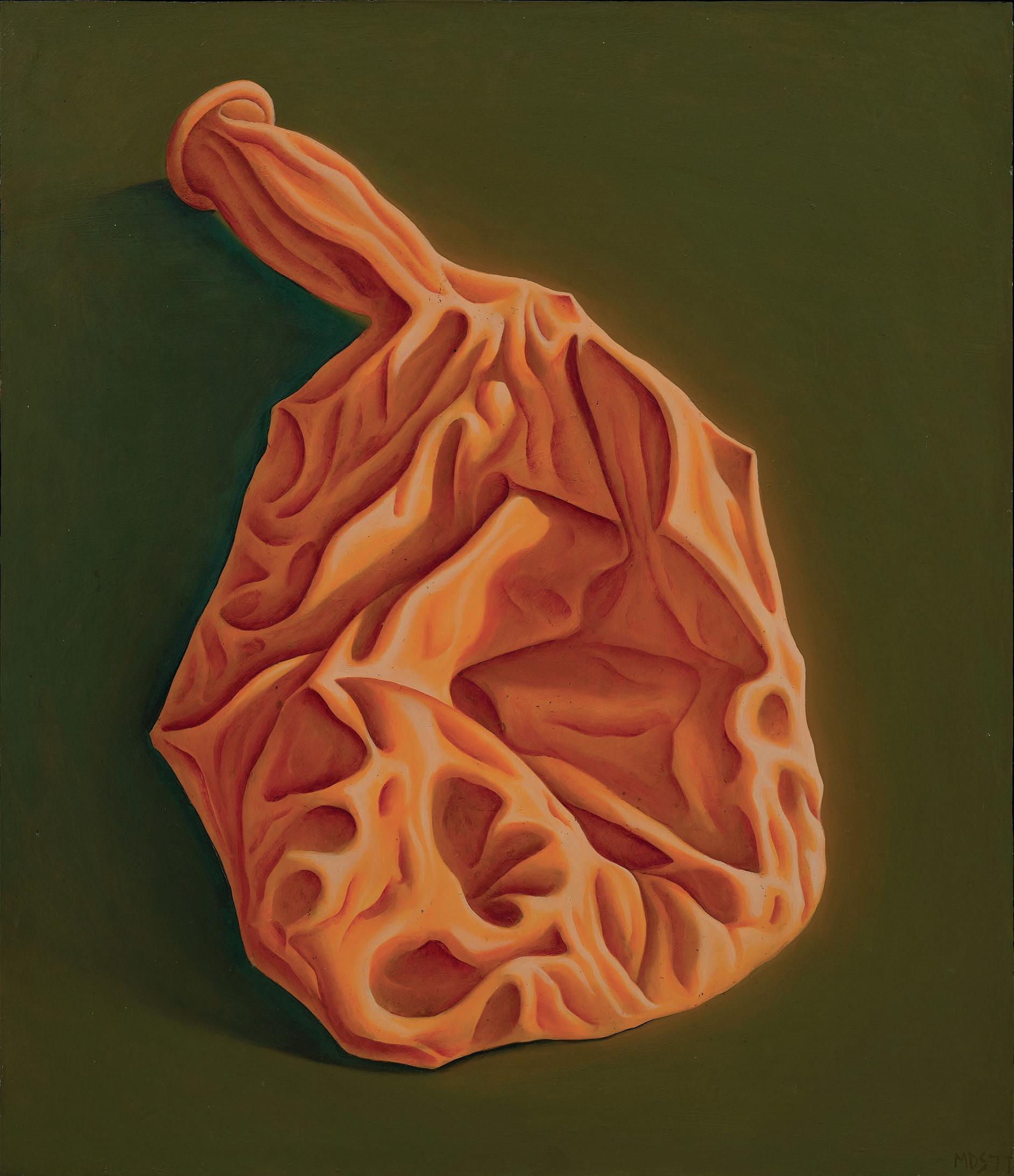
38 MICHAEL SMITHER (b. 1939)
Spent Balloon Oil on board
68 x 58.5 cm
Signed & dated 77 lower right
Signed & inscribed Balloon verso
$40,000 - 60,000
PROVENANCE
Private Collection, Auckland
ILLUSTRATED
Trish Gribben, Michael Smither Painter, Ron Sang Publications, Auckland, p. 156
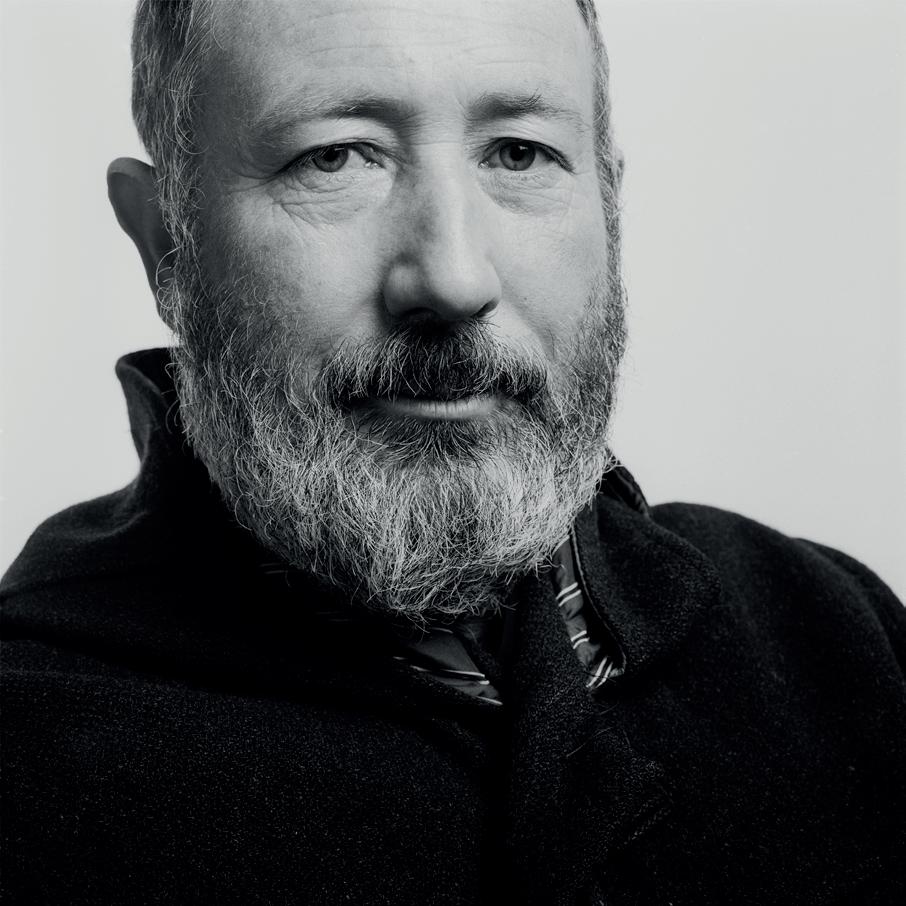
“I find at times that my eye is captured by a seemingly mundane object. Some spirit demands that I pay it particular attention. This painting, like the yellow rubber gloves, is a response to my “mindless” eye, or maybe I’ve got a rubber fetish.”
Michael Smither
39
MICHAEL SMITHER (b. 1939)
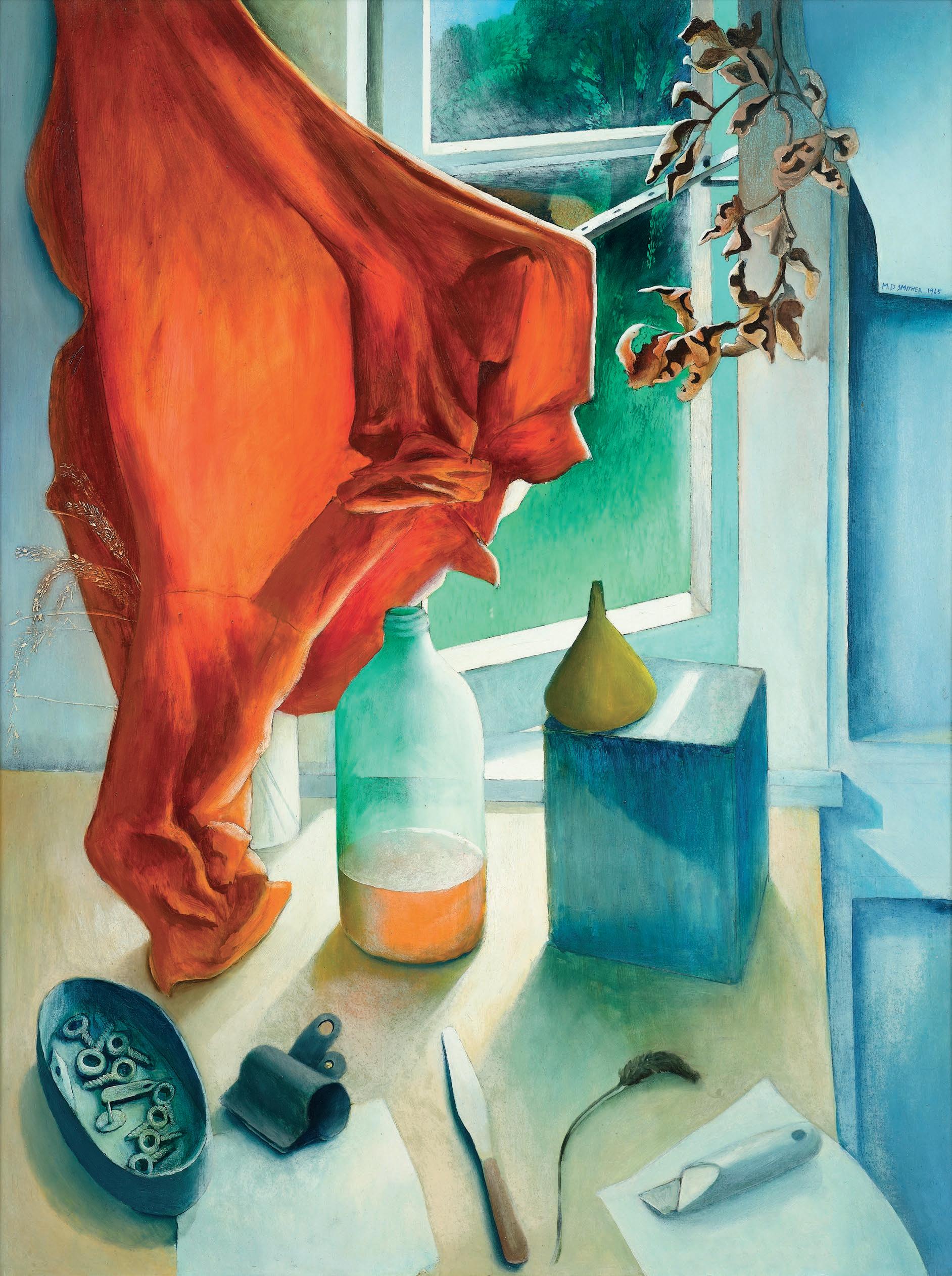
Still Life in Artist’s Studio Oil on board
121 x 90.5 cm
Signed M.D Smither & dated 65 upper right
$80,000 - 120,000
PROVENANCE
Private Collection, Wellington Acquired from Webb’s, Fine New Zealand & Foreign Paintings, Auckland, 03/04/2001, Lot no. 58
“This is a painting made of my studio in Brookland Park, The Gables. It had lovely light and I used my orange shirt to shade my eyes from the morning sun. I did many paintings from that place.”
Michael Smither
40
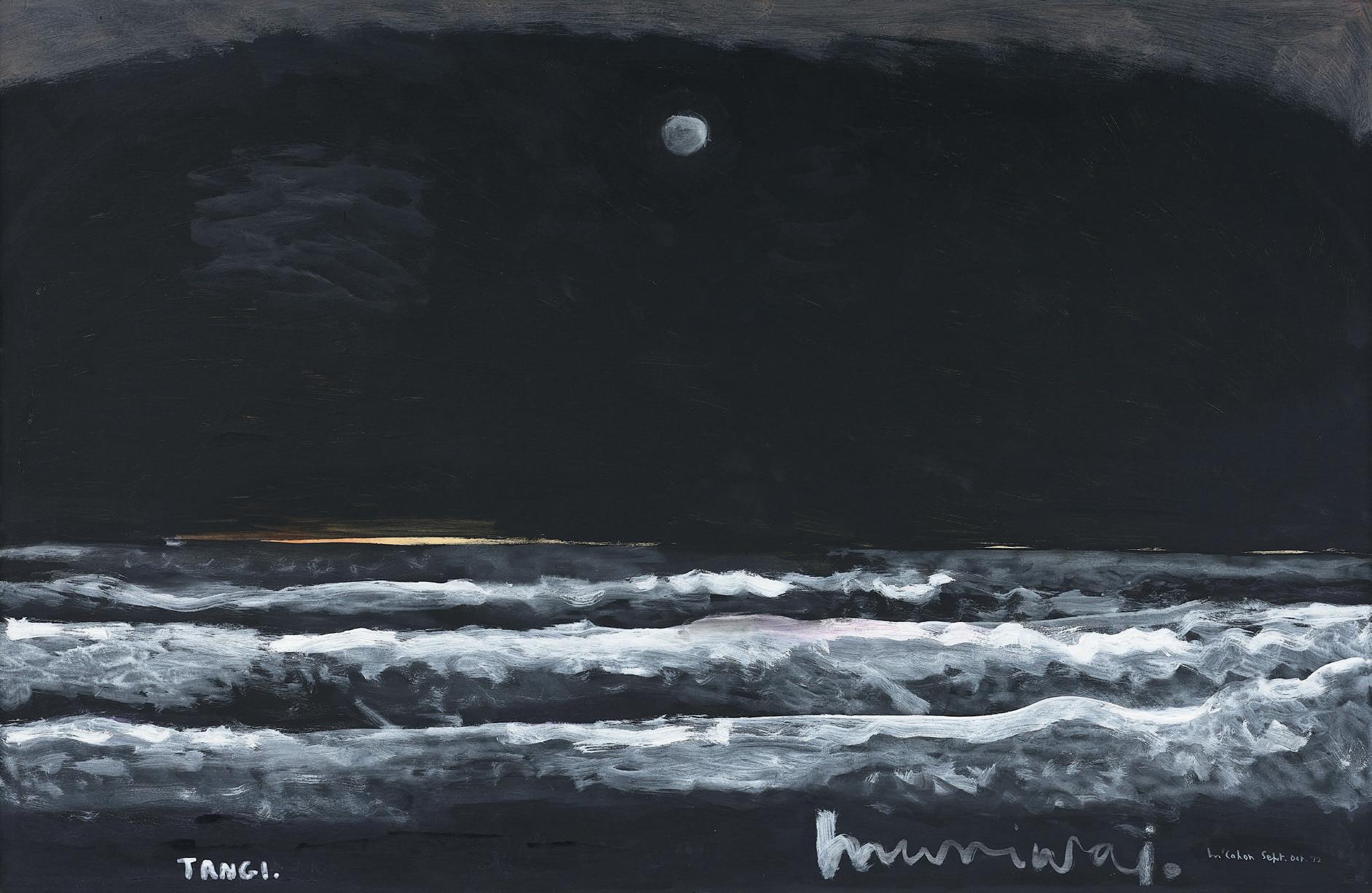
COLIN MCCAHON (1919 - 87)
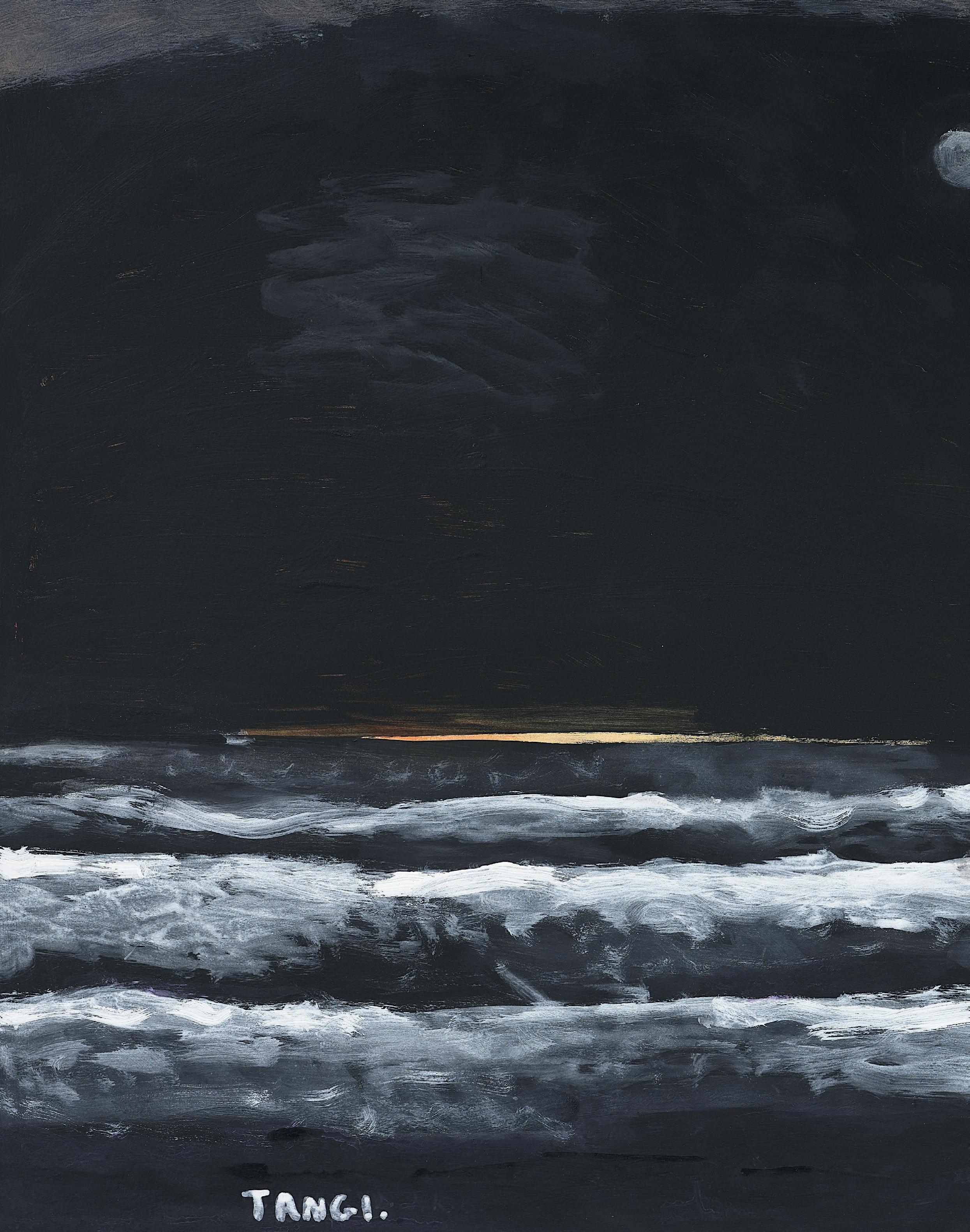
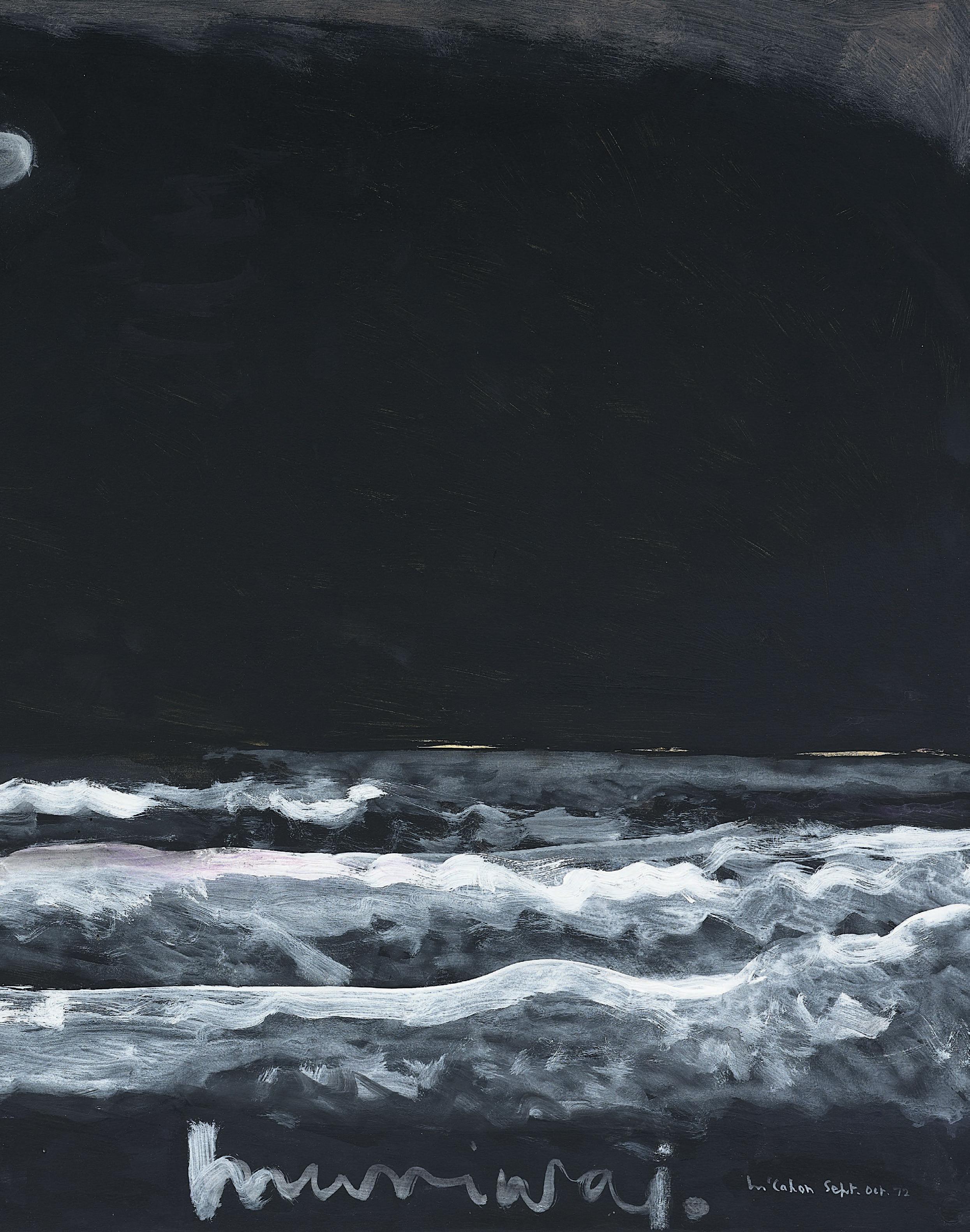
Tangi: Muriwai, 1972
Synthetic polymer paint on Steinbach on board 72 x 111 cm
Signed, inscribed Tangi, Muriwai & dated 1972
$300,000 - 500,000
PROVENANCE
Private Collection, Auckland Bowerbank Ninow, Auction No. 1, Auckland, 25/11/2015, Lot No. 20
Acquired from Barry Lett, Galleries, Auckland, 1977
RECORD NUMBER
cm001862
REFERENCED
Gordon H. Brown , Colin McCahon: Artist, New Edition, A.H. & A.W. Reed, Wellington, 1984, p. 161, 172
In 1969 Colin and Anne McCahon acquired land at Muriwai Beach, north west of Auckland, on which they built a large studio then a house, around the time of Colin’s retirement from Elam. Becoming a full-time painter led to a huge increase in his output in the 1970s, much of it stimulated by the new landscape opened up to him at Muriwai.
At first it was the towering cliffs at Māori Bay and the rock stack of Moturoa with their associated bird colonies that attracted him, especially in the big series of abstracted landscapes called Necessary Protection (1971-72) and Jump (1973-74). However, from 1972 it was the long, sandy Muriwai Beach itself which became his focus, especially in the grand series known as Beach Walk (1973), or formally Series A, B, C and D. Before these ambitious works were conceived McCahon made some individual paintings of the beach of which Tangi, Muriwai is one. Other related paintings are called Seaweed on the beach or Low tide, Muriwai and another layer of meaning is introduced by the words inscribed along the bottom of four of the paintings: Taitimu. Tangi. Muriwai. ‘Taitimu’ in Māori means low tide, while ‘Tangi’, of course, alludes to grieving for the dead. Tangi, Muriwai, uniquely, omits the word ‘taitimu’, so presumably depicts the beach at full-tide.
Earlier, McCahon had acquired The Tail of the Fish: Māori memories of the Far North by Matire Kereama (1968), a book on which he drew for many paintings, including The Lark’s Song (1969, Auckland Art Gallery). By 1972 he was most involved with Chapter 24, ‘Going Out with the Tide’ which begins: ‘When I was a child no person died without first asking about the state of the tide, whether it was full or low. People always liked to die at low tide because the tide had to be completely out to enable them to reach Te Reinga Wairua, “The Leaping Place of Spirits”, in the Far North’. (p. 74). These words are the clue to the wider meaning of this group of works. They are paintings about death and the spirit’s journey to Cape Reinga, a pathway that included Muriwai Beach. In later paintings McCahon would associate this spirit journey with dead friends such as the poets James K. Baxter, R.A.K. Mason and Charles Brasch.
Tangi, Muriwai is a superb nocturne of moonlit waves hurrying towards Muriwai Beach with the merest sliver of setting sunlight visible along the horizon. An unusually ‘descriptive’ painting for this phase of his career, the sombre atmosphere is heightened by the overwhelming blackness of the night relieved only by the presence of a large pale moon hanging in the night sky. If Tangi. Muriwai is, as argued above, a ‘full tide’ not a ‘low tide’ painting, it moves the symbolism towards recovery or resurrection rather than death, a suggestion reinforced by the unusual (for McCahon) presence of the moon.
One chapter in The Tail of the Fish, has an epigraph: ‘Me tangi, kāpā ko te mate e te marama’, translated as: ‘Let us weep, for his is not the death of the moon’, a saying McCahon incorporated in several works, including some textual drawings which read: ‘Ours is as the life of the moon/ One generation falls/ as another rises/ Ours is the life of the moon’. In other words, the moon with its perpetual changes is for McCahon a symbol of change and renewal, consistent with both Māori and Christian belief. This ‘tangi’, then, is not without hope, as suggested by the gleam above the horizon and the faint patina of colour on the moon-lit waves.
PETER SIMPSON
41 TONY FOMISON (1939 - 90)
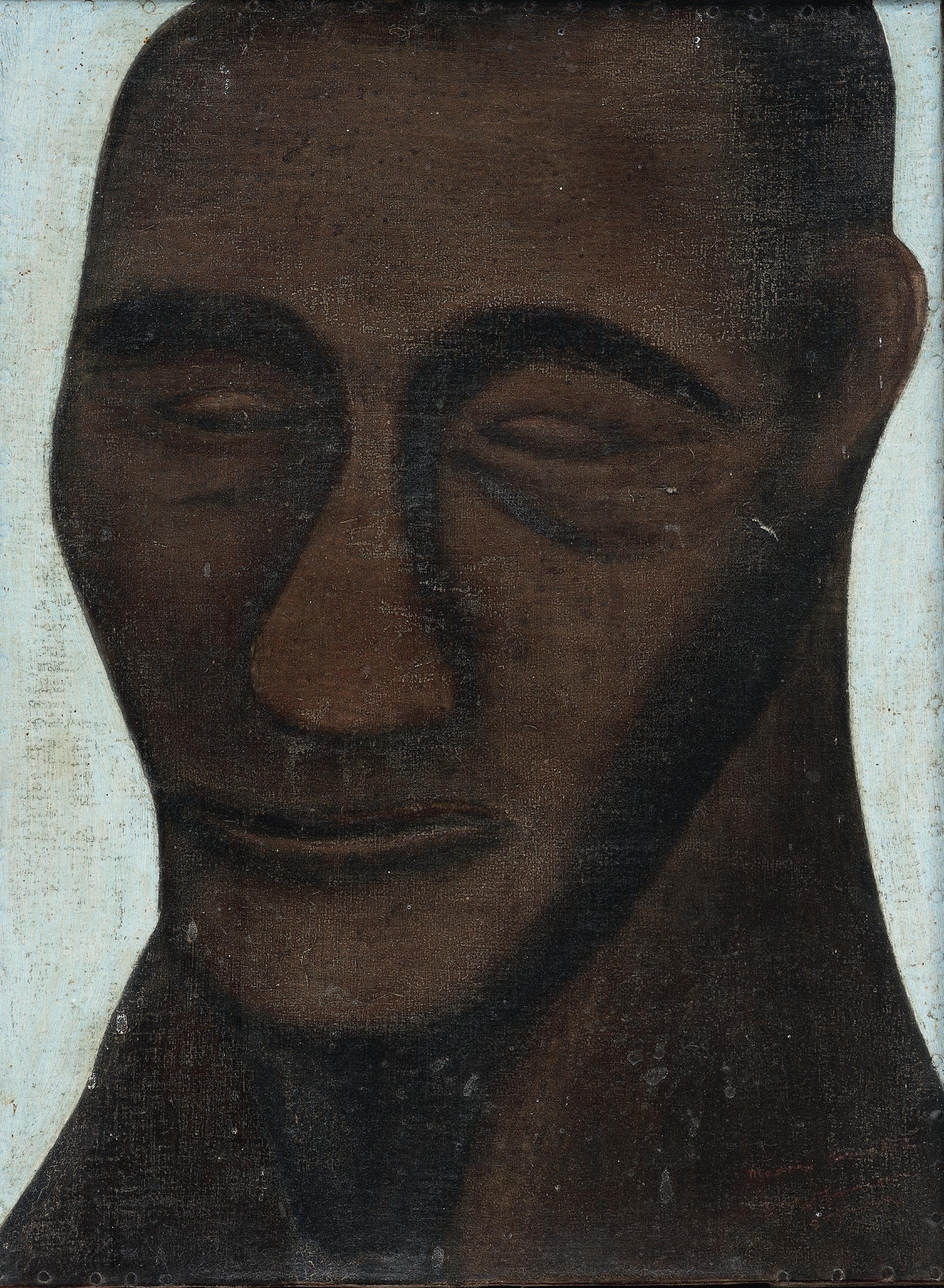
Māori Prophet (#91)
Oil on canvas laid onto board
45 x 33.5 cm
Title inscribed, signed & dated 1975 - 76 lower right
Inscribed #91 verso
$55,000 – 75,000
PROVENANCE
Private Collection, Auckland
EXHIBITED
Barry Lett Galleries, Auckland, 27 July – 6 August 1976
REFERENCED
Ian Wedde, Fomison, What shall we tell them?, City Gallery, Wellington, 1994, Supplementary Catalogue no. 225, p.168
Involved in a survey of Māori rock drawings in South Canterbury and North Otago in 1959 when he was just 20 years old, Tony Fomison maintained a life-long engagement with Māori history. Māori Prophet, an almost monochrome painting of a male head with eyes closed, was created during the most productive period in Fomison’s career when he was in his late 30s. He was finally settled, having weaned himself off methadone and he was renting his own house at 17 Gunson Street Ponsonby after sharing accommodation since his move north from Christchurch in 1973. He completed 54 paintings in 1975, and a further 46 in 1976, facilitated by a stipend from his gallerist and an arts grant for materials.
Always a figurative artist, Fomison was influenced by the Swiss psychoanalyst Carl Jung, and imbued his works with Jung’s idea of the collective unconscious; the belief that all humanity shares certain archetypes and symbols. At Barry Lett Galleries in winter 1976, Fomison exhibited this painting and a small carving of The Three Prophets – inviting viewers to think about influential Māori
religious leaders such as Te Kooti Arikirangi Te Turuki, Te Whiti-o-Rongomai and Rua Kenana, who combined spiritual leadership with resistance to colonial injustice. Rather than creating a literal portrait of an individual here, Fomison offers us a close-up view of a generic Polynesian head with eyes closed as if in prayer, or experiencing a visionary dream. He evokes the important role prophets played in preserving Māori identity during periods of conflict and land loss. The interiority of the figure and the composition of the work are reminiscent of the painting and lithograph from 1890 by French Symbolist Odilon Redon, titled Les Yeux Clos. While these nineteenth century works depict the passive, dreaming face of the artist’s wife, the visage in Māori Prophet expresses male strength, wisdom, and spiritual authority. As James Ross wrote in his Art New Zealand review of the 1976 Barry Lett exhibition, “The images themselves are part of the painter’s inner world: prophets and pilgrims - those archetypal symbols of the search for self: old images but firmly welded to a modern conception of man’s continuing predicament.”
Begun the year that Whina Cooper led the Māori Land March to Wellington in 1975, this painting is characterised by Fomison’s distinctive style, using dark, earthy colours and dramatic contrasts between light and shadow. A careful layering of thin glazes creates a haunting atmosphere that amplifies the emotional intensity of the figure. The prophet’s face appears ageless yet deeply expressive, suggesting both the hardships endured by Māori communities and the resilience of their spiritual traditions. The subdued colour palette reinforces the solemn and mysterious mood, while the textured surface of oil applied to canvas on board gives the work a timeless, almost archaeological quality. These techniques reflect Fomison’s admiration for European Old Masters, particularly their use of chiaroscuro, and his determination to adapt these methods to New Zealand subjects, as well as his belief that art could explore both historical memory and contemporary social issues.
LINDA TYLER
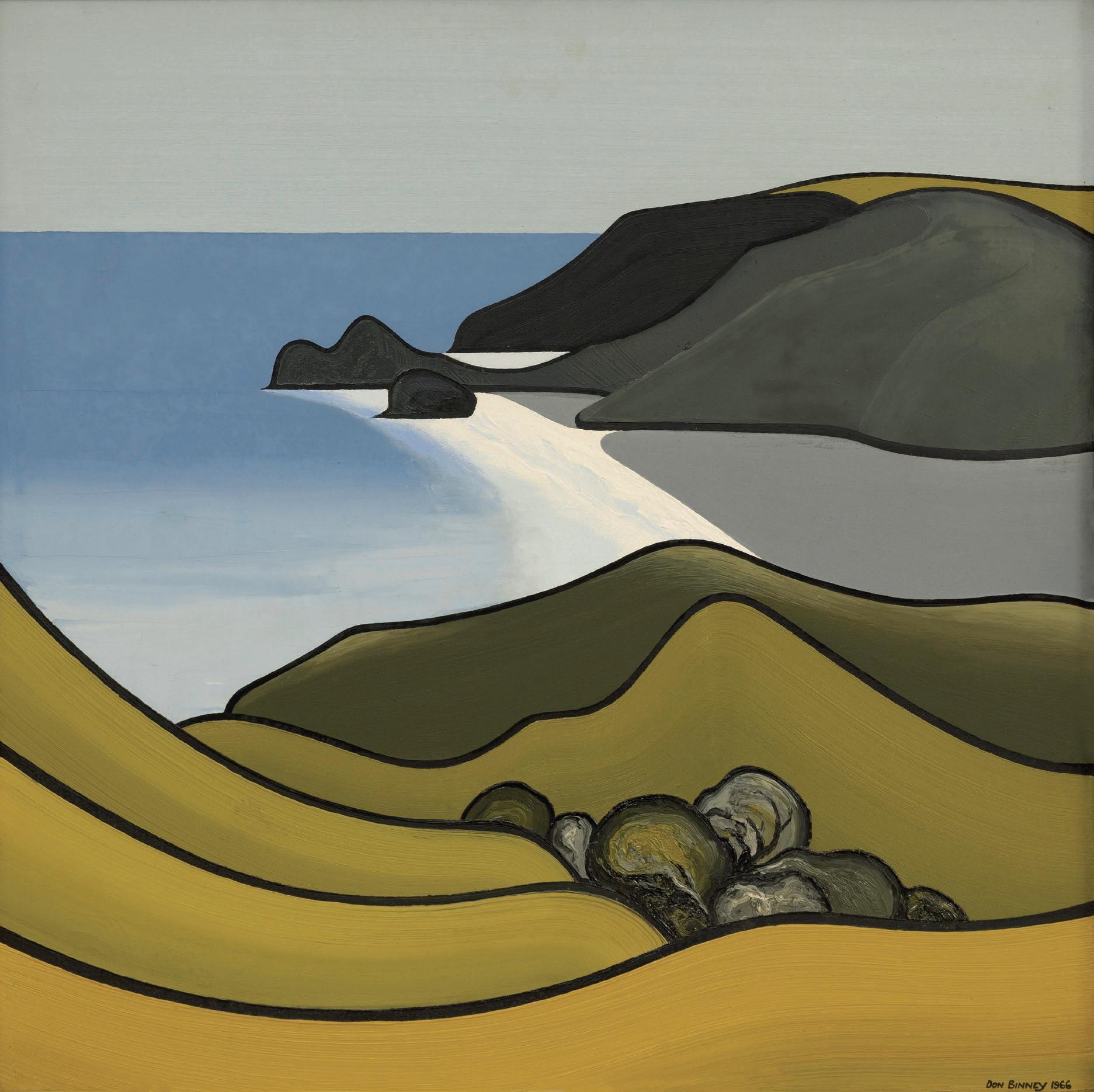
The selection of paintings by Don Binney - West Coast (1966) (Lot 44), Under the Hill of the Homestead (1968) (Lot 42), Te Henga (1973) (Lot 43) and Te Henga, (1971) (Lot 45) all belong to the most admired and productive period of his career, which was by general consent from the mid-1960s to the mid-1970s. This period saw his meteoric rise to fame within New Zealand and has also incidentally been the focus of his spectacular posthumous success. Furthermore, all four are associated with the location that was at the heart of his creative enterprise: Te Henga or Bethells Beach on the West Coast of Auckland beyond the Waitakare ranges. Binney made paintings of many other parts of New Zealand from Northland to Stewart Island, and also of many places overseas – Mexico, Hawaii, England, Africa, South East Asia, Australia – but there is little doubt that the omphalos or navel of his creative world was the West Coast beaches near Auckland and especially Te Henga (Bethells Beach).
Binney was familiar with the area from boyhood onwards, often visiting with his family. He began painting in the area from about 1962 and for several years occupied from time to time a cottage on property owned by the Bethell family, the pioneer settlers who gave their name to the beach that Binney preferred to call by its Māori name, Te Henga, just as he usually referred to the birds that were the subject of so many of his paintings by their Māori names (kererū rather than wood pigeon, kawaupaka rather than little pied shag, for example).
This lengthy sojourn at Te Henga gave Binney immediate access to to the dunes, lakes, hills, streams, wetlands, bush, beaches, headlands, rocks and marine environment of the area. As early as 1966 he wrote in notes for an exhibition at Barry Lett Galleries: ‘an artist’s commitment to an area defines the idiom of the artist as it does the forms, surfaces and innate presence of land that compels his vision.
These qualities, seen in the light of year to year experience produce characteristic images which gain in strength from this constant reappraisal’.
This year (1966) is also the date of West Coast (Lot 44), a painting square in format which offers an elevated panoramic view of the physical environment of hills, a remnant patch of bush, the beach, the surf, the islands and headlands at the north end of the beach and the ocean stretching to the horizon. It is a scene empty of any explicit sign of human presence (except that implied by the bare hills) or even of bird life in this instance –as bare and abstracted as the early landscapes of Colin McCahon. It is worth pointing this out, because Binney’s landscapes have such confidence, such presence, that it is easy to underestimate the high degree of abstraction and simplification they involve. On a map we could identify this scene as the view from Razorback looking north across the beach to Ihumoana Island and Erangi Point and beyond.
In his treatment of the scene Binney registers the main contours of the land with firm black lines, emphasising in the foreground the repeated rhythms of ridges and hill profiles, filling in between the lines with solid blocks of colour, mainly ochres of various shades. The small patch of bush nestled in a gully provides tonal variety while repeating in miniature the rhythms of the wider view. The distant scene is presented with simple colour contrasts in the blueness of ocean, the whiteness of surf, the greyness of sand, the darkness of rocks and hills and the pale grey of sky. It is an orderly, coherent and benign vision of a cherished landscape.
PETER SIMPSON
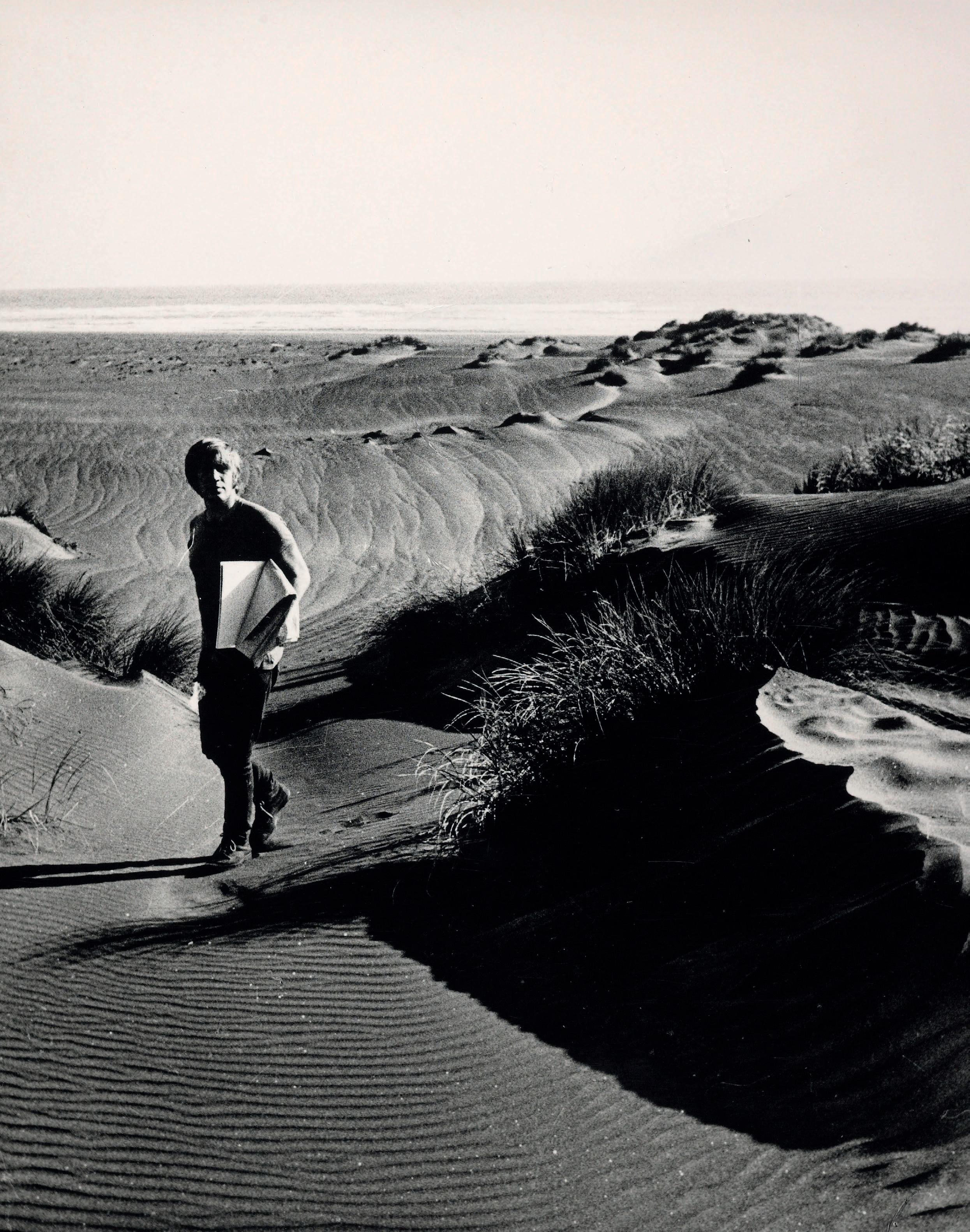
Illustrated: Don Binney, 1977-79?, Auckland, by Marti Friedlander. Purchased 2007. Te Papa (O.031286)
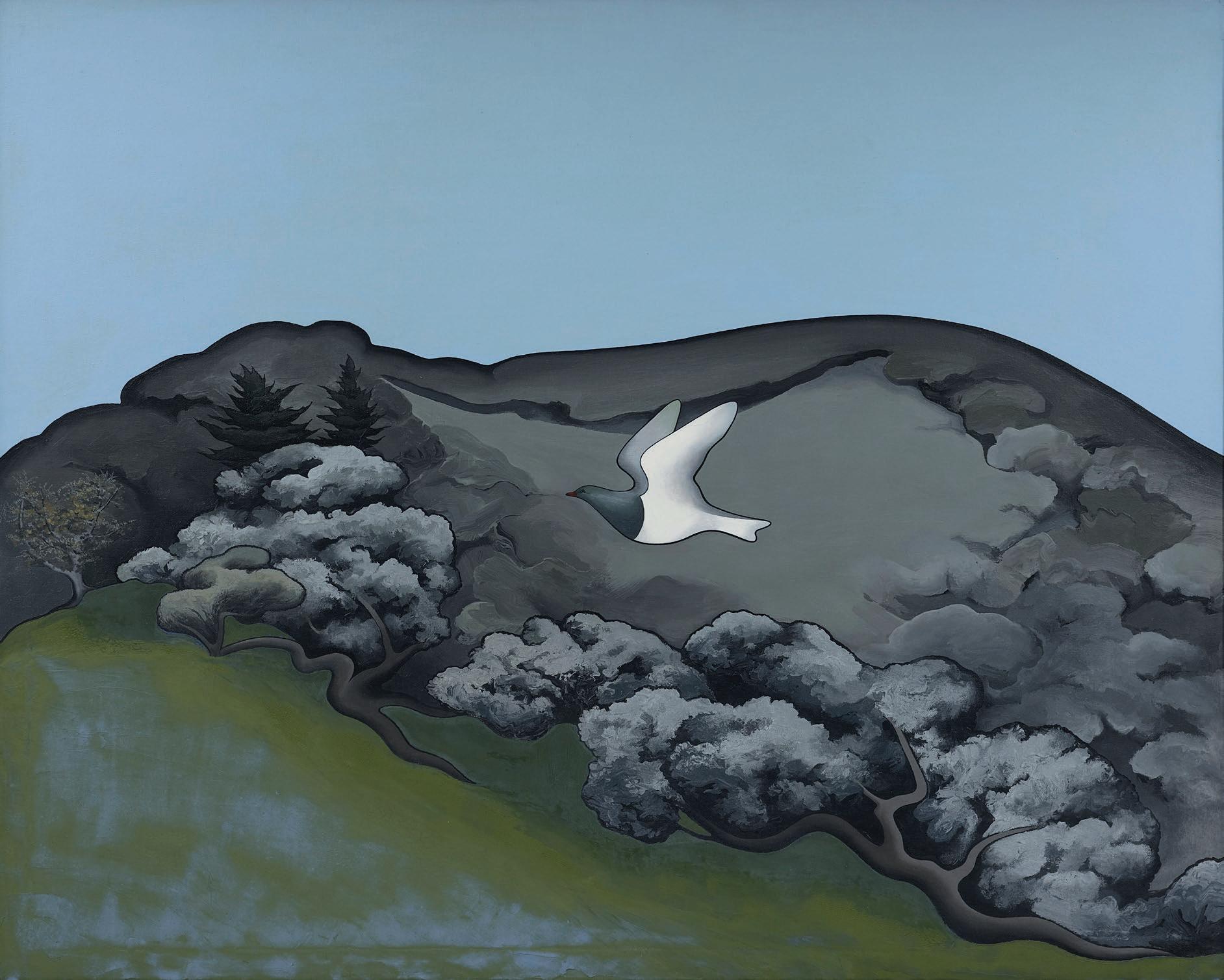
42 DON BINNEY (1940 - 2012)
Under the Hill of the Homestead, 1968
Oil and acrylic on board
120 x 151 cm
Signed & dated Sept-Oct 1968 upper right
$1,200,000 - 1,500,000
PROVENANCE
Private Collection, Auckland Acquired from Webb’s, Fine Jewellery & Decorative Arts, Auckland, 21/09/2004, Lot no. 38
Formerly in the Collection of Fletcher Challenge
ILLUSTRATED
Damien Skinner, Don Binney Nga Manu/Nga Motu - Birds/Islands, Auckland University Press, Auckland, 2003, pl. 25
Gregory O’Brien, Don Binney: Flight Path, Auckland University Press, Auckland, 2023, p. 163
A birdwatcher and ornithologist since his schooldays Binney found the Te Henga area a happy hunting ground for his observation of birds of all kinds which he celebrated in his art; gulls, terns, dotterels, wood pigeons (kererū), tūī, bitterns (matuku), fernbirds, shags (kawaupaka), hawks (kahu), shining cuckoos (pīpīwharauroa), long tailed cuckoos (koekoeā), herons, fantails, kingfishers (kōtare), pied shag (kāruhiruhi), rosella and others.
Speaking to John Daly-Peoples in 1972, Binney said: ‘I see [birds] as a whole quality of existence in themselves … recurrent forms in space and in place … birds have lived in the world for so much longer than the human species … and I think we owe them tremendous respect’. Birds, he continued, ‘lived in harmony and have coexisted with the topography … of habitable earth space … and they have won their place by means of flight … nesting patterns … migration … feeding habits, and the whole way they deploy themselves against … this land and this life’.1
Such a sophisticated appreciation and understanding of bird-life in relation to habitat lies behind Binney’s celebrated bird paintings.
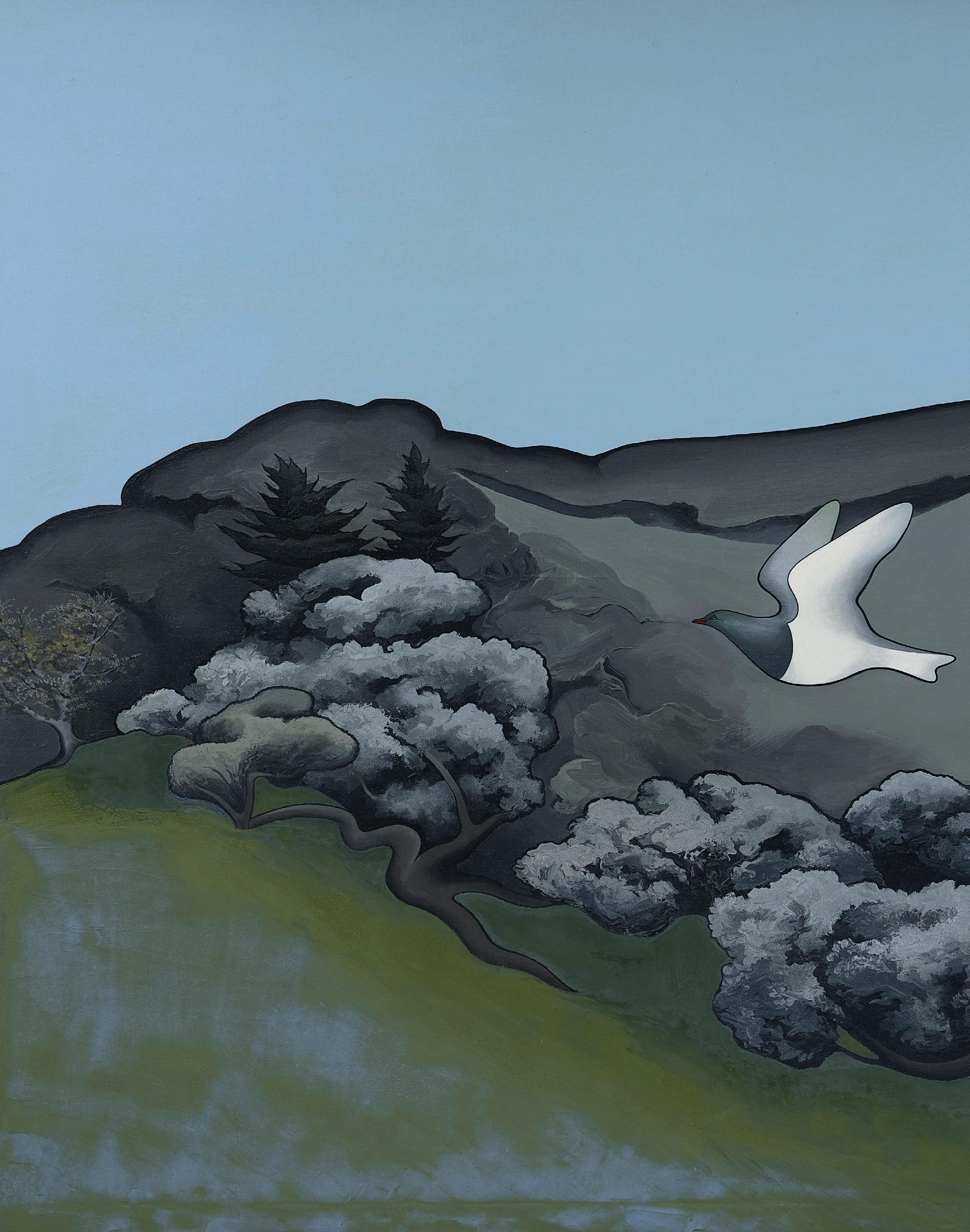
The kererū is one of Binney’s favourite bird subjects, as in Kereru over Wainamu, New Kereru at Te Henga, Lower Kauri Track and many others. What makes Under the Hill of the Homestead (1968) unusual is that the bird, though centrally placed, is relatively small within the sizeable canvas, as if viewed from a distance, whereas often in Binney’s pictures the kererū dominates the picture plane, emphasising its impressive size and weight as well as its sleek design and colouring.
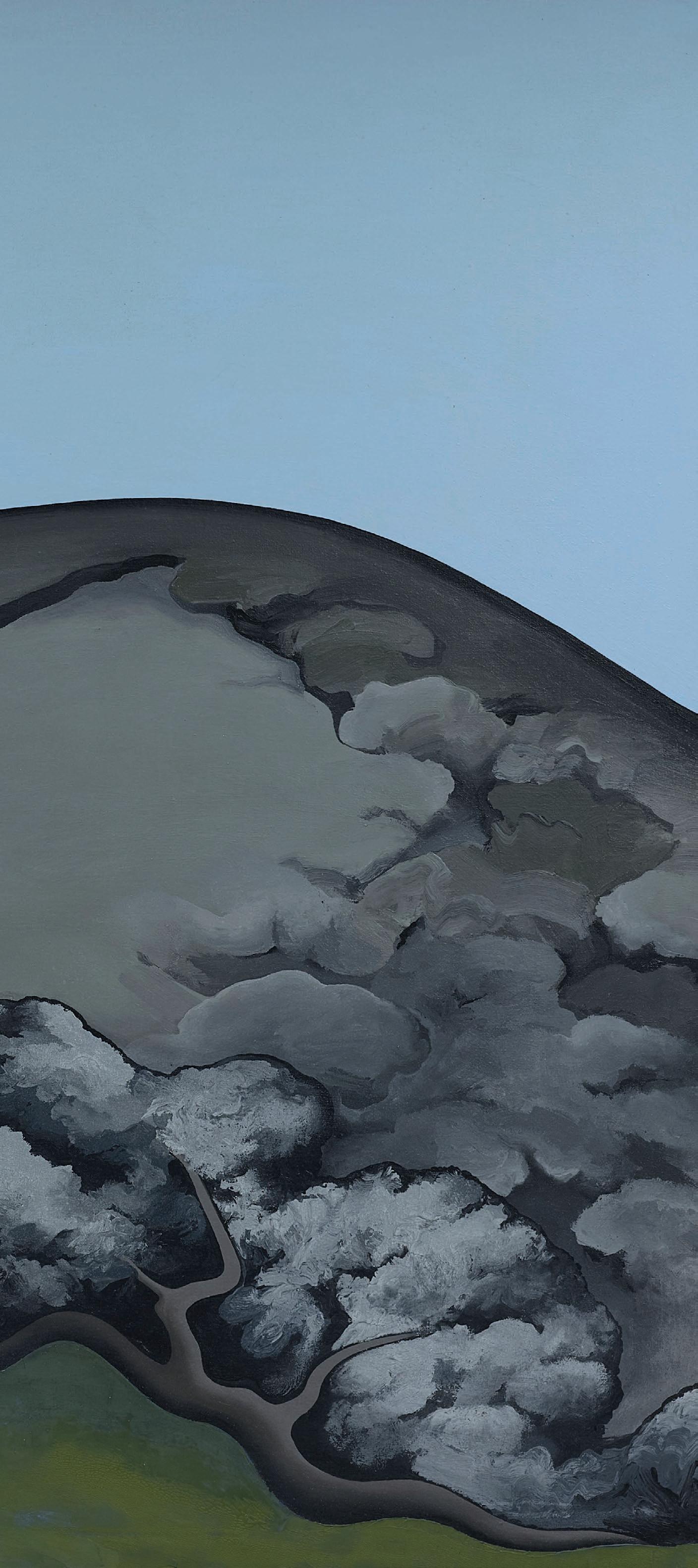
Here the bird is visually subordinated to its habitat. It is shown in mid-flight against a dark hillside with a grove of gnarly pōhutukawa trees advancing diagonally up the slope from the bottom right corner.
The colouring depends on contrast, with the pure white of the kererū’s breast and underwings standing out strongly against the dark greys of the dune-originated hill and the blue-green of the somewhat brighter foreground. The darkness of the hill stark against the paleness of the sky provides another strong contrast, while such light and dark patterning is picked up in the pale and dark tones of the foliage of the pōhutukawa as well as in the plumage of the bird.
The ‘homestead’ of the title refers to the dwelling of the pioneer family. The macrocarpas and other trees towards the top left are also signs of Pakeha habitation. Binney’s title ‘Under the hill …’ subtly suggests the complex interrelationship between creature and environment that is such an essential feature of his approach.
PETER SIMPSON
1 (https://nzartsreview.org/2025/09/01/don-binney-the-1972-interview/)
43 DON BINNEY (1940 - 2012)
Te Henga, 1973
Oil on canvas
75 x 62 cm
Signed & dated ’73 upper right
$600,000 - 800,000
PROVENANCE
Private Collection, Auckland
Acquired from International Art Centre, Quality
NZ Contemporary & Historical Paintings, Auckland, 07/11/2002, Lot no. 34
Private Collection, United Kingdom
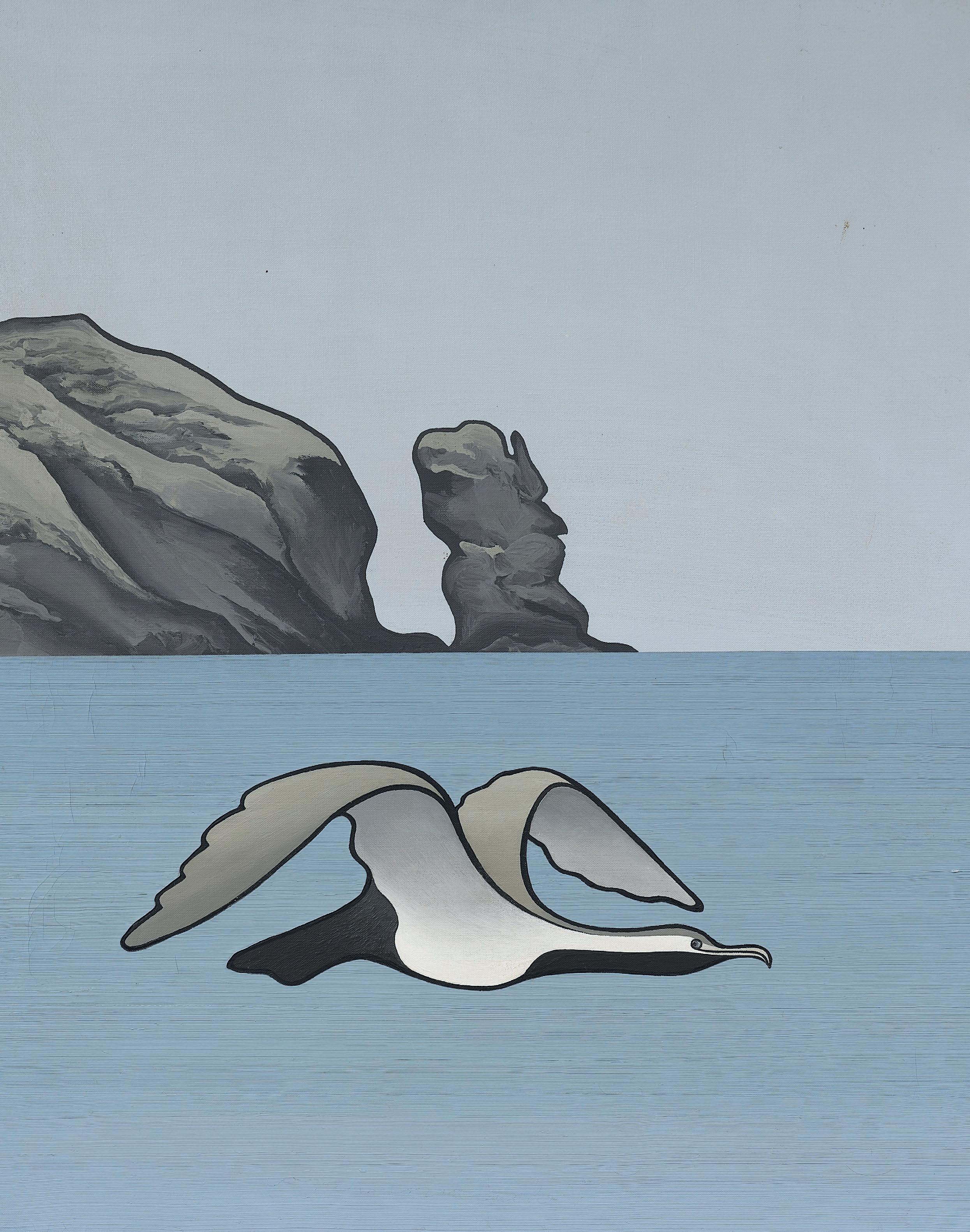
Again in Te Henga (1973) the title foregrounds the habitat not the identity of the bird. The kawaupaka or little shag, also known as little pied shag or cormorant, is also the subject of several Binney paintings including Kawaupaku, Te Henga (1967), a large painting at University of Auckland of the bird above a lake which bears its name, and Pond Bird, Te Henga (Te Manawa, 1967), showing the shag perched on a branch.
In this Te Henga, kawaupaka is in flight against a background of pale blue sea while the upper half of the painting depicts a coastal headland and volcanic rocks against an even paler grey-blue sky. Those familiar with the area will recognise the setting as Raeakiaki Point at the south end of the beach with Man’s Head the prominent rock form at water’s edge.
The elements of this painting are reduced to essentials: sky, headland; offshore rock-stack; a light blue sea and the little shag in flight displaying its striking black, white and grey plumage, firmly outlined in black. There is an exquisite subdued colour harmony of black, white, pale blue and light and dark greys.
As always with Binney the interrelationship of tones and shapes is subtle and not overstated. Everything is in twos: the double wingspan of the bird and the ‘pied’ colouring of its plumage, echoing the doubling of the landforms, while sea and sky occupy equal space in a picture precisely divided between top and bottom halves. All is ‘pied beauty’ (in Gerard Manley Hopkins’ lovely phrase), harmoniously balanced and deeply satisfying without ever distorting the realism of bird and habitat.
Binney’s reputation had its ups and downs over time but few would question the brilliance and authority of the paintings of Te Henga and its birdlife in the late sixties and early seventies such as these.
PETER SIMPSON
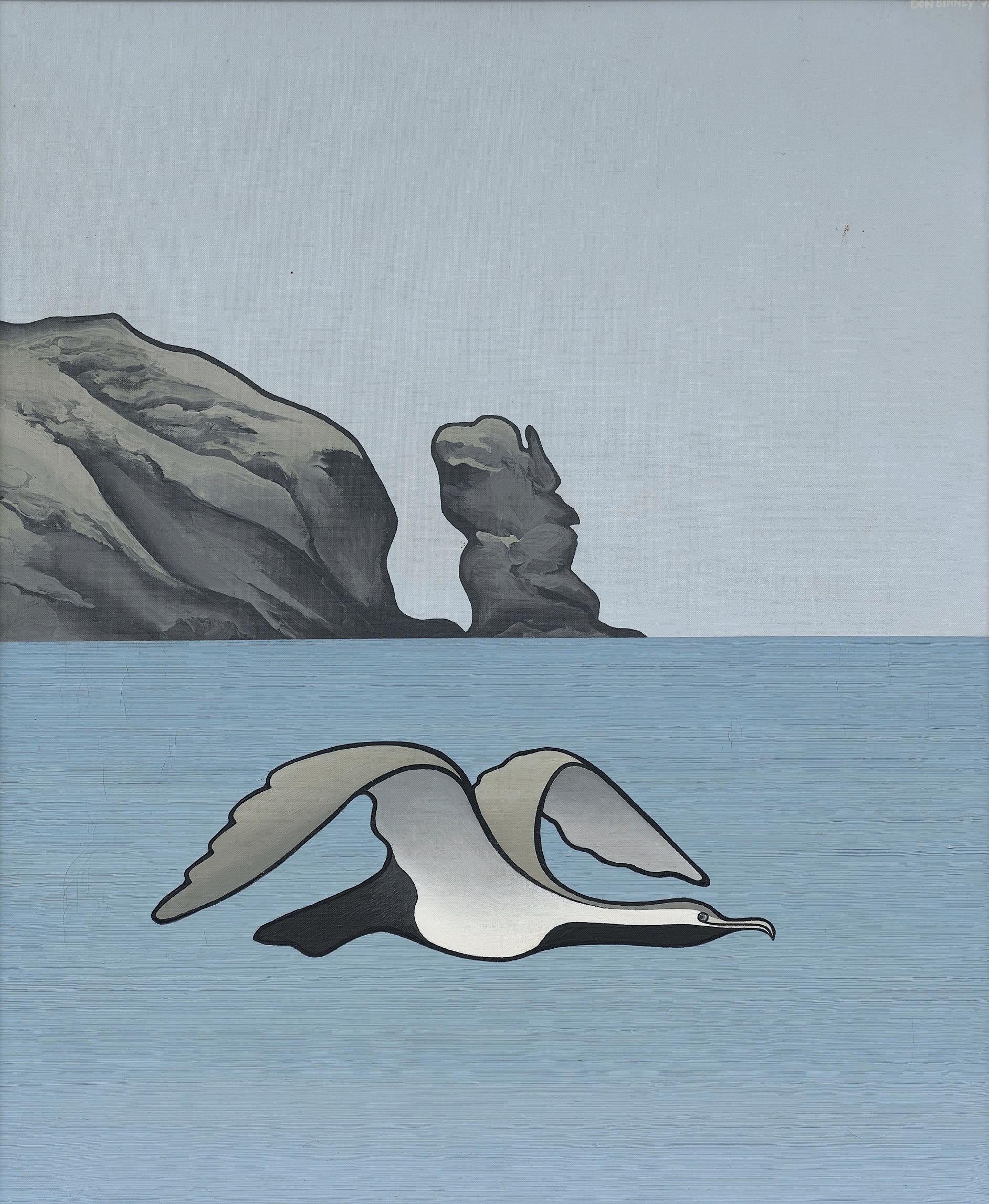
44 DON BINNEY (1940 - 2012)
West Coast Oil on canvas
75 x 75.5 cm
Signed & dated 1966 lower right
$200,000 – 300,000
PROVENANCE
Private Collection, Auckland
Acquired from Barry Lett Galleries, Auckland, 1966
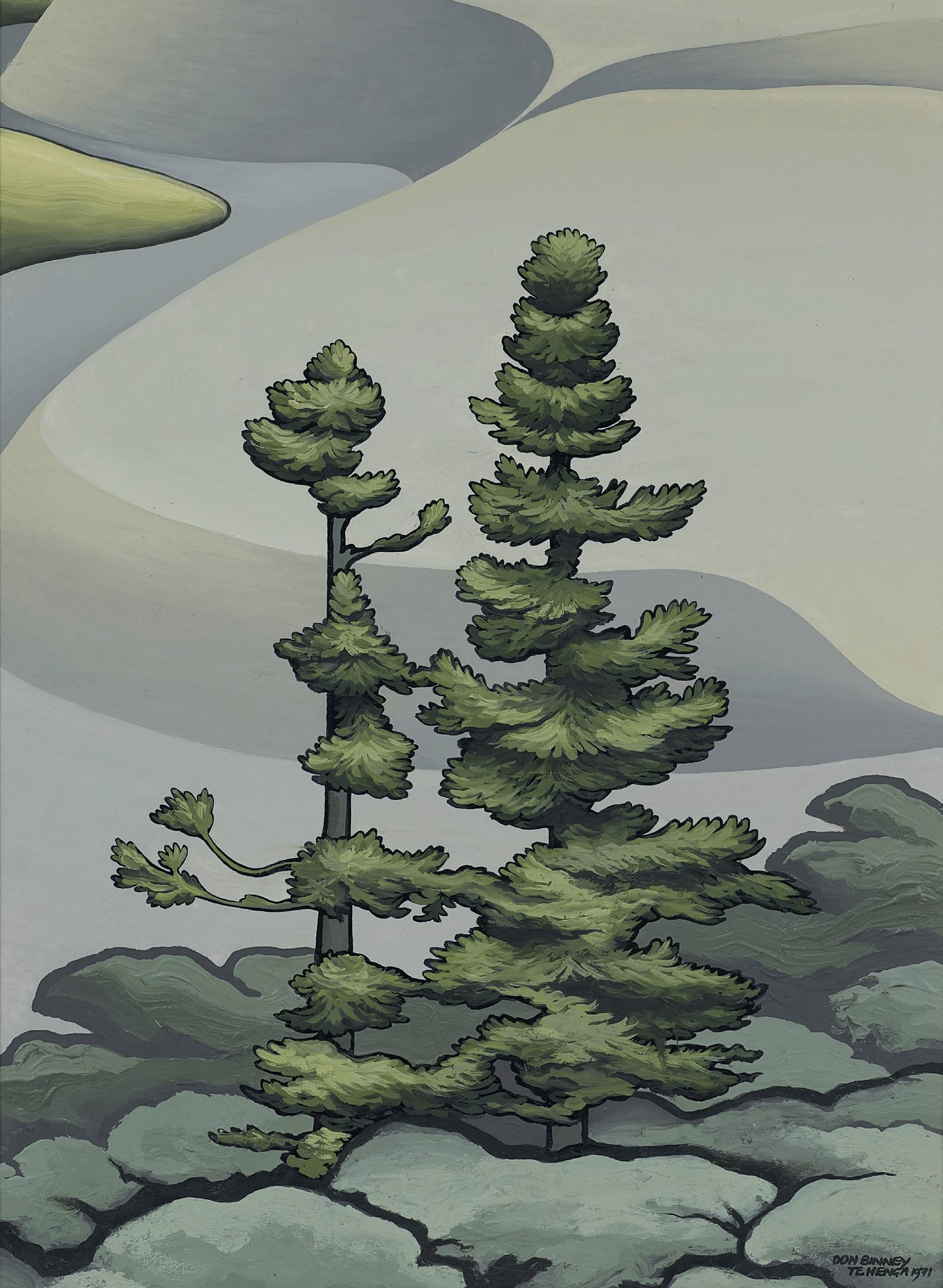
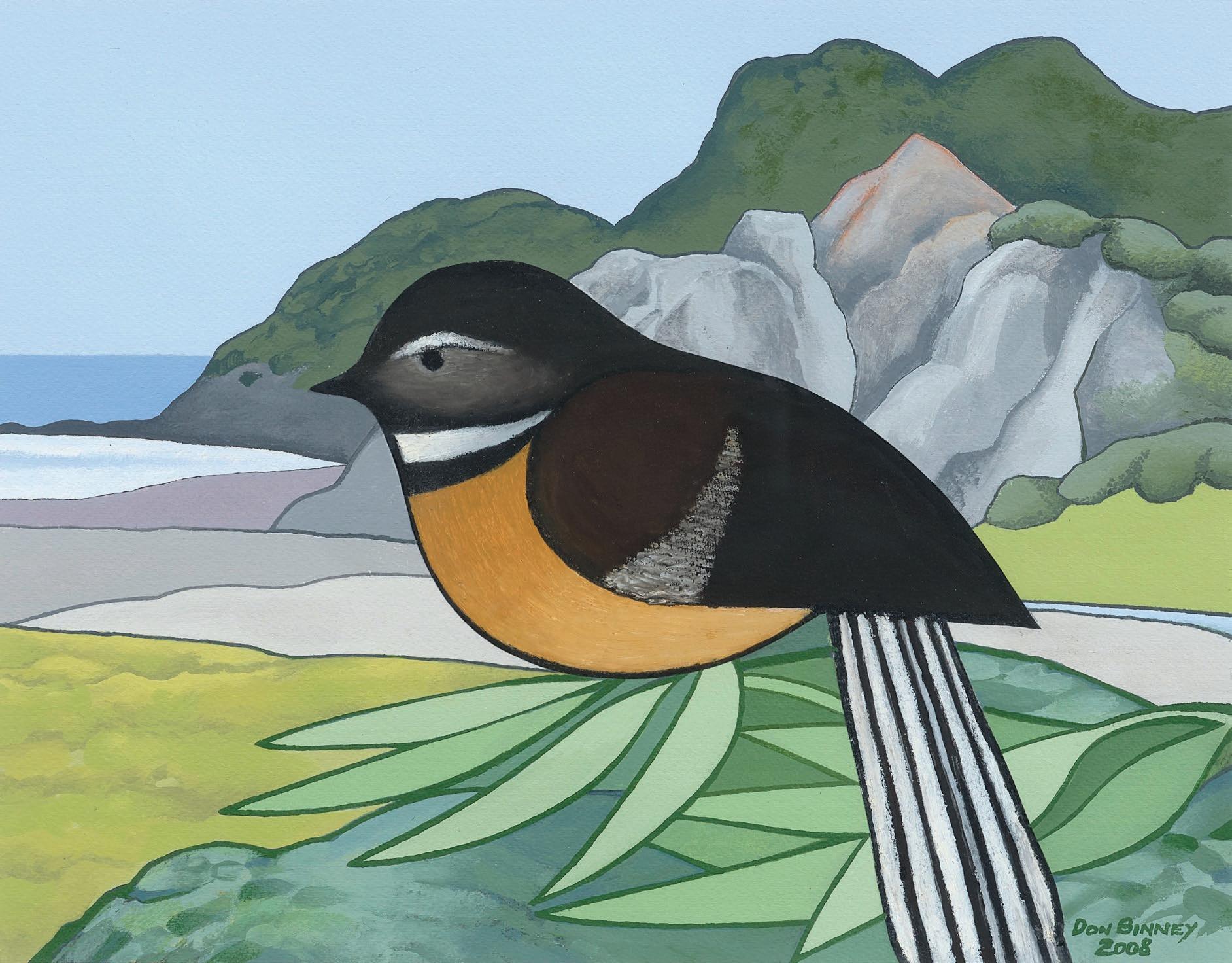
Oil on paper on board
74 x 54 cm
Signed, inscribed Te Henga & dated 1971 lower right
$150,000 - 200,000
PROVENANCE
Private Collection, Auckland
Above Karekare
Acrylic and oil stick on arches paper
29.5 x 38 cm
Signed & dated 2008 lower right
$70,000 – 100,000
PROVENANCE
Private Collection, Bay of Plenty
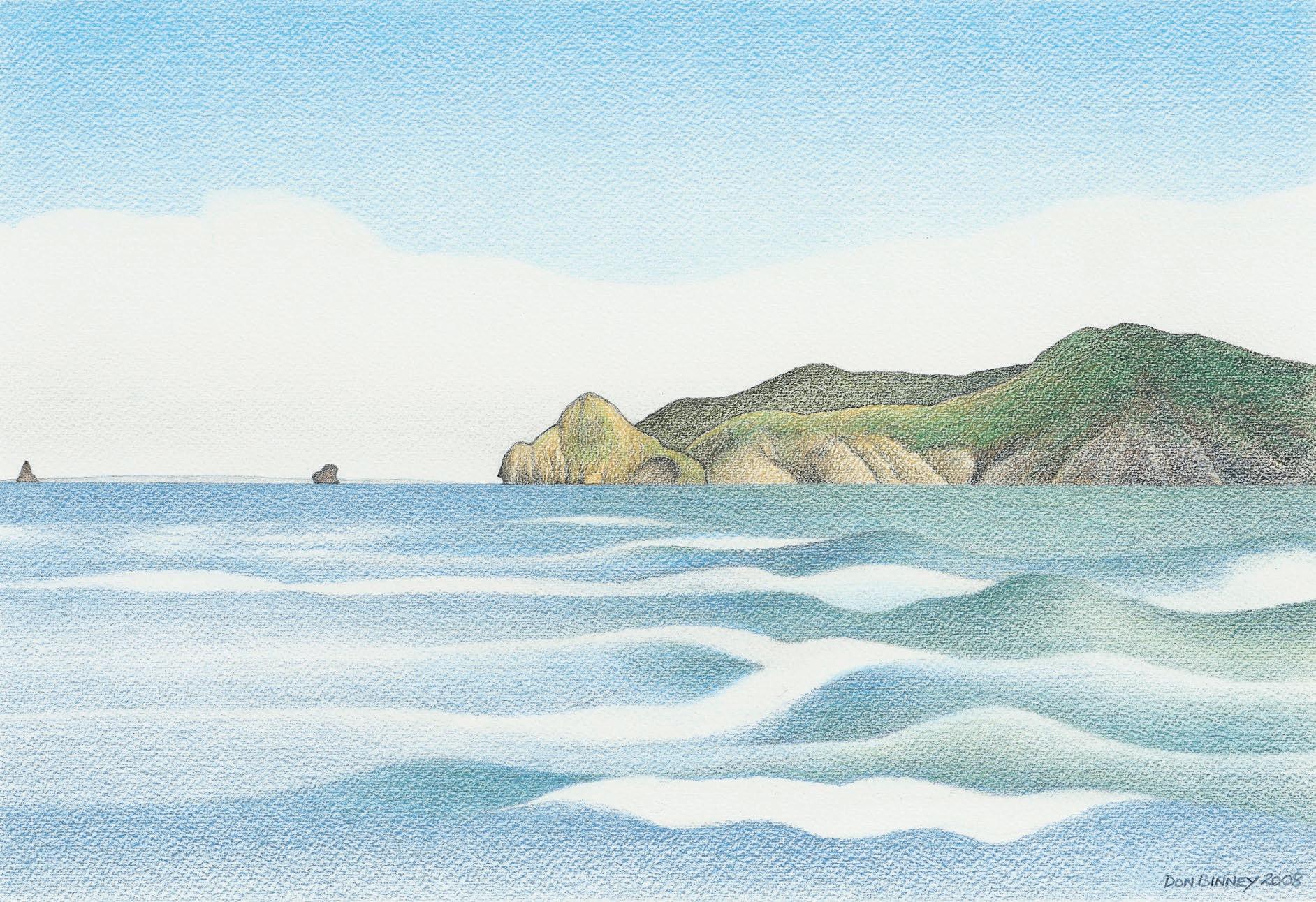
47 DON BINNEY (1940 - 2012)
Manukau Bar: Crossing
Coloured pencil on arches 300gsm paper
25.5 x 37cm
Signed & dated 2008 lower right
$15,000 - 20,000
PROVENANCE
Private Collection, Bay of Plenty
Acquired from The Diversion Gallery, Picton
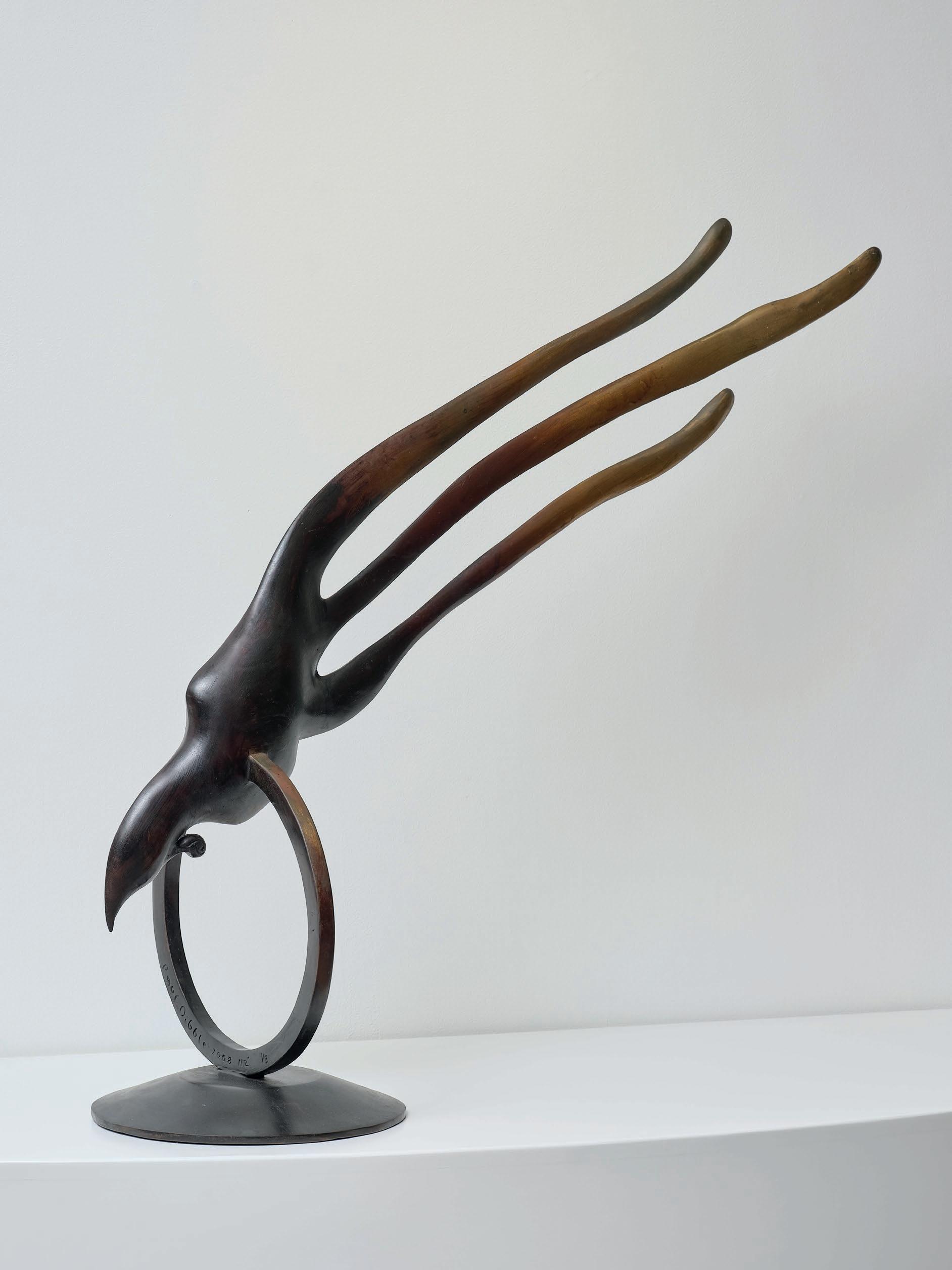
48 PAUL DIBBLE (1943 - 2023)
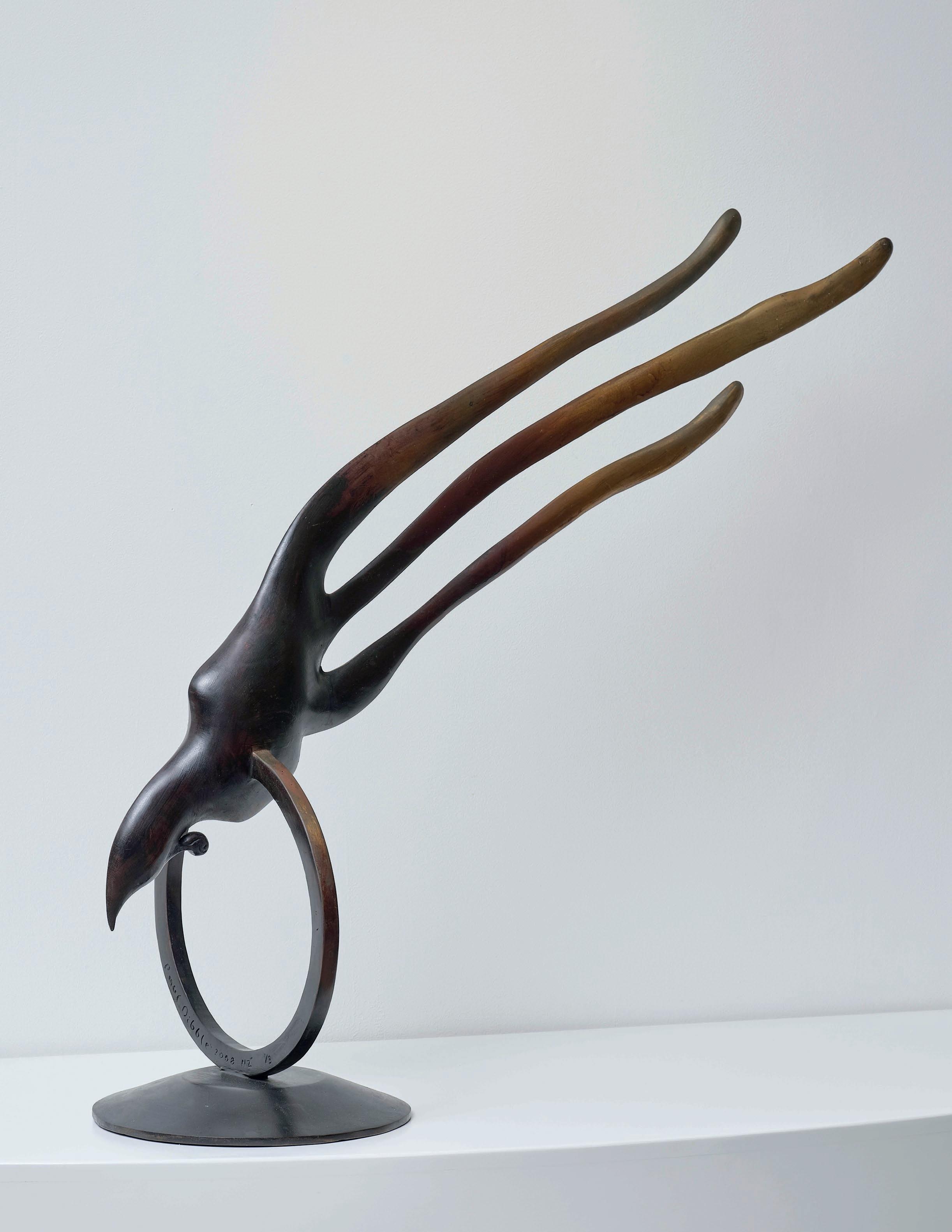
Tui-ee-ee larger
Bronze, edition 1/3
83 x 120 cm
Signed, editioned & dated 2008
$50,000 - 75,000
PROVENANCE
Private Collection, Auckland
Acquired from Gow Langsford Gallery, Auckland
EXHIBITED
Exhibited at as Hawk study 1, Melbourne Art Fair, Page Blackie Gallery, Melbourne, 2008
Thoughts on Men and Birds, Page Blackie Gallery, Wellington, 2009
Cable Bay Vineyards, Waiheke, 2009
49
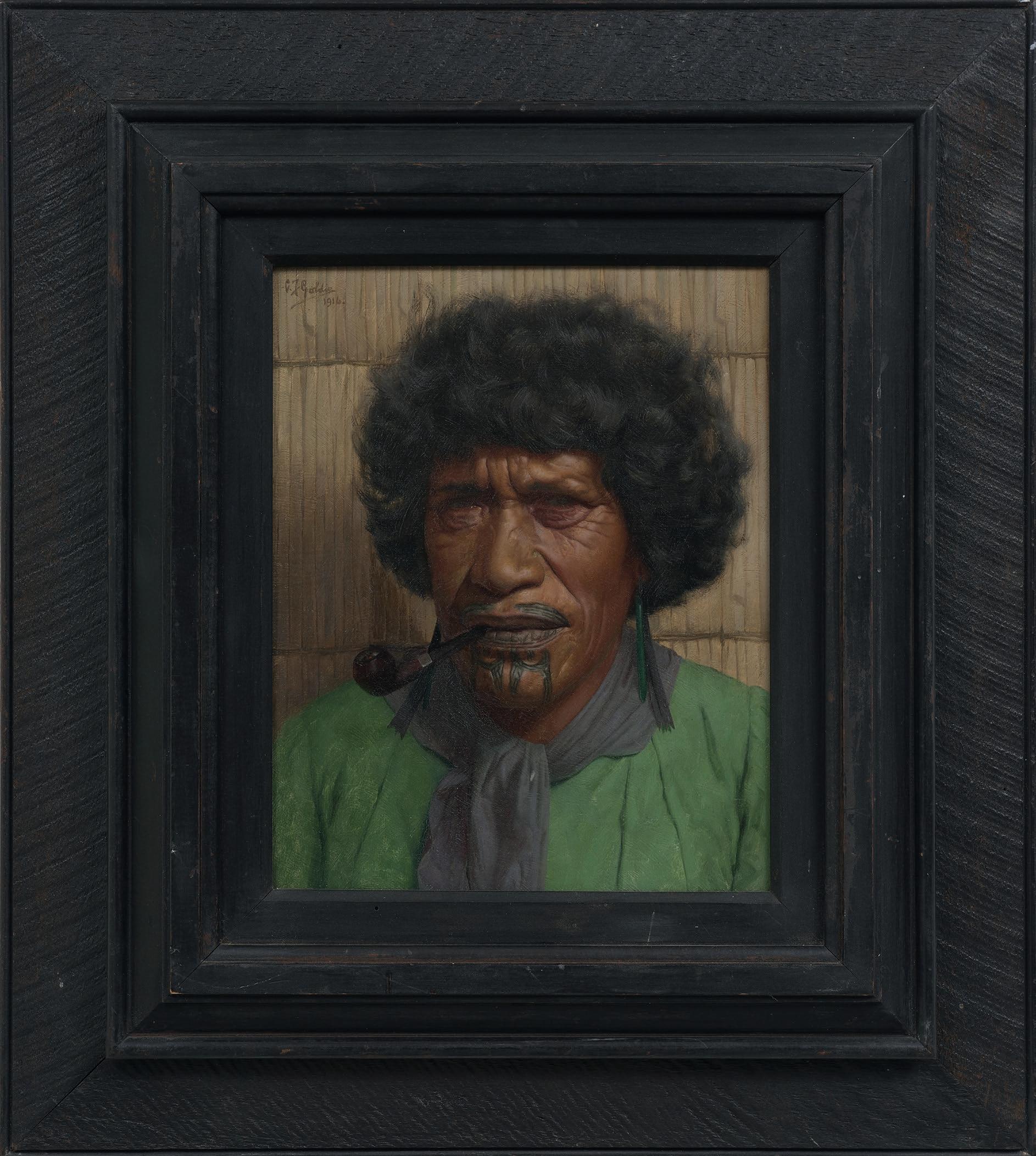
CHARLES FREDERICK GOLDIE (1870 - 1947)
‘In Doubt’ an Arawa Chieftainess
Maramena Wiari
Oil on canvas
26 x 21 cm
Signed & dated 1916 upper left Original label affixed verso
$400,000 – 600,000
PROVENANCE
Private Collection, Hawke’s Bay
Acquired from International Art Centre, Important & Rare, Auckland, 24/08/2016, Lot no. 38
Few artists have shaped New Zealand’s artistic identity as profoundly as Charles Frederick Goldie. Born in Auckland in 1870, Goldie displayed exceptional artistic ability from an early age and later studied under Louis John Steele. Encouraged by Sir George Grey, he travelled to Paris in 1893 to attend the prestigious Académie Julian, where he trained under leading exponents of French academic realism, including William-Adolphe Bouguereau. Returning to New Zealand in 1898 with an extraordinary command of portraiture, Goldie established himself as one of the country’s foremost artists.
A visit to Rotorua in 1901 marked a defining moment in his career. There he met many distinguished Māori elders who would become the subjects of his finest works. Over the following decades, Goldie travelled extensively throughout the North Island, forming enduring relationships with a number of his sitters. His portraits are celebrated not only for their remarkable technical precision but for the dignity, individuality and mana they convey. Goldie’s paintings today are valued as both exceptional works of art and important historical records, preserving the likenesses of many respected kaumātua and rangatira.
Painted in 1916, ‘In Doubt’ an Arawa Chieftainess Maramena Wiari depicts Maramena Wiari of Te Arawa and dates from the height of Goldie’s career. During this period, his portraits achieved an extraordinary balance between academic realism and psychological insight. Rather than relying on elaborate settings or narrative, Goldie allows the sitter’s expression to command the composition. The delicate modelling of the face, meticulous rendering of the moko and subtle handling of light demonstrate the technical brilliance that has made his work internationally admired.
(1870 - 1947)
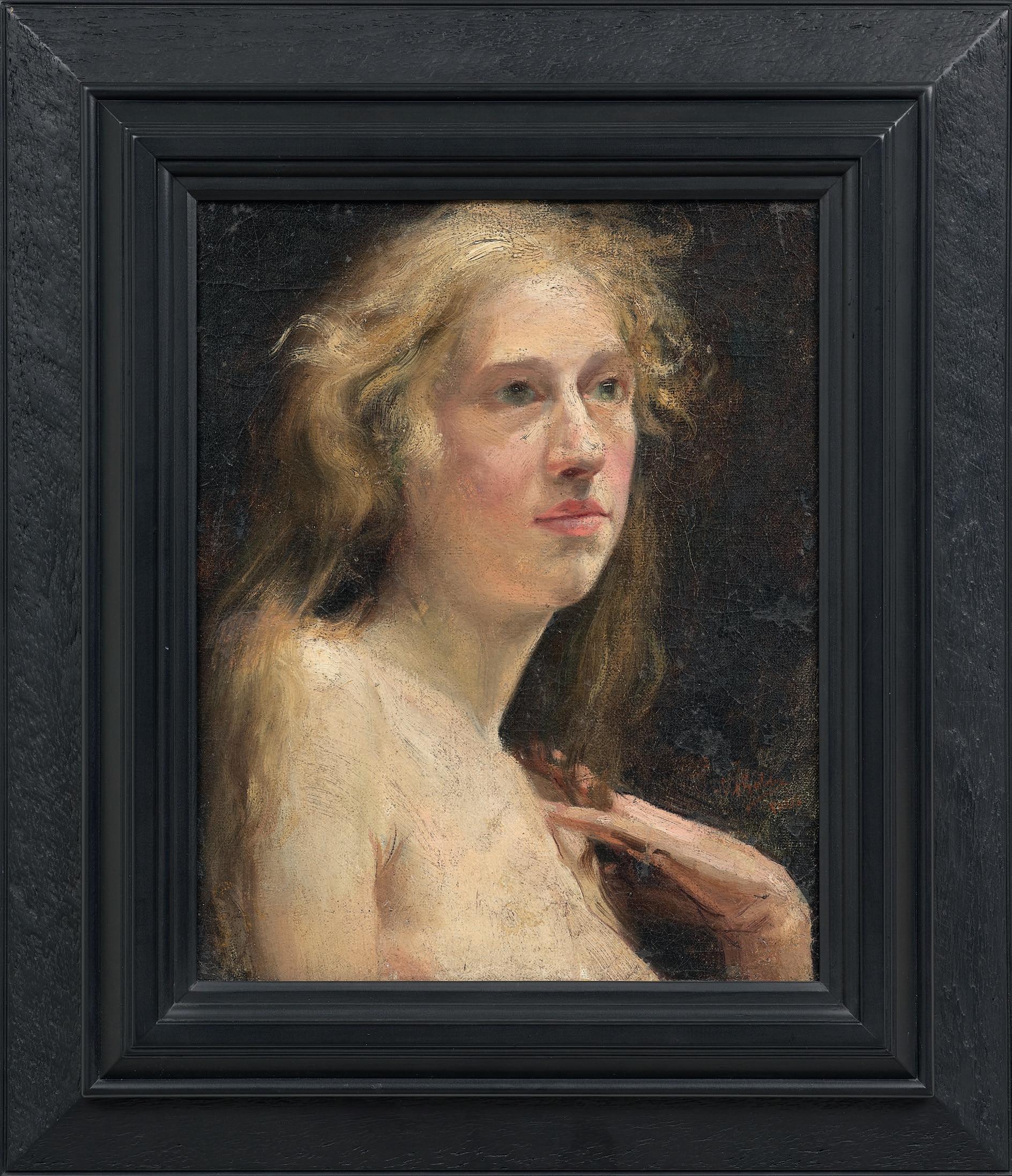
Untitled, Portraiture Study
Oil on canvas on board
43.5 x 34.5 cm
Signed & inscribed Paris lower right
$80,000 – 120,000
PROVENANCE
Private Collection, Hawke’s Bay
Acquired from International Art Centre, Important & Rare, Auckland, 24/08/2016, Lot no. 42
An Auckland Estate Collection
Acquired from International Art Centre, Important, Early and Rare, Auckland, 31/03/2009, Lot no. 49
Private Collection, Auckland since 1924
This work was completed between 1893 and 1898, when, at the age of twenty-two, Goldie enrolled at the cosmopolitan Académie Julian in Paris. For four years he studied under the supervision of eminent Salon painter William-Adolphe Bouguereau. The academic training Goldie received at the Académie indicates that this painting is either a life study of a class model or a detailed study of an existing work.
51 GOTTFRIED LINDAUER (1839 - 1926)
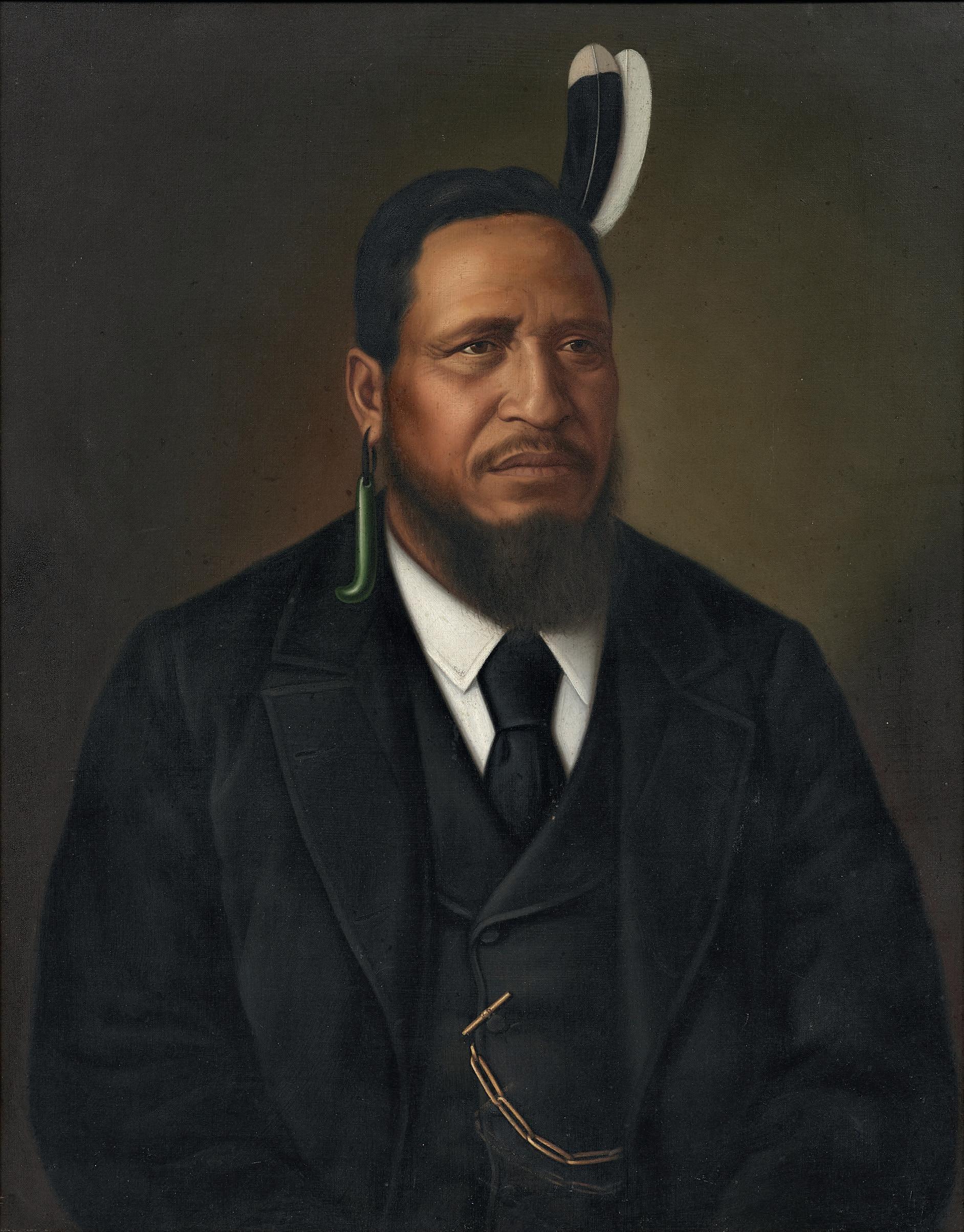
Wi Wheko
Oil on canvas
85 x 66.5 cm
$200,000 – 300,000
Private Collection, Nelson Webb’s, circa 1989, Hiraani Logan Estate Passed by descent to Wi Wheko’s niece, Hiraani Te Hei, and so to Te Hei’s adopted daughter, Kathleen Scott, and so to Scott’s daughter, the then vendor Scott’s father was J T Blake, a Māori interpreter who operated out of Hastings
Gottfried Lindauer, along with Charles Goldie, is the best known painter of Māori subjects from the late nineteenth early twentieth centuries. Born in Pilsen, Bohemia, then part of the Austro-Hungarian Empire, he trained professionally at the Academy of Fine Arts in Vienna, emigrating to New Zealand in 1874.
Lindauer’s first portraits of Māori were painted in Nelson. A move to Auckland in the mid 1870s proved crucial, there he met businessman, Henry Partridge (18481931). Lindauer travelled extensively throughout New Zealand living in a variety of locations besides Nelson and Auckland, notably Christchurch, Napier, where he was closely associated with the photographer Samuel Carnell (1832-1920) and finally, from 1889, Woodville.
Wi Wheko was born at Manawatu, where the Ngāi Te Ūpokoiri sub-tribe were living in exile. His father Wi Te Ota was a leading chief of the tribe and signed the Treaty of Waitangi. Wi Wheko’s mother was Retapu of Ngāti Hinemanu.
As a young man he joined one of the hekes of the 1850s as his people repatriated their former lands at Omahu. He and his wife Pipi had one son who died young. He was a recognised authority on tribal history and gave evidence in the Native Land Court concerning lands in Hawke’s Bay and Mōkai Pātea.
In 1884 he travelled to Palmerston North to give evidence at the Otamakapua 2 subdivision hearing. He appears in Lindauer’s commission list for that year, and the price of the portrait was thirty pounds. Wi Wheko died at Omahu in 1893.
52
(1839 - 1926)
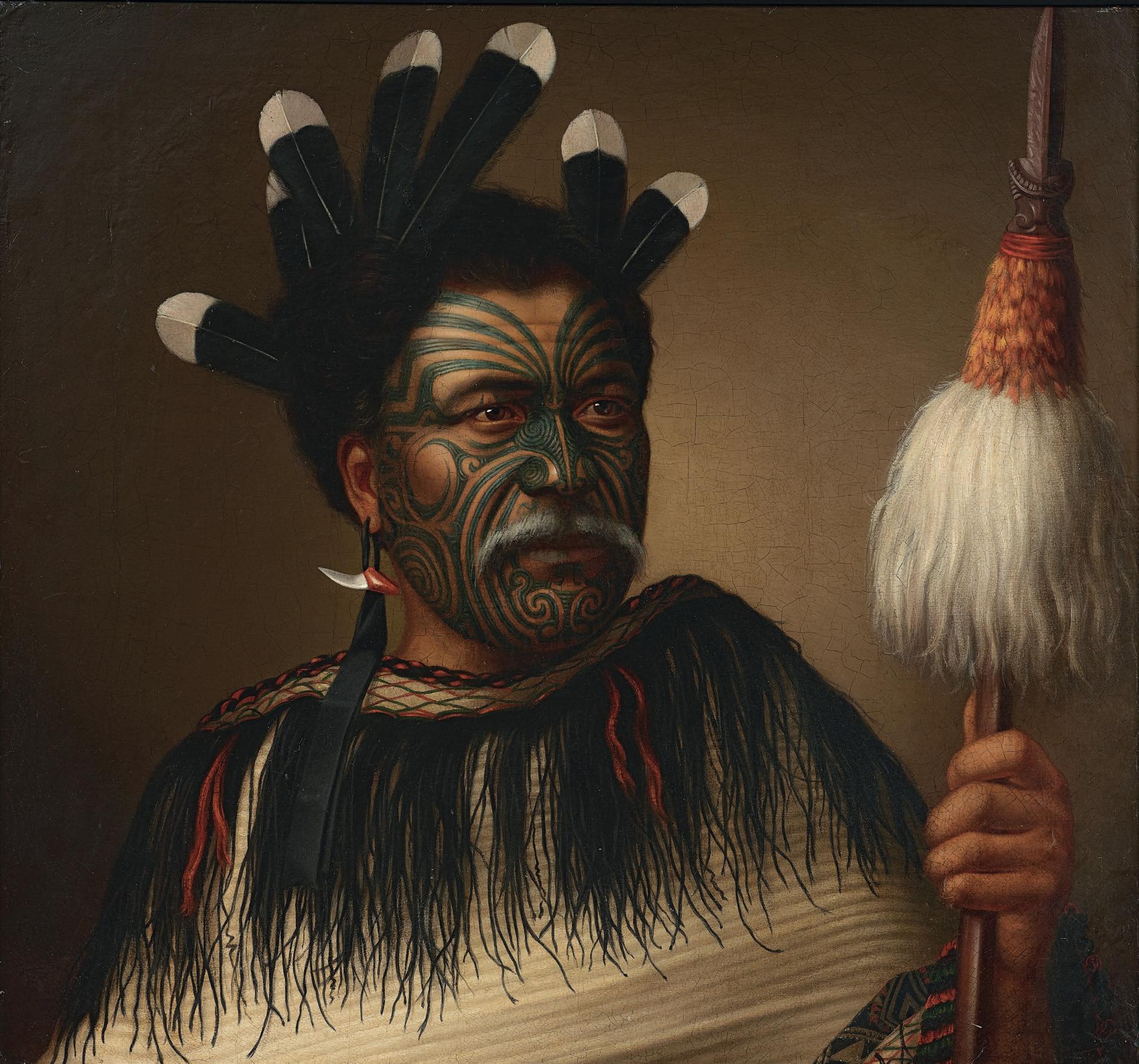
Chief Ngairo of the Ngāti Kahungunu Wairarapa
Oil on paper on hardboard
58 x 62 cm
Inscribed verso
$80,000 - 120,000
PROVENANCE
Private Collection, Nelson
Ngairo Rakaihikuroa was a chief of Ngāti Kahungunu, Wairarapa, on the south-eastern coast of the North Island. He was also known as Ngairo (Te) Apuroa, and Ngairo Takaputea.
Ngairo was involved in fighting Te Āti Awa in the 1820s and 1830s, and negotiating peace with Te Wharepōuri, in 1839. He was a prominent landowner in the 1850s, his name being recorded on many land sale documents at the time. Ngairo’s death was reported as having taken place on 14 December 1884.
A little over a year later, in January 1886, it was reported that Lindauer had taken up residence in Masterton. It is of course possible that Lindauer had been asked to paint a posthumous portrait of the Ngairo. Two other portraits of Ngairo painted by Lindauer are known. One, dated 1878, is held by the Pitt Rivers Museum, University of Oxford. Another undated one is held by the Dunedin Public Art Gallery. These two portraits show Ngairo in essentially the same dress and pose.
The present portrait is similar in pose and dress below the neck, but the head is markedly different. Ngairo is shown with a moustache, his moko is less elaborate, and his hair is decorated with a profusion of huia feathers. Furthermore, the head of Ngairo’s taiaha is turned away from the viewer, whereas in the other portraits it is face on. Unusually, this portrait appears to have been painted on paper rather than canvas. Two other Lindauers on paper are held in private collections. Both date to the 1890s and depict Pākehā subjects. Curiously, those examples are painted directly onto photographs.
53 GRACE JOEL (1865 - 1924)
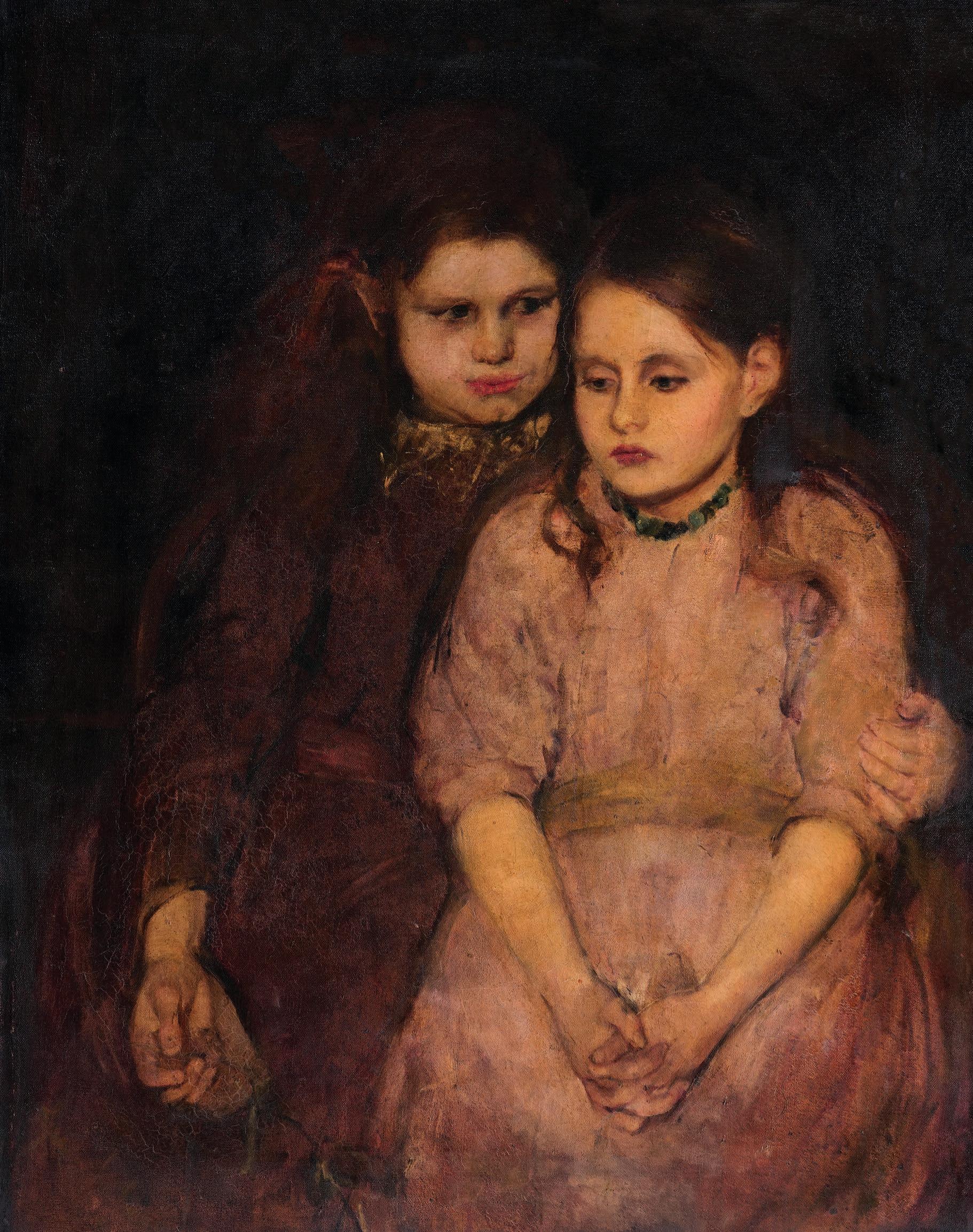
Untitled, Enfants sans mére / Sympathie Oil on canvas
91 x 72 cm
$10,000 - 15,000
PROVENANCE
Private Collection, United Kingdom
ILLUSTRATED
Joel Schiff, Grace Joel : An Impressionist Portrait, Otago University Press, Dunedin, 2014, p. 143, image 6.25
Grace Joel was one of New Zealand’s most accomplished artists whose career spanned the late nineteenth and early twentieth centuries (1865–1924). Born into a prominent Dunedin family, she and her contemporary Frances Hodgkins participated in the city’s vibrant artistic milieu before Joel left to study at the National Gallery School in Melbourne, where she won the prestigious Ramsay Art Prize for painting from the nude. She subsequently continued her studies at the Académie Julian in Paris, whose students over the years included John Singer Sargent, Henri Matisse, Pierre Bonnard and, from New Zealand, Charles F. Goldie. Joel later settled in London, where she exhibited at the Royal Academy, the Paris Salon and the Royal Scottish Academy, as well as holding solo exhibitions in Europe.
The present work is likely to be either Enfants sans mère, exhibited with the Société des Artistes Français at the Paris Salon in 1908, or Sympathie, exhibited with the same society at the Paris Salon in 1923. Although no documentary evidence has yet been found to establish whether the two titles refer to the same painting, it is entirely plausible that the work exhibited in 1908 as Enfants sans mère was re-exhibited fifteen years later under the title Sympathie. Retitling paintings between exhibitions was a well-established practice among artists of the late nineteenth and early twentieth centuries.
The latter work received an honourable mention, reportedly missing a silver medal by only a few votes. The near miss was widely reported in the Australian press, which described the painting as “original and distinguished” and praised it for possessing “the colouring of the old masters.” The older child appears to be holding a handkerchief while comforting the younger, making either title entirely appropriate.
JOEL SCHIFF
54 HENRY MOORE (British 1898 - 1986)
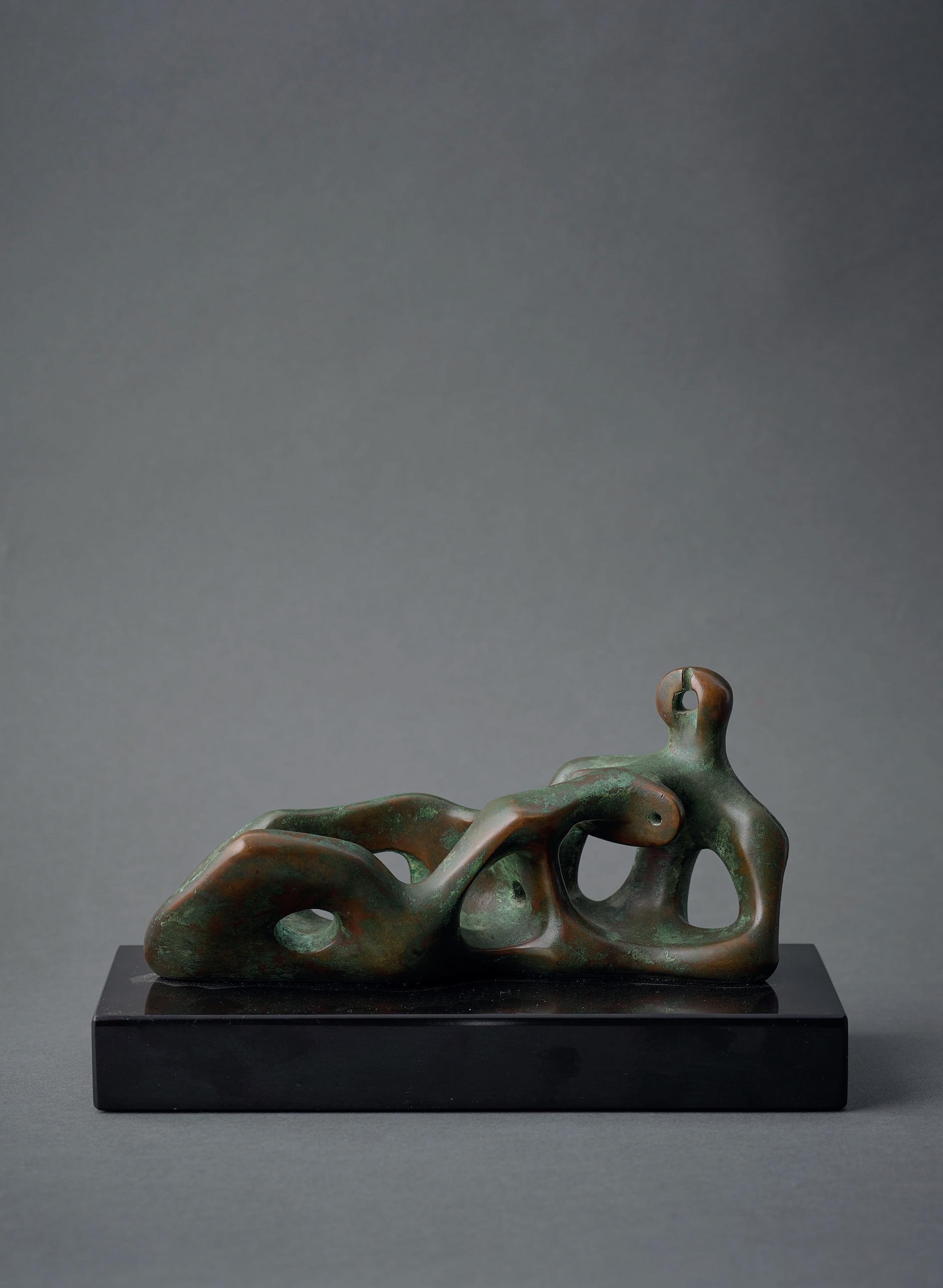
Maquette for Reclining Figure 1938
Bronze with green patina, cast no. 9/9
10.5 x 21 x 10.6 cm
$250,000 - 350,000
PROVENANCE
Private Collection, Auckland
Acquired from Waddington Galleries Ltd, London, 1989
Leicester Galleries, London, 1950
LITERATURE
Alan Bowness, Henry Moore Sculpture and Drawings 1921 - 48, Lund Humphries, London 1957, Vol. 1, no. 185, illus. p.11 (see large elm wood version pp. 120 - 124)
W. Grohmann, The Art of Henry Moore, Thames and Hudson, London, 1960, no. 25, illus. p.6 (polished bronze version)
Henry Moore’s reclining figures occupy a central position within the history of twentieth-century sculpture, and Maquette for Reclining Figure represents one of the defining moments in the evolution of this enduring theme. Conceived in 1938, at the height of Moore’s prewar experimentation, the sculpture distills the human body into a harmonious arrangement of flowing organic forms, pierced volumes and sculptural voids. These openings are not merely negative spaces but integral elements of the composition, allowing light to penetrate the work and reinforcing Moore’s belief that interior and exterior space should exist in dynamic balance.
The present bronze is cast from Moore’s original 1938 model and belongs to the edition of nine. Although intimate in scale, it possesses the same monumentality and rhythmic presence that characterise the artist’s large public sculptures. The softly modelled forms, enhanced by a rich green patina, reveal Moore’s fascination with the landscape; bones, pebbles and natural erosion, motifs that informed his sculptural language throughout his career.
This example carries distinguished provenance, having been acquired from Waddington Galleries, London, in November 1989. The invoice accompanying the work records an earlier provenance to Leicester Galleries, London, and cites its inclusion in Alan Bowness’s Henry Moore Sculpture and Drawings 1921–48 (Vol. I, no. 185) and Will Grohmann’s The Art of Henry Moore (1960, no. 25), underscoring the importance of this composition within Moore’s oeuvre.
55 HENRY MOORE (British 1898 - 1986)
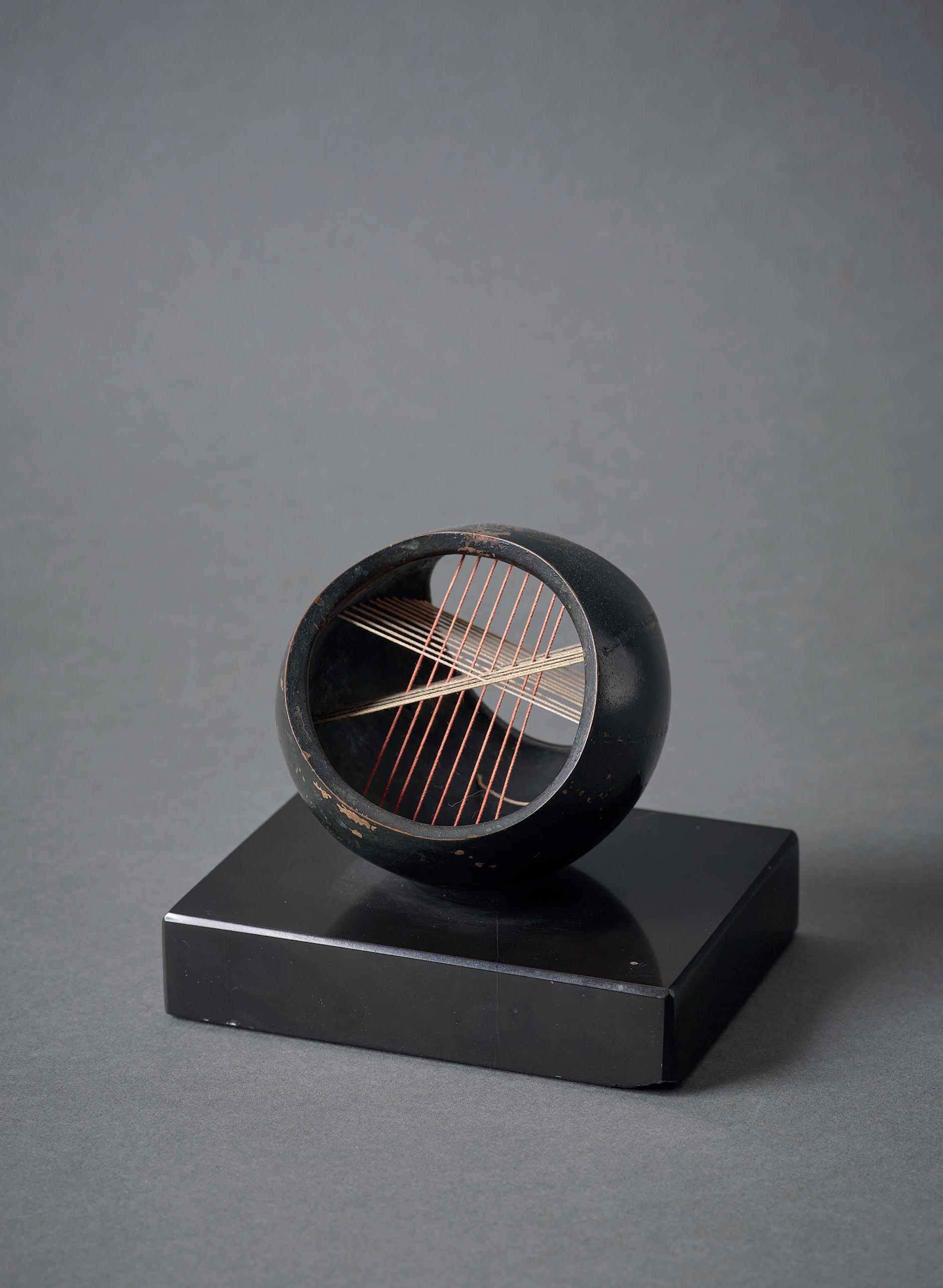
Stringed Ball 1939
Bronze with dark brown patina and string, edition of 9
10.5 x 12.5 x 10 cm
$250,000 - 350,000
PROVENANCE
Private Collection, Auckland
Acquired from Waddington Galleries Ltd, London, 9 June 1988
EXHIBITED
Henry Moore, Sixty Years of His Life, The Metropolitan Museum of Art, New York, 1983, no. 198
LITERATURE
David Sylvester (ed), Henry Moore, Sculptures and Drawings 1921 - 48, Lund Humphries London, 1957, p.12. no. 198 (another cast illus.)
Stringed Ball (1939) is one of Henry Moore’s most innovative and intellectually ambitious sculptural experiments. Created during a period of intense artistic exploration, it forms part of the celebrated “stringed” series inspired by Moore’s study of mathematical models in the Science Museum, London. These scientific teaching models employed taut strings to illustrate complex geometric curves and equations, prompting Moore to investigate how tension, line and void could become integral sculptural elements.
Widely regarded as one of the foremost sculptors of the twentieth century, Henry Moore (1898–1986) transformed modern sculpture through his pioneering exploration of abstraction, landscape and the human figure.
Educated at the Leeds School of Art and the Royal College of Art, Moore drew inspiration from ancient cultures, natural forms and the direct carving movement, developing a distinctive visual language that balanced monumental mass with flowing organic forms. His sculptures are represented in the world’s leading museum collections, and his public commissions have become enduring landmarks across Europe, North America and beyond.
In Stringed Ball, Moore creates a compelling dialogue between solid form and enclosed space. The taut strings divide and activate the sculpture’s interior, introducing a sense of rhythm, tension and spatial complexity. Rather than treating empty space as merely a void, Moore made it an active component of the composition, allowing line and volume to exist in dynamic balance. This groundbreaking integration of string into sculpture marked a significant development in his practice and anticipated many of the sculptural innovations that followed in the post-war period.
Today, Moore’s stringed sculptures are regarded as among the most original and influential works of his career, representing a pivotal moment when art, science and geometry converged to redefine the possibilities of modern sculpture.
Note:
One of the tensioned strings has become detached, and the sculpture will require conservation treatment to restore it to its original configuration. During the cataloguing of this work, we have identified the recognised authority on Henry Moore’s stringed sculptures and will provide their contact details to the purchaser. The sculpture was acquired in 1988 from Waddington Galleries, London, by the current owner’s family, adding to its established provenance
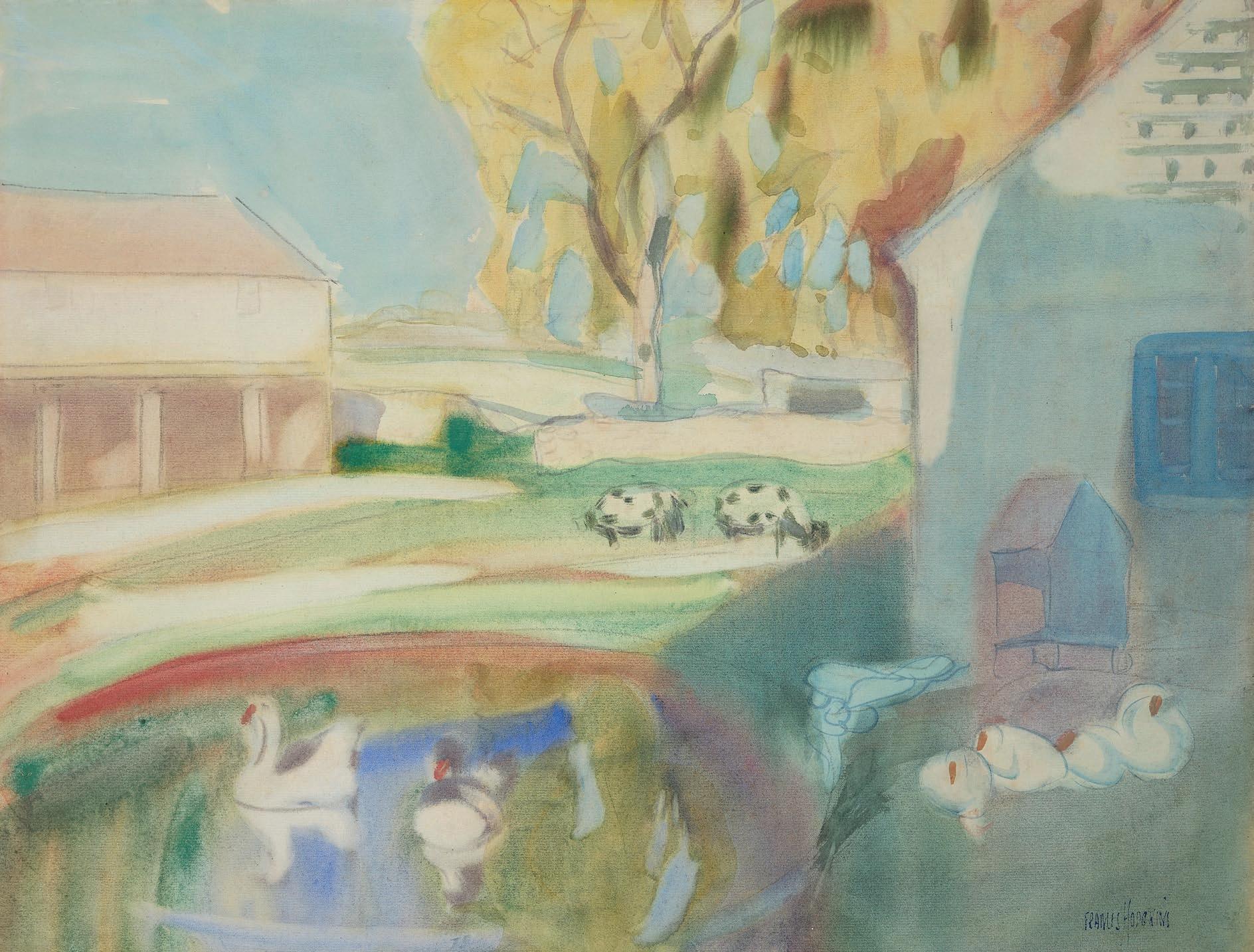
56 FRANCES HODGKINS (1869 - 1947)
The Pond, 1919
Watercolour and graphite on paper
44 x 57 cm
Signed lower right
$70,000 – 100,000
PROVENANCE
Private Collection Collection of Mrs Roger Field
EXHIBITED
Frances Hodgkins: Retrospective Exhibition, Lefevre Gallery, London, Nov 1946
CATALOGUE NUMBER
FH1323
In 1917, Frances Hodgkins stayed briefly with her summer students at the Swan Inn, Burford, seeking rural subjects from which they could develop their skills. She had only recently been to London, where she had narrowly missed being caught up in the Blitz, having visited the London branch of the Bank of New South Wales only half an hour before the bombing started. Yet none of that fear is apparent in her work.
The sturdy stone pillars supporting the upper floor of the barn in the background of The Pond, which created a handy porch in which to shelter from winter storms or bleaching summer heat, introduced an important verticality to her composition, as do the clump of swiftly delineated trees behind the simple farmhouse on the right.
Painted wet-on-wet, swathes of pigment mark the horizontal bands of walls and field, on which two Gloucestershire Old Spots pigs, a breed famed for their size and gentle behaviour, rootle happily. A dark ochre swathe denotes the stone edging of the pond, the shimmering reflection of the barn uprights providing a dynamic contrast to the iridescent blue water, across which two elegant swans glide. Their bodies delineated by interweaving brushstrokes, four swans nest on the bank, collapsing into each other like the corps de ballet in Swan Lake. They reinforce the brilliant handling of what might be some kind of small stone bastion or ledge jutting out towards the pond itself, its form merely hinted at in a series of blue swoops and furls that are a painterly tour de force. There is no hint here of the artist’s restlessness, yet Hodgkins soon fled back to her studio in St Ives, preferring the stimulus of the community of older artists who remained there during the war.
MARY KISLER
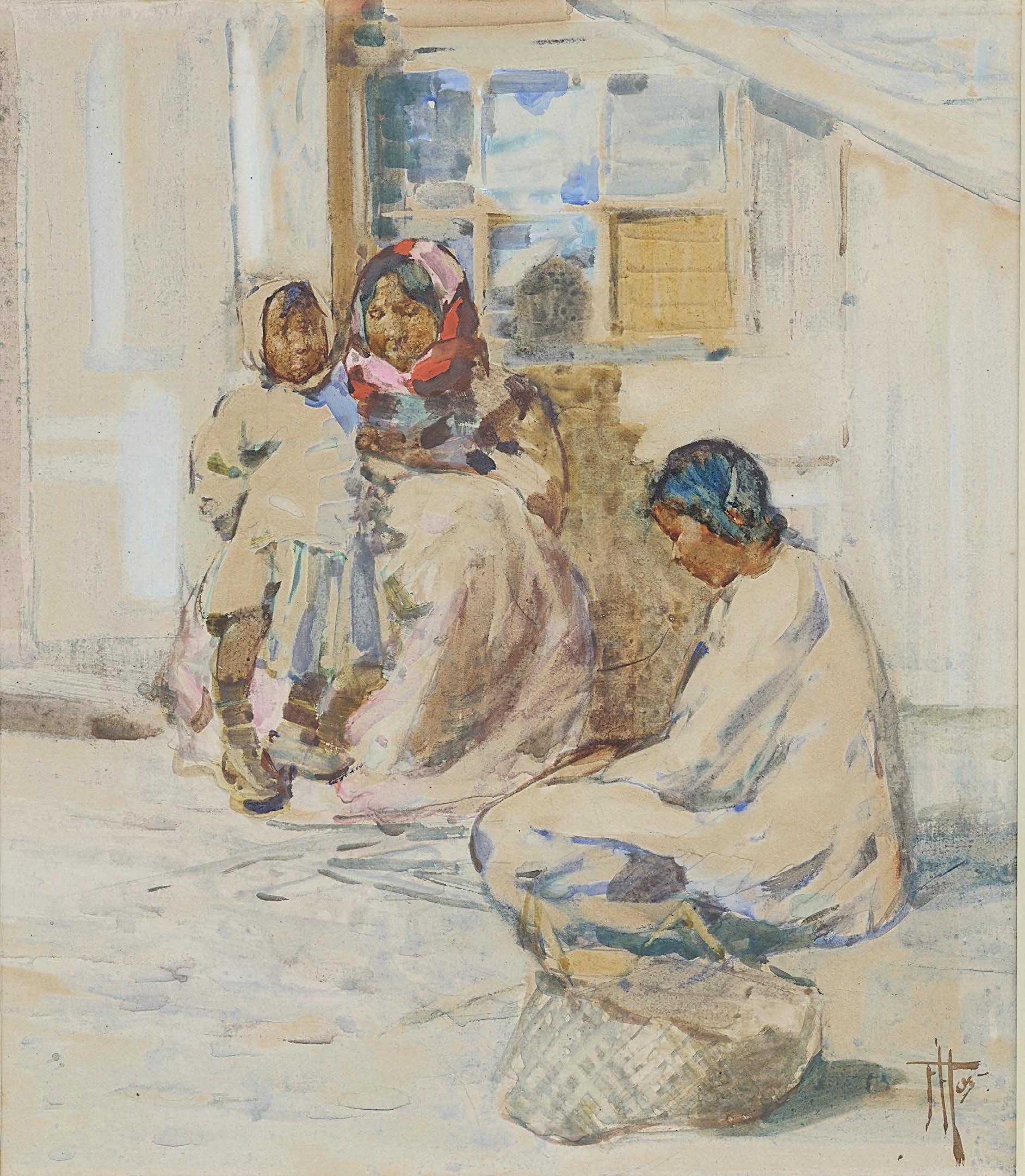
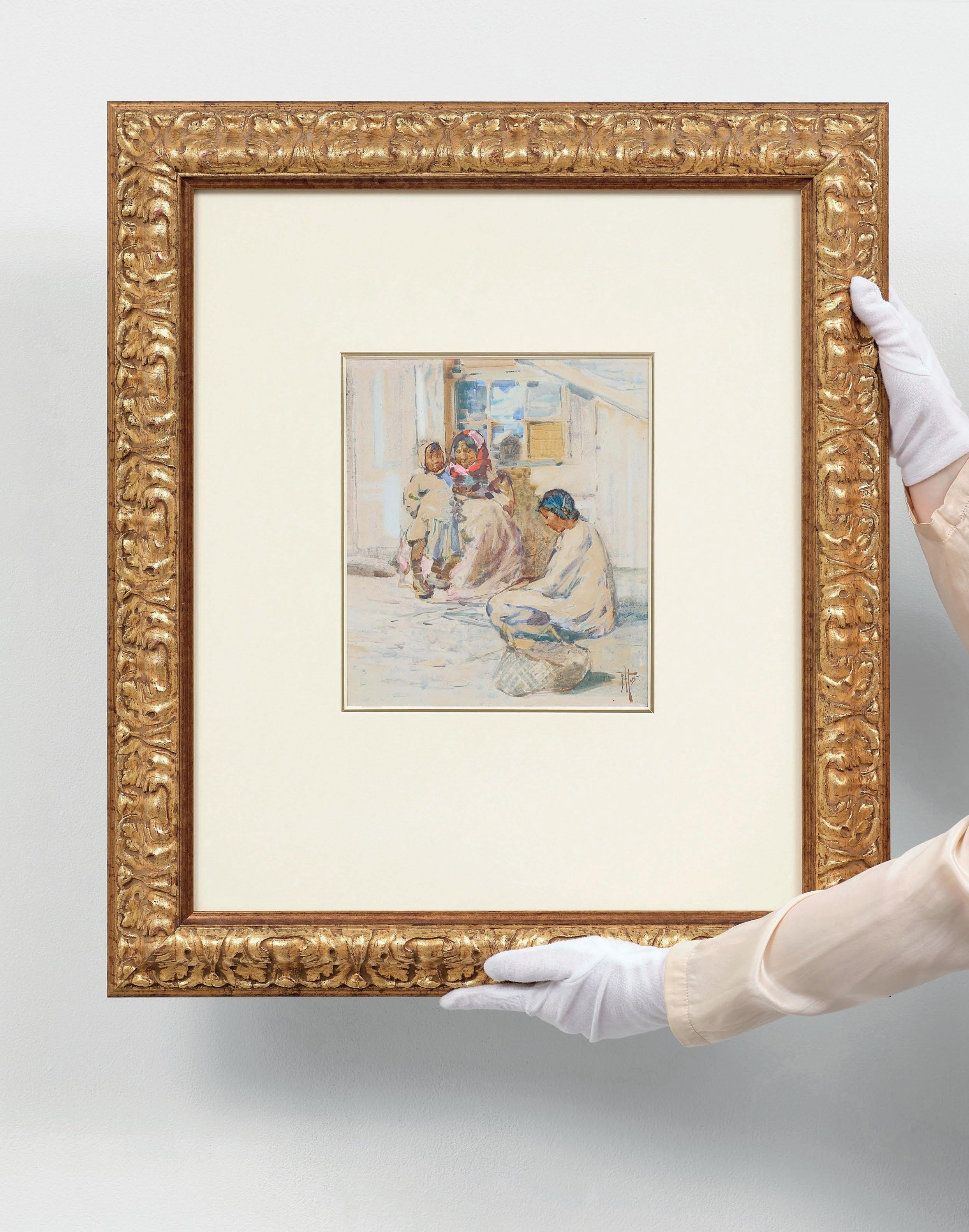
57 FRANCES HODGKINS (1869 - 1947)
Idlers, 1905
Watercolour on paper 23 x 20 cm
Initialled & dated 05 lower right
$40,000 – 60,000
PROVENANCE
Private Collection
Collection of Mrs F P Nelson, Pahiatua Collection of H M Gore, Wellington
EXHIBITED
New Zealand Academy of Fine Arts, 17th Annual Exhibition, Academy’s Gallery, Whitmore St, Wellington, 14 Oct 1905
A Notable Exhibition of Water Colors by Miss Frances Hodgkins, Anthony Hordens’ Fine Art Gallery, Sydney, 14 Apr 1913
A Notable Exhibition of Water Colours, Art Gallery Hall, Dunedin, 21 Jul 1913 - 31 Jul 1913
LITERATURE
E H McCormick, Works of Frances Hodgkins in New Zealand, Auckland City Art Gallery, Auckland, 1954, p. 184
E H McCormick, Portrait of Frances Hodgkins, Auckland University Press, Auckland, 1981, p. 56 (ill.)
Iain Buchanan, Michael Dunn, Elizabeth Eastmond, Frances Hodgkins: Paintings and Drawings, Auckland University Press, Auckland, 1994, p. 20 (ill. 9)
CATALOGUE NUMBER
FH0441
From her earliest days on the Otago Peninsula, Frances Hodgkins had delighted in painting Māori subjects, mostly women and children who were prepared to pose for her for a tiny sum. When she sailed for Europe in 1901, she wore her ‘little tiki man’ for the duration.
Drawn back to Aotearoa New Zealand at the end of 1903 by a sense of family duty, she recognised immediately that the country of her birth was not ready for the hints of Impressionism in her latest work. Disillusioned by a broken engagement, it was now expected that she would care for her mother, while playing the role of maiden aunt for her sister’s busy family. A cloud of frustration settled on her, making it difficult to work
A stay with Dorothy Kate Richmond, where they would have reminisced of their previous European adventures, was followed by a stay at Ohinemutu in Rotorua in June 1905, where she found again her favoured subject material.
Idlers depicts a mother and child seated in front of a whare, the younger woman gazing pensively at the ground, a flax kete at her feet. It is an introspective work, animated by the frustrated stance of the young child leaning into his mother, hoping to attract her attention. Hodgkins paid for their services (she described the local models as ‘coy and greedy’), but they knew their worth.
The work reflects her subjects’ capacity for stillness, overlaid with Hodgkins’ own dissatisfaction. While in Rotorua she was notified that for the third time her work had been hung in the Royal Academy, and she determined to return to Europe and take her chances.
MARY KISLER
Watercolour
22.5 x 46 cm
Signed & dated 1901 lower right
$10,000 - 15,000
PROVENANCE
Private Collection, Christchurch
Watercolour
57 x 44.5 cm
Signed lower left
$10,000 – 15,000
PROVENANCE
Private Collection, Waikato
110 x 69 cm
$15,000 – 25,000
PROVENANCE
Private Collection, Auckland
Acquired from International Art Centre, Contemporary & Traditional New Zealand & European Art, Auckland, 29/03/2001, Lot no. 66
62.5 x 75 cm
Signed lower left
$10,000 – 20,000
PROVENANCE
Private Collection, Auckland
Portrait of a
Watercolour
55 x 42 cm
Signed lower left
$8,000 – 12,000
PROVENANCE
Private Collection, Waikato
Acquired from International Art Centre, Important & Rare, Auckland, 08/08/2017, Lot no. 75
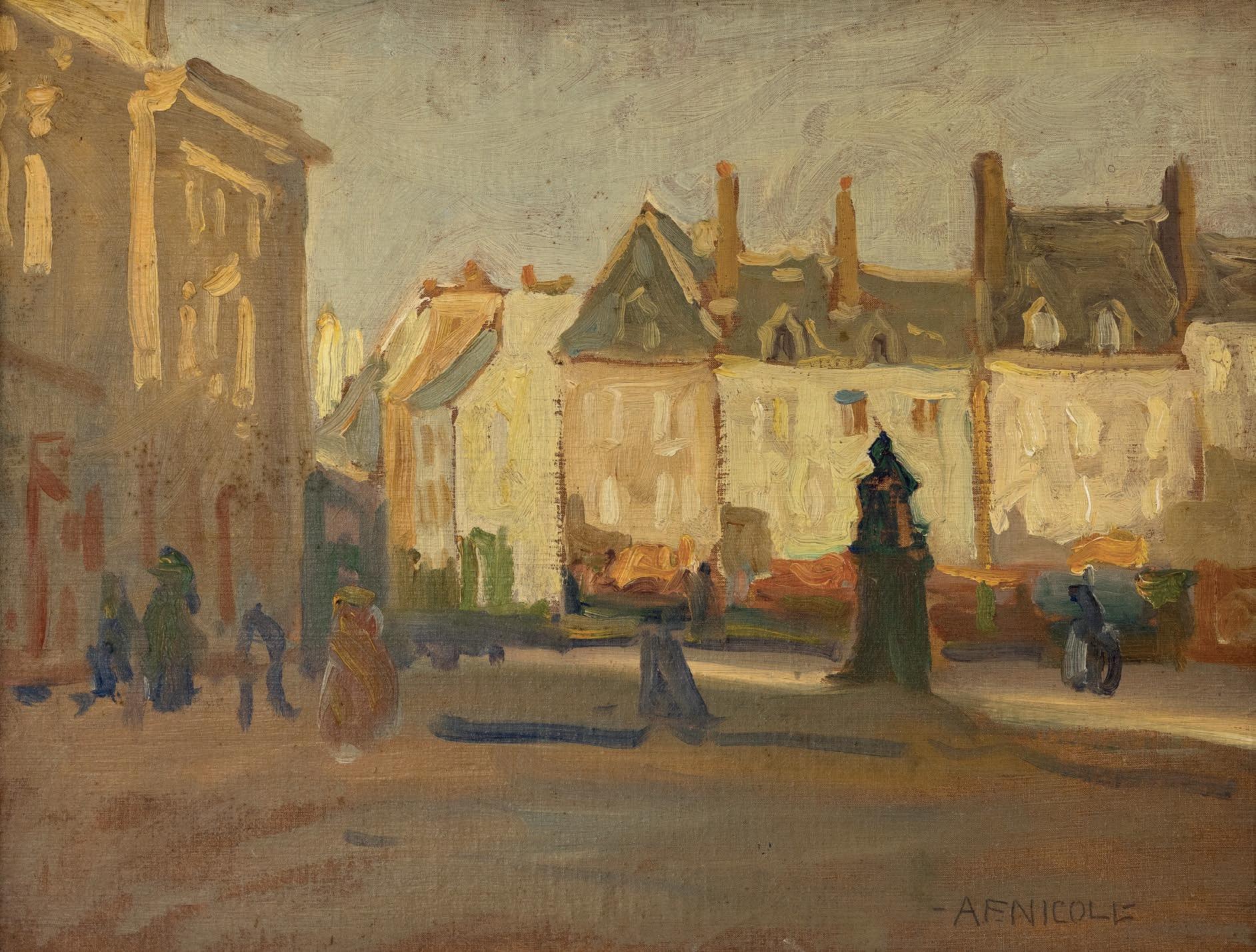
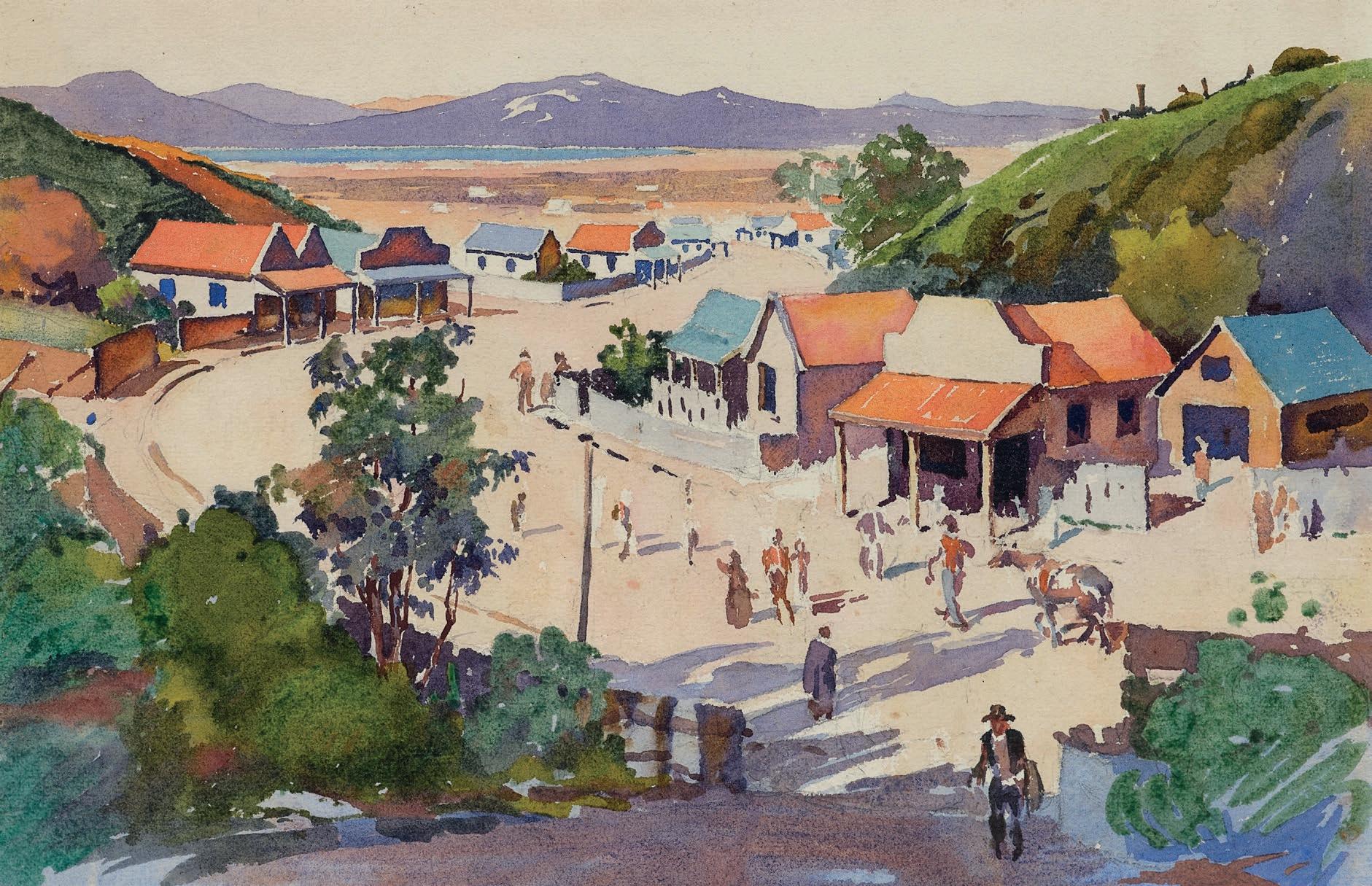
Village Square
Oil on canvas on board
29.5 x 38.5 cm
Signed lower right
$4,000 - 6,000
PROVENANCE
Private Collection
Acquired from Webb’s, Auckland, c. 1980
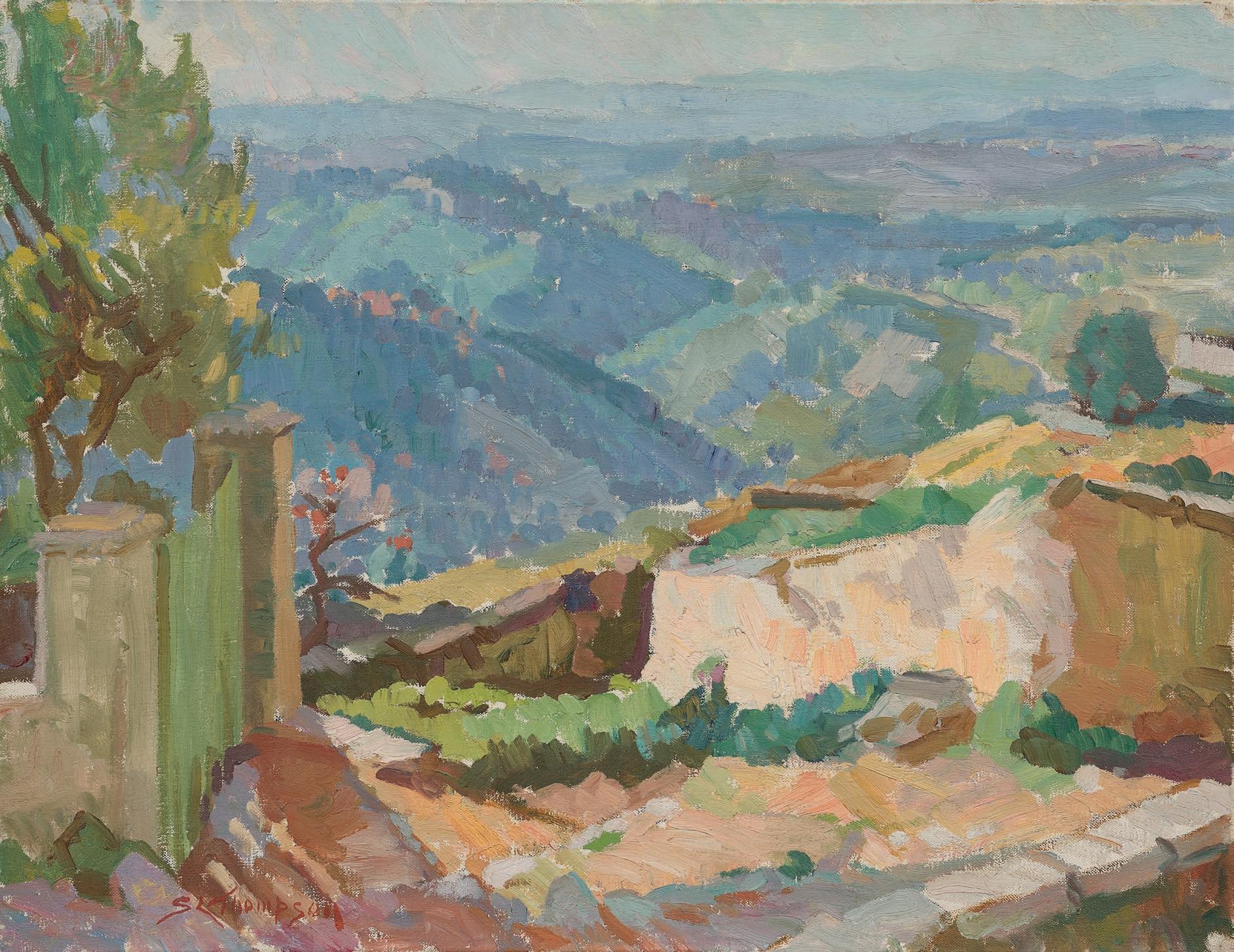
50 x 65 cm
Signed lower left
$15,000 – 20,000
PROVENANCE
Private Collection, France
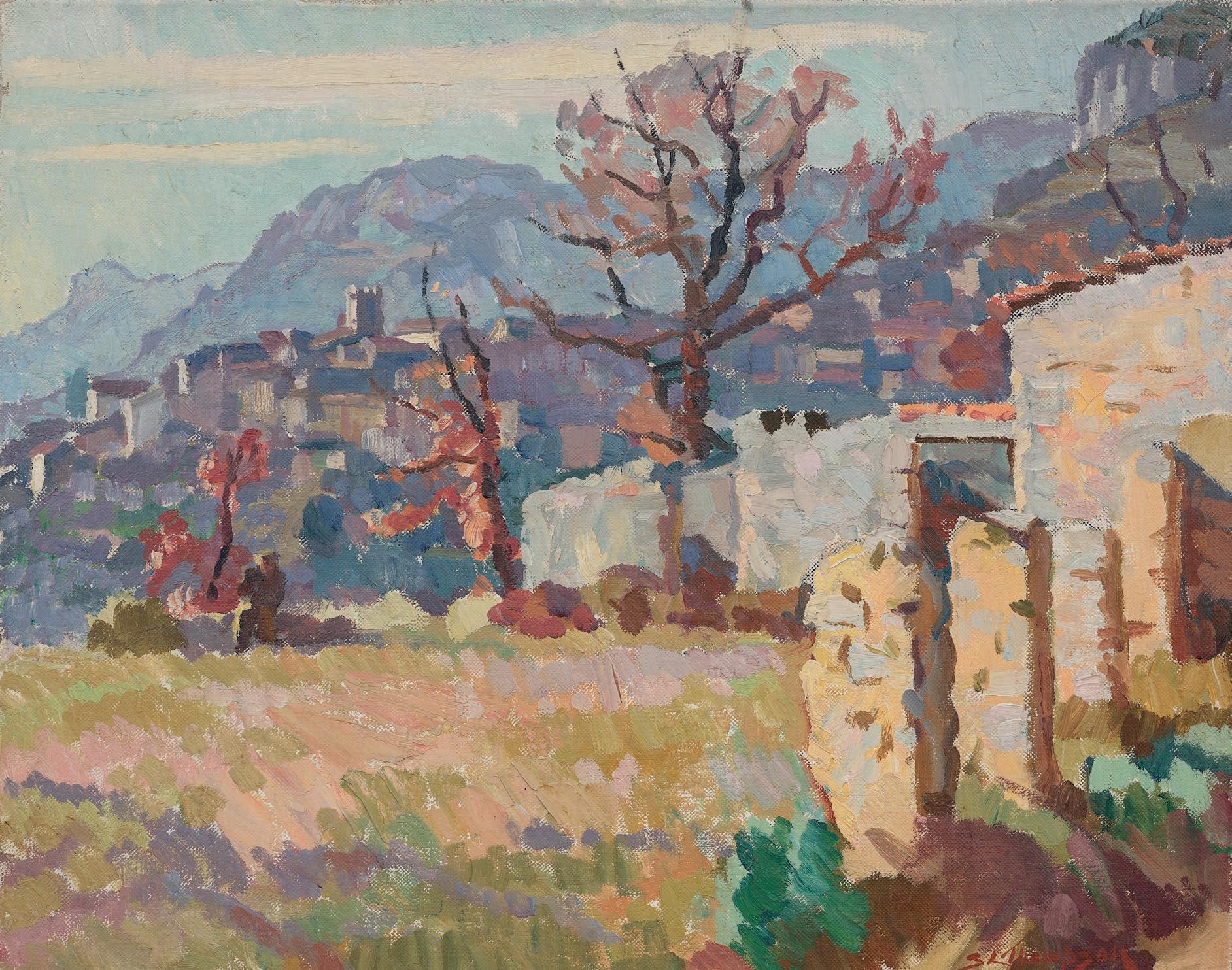
50
Signed lower right
Inscribed & dated 1949 on stretcher verso
$15,000 – 20,000
PROVENANCE
Private Collection, France
66
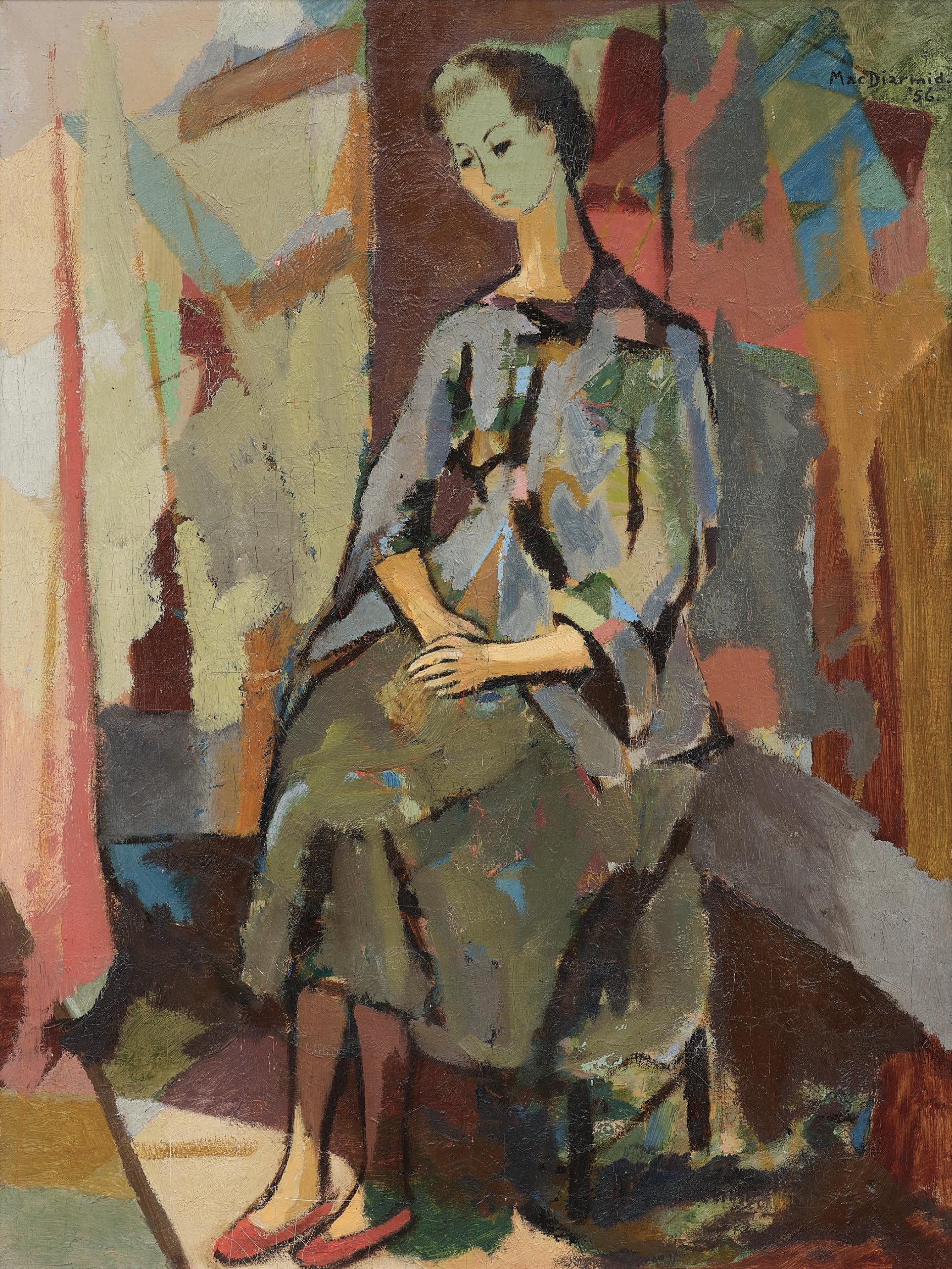
DOUGLAS MACDIARMID (1922 - 2020)
Woman Sitting Oil on canvas
60 x 50 cm
Signed & dated ‘56 upper right
$10,000 – 15,000
PROVENANCE
Private Collection, Auckland
The subject of this painting is thought to be a live model in an art class. In 1956, Douglas was living in Paris with Jacqueline, a wealthy, mercurial older patron and talented amateur artist who became his lover and later fiancee. She set him up in luxurious living quarters, including a studio, within her mansion. On occasion, they attended local art academy live drawing sessions while Jacqueline was refining her figurative skills.
Douglas found people endlessly fascinating and was intrigued by the nuances of body language, nonverbal communication and what he called the ‘human condition’. During the mid-1950s to 1960s, he regularly painted French people going about their everyday lives.
This was MacDiarmid rediscovering his adopted country and providing a figurative interplay between traditional and modern European culture. Among paintings of folk engaged in typical tasks were other figures simply being, captured for a look or an attitude that piqued his interest ... like a live model holding a pose. A number of these works found their way into private and public collections in New Zealand.
Apart from a summer break at Jacqueline’s beach house in Le Pyla on the Atlantic coast, and road trips to the Loire Valley, Provence and French Riviera, Douglas was mostly based in Paris during 1956. He was busy with commissioned portraits, regularly selling landscapes through a gallery on Montmartre hill, and thanking his lucky stars for this change of fortune after years on the poverty line. However, his relationship with Jacqueline was tumultuous and often had him questioning his worth as a still largely penniless painter. It came to a tragic end in 1961 when she died unexpectedly after a skiing accident, while he was back in New Zealand visiting his parents.
ANNA CAHILL
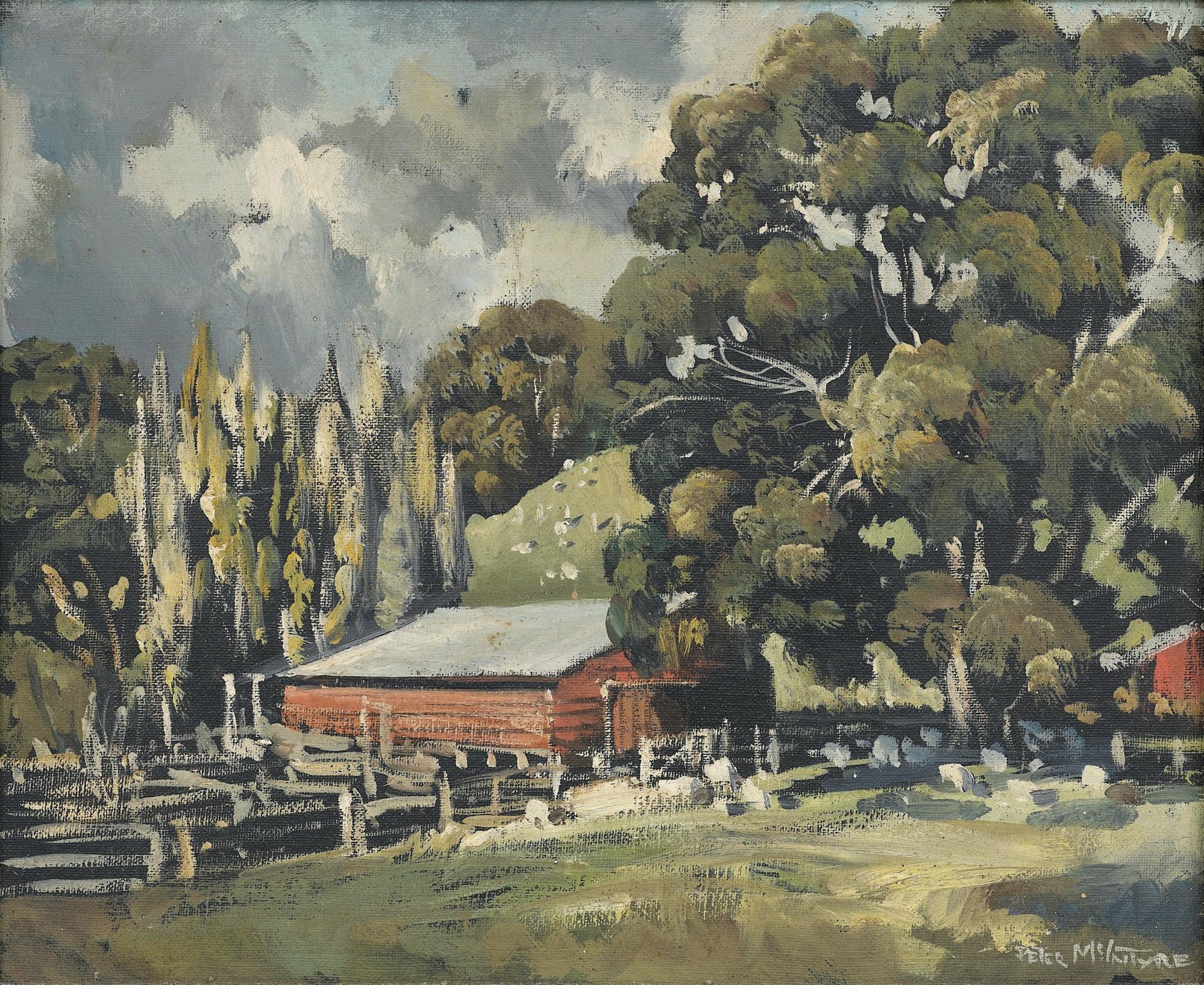
Dorsington Woolshed, Havelock North Oil on board
32.5 x 39.5 cm
Signed lower right
$4,000 - 6,000
PROVENANCE
Private Collection, Auckland Acquired directly from the artist
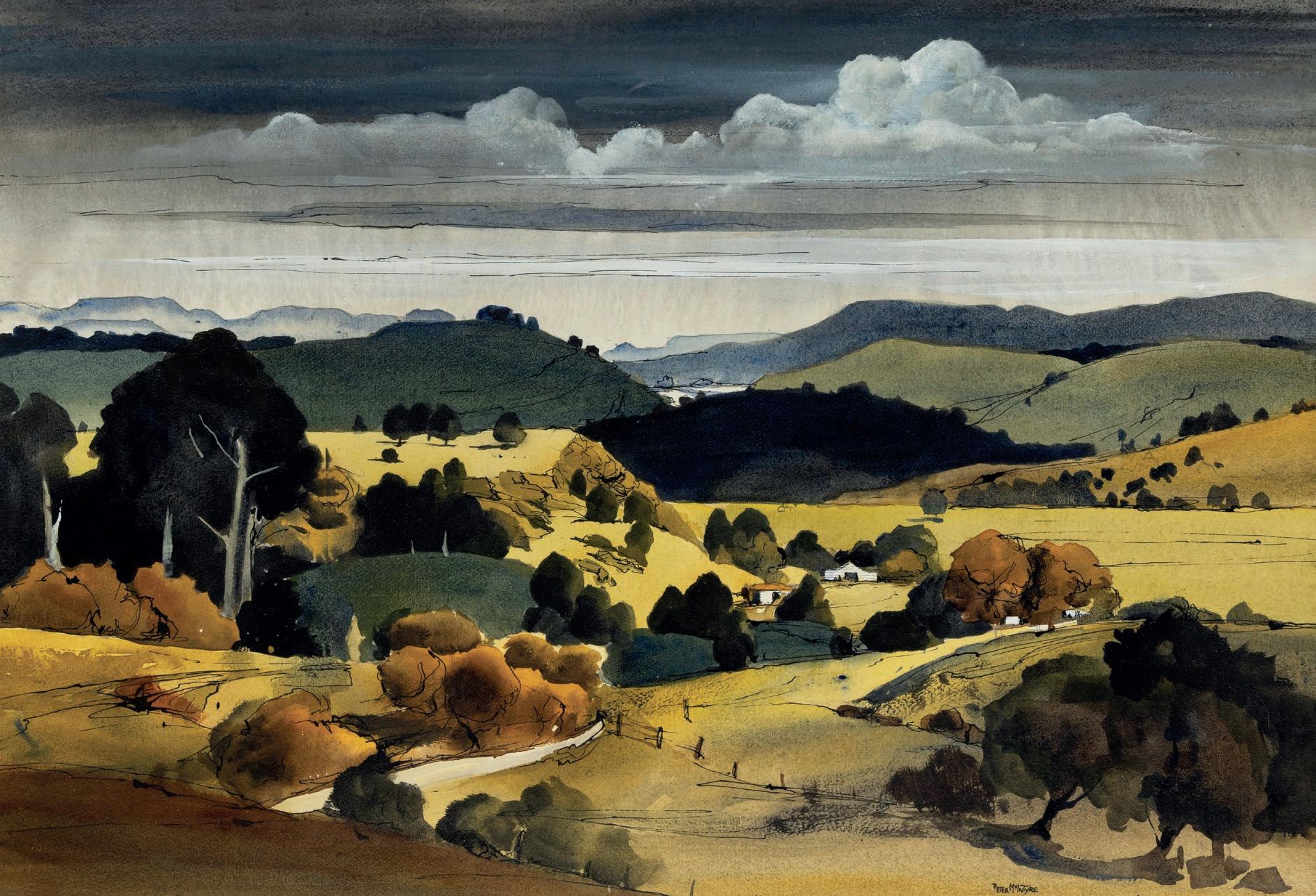
68 PETER MCINTYRE (1910 - 95)
Central Otago Landscape, c. Mid 1960s
Watercolour and indian ink
heightened with white
50 x 72 cm
Signed lower right
$15,000 – 20,000
PROVENANCE
Private Collection, Waikato
Dunbar Sloane, New Zealand & International
Fine Art -Day 1, Wellington, 14/04/2016, Lot no. 17
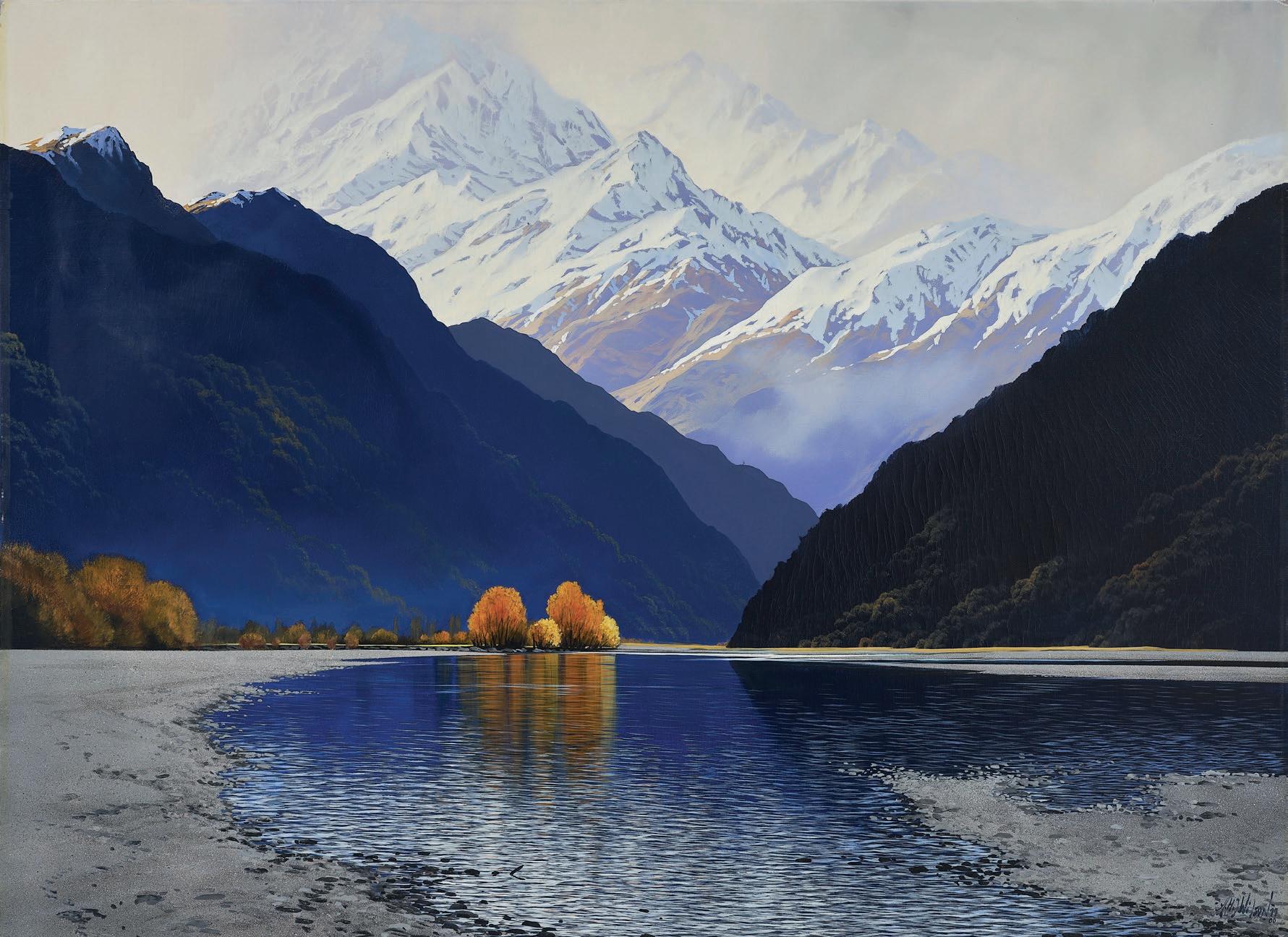
69 TIM WILSON (1954 - 2020)
Untitled Oil on canvas
91 x 121 cm
Signed & dated 99-00 lower right
$15,000 – 20,000
PROVENANCE
Private Collection, Australia
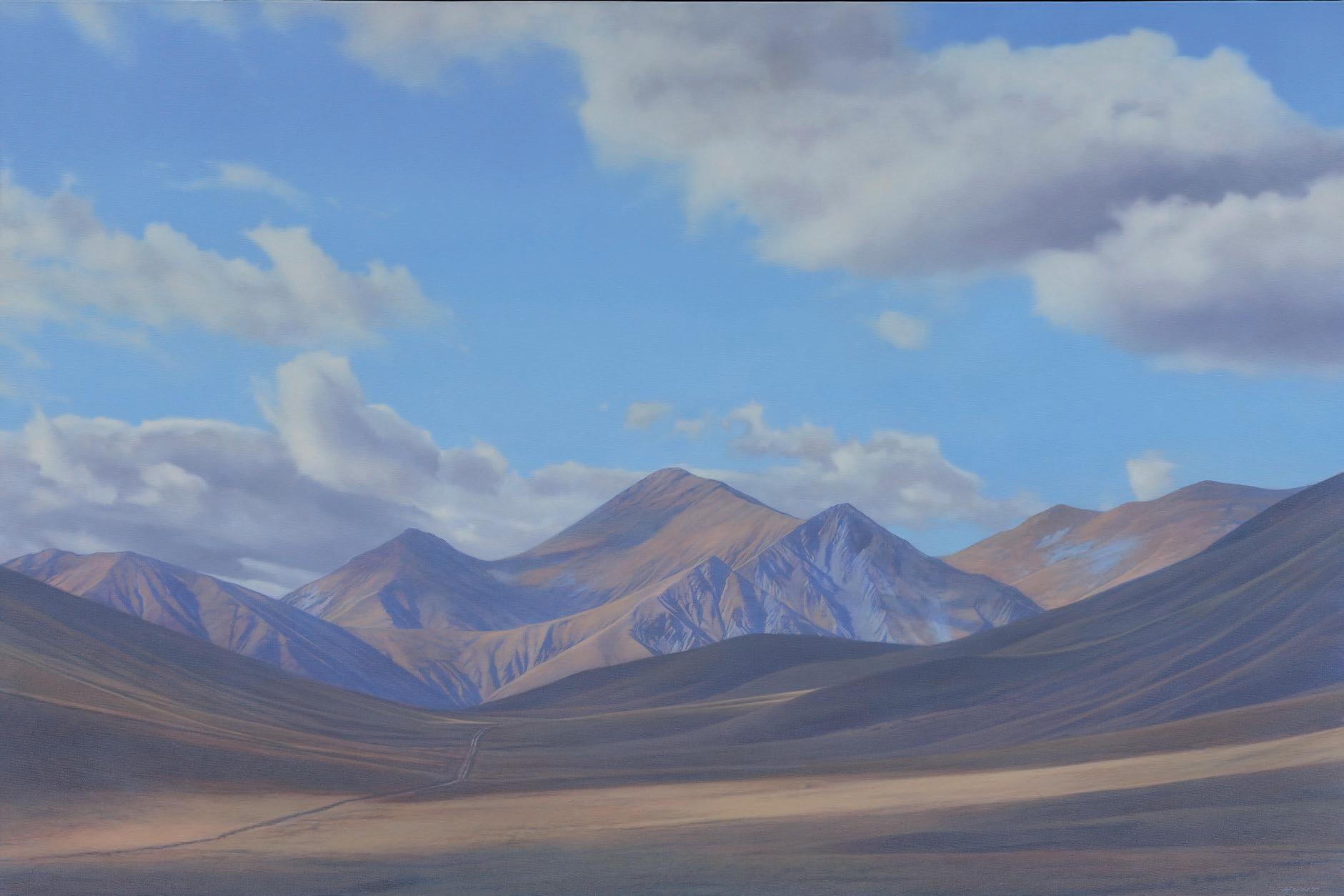
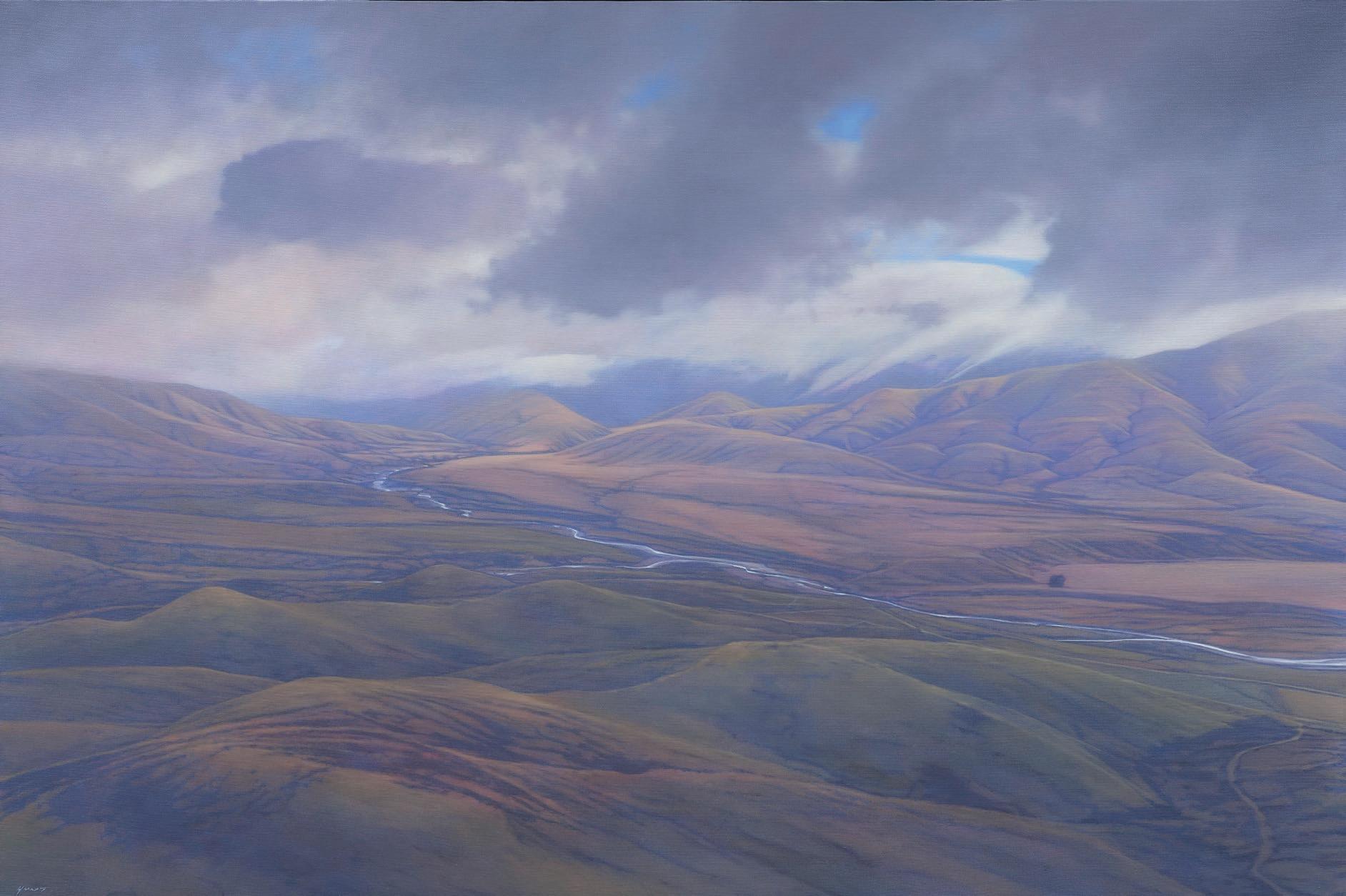
70 BRUCE HUNT (b. 1964)
The Lindis II
Acrylic on canvas
111 x 167.5 cm
Signed lower right
Signed, title inscribed & dated 2021 verso
$8,000 - 12,000
PROVENANCE
An Estate Collection
Acquired from ARTIS Gallery, Auckland, 2021
71 BRUCE HUNT (b. 1964)
Smell of Rain, Upper Reaches, Hakataramea
Acrylic on canvas
111 x 167.5 cm
Signed lower left
Signed, title inscribed & dated 2021 verso
$8,000 - 12,000
PROVENANCE
An Estate Collection Acquired from ARTIS Gallery, Auckland, 2021
72
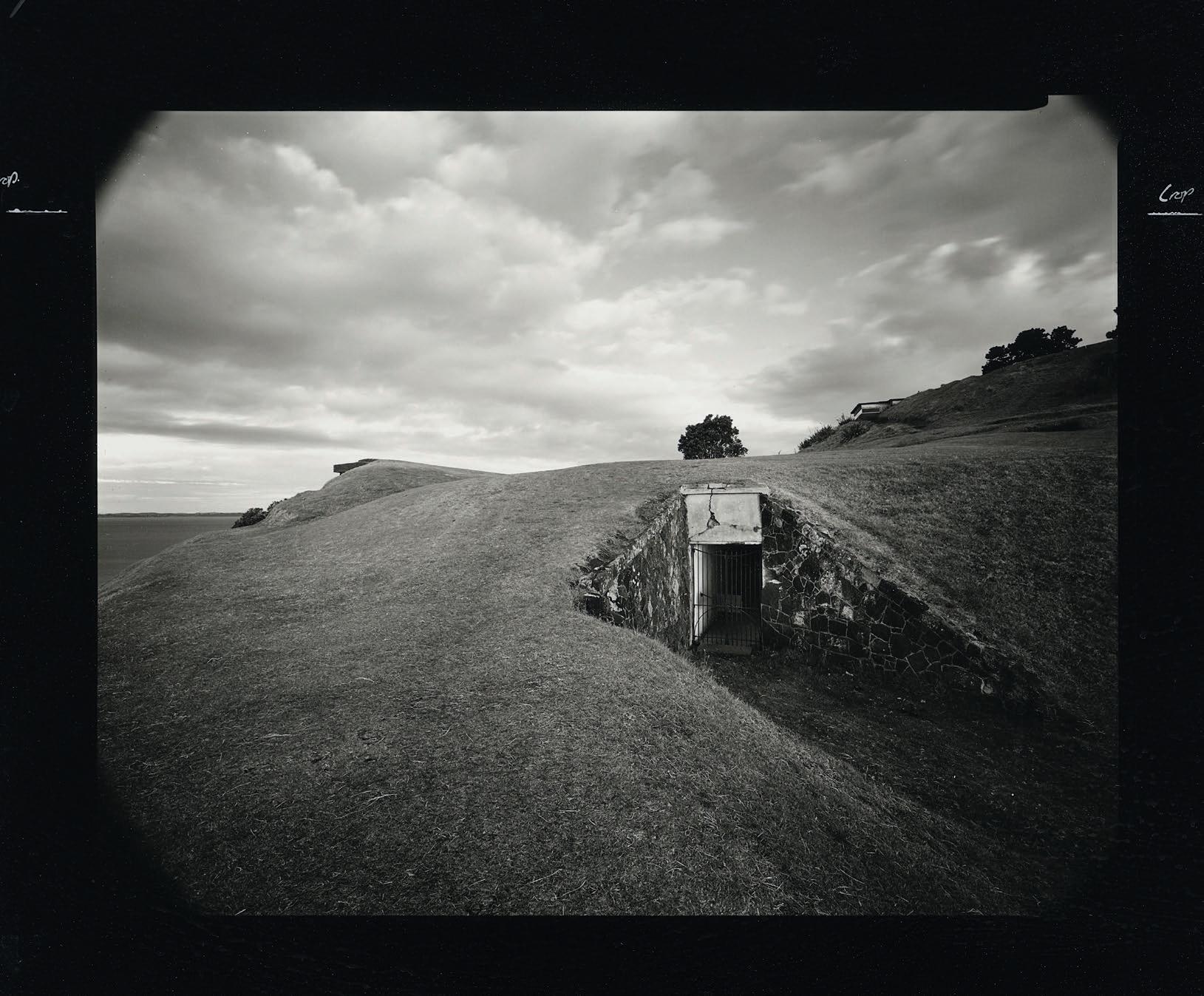
LAURENCE ABERHART (b. 1949)
Untitled
Silver gelatin print
24 x 29 cm
$2,000 - 4,000
PROVENANCE
Private Collection, Auckland
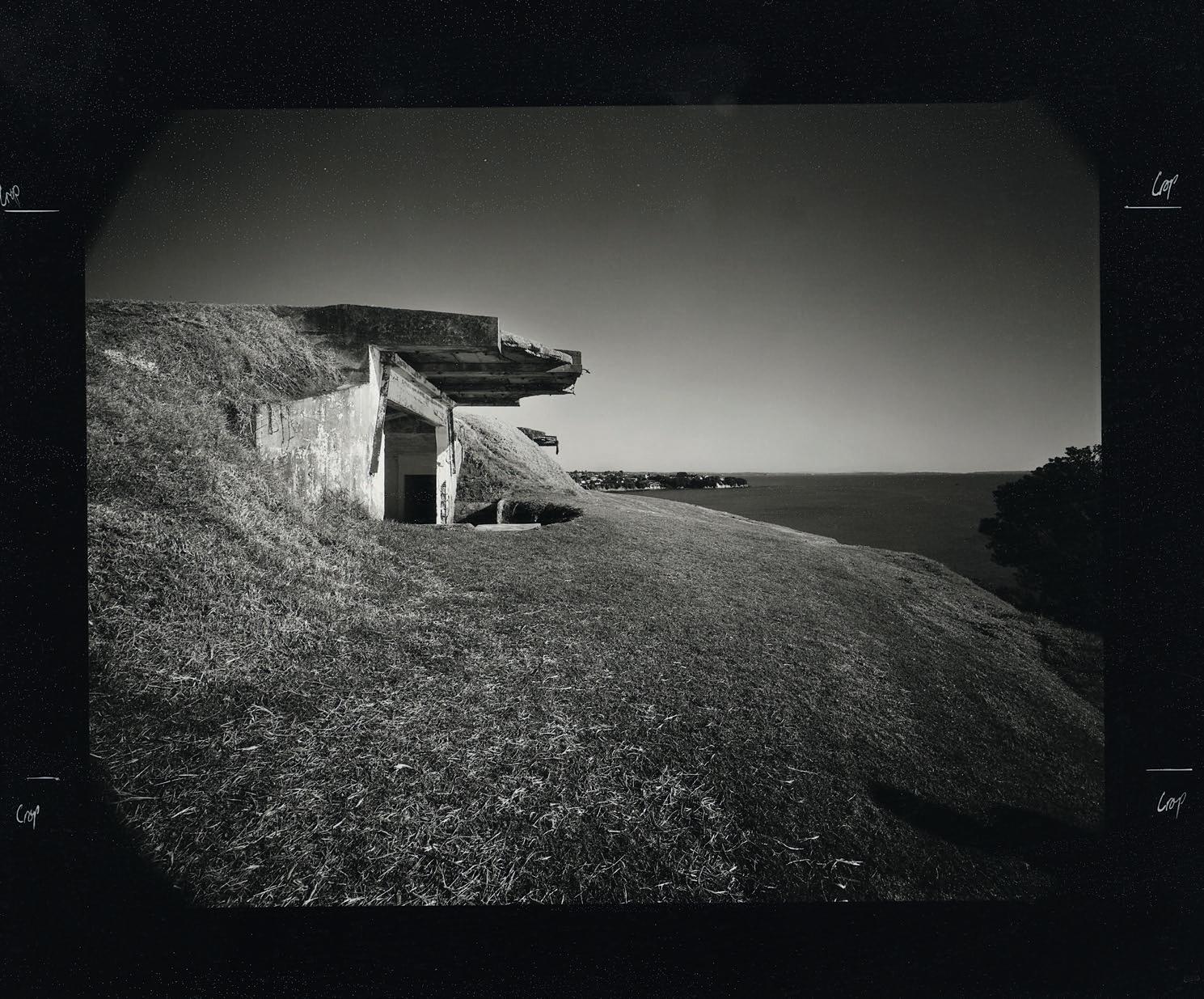
73
LAURENCE ABERHART (b. 1949)
Untitled
Silver gelatin print
24 x 29 cm
$2,000 - 4,000
PROVENANCE
Private Collection, Auckland
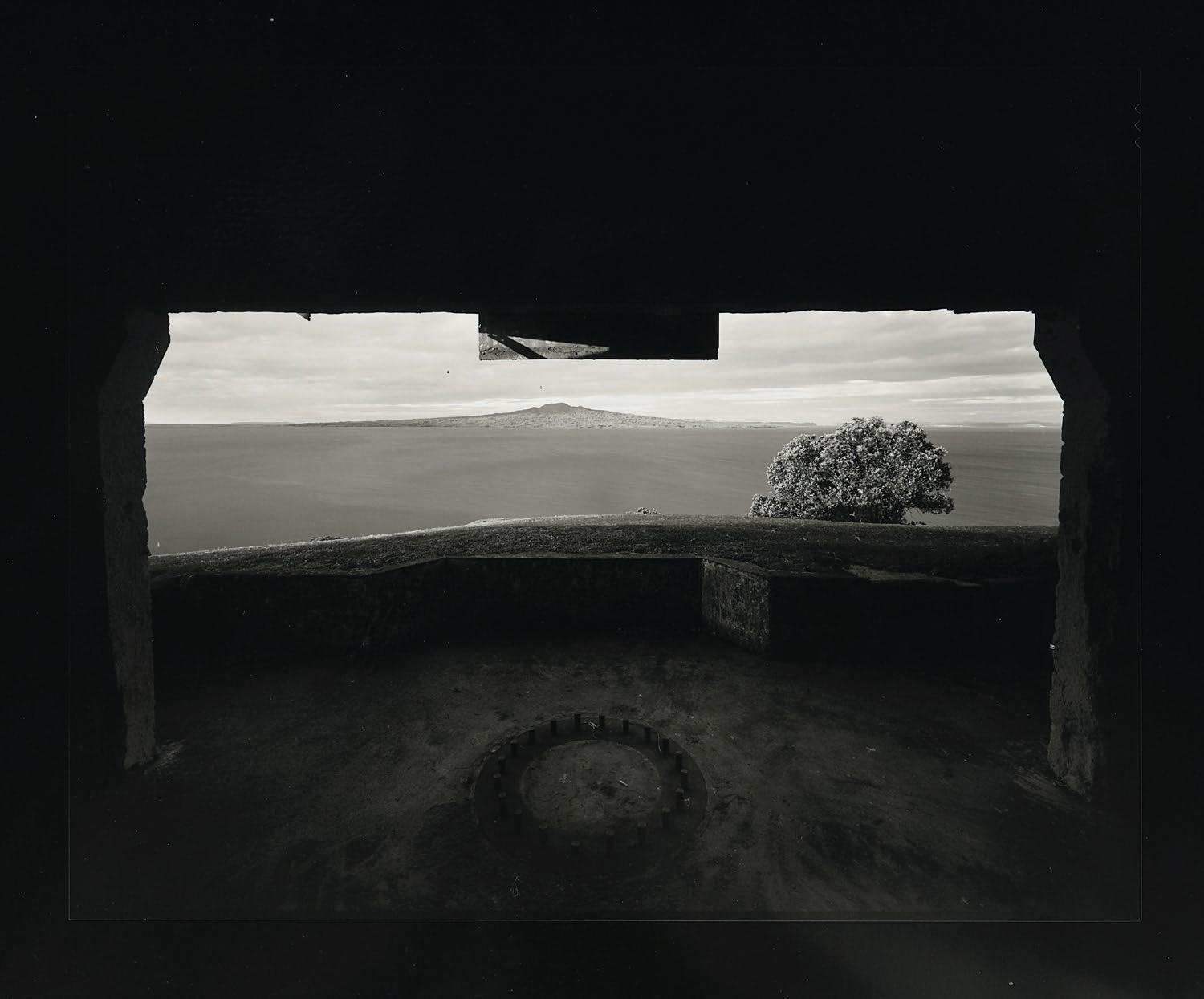
74 LAURENCE ABERHART (b. 1949)
North Head Gun Emplacement, Looking
Directly to Rangitoto
Silver gelatin print
23.5 x 28.5 cm
Signed and title inscribed verso
$2,000 - 4,000
PROVENANCE
Private Collection, Auckland
75 FIONA PARDINGTON (b. 1961)
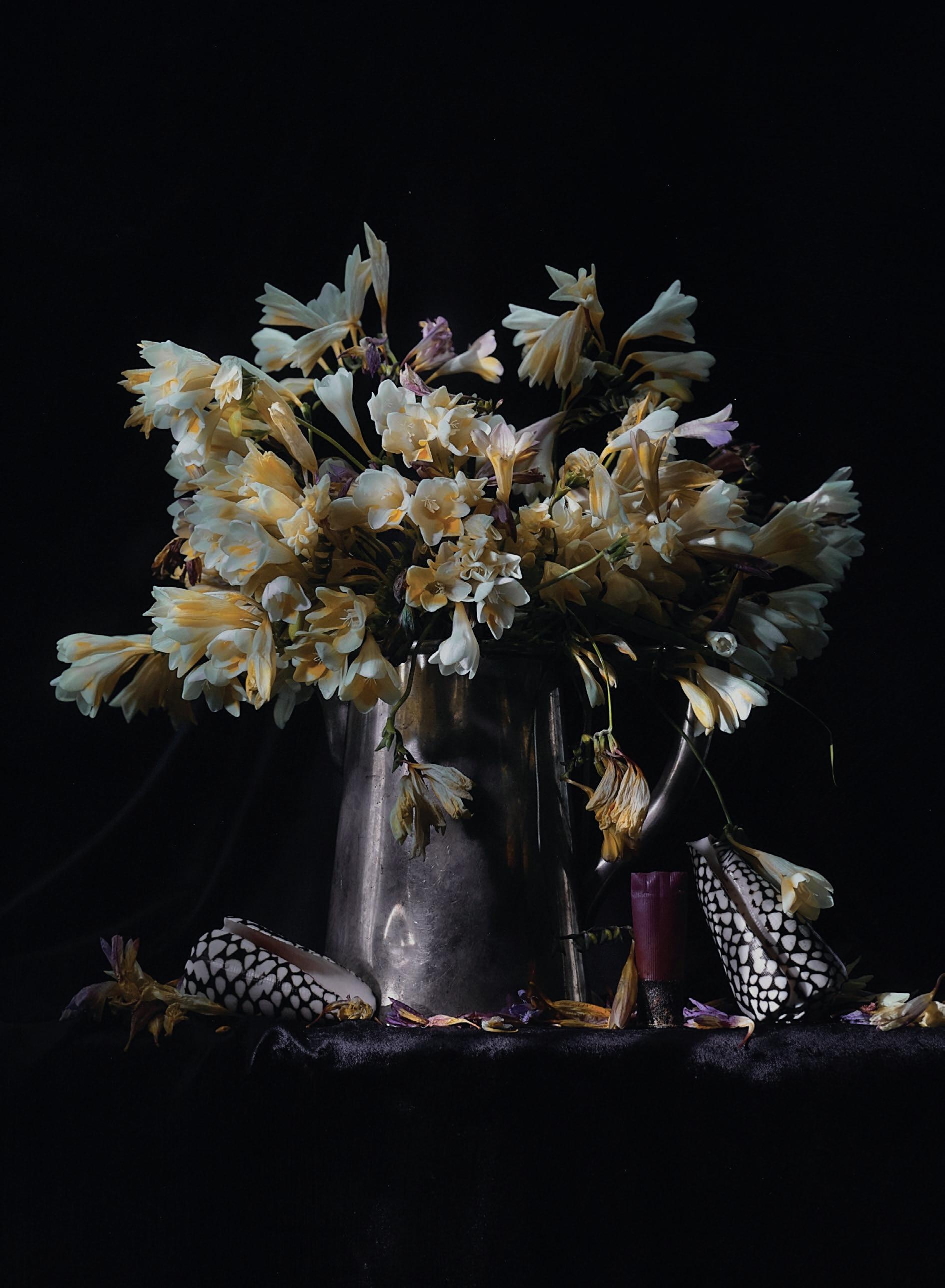
Dying Freesia in a Silver Water Jug with Two Conus Marmoreus and A Shotgun Shell Ripiro, 2014
Archival inkjet print, edition 6/25
37 x 27.5 cm
Editioned & dated 2014 verso
$3,000 - 6,000
PROVENANCE
Private Collection, Auckland
76 STEVEN RUMSEY (1928 - 2011)
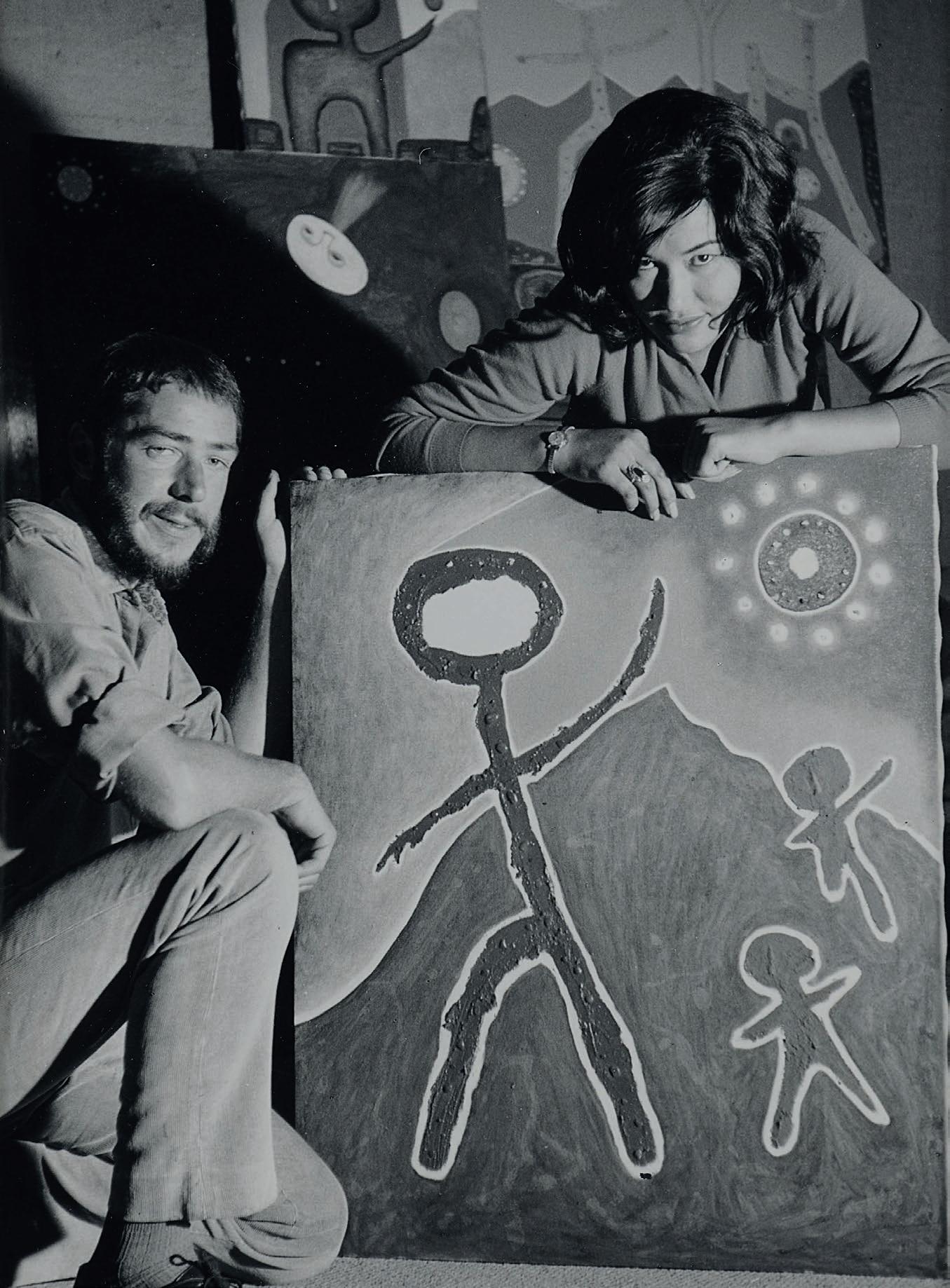
Mike Illingworth and Elizabeth Mountain
Vintage gelatin silver print
20.5 x 14 cm
Signed, inscribed & dated 2 March 1963 verso
$500 - 1,000
PROVENANCE
Private Collection, Auckland
77 ROY GOOD (b. 1945)
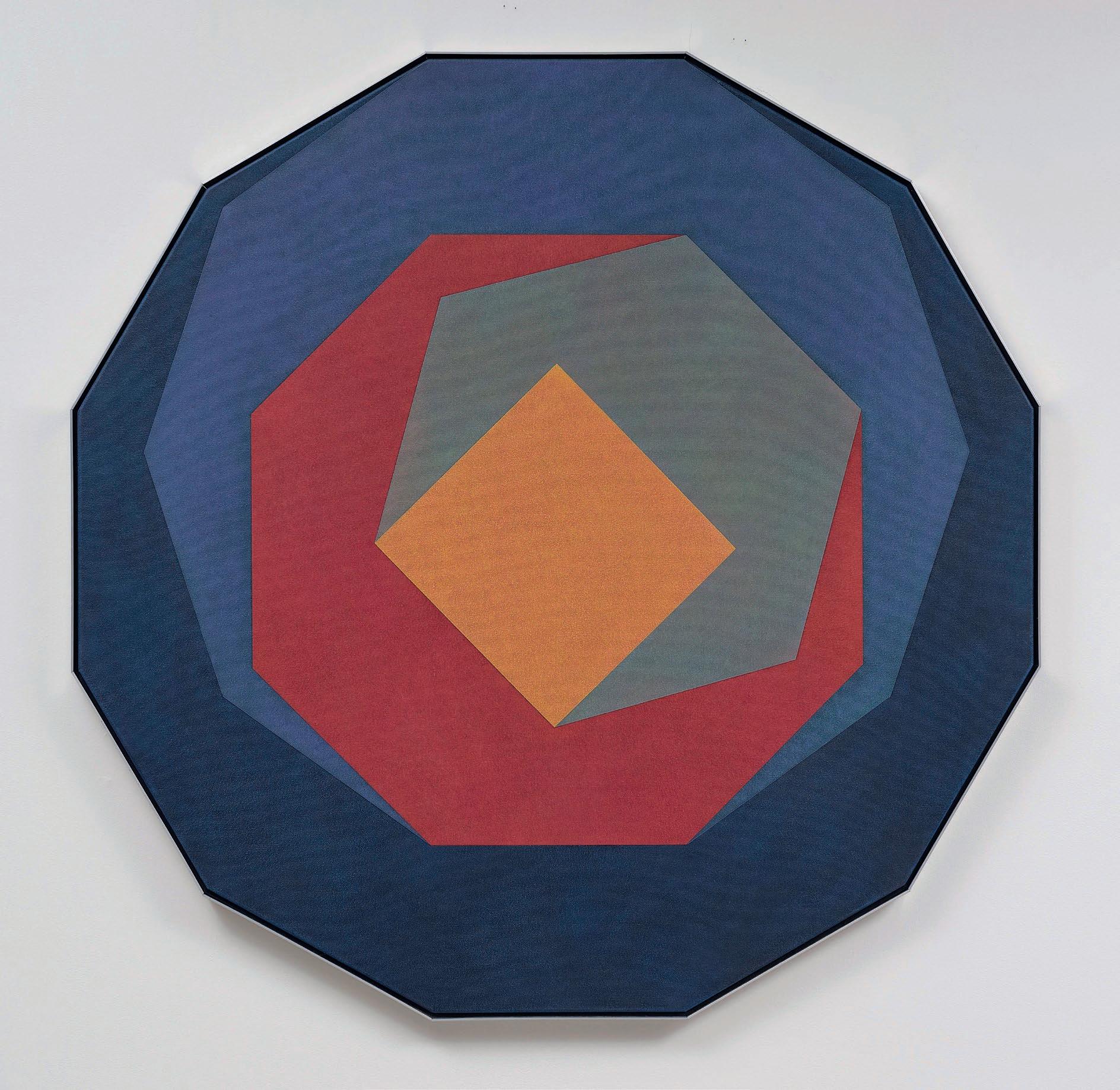
Duodecagon Variation No. 2
Acrylic on canvas
120 x 120 cm
Signed & dated 2011 verso
$14,000 – 18,000
PROVENANCE
Private Collection, Auckland
78 PIERA MCARTHUR (1929 - 2025)
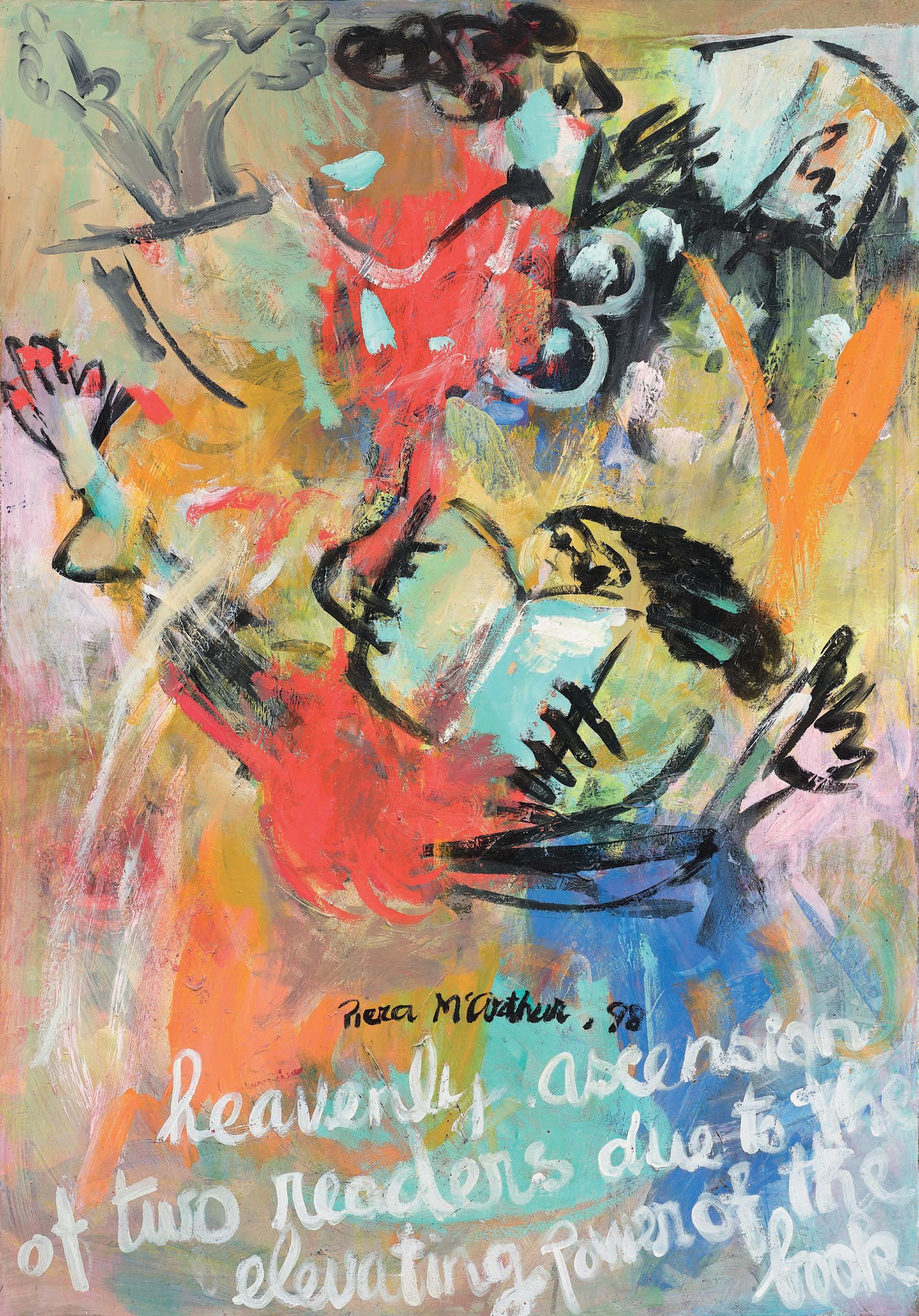
Heavenly Ascension of Two Readers Due to the Elevating Power of the Book
Acrylic on canvas
152 x 106 cm
Signed, inscribed & dated 98 lower centre
$8,000 – 12,000
PROVENANCE
Private Collection, Hawke’s Bay
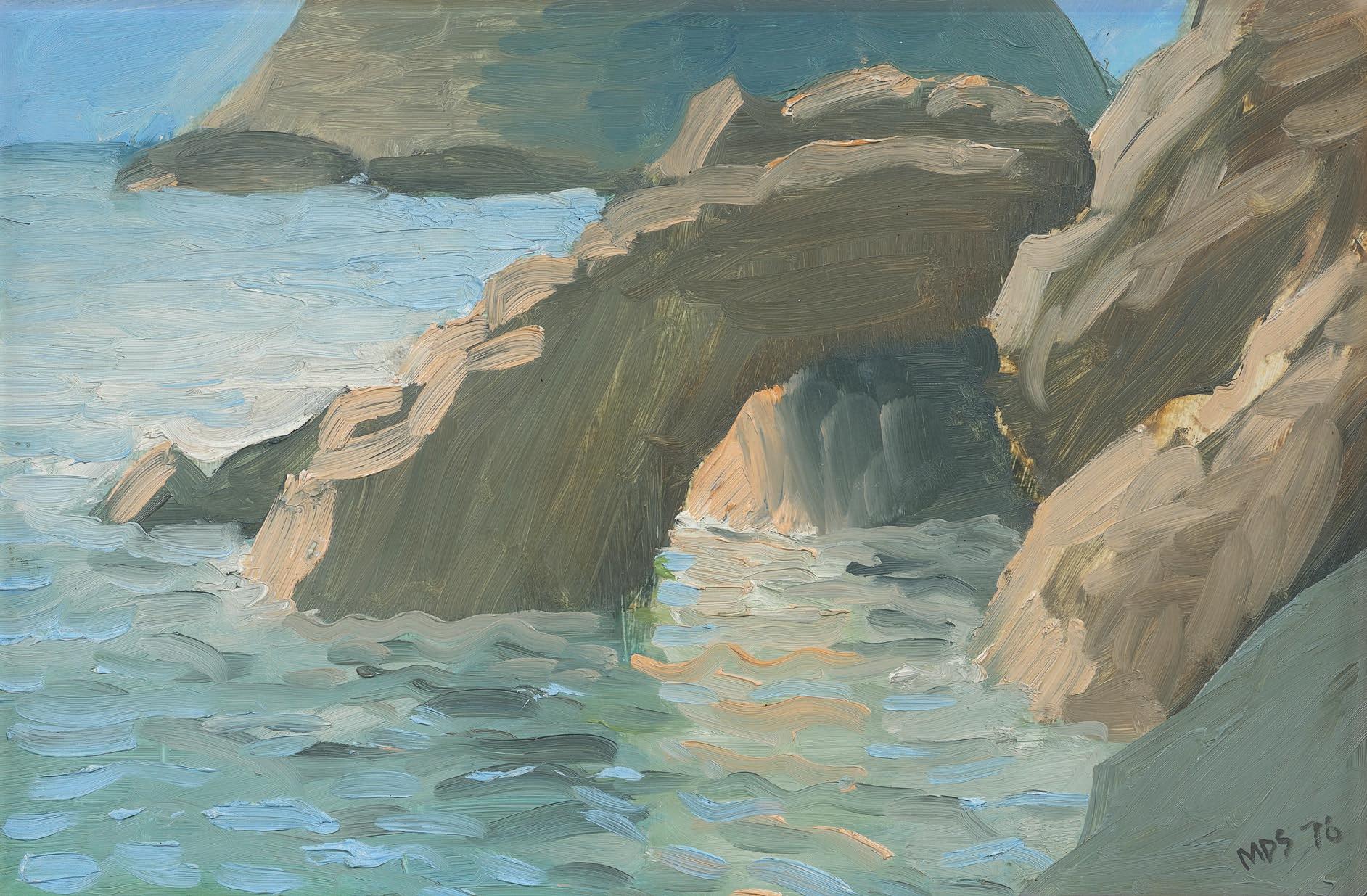
Untitled, Seascape Oil on board
28.5 x 43.5 cm
Initialled & dated 76 lower right
$3,500 – 4,500
PROVENANCE
Private Collection, Hawke’s Bay
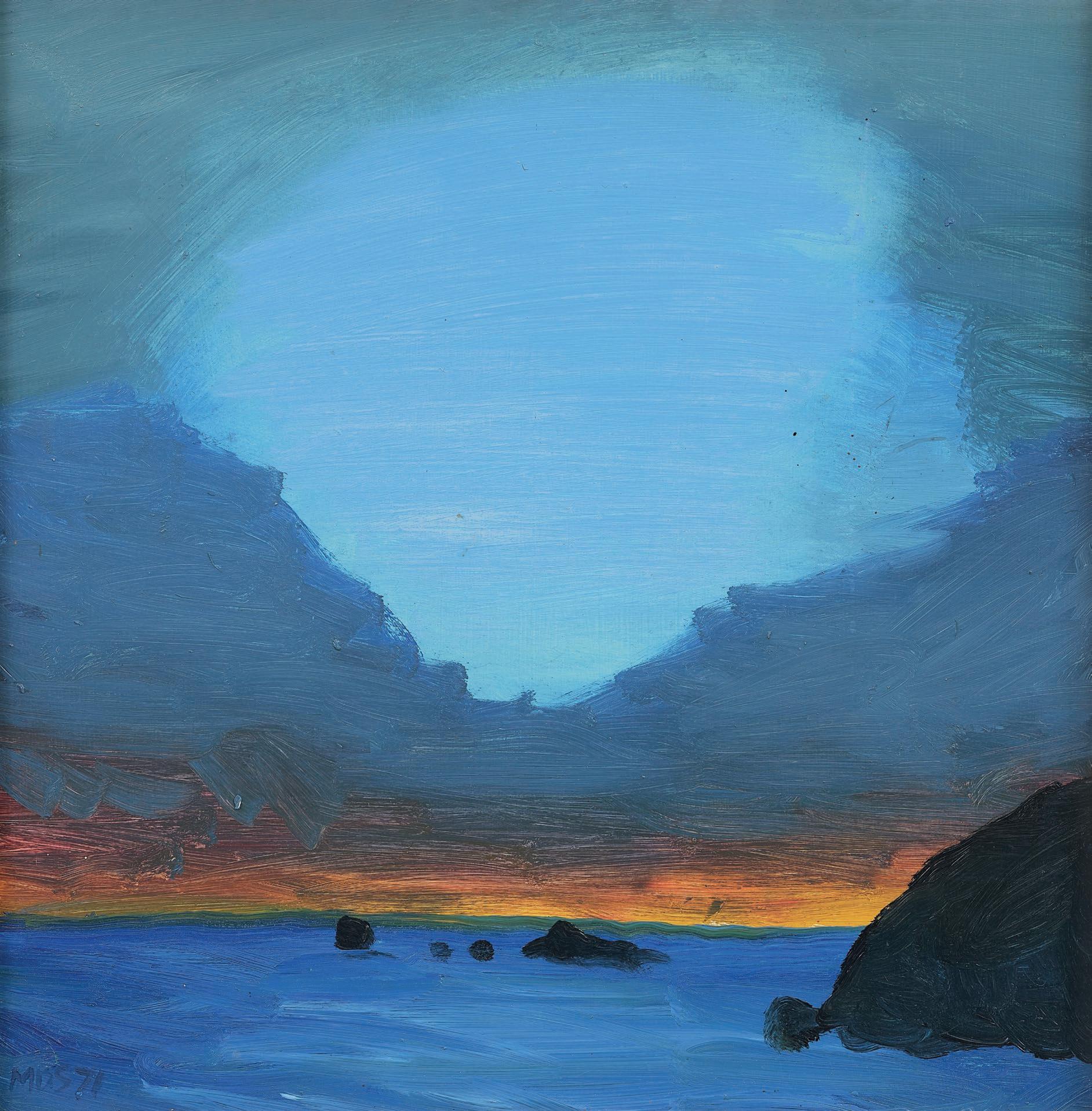
Sunset Over Sea & Blue Hole in the Sky Plus Island Oil on board
31 x 31 cm
Initialled & dated 71 lower left
Signed & dated verso
$3,500 – 4,500
PROVENANCE
Private Collection, Hawke’s Bay
81
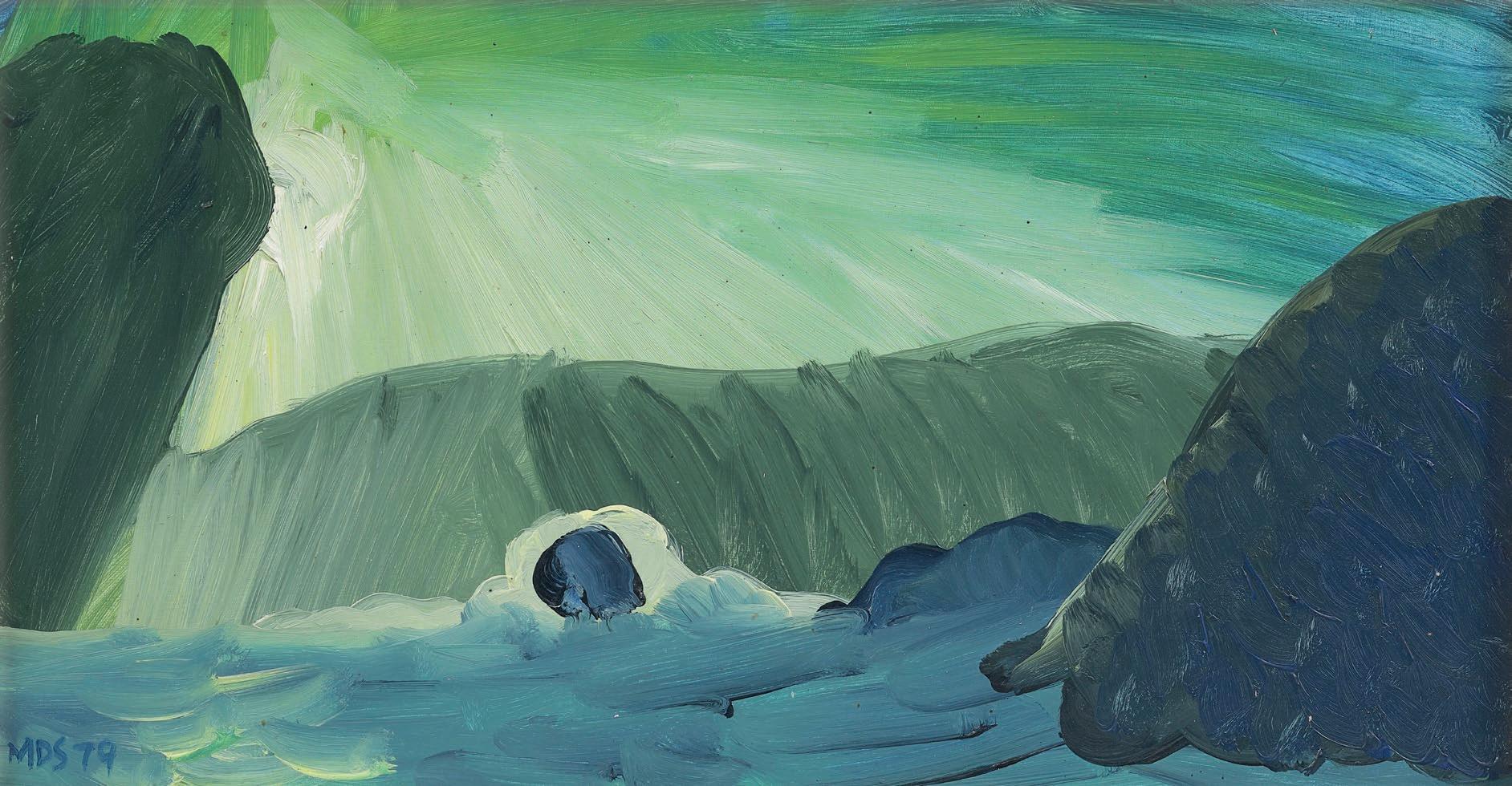
MICHAEL SMITHER (b. 1939)
Wave at Castle Rock, 1979
Oil on board
22 x 42 cm
Initialled & dated 79 lower left
Signed, titled & dated verso
$3,500 – 4,500
PROVENANCE
Private Collection, Hawke’s Bay
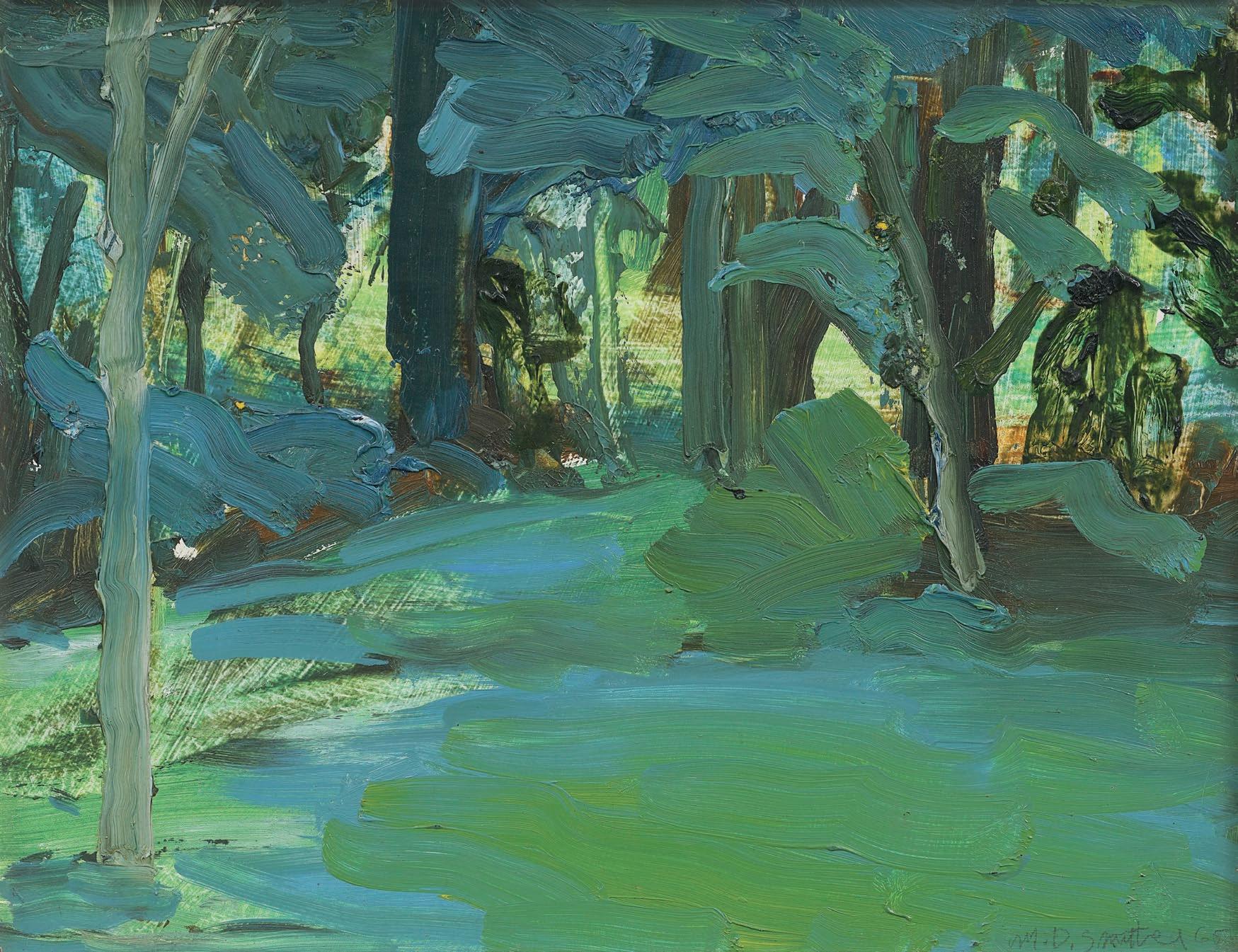
82 MICHAEL SMITHER (b. 1939)
Bush Study, 1965 Oil on board
30 x 38 cm
Signed & dated 65 lower right
Govett-Brewster Art Gallery label affixed verso
$3,500 – 4,500
PROVENANCE
Private Collection, Hawke’s Bay
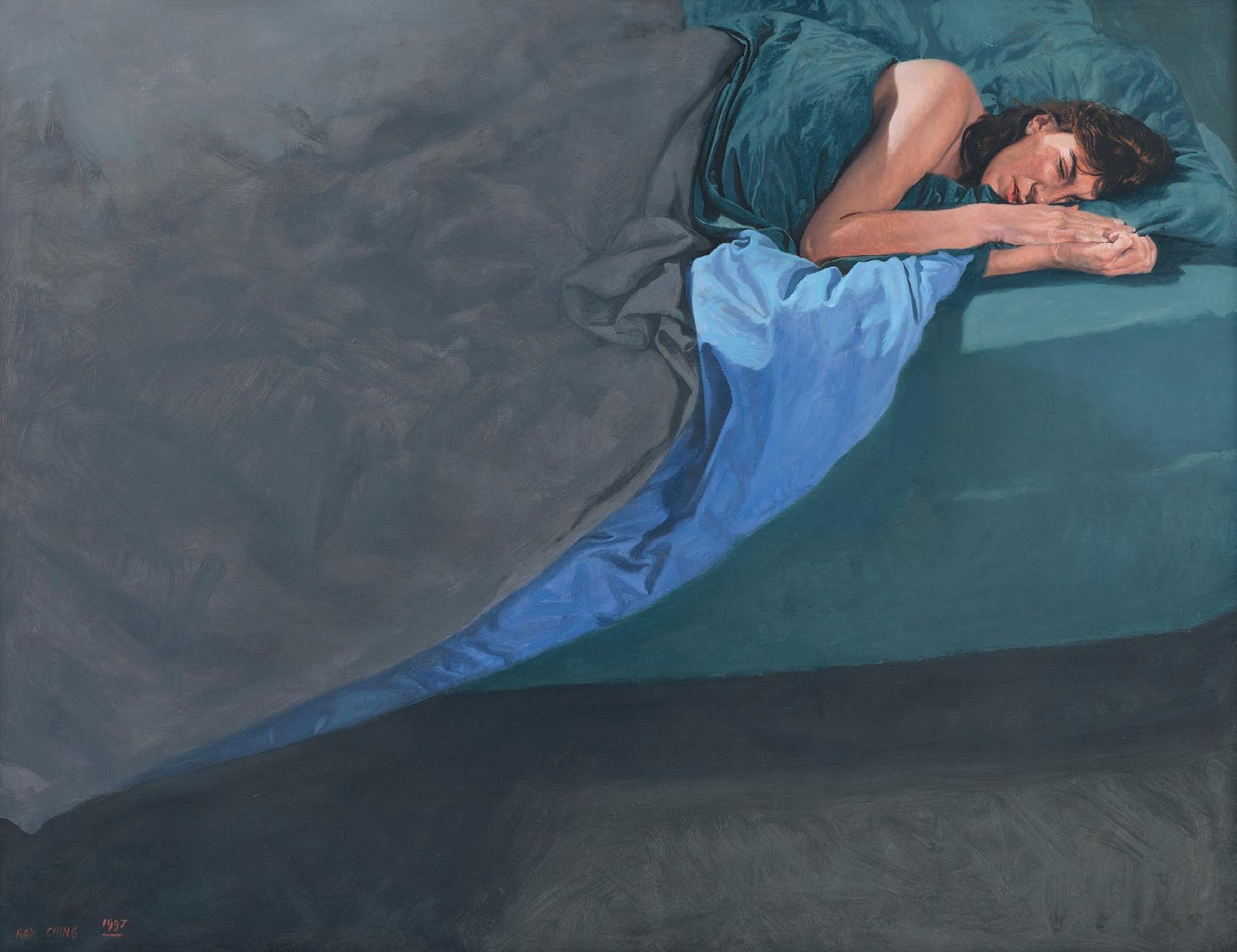
83 RAYMOND
(b. 1939) Morning Oil on canvas
70.5 x 90.5 cm
Signed & dated 1997 lower left
Signed, inscribed & dated verso
$18,000 - 25,000
PROVENANCE
Private Collection, Auckland
83
84
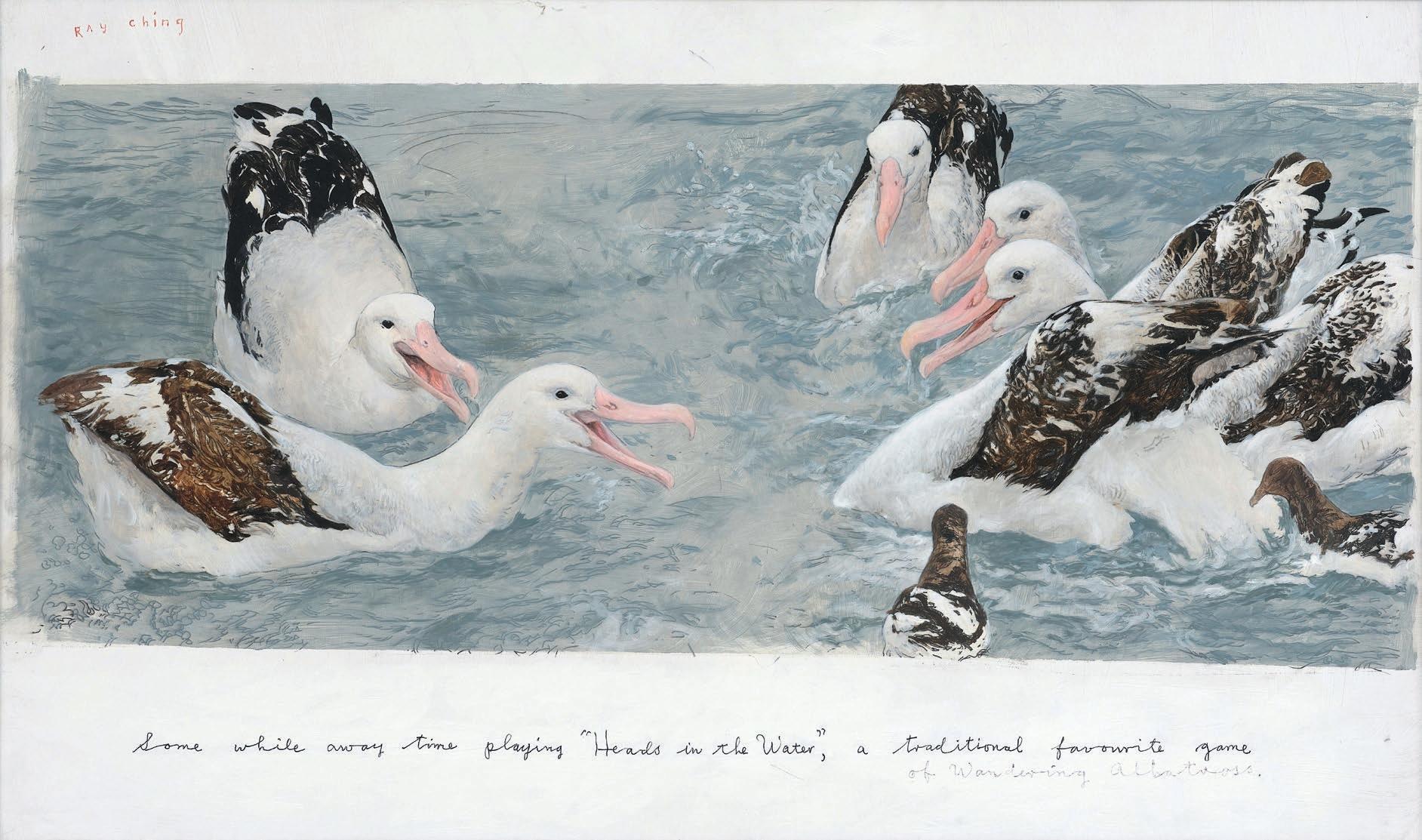
RAYMOND CHING (b. 1939)
P. 20-21 Heads in the Water
Alkyd/acrylic on board
53 x 89.5 cm
Signed upper left
$8,000 – 12,000
PROVENANCE
Private Collection, Auckland Acquired from ARTIS Gallery, Auckland
ILLUSTRATED
Ray Ching, Dawn Chorus, David Bateman Ltd Auckland, 2014, p. 20 - 21
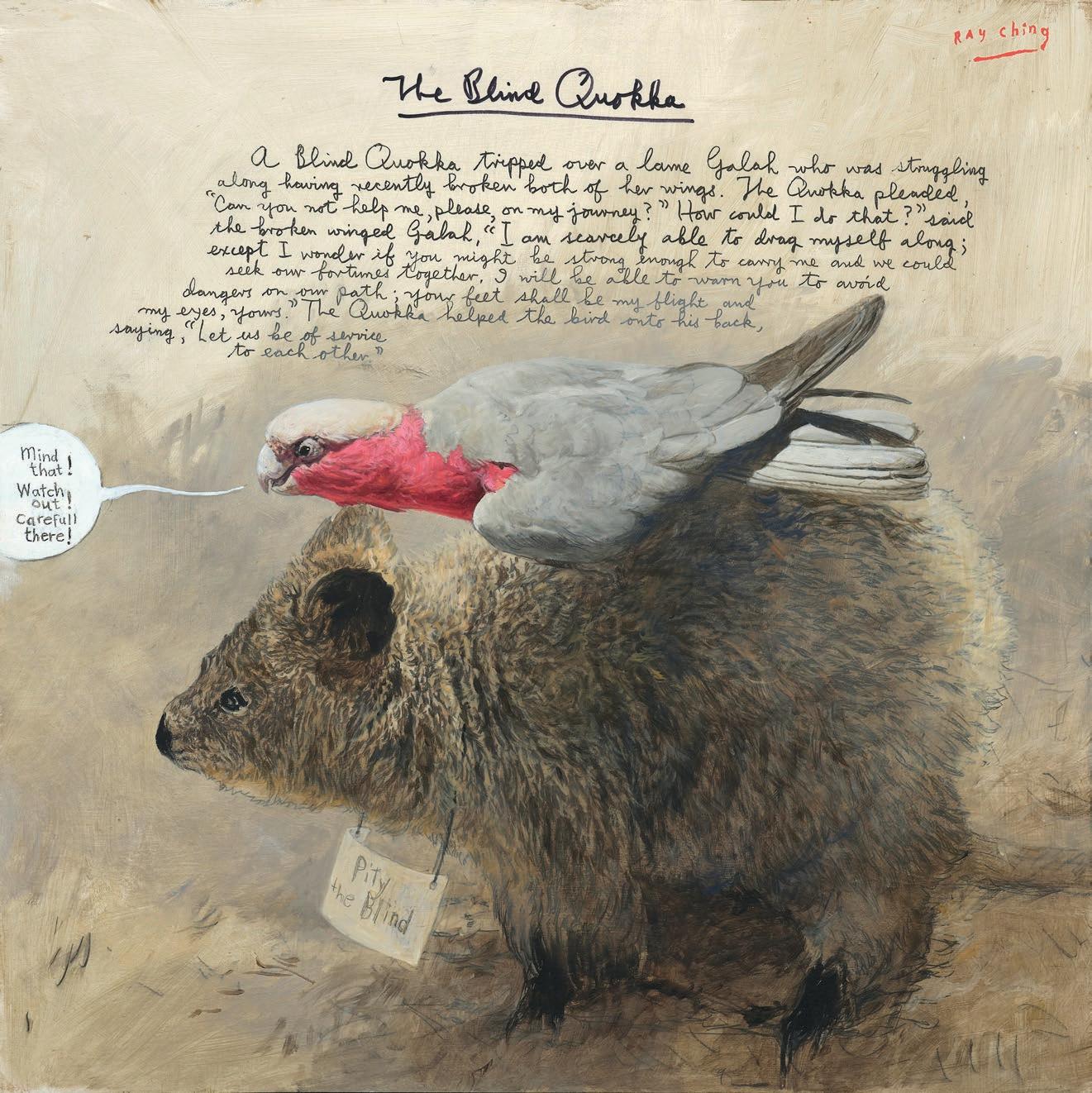
85 RAYMOND CHING (b. 1939)
P. 98-99 The Blind Quokka & The Lame Galah Alkyd/acrylic on board
50.5 x 50.5 cm
Signed upper right
$8,000 – 12,000
86
PROVENANCE
Private Collection, Auckland Acquired from ARTIS Gallery, Auckland
ILLUSTRATED
Ray Ching, Aesop’s Outback Fables, ARTIS Gallery, Auckland, 2018, p. 98 - 99
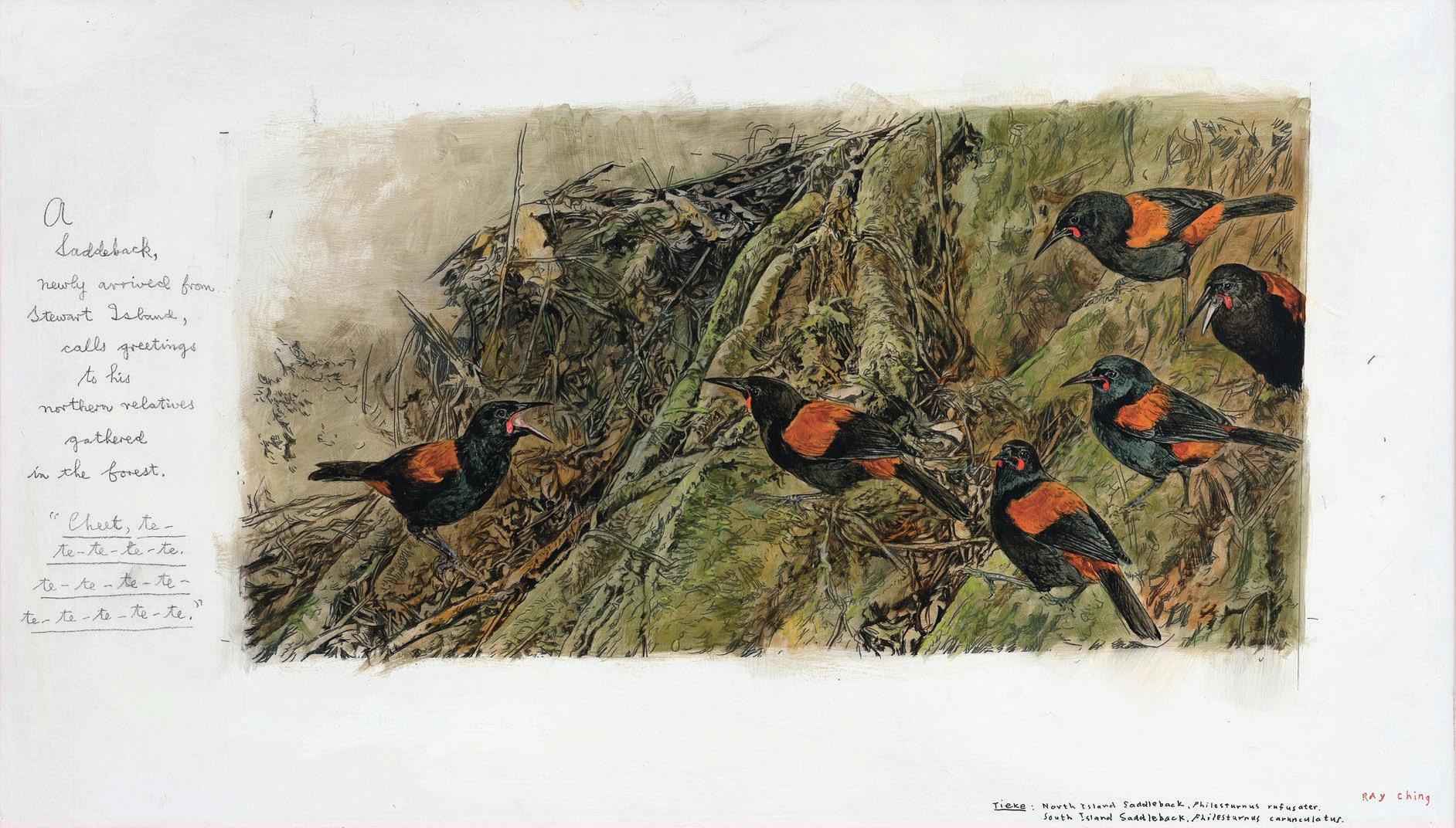
RAYMOND CHING (b. 1939)
P. 152-153 Cheet, te-te-te-te-te-te
Alkyd/acrylic on board
49.5 x 87 cm
Signed lower right
$8,000 – 12,000
PROVENANCE
Private Collection, Auckland Acquired from ARTIS Gallery, Auckland
ILLUSTRATED
Ray Ching, Dawn Chorus, David Bateman Ltd Auckland, 2014, p. 152 - 153
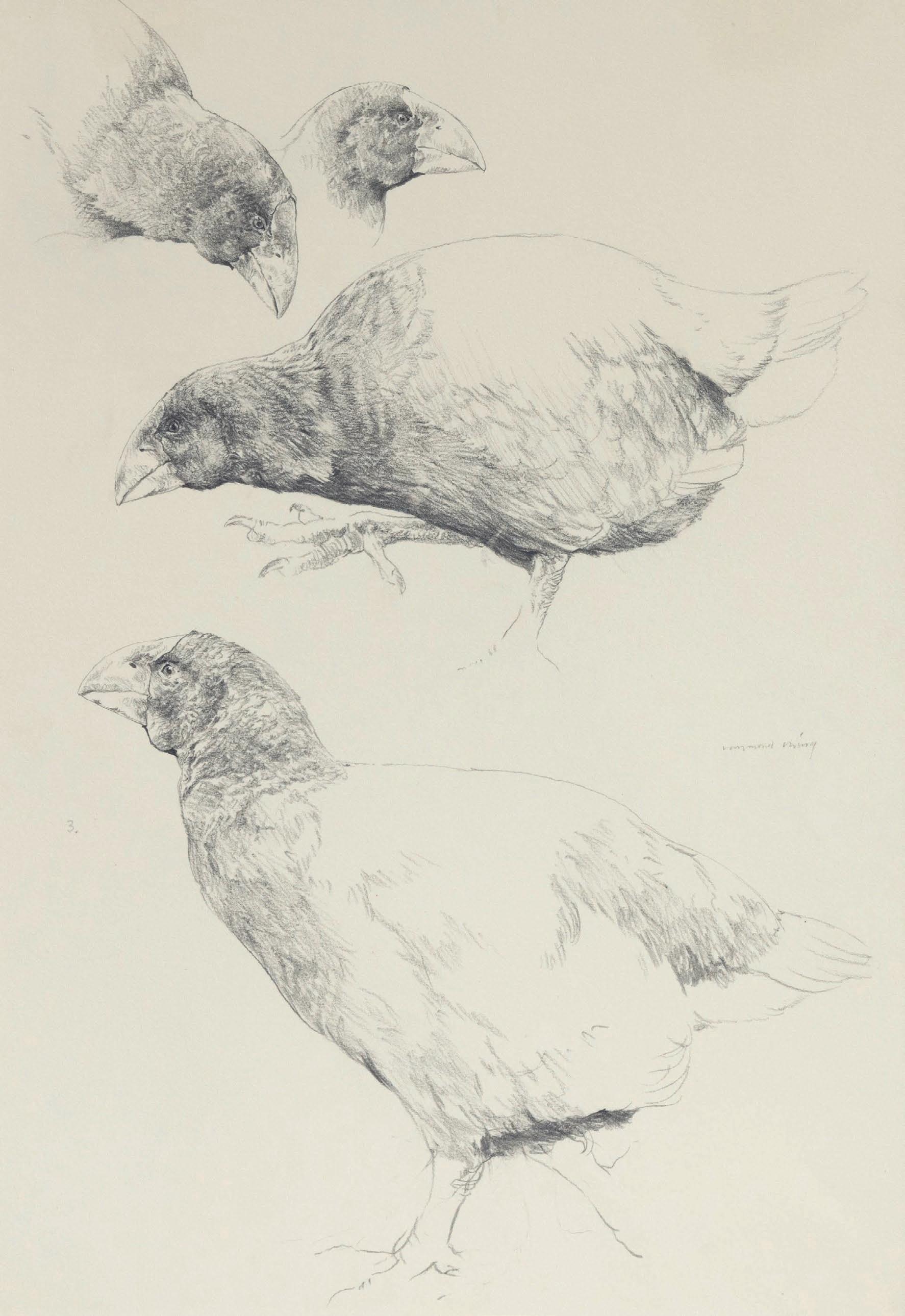
87 RAYMOND CHING (b. 1939)
Takahe
Graphite on paper
53 x 36.5 cm
Signed centre right
$2,500 – 4,500
PROVENANCE
Private Collection, Waikato
ILLUSTRATED
Raymond Ching, Errol Fuller, Studies & Sketches of a Bird Painter, Lansdowne Publishing, 1981, p. 199
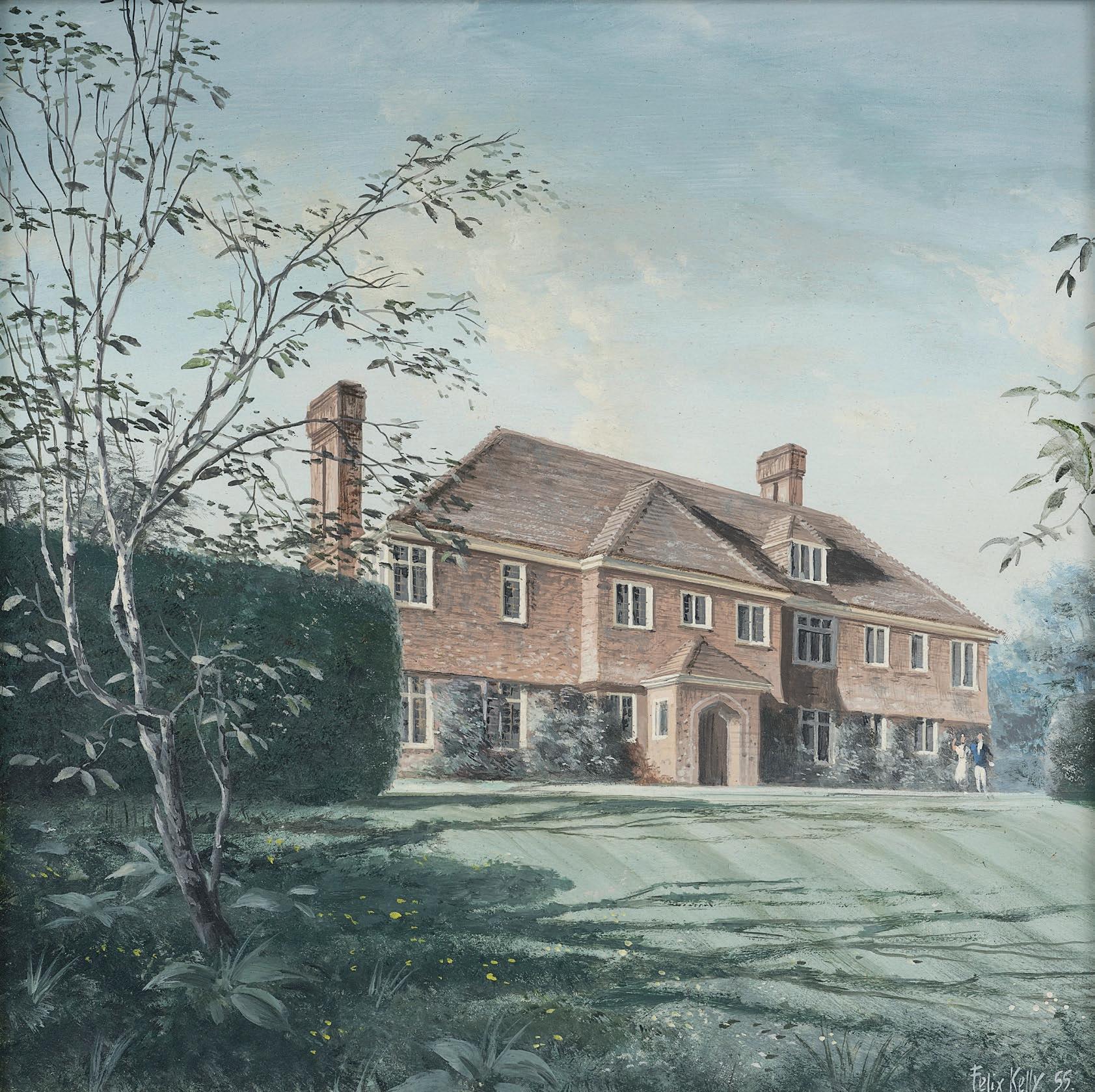
88 FELIX KELLY (1914 - 94)
Oldany House Overlooking the River Alde Near Aldeburgh, Suffolk Oil on board 28 x 28 cm
Signed and dated 55 lower right
$4,000 – 6,000
PROVENANCE
Private Collection, Auckland
ILLUSTRATED
Country Life, September 12, 1957
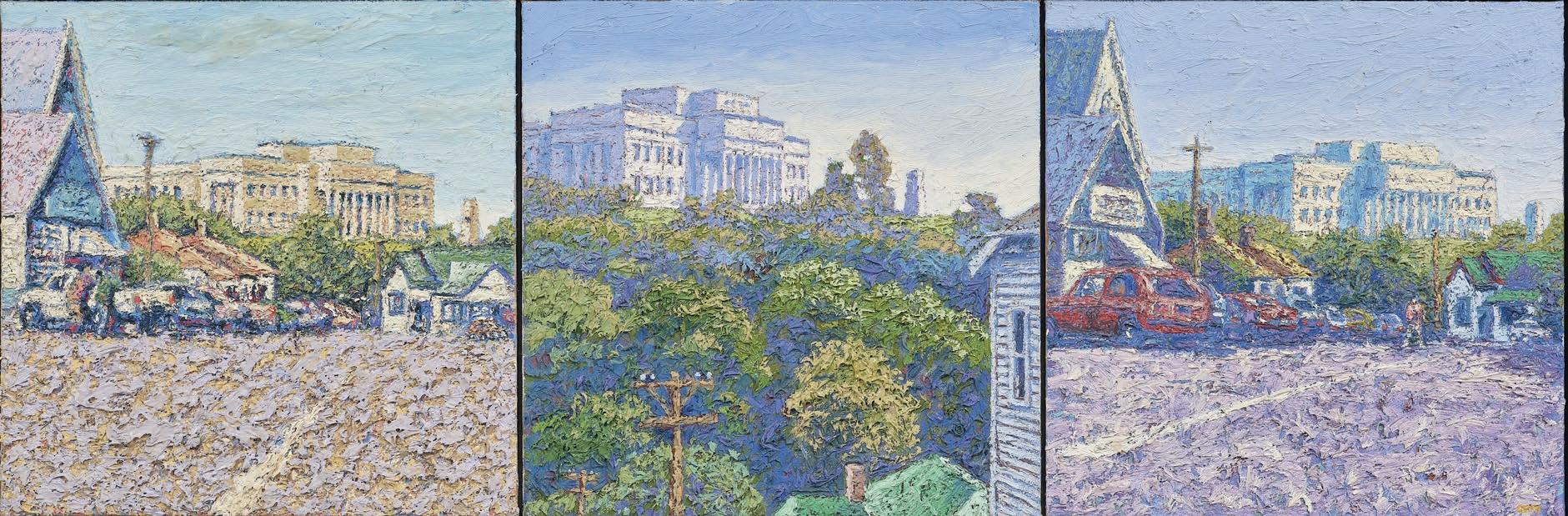
89 GEORGE BALOGHY (b.1950)
Auckland Museum - Triptych Oil on canvas
45.5 x 137.5 cm
Signed & dated 91 lower right
Inscribed & dated 1991 verso
$8,000 – 12,000
PROVENANCE
Private Collection, Auckland
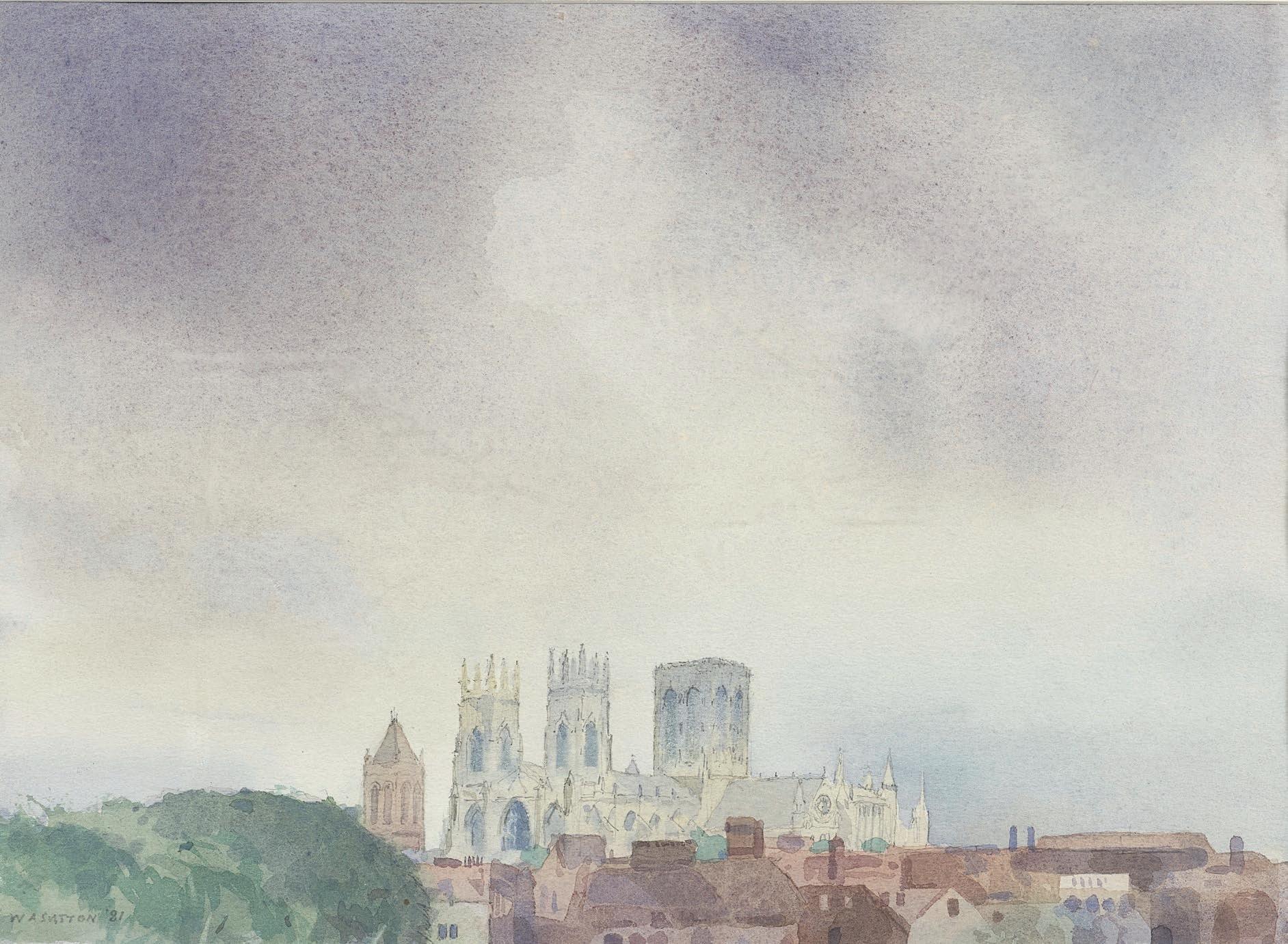
90 WILLIAM ALEXANDER (BILL) SUTTON (1917 - 2000)
Yorkminster, 1981
Watercolour
26.5 x 36.5 cm
Signed & dated ‘81 lower left
$2,000 – 3,000
PROVENANCE
Private Collection, Whanganui
Original Brooke Gifford Gallery label verso
91
North Country Town
Watercolour
22 x 34 cm
Signed verso
$2,000 – 4,000
PROVENANCE
Private Collection, Auckland
Acquired from Dunbar Sloane, New Zealand & International Fine Art, Day 2, Wellington, 05/09/2019, Lot no. 250
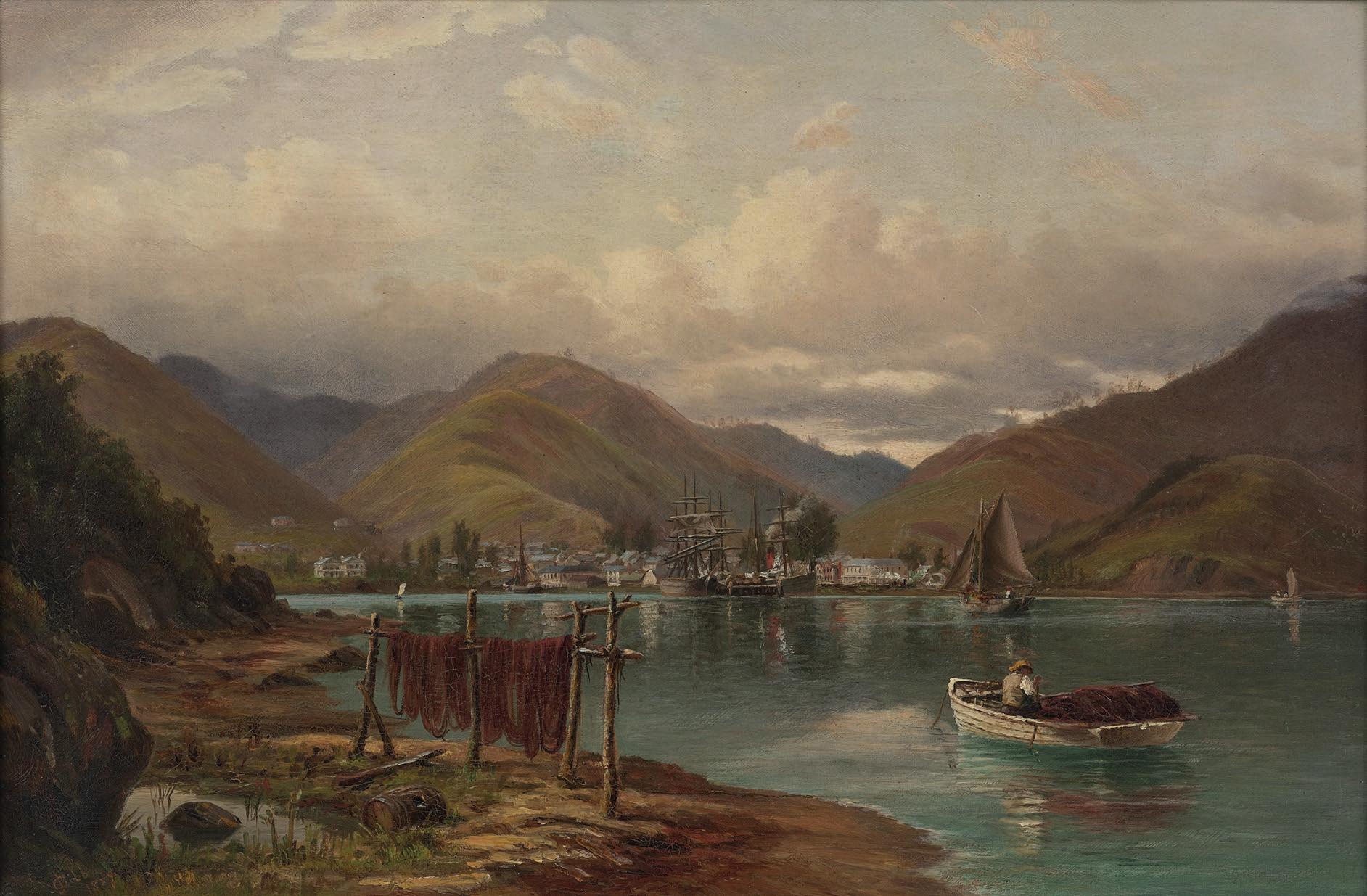
92 JOHN GIBB (1831 - 1909)
Picton, Queen Charlotte Sound, New Zealand
Oil on canvas
39 x 59.5 cm
Signed & dated 1887 lower left
$8,000 – 12,000
PROVENANCE
Private Collection, Auckland
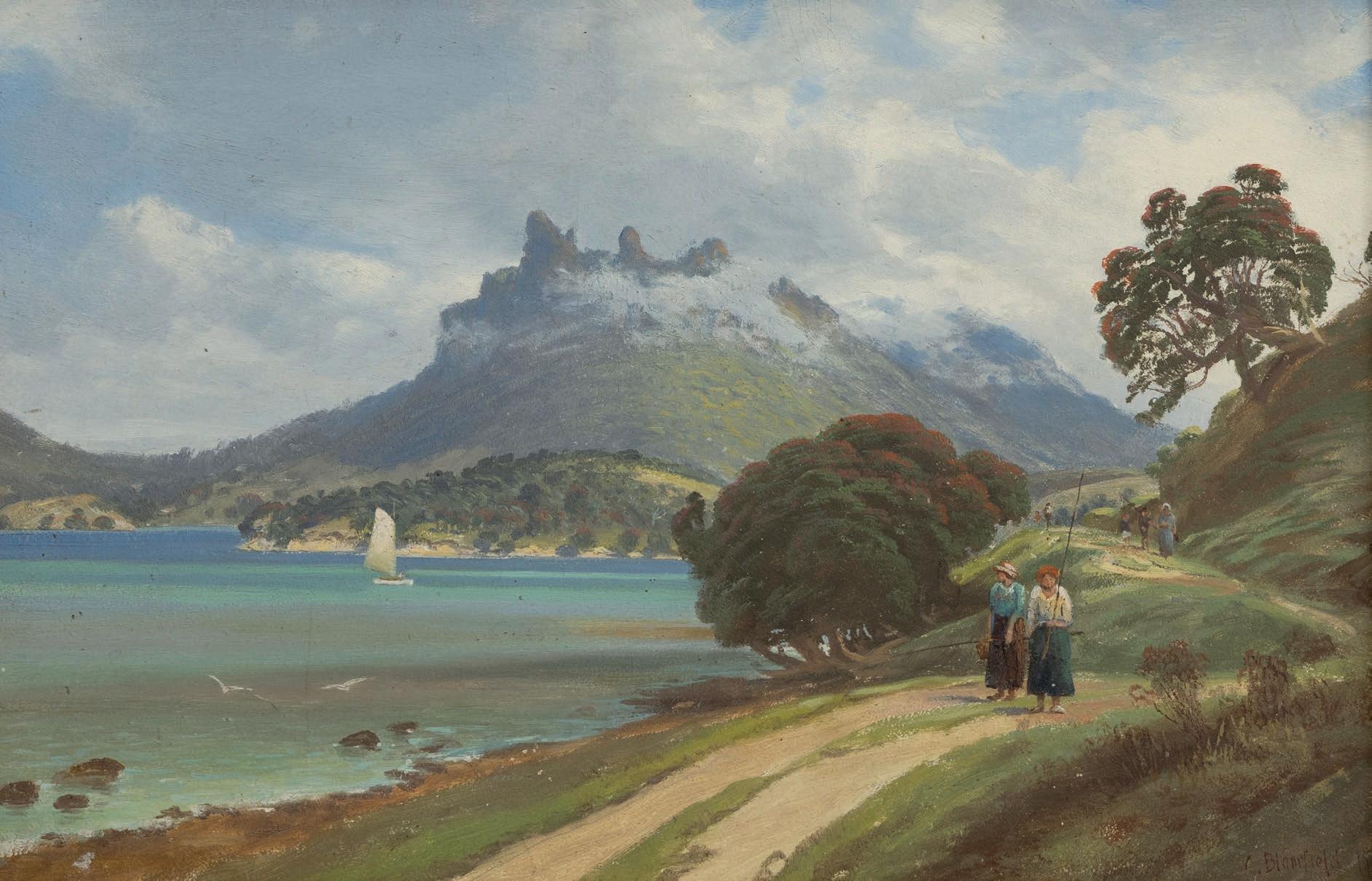
93 CHARLES BLOMFIELD (1848 - 1926)
Old Manaia, Whangarei Heads
Oil on board
28 x 42 cm
Signed lower right
$8,000 – 12,000
PROVENANCE
Private Collection, Whangārei
Acquired from International Art Centre, Important & Rare, Auckland, 06/04/2016, Lot no. 44
94
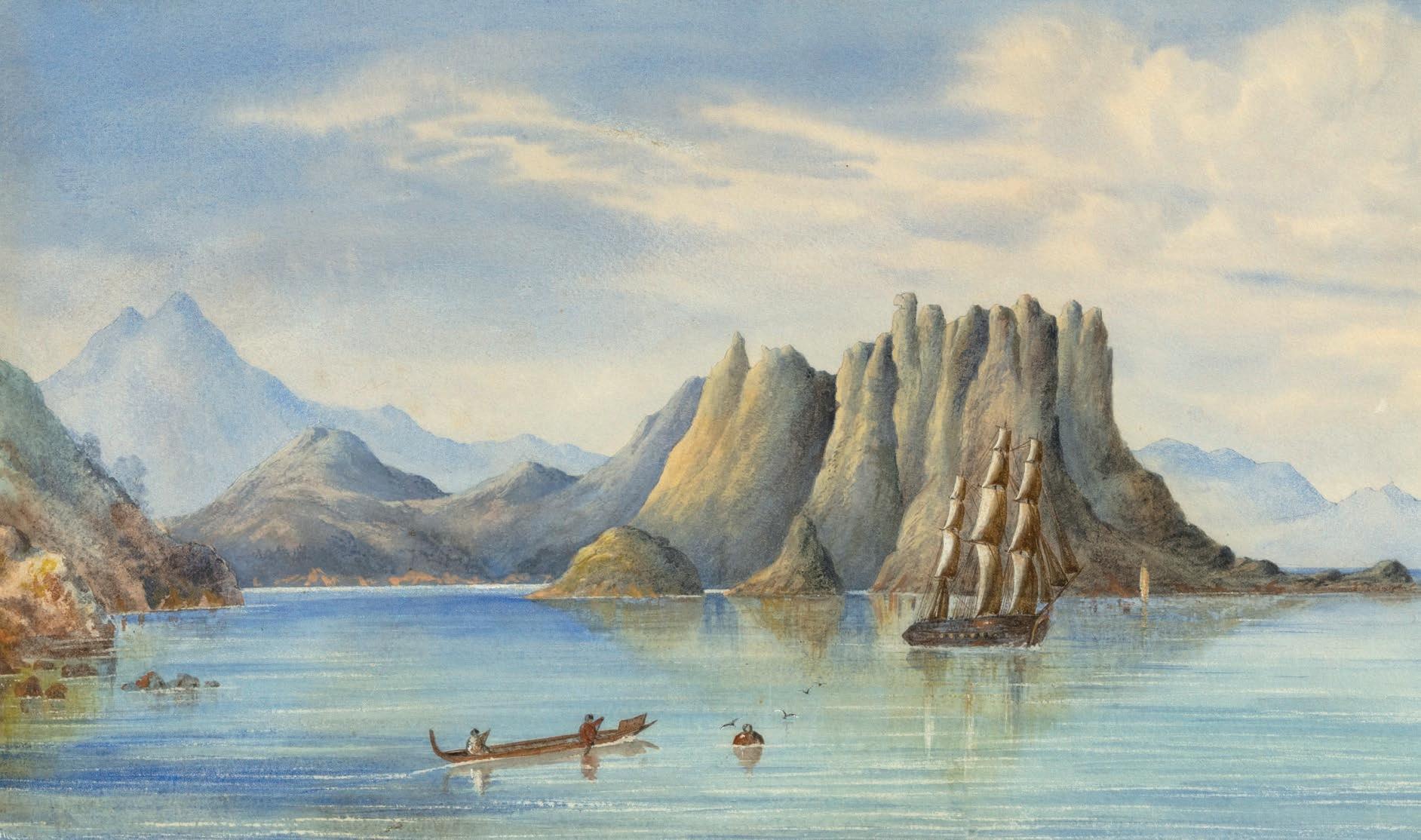
JOHN BARR CLARK HOYTE (1835 - 1913)
Bream Head - Whangarei
Watercolour
26 x 44 cm
Signed lower left
$6,000 – 8,000
PROVENANCE
Private Collection, Whangārei
Acquired from International Art Centre, Important, Early & Rare New Zealand Art, Auckland, 28/07/2009, Lot no. 74
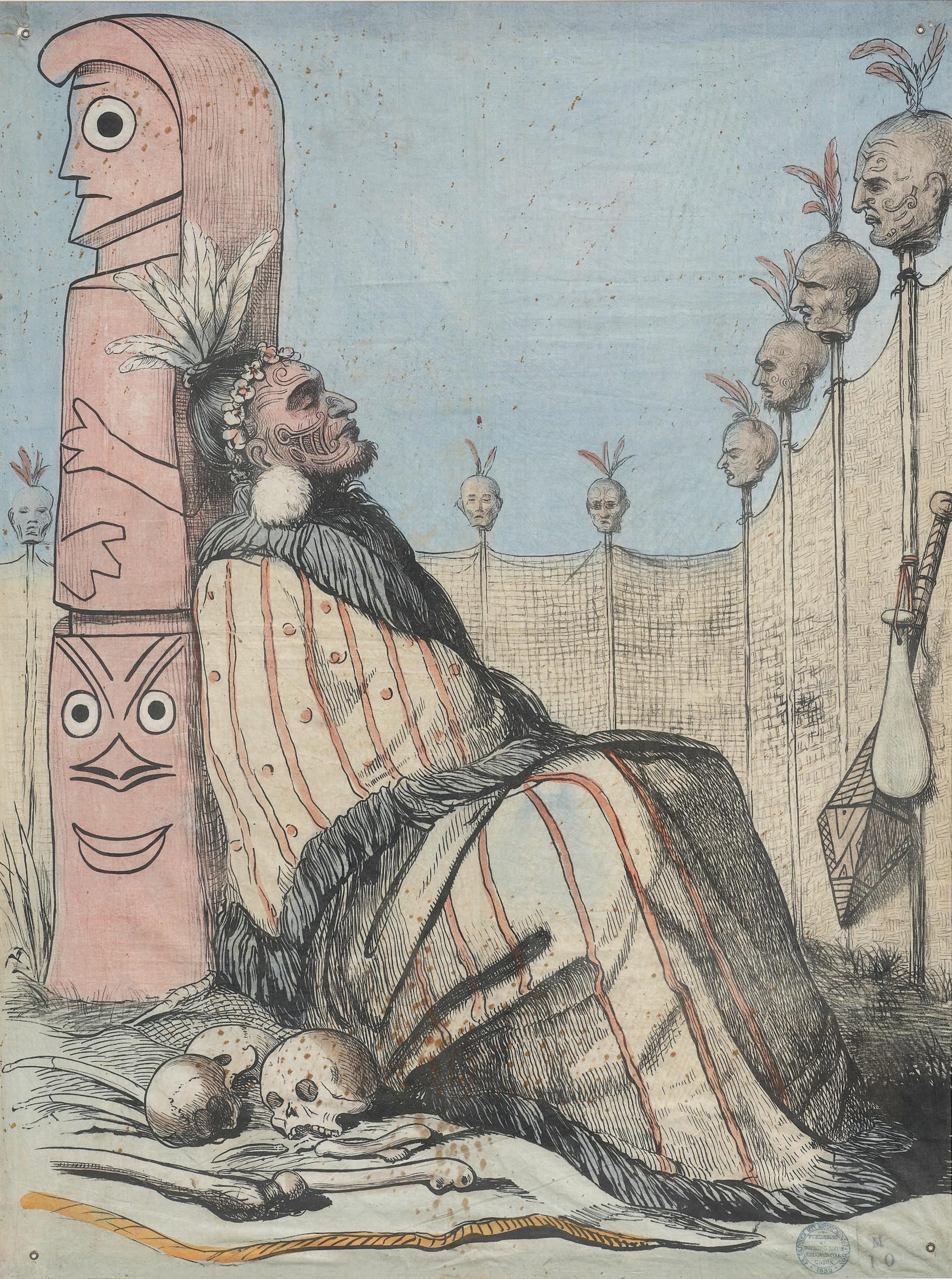
95 ENGLISH SCHOOL
The Māori Chief Print on linen
108 x 88 cm
$6,000 - 8,000
PROVENANCE
Private Collection, Auckland
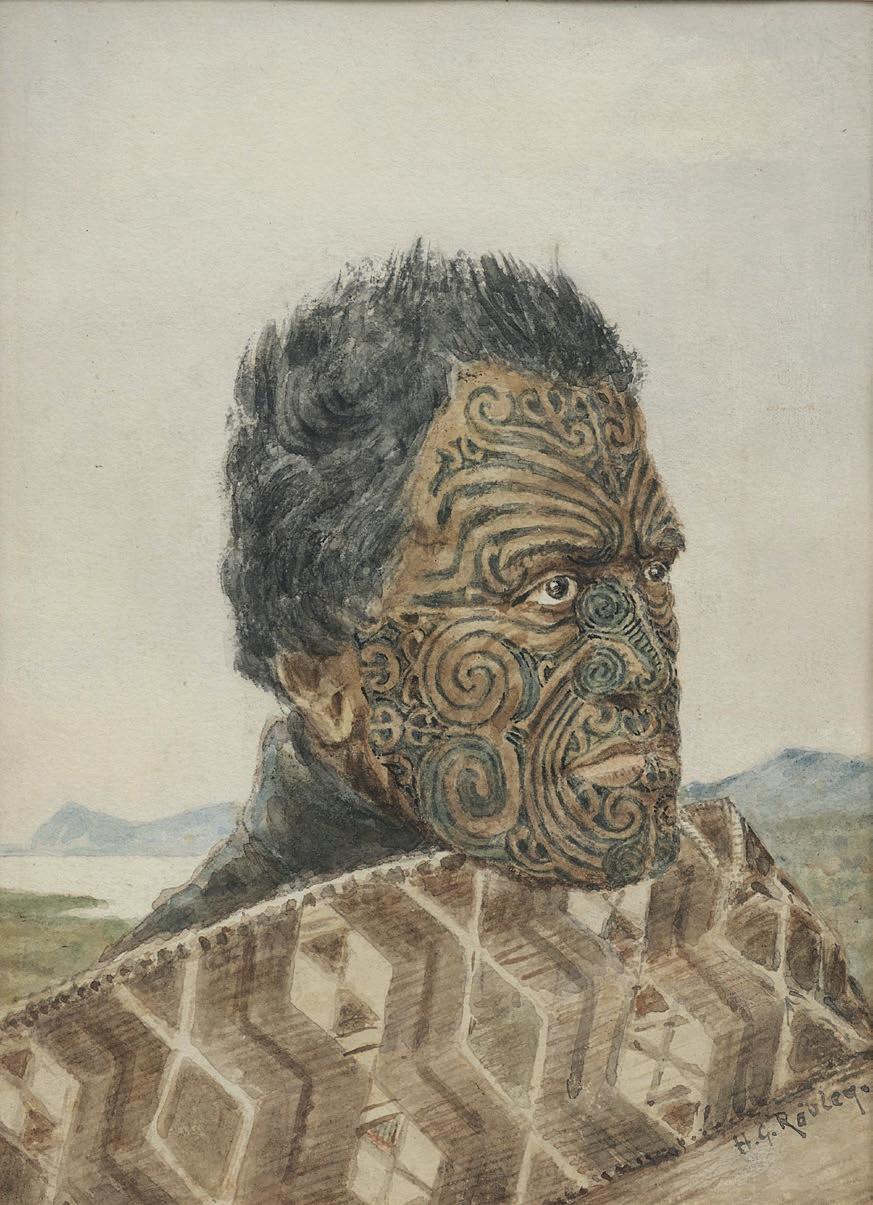
96 HORATIO GORDON ROBLEY
(Britain, New Zealand, 1840 - 1930)
A Chief From Coromandel
Watercolour
19 x 14 cm
Signed lower right
$1,500 – 2,500
PROVENANCE
Private Collection, Whangārei
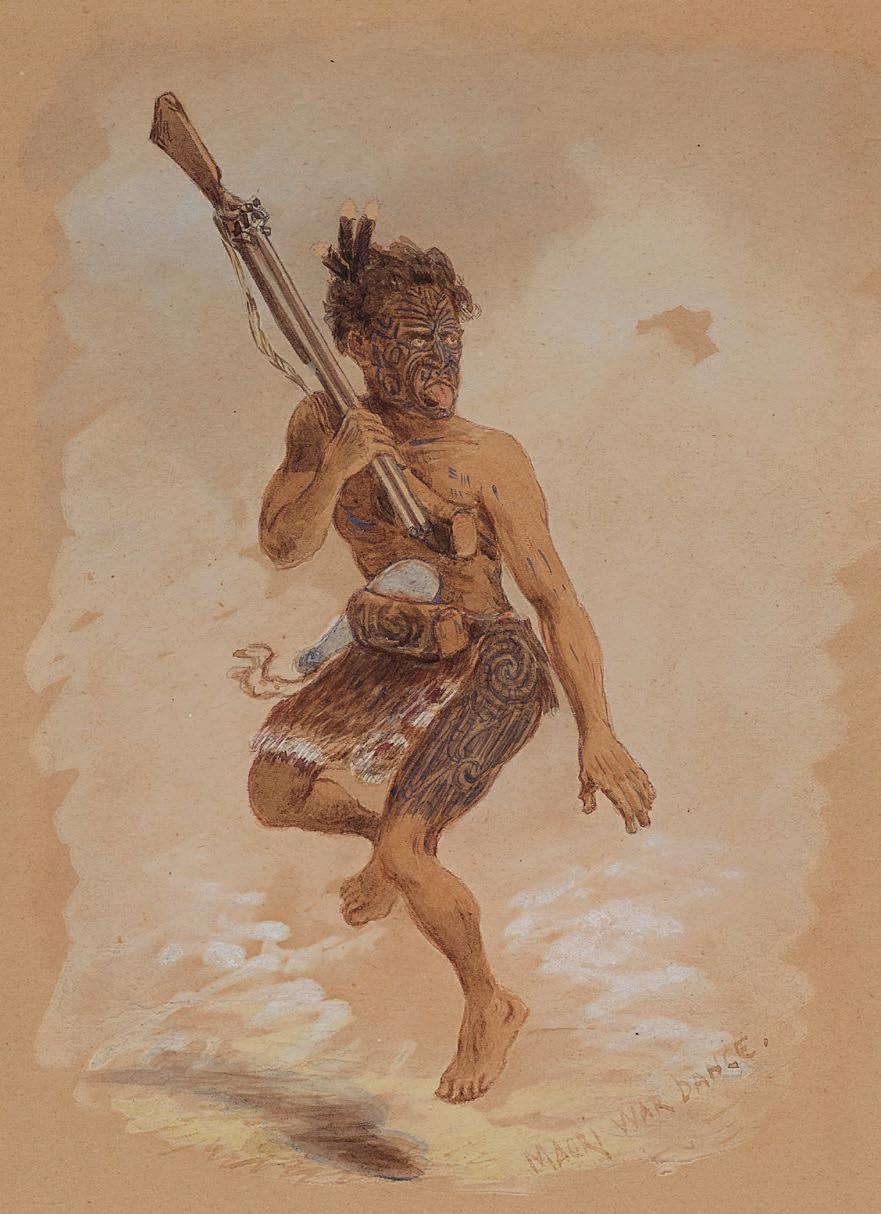
97 HORATIO GORDON ROBLEY
(Britain, New Zealand, 1840 - 1930)
Māori War Dance
Watercolour over pencil heightened with bodycolour
24 x 19 cm
Title inscribed lower right
$1,500 – 2,500
PROVENANCE
Private Collection, Whangārei
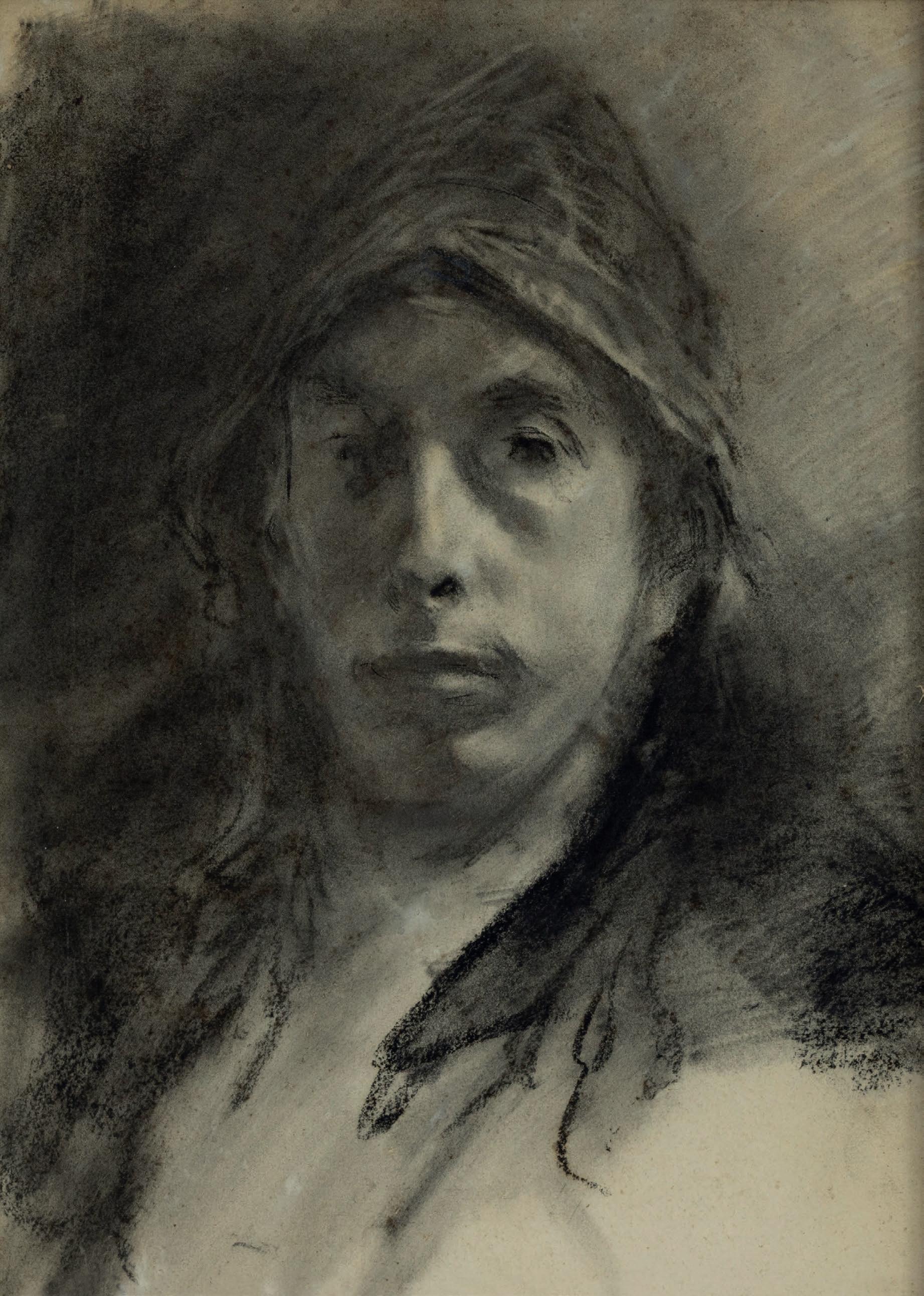
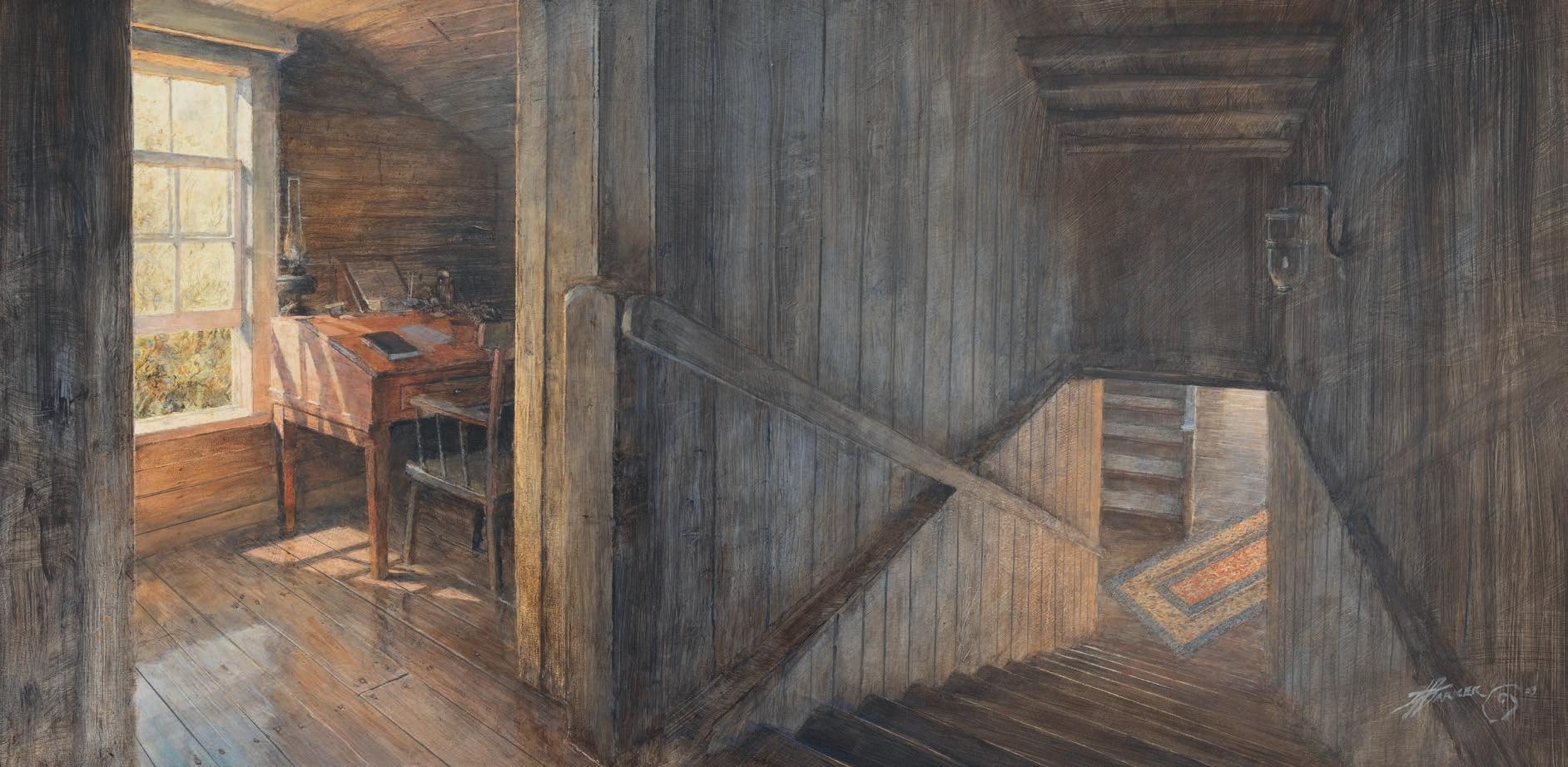
98 PETRUS VAN DER VELDEN (1837 - 1913)
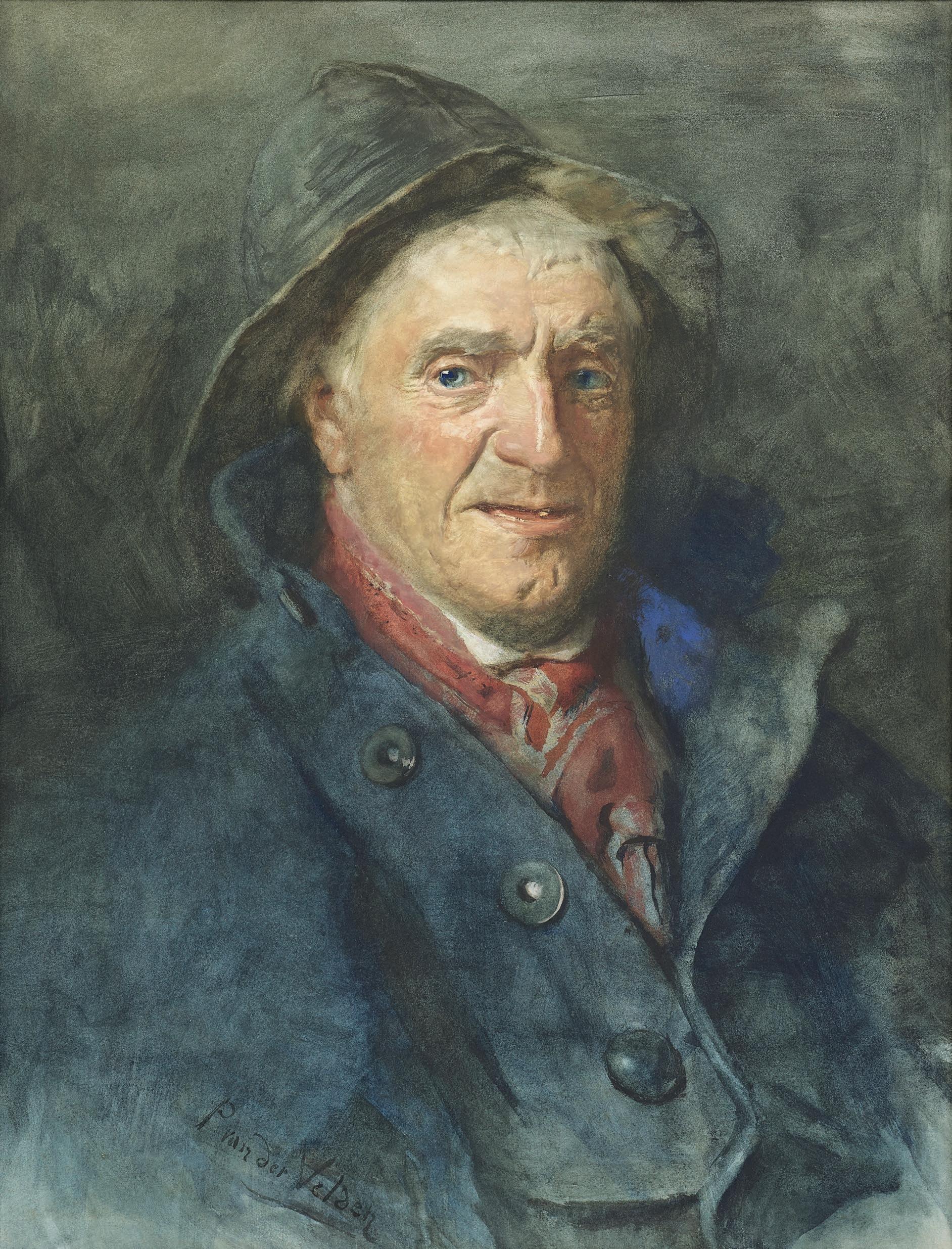
Man in a Southwester (Study for ‘The Orphans’)
Charcoal on paper
45 x 33 cm
Robert McDougal Art Gallery label affixed verso
$1,500 - 2,500
PROVENANCE
Private Collection, Waikato
EXHIBITED
The Art of Petrus van der Velden, Robert McDougall Art Gallery, Christchurch, 11 November – 11 December 1963, cat. no.4
EXHIBITED
T. L. Rodney Wilson, Petrus van der VeldenA Catalogue Raisonné, Volume II, Chancery Chambers (Publishers), Sydney 1979, p. 31 plate 1.2.1.33
99 DAVID BARKER (b. 1941)
The Captain’s Study, Butler Point, Mangonui, NZ Oil on board
49.5 x 99.5 cm
Signed & dated 03 lower right
$5,000 – 8,000
PROVENANCE
Private Collection, Auckland
Lot 57
6:30pm Tuesday 4 August 2026
I instruct International Art Centre to bid on my behalf for the following lots up to the prices indicated below. I understand my bids are to be executed at the lowest attainable price level. All bids are subject to Conditions of Sale printed in this catalogue.
REGISTRATION NUMBER
ADDRESS
TELEPHONE NAME
We will allocate a bidding number if you don’t already have one.
Signature ........................................................................................... / / 2026
I have read and understand the Conditions of Sale. International Art Centre offers this service to clients unable to attend sale and is not responsible for error or failure to execute bids.
Email to info@internationalartcentre.co.nz before 3pm day of sale
Alternatively, visit our website www.internationalartcentre.co.nz and place absentee bids online or our bidding platform to participate in the auction live and remotely https://auctions.internationalartcentre.co.nz
Lot 34
The highest bidder shall be the buyer. In the event of any dispute regarding bidding, the auctioneer may re-offer the lot at their discretion, and the auctioneer’s decision shall be final.
The auctioneer reserves the right:
(i) to refuse any bid; (ii) to advance the bidding at their discretion; (iii) to place a reserve on any lot; (iv) to bid on behalf of the seller; (v) to withdraw any lot from sale; and (vi) to require immediate payment of all or part of the purchase price.
The auctioneer acts as agent for the seller. Neither the auctioneer nor the seller is responsible for any faults, defects, errors of description or the authenticity of any lot. No compensation shall be payable in respect thereof. Risk passes to the buyer upon the fall of the hammer. Title to the property does not pass until payment has been received in full.
Payment is due immediately following the sale unless prior arrangements have been approved by the auctioneer. All bidders must register for a bidding number prior to the auction. Subscribers may use their permanent bidding number. We reserve the right to request photographic identification from new clients.
All lots must be paid for immediately following the sale and collected, at the buyer’s expense, no later than Friday 7 August 2026, unless otherwise agreed. Should a buyer fail to comply, the auctioneer and/or seller reserves the right to retain any deposit, cancel the sale and resell the lot. Any shortfall and associated costs arising from such resale shall be the responsibility of the defaulting buyer. No lots may be collected, and no payments processed, while the auction is in progress.
Where a lot is declared “subject”, the bid is below the reserve and remains subject to the vendor’s approval. The vendor may accept, reject or negotiate the bid. If accepted, the highest bidder is bound to complete the purchase.
Estimates are provided as a guide only and may be revised at any time prior to the sale. Estimates are based on the hammer price only and do not include the buyer’s premium.
Absentee bids may be submitted using the form at the back of the catalogue or via email to info@internationalartcentre. co.nz by 3.00pm on the day of the sale. Security details may be requested. Registered users may also place absentee bids through our website. Although online bidding is available, prospective buyers are strongly encouraged to inspect lots in person or request a condition report prior to bidding.
Telephone bidding is available, subject to availability, to registered bidders at no additional charge. Requests should be made prior to the day of sale.
EFTPOS: Subject to daily limits.
Bank Transfer: Details are provided on the invoice. Please quote your lot number(s) and surname when making payment.
Credit Cards: Visa and Mastercard are accepted. A 2% surcharge applies. Cheques are not accepted.
Certain works by New Zealand artists that are more than 50 years old may require an export permit under the Protected Objects Act 1975. Applications may be made through the Ministry for Culture and Heritage.
We are pleased to arrange packing and delivery nationally and internationally. Buyers are responsible for all export, import, customs and quarantine requirements applicable to their purchases. Risk passes to the buyer upon collection or when the lot leaves our premises, and buyers are responsible for arranging appropriate insurance from that time.
A buyer’s premium of 19% applies to all lots. GST is payable on the buyer’s premium only, resulting in an effective buyer’s premium of 21.85% (including GST).
ANGUS R 26
BANKSY 39, 40
BINNEY D .............................. 3, 4, 30
BROWN N 63, 64, 65, 87
BULLMORE E 15, 16
CAULFIELD P ..................................38
CHING R 22
COLEMAN B 6
COTTON S 17
HODGKINS F ................................. 34 HOLMWOOD J 78, 79
R 9, 89, 90
SMITHER
C
MCINTYRE P
42, 43, 44, 45, 46, 47, 48, 49, 50