What is myeloma?
Who gets myeloma?
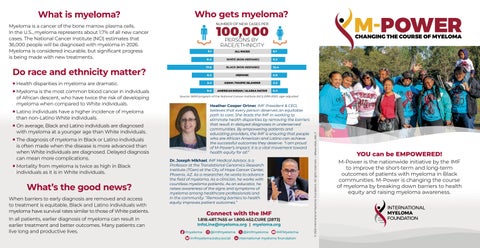
Myeloma is a cancer of the bone marrow plasma cells. In the U.S., myeloma represents about 1.7% of all new cancer cases. The National Cancer Institute (NCI) estimates that 36,000 people will be diagnosed with myeloma in 2026. Myeloma is considered incurable, but significant progress is being made with new treatments.
PERSONS BY RACE /ETHNICITY
NUMBER OF NEW CASES PER
9.1
6.1
8.4
5.2
Do race and ethnicity matter?
17.9
13.4
8.3
5.8
Health disparities in myeloma are dramatic.
5.2
3.5
Myeloma is the most common blood cancer in individuals of African descent, who have twice the risk of developing myeloma when compared to White individuals.
8.6
5.4
Heather Cooper Ortner, IMF President & CEO, believes that every person deserves an equitable path to care. She leads the IMF in working to eliminate health disparities by removing the barriers that result in delayed diagnoses in underserved communities. By empowering patients and educating providers, the IMF is ensuring that people who are African American and Latino can achieve the successful outcomes they deserve. “I am proud of M-Power’s impact; it is a vital movement toward health equity for all.”
Latino individuals have a higher incidence of myeloma than non-Latino White individuals. On average, Black and Latino individuals are diagnosed with myeloma at a younger age than White individuals. The diagnosis of myeloma in Black or Latino individuals is often made when the disease is more advanced than when White individuals are diagnosed. Delayed diagnosis can mean more complications. Mortality from myeloma is twice as high in Black individuals as it is in White individuals.
What’s the good news? When barriers to early diagnosis are removed and access to treatment is equitable, Black and Latino individuals with myeloma have survival rates similar to those of White patients. In all patients, earlier diagnosis of myeloma can result in earlier treatment and better outcomes. Many patients can live long and productive lives.
Dr. Joseph Mikhael, IMF Medical Advisor, is a Professor at the Translational Genomics Research Institute (TGen) at the City of Hope Cancer Center, Phoenix, AZ. As a researcher, he works to advance the field of myeloma. As a clinician, he works with countless myeloma patients. As an educator, he raises awareness of the signs and symptoms of myeloma among healthcare professionals and in the community. “Removing barriers to health equity improves patient outcomes.”
Connect with the IMF
1.818.487.7455 or 1.800.452.CURE (2873) InfoLine@myeloma.org | myeloma.org /myeloma
@imfmyeloma
imfmyeloma.bsky.social
@imfmyeloma
IMFMyeloma
international myeloma foundation
© 2026 International Myeloma Foundation. All rights reserved. — MPower trifold_2026_f1
Source: SEER program of the National Cancer Institute (NCI) 2019-2023, age-adjusted
YOU can be EMPOWERED!
M-Power is the nationwide initiative by the IMF to improve the short-term and long-term outcomes of patients with myeloma in Black communities. M-Power is changing the course of myeloma by breaking down barriers to health equity and raising myeloma awareness.
The IMF is here to help YOU
Better outcomes for patients
Knowledge is POWER
The IMF vision is a world where every myeloma patient can live life to the fullest, unburdened by the disease. We are dedicated to improving the quality of life of myeloma patients while working toward prevention and a cure.
If you or your doctor suspect that you might have myeloma, do not delay in getting an opinion from a myeloma specialist, in person or remotely. Any ONE of these early signs could be an indication of myeloma: Unexplained tiredness or weakness, Bone pain or an unexplained fracture, or Recurring or persistent infections.
Visit mpower.myeloma.org to learn about disparities in myeloma, what actions are being taken by the IMF to achieve health equity, and how our M-POWERed partner cities are changing the course of myeloma: Atlanta Baltimore Charlotte Detroit New York City Philadelphia Richmond Tampa
The IMF provides free-of-charge services, programs, and resources to myeloma patients and their care partners, friends, families, and communities. To receive the most up-to-date information in a caring and compassionate manner, contact the IMF InfoLine. Visit mmsm.link/infoline to schedule a time convenient for you to talk with an IMF InfoLine Coordinator, who can help explain treatment options, locate a support group or a myeloma doctor, and refer you to potential sources of relief for your expenses. MYELOMA PATIENT STORIES
Be sure to get all THREE of these accurate and cost-effective screening tests for myeloma. When used together, these three tests will identify 99% of myeloma cases: 1. Serum free light chain test (free kappa, free lambda with ratio, serum), 2. S erum protein electrophoresis (SPEP), and 3. I mmunofixation electrophoresis (IFE).
MYELOMA PATIENT STORIES
MYELOMA PATIENT STORIES
Tiffany was diagnosed with myeloma in 2013; a moment that transformed her life and ignited her purpose. Guided by her personal truth – “cancer doesn’t define me, but it has redefined my life” – Tiffany has transformed her lived experience into becoming a powerful advocate, uplifting others and driving meaningful change.
Gail is a Community Health Educator and co-leader of a myeloma support group. Diagnosed in 2008, she has closely followed the developments in the field. “Advances are being made in part because myeloma clinical research has become so patientcentric, and the IMF has been key to myeloma patients having a voice and a seat at the table.”
The IMF is collaborating with the National Medical Association (NMA) and the W. Montague Cobb Health Institute on a program that pairs medical students with myeloma expert mentors, thereby boosting the number of future myeloma doctors dedicated to serving people from minority communities. Currently, African Americans consti tute 13.6% of the U.S. population and 6.2% of recent medical school graduates, but only 3% of practicing oncologists.
Jameca was diagnosed at age 26.
Through the support of the IMF and the unwavering love and care by her community of family and friends, Jameca has celebrated 20 years of myeloma survivorship without relapse! Her advice: “Accept the IMF’s help and take advantage of all available local, national, and worldwide resources. Most importantly, give what the world needs more of…LOVE.”
Thomas was diagnosed in 2005 at
age 34. Thomas is now a leader of a myeloma support group powerful with knowledge, and he has this advice to share with others: “Know your body. Don’t be scared to get tested. Don’t be afraid to advocate for yourself. It’s okay to question the doctors. It’s okay to get a second opinion.”
Robert, a pastor and retired business
man, was diagnosed with myeloma in 2014 during a routine physical exam as he was preparing to run a 15k race, which had been his personal challenge and tradition for 18 years. Robert now counsels others who have myeloma, and he practices what he preaches: “I keep the message simple and deliver it with love.”
Terrence survived prostate cancer,
then came myeloma. “My mindset is to look for the positives,” he says. “And my wife Toni has been totally amazing throughout.” Toni adds, “Patients and caregivers need to know that there are resources out there. Ask questions. Don’t be intimidated. Get a doctor who is a myeloma doctor. And take care of yourself, too.”