What to Wear to Bed for Better Muscle
Relaxation
Muscle relaxation during sleep sounds like it should be automatic. You lie down, you close your eyes, and your muscles , having done their work for the day , simply let go.
For a lot of people, especially those who carry chronic tension, exercise regularly, or sit at a desk for most of their waking hours, this is not what happens. The muscles don't fully release. The shoulders stay somewhere near the ears. The jaw remains slightly clenched. The lower back holds the accumulated tension of a full day of sitting and compensating. Sleep arrives, but it arrives in a body that hasn't fully surrendered to it.
There are many reasons for this , stress, posture, nervous system activation, inflammatory processes that keep tissue guarded. Most of them are addressed through pre-sleep routines: stretching, breathing, heat therapy, magnesium, all the interventions aimed at shifting the body from sympathetic activation toward parasympathetic rest.
But once all of that is done, there's one more variable in the room. It's the garment you just put on. And it is either helping the muscles finally release, or maintaining just enough stimulus to prevent them from doing so completely.
Why Muscle Relaxation During Sleep Is a Physiological Event
Before discussing what to wear, it helps to understand what muscle relaxation during sleep actually requires , because relaxation isn't simply the absence of activity. It is an active physiological state that the nervous system has to achieve and maintain.
Muscle tone , the level of background contraction present in a muscle at rest , is governed by motor neurons. These neurons fire continuously at a low rate even during rest, maintaining the readiness that keeps posture and function available. During deep sleep, this firing rate decreases significantly. Motor neuron activity drops. Muscles achieve a genuinely lower tone than they can during waking hours , a state of release that is deeper than any conscious relaxation technique can produce.
This reduction in motor neuron firing is part of the parasympathetic shift that deep sleep represents. The autonomic nervous system moves from its sympathetic, alert state, which maintains higher muscle tone, into its parasympathetic rest state. For this shift to be complete, the nervous system needs the sensory environment to go quiet. This is one reason the Best Sleepwear for Older Adults With Muscle Tension should prioritize comfort and minimal physical irritation during sleep. The environment does not need to be completely silent, as biological processes continue, but it should be quiet enough that no external inputs compete with the signal that it is safe to downregulate.
This is where sleepwear enters the equation.
Any garment that creates sustained sensory input , through friction against the skin, thermal discomfort, electrostatic stimulation, or mechanical pressure , provides the nervous system with exactly the kind of ongoing input that keeps it from fully completing the parasympathetic shift. Muscle tone stays slightly elevated. The depth of relaxation achievable during sleep is reduced. And the quality of rest that follows , including the recovery, repair, and restoration that deep sleep enables , is diminished accordingly.
The Sensory Inputs That Prevent Complete Relaxation
Identifying the specific ways common sleepwear interferes with muscle relaxation makes the solution considerably clearer.
Heat and moisture accumulation. Core body temperature must drop to initiate and sustain deep sleep. The thermal descent that triggers slow-wave sleep also corresponds to the drop in sympathetic nervous system activity that allows motor neuron firing to decrease. Sleepwear that traps body heat , synthetic fabrics, heavy materials, poorly ventilated designs , prevents this descent, keeping both the thermal and neural environment warmer and more active than deep sleep requires. The muscles stay in a slightly more contracted state because the nervous system hasn't fully transitioned.
Perspiration that isn't absorbed creates a damp, humid microclimate against the skin. Wet fabric against skin triggers sensory receptors that report back to the CNS. The nervous system responds by maintaining lighter sleep and elevated sensory monitoring , the opposite of the conditions needed for full muscle relaxation.
Surface friction. Most fabrics have some degree of roughness at the microscopic level , fiber ends that protrude from the yarn surface and create a textured contact with the skin. For most people in most circumstances, this is below the threshold of conscious notice. But the nervous system during lighter sleep stages operates at a lower threshold of sensory detection. Fabric roughness that is imperceptible while awake can produce sufficient sensory input during sleep to maintain the nervous system at a level of activation that prevents full motor neuron downregulation.
For people with muscle tension , whose motor neurons are already firing at above-baseline rates before they get into bed , the bar for what constitutes a disruptive sensory input is lower. These individuals need less from the external environment to be pushed back toward lighter sleep, and benefit more from a fabric surface that creates nothing registerable.
Static electricity. Synthetic fabrics generate electrostatic charge through friction with the skin during movement in bed. This charge delivers low-level electrical stimulation to the skin surface and the sensory receptors within it , a stimulus that is typically not felt consciously but is detected by the nervous system. In the context of sleep, it functions as a source of continuous low-grade arousal that competes with the CNS's effort to downregulate.
Mechanical pressure from fit. Elasticated waistbands, tight sleeve hems, fitted cuts across the chest or hips, seams positioned against sensitive areas , all of these apply sustained mechanical pressure that the nervous system registers as ongoing physical input. This input maintains a mild level of somatosensory processing that occupies neural resources that would otherwise contribute to the downregulation of motor tone.
Tight sleepwear that compresses the chest is particularly relevant to muscle relaxation. Diaphragmatic breathing , the slow, full-belly breathing pattern that activates the vagus nerve and drives parasympathetic nervous system activity , requires an unobstructed abdomen and ribcage. Any compression that restricts this breathing pattern reduces the depth of the parasympathetic shift, which directly limits how fully motor neurons can downregulate and muscles can release.
The Fabric That Removes the Barriers
The criteria for muscle-relaxation-supporting sleepwear follow directly from the sensory inputs described above. The optimal fabric for this purpose is one that:
Absorbs and releases moisture rather than trapping it
Allows air circulation to support thermal descent
Has a surface smooth enough to produce no registerable tactile sensation
Generates no electrostatic charge
Remains soft and consistent through repeated washing
Extra-long staple cotton , particularly Pima cotton , satisfies all of these criteria more completely than any other widely available natural fiber.
The key is the fiber length. Pima cotton fibers measure 1.5 inches or more , significantly longer than the approximately one-inch fibers of standard Upland cotton used in most commercial garments. Longer fibers produce finer, more uniform yarn with far fewer protruding ends at the surface. Those ends are what create fabric roughness. Eliminate them, and the fabric surface becomes smooth enough that skin contact produces no sensation the nervous system needs to report.
The result, practically speaking, is a fabric that the body stops registering. It is warm enough, cool enough, smooth enough. There is nothing to adapt to, nothing to process, nothing to maintain vigilance around. The nervous system is free to direct its activity entirely inward , toward the motor neuron downregulation and muscle tone reduction that deep sleep enables.
Pima cotton is also highly breathable. Its weave structure allows passive airflow and moisture evaporation , drawing perspiration away from the skin and releasing it into the environment rather than retaining it between fabric and body. This thermal management is what allows core temperature to descend appropriately across the night, supporting the transition into and maintenance of slow-wave sleep.
Fit Principles for Muscle Relaxation
Fabric is one dimension. Fit is the other , and for muscle relaxation specifically, fit decisions have direct physiological consequences.
Chest and abdomen: fully unobstructed. Nothing should restrict the ribcage or the belly during breathing. Loose, unstructured fits in the torso , neither tight nor binding , allow the diaphragm to move fully with each breath, maximizing the vagal activation that deepens the parasympathetic shift and enables the greatest degree of motor neuron downregulation.
Waistband: soft or absent. Any waistband that applies meaningful pressure to the lower abdomen or lower back is applying pressure to two of the body's highest-tension zones. Lower back musculature that is already tense from sitting, exercise, or chronic postural loading does not need an external pressure source maintaining sensation in that area through the night. Wide, soft waistbands with minimal compression , or drawstring closures worn loose , remove this input. Waistband-free designs (long nightgowns, sleep robes) eliminate it entirely.
Shoulder and neck region: seam-free or raglan. The posterior shoulder, upper trapezius, and posterior cervical region are the most common sites of chronic muscular tension in people who spend significant time sitting, using screens, or carrying stress physically. Conventional set-in sleeves place a seam directly across this region. Raglan sleeve construction, which runs diagonally from collar to underarm without a shoulder seam, removes this contact point entirely. For anyone with shoulder, neck, or upper back tension, this single design detail can meaningfully change the overnight experience in those muscles.
Neckline: wide and clear of the throat. A neckline that sits against the base of the throat or the posterior neck during side sleeping applies contact pressure to one of the highest-innervation areas of the body , an area particularly sensitive to tactile input and particularly relevant to the tension patterns of the upper back and neck. Wide crew necks, relaxed V-necks, and boat necklines that clear the throat and posterior neck in all sleep positions eliminate this contact point.
What Temperature Needs from Your Sleepwear
Muscle relaxation and thermal regulation are intertwined because the nervous system shift that enables one is the same shift that requires the other.
The core temperature drop that initiates deep sleep , and the associated reduction in sympathetic nervous system activity , is what allows motor neuron firing rates to decrease. The two processes are physiologically linked. Supporting one means supporting both.
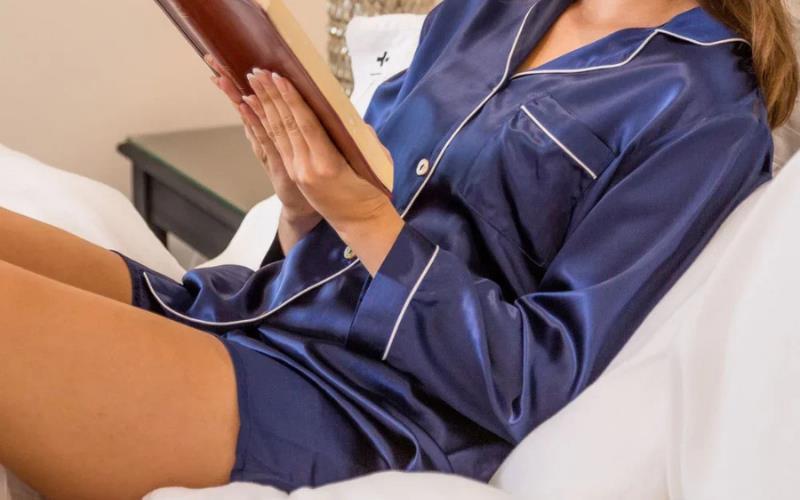
Lightweight, full-coverage Pima cotton sleepwear handles the thermoregulatory dimension most effectively for most people. Full coverage , long sleeves, full-length legs , keeps the major muscle groups from becoming cold and reflexively contracting to generate heat. Breathable, lightweight fabric prevents heat accumulation. The body remains warm enough to stay relaxed, cool enough to stay in the thermal range that deep sleep requires.
For those who sleep hot, short-sleeved tops paired with full-length bottoms , or vice versa , allow customization of the thermal balance without sacrificing the coverage that muscle warmth and sensory protection require.
The Sum of Small Inputs
The barrier to full muscle relaxation during sleep is rarely one dramatic thing. It is usually the sum of several small inputs , each below the threshold of conscious attention, each individually tolerable, each contributing to a sensory environment that keeps the nervous system more active than it needs to be.
Fabric that traps heat. Moisture that builds against the skin. Roughness that generates continuous friction. Static that delivers low-grade electrical stimulation. A waistband pressing against the lower back. A seam sitting on a sore shoulder.
None of these is a crisis. Together, they are the difference between a nervous system that fully transitions into parasympathetic rest and one that maintains a partial state of activation through the night , keeping muscle tone slightly elevated, sleep slightly lighter, and recovery slightly less complete than it would otherwise be.
Removing them, with the right fabric and the right fit, is not a dramatic intervention. But it is a consistent one. And in the context of sleep , where small improvements to depth and continuity compound across every night , consistent matters more than dramatic.
Wear something your nervous system can ignore. That's what muscle relaxation during sleep actually needs.