Montgomery v. Caribe Increases Litigation Activity, Not Shipper
Report: How AI Is Changing the Roles of Account Managers and
Account
Your Business: What Every Agency Owner Should Do Before Going to Market
It Covered? No
No Coverage? Is Your Home Uninsured?
Most Insurance Agencies Don’t Actually Train New Hires
Estate E&O: The Importance of Specialized Coverage in an Increasingly Complex Market
Marketing Connection: Why Consistency Beats Creativity in Insurance Marketing
Retention Strategies in a Softening Market
Quote: Shopping for Cyber Insurance? Start With the End in Mind
Market Share Up in 2025
The independent agency channel placed 62.1% of all property and casualty insurance written in the U.S. in 2025, a slight increase from 2024 when 61.5% of insurance written was placed by independent agents.
According to the 2026 Market Share Report published by the Independent Insurance Agents & Brokers of America (Big “I”) trade association, independent agents (IAs) wrote 87.7% of commercial lines written premiums in 2025 and 39.5% of personal lines.
The independent insurance agency channel also gained traction in surplus lines, with a 9.9% utilization rate, up from the five-year average of 9.3%. Private flood had a 52.6% utilization rate, up from the 47.4% five-year average.
During 2025 independent agents held the highest market share penetration rate in Massachusetts (79.8%), and the lowest in Alabama (51.1%).
In the United States, top penetration rates by line of business were: Multi-Peril Crop (97.3%), Ocean Marine (96.7%), and Private Crop (96.7%).
When it comes to commissions, the highest average commission rate was 13.6% (Massachusetts), and the lowest was 9.8% (Delaware). The average commission rate in the United States in 2025 was 11.6% for all P&C lines combined, the report said.
The report also noted that while Nationwide was the largest insurer, and State Farm Group (G) was the largest group, overall in the United States, writing 10.5% of all P&C premiums in 2025, Auto-Owners Insurance Company emerged as the largest pure independent agent-broker distribution style individual insurer. State Farm Mutual Automobile Ins Co was the largest exclusive-captive distribution style individual insurer, and GEICO General Insurance Company as the largest direct distribution style individual insurer.
‘As the market has begun to shift, the channel is on firm footing and poised to make the most of these improving conditions.’
“The resilience of the independent agency channel is evident in this year’s Market Share Report, painting a clear picture of its stability through the hard market,” said Charles Symington, Big “I” president and CEO. “As the market has begun to shift, the channel is on firm footing and poised to make the most of these improving conditions.”
According to the study, loss ratios improved to 57.3 in 2025 compared with the five-year average of 63. Combined ratios lowered to 88 in 2025, from 92 the prior year. The average of the last five years is 94.
The annual report compiles and analyzes property & casualty premium data from AM Best and provides insights for agencies and carriers on current market shares by distribution types.
| jcarlson@insurancejournal.com
ADMINISTRATION / CIRCULATION
Chief Financial Officer Terry Freeburg | tfreeburg@wellsmedia.com
Circulation Manager Elizabeth Duffy | eduffy@wellsmedia.com
Staff Accountant Sarah Kersbergen | skersbergen@wellsmedia.com
EDITORIAL
V.P. of Content
Andrea Wells | awells@insurancejournal.com
Executive Editor Emeritus Andrew Simpson | asimpson@wellsmedia.com
National Editor Chad Hemenway | chemenway@insurancejournal.com
Southeast Editor
William Rabb | wrabb@insurancejournal.com
South Central Editor/Midwest Editor Ezra Amacher | eamacher@insurancejournal.com
West Editor Don Jergler | djergler@insurancejournal.com
International Editor L.S. Howard | lhoward@insurancejournal.com
Contributors: Kelly Basler, Tim Carlson, Ross DiBono, Jeremy Gittler, John Heft, Brandy Law, Theodore Schaer Columnists: Erin Dwyer, Catherine Oak, Bill Schoeffler, Bill Wilson
Sr. Sales & Marketing Coordinator Laura Roy | lroy@insurancejournal.com
Marketing Director Derence Walk | dwalk@insurancejournal.com
DESIGN / WEB / VIDEO Graphic Designer Chris Johnson
Web Team Lead
Josh Whitlow | jwhitlow@insurancejournal.com
Ad Ops Specialist
Jeff Cardrant | jcardrant@insurancejournal.com
Web Developer Terrance Woest | twoest@wellsmedia.com
Web Developer Jason Chipp | jchipp@wellsmedia.com
V.P. of New Media
Ashley Cochrane | acochrane@insurancejournal.com
Senior New Media Strategist
Ashley Waldrop | awaldrop@insurancejournal.com
ACADEMY OF INSURANCE
Director Patrick Wraight | pwraight@ijacademy.com
Online Training Coordinator George Jack | gjack@ijacademy.com
AI IN A HEALTHCARE PRACTICE: A Game Plan for Success
In the 2024 article “AI Will Be as Common in Healthcare as the Stethoscope,” Dr. Robert Pearl, former CEO of the Permanente Medical Group, opined that artificial intelligence would soon emerge as a powerful equalizer—helping to address physician burnout while advancing the quality of patient care. The article explains that AI can process vast, nearly limitless volumes of data to personalize care recommendations and support optimal treatment plans and outcomes. That optimism, however, also carries an implicit pressure to adopt AI as quickly as possible. While many articles emphasize AI’s potential to reduce administrative and clinical burdens, far fewer address a critical question: How should healthcare practices begin the process of selecting and implementing the right AI solution for their specific needs? The following practical steps are intended to help guide practices forward.
1 LOOK INWARD BEFORE OUTWARD
2 BUILD FROM THE GROUND UP
3 “OPTIONAL” MEANS GO
No practice can—or should— attempt to address every operational challenge or deploy every available AI application at once. Leadership should begin by engaging key stakeholders, regardless of practice size, to assess the organization’s specific needs and capacity. Which administrative or clinical tasks are placing the greatest strain on staff? Should initial efforts focus on billing, documentation, patient no-shows, or inventory management? Practices should also evaluate which AI vendors provide robust implementation, training, and ongoing IT support. Will the transition be managed internally, or will outside expertise be needed to address legal, workflow, or technical considerations? Aligning project scope with the practice’s project management capabilities is essential to successful adoption.
Adopting AI is a strategic, forwardlooking decision, but rushed implementation, misjudged priorities, or overestimating organizational readiness can undermine what might otherwise be a sound business choice. Introducing AI into the clinical environment requires a strong foundation and a clear understanding of the long-term commitment involved. In many cases, it is prudent to begin with administrative applications—such as scheduling optimization, staffing support, or supply chain management—before moving into clinical decision support. AI tools that directly influence patient care warrant heightened scrutiny to ensure ethical, safety, and legal standards are met. Thoughtfully laying this groundwork is critical to realizing sustainable long-term benefits.
In sports, “optional” practices often mean full participation—and the same principle applies to AI adoption. Once an organization commits to an AI solution, leadership and staff must be fully engaged. Successful implementation depends on understanding workflows, staying current with system updates, and developing the skills necessary to use AI as a complement to clinical judgment and operational processes. Whether in a solo practice or a large health system, prioritizing consistent training, monitoring competency, and dedicating time for staff education will improve outcomes. Ongoing education throughout each phase of implementation fosters shared ownership and confidence. When staff fully understand the purpose, benefits, limitations, and documentation requirements of the AI solution, they are better positioned to raise questions and identify concerns early.
DECISION
The rapid growth of AI developers and products makes careful evaluation more important than
ever. Practices should resist the temptation to rush adoption and instead devote sufficient time to identifying solutions that align with their operational needs and patient populations. Due diligence should include confirming that the AI product’s underlying data sets are appropriate and representative of the practice’s patients. Physicians and administrators should feel empowered to thoroughly assess how the product is trained, what data it relies upon, and how its outputs are generated. Vendor support, implementation timelines, and workflow integration are also critical considerations. Because AI can influence patient care, ethical and safety considerations must remain paramount. If a solution does not meet the practice’s standards, walking away—regardless of marketing appeal—is a prudent decision.
IN WRITING
Jennifer Freeden, JD, CPHRM Southwest Regional Risk Manager
Regardless of size, any practice adopting AI should do so under a formal, written agreement with the chosen
Regardless of size, any practice adopting AI should do so under a formal, written agreement with the chosen system vendor reviewed by legal counsel. Key contractual provisions warranting careful review include data ownership and retention, payment terms, indemnification and liability, services and deliverables, HIPAA compliance and encryption requirements, privacy and nondiscrimination clauses, remedies for misinformation or system errors, vendor update obligations, recalibration protocols, and ongoing IT maintenance responsibilities.
Adopting AI in healthcare represents a significant organizational step. By thoughtfully assessing needs, building a strong foundation, committing to training, conducting rigorous due diligence, and securing well-structured contracts, practices can leverage AI’s benefits while minimizing risk. Taking these steps now can help position a practice for long-term success in an increasingly AI-enabled healthcare landscape.
News & Markets
Flood Insurance Gap Will Squeeze Local Governments, Homeowners, Moody’s Says
By William Rabb
The flood insurance gap in the United States is big—and it’s not getting better. And the consequences of that gap are about to worsen for property owners and state and local governments, thanks to increasing rainfall amounts, stronger storm surge, more development in flood zones, cutbacks in federal aid, and aging river levees around the country.
That was the word from Moody’s Rating analysts who delved into the realities at a recent webinar.
“When flood losses happen and they are not absorbed by the shock absorber of insurance, they don’t disappear,” said Firas Saleh, director of insurance solutions and product management at Moody’s, the global ratings and analytics firm.
Some of those costs are shifted onto impacted households that do not carry adequate (or any) flood insurance, onto federal assistance programs, and—more and more—to state and local governments, Saleh said. Government programs often are asked to pay for debris removal, demolition of flooded structures, bridge
replacement, road repairs, and temporary housing.
But local property tax revenue often takes a dive after flooding events, as damaged sites lose value. That’s especially true in smaller, less-affluent counties and cities. The decline can affect local credit ratings, costing jurisdictions more to issue bonds and borrow money.
After Hurricane Harvey in 2017, for example, a few coastal counties in Texas faced deficits after properties were reassessed and property tax revenue plummeted, said Denise Rappamund, a vice president and senior analyst at Moody’s. Buncombe County, North Carolina, one of the places hit the hardest by Hurricane Helene flooding in 2024, saw its credit outlook rating temporarily downgraded to “negative,” explained Jennifer Chang, Moody’s vice president and senior credit officer.
As the current U.S. president and his administration have espoused major cuts in federal funding, including cuts to Federal Emergency Management Agency programs, it will fall more on cities, counties, and state governments to rebuild
infrastructure after devastating floods, the analysts said.
And locals may be less financially prepared than they have been in decades: Several states in recent years have reduced or eliminated their state income taxes, leaving smaller pots of money to handle greater losses. Florida lawmakers this year moved to cut much of the state’s property taxes for homeowners. If approved by voters, that could cost local governments as much as $12 billion a year, some economists have warned.
Some of the states that have most embraced the Donald Trump ideology of government spending reductions are the ones that will feel the pain the most.
The deep red states of Texas, Louisiana, Florida, and North Carolina, for example, received the most federal disaster aid as a share of overall state revenue from 2017 to 2025, the Moody’s team noted. Louisiana enjoyed the largest share in the country— more than 5% of its revenue came from federal disaster aid in recent years.
At the same time, participation in the National Flood Insurance Program has
continued on page 12
THE POWER OF PARTNERSHIP
Net the whole catch as a leadership agent with Smart Choice – earning 100% commissions on what you write
Kavan Maybee Insurance Agency owner Kavan Maybee and Smart Choice State Director Kim Carney
This agency owner and tournament bass fisherman is landing bigger clients and has hooked into new commercial lines revenue streams thanks to his partnership with Smart Choice. No more catch and release with his profits – he earns 100% commissions as a Leadership Agent. A former captive agent, Kavan now has the freedom, flexibility and expertise he needs to find the best coverage solutions and pricing for his clients.
Whenever a unique challenge arises, I just call Kim, my Smart Choice State Director. She is always there for me, and I’ve never had a problem that she hasn’t fixed. That’s what she does. I love her to death – that was a great decision on my part. She’s helped me out tremendously.
News & Markets
Doing Its Job: Large Majority of Cyber Losses Covered by Insurance, Says Willis
More than 95% of average data breach losses and 90% of average first-party losses are adequately covered by insurance, according to a recent report by Willis, a WTW business.
Cyber claims in Focus – Getting value from cyber insurance analyzed 5,500 cyber claims from January 2013 to January 2026 across 95 countries, and around $1 billion in insurer payments.
Data breaches are the most frequently reported cyber insurance loss, with malicious data breaches accounting for the majority of incidents. Ransomware losses register the highest financial severity, predominantly driven by the disrupted productivity and prolonged downtime that follows incidents. Third-party vendors are responsible for an increasing proportion of losses, and systemic risk from single-vendor incidents impacting multiple organizations remains a critical concern.
Other key findings include:
• The average ransomware event lasts 25 days and the average loss is $5.3 million, with the largest single loss now exceeding $500 million.
• Artificial intelligence isn’t yet appearing as a stand-alone driver of cyber insurance claims but is fueling risk volatility by amplifying existing threats.
• Events where attackers target organizations’ systems directly account for 58%
continued from page 10
declined significantly in recent years, leaving some homeowners more exposed than ever, the Moody’s team pointed out. Some 470,000 NFIP policies were lost between 2018 and early this year. Since 2009, 5.6 million policies have left the program.
While private flood insurance firms have filled that gap to a large degree, the overall level of U.S. flood coverage has remained about the same, Saleh explained.
And while critics of the FEMA flood maps have long argued that the maps don’t show the true extent of flood-vulnerable areas, Moody’s computer models
of ransomware notifications and 95% of total costs, while vendor-led incidents account for 42% of notifications but only 5% of costs.
• Business interruption losses and ransom payments represent the two largest cost elements for ransomware events. Average ransom demands are now $3.8 million versus an actual payment of $1.5 million.
• Third parties are responsible for nearly 50% of data breach losses and 29% of first-party losses.
• Pixel-tracking litigation is the hidden cyber insurance risk, with some cases leading to substantial losses across the wider cyber insurance market.
bring it into sharp relief. For the Houston area, for example, a Moody’s map shows a 1-in-100-year flood reaching a vastly larger number of square miles than FEMA’s maps show.
The reach of inland flooding will be even greater if levees fail. Saleh said studies show that America has about 100,000 miles of levees, mostly along rivers and lakes that may be increasingly vulnerable to extreme rainfall events.
The average age of those levees is 60 years old, he said.
How property and casualty insurers are preparing clients for these growing risks is
The report includes industry spotlights on financial institutions, healthcare, transportation, and manufacturing.
Peter Foster, chairman, global FINEX cyber and cyber risk solutions at Willis, said:
“Cyber insurance cover varies widely, which is why organizations must understand what they have in place and ensure it aligns with their risk exposures. When cover doesn’t reflect reality, organizations risk critical gaps where protection is needed most, while paying for cover that offers little real value. To get the strongest value from cyber insurance, consideration must reflect the claims patterns seen across the market.”
less than clear and is something analysts and local governments will likely examine in coming months and years.
“There’s really a spectrum on how certain insurers are demonstrating what they are doing in terms of resilience, and how much they have invested,” Chang said.
Some carriers have developed plans to improve policyholders’ resilience to hazards, while others have not.
Moody’s published report on flood coverage can be accessed at: https:// www.moodys.com/web/en/us/insights/ physical-transition-risk/us-flood-risk-acountry-level-analysis.html.
Did you know Foremost®, part of Farmers Insurance®, insures nearly everything? We are a leader in the auto and home market, and we offer a robust suite of specialty products. This may mean more bundling opportunities and stronger retention — we have insurance solutions for the whole household and can be a go-to solution in your agency! If you’re ready to expand your book of business and grow with Foremost, visit ForemostAgent.com/Get-Appointed and fill out the form.
33%
The amount U.S. residential roof replacement costs jumped in 2025, with repair costs climbing 25% compared to a prior four-year average. Roof losses didn’t slow despite a 20% decline in overall claims volume in 2025, according to Verisk. Roofing line items represent about 30% of all line items within claims estimates.
470,000
The number of National Flood Insurance Program policies lost between 2018 and early this year. Since 2009, 5.6 million policies have left the program, according to Moody’s. The impacts of the flood insurance gap will hit property owners and state and local governments as climate change and flood zone development drive more flood losses.
Figures
41%
The amount below the national average California homeowners pay for homeowners insurance (HOI), according to LendingTree’s State of Home Insurance: 2026 report. California homeowners paid an average of $1,413 annually for home insurance compared with the national average of $2,395. However, California's HOI rates have risen 53.7% since 2020, the report shows.
$1,000
The first violation penalty for not disclosing a “synthetic performer,” or AI-generated person, in advertising in New York. The price is $5,000 for any further violations. Gov. Kathy Hochul’s office is calling it a “first-in-the-nation law” that will boost transparency at a time when it says AI-generated performers are popping up across all forms of media, including on social platforms and in digital advertising.
$2.65 million
The cost of repairs after an old oil well sprang back to life under the parking lot of the First Baptist Church of Grandfalls, Texas, in April. Over eight days, more than 1.5 million gallons of toxic wastewater flowed out of the earth. The state regulator, the Railroad Commission, spent $1.49 million plugging the leak and another $1.16 million disposing of the wastewater back underground.
Declarations
The “I”s Have It
“The resilience of the independent agency channel is evident in this year’s Market Share Report, painting a clear picture of its stability through the hard market. As the market has begun to shift, the channel is on firm footing and poised to make the most of these improving conditions.”
— Charles Symington, the Independent Insurance Agents & Brokers of America (Big “I”) president & CEO. According to the Big “I” 2026 Market Share Report, the independent agency channel placed 62% of all property/ casualty insurance written in the U.S. in 2025, up from from 61.5% in 2024. Independent agents wrote 87.7% of commercial lines written premiums and 39.5% of personal lines.
Storm Forecast
“We call these storms historic; that is only true compared to the past. I think it is more appropriate to consider it typical of the climate of the future.”
— Richard Rood, a University of Michigan climate scientist, discussing increased flood risk across the Midwest. A warmer atmosphere holds more moisture for longer periods, which can lead to heavy rain or snow when enough builds up. And this spring, an “extraordinarily warm” Gulf of Mexico set the stage for both snow and rain in the upper Midwest, Rood said. This year, Michigan and neighboring Wisconsin experienced their wettest March 1-April 15 period on record.
Primary Concerns
“We think the only thing worse than expensive insurance is not being able to get it. And we’ve talked to a lot of customers where we’ve had to manage our exposure in markets. They’ve got to go to the secondary market and pay multiples of what they would have to pay if we could get our rates approved in the primary market.”
— State Farm Chief Executive Officer Jon Farney, in a discussion with Assured Research President William Wilt during an Executive Perspectives panel at the S&P Global Ratings 42nd Annual Insurance conference in June.
Stopping Screwworm
“We will respond based on facts, not fear. But we will also continue to be the most aggressive state in the nation when it comes to protecting our livestock, pets, wildlife, people, and agricultural economy from this threat,”
— Florida Agriculture Commissioner Wilton Simpson, regarding increased efforts to stop the spread of the New World Screwworm. The Florida Department of Agriculture and Consumer Services Pets implemented emergency rules prohibiting the importation of rescue and shelter dogs and cats from states with confirmed screwworm detections and revising the definition of infested zones to any county with a confirmed screwworm detection and its surrounding counties.
Heat vs. Health
“No one should have to choose between their paycheck and their health. The workers building our skyline, delivering our packages, selling food on our street corners and keeping this city running deserve to come home safe at the end of every shift. In the past, workers have borne the burden of extreme heat while government looked the other way.”
— New York City Mayor Zohran Kwame Mamdani, signing an executive order to protect workers from extreme heat. Workers’ compensation claims are 45% more frequent and 20% more severe on hot days, according to the New York State Insurance Fund.
Land Restoration
“Maybe that’s not in my lifetime, but it’s definitely in my children’s lifetime. That’s pretty wild to think about.”
— Kristi Trail, executive director of Louisiana’s Pontchartrain Conservancy, discussing the ongoing erosion and imminent loss of the New Orleans Land Bridge, which could disappear in 50 years without restoration efforts. The state loses the equivalent of one football field of land every 100 minutes, according to the U.S. Geological Survey. Threats include erosion, sea-level rise, and levees, which cut wetlands off from land-restoring river sediments. Louisiana’s Coastal Master Plan calls for investing more than $1.1 billion in New Orleans Land Bridge restoration projects, reviving about 29,000 acres.
Business Moves
National
ANV Group Holdings Ltd., Open Lending Corporation
ANV Group Holdings Ltd. entered a definitive merger agreement with Open Lending Corporation.
Open Lending partners with financial institutions across the U.S. to help expand access to automotive financing.
Global insurance intermediary ANV operates a growing portfolio of specialty insurance businesses across a diverse range of risk and insurance products. The acquisition adds a specialty underwriting business that fits well within ANV’s existing business segments and is consistent with its strategic M&A approach.
Upon the completion of the transaction, Open Lending will become a privately held company, and its common stock will no longer be listed on NASDAQ.
Open Lending’s board has approved the transaction, which is expected to close in the third quarter of 2026.
New York-based Cover Whale Insurance Solutions LLC, a technology-enabled commercial transportation managing general agent (MGA), launched Breakwater Markets, a digital wholesale brokerage focused on transportation risks.
The firm appointed Roman Atkielski as executive vice president of brokerage at Breakwater. He joins from Jencap
Insurance Services. The move expands Cover Whale’s core programs, giving retail agents a platform to place risks that sit outside the company’s underwriting appetite. It is designed to handle a broader range of transportation risks, including non-standard, surplus lines, and more complex placements.
Cover Whale offers commercial auto liability, cargo, physical damage, general liability, non-trucking liability and roadside assistance.
World Insurance Associates LLC, ML Ruberton Agency, MLR Risk Management
World Insurance Associates LLC acquired the business of ML Ruberton Agency and MLR Risk Management (MLR) of Hammonton, New Jersey.
MLR provides personal and commercial property insurance, life and health insurance, and consulting services.
World Insurance Associates LLC, Wolpert Insurance Agency
Global insurance broker World Insurance Associates LLC bought the business of Wolpert Insurance Agency of Worcester, Massachusetts. Wolpert was established in 1956 and is known for its transportation specialty, including trucking and transportation insurance, limousine insurance, and bobtail insurance. It also sells personal and commercial lines insurance throughout Massachusetts and Rhode Island. Mike Wolpert and Robert Mucci are principals of the agency.
World Insurance, based in Iselin, New
Jersey, serves clients from more than 250 offices across the U.S. and U.K.
Inszone Insurance Services, Sommelier Insurance Group LLC
Inszone Insurance Services acquired Sommelier Insurance Group LLC. The acquisition strengthens Inszone’s presence in Omaha, Nebraska, and adds specialized expertise in several key commercial sectors to the Inszone network.
Sommelier Insurance Group, LLC was founded in September 2020 by Luper Akough.
King Risk Partners, Perry Insurance Agency
Florida-based King Risk Partners continued its expansion in New England with the acquisition of Perry Insurance Agency of North Andover, Massachusetts.
Perry Insurance Agency is an independent insurance agency that offers personal insurance, commercial insurance, and liability coverage options. It is owned by Darryl Perry and Marc Perry.
King Risk Partners has more than 50 locations on the Eastern seaboard from New Hampshire to Florida, including six in Massachusetts, six in Connecticut, two in New Hampshire and one in Rhode Island.
Union Bay, Arlington Agency Inc.
Union Bay Acquisition, an aggregator of insurance agencies, has acquired the assets of Arlington Agency Inc., based in Livonia, Michigan. Terms were not disclosed. This is Union Bay’s eighteenth acquisition, and fifth in the state of Michigan. Arlington Agency offers auto, homeowners, business and life insurance products.
Based in Lancaster, Pennsylvania, Union Bay Acquisition owns property-casualty insurance agent Union Bay Risk Advisors LLC and acquires small insurance agencies in the Northeast and Midwest.
Higginbotham, Turbeville Insurance Agency
Higginbotham expanded into South Carolina with the acquisition of Turbeville Insurance Agency.
Turbeville, founded in 1991 by William
L. "Bill" Turbeville Jr., has 60 employees, with offices in Columbia, Lexington, Beaufort and Charleston. The Turbeville agency has focused on personal, commercial, life and health insurance, as well as employee benefits.
Higginbotham, with offices in Fort Worth, has been in business since 1948, and has more than 180 agency locations across the country.
Midwest
Westfield Specialty, DOXA’s Arris Property Underwriters Program
Westfield Specialty acquired the renewal rights for DOXA’s Arris Property Underwriters Program. The E&S commercial property program provides custom solutions for real estate, hospitality, healthcare, education, municipalities, and manufacturing through wholesale distribution.
The renewal rights deal provides Westfield Specialty with an opportunity to continue to grow and diversify their property book.
Westfield Specialty offers customized shared and layered property, as well as middle-market property insurance solutions on a wholesale basis.
Keystone, Kreager Insurance Service Inc.
Keystone acquired Kreager Insurance Services Inc. as its newest network partner in Wisconsin.
Founded more than 50 years ago, Kreager is independent insurance agency serving individuals, families, and businesses throughout Wisconsin. With offices in Marathon and Schofield, the agency is led by partners Ryan and Julie Kreager.
South Central
Equal Parts, D3
Equal Parts, an insurtech that acquires independent insurance agencies and equips them with artificial intelligence technology, acquired Texas-based D3. D3 was started in Amarillo, Texas, by Rex Young, Stephanie Musick, Dustin Webb and Brock Sherwood. D3 writes home, auto and commercial and has addi-
tional offices in Denton and Gainesville.
Austin-based Equal Parts launched in 2025 with $10 million of capital led by Equal Ventures and Max Ventures.
Southeast
Inszone Insurance Services, Sanford, Bruker & Banks
Inszone Insurance Services, based in Sacramento, California, acquired the Sanford, Bruker & Banks agency in Georgia.
Sanford, Bruker & Banks, with offices in the Augusta area, was founded in 1915. The current owner is Jeffrey Banks.
Inszone, founded in 2002, has expanded steadily in recent years through organic growth and acquisitions. This spring, the brokerage expanded to serving clients in 24 states, with the acquisition of agencies in Michigan, Colorado, Nebraska, Arizona, Arkansas, Texas and Florida.
Inszone is owned by its leadership team and two private equity firms.
Higginbotham, Blanton & Griffin Insurance Agency
Higginbotham acquired Blanton & Griffin Insurance Agency in Valdosta, Georgia.
The collaboration adds southern Georgia market strength and an established local team to Higginbotham’s growing Georgia presence, while giving Blanton & Griffin expanded resources, carrier relationships and service support.
Blanton has retained its name but is now known as a Higginbotham partner. The agency was founded in 1985 and is focused on commercial lines, including construction, hospitality, nonprofit and manufacturing coverage.
Higginbotham, now in its 78th year of business, is headquartered in Fort Worth, Texas.
West
Inszone Insurance Services, Webtec Insurance Services Inc.
Inszone Insurance Services, headquartered in Sacramento, California, acquired Webtec Insurance Services Inc.
Webtec is a specialized insurance agency primarily focused on auto and homeowners insurance. Originally based in California, which remains the bulk of its business, the agency later relocated its home base to Colorado.
Inszone is an insurance brokerage firm offering a range of property/casualty, along with employee benefits services.
Inszone Insurance Services, Professional Insurance Strategies LLC
Inszone Insurance Services acquired Professional Insurance Strategies LLC in Arizona.
Founded in 2006 by Gary Hanson, Professional Insurance Strategies was built to serve complex, niche industries. The firm specializes in the construction and public transportation sectors.
Honeycomb Expands Into Nevada
Digital insurer Honeycomb Insurance is expanding into Nevada roughly one month after receiving a $40 million funding round.
Honeycomb’s digital platform is designed to enable agents to quote and bind policies quickly using only a property address for initial eligibility.
Agents will have access to Honeycomb’s admitted and non-admitted habitational products, as well as excess liability coverage. Honeycomb is headquartered in Chicago, with offices in the U.S. and Israel. The company specializes in landlord and condominium associations and now offers coverage in 24 states.
Orion180 Launches FLEX in Colorado
Orion180 Insurance has launched its FLEX homeowners insurance coverage in Colorado. The FLEX product is powered by a hail and wildfire risk model built specifically for Colorado. The company's underwriting and rating engine evaluates individual property characteristics to reflect actual risk exposure.
Orion180 is a technology-driven insurance provider offering property insurance, flood coverage and other products and services. Operating as a full-stack carrier, the company partners with independent agents.
National Hiscox, with headquarters in Atlanta, appointed Lori Bailey as head of channel, trade, and Corix. Bailey will report to Mary Boyd, CEO of Hiscox USA, and will serve on the Hiscox U.S. leadership team. She will lead Hiscox USA’s traded channel, in addition to the recently acquired Corix business. Prior to joining Hiscox, Bailey served as head of global cyber and technology for Axis. With nearly 30 years of experience in the industry, she has served as chief insurance officer with Corvus Insurance and held several global leadership roles.
CRC Group named Bethany Greenwood CEO of its underwriting division. Greenwood has over 25 years of specialty insurance leadership experience spanning brokerage, underwriting, and executive management. Most recently based in London and relocating to the U.S., Greenwood has held a series of senior leadership positions, including head of specialty risks for a global specialty insurance and reinsurance firm. The underwriting division includes Starwind Specialty, AmRisc, Atrium, and Euclid Transactional.
Gavin Spencer is the new head of specialty, North America at AIG. He is taking on this expanded role alongside his current responsibilities as
head of marine, North America. AIG is headquartered in New York City. Spencer joined AIG in 2024 as head of marine, North America. He has over 25 years of experience across the marine, cargo, and logistics insurance sectors in leadership roles spanning underwriting, claims, broking, and surveying across multiple countries and international markets, including Lloyd’s of London, the Americas, Asia, and EMEA. Prior to joining AIG, he held strategic leadership and underwriting positions at Parsyl, Marsh, and W E Cox Claims Group.
AXA XL appointed Jeanmarie Giordano as global chief underwriting officer. She succeeds Libby Benet, who has been appointed CEO of AXA XL Risk Advisory, AXA XL’s new business unit dedicated to prevention. Giordano joins AXA XL from Everest, where she most recently served as North America chief underwriting officer, a role she has held since March 2025. Before joining Everest, she spent nearly 15 years at AIG, where she held senior leadership roles including global head of multinational for financial lines and chief underwriting officer –professional liability.
East
joined HUB in 2017 and has served as president and CEO of HUB Northeast. A series of targeted acquisitions expanded HUB Northeast’s areas of industry and product specialization and broadened HUB’s footprint across the broader Northeast corridor.
Southeast
WTW appointed Lizzie Eason as director and actuarial data scientist within its pricing, product, claims, and underwriting (PPCU) consulting team in North America. Eason brings nine years of insurance carrier experience, including strong expertise in actuarial and data science, predictive modeling, and machine learning. Most recently, she served as principal data scientist at Everest. Prior to that, Eason was a data science consultant at Nationwide. Corporate and specialty insurer HDI Global (HDI), headquartered in Chicago, Illinois, appointed Jill Salmon as head of cyber underwriting at HDI Global U.S. Most recently, Salmon served as head of professional liability with Berkshire Hathaway Specialty Insurance, responsible for the cyber and E&O portfolio.
Pennsylvania Lumbermens Mutual Insurance Company (PLM), headquartered in Philadelphia, Pennsylvania, hired Courtney Flanagan as vice president of claims. Prior to joining PLM, Flanagan served as vice president of claims at Encova Insurance Company.
Flanagan succeeds John Kennealy, who has led PLM’s claims functions for over seven years and will retire in August 2026 after a 43-year career in the insurance industry.
Hub International Limited (HUB), headquartered in Chicago, Illinois, appointed Paul Collins as Northeast area president. Collins will continue to lead HUB Northeast while also assuming responsibility for HUB New England. Collins has been in the insurance industry for more than 29 years. Collins
Fortegra Group, the Jacksonville-based parent company of specialty insurers, named Anthony Katz, a longtime actuary, as senior vice president for reserving. Katz will lead Fortegra’s team of actuaries, overseeing reserving, credit insurance, statistical reporting, and compliance with the new IFRS 17 accounting standard. Katz has 30 years of experience in the actuarial space, including time with ToaRe, EverestRe, Arch Insurance, Ernst & Young, and ACE.
Fortegra also named Mark Rattner as president. Rattner has been with the global insurer since 2016, serving as executive vice president and chief underwriting officer.
Todrick Burks has been promoted to deputy commissioner of the Alabama Department of Insurance. He joined DOI in 2005 as an examiner and most recently was a premium tax administrator, overseeing the single largest source of revenue for the state’s general fund, DOI said in a news release. Burks
Lori Bailey
Bethany Greenwood
Gavin Spencer
Lizzie Eason
Courtney Flanagan
Mark Rattner
Todrick Burks
will now oversee external affairs and actuarial services.
Larry Chapman is the new Alabama DOI chief deputy commissioner, overseeing administration, human resources and government relations. Chapman, a former Alfa Insurance agent, was named a deputy commissioner in 2023 and chief of staff last year.
Others given new roles include: Richard Fiore was promoted to deputy commissioner for accountability, innovation, and resilience; Dusty Smith, deputy commissioner for regulatory operations; Reyn Norman, general counsel.
with Donegal, overseeing the more recent combination of Donegal’s Michigan and Midwest regions into the Greater Midwest region in 2024. Veenstra began her Michigan Insurance Company career in personal lines in 2002. She was named regional vice president for the Donegal Insurance Group in 2021, leading to her promotion to senior regional vice president in 2023. In April, Veenstra was elected to the board of directors for Donegal Group Inc.
risks. Platinum Specialty Underwriters is based in Columbus, Ohio.
experience across carriers, insurtech, and data and analytics providers. He joins ZestyAI from LexisNexis Risk Solutions, where he ran the auto and home portfolio. At ZestyAI, he leads client development.
Midwest Donegal Insurance Group, headquartered in Marietta, Pennsylvania, and its member company, Michigan Insurance Company, promoted Rob Faber to regional vice president of the group’s Greater Midwest region. Faber succeeds Melissa Veenstra, who will retire on July 2.
Faber joined the Donegal team in 2009 as a production underwriter covering an Iowa territory. He was promoted to assistant vice president and regional sales manager for the Midwest region in 2015.
Veenstra’s retirement follows a career of nearly four decades in insurance, including 23 years with Michigan Insurance Company and five years in marketing leadership positions
Alliant Insurance Services has added Yana Jones as Vice President within its Employee Benefits Group, expanding the firm’s benefits consulting capabilities in Indiana and across the region. Jones has worked with employers in Indiana and the Chicagoland region across a wide range of industries, including manufacturing, technology, financial services, and public entities. Prior to joining Alliant, Jones served as a health and benefits consultant with a national insurance brokerage and employee benefits consulting firm.
Platinum Specialty Underwriters appointed Bryan McGarry and Adam Berger to support the continued growth and expansion of its property capabilities with a program launch later this summer. McGarry joins Platinum Specialty Underwriters as managing director, Platinum Property Program, while Berger joins as commercial property program chief underwriting officer. Platinum Property Program will provide property solutions for commercial real estate, hospitality, habitational, retail, and service-related
Sunstar Insurance Group appointed Brad Hearst as executive vice president, national growth and sales strategy. Prior to joining Sunstar, Hearst held senior leadership roles within the insurance industry with a focus on producer development, scalable growth frameworks, and driving results across varied markets. Hearst has served as a producer, business development director, practice leader, and executive at various national and regional insurance brokerage and agency platforms.
West
ZestyAI, headquartered in San Francisco, California, appointed David Friend as chief financial officer and John Ross as senior vice president of client development. Both executives have decades of experience in insurance and enterprise technology.
Alliant Insurance Services, headquartered in Irvine, California, hired Derek Ackerman as vice president in its employee benefits group. Based in Phoenix, Arizona, Ackerman’s experience includes group captives, pharmacy benefit management optimization, employee engagement initiatives, and benefits communication programs. Prior to joining Alliant, Ackerman was an employee benefits consultant with a national insurance and employee benefits consulting firm.
Friend has over two decades of experience scaling high-growth enterprise software companies. He most recently served as CFO of Quantum Metric. He previously served as an investor at Bain Capital Ventures. At ZestyAI, he leads finance, accounting, and corporate development.
Brandon Ward also joined Alliant Insurance Services as senior vice president within its employee benefits group. Ward has a background working with technology companies, venture-backed businesses, and growth-stage organizations. Before joining Alliant, Ward was a business consultant with an employee benefits consulting firm. Alliant is headquartered in Irvine, California.
Ross has nearly two decades of property/casualty insurance
Delos Insurance Solutions appointed Wendy Cammet to the newly created role of chief product officer. Cammet is an insurance executive with experience in property/casualty insurance, product strategy, and risk management. She has held several senior leadership roles, most recently as president of Foremost Insurance (a Farmers Insurance company). Delos is headquartered in San Francisco, California.
Rob Faber
Melissa Veenstra
David Friend
John Ross
Spotlight: Directors & Officers
D&O Market Expected to Tighten Under Pressure, Says AM Best
By Chad Hemenway
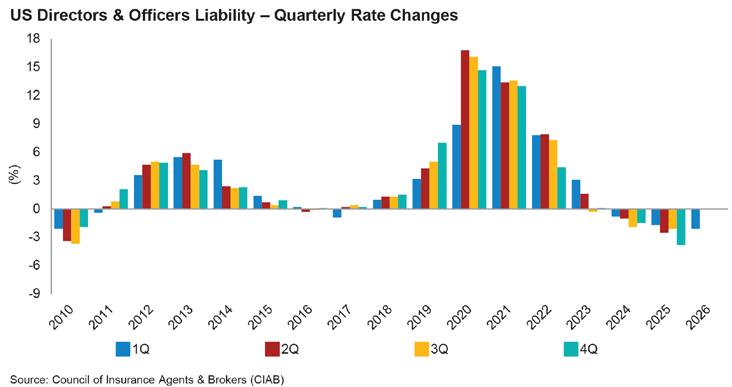
Analysts at insurance rating firm AM Best said there are “warning signs” for the directors & officers liability market, leading to shrinking underwriting margins and a tighter environment for buyers in 2026.
In a new report, AM Best said 2025 marked the fourth straight year of premium decline in the D&O liability line. Nevertheless, insurers have generated favorable direct underwriting results the last few years while insureds have enjoyed competitive renewal terms and new offerings in a market that has maintained abundant capacity.
However, in 2025 premium decreases were lower on average at renewal, with some seeing flat or slightly upward adjustments.
The recent trend of premium decline could be explained by a decrease in demand, especially for transactional risk coverage as initial public offerings fell. The IPO market rebounded in 2025 and has since leveled off somewhat due to economic uncertainty related to the Iran conflict, AM Best said.
AM Best noted a direct loss ratio of 54.5 in 2025—five percentage points higher compared with 2024. In addition, reserve levels for accident years 2023 and 2024 were inadequate in 2025. In fact, claims-closure rates for years 2023 and 2024 were slower than accident years 2018 and 2019, which caused adverse development last decade and price increases.
“This might indicate an underlying deficiency that could lead to a downturn in D&O liability underwriting
results over the near term,” said David Blades, associate director, AM Best. As claims remain open longer, profitable underwriting margins might start to disappear, AM Best added.
‘This might indicate an underlying deficiency that could lead to a downturn in D&O liability underwriting results over the near term.’
The line of business also faces headwinds related to geopolitical and economic uncertainties, technology, and regulatory scrutiny. AM Best noted discipline among insurers with policy terms and conditions.
“Insurers will need to conduct expert due diligence in
determining which industries and business segments they want to pursue in providing D&O insurance,” AM Best said, as corporate leaders face criticism over how they interpreted and handled fluid risks such as trade policies, supply chains, overseas conflicts, financial reporting changes, cyber, and regulatory shifts such as with environment, social, governance (ESG) and diversity, equity, and inclusion (DEI).
Additionally, enterprises face risks associated with disclosure and oversight of the use of artificial intelligence. AM Best said some companies may struggle to connect investments in AI with returns. The industry could influence the AI-related regulation, but “disclosure management is going to be vital to successful AI use no matter the industry,” AM Best added.
Spotlight: Employee Benefits
Why Building a Benefits Department Is Good Business
By Patrick Wraight
For many property and casualty agents, the realm of employee benefits might seem like a strange and mysterious world outside of their normal business. But what if it could be a way of strategically meeting the clients’ needs and building client relationships in a less traditional way?
Agencies that serve businesses already understand their risks.
Consider all of the businesses you work with; whether you consider yourself a generalist or specialist, by the time you work with a client for a couple of years, you should have a good working knowledge of the risks that the business faces from a P&C standpoint. On top of that, if you’re already writing their workers’ compensation insurance, that gives you more
insights. You know how large their team is and potentially how well they are finding and keeping the high-quality team they need.
‘Building
a benefits segment is a business decision worth considering.’
Understanding a clients’ risks is a basic part of helping them with their insurance. You spend time getting applications completed, reviewing property valuation reports and lists of personal property (and contractors’ equipment). You may be at their locations, taking pictures, or looking at policies and procedures, depending on the coverages that you’re working on.
The question then becomes
why wouldn’t you be able to help them with their employee benefits, as well. Of course, licensing may be a hang up, but that’s a small hurdle to overcome. It’s only a matter of determining who would work through the licensing process. If that’s something an agency hasn’t contemplated doing in the past, consider that broadening the types of licenses the agency holds only broadens the product selections that can be sold.
This is about having a broad risk management skill set.
As an agency builds relationships with their clients and gains an understanding of their risks, we would expect that they could make additional recommendations, or at least make additional offers of insurance that meet different
continued on page 26
Snapshot: Environmental and Construction Professional Liability Insurance Market Spotlight: Construction
Uncertainty in the economy and environmental regulation, the continuing impact of social inflation, and the construction industry’s ongoing business challenges are complicating exposures for project owners, developers, and contractors. Amid these trends, the environmental and construction professional liability insurance market remains dynamic. Navigating that market becomes easier when brokers, underwriters, and insureds have actionable intelligence.
By John Heft
making news—albeit, no exclusions are expected in the near future, unless there is a higher exposure project type such as airports or manufacturers of products containing PFAS.
General Liability/Pollution Legal Liability
(GL/PLL)
This combined form was a preferred solution in 2025 for facility-based risks with environmental exposures from products, sites, and processes.
Certain insurance markets are restricting coverage and raising rates on classes they deem as high-hazard, including recycling and heavy manufacturing. Automobile coverage is limited and expensive in certain jurisdictions for these classes.
contractors with heavy fleets are seeing double-digit rate increases, however.
Excess insurers are expected to continue to pare down their limits in 2026, though overall market capacity remains abundant to build towers of $100 million or more by involving more insurers. As PFAS remediation becomes a focus, environmental casualty insurers will likely offer coverage, with increased underwriting scrutiny.
Pollution
Legal Liability (PLL)
This article reflects a summary of RT ECP’s Market Update, an analysis of environmental and construction-related professional liability trends by specialists, with perspectives from leading insurance companies writing these risks. Following are summary outlooks by line of coverage.
Contractor’s Pollution Liability (CPL)
This form provides coverage for pollution conditions that arise from contracting operations performed by or on behalf of the insured. Standard CPL forms usually include coverage for: jobsite contracting operations; transportation; non-owned disposal sites (NODS); pollution legal liability for owned, leased, or rented locations; and emergency response to minimize sudden and accidental pollution.
CPL rates continue to be soft to stable, due to low loss frequency and new market entrants. Strong growth in new construction starts in 2026 is forecast for the infrastructure, energy, artificial intelligence, institutional, and healthcare sectors, though starts are expected to be flat in residential and commercial construction when compared with 2025.
Claims drivers for CPL are expected to include indoor air quality issues with the potential for per- and polyfluoroalkyl substances (PFAS), or “forever chemicals,”
Excess capacity for GL/PLL risks has diminished, while upward rate pressure of 10% to 20% is likely in 2026 for automobile and excess lines. Nevertheless, the addition of several new entrants in this space may offset some rate and capacity challenges.
‘Claims drivers for CPL are expected to include indoor air quality issues with the potential for per- and polyfluoroalkyl substances (PFAS), or “forever chemicals” …’
General Liability,
Contractor’s Pollution Liability, and Professional Liability (GL/ CPL/PL)
This combined environmental casualty program has remained a preferred insurance approach for specific segments, including asbestos and lead abatement, crime scene cleanup, environmental consultants, mold remediation, oil and gas, and renewable energy contractors.
Placing the GL/CPL/PL program with a single insurer can be a creative way for insureds to gain flexibility on more difficult lines, such as auto liability. Environmental
This environmental coverage has become the preferred insurance for a multitude of risk classes, including contaminated property transactions, lender requirements, site redevelopment, and state and federal financial responsibility requirements for hazardous materials.
Market conditions for PLL softened in 2025 due to capacity from new entrants, leading to aggressive competition among insurers. Limits for PLL are stable, with a few insurers continuing to offer up to $50 million. Excess capacity has shrunk somewhat but remains available.
PFAS exposure remains the largest concern of PLL underwriters, though some markets offer sublimited affirmative coverage for bodily injury and property damage. Other exposures receiving underwriting scrutiny include emerging contaminants, such as ethylene oxide, microplastics, and formaldehyde.
Architects & Engineers Professional Liability (AEPL)
This stand-alone product serves professional firms in design and construction, including architects, engineers, surveyors, agency construction managers, design professionals, and consultants.
AEPL claims frequency, severity, and complexity increased in 2025, stemming from factors such as social inflation, construction costs, supply chain constraints, and general economic inflation. Capacity has remained consistent, but insurers are applying more scrutiny on limits exceeding $5 million per claim/aggregate.
Design professionals can expect relatively stable rates in 2026, with some modest challenges in classes including structural engineering, civil engineering, geotechnical engineering, and architecture.
Contractor’s Professional Liability (CPrL)
This coverage responds to damages or loss arising from acts, errors, or omissions in professional services performed by or on behalf of a construction firm. CPrL typically includes two first-party insuring agreements: protective indemnity and rectification/mitigation.
Rates and the number of markets writing CPrL remain stable. Growth in projects involving new technologies and intricate design is leading to higher deductibles, retentions, and premiums for those types of projects. Demand for artificial intelligence is creating a boom in data center construction, which is leading to anticipated related growth in energy infrastructure.
2026 should continue to see insurance markets exercising creativity in insuring new and high-value project types. Similarly, the construction industry’s pursuit of project efficiency may lead to exploration of alternative project delivery methods. Progressive design build, in
which owners split projects into two distinct phases to bring certainty on timing and cost, may become more prominent.
Owner’s Protective Professional Indemnity (OPPI)
This specialized product acts as excess insurance for project owners, supplementing the primary professional liability policies of design professionals and contractors. OPPI is a cost-effective means of protection from initial design through a project’s applicable statute of repose.
Advantages of OPPI include dedicated financial protection where underlying professional liability policy limits are exhausted or inadequate, a buffer when fast-tracked designs lead to coordination gaps, and third-party defense coverage for vicarious liability litigation.
Expected growth in project values will challenge architects and engineers to find higher professional liability limits. We anticipate OPPI to be the preferred mechanism to supplement existing insurance.
Real Estate Developers (RED) Professional Liability
RED is a specialized solution for the self-performed or delegated professional
liability exposures of any organization involved in acquiring and improving real property.
The market for this coverage remains stable, with downward pressure on rates. Capacity from individual markets is limited to $5 million, but larger limits exist through layered programs. Among the most attractive project types for RED underwriters are commercial projects, apartments, retail and office space, hospitality, and manufacturing. Condominium and single-family residential developments are seeing more underwriting scrutiny, higher rates, and elevated retentions.
This year, real estate developers are likely to explore cost-efficient RED policies as a means to supplement existing professional liability programs.
To obtain appropriate financial protection for environmental and construction-related risks, businesses should discuss their exposures with qualified risk, insurance, and legal advisors.
Heft is executive vice president with RT Specialty’s Environmental and Construction Professional Practice. He holds the Construction Risk and Insurance Specialist designation. Email: john.heft@rtspecialty. com. Phone: 610-639-7279.
Spotlight: Transportation
Montgomery v. Caribe Increases Litigation Activity, Not Shipper Exposure
By Theodore M. Schaer
Arecent Supreme Court decision that is widely viewed as a significant development in transportation litigation is particularly worth examining in the context of negligent hiring claims against freight brokers.
The court’s decision in Montgomery v. Caribe Transport II, LLC holds that such claims fall within the Federal Aviation Administration Authorization Act’s (FAAAA) safety exception and therefore are not preempted, resolving a longstanding circuit split and removing a powerful threshold defense that brokers had increasingly relied upon.
For insurance carriers, however, especially those insuring shippers, the more important question to be considered is not what Montgomery says about broker liability but what it does to upstream exposure.
Although plaintiffs
have already begun citing Montgomery in an effort to expand liability across the transportation chain, the decision itself is narrow, broker-specific, and notably silent on shippers. As a result, it does not materially alter the legal framework governing shipper liability. What it does change is the litigation dynamic, particularly at the pleading and discovery stages.
The background of the case shows that petitioner Shawn Montgomery sustained severe injuries after his tractor trailer was struck by a truck driven by respondent Yosniel Varela-Mojena, who was driving a load of plastic pots through Illinois for motor carrier Caribe Transport II LLC. Transportation broker C.H. Robinson Worldwide Inc. had coordinated the shipment. Montgomery sued all respondents in Federal District Court, alleging that C.H. Robinson was
liable for his injuries because it negligently hired VarelaMojena and Caribe Transport.
At its core, Montgomery is a case about statutory interpretation, not about expanding tort duties. Prior to the decision, courts agreed that negligent hiring claims against brokers were “related to” broker services under the FAAAA but were divided on whether those claims were saved by the statute’s safety exception. The Supreme Court adopted the view that such claims fall within a state’s preserved authority “with respect to motor vehicles,” even where asserted against non-carrier entities like brokers.
Crucially, however, that is where the holding ends. The court did not create new duties, endorse negligent hiring theories as a matter of policy, or suggest that liability should flow upstream to other participants in the logistics
and Ross J. DiBono
chain. Most importantly for carriers evaluating exposure, the court did not address shippers at all and did nothing to disturb the longstanding distinction between brokers and shippers embedded in both the statutory text and the broader regulatory framework.
That distinction continues to matter. The FAAAA’s preemption clause expressly lists motor carriers, brokers, and freight forwarders, but omits shippers. Courts have consistently treated that omission as intentional and have declined to extend the statute to parties acting purely as shippers. As a result, preemption has never been the primary defense for shipper liability in transportation accident cases. Instead, exposure has always turned on traditional tort concepts—namely duty, control, agency, and causation, and Montgomery leaves that framework entirely intact.
From a substantive standpoint, the decision does not expand the duties owed by shippers. Nothing in the court’s reasoning suggests that shippers must now supervise brokers, audit carrier selection practices, or assume any new role in ensuring transportation safety. There remains no federal statutory or regulatory framework imposing such obligations, and the court did not attempt to create one. The analytical focus remains on the shipper’s role in selecting a broker, not on downstream operational decisions made by that broker or by the motor carrier it ultimately retains.
The independent contractor relationships that structure the transportation industry likewise remain unchanged.
Courts continue to recognize that brokers and carriers operate independently, absent evidence of control over the manner and means of performance. Montgomery reinforces, rather than undermines, that principle by focusing squarely on the broker’s role in carrier selection. For carriers assessing indemnity risk, this preserves a critical barrier to vicarious liability claims against shippers.
Causation presents an additional, and often dispositive, constraint. The typical chain of events in these cases involves multiple independent actors: a shipper retains a broker, the broker selects a carrier, the carrier employs a driver, and the driver causes an accident. Courts have long been skeptical of attempts to attribute liability across that attenuated chain, and Montgomery does nothing to shorten or simplify it.
Despite these unchanged fundamentals, Montgomery is not without impact from a carrier perspective. The decision is likely to influence how plaintiffs frame their claims and how cases are litigated, even if it does not ultimately increase the likelihood of success on the merits. In particular, carriers should expect to see broader pleadings that more routinely include shippers as defendants, often under theories of negligent selection or “supply chain liability.” These claims may have limited legal viability, but they increase the complexity and cost of litigation at the outset.
The decision will also predictably expand the scope of discovery. Plaintiffs are likely to seek internal policies, communications, and risk management materials in an
effort to argue that the shipper assumed responsibilities beyond its traditional role. Plaintiff lawyers will continue to argue that shippers have a duty to select a broker who employs reasonable vetting procedures when selecting a motor carrier. This focus will result in questions of fact which may erode efforts to seek dismissal on summary judgment.
‘Most importantly for carriers evaluating exposure, the court did not address shippers at all and did nothing to disturb the longstanding distinction between brokers and shippers embedded in both the statutory text and the broader regulatory framework.’
While courts have generally rejected the notion that voluntary safety practices create legal duties, such arguments can complicate discovery and delay early resolution. The result is a form of practical exposure, measured in defense costs and litigation burden, rather than a meaningful shift in liability risk.
These dynamics may influence early case valuation. With more parties in the case and broader allegations in the complaint, claims may appear more significant at the intake stage, leading to upward pressure on initial reserves. Over time, however, the same structural defenses that existed
before Montgomery—lack of control, independent contractor status, and attenuated causation—should continue to reassert themselves.
Ultimately, what Montgomery means for shippers and their insurers is best understood as a distinction between procedural pressure and substantive exposure. The ruling is likely to generate more aggressive pleading strategies and more intensive discovery aimed at upstream parties. But it does not create new duties, alter the governing legal standards, or meaningfully expand the circumstances under which shippers can be held liable.
In that sense, Montgomery is a significant case but a targeted one. It reshapes the litigation landscape for brokers while leaving the core principles governing shipper liability largely untouched. For insurance carriers, the takeaway is straightforward: expect more activity at the front end of cases but recognize that the ultimate exposure analysis remains grounded in the same role-specific, control-driven framework that has long defined this area of law.
Schaer is a director at Zarwin Baum DeVito Kaplan Schaer where he chairs the litigation department and leads the insurance defense group. He is regularly hired by large national insurers, third-party administrators, motor carriers, and businesses. He has tried more than 50 jury trial across the country.
DiBono is a shareholder at Zarwin Baum DeVito Kaplan Schaer. A member of the insurance defense group, he concentrates his practice on complex civil litigation, primarily defending clients in catastrophic injury cases involving commercial transportation, construction, products liability, and premises liability matters.
Spotlight: Employee Benefits
continued from page 21
insurable exposures. While the arena of employee benefits doesn’t fit neatly into the realm of the P&C agent, that doesn’t mean that it can’t fit.
Hiring trends and markets fluctuate just like any other part of the business market. With that, the expectations people bring
to jobs change, too. Paid time off, 401(k), medical, dental, vision, and other benefits are the baseline expectations of new employees. While the P&C agent probably shouldn’t be making detailed recommendations related to all of these, helping clients build their benefits packages can help mitigate some of their employee
turnover and onboarding risks.
Clients (and their employees) need someone who understands benefits.
The P&C agent is already the insurance professional in the room, so it only makes sense that you could also be there to help clients choose their benefits packages, how they work, and who should participate in them.
Medical coverage from company to company is similar. The primary difference between carriers is the network of providers that accepts each company’s offerings. From a coverage perspective, that means that we aren’t necessarily looking at which company will provide the best coverage, but likely more importantly, which one is providing the best network for the best price range in the area.
Additionally, understanding how monthly premiums, deductibles, co-pay structures, and out-of-pocket maximums work will help clients to determine what plans make the most sense for the group to offer and whether to offer multiple plans to the team.
This is also another way of helping clients to understand the value of how offering additional insurance benefits can help them to mitigate their employee turnover risks. This is where you can help clients understand why they might consider additional benefits, such as group life, long-term disability, dental, and vision. These additional benefits can help your client stand out in the employment space as they are trying to hire and keep the high-quality team their business needs.
Building a benefits segment is a business decision worth considering. Take a hard look at the cost in licensing, marketing, staffing, training, and servicing the segment. The potential upside is significant. Your clients already trust your team to protect other parts of their business. Adding benefits gives you another way to secure your clients, solve a real problem, and create more reasons for them to stay connected to your agency over time.
Wraight, CIC, CRM, AU, is director of Insurance Journal’s Academy of Insurance. He can be reached at pwraight@ijacademy.com.
49 results for ‘golf & country clubs’
News & Markets
California Homeowners Insurance Costs Still 41% Below National Average, Report Shows
California homeowners pay 41% below the national average for homeowners insurance, a study from LendingTree shows.
LendingTree’s State of Home Insurance: 2026 report, which is based on rates publicly sourced from insurer filings, shows California homeowners paid an average of $1,413 annually for home insurance compared with the national average of $2,395.
However, homeowners insurance rates in California have risen 53.7% since 2020, the report shows.
Colorado had the largest cumulative increase in home insurance rates, with costs rising 100.8% from 2020 to 2025. That’s more than double the rise in U.S. homeowners insurance rates, which rose a cumulative 46.8% from 2020 to 2025. Annual increases began accelerating more sharply in 2022, peaking at 12.7% in 2024 before easing slightly n 2025, the report shows.
The average annual cost of homeowners insurance across the U.S. was $2,395. Oklahoma had the highest average rate ($5,298), followed by Nebraska ($4,956) and Colorado ($4,310). Hawaii had the lowest average rate at ($801). followed by Vermont ($924) and New Hampshire ($1,028).
The report blames the climb in rates since 2020 is on a rise in severe weather losses and an increase in the price of labor,
materials and repairs.
LendingTree analyzed home insurance data pulled in February 2026 from Quadrant Information Services. The following coverages and deductibles were used: Dwelling coverage ($350,000); [personal liability ($100,000); medical payments ($1,000); deductible ($1,000).
The state’s homeowners insurance crisis took on a bigger focus for regulators and Legislators following the January 2025 Los Angeles wildfires. Insurers have paid out more than $23.7 billion to residential, commercial, and auto policyholders impacted by the L.A. wildfires, according to the California Department of Insurance.
The fires were seen as a low in an ongoing homeowners insurance crisis in California. Several carriers pulled back or halted writing new policies in the state,
and regulators responded with measures including enabling quicker rate request reviews, allowing forward-looking catastrophe modeling and other steps. As a result, some carriers have returned to writing new homeowners policies.
The Travelers Companies said it intends to expand its homeowners insurance offerings across California. In January, two carriers announced they were working to expand coverage in wildfire-prone regions of the state in exchange for rate hikes.
CSAA Mercury Insurance raised rates 6.9%, a move that was approved under the Sustainable Insurance Strategy. Farmers Insurance in late November announced it would eliminate a cap on the number of homeowners insurance policies it offers in California.
California AG Announces $7M Settlement in ‘Algorithmic Rent Scheme’
Aproperty management company is paying $7 million for what the California Attorney General calls an “algorithmic rent alignment scheme.”
California Attorney General Rob Bonta worked on the settlement as part of a coalition of nine attorneys general with LivCor LLC, one of the property management companies named as a defendant in Bonta’s ongoing antitrust lawsuit against software company RealPage.
The settlement resolves allegations
that LivCor used RealPage’s revenue management system to align rental prices with competing landlords by illegally sharing and gathering confidential pricing information. According to the lawsuit, this conduct interfered with the competitive process and enabled landlords to keep prices higher.
LivCor managed 57 multifamily rental properties that used RealPage’s pricing software in California.
The settlement, which requires LivCor
to pay $7 million in penalties and fees to the states, is subject to court approval. LivCor agreed to not use software offered by any company that uses competitively sensitive information to align rent prices and agrees to cooperate in the ongoing prosecution of RealPage and other defendant landlords.
This is the second settlement reached in this litigation. In November 2025, Bonta and other state attorneys general announced a settlement with Greystar.
My New Markets
Environmental Liability
Market Details: Established as a specialist in environmental insurance strategies, risk mitigation, and products, Synapse offers its retail brokers understanding, experience, and familiarity with the risks, challenges, trends, compliance issues, and opportunities in this increasingly important field. Coverages include: closure and post closure, combined casualty, contractors pollution liability, contractors pollution professional, environmental impairment liability, environmental lenders policy, general liability, packaged CGL & pollution liability for contractors, performance bond and payment, site cost overrun liability – cleanup cost CAP, storage tank liability, and workers’ compensation.
Market Details: Kinetic is a tech-first managing general agent (MGA) focused on leveraging AI-driven technology and expert human support to transform workers’ compensation claims management. By utilizing data to create actionable steps from the moment of injury through closure, Kinetic works to reduce workplace injuries, streamline the claims process, and lower premiums for businesses.
Offering differentiated workers’ comp coverage, backed by advanced technology, that prevents and manages workplace injuries for your accounts. Kinetic is backed by A-rated carriers like Nationwide. Featuring limited distribution, a unique appetite, and specialized services. Kinetic rewards clients for controlling losses and has broker support with expert underwriting, data-driven insights, and AI-enabled loss management.
Market Details: Cennairus provides tailored coverage for both personal and commercial insurance, including auto, homeowners, recreational vehicle, business auto, yacht, and fleet insurance, among others.
Customized Commercial Insurance Solutions: Safeguard businesses with tailored insurance coverage. Cennairus offers comprehensive solutions for businesses of all sizes, including general liability, professional liability, business owners (BOP), commercial property, workers compensation, comprehensive personal insurance coverage, watercraft insurance, homeowners and flood insurance.
Available Limits: Not disclosed. Carrier: Not disclosed. States: All states and the District of Columbia.
Market Details: ChemPlan has been a provider of specialized insurance programs for chemical distributors and manufacturers since 1984. The ChemPlan program offers general liability including: products/ pollution; automobile including pollution liability; chemical umbrella liability; property including pollutant clean-up; and chemical facility pollution legal liability.
Available Limits: Not disclosed. Carrier: Admitted States: All states and the District of Columbia.
Contact: Dan Hagan, dhagan@chemplan. net, 800-410-1511
For-Hire & Exempt Transportation
Market Details: Polaris Insurance Company offers a comprehensive commercial auto liability program tailored for for-hire and exempt transportation companies aiming to enhance compliance, safety, and claims management through advanced telematics and safety platforms. The program accommodates local, intermediate, and long-haul routes. Coverage is available for drivers operating in the
United States and Mexico.
Coverages & Limits: Automobile Liability: $1,000,000 CSL, physical damage, cargo, hired and non-owned. United States coverage only; Mexico drivers covered upon consideration.
Requirements: Completed application including a vehicle list and driver MVRs; current plus two prior years of loss information (valued within 90 days); state and federal filings available. Distressed, challenging, and hard-to-place risks considered. Risks with one or multiple USDOT alerts considered. UIAA endorsement available.
Available Limits: See above.
Carrier: Not disclosed.
States: All states and the District of Columbia.
Contact: Joel Black, submission@polarisrrg.com, 520-201-3747
Cyber Security
Market Details: Hiscox offers fast and simple quotes online or by phone. Sameday coverage for 180+ professions. Direct billing - Hiscox handles all servicing and billing. Automatic renewal: Earn commission for the lifetime of the policy as long as you are the producer of record. Hiscox cyber security insurance is admitted with a $5 million revenue limit. Start-up friendly with a $270 minimum annual premium. Automatic renewals after 12 months. Has pen.
Available Limits: See above.
Carrier: Hiscox USA. Admitted. Rated A by A.M. Best
From Verizon CEO Dan Schulman predicting that AI will cause unemployment to rise by up to 30% in the next two to five years to the Boston Consulting Group suggesting that 10-15% of existing jobs may be cut by 2031, there’s fear and concern in almost every sector.
But what does this mean for front-line insurance employees in an independent agency? How is AI changing the roles of account managers, account executives, and other support staff, and how might emerging AI technology change these roles in the future?
That’s a question that cannot be answered with total confidence, but
there’s plenty of expert speculation to consider.
“I think we’re going to see a lot more layoffs because of AI,” Ryan Hanley, president of Linqura AI, who is a frequent speaker and podcaster on all things insurtech related, told Insurance Journal late last year. Any person doing “repeatable tasks” is at risk.
However, the best agency account managers are likely not in that category, others say.
“Many traditional things that an account manager type role would do—whether that’s certificates or endorsements or coverage changes, renewal follow-ups, policy
reconciliation—those are things that could potentially be automated,” said Kasey Conners, the Big “I’s” executive director of the Agents Council for Technology. There’s definitely concern about job elimination in these areas, but right now, nobody has really figured out the exact areas to be concerned about, she added.
“From a Big I perspective, there’s the account services coordinator and then there’s a piece of it that really is a client advisor,” she said. “That’s not going to go away.”
Many agency owners are taking a cautionary approach to the real benefits that AI will bring to their agencies, said
Mary Newgard, partner at Capstone Search Group. They are mostly optimistic that AI capabilities in their agency management systems will reduce backroom servicing.
“It’s costly for agencies to manage behind-the-scenes processing, whether they choose to do so in-house or outsource,” she said. “If AI can assume those service functions, then agencies stand to save a lot of time and money paying people to do those tasks.”
‘Someone who can build relationships and strategize with clients, consult on coverage and give options, help with complex issues, recommend policy enhancements, and so forth, doesn’t seem to be as easily replaced with technology.’
That doesn’t mean the human touch will not be necessary in agency service roles, she added. The independent agencies that Newgard advises do not foresee AI replacing any service positions that “heavily interact with clients.”
Those positions that are “client engaging” or “client facing” are valued and are not likely to be impacted much by the AI revolution, she said.
“Someone who can build relationships and strategize with clients, consult on coverage and give options, help with complex issues, recommend policy enhancements, and so forth, doesn’t seem to be as easily replaced with technology,” Newgard said. However, she does think that service positions that are only administrative with little to no client interaction could be cut.
“I would recommend to anyone who’s a CSR or account manager to do everything possible to ensure what they bring to their role includes a lot of client interaction and engagement in diverse and impactful ways that can’t be easily replaced by technology,” she advised.
In this magazine issue, Insurance Journal recognizes 18 account managers and CSRs who have become “MVPs” in the area of agency service and support.
Insurance Journal spoke with three of those MVPs about how technology is changing what they do and what they recommend to others. Here’s what they had to say.
Michelle Salow
When Michelle Salow began as an assistant account manager at Heffernan in 2003, she was doing things a lot differently than she does today.
“At that time, I physically had a stack of endorsements printed—like additional insured and lost pay endorsements that we would manually type out, print, attach these endorsements, and mail them,” she said. Years later the agency moved to an online platform that allowed certificates for endorsements to be processed via PDFs and email.
Today, almost everything is accessible via an online platform that allows clients to input their information directly, eliminating the steps needed to print, scan, sign, and return via email. The past two years have been another “game changer” as AI capabilities in the agency’s tech stack brought more efficiencies, Salow said.
“Now, we can use AI to do at least the initial phases of a lot of the tasks that take up a lot of our time,” she explained. This ranges from initial proposals for the clients to policy checks. AI can check policies against the proposal and quote. “Then
account managers are just having to verify the information that doesn’t match or that’s questionable,” she said. That saves considerable time.
“Oftentimes we’re having to do premium comparisons, coverage comparisons, and loss summaries for clients. But now there’s AI tools that you can drop information into,” she said. “It’ll spit out those comparisons or some loss tables, find loss trends, and then we’re just taking that information and reviewing it for accuracy. It’s a much quicker way to get all the tedious work done.”
Salow, now an executive account manager, isn’t worried about AI replacing her expertise.
“I think there is still enough of a need for client touch that AI isn’t eliminating many positions,” she said. “Our clients still very much engage on a very regular basis with us, and so AI can’t do that personal touch.”
Kimberly Garza
For Higginbotham’s Kimberly Garza, a senior commercial lines CSR, technology and AI bring both pros and cons. But for Garza, a 38-year industry veteran, AI has mostly been a “pro” to the way she and others work.
“To be completely honest, when they first introduced AI, I thought, ‘I’m too continued on page 44
Special Report: Most Valuable Players:
Welcome to Insurance Journal’s fourth annual Most Valuable Players recognition awards report for insurance agency customer service representatives and account managers. This report features 18 MVPs who define what it means to be a successful CSR and/or account manager in today’s independent insurance agencies. These professionals have achieved impressive success throughout their careers and demonstrated key skills of what it takes to be the best service professional. They also have shown they have a passion for what they do and a commitment to professionalism and, in some cases, specialization. For them, being a CSR/account manager is more than a job.
Insurance Journal’s MVPs come from all regions of the country, live and work in cities or towns big and small, and know the importance of serving their customers.
Information included in this report was voluntarily submitted online by individuals and management and was supplemented by other public information sources. There are more agency MVPs who deserve recognition than are profiled in this report and, hopefully, these profiles will inspire others to do what it takes to reach the top of their profession. Insurance Journal hopes to recognize more MVPs in future reports.
For questions or comments on this award program, please contact Andrea Wells at awells@ insurancejournal.com.
Account Managers & CSRs
Michelle Salow Heffernan Insurance Brokers Walnut Creek, California
Michelle Salow gets creative to help her clients serve their communities.
“In the nonprofit realm, I look for insurers who offer on-site loss control, telephonic medical triage, and other safety measures to mitigate claims and lower our clients’ premiums,” said Salow, an executive account manager who focuses on nonprofit and non-emergency medical transportation.
“For our medical transportation clients, who are on the
If you’re looking for the voice of experience, talk to Kimberly Garza at Higginbotham Insurance Agency.
Garza has been in the insurance industry for 38 years, serving the last 14 on the insurance agency side. She holds four designations: Accredited Customer Service Representative, Certified Account Manager, Certified Insurance Service Representative, and Texas Independent Insurance Advisor.
“I am passionate about my work and helping anyone on my team and all of our
Rafael Rivera is a CSR who can do anything and always goes above and beyond.
That’s the word from his nominator at Brightway Insurance, where Rivera has worked since 2020.
road at all hours, safety is the top priority,” she said. “I work with our clients’ captive insurers to offer robust loss control services that take a hands-on approach to safety—including on-site visits, webinars, and online safety resources.”
Salow joined Heffernan Insurance Brokers as an assistant account manager in 2003 and moved to large commercial accounts as an account manager in 2015. In addition to her account management responsibilities, Salow helps
clients,” Garza said. “I strive to provide the best service that I can to my teammates and our clients.”
Garza manages high-volume workloads while still providing responsive, high-quality service to clients of every size. “My service is what transforms new accounts into long-term relationships,” she said.
Garza’s producers see her as a leader and a critical part of the team’s success.
“Kim is about lifting others up, solving problems quietly and effectively, and ensuring that clients and colleagues are fully supported no matter how challenging the situation
in insurance, and when he came on board, he immediately hit the ground running with learning systems, processes, carriers, and customers alike,” said his nominator.
mentor colleagues and handles highly technical specialty projects.
The result of her out-ofthe-box strategies, technical skills, and industry expertise is coverage and limits that “keep rigs on the road,” she said.
Joining the agency in the middle of the COVID-19 pandemic, Rivera, who lives in Puerto Rico, has changed the way the Jacksonville, Florida, office does business.
Vedra Beach Jacksonville, Florida
“He had no prior experience
Rivera is always willing and ready to help the team as well as pick up any heavy-lifting items insureds may call in about, they added. As the business has rapidly evolved over the last five years, Rivera has been ready to adapt to
“If I can find these kinds of creative ways to reduce our clients’ premiums or lower their deductibles, that puts more money into their pockets so they can better serve their clients, their employees, and their communities,” Salow said.
may be,” said one producer. “She frequently steps in before anyone even realizes help is needed, whether it’s assisting with a complex renewal, coaching a new team member, or smoothing out a client situation behind the scenes.”
Another added, “When I’ve earned a client, Kim is the reason they stay. Her year-round dedication builds trust, loyalty, and confidence in our agency. Clients frequently tell me that the service Kim provides is unprecedented and far beyond what they have experienced elsewhere, and that she is a major reason they will always do business with us.”
every challenge in the Florida market.
“The biggest piece that he has brought to our team is his overwhelmingly positive attitude every single day, every single transaction,” the nominator said. “A huge functional asset is that he is very bilingual and has been able to help interpret for our Spanishspeaking clients, realtors, and loan officers to help bridge the communication gap.”
Rafael Rivera
Brightway Insurance
Ponte
Kimberly Garza
Higginbotham Insurance Agency
Fort Worth, Texas
Special Report: Most Valuable Players:
continued from page 31
Lauren Gundersdorf
The Mahoney Group Chandler, Arizona
Lauren Gundersdorf’s career advice? Stay curious.
“I constantly ask the questions. I am always working toward the best outcome for our clients, even if that means thinking outside the box,” she said. “I do not want to be stagnant. There is always something to learn, and embracing that has made me a better client manager and colleague.”
Gundersdorf has been in the insurance industry for almost 12 years and specializes in
Ashley Zumbado balances high-tech account management with high-touch client service.
Zumbado is an Acrisure senior account manager in private client services with over 16 years of experience across personal lines insurance, information systems, process improvement, and data/financial analytics. Her background is centered on managing high-net-worth and ultra-high-net-worth client portfolios, with a focus on complex risk placements, including homeowners, excess liability, flood, and specialty coverages.
“Throughout my career, I have developed expertise in
large real estate (multifamily habitational) and construction accounts at The Mahoney Group.
Part of staying curious is pursuing professional development opportunities. Gundersdorf is getting her CISR designation and is in the process of completing her CIC designation.
“I started under an amazing mentor that pushed me to learn, take on more accounts, and grow my insurance knowledge with a book of
coordinating multi-layered accounts, working closely with carriers, family offices, and internal teams to deliver tailored insurance solutions,” Zumbado said.
“I am experienced in renewal strategy, remarketing, and navigating challenging market conditions while maintaining a high standard of client service and communication.”
Zumbado also works in creating a successful agency environment, improving workflows, ensuring compliance, and maintaining thorough documentation aligned with E&O best practices. She is researching the application of artificial intelligence within the high-net-worth personal
business that included many types of risks,” she said. Today, she loves mentoring others and serves on committees for developing agency standards and service team training standards.
Adriana Londono stays ahead of her clients’ needs. Whether it’s endorsements, policy changes, renewal details, or emerging risks, she is in constant, proactive communication about upcoming changes and challenges, taking each client’s individual situation into account.
Londono has served as a customer service representative for eight years. Her bilingual abilities allow her to
serve a diverse customer base, ensuring effective communication throughout every stage of the insurance process. Her willingness to educate and thorough explanations instill confidence in her clients, which contributes directly to high levels of satisfaction and retention.
Londono is also known for staying calm and composed under pressure, whether managing complex trucking
“It is so rewarding to work with others, share my knowledge, and pay forward what my mentor did for me,” she said. “I have always felt we are only as good as the people around us.”
“Working toward common goals and helping lift others up is the greatest part of my job.”
lines space, focusing on leveraging AI to improve client experience, data analysis, and operational efficiency.
Staying up to date with technology and having a meticulous attention to detail are part of her proactive approach to account management—anticipating client needs, staying ahead of renewal timelines, and clearly communicating market conditions and coverage strategies, she said.
“In a challenging and evolving insurance landscape, I prioritize transparency and education so clients can make informed decisions, particularly when options are limited or require strategic compromise,” Zumbado said.
accounts or assisting coworkers. Her ability to consistently go above and beyond sets her apart, said her nominator.
“Her dedication, professionalism, and willingness to help make a significant impact on the team and the level of service we provide every day,” they said. “She not only meets expectations but exceeds them by ensuring both clients and teammates feel supported and valued.”
Ashley Zumbado
Acrisure Miami, Florida
Adriana Londono Prestige International Insurance Group Inc. Tamarac, Florida
Account Managers & CSRs
Sara Penn Fleming
Sterling Seacrest Pritchard Atlanta, Georgia
Starting as an intern at Sterling Seacrest Pritchard (SSP) in 2019, Sara Penn Fleming joined the agency full-time as an account analyst after graduating from the University of Georgia.
Today, Fleming is a senior client service executive with a diverse generalist book of business and a growing concentration in poultry, hospitality, and technology accounts.
Fleming relishes really getting to know clients and dig-
When it comes to serving Montana contractors, farmers, and ranchers, Bobbie Patterson said that strong relationships are the foundation of success.
“Throughout my 16 years in the insurance industry, my greatest resource has always been the relationships I have built with colleagues, clients, and carrier partners,” said Patterson, who specializes in serving contractors and farm and ranch operations.
Patterson is an account executive and team lead for assistant account managers
Carlene Fauver’s career fast track has inspired her to lead and support others in their professional development at Higginbotham Insurance Agency.
ging into their potential risks and coverage opportunities.
“I genuinely enjoy developing long-term partnerships and taking the time to understand each client’s business so we can continuously enhance and strengthen their insurance program,” she said.
“I also take pride in being someone my clients and teammates can rely on, whether that means helping navigate challenges, identifying opportunities for improvement, or simply being a trusted resource
with Leavitt Great West in Billings. She holds both the CISR and CIC designations along with a bachelor’s degree in accounting, which she said provides a solid foundation for her analytical approach to risk management, financial analysis, and audit dissection.
“This expertise enables me to assist clients in understanding and managing the financial and operational aspects of their insurance programs,” Patterson said.
When she combines her education with the practical and technical knowledge she
and advocate,” she said.
Supportive leadership at SSP has been key to Fleming’s professional development.
“Finding leaders within SSP whom I admire and learning from their experience has helped me grow both professionally and personally,”
“The most impactful influence in my career has been the support and encouragement of my coworkers,” she said. Now she is happy to pass it on. “Whether it’s helping troubleshoot a coverage question, assisting with a servicing issue, or simply being available when someone needs guidance, I am committed to helping others succeed.”
Fauver launched her insurance career just six years ago, with no previous experience in the industry. After just two years on the job, she was promoted to the small business unit (SBU) as an account manager and quickly advanced to managing the SBU department. After several successful years in that role, she transitioned into large commercial lines, where she currently serves as a team lead for commercial lines in her office.
Fauver was honored to receive the 2023 Outstanding CSR of the Year award for the
Fleming said. “Over the last several years, I have also had the opportunity to do the same for newer colleagues within SSP, which has been especially rewarding and something I truly enjoy.”
has gained from experienced mentors, Patterson becomes a reliable resource for her clients. Being a part of their success, and the success of their communities, is its own reward.
“Whether I’m helping a client navigate a complex issue, mentoring a teammate, or volunteering in my community, I strive to do it all with a smile,” Patterson said. “It’s a simple philosophy, but one that has helped me build strong relationships and make the work enjoyable for everyone involved.”
state of Mississippi and is now pursuing her CISR designation.
More than just encouragement, she takes concrete steps to push her team forward, such as establishing a dedicated webinar training room and providing her team with a quiet, uninterrupted space for online classes and webinars.
“Creating opportunities for others to learn and grow is something I am deeply passionate about,” she said. “I believe investing in knowledge not only strengthens the individual but the entire team.”
Childress Insurance Partners Albemarle, North Carolina
Maria Barnowski Starkweather & Shepley Insurance Brokerage East Providence, Rhode Island
Brianna Lisk found her insurance calling early by making a collegiate pivot to finance with risk management and insurance as a “Hail Mary.” She learned that she loved the industry.
After interning for Marsh McLennan Agency at their Charlotte, North Carolina, office, she was offered a role with MMA in San Diego, California, after graduation.
“I worked there for three and a half years in their executive lines division as a marketing associate, gaining
Vice President Maria Barnowski’s nearly 30-year career at Starkweather & Shepley Insurance Brokerage is a powerful example of proactive thinking and determination.
Barnowski joined the firm as a temporary employee in the Word Processing Department in 1997.
While she had some personal lines experience, commercial insurance was a new field. Her proactive approach led her to assist the new business/ construction team with critical service tasks, which garnered
Fusco Orsini & Associates
Insurance Services CEO
more knowledge in management lines such as D&O/EPLI/ FID/CRM and K&R,” said Lisk. “I met some really successful people in the industry who I still look up to.”
Eventually, she wanted to move back to North Carolina and joined Childress Insurance Partners in Albemarle, where she now serves as an account manager handling a diverse range of accounts.
“In insurance, you don’t know what you don’t know, but I learned a lot really quickly when I started this job
a full-time position. “My initiative resulted in the creation of a brand-new role—assistant account manager—to which I was promoted in early 1998.”
From there, Barnowski took advantage of every opportunity for education and advancement, and now mentors others to do the same.
“Having risen through the ranks from a temporary position, I now find the greatest fulfillment in mentoring the next generation of insurance professionals,” Barnowski said. “I draw on my own journey to teach them not
here in Albemarle,” Lisk said.
“There is no niche market here at the agency; we are more of a generalist handling construction, restaurants, retail stores, manufacturing, trucking, colleges, dealers, etc. And when you work on this many different accounts, you learn markets, coverages, and what is needed to help your client really quickly.”
“I have gotten to work with some wonderful people and clients through my six years, and I am excited for what’s to come,” Lisk said.
only the technical intricacies of the industry but also the foundational importance of relationship-building and unwavering dedication to our clients.”
Successful leadership means taking ownership, she said.
“I step into the ‘messy’ situations, following every issue through to total resolution. If a challenge arises, I don’t deflect; I acknowledge it and lead the fix,” Barnowski said. “To me, ownership means ensuring the client never has to wonder if their problem is being handled.”
Amanda Orsini
Fusco Orsini & Associates Insurance Services
San Diego, California
Michael “Mike” Fusco says the agency is built on the excellence of people like Amanda Orsini, a senior CSR with Fusco Orsini & Associates for over 11 years and a lead within the servicing team.
“Other staff members rely on Amanda for support, information, technical updates, and even difficult client situations,” said Fusco, who nominated Orsini for the MVP recognition.
“Amanda is also a favorite
with our clientele. As the CEO of the agency, I cannot think of a time when a client has complained,” Fusco added. “In fact, her excellence in customer satisfaction and relations with our insurance partners has helped our agency grow year-over-year.”
Orsini specializes in blue-collar commercial lines, such as construction, hospitality, and manufacturing. Her clients value her responsiveness and professionalism, reflected in her strong retention and
long-term relationships.
Orsini’s career reflects a commitment to continuous growth, learning, and excellence, Fusco said.
“She joined the agency in 2014 without prior insurance experience but now knows the industry and her role specifically better than any CSR I have ever worked with,” he said. “She has taken the initiative to build her skills and deepen her industry knowledge, becoming a trusted expert within her agency.”
Account Managers & CSRs
Stephanie LombardVilla
Robertson Ryan Insurance Milwaukee, Wisconsin
Candace Ward
Robertson Ryan Insurance Milwaukee, Wisconsin
Sherri Hanish
Ethos Risk Management / Superior Insurance Partners Griffith, Indiana
Stephanie Lombard-Villa’s management team calls her “an absolute rock star.”
Her producer says LombardVilla is vital to the team’s success and “an absolute joy to work with.”
With almost three decades in the industry, Lombard-Villa began as a receptionist but quickly grew into a customer service and account management role. She joined Robertson Ryan Insurance in 2017 with a strong CSR
Candace Ward has over 20 years of experience in the insurance industry and is recognized for her expertise in managing complex commercial accounts at Robertson Ryan Insurance.
The RRI management team said, “Not only is Candace Ward one of our agency’s top-performing account managers, but she always brings a smile and positive attitude, no matter the situation. She consistently goes above and beyond in her duties and goes
Sherri Hanish isn’t afraid to get her boots dirty.
background.
Since then, she has developed deep expertise across multiple lines of coverage—particularly in complex professional liability areas—and is known for her hands-on, responsive approach to client service. Her specialties include professional liability, such as medical malpractice, cyber liability, and management liability.
Lombard-Villa is recognized for her responsiveness and
the extra mile to take care of her clients as well as her colleagues.”
Ward has built a strong foundation in commercial insurance, holding both CIC and CPSR designations. She has served in account management roles, including account executive and commercial account manager, with a particular focus on hospitality and educational institutions, including colleges and large hotel risks.
Ward also consistently goes beyond her core responsibil-
ability to provide clear, timely solutions. Clients and colleagues rely on her to navigate challenging situations with confidence and accuracy.
While mentorship has played a key role in LombardVilla’s professional growth, and she continues pursuing professional development, she is now a recognized team leader and an invaluable resource for her team.
Hanish, a senior commercial lines account manager at Ethos Risk Management, has developed her expertise in farm and construction accounts through professional development opportunities and meeting clients where they live, literally. She said the most valuable part of developing her expertise was gaining firsthand, “boots on the ground” experience.
“A producer took me directly to farms so I could truly learn and understand the business from the client’s perspective,” Hanish said. “That hands-on exposure allowed me to see
daily operations up close, understand the equipment and processes involved, and recognize the challenges farmers face in protecting their livelihoods.”
Agribusiness clients value working with someone who understands the realities of their business, and Hanish takes pride in being a trusted resource and advocate for them.
Hanish graduated in 1996 with a degree in communications and planned to pursue a career in broadcasting. However, after being hired at an insurance agency, she quickly discovered how much
ities, contributing to collaboration across departments and helping improve agency processes. She recently took on the role of agency bill specialist in addition to her account manager duties, helping to bridge the interdepartmental gap and increase agency-wide collaboration.
Ward’s ability to anticipate challenges and provide thoughtful, flexible recommendations has earned her the trust of both clients and colleagues.
she enjoyed the opportunity to help clients protect what matters most to them.
Starting in the insurance industry from the ground up taught her the value of adaptability and teamwork.
“I have never been afraid to do whatever the job requires, and I believe being willing to step in and help wherever needed is an important part of being a dependable team member,” said Hanish. “Those experiences gave me a strong appreciation for every role within an agency and helped build the work ethic I carry today.”
Special Report: Most Valuable Players
continued from page 35
Lisa Vu InsureCAL Insurance Agency Modesto, California
Lisa Vu was the first employee hired by InsureCal Insurance Agency and has played a foundational role in its growth and success for over 11 years.
“Lisa is truly the backbone of InsureCAL,” said her nominating coworker. “She has the rare ability to balance a heavy workload without ever sacrificing accuracy or customer service. Commercial and farm insurance accounts often involve complicated coverages, strict timelines, and constant communication, and Lisa handles it all with consistency
and professionalism.
“She keeps the agency running smoothly by making sure every detail receives the attention it deserves.”
Specializing in commercial and farm accounts, her years have earned the expertise that allows her to anticipate complex issues before they arise and provide proactive support to clients.
Vu is also known for patience and positivity, making her a go-to resource for those in the office who are learning the ropes or navigating challenging
issues. She is known for building strong relationships with clients, carriers, and colleagues, fostering trust and collaboration.
“From the beginning, she has played a vital role in helping build the agency into what it is today through her dedication, professionalism, and unmatched work ethic,” her nominator said. “Lisa represents everything that an outstanding CSR should be: knowledgeable, dependable, hardworking, compassionate, and committed to excellence.”
Kathleen Fuoss-Laurent is a self-proclaimed “insurance nerd.”
The IPG account executive specializes in habitational and large property accounts and has earned several designations, including CPCU, CISR, AU, API, and AINS.
But there is another side to her success.
ence in this profession.”
“To be successful in this role, you have to care when a client’s email or phone call goes unanswered, and you have to care when negotiating the best possible coverage and premiums on their behalf.”
Kathleen Fuoss-Laurent IPG / Superior Insurance Partners
Champaign, Illinois
Susan Cummins Plastridge Insurance Delray Beach, Florida
“When training new hires, I often tell them, ‘I can teach you insurance, but I cannot teach you to care,’” Fuoss-Laurent said. “Technical knowledge can be learned, but compassion, responsiveness, and dedication are what truly make a differ-
Susan Cummins began her insurance career at The Plastridge Insurance Agency in December 1982, starting as a file clerk and eventually advancing to personal lines account manager. With over four decades in the insurance industry, she works every day to make a meaningful impact on the lives of both her clients and her peers.
Cummins was promoted through the ranks and even-
Fuoss-Laurent started her insurance career after graduating from the University of Illinois Urbana-Champaign in 2005 with a double major in accountancy and finance. After an initial stint with a national carrier as a commercial lines underwriter, she transitioned to the agency side and joined a national insurance brokerage.
tually became team leader for the personal lines department, overseeing account managers, supporting their development, monitoring continuing education, and ensuring high standards of ethics, compliance, and customer service. She enjoys the opportunity to work with individuals and families to design coverage solutions tailored to their risk exposures and that will help them meet their financial goals.
She was then approached to help launch a new branch office for Insurance Providers Group.
“Beginning my career as an underwriter gave me a strong foundation in coverage analysis, risk evaluation, and carrier relationships, while my agency experience has allowed me to focus on advocacy, service, and long-term client relationships,” she said.
“Over the past 10 years with IPG, I have taken great pride in helping grow the office while fostering the collaborative, family-oriented culture that makes our team so special.”
Cummins credits the agency’s supportive leadership team, an emphasis on continuing education, and a culture of open communication and collaboration for her long-term success and career progression. The positive work environment fosters her commitment to strong relationships with clients and colleagues, professionalism, integrity, and mentoring others.
INSURANCE INDUSTRY CHARITABLE FOUNDATION
Helping communities and enriching lives, together.
The Insurance Industry Charitable Foundation (IICF) is a unique nonprofit that unites the collective strengths of the insurance industry to help communities and enrich lives through grants and volunteer service. IICF has awarded more than $55 million in community grants and contributed over $13 million in volunteer service value over the past 30+ years.
Join us for the IICF Month of Giving Register as a team or individual volunteer and find projects near you at: volunteer.iicf.org
IICF Month of Giving
October 2026
Since 1998, IICF has hosted the largest ongoing volunteer initiative in the insurance industry. This tradition continues with our month-long celebration of industry volunteerism in October.
IICF also offers year-round volunteering for sustained community involvement and impact. Join with thousands of your insurance industry colleagues as we come together and give back to our neighbors in need.
Midwest Division
Kelly Hartweg
Phone: (773) 991-2149 khartweg@iicf.org
Northeast Division
Betsy Myatt
Phone: (917) 544-0895 emyatt@iicf.org
Southeast Division
Sarah Conway Phone: (214) 228-2910 sconway@iicf.org
Western Division
Melissa-Anne Duncan
Phone: (714) 870-1084 maduncan@iicf.org
IICF Canada
Sarah Gladki
Phone: (647) 704-1550 sgladki@iicf.org
Idea Exchange: Minding Your Business
Preparing the Agency to Sell
What Every Agency Owner Should Do Before Going to Market
By Catherine Oak and Bill Schoeffler
f an agency owner is seriously considering selling the agency—whether in the next 12 months or the next three years— the most valuable step to take now is to prepare operationally. Agencies that achieve the best outcomes are rarely the ones that scramble after a buyer appears. They are the ones that invest time in advance to make the business easier to understand, easier to trust, and easier to buy.
Today’s buyers are experienced, organized, and thorough. Their diligence teams will review your financial statements, client relationships, producer agreements, carrier contracts, and internal systems. What they find—and how quickly and confidently you respond—can influence not only price but also deal structure, timing, and sometimes whether the transaction closes at all.
Here are the areas that deserve the most attention.
Get Your Financials in Order
This is where many agency deals
encounter the most friction, and it is also the area most within your control. Many owners run some personal expenses through the business, keep books designed primarily for tax filing rather than analysis, or operate through multiple entities with intertwined results. None of that is fatal, but all of it should be cleaned up before going to market.
The accountant should help the owner to produce clear, consistent financial statements for the last three years. Identify and document personal, discretionary, and nonrecurring expenses. Reconcile reported revenue to commission statements and the agency management system.
Buyers will perform their own normalization during diligence, but sellers who do this work first—with support for each adjustment—move faster, negotiate from a stronger position, and give buyers fewer reasons to reduce value. One doesn’t need to change what is expensed or how it is expensed. The owner and accounting manager just need to go through the
expenses and identify what’s nonrecurring and what is personal expenses versus required business expenses.
If the agency has added complexity, such as trust accounts, multiple entities, fluctuating income, or significant owner compensation adjustments, consider a pre-sale quality-of-earnings review by an accountant or an insurance consultant. It often pays for itself by reducing surprises later in the process.
Understand the Revenue Profile
Buyers are not simply purchasing revenue. They are evaluating whether it is recurring, whether it is likely to survive a change in ownership, and whether it is concentrated in ways that increase risk. A book that depends heavily on a single client, carrier, or line of business will attract scrutiny. That does not always mean a lower offer, but it does mean tougher questions.
Before going to market, pull three years of retention data, new business production, and commission income by carrier and line. Know your renewal rates. Understand which accounts are relationship-driven and which are embedded institutionally. If growth has come through broker-of-record transfers, be prepared to show that those accounts are stable and renewing rather than temporary.
Concentration can be managed when it is identified and explained. What buyers dislike is discovering it late in diligence with no context. If the owner is not sure where to start, hire an insurance agency consultant to review the book of business and income by commission source.
It is also critical to understand contingent and bonus income. Make sure there is a listing of contingents and bonuses that are separate from commission income. Identify the carrier and the criteria that led to the amount earned.
Reduce Owner Dependence
For many long-tenured agency owners, this is the hardest issue to confront, but it is one of the most important. If the business depends primarily on relationships, carrier access, or institutional knowledge,
a buyer may see less of a transferable enterprise and more of a transition risk. The owners do not need to step away before a sale. They do need to show that the business can transfer successfully. That means introducing key clients to other team members, documenting renewal workflows and account history, delegating carrier-facing responsibilities where possible, and building a realistic transition plan for the first 12 to 18 months after closing.
A great way to get this done is for the owner to go on a month-long vacation. They need to work with the staff to prepare them to handle the agency while they are gone.
Buyers place more value on agencies with a credible transition plan and an organized team than on agencies where the book appears likely to leave with the owner.
‘Buyers place more value on agencies with a credible transition plan and an organized team than on agencies where the book appears likely to leave with the owner.’
Review Producer and Staff Agreements
Producer agreements are among the most overlooked risks in agency sales and among the easiest to address early. Before speaking with buyers, owners should know whether the producer agreements are in writing, whether they clearly establish that the agency owns the book of business, whether a sale triggers any producer payout obligations, and whether restrictive covenants are likely to be enforceable under applicable law.
Review all producer, employment, and staff agreements with legal counsel before going to market. If there are ambiguities, outdated provisions, or missing documents, address them in advance. Buyers who uncover unresolved contract issues during diligence often respond by lowering the purchase price or requiring escrows that reduce proceeds at closing.
Confirm Carrier and Compliance Readiness
Licensing gaps, carrier probation, change-of-control restrictions, and unresolved E&O matters can delay or derail a transaction. Just as important, these issues are almost always better received when disclosed early by the seller than when uncovered independently by the buyer.
Before going to market, confirm that licenses and carrier appointments are current in every state where business is written. Review carrier contracts for provisions triggered by a change in ownership. Check trust account procedures and surplus lines documentation. If there are open E&O claims or regulatory matters, owners need to understand their current status and be prepared to explain them clearly and factually.
Buyers understand that agencies have operational complexity. What they do not tolerate well is finding surprises.
Summary
The agencies that sell well are rarely the ones that decided to sell last quarter. More often, they are the ones that spent a year or two becoming more organized, more transferable, and more transparent. Those improvements do not just help a transaction; they also reflect the habits of a well-run agency.
If a sale may be on the agency’s horizon, now is the time to prepare. Even if owners are not planning to sell in the near future, it’s always best to run the agency as if they are ready to sell it. Clean financials, documented processes, transferable relationships, and organized records do not happen overnight, but they are within the agency’s control. Owners who put in that work usually achieve better valuations, better terms, and smoother closings.
Oak is the founder of the international consulting firm Oak & Associates, based in Northern California and Bend, Oregon. Schoeffler is an associate of the firm. The firm specializes in financial and management consulting for independent insurance agencies, including valuations, mergers, acquisitions, sales and marketing planning as well as perpetuation planning. Oak can be reached at 707-935-6565 or by e-mail at catoak@gmail.com
Idea Exchange: Is It Covered?
Logic & Language and Forms & Facts
No Residency, No Coverage? Is Your Home
My May 2026 column about the enforceability of an exclusionary endorsement that was not listed in a policy’s schedule of endorsements began with this quotation that referenced “endorsements hiding in plain sight”:
“Insurance rarely fails loudly. It fails quietly, through definitions, territorial carve-outs, and endorsements hiding in plain sight.” — Yehuda Daniel Katz
By Bill Wilson
I begin this month’s column with the same quote because it references policy “definitions…hiding in plain sight.” This is a great quotation because it illustrates that many losses can be denied not by exclusions per se but by other policy provisions that may unexpectedly, under certain circumstances, result in a lack of coverage.
Coverage under insurance policies usually begins with an Insuring Agreement that establishes a broad basis for coverage. Then, to make the risk insurable and coverage affordable, the insuring agreement is whittled down by limitations in the policy,
Uninsured?
from deductibles to special limits and conditions to exclusions. All too often we focus only on exclusions when advising customers.
In my September 2022 column, I wrote about an issue that I thought was mostly a historical perspective of how coverage can be lost not by application of an exclusion but rather by an insuring agreement itself. As I explain in the aforementioned column, this issue first came to my attention 22 years ago, and it took me 10 years to get ISO to address the issue and one insurance company to resolve the issue.
The vast majority of homeowners poli-
cies cover the dwelling on the “residence premises” shown on the policy’s declarations page. The term “residence premises” is defined in most policies to include the dwelling “where you reside.”
One interpretation of this language is, if you don’t reside in the dwelling at the time of the loss, you have no coverage for damage to that dwelling. As my 2022 column outlined, in a white paper I wrote that triggered my 10-year quest to resolve this issue, I gave numerous real-life examples of claims denied where insureds lost their homes or suffered six-figure uninsured losses. These denied claims weren’t the result of the application of an exclusion but rather arose from three words buried in a definition referenced in an insuring agreement.
Space doesn’t allow for a rehash of all of those examples, but I’ll provide a few recent ones that prompted this month’s column. In addition, next month I’ll be doing a webinar for the Academy of Insurance where I will discuss the issues and solutions involved in this potentially catastrophic coverage gap in greater detail.
In his Insurance Coverage Law blog, policyholder attorney Chip Merlin discusses a fire loss to a Minnesota dwelling owned by an insured who had moved to Georgia at least two years earlier, though his sons continued to reside in the Minnesota home.
In Pour v. Liberty Mutual Personal Ins. Co., No. 24-1824, 2025 WL 3440993 (8th Cor. Dec. 1, 2025), the plaintiff had argued that “where you reside” was a descriptive term applicable at the time of policy inception and not a warranty of continued residency. However, the court ruled that the father did not live in the dwelling at the time of the policy renewal nor at the time of loss, so there was no coverage.
In another case also reported in Merlin’s blog several months earlier, he discusses the Massachusetts case of Pimentel v. AmGUARD Ins. Co., No. 23-11005 (D. Mass. Oct. 23, 2024) where the homeowner purchased a home and insured it but could not move in immediately because apparently it needed renovation. However, before she could move in, less than a month later the dwelling suffered a $300,000 fire loss.
The insurer denied the claim, citing the residency requirement. The court noted that, according to the insurer’s interpretation, “a new policyholder must move into her new home before midnight on the ‘inception date,’ or else coverage never attaches.” The court found this interpretation to be “absurd” and, even at a minimum, the policy’s definition of “reside” was ambiguous and should be interpreted in favor of the policyholder.
In between these two court cases, I had a question from an agent whose insured, the only member of the household, had passed away during the policy period. There had not been a claim, but when the agent advised the insurer of this, he was told that since the named insured
no longer resided there, coverage on the dwelling died when he did.
The argument for coverage continuing is that the policy includes a “Death” condition that states that coverage extends to the legal representative of the insured who presumably has an insurable interest. The counter argument is that this provision still does not specifically modify the insuring agreement that requires residency at the time of loss on the part of a named insured or resident spouse—something that is arguably nonsensical.
Regardless, the entire issue of residency has nuances that can result in a claim denial by some insurers that have been upheld in some courts. These scenarios can routinely arise when, for example, an insured is unexpectedly confined to a nursing home, then learns that he or she will never be able to return to their residence. Does coverage end at that instance?
Insureds sometimes relocate on short notice due to job changes. Homes are foreclosed on. People move out of their homes days before closing the sale with the new owners. A home may be purchased but not occupied for days, weeks, or months due to renovations or remodeling. An insured leaves home for months on military deployment. And the list goes on.
Are your customers aware that they need to report changes in residency that take place after policy inception? When was the last time you advised them of the importance of such notice?
Again, this issue will be addressed next month in much greater detail in the webinar I’m doing for the Academy of Insurance. If you have specific questions you’d like me to address in that session, please feel free to email them to me. To register for the webinar, visit: www. ijacademy.com.
Wilson, CPCU, ARM, AIM, AAM, is the founder and CEO of InsuranceCommentary.com and the author of six books, including “When Words Collide…Resolving Insurance Coverage and Claims Disputes,” which BookAuthority has ranked as the #1 insurance book of all time. He can be reached at Bill@InsuranceCommentary.com.
Idea Exchange: Agency Management
Why Most Insurance Agencies Don’t Actually Train New Hires
By Brandy Law
Most agency owners will tell you they have a training program. And they genuinely believe it. But when you dig into what that looks like, it’s usually some version of the same thing: a checklist of tasks to complete in the first week, a seasoned employee assigned to answer questions, and an unspoken expectation that the new hire will piece things together over time.
That’s not a training program. That’s onboarding by default, and there’s a meaningful difference between the two.
The ‘Sit Next to Someone and Learn’ Trap
The most common training approach in independent agencies is still shadowing. A new hire follows an experienced employee around for a week or two, takes notes, and gradually starts taking on responsibilities. It feels practical because it requires almost no preparation from leadership. No documentation to write, no curriculum to build, no time carved out. You just pair people up and let it happen.
The problem shows up a few months later, when you realize two employees doing the same job have developed completely different habits. One documents every client interaction in detail. The other types a few words and closes the activity. One understands the full renewal workflow from start to finish. The other only knows the transaction processing piece because that’s all they saw during their first two weeks. Nobody set out to create inconsistency, but it accumulated quietly because nobody ever defined what doing the job actually looked like. There is no quality assurance process in place. The situation gets worse when an experienced employee leaves. I’ve seen agencies lose a 12-year employee and suddenly realize that entire workflows existed only in that person’s head. No documentation, no handoff notes, nothing written down. Just years of knowledge that walked out the door with them. The agency is left trying to reconstruct processes from memory while simultaneously training a replacement, which puts everyone under pressure and guarantees the next hire will repeat the same cycle.
Experience Doesn’t Mean What You Think It Means
One of the most expensive assumptions agency owners make is that an experienced hire needs minimal onboard-
ing. The logic makes sense on the surface. If someone has spent eight years working as a CSR at another agency, they already know insurance. Why spend time on the basics?
The answer is that operational onboarding isn’t about insurance fundamentals. It’s about how your specific agency runs. Every agency handles naming conventions differently. Activity management, download workflows, renewal timelines, documentation standards, client communication expectations. All of it varies from one shop to the next. An experienced hire doesn’t know your version of any of it. So, they default to what they learned at their last job, which is the only frame of reference they have. And you know what that usually means? Bad habits.
Strong onboarding for experienced hires isn’t about questioning their competence. It’s about giving them the specific operational context they need to contribute consistently from the start.
‘One of the most expensive assumptions agency owners make is that an experienced hire needs minimal onboarding.’
The Costs That Don’t Show Up on Financial Reports
The financial impact of poor training is real, but it almost never appears in a way that’s easy to measure. There’s no line item for “rework caused by unclear expectations” or “management hours spent correcting preventable errors.” The costs are distributed across dozens of small inefficiencies that each seem manageable on their own. Not to mention when the new hire gets frustrated with the lack of training and processes and quits.
Think about what it costs when a file gets processed incorrectly and must be redone. The time to fix it. The manager who has to identify the problem, track down the right person, explain what went
wrong, and verify the correction. The possibility that the error reached a client before anyone caught it. Multiply that by the number of times something similar happens in a month, and you start to see how quickly it adds up, even before you factor in E&O exposure from documentation gaps. Ouch.
The human cost is almost more significant. Your most experienced employees are typically the ones absorbing the consequences of inadequate training because they’re the ones available to answer questions and fix mistakes. Over time, constant interruptions and repetitive correction work creates frustration and burnout in exactly the people you can least afford to lose. In an industry already struggling with retention and staffing shortages, that’s a problem you can’t afford to ignore.
Why Technology Alone Won’t Solve It
A lot of agencies respond to operational inconsistency by investing in more technology. A new agency management system, an upgraded CRM, a more sophisticated communication platform. The assumption is that the right tools will naturally produce better outcomes. It’s honestly exhausting and costs you more money than is needed.
What really happens is that the existing inconsistency just moves into the new platform. Two employees who had different documentation habits before the upgrade will continue to have different documentation habits after it. One will use the new system thoroughly and accurately. The other will find the path of least resistance and do the minimum required to move forward. Both are technically using the same tool. The data quality and
the reporting built on top of it will still be unreliable because no one is checking. Technology is most valuable when it operates on top of clearly defined processes. Without that foundation, upgrading your systems is like renovating a house built on a cracked foundation. It looks better, but the underlying problem is still there.
What Good Onboarding Actually Looks Like in Practice
The agencies that get this right aren’t necessarily doing anything complicated. They are following a process. They define workflows clearly enough that a new employee understands not just the steps but the reasoning behind them, which matters when situations arise that don’t fit neatly into the standard continued on page 44
Idea Exchange: Agency Management
continued from page 43
process (hello gray area). They document procedures in writing so that training is consistent regardless of who delivers it and so the agency isn’t vulnerable every time a key employee leaves. They build role-specific onboarding paths because the things a new producer needs to understand on day one are genuinely different from what a new CSR needs, and treating them the same shortchanges both.
Perhaps most importantly, they treat training as an ongoing system rather than a one-time event. The first week of onboarding is where people learn what they’re supposed to do. The following weeks and months are where they actually learn how to do it consistently, through follow-up sessions, quality reviews, and regular reinforcement of expectations.
Building an Agency That Can Actually Scale Effectively
Operational consistency isn’t just about
continued from page 29
old for this,’” Garza said. “But it’s just like anything else—it has its pros and it has its cons.” For example, AI policy checking has been a “great thing,” she noted.
“It checks everything,” she said. “It checks the policy against the proposal that was submitted to the client, and it also checks against the proposal, the policy, and our agency management system—all three.”
Garza admits: “At first, I thought, ‘Oh no, this is not for me,’ but now I love it.” It saves a great deal of time for the account manager, she said. Prior to the AI’s implementation, a person had to manually check the policy against the proposal for entry into the agency’s AMS. “Now we don’t have to manually do that,” she added.
Garza said even with the new changes she doesn’t worry about the future role of account managers being eliminated by AI.
“I’ve been in the industry for almost 38 years now, and the client relationship has always been most important,” she said. “Even with AI, you’re still going to need that human contact to maintain your
day-to-day efficiency. It’s about building something that can grow without breaking. Smaller agencies can often function on informal systems because communication is fast and everyone knows each other well enough to fill the gaps. But as headcount grows, those gaps turn into real problems. Service delays increase. Accountability becomes harder to maintain because expectations were never formalized. Delegation becomes difficult because the work was never documented clearly enough for someone else to take it over.
Agencies with standardized onboarding and documented workflows scale more effectively because they’ve already done the work of defining how things should operate. New employees can get up to speed faster, managers spend less time fixing messes, and leadership has the visibility they need to make good decisions about where the business is headed.
current clients and also to get new clients.” AI is great, but it’s not a human who can explain the details that insureds rely on, she added.
‘See where AI is failing—it always will at some level because it is not for complex situations—and make sure you are there to fix that.’
Ashley Zumbado
Ashley Zumbado doesn’t fear AI’s influence. She embraces it to help improve her clients’ experience.
Zumbado is a senior account manager in private client services for Acrisure in Miami, Florida. She spends her spare time researching how to remove administrative burdens by leveraging AI to improve client experience, data analysis, and operational efficiency within the high-net-worth personal lines space.
Innovative approaches that help improve the client relationship with AI-based technology—that’s the future of
The best part is it creates a more reliable experience for clients. Isn’t that always our main goal? Clients may never see the internal processes, but they experience the results of them every time they reach out. That consistency is what a real training program is actually building. Not just competent employees but an agency that runs the same way regardless of who is behind the desk.
Law has spent more than 18 years in the insurance industry working in roles ranging from account management to training, quality assurance, and leadership. Which means she has seen how things are supposed to work… and how they actually work inside most agencies. Now she helps agencies clean up the operational side of the business, such as workflows, procedures, system usage, and consistency. Because when processes are messy, outdated, or living in someone’s head instead of documented, things get inefficient fast. Law also enjoys writing insurance content that helps agencies get back on track, boosting team morale, and increasing revenue.
insurance, she said. AI will not replace her skills; instead, it helps to fortify what she already does for her clients, she told Insurance Journal.
“The insurance industry, specifically the high-net-worth space, is completely driven by relationships, and I think that is at the forefront of everything we do,” Zumbado said. “Technology and AI—it’s our partner, and it’s not against us.”
Insurance is a complex product. And when it comes to complexities, which are notorious in the high-net-worth space, AI fails, she said.
“And where AI fails, this is where we have to connect the dots,” she said. AI is the tool that helps; it’s the second ingredient. “The first is the relationship.”
Zumbado suggests that other account managers immerse themselves in understanding how AI can help support the role of account managers, not replace it.
“See where AI is failing—it always will at some level because it is not for complex situations—and make sure you are there to fix that,” she said. “We are the relationship builders, and that is how we’re going to keep our clients.”
Idea Exchange: Professional Liability
Real Estate E&O: The Importance of Specialized Coverage in an Increasingly Complex Market
Professional liability insurance for real estate professionals—commonly referred to as errors and omissions (E&O) coverage—is often treated as a routine placement. Yet, for brokers advising clients involved in real estate, this line of business presents both persistent risk and a meaningful opportunity to add value.
By Kelly Basler
Real estate E&O is shaped by a unique mix of legal exposure, transaction complexity, and long-tail claims, making informed advisory and carrier selection critical. Understanding how this coverage works, where it frequently breaks down, and why specialization matters allows brokers to better protect clients and strengthen long-term relationships.
An Evolving Risk Landscape
Professional liability risk for real estate professionals has grown meaningfully over the past decade. Heightened regulatory enforcement, expanding disclosure obligations, fair housing scrutiny, environmental concerns, and increasingly sophisticated plaintiffs’ strategies all have reshaped the claims landscape.
At the same time, many real estate firms remain insured under generalized professional liability policies that were not designed for the realities of today’s marketplace. This gap has elevated the role of specialized real estate errors and omissions coverage and the brokers and carriers best equipped to provide it.
Customized Coverage, Improved Client Outcomes
Specialized real estate E&O goes beyond traditional agent-focused policies by addressing the full spectrum of services
performed across the real estate life cycle.
These tailored forms are designed for brokers, agents, property managers, developers, appraisers, and affiliated entities, recognizing that professional exposure does not stop at a transaction closing. Claims frequently arise years later from allegations tied to disclosure errors, failure to comply with fair-housing statutes, environmental representations, use of third-party vendors, or bodily injury exposures connected to managed or marketed properties.
Unlike generic E&O forms, specialized real estate policies incorporate industry-specific definitions—such as real estate services, property management, real estate development, and special purpose entities—that reduce ambiguity when a claim is made.
Many specialized policies also broaden the definition of a “claim” to include mediation, arbitration, and other alternative dispute resolution proceedings. This is particularly important in real estate, where disputes are commonly resolved outside of court but still generate significant defense expense.
Optional coverages further set these programs apart: examples include third-party discrimination and fair-housing coverage, contingent bodily injury and property damage, pollutant disclosure, lockbox and open-house liability, and crisis-management expenses. These specialized options address loss scenarios common to real estate firms that standard professional liability policies often exclude or limit.
Client Education Is Key
For insurance brokers, education is essential in closing the gap between perceived and actual exposure. Many real estate professionals assume that because they have never experienced a significant claim, their existing coverage is adequate. Brokers can shift this mindset by explaining how claims typically develop: often long after services are rendered and frequently triggered by regulatory investigations or third-party allegations rather than transaction errors alone.
A productive starting point is a detailed discussion of the client’s
continued on page 47
Idea Exchange: The Marketing Connection
Why Consistency Beats Creativity in Insurance Marketing
Have you ever walked into an insurance conference and realized you already know who half the exhibitors are? Not because you’ve done business with them or met their team, but because you’ve seen their emails, read their articles, noticed their LinkedIn posts, or have seen them at other industry events over
By Erin Dwyer
the years.
That’s not luck. That’s consistency. Consistency doesn’t always have the appeal of a new marketing platform, a viral social media trend, or the latest AI-powered tool promising to transform your business overnight. It’s not necessarily flashy or groundbreaking, and it doesn’t always make for a dramatic conference presentation. Consistency is what separates insurance organizations that stay top-of-mind from those that get forgotten between conversations. It’s one
of the most effective marketing strategies an insurance organization can have.
No Rewards for One-Hit Wonders
Many insurance professionals approach marketing with bursts of enthusiasm. A company launches a new email campaign, someone commits to posting on LinkedIn every week, a blog gets updated regularly for a month or two… then business gets busy. Renewals pile up. Events take over the calendar. Marketing slips down the priority list. A few months later, the cycle starts again.
Insurance operates on long sales cycles and relationship-based decision-making. Most prospects don’t make decisions after seeing one social media post, receiving one email, or attending one webinar. They make decisions after repeated exposure to an organization over time. In other words, marketing success in insurance is rarely built on a single moment. It’s built on accumulation.
Familiarity Creates Trust
Think about the organizations that immediately come to mind in your corner of the insurance industry. Chances are, they didn’t earn that recognition because of one memorable marketing campaign. You see them at industry events, you read their insights, their emails show up periodically, perhaps their leaders share perspectives on industry issues. Their messaging feels familiar because you’ve encountered it consistently over time. That’s not accidental.
People tend to develop trust (and preference) for things they encounter repeatedly. While insurance decisions are certainly more complex than choosing, say, a favorite snack brand, the same principle applies. People are more likely to trust organizations they recognize, and consistency helps create that recognition.
Repetition Is Not the Same as Being Repetitive
One reason organizations struggle with consistency is the fear of sounding repetitive. Someone inevitably says, “Didn’t we already talk about that?” Probably. And that’s OK. Most audiences are not
paying nearly as much attention to your marketing as you are. A company may feel like it’s discussed a topic extensively, while many of its prospects have only seen a fraction of that content (or none of it at all).
Repetition becomes a problem when you’re saying the exact same thing in the exact same way. Strategic reinforcement is different. For example, an organization might consistently emphasize expertise in a specific market but communicate that expertise through articles, client stories, conference presentations, webinars, social media posts, and producer conversations. The core message remains the same, but the delivery evolves.
‘Consistency
is what separates insurance organizations that stay top-of-mind from those that get
forgotten between conversations.’
Consistency Goes Beyond Content
When people think about marketing consistency, they often think about posting schedules or email frequency—but consistency goes much deeper. It includes:
• Consistent messaging about who you serve and how you help
• Consistent visual branding across channels
• Consistent communication with clients and prospects
• Consistent participation in industry conversations
• Consistent follow-up after meetings and events
In many cases, the organizations that appear most established aren’t necessarily doing more marketing than everyone else. They’re simply showing up more consistently.
The Compound Effect of Showing Up
One of the challenges with marketing is that its impact isn’t always immediate. An email campaign may not generate a flood of opportunities overnight, a thought leadership article may not produce instant results, and a social media post may
receive modest engagement. That can make consistency feel frustrating, but marketing works the same way many longterm business relationships do. The value builds gradually.
Perhaps a prospect sees an article that features your company. A few weeks after that, they attend the same industry event as your team. Down the road, they receive an email that addresses a challenge they’re actively facing. No single interaction creates the opportunity. Consistency creates a series of touchpoints that build familiarity, credibility, and trust.
Consistency Is a Strategic Choice
Marketing consistency doesn’t require publishing every day, attending every event, or creating endless amounts of content. It just requires commitment. A realistic plan executed consistently will almost always outperform an ambitious plan that lasts three weeks.
The organizations that gain the most from marketing are often the ones that embrace this reality. They focus less on chasing every new tactic and more on building a sustainable presence over time.
Boring Is Underrated
In insurance, trust is built through reliability, predictability, and follow-through. Ironically, those same qualities make marketing work. Consistency isn’t always the most exciting part of a marketing strategy. It may not generate headlines or become the topic of a viral social media post. But it helps organizations stay visible, build credibility, and strengthen relationships over time.
The next time you walk through an insurance conference, pay attention to the companies, carriers, brokers, MGAs, and technology providers whose names feel familiar before you ever stop at their booth. Chances are, they didn’t get there through a single campaign or a lucky break. They got there by showing up consistently, year after year.
Dwyer is a senior account manager at Direct Connection Advertising & Marketing. Visit directconnectionusa.com to learn more.
continued from page 45
operational scope.
Property management activities, affiliated development entities, use of lockboxes, hosting open houses, and reliance on third-party vendors all introduce risk vectors that may fall outside generic E&O forms.
Brokers should also address how disputes are resolved locally, highlighting the importance of coverage that responds during mediation or arbitration, where many real estate claims are ultimately decided.
Carrier Specialization: Why It Matters
Policy language alone does not determine coverage outcomes; carrier expertise plays a decisive role when claims arise.
Specialty insurers dedicated to real estate professional liability bring deep familiarity with transaction workflows, regulatory frameworks, documentation practices, and common plaintiff strategies. This expertise informs both underwriting discipline and claims handling, resulting in more consistent and predictable outcomes for insureds.
Specialty carriers are also more likely to embed insured-friendly provisions, including most favorable jurisdiction wording, directly into policy forms. For real estate firms operating across multiple states, this feature can reduce uncertainty and limit venue-related disputes.
As scrutiny and litigation severity continue to intensify across the real estate sector, professional liability insurance can no longer be treated as a commodity purchase. Specialized real estate E&O coverage, delivered by experienced specialty carriers and guided by knowledgeable brokers, offers a more resilient and relevant approach to managing today’s complex liability environment.
Basler, RPLU, is senior vice president and underwriting manager, E&S Financial Lines
Miscellaneous Professional Liability at Munich
Re Specialty – North America.
Idea Exchange: Agency Management
Client Retention Strategies in a Softening Market
The hard insurance market of the past few years has challenged everyone. Clients faced rising premiums, limited options, and complex renewal conversations, while agents had to invest significant time and energy into addressing their frustrations. However, the market is now shifting. Carriers are loosening underwriting standards, reducing rates, and chasing organic growth, leaving clients with more options and less pressure. While it is a welcome change, agents must resist the temptation to treat a softening market as a reason to relax.
By Tim Carlson
Clients are now more engaged and informed shoppers. This means agents must focus on retention by deepening relationships and moving the conversation beyond price.
Falling Rates, Rising Expectations
While a softening market is welcome news to clients and agents, recent years have changed how many policyholders think about and shop for insurance. Years of steep increases and difficult renewal conversations turned passive clients into attentive, engaged shoppers. And their scrutiny is not disappearing just because premiums are falling. Many clients now read renewals more closely, compare options, and ask detailed questions about what is covered under their policies.
Clients also expect more from their agents, particularly guidance and a clearer understanding of how their coverage addresses their risk. And with access to better information and higher agent expectations, clients are leveraging their newfound insurance knowledge to avoid the transactional relationships of their parent’s or grandparent’s generation.
In an age of online reviews and a desire to understand their purchasing decisions better, clients also remember how agents treated them in the hard market. Those who stayed engaged through the tough years built a level of trust that is hard for a competing agent to undercut on price alone. Quality agents explained the rationale behind the rate increases, explored every option with their clients,
and maintained consistent communication. Meanwhile, agents who stayed quiet and let renewals go through without a meaningful conversation left themselves exposed. Retention in a soft market is not about matching the lowest rate; it is about connecting with clients and cultivating a deeper relationship.
3 Ways to Stay Ahead on Retention
Retention doesn’t happen by accident in any market. It takes strategy, and there are three approaches agents can put into practice now to stay ahead of client behavior as conditions change:
‘Years of steep increases and difficult renewal conversations turned passive clients into attentive, engaged shoppers.’
Build a proactive communication plan. Agents who did the best through the hard market were not necessarily those with the lowest rates. They were the ones who stayed in communication with consistent touchpoints throughout the year. A simple check-in call, a note about market developments, or an update on policy coverage can help clients feel more connected to the agency and make them a harder target when a competing agent reaches out with a savings pitch.
Build real relationships across the entire agency team. Whether it is a certificate request or a policy change, every interaction a client has with the agency is an opportunity to cultivate deeper loyalty and boost retention rates. It is also worth noting that clients with multiple policies at an agency stay at significantly higher rates. Cross-selling isn’t just about revenues; it is a highly effective retention strategy. As a result, agents who continually look for natural opportunities in a client’s coverage strengthen the relationship and the book at the same time.
Growing the Book While Protecting It
Fortunately, AI-powered tools can improve agency workflows. A renewal process that once took significant time can now be handled more quickly and consistently, and agents can prepare quotes and proposals at speeds that were previously impossible.
Move conversations beyond price. While it may be tempting to make rate reductions the focus, clients who act on price alone are often the least loyal. Agents should use this period to have more substantive coverage conversations around how coverage fits their risk profile, options they have not considered, and how they can benefit from a risk management program.
Clients who do not clearly understand their policy are most likely to feel burned and blame their agent when something goes wrong. Meanwhile, agents who take the time to clarify coverage build a different type of loyalty that holds up against competitors who simply have a lower number.
While retention is important, agencies must still focus on growth to keep the business healthy when market conditions compress. However, inefficient workflows, manual review processes, and chasing documentation can detract from time spent on business development. Streamlining or automating processes frees up time and bandwidth to pursue growth.
July 13, 2026 General Security National Insurance Company 28 Liberty Street, STE 5400 New York, NY 10005
The above company has made application to the Division of Insurance to amend their Foreign Company License to transact Property and Casualty Insurance in the Commonwealth of Massachusetts.
Any person having any information regarding the company which relates to its suitability for the license or authority the applicant has requested is asked to notify the Division by personal letter to the Commissioner of Insurance, 1 Federal Street, Suite 700, Boston, MA 02110, Attn: Financial Surveillance and Company Licensing within 14 days of the date of this notice.
The hard market changed clients in ways that will not fully reverse when premiums come down. Insurance consumers came out of the hard market more informed, more engaged, and expecting more from their agent, presenting an opportunity for agents willing to meet the opportunity. Those who win in softening markets are not necessarily the ones with the best rates; they are the agents who communicate consistently, compete on relationships, and use available tools to work smarter.
Carlson is the West/Central Regional President at SIAA – The Agent Alliance, which has more than 5,200 member agencies and more than $18 billion in written premium. Email: tim.carlson@siaa.com.
Closing Quote
Shopping for Cyber Insurance? Start With the End in Mind
By Jeremy Gittler
‘Most policies in stand-alone cyber coverage look similar at a surface level, and price is a poor proxy for quality.’
The moment a cyber incident hits, the nature of the insurance relationship becomes clear. A policy is only as valuable as the team behind it, and the right claims partner can make an otherwise stressful situation manageable, guiding your client through recovery with speed and expertise.
Brokers spend significant time comparing policy features when selecting a cyber insurer. Most policies in stand-alone cyber coverage look similar at a surface level, and price is a poor proxy for quality. What matters most, and what gets the least scrutiny, is claims capability.
Here are five capabilities worth examining before you choose an insurer.
In-house claims bench strength. Traditional insurance companies writing cyber risk tend to run lean claims departments. Even large carriers may have only a dozen or so cyber claims specialists. Ask how many cyber claims professionals the insurer employs and what their experience looks like from executive leadership down. Cyber claims require specific expertise that generalist adjusters don’t have. A deep bench matters when multiple incidents land
simultaneously or when a case requires senior judgment.
Claims settlement authority. Financial losses following a cyber incident can escalate quickly. According to NetDiligence’s 2025 Cyber Claims Study, the average cyber incident cost for large companies between 2020 and 2025 was $10.3 million; the five-year average payout was $2.8 million. How does your insurer’s settlement authority compare?
High settlement authority, in the millions, signals two things: confidence in the claims team’s expertise and a higher likelihood of rapid resolution. Low settlement authority tends to mean escalation, delays, and mounting business interruption costs while the clock runs.
Integration of threat intelligence with claims. There is a real difference between a claims function that pays losses and one that actively manages them. The more valuable version keeps clients informed about threat activity so they can mitigate exposure or prevent a claim entirely. This works best when cybersecurity experts, underwriters, and claims professionals operate under one roof. Thirdparty panel resources can be skilled, but they run different systems, which creates information lag. When claims data feeds directly into real-time
threat intelligence, each incident becomes an early warning signal for the affected client and for the broader portfolio.
Portfolio-wide sharing of claims insights. An extension of that intelligence integration is systematic sharing of insights across the client base. When claims handlers understand threat actor tactics in real time, they can deliver that knowledge to clients who haven’t experienced an incident yet. Proactive risk intelligence is not standard at traditional insurers, and it can meaningfully inform how clients strengthen their defenses and update their response plans.
How the claims process strengthens the client’s risk posture. The best cyber insurers measure their claims function not just by how efficiently they pay losses but by how much better their clients become as a result. The question worth asking any insurer is not “will you cover this incident?” but “how do you use claims experience to help clients become more resilient?” That is a different operating philosophy—and one worth finding before you need it.
Gittler is global head of claims at Resilience. Before joining Resilience, he held underwriting and claims leadership positions at AXA XL, where he built its cyber claims team. Earlier in his career, he handled complex cyber and technology claims at AIG and worked as a litigation attorney at Wilson Elser Moskowitz Edelman & Dicker LLP.
Honoring
Kerner
Raise a stein and join 300+ insurance industry professionals for an Oktoberfest-themed celebration in support of cancer research.
To sponsor the gala or reserve your seats, visit: cityofhope.org/NIIC. September 29, 2026
110 E. 42nd St. New York, NY
Scan the QR code to hear why Michael Kerner is teaming up with City of Hope in support of its lifesaving mission to end cancer for all.
Up-and-down
The best scramblers on tour today achieve a 67% conversion rate.
Luke Donald knows the game has evolved. As a winning Ryder Cup Captain, he chooses his players carefully.
At United Risk, we unite elite capability backed by proven results. A magnet for apex underwriting professionals committed to free enterprise and success.
Luke Donald Ryder Cup Captain, Team Europe 2023 & 2025 Former World Number One.