

What a Soft Market Means for Older Frame Habitational Risks
As the multifamily and habitational insurance market softens, competition for older frame construction with strong maintenance profiles and stable loss history has increased significantly.
After years of rising deductibles, tighter underwriting standards and reduced carrier appetite, capacity is returning to the market and pricing momentum has moderated. For retail agents and wholesale brokers, that creates new opportunities—along with increased retention pressure.
Brokers who understand the mechanics behind the changing market environment will be better positioned to retain accounts, improve submissions and secure favorable outcomes for their clients.
“Underwriting scrutiny on older frame construction still remains—it is simply more nuanced,” AIU writes in a recent white paper outlining the market shift. “Risk differentiation now drives pricing more than market momentum.”
What Are the Markets Targeting?
Amalgamated Insurance Underwriters (AIU) is seeing renewed appetite for risks with “proactive ownership, modern systems and clean, consistent loss experience,” said Aaron Lowenthal, the MGA’s senior sales director.
AIU specializes in underwriting multifamily and habitational risks with a focus on older frame construction and complex property portfolios. According to them, carriers are increasingly targeting:
• Properties with modernized plumbing and electrical
• Smaller portfolios with lower per-location TIVs
• Sprinklered risks or central station alarms
• Value-add projects with documented capital expenditures.
Competition remains strongest on accounts with clean three- to five-year loss histories.
What Does This Mean for Brokers Working with AIU?
Agents and brokers should expect modest renewal decreases on stronger risks, rapid quote turnaround times, a streamlined renewal process, and clear direction every step of the way.
Older frame multifamily properties remain challenging exposures, but underwriting quality now plays a larger role in pricing and coverage terms as competition increases.
How Can Brokers Stand Out?
Don’t treat your book as one homogeneous portfolio anymore.
AIU advises agents and brokers with significant pre-1980s wood frame construction portfolios to segment their books into three tiers—institutional quality, mid-tier and lower tier—based on maintenance quality, system updates and loss history. Doing so helps identify which accounts deserve premium positioning and which risks require more proactive management.
Brokers can strengthen submissions and reduce underwriting uncertainty through thorough documentation. AIU recommends completed SOVs with full COPE information, five-year loss runs with narrative commentary and datestamped roof documentation.
Underwriters also emphasized the importance of starting the renewal process early. According to AIU, a proactive renewal strategy beginning 60 days before renewal is one of the most effective retention tools available in a soft market.
“Waiting until 30 days out cedes narrative control to competitors,” AIU said. “Early engagement is the single most effective retention strategy in a softening cycle.”
The Bottom Line
Many insureds do not fully understand how replacement cost modeling, CAT exposure and reinsurance trends influence pricing. Explaining these factors positions brokers as advisors—not shoppers.
Underwriting discipline still matters. Brokers who understand risk differentiation, segment portfolios strategically and engage markets early will be best positioned to retain business and secure stronger outcomes for clients.
About AIU
AIU continues deploying capacity selectively on older frame habitational risks with strong underwriting fundamentals. While remaining disciplined on aging, under-maintained properties with systemic loss concerns, they con tinue supporting complex older frame portfolios backed by proactive owner ship and sound risk management.
Visit aiu-usa.com to learn more.






Recruiter: Time Is the Best Indicator of Recruiting
Why AI Will Redefine Independent Agency Performance


















Top Business Risks
Cyberattacks and inflation are at the top among concerns for business leaders, according to a recent survey from The Hartford.
The insurer’s 2026 Risk Monitor report is based on a survey of 500 U.S. midsize and large businesses. Results put both cyber risks and economic risks at the top for 77% of respondents.
Cyber remains the most persistent and top-of-mind risk for midsize and large businesses, driven by ongoing concerns around phishing, ransomware, and data breaches.
Phishing, ransomware, and data breaches are at the forefront of business concerns that can disrupt operations and damage trust, according to the survey, and 67% of respondents said their business has an insurance policy and a response plan—leaving a third without one.
More than half of business leaders said enhancements to cyber policies are planned in the coming year, but despite mitigation efforts, many businesses still see cyber threats as an evolving and escalating challenge
Artificial intelligence crept into the top 5 risks, with 53% of leaders citing the risk. Cybersecurity threats, data security, misuse, accuracy, and the broader impact AI may have on operations and the workforce were cited as concerns.
Turning to economic risk, fluctuating economic uncertainty has leaders concerned as “trade policies and geopolitical pressures make it difficult for organizations to plan and operate with confidence,” The Hartford said.
One respondent quoted said that inflation is the biggest concern because it can affect revenue and material costs. Sixty-three percent of respondents are concerned about tariffs.
Supply chain risks have grown significantly, with businesses worried about delays, cost increases, and the ability to meet customer and project demands. These disruptions are closely tied to broader economic and geopolitical pressures. This risk was named by 67% of respondents.
Concerns about regulatory complexity and compliance have increased compared to last year, reflecting a more challenging policy environment. Midsize and large businesses are focused on keeping pace with changing regulations while avoiding penalties and operational disruptions. This risk was also named by 67% of respondents.
‘Supply chain risks have grown significantly, with businesses worried about delays, cost increases, and the ability to meet customer and project demands.’
Worker safety remains a critical operational concern, particularly as organizations focus on reducing injuries, controlling workers’ compensation costs, and retaining talent. Many businesses are prioritizing safety training and procedures as key risk mitigation strategies. This risk was named by 63% of respondents.
Chairman of the Board Mark Wells | mwells@wellsmedia.com
Chief Executive Officer Joshua Carlson | jcarlson@insurancejournal.com
ADMINISTRATION / CIRCULATION
Chief Financial Officer Terry Freeburg | tfreeburg@wellsmedia.com
Circulation Manager Elizabeth Duffy | eduffy@wellsmedia.com
Staff Accountant
Sarah Kersbergen | skersbergen@wellsmedia.com
EDITORIAL
V.P. of Content
Andrea Wells | awells@insurancejournal.com
Executive Editor Emeritus Andrew Simpson | asimpson@wellsmedia.com
National Editor Chad Hemenway | chemenway@insurancejournal.com
Southeast Editor William Rabb | wrabb@insurancejournal.com
South Central Editor/Midwest Editor Ezra Amacher | eamacher@insurancejournal.com
West Editor Don Jergler | djergler@insurancejournal.com
International Editor L.S. Howard | lhoward@insurancejournal.com
Assistant Editors Jahna Jacobson | jjacobson@insurancejournal.com
Kimberly Tallon | ktallon@carriermanagement.com
Columnists & Contributors
Contributors: Bob Bondi, Andrea DeField, Myah Drouin, Patrick Kennell, Madalyn Moore, Susanne Sclafane, S. Alice Weeks
Columnists: Chris Burand, Mary Newgard
SALES / MARKETING
Chief Marketing Officer
Julie Tinney | jtinney@insurancejournal.com
West Sales
Dena Kaplan | dkaplan@insurancejournal.com
Romeo Valdez | rvaldez@insurancejournal.com
Kelly DeLaMora | kdelamora@wellsmedia.com
South Central Sales
Mindy Trammell | mtrammell@insurancejournal.com
Southeast and East Sales (except for NY, PA, CT) Howard Simkin | hsimkin@insurancejournal.com
Midwest Sales
Lisa Whalen | (800) 897-9965 x180
East Sales (NY, PA and CT only)
Dave Molchan | (800) 897-9965 x145
Advertising Coordinator
Erin Burns | eburns@insurancejournal.com
Insurance Markets Manager
Kristine Honey | khoney@insurancejournal.com
Sr. Sales & Marketing Coordinator Laura Roy | lroy@insurancejournal.com
Marketing Administrator
Alberto Vazquez | avazquez@insurancejournal.com
Marketing Director Derence Walk | dwalk@insurancejournal.com
DESIGN / WEB / VIDEO
Graphic Designer Chris Johnson
Web Team Lead
Josh Whitlow | jwhitlow@insurancejournal.com
Ad Ops Specialist
Jeff Cardrant | jcardrant@insurancejournal.com
Web Developer Terrance Woest | twoest@wellsmedia.com
Web Developer Jason Chipp | jchipp@wellsmedia.com
V.P. of New Media
Ashley Cochrane | acochrane@insurancejournal.com
Senior New Media Strategist
Ashley Waldrop | awaldrop@insurancejournal.com
ACADEMY OF INSURANCE
Director Patrick Wraight | pwraight@ijacademy.com
Online Training Coordinator George Jack | gjack@ijacademy.com























News & Markets

MMA Alleges Broker Patriot Poached 11 Surety Team Members
By Chad Hemenway
Marsh & McLennan Agency has filed suit against brokerage Patriot Growth Insurance Services and eight former members of a surety team over an alleged poaching scheme.
Filed early June in U.S. District Court for the Southern District of New York and since remanded to state court, the lawsuit names former employees Keith Wallace Harrelson, Ryan McClendon, Albert Bowen Evans, Jeffrey Cutshall, Rebecca Burrus, Hailee Wesson, Hunter Harper, and Jennifer Barranco—who had each worked at MMA’s Birmingham, Alabama office.
The group made up about half of the surety team in Birmingham, said MMA, and most resigned on May 18 by leaving letters on top of their laptops and cellphones, according to the lawsuit. During the days that followed, Barranco resigned as did two others from the team, Michelle Hicks and Kayla Loyd. Eleven in total resigned to join Patriot, doing business under the brand Turner Insurance &
Bonding Co., MMA alleged.
Each defendant is in violation of employment contracts, said MMA, which pointed out in the suit that several of them immediately filed for declaratory judgment in Alabama to make their MMA agreements unenforceable.
Patriot Growth was ranked No. 23 in Insurance Journal’s Top 100 Independent Property/Casualty Agencies report in 2025, with about $259 million in property/ casualty revenue.
Since the team left, MMA said it has received no fewer than 71 broker-of-record documents transferring clients to Patriot, resulting in at least $3.5 million of lost annually recurring revenue by May 22. MMA alleged some of the defendants, before their resignations, talked or met with clients to let them in on their plan to join Patriot.
In the suit MMA alleged Patriot “encouraged and facilitated” the departure of MMA’s employees. MMA claimed Patriot had a limited presence in Birmingham, but “rather than developing its own operations organically, Patriot engaged in
a targeted and systematic effort to solicit MMA’s employees to unlawfully poach them and MMA’s clients.”
MMA said each defendant, with the exception of Harper, worked at J. Smith Lanier & Co., which merged with MMA early in 2017. All defendants signed non-solicitation and confidentiality agreements upon the merger, as did Harper when he joined MMA in 2021, the broker said in the lawsuit.
Patriot said it could not comment on the lawsuit.
Temporary Restraining Order
According to court documents, the individual defendants are enjoined and temporarily restrained from violating their MMA employment contracts. This includes soliciting or inducing MMA clients whom they had contact with as MMA employees, or soliciting MMA employees to leave. The defendants are required to return property containing confidential information or trade secrets, and they cannot disseminate any of the material, the court ruled.

News & Markets
Acrisure Goes After Former Owners of Businesses It Acquired for Leaving to Compete
By Chad Hemenway
Brokerage Acrisure has filed a federal lawsuit, accusing a former employee of using employees and intellectual property to peel away at least 50 clients to a company he started—named after one Acrisure acquired in 2016.
The Grand Rapids, Michigan-based global broker said in a lawsuit filed in U.S. District Court for the Western District of Michigan that Adam DeVone is “actively infringing upon” Acrisure trademarks and is “breaching voluntarily assumed contractual obligations to Acrisure.”
In October 2016, Acrisure bought Benefits Exchange Alliance Inc. from founder and chairman DeVone and other owners. The acquisition included all trademark rights and brandings, including derivatives such as “BXA” referred to as “BXA Marks,” said Acrisure. According to the suit, DeVone stayed on as an Acrisure employee and was most recently an independent contractor until that agreement ended on April 1.
However, in early May, DeVone emailed Acrisure to inform it that about 50 customers have chosen a new company he created—BXA Global Insurance Services, Inc.—to represent them. A day later, he requested broker-of-record documents for another five clients leaving for “BXA Global,” alleged Acrisure.
“DeVone is, of course, free to venture back out on his own and attempt to compete in the same marketplace as Acrisure, but he must do so fairly and lawfully,” Acrisure said in the suit filed May 7. Yet, the new company he created “literally uses the same letters that Acrisure uses today and that DeVone sold to Acrisure nearly ten years ago.”
On June 2, DeVone answered Acrisure’s allegations that he is trying to “steal back” a company, denying that he is infringing upon any trademarks or breached

contract obligations. He said he informed Acrisure’s president of retail sometime in March that he would be starting a new brokerage named BXA Global.
DeVone alleged Acrisure “abandoned any right it may once have held in the so-called BXA Marks,” and BXA Marks did not become the property of Acrisure after its 2016 acquisition of Benefits Exchange Alliance Inc.
As to Acrisure’s claim within its lawsuit that it “provides intelligence-driven financial services solutions,” DeVone said he “lacks knowledge and information sufficient to form a belief as to whether Acrisure’s financial services solutions are ‘intelligence driven.’”
Other Recent Lawsuits Against Past Business Sellers
Separately, Acrisure has filed suits in the same venue against Peter Freska, Stephan Plotzker, and Hakop “Jack” Papazyan.
Freska sold his business, The LBL Group, and wholly-owned subsidiary Nautilus Insurance Services to Acrisure in
2016. Acrisure alleged that Freska, while still employed by Acrisure, “has taken concrete steps to compete with Acrisure on behalf of [BXA Global] by interfering with Acrisure’s efforts to retain customers of Acrisure’s BXA team that are now being solicited by [BXA Global].”
Freska was terminated on May 27, the same day Acrisure filed its lawsuit.
Plotzker resigned from Acrisure on April 14. The next day Acrisure filed a lawsuit alleging that Plotzker, who sold his Bridgeport Insurance Brokers, Inc. business to Acrisure in 2015, solicited other employees in breach of contract to leave and work for an unnamed competitor.
In the suit against Papazyan, filed in mid-April, Acrisure alleged that he, too, left for a competitor in violation of contracts with several of his team members after resigning on or about April 9. Papazyan sold his business Gain Insurance Agency to Acrisure in 2020.
Acrisure was awarded a preliminary injunction against Papazyan on May 26, with the court finding that Papazyan will cause immediate and irreparable injury to Acrisure.
Staying ahead starts with a carrier that’s involved.

News & Markets
Moody’s: US Faces $375B in Uninsured Flood Losses From 1-in-100Year Event
By Ezra Amacher
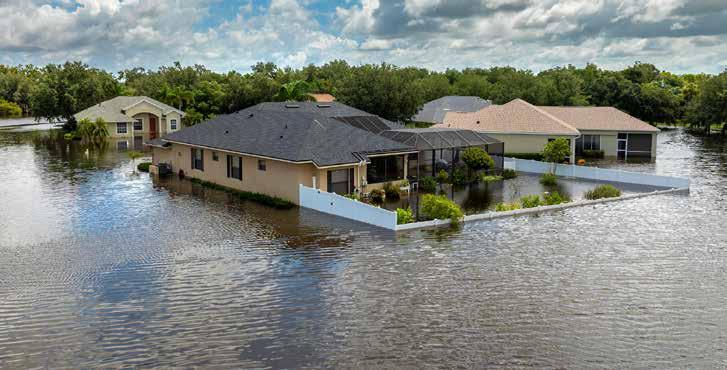
The U.S. faces a widening gap between growing flood risk and the take-up of flood insurance, potentially exposing the nation to more than $375 billion in aggregated uninsured flood losses from a 1-in-100-year event, according to a new whitepaper from Moody’s.
The growing insurance protection gap, now at 65%, poses a significant financial risk to households and local governments, which have long relied on FEMA Specific Flood Hazard Area (SFHA) maps primarily based on riverine flooding and generally don’t account for flood risk from storm surge, sea level rise, or extreme precipitation, the Moody’s report said. This exposes counties to losses that can occur outside of mapped FEMA flood zones, added Moody’s.
Mortgage underwriters use FEMA SFHA maps to determine if a property needs to carry flood insurance, which is primarily provided to U.S residences by the National Flood Insurance Program. According
to Moody’s, private flood insurance represents about 10% of the market.
“Uninsured losses arise not from isolated outliers but from persistent gaps between expanding flood hazards—particularly beyond regulatory flood maps that dictate mortgage requirements, as well as rarer, high-severity events—and insurance take-up,” Moody’s concluded.
The interactive whitepaper analyzed residential flood risk in the U.S. using the Moody’s RMS US Inland Flood HD model, including scenarios of a 1-in-100-year flood and a more extreme 1-in-500-year flood, which could result in uninsured loss exposure of more than $1 trillion with a 70% protection gap.
In a 1-in-100 year-flood scenario, most counties’ uninsured loss exposure is manageable as a share of property replacement cost, the whitepaper found. A 1-in-100-year flood is a flood event that has a 1% chance of occurring in any given year.
In such a scenario, less than 2% of counties in 11 states carry 65% of the country’s uninsured loss exposure. Counties in Florida, Louisiana, South Carolina, and
Texas face more than $5 billion in potential uninsured losses in the event of a 1-in-100year flood. Protection gaps range from 45%-75%, Moody’s found.
Flood events are not contained to 1-in-100-year or even 1-in-500-year scenarios.
Asheville, North Carolina, experienced rainfall far above the expected rainfall from a 1-in-1,000-year event when Hurricane Helene hit in September 2024. Buncombe County, the home county of Asheville, had a flood insurance protection gap of 88%, Moody’s RMS model results indicate.
The divergence of potentially catastrophic flood events and low flood insurance take-up “highlights the risks and limitations of relying solely on backward-looking statistics to characterize flood risk in a changing hydroclimate, particularly for short-duration, high-intensity rainfall events,” the whitepaper states.
Moody’s found that uninsured loss exposure from a 1-in-100-year flood event could increase nationwide by about 25% on average by 2050, to around $472 billion.

We speak human, not fine print.
We believe insurance should sound like a conversation, not a contract. So, we skip the jargon and meet you where you are—with tools, insights, and people who know your customers’ industries inside and out, from manufacturers and contractors to breweries and wineries.
That’s how partnerships work. And that’s how we work. Because at EMC, we’re all about Keeping insurance human®
Let’s get to know each other at emcinsurance.com
News & Markets

AI to Double Data Center Power, Water Use by 2030, UN Researchers Say
By David Stanway
Data centers are expected to consume twice as much power and water by 2030 as they expand to meet the surge in demand from artificial intelligence, according to U.N. researchers.
Unless governments heed the rising environmental costs of AI, the rapid rollout could also strain scarce land resources and create mountains of electronic waste, the United Nations University Institute for Water, Environment and Health warned in
a recent report.
Here are a few takeaways:
• Last year, data centers consumed 448 terawatt-hours of electricity globally, more than the whole of Saudi Arabia. AI accounted for a fifth of the total.
• They also consumed 4.5 trillion liters of water, enough to meet the needs of more than 600 million people in Sub-Saharan Africa, while generating 189 million tons of carbon dioxide emissions.
• “The public debate still often treats
AI as software, but AI is also physical infrastructure: data centers, electricity generation, cooling systems, transmission networks, chips, minerals, land and water,” said Kaveh Madani, the institute’s director and the report’s lead author.
• Annual power consumption from data centers is projected to double to 945 TWh by 2030, around the same as the whole of Japan, with AI accounting for 40% of the total.
• Water consumption is expected to reach 9.3 trillion liters, while CO2 emissions will rise to 399 million tons.
• The data center land footprint is also forecast to increase from 6,900 square km (2,664 square miles) last year to more than 14,500 square km by 2030, the report said.
• While AI could boost efficiency by optimizing power grids and reducing waste, overall electricity and water demand is still likely to rise as countries and corporations race to build new capacity.
• “Right now, the competition for growing faster than others overshadows the very basic principles of sustainable growth,” Madani added.
• “AI will not simply ‘run out’ of water or electricity worldwide. But in specific places, poorly planned data center expansion could collide with existing resource pressures. That is why responsible planning matters now, before infrastructure and dependencies become locked in.”
Copyright 2026 Reuters
Renewals for Most Commercial Lines Decrease in May, Says Ivans
Year over year, average U.S. commercial premium renewals for May increased in all lines except workers’ compensation, according to the Ivans Index.
However, month over month, commercial auto, business owners policy, general liability, and umbrella saw a decrease, while commercial property and workers’ comp experienced an increase, said Chicago-based Ivans.
Premium renewal rate change by line of
business for May 2026 highlights include:
• Commercial Auto: 4.96%, down from 5.24% last month
• BOP: 6.07%, down from 6.43% at the end of April
• General Liability: 5.28%, down from April, which was 5.70%
• Commercial Property: 6.71%, up from 6.24% in April
• Umbrella: 8.01%, down from 8.27% in April
• Workers’ Compensation: -1.31%, up
slightly from -1.35% last month
In its last report, Applied Systems’ Ivans said premium renewal rates in the first quarter of 2026 decreased for all major commercial lines compared to fourth-quarter 2025.
The Ivans Index analyzes more than 120 million data transactions, and includes more than 38,000 agencies and 700 carriers and managing general agents.
Coverage Designed for the Biggest Builds
Safety National’s workers’ compensation, general liability, and auto liability solutions are designed to address the unique challenges of large construction projects and contracting risks.
We take a flexible, tailored approach to insurance program design as placement specialists for businesses like commercial general contractors, trade contractors, renewable energy construction, and heavy civil infrastructure providers. Coverage is tailored to your organization’s specific needs with support from a partner you can rely on every step of the way.

Learn
55%
The amount of paid wedding claims tied to vendor difficulties in 2025, up from 45% in 2024. Other top claims, according to The Travelers Companies Inc., include illness or injury (16%), extreme weather (10%), accidental damage or injury (6%), and military deployment.

$27 million
The amount a Kentucky school district secured in settlements from Meta Platforms and other social media companies over claims they fueled a student mental health crisis. Meta agreed to pay the most at $9 million in the bellwether case for school districts.

$424 billion
The global value of uninsured natural catastrophe losses last year, up over 7% annually, according to a report from Swiss Re Institute. North America is the most exposed region. At the same time, insurance coverage is going down in some highly hazardous areas. In California, for example, just 12% of residential property policies included earthquake coverage in 2024, down from 30% in 1994, the report found.


448
The number of terawatt-hours of electricity consumed globally by data centers in 2024, more than the whole of Saudi Arabia. AI accounted for a fifth of the total. Data centers also consumed 4.5 trillion liters of water—enough to meet the needs of more than 600 million people in Sub-Saharan Africa—while generating 189 million tons of carbon dioxide emissions, according to U.N. research.

$20 trillion
The amount of global spending extreme weather will likely spur over the next decade, boosting sales and earnings for reinsurers and companies involved in energy efficiency and climate security, according to analysts at Bloomberg Intelligence.
Declarations

Growing Hail Threat
“Here we show a 36.5%–42.1% increase in global hailstorm-induced damage potential by the late twenty-first century, with the magnitude determined by the emission scenario.”
— An abstract for “Rising global hail damage potential in a warming world,” posted in the journal Nature. Researchers from Peking University and from Central Michigan University found that the frequency of hailstones larger than 1.18 inches in diameter will rise by as much as 52%, while the chance of smaller stones will likely decline, due in large part to warmer temperatures and higher humidity near the surface of the planet.

Regulating Rate Increases
“Illinois has a competitive insurance market, but when policymakers focus on controlling rates instead of reducing costs and risk, consumers end up with fewer choices and a less stable market.”
— Brian Christenberry, regional vice president for NAMIC, commenting on Illinois legislative measures HB 4273 and SB 714, which give the Illinois Department of Insurance the ability to review and overturn rate increases that are deemed “excessive, inadequate or unfairly discriminatory.” The insurance industry heavily opposed the measures, warning that expanded government control over insurance rates will reduce competition and drive prices up without addressing the underlying drivers of premium increases.

Medical Debt Erasure
“Nobody should go broke just because they got sick, but our healthcare system too often leaves families on the hook for bills they simply can’t pay. That’s exactly why partnerships like this one matter so much.”
— Allison Sesso, president and CEO of Undue Medical Debt, on a new round of medical debt relief for Connecticut residents. Governor Ned Lamont’s administration launched the program in partnership with Undue Medical Debt to give relief to qualifying residents who are having difficulties paying outstanding medical bills. The latest round will erase debt for 97,000 residents.

Law and Order AI
“These orders, though reasonable and motivated by valid concerns, have created a patchwork of differing disclosure and certification obligations for the parties and attorneys who participate in the court system throughout our State. The Court believes that a uniform, statewide approach to AI-related disclosure and certification would better balance the needs of the court system with the interests of the external users of that system.”
— The Florida Supreme Court in a recent order issuing statewide rules designed to hold attorneys more accountable for the use of AI in filings. The rules require lawyers to certify that case rulings and opinions cited in filings actually exist and are accurately referenced.

Secure Messaging Suit
“Texans deserve to know whether their private communications are indeed truly private. WhatsApp markets its services as secure and encrypted, but it does not deliver on those promises. I am suing to protect Texans’ privacy and ensure that WhatsApp by Meta does not mislead Texans by unlawfully accessing private conversations and data.”
— Texas Attorney General Ken Paxton on messaging privacy concerns, adding WhatsApp to the growing list of companies he has accused of violating Texans’ data privacy. Paxton filed a lawsuit against the messaging app and its parent company, Meta.

Explosion Fallout
“I’ve had a lot of inbound calls from my brokers, who have been receiving a lot of inbound calls from their clients.”
— Dennis Willette, senior vice president and head of environmental at Westfield Specialty Insurance. Following the implosion of a massive tank at a Washington state paper mill that killed 11 workers and spilled hundreds of thousands of gallons of chemicals, people in the environmental specialty line are fielding calls from clients to discuss their coverage. Many general liability policies have a pollution exclusion structured mainly to address this type of issue, which is why the environmental market exists.
Business Moves

National
Wellington Management, Hartford Funds
Wellington Management and The Hartford entered into a definitive agreement under which Wellington will acquire Hartford Funds. Upon closing, Hartford Funds will be integrated into Wellington’s U.S. Wealth business and going forward the business will operate under the Wellington brand. The deal is expected to close in the first quarter of 2027, subject to regulatory and fund approvals.
As a single, integrated platform, Wellington will provide advisors with broader access to investment strategies and solutions across mutual funds, ETFs, SMAs, models, and alternative investments.
The Wellington and Hartford Funds' relationship began in 1978 and formally evolved in 1984 with the launch of a long-standing sub advisory partnership across mutual funds. Since then, the partnership has broadened to include new capabilities such as ETFs and additional investment strategies.
Luminor Risk Launches
Luminor Risk, a managing general agent specializing in the U.S. excess and surplus property market, announced its official launch on May 28 with backing from investment and technology firm D.E. Shaw group.
The Atlanta-based Luminor platform pairs experienced underwriting leadership with modern data and modeling infrastructure, giving underwriters real-time
analytical support across submission intake, risk selection, pricing, and portfolio construction.
The D.E. Shaw group, as majority owner, will deploy fully collateralized capacity sitting behind Luminor’s capital partners. Luminor has also attracted a group of reinsurers and capital providers as capacity partners.
DB Insurance Co., The Fortegra Group
South Korea’s DB Insurance Co. acquired The Fortegra Group. The Jacksonville, Florida-based Fortegra will operate independently and keep its existing leadership team as well as distribution relationships. Fortegra scrapped its planned initial public offering last year, citing market conditions. The $1.65 billion acquisition by DB Insurance is the biggest US acquisition by a non-life insurer from the country.
East
King Risk Partners, The Roberts Agency Inc.
King Risk Partners acquired The Roberts Agency Inc., an independent insurance agency specializing in the construction industry that is based in Bloomfield, Connecticut.
The Roberts Agency has been in business for more than 60 years, serving home builders, trade contractors, general contractors, and construction-related businesses with coverages and surety bonds. The agency’s service area extends beyond Connecticut to include Massachusetts, New Hampshire, New Jersey, New York,
Rhode Island, and Vermont. The agency also offers commercial insurance, special coverage, benefits coverage, and homebuilders programs.
Jennifer Semple and Laura Langan are the owners of The Roberts Agency.
Headquartered in Gainesville, Florida, King Risk Partners has been expanding its presence across Eastern and Southeastern states.
Sands Point Risk, Launch Environmental Underwriters
Sands Point Risk, a multi-program managing general agency platform, acquired Launch Environmental Underwriters, a provider of environmental general liability insurance. The terms of the transaction were not disclosed.
Jersey City, New Jersey-based Launch focuses on complex risks across the energy, infrastructure, construction, chemical, mergers and acquisitions, and industrial sectors.
Stamford, Connecticut-based Sands Point said Launch will serve as the cornerstone of its environmental practice.
Sands Point Risk was launched in 2024 to serve the transaction liability insurance sector with the support of private equity firm Avesi Partners. Dennis Kearns, who founded the transaction risk program at DUAL, is chief executive officer of Sands Point. Dan Simnowitz and Patrick Darragh, who were also part of the DUAL’s transaction program leadership team, are executive vice presidents at Sands Point.
Risk Placement Services Inc.,
McKee Risk Management
Risk Placement Services, Inc. (RPS) acquired McKee Risk Management Inc., a King of Prussia, Pennsylvania-based program administrator. Terms of the transaction were not disclosed.
McKee Risk Management provides underwriting, policy administration, claims coordination and risk management services with program focuses of construction, public entity and property. Clyde McKee III, Clyde McKee IV and their team will operate under RPS’s program administration division.
RPS is the U.S. wholesale brokerage,
binding authority and programs division of global broker Arthur J. Gallagher & Co. Arthur J. Gallagher & Co. is headquartered in Rolling Meadows, Illinois. Gallagher provides services in approximately 130 countries.
Midwest
Shepherd Insurance, Capitol Insurance Group
Shepherd Insurance acquired two Indiana agencies, Indianapolis-based Capitol Insurance Group and Cox & Kimball Insurance, based in Bedford.
Founded in 1981, Capitol Insurance Group is a family-owned company. Capitol clients will continue working with the same trusted local team, now supported by Shepherd Insurance’s expanded resources, broader carrier relationships, and additional expertise.
Cox & Kimball brings decades of industry experience and long-standing client relationships to the Shepherd team. As part of this partnership, the Cox & Kimball team will join Shepherd Insurance’s Bedford location. The acquisition holds special significance as founder Dave Shepherd was born in Bedford.
Shepherd is an independent insurance agency serving clients across multiple states, with a focus on delivering customized coverage solutions backed by responsive, relationship-driven service.
World Insurance Associates LLC, Agency West Insurance
World Insurance Associates LLC acquired the business of Agency West Insurance of Olathe, Kansas. Terms of the transaction were not disclosed.
Agency West has been operating in Kansas for many years. They serve the insurance needs of both families and individuals, as well as businesses.
Inszone Insurance Services, Legacy Partners
Inszone Insurance Services announced the acquisition of Michigan-based Legacy Partners Insurance Services.
Following the acquisition, the Legacy
Partners team will continue to operate primarily from its Harrison Township hub. Founder Joe Graham will remain actively involved as an agency partner. Additionally, Legacy Partners’ chief operations officer, Cale Johnson, will be stepping into a new role as General Counsel for Inszone.
Howden, Cybeta
Howden acquired the intellectual property assets of Cybeta, a cyber data and analytics provider. The acquisition enables Howden to provide clients with faster, more precise insight into cyber risk, supporting better underwriting, placement, and claims outcomes.
Fishers, Indiana-based Cybeta was founded in 2019 by a team of data science experts with experience in the U.S. Department of Defense and intelligence communities to help businesses predict and prevent cyber attacks. In addition to the acquisition, former members of Cybeta’s team also join Howden.
This acquisition follows the launch of Howden’s U.S. Cyber practice in January 2026, which supports clients across all aspects of cyber insurance, including strategy, client service, brokerage, product development, claims and cyber risk consulting.
TWFG, Fortress Insurance Services
TWFG acquired Fortress Insurance Services, adding four new agency locations and expanding TWFG’s presence in the Upper Midwest and TWFG’s local market capabilities across both personal and commercial insurance lines.
Agency Brokerage Consultants advised Fortress Insurance Services on the transaction.
South Central
ANV, Specialty Comp Insurance
ANV, a global insurance intermediary platform, has completed the acquisition of Specialty Comp Insurance Solutions from Specialty Program Group, a subsidiary of Hub International.
SCIS is a Texas-based managing general agent specializing in tough-to-place mono-
line workers’ compensation insurance.
SCIS currently manages a diversified portfolio spanning key industries including construction, manufacturing, and healthcare. SCIS also has a presence in the temporary staffing industry.
Founded in 2007 and headquartered in Dallas, Texas, SCIS operates with a team of 20 employees led by an experienced executive group with deep backgrounds in specialty underwriting, actuarial science, and program management.
Southeast
Inszone Insurance Services, Coastal Insurance Services
California-headquartered Inszone Insurance Services acquired Coastal Insurance Services in Florida and affiliated Optimal Insurance Solutions.
The acquisition marks Inszone’s first step into the Florida market, the company said in a news release. Coastal Insurance was founded in 2008 by Rolando Gonzalez. He later established Optimal Insurance in Illinois, and the two agencies were combined in 2024.
The agencies’ teams are likely to remain in place under the Inszone ownership, the companies said. Inszone offers commercial and personal insurance coverage, as well as benefits.
West
LP Insurance Services, Van Noy Consulting Group
LP Insurance Services acquired the employee benefits consulting practice of Van Noy Consulting Group in Nevada.
The deal includes the addition of Terry Van Noy as an employee benefits consultant. Van Noy has over five decades of leadership and consulting experience across health insurance, managed care and employee benefits.
Reno, Nevada-based LP Insurance Services is an employee-owned risk management, insurance services and employee benefits firm with business and individual clients throughout the Western U.S. The firm has offices in Nevada, California, New Mexico and Arizona.
National
AXIS Capital Holdings Limited, headquartered in Pembroke, Bermuda, appointed Austin Su head of alternative risk, North America. Su leads the development and execution of AXIS’s alternative risk and structured casualty strategy. Su joins AXIS with over 25 years of experience in the global insurance industry, most recently serving as head of structured risk solutions, Americas at AXA XL.
Hub International appointed Kyle Bloemers to the newly created role of national chief cross-sell officer. Bloemers previously held senior leadership positions at HUB, including chief sales officer and chief marketing officer for the Midwest East region.
Berkshire Hathaway Specialty Insurance (BHSI), based in Boston, Massachusetts, promoted Ben Wyatt to head of marine for North America and the UK. Wyatt drives underwriting, strategy, and portfolio management across these regions. BHSI also promoted Gregg Shannon to vice president, contractors equipment and inland marine; Jim Norman to vice president, inland marine; and hired Kevin Kempf as vice president, ocean marine cargo/ stock throughput.
served as The Hartford’s national cargo practice leader and previously served at AXA/ XL as national cargo producer leader for the United States.
as head of sales and client management.
writing officer at Travelers and previously served as director of underwriting.


Gallagher appointed new practice leaders in its U.S. retail brokerage. New leadership includes Alush Garzon, managing director, manufacturing; Trevor Gilstrap, managing director, energy; and Andy Engardio, managing director, transportation. Garzon, Gilstrap and Engardio most recently served as their respective industry vertical leaders at AssuredPartners prior to Gallagher’s acquisition of the firm in 2025.
Artificial Labs, headquartered in London, appointed Eric Joost as president, leading its U.S. expansion. Joost has almost four decades of experience across the U.S. and global insurance markets. He most recently served as chief operating officer of CAC Group in the U.S.

Hudson Insurance Group, headquartered in New York City, appointed Beth Diamond as senior vice president and chief claims officer. Diamond has over 20 years of specialty claims experience and most recently served as group chief claims and litigation officer at Beazley.
Longbrook Insurance appointed Mike Sherry as head of North America transactional liability. Sherry leads the development and expansion of Longbrook’s transactional risk insurance platform across North America. He is headquartered in London.
East
The Hartford named Allan Ilias head of ocean marine, U.S., and global practice leader. Ilias replaces Tony Plutino, who is retiring. Ilias previously

Willis, a WTW business headquartered in New York City, appointed new leadership across corporate risk and broking, North America. Michael Butch joins the business as growth operations leader for North America. Butch has over 20 years of experience and joins from Marsh, where he most recently served as North American sales analytics and insights lead.
Jim Blaney was appointed growth enablement leader, North America. Blaney has held multiple leadership positions at WTW and most recently served

Lawley, headquartered in Buffalo, New York, hired AmyRae Nessa as an insurance advisor. With more than a decade of experience, Nessa specializes in construction, hospitality and business development. She previously served as membership and sales director for the Construction Exchange of Buffalo & Western New York.
The Great Bay Insurance Group, headquartered in West Atlantic City, New Jersey, hired Anthony Famiglietti as vice president, commercial lines. Famiglietti most recently served as an executive under-
Davis & Towle Insurance Group, headquartered in Concord, New Hampshire, appointed John Kneeland as commercial lines manager and promoted Sherri Cole to assistant commercial lines manager. Kneeland previously served in leadership and business development roles at Providence Mutual, The Hanover, Bristol West and Farmers. Cole will continue in her role as a senior commercial lines account manager while also supporting training efforts and providing broader assistance in managing the commercial lines division.
Howden, the global insurance broking group, launched its new U.S. Aviation Practice, led by Julio Jimenez, aviation practice leader. Jimenez most recently served as a partner, vice president and risk management consultant at USI Insurance Services.
Boston-based Liberty Mutual Insurance promoted Wes Hyatt as president, Global Risk Solutions North America Distribution & Global Client Engagement. A 22-year Liberty veteran, he previously served as global chief client officer and senior vice president of workers’ compensation claims.
Allan Ilias
Alush Garzon
Trevor Gilstrap
Andy Engardio
Eric Joost
AmyRae Nessa
Southeast
IMA Financial Group named Rob Price as Alabama market president, based in Birmingham. Price recently led IMA’s executive risk, private equity and mergers practice. As Alabama market head, he will oversee IMA’s Alabama offices, including growth and profitability.
who has been a member of the Board of Directors since 2021, succeeds Sue Sutter, who has served as Board Chair since 2024 and concludes 21 years of service.
Church Mutual named
Daniel Kim as senior vice president and chief financial officer.


Alfa Insurance, based in Montgomery, Alabama, named David Bailey senior vice president of claims. Bailey, who recently served as regional vice president, takes over from Bryan Hubbard, who retired after 36 years at the Montgomerybased firm.
South Central
Holmes Murphy hired Chaz Cointment as a senior client executive, surety. Cointment has over 18 years of experience in the industry, most recently as the vice president of surety for American Global.
Midwest
HUB appointed Kyle Bloemers to the newly created role of national chief cross-sell officer. Bloemers has over two decades of insurance sales and leadership experience, previously serving in senior leadership positions at HUB, including chief sales officer and chief marketing officer for the Midwest East region. He is based in Grand Rapids, Michigan.
Pharmacists Mutual Insurance Group appointed Felix Gallagher as chair of its board of directors. Gallagher,
Kim has nearly two decades of experience, most recently serving as head of planning and performance management for Zurich Cover-More.
previously served as the national practice leader for private equity, family office and M&A at Beecher Carlson. Prior to joining Alliant, Bender led the private equity and M&A practice at Beecher Carlson.
Washington Insurance

Prior to that, he served as CFO for Zurich’s Japan property and casualty business.
Dewey Gantz, Church Mutual’s former senior vice president and chief financial officer, will transition into the role of senior financial advisor.
Tracy Schmeltzer was promoted to vice president of underwriting for religious markets.

Schmeltzer has been with Church Mutual for 35 years and most recently served as AVP of camps, sports and outdoor recreation underwriting.
West
Commissioner Patty Kuderer has been selected to chair the National Association of Insurance Commissioners’ new Child Care Insurance Working Group.
mercial insurance, has been named president of commercial lines. Genova continues to lead commercial operations while continuing his oversight of PGI’s agency performance division. Additionally, Genova oversees PGI’s technology investments.
Delos Insurance Solutions appointed Brian Schween to the role of chief technology officer.

Mutual of Enumclaw named Joe Peterson vice president of claims and chief claims officer. Peterson has more than 20 years of claims leadership experience, most recently as vice

president – P/C claims at Zenith Insurance Company.
Premier Group Insurance (PGI) named Rex Hickling executive president. Hickling joined PGI over 16 years ago after a 25-year career with Safeco and Travelers. Hickling will guide long-term growth.
Schween has extensive technology experience in the insurance industry, having had several C-level roles in a variety of organizations. Delos is headquartered in San Francisco, California.
Ryan McEachern joined XPT Specialty as vice president, commercial underwriter/ broker in its Woodland Hills, California office.

McEachern joins XPT from Burns & Wilcox. He previously served as a private client banker at JPMorgan Chase.

Alliant Insurance Services hired Joseph Ehrlich and Jackson Bender as executive vice presidents within its mergers and acquisitions (M&A) vertical. Based in New York, Ehrlich is a former M&A attorney and
Shawn Walker, formerly senior vice president, will assume the role of president of personal lines. Walker has 23 years of industry experience and leads the profit and loss performance across additional departments within the PGI home office. Walker will also spearhead the organization’s long-term acquisition strategy.
Matt Genova, a five-year PGI veteran with expertise in com-
Trucordia, headquartered in Lindon, Utah, hired Tom Legner as senior vice president of the company’s agriculture platform.

Legner has over 25 years of experience, most recently spending over a decade with Silveus Insurance Group.
David Bailey
Daniel Kim
Tracy Schmeltzer
Joseph Ehrlich
Jackson Bender
Joe Peterson
Brian Schween
Ryan McEachern
Tom Legner
News & Markets
Roof Costs Soar Even as Claims Decline: Verisk
Hail volatility and aging roofs are driving higher residential replacement severity, a new study by data analytics and technology provider Verisk finds.
Roof losses didn’t slow despite a 20% decline in overall claims volume in 2025.
Data showed that average U.S. residential replacement costs jumped 33% and repair costs climbed 25% in 2025, compared to the prior four-year average. Average residential roof replacement costs reached $17,631 in 2025, with repair costs averaging $4,699.
Residential roof replacement cost value (RCV) declined to $23 billion in 2025, compared to an average of $24.4 billion from 2021 to 2024, the study found. The 2025 decline was driven by a limited U.S. landfall hurricane season, though RCV remained elevated.
In Verisk Risk Analyzer-designated hail states, 57% of residential properties have roofs nine years old or newer, compared with 38% in non-hail states, highlighting faster replacement cycles alongside significant local volatility.
The Midwest and Northeast have the highest shares of older residential roofs (31+ years), at 17% and 18%, respectively, compared with just 4% in the South. The study found that hail volatility and aging roof stock are driving increased risk across U.S. insurance, construction, and housing markets.
Roofing claims represent a large portion
of all property claims within the U.S., with roofing line items representing approximately 30% of all line items within claims estimates. As such, roofing trends are often in line with larger claims trends.
Roofs that are visibly in moderate to poor condition show approximately 60% higher loss costs than roofs in good or excellent condition, according to Verisk’s Roof Condition Score (RCS) 2025 baseline data.
Severe hail activity—considered to be hail greater than or equal to 1 inch in diameter—was concentrated in the Central Plains, while previous years have been more impactful to the Northern and Southern Plains. Arkansas, Kansas, Nebraska, Oklahoma, and South Dakota rank among the top states by the share of roofs impacted by severe hail.
Sixteen states in the U.S. experienced severe hail impacts on more than 20% of roofs, up from 12 in 2024.
Year-to-year, “giant” hail (greater than or equal to 2 inches) tends to follow more stable geographic patterns, while “large” hail (1–2 inches) shows much wider metro-level volatility, with hundreds of local markets experiencing meaningful year-to-year increases in hail activity, data showed.
“Hail risk is not just about one monster storm; it’s the cadence of frequent, smaller-scale events that can rapidly age and weaken a roof,” said Tory Farney, vice president, Verisk Weather Solutions. “Large hail may cause less damage per

event than giant hail, but its wider footprint and year-to-year variability can drive unexpected concentrations of damage. Understanding where hail is most likely to cluster helps insurers, contractors, and communities prepare for faster, more resilient recovery.”
Verisk found that the nation’s roof inventory highlighted striking regional variations that directly correlate with the exposure patterns.
• South: 28% of roofs are 0–4 years old, and only 4% are 31 years or older, reflecting a higher turnover driven by severe weather events and rapid housing growth.
• Midwest: 21% of roofs are 0–4 years old, while 17% are 31 years or older.
• Northeast: 14% of roofs are 0–4 years old; 18% are 31 years or older.
• West: 20% of roofs are 0–4 years old; 11% are 31 years or older.
“Accurately assessing roof age, condition, and remaining life is a critical part of understanding a property’s vulnerability to wind and hail,” said Ryan D’Amario, senior vice president of property product management at Verisk. “Aerial imagery analytics reveal that, as of 2025, 38% of U.S. residential homes show moderate to poor roof condition—often with visible defects that can materially influence performance during severe weather. When more than a third of the housing stock falls into this category, roof condition becomes a core underwriting signal that has meaningful implications for risk selection, loss predictability, and pricing accuracy.”
Compounding the rising costs, inflation in roofing materials continues to outpace labor costs, even as national averages mask significant variation across states, the data highlighted. In 2025, roofer labor costs increased 0.79%, compared with a 1.48% rise in roofing material costs.
Sharp regional swings in material pricing also contribute to rising costs. For example, roofing material costs climbed 10.37% in Nevada in 2025, while declining 15.80% in New Hampshire.

Survey Highlights Growing Interconnected Risks, Protection Gaps
Anew survey from the Insurance Information Institute (Triple-I) and Munich Re US shows overlapping exposures are shaping today’s risk landscape.
Triple-I and Munich Re’s RiskScan 2026 examines evolving risk perceptions and interconnected exposures in the United States and United Kingdom insurance markets.
More than 1,700 participants were surveyed in the U.S. and U.K. across five key insurance market segments: consumers, small business owners, middle-market decision-makers, property/casualty insurance agents and brokers, and P/C insurance carriers.
RiskScan 2026 provides two in-depth reports:
RiskScan 2026 (Re)insurance highlights the growing alignment around related risks that are reshaping economies and societies and cites persistent insurance protection gaps that threaten long-term resilience. It demonstrates that today’s risk landscape is increasingly defined not by isolated threats but by overlapping pressures spanning cyber incidents, natural catastrophes, economic volatility, artificial intelligence (AI), business interruption, and emerging liability exposures.
RiskScan 2026: Specialty Insurance incorporates global specialty market perspectives and insights on cyber incidents, business interruption, new technologies, and natural catastrophes—revealed as
tightly interconnected concerns that reinforce how operational disruption, supply chain volatility, liability exposure, and technology dependencies can quickly cascade across organizations and industries. The specialty findings also underscore growing attention to long-tail emerging exposures, including evolving AI-related risks.
“The survey findings make clear that recognizing risk is only the first step,” said Sean Kevelighan, CEO, Triple-I. “As flood, cyber, and other interconnected exposures continue to evolve, the industry has an important opportunity to strengthen public understanding, close protection gaps, and work collaboratively with consumers, policymakers, businesses, and communities to better predict, prepare, and prevent ever-increasing risks.”
Key Findings
• Cyber incidents, economic pressures, and AI emerged as top concerns across all market segments, reflecting the increasingly interconnected nature of modern risk.
• Non-peak (secondary) catastrophe perils, including floods, severe storms, winter weather, and wildfires, are now viewed as frequent, high-impact risks, challenging traditional assumptions about catastrophe exposure and diversification.
• AI ranked as the most impactful emerging technology, highlighting both
its rapid adoption and growing concerns around operational, regulatory, liability, and systemic risks.
• Persistent protection gaps remain for flood and cyber insurance.
• Growing recognition of legal system abuse as a driver of rising P/C insurance costs signals broader awareness of the factors influencing affordability and long-term market stability.
The study found inflation, economic decline, and rising property insurance costs remain among the top market concerns across all audiences surveyed. Respondents increasingly recognized macroeconomic pressures, including inflation, supply chain disruption, geopolitical uncertainty, and legal system abuse, are intensifying the impact of catastrophe losses, cyber incidents, and overall insurance affordability challenges.
“As insurance professionals, we are committed to driving positive change by helping clients better understand, mitigate, and manage today’s increasingly complex risks, from cyber incidents and business interruption to natural catastrophes and emerging AI exposures,” said Marcus Winter, president and CEO, North America (P&C Re), Munich Reinsurance America, Inc. (Munich Re US). “The findings also reinforce the critical role insurance plays in helping communities recover after loss, promoting long-term financial stability, and strengthening resilience.”
Spotlight: Reinsurance
Reinsurers Bring Strong Risk Appetite to Florida’s June Renewals: Guy Carpenter
By L.S. Howard
Legal reforms, improved building resilience, and disciplined underwriting have combined to restore confidence in the Florida re/ insurance market, leading to increased capacity as well as improved terms and pricing during the June reinsurance renewals, according to Guy Carpenter.
Since landmark tort reforms were enacted in December 2022, Florida’s property insurance market has strengthened, with domestic underwriters posting a 76.8 combined ratio in 2025, said Guy Carpenter in its report titled “June 2026 Florida Reinsurance Renewals – A Thriving Market Restoring Capital to Healthy Levels.”
“Policyholders’ surplus surged by 45%, as carriers continued to rebuild from the eroded capital levels that resulted from the prior legal environment,” Guy Carpenter said, explaining that the strong surplus levels enabled many
insurers to retain more risk and negotiate improved reinsurance terms as they headed into the 2026 renewals.
“We also continue to observe declining litigation, which has decreased roughly 66% since the peak of litigation activity. On the back of profitable results and the proven success of legal reform, policyholders are now beginning to see much-anticipated rate relief,” the report continued.
The legal reforms of 2022 were designed to resolve excessive litigation that had been hitting homeowners with high insurance costs. A recent report calculated that property/ casualty insurance costs in Florida are now about 14.5% lower than what they would have been if the reforms had not been enacted.
Strong underwriting performance was also bolstered by a benign hurricane season—the first in a decade without a landfalling tropical storm, the report noted.
The depopulation of Citizens

Property Insurance Corp. has provided a significant source of new business for many insurers over the past three years—helping to launch 14 new companies, Guy Carpenter said, adding that more than 1.4 million policies have exited Citizens since 2022. “As of the beginning of 2026, the era of Citizens depopulation has now largely run its course, and going forward, companies will rely on more conventional market competition to drive growth.”
Property Catastrophe Demand
During the June renewals the demand for property-catastrophe capacity continued to grow—driven by depopulation of Citizens, population growth, and a rise in average insured values, the report said, pointing to the fact that property-cat demand increased by 12%, which was readily met by expanded reinsurer appetite.
“Reinsurers’ desire to grow with Florida clients was demonstrated by a broad increase in risk appetite across attachment points and a willingness to consider expanded coverage,” the report added. “There was abundant capacity for products such as lower-attaching catastrophe layers and reinstatement premium protection, which were previously areas of constrained capacity in recent years.”
While reinsurers sought to expand relationships with their existing trading partners by offering capacity across a broader spectrum of their programs, they often found it
difficult to secure additional shares given the strong appetite from incumbent reinsurers at all attachment points, Guy Carpenter said.
“Additionally, there was greater interest in providing subsequent event cover. Collateralized reinsurers more frequently offered combined packages solving for multiple risk transfer needs, such as top and drop and top and aggregate covers.”
Competitive Pricing
Guy Carpenter said property-catastrophe prices continued to soften with risk-adjusted decreases typically seen in the -15% to -20% range, while some individual layers saw deeper risk-adjusted decreases, especially at remote attachment points.
“Additionally, loads on reinstatement premium protection began to ease from the extremely elevated levels seen in recent years,” the report continued.
Quota Share Demand Drops
As Florida insurers’ balance sheets have strengthened, there has been less demand for quota share capacity, but reinsurers’ appetite for Florida quota share business continues to rise because of the strong outlook for insurers in the state.
“Quota share terms improved meaningfully for Florida carriers with the ability to obtain additional catastrophe occurrence limit, additional catastrophe aggregate limit, and additional ceding commission.”
Spotlight: Environmental

Environmental Brokers Busier Following Washington Chemical Plant Blast
By Don Jergler
In the weeks following the implosion of a massive tank at a Washington paper mill that killed 11 workers and spilled hundreds of thousands of gallons of chemicals— believed to be the deadliest industrial accident in state history—managers of similar operations have been dialing up their insurance brokers to find out how well they’re protected.
It took days to recover all the bodies of missing workers who died in the May 26 blast at the Nippon Dynawave site in Longview. In addition to the workers killed, seven other workers and a firefighter were injured by burns from the chemical known as white liquor that was spilled in the blast.
With the deaths, damage, and spillage into the Columbia River, as well as potential lawsuits already lining up, it’s
Westfield Specialty Insurance.
“I’ve had a lot of inbound calls from my brokers, who have been receiving a lot of inbound calls from their clients,” he said.
Many general liability policies have a pollution exclusion structured mainly to address this type of issue, which is why the environmental market exists.
Insurers like Westfield Specialty provide coverage on an excess basis, and the market also provides a combined general liability and pollution program. There are myriad ways to buy these coverages. Some insureds buy a limited time-element coverage, others a broader coverage.
likely to be a costly event for the plant’s owners. It’s not immediately clear what coverage the operation has or who insures it. But the event, which has been heavily reported on by media, has other manufacturers in the industry checking on their insurance coverage.
“Depending on what they buy will really dictate the level of coverage that they have, and then further to that, one of the challenges is that the aggregate is typically shared with their general liability,” Willette said. “And if they buy the pollution coverage, it may not be available to them depending on whether or not their limit has been exhausted by any other general liability claims and vice versa. If there’s a large pollution claim such as this, their general liability limit may be exhausted by the pollution limit, so that’s the blended model.”
The environmental line also offers dedicated towers of pollution liability insurance for clients not shared with the general liability policy, providing affirmative and often broader pollution coverage, he added.
People in the environmental specialty line are fielding calls from clients to discuss their coverage, according to Dennis Willette, senior vice president and head of environmental at continued on page 26
Willette, whose background includes work as an environmental scientist, said the costs from the experts that the com-
Spotlight: Environmental
continued from page 25
pany likely has on site trying to understand what happened and to get the plant back into operation alone is going to be expensive.
“What I can say is the cost to investigate, sample, remediate, resolve, and settle these concerns gets expensive very quickly,” he said.
Lawmakers and family members are calling for an impartial investigation of the incident, and at least two families said they have retained lawyers, according to media reports.
Investigators from the U.S. Chemical Safety Board were already on site.
The Washington Department of Labor & Industries also has investigators at the site to conduct a workplace
safety probe to determine what happened and if there were safety violations connected to the incident.
‘What I can say is the cost to investigate, sample, remediate, resolve, and settle these concerns gets expensive very quickly.’
L&I, the regulatory authority for workplace safety in Washington, officially opened its investigation early this month, which includes inspectors who focus on high-hazard chemical industries. The agency said it plans to interview witnesses and conduct a




physical inspection of the site.
By law, these investigations must be completed in 180 days. The agency said it anticipates using all the time available due to the complexity and scale of the investigation.
Roughly 550 people work at the plant, and plant operators had agreed to pay workers while operations were shut down. But now U.S. Rep. Marie Gluesenkamp Perez is calling on the mill owners to provide a written guarantee that workers will continue receiving pay and benefits.
Gluesenkamp said workers were told they will only be paid through June 7, leaving hundreds of employees facing the possibility of losing their paychecks if the investigation and shutdown
continue beyond that date, according to the news website MyNorthWest.com.
As costs rack up, Willette said he thinks brokers will use the increased awareness to educate clients about environmental insurance products.
“I don’t see this being a market-moving event in terms of it changing what’s offered in the marketplace,” he said. “Quite frankly, I think it’s going to be used as an educational opportunity to help take what is the underinsured or not-insured segment of eligible buyers and move some of those into the segment of buyers who are protecting themselves and taking advantage of the risk transfer solutions provided by the environmental insurance industry.”





News & Markets

Colorado Governor Signs Law Aimed at Lowering Homeowners Insurance Costs
Colorado Gov. Jared Governor Polis signed a bill into law that proponents say will lower the price of homeowners insurance in Colorado, Polis signed SB26-155, called Increase Access Homeowner’s Insurance Enterprise, designed to make it more affordable for residents to get hail proof roofs, help decrease premiums and increase market competition in high-wildfire areas. The bill is part of Polis’s efforts he says will save
Coloradans $800 each year on homeowners insurance.
The bill, sponsored by Speaker Julie McCluskie and Representative Kyle Brown, and Senators Kyle Mullica and Janice Marchman, creates an enterprise governed by a seven-member board, including the commissioner of insurance or their designee; members with expertise in home hardening, risk mitigation, resilient roof systems, and insurance underwriting or
actuarial analysis; and members representing the interests of insurance companies, consumers, and counties.
The enterprise will impose an annual fee of 0.5% starting in 2027 of the total premium collected by admitted insurers selling multiperil homeowner’s insurance policies in the state.
The fee will go to efforts including:
• Defraying the cost of retrofitting residential property by providing grants for the installation of resilient roof systems. At least 85% of the fee revenue must be used for grants to Colorado homeowners to retrofit residential property to reduce insurer losses due to hail and windstorms.
• Analyzing data on hail losses to identify areas of the state to target for installation of resilient roof systems;
• Setting standards for resilient roof systems and awarding workforce training grants for installing and certifying resilient roofs;
• Creating codes of conduct for roofing contractors to ensure roofs are properly and appropriately installed;
• Conducting or contracting with a third party to conduct a study to analyze insurance risk in high-risk wildfire areas of the state.
Report Calls for Transparency, Modernization of Washington Fire Scoring Bureau
Lack of transparency in property protection classifications from a state rating bureau is one of the biggest concerns from people involved with fighting fires in Washington, a new report from the Washington state Office of the Insurance Commissioner shows.
The OIC’s report on property protection classification standards recommends performance-based modernization and transparency for the Washington Survey & Rating Bureau, among other changes to the state’s independent fire protection rating bureau.
The Legislature requested a report on the WSRB’s rating methodologies and the potential for modernizing them. The OIC delivered the report to the Legislature on May 28.
The WSRB collects data about fire
departments, municipal water supplies and emergency communications in Washington to generate protection class ratings. The bureau assigns ratings from 1 to 10. Insurance companies buy rating scores to determine if they will cover individual properties and use the scores for setting premiums.
rating scores.
The report’s findings include:

Report consultants surveyed fire service professionals across the state and found that the lack of transparency was the most pressing concern. One problem mentioned was the difficulty in understanding how classifications are calculated and how investments of public funds could change
• WSRB’s methodology doesn’t reflect how fire departments perform during actual fire responses.
• Its fixed distance thresholds create “cliff” effects where minor geographic variations produce major classification swings.
• Rural and volunteer departments are evaluated based on standards created for urban departments staffed full-time by career firefighters.
The report proposes a structured pilot framework for fire protection capability ratings focusing on performance-based metrics.
My New Markets
Repossession Workers’ Compensation
Market Details: Worksperity delivers Workers’ Compensation solutions tailored to repossession. Excelling in placement for repossession risks that have coverage limitations like tough class codes, prior coverage issues, high experience mods, and prior losses.
Repossession segments covered: Vehicle repossession services, equipment and machinery recovery, debt collection support services, towing and impound operations, asset tracking and retrieval, and all other repossession classes.
Program highlights: Premium only, risk controls all payroll functions, risk pays tax on their own federal ID, pay-as-you-go premium, no year-end audits.
Available Limits: Not disclosed. Carrier: Not disclosed.
States: All states and the District of Columbia except Alaska, Hawaii, North Dakota, Ohio, Washington, and Wyoming. Contact: Ken Heideger, ken@worksperity. com, 866-269-0037
National Commercial Property Market
Market Details: All states - all risk classes. Submission requirements: Acord 125; Acord 140 with age, construction class, square footage, age of roof, adjacent structures and risks, occupancy; statement of values; loss runs less than 60 days old; pictures; and expiring and target premiums.
Available Limits: Not disclosed.
Carrier: Not disclosed.
States: All states and the District of Columbia.
Contact: Darren Yancy, dy@astr1.com, 817-426-5100
Equestrian Businesses - Boarding, Training, Riding Instruction
Market Details: The Marshall+Sterling equine division is licensed in all 50 states (though with limited options in Alaska and Hawaii) and specializes in CGL and CCC for equestrian professionals (boarding, training, riding instruction, horse shows and clinics, horse clubs, therapeutic riding programs, fox hunts); and farm/
ranch packages (dwellings, barns, arenas, outbuildings, equipment, commercial and personal liability, work comp, auto, etc.). Marshall+Sterling also writes equine mortality, medical and related coverages, and private horse owners’ liability.
Offices in California, Texas, Wisconsin, Michigan, New York, Virginia, Florida, and Pennsylvania with the ability to write in any state. Access to most of the U.S. markets that write equine-related coverages allows partnerships with agencies around the country to place equine risks of just about any type.
Available Limits: Not disclosed.
Carrier: Not disclosed.
States: All states and the District of Columbia except Alaska and Hawaii. Contact: Rachel Minholz, RMinholz@ marshallsterling.com, (800) 836-3046 Ext. 2207
Rodeo Event Insurance
Market Details: The American Insurance Specialist Rodeo Event Liability Policy extends coverage to the Show organization, premises owners, show officials, committee members, judges and volunteers. Sanctioning organizations may be included as additional insureds. Coverage is written on an occurrence basis through an admitted, A-rated insurance company. The policy may be written on a “per event” or annual event reporting form.
Available Limits: Not disclosed. Carrier: Not disclosed.
States: Arizona, Arkansas, California, Colorado, District of Columbia, Florida, Georgia, Idaho, Illinois, Indiana, Iowa, Kansas, Kentucky, Louisiana, Maine, Maryland, Michigan, Minnesota, Mississippi, Missouri, Montana, Nebraska, Nevada, New Jersey, New Mexico, New York, North Carolina, North Dakota, Ohio, Oklahoma, Oregon, Pennsylvania, South Carolina, Tennessee, Texas, Utah, Virginia, Washington, Wisconsin, and Wyoming. Contact: Brent Allen, americanspecialtyinsurance@gmail.com, 480-666-5520
Habitational Program NonAdmitted
Market Details: Core Programs offers coverage for apartment buildings with or
without retail, residential condominiums, co-ops, homeowners associations, and townhomes with or without retail.
Property: TIV limits up to $20M per location, including building, contents, time element coverages, and ordinance or law. Special form, agreed amount, replacement cost available. Deductibles starting at $5,000. Equipment breakdown available. Limits for back-up of sewers, terrorism ordinance or law: Up to 10% of the building limit. Enhancement coverage forms: property broadening form options available where crime coverage is included. No age restrictions or construction class restrictions. General liability: $1M/occurrence; $2M/annual aggregate. Coverages available: Hired-non-owned auto; employee benefits. Has pen.
Available Limits: See above.
Carrier: Coverage written through an A-VIII, AM Best-rated carrier.
States: California
Contact: Laura Acquadro, lacquadro@ core-programs.com, 973-946-5085
D&O, EPLI and Fiduciary
Market Details: Orion is an Insurance MGA, leveraging over 25 years of underwriting, brokerage, and MGA experience. Orion offers D&O, EPLI and fiduciary products to publicly traded, privately held and not-for-profit entities. Capable of deploying up to $5M for primary or excess placements. Orion works with dedicated wholesale distribution partners.
Available Limits: Not disclosed. Carrier: Not disclosed.
States: All states and the District of Columbia.
Contact: Robert Ribbe, rob@orion-ins. com, 312-805-0548
section brought to you by

Special Report: Construction
By Andrea Wells
Construction insurance brokers say the current market is a good time to build stronger relationships with insureds because attention does not have to be so focused on pricing but can instead be more on the complex risks in the business. By reviewing the risks, brokers can arrive at a deeper understanding of their insureds’ approach to risk and be in a better position to structure a program tailored to their risk tolerance when the market turns.
Construction risks are complex, and knowing how to manage these risks is critical when helping contractors build the right program structure, specialists say.
Labor shortages, added cost pressures, and supply chain concerns have been around the construction sector for many years. However, according to Song Kim, president of Global Commercial Industry Segments at CNA, what is important is to get insureds to understand that these pressures aren’t happening in isolation. Combined, they bring risk exposures that may not be discovered for years, he said.
The biggest challenge for underwriters today isn’t one single trend, he said. “It’s really understanding the compounding effect of all of these trends simultaneously.” These challenges all have a dependency on each other. “They’re interconnected risks,” Kim said. They could impact not only the construction insurance industry but also the success of construction projects now and in the future. “And that’s something that the underwriting community is watching closely.”
Kim believes that this “interconnectedness” of industry challenges is continuing to build pressure on contractors and their risk profiles. It’s something he feels that people don’t always have an appreciation for when it comes to insuring construction today. “But they fundamentally change the risk and how we, as underwriters, look at risk.” So, rising costs in the global economy, supply chain pain points, and a shortage of skilled labor all will ultimately
impact severity, he said. “We don’t know when it’s going to show up, but we know that there is a strong correlation.”
The construction industry is resilient even in an uncertain macro-economic environment like today, Ryan Powers, senior vice president, head of construction at QBE North America, told Insurance Journal. “Project starts are slowing, driven by a scarcity of talent and inflationary pressure,” he said. And that lack of skilled talent is a huge barrier for some firms and a contributor to added risk.
According to the Associated General Contractors of America, 80% of member firms reported that at least one construction project had to be cancelled, scaled back, or postponed due to a shortage of labor with more than 90% of firms stating they continue to find it difficult to hire qualified labor.
New employees drive heightened exposure on a construction job site, Powers noted. “As skilled labor becomes more scarce, less tenured employees become more common, which in turn drives higher severity and frequency of loss.”
These trends and the added risk they bring “will define the next phase of the construction insurance market,” Kim said, as a “transformation from underwriting an individual single risk to underwriting around ecosystems” takes place. This is necessary to help underwriters in “truly understanding the value chain, how projects are designed, how they’re built, and ultimately how they perform when they become operational.”
Preparation and specialization are crucial for what’s to come, he said. “Whenever you have that deep specialization, there’s always going to be opportunity,” he added. “We’re seeing significant growth in areas like digital infrastructure, large-scale industrial projects. They’re creating significant demand for insurance, but more importantly, they’re elevating the role of insurance from a business transaction to one of a strategic partner that offers not just product but true risk insights,” he said.
Jake Schmitz, Holmes Murphy’s client executive for the construction sector, said that now is a great time to review program structures with construction clients. He plans to “double down” on conversations with insureds around their program structure, risk tolerance, and overall risk strategy in this newer soft market cycle. This provides agents and brokers an opportunity to foster strong client relationships by doing what’s best for them, he said. This is the first time in a long time where “you can have your cake and you can eat it, too,” he said.
‘It’s really understanding the compounding effect of all of these trends simultaneously.’
Current Trends
For the 12 months ending April 2026, total construction starts were up 8.1%, according to the Dodge Construction Network. While residential starts were down 4.4%, nonresidential starts were up 10.0%, and nonbuilding, which includes public works and other infrastructure, was up 19.5%.
Construction in digital infrastructure, energy, and other large-scale infrastructure projects are leading the way. Specialists see some growth in other areas of construction as well, but the best opportunities for construction specialists come from a more competitive insurance market.
Despite the challenges of interconnected risks, contractors and their insurance specialists are finding a better insurance market, at least for top-tier accounts. Some specialists might even refer to today’s market as having “turned the corner” into soft market territory.
“There’s great opportunity for construction risk managers in this current insurance environment to capitalize on the softening market,” said Schmitz. He said the second half of 2026 is showing signs of a more competitive market cycle continued on page 30
Special Report: Construction
continued from page 29
and is a great time to negotiate not only better rates but also better coverage terms for his construction clients. “I think that is absolutely the critical part,” he said.
Trusted carrier partners are now more willing and ready to do what they need to do from a premium and, even more importantly, from a terms and conditions standpoint, to retain the business and keep partnerships strong, Schmitz said. It depends on each broker’s approach to the market and what their clients are comfortable with, but this year brought an insurance market more willing to make positive coverage changes that impact a contractor’s cash flow and profitability, he added.
‘Project starts are slowing, driven by a scarcity of talent and inflationary pressure.’
Those changes might mean different deductible structures, changes to policy limits and rate, Schmitz said. “But I would say buyer beware because not all policies are created equal.”
“Factors like labor shortages and project-related costs have a negligible impact on insurance programs in the eyes of most carriers,” he added. Some might have more concerns than others, but when it comes to the top construction insurance carriers in the market, there’s high capacity for contractors that put into place the right risk management controls, according to Schmitz.
Darren Tasker, head of construction for the Americas, Allianz, agrees. “I would say Q2 this year we’ve noticed a real acceleration of the market to be more competitive, [with] more capacity,” he said.
Part of what’s driving the trend is the rapid softening of the property market. “The property market has really fallen off a cliff, so revenues are down on that front, so I think a lot of carriers holistically are saying, ‘OK, we can offset some of that lost income or revenue from the property side by making that up on the construction side, which creates a hyper competitive environment compared to
what it was a year ago.”
Tougher E&S Risks
There will always be areas in construction that are more challenging to insure such as heavy fleet risks, habitational, and heavy construction, said David Gross, managing director, broker, casualty, at Burns & Wilcox.
“So, [for] the good contractors with good loss history, no matter what the size, the market’s changing. It’s getting softer, but not terribly,” Gross said. “A lot of the stuff we’re seeing right now is flat unless there’s a huge auto fleet which really drives rate.”
Gross said that even in the difficult habitational market, things are changing. “Now, in habitational risks it’s the terms and conditions that are driving change,” he added. “The price got to where the price is going to be over the last couple of years when the market was hard, but now terms and conditions are the focus.” Difficult habitational risks with heavy claims history might find an E&S market adding exclusions on bathrooms or even sidewalks, he said.
And while commercial auto rates tend to be trending down slightly, that’s not always the case in construction, he said. Heavy constructions trucks can be tough. “Anything wheels related, excess truck or just primary auto, that’s tough.”
Gross advises retailers to know their broker and their capabilities. “It’s not just a wholesaler,” he said. “What matters is the quality of the broker.” He warns there are high-quality brokers in almost every wholesale organization, but there also may be some that are just mediocre or less. “It’s very rare to find somebody who services the account to death and knows the marketplace like the back of their hand,” he said. “We’re coverage brokers, we understand the coverage, we understand policy wording, and we know what a contractor needs.”
Sectors Driving Growth
Three sectors are driving the bulk of global construction demand. Digital infrastructure, power infrastructure, and other critical infrastructure assets are the main engines of construction growth

worldwide, according to Aon’s 2026 Global Construction Insurance and Surety Market Report, released in May. Demand across each of these sectors is expected to remain strong, driven by the energy transition, the expansion of the digital economy, and the need to modernize and climate proof aging infrastructure assets, the report said.
Data center construction is booming. Spending on data center construction has tripled over the last three years, and project developments are expected to continue growing in both numbers of centers built and in value. The Aon report noted that data center projects are multiple times larger than they were even a couple of years ago. The expansion in size is leading to significant increases in power requirements as well.
“Everybody’s looking to build data centers and looking to build them quickly,” said Edward Sheifflele, executive vice president at Berkley Construction Professional. Globally, the data center demand has led to opportunities in new hotspots like Richmond, Virginia (North America),
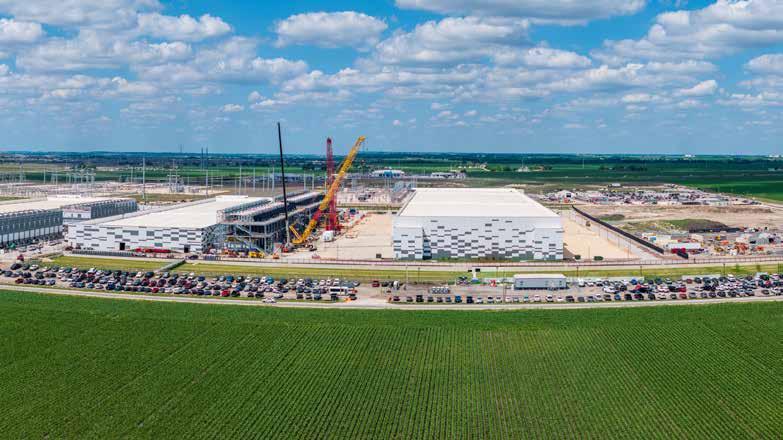
Santiago (Latin America), and Mumbai (Asia-Pacific), according to a report by Allianz’ last year, The Data Center Construction Boom.
‘There’s great opportunity for construction risk managers in this current insurance environment to capitalize on the softening market.’
While there are no clear signs that the growth in data centers has reached a peak, there could be challenges ahead that impact the industry’s upward trajectory, according to Allianz’s Tasker.
“Future demand for AI is difficult to gauge, due to rapid technological advances and various barriers to widescale roll-out. This has led some commentators to voice fears about a bubble, over-investment, and the prospect of stranded assets,” he said in the report.
Even so, Tasker said that Allianz has seen a significant increase in the number
of submissions for data centers in recent years.
Construction costs for data centers used to be in the range of $200 million to $300 million but now can cost as much as $20 billion or more, Allianz reported. The size of some larger data centers has pushed construction into more remote areas as well. That is leading to risk challenges because these remote regions may not have the infrastructure to support their activities, such as sufficient grid capacity and transportation, according to the Allianz report. Also, in remote locations data centers can be exposed to added natural catastrophe risk, particularly in U.S. regions experiencing heightened storm frequency and severe weather events, the Allianz report said.
“Typically, these large construction projects require project-specific policies given their size, and the main reason for that is an insurer who is insuring these large projects wants to ensure that all of the parties on-site have adequate coverage,” Tasker said. “Project-specific policies can include
casualty coverage, like wrap-up liability exposures and workers’ compensation, plus professional liability for engineers and other professionals. On the property side, builder’s risk covers the property while it is under construction, and project cargo covers the transportation of equipment.”
Data center construction might also include power and water treatment plants needed to fuel and operations, which is another area of growth, Tasker said. But outside of data centers, energy overall is also on an upward trend, he added.
“Conventional power, more talk around a nuclear power renaissance, and then certainly the renewable energy sector as well” are growth areas for Allianz construction, Tasker said.
So, is the construction sector still booming?
“I would still say it’s a boom,” Tasker replied. “We’re still seeing a lot of activity, a lot of submissions. We’re still seeing our contractor clients with a significant backlog of contracts. It’s just not as diversified as it was in prior years,” he said.
Spotlight: Nonprofits
Evolving Risk Landscape for Nonprofits Reinforces Need for More Than Insurance Partner
Nonprofit organizations face an increasingly complex and evolving risk landscape today as they navigate changing regulations, heightened scrutiny, and cuts to funding.
One of the most significant risks facing nonprofits stems from mission creep, where organizations begin offering services beyond their core expertise, such as a disaster relief organization that begins offering counseling services, or a food pantry that expands into basic healthcare, according to a recent report by HUB, titled Nonprofit Leader’s Guide to Managing Regulatory, Fiduciary and Governance Risks.
“While these service offerings are well-intentioned, they can inadvertently create substantial liability exposures for nonprofits without proper credentialing, training, oversight, and risk controls in place,” the report said.
Today’s interconnected risks facing nonprofit leaders demand careful attention
and risk strategy from their insurance partners. In an interview with the report’s author, Scott Konrad, HUB’s North American nonprofit practice leader, discusses a few of the most pressing issues affecting nonprofits and how insurance partners can help.
‘If you want to be successful in this sector, you need to immerse yourself in the industry.’
Are you seeing an uptick in litigation or increased exposure as funding cuts are hitting nonprofits?
is the good news right now because we’re coming into a softening phase, which is good for buyers.
Now adding to the financial challenge is what I would call regulatory turmoil that some folks are experiencing. For example, I’ve got a lot of clients that are what I would call social justice or public advocacy type organizations. And these folks are calling me asking, ‘Hey, if we become the target of a governmental investigation, congressional investigation, if we’re subpoenaed … are we covered by our insurance?’

Scott Konrad: Nonprofits are getting squeezed by funding cuts and cost creep. Half of my clients were USAID-funded global organizations, so in one fell swoop, the faucet turned off and they were laying off 20% of the workforce. For your human services organization, it’s more of a trickle-down approach. The funding cuts are happening at the federal level, then it eventually trickles down to the city or the county, and then eventually to the organization. They can’t afford to continue with the same staffing or maybe they’re winding down programs. Against the backdrop of all that, you’ve got cost creep. Employee benefits costs are going up. Labor costs are going up. Everything is going up. Insurance
Your report notes that the foundation of nonprofit risk management rests on the organization’s workforce. But as organizations face rising cost pressures and perhaps reduced funding, what role does that play in risk management?
Konrad: Some of these folks are experiencing burnout. They are experiencing mental health issues, and they need proper coverage to address those issues. And then nonprofit workers bring problems home with them at night. Sooner or later, something’s going to give. And in a worst-case scenario, maybe they’re exiting the nonprofit sector (due to work stress and burnout). So, there’s more human need for services now, but you don’t have the people to do the job. Where does that lead you?
[HUB’s report noted that this current environment of staffing shortages is creating another opportunity for risk.]

You mentioned the softening insurance market—are you seeing more competition from markets or new carrier interest in the nonprofit sector?
Konrad: I don’t know that they’re new carriers. But what I would say, at least from my perspective, [is] some of them are hungrier than they ever were before. They’re very eager to work with us… So, we’re seeing more ramping up their business development efforts with us. And I think we’re seeing some mutation of appetites. For example, I was on a call two hours ago with one of
Scott Konrad

the big household names in insurance. They play heavily in the nonprofit sector, but their appetite has historically been human services. … Now they are broadening their appetite to areas like arts and culture, religion, and social advocacy groups. So, that’s what we’re seeing. It’s not a seismic change in the business, but it’s a good thing for buyers.
What is your advice going into the second half of 2026 for nonprofit leaders and their insurance partners?
Konrad: My advice would
be the same … If you want to be successful in this sector, you need to immerse yourself in the industry. Immerse yourself in the sector to understand the big picture of what makes it tick, what are the strategic challenges that nonprofit leaders are trying to solve. Be able to talk in their language, not ours. The broker or agent who is just peddling product is totally missing the boat. … Folks are concerned about how they are going to get to the other side of this hot mess … [Funding cuts and other challenges] are
leading more organizations to re-examine what they do so they’re trying to get back to their core mission. Over the years, maybe they’ve taken on more services, or mission creep, so they’ve broadened what they offer. But maybe what they need to do now is focus on what they always did best to get to the other side. …
The other piece of this is for organizations to just develop a plan to be able to manage any crisis, whatever comes down the pipe—whether it’s a funding cut, whether it’s reputational damage, whether
it’s a cyber breach. The organization should figure out what its cataclysmic risks are, what is that handful of risks that would bring the organization to its knees and then say, “All right, how are we going to manage these risks?” And if they have a plan B for all those major kinds of risks, the likelihood that they’ll survive and be able to thrive is much greater.
The bottom line: this goes way beyond just insurance. And sometimes the answers come from our toolbox or from people that we know.
Closer Look: Umbrella
Umbrella Traps: Errors That Create Trouble in the Layers
By Patrick Wraight
There are many reasons a business or individual might buy umbrella coverage. They may have current assets that they want to shield from the potential for loss. They may also be planning to shield future assets. They may just want the added security of knowing that in the event of a catastrophic liability claim, they are protected—and with judgments on the rise, who can blame them?
The insured may need a simple $1 million umbrella policy to make sure they are in compliance with a contract; or they may be a bigger insured with the potential of a catastrophic liability claim and they may need a complex liability tower, with multiple insurance companies and excess over excess policies. In either case, there are a few ways where their liability protection could fall apart, and they may not even realize these traps exist.
Any policy wording that is quoted here comes from the ISO CU 00 01 04 13 Commercial Liability Umbrella Coverage Form. Read your full policy for details about the specific situation that your client (or you) may be in.
Did you tell the carrier about the claim?
It feels like it should be common sense that when there’s a potential claim, the carrier needs to know about it so they can investigate, mount a defense, and reserve it properly. What if the insured thinks the claim “isn’t that bad”? If you’ve been in the insurance

business for any length of time, you know that a claim can be reported and the initial assessment comes in low, but over time, it creeps up or jumps when new information surfaces.
We often look at coverages, exclusions, and definitions when we talk or write about policy language, but for our purposes here, we are focused on the policy conditions.
Duties in the Event of Occurrence, Offense, Claim, or Suit
You must see to it that we are notified as soon as practicable of an “occurrence” or an offense, regardless of the amount, which may result in a claim.
If a claim is made or “suit” is brought against any insured, you must: Immediately record the specif-
ics of the claim or “suit” and the date received; and Notify us as soon as practicable.
You must see to it that we receive written notice of the claim or “suit” as soon as practicable.
In the first sentence, we immediately learn that there’s no such thing as a claim that “isn’t that bad” when it comes to this coverage form. It wants to know whenever something comes up that may result in a claim. The amount of the potential claim doesn’t matter. It also doesn’t seem to matter whether or not there’s an actual claim. The wording tells us that the offense or occurrence may result in a claim.
In the second sentence, we learn that when a claim is made against any insured, this policy also wants the company to be notified immediately. This
may seem like a restatement of what we’ve already seen, but the difference comes from who received notice of the potential claim. In the first sentence, the claim was received by “you,” which is specific to the named insured. In the second sentence, the claim was received by any insured, which is a much broader term.
This forces us to look back at the Who Is An Insured section to discover who the policy considers an insured. We will leave that to you to read later, but everyone who qualifies as an insured according to that section could be given notice of a claim. This is also a reminder that an additional insured is an insured, and when that additional insured receives notice of a claim, this policy wants to know that, too.
The last sentence restates something that we’ve seen
three times now: The policy wants to know about any claim as soon as is practicable. According to the Cambridge Dictionary Online, practicable means able to be done or put into action. That’s a good definition, but it is open to interpretation, which means that there may be disagreement about when something is practicable.
This condition could create a situation where the insured finds themselves self-insuring a liability claim because they did not give notice as soon as it was practicable, or because they thought that the claim “wasn’t a big deal.”
Did you change any of the underlying insurance policies?
Time to be honest. Sometimes insureds make decisions and forget to tell other people about them. Like that time one of your clients bought three new vehicles and didn’t tell you until one of them was involved in an at-fault accident, or when they decided to take on work in a new state and didn’t let you know because “my workers’ comp premium might have gone up.” This deserves a look at another condition.
Maintenance of/Changes to Underlying Insurance
Any “underlying insurance” must be maintained in full effect without reduction of coverage or limits except for the reduction of the aggregate limit in accordance with the provisions of such “underlying insurance” that results from payment of claims, settlement or judgments to which this insurance applies. Such exhaustion or
reduction is not a failure to maintain “underlying insurance.” Failure to maintain “underlying insurance” will not invalidate insurance provided under this Coverage Part, but insurance provided under this Coverage Part will apply as if the “underlying insurance” were in full effect.
If there is an increase in the scope of coverage of any “underlying insurance” during the term of this policy, our liability will be no more than it would have been if there had been no such increase.
You must notify us in writing, as soon as practicable, if any “underlying insurance” is cancelled, not renewed, replaced or otherwise terminated, or if the limits or scope of coverage of any “underlying insurance” is changed.
What’s most interesting about this condition isn’t that the policy allows that coverage will apply, but that it specifically tells us that the policy is not invalidated. Here’s where other coverage forms may be different because carriers might have their own forms that tell a different story. In this case, coverage still exists, but there is one major issue to deal with.
If the insured fails to maintain the underlying coverage in the way that the insurance company doesn’t expect, this policy will respond to the claim as originally intended. That is, if there should be a $1 million occurrence limit in the underlying auto policy, and that limit is lowered to $500,000, this policy won’t pay until the indemnity payment exceeds $1 million. If there’s
a judgment for $750,000, the insured will self-insure through that.
Additionally, if the insured’s underlying policy is changed to reflect a broadening of coverage, this policy will not automatically provide that same broader coverage. Even if the underlying policy and this policy initially provided identical coverage, with the same exclusions and limitations, this policy will stay the same as it was, providing coverage in the same way it did before the change.
Failure to let this insurer know that underlying insurance has changed can create a coverage gap that could cost the insured significantly.
‘When looking over an umbrella policy, it wouldn’t be advisable to assume that the umbrella covers liability claims exactly as the underlying policies would, even if the policies are issued by the same company.’
Did you see that exclusion?
When looking over an umbrella policy, it wouldn’t be advisable to assume that the umbrella covers liability claims exactly as the underlying policies would, even if the policies are issued by the same company. This is where expertise in policy review becomes important for the insured especially.
If there is a claim that is excluded from coverage on the underlying insurance,
you can’t assume there is no coverage on the umbrella. It’s possible that the umbrella will provide coverage for that claim. It won’t be exactly like when the loss is covered by the underlying policy, which is a good thing for the insured. In the case where coverage is excluded on the underlying policy, and covered on the umbrella, the policy will act like there is no underlying policy, and that could activate the self-insured retention, which is better than one of the prior situations, where the policy says that there is no coverage because of changes.
On the other hand, if there’s a claim that is covered by the underlying policy, and excluded on the umbrella, it’s not covered. One of the worst-case scenarios is that the insured believes that there is coverage on the umbrella, and when the judgment comes in, finds out that this claim was excluded the whole time. Maybe that’s an unlikely outcome and maybe the insured will already be told that there’s no coverage. But maybe they don’t know that, and they find out that there’s a large check they need to write.
In the end, ensuring that the insured understands their umbrella coverage, including the terms and conditions of their own policy, is important so there aren’t any surprises when the claim comes in— especially surprises that could be easily and quickly avoided by complying with the policy requirements.
Wraight, CIC, CRM, AU, is director of Insurance Journal’s Academy of Insurance. He can be reached at pwraight@ ijacademy.com.
Spotlight: Carrier Technology
The Big Dog Is Off the Tech Porch
State Farm as ‘Next Gen Good Neighbor’
By Susanne Sclafane
You’d have to roll back the calendar a few decades to find a time when competitive moves by the nation’s biggest auto and home insurer were described with the phrase, “The big dog is off the porch.”
Still, against the backdrop of competition surging in the personal lines insurance market, it was hard for this “mature” journalist not to draw a parallel to the price wars of the late 1990s and AI wars that seem to be revving up in 2026 when reading a recent State Farm media statement detailing the carrier’s “Next Gen Good
Neighbor” vision.
The statement, as well as blog items posted on State Farm’s website last month from President and Chief Executive Officer Jon Farney and from Joe Park, executive vice president and chief digital information officer, promise a future-ready carrier that will focus “on even faster and simpler claims service; more competitive prices that match price to risk; and data-driven underwriting.”
“Technology underpins Next Gen Good Neighbor, building on the personal relationships that remain the foundation of State Farm,” the statement says, revealing AI-powered
tools, like one for State Farm agents that summarizes customers’ top-of-mind household concerns, and another that connects customers to support services at the start of the claims process.
Is the big dog off the tech porch with a competitive strategy to surpass national carriers barking about their AI initiatives? Or regionals touting their local human presence?
During an interview with Insurance Journal’s sister publication Carrier Management, Farney didn’t buy into the idea that the timing of the announcement was meant to signal State Farm throwing down a tech gauntlet
to competitors. But the “we have both” human and digital message is spot on, he agreed, suggesting the announcements of State Farm’s in-progress technology transformation are more appropriately seen as a reminder to State Farm employees and agents about the foundation the insurance leader is building upon with technology that will enhance their ability to deliver on promises to customers.
“We are saying to our people [that] our jobs every day [are] to make sure we’re taking care of customers today. And we believe we have a job to help customers prepare for the future,” Farney told Carrier
Management.
“And, yes, we believe that there are immensely human moments in the insurance world. While there are massive amounts of data and all kinds of information that help us run our business, this is a people-helping-people type of business. We want to be sure that our people know our technology is [here] so they can help people—serve them better.”
State Farm Is There With AI Coworkers
“In a world that can feel increasingly disconnected, State Farm agents provide local presence, trusted guidance, and community. And as we modernize, we’re doing it with the clear principle that technology should strengthen human connection, not substitute for it,” Farney wrote in a blog post, titled “A Next Gen Good Neighbor.”
“We need transformation just because customers continue to change,” Farney told Carrier Management. “We’re a growing company. We have great financial strength to be able to meet our promises. We have a strong brand and we have great people. But we know that customers are changing. And as we look forward, what a Next Gen Good Neighbor is, is it keeps those strengths, but it builds on them by adding speed and more technology,” he said.
Farney noted that State Farm brought Park on as head of technology last year. “He’s helping us bring in more AI tools that we can use to help empower our employees, our agents—all of our people to serve customers better.”
Earlier this year, Park and
OpenAI both announced a partnership through which State Farm became one of the first participants in OpenAI’s Frontier platform—a new platform that helps enterprises build, deploy, and manage AI agents that can do real work,” according to OpenAI.
OpenAI explained that Frontier “gives AI agents the same skills people need to succeed at work: shared context, onboarding, hands-on learning with feedback, and clear permissions and boundaries. That’s how teams move beyond isolated use cases to AI coworkers that work across the business.”
‘While there are massive amounts of data and all kinds of information that help us run our business, this is a people-helping-people type of business. We want to be sure that our people know our technology is [here] so they can help people—serve them better.’
At State Farm, by “implementing AI thoughtfully, we are taking practical steps to make insurance more accessible, affordable, and responsive,” said Park at the time of the announcement.
In a May blog post, Park described one of his earliest experiences visiting a State Farm agent’s office and witnessing the connection that agent made to the customer—sitting with the customer
and asking thoughtful questions but also having to “navigate screen after screen” to piece together a full customer picture from disparate systems.
“We have a systems problem. Too many disconnected tools. Too much time spent finding information instead of helping customers,” Park wrote in his post, “Empowering Next Gen Good Neighbors.”


That’s changing according to last month's media statement, which announced that State Farm is “consolidating disconnected systems into a single insurance platform, bringing data together so it is consistent and usable,” and so that work can flow without friction.
In addition to noting that State Farm’s work with OpenAI, the announcement said State Farm is working with other leading technology companies “to apply AI strategically” (without specifically naming the other tech companies). And beyond adding AI coworkers to the mix through the OpenAI partnership, the announcement said that State Farm is intent on making the insurer “a destination for well-versed top talent with the knowledge and expertise to execute State Farm’s technological transformation.”
Park, who transitioned to State Farm from his previous role as chief digital and technology officer of Yum! Brands in October last year, offered a picture of the unified technology-build, imagining a scenario where a customer starts the claim process via State Farm’s mobile app, “and at the same moment, the claims
representative has everything needed to move forward—no chasing information. And if the customer calls, the agent sees the same complete, up-to-date view.”
Beyond the single insurance platform, the recent media announcement refers to several AI tools woven into the connected system that support the Next Gen Neighbor vision.
In the claims area, the company is piloting an AI-powered virtual assistant to streamline initial loss reporting—quickly connecting customers to support services and gathering information needed to help. In addition, “tools that streamline intake, triage, and documentation” are helping claims professionals make coverage and payment decisions.
For agents, there is Navi, an AI-powered digital assistant embedded within State Farm’s agent management platform, which is being rolled out to give agents a faster path to price quotes, find policy details, and other answers. Navi will soon include the ability to check quote statuses
continued on page 38
Jon Farney
Spotlight: Carrier Technology
continued from page 37
and generate customer insight lists, State Farm promises.
Household Story is another AI tool for agents—this one, an AI-powered customer intelligence tool that provides “an instant summary of each household’s active concerns,” along with tailored product recommendations to address them.
Bridging the agent and claims world, the announcement also refers to a new agent-initiated loss-reporting tool. This one is not identified as an AI tool. According to the announcement, this tool allows agents to submit claims for customers at their request without having to make a call. For agents, another important part of State Farm’s tech transformation—soon to come—is a “single point of entry for operations support, making it easier for them to get the information they need without navigating multiple systems,” the media statement said.
Transformation in Progress
What is Farney’s personal favorite new tool? CM asked the CEO who served in many leadership roles in finance and planning before ascending to his current position on June 1, 2024. Is there something that resonates based on challenges he faced in the past?
In a financial role, “you always have questions as you’re looking at markets: ‘How do we meet what customers want in that market? Where is our opportunity to serve their needs better? How fast are we growing in this ZIP code vs. that one? And does that make sense? Do we have our pricing models tuned
right so we’re pricing the best we possibly can for our customers?’”
“The work to compile that information in the past [was] significant. The ability of these tools to help you really empower employees to make faster judgments, make choices that increase the velocity of your business to serve customers better is one from my personal past that’s very exciting,” Farney said.
‘If we can make it easy for our customers, [then] we want to be where, when, and how customers want to shop and be serviced. And some of that might be through an agentic AI agent.’
Stepping back from his own experience, Farney offered, “There’s not a role I see in the organization that can’t be empowered with better data and tools,” suggesting that improved technology can quickly provide clarity to a frontline representative answering a customer with a billing question or to a corporate communications professional handling an enterprise issue. “It can be empowering to our people in order to serve our customers in almost every role.”
Farney confirmed that although State Farm made the public announcement about its technology transformation in May, it has been in progress for some time. “I don’t know if there’s ever a period that you’re not in transformation,”
he said, referring to past transformations of pricing models and corporate structure, among others.
May’s press release, for example, noted that State Farm continues to build underwriting and pricing models with advanced data, going on to reference the existing Drive Safe & Save telematics program as an example of personalized risk-based pricing already offered for auto insurance.
Beyond past transformational efforts, State Farm is now trying to position itself differently with the announcement about the Next Gen Good Neighbor vision. “With so many questions in the world about AI and so much discussion going on, we’re trying to remind our people of the strengths—of who we are, and the things that we need to improve on in order to be able to serve people for a long time.”
“I’ve been with State Farm for 30-some years, coming up on two years in the CEO role. And my team and I have been working on this for a while. But really, we’re ready to be sure that our customers, our agents, and our employees know where we are, know all these great things about us, but also know that we don’t have our sights set on the past. We have our sights set on the future,” Farney said.
The announcement comes at a time when personal lines insurers face the challenge of an increasingly competitive insurance market, customers face affordability challenges, and State Farm itself is being scrutinized for its claims handling practices in the media and with regulators.
Does the Next Gen Good Neighbor announcement
timing have anything to do with any of those things? Does the introduction of any of these tools help State Farm to solve any of those problems? CM asked the CEO.
“In a big business, you always have issues that you’re working on. What we’re focused on is the future and positioning our people to understand how these tools and new technology, along with a culture of speed, can position us to serve customers’ needs even better into the future.”
“All of the things that you bring up are issues that all businesses have to deal with at different times. This is about our future, who we are becoming, and hanging on to our strengths from the past— not in response to anything in particular going on in the greater environment.”
As to the affordability challenges of customers, May’s media statement suggests that lower prices could follow from transformation efforts. “State Farm will continue delivering value to customers by finding new efficiencies in the way it works, improving processes, and developing and supporting employees and agents,” the release said in a section headed, “More competitive prices.” The statement also reminds readers that as a mutual, State Farm serves customers rather than shareholders—a difference demonstrated with the February announcement of a $5 billion dividend for State Farm Mutual Automobile Insurance Company auto customers.
What the Competition Is Doing
Publicly traded personal

lines competitors have offered a variety of reports on their companies’ use of AI, their customer targets, and insurance market conditions at recent investor meetings and during conferences with analysts. While some, like Berkshire Hathaway CEO Greg Abel, spoke broadly about multi-year efforts to build technology to support price-to-risk and customer-segmentation goals, others have announced launches of specific AI tools—among them, a fully agentic intelligent voice service to handle customer claim calls at Travelers.
More recently, Allstate CEO Tom Wilson, asked whether AI tools can make agents more productive during a first-quarter 2026 earnings call, noted that Allstate currently has “something called customer engagement sidekick” in market today. “If you’re doing
50 calls a day or something like that, it’s always good to have somebody say, ‘Hey, this is what I’m kind of hearing. Maybe you should go here. Here’s the tonality,’” Wilson said, offering sample assists from the sidekick to improve customer interactions.
“AI can also just sell directly. And we’re live in the market doing that right now on a particular product,” Wilson said. He didn’t reveal the product but described the AI direct sales initiative as a learning experience in three states. “It’s closing policies. We’re just seeing what we learn from that,” Wilson said.
Progressive CEO Tricia Griffith also addressed a question about the distribution impact of AI during a fourth-quarter 2025 earnings call—specifically the question of whether AI agents could
change the personal lines distribution equation for Progressive.
“If we can make it easy for our customers, [then] we want to be where, when, and how customers want to shop and be serviced. And some of that might be through an agentic AI agent,” she said, noting specifically that Progressive’s direct channel could “change dramatically” with AI agents delivering some Progressive policies. But she also sees a continued role for independent agents because customers with more complex needs desire “knee-to-knee” interactions to feel comfortable about their coverage decisions, she said.
Earlier this year, Griffith delivered commentary about how Progressive’s investments in “technology and process improvements to improve efficiency, accuracy, speed,
and our work environment” will enhance the ability to price insurance competitively in her letter to shareholders in the company’s 2025 annual report. Simultaneously, the letter noted the internal staffing impacts that have come as a result of tech improvements.
“While our staff at year end was up by nearly 4,000 more people from the prior year end, headcount has been declining modestly since the end of the third quarter, and we expect to handle significantly more customers through 2026 without increasing our headcount. People are a significant portion of our NAER [non-acquisition expense ratio] and LAE [loss adjustment expense], and consequently this will help improve those ratios, especially in light of less tailwind from changes in average premium,” continued on page 49
Idea Exchange: The Competitive Advantage

Why Are Property & Casualty Carriers So Profitable?
Property and casualty carriers have made fortunes over the last two years. In fact, they have been profitable for 30 of 31 years. The exception was after the 9/11 attacks, when they threw in all the reserves they should have made in years prior. Specific carriers used that tragedy as camouflage for past reserving sins.
economies of Peru, Greece, and Finland.

By Chris Burand
Over the last two years combined, profits totaled $317 billion. For context, according to the Congressional Budget Office, the entire U.S. Federal Government saw an increase of $317 billion in fiscal year 2025. This is approximately the ENTIRE
Even with all the nuclear verdicts (OMG! The sky is falling!), the catastrophes (global warming is ruining insurance!), and the plaintiffs’ bar successes (those attorneys are killing the industry!), etc., the carriers were still extremely profitable.
The only time in the last 30 years carriers have run into trouble is when they have made bad investments. Losses are virtually never a problem for the industry overall. In some states, the plaintiffs’ bar clearly has significant control. And in some states, regulators are asleep at the wheel. In other places, hurricanes definitely have an affinity. But overall, claims are never an issue. There’s a lot to be said for spreading risk—something more than one carrier strategist has forgotten.
Carriers lose money when they make bad investments, and when they make bad investments, hard markets often follow. The most recent hard market was largely caused by an investment loss of around $90 billion in 2022. (Compared with a recent analysis showing that nuclear verdicts might cause a loss of $5 billion per year, peanuts!) The total loss to surplus was around $70 billion. A shortage of surplus causes hard markets, not a lack of profits. There isn’t a lack of profits anyway.
Good Luck?
Why are carriers so incredibly profitable that, collectively, they could buy countries? Luck has a lot to do with it. Last year’s profits were high partially due to luck. Any

carrier that did not make a fortune in 2025 should probably replace their entire C-suite because making money last year was like taking candy from a baby. Pretty easy. It was the best underwriting year since 2006, and 2006 was an anomaly affected by the Credit Crisis.
Another reason, at least nominally, is that carriers have become better underwriters. The chart below clearly shows a downward trend in combined ratios.
But a combined ratio has two components, so there are two ways to improve it. The numerator consists of claims and expenses. The denominator consists of premiums.
The first option is to decrease claims and/or expenses. Carriers have done a remarkable job of reducing expenses over the last 10 years, which has contributed to the downward trend. Losses can be reduced by better underwriting or by insuring less, especially if a commensurate rate decrease does not occur. And carriers are insuring less property. The huge increase in property deductibles demonstrates this fact.
The other way to decrease the combined ratio is to increase rates beyond inflation and exposure growth. As noted, carriers are successfully reducing expenses, so their expenses are not driving the need to increase rates. Net written premium (NWP) growth exceeded consumer inflation and claims cost inflation almost every year over the last 30 years (the credit crisis was the major exception). NWP has also increased faster than U.S. GDP almost every year (the credit crisis, again, was the major exception), and GDP is a reasonable proxy for exposure growth. If NWP is consistently increasing faster than inflation, claims costs, and exposure growth, then it is fair to say rates are excessively high.
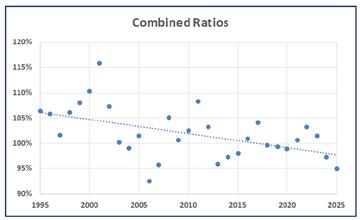
In commercial lines, these points understate the overcharging. This is because approximately 90% of corporate property is now intangible, and insurance companies are loath to insure intangible property. This means almost all of the GDP figures specific to commercial property growth are in property that insurers do not insure. If intangible property was subtracted from GDP,
the delta between GDP growth and NWP growth would be greater, but that would be the fairer measure.
ART
Smart commercial accounts practicing quality risk management understand they are being materially overcharged. This is why the alternative risk transfer options are growing so quickly.
A recent AM Best report estimated savings of approximately 40% by moving to an alternative risk transfer option. Other reports already suggest that over half of all commercial premiums are in alternative risk models, meaning what is left is skewing adverse selection.
I don’t know if most carriers understand why they want so much small commercial. The U.S. GDP needs to double to satisfy the appetite for small commercial carriers want to write. An important reason for writing small commercial is these accounts are less able to take advantage of alternative risk transfer mechanisms. The good small commercial accounts remain, whereas the good middle market and large commercial accounts can move. That is not to say all these accounts should move, but they can. Many have, and more will, because they see no reason to overpay by 40%.
Carriers jacked rates so high that they overshot in this last hard market. They somehow managed to further damage their reputation and give the plaintiffs’ bar more ammunition.
If you are an agent, get educated on these alternatives. Don’t trust everything you hear, because many charlatans exist, preying on the desperation created by this market. Develop these options because some are far more valuable than 10 additional admitted markets.
If you are a carrier, sharpen your actuarial minds and determine whether you really need to charge so much. The financials suggest you do not. Then figure out how to build a brand that positions you above your competitors who continue to overcharge.
Burand is the founder and owner of Burand & Associates LLC based in Pueblo, Colo. Phone: 719-4853868. E-mail: chris@burand-associates.com.
Idea Exchange: Directors & Officers
Directors and Officers Insurance Policy Proceeds as Estate Assets in Bankruptcy
Directors and officers of corporations take great comfort in having corporate insurance to protect challenges to their decision-making or allegations of failing to act—but are those policies cold comfort if the corporation goes bankrupt?

By Patrick M Kennell

Bankruptcy courts saw an 11% increase in filings last year, with business bankruptcy filings rising 7.1% for the 12-month period ending December 31, 2025. Directors and officers of insolvent companies can face unique liability risks when it comes to bankruptcy. A Chapter 11 filing shifts control of corporate causes of action from the company’s directors and officers to trustees, creditors’ committees, or liquidating trusts—all of which act as fiduciaries to the company’s creditors.
Estate fiduciaries regularly name directors and officers in lawsuits seeking to recover on the estate’s behalf. Once a company enters the “zone of insolvency,” directors are subject to heightened duties that expand beyond the corporation itself to include the interests of creditors. With 20/20 hindsight, pre-bankruptcy transactions and strategic decisions are heavily examined. Indeed, bankruptcy can give rise to the “deepening insolvency” theory of breach of duty, subjecting directors to allegations of misfeasance for prolonging insolvency and increasing creditor losses.
An insolvent company often involves limited or encumbered assets, and D&O insurance towers often are one of the few sources of unencumbered funds available for creditor recoveries. As the estate typically cannot indemnify directors during bankruptcy proceedings, these actions are almost certain to impact the proceeds of a company’s directors and
officers insurance policy.
Bankruptcy creates a unique circumstance in which a single fiduciary asserts an ownership interest in D&O policy proceeds as property of the estate while simultaneously seeking to recover those same proceeds from the directors and officers as damages. Compounding the issue, D&O policies are typically “wasting” policies, meaning that every dollar spent defending directors and officers against the trustee reduces the funds ultimately available for recovery by the estate if the trustee prevails.
To access funds from the D&O policy, a director generally does not need to seek bankruptcy court approval unless the policy proceeds are considered estate assets. Where insurance policy proceeds are estate assets, directors must seek court approval with a “comfort order” subject to the approval of the bankruptcy court. This provides creditors and estate fiduciaries—some of whom may be competing for those same funds in order to assert claims against the directors themselves—the opportunity to object. This can significantly delay a director’s access to defense funds, often creating protracted litigation to determine the parties’ respective rights to the policy.
‘The bankruptcy courts are in disagreement as to whether the proceeds of Side B and Side C policies are estate assets.’
A, B, or C Coverage
The Ninth Circuit’s decision in In re Minoco Grp. of Companies, Ltd. (1986) established a rather bright-line rule wherein a debtor’s insurance policies are estate assets, notwithstanding the fact that any resulting payments are made to third-party claimants rather than to the estate. However, In re Louisiana World Exposition (Fifth Circuit, 1987) departed from the standard set forth in Minoco by reframing
the inquiry: The relevant question is not who owns the policy, but who owns the policy proceeds—and to whom those proceeds are payable—in determining whether the policy constitutes an estate asset. The Louisiana World court ultimately held that insurance proceeds payable directly to company directors and officers are not estate property.
Drawing on the reasoning of Minoco and Louisiana World, the Bankruptcy Court for the District of Delaware in In re Allied Digital Technologies Corp. (2004) articulated the modern analytical framework in assessing whether D&O policy funds constitute estate assets. The analysis under this framework typically turns on whether the policy provides Side A, Side B, or Side C coverage.
Bankruptcy courts largely agree that proceeds of a debtor’s Side A policy do not constitute estate property, given that the debtor lacks any legal entitlement to those proceeds and does not receive a benefit or reduction of estate liabilities from their payment.
In addition to standard Side A coverage, companies typically opt to purchase excess Side A Difference-in-Conditions (DIC) coverage, which provides an additional layer of protection for directors in the event that the underlying D&O insurance is depleted. A key feature of a Side A DIC policy is the “drop-down provision” allowing the Side A coverage to step in and provide coverage to directors where they are unable to secure coverage from the ABC tower.
The bankruptcy courts are in disagreement as to whether the proceeds of Side B and Side C policies are estate assets. Where Side B coverage permits the debtor to obtain reimbursement for indemnification expenses incurred on behalf of directors and officers, and Side C coverage affords direct coverage to the company, the debtor may, in each case, assert a colorable interest in the proceeds such that the policies are brought within the estate.
To address this issue, the court in Allied Digital focused on whether payment of
and Myah E. Drouin
the insurance proceeds would cause the debtor to suffer a direct financial loss. If use of the proceeds to fund directors’ and officers’ defense costs would diminish an asset otherwise available to the estate, then the proceeds may be treated as property of the estate.
Post-Allied Digital, bankruptcy courts have expanded on this framework by incorporating equitable considerations which address the practical realities of disallowing access to defense costs. As such, bankruptcy courts have considered the hardships directors may face without policy funds and the administrative efficiency in avoiding prolonged motion practice and litigation over the use of proceeds. Courts have also highlighted that depriving directors and officers of their contractual rights to coverage may deter individuals who would otherwise have elected to serve as directors and officers.
In an attempt to balance the equities, some courts have adopted a modified lifting of the stay in order to permit director access to funds. For example, courts have agreed to lift the stay so long as the directors agreed to regular reporting on policy erosion.
Courts also look to whether the insurance policy contains a priority of payments provision to determine the parties’ respective rights. The court in In re MF Glob. Holdings (Bankr. S.D.N.Y. 2014) held that the ABC policy’s proceeds were not estate assets where there were no present claims against the entity, making any future indemnification obligations speculative. Further, the company was bound by the policy’s “priority-of-payments” provision which required priority advancement of policy funds to directors. More recently, this holding was reaffirmed in In re Mountain Express Oil Co. (Bankr. S.D. Tex. 2025), where the court held that insurance

proceeds are only estate property where a debtor has the right to receive the proceeds upon payment of a claim.
A similar priority of payments provision was relied on by the Southern District of New York in In re SVB Financial Group (2023), where the directors of Silicon Valley Bank faced class action lawsuits and regulatory investigations for which they sought the advancement of funds from the debtor’s ABC policy. The court saw no need to proceed to the question of whether the debtor’s side ABC proceeds were estate assets, because the plain language of the policy’s priority of payment provision provided the directors the first rights to the proceeds. Even if the directors’ defense costs would deplete the remaining ABC policy limits, the debtor was last in line for the proceeds.
Importance of Side A
The classification of D&O insurance policy proceeds as estate assets can materially affect a director’s ability to mount a defense, as such a determination may substantially restrict—or entirely foreclose—access to defense funds. Although bankruptcy courts frequently agree that ABC policy proceeds constitute estate property, the inquiry requires the court to conduct a fact-specific analysis, leaving open the possibility that directors will face protracted litigation and, ultimately, the risk of having no access to policy proceeds.
Even where policies contain protective features, such as unambiguous priority of payment provisions, the treatment of ABC policies in bankruptcy remains uncertain, underscoring the importance of maintaining robust Side A towers, as there is little dispute among the courts that Side A policies are not estate property.
Kennell is the co-managing partner of Kaufman Dolowich’s New York City office. A directors and officers (D&O) and professional liability litigator, he represents companies, boards, executives, and professionals in courts throughout the U.S. Email: pkennell@kaufmandolowich.com. Drouin is an associate in Kaufman Dolowich’s New York City office, who works within the firm’s directors and officers’ liability and insurance coverage practices.
Idea Exchange: Cyber
What to Know About Cyber-Enabled Fraud and How Insurance Can Help
As the second quarter of 2026 gets underway, cyber insurance trends are already pointing in a new direction, with cyber-enabled fraud surpassing ransomware as the risk causing the biggest concern for C-suite executives. This shift underscores the reality that fraud losses continue to balloon and that many policyholders are surprised that these losses are often covered only in part, or not at all, under many cyber insurance policies.

By Andrea DeField


According to the World Economic Forum’s Global Cybersecurity Outlook 2026 report, a recent survey of C-suite executives found that fraud and phishing have overtaken ransomware as the top cyber risks worrying CEOs, especially in organizations with less developed cybersecurity resilience. This represents a noticeable shift from 2025, when ransomware was the top cyber risk concerning CEOs. The report highlights that 73% of survey respondents experienced cyber-enabled fraud directly, or knew someone— personally or professionally—who was affected by it in 2025. Interestingly, while CEOs are most concerned about fraud, the report shows that chief information security officers (CISOs) continue to view ransomware as their primary cyber risk concern. With fraud now at the forefront for CEOs, policyholders and their brokers should take care to ensure that insurance programs adequately address this risk and that critical coverage does not fall through gaps between policies.
Cyber Fraud
Cyber-enabled fraud is often perpetuated by social engineering techniques like business email compromise (BEC), a type of cyber incident that is often used together with funds transfer fraud (FTF), where a cybercriminal compromises a business email to misdirect company funds. Cybercriminals often achieve their goal of misdirecting company funds to fraudulent accounts by using a variety of tactics. Those tactics include producing phony invoices while impersonating a company’s actual vendors; impersonating company executives by spoofing or creating an email address similar to an executive’s; impersonating attorneys and demanding wire transfers; and launching a BEC attack that uses a legitimate employee’s stolen email credentials (or a near-name/spoofed email address) to request invoice, EFT, or credit card payments from customers.
According to the Federal Bureau of Investigation, BEC attacks have resulted in more than $17 billion in reported losses in the United States in recent years. The frequency and sophistication of these attacks continue to rise, impacting organizations of all sizes and sectors and driving a significant share of cyber insurance claims.
To add another layer of uncertainty to this rapidly evolving risk, the mass deployment and implementation of artificial intelligence among companies of all sizes creates the possibility that cyber-enabled fraud attacks could become more frequent as AI continues to develop. Given that AI is already capable of generating deepfakes, eerily realistic websites, and engaging in hyper-personalized social engineering and phishing, the rate at which cyberattacks are deployed is likely to increase.
To maximize insurance coverage for cyber-related fraud losses, brokers and risk managers should consider the following when building comprehensive insurance programs.
Cyber-enabled fraud losses present unique coverage challenges.
Unlike ransomware, which cyber insurance policies typically cover, many standard cyber policies exclude coverage for social engineering losses and fraudulent transfers. Rather, many cyber insurance underwriters look to crime insurance to pick up these types of losses.
Yet, even under standard crime insurance policies, fraudulent transfers and business email compromises due to social engineering may be excluded unless endorsements are purchased adding the coverage back in, oftentimes subject to various conditions.
‘Carefully scrutinize the various insuring agreements under cyber insurance policies and crime insurance policies to ensure there are no gaps in coverage for these common risks.’
For example, some policies require that the policyholder’s employees confirm changes in banking details via a separate confirmatory call or email. Failure to comply with that condition may jeopardize coverage. Further, as with all insurance policies, wording matters. Terms like “computer fraud,” “funds transfer fraud,” or “fraudulent instruction” can create confusion concerning which option insures against a request to transfer funds that an employee received from a spoofed executive email.
Agents, brokers, and risk managers should:
1. Carefully scrutinize the various insuring agreements under cyber insurance policies and crime insurance policies to ensure there are no gaps in coverage for these common risks.
2. Ensure that policyholders understand the definitions applicable to different
S. Alice Weeks
and Madalyn Moore
kinds of losses.
3. Flag any unique conditions precedent to coverage, as well as other conditions like notice timing and proof of loss deadlines.
Cyber policies often have policy limits that may be insufficient to cover cyber-enabled fraud losses.
Where coverage for losses stemming from cyber-enabled fraud does exist in cyber policies, it is often subject to low sublimits that are much lower than the overall policy limits (often $250,000 in total coverage or less). Additionally, cyber policies may include retentions that are much larger than the applicable sublimits.
For example, a policy may have a $100,000 sublimit for fraudulent transfers but a $1 million self-insured retention. In this scenario, the policyholder must incur $1 million in covered loss before obtaining up to $100,000 in coverage for the fraudulent transfer.
These low sublimits and high retentions exist because cyber insurers often look to a policyholder’s crime insurer to cover social engineering losses in the first instance. As a result, agents, brokers, and risk managers should consider whether other policies provide additional coverage, such as crime or endorsements to property insurance policies. As noted, losses resulting from fraudulent transfers, social engineering schemes, and business email compromises resulting in the payment of money may be covered solely under standard, or endorsed, insuring agreements to a crime policy, rather than a cyber or technology errors and omissions policy.
Build suitable limits under crime insurance towers.
If the insured frequently makes large wire transfers or other payments to vendors or other parties, carefully consider what limits should be purchased to sufficiently insure common transfers at risk of social engineering schemes.
For example, construction and real estate companies may make regular transfers in the several millions of dollars range. Yet, even under crime insurance policies, coverage for these social engi-

neering schemes and fraudulent transfers is often capped at a sublimit of $250,000 or less (although commonly subject to much lower self-insured retentions than coverage offered under cyber insurance policies).
Fortunately, policyholders can purchase excess crime insurance coverage that will “drop down” to provide excess coverage over these sublimits to create total coverage in the millions of dollars, if needed.
Securing coverage for cyber-enabled fraud losses requires a comprehensive strategy.
Brokers, agents, and risk managers should also ensure their clients’ risk management strategies are regularly updated and address the latest cyber and fraud trends. Employees should receive ongoing training to recognize signs of fraud and social engineering, as proactive awareness can prevent losses before they materialize.
Further, the insured’s verification and other cybersecurity and fraud control measures are important because insurers often condition coverage for losses stemming from cyber-enabled fraud on continued on page 46
Idea Exchange: Cyber
continued from page 45
the policyholder maintaining and using specific verification methods before transferring funds. In addition, both cyber and crime insurers scrutinize cyber controls and proactive readiness in the underwriting and renewal process.
Brokers, agents, and risk managers
should identify the specific procedures mandated by the policy or represented to the insurer during the application process, and confirm those requirements are being followed. Ideally, this will not only avoid post-claim denials of coverage (based on a potential misrepresentation in the insurance application

45 results for ‘demolition’
about various policies or controls) but may also prevent the loss in the first instance.
Cyber insurance applications are very detailed, and when completing applications, all key members of a company’s IT team, legal team, and business team should be involved to ensure that responses to application questions are accurate and complete. Experienced coverage counsel and skilled insurance brokers should assist policyholders in reviewing these applications for completeness and to avoid ambiguities.
As cyber-enabled fraud is taking center stage, agents, brokers, and risk managers should ensure that insurance programs are adequate to cover cyber-enabled fraud losses, identify any sublimits and retentions that could limit recovery, and coordinate cyber and other policies so there are no gaps in coverage for a loss. Additionally, introducing clients to available training, assisting in the development of well-practiced cyber incident response plans, encouraging investment in cyber controls, and educating insureds on the application process (and the need for complete and accurate responses therein) are key ways to ensure clients are adequately protected.
By pairing those controls with a well-negotiated insurance renewal strategy, agents, brokers, and risk managers will help manage a risk that is growing in both frequency and sophistication.
DeField is a partner at Hunton Andrews Kurth LLP, where she leads the firm’s cyber insurance practice and serves as a firmwide hiring partner. She has guided clients through insurance claims for some of the most widely publicized international cyber incidents from 2020 to the present. Email: adefield@ Hunton.com.
Weeks is an associate at Hunton Andrews Kurth LLP, where she handles all aspects of insurance coverage and bad faith litigation, with an emphasis on cyber insurance. Email: aweeks@Hunton.com.
Moore is an associate at Hunton Andrews Kurth LLP, where she handles complex insurance litigation and advises policyholders in insurance coverage matters involving property and business interruption losses, commercial liability insurance, and cyber insurance. Email: mmoore@Hunton.com.
Idea Exchange: Ask the Insurance Recruiter

Time Is the Best Indicator of Recruiting Success
By Mary Newgard
Insurance agency leaders often ask me how their recruiting stacks up against others. It’s a fair question, especially when even small delays can cause an agency to fall behind.

By Mary Newgard
When hiring goals are missed and jobs are open for a long time, the gap compounds quickly, and the pressure builds with each passing week, month, and quarter. The longer it takes to identify, engage, and move candidates forward, the harder it becomes to meet your hiring goals.
Time is the clearest signal of how well your hiring approach is working. As an insurance recruiter, I measure success not just by the outcome but when hours and days slip away because those moments reveal the true strengths and weaknesses of a process. Moving quickly keeps candidates engaged, builds excitement, and gives your agency a polished look. Moving slowly gives job seekers time to explore other options or lose interest as well as room for your competitors to step in.
Following are easy ways you can use time as a guide to reveal if your recruiting rhythm is strong or you need to improve your hiring approach.
24
Hours
Completing these steps within a day shows your agency has strong organization and consistency:
• Posting a job within a day of finalizing the description.
• Sharing HR screening notes quickly with hiring managers.
• Sending interview details immediately after scheduling.
• Debriefing with hiring managers right after interviews.
• Converting a verbal offer into a written one without delay.
• Sending any additional information candidates need for next steps.
48 Hours
A steady two-day rhythm keeps momentum going:
• Sending a warm message or scheduling the first conversation after an application.
• Reviewing resumes and confirming interview selections.
• Providing timely interview feedback.
• Calling candidates after they accept an offer to prep them for next steps.
• Discussing their resignation plan and preparing for counter offers.
• Offering guidance so candidates know what to expect from onboarding.
Once a Week
Weekly habits help maintain order and prevent slowdowns:
• A short HR and hiring manager check-in to stay aligned.
• Confirming no applications or candidate files were missed.
• Connecting with candidates on LinkedIn.
• Notifying applicants who are no longer under consideration.
• Reviewing posting performance and compliance.
• Encouraging referrals and outreach through employees and external centers of influence.
Time gives you immediate insight into how well your recruiting process performs. Faster steps show candidates they matter, keep your team aligned, and prevent bottlenecks from building. When you consistently measure and improve your timing, you create a smoother, more predictable hiring experience—one that helps you avoid bottlenecks and secure talent before anyone else.
Newgard is partner and senior search consultant for Capstone Search Group, a national recruiting firm dedicated to the insurance industry. Email: asktherecruiter@ csgrecruiting.com.
Research & Trends Center
Search dozens of topics and trends like cyber risk, artificial intelligence, customer experience, marketing, agency growth, and many more.
Access hundreds of high-quality white papers, webinars, reports, articles, and other resources. The majority are absolutely free.

Spotlight: Carrier Technology
continued from page 39
she wrote.
“We are very clear that our strategy is not to be the low-cost leader in the industry but to have a competitive cost structure which, in concert with industry-leading pricing segmentation and accurate claims handling, ensures competitive prices for new and existing customers,” she wrote, indicating Progressive’s intention to continue to drive down the NAER and LAE ratios over the long term to fuel future growth.
More recently, during a first-quarter 2026 earnings call, Griffith and Personal Lines President Pat Callahan spoke about an increased focus on customers who bundle home and auto in 2026, following a year in which Progressive’s written premium growth for just private passenger auto represented 86% of the growth recorded by the top 10 carriers ($8.9 billion for Progressive vs. $10.4 billion for the top 10, according to Griffith).
“It’s an area where captive or exclusive agent companies own a large portion of that market share,” Callahan said, noting a high level of competition for bundlers. “And as we know, those companies that are mutuals or in some cases reciprocals have different objective[s] and a different time horizon for how they think about pricing their products.”
All Customers Wanted
Farney said that customers are changing, prompting CM to ask whether State Farm is looking to attract a new cohort of policyholders. Is the current distribution of customers skewed to younger or older customers? Renters or bundlers? And is that changing?
“We’re a mutual company. So, we want to serve all customers really well,” he stated. “Our past success in our current book is largely bundlers. We were bundling before bundling was cool,” he said, also referring to State Farm’s “extremely large auto business” and its leading position in the homeowners market—“double our closest competitor.”
“We insure about one in every five homes in America. So, we want to continue to be able to package the right products
to meet the customers’ needs. And when we do that, we can also offer them the best price possible because we understand those risks across all their product lines even better,” he said, referring to actuarially justified discounts available as customers insure more things.”
“We think that those customers have their needs served wonderfully by State Farm, and they also are more sticky. They stick with State Farm longer,” he said,
give leaders closest to the workforce “the context of what our mission is today and what we’re trying to become.”
Then, leaders’ roles are to be “in constant communication” so that employees “can be co-creators of our future. We think our people are incredibly important in helping create our future.”
“We have new executives that join our team and we say, ‘Go out and get close to customers. Spend time in agents’ offices so that you can see what today’s problems are and what tomorrow’s opportunities are,” Farney said.

referring to bundlers.
“At the same time, we know [that] different customers want different things. And so that’s where we think this combination of the best technology and the best people can meet a broad range of customers’ needs,” Farney stated.
Leading Transformation
Asked about his role in leading State Farm’s technology transformation, Farney said it’s most important to set the stage where people can be at their best. “As CEO, I’m talking with our people a lot about what it means to become a Next Gen Good Neighbor. But rather than setting every choice, what you’re really trying to do is set the ethos—stay true to our values and unleash the power of new tools so that people can be their best at meeting customers’ needs and finding the opportunities that help us serve customers better.”
“That’s what I really view my job as—it’s telling the story and positioning people to be their best.”
“You have to step back and [ask], ‘Am I creating the right context for people? Am I positioning them to make this longer-term journey successful?’” Farney replied.
“That is a series of a lot of conversations,” he said, referring to the need to
“We’re really setting a vision of what a Next Gen Good Neighbor is and how their role is so critical in being a local face of State Farm in their community to serve customers’ needs.”
“We’re going to invest in them … We know they’re an important part of our past. We believe they’re a really important part of our future too,” Farney concluded.
Sclafane is Executive Editor of Carrier Management, a publication of Wells Media Group serving property/ casualty insurance carrier executives.
Closing Quote
Why AI Will Redefine Independent Agency Performance

By Bob Bondi
Independent insurance agents are entering the most transformative era in the history of insurance distribution. Artificial intelligence is already reshaping underwriting, claims, marketing, and service workflows. The question is not whether independent agents will be affected but how they choose to respond. Independent agents who embrace AI will exponentially increase their relevance, capacity, and competitive advantage.
Why AI Will Not Replace Agents
Insurance has always been a product that is bought, not sold. Consumers and business owners actively seek guidance when making complex risk decisions that affect their property, livelihood, and financial stability. That guidance rests on three capabilities AI cannot replicate: physical inspection and environmental awareness;
human-to-human trust; and experienced, contextual risk assessment. These are the foundational strengths of the independent agent. AI does not replace them; it amplifies them.
This is not the first time agents have confronted a supposed existential threat. When carriers expanded direct distribution for personal lines, many predicted the decline of the independent model. Instead, agents adapted by leaning into technical expertise, complex risks, and relationship-driven value—areas where direct channels consistently struggled.
Earlier this year, headlines once again stirred alarm when an online agency released a ChatGPT-powered personal auto comparison tool. The announcement triggered immediate stock volatility for several major carriers and renewed anxiety about distribution disruption. But rather than signaling erosion of the independent agent’s value, it highlighted something far more important: the urgency for agents to stay agile, current, efficient, and responsive. These are precisely the capabilities that AI strengthens when implemented strategically. Independent agents will not win by drifting toward commoditized, transactional business. They will win by leaning deeper into their advisory role, using intelligent tools to enhance insight, speed, and service while preserving the human
judgment and trust that remain irreplaceable.

AI Use Is Rising Rapidly Findings from the 2025 Independent Agents at Work Study offer the clearest snapshot yet of AI adoption across agencies. One in three employees (≈33%) used AI in the past year, and 57% expressed interest, early indicators of accelerating adoption and widening performance gaps. Younger employees (Millennials and Gen Z) are leading adoption, and the fact that only 12% of agencies have an AI policy shows that usage is emerging organically from the bottom up. This presents opportunity and risk. Without proper guidelines, agencies may inadvertently expose themselves to privacy issues as employees test generic, thirdparty AI tools with client data. The motivations behind adoption are consistent and revealing. Operational efficiency (60%) and productivity gains (52%) are the primary advantages, while concerns center on data privacy (24%) and inaccurate outputs (22%). These concerns are particularly acute when staff rely on public AI systems not designed for the specificity of insurance. Together, these motivations and risks are pushing agencies toward trusted partners and networks capable of delivering private, purpose-built AI systems—tools designed to enhance human expertise, not replace it.
The Productivity Leap Independent agencies currently average roughly $200,000 in revenue per
employee, according to Agency Merger Advisors. AI is poised to multiply that number.
Agents and account managers who once supported a fixed portfolio of clients will soon support two, three, or even five times the volume, without diminishing service quality. This shift comes at a pivotal moment:
• Talent is increasingly difficult to recruit.
• Veteran insurance professionals are retiring.
• Younger staff expect modern tools.
• Client expectations continue to rise.
AI does not eliminate jobs; it eliminates bottlenecks. It reallocates human time toward advising, consulting, and selling—the value centers that drive agency growth.
The Future: Agents Powered by AI, Not Competing with It AI is not the competitor. AI is not a threat. AI is the next-generation toolkit that makes independent agents faster, smarter, and more competitive. Agents who embrace AI will:
• Produce more with less staff.
• Win more complex accounts.
• Deliver better, more responsive client experiences.
• Strengthen carrier relationships.
• Operate with unmatched speed and accuracy.
Most importantly, they will elevate what makes independent agents irreplaceable: human judgment, empathy, and expertise.
Bondi is CEO of Renaissance, a network of independent insurance agencies.







Specialty underwriting is as much art as analysis. These islands of risk demand bold expertise—where the unknown becomes knowable, and the impossible is nothing. Experience the confi dence only Applied delivers. Learn more at auw.com or call (877) 234-4450.