














On Feb. 9 public insurance broker stocks fell by 9% on the news that two digital companies had launched chat-bot assistants using ChatGPT’s tools. While the valuation of those brokers’ stocks have largely recovered, at least a few analysts suggest that thinking may be premature.
In a report by BofA Global Research, “Putting numbers around insurance agent/broker AI disintermediation risk,” analysts reported that at least $15 billion of independent agency commissions and broker fees-those considered “low complexity”-are at risk for some disintermediation. Analysts estimate in total U.S. independent agency commissions/broker fees were in excess of $100 billion in 2025.
The report looked at six carriers catering to small business and personal lines, including Travelers (Select Accounts and Personal only), Hartford (Small Business and Personal only), Progressive, Cincinnati Fin’l, Hanover and Selective. In review of those carriers, BofA said they believe that over $15 billion of commissions, largely skew toward low-complexity, are at-risk.
“There are clearly other carriers-most notably Liberty Mutual-who generate additional billions in commissions that also can skew toward low complexity. Public insurance agent/ broker disclosure tends to be very thin, making it difficult for investors to estimate what proportion of their commissions skew toward low complexity,” the report said.
The report’s authors added that they are not suggesting a “mass disintermediation ofr the entirety of a business” but believe a “non-immaterial minority of the business” could be a risk.
“Our view is that large-language model digital agents can effectively do a non-immaterial portion of the work currently provided by 20-30k independent agents across the United States,” the report stated. But nothing is certain. “As with many theses regarding technological innovation, the future is hard to predict,” the authors wrote.
‘Our view is that large-language model digital agents can effectively do a non-immaterial portion of the work currently provided by 20-30k independent agents across the United States.’
For now, it seems large commercial risks are not “at-risk” for AI disintermediation. The complexity of such risks and the value that an agent and broker provide to these insureds cannot be replaced.
Still, the report noted there could be a “deflation” in large-case business.
“While we do not expect large insurance buyers to use digital agents to purchase insurance, we do expect A.I. will de-mystify insurance markets,” the analysts wrote. “Sophisticated insurance buyers will benefit from the deflationary impact of technological innovation, potentially reducing pricing power for their services.”
Chairman of the Board Mark Wells | mwells@wellsmedia.com
Chief Executive Officer Joshua Carlson | jcarlson@insurancejournal.com
ADMINISTRATION / CIRCULATION
Chief Financial Officer Terry Freeburg | tfreeburg@wellsmedia.com
Circulation Manager Elizabeth Duffy | eduffy@wellsmedia.com
Staff Accountant Sarah Kersbergen | skersbergen@wellsmedia.com
EDITORIAL
V.P. of Content Andrea Wells | awells@insurancejournal.com
Executive Editor Emeritus Andrew Simpson | asimpson@wellsmedia.com
National Editor Chad Hemenway | chemenway@insurancejournal.com
Southeast Editor William Rabb | wrabb@insurancejournal.com
South Central Editor/Midwest Editor Ezra Amacher | eamacher@insurancejournal.com
West Editor Don Jergler | djergler@insurancejournal.com
International Editor L.S. Howard | lhoward@insurancejournal.com
Content Editor Allen Laman | alaman@wellsmedia.com
Assistant Editors
Jahna Jacobson | jjacobson@insurancejournal.com
Kimberly Tallon | ktallon@carriermanagement.com
Columnists & Contributors
Contributors: Mike Fletcher, Kathleen V. Gatti, Cort T. Malone, Trindl Reeves, Susanne Sclafane
Columnists: Chris Burand, Anita Nevins, Mary Newgard, Catherine Oak, Bill Wilson
SALES / MARKETING
Chief Marketing Officer
Julie Tinney | jtinney@insurancejournal.com
West Sales Dena Kaplan | dkaplan@insurancejournal.com
Romeo Valdez | rvaldez@insurancejournal.com
Kelly DeLaMora | kdelamora@wellsmedia.com
South Central Sales Mindy Trammell | mtrammell@insurancejournal.com
Southeast and East Sales (except for NY, PA, CT)
Howard Simkin | hsimkin@insurancejournal.com
Midwest Sales
Lisa Whalen | (800) 897-9965 x180
East Sales (NY, PA and CT only)
Dave Molchan | (800) 897-9965 x145
Advertising Coordinator
Erin Burns | eburns@insurancejournal.com
Insurance Markets Manager
Kristine Honey | khoney@insurancejournal.com
Sr. Sales & Marketing Coordinator
Laura Roy | lroy@insurancejournal.com
Marketing Director Derence Walk | dwalk@insurancejournal.com
DESIGN / WEB / VIDEO
Graphic Designer
Chris Johnson
Web Team Lead
Josh Whitlow | jwhitlow@insurancejournal.com
Ad Ops Specialist
Jeff Cardrant | jcardrant@insurancejournal.com
Web Developer Terrance Woest | twoest@wellsmedia.com
Web Developer Jason Chipp | jchipp@wellsmedia.com
Digital Content Manager
Ashley Cochrane | acochrane@insurancejournal.com
Videographer/Editor
Ashley Waldrop | awaldrop@insurancejournal.com
ACADEMY OF INSURANCE
Director Patrick Wraight | pwraight@ijacademy.com
Online Training Coordinator
George Jack | gjack@ijacademy.com

Andrea Wells V.P. of Content
With more than one billion miles traveled since 2016, PHLYTrac is a proven GPS tracking system that helps organizations correct dangerous driving and lower costs. See real-time updates on driver behavior and fleet conditions. Reduce driver risks like hard braking, hard acceleration, speeding, and more, all while reducing losses by nearly 20%. Get started with PHLYTrac and experience the PHLY difference.

Ann D’Amicantonio EVP/Chief Integration Officer


By Chad Hemenway
Small- and medium-sized businesses (SMB) are especially at risk of being struck by a new trend: a rise in cyber privacy litigation.
“Privacy risk is no longer just about data breaches,” said Andy Thomas, CEO of KYND.
A new report from the Austin-based cyber risk intelligence company said everyday website tracking and digital wiretapping have spawned an sharp increase in privacy lawsuits. Cases used to total in the hundreds per year. Now the tally has eclipsed 2,000.
“What may seem like a minor compliance issue is becoming a repeatable and scalable source of litigation, particularly across the SMB market,” Thomas added. “We’re seeing a shift toward claims driven by everyday website behavior. For insurers, this creates a new challenge. These risks are scalable, often hidden, and can accumulate across portfolios in ways that are difficult to detect without the right visibility.”
‘What may seem like a minor compliance issue is becoming a repeatable and scalable source of litigation, particularly across the SMB market.’
Claims focus on businesses’ collection and sharing of user data activity recorded when visiting a website. According to KYND, this data can be used to identify users without their consent—even without entering personal information. This data collection can be challenged under laws that do not require proof of financial harm, added KYND.
At a cyber conference held by Zywave late last year, panelists said insurers were re-evaluating broad privacy coverage within cyber policies to adjust to a rise in privacy litigation. Traditionally, coverage for privacy losses was triggered by a data breach, but regulatory changes in the U.S. and elsewhere have widened the exposure so much so that a breach doesn’t neces-
sarily need to be the precursor for privacy litigation.
KYND’s research based on about 10,000 North American organizations found about 18% had tracking technologies operating with no visible user consent. The percentage is higher among SMBs, who use common website configurations and third-party tools for analytics and marketing pixel-trackers. KYND said SMBs are also more likely to be affected due to a combination of factors like default website tools and limited technical resources. Meanwhile, there is a growing use of legal frameworks by plaintiffs’ attorneys that allow claims to be brought at scale.
Privacy claims are high-frequency, low-severity occurrences but can accumulate into significant losses across an insurer’s portfolio since the same tracking practices are used by many businesses.
The risks are in plain sight, and using the data for underwriting and portfolio monitoring can identify exposures earlier to “differentiate risk more effectively, and avoid unwanted accumulation,” Thomas said.



















11-16
The number of named storms forecast by AccuWeather experts for the 2026 Atlantic hurricane season, including four to seven hurricanes and two to four major hurricanes of Category 3 strength or greater. The season starts June 1 and lasts through November.

4
The number of years Florida man Thomas A. George faked a debilitating brain injury in hopes of receiving a $6.6 million insurance settlement following a 2019 crash with an oil company truck. He and cohort Tamika Hampton claimed that George would need a lifetime of care and could no longer walk or talk. In 2023, a traffic stop exposed the fraud. In February 2026, the couple pleaded “no contest” to insurance fraud charges.


$2.65 Million
The amount Pennsylvania is seeking in penalties from UGI Utilities Inc. over the March 2023 natural gas explosion at the R.M. Palmer chocolate factory that killed seven workers and injured 10 others. The Pennsylvania Public Utility Commission’s formal complaint alleges 27 violations of state and federal safety regulations governing natural gas distribution systems.

0.3%
The amount of THC allowed in smokable Texas hemp products under Texas Department of State Health Services regulations that went into effect March 31. Hemp retailers say the regulation eliminates popular, smokable hemp products, such as rolled joints and flower buds, which make up more than 50% of some stores’ inventories.

$500 Billion
The cost of SoftBank Group Corp.’s proposed single-campus, data center-focused project in Ohio, according to CEO Masayoshi Son. At 10 gigawatts, the center would be among the largest—if not the largest—in the world.



















“Limiting consumers to only the most expensive coverage just made buying a home that much more difficult and created real harm for the homeowners market. The vast majority of mortgages are backed by the (government-sponsored enterprises), and so keeping costs needlessly high probably prevented some consumers from becoming homebuyers.”
— Neil Alldredge, president and CEO of the National Association of Mutual Insurance Companies, discussing homeowners insurance required by Fannie Mae and Freddie Mac. Requirements are reverting to actual cash value coverage, reversing a February 2024 change.

“We’re not really fortifying homes by putting on a new roof. An old roof is a maintenance item, not an insurance matter.”
— Florida state Rep. Brian Hodgers, R-Viera, arguing that Florida’s $833 million My Safe Florida Home mitigation program has some glaring issues that do little to reduce insurance costs. Hodgers, one of two insurance agents in the Legislature, filed a bill that would have revamped the program by allowing roof replacement matching grants only if an existing roof fails to meet state building code standards. Program inspectors also would have to verify, under penalty of perjury, that grant-recipient homes have been properly retrofitted.

“The claimant’s attempt to bring Abbott’s backpack to their new table was within the scope of her employment. Abbott’s backpack contained her work laptop and various other personal items, including personal notebooks related to work.”
— A deputy commissioner whose notes swayed the Virginia Workers’ Compensation Commission (VWCC) to affirm benefits for an Abbott Laboratories employee who suffered a cervical spine injury at the company’s national sales conference when she attempted to move her manager’s heavy backpack. The VWCC concluded the claimant’s attempt was an “exercise of common courtesy and good judgment.”

“The conduct alleged in the Social Media Litigation—even when viewed through the lens of negligence—describes deliberate acts rather than accidents under the policies. Because the court’s determination regarding Meta’s intent is based strictly on the face of the underlying complaints, it does not ‘overlap’ with the factual truth of the allegations to be litigated in California.”
— Delaware Superior Court Judge Sheldon K. Rennie ruling insurers, including Hartford, Chubb, and more than 20 others, do not have a duty to defend Meta Platforms in the thousands of lawsuits that allege its social media platforms harm children. Meta, incorporated in Delaware, has 30 days to appeal.

“This trial shows how systemic insurance fraud can be, involving all types of bad actors, from attorneys and medical providers to criminals willing to cause accidents on Louisiana roads. These schemes are not only dangerous—they also drive up the cost of insurance for all drivers. I am committed to working with our law enforcement partners to stop criminals like these and make Louisiana a national leader in the fight against insurance fraud.”
— Louisiana Insurance Commissioner Tim Temple on a case involving two New Orleans personal injury attorneys who were found guilty of staging fraudulent accidents. The defendants will be sentenced in July.

“Homeowners trust contractors or businesses with their hard-earned money. Breaking that trust harms customers and undermines honest professionals.”
— Ohio Attorney General Dave Yost on lawsuits against contractors filed in three counties, which allegedly defrauded consumers of $564,000 combined. All four lawsuits allege violations of the Ohio Consumer Sales Practices Act and include allegations against three home-improvement contractors and a builder of outdoor structures, accusing them of shoddy work, incomplete work, work that was never initiated and a refusal to issue refunds.
And

Let’s start something.

By Andrew G. Simpson
ADelaware judge has ruled insurers do not have a duty to defend Meta Platforms in the thousands of lawsuits that allege its Facebook and Instagram platforms harm children.
Superior Court Judge Sheldon K. Rennie ruled Meta’s insurance companies are not obligated to provide its defense because the allegations against the company describe deliberate and intentional acts rather than accidents or occurrences that would trigger coverage under the commercial general liability policies. The judge also found that Meta would not be prejudiced by a Delaware coverage ruling at this time.
Thousands of suits have been filed on behalf of children who used Meta’s platforms, as well as by more than a thousand school districts and 43 states. The lawsuits have been consolidated into two actions in California. Known as the Social Media Litigation, the complaints allege Meta intentionally designed addictive algorithms and features on Instagram and Facebook that allegedly cause young users to suffer mental health issues, including anxiety, depression, and eating disorders.
Hartford, Chubb, and more than 20 other insurers sought a declaration in Delaware, Meta’s state of incorporation, that they owe no duty to defend Meta in the Social Media Litigation.
In Meta’s view, the design choices it made constituted accidents and are thus covered by its insurance because it did not intend to cause the alleged resulting harm.
However, insurers successfully argued the complaints do not need to allege Meta intended to cause harm, just that Meta intended to engage in certain conduct, and the conduct resulted in harm. Because the harm allegedly flowed directly from deliberate design choices, the insurers argue the “accident” requirement of the insurance policies is not met.
Meta asked that any ruling about coverage be dismissed or delayed until after the litigation is completed. It maintained that California law dictates coverage litigation must be stayed pending resolution of the underlying action when the coverage litigation turns on facts to be litigated in the underlying action.
The insurers said California law does not mandate a stay in this case because the court is not making factual determinations
regarding intent, causality, or knowledge.
Judge Rennie agreed with the insurers, ruling: “The conduct alleged in the Social Media Litigation—even when viewed through the lens of negligence—describes deliberate acts rather than accidents under the policies. Because the court’s determination regarding Meta’s intent is based strictly on the face of the underlying complaints, it does not ‘overlap’ with the factual truth of the allegations to be litigated in California.”
The ruling applies only to the duty to defend, and not to indemnification, which could require discovery into the facts. Meta has 30 days to appeal the matter to the Delaware Supreme Court.
Insurance policyholder attorney Tae Andrews of the firm Calfee, Halter & Griswold LLP is disappointed but not surprised by the Delaware court ruling. “In short, this is nothing new but continues the Delaware state courts’ trend of hollowing out the duty-to-defend standard from what should be a broad standard into a much narrower and difficult one for policyholders,” Andrews, who was not involved in the Meta case, told Insurance Journal.
Andrews pointed to a 2022 opinion in which the Delaware Supreme Court held that Chubb had no duty to defend Rite Aid against suits brought by Ohio counties over the cost of responding to the opioid epidemic because the underlying actions only sought recovery of economic losses.
For insurers, the ruling could be a major victory setting a precedent that claims like those in the Social Media Litigation do not trigger defense or indemnity coverage under standard policies.
The court rejected Meta’s claim it would face potential prejudice in the underlying litigation if the ruling on defense coverage was not stayed. To the contrary, such a stay would prejudice the insurers, the court found.
“An insurer’s duty to defend must be assessed at the outset of a case. Just as the insured is entitled to a prompt defense if coverage is possible, an insurer is entitled to a prompt exit when there is no potential for coverage. Delaying this determination through a stay would force insurers to fund a defense they do not legally owe,” the opinion added.


Beazley, kWh Analytics
Specialty insurer Beazley reached an agreement to acquire kWh Analytics. Terms of the deal were not disclosed.
kWh Analytics, a managing general agency, combines data with advanced analytics to deliver insurance and risk management solutions for clean energy assets in the U.S.
Beazley said kWh Analytics will add scalability and enhance its capabilities in modeling, underwriting and risk management across renewable energy portfolios. San Francisco, California-based kWh Analytics will be part of Beazley’s MAP (Marine, Accident & Political) Risks team.
kWh CEO Jason Kaminsky will report to Tim Turner, group head of MAP Risks and be a part of the transition underwriting strategy, led by Kelly Malynn, senior risk manager.
Last month, Zurich Insurance Group said it had agreed to buy London-based Beazley for $10.9 billion.
kWh’s licensed insurance subsidiary, Solar Energy Insurance Services, recently announced a renewal agreement with Aspen Specialty, expanding support of its property insurance offering for renewable energy assets and projects.
Risk Theory, Roundhill Express
Risk Theory, a specialty insurance platform, completed the acquisition of Roundhill Express, a specialized managing
general agent (MGA) underwriting commercial habitational properties throughout New York City.
Following the acquisition, Roundhill Express will continue operating under its established brand.
Founded in 2013 and headquartered in Dallas, Risk Theory operates 15 specialty programs across seven brands, with distribution reaching more than 2,000 producers nationwide.
The transaction marks Risk Theory’s first MGA acquisition. Policies written through the Roundhill Express platform will be supported by Amherst Specialty Insurance Co., Risk Theory’s affiliated surplus lines carrier.
Amherst Specialty, Jet Insurance Co.
Amherst Specialty recently acquired Jet Insurance Co., now operating as Amherst National Insurance Co.
Jet provides primarily surety bonds in the admitted market and joined Amherst Specialty as a 100% wholly owned subsidiary.
Patriot Growth Insurance Services acquired a new strategic partner, Morse Insurance Agency, a property/casualty insurance agency based in North Easton, Massachusetts.
Morse Insurance Agency operates multiple locations across the state, including offices in North Easton, Norton, Bridgewater and Marion. Morse Insurance Agency will continue to operate under its
existing leadership while gaining access to Patriot’s expanded resources, strategic support and growth capabilities.
Founded in 2019, Patriot has more than 2,200 employees operating in over 100 locations across 29 states. Patriot is backed by GI Partners and Summit Partners.
Totalis Program Underwriters, ShoreOne Insurance Managers
Coastal-focused homeowners and flood insurance broker ShoreOne Insurance Managers, Inc. has been acquired by Totalis Program Underwriters, a New York specialty insurance platform that is part of NFP, an Aon company.
Terms of the deal were not disclosed. However, BrightShore Insurance Co., founded by ShoreOne, is not part of the transaction and will retain its current ownership.
Dedham, Massachusetts-based managing general agent ShoreOne offers a homeowners product that integrates comprehensive flood coverage, serving coastal markets across South Carolina, New Jersey, New York, Massachusetts and Rhode Island.
ShoreOne was founded in 2019 by Cameron Rhodes and Nick Steffey. It will continue to operate as an independent business unit within Totalis. Rhodes will succeed Nick Steffey as chief executive officer and report to John Mahoney, head of programs, Totalis. Steffey will remain involved with ShoreOne as an executive advisor, while maintaining his role as chairman of BrightShore.
Inszone Insurance Services, Ohio Valley Insurance
Inszone Insurance Services, a provider of commercial, personal, and benefits insurance solutions, expanded its footprint in the Midwest through the acquisition of Ohio Valley Insurance, an established independent insurance agency.
Ohio Valley Insurance was founded by Dan Hardaway in 2003 as Ohio Valley Crop Insurance. The Ohio Valley Insurance team will remain in place, continuing to serve clients locally with the added backing,
technology, and market access of Inszone Insurance Services.
Murray will stay on with Inszone, maintaining his active role in client service and agency leadership.
Through the acquisition, Inszone said it plans to further develop and expand its agricultural capabilities to better serve farming communities and agricultural businesses across the Midwest and beyond.
Relation Insurance Services acquired the assets of Rummel Associates Inc. Terms of the transaction were not disclosed.
Specializing in both commercial and personal insurance, Rummel is based in Chicago, Illinois.
Jared Rummel, owner of Rummel Associates, will continue managing that office as a valuable part of the Relation family.
Rummel was established in 1948.
Inszone Insurance Services acquired Jaffery Insurance & Financial Services, an independent insurance agency based in Omaha, Nebraska. This acquisition marks Inszone’s entrance into the Nebraska market and the company’s growing presence in the Midwest.
Founded in 2019 by Cyrus Jaffery, Jaffery Insurance specializes in personal lines with a focus on home and auto coverage.
Clients of Jaffery Insurance & Financial Services will continue to work with the same trusted agents while benefiting from Inszone’s expanded carrier access, advanced tools, and nationwide support.
WalkerHughes Insurance, Hometown Insurance Agency LLC
WalkerHughes Insurance acquired Hometown Insurance Agency LLC, located in Independence, Missouri. This partnership marks WalkerHughes’ entry into the Kansas City metropolitan area.
Hometown Insurance Agency team members will remain with the firm.
WalkerHughes is a privately held, founder-led retail insurance brokerage headquartered in Indianapolis, Indiana.
TPG, Third Wave Insurance, Palmer & Cay
In a three-way deal, TPG, an asset management firm, launched an insurance brokerage with offices in South Carolina.
That brokerage, Third Wave Insurance, has acquired Palmer & Cay, an insurance and employee benefits brokerage in Atlanta.
Palmer & Cay, founded in 1968, will serve as the flagship retail business for Third Wave and will continue to operate under its own name. Palmer & Cay focuses on commercial coverage for midsized to large corporate clients. Jack Cay is CEO and is the fifth generation of Cay family members to lead the firm.
Third Wave, with headquarters in Bluffton, South Carolina, offers a producer-focused model aimed at speeding the process. Brian Bair, an insurance industry veteran, is founder and CEO.
TPG, with offices in San Francisco, has $286 billion of assets under management.
Relation Insurance Services, Chinook Insurance Group LLC
Relation Insurance Services acquired the assets of Chinook Insurance Group LLC, based in Seattle, Washington.
Chinook Insurance Group focuses on commercial clients and brings specialized expertise in insurance services for the subsea and aquaculture industry.
The company also has additional expertise across directors and officers liability, employment practices liability, professional liability, cyber and kidnap and ransom.
Relation is an insurance brokerage that offers risk management and benefits consulting services across the U.S. with roughly 1,350 employees across more than 100 locations.
Relation is a privately held corporation backed by Aquiline Capital Partners, a private equity firm.
A-MAX Insurance, Best Buy Insurance
A-MAX Insurance acquired Best Buy Insurance, an Arizona-based agency. The deal marks A-MAX’s first physical expansion into the Arizona market.
Best Buy Insurance was established in 1996.
Headquartered in Dallas, Texas, A-MAX operates more than 200 locations nationwide, providing access to non-standard and standard auto, renters, homeowners, and commercial lines coverage. A-MAX serves customers across Texas, California, Arizona, Illinois and Indiana.
Risk Placement Services Inc.,
S Philips Surety & Insurance Services Inc.
Risk Placement Services Inc. acquired Agoura Hills, California-based S Philips Surety & Insurance Services Inc.
The S Philips team will remain in its current location under the direction of Jeremy Crawford, head of RPS’s surety bond operations. S Philips provides surety bonds to agents and brokers on the West Coast.
RPS is the U.S. wholesale brokerage, binding authority and programs division of Arthur J. Gallagher & Co., a global insurance brokerage, risk management and consulting services firm headquartered in Rolling Meadows, Illinois.
Inszone Insurance Services, Streeter Brothers Insurance
Inszone Insurance Services acquired Streeter Brothers Insurance in Billings, Montana.
Streeter Brothers Insurance will continue operating from its current Billings location, with the existing team remaining in place.
Founded in 1922 by Delton and Delbert Streeter, Streeter Brothers Insurance has operated through multiple generations of ownership.
The agency was most recently owned by Linda Schmaing, who began her career with Streeter Brothers in 1986 and purchased the agency in 2016.
Sacramento, California-based Inszone is an insurance brokerage firm offering property/casualty and employee benefits services.
National Liberty Mutual
Insurance, headquartered in Boston, Massachusetts, named Phil Hobbs, currently president, Liberty International Insurance, as president of underwriting, Global Risk Solutions (GRS). Hobbs, based in London, leads underwriting strategy, portfolio management and product leadership for the global property, casualty and specialty business. Hobbs has 25 years of industry experience, including 20 years with Liberty as chief actuary, deputy managing director and chief underwriting officer, Liberty Specialty Markets.
DUAL Group, headquartered in London, appointed Ed Ashby as CEO of DUAL North America.

Hattaway spent nearly eight years at Scion Underwriting Managers and previously held senior leadership roles at Hallmark Financial Services, Liberty International and W.R. Berkley’s Facultative Resources.

Ashby leads the U.S. business from New York. He joins DUAL from Axis, where he was chief commercial officer. He previously held leadership roles at QBE, including head of global distribution, North America and head of credit and surety. He has 30 years of experience in the U.S. market.
RB Jones named Michael Hattaway as president. Based in New York City, Hattaway oversees RB Jones underwriting operations, driving business growth within the marine, energy, property and professional liability sectors.

Rokstone, the international specialty (re)insurance MGA, appointed Claire Lill as senior underwriter, North American Casualty. Lill most recently served as portfolio manager, U.S. Casualty, at QBE Europe. She previously held senior underwriting and leadership roles at Apollo Syndicate 1969, Argo Group International Holdings, Liberty International Underwriters and Zurich Insurance Company Ltd.

Soular joins as senior vice president, miscellaneous professional liability. With over 20 years of experience in professional lines and cyber underwriting, he previously oversaw the professional liability group at Liberty Mutual/Ironshore.

and health division.
Govada was promoted to associate commissioner and leads the operations and technology division.
Chubb Limited appointed Seshadri (Sesh) Iyer executive vice president, Chubb Group, operations, technology and digital transformation. Iyer joins Chubb from Boston Consulting Group (BCG), where he spent nearly 20 years engaging with clients across industries, including financial services in North America, Europe and Asia. Most recently, he served as the North America chair for BCG X, the firm’s tech design and build unit.

In Chicago, Illinois, Michael Rossiter is assistant vice president, financial institutions. He previously served on the FI underwriting team at Berkshire Hathaway Specialty Insurance and held a regulatory role at FINRA.

In Los Angeles, California, Katy Heatherton joined as assistant vice president, financial institutions, overseeing the U.S. western region. Heatherton held prior underwriting roles at CNA and Nationwide.

Patriot Growth Insurance Services, headquartered in Fort Washington, Pennsylvania, appointed Barninder Khurana as chief information officer. He previously served as chief technology officer at Cover Whale and chief information officer at GeoVera.
The MEMIC Group, headquartered in Portland, Maine, appointed Jim Keck as the regional vice president for the Eastern region, which spans from Vermont to Florida.

He joined MEMIC in 2016 as a senior production underwriter and was promoted to territory manager for the Northeast region in 2021.
Mosaic Insurance, headquartered in Hamilton, Bermuda, made leadership hires to finpro lines across North America.
In New York City, John
Maryland Insurance
Commissioner Marie Grant appointed Megan Mason as associate commissioner of life and health and Giri Govada as associate commissioner of operations and technology.
Mason oversees the agency’s life


Plymouth Rock Assurance, headquartered in Boston, Massachusetts, appointed Elliott Seaborn as chief marketing officer (CMO) of its independent agency (IA) group.

Seaborn has 30 years of experience, including seven years working with Progressive, as well as more than a decade consulting for insurance companies across multiple industry sectors.
Seaborn previously served as chief marketing officer at IntelyCare and Monster.
The Andover Companies, headquartered in Andover, Massachusetts, appointed Paul Nadeau as senior executive vice president and chief operating officer and Patrick Duchette as senior vice president and chief underwriting officer.
company’s portfolio in Tennessee.
Roberts oversees the MEMIC business in

Previously, she served as president – specialty property and casualty at The Hanover Insurance Group.


Nadeau leads enterprise operations, including underwriting, claims, marketing, innovation, business intelligence, digital experience and solutions, reinsurance, and information and technology services. He joined The Andover Companies in 1992, recently serving as executive vice president.
New Jersey and Pennsylvania, leading the underwriting team. He joined MEMIC in 2019 and became a senior loss sensitive underwriter in 2024.

Duchette oversees personal and commercial lines underwriting, underwriting product development, and loss control. Duchette joined The Andover Companies in 2008 and most recently served as a director of personal lines underwriting.
The MEMIC Group, headquartered in Portland, Maine, promoted Sunny Jarrard to territory manager for its Southeast Region and Benjamin Roberts to territory manager for its Northeast Region.

Jarrard guides MEMIC’s business across Virginia, Maryland, D.C. and Delaware, and supports the
Green Tree Risk Partners, headquartered in Philadelphia, Pennsylvania, named Laura Page as director of Green Tree Risk Partners. Page has 20 years of insurance and leadership experience, previously serving as the vice president at Extraco Insurance Agency.
Ziegler joined Church Mutual in January 2025 as vice president – religious markets underwriting. He has more than 20 years of underwriting and leadership experience.

MSIG USA appointed Matt Thompson as South Central region distribution leader, leading growth strategy across Texas, Oklahoma, Mississippi, Louisiana, and Arkansas.
Thompson has over 20 years of experience, most recently serving as regional vice president for the south-central region at Starr.
Church Mutual Insurance Company promoted Pam Rushing to chief operating officer and Neil Ziegler to chief underwriting officer – admitted.

Rushing joined Church Mutual in June 2023, as president – subsidiaries and chief underwriting officer.
Old Republic International named Meyer Lehman president and CEO, BITCO Insurance Companies, and Vince Lamb, BITCO’s previous CEO, as executive chairman. BITCO is based in Davenport, Iowa.
Reed Anders joined Alliant Insurance Services, headquartered in Irvine, California, as senior vice president within its employee benefits group. Based in Chicago, Illinois, Anders previously served as chief financial officer and chief operating officer at Third Road Management.
West John Pham joined Farmers Insurance, headquartered in Woodland Hills, California, as chief strategy and risk officer. Pham most recently served as head of strategic business initiatives at GEICO. He previously served as chief information officer at GEICO, leading large business units with P&L responsibility.

CopperPoint Insurance Companies, headquartered in
Phoenix, Arizona, named Mark Woods senior vice president, head of product. Woods has over 18 years of insurance experience across product, underwriting, risk management, analytics and technology-driven services.

Nancy Yoshida joined Alliant Insurance Services, headquartered in Irvine, California, as senior vice president with Alliant Private Client. Operating from the West Coast, Yoshida has over 35 years of experience, previously serving as senior vice president at Momentous Insurance Brokerage Inc., a Marsh McLennan Agency LLC company.
Melody Gray joined Alliant Insurance Services as vice president within its employee benefits group. Based in Portland, Oregon, she serves clients throughout the Pacific Northwest and Alaska. With over 20 years of industry experience, Gray previously served as an employee benefits consultant with USI and as an account executive at Parker, Smith & Feek.
Jennifer Dantona joined Alliant Insurance Services as senior vice president with Alliant Private Client.
Based in Irvine, California, where Alliant is headquartered, Dantona has over 20 years of experience supporting personal insurance portfolios, including many individuals and families in the entertainment sector, including affluent clientele with national and global exposures.
By Jeff Wargin, Chief Product Officer, Dyad
By Jeff Wargin, Chief Product Officer, Dyad
Artificial intelligence has quickly become one of the biggest topics in insurance Agencies of every size from small independent shops to large multi-location firms are hearing the same advice: you need AI to stay competitive
Artificial intelligence has quickly become one of the biggest topics in insurance Agencies of every size from small independent shops to large multi-location firms are hearing the same advice: you need AI to stay competitive
There is some truth in that But there is also some inherent risk. Let me explain…
There is some truth in that But there is also some inherent risk. Let me explain…
When agency leaders jump straight to AI, they can skip the more important question: is the work itself structured well enough for AI to create value?
When agency leaders jump straight to AI, they can skip the more important question: is the work itself structured well enough for AI to create value?
In many cases, the first step is not AI. It is in identifying those things that should be automated
In many cases, the first step is not AI. It is in identifying those things that should be automated
Most agencies are not struggling because they lack access to AI. They are struggling because too much work still depends on manual effort
Most agencies are not struggling because they lack access to AI. They are struggling because too much work still depends on manual effort
Renewals move through inboxes Endorsements require follow-up. Documentation standards vary by employee. Teams rekey the same information across systems Tasks get delayed because ownership is unclear.
Renewals move through inboxes Endorsements require follow-up. Documentation standards vary by employee. Teams rekey the same information across systems Tasks get delayed because ownership is unclear.
Those are not really AI problems. They are workflow problems
Those are not really AI problems. They are workflow problems
That’s why automation matters so much It helps agencies create consistency, reduce friction, and move work through the business more reliably And that is exactly what makes AI more useful later.
That’s why automation matters so much It helps agencies create consistency, reduce friction, and move work through the business more reliably And that is exactly what makes AI more useful later.
Automation Creates the Structure
Automation is not just about efficiency. It is about structure
Automation is not just about efficiency. It is about structure
It defines how work moves, when tasks trigger, who owns the next step, and what happens when something stalls. For a small agency, that can mean fewer dropped balls and better use of limited staff time.
It defines how work moves, when tasks trigger, who owns the next step, and what happens when something stalls. For a small agency, that can mean fewer dropped balls and better use of limited staff time.
For a larger agency, it can mean stronger consistency across teams and locations Either way, automation creates the framework that allows more advanced technology to work
For a larger agency, it can mean stronger consistency across teams and locations Either way, automation creates the framework that allows more advanced technology to work
That is the key point: automation does not compete with AI AI enables it.
That is the key point: automation does not compete with AI AI enables it.
Once workflows are clear and repeatable, AI becomes much more practical
Once workflows are clear and repeatable, AI becomes much more practical
It can summarize documents, extract key information from submissions, categorize inbound requests, draft communications, and surface patterns that support better decisions It can help turn unstructured information into usable work.
It can summarize documents, extract key information from submissions, categorize inbound requests, draft communications, and surface patterns that support better decisions It can help turn unstructured information into usable work.
But AI only creates real value when there is already a process around it Someone still needs to know where the output goes, who reviews it, and what action comes next.
But AI only creates real value when there is already a process around it Someone still needs to know where the output goes, who reviews it, and what action comes next.
If the workflow is unclear, AI does not solve the confusion It amplifies it
If the workflow is unclear, AI does not solve the confusion It amplifies it
That is why agencies should start with workflow questions, not feature questions
That is why agencies should start with workflow questions, not feature questions
Where does work slow down? Where are we rekeying? How are endorsements tracked? Where do tasks stall? When answers vary by person, it is usually a sign that the agency needs more operational discipline before it needs another tool.
Where does work slow down? Where are we rekeying? How are endorsements tracked? Where do tasks stall? When answers vary by person, it is usually a sign that the agency needs more operational discipline before it needs another tool.
This applies to agencies of every size In fact, smaller agencies may have even more to gain. When teams are lean, every inefficiency carries more weight
This applies to agencies of every size In fact, smaller agencies may have even more to gain. When teams are lean, every inefficiency carries more weight
AI is absolutely part of the future of insurance But agencies do not become AI-ready by chasing headlines or adding disconnected tools.
AI is absolutely part of the future of insurance But agencies do not become AI-ready by chasing headlines or adding disconnected tools.
They become AI-ready by strengthening workflows, improving accountability, and reducing manual friction first That is the real opportunity: not replacing the people who make agencies valuable, but equipping them to do their best work at greater scale
They become AI-ready by strengthening workflows, improving accountability, and reducing manual friction first That is the real opportunity: not replacing the people who make agencies valuable, but equipping them to do their best work at greater scale
Automation is what unlocks that future
Automation is what unlocks that future
About the Author

With more than 25 years in the P&C insurance software market, Jeff Wargin serves as Chief Product Officer at Dyad, where he leads Dyad’s product vision, strategies, and roadmaps.
With more than 25 years in the P&C insurance software market, Jeff Wargin serves as Chief Product Officer at Dyad, where he leads Dyad’s product vision, strategies, and roadmaps.
Nexsure, Dyad’s Agency Management System (AMS), is designed to support independent agencies with configurable workflows and automation. Learn more at dyadtech.com
Nexsure, Dyad’s Agency Management System (AMS), is designed to support independent agencies with configurable workflows and automation. Learn more at dyadtech.com

Nexsure DX is the AMS for the modern agency. With highly configurable workflows, Nexsure DX streamlines submissions, automates policy workflows, and delivers real-time analytics to empower teams and drive agency growth.
Marketing, quoting, and submission tracking
Policy lifecycle management

Automated customer communication
Reporting & analytics
Integrations & APIs
Accounting

Powered by the Dyad Experience
The Dyad Experience (DX) means deep workflow intelligence, modern technology, and white-glove partnership from a team that actually knows insurance.
Nexsure DX upgrades include:
Opportunities. Enter risk data once and send it to multiple markets.
One-click proposal & binding. Workflows that get you from “yes” to issued in no time. No-code product flexibility. Build your own workflows and set your own rules.
Modern & intuitive user experience. An updated Policy experience designed to reduce user workload by up to 40%.
READY TO MAKE YOUR AMS WORK FOR YOU? VISIT Info.dyadtech.com/nexsure-dx to learn more and to BOOK YOUR DEMO!

By Ezra Amacher
When passengers step onto an airplane, they’re accustomed to turbulence, seat kicking, and lengthy tarmac delays. Those are the predictable annoyances of air travel.
But a far more serious risk to the safety of flyers has received heightened attention in recent months: toxic fume events. These incidents, where passengers and crew breathe in toxic chemicals from jet engine lubricants, can lead to short-term symptoms like headaches and dizziness as well as long-lasting injuries including chronic impairment, respiratory illnesses, and mood disorders.
A toxic fume event is caused when engine oil or hydraulic fluid enters a plane’s air supply, often because of faulty seals or maintenance issues. On most
commercial jets, about half of the air that passengers and crew breathe is pulled directly from the engine through a process known as “bleed air.”
Fume events are a long known and rare occurrence, but the number of reported incidents has risen substantially over the past decade, according to data compiled by the Wall Street Journal.
Rising awareness of the severity of fume events has caught the attention of plaintiffs’ attorneys, who are actively advertising to people who may have been exposed to toxic fumes on flights.
“I think when society starts looking closely at health issues, there can be a cascading effect where more and more people become aware of it, and that results in more litigation,” said Noel Paul, an insurance recovery partner at Honigman.
While lawsuits alleging injuries from fume events have long been limited to airline employees and settled through workers’ compensation, that may be changing.
In late 2025 a law professor sued Boeing for $40 million after allegedly developing a long-term illness from exposure to toxic fumes on a 2024 flight operated by Delta Airlines.
The plaintiff, Temple professor Jonathan Harris, alleged the cabin of the 737 plane was filled with a dirty sock-like odor during a 45-minute delay on the LAX tarmac. Harris experienced trouble breathing as toxic fumes seeped into the cabin, the lawsuit alleges.
Harris claims he suffers from balance and motor skill issues, tremors and memory loss, and cognitive defects. The case is awaiting a hearing.

Airplane manufacturers are likely to be the primary target of lawsuits brought by passengers, while airlines may face litigation that falls outside of traditional workers’ comp claims, according to Paul.
“I think it’s very likely that [insurers] are going to have a lot of interest in what the manufacturers and the airlines are aware of in terms of claims and what steps they’re taking to address the issue,” Paul said.
Plaintiffs who believe they’ve been the victim of a toxic fume event would face a high bar in proving their symptoms were caused by a specific incident or multiple fume events, as opposed to some other underlying health issue or incident, according to Paul.
“Causation I think is really the key issue with these incidents,” Paul said. “Certainly it would be argued by defendants in these suits, and I think is argued now, that there’s no proof that these fume events are causing the symptoms that many of these people are alleging.”
Establishing causation for toxic fume injuries isn’t without precedent.
In 2020 the Oregon Workers’ Compensation Board ruled in favor of a JetBlue pilot who was denied disability for a career-ending exposure to vaporized engine oil.
During a January 2017 maintenance check in Portland, Captain Andrew Myers was exposed to a “choking, burning odor” while performing routine maintenance on an Airbus 320. The incident left him with toxic encephalopathy—a neurological disorder that manifested as tremors so severe he couldn’t hold a glass of water, alongside memory loss and vision problems.
JetBlue and its insurer AIG repeatedly denied compensability for Myers’ toxic encephalopathy on the grounds that the “condition did not exist and, if it did, the industrial injury was not a material contributing cause of that condition.”
Administrative law Judge Darren Otto ruled there was a causal link between the toxic fumes and Myers’ brain damage and ordered JetBlue to pay hundreds of

thousands of dollars in attorney fees. JetBlue was hit with a 25% penalty for unreasonably denying Myers’ claim. Otto critiqued JetBlue’s safety culture, writing that “airlines appear to be more concerned about keeping planes in the air than worker safety.”
‘I
think it’s very likely that [insurers] are going to have a lot of interest in what
the manufacturers and the airlines are aware of in terms of claims and what steps they’re taking to address the issue.’
Litigation involving toxic fume events has so far mostly been driven by individual plaintiffs. As lawmakers and the public grow more interested in the issue, there is a likelihood of class-action lawsuits.
Attorneys at Moran and Lewis, a law firm with a specialized aviation practice, wrote in January that the plaintiffs’ bar may be looking toward “larger class and mass filings, potentially based on failure-to-warn theories that do not depend on individualized proof of personal injury.”
Last month, Lowey Dannenberg launched an investigation into whether JetBlue officers and directors breached their fiduciary duties by failing to disclose the systemic risks of toxic fumes to shareholders.
The investigation follows a February lawsuit brought forth in North Carolina by a JetBlue flight attendant who claims the airline concealed and downplayed the risks associated with exposure to the toxic fumes. JetBlue didn’t respond to a request for comment.
“I think if there’s regulatory pronouncements or court pronouncements that are in favor of plaintiffs and claimants trying to establish liability, then that could certainly lead to a surge in these types of claims and lawsuits by both crew members and passengers,” Paul said.
A lawsuit brought by individuals alleging they suffered injuries from a fume event could potentially trigger years if not decades of insurance coverage, Paul said, comparing it with asbestos litigation.
“I see that as one key distinction that really could make insurance quite important if people start saying, ‘Oh, I was on a flight back in the 80s and I was part of a fume event. I didn’t realize it at the time, but I was and it caused me serious injury that’s affected my whole life,’” Paul said.

By Kristen Swift
For directors and officers (D&O) insurers, the outcome of a claim is often shaped as much by where it is litigated as by what the policy says. Delaware’s courts, especially the Court of Chancery and the Superior Court’s Complex Commercial Litigation Division (CCLD), sit at the center of modern corporate governance disputes and continue to shape the landscape of D&O coverage. For carriers, Delaware is not just another venue but one that can meaningfully influence defense costs, settlement dynamics, and overall exposure.
This article explains why Delaware can present both strategic advantages and unique challenges for insurers; how its courts distinguish between coverage disputes and breach-of-duty claims; and what some recent Delaware decisions mean for claims handlers, defense obligations, and forum strategy.
Most U.S. public companies, and many large private ones, are organized under Delaware law. That concentration gives Delaware courts a steady pipeline of high-stakes fiduciary duty and M&A litigation, along with related D&O coverage disputes. Over time, the
Court of Chancery and the Delaware Supreme Court have developed deep, specialized expertise in corporate law and D&O insurance. Although the Complex Commercial Litigation Division, a specialized trial court, is newer than these other courts, it has already signaled through several major coverage decisions that it is a strong leader for determining D&O coverage disputes.
For insurers, the Delaware Courts’ expertise offers several practical benefits:
• Corporate fluency. Delaware judges are well-versed in board processes, deal structures, indemnification, and advancement, enabling efficient handling of complex D&O matters. They adeptly understand the underlying disputes in these complex coverage cases.
• Predictability. Because D&O disputes often arise out of recurring scenarios such as M&A challenges, disclosure claims, and derivative suits, Delaware precedent provides a relatively predictable framework for analyzing advancement, indemnification, and coverage issues. Delaware’s predictability is also useful for underwriters when drafting policies because it allows them to anticipate how Delaware would interpret the policy language.
• Speed and discipline. Both the Court of Chancery and the CCLD are designed to move complex business cases efficiently, with active case management and detailed written opinions.
The CCLD: Delaware’s Specialized Business Court
Created in 2010, the CCLD handles complex commercial litigation, including disputes involving at least $1 million in controversy, matters subject to exclusive jurisdiction agreements, and cases otherwise designated as complex. At the outset, qualifying cases are assigned to judges experienced in managing large, sophisticated disputes.
The CCLD is designed to move these matters efficiently, with procedural rules tailored to complex discovery, e-discovery, and alternative dispute-resolution mechanisms. For D&O insurers, the division is particularly relevant because it often serves as a venue for complex insurance coverage disputes among sophisticated commercial parties, especially where the underlying transaction or D&O insurance portfolio is significant in scale. These cases benefit from judges familiar with M&A disputes and contract interpretation.
The Court of Chancery and the CCLD play complementary but distinct roles. The Court of Chancery has exclusive jurisdiction to decide equitable fiduciary duty claims and is the primary venue for interpreting corporate documents, while the CCLD focuses on commercial disputes that do not invoke equity jurisdiction.
This distinction shapes insurers’ venue choices when a fiduciary duty action proceeds in Chancery alongside a related
coverage dispute. Where the coverage dispute is framed as a commercial contract matter rather than a governance claim, parties may seek to proceed in the CCLD. Delaware’s unique offerings of both an equitable venue and a complex commercial trial court allows insurers to litigate coverage issues in a forum focused on contract law and complex commercial disputes, separate from the court evaluating directors’ conduct.
‘Venue rarely decides a D&O coverage case by itself, but it shapes the path to resolution.’
One of the most important features of Delaware practice is the way courts distinguish between fiduciary duty claims and insurance coverage disputes. Fiduciary duty claims are claims that invoke an equitable right under Delaware law, which allows the Court of Chancery to exercise subject matter jurisdiction over a matter wherein a fiduciary duty claim is raised. Coverage disputes, by contrast, are viewed as contract interpretation cases and are often litigated in the Superior Court, including the CCLD, or in some circumstances in Chancery if equitable relief is sought.
This distinction can significantly affect both forum and timing. Fiduciary duty lawsuits focus on directors’ conduct, process, and conflicts, while coverage cases focus on

policy wording, exclusions, and allocation. For D&O insurers, separating these issues can allow earlier resolution of advancement or allocation questions, reduce the risk that factual findings in the underlying case drive coverage outcomes, and provide a clearer framework for evaluating defense obligations.
Venue rarely decides a D&O coverage case by itself, but it shapes the path to resolution. Most often, policy language, bylaws, and charters control the outcome. Many modern D&O policies may include forum selection or
choice-of-law clauses favoring jurisdictions such as New York or Delaware, though Delaware courts have often applied Delaware law to disputes involving Delaware corporations’ D&O obligations, particularly where advancement, indemnification, or internal affairs issues are at stake.
When fiduciary duty litigation and related coverage disputes arise from the same underlying events, insurers may face parallel proceedings, including:
• A Delaware Court of Chancery action addressing fiduciary duty claims; and
• A separate coverage action in the CCLD or another jurisdic-
tion focused on the scope of insurance coverage.
Parallel proceedings can create both risk and opportunity. Inconsistent findings or differing characterizations of the same conduct may complicate coverage defenses. At the same time, keeping related disputes in Delaware can promote consistency, especially when advancement, indemnification, and insurance obligations overlap. Often times, one of the cases will be stayed while the other proceeds. Cases can also be transferred among the courts, and the Court of Chancery can establish jurisdiction over other claims in a fiduciary duty
case through its “clean-up” doctrine, allowing one court to hear all claims.
Forum selection also affects defense cost obligations and settlement leverage.
Early Delaware rulings on advancement or allocation may clarify which carriers must fund defense costs, shape coverage positions, and influence settlement dynamics.
Delaware courts have issued a series of decisions in recent years that directly affect D&O risk, particularly around advancement and indemnificacontinued on page 26
continued from page 25
tion, exclusions, allocation, and public-policy limits.
Advancement and indemnification issues remain front and center. Delaware courts have emphasized the contractual nature of advancement rights and the state’s strong policy favoring enforcement of those rights as written. As a result, disputes over ultimate indemnification are often deferred, while defense cost obligations may be resolved early in the litigation.
On exclusions and allocation, Delaware appellate courts have scrutinized carriers’ reliance on certain policy provisions, including so-called “bump-up” exclusions in M&A litigation. In a recent Delaware Supreme Court decision, the court required insurers invoking such an exclusion to demonstrate not only that the underlying claim alleged inadequate consideration but also that the settlement amount effectively represented an increase in deal consideration. These rulings underscore that exclusions will be applied according to their text and in the context of Delaware’s corporate law framework.
Delaware courts have also addressed the limits of D&O insurability. In another key Delaware Supreme Court ruling, the court declined to adopt a categorical public policy bar on coverage for a fraud-based settlement, emphasizing that coverage turns on policy language and that it was not against Delaware’s public policy to insulate directors and officers.
Generally, Delaware courts over the last few years have upheld coverage in cases concerning False Claims Act
allegations, settlements that do not involve capital, and have found coverage for government investigations claims.
Against this backdrop, insurers should view Delaware not as a default forum but as a powerful tool that can either mitigate or amplify risk. Several practical points emerge:
• When Delaware may be advantageous. Delaware can be beneficial where disputes turn on corporate law issues or the interplay of advancement, indemnification, and insurance. Complex, multi-layered coverage disputes involving multiple insureds often align well with Delaware’s business courts.

that will limit exposure under Delaware decisional authority is critical for insurers.
• When it may make sense to litigate in a different venue. If you are attempting to enforce an exclusion that may be subject to more than one interpretation, you may want to consider a different venue. Delaware is going to interpret the contract language at issue based on its strong desire to uphold parties’ agreements. Exclusions to coverage carry a high standard and will typically only be enforced where there is specific, clear, plain language that is conspicuous and consistent with public policy.
• Never underestimate the underwriter. The underwriter’s role in crafting policies
• Coordinate early. Claims professionals, underwriters, and coverage counsel should connect early when a Delaware-incorporated insured reports a significant matter, including assessing likely forums and the potential for parallel proceedings.
• Leverage Delaware precedent. Even when a case is litigated elsewhere, Delaware decisions on advancement, exclusions, and public policy can inform negotiations and mediation strategy.
• Plan for early rulings. Delaware courts often address advancement and certain allocation issues early, requiring insurers to make prompt coverage determinations and incorporate that timing into reserves and settlement strategy.
The concentration of companies organized in Delaware and the sophistication of its courts ensure Delaware will continue to be a central and influential force in shaping D&O risk. Insurers that understand how Delaware courts separate governance from coverage, how the CCLD fits into the state’s commercial litigation framework, and how recent decisions on advancement, exclusions, and public policy are likely to be applied will be better positioned to manage risk and avoid being surprised by where, and how, the next major D&O claim is decided.
Swift serves as managing partner of Kaufman Dolowich’s Delaware office, focusing her practice on insurance coverage and litigation, professional liability, labor and employment, directors and officers, commercial litigation, construction, and real estate disputes.
Market Details: Shield Commercial Insurance Services offers comprehensive business owner’s policy (BOP) coverage designed to protect a business’s property and operations against bodily injury and property damage. Coverage options include business income (actual loss sustained) and extra expense, with total insurable values up to $10 million per location. New ventures are eligible for select classes. The program is written on admitted paper and includes broadening endorsements. Hired and non-owned auto (HNOA), EPLI and professional coverage can be included and available in 48 states. Available Limits: Up to $10 million per location.
Carrier: Non-admitted.
States: All 50 states and the District of Columbia except Alaska and Hawaii.
Contact: Rob Anderson, randerson@ shieldins.net, 760-345-9029
Market Details: For over 20 years, the underwriters at Verve Risk Services Limited have been a recognized lead and the go-to market for insurance industry professional and management liability solutions. Deep subject matter expertise combined with technical underwriting skills offers both one market and multi-line professional and management liability solutions.
Highlights: Primary and excess, backed by AM Best A-Rated capacity, U.S.-based claims handling, 50+ years combined experience.
Appetite: Insurance companies/ carriers, national and regional, public and private, rated and non-rated, stock and mutuals, captives (incl. PCC, SCC, group, association, ILS and collateralized). Also includes risk retention groups, reciprocals and exchanges, and self-insurance trust. Serving property and casualty agents and brokers, managing general agents and managing general underwriters, program administrators, surplus lines brokers, insurance consultants, underwriting managers, reinsurance intermediaries, and captive managers.
Standalone or multi-line product offering, including E&O, D&O, EPL Fiduciary and employed lawyers liability.
Risk located in: U.S., USVI, BVI, Cayman Islands, Bermuda, Barbados, Canada, Ireland, Jersey, Guernsey, Malta, Gibraltar, Isle of Man, Anguilla, Bahamas, Nevis, St Lucia and Turk & Caicos.
Available Limits: Not disclosed.
Carrier: Non-admitted. A-rated capacity by AM Best.
States: All 50 states and the District of Columbia.
Contact: Alan Lambert, Alan.lambert@ ververisk.com
Broad Flood Insurance Market
Market Details: AFR Insurance Services offers flood insurance expertise, broad market access, and tailored coverage options. With 30+ years in the flood business, they have the experience and insight to provide P&C agents with a suite of solutions that save time and money while lowering client risks.
Access multiple private flood markets: primary commercial, excess commercial, primary residential, excess residential, limits up to $30 million, and multiple deductible options available.
Available coverage benefits: real property, contents (household and business), improvements and betterments coverage, replacement cost coverage for building and contents, business income coverage for commercial policies, INB & BI for leased properties, builders risk coverage, and living expense coverage for residential policies.
As a coverholder for Lloyd’s of London, AFR offers private flood insurance. All policies are individually rated based on the property’s location, elevation, flood zone, number of stories, construction type, foundation type, and history.
Target properties include hotels/motels, shopping centers, restaurants, light manufacturing, apartment complexes, and office buildings.
All other properties can be submitted for approval. We also have the ability to schedule multiple buildings/locations on one policy. Has pen.
Available Limits: Not disclosed. Carrier: Non-admitted. Rated A or better by AM Best.
States: All 50 states and the District of Columbia.
Contact: Chris Catalano, ccatalano@ afrservices.com, 469-443-5420
Market Details: Swyfft’s Wind Deductible Buyback (DBB) program helps reduce high wind or hurricane deductibles for eligible risks. Available for both Homeowners (HO) and Commercial (CO) policies in select states, written as a separate policy alongside primary coverage. Subject to underwriting guidelines and state availability.
Available Limits: Not disclosed.
Carrier: Not disclosed.
States: Alabama, Arkansas, Colorado, Connecticut, Delaware, Florida, Georgia, Hawaii, Kentucky, Louisiana, Maine, Maryland, Massachusetts, Mississippi, New Jersey, New Mexico, New York, North Carolina, Oklahoma, Rhode Island, South Carolina, Tennessee, Texas, Vermont, Virginia, and Washington.
Contact: Briana Baier, briana@swyfft.com, 855-479-9338
Market Details: Guardian’s agent portal, QuoteFirst!, offers an indication in seconds. Package non-trucking with physical damage or write separately.
Available Limits: Not disclosed. Carrier: Admitted and Non-admitted.
States: All 50 states except Alaska, Hawaii, New York, and the District of Columbia. Contact: David Huff, dlhuff@guardian-ins. com, 800-325-9059
This section brought to you by Insurance Journal's sister website:

By Andrea Wells
Opportunities to grow, identifying challenges and having the ability to solve them, finding the right people and building strong relationships, and the satisfaction that comes with helping others—those are a few reasons that young industry professionals cite as why they
enjoy the opportunities that a career in insurance provides.
Insurance Journal spoke to a handful of young professionals making their mark in the insurance world. We asked them to share why they chose a career in insurance, what they love about their job, and what they’d tell other young job seekers looking for guidance in the sector.
While some people value compensation and benefits, 23-year-old Grant Harper,
insurance commercial consultant at Higginbotham, said nothing beats his agency’s culture. Sure, pay is important— but that’s not always consistent day-in and day-out.
For independent agents, there are weeks when the pay is great, and then there are weeks when the pay is terrible, Harper said. “But even when pay is up and down, the culture is always going to be good,” he said. “100%. I value the culture here the most.”
His office in Springfield, Missouri, is
“awesome,” he said. “All the guys I’m working with, my coworkers, we’re friends,” Harper said. “I talk to these guys every single day. We’re on the phone, even weekends. It doesn’t even feel like a job at times. It’s very enjoyable.”
That’s not to say that being an independent agent is easy. It can be very difficult at times, Harper explained. “There are days that who knows what fire I’ll get thrown into, but I still feel very fortunate to be with Higginbotham. Very, very lucky. Joyless is far from what my job is. I have lots of fun days.” Sure, it’s a sales job. “You need to sell, and if you’re not selling, you work more,” he said. “But if you are selling, you can play hard, too.”
Harper never expected to land a career in insurance, but it’s where he plans to stay after meeting a rep from Higginbotham at a college career fair.
“It was actually the first booth I stopped at,” he said. After an informal lunch with two Higginbotham managing directors, he decided to apply for a summer internship. “I ended up getting into the summer internship program and wasn’t ready to leave; the three months went by too fast,” Harper said.
“I was like, ‘Man, I wish I could stay out here full-time, and they actually allowed me to stay on through my senior year of college,” he said. Then after graduation, he joined the agency full-time. “I haven’t looked back since,” he said. “I really don’t want to ever work for any other company. It’s been great.”
Find a Niche
For Alex Dantzig, senior vice president at Heffernan Insurance Brokers, a career in


insurance wasn’t always top of mind even though he heard plenty about the industry at the dinner table growing up. Dantzig’s grandfather was one of the first employees at Heffernan. His father and aunt also worked for the agency. So, landing an internship at Heffernan during college seemed apropos.
From there things began to fall into place, he said. “The office was only 20 minutes from my college, so I began working there about 20 hours a week doing inside projects,” he said. He started to enjoy the agency’s culture and people. “And then my dad was like, ‘Hey, you seem to like it here. Do you want to give sales a shot?’”
His initial two years of sales were spent calling on small religious businesses around the country. “My family had built a church business, church programs by denomination; that’s what my grandfather, dad, and my aunt did,” he said. “We insured thousands of churches across the entire U.S., so when I first started, I just called on small churches.” Then Dantzig began to explore other areas, targeting larger accounts in transportation, when he landed on an underserved market for ambulance and non-emergency medical transport companies.
“It was a niche that Heffernan had never really focused on prior to when I started,” he said. “No one else was going after them, so I started going to all the conferences.” He joined the California Ambulance Association and now sits on a few committees. With the help of those relationships, Dantzig has been able to build a significant book of business in the space.
“It’s a very niche-focused and very

difficult market, so there’s not a lot of insurance carriers that play in that space,” he explained. That specialty expertise has attracted clients and carriers alike. “Just based on the volume, we’re able to get market access for a lot of the carriers, so that’s been helpful.”
For 27-year-old Chase Del Biaggio, an employee benefits consultant at Heffernan Insurance Brokers, that niche was healthcare. “It doesn’t take rocket science to figure out that healthcare in America is challenging and troubling,” he said. “That’s why I chose the health insurance side of the industry—I saw an opportunity to hopefully make a difference.”
The healthcare industry’s challenging landscape is a motivator for him. “I like the problem-solving aspect of healthcare,” said Del Biaggio. “It’s great knowing that when you work with these groups, there are 100, 200, 300, maybe a 1,000 people that you get to actively help or guide through the medical system,” he said. “At the end of the day, we’re just trying to help people that don’t understand the system.”
Dantzig’s advice to younger producers: “Pick a couple niches and then just drive them really aggressively rather than being more of like a generalist,” he said. “And get involved at the association level—that is really important.” But he also admits there’s no real secret to sales success other than relentlessness. “For me, it was really just finding niches, becoming an expert in that niche, trying to drive the relationships, and then just opening as many doors as possible.”

Del Biaggio, agrees, adding that being “hungry for knowledge” those first few years in the career is just as important as being hungry for sales. “Don’t treat it as a job. It’s fun to learn stuff.”
For Cash McMillen, partner, executive vice president, operations, at The Cashion Company in Little Rock, Arkansas, and current chair continued on page 30

continued from page 29
of the Big I’s Young Agent Committee, a career in insurance came after a completely different first career.
McMillen entered the natural gas industry right after college. He spent more than eight years in the sector until the industry crashed throughout the state. “A lot of us were laid off at the time,” he said. Then a good friend from college helped him get into the insurance industry.
He started at a national insurance company from the ground floor. “I took a 75% pay cut when I got into the industry, but I just knew there was opportunity. But at the time I knew nothing,” he said. “I needed to learn from the bottom up,” he added. “I started out training on how to rate and process endorsements, rate new business, rate renewals, how to process things. I learned coverage forms. I took every class I could get my hands on, and I asked
for every opportunity to train and grow my knowledge,” he said. Within 18 months, he was promoted to an underwriting assistant.
Soon after he was offered an opportunity to interview for an underwriting role at a different carrier. “I didn’t know anything about underwriting other than the rating piece, so I told them, ‘I don’t have underwriting experience, but I promise you I can learn it faster and better than any other candidates that you have.’ The regional vice president at the time—I still consider him a friend—he took a chance and hired


me.” That is when he began working with independent agencies, which eventually led to his transition to the agency side.
For 34-year-old Austin Gallo, commercial lines agent at Garrison Insurance Group in Lilburn, Georgia, insurance came as a second career as well. She was a stayat-home mom with two young children but working small jobs on the side. One day in 2019 she found herself cleaning the Garrison Insurance Group office. “I was actually cleaning the office and filing paperwork when the owner offered me a job,” she said. A few months later she began working full-time.

“I love what I do and the flexibility and opportunity to still be involved with my kids,” she said Gallo began writing personal lines but now focuses only on commercial lines business. With just six people in the agency, she relies on the agency’s network, Renaissance, for help with market access
and educational opportunities. “Learning is never done in insurance. I learn something new every single day, especially in commercial lines,” she said.
Starting out on the ground floor in whatever role can help build skill and insight into the entire process of insurance, McMillen said. Starting off at the bottom of an insurance carrier, learning each role and perspective in the insurance value chain helped build his skills and industry knowledge, he said.
“But there’s lots of different paths to success throughout the industry,” he said. “No matter what role you’re hired into, be eager and get involved,” he suggested. “Always ask for more training, so that you can learn and grow.” And get involved with industry groups like the Big I’s Young Agents Group, he recommended. “That really changed my path through the insurance world.”
Tori Sarmiento grew up in the insurance world. Her mom led the underwriting department for a large insurer.
“My first internship in high school was working for that insurer, literally working in filing cabinets, printing and working off an Excel spreadsheet,” she said. It wasn’t the most exciting work. “I was like, ‘Oh my goodness, I’m never getting into insurance,’” she laughed.
After graduating with a degree in marketing, Sarmiento joined a global technology firm. “I really liked the person-to-person interactions in marketing because I knew I wanted to do something that wasn’t just behind a desk,” she said. “Like an insurance broker and agent, I wanted to be in front of people.”
After a few years, Sarmiento took a job with a large insurtech firm and was surprised by what she discovered. “When I first came into insurance, I expected the industry to be a lot slower moving than what it actually was,” she said. By comparison to other industries, she thinks insurance gets a bad rep when it comes to modernization and tech innovation.
“The pace of innovation in the insurance world, especially the past two years, has really surprised me,” she said. “All these big insurers, even small startups, have
Leah Scoggins, vice president of talent operations at Higginbotham, said the number one topic young talent asks about in her world of agency hiring is culture.
“Most of the early career applicants we hear from want to know who we are as a company,” Scoggins said. “They’re interested in the industry, but they also just want to understand that we are involved in the community, giving back to the community, that we have a great work culture, work-life balance, those types of things.”
A constant flow of new talent is a must for a growing firm like Higginbotham, which has grown by thousands of employees since Scoggins began with the agency more than 18 years ago. “When I started in 2007, we had about 280 employees and now we have 4,000,” she said, adding that the agency continues to hire on average about 60 people a month. “We’re constantly hiring for everything—production, client services, and even operations—and I don’t see that slowing down,” she said.
Young professionals also like to see growth when seeking an employer, she added. A lot of Higginbotham’s growth
technology on their mind, all have technology road maps, all are implementing AI in a number of different ways,” she said.
Sarmiento, now senior sales executive at Instanda, encourages young professionals, especially recent college graduates, to explore the insurance world. “There’s a whole realm of different opportunities within the industry to explore; whatever you’re interested in, there’s something.”
Insurance is all about relationships, no matter the sector.
“I’ve been in the industry for a relatively short time, about seven years, but it’s all about networking and relationships,” Sarmiento said. “And everybody wants to help.” One mentor often leads to another, she added. “When you find someone,
has been organic, but a good chunk has been through acquisition as well, she said. That growth is exciting for early career applicants, she added. “They’re excited to see that we’re growing; excited to see that there’s opportunity in different markets or in different verticals.”
Scoggins said the age-old story of “falling into insurance” is changing as many universities around the country expand their risk management and insurance programs. That means it’s critical to create intentional pathways for career growth once new recruits get in the door.
Each year Higginbotham recruits about 100 interns for its summer program. Once the internship is over the students have an opportunity to apply for an apprenticeship, which can mean a part-time job at the agency until graduation. That may lead to a full-time job at Higginbotham after graduation or elsewhere, Scoggins explained. “We’ve even helped some of our interns get jobs at other agencies and insurance carriers,” she said. “We are not trying to corner the market; we just really want to give young talent a great opportunity and exposure to the industry and then help them leverage that experience and grow. We want to see them succeed.”
they’ll introduce you to someone else ... It’s not hard to find a mentor. Just get out there in front of people and ask for that mentorship,” she said. “It’s a lot about relationship building, so tap into your network, ask questions, ask to talk to people.” Then remember to pay it forward, Sarmiento said. “Be a mentor to others that are coming through the door.”
McMillen agrees and likes to remind the young professionals he has mentored to be open and learn from their mistakes. “I had a great mentor, a seasoned underwriter,” he said. “When I made a mistake, she poured into me,” he said. “But my attitude has always been when faced with something like that to accept responsibility and learn how to avoid it next time.” Being able to take constructive criticism is a very important skill to have, he said.

Irecently had the opportunity to attend the CLM annual conference, hosted by the Claims and Litigation Management Alliance, and one of the sessions that I was interested in was about the hiring gap that the insurance world is deep in the middle of right now. Anyone who is still talking about Millennials is way behind because that generation is firmly in place. We need to be talking about how we get the next two generations into the insurance world beginning yesterday. From what I gathered talking to people and paying attention to the younger attendees, I came away encouraged— especially if we continue on the culture

By Patrick Wraight
path the insurance world seems to be embracing. If you read this and think to yourself that your current experience is way different from what I’m going to write about, you have to realize that your experience may not be what’s going on outside of your part of the world.
That might be something to consider.
Many of the people I know say that insurance found them. They were in the right place at the right time, looking for meaningful work—or just work—and an opportunity came up in the insurance world, and they never left. They found the work interesting and rewarding, but nothing in their lives really prepared them for what they would find as they began that phase of their careers.
Today, there are more opportunities to learn about the insurance world than ever before. Kids in high school can take insurance courses to learn about what the industry does. Community colleges provide pre-licensing education (in those states that still require it), and students are getting their undergraduate and graduate degrees in risk and insurance. Where I went to college, that wasn’t an option, but that’s another story.
All of this is signaling that even though the general population of the latest generations aren’t looking at insurance as a career, there is a set of people who see the value, understand the opportunities, and are actively looking for a career in our space. Welcome. Enjoy the ride.
For those who haven’t started their path looking for a career in the insurance

world, let me offer you two specific traits of a career in insurance that I have experienced and that the people I spoke with and heard from at the conference mentioned to me.
When I tell people that I work in insurance, they always, without fail, think that I sell insurance. I am not, nor have I ever been, a licensed insurance agent. I came up as an underwriter. I haven’t sold insurance. I have taken in applications and wondered what agents were thinking, but I’ve never been the agent wondering what the underwriter was thinking.
That’s the thing: Whatever people think they know about the insurance world, they only know part of it. Yes, there are still insurance agents. That should be obvious because you’ve seen their offices and billboards all over your town.
There are jobs in every profession that touch the insurance world. If you’re interested in tech, we have a ton of tech people in insurance. If you are a detail-oriented person, we have space for you in claims and underwriting. The point is that there are more insurance jobs than growing up to be “Ned the Head.”
Career
Have to Be a Straight Line
Some people look at a career in insurance as a life sentence behind a desk in an office somewhere under fluorescent lights that sap your energy until you finally retire. That’s totally not true. Well, it could be if that’s what you want it to be, but it doesn’t have to be. Work in the insurance world is as varied as you want it to be.
A person can come into insurance in underwriting and spend their entire career working in different kinds of underwriting. You could start in commercial property and spend a few years there. Maybe you will get into business income from there. It’s easy to think that you could end up in different casualty (liability) lines from there. It’s also possible to get into a niche where you’re writing multiple lines for a specific class of business, like contractors or fireworks distributors. (Yeah, they need insurance.)
If you get into underwriting and find that it isn’t for you, you can change. I’ve known people who have spent a few years in underwriting and found jobs as an outside claims adjuster. That means they went from a desk job to a job where they were outside all the time, climbing up on roofs or taking pictures of vehicles that have been in accidents. If you’re a math expert, there are insurance jobs for you. The point is that there are jobs for every different personality and for all kinds of interests.
In my insurance life, I started in underwriting and spent years working as an underwriter. I loved that work. I met agents from around the country and got to see risks of all sorts, even in the niche markets where I was working. My next job was working as an underwriting trainer at an insurance company. While I was doing that, I also got the chance to train adjusters, agents, and more. From there, I moved to my current role, where I get to teach insurance topics and write for Insurance Journal.
This career can take you wherever you want to go.
Things All the Time
I’ve heard people say the insurance world is boring. That’s just because they think that we spend every day reading and writing emails, answering the phone, and selling insurance policies that no one understands,and no one has ever read.
That might be true for someone in the insurance world, but I don’t know that person. If you know someone who has a boring insurance job, have them email me. I have questions.
The insurance world is anything but boring because insurance touches everything. You wouldn’t have ChatGPT unless some insurance company decided that OpenAI was a worthy risk to write insurance on just in case something bad happens with the chatbot. You can’t drive cars without insurance. You don’t have professions without insurance. SpaceX doesn’t provide Starlink internet without insurance.
‘Today,
there are more
opportunities to learn about the insurance world than
ever before.’
The thing that people don’t think about in the insurance world is that any day, an insurance professional doesn’t necessarily know exactly what phone calls, emails, or applications are going to come in. It doesn’t matter if the insurance professional is an agent, an underwriter, or an adjuster.
All of these positions will deal with something that they didn’t see coming every week of their insurance life.
In my career, I’ve seen accidents where an ambulance came around the corner and crashed into a herd of cattle. I’ve seen property losses where insureds refused to repair the flooded property until the mold took over the building and it had to be demolished. I’ve heard about calls asking if a driver was covered if they drove without a seatbelt because it got in the way of their morphine pump. And there’s more.
The insurance world is vast and touches all of life. It also is a great place to begin to discover who we want to be when we grow up. Never allow anyone to tell you that insurance is all about selling, or sitting at a desk, doing mind-numbing work. It can be as exciting as you want it to be. This work can take you anywhere and show you things you never thought you would see.
Wraight, CIC, CRM, AU, is director of Insurance Journal’s Academy of Insurance. He can be reached at pwraight@ijacademy.com.
By Susanne Sclafane
The U.S. insurance industry saw $7.3 billion of adverse loss development in the other liability (occurrence) line during 2025, with more than half of the total coming from recent accident years, according to a new report.
The report published by S&P Global Market Intelligence last month shows $3.9 billion of one-year adverse development for accident years 2021-2023 for the other liability (occurrence) line—and nearly $3 billion of reserve strengthening in accident years 2022 and 2023 alone.
Adverse development is now centered on recent accident years rather than legacy runoff, the report notes, referring to the smaller $1.0 billion boost for accident years prior to 2016.
“When Schedule P one-year development turns adverse, it is not accounting noise but proof that last year’s booked ultimate was too low, and when that adverse development clusters in recent accident years, it signals that loss trends are outrunning pricing,” state the authors of the report, “Other liability (occurrence) trouble shifts to recent years in 2025.”
Does that mean pricing is set to change?
“Our view is that pricing in a broad sense does need to go higher—and is going substantially higher in certain coverages like personal umbrella/excess—but it will struggle to catch up to loss costs in certain coverages given both the impact of competitive pressures on the magnitude of price increases and the role social inflation is playing in some jurisdictions,” Tim Zawacki, principal research analyst at S&P GMI, told Carrier Management in an emailed response.
Given the level of ongoing prior-period development (PPD), competitive pressures won’t fuel the level of softening that’s likely to impact other lines this year, such as private passenger auto, according to William Wilt, president of Assured Research. Wilt wrote that “the ingredients are in place for a ‘gradual recalibration’ in liability lines rather than outright softening” in a reserve analysis Assured
Research published last month. Overall, Wilt’s analysis indicates a $20.7 billion redundancy in industry carried reserves across all lines but a $12.5 billion deficiency for the other liability (occurrence) by itself.
“It’s my perspective [based on prior research] that adverse PPD is one of the main drivers of other liability (occurrence) rates,” he told Carrier Management in an email explaining his view that outright softening is not on the cards for this line.
Wilt highlighted the impact of recent accident years on his projected deficiency for the line, with accident years 2021-2023 accounting for more than 70% of the $12.5 billion deficiency. (His figures reveal a $2.1 billion deficiency for AY 2021, $3.1 billion for AY 2022, and $3.5 billion for AY 2023.)
Wilt projected ultimate loss ratios for accident years 2021-2023 that are roughly 5 points higher than the published industry ultimate loss ratios for these accident years. That difference is cut nearly in half for AY 2024, and there is almost no deficiency indicated for AY 2025. (In other words, Wilt’s estimated ultimate loss ratio for accident year 2025 is just about the same as the industry published loss ratio.)
Insurers have become more conserva-
tive in their loss ratio picks for the two latest accident years, he noted.
Putting all this together, “the ingredients are in place for other liability (occurrence) rates to remain elevated as adverse PPD comes through on AYs 2021-2023, but assuming less comes through on AYs 20242025, it seems less likely to me that rates move higher than loss trend,” he explained.
“If rate increases on other liability occurrence products stay elevated and come down more gradually than most or all other lines, I’d call that a recalibration rather than an outright softening,” he wrote.
The S&P GMI report displays the distribution of reserve strengthening for the other liability (occurrence) line across various accident years for each of the last five calendar years (see top of page 25).
“The industry is spending nearly as much reserve strengthening on near-current underwriting years as on the mid-tail, and far less on truly old years than it used to,” the authors observe, pointing to the fact that only 14.1% of the line’s adverse development during 2025 related to the oldest accident years. In calendar year
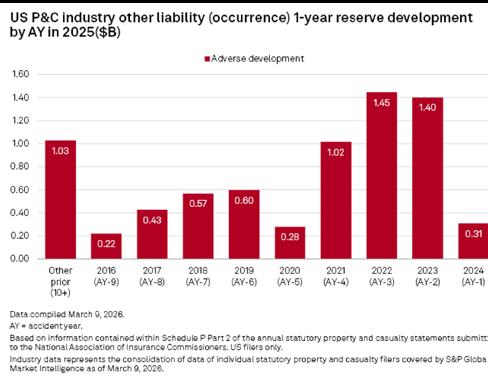

2021, the comparable figure was 77.9%.
S&P GMI analysts refer to the challenge of adverse reserve development for the other liability line as a “systemic one,” highlighting a long list of commercial insurers—primary carriers and global reinsurers—reporting reserve strengthening for the line in 2025. A list of the 2025 reserve changes for 20 other liability writers presented in the report shows half with adverse development and half with takedowns. Liberty Mutual had the biggest amount of adverse development at $1.3 billion followed by Chubb at roughly half as much ($0.7 billion). On the other end of the spectrum, Swiss Re had the largest amount of favorable development, at just over $700 million.
According to S&P GMI, the “systemic challenge is shaped by each company’s business mix, attachment points, and prior reserving stance, compounded by shifting litigation and social inflation dynamics.”
“Other liability (occurrence) serves as a long-tail stress test for the U.S. P/C industry, concentrating the legal system’s loss amplifiers. Even small assumption changes can lead to significant reserve movements, with tort reform legislation having mixed impacts across different states,” the analysts said.
Overall, loss reserves across all P/C lines combined developed favorably in calendar year 2025, with total favorable development of $18.7 billion. More than 90% of the total came from favorable development in the private passenger auto liability ($6.5 billion), workers’ compensation ($5.5 billion), and auto physical damage lines ($5.3 billion).
Based on Carrier Management records, 2025 marked the 20th straight year of favorable overall development.
Sclafane is Executive Editor of Carrier Management, a publication of Wells Media Group.
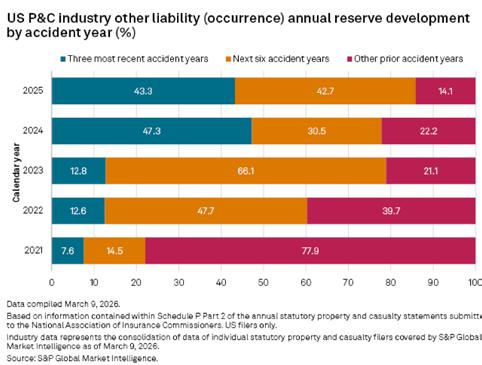
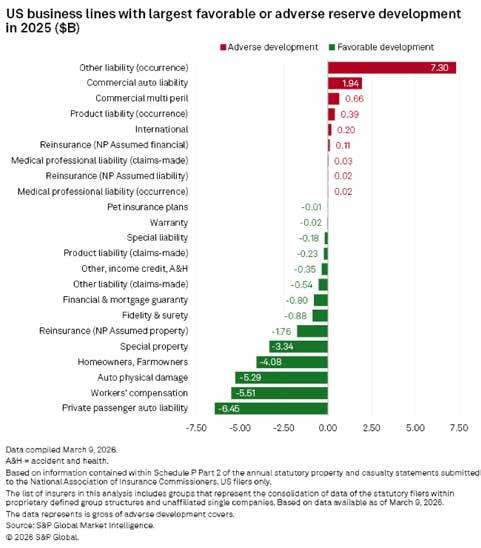
While insurance broker valuations remained resilient in 2025, essentially staying near all-time highs, the elephant in the room— Brown & Brown (NYSE: BRO)—has received little attention.

Mike Fletcher
From a valuation perspective, what happened with Brown & Brown? After the brokerage’s value surged more than 15% in the first quarter of 2025, it subsequently plummeted by nearly one-third from its June peak to the end of the year.
Brown & Brown began 2025 trading at an EBITDA multiple of 17.8x but finished at just 12.9x.
In contrast, the average multiple for agencies with between $1 million and $10 million of
EBITDA (the midmarket) began at 11.9x and ended at 11.4x during 2025.
To be fair, it’s not just Brown & Brown. Collectively, public brokers’ values have fallen 21.0% since March and are down 2.7% from 2025, compared to the S&P’s 16.6% gain.
We highlight Brown & Brown because it’s the bellwether for investor sentiment in the midmarket brokerage sector. Its drop in EBITDA multiples signals a broader concern for the insurance distribution M&A landscape.
Interestingly, the overall midmarket broker M&A market has shown remarkable resilience. Because broker deals are typically highly leveraged, it was not surprising that valuations peaked in 2022 when interest rates were lowest. What is surprising is
that valuations have stayed near those highs even after the largest interest-rate increases in U.S. history.
That said, signs of strain are emerging. In 2024, the market expected large brokerage deals ($250 million+ in EBITDA) to trade in the 17–19x range. But AssuredPartners ($1 billion EBITDA) priced at about 14.5x and Risk Strategies ($600 million EBITDA) at approximately 16.0x in their acquisitions by Gallagher and Brown & Brown. The drop in multiples for large transactions wasn’t wholly unexpected—rising interest rates have made it harder to justify lofty valuations (see prior analyses on Brown & Brown’s Risk Strategies deal and the Arthur J. Gallagher / AssuredPartners transaction). With public equity (PE)-backed brokers typically carrying 4–5x EBITDA in leverage (higher when including preferred equity), we anticipated leverage constraints would cap
multiples for large, PE-backed deals at 16x. Brown & Brown’s valuation decline is unique in that it was not driven by higher interest rates. Its leverage, roughly 2.4x at the start of 2025, is among the lowest of the large brokers.
With minimal leverage on its balance sheet, why did Brown & Brown decline so steeply?
The downturn was tied to a sharp slowdown in organic revenue growth that became apparent with the Q2 2025 results, where organic growth fell to 3.6%, compared to 10.0% in Q2 2024. The stock began weakening and the Q2 2025 release confirmed the slowdown, starting the sustained decline.
Go From Here?
We expected midmarket valuations to soften in 2023, but that segment remained resilient even as the broader

market pulled back. Three factors have sustained higher-than-expected deal pricing: (1) insurance revenues growing roughly 10% annually over the past three years, offsetting rising interest costs; (2) multiple arbitrage; and (3) a proliferation of buyers driven by strong PE interest.
At the same time, insurers’ confidence in pricing sufficiency, supported by healthy industry surplus levels, has encouraged a more assertive underwriting posture. The market has reached the familiar transition point where carriers will trade premium on renewals to win new accounts. By Q4 2025, the average premium change for commercial P&C business had moderated to 0.2%, a significant retreat from the peak increase of 11.7% in Q3 2020.
For each agency on the market, roughly 50 PE-backed or public brokers are positioned to bid; this demand remains the strongest support for current valuations.
While the data points to lower valuations ahead, we were proven wrong the last time we predicted a broker apocalypse. Despite the headwinds, there are positives:
Premium growth is down, but it’s likely weaker at public brokers, which have greater exposure to larger accounts and excess and surplus lines—segments with larger rate declines.
As growth slows disproportionately at larger firms, they will lean more on acquisitions to meet targets, which should support valuations.
Interest rates have already fallen by about 50 basis points, and with a benign inflation
report and the prospect of further cuts, financing conditions are easing.
Public brokers took another hit in late February amid AI disruption headlines—Brown & Brown slid about 8%. Still, we
believe institutional demand and strategic acquisition needs will support midmarket valuations for at least the remainder of 2026.
Fletcher is managing partner at Sica | Fletcher. Previously a senior partner at Hales & Company, Fletcher decided to
break out on his own in 2014 with business partner and long-time friend Al Sica to create an M&A firm that would focus primarily on midsize businesses. Initially focused on professional services, his background in the financial world was one of the primary factors leading the firm to expand its horizons into broader markets.
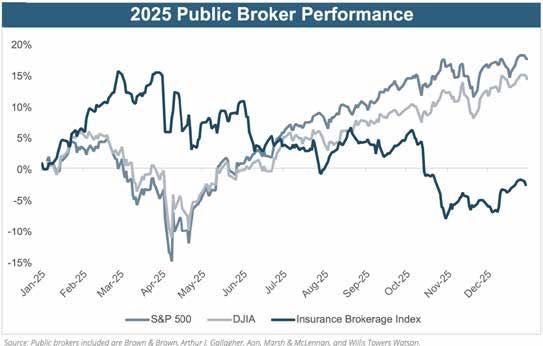
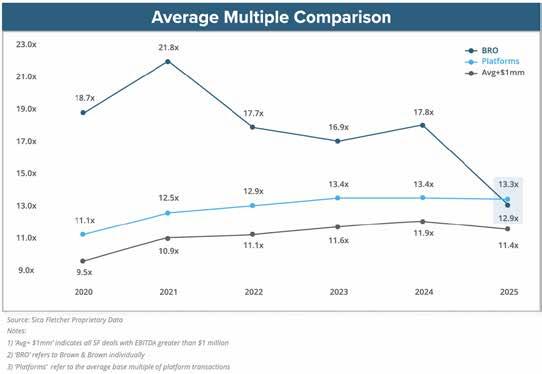

My November 2025 column talked about ambiguity in insurance policies. When litigation is initiated by an insured seeking coverage following a claim denial, often a primary assertion is that the policy language in question is ambiguous. If the court agrees that there is more than one reasonable interpretation of the meaning of the policy provision, the insured usually wins.

By Bill Wilson
The question posed in last month’s column was whether almost all policies
today, after decades of litigation, include significant ambiguities in the contract language. Can many policy provisions have multiple interpretations that are reasonable? If so, how do we address these conflicts?
This issue came up again recently when I read a LinkedIn discussion initiated by policyholder attorney Chip Merlin in reference to a recent Claims Journal article by an attorney that usually represents insurers in litigation. Literally while I was reading the LinkedIn thread, I got an email from an agent that raised the same issue of ambiguity.
According to the agent, a customer
entered into a sales agreement under a written contract with an automobile dealer to sell a car owned by the customer. A couple of weeks later, the dealer advised that the car had sold and the money would be forwarded to the customer.
Several weeks and follow-up phone calls later, the money had still not shown up, so the customer reported the incident to his automobile insurer, which quickly denied the claim. For decades, my experience in getting arguable claim denials reversed has been pretty good—except for the insurer in question that largely uses non-ISO forms and, as I’ve found, rarely backs off of claim denials.
The policy in question includes “Theft Coverage” in the physical damage insuring agreement as follows:
“We will pay for loss of or damage to your automobile and its equipment caused by theft, larceny, robbery or pilferage. We cover your loss when you are tricked into giving your automobile to another person.”
The insured’s interpretation of this insuring agreement is that it covers his situation, that the dealer committed theft by accepting the vehicle for sale then kept the money. He believes it was either outright theft or trickery by the dealer in enticing the insured to trust him. Is such an interpretation of this insuring agreement reasonable?
I discuss the issue of what constitutes “theft” in my book “When Words Collide…Resolving Insurance Coverage and Claims Disputes,” pointing out dictionary definitions such as:
• “A criminal act in which property belonging to another is taken without that person’s consent.”
• “The generic term for all crimes in which a person intentionally and fraudulently takes personal property of another without permission or consent and with the intent to convert it to the taker’s use (including potential sale).”
Theft synonyms include: felonious taking, robbery, stealing, larceny, swindling, TRICKERY, thievery, shoplifting, burglary, misappropriation, embezzlement, fraudulent taking, looting, pilferage, conversion, plunder, shoplifting, holdup, heist, stickup, five-finger discount, ripoff, furtum, and peculation. (Who knew that Dillinger was a ‘peculator’?)
Webster’s sums it up with “An unlawful taking of property.” In other words, the word “theft,” in the vernacular, can include virtually any act of illegally taking someone’s property. That sure seems to fit here.
However, later in this auto policy, there is a specific exclusion that says that the “Theft Coverage” does not apply to “conversion, embezzlement or secretion by any person lawfully having your automobile under a sale, lease or
similar agreement.”
In this exclusion, the key word is “conversion,” which is a common law term that means that someone has been entrusted with someone else’s property then violated that trust by not returning the property or disposing of it for their own gain. That appears to be the case in this claim, especially given that the exclusion for conversion only appears to apply to situations where the offending party lawfully has the auto “under a sale, lease or similar agreement,” and that is the circumstance here.
‘Often differences in interpretation of policy provisions arise because the drafter(s) failed to clearly convey the meaning behind the words chosen to express the insurer’s intent.’
The insured, on the other hand, believes that he was “tricked” by the dealer into entrusting the car to him and the insuring agreement specifically says, “We cover your loss when you are tricked into giving your automobile to another person.” He believes this gives him a reasonable expectation of coverage, especially given that, in his opinion, only a lawyer and not a layman would know what is meant by “conversion, embezzlement or secretion.”
My guess is that, if this is litigated, most courts would uphold the exclusion, especially given its limitation to sales and leasing types of agreement as we have here, but you never know for sure…and that’s not really the point of this column.
Getting back to the Claims Journal article mentioned earlier, the title of that article is “Sins of Policy Interpretation: A Call to Repentance.” A primary point of the article is that, before we get to litigation or even interpretative arguments about the meaning of the words in an insurance policy, we should begin with the drafter(s) of the policy that committed the original sin of ambiguity. Often differences in interpretation of
policy provisions arise because the drafter(s) failed to clearly convey the meaning behind the words chosen to express the insurer’s intent. For example, in this particular case, was there really any need to include the statement that “We cover your loss when you are tricked into giving your automobile to another person” in the insuring agreement, especially when this statement isn’t qualified until two pages later in the policy rather than immediately in the insuring agreement?
Some years ago, when I did commercial property seminars, I used to ask students whether the ISO CP 00 10 Building and Personal Property Coverage Form covered signs and, if so, for what perils and for how much in value. At the time, the initial insuring agreement said it essentially covered all structures on the described premises. However, later in the coverage form under Property Not Covered, it said signs weren’t covered.
Then even later, it said that signs WERE covered, but only for $1,500 and only for five perils. Still later in the coverage form, it said IF the sign was attached to a building, it was covered for the same perils that covered the building BUT only for $1,500. Note that only signs ON the described premises were covered, not the highway sign a mile down the road.
Wouldn’t it have been better to address sign coverage entirely in one provision in the policy, rather than repeatedly revisit the coverage, or lack thereof, throughout the policy?
Surely, we can improve how we convey our coverage intent so as to limit the need for a “Where’s Waldo®” search for coverage? If not, we’re doomed to continue to litigate ambiguity allegations that arise, not from differences in interpretation of the meaning of words, but simply because we haven’t more clearly expressed the coverage intent. We can do better.
Wilson, CPCU, ARM, AIM, AAM is the founder and CEO of InsuranceCommentary.com and the author of six books, including the Amazon 4.8 star rated “When Words Collide…Resolving Insurance Coverage and Claims Disputes.” He can be reached at InsuranceCommentary@outlook.com.
I’m 100% certain that insurance company executives do not understand the significance of the homeowners insurance crisis. They are either caught up in losing too much money on property, or the executives are too immune in their own safer world.

By Chris Burand
After traveling around the country and listening to agents from coast to coast and border to border over the last three weeks, I’ve heard so many agents pleading for a solution. As one agent told me—and she was emotionally struggling while sharing her story—she has clients who cannot afford a home now because premiums are so high. These elevated premiums are ruining lives.
This industry owes society as a highly regulated public service. It is a public service because buying homeowners insurance is not an option. It is mandatory for everyone who needs to borrow money to buy a house.
I don’t often feel sorry for insurance companies and their woes, but in this case, they have a legitimate point. They cannot seem to make money on property coverage, although some may
have in 2025 based on preliminary results. Unfortunately, I do not have access to the data I would need to identify the entire problem, but the issue is not limited to catastrophes. Anyone blaming catastrophes and global warming is either ignorant or floating red herrings.
Even without the data, though, we can work through some scenarios.
The first solution I’ve heard is that the HO-3 coverages must be reduced. There is likely some value in this because most people do not have contents worth 70% of their Coverage A. But in other aspects, coverage needs to be expanded. For example, 10% Ordinance Coverage is very likely inadequate for a majority of homeowners today. I don’t know how a reduction in contents versus an increase in Ordinance would affect net rates, but I’m guessing the average rate would increase because rebuilding to current codes is more expensive than buying a new couch.
The solution many carriers are pursuing is high deductibles, especially for roofs. This is problematic because some of these deductibles, including those for commercial properties, are so high that they render wind/hail claims coverage almost pointless. If a church must have a $100,000 deductible, why buy insurance at all? Deductibles this high require the agent

and the insured to assess the insured’s working capital, lines of credit, and overall financial situation because it may not be worth buying any coverage, or at least not any wind/hail coverage.
Another option people without mortgages are choosing is to not buy any insurance. One way to know how many people make this choice is to review a large catastrophe and determine how many claims are filed. In many catastrophe zones, 25% or more of homeowners do not make claims because they don’t have insurance. I’m not sure this is a good solution for society, much less the homeowners.
Another possibility is for insurance companies to get a brain and think through true exposures. But this is wishful thinking, and I’m not being sarcastic. I don’t see evidence of any critical thinking on their part.
The best solution might be to bypass regular insurance companies that refuse to think. Regulators would be wise, if they care enough to act, to listen to agents because the agents I have spoken with are willing to forego portions of their commissions to solve this problem. Solving this problem means they will make less money, and no one else in the equation is offering to take a pay cut.
Why won’t carriers be more proactive? It may be because they have a hidden problem that no one wants to address. Study after study has shown that both personal and commercial insureds’ properties are significantly underinsured. Why is this?
One reason is that the replacement cost estimators have material margins of error. These estimators need to be significantly improved, and I think this is an area essential for regulators to investigate.
Another reason is many agents and insureds do not know how to complete the estimators.
Would insuring property correctly solve the problem, though? Let’s work through the math. Let’s assume we have a $1 million property exposure. The average homeowners combined ratio over the last 10 years (as of 2024) is approximately 102

on a weighted basis, per AM Best data. Excluding investment income, this means carriers lose $20,000.
But what if that property is underinsured by 25%, which is well within the amount that properties are currently underinsured, per the studies I’ve read. Let’s further assume a straight line rate. I’ll make up the rate for example purposes. Let’s use $2 per thousand. The premium would be $2,000. But if it was correctly insured, the premium would be $2,500. That is a 25% increase, which is far greater than the two percentage points underwriting loss. Yet most claims are partial, so losses would not increase in proportion to the increased coverage.
It seems like this is a good solution because insureds would have better coverage, carriers would be more profitable, and the rate per thousand could decrease. The insureds might still find insurance too expensive, so we need to explore more, but as with most things in life, doing the right things the right way goes a long way
to solving the endemic problem. Sloppy is rarely a good solution.
Why wouldn’t carriers be more focused on this part of the solution? Many carriers clearly are not focused on it based on all the conversations I’ve had with agents and carrier reps, multiple white papers, and research I’ve done. A strong reason is that insurance companies might not have a large enough surplus. The more property a carrier insures, the more surplus they need. If they are already short of surplus, they might not want to insure property correctly.
This is something regulators owe the public to explore. From what I am seeing in the field, some carriers are seriously underinsuring property. If that gives them a competitive advantage over carriers with surplus insuring property to value, then regulators need to address this because it is not fair to carriers trying to insure property correctly, and it is not fair to consumers.
Before cutting coverage from already underinsured properties, let’s reset and
figure out the solution if property was properly insured. I am willing to bet that if property was correctly insured, carriers would be making an underwriting profit. By reducing the rate per thousand, the market might be expanded, bringing consumers back into the market.
Then add good incentives for risk reduction to property, like what has happened in Alabama, and this consistent loser (property) could easily become profitable. This step may require new markets led by people who are smarter and care more, but this is the second part of the solution. If you are an agent frustrated by carriers who won’t fulfill their duty, look to the alternative solutions that are being developed. Some good ones are coming to market so you can bypass regular markets, especially in commercial lines. We owe it to clients to explore creative solutions.
Burand is the founder and owner of Burand & Associates LLC based in Pueblo, Colo. Phone: 719-4853868. E-mail: chris@burand-associates.com.
Picture this scenario. A couple meets and they go through the courting period. Both parties try to look their best and pay extraordinary attention to each other. At some point they get engaged and formalize their relationship. They talk with each other often about their goals and plans for the future. For a few years the couple gets along really well, and the long-term future looks promising. But after a few years they slowly start to drift. The attention they pay each other diminishes, and some promises are not kept. The two now seem to be going down separate paths. Communication now has trickled down to just the formal business that keeps the couple together. After a while the two realize they no longer share the same goals, and they have little in common.
By Catherine Oak
with to meet their needs for competitive, responsive markets.
Both parties need to grow, and relationships of the past may no longer meet the needs of today, especially if either party has targeted certain classes of business that aren’t of interest to the other. Resources should not be wasted on maintaining relationships with carriers that offer little benefit to the agency.

This is a common situation. Marriages often fail because the couple does not maintain the same energy that brought them together. A truly successful longterm relationship requires continuous effort by both sides. This applies to personal relationships as well as business relationships. The scenario outlined above is what happens quite often to agencies and their carriers.
The key to any good relationship is communication. It is imperative that the agency has a well-organized plan to communicate with each carrier. Some insurance companies communicate better than others, so the independent agent needs to take full responsibility to ensure a dialog occurs.
Agencies need to take a proactive approach to managing company relations. Good relations cannot be allowed to stagnate, and weak relations must be built up. Agency owners need to evaluate which companies they should do business
Companies continue to limit the number of agencies they do business with, often to better utilize their resources and to reduce costs. Some companies differentiate between the services they provide, their preferred agents, and their regular agents. It is usually worth the effort to achieve the “preferred” agency status with as many companies as possible.
The “preferred” agent may receive better underwriters, quality target/niche marketing programs, or exclusive programs. The “preferred” contracts usually contain enhanced profit-sharing agreements, value-added services, interface capabilities, training programs, and financing of various items, such as producers, acquisitions, and perpetuation.
So, how does an agency keep the communication open with its markets and perhaps become a “preferred” agent? Create a process that makes it easy for management to focus on company relationships. The first step is to assign an individual or two from the firm to each carrier as that carrier’s “relationship manager.”
Responsibilities for the management of the firm’s top carriers should be divided up among the owners and/or a key non-owner producer or account manager, depending on who has the best relationship with each carrier. Overall
carrier relationship management should always be a major focus for all owners; however, dividing up duties with others in the firm will ensure that the steps are implemented.
A specific action plan should include job assignments, planned visits, information and data to communicate, and a budget to implement the plan. Keep in mind, it takes time and money to nurture a successful company relationship. It’s important to keep track of the plan and make sure it is followed. Even a strong relationship will eventually die if it is neglected.
The collection and presentation of information and data is a significant step since it will set the tone of the communication. Agencies that are prepared and well informed will create immediate interest from the company representatives, since unfortunately, most agencies fail to do their homework.

Learn about the agency’s relationship with its markets. A list should be made of all companies and include three years’ worth of the following information: written premium, earned premium, commissions paid, contingents received, number of policies, average commission per policy, number of submissions, number of quotes, hit ratio, and loss ratio.
The targeted classes of business that the carriers seem to be interested in should be written down and which classes they are competitive in. A report card for the company should be created and completed by the staff.
Ask the companies to fill out a report card on the agency, as well, in order to identify the carriers’ perceptions of the firm. Discuss what the firm can do to improve the existing relationship and to write more business. Determine how the agency can take advantage of the valueadded services offered by the carriers, such as financing, training, etc.
The next step is to create a profile of the agency. Agencies, like people, have their own unique personality. Agencies that know the firm’s “personality” and their strengths and weaknesses will be in a good position to communicate their needs to the carriers. How can agencies expect the markets to meet their needs when they don’t know or understand their own needs?
‘Building improved relationships needs to be a two-way street.’
Take the agency profile package and the insurance company evaluation directly to the market representatives. Set an annual meeting to discuss agency goals and future opportunities. In this annual meeting, the agency principal in charge of markets and the relationship manager for that carrier should meet face to face with the regional vice president or branch manager of each contract company and the main underwriter assigned to the agency.
There are three objectives for this meeting:
1. Inform the company’s management about the current status of the agency and future plans.
2. Find out where the company stands now and its plans for the future.
3. Discuss how the agency and the company can do more business together in the future.
There should be follow-up meetings to discuss progress on the agency-company game plan on at least a quarterly basis. Both parties need to be open and frank. The agency profile and the company evaluation should be reviewed and discussed at the meeting. Reasonable goals and commitments for future business need to be established. Relay the highlights of the meeting back to the agency staff. Plan ongoing carrier networking activities to enhance relationships. It is easier to develop a relationship if parties meet often, and social visits are especially effective. The whole agency needs to be involved with fostering good relations with the markets.
Now more than ever before, with markets often cancelling the ability to write new business and gain new appointments, it is extremely important for insurance companies and owners of agencies/brokerages to build partnerships that are responsive to the business plans established each year by each party. Building improved relationships needs to be a two-way street. It is easy to get this relationship-building program underway, and it really works. Responsibilities for this program must be shared, and communication needs to be flowing within the firm, within the carrier, and between each other. Improved communication and a focus on improving relationships will save time and will guarantee both parties more money.
Oak is the founder of consulting firm Oak & Associates, based in California and Oregon. The firm specializes in financial and management consulting for independent insurance agencies, including valuations, mergers, acquisitions, sales planning as well as perpetuation planning. Phone: 707-936-6565. Email: catoak@gmail.com.
Create a package that contains information about the agency that can be shared with market representatives. The more detail and openness displayed in the package, the easier future communication will be achieved. The following is a list of some key items that should be included in the Agency Profile Package:
• A cover letter to the carrier explaining the agency’s objectives and goals with that insurance company.
• The agency mission statement or an overview of the firm’s philosophy.
• The agency history, organizational chart, and resumes of key employees.
• Copies of agency brochures and general marketing material.
• A copy of the agency’s strategic business and perpetuation plan.
• Details on the agency’s sales and marketing approach.
• A breakdown of the lines of business written by the agency, including an overall summary of the number of accounts and commission by line of business.
• A list of the main types of businesses and the average size of account written by the agency and each producer for personal and commercial lines.
• Details on any niches or programs the agency may have.
• New premium written last year by each producer.
• A description of the producer compensation plan.
• Details on the agency’s automation capability.
In addition to the above information, it may be useful in the quest for new markets to include the following in the package:
• Summary of company experience with premium and loss ratios for each major carrier for the past five years.
• Financial information including most recent P&L and balance sheet.
• Copy of agency’s E&O policy.


Insurance brokers often can get caught in between when the interests of policyholders and insurance companies diverge. In the obvious case of a claim denial, brokers should take care to protect themselves as well as their policyholder clients. But potential broker liability can arise much earlier in the insurance procurement or claims processes, and brokers must be aware of these potentially thorny issues.
This article highlights five common issues that insurance brokers should consider as they maneuver through the world of clients, claims, and coverage.
Insurance companies assert that material misrepresentations on an insurance application allow them to rescind the policy. As such, brokers must take great care to work with policyholders in ensuring accurate application submissions. A misrepresentation is considered material if it affects the insurance company’s decision to issue the policy, influences the premium rate, or impacts the assessment of risk. Materiality can be established by documentary evidence establishing that the policy would not have been issued if the correct information had been provided.
On the other hand, the answer to an ambiguous question on an insurance application cannot be the basis for a claim of misrepresentation. Ambiguous questions are those that lend themselves to more than one reasonable interpretation. Still, even innocent misrepresentations in certain situations may be sufficient to allow the insurance company to avoid its obli-
gations under the policy, and omissions can count as material misrepresentations. Thus, it is essential for policyholders to be as clear as possible when answering application questions.
Ultimately, it is the responsibility of the broker to ensure accuracy and completeness of application materials, and actual knowledge that a statement is false is not a requirement. Therefore, brokers must consistently check in with policyholders to ensure that all information is up to date—especially for renewals—because even a minor change, if not updated, can open the door for the insurance company to attempt to void the policy. For long-term clients with annual renewals, brokers should be sure to remind their clients that renewing for a new year means updating all appropriate information so that the new policy reflects any changes and the proper coverage is secured.
Brokers owe their policyholders a duty of care that includes obtaining requested coverage for clients within a reasonable time, securing a policy that is not void or materially deficient, and informing clients if coverage cannot be acquired. Brokers are expected to possess reasonable knowledge regarding types of policies, policy terms and conditions, and the coverage available in all relevant locales. Brokers must exercise the requisite, industry-standard skill and diligence when fulfilling those obligations. Otherwise, liability can arise.
A “special relationship” between the broker and policyholder can arise when the broker agrees, whether explicitly or implicitly, to go
beyond these general duties and accept greater responsibilities. For instance, in New Jersey, courts have held that a special relationship between broker and policyholder can arise when the broker contracts to assume additional duties or there is some custom or course of dealing between broker and policyholder that goes beyond the ordinary relationship. In New York, the Court of Appeals has recognized three situations that may give rise to a special relationship: (1) where the broker receives compensation for consultation apart from payment of premiums; (2) where there was some interaction regarding a coverage question, and the policyholder relied on the expertise of the broker; and (3) where there is a course of dealing over an extended period that should have alerted the broker that their advice was being sought and relied upon for a specialized purpose. The key considerations for a broker’s special relationship are “advice” and
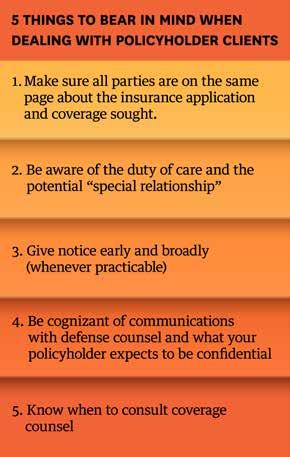

“expertise.” If a broker steps into an advisor role or the client relies on the broker’s specific expertise, these are factors potentially indicating a “special relationship.” One option worth considering is whether to enter into a written agreement with the client that addresses the scope of services provided as well as compensation. This written agreement should indicate if the broker will be expected to provide advice and expertise to assist the client in their selection of insurance or handling of claims.
‘A
‘special relationship’ between the broker and policyholder can arise when the broker agrees, whether explicitly or implicitly, to go beyond these general duties and accept greater responsibilities.’
Once the special relationship between broker and policyholder exists, the broker may be subject to liability for failing to advise the client, even in the absence of a specific request to do so. This is a high
standard to meet, and New York courts have stated that special relationships in this context are the exception, not the norm. Still, it is always best for brokers and policyholders to set expectations for the relationship with clarity when it comes to the responsibilities of the parties.
There is often a push and pull between brokers and policyholders surrounding notice of claims because policyholders fear an increase in claims will lead to a corresponding increase in premiums, which can be true. Yet, more often than not, it is better for brokers to recommend giving notice early and under all potentially responsive policies. The flip side to potentially increased premiums could be no coverage for a costly claim based on a late notice defense that easily could have been avoided.
Courts typically interpret insurance policy notice provisions to mean that notice must be given within a reasonable time based on the facts and circumstances of the case. Failure to comply with a notice requirement can result in forfeiture of an otherwise meritorious claim for
coverage. For example, in New York, notice of an occurrence given more than two years after practical to do so excuses the insurance company’s duty to defend unless the policyholder can show that the delay was reasonable or did not prejudice the insurance company. This is why it is essential to understand notice provisions and give notice as broadly as practicable. While every situation is subject to its unique facts, the most protective option for brokers is to recommend broad and early notice of any circumstances likely to result in a claim.
Brokers must exercise caution when engaging with defense counsel in an underlying case involving their policyholders, as privilege issues may apply, and the insurance company may seek access to communications between brokers, clients, and defense counsel. The attorney-client privilege applies when a communication from an attorney to the client is for the purpose of facilitating legal advice in the course of a professional relationship. Additionally, the communication itself must be of continued on page 46
continued from page 45
a legal nature. Generally, disclosing a communication to a third party waives the attorney-client privilege. However, the privilege is not waived if the third party is acting as an agent of the attorney or the client. This is true in New York and in other jurisdictions and can apply
to brokers where they are consulting directly on legal matters.
Whether a third party is an agent for the purpose of not waiving the privilege depends on what the client believes regarding the communications. If the client had a reasonable expectation of confidentiality under the circumstances,

the third party is likely to be considered an agent under the circumstances.
One New York case, TC Ravenswood, LLC v. National Union Fire Insurance Company, 2013 WL 3199817 (N.Y. Sup. Ct. 2013), is illustrative on this point: where the broker specifically was hired by the policyholder and its counsel to explain the complex insurance policies at issue, the attorney-client privilege was not waived because the policyholder had a reasonable expectation of privacy. (Disclosure: the authors’ law firm, Anderson Kill P.C., represented the policyholder in this case.) Thus, when a broker’s activity is directly tied to a litigated claim, it is more likely that privilege will be maintained.
It is never too early for brokers to recommend that their clients reach out to an attorney who specializes in insurance recovery if an insurance company is not engaging fairly or will not engage with the policyholder’s claim. Situations where it is beneficial to speak with an experienced insurance coverage attorney include, but are not limited to:
• An insurance company denying a claim
• An insurance company threatening to terminate or deny coverage
• An insurance company offering less money than the claim is worth
• An insurance company being unresponsive to a claim
• An insurance company neglecting to resolve a claim while the statute of limitations is approaching
Malone is a shareholder in Anderson Kill’s New York and Stamford offices. Cort focuses his practice on insurance coverage litigation and dispute resolution, with an emphasis on commercial general liability insurance, cyber insurance, employment practices liability insurance, advertising injury insurance, directors and officers insurance, and property insurance issues.
Gatti is an attorney in Anderson Kill’s New York office. Kathleen focuses her practice on insurance recovery and complex financial litigation. She is also a member of the firm’s Restaurant, Retail and Hospitality and Sports, Media and Entertainment industry groups.
Each year brings new viral job search trends, and 2026 is no different. Even in these early months, I have already noticed trends that, while not exclusive to the insurance industry, can and do influence agencies and could be critical to help you:
• Stay informed on the latest techniques to identify, attract, and retain talent.
• Adopt new strategies to target diverse employee groups, from recent graduates to seasoned insurance professionals.
This term has become increasingly popular on social media platforms. It refers to companies offering uniform compensation—such as merit raises or bonuses—across their entire organization, akin to spreading peanut butter evenly. It concerns employees who remember something similar happening during the 2008 Great Recession. Ultimately, it leads to limited raises and smaller payouts.
Peanut butter raises can become job search motivation. Capstone’s recent survey revealed 71.8% of employees who prefer bonuses over salary increases
want them calculated on individual performance. How do you think a universal bonus would be perceived in your agency? If seven out of 10 employees favor individualized compensation, the peanut butter approach could pose significant challenges for employee retention.
If you’re familiar with the term “Evergreen Jobs,” you’ve essentially come across a ghost job. These are job postings that companies don’t intend to fill right away; they are often utilized to create pipelines for future openings.
There are some downsides to Ghost Jobs. Having a lot of applications isn’t always helpful, especially if they are unqualified and overload your inbox. Also, candidates might not remember every job they applied for, but they’ll remember if your company never responds to them. Ghost jobs make it harder to follow up with candidates, and ignoring them could hurt your chance of engaging with them down the road on a real job.
Many insurance agencies have told me other third-party recruiters have offered a pay-for-work model. In this arrangement, you pay the recruiter either by the hour to work on a job opening or for a predetermined number of resumes.
While this setup may seem cheaper in lieu of traditional placement fees, ultimately you still want effective results

regardless of the cost. The insurance industry is specialized and requires specific expertise for successful hires. If someone proposes this to you, ask thorough questions about their insurance recruiting experience, request references, and speak with companies like yours to learn about their experiences and outcomes.

By Mary Newgard
#CareerTok and #JobTok: Reports show that nearly half of GenZ job seekers have found jobs via TikTok and an even higher percentage seek career advice on Instagram. This raises an important question: should your agency rethink or diversify its social media strategy to engage and build trust with younger generations? Establishing a presence on TikTok and Instagram is particularly essential if you want to connect with young talent, and a lack of visibility on these platforms might cause them to doubt your brand.
Engaging in Chat Forums: Platforms such as Discord, Slack, and Reddit allow users to communicate directly with hiring managers, enabling them to bypass the conventional application process.
Using AI to Write Resumes: While some people may use AI to generate their resume from scratch, many more use it to make edits, clarify key points, and tailor content for specific job applications. Don’t mistake this for laziness or being insincere. Online resume-writing tools and templates have existed for years, and this is simply a natural progression.
Newgard is partner and senior search consultant for Capstone Search Group, a national recruiting firm dedicated to the insurance industry. Email: asktherecruiter@ csgrecruiting.com.


IBy Anita Nevins
nsurance professionals are producing more marketing content than ever before. Blog posts, emails, social media updates, videos, webinars, event recaps … the list keeps growing. Yet many still feel like their marketing efforts aren’t moving the needle in meaningful ways.
The problem usually isn’t effort. It’s alignment.
Insurance decision-makers today are overloaded with content but starved for clarity. They don’t need more noise. They need information that helps them make confident decisions in a complex, highstakes industry.
Understanding what your audience wants from marketing content (and when they want it) is one of the biggest opportu-
nities insurance businesses have to stand out.
One of the most common mistakes insurance professionals make is judging content success by surface-level metrics alone. Likes, views, clicks, and impressions can feel encouraging—but they don’t always tell the full story.
What matters more is whether your content aligns with buyer intent. In other words, does it answer the questions your audience is already asking at that stage of their decision-making process?
• An insurance prospect just becoming aware of a problem is looking for clarity and education.
• A prospect comparing options wants proof, differentiation, and reassurance.
• A prospect ready to move forward wants confidence they’re choosing the right partner.
Content that ignores this progression often feels irrelevant, overly promotional, or mistimed, even if it’s well designed and professionally written.
Insurance is a relationship-driven industry, but that doesn’t mean decision-makers skip the research phase. In fact, many insurance decisions now begin long before a conversation ever happens.
Marketing content plays a different role at each stage of the buyer journey:
Early stage (awareness): Insurance audiences are trying to understand a challenge, risk, or opportunity. Educational content performs best here. Think of explanatory articles, industry trend insights, common misconceptions, or plain-language breakdowns of complex topics. At this stage, prospects are not looking to be sold. They are looking to be informed.
Mid stage (consideration): Potential new clients are evaluating options and approaches. This is where comparison-style content, real-world examples, use cases, and practical guidance become valuable. Content that demonstrates expertise and experience (without overselling) builds trust.
Late stage (decision): Prospects want reassurance. Testimonials, case examples, FAQs, and clear explanations of the process help reduce uncertainty. At this point, credibility and consistency matter more than clever messaging.
When insurance marketing skips straight to promotion without supporting the earlier stages, it often fails to resonate.
In insurance, many decision-makers are skeptical. They may have been trained to assess risk, question assumptions, and look for gaps. Highly polished promotional content may look impressive, but it rarely builds trust on its own.
Educational, problem-aware content performs better because it meets your audience where they are. It shows that you understand their world, their pressures,
and their decision criteria.
This doesn’t mean avoiding professionalism or polish altogether. It means prioritizing clarity over cleverness and usefulness over buzzwords. Content that explains, guides, and contextualizes signals competence. Over time, that competence becomes credibility.
Not all content formats serve the same purpose, and expecting them to do so often leads to frustration.
• Long-form articles and guides are effective for building authority and depth.
• Short-form content like social posts or emails can reinforce visibility and keep your name familiar.
• Visual formats can simplify complex ideas.
• Events and webinars can strengthen relationships and create shared experiences.
The key is understanding what job each format is meant to do and not measuring them all by the same standard. A social post that sparks recognition may never directly generate a lead, but it may influence a decision months later. Marketing in insurance is rarely about one touchpoint—it’s about cumulative impact.
April 13, 2026
Clear Blue Insurance Company
B7 Tabonuco Street, Suite 912 Guaynabo, PR 00968
The above company has made application to the Division of Insurance to amend their Foreign Company License to transact Property and Casualty Insurance in the Commonwealth of Massachusetts.
Any person having any information regarding the company which relates to its suitability for the license or authority the applicant has requested is asked to notify the Division by personal letter to the Commissioner of Insurance, 1 Federal Street, Suite 700, Boston, MA 02110, Attn: Financial Surveillance and Company Licensing within 14 days of the date of this notice.
‘Marketing isn’t a one-time project or a nice-to-have add-on. It’s an ongoing business function that supports growth, relationships, and reputation.’
Insurance prospects don’t just evaluate what you say. They evaluate how consistently you show up. Inconsistent marketing creates doubt. Consistent messaging, tone, and presence create familiarity, and familiarity builds confidence. When they see thoughtful, relevant content over time, it reinforces the perception that an organization is stable, credible, and invested in its relationships.
This is especially important in insurance, where long-term partnerships matter more than quick wins.
Marketing isn’t a one-time project or a nice-to-have add-on. It’s an ongoing business function that supports growth, relationships, and reputation.
For insurance businesses, effective marketing helps:
April 13, 2026
American National Property and Casualty Company
American National Center, 1949 East Sunshine Springfield, MO 65899
The above company has made application to the Division of Insurance to obtain a Foreign Company License to transact Property and Casualty Insurance in the Commonwealth of Massachusetts.
Any person having any information regarding the company which relates to its suitability for the license or authority the applicant has requested is asked to notify the Division by personal letter to the Commissioner of Insurance, 1 Federal Street, Suite 700, Boston, MA 02110, Attn: Financial Surveillance and Company Licensing within 14 days of the date of this notice.
• Shorten sales cycles by educating your audience early
• Improve conversations by establishing credibility in advance
• Support relationship-based selling with consistent visibility
• Differentiate expertise in crowded or competitive spaces
The return isn’t always immediate or easily tied to a single piece of content. But over time, marketing that aligns with buyer intent pays off in stronger relationships and better outcomes.
Clarity Is the Competitive Advantage
Insurance decision-makers don’t want to be impressed. They want to understand. The insurance organizations that win attention are the ones that make complex topics easier to grasp, respect the buyer’s decision process, and provide value before asking for commitment. Marketing content that prioritizes clarity over promotion doesn’t just perform better. It builds trust. And in insurance, trust is everything.
Nevins is the founder and co-CEO of Direct Connection Advertising & Marketing. She manages the company and is heavily involved in strategy and planning for the agency’s clients. Website: directconnectionusa.com.
The insurance workforce is undergoing a fundamental shift. Aging demographics, evolving employee expectations, and accelerating technology adoption are converging. For insurers and brokers, this represents more than a hiring challenge—it signals a strategic workforce transformation.

By Trindl Reeves
For decades, insurance industry talent strategies have relied heavily on long-tenured employees, relationship-driven knowledge transfer, and incremental hiring cycles. That model is becoming increasingly difficult to sustain. The industry is projected to face a significant deficit of workers in the coming years, mainly due to the “silver tsunami”—the retirement of Baby Boomers. At the same time, workforce demographics are shifting more broadly. Workers over 65 made up about 7% of the workforce in 2024, and that share is expected to grow in the coming years as people live and work longer. This trend underscores the importance of structured
knowledge transfer and succession planning. The challenge isn’t simply replacing headcount. It’s about ensuring institutional knowledge, client relationships, and technical expertise transition effectively while attracting a new generation with different career expectations.
Younger professionals are entering the workforce with priorities that differ from those of previous generations.
Career development, mentorship, and continuous learning rank among the most important factors influencing retention and engagement. These expectations are reshaping how insurance organizations must approach workforce development.
Traditional “sink or swim” learning models are giving way to structured career pathing, formal mentorship, and technology-enabled training programs. Organizations that don’t adapt risk higher turnover, lower engagement, and difficulty attracting early-career talent.
Talent shortages are no lon-
ger just HR challenges—they’re operational and financial risks. This creates an experience cliff if knowledge transfer isn’t intentional and structured. Institutional knowledge transfer must shift from informal to intentional. Leading practices now include:
• Formal mentorship programs with defined objectives and measurements
• Documented underwriting and claims decision frameworks
• Digital knowledge repositories that capture tacit expertise
• Phased retirement programs to extend transition timelines
• Reverse mentorship to blend digital fluency with industry depth
Technology plays a central role. Knowledge capture platforms, workflow documentation tools, and learning management systems help organizations preserve expertise before it walks out the door. Without deliberate investment in these technologies, demographic change could become a resilience vulnerability.

Employee expectations are shifting rapidly, as well. Federal government data shows younger workers prioritize growth opportunities, meaningful work, and development pathways more heavily than prior generations. Career architecture must be visible and credible. This is where personal branding becomes strategically relevant.
Early-career professionals increasingly evaluate
whether an organization will help them:
• Build recognized expertise
• Develop leadership visibility
• Gain access to mentorship
• Participate in industry conversations
• Create a long-term professional identity
Organizations that enable and encourage employees to speak at conferences, contribute thought leadership content, build LinkedIn presence, and deepen subject-matter authority strengthen both individual and corporate brands.
Personal branding isn’t vanity—it’s a retention strategy. Workforce strategy should integrate development, mentorship, and brand enablement into core talent planning. This approach can help organizations move from reactive hiring to proactive workforce design.
Technology isn’t replacing insurance professionals; it’s reshaping how they work and what skills matter most. Digital platforms help capture institutional knowledge, standardize workflows, and support faster onboarding. They also create visibility into performance trends, training needs, and productivity metrics. This is especially important as hybrid work models and distributed teams become standard.
Organizations that invest in workforce enablement technology today may be better positioned to scale operations, support employee growth, and manage future disruption.