


146 results for ‘bars & breweries’






146 results for ‘bars & breweries’
Small businesses are not always the owners of the building where they operate. That can limit what can be done to prepare for a natural disaster, but every business should be prepared regardless.
“Small business owners may be tenants of the building, so there is lessor’s risk, and with lessor’s risk, there’s often limitations about what can be done with that building,” said Ross Haigler, head of commercial lines at the Insurance Institute for Business & Home Safety (IBHS). “For example, who is responsible for building upgrades? Is it the tenant, is it the landlord, or is it the property management firm?” he asked.
Small business commercial properties, whether rented spaces or owned property, might also be older buildings, he added. “So, the aging infrastructure contributes to how well these buildings perform when they’re tested against extreme weather events,” Haigler added. “That exposure really highlights the risk of convective storms in older buildings and why they might have failure mechanisms such as a leaky roof.”
Haigler said IBHS often “preaches” that the roof is the first line of defense against natural disasters relating to wind, hail, and flooding, especially for small businesses where an aging roof or an aging roof covering can lead to a single breach of water into that building. That type of event could potentially close down that business, he said.
IBHS offers business continuity planning toolkits, free and accessible on their website, as a resource for small businesses. They recommend long-term strategies include taking preventative risk mitigation measures, such as trimming trees around the property to mitigate roof damage in the event of high winds, snow, or ice; installing a generator in case of power outages (especially for refrigeration-dependent businesses); and when owning the building, making sure the building materials are high quality.
Haigler said when possible, agents can help their small business clients prepare for future natural disasters by encouraging simple routine property inspections.
“Ensure that those facilities are routinely inspected and maintained and that the roof is up to standard and able to prevent rainfall from coming in,” he said. “Routine maintenance is one of the items that often goes unnoticed, but it also has one of the largest potential outcomes of a severe weather event.”
Most importantly, Haigler advised to have a plan for when disaster strikes.
“From a business continuity perspective, most important is to ask the important questions, like: Who are your major suppliers? What happens if that building is unable to return to working conditions quickly? Are you able to work offline? Who are your distributors? Who are your customers? How are you communicating? And then, have an up-to-date inventory of what is in your building just in case.”
Chairman of the Board Mark Wells | mwells@wellsmedia.com
Chief Executive Officer Joshua Carlson | jcarlson@insurancejournal.com
ADMINISTRATION / CIRCULATION
Chief Financial Officer
Terry Freeburg | tfreeburg@wellsmedia.com
Circulation Manager Elizabeth Duffy | eduffy@wellsmedia.com
Staff Accountant Sarah Kersbergen | skersbergen@wellsmedia.com
EDITORIAL
V.P. of Content Andrea Wells | awells@insurancejournal.com
Executive Editor Emeritus Andrew Simpson | asimpson@wellsmedia.com
National Editor Chad Hemenway | chemenway@insurancejournal.com
Southeast Editor William Rabb | wrabb@insurancejournal.com
South Central Editor/Midwest Editor Ezra Amacher | eamacher@insurancejournal.com
West Editor Don Jergler | djergler@insurancejournal.com
International Editor L.S. Howard | lhoward@insurancejournal.com
Content Editor Allen Laman | alaman@wellsmedia.com
Assistant Editors
Jahna Jacobson | jjacobson@insurancejournal.com
Kimberly Tallon | ktallon@carriermanagement.com
Columnists & Contributors
Contributors: Mike Gulla, Monica Ningen, Matthew F. Power
Columnists: Chris Burand, Mary Newgard
SALES / MARKETING
Chief Marketing Officer
Julie Tinney | jtinney@insurancejournal.com
West Sales Dena Kaplan | dkaplan@insurancejournal.com
Romeo Valdez | rvaldez@insurancejournal.com
Kelly DeLaMora | kdelamora@wellsmedia.com
South Central Sales
Mindy Trammell | mtrammell@insurancejournal.com
Southeast and East Sales (except for NY, PA, CT)
Howard Simkin | hsimkin@insurancejournal.com
Midwest Sales
Lisa Whalen | (800) 897-9965 x180
East Sales (NY, PA and CT only)
Dave Molchan | (800) 897-9965 x145
Advertising Coordinator
Erin Burns | eburns@insurancejournal.com
Insurance Markets Manager
Kristine Honey | khoney@insurancejournal.com
Sr. Sales & Marketing Coordinator
Laura Roy | lroy@insurancejournal.com
Marketing Director Derence Walk | dwalk@insurancejournal.com
DESIGN / WEB / VIDEO
Graphic Designer
Chris Johnson
Web Team Lead
Josh Whitlow | jwhitlow@insurancejournal.com
Ad Ops Specialist
Jeff Cardrant | jcardrant@insurancejournal.com
Web Developer Terrance Woest | twoest@wellsmedia.com
Web Developer Jason Chipp | jchipp@wellsmedia.com
Digital Content Manager Ashley Cochrane | acochrane@insurancejournal.com
Videographer/Editor
Ashley Waldrop | awaldrop@insurancejournal.com
ACADEMY OF INSURANCE
Director Patrick Wraight | pwraight@ijacademy.com
Online Training Coordinator
George Jack | gjack@ijacademy.com

Andrea Wells V.P. of Content



By Chad Hemenway
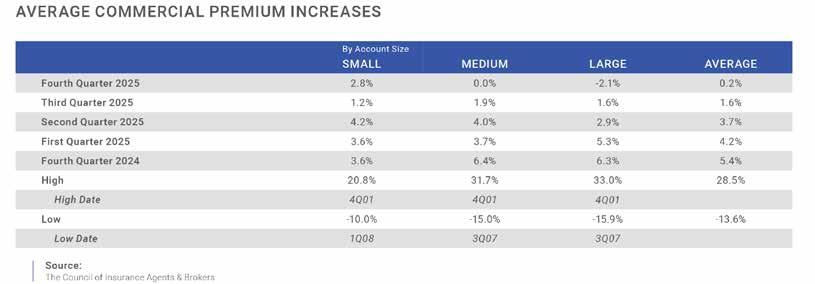
Commercial property/casualty premiums across all account sizes in the fourth quarter of 2025 were the softest they have been since 2017, according to The Council of Insurance Agents & Brokers (CIAB) quarterly survey.
Overall, premiums across all account sizes rose by an average of just 0.2%, down from 1.6% in Q3 2025, when CIAB called out “clear soft market conditions.”
In its latest survey report, CIAB said, “Signs of softened market conditions were equally evident across lines of business.”
Nine lines of business—cyber, business interruption, commercial property, construction, directors & officers, employment practices, surety bonds, terrorism, and workers’ compensation—saw premiums decrease this quarter, up from six during Q3 2025. D&O decreased the most, down 3.8%, making it the eighth consecutive quarter of decreases for the line.
Even commercial auto, which led all lines with an average premium increase of 6.6% and marked 58 straight quarters of increases, fell from an increase of 7.4% in Q3 2025. Survey respondents continued to blame social inflation and
nuclear verdicts, and about half of them also reported an increase in claims. Respondents also noticed a decrease in capacity for commercial auto risk, according to the survey.
The 1.9% average premium increase across all lines of business in Q4 2025 was a 30% decrease from 2.7% in Q3 2025, said CIAB, who noted that for the first time since Q4 2017, large account premiums decreased at an average of -2.1%. Respondents cited more competition for upper-middle and large accounts.
2017 was the end of the last soft market cycle recorded by CIAB’s survey.



Foremost®, part of Farmers Insurance®, has a legacy of more than 70 years of industry leadership and excellent service. Built from decades of experience, we deliver customizable coverages for autos, homes, boats, personal watercrafts and much more.
Your customers can live confidently knowing Foremost has their back with our dedicated claims team who are there when you need them 24 hours a day, seven days a week. Look to Foremost for trusted stability, above-and-beyond service and coverage you can count on.
The total amount of claims tied to SRCC (strikes, riots, and civil commotion) between 2020 and 2024. The category of insurance risk that hardly existed a little over a decade ago has morphed into a meaningful source of losses as episodes of unrest increasingly lead to the destruction of property in Western democracies. Howden Re estimates that insured losses related to SRCC soared from negligible levels in 2013 to more than $8 billion between 2020 and 2024.
The total amount that two asphalt companies have agreed to pay to resolve False Claims Act allegations that they submitted fraudulent test results to the Ohio Department of Transportation (ODOT) for federally funded asphalt projects in Ohio. Ohio’s Construction and Materials Specifications require that companies performing asphalt projects must conduct certain mix design testing of their asphalt mixtures and submit the test results to ODOT before beginning their asphalt work on federally funded projects. $8B

33,750 pounds
The amount of frozen snow crabs stolen from a Worcester, Massachusetts, warehouse in July 2025 through hightech cargo theft. Nationally, estimated cargo theft losses surged 60% from 2024 numbers to nearly $725 million in 2025, while confirmed cargo theft incidents increased 18%. Prosecutors claim that before the alleged seafood heist, the same suspect allegedly stole a shipment of blueberries in New Jersey and approximately $433,830 worth of cologne in New York.


14
The number of crashes Tesla Inc.’s robotaxis have been involved in since service began eight months ago in Austin, Texas, according to reports the carmaker made to regulators. A federal order requires carmakers to report when automated driving systems are involved in certain crashes. Austin remains the only city where Tesla is offering robotaxi rides.

$30 Million

“There are no sectors of the economy that are insulated from the potential impact of AI. As an industry we need to prepare for how these rapidly evolving risks are underwritten across commercial insurance and what emerging claims patterns will look like.”
— Oliver Brew, co-author of the report and head of Cyber Centre of Excellence, Lockton Re, in a statement regarding a new report from Lockton Re, in collaboration with Lockton International and Armilla AI, which found rapid adoption of AI by organizations across all industries is changing the commercial risk landscape and suggested it’s time to consider making AI its own risk classification.

“Decades of fire suppression have allowed other plant species to move in, increasing competition and fuel buildup such as leaf litter, needles, and woody debris,”
— U.S. Forest Service’s Public Affairs Officer Ethan Ready, in an email to VTDigger, advocating for the Northern Escarpment Ecological Restoration and Fire Resilience program, designed to improve the area’s resistance to wildland fires, pest infestations, and drought. The project covers four areas spanning 2,770 acres of the Green Mountain National Forest and would begin in the spring of 2027. The project aims to reduce flammable materials and expand native plant communities that depend on regular, low-intensity fire in the forests.

“Texans should not be forced to endure offensive and harmful odors in their own communities, especially when a company is failing to comply with the standards required by law.”
— Texas Attorney General Ken Paxton filing a lawsuit against Darling Ingredients, Inc., an Irving-based company that turns used cooking oil, food waste, and inedible animal parts into animal feed and fertilizer. Residents have described odors coming from the facility as smelling like dog food, cooked grease, and burning feathers. The lawsuit claims emissions interfere with residents’ health and their ability to enjoy their land, a potential violation of the Texas Clean Air Act.

“Over the past year, federal policy changes have altered the federal-state partnership by shifting costs to states and reducing support for longstanding programs that serve working families. Unlike the federal government, states across the country— including Illinois—are required to balance their budgets, and as repeatedly stated, Illinois cannot backfill billions of dollars as the federal government makes reductions.”
— Press release from the Illinois Governor’s Office of Management and Budget warning of “unprecedented” budgetary pressures. Illinois is already expecting $587 million less in revenue for the year through June 30, due to provisions in Trump’s signature tax cut legislation.

“Increasingly, courts have recognized that the use of surveillance technologies can violate the Fourth Amendment’s protections against unreasonable searches and seizures. Although this area of law is still developing, the use of LPRs and predictive algorithms to track and flag individuals’ movements represents the type of sweeping surveillance that should raise constitutional concerns.”
— A letter from privacy and advocacy organizations calling on California Gov. Gavin Newsom to remove a network of license plate readers across Southern California that may feed data into a U.S. Border Patrol predictive domestic intelligence program.

“Without even a public meeting, TVA (Tennessee Valley Authority) is telling the people who live near these coal plants that they will breathe in toxic pollution from not one but two major power plants for the foreseeable future. This decision is salt in the wound after ignoring widespread calls for cleaner, cheaper replacements for the Kingston and Cumberland coal plants.”
— Gabi Lichtenstein, Tennessee Program Coordinator for Appalachian Voices, reacting to TVA’s (Tennessee Valley Authority) reconsidering two plant closures because of regulatory changes and increasing demand for electricity. TVA previously planned to shutter the plants by 2035.
By Allen Laman
More than two-thirds of independent agencies plan to increase use of artificial intelligence in the next 12 months, though just 8% said AI is currently embedded in their daily workflows, according to a new report from The Big “I” Agents Council for Technology.
In its annual tech trends report, ACT found that 38% of survey respondents are “very likely” to increase AI use, while 30% are “somewhat likely” to do so over the next year.
Operational efficiency (60%) and staff productivity (52%) were cited as leading motivations for adopting AI. Data privacy or compliance risks (24%) and inaccurate outputs (22%) topped the list of concerns.
Kasey Connors, executive director of ACT, called the report’s findings “a pivotal moment” for independent agencies. With growing AI interest signaling momentum, “long-term success hinges on clearer

governance, stronger training, and more integrated technology strategies,” she said in a statement.
Nearly a third of the national survey’s respondents (31%) said they are not currently using AI, while 33% described themselves as “just experimenting” with the technology. Another 22% said they are
using AI only in limited areas. ACT pointed to “a growing gap” between the promise of what AI can deliver and the operational readiness required to implement it responsibly and effectively. The council highlighted several constraints, including a lack of documented processes, vendor-related confusion, resource and
By Chad Hemenway
Success for the property/casualty industry in 2025 was marked by rate increases and investment income, but plateauing or softening rates in many lines of business may pressure financial results in 2026, said AM Best.
commercial property, and auto physical damage repairs, will likely lead to a slightly higher industry loss ratio,” Jacqalene Lentz, senior director at AM Best, said in a statement.

In a new report, the insurance industry financial rating analyst said it expects lower net premium growth in 2026 and has predicted that the P/C industry combined ratio will increase 1.9 points to 96.9.
“Macroeconomic headwinds, including rising claims costs attributable to higher prices of materials required for home,
In 2025, continued rate increases benefitted overall financial results and offset adverse trends such as social inflation, nuclear verdicts, and litigation financing, especially in general liability, said AM Best. Net premiums written increased 6.1% in 2025 compared with 8.7% in 2024. For most lines of business seeing premium growth, AM Best reported that the magnitude diminished throughout 2025 and into 2026. Cyber, D&O, commercial property, and workers’ compensation
recorded lower renewal pricing in 2025 compared with 2024.
The 95 combined ratio in 2025 improved on 2024’s combined ratio of 98—which was the first time under 100 in three years. State regulators’ approval of rate filings helped personal lines, as did insurers’ adoption of technology to improve underwriting and efficiency. However, home and auto could see profit margins squeezed in 2026 thanks to rising repair costs and higher fatality rates in auto.
“The segment should generate solid results, but with premium volume expected to be constrained as year-over-year rate changes flatten,” AM Best said.
Lower net premium growth in 2026 for commercial lines will lead to a higher combined ratio of 96.3 compared with
budget limitations, portal and multifactor authentication fatigue, security and governance gaps, as well as change fatigue and tool sprawl.
“AI is entering agencies at a time when many are already struggling with disconnected systems and limited automation,” Connors said. “That complexity makes it harder to move from experimentation to meaningful impact.”
“What we hear consistently is that agents aren’t worried about the price of AI—they’re worried about the cost of getting it wrong. Data privacy, compliance, and accuracy have to be addressed before agencies are comfortable scaling AI use,” she said.
Beyond privacy and compliance concerns, 17% of survey respondents said their top worry about using AI tools is losing human touch, while 16% said they don’t know how to apply the technology.
About half of survey respondents (45%) reported already using ChatGPT and other public large language models. Far fewer agencies said they use AI in policy comparison tools (20%), marketing tools (18%), chatbots and virtual assistants (13%), or document and data extraction tools (13%).
“AI in its current form should be treated like a junior colleague,” ACT said in the report. “Although it’s fast and capable of consuming large volumes of information, it still requires supervision for complex or high-impact decisions.”
The council’s survey found that only 13% of agencies have a formal AI policy.
More than half (56%) do not have a policy, and almost 44% reported relying on peer-to-peer training on new tech tools or systems.
“That will have to change in the coming year for agencies to close significant security and liability gaps,” ACT said in the report.

95.8 in 2025, AM Best estimated. Three commercial lines of business—auto, medical professional liability, and other/products liability—turned in combined ratios over 100 in 2025 (103.5, 106, and 108, respectively).
Net loss and loss adjustment reserves, often the largest liability to an insurers’ balance sheet and a leading cause of insolvency, remain a critical issue for AM Best, who said a re-estimation of the P/C industry’s ultimate reserves resulted in an overall reserve position for year-end 2024 reserves, including the statutory discount, to a $9 billion deficiency, almost $10 billion better than originally estimated.
The report also noted that the flow of risk to the excess & surplus market “was one of the defining factors” of 2025. Admitted carriers increasingly avoided risks in property, auto liability, and high-hazard casualty lines, but the E&S market jumped in to provide flexibility and customization.


Sompo Holdings Inc. received the necessary antitrust and insurance regulatory approvals required to complete its previously announced acquisition of Aspen Insurance Holdings Ltd., via a wholly owned subsidiary of Sompo International Holdings Ltd. (SIH).
Following closing, Sompo will begin the process of integrating Aspen’s capabilities to ensure a globally diversified property/ casualty platform.
Private equity firm Aquiline Capital has entered into a definitive agreement to sell independent insurance broker Relation to investment firm BayPine. Terms of the deal were not disclosed.
Founded in 2007, Relation provides risk management and benefits consulting services to deliver insurance solutions across commercial P/C, employee benefits, personal lines, private client services, retirement solutions, and wealth management to clients of all sizes across a range of industries such as construction, transportation, agriculture, entertainment, healthcare, manufacturing, hospitality, and real estate.
Since Aquiline’s initial investment in 2019, Relation has completed more than 100 acquisitions.
Boston-based BayPine said Relation’s management team will continue to lead the company.
SterlingRisk, ASZ International Inc.
Insurance broker SterlingRisk of Woodbury, New York, acquired ASZ International Inc., a Westchester County, New York, agency specializing in transportation risks.
As part of the transaction, ASZ principals Marc Zettl and Chris Zettl have joined SterlingRisk. Marc Zettl will serve as president of SterlingRisk’s Transportation Vertical, and Chris Zettl joins as account specialist, supporting the continued growth of the practice. The agency also sells personal and other business insurance.
ASZ International was advised by MidCap Advisors.
Arthur J. Gallagher & Co., B&W Insurance Agency Inc.
Arthur J. Gallagher & Co. announced the acquisition of Washington, Pennsylvaniabased B&W Insurance Agency Inc. Terms of the transaction were not disclosed.
B&W Insurance Agency offers personal lines and commercial brokerage services to clients in southwest Pennsylvania. Paul Barzd III, Jim Cote, and their team will remain in their current location under the direction of Jen Tadin, head of Gallagher Select, its U.S. property/casualty operations for small businesses and personal insurance.
Arthur J. Gallagher & Co. is a global insurance brokerage, risk management, and consulting services firm headquartered in Rolling Meadows, Illinois.
Gallagher operates in 130 countries through its owned operations and a network of correspondent brokers and consultants.
Tapco Underwriters Rebrands as CRC Tapco
Tapco Underwriters, a North Carolinabased managing general agent, has new livery and a new name, 17 years after it was acquired by CRC Insurance Services. The MGA will now be known as CRC Tapco and will continue to focus on specialty and surplus lines, the Birmingham, Alabamaheadquartered CRC Group said in a news release.
Tapco was launched in 1983. It was acquired by CRC in 2009 and continues to work as a wholesale broker with binding authority. CRC Group is one of the largest independent wholesale specialty insurance distributors, with some 6,000 associates in the U.S., Canada, and the U.K.
King Risk Partners, Hanc Group
Gainesville, Florida-based King Risk Partners has acquired the Hanc Group, an insurance agency that serves the KoreanAmerican community and others in north Georgia, King Risk announced this week. Rick Han, owner of Alpharetta-based Hanc Group, said the partnership will allow the agency to expand its personal and commercial insurance offerings. Hanc Group was formed in 2018. The agency is appointed with multiple carriers, including property/casualty, life, and accident and sickness, and offers home, auto, church, professional liability, and other lines.
Specialty Program Group LLC, Logistiq Insurance Solutions
Specialty Program Group LLC (SPG), an operator of specialty insurance distribution, underwriting, and consulting businesses, announced the acquisition of Logistiq Insurance Solutions and the subsequent integration of Logistiq with Anova Marine Insurance, a firm acquired by Specialty Program Group in 2025.
These new cargo and logistics capabilities will complement and enhance SPG Transportation’s position in marine cargo expertise.
Enstar Group Limited, a global insurance and reinsurance group backed by investment vehicles managed by affiliates of global investment firm Sixth Street, announced it has entered into a definitive stock purchase agreement to acquire 100% of the shares of Accident Fund Holdings, Inc. (AF Group) from Blue Cross Blue Shield of Michigan.
Headquartered in Lansing, Michigan, AF Group has been a provider of insurance solutions through its affiliate brands for more than a century. It was acquired by Blue Cross in 1994. Upon completion of the transaction, AF Group will become a wholly owned subsidiary of Enstar and operate largely as a standalone company. AF Group is expected to operate under its existing leadership team.
Inszone Insurance Services, Scarbrough, Medlin & Associates
Inszone Insurance Services acquired Scarbrough, Medlin & Associates, Inc., a Dallas, Texas-based agency with more than four decades of experience serving commercial property clients.
Scarbrough, Medlin & Associates specializes in commercial property insurance, with deep experience supporting property management firms, association management companies, and multifamily and mixed-use developments. The firm also has a long history of servicing other complex commercial classes, including large school districts, electric cooperatives, oil and gas operations, contractors, and restaurants and bars.
The Scarbrough, Medlin & Associates team will remain in place.
Alliant Insurance Services, Laredo Commercial Insurance Agency
Alliant Insurance Services has acquired Laredo Commercial Insurance Agency’s
For-Hire Trucking portfolio, establishing the firm’s local presence in Laredo, Texas.
As part of the acquisition, Steven Cadena has joined Alliant Transportation as Vice President.
Cadena brings extensive experience and understanding of the complex Laredo transportation market, strengthening the
roster of strategic broker hires with regional expertise in cross-border transportation risk.
Laredo is the third Texas-based agency to join Alliant in recent months, following the acquisitions of McAfee Insurance Agency in Mercedes and Highpoint Insurance Group in Friendswood.

National
Westfield, headquartered in Westfield Center, Ohio, appointed Lloyd Scholz as enterprise chief information officer (CIO). Scholz most recently served as senior managing director and chief technology officer at Markel.

IICF board of governors as its first vice chair.
W. R. Berkley Corporation, headquartered in Greenwich, Connecticut, named Lee Iannarone executive vice president. Iannarone is succeeded by Stephen Kennedy, who has been named senior vice president and general counsel.
officer for the U.S. business. Grippa will serve on the firm’s U.S. Executive Committee and act as a strategic advisor, helping advance BMS Re US’s multi-year strategic plan and accelerate organic growth across its programs, mutuals, and specialty segments.
development and growth of the energy sector team.
Billingslea is based in Dallas, where he most recently served as an Energy Liability Underwriter at AXA XL.

NFP, headquartered in New York City, named Tom Gillingham as president, commercial risk, expanding his executive leadership across NFP’s commercial P&C, programs, and wholesale businesses. The company also appointed John Mahoney head of programs, Totalis Program Underwriters, NFP’s Specialty MGA and MGU. Mahoney joined NFP via EverGuard in 2017.

Converge, headquartered in New York City, appointed Howie Altman as chief technology officer. Altman will oversee the continued evolution of the company’s technology infrastructure, including AI-powered risk assessment, automated underwriting workflows, and advanced portfolio management tools.

Marsh Risk, headquartered in New York City, made three leadership appointments.
Jimmy Tse was named U.S. financial institutions surety growth leader. Based in New York, Tse will report to Carrick Bligh, U.S. surety financial institutions leader.

Hub International Limited (HUB), headquartered in Chicago, Illinois, named Andrea Baldrica as chief sales officer of U.S. Employee Benefits.
Coalition, headquartered in San Francisco, California, appointed Frank Fumarola as chief product officer. Fumarola joins Coalition from Nubank.
The Insurance Industry Charitable Foundation (IICF), based in Los Angeles, California, named Steve Marohn, president, commercial lines at Grange Insurance, as chair of IICF’s board of governors. Adam McDonough, executive vice president of Lockton Insurance Brokers, will join Marohn in leading the
Crawford & Company, headquartered in Atlanta, Georgia, promoted Mike Hoberman to CEO of U.S. Operations. Canada will transition into International Operations under the leadership of Andrew Bart, CEO of international operations. Pat Van Bakel was named chief commercial & strategy officer.

Crawford also promoted Paul Kottler to president, U.S. Loss Adjusting; Lance Malcolm to president, U.S. Network Solutions; and Jeffrey Sickles to president, Crawford TPA: Broadspire.
BMS Re, the reinsurance arm of independent insurance and reinsurance broker BMS Group, headquartered in New York City, appointed Tony Grippa as chief strategy
Drew Vann was named U.S. construction surety leader. Based in Atlanta, Vann will report to Fran Curran, U.S. Surety Leader at Marsh Risk, where he will support U.S. construction clients with strategies to enhance credit capacity and manage financial risk.

Caroline Jardim was named U.S. multinational surety leader. She joins from Marsh Risk Brazil, where she most recently served as credit specialty leader. Based in New York, she will also report to Curran.

Baldrica has over 25 years of insurance industry experience, serving with HUB since 2014, when HUB acquired Baldrica & Company.

HUB also hired Ellen Sue Bernards to the HUB Complex Risk team as alternative risk solutions practice leader, a new role.
CRC Group named Tracey Fallon as office president for its first Virginia office. Fallon, who will lead CRC’s recently opened New Richmond office, has over a decade of experience in the insurance industry, with a background in E&S underwriting, binding authority, and commercial risk placement.

AXA XL, headquartered in Dallas, Texas, appointed Jason C. Billingslea as head of energy, E&S, where he will lead the
NFP, an Aon company headquartered in New York City, appointed Jack Spencer as senior vice president, commercial risk, in its Northeast region.
Spencer has over a decade of experience in commercial risk insurance in the New York City metro area.

company as chief customer success officer.
Lawley, headquartered in Buffalo, New York, promoted Michael Szymoniak Jr. and Adam Clouden to partners within the employee benefits division, and Michael Bandini to partner within the property & casualty division.
The Virginia Workers’ Compensation Commission reappointed Commissioner Robert A. Rapaport to serve an additional six-year term as a commissioner of the Virginia Workers’ Compensation Commission.
Smart AutoCare, headquartered in Richardson, Texas, appointed Christopher Murphy as president. Murphy has over 20 years of executive leadership experience, joining Smart AutoCare from OptionSoft Technologies, Inc., where he served as president.
Higginbotham hired Samuel Isaac Ritter, M.D., as medical director for employee benefits, adding a client-facing physician resource within its self-funded advisory work. Ritter is an award-winning emergency physician at Baylor University Medical Center.
Finys, a provider of insurance software solutions for property and casualty carriers, announced that Emeka Iheme has joined the
Unison Risk Advisors, headquartered in Cleveland, Ohio, appointed Nicole L. O’Sullivan as chief people officer. O’Sullivan joins Unison with more than 25 years of experience leading enterprise-wide people strategies for complex, growing organizations.

and Mississippi. These changes are effective April 1.
Jonathan Diessner has been promoted to president of Kraus-Anderson Insurance, one of Minnesota’s largest privately held independent insurance agencies and a member of the KrausAnderson family of companies.

ICW Group hired Travis Murnan as head of its new ICW Specialty business unit, Alternative Risk Transfer (ART). ART is expected to go to market later this year as part of ICW Specialty, which was launched in 2025 to support excess and surplus products and other coverage services.

Buckner Partners, an insurance brokerage with offices in Idaho Falls and Rexburg, Idaho, appointed Greg Taylor as president of Buckner of Idaho. Taylor previously held leadership roles with State Farm Insurance, John Deere Financial, and Farmers Mutual Hail.
Hub International Limited (HUB), headquartered in Chicago, Illinois, hired Cindy Ackerman as senior vice president (SVP), private client risk advisor in Colorado.

Alliant Insurance Services, headquartered in Irvine, California, added Amanda Quitmeyer, based in Chicago, Illinois, as assistant vice president within its employee benefits group.
Chubb, headquartered in Warren, New Jersey, appointed Ben Mortimer to the role of regional executive officer for the Southeast.
Kevin Kraselsky, senior vice president, Atlanta branch manager, will take on the additional responsibility of having the Birmingham branch territory report to him, overseeing distribution and production throughout Georgia, Alabama
Capital Insurance Group (CIG), headquartered in Monterey, California, promoted Kimberly Noel to regional field executive for its Northwest region, overseeing underwriting teams and line of business performance in Oregon and Washington. Noel has over 20 years of underwriting and leadership experience, including more than a decade with CIG, including roles as regional underwriting manager, underwriting team leader, and regional executive underwriter. She began her insurance career with Travelers Insurance.
Trucordia, headquartered in Lindon, Utah, hired Jason Nelson for the new role of vice president of public relations. Nelson has over two decades of experience across broadcasting, advertising, and publishing. He was a partner in a publishing group and the advertising agency Swell Media, where he worked closely with Trucordia.
Arrowhead Specialty named Jimmy Curcio executive vice president. Curcio most recently served as the chief strategy and analytics officer for Arrowhead Intermediaries and, previously, for Arrowhead Programs. Before joining Arrowhead, he held leadership roles at Munich Re.


Hub International Limited named Brandon Hetrick vice president, private client risk advisor in Newport Beach, California. Hetrick has 25 years of insurance experience. Before joining Hub, Hetrick spent more than a decade with an insurance brokerage firm.

By L.S. Howard
Investments in global insurtech rose 19.5% during 2025 to US$5.08 billion from US$4.25 billion in FY 2024, marking the first annual increase since 2021, according to Gallagher Re’s Q4 Global Insurtech Report.
During the fourth quarter of 2025, global insurtech funding surged 66.8% to US$1.68 billion from US$1.01 billion during Q3, said Gallagher Re, noting that Q4 funding was the largest quarterly amount seen since Q3 2022 when US$2.35 billion was raised.
Gallagher Re attributed the surge to a combination of factors such as growing investments from insurers and reinsurers (as opposed to private equity companies); funding for insurtechs that are focused on artificial intelligence (AI); and the return of “mega-rounds,” where more than US$100 million is raised in a single round.
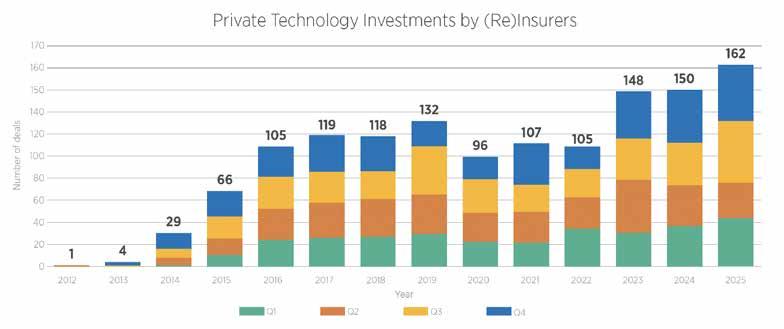
During 2025, re/insurers made more private technology investments into insurtechs—162 deals—than any other year on record, said the report, which pointed to a “changing of the guard” or a “notable shift in the insurtech investor community.”
“This suggests that re/insurers are not
only more comfortable investing, but also that they see insurtechs as a route forward in their own strategies,” the report said.
Regarding the effects of artificial intelligence, Gallagher noted that twothirds of insurtech funding last year went to AI-centered insurtechs, which raised US$3.35 billion across 227 deals—66% of funding and 62% of deals, respectively. This level of investment demonstrates the extent to which the re/insurance industry is invested in this technology, the report added.
For Q4 2025, AI-centered insurtechs raised US$1.31 billion across 66 deals, with an average deal size of US$22.14 million, or slightly above the overall Q4 2025 average, the report said, noting that 77.9% of insurtech funding during the quarter went to AI-centered companies.
“AI is squarely the focus of most of the contemporary insurtech world. Over time, we see AI becoming so integrated into insurtech that the two may well become synonymous,” said Andrew Johnston, global head of Insurtech at Gallagher Re, in comments accompanying the report.
In a forward to the report, Johnston said that three-quarters of all funding is going
into insurtech businesses with an AI label— whether they are AI powered themselves or provide AI tools to other businesses.
“We do not see this trend slowing down. In fact, we see AI becoming so integrated into insurtech over time that the two may well become effectively synonymous—in much the same way as we could already argue that ‘insurtech’ is itself a meaningless label, because all insurers are technology businesses now,” Johnston said.
Property/casualty insurtech funding rebounded from 2024’s low, increasing 34.9% to US$3.49 billion in 2025, the Gallagher Re report said, explaining that mega-rounds fueled P/C’s rebound, with funding up from US$320 million in 2024 to US$1.06 billion, while deal count rose 20% to 264.”
In P/C insurtech funding, there was a 90.5% quarter-on-quarter hike to US$1.31 billion, driven by mega-round deals, the report said, adding that five companies— CyberCube, ICEYE, Creditas, Federato, and Nirvana—collectively secured US$662.81 million in mega-rounds during the fourth quarter.
Unlike P/C, life and health (L&H)
insurtech funding and deal count both declined last year, with funding dipping by 4.6%, year-on-year, to $1.59 billion and deal count falling 17.7% to 102, Gallagher added.
Additional notable findings from the report include:
• Tech vendors saw record-high dealshares across P/C and L&H insurtech. Nearly 60% (58%) of P/C deals went
to business-to-business insurtechs, a 12-percentage-point increase from 2021’s funding boom.
• Deal shares to insurtechs in the category of lead generator/broker/MGA fell from 42% in 2024 to 35% in 2025—the lowest on record.
• The global deal share of U.S.-based insurtechs rose 5.16 percentage points between 2024 and 2025—the largest gain
among all countries. Specifically, the U.S. deal share increased from 50.58% in 2024 to 55.74% in 2025.
• Other than the U.S., only Bermuda saw its deal share increase by more than one percentage point, year-on-year.
• Re/insurers are using AI for machine learning, data entry and classification, advanced and predictive analytics, large language models, and automation.
By Allen Laman
Cyberattacks are no longer designed solely to cause immediate business disruption.
Instead, they are increasingly engineered to inflict sustained financial, regulatory, and reputational damage that lingers well beyond the initial incident, according to a new portfolio study from Resilience, a cyber risk solutions company.
In its 2025 Cyber Risk Report, Resilience said the cyber threat landscape has shifted away from ransomware campaigns centered on encrypting data and toward pure extortion based on data theft.
As a result, the primary risk is no longer simply going offline, the company wrote.
“[It] is the multi-year legal, regulatory, and reputational ‘tail’ that follows a data exposure event,” the report said. “As the business of cybercrime reaches higher maturity levels, the real risk comes not just from disruption—but duration.”
Resilience found that data theft-only attacks rose from 49% of extortion claims in the first half of last year to 65% in the second half. The company described the shift as a move to a strategy centered on stealing sensitive data, threatening to publish it, and demanding payment.
That approach diminishes the effectiveness of backup-based defenses, which are “ineffective against the primary threat: reputational and regulatory damage from data exposure,” the report said. Resilience also reported seeing instances in which an insured pays a threat actor to suppress stolen data, only to face class-action litigation

after affected individuals are notified of the breach.
And there’s still no guarantee that threat actors won’t sell the data they were paid to suppress.
Resilience predicted this extortion-only model may represent the majority of extortion incidents by the end of 2026. The insurer said organizations must move from recovery-focused strategies to prevention-focused strategies that include data loss prevention, zero trust architecture, encryption at rest, and identity containment.
“Cyber risk is constantly changing,” Vishaal “V8” Hariprasad, co-founder and CEO of Resilience, said in a press release. “As cybercriminals shift their tactics, a new reality is setting in: The real risk is about more than a security incident’s immediate disruption; it’s about the longtail aftershocks that follow.”
In the report, Resilience urged organizations to “prepare for the reality that successful attacks, driven by the shift from
operational disruption to reputational and regulatory exposure, now carry substantially higher financial severity than in previous years.”
Scattered Spider, a cybercriminal group that targets large companies, made industry headlines for its cross-industry campaigns last summer. The group’s series of attacks on U.K. retailers were felt at Resilience; the company reported that the retail sector went from near-zero material losses in its portfolio in 2024 to one of the top three industries for cyber losses, with an average severity of $2.6 million.
Manufacturing remained the highest total loss industry in Resilience’s portfolio—though average severity declined by approximately 29% from the prior year—and health care remained the highest-severity sector. Combined with retail, these three industries accounted for 68% of all portfolio losses.

By Andrea Wells
Small businesses are not immune to the increasing frequency and intensity of severe weather-related events. Even a lengthy power
outage from a winter storm can be a threat to small businesses, leading to economic damage that is difficult to overcome.
“Winter risk is no longer defined solely by snow accumulation or short-lived
disruptions,” writes Monica Ningen, CEO of Swiss Re’s US P&C business, for this issue’s Closing Quote (see page 50).
“Today’s storms bring a combination of extreme cold, heavy precipitation, ice, flooding,
power outages, and extended recovery timelines.”
Research suggests the primary risk facing small businesses after natural disasters is an extended business disruption which can sometimes lead to
permanent closure. The longer it takes for a business to recover from a disastrous event, the more likely that business is to fail.
The trend of billion-dollar natural disaster events is continuing. Billion-dollar events increased from 6.7 events per year from 2000-2009, to an average of 23 events per year from 2020-2024, according to the National Centers for Environmental Information. Insured losses from natural catastrophes topped the $100 billion mark in 2025 for the sixth consecutive year. While the main driver of loss in 2025 stemmed from the Los Angeles wildfires, severe convective storms remain a major global loss driver, reports Swiss Re Institute. Global insured losses from severe convective storms alone were $50 billion last year, making 2025 the third costliest year after 2023 and 2024.
So, what can small businesses do to prepare for the next disaster, and how can their insurance partners help? To safeguard against disastrous scenarios for the small business client, insurance partners should make sure that before disaster strikes, their clients have insurance coverage that is adequate and preparedness plans that will ensure business continuity.
The small business insurance market, as well as the personal lines sector, have both entered 2026 in a stable position, according to Amwins’ Small Business and Personal Lines Outlook. After years of disruption and rate escalation, market conditions have begun to normalize with average rates softening in
some property classes, and capacity and underwriting appetite returning to segments that had become constrained. But natural catastrophe exposures remain key areas of concern, especially in highly populated areas, the report said.
“Severe convective storms, once principally confined to ‘tornado alley,’ have become a nationwide concern. In response, underwriters are deploying detailed geographic modeling to assess micro-region risk (i.e., Los Angeles hill area). Carriers are also increasing scrutiny of roof age, considering it even more important than building age in how a property responds to a wind event,” the report said.
Like much of the personal lines market, the small business owners’ insurance market faced severe frequency and severity of natural disasters over the last several years, William King Sr., director of commercial underwriting at Progressive Insurance, told Insurance Journal. “As a result, geographically disaster-prone areas experienced higher premiums, limited availability, and/or increased use of cost sharing terms from insurers,” King said, adding that because small businesses often operate with tighter or limited safety nets, closing after a natural disaster can be challenging.
Kristin Thelen, assistant vice president, account management at Insureon, Hub International’s small business focused digital agency, said that while the market overall has softened, there’s still a lot of volatility on pricing for small business in higher-risk areas.
“We’ve definitely seen a shift in specific states wanting to write business property; in particular, Florida and California are still problematic,” she said. “We have carriers pulling out of states. The carriers remaining in those states, (have) very high premiums, very high deductibles, and lots of natural disaster exclusions, if you will.” Thus, retaining business has been a challenge for some carriers, she added.
Jerry Palmioli, director of sales at Insureon, said that changing carrier appetites remain an issue. “Carriers are changing their appetite almost monthly,” Palmioli said. “One disaster, one big claim, one storm happens, and carriers are worried about their profit loss margins.”
‘When
a secondary peril event occurs, like flooding, especially like the inland flash flooding that dominated 2025, small business owners oftentimes are left with zero recovery funds.’
Palmioli said that disasters can also lead to a changing risk profile for some small businesses. “We see that on the underwriting side. … It could be a contractor, and because a storm came through an area, now everyone wants to be a carpenter in Florida after a storm, so the underwriting guidelines could change very dramatically for getting insurance,” he said.
Counseling insureds to purchase coverage for the long term is just as important for
the small business client as it is for larger commercial clients. “Don’t just buy coverage for the project, buy it for the long term, otherwise you may never get insured again in the standard markets,” Palmioli said.
Insureon’s Thelen added that success in small business, like with any other commercial insurance, comes from ensuring that the right coverage is offered through a consultative approach. Making sure to have proactive conversations on how the business can mitigate losses—whether it’s property, cyber, or umbrella coverage— and tying those conversations to real life scenarios is key, she advised.
Small businesses are more vulnerable in post-disaster situations oftentimes due to limited cash reserves that could help keep the business afloat. The disaster disrupts operations, creating an uncertain path to recovery.
Flooding poses a significant threat to small businesses, impacting operations, finances, and long-term stability. “When a secondary peril event occurs, like flooding, especially like the inland flash flooding that dominated 2025, small business owners oftentimes are left with zero recovery funds,” said Colin Tinley, senior vice president at Amwins Access. “If you don’t have coverage for those secondary perils like flood, you may have a gap when it comes to recovery.”
Ensuring that small businesses have adequate business income can reduce the coverage gap and help the business outlast disaster-relatcontinued on page 22
continued from page 21
ed closures. But it’s important to choose the right type of business income coverage, according to Progressive’s King.
“Some policies cover the actual loss sustained (ALS) for a certain period of time, and others have specific business income limits,” King explained. “If your coverage is ALS, it is important that the covered time period is substantial enough for the potential closures you may experience. If you have specific limits, then you need to ensure the limits are high enough to support your business needs during the potential closures.”
Amwins’ Tinley added that while small business owners have become more aware of the need for business interruption coverage, there’s still a protection gap in coverage, especially when it comes to floods.
“At the end of the day, if a business isn’t carrying a separate flood policy and a flood shuts them down, their standard BI is typically not going to trigger,” he said. “In addition, if you have a small business and you have an NFIP policy, business interruption is not going to be covered on that policy. So, you could have flood coverage but not have business interruption coverage.”
That’s where the private market can play a key role, he said. “The private market can come in, provide a solution,” he said. “With overall property rate softening, now is a good time to think about how those coverage gaps can be covered,” Tinley suggested. “Because if they’re getting significant rate reductions on their property, we can then come in and say, ‘well, your client may now have some extra funds to increase their overall coverage. So, have you thought about coverage for flood? Have you thought about coverage for business interruption?’ Something like that,” he said.
With climate-related disasters rising in the past decade, business interruption claims have surged, said Ross Sinclair, founder and CEO at UK-based EIP, an embedded insurance program provider. Sinclair believes parametric insurance coverage can play a key role in helping small businesses recover faster than relying solely on traditional insurance.
Parametric products aren’t new, but they are still unfamiliar to many small business owners, Sinclair said. This is starting to change as the impacts of weather-related events escalate, he said.
“Climate-related disasters have increased by more than 80% in the last four decades and, in the first half of 2025 alone, natural disasters caused about $131 billion in losses worldwide, with only roughly $80 billion insured, leaving many businesses exposed when they need cash
the most,” he told Insurance Journal. “At the same time, more frequent disputes and delays around business interruption coverage can force firms into litigation just to access a payout.”
“This is where parametrics structures can be particularly attractive as they reduce ambiguity and the incentives to litigate,” he said.
In his view parametric products can alleviate the administrative burden and deliver faster payouts for the business, especially for weather-related insurance, resulting in less disgruntled end customers. “From the insurers’ perspective, not only is this reputationally beneficial, but the reliance on pre-agreed triggers verified by third-party data supports pricing modeling and reduces the operational costs of claims processing overall,” Sinclair added.
With parametric insurance, the insurer and the policy-

holder agree upfront on the payout and the circumstances that trigger the release of the payout.
“That means there’s no debate after the event about what happened or how much should be paid,” he said. “Simply put, if the trigger is met, the money is released.”
The payout structure can be a fixed amount, resulting in a single, pre-set payment once the threshold is reached, or tiered, where the payment increases in line with the intensity of the event.
For example, imagine a small business in an area prone to winter flooding that wants protection if flooding interrupts operations, he said. “The trigger might be floodwater reaching a specified depth, say one metre, measured using an agreed third-party data source,” Sinclair explained.
“If the policy is written with a fixed payout, then as soon as floodwater reaches one metre,
the pre-agreed amount is automatically paid.”
Sinclair said that quick access to cash can help the business keep paying rent, suppliers, and wages in the immediate aftermath of a flooding disaster, while business income may be disrupted and traditional claims processes proceed.
Parametric insurance isn’t designed to replace the full end-to-end insurance lifecycle, he said, but instead serves as means of first response.
“As the trigger and payout are agreed in advance, business can access liquidity quickly and avoid the kind of cashflow death spiral that can follow a major disruption,” Sinclair noted. “Traditional business interruption indemnities can then sit above it, dealing with repairs and more complex loss calculations over a longer restoration period once the firm has a bit of breathing room.”
Simple parametric products

often are embedded into the sales process for consumer products such as flight delays or cancellations due to weather-related incidents. Other more complex parametric insurance products such as flood may require that the client and insurer both agree on the triggers and payout beforehand, Sinclair said.
“Parametric insurance first gained traction in flood scenarios because the triggers were relatively straightforward to define—flood depth is measurable and it can be linked cleanly to a payout,” he said. “Since then, the concept has broadened and can be applied to a wide range of risk factors as long as there is a clearly defined trigger that can be measured consistently using agreed data. It’s less about the type of disaster and more about whether the event can be measured reliably with objective data.”
Because parametric
policies are built on preagreed triggers, payouts are easier to model and price and operational costs can be lower since claims aren’t being adjusted in the traditional way, Sinclair explained. Plus, the growing availability of realtime, AI-powered climate and hazard data from sources such as satellites makes it easier to monitor events quickly and verify whether triggers have been met. “This can help insurers and communities coordinate recovery faster because funding arrives sooner and with less administrative friction,” he said. “It also helps reduce the reputational and financial drain of prolonged claim disputes, which can be damaging for insurers and devastating for policyholders trying to reopen and rebuild.”
The U.S. parametrics market is predicted to grow. “The market is currently valued at $4.29 billion, which forecasts estimate will grow to $7.84
Progressive’s King encourages agents to check in on their small business clients periodically to possibly adjust coverage limits that might better align with the business’s changing needs, especially as the small business grows over time. This is where working with an agent can help, he said. “Working with an agent can help provide more confidence and expertise in choosing the right coverage and policy for your business needs and also assist with navigating the claims process,” King said. “Often, growth or changing business operations could result in different insurance needs like expanding locations,
higher sales, or hiring more employees, so it’s encouraged for business owners to engage with their agents on a regular basis.”
Small businesses, whether they have business income coverage or not, can potentially reduce impact and loss from weather events with business continuity planning, King added. “Business continuity planning helps small business owners understand their risks and identify preventative measures, including actions they can take pre- and post-event to reduce loss.” He also suggested that small businesses revisit their plan often to ensure it is up to date.
billion by 2035 at a compound annual growth rate of 7.82%,” he said. “This aligns with the idea that as climate volatility increases, demand for products that allow subjective and comprehensive cover will follow suit.”
In late February, Floodbase, an insurance platform for insuring flood risk, and Liberty Mutual announced the launch of an instant quoting application for parametric flood (re) insurance in the U.S.
“It’s the same coverage—just delivered faster and with far less friction, enabling the brokers to effectively explore and customize a client’s flood coverage in seconds before even emailing an underwriter,” said Jean-Christophe Garaix, head of Parametrics & Agriculture at Liberty Mutual, in a media statement. The collaboration “not only improves the client and distribution experience, it enables us to respond to evolving flood risk
with novel parametric products for small-and-medium market segments.”
“Parametric flood can be an effective risk management instrument bridging protection gaps in traditional policies for small-and-medium businesses in the U.S.—but that requires rapid distribution at scale,” added Bessie Schwarz, co-founder and CEO of Floodbase.
A quick search on MyNewMarkets.com, a division of Insurance Journal, showed several other parametric products for disaster related risks for small businesses, including:
• Parametric Wind by Siracusa Risk Management
• Parametric Flood, Wind and Business Interruption by Parametric Risk
• Parametric Earthquake Insurance by Jumpstart
• Auto Dealer’s Open Lot with a hail parametric offering by Amwins
By Susanne Sclafane
In their latest report on the U.S. auto insurance market, analysts from S&P Global Market Intelligence predict the strongest overall U.S. property/ casualty insurance underwriting results in 18 years for 2025, driven by favorable private passenger auto outcomes.
Still, while their 2025 projected combined ratio across all lines is now 96.2, three points better than a midyear projection of 99.2 estimated for the year in August, “success is anticipated
to be temporary due to various market dynamics and challenges,” S&P GMI said in a December statement.
The media statement announced the publication of the firm’s 2025 U.S. Auto Insurance Market Report, which stresses the significant weight that auto insurance has on overall P/C insurance industry results.
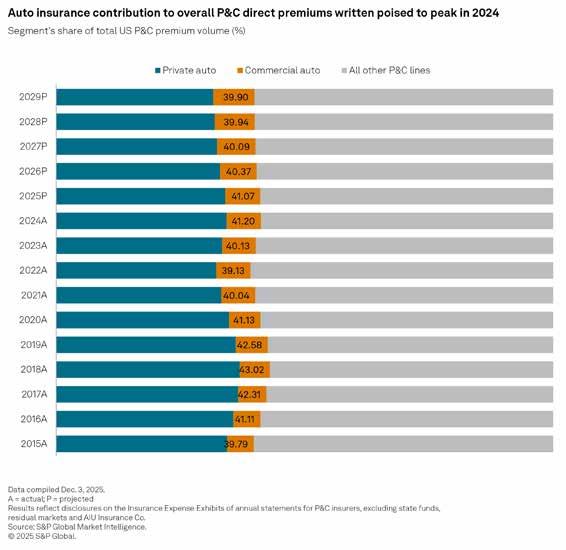
Together, S&P GMI estimates that private and commercial auto insurance will account for 41.1% of total U.S. P/C direct premiums written in 2025 when final results are
tallied—slipping down slightly from a five-year high of 41.2% achieved in 2024, reflecting the impact of competition emerging in the private auto market.

the first sub-97 results in successive years since 2006-2007, according to the statement.
S&P GMI projects a 94.5 2025 combined ratio for auto insurance (personal and commercial together), driving the all-lines P/C combined ratio down to 96.2, compared to 96.5 in 2024. This marks
Offering reasons for the industry’s success in 2025, S&P GMI noted the impact of “a generational hard market in personal lines,” as well as a benign year for natural catastrophes. “These factors are unlikely to recur, suggesting that the current level of success may be fleeting,” S&P GMI said.
In particular, the private auto business has seen accelerated competitive dynamics, “with rate decreases matching rate increases and increased advertising spending,” the statement said.
Focusing on the 94.5 combined ratio projected for the combination of personal and commercial auto lines, the report notes that in the last two decades, the auto insurance business only produced a better result once—93.8 in 2020—when COVID-19 lockdowns fueled a precipitous drop in claims frequency. Even sub-100 combined ratios had been scarce from 2009 through 2023, with 2018 marking the only year other than 2020 with a result below breakeven.
Looking ahead, S&P GMI expects auto insurance combined ratios to breach the breakeven level again in 2028, edging up to 97.1 in 2026 (matching 2024’s auto com-
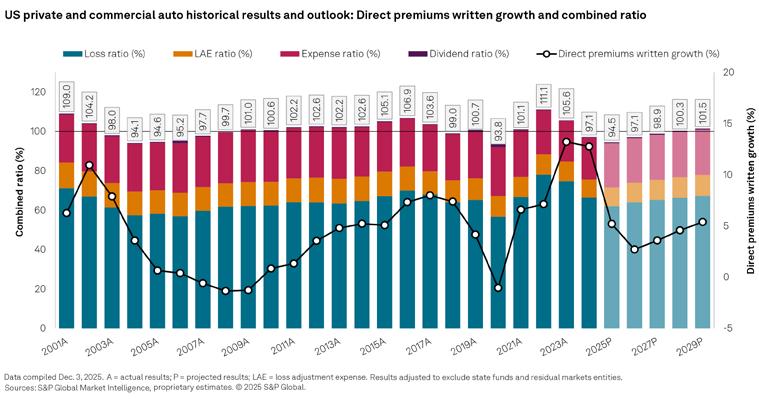
bined ratio) and 98.9 in 2027, according to the full report.
“Though we project that the combination of the private and commercial auto insurance businesses will post some of their strongest underwriting results on record in the near term, this is not to imply that the market is devoid of risks,” the report says. “Social inflation, or the escalation in claims severity due to adverse litigation trends, has vexed the commercial auto business for years, and recent results suggest that it is becoming a more significant threat to the private auto business—particularly among at-fault drivers with higher limits of liability under personal umbrella policies.”
“The political environment remains a wildcard as elected officials propose and/or implement policies with direct or indirect implications for auto insurance….[T]he generational hard market of the past several
years in both private auto and homeowners has prompted calls for revisions to rate filing regimes that are likely to crescendo in 2026 to the extent our projections for continued historically favorable levels of profitability pan out.”
Also mentioned in the report is the tariff wildcard. Even though tariffs received a lot of attention earlier this year, they ultimately did not impact auto physical damage results. Still, future emergence cannot be entirely ruled out, S&P GMI suggests.
(Editor’s Note: Separately, S&P GMI projects a 92.7 combined ratio for personal auto in 2025 and 104.3 for commercial auto. If it actually lands at 92.7, the personal auto combined ratio result “would rival 2020 for the best private auto combined ratio [92.5] in at least 30 years,” without the material changes in driving behavior that accompanied a
global pandemic.
Although S&P GMI doesn’t project that the personal auto combined ratio will rise above 100 until 2029, the text of the report suggests that a nearly 3-point improvement in the commercial auto combined ratio could be short-lived. The official forecast is for commercial auto combined ratios to move up slowly—from 104.4 in 2026 to 106.3 in 2029. But referring to historical results that could repeat, the text said that a 3.5-point improvement in 2014 was followed by five years of pre-pandemic ratios ranging from roughly 109-111.)
In addition to auto insurance, the 2025 U.S. Auto Insurance report, published in late December, includes full-year 2025 combined ratio projections for homeowners insurance in personal lines and for several commercial lines,
as well as projections of direct written premium growth for the same lines.
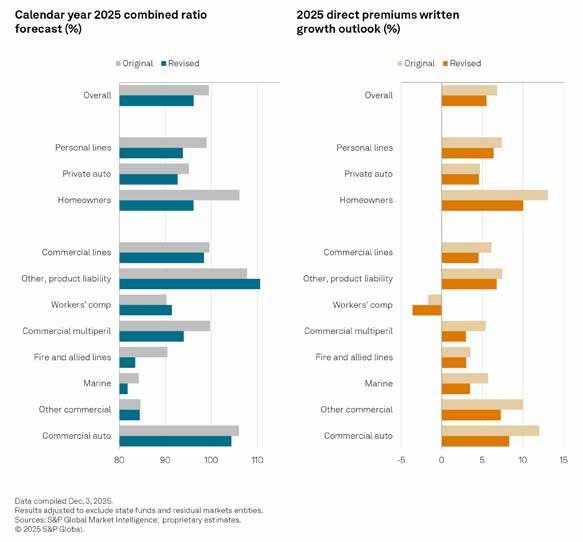
Comparisons to earlier projections delivered in S&P GMI’s 2025 U.S. Property and Casualty Insurance Market Report, published in August 2025, are shown graphically in the latest report on auto lines and set forth below.
The latest combined ratio projections are generally better than the August projections, with the homeowners line showing the greatest change—falling down from a forecast of 106.1 in August to below 100 (96.2) in December. The only line for which the forecasted full-year combined ratio moved in the opposite direction is commercial liability (other liability and product liability), which moved from 107.8 in the August report to over 110 in December.
Previously, the homeowners continued on page 26
continued from page 25
combined ratio projection had incorporated expectations for another active severe convective storm season in the second quarter and an average hurricane season in the third quarter—neither of which materialized.
“Meanwhile, adverse reserve development in certain casualty lines is running ahead of what we presumed to have been conservative projections,” the report says, commenting on the commercial liability lines. “This is particularly worrisome given that the fourth quarter, when companies occasionally implement ‘kitchen-sink’ reserve charges, lies ahead.”
As for premium growth, S&P GMI hasn’t changed its personal auto forecast of a jump of about 5% in 2025, compared with 2024, but analysts now project commercial auto insurance direct premiums “expanding at a more sluggish pace” than previously expected. In the August report, S&P GMI put commercial auto premium growth at 12%, but the forecast now falls below 10%, according to the graphical comparison.
On the personal lines side, S&P GMI has also taken down its projected growth rate for homeowners insurance—to roughly 10%, according to the December auto insurance report, down from 13.1% in the August analysis.
S&P GMI’s December auto insurance report also includes:
• A discussion of macroeconomic factors and their impact on the auto insurance business.
• Separate analyses of liability and physical damage combined ratios and growth rates for personal and commercial auto insurance segments.
• Lists of the top 20 personal and commercial auto insurers, showing five years of direct premiums and loss ratios for each insurer (2020-2024).
• Maps providing state-bystate loss ratio comparisons (five-year loss ratios for 20202024, presented separately for personal auto liability, personal auto physical damage, commercial auto liability, and commercial auto physical damage).
• Maps indicating 2025 rate-change relativities for
personal auto by state, and cumulative rate changes from 2021 through 2024.
• Discussion and analysis of advertising spending of major personal lines direct writers.
• Crash frequency statistics for commercial trucks and the analysis of E&S growth in the commercial auto market.
Throughout the report, S&P GMI also reminds auto insurers of long-term challenges on the horizon as the potential shift toward autonomous vehicles requires insurers to plan for a future with different risk profiles and coverage needs.
Conceding that “the promise of full autonomy
within the private passenger fleet seemingly remains years away,” the report advises that “no matter how distant the transition, auto insurers have had no choice but to plan for a future that may look very different than the present and past.”
Sclafane is Executive Editor of Carrier Management, a publication of Wells Media Group serving property/casualty insurance carrier executives. She is a media professional with deep background in the P/C insurance industry including 25 years as editor and reporter for trade magazines, online news services, digital journals. Her prior experience includes 14 years as a casualty actuary.


By Jonathan Stempel
PacifiCorp, a utility owned by Berkshire Hathaway, agreed to pay $575 million to resolve U.S. government damages claims related to six wildfires in Oregon and California that burned nearly 290,000 acres of federal land, the U.S. Department of Justice said this month.
The settlement resolves claims that PacifiCorp’s electrical lines negligently started the fires.
Five of the fires – Archie Creek, Echo Mountain Complex, Slater, South Obenchain and 242 – began during Labor Day weekend in 2020 and burned approximately 250,000 acres of federal land. The sixth fire, McKinney, began in July 2022 and burned 39,000 acres of
Acontractor in Washington was fined $200,000 for putting workers at risk during a demolition project at a home in Bellevue, Washington.
The Washington State Department of Labor & Industries cited Seattle Environmental Services LLC for knowingly exposing workers to toxic conditions on a 2025 project while telling inspectors that the site was safe.
negative for asbestos, making respiratory gear optional.
However, Seattle Environmental Services couldn’t provide evidence that they actually tested the material that they planned to tear out for asbestos, so inspectors posted an order to stop the work, according to L&I.

When inspectors were called to a home in Bellevue, the owner of the company reportedly told inspectors that the job was a general demolition project, and that samples that were tested came out as
L&I said evidence was present that looked like the contractor was treating the jobsite like an asbestos removal project. Inspectors took pictures of yellow bags designed for asbestos waste, and a negative air machine was also found with an exhaust tube running through the property’s sliding door, inspectors say. When the contractor produced test
federal land.
PacifiCorp’s payment will help repay the government for firefighting costs, and allow the Forest Service and Bureau of Land Management to restore some of the burned land.
The settlement “ensures fair compensation to the American taxpayer,” and “strikes a balance by addressing the government’s significant fire-suppression costs and loss of natural resources without preventing PacifiCorp from offering electricity at fair prices,” Principal Deputy Assistant Attorney General Adam Gustafson said in a statement.
PacifiCorp denied liability in agreeing to settle, the Justice Department said. The utility did not immediately respond to requests for comment.
The settlement was announced three days after PacifiCorp said it planned to sell many of its assets in Washington state to Portland General Electric POR.N for $1.9 billion, to bolster liquidity as it defends against wildfire litigation.
(Reporting by Stempel in New York; Additional reporting by Costas Pitas and Ismail Shakil; Editing by David Ljunggren and Deepa Babington) Copyright 2026 Reuters. All rights reserved.
results hours after the work stopage, it was confirmed that nearly 3,000 square feet of walls and ceilings contained asbestos. By the time the test results were available, three workers had already removed the toxic material without using proper respirators and decontamination showers, according to L&I.
L&I said that after the initial story, the employer said he mixed up the abatement job with another. He worked with inspectors to make sure that the asbestos debris was removed, which led L&I to allow the company to restart the work on the site.
Seattle Environmental Services was cited 10 times for willful serious violations, as well as six serious and four general violations for ignoring rules for removing asbestos and for providing inaccurate information to L&I.
E&S is now SPG Wholesale | Specialty Program Group














Anew bill in California would require insurers to offer homeowners insurance to those who meet state home hardening and defensible space requirements.
Senate Bill 1076, the Insurance Coverage for Fire-Safe Homes Act, was introduced by Senator Sasha Renée Pérez (D-Pasadena) and is co-sponsored by the Eaton Fire Survivors Network and Consumer Watchdog in response to wildfire survivors’ concerns that they could lose coverage after they rebuild, even if they meet the highest wildfire safety standards.
SB 1076 requires insurers to offer homeowners insurance to Californians who meet state home hardening and defensible space requirements set by the insurance commissioner.
“I’ve spoken with Eaton Fire survivors whose newly built homes will meet the highest levels of protection against wildfires but still fear they won’t be able to purchase insurance,” Pérez stated. “Being denied coverage after meeting safety standards sends the wrong message and is akin to being penalized for doing the right thing. SB 1076 will ensure that our communities’ insurance needs are met by making coverage available to them for making existing neighborhoods safer.”
The legislation would:
• Require carriers to offer and renew coverage for any home that meets

wildfire-safety standards adopted by the insurance commissioner, including home hardening measures and defensible-space requirements.
• Allow the insurance commissioner to impose a five-year bar from both home and auto markets for insurers that refuse to comply.
“On and after January 1, 2028, this bill would prohibit an admitted insurer that offers or sells residential property insurance in this state from refusing to offer, sell, or renew a policy of residential property insurance for an applicant or insured whose property meets minimum
Abill intended to combat insurance fraud by updating a 20-year-old law passed the Washington state senate in late February.
Senate Bill 6031 defines insurance fraud as its own crime, a Class B felony.
The bill passed on a unanimous vote.
Insurance Commissioner Patty Kuderer.

SB 6031 was pushed for by Washington
State law established the Office of the Insurance Commissioner’s Criminal Investigation Unit in 2006, but the law hasn’t been updated since.
With SB 6031, Kuderer believes this gives the unit modern tools to investigate modern fraud.
The bill expands “victims of insurance
home hardening and wildfire mitigation standards, except as provided,” the text of the bill states. “The bill would authorize an admitted insurer to apply to the commissioner for a temporary waiver of that prohibition in a particular geographic area of the state, as specified. On and after January 1, 2028, the bill would also require any residential property insurance offered or sold to, at a minimum, provide coverage equivalent in scope to the residential property coverage the admitted insurer most commonly offers or sells in this state.”
The bill is awaiting referral to a committee.
fraud” to include insurance consumers and insurance beneficiaries, making them eligible for criminal restitution.
SB 6031 would also expand statutory reporting of suspected insurance fraud to the commissioner by adding regulators of healthcare or financial services professions, and other law enforcement and public safety agencies as among the required reporters of suspected fraud.
The bill now moves to the state House of Representatives for consideration.
Commercial & Recreational Marine
Market Detail: RISCO has marine expertise for commercial and recreational marine business. We assist brokers with all their marine needs. Available Products & Services, including but not limited to:
Commercial Marine: Marine Contractors, Ship Repairers, Boat Builders, Boat Dealers, Terminal Operators, Vessel Operation (passenger vessels, tour boats, ferry services), Marine and Allied Industries (including Manufacturers & Wholesalers), and Cargo.
Recreational Marine: Marinas, Boatyards, Yacht Clubs, Boat Dealers, Yacht Builders, and Marine Artisans.
Coverages: Hull & Machinery, Protection & Indemnity, Jones Act (crew coverage), Builders Risk, Builders Risk P&I, Property, Contractors Equipment, Commercial Liability, Product Liability, Marina Operators Legal Liability, Ship Repairers Legal Liability, Vessel Pollution, Wharfingers, Piers, Wharfs & Docks, and Bumpershoot.
Available Limits: Not disclosed.
Carrier: Admitted and non-admitted. States: Connecticut, Maine, Massachusetts, New Hampshire, and Rhode Island.
Contact: Charles Finnegan, riscocl@ risco-inc.com, 800-533-3649
Market Detail: Optimal Property Coverage Solutions - Expert IGP Specialty Property team provides optimal solutions for property clients. Their team leverages its extensive experience and market partnerships to build property programs tailored to the needs of insureds. They focus on schedules of all sizes; CAT and non-CAT; and specialized lines of property coverage.
Specialized Coverage: Builder’s Risk, Catastrophic Exposed Property, Deductible Buydown, DIC, Flood, Inland Marine, Multi-Peril, Shared/Layered Schedules, Stock Through-Put, and Terrorism.
Target Areas of Expertise: Real Estate, Condominiums, Commercial, Mixed Use, Multi-Family/Apartments, Vacant Property, Hospitality and Entertainment, Bars/ Nightclubs, and Hotels/Motels.
Other Industries: Agribusiness, Environmental and Energy Facilities,
Healthcare Risks and Manufacturing/ Distribution/Warehousing.
Available Limits: Not disclosed. Carrier: Not disclosed.
States: All 50 states and the District of Columbia except Alaska and Hawaii.
Contact: Alan Griesemer, alan.griesemer@ usi.com, 800-241-6633
Assisted and Independent Living
Market Detail: Convelo brings decades of experience providing insurance for senior living clients, supported by a deep understanding of the industry today. Expertise and strategic alliances put the company in a prime position to offer foundational products like package insurance and workers’ compensation, along with supporting products like cyber and management liability. Lean on Convelo’s expertise to help win clients’ business and trust by offering the best possible protection. The program is a true package product on A+ admitted paper—a winning combination that clients would be hard-pressed to find anywhere else.
Coverages: Property, Liability, Auto, and Excess.
Target accounts for Assisted and Independent Living program include nonprofit assisted and independent living facilities with ambulatory residents age 55 and up; best-in-class facilities with multiline premiums $25K and up; operations in all states except AL, AK, CA, LA, MS, WA, and WY. Facilities must be in operation for at least five years with historic loss ratios consistent with well-controlled operations. Buildings must be equipped with automatic sprinkler systems.
Available Limits: Not disclosed. Carrier: Admitted with A+ rating. States: All 50 states and the District of Columbia except Alabama, Alaska, California, Louisiana, Mississippi, Washington, and Wyoming.
Contact: Brian Botwinick, bbotwinick@ conveloins.com, 833-266-8356
Market Detail: Coverage offered includes General Liability coverage for Waste Haulers, General Liability coverage for
Roll-off Container Service Companies, Waiver of Transfer of Rights of Recovery against others to the insurer, Primary Noncontributory Language, and various Additional Insured endorsements.
Limits: 1/2/2 limits (1M occurrence, 2M general aggregate, 2M products, and completed operations aggregate). NEW! 2/4/4 limits. 5M Per Project Aggregate.
Supported Excess with Scheduled Auto available. Has Pen.
Available Limits: $10,000 minimum premium, $1 million maximum premium.
Carrier: Non-admitted, rated A- by AM Best.
States: All 50 states and the District of Columbia except Alaska.
Contact: Drew Moyer, dmoyer@usmcins. com, 484-801-4794
Market Detail: BeautyGuard is a specialized insurance solution built exclusively for salons, spas, and beauty professionals. Unlike standard policies, it’s designed to address the unique risks of the beauty industry so that you can deliver complete protection and peace of mind to independent beauty professionals and salon or spa owners.
Coverage: Estheticians, Hair Stylists, Nail Technicians, Permanent Makeup Artists, Cosmetologists, Massage Therapists, Salon Owners, Spa Owners, and Permanent Jewelry Businesses. Has pen.
Available Limits: Not disclosed.
Carrier: Not disclosed.
States: All 50 states and the District of Columbia.
Contact: Nate Szana, nate@beautyguardinsurance.com, 833-770-4067.
section brought to you by
By L.S. Howard
The global boom in the construction of data centers—driven by the growth of generative artificial intelligence (AI) and machine learning—is creating organic growth opportunities for major brokers such as Aon and Marsh.
“Over the next five years, it’s estimated that between 2,000 to 3,000 data centers will be constructed worldwide, and we’re already well on the way to establishing our pre-eminence in this ecosystem as a trusted partner,” said Martin South, president and chief executive officer of Marsh Risk, during an analysts’ call to discuss Marsh’s fourth-quarter and full-year results.
In 2025 alone, South added, Marsh US had the leading market share of the $205 billion in data center construction values, while the company is “the clear leader” in Asia, serving six of the largest foundry businesses, the four largest memory integrated device manufacturers, and the largest semiconductor tool manufacturer.
“The data center opportunity, it is unique; it has never been seen before; it is monumental. It also requires a level of response and complexity that’s beyond what the traditional industry has ever accomplished—just be clear about that,” said Aon Chief Executive Officer Greg Case during an analysts’ call on Q4/ FY2025 results.
“This requires real, net new innovation around alternative forms of capital, how we
think about risk, how we pool risk, all those pieces,” he said, adding that data center opportunities will reinforce mid-single-digit or greater organic revenue growth.
John Doyle, president and CEO of Marsh, said investment in the digital infrastructure world is expected to hit roughly $3 trillion over the next five years.
A recent report published by Allianz Commercial quotes statistics from Morgan Stanley that data center investments will hit $3 trillion by 2029, while McKinsey estimates capital outlays of close to $7 trillion by 2030.
“It’s been an area of focus for us for some time,” Doyle said, noting that Marsh has launched a Digital Infrastructure Practice in response to growing demand. (The practice is led by Mike Mathews, global digital infrastructure leader, who was appointed in December 2025.)
The investment in digital infrastructure “comes from lots of different parts of the economy, not just hyperscalers, of course. And so we’ve been focused on it, and we’re quite excited about the investment there,” Doyle added.
Allianz defines “hyperscalers” as the major technology companies, which are spearheading this expansion. “In 2024, hyperscalers globally spent around $210 billion on data center capital expenditures related to AI deployments,” Allianz said.
Dean Klisura, president of
Guy Carpenter, Marsh’s reinsurance business, described the digital infrastructure space as providing the single biggest new business opportunity in 2026 for both cedents and reinsurers.
There have been “estimates of up to $10 billion of new premium entering the market in 2026 because of these opportunities,” he said, emphasizing that the market needs more capacity.
“No cedent is going to put up billions of dollars of capacity for a single location risk. So, that’s a real issue. All of our clients want to write data centers across 10-plus products globally, but they require additional reinsurance protections,” Klisura continued.
“Everybody is concerned with accumulations in portfolios, and we’re solving that right now for our clients,” he said.
As a result, Klisura said, new capital—not just traditional reinsurance capital—needs to enter the market. “The introduction of third-party capital and securitizing some of these risks via sidecars and other vehicles is going to be critical,” he said, explaining that such third-party capital will have to be sourced from “deep-pocketed investors given the size of these risks.”
Nick Studer, president and CEO of Marsh Management Consulting, explained that the data center opportunities go beyond the construction of new facilities and include 90% of existing data centers that need to become AI-enabled.
“So, we’re working with colleagues across our businesses

to help manage that transformation, integrating strategy, risk, and execution planning,” Studer said. “And we’re also seeing strong demand in our energy practice around power, around grid strategy, around supply chain resilience, around the navigation of regulation.”
Marsh Risk’s South said the company recognizes that insurance capacity is a critical factor in supporting data center growth, which is why Marsh’s large-scale data center construction insurance facility, “Nimbus,” in January doubled its capacity to US$2.7 billion for major data center construction projects in the U.K., U.S., Canada, Europe, Australia, and New Zealand.

Insurance broker Aon also detailed some of the opportunities it is seeing from the data center construction boom.
Aon’s CEO Case said the broker currently handles onethird, or even more, of the data centers out there now, so it is “incredibly well-positioned.” The AI/data center race is just beginning, he affirmed.
KBW equities analyst Meyer Shields summed up Aon’s comments about data center opportunities “as a once-in-a-generation global build cycle requiring new risk structures, alternative capital, and analytics…”
“[T]here are only a handful of global brokers (obviously including Aon) that can credibly address data center insurance needs, and we expect
that, combined with increasing recent hire productivity, to sustain above-average organic revenue growth in 2026 and beyond,” according to Shields’ “Flash Note” covering Aon’s conference call takeaways.
In July 2025, Aon launched its Data Center Lifecycle Insurance Protection Program (DCLP), which provides coverage for data centers from construction through operational readiness under a single integrated facility. Capacity was expanded earlier this year to $2.5 billion from $1.5 billion.
Case went on to cite several data center success stories to demonstrate how Aon is driving results and fueling momentum in 2026.
When a large international construction client needed a
dedicated broker to support the full life cycle of a new data center project, Case said, Aon combined its “role as a trusted adviser with a united global team, bringing together account leadership with construction, data center, energy, and cyber specialists to deliver an integrated proposal.”
In addition to DCLP coverage, Aon provided advanced climate analytics and proprietary risk analyzers, all aligned to the client’s long-term growth strategy, Case said.
“The client credited our team’s expertise and our global connectivity and capabilities as central to the win, reinforcing our strength in leveraging trusted relationships and leading analytics to create high-quality growth opportunities,” he continued.
Case then detailed another client win from Aon’s reinsurance team, which “recently designed and placed the first-ever data-center-specific treaty,” delivering a solution that provides up to $5 billion of capital through the insurance value chain behind a single leading insurer.
“Our advisory capabilities around site selection, design, and engineering, as well as tremendous data and advanced analytics, are critical to informing effective capital protection decisions in the face of extreme weather, supply chain, and cyber risk,” Case said, emphasizing that Aon’s “leadership in this space is another factor that supports organic revenue growth.”
earching for the right market for a hard-to-place hospitality risk? Look no further than Insurance Journal’s Hospitality Risks Directory — a comprehensive listing of excess and surplus lines intermediaries and carriers offering hospitality risks coverage nationwide.
The information listed in this directory has been compiled to serve as a resource guide for independent agents and brokers looking for superior markets for everything from nightclubs to special events, hotels to motels, spas, resorts and restaurants too.
All markets profiled in this directory have been updated with the most current information available provided directly by the intermediaries and carriers writing the coverage. IJ has made every attempt to ensure the accuracy of all information listed in this directory.
To submit a listing for future Hospitality Risks directories, e-mail Kristine Honey at: khoney@insurancejournal.com. We hope you find IJ’s 2026 Hospitality Risks Directory to be a useful tool when searching for quality markets.
To comment on this directory, or any other Insurance Journal resource, please e-mail: editorial@insurancejournal.com.
Executive
First
Friedlander Group, Inc. (Worker's Comp) Most States
Gateway Specialty Insurance
Golden
Gorst & Compass Insurance CA GSS Insurance Services
Hospitality Insurance Group
Innovation Growth Partners Specialty, LLC
(IGP Specialty)
James River Insurance Company
States Jencap
Jimcor Agencies
Joseph Krar & Associates CT MA
National Trust Insurance Services All States except AK
Nautilus Insurance Co. & Great Divide Ins. Co. All States
NeitClem Wholesale Insurance Brokerage, Inc. AZ CA NV
New Age Underwriters Agency, Inc. Most States
New England Excess Exchange
Number One Insurance Agency, Inc. MA
Pacific Excess Insurance Marketing Most States
PLIS Inc. - Underwriting Facilities All States
Quirk & Company
River Valley Underwriters
Roush Insurance Services, Inc.
RT Specialty
Smart Choice Express Markets 48 States
Southern Insurance Underwriters, Inc. CMGA
TAPCO Underwriters, Inc. Most States
Walter General Agency (WGA)
Western Surplus Lines Agency, Inc.
Wilson Smith Group
Worksperity (Worker's Comp coverage)
XPT Specialty
Bars / Night Clubs coverage category sponsored by:
Applied Underwriters - for more info, check out our ad on the Back Cover.
States
Market Available
Admiral Insurance Group
Most States
AFR Insurance Services (Flood coverage) All States
Amwins All States
Applied Underwriters, Inc. All States
Ascendant Insurance Solutions AL AZ CA CO CT DC FL KY
IL LA MA MD NJ NC
NY NV PA SC TN TX VA VT WY
Ashley General Agency TX
Bass Underwriters
Most States
Braishfield Associates, a division of Hull & Co. All States
Brecht & Associates OK TX
Business Alliance Insurance Company CA
Canngen Insurance Services, LLC All States
Centrex Underwriters (GL, Liquor, Property) Most States
CID Insurance Programs, Inc. AZ CA CO ID NE NM NV OR TN TX UT WA
CRC - Middletown CT MA ME NH NJ NY RI PA VT
DeCotis Insurance Associates AZ CO CT DE FL GA MA MD ME NC NH NJ NM NY OK PA RI SC TX VA VT
Eastern Underwriting Managers
Entertainment Risk
AR AZ CA FL GA IL
KS KY LA MO MS NC
NV OK SC TN TX VA
CO FL GA IL LA MA
MI NV NY OH TN
UT VA
Executive Insurance Professionals, PLLC TX OK NM
First Choice Ins. Intermediaries (Liq. Liab only) Most States
Founders Insurance Company
AL CO CT FL IA IL IN KS LA MI MN MT NC NH NY OH OR TN WI
Friedlander Group, Inc. (Worker's Comp) Most States
FTP Inc.
Golden Bear Insurance Company
CT DE GA MD NC NJ NY PA SC VA
AL CA CO HI ID KY MO
MT NE NC ND NM OR SD UT WA
Gorst & Compass Insurance CA
Greenwood General Insurance Agency Most States
Hinterland Insurance
Hospitality Insurance Group
All States except OK TX
CT MA NC NH PA RI VT
Innovation Growth Partners Specialty, LLC All States (IGP Specialty)
Integrated Specialty Coverages (ISC) All States except AK & NM (includes Gastropubs, Sports Bars & Taverns)
James River Insurance Company All States
Jencap All States States
Market Available
Jimcor Agencies (includes Taverns) All states except AK HI NE SD WY
Joseph Krar & Associates CT MA ME NH RI
Kinsale Insurance Company All States
Legacy Employer Concepts, LLC All States
London Underwriters, LLC All States except NY & HI
M.J. Hall & Company Insurance Brokers AK AZ CA CO HI ID KS MT ND NE NM NV OK OR SD TX UT WA WY
Market Finders Insurance Corp. All States
MAXIMUM All States
May Specialty Underwriters (Excess Liability) All States
McLeckie Insurance Group AZ CO FL NC OK RI TN TX
New Age Underwriters Agency, Inc. Most States
New England Excess Exchange CT DC MA MD ME NC NH NJ NY OH PA RI VA VT
Number One Insurance Agency, Inc. MA
One80 Intermediaries See website for state info
Pacific Excess Insurance Marketing Most States
Pacific Gateway Ins. Agency (Auto coverage) All States except FL
Pie Insurance (Work Comp coverage) 38 States + DC
PLIS Inc. - Underwriting Facilities All States
Prime Insurance Company All States
Quirk & Company
Rainbow (no Nightclubs)
Risk Placement Services, Inc.
Risk Placement Services Sacramento CA
Roush Insurance Services, Inc.
RT Specialty
Smart Choice Express Markets
Southern Ins. Underwriters CMGA (+ Taverns) AL FL GA SC TN
Southwest Risk, LP All States except AK HI NJ NY
The McGowan Companies All States UFG Specialty Excess P&C coverages in All States
USASIA Insurance Services CA NV
USG Insurance Services, Inc. All States
Walter General Agency (WGA) AR
States
AFR Insurance Services (Flood coverage) All States
Amalgamated Insurance Underwriters All States except LA TX OK NY HI and AK
Amwins All States
Amwins Underwriting All States
Applied Underwriters, Inc. All States
Ascendant Insurance Solutions
Ashley General Agency TX
Atlas, An RPS Company
AZ CA CO CT DC FL KY
CA IL LA NV PA TX
Bass Underwriters Most States
Berkley Select | a Berkley Company All States
Centrex Underwriters (GL, Liquor, Property) Most States
Cochrane & Company AR AZ CA CO ID KS MO MT OR UT WA
Element22 Insurance Services All States
Eastern Underwriting Managers
AR AZ CA FL GA IL
Friedlander Group, Inc. (Worker's Comp) Most States
FTP Inc.
Admiral Insurance Group Most States
AFR Insurance Services (Flood coverage) All States
Amwins All States
Applied Underwriters, Inc. All States
Atlas, An RPS Company
Bass Underwriters
Braishfield Associates, a division of Hull & Co.
Business
Canngen Insurance Services, LLC
Centrex Underwriters (GL, Liquor, Property)
CID Insurance Programs, Inc.
Cochrane
CRC - Middletown
DeCotis
Eastern
DE GA MD NC NJ NY PA SC VA
Greenwood General Insurance Agency Most States
Hinterland Insurance All States except OK TX
Innovation Growth Partners Specialty, LLC All States (IGP Specialty)
James River Insurance Company All States
Jencap All States
Joseph Krar & Associates CT MA ME NH RI
London Underwriters, LLC All States except NY & HI
May Specialty Underwriters (Excess Liability) All States
McLeckie Insurance Group AZ CO FL NC OK RI TN TX
National Trust Insurance Services (Historic) All States except AK & HI
NeitClem Wholesale Insurance Brokerage, Inc. AZ CA NV
New Age Underwriters Agency, Inc. Most States
Number One Insurance Agency, Inc. MA
Pacific Gateway Ins. Agency (Auto coverage) All States except FL HI LA MA MI NJ NY
Philadelphia Insurance Companies All States except LA
Pie Insurance (Work Comp coverage) 38 States + DC
PLIS Inc. - Underwriting Facilities All States
Prime Insurance Company All States
Quirk & Company LA NM OK OR TX WA
Risk Placement Services, Inc. All States
River Valley Underwriters
AL CO FL GA IA ID IL
Southern Insurance Underwriters, Inc. CMGA AL FL GA SC TN
Southwest Risk, LP All except AK HI NJ NY
SPG Wholesale All States
TAPCO Underwriters, Inc. Most States
The McGowan Companies All States
UFG Specialty (Excess P&C coverage) All States
Western Surplus Lines Agency, Inc. LA ND
Wilson Smith Group
XPT Specialty All States
Gorst
NeitClem
Braishfield
DeCotis
Founders
Friedlander
CID
James
Kinsale
NeitClem
New
Prime
Risk
Risk Placement Services Sacramento
Roush
Smart
UFG
Hotels / Motels coverage category sponsored by:
Amalgamated Insurance Underwriters - for more info, check out our ad on page 1 (West, Southeast, East & Midwest).
States Market Available
AllComp Solutions (Work Comp coverage) Most States
Amalgamated Insurance Underwriters All States except LA TX OK NY HI and AK
American Specialty Ins. & Risk Services, Inc. All States
American Union Risk Associates (Umbrella) All States except GA
Amwins All States
Amwins Underwriting All States
Applied Underwriters, Inc. All States
Ascendant Insurance Solutions
AZ CA CO CT DC FL KY
IL LA MA MD NJ NC
NY NV PA SC TN TX VA VT WY
Ashley General Agency TX
Atlas, An RPS Company AZ CA IL LA NV PA TX
Bass Underwriters
Most States
Berkley Select | a Berkley Company All States
Braishfield Associates, a division of Hull & Co. All States
Brecht & Associates OK TX
Canngen Insurance Services, LLC All States
Centrex Underwriters (GL, Liquor, Property) Most States
Cochrane & Company AR AZ CA CO ID KS MO MT OR UT WA
Covenant Underwriters
e-commerce insurance programs All States
CRC - Middletown
MA ME NH NJ NY RI
VT
DeCotis Insurance Associates AZ CO CT DE FL GA MA
ME NC NH NJ NM NY OK PA RI SC TX VA VT
Distinguished Programs All States
Eastern Underwriting Managers
AL AR AZ CA FL GA IL IN KS KY LA MO MS NC NJ NV OK SC TN TX VA
Element22 Insurance Services All States
Friedlander Group, Inc. (Worker's Comp) Most States
FTP Inc.
CT DE GA MD NC NJ NY PA SC VA
Gorst & Compass Insurance CA
Greenwood General Insurance Agency
GSS Insurance Services
Most States
AZ CA FL NV TX
Halcyon Underwriters All States
Hinterland Insurance
James River Insurance Company
Jencap
Jimcor Agencies
All States except OK TX
All States
All States
All states except AK HI NE SD WY
States
Market Available
Kinsale Insurance Company All States
KZ Insurance Brokerage, LLC AZ CA CO LA NV TN
Legacy Employer Concepts, LLC All States
London Underwriters, LLC All States except NY & HI
Market Finders Insurance Corp. All States
MAXIMUM All States
May Specialty Underwriters (Excess Liability) All States
McLeckie Insurance Group AZ CO FL KY NC OK RI TN TX
National Trust Insurance Services (Historic) All States except AK & HI
Nautilus Insurance Co. & Great Divide Ins. Co. All States
NeitClem Wholesale Insurance Brokerage, Inc. AZ CA NV
New England Excess Exchange CT DC MA MD ME NC NH NJ NY OH PA RI VA
One80 Intermediaries See website for state info
Pacific Excess Insurance Marketing Most States
Philadelphia Insurance Companies All States except LA
Pie Insurance (Work Comp coverage) 38 States + DC
PLIS Inc. - Underwriting Facilities All States
Prime Insurance Company All States
Professional Program Ins Brokerage, A div. All States of SPG Insurance Solutions
Quirk & Company LA NM OK OR TX WA
Risk Placement Services, Inc. All States
Risk Placement Services Sacramento CA
River Valley Underwriters AR AL CO FL GA IA ID IL IN KS LA MD MO MS NC NE NM OH OK SC SD TN TX UT VA
Roush Insurance Services, Inc. IA IL IN OH WI
RT Specialty All States
Smart Choice Express Markets 48 States
Southern Insurance Underwriters, Inc. CMGA AL FL GA SC TN
Southwest Risk, LP All States except AK HI NJ NY
SPG Wholesale All States
TAPCO Underwriters, Inc. Most States
The McGowan Companies All States Travelers All States
UCA General Insurance Services, Inc. AZ CA ID NV OR UT WA
UFG Specialty Excess P&C coverages in All States
USG Insurance Services, Inc. All States
Walter General Agency (WGA) AR IA IL IN KS KY MO OK TN
Western Surplus Lines Agency, Inc. LA ND NM OK TX
Wilson Smith Group AZ LA MD MI MS NJ NV NY OK PA TX
Worksperity (Worker's Comp coverage) All States
Restaurants coverage category sponsored by: SPG Wholesale - for more info, check out our ad on page 3 (West).
Amalgamated Insurance Underwriters
American Specialty Ins. & Risk Services, Inc.
Amwins
Amwins Underwriting
Atlas, An RPS Company
Bass Underwriters
Berkley Select | a Berkley Company
Canngen Insurance Services, LLC
Cochrane & Company
Distinguished Programs
Friedlander Group, Inc. (Worker's Comp)
Gorst & Compass Insurance
Hinterland Insurance
James River Insurance Company
Jencap
Jimcor Agencies
K & K Insurance Group, Inc.
Kinsale Insurance Company
London Underwriters, LLC
MAXIMUM
National Trust Insurance Services (Historic)
One80 Intermediaries
Pacific
Ashley General Agency
Atlas, An RPS Company
Bass Underwriters
Berkley Select | a Berkley Company
Braishfield Associates, a division of Hull & Co.
Brecht & Associates OK TX
Business Alliance Insurance Company
Canngen Insurance Services, LLC
Centrex Underwriters (GL, Liquor, Property)
CID Insurance Programs, Inc.
Coterie Insurance
CRC - Middletown
DeCotis Insurance Associates
Distinguished Programs
Element22 Insurance Services
ERGO NEXT Insurance All States
Executive Insurance Professionals, PLLC TX OK NM
First Choice Insurance Intermediaries, Inc. Most States
Founders Insurance Company
Friedlander Group, Inc. (Worker's Comp) Most States
FTP Inc.
Golden Bear Insurance Company
Gorst & Compass Insurance CA
Great American Ins. Group, Alternative Markets All States
Greenwood General Insurance Agency Most States
GSS Insurance Services
Halcyon Underwriters
Hinterland Insurance
Hospitality Insurance Group
Innovation Growth Partners Specialty, LLC All States (IGP Specialty)
Restaurants States Market Available
Integrated Specialty Coverages (ISC) All States except AK & NM
James River Insurance Company All States
Jencap All States
Jimcor Agencies All states except AK HI NE SD WY
Joseph Krar & Associates CT MA ME NH RI
Kinsale Insurance Company All States
KZ Insurance Brokerage, LLC AZ CA CO LA NV TN
Legacy Employer Concepts, LLC All States
London Underwriters, LLC All States except NY & HI
Market Finders Insurance Corp. All States
MAXIMUM All States
May Specialty Underwriters (Excess Liability) All States
McLeckie Insurance Group AZ CO FL KY NC OK RI TN TX
National Trust Insurance Services (Historic) All States except AK & HI
Nautilus Insurance Co. & Great Divide Ins. Co. All States
NeitClem Wholesale Insurance Brokerage, Inc. AZ CA NV
New England Excess Exchange CT DC MA MD ME NC NH
New Age Underwriters Agency (Casual/Fine) Most States
Number One Insurance Agency, Inc. MA
One80 Intermediaries See website for state info
Pacific Excess Insurance Marketing Most States
Philadelphia Insurance Companies All States except LA
Pie Insurance (Work Comp coverage) 38 States + DC
PLIS Inc. - Underwriting Facilities All States
Prime Insurance Company All States
Quirk & Company
Rainbow
NM OK OR TX WA
Risk Placement Services, Inc. All States
Risk Placement Services Sacramento CA
River Valley Underwriters
Roush Insurance Services, Inc.
RT Specialty
Smart Choice Express Markets
Southern Insurance Underwriters, Inc. CMGA
Southwest Risk, LP
SPG Wholesale
TAPCO Underwriters, Inc.
Target Market Specialists All States
The McGowan Companies (includes Fine / Casual Dining) All States
Travelers
UCA General Insurance Services,
USASIA
AFR
Ascendant
Ashley
Braishfield
Centrex
CID
Coterie
Executive
First
Gateway
Gorst
James
Joseph
Kinsale
NeitClem
Philadelphia
Professional
Risk
SASSI
SPG
TAPCO
Walter
Western
Special Events coverage category sponsored by: Philadelphia Insurance Companies - for more info, check out our ad on page 7 (National).
American Specialty Ins. & Risk Services, Inc. All States
Amwins All States
Amwins Underwriting All States
Ashley General Agency TX
Bass Underwriters Most States
Braishfield Associates, a division of Hull & Co. All States
Brecht & Associates OK TX
Canngen Insurance Services, LLC
States
Centrex Underwriters (GL, Liquor, Property) Most States
CID Insurance Programs, Inc.
Cochrane & Company
CRC - Middletown
DeCotis Insurance Associates
CA CO ID NE NM
OR TN TX UT WA
AZ CA CO ID KS MO
VT
CO CT DE FL GA MA
Executive Insurance Professionals, PLLC TX OK NM
First Choice Insurance Intermediaries, Inc. Most States
Founders Insurance Company
Gateway Specialty Insurance
Gorst & Compass Insurance
Greenwood General Insurance Agency
GSS Insurance Services
CA FL NV TX
Halcyon Underwriters All States
Hospitality Insurance Group
MA NC NH PA RI VT
Innovation Growth Partners Specialty, LLC All States (IGP Specialty)
InsuranceHelper.com All States
James River Insurance Company All States
Jencap All States
Joseph Krar & Associates CT MA ME NH RI
K & K Insurance Group, Inc. All States
Kinsale Insurance Company All States
London Underwriters, LLC All States except NY & HI
M.J. Hall & Company Insurance Brokers
AZ CA CO HI ID KS MT
Market Finders Insurance Corp. All States
MAXIMUM All States
McLeckie Insurance Group AZ CO FL KY NC OK RI TN TX
National Trust Ins. Services (Historic Venues) All States except AK & HI
Nautilus Insurance Co. & Great Divide Ins. Co. All States
NeitClem Wholesale Insurance Brokerage, Inc. AZ CA NV
New England Excess Exchange
Number One Insurance Agency, Inc. MA
One80 Intermediaries See website for state info
Pacific Excess Insurance Marketing Most States
Pacific Gateway Insurance Agency All States except FL HI LA MA MI NJ NY
Philadelphia Insurance Companies All States except LA
Prime Insurance Company All States
Professional Program Ins Brokerage, A div. All States of SPG Insurance Solutions
Quirk & Company LA NM OK OR TX WA
Risk Placement Services, Inc. All States
Risk Placement Services Sacramento CA
River Valley Underwriters
AL
Roush Insurance Services, Inc. IA IL IN OH WI
RT Specialty All States
Smart Choice Express Markets 48 States
Southern Insurance Underwriters, Inc. CMGA AL FL GA SC TN
Southwest Risk, LP All States except AK HI NJ NY
SPG Wholesale All States
TAPCO Underwriters, Inc. Most States
The McGowan Companies All States
USASIA Insurance Services CA NV
USG Insurance Services, Inc. All States
Walter General Agency (WGA) AR IA IL IN KS KY MO OK TN
Western Surplus Lines Agency, Inc. LA ND NM OK TX
Wilson Smith Group
Worksperity (Worker's Comp coverage) All States
XPT Specialty All States
Admiral Insurance Group
232 Strawbridge Dr., Moorestown, NJ 08057
Phone: 856-429-9200
Email: admiralmarketing@admiralins.com www.admiralins.com
AFR Insurance Services
1820 Preston Park Blvd., Ste. 1100, Plano, TX 75093
Phone: 800-995-8667
Email: brcatalano@afrservices.com www.afrservices.com
AllComp Solutions
555 North Lane, Ste. 6060, Conshohocken, PA 19428
Phone: 610-808-9586, Fax: 610-941-9889
Email: nsmmarketing@nsminc.com allcompsolutions.com

1 Paragon Dr., Ste. 265, Montvale, NJ 07645
Phone: 845-426-0400
Email: hello@aui-usa.com www.aui-usa.com
The team at AIU shares a passion for creating and managing niche insurance programs for wellmaintained Multi-Family, Hotel/Motel, and Healthcare properties.
American Specialty Insurance & Risk Services
7609 W. Jefferson Blvd., Ste. 100 Fort Wayne, IN 46804
Phone: 260-969-5203, Fax: 260-969-4729
Email: sbatt@americanspecialty.com www.americanspecialty.com
American Union Risk Associates, LLC
100 N. Federal Hwy, Ste. 300 Hallandale Beach, FL 33009
Phone: 877-506-1430, Fax: 954-362-1527
Email: Thomas.Clementi@aurains.com www.aurains.com
Applied Underwriters, Inc.
P.O. Box 3804 Omaha, NE 68103
Phone: 877-234-4450, Fax: 877-234-4452
Email: info@auw.com auw.com
Ascendant Insurance Solutions
2199 Ponce de Leon Blvd., Ste. 500 Coral Gables, FL 33134
Phone: 305-820-4360, Fax: 305-820-4360
Email: marketing@ascendantgroup.com www.ascendantgroup.com
Ashley General Agency
1811 W. White Oak Terrace, Conroe, TX 77304
Phone: 936-441-5959
Email: quotes@ashleyga.com www.ashleyga.com
Atlas, An RPS Company
6165 Greenwich Dr., Ste. 200, San Diego, CA 92122
Phone: 844-646-7868
Email: RPS.SanDiego-2.Mktg@rpsins.com www.atlas.us.com
Bass Underwriters
6951 W. Sunrise Blvd., Plantation, FL 33313
Phone: 954-473-4488, Fax: 954-316-3100
Email: marketing@bassuw.com www.bassuw.com
Berkley Luxury Group
389 Interpace Pkwy, Ste. 550, Parsippany, NJ 07054
Phone: 201-518-2500
Email: mail@berkleyluxurygroup.com www.berkleyluxurygroup.com
Berkley Select | a Berkley Company
550 W. Jackson St., Ste. 500, Chicago, IL 60661
Phone: 312-800-6200, Fax: 312-207-1839
Email: info@berkleyselect.com www.berkleyselect.com
Braishfield Associates, a division of Hull & Company, LLC
5750 Major Blvd., Ste. 200, Orlando, FL 32819
Phone: 888-335-6616, Fax: 888-335-6615
Email: solutions@braishfield.com www.braishfield.com

Amwins
See Website for Locations
Headquarters: Charlotte, NC 28210
Phone: 704-749-2700
Email: marketing@amwins.com www.amwins.com
Amwins Underwriting
4725 Piedmont Row Dr., Ste. 600, Charlotte, NC 28210
Phone: 704-749-2700
Email: marketing.uw@amwins.com www.amwins.com/underwriting
www.insurancejournal.com
Brecht & Associates
1450 Hughes Rd., Ste. 109, Grapevine, TX 76051
Phone: 817-424-5335, Fax: 817-424-3772
Email: jbrecht@brechtassoc.com www.brechtassoc.com
Business Alliance Insurance Company
400 Oyster Point Blvd., Ste. 327
South San Francisco, CA 94080
Phone: 650-866-3999, Fax: 650-866-3996
Email: sbarsotti@ebaic.com www.ebaic.com
Canngen Insurance Services, LLC
P.O. Box 388, Roseville, CA 95661
Phone: 888-751-3141
Email: marketing@canngenins.com www.canngenins.com
Centrex Underwriters
7508 Capital Dr., Germantown, TN 38138
Phone: 901-201-6076, Fax: 901-767-0153
Email: jcooper@centrexuw.com www.centrexuw.com
CID Insurance Programs, Inc.
7125 El Cajon Blvd. Ste 3, San Diego, CA 92115
Phone: 800-922-7283, Fax: 619-593-2008
Email: marketing@cidinfo.com www.cidinsurance.com
Cochrane & Company
P.O. Box 19150, Spokane, WA 99219
Phone: 509-838-0655, Fax: 509-838-1710
Email: marketing@cochraneco.com www.cochraneco.com
Coterie Insurance
181 S. RiverHeath Way, Ste. 1200, Appleton, WI 54915
Phone: 855-460-1420
Email: john.poucher@coterieinsurance.com www.coterieinsurance.com

Covenant Underwriters
e-commerce insurance programs
1221 McKinney St., Ste. 3110, Houston, TX 77010
Phone: 346-330-3777
Email: broker@covenantunderwriters.com https://covenantunderwriters.com/
Covenant builds specialty programs that make it easier for retail brokers to write E+S package policies. E-commerce platform, multiline policy, and automated billing take paperwork off your desk so you can focus on your next prospect!
CRC - Middletown
421 Wadsworth St., Middletown, CT 06457
Phone: 860-347-9600, Fax: 860-347-9611
Email: ctapps@crcgroup.com www.crcgroup.com
DeCotis Insurance Associates
245 Waterman St., Ste. 501, Providence, RI 02906
Phone: 401-351-0066
Email: tdecotis@decotis.com www.decotis.com
Distinguished Programs
1180 Avenue of the Americas, 16th Fl
New York, NY 10036
Toll-Free: 888-355-4626 ; Main: 212-297-3100
Email: jsafer@distinguished.com www.distinguished.com
Eastern Underwriting Managers
300 N. Forest Park Blvd., Ste. 103, Knoxville, TN 37919
Phone: 865-347-2220, Fax: 865-312-9610
Email: garland@easternunderwriting.com www.easternunderwritingmanagers.com
Element22 Insurance Services
3000 Gulf to Bay Blvd., Ste. 600, Clearwater, FL 33759
Phone: 877-591-8283
Email: dapplebaum@element22ins.com www.element22ins.com
Entertainment Risk
990 Hammond Dr., Ste. 1050, Atlanta, GA 30328
Phone: 844-368-7475
Email: info@entertainmentrisk.com www.entertainmentrisk.com
ERGO NEXT Insurance
975 S. California Ave., Palo Alto, CA 94304
Phone: 855-222-5919
Email: agents@nextinsurance.com agents.nextinsurance.com
Executive Insurance Professionals, PLLC
4275 Little Rd., Ste. 205-10, Arlington, TX 76016
Phone: 800-779-4095, Fax: 866-779-4331
Email: cheryl@execins.com www.execins.com
First Choice Insurance Intermediaries, Inc.
814 A1A North, Ste. 206, Ponte Vedra Beach, FL 60173
Phone: 866-821-9572, Fax: 904-543-4501
Email: info@firstchoiceii.com www.firstchoiceii.com

Founders Insurance Company
1350 E. Touhy Ave., Ste. 200W, Des Plaines, IL 60018
Contact: Pat Vaulman
Phone: 800-768-0040 ext 2562, Fax: 847-296-3362
Email: pvaulman@foundersinsurance.com www.foundersinsurance.com
Founders is a multi-state specialty carrier, serving the insurance needs of independent agents for over 100 years. Founders specializes in writing Liquor Liability and Special Events (liquor & GL*) coverages for the hospitality industry. Founders is rated “A-” or “Excellent” by A.M. Best, and is a member of the Utica National Insurance Group. * (excludes AL, FL)
Friedlander Group, Inc.
2500 Westchester Ave., Ste. 400 A Purchase, NY 10577
Phone: 914-259-6399
Email: adamf@friedlandergroup.com www.friedlandergroup.com
FTP Inc.
131 White Oak Lane, Old Bridge, NJ 08857
Phone: 732-679-3700
Email: hdiamandis@ftpins.com www.ftpins.com
Gateway Specialty Insurance
1170 Devon Park Dr., Wayne, PA 19087
Phone: 877-977-4474, Fax: 610-254-1855
Email: submissions@gatewayspeccialty.com www.gatewayspecialty.com
Golden Bear Insurance Company
1550 W. Fremont St., Stockton, CA 95203
Phone: 209-948-8191
Email: Casualty@goldenbear.com www.goldenbear.com
Gorst & Compass Insurance
9310 Topanga Canyon Blvd., Chatsworth, CA 91311
Phone: 818-507-0900, Fax: 818-507-1133
Email: mail@gorstcompass.com www.gorstcompass.com
Great American Insurance Group, Alternative Markets
301 E. Fourth St., Cincinnati, OH 45202
Phone: 513-207-9441
Email: jguidry@gaig.com www.greatamericaninsurancegroup.com/about-us/ business-operations/division/alternative-markets
Greenwood General Insurance Agency
507 S Myrtle Ave, Monrovia CA 91016
Phone: 626-817-9100
Email: catherine@gwgeneral.com gwmga.com
GSS Insurance Services
P.O. Box 20277, Bullhead City, AZ 86439
Phone: 760-947-5500, Fax: 909-494-7854
Email: info@gssinsurance.com www.gssins.com
Halcyon Underwriters
555 Winderley Place, Ste. 420, Maitland, FL 32751
Phone: 800-393-9090
Email: marketing@halcyonuw.com www.halcyonuw.com
Hinterland Insurance
4601 DTC Blvd., Ste. 250, Denver, CO 80237
Phone: 314-496-7077
Email: info@hinterlandins.com www.hinterlandins.com
Hospitality Insurance Group
106 Southville Rd., Southborough, MA 01772
Phone: 877-366-1140, Fax: 508-836-4940
Email: MTrombly@hmic.com www.HMIC.com
Innovation Growth Partners Specialty, LLC
(IGP Specialty)
1 Concourse Pkwy, Ste. 700 Atlanta, GA 30328
Phone: 817-873-5582
Email: wholesalemga@igpspecialty.com www.igpspecialty.com
InsuranceHelper.com
P.O. Box 1549, Grass Valley, CA 95949
Phone: 530-648-1100, Fax: 855-493-8368
Email: brokers@insurancehelper.com www.insurancehelper.com

Integrated Specialty Coverages (ISC) 1811 Aston Ave., Ste. 200, Carlsbad, CA 92008
Phone: 888-531-4722
Email: contact@iscmga.com www.iscmga.com
ISC has developed a Hospitality Program (GL/Liquor/ Property) underwritten by a team with over 100 years of combined experience. The program provides exceptional coverage options with best in class service and supporting technology for Bars, Billiards, Breweries, Restaurants & more.
James River Insurance Company
6641 W. Broad St., Ste. 300, Richmond, VA 23230
Phone: 804-289-2700, Fax: 804-549-5087
Email: info@jamesriverins.com www.jamesriverins.com
Jencap
1350 Broadway, Ste. 602, New York, NY 10018
Phone: 800-892-8892
Email: info@jencapgroup.com www.jencapgroup.com
Jimcor Agencies
60 Craig Rd., Montvale, NJ 07645 Phone: 201-573-8200, Fax: 201-573-8820
Email: marketing@jimcor.com www.jimcor.com
Joseph Krar & Associates, Inc.
1676 West St., Southington, CT 06489 Phone: 860-628-3967, Fax: 860-628-3967 Email: emailrec@jkrar.com www.jkrar.com
K & K Insurance Group, Inc.
1712 Magnavox Way, Ft. Wayne, IN 46804
Special Events Ph: 800-553-8368, Fx: 260-459-56243
Resorts Ph: 877-355-0315, Fx: 260-459-5990
Email: kk.general@kandkinsurance.com www.kandkinsurance.com
Kinsale Insurance Company
P.O. Box 17008, Richmond, VA 23226 Phone: 804-289-1300, Fax: 804-673-5697
Email: marketing@kinsaleins.com www.kinsaleins.com
Legacy Employer Concepts, LLC
7901 4th St. North Ste. 300, St. Petersburg, FL 33702
Phone: 813-460-9166
Email: brett@legacyemployerconcepts.com www.legacyemployerconcepts.com
London Underwriters, LLC
800 Silks Run, Ste. 2340, Hallandale, FL 33009
Phone: 866-245-5197, Fax: 866-245-5197
Email: df@londonuw.com
Email: newbusiness@londonuw.com www.londonuw.com
M.J. Hall & Company Insurance Brokers
P.O. Box 192, Stockton, CA 95201
Phone: 209-948-8108, Fax: 209-465-3843
Email: Alyssa.Lahti@mjhall.com www.mjhall.com
Market Finders Insurance Corp
P.O. Box 6549, Louisville, KY 40206
Phone: 800-626-5660, Fax: 502-426-7970
Email: kelliwharton@mfic.com www.mfic.com

MAXIMUM
222 S. Riverside Plaza, Ste. 2340, Chicago, IL 60606
Phone: 312-559-9348
Email: joem@maxib.com www.maxib.com
May Specialty Underwriters
32 Monmouth St., 2A, Red Bank, NJ 07701
Phone: 201-247-4291
Email: greg.may@mayspecialty.com www.mayspecialty.com
McLeckie Insurance Group
P.O. Box 770, Naples, TX 75568
Phone: 903-897-9090
Email: bill@mcleckie.com www.mcleckie.com
National Trust Insurance Services, LLC
10150 York Rd., Ste. 420, Cockeysville, MD 21030
Phone: 866-269-0944
Email: info@nationaltrust-insurance.org www.nationaltrust-insurance.org
Nautilus Insurance Co. & Great Divide Ins. Co.
7233 E. Butherus Dr., Scottsdale, AZ 85260
Phone: 480-951-0905, Fax: 480-951-9730
Email: mmccormick@nautilus-ins.com www.nautilusinsgroup.com
NeitClem Wholesale Insurance Brokerage, Inc.
7442 N. Figueroa St., Los Angeles, CA 90041
Phone: 323-258-2600, Fax: 323-258-2676
Email: jcenteno@neitclem.com www.neitclem.com
New Age Underwriters Agency, Inc.
1 Old Country Rd., Ste. 421, Carle Place, NY 11514
Phone: 516-488-2500, Fax: 516-488-2508
Email: m.ascher@newageins.com www.newageins.com
New England Excess Exchange
P.O. Box 650, Barre, VT 05641
Phone: 800-548-4301, Fax: 800-347-4935
Email: achase@neee.com www.neee.com
Number One Insurance Agency, Inc.
91 Cedar St., Milford, MA 01757
Phone: 508-634-2900, Fax: 508-634-2930
Email: chess@massagent.com www.massagent.com
One80 Intermediaries
3250 N. 29th Ave., Hollywood, FL 33020
Phone: 561-459-2881 - Scott Cook
Email: scook@one80intermediaries.com www.one80intermediaries.com
Pacific Excess Insurance Marketing
6363 Katella Ave., Cypress, CA 90630
Phone: 800-222-5582, Fax: 714-228-7838
Email: marketing@pacificexcess.com www.pacificexcess.com
Pacific Gateway Insurance Agency
28470 Ave Stanford, Ste. 325, Valencia, CA 91355
Phone: 800-354-4844, Fax: 661-257-5988
Email: mark_thorne@pgiainsurance.com www.pgiainsurance.com

Philadelphia Insurance Companies
One Bala Plaza, Ste. 100, Bala Cynwyd, PA 19004
Phone: 800-873-4552, Fax: 610-617-7940
Email: phlysales@phlyins.com www.phly.com
Philadelphia Insurance Companies, a Member of the Tokio Marine Group, designs, markets, and underwrites commercial property/casualty and professional liability insurance products incorporating value added coverages and services for select industries.
Pie Insurance
1615 L St. NW, Ste. 620, Washington, DC 20036
Email: rebecca.sunshine@pieinsurance.com www.pieinsurance.com/agency
PLIS Inc. - Underwriting Facilities
5802 Thunderbird, Ste. 100, Lago Vista, TX 78645
Phone: 800-761-7547, Fax: 512-327-5834
Email: underwriting@plisinc.com www.plisinc.com
Prime Insurance Company
1 S. Dearborn St., Ste. 800, Chicago, IL 60603
Phone: 800-257-5590, Fax: 800-257-5590
Email: RJL@primeis.com www.primeis.com
Professional Program Insurance Brokerage, A division of SPG Insurance Solutions, LLC
1304 Southpoint Blvd., Ste. 101, Petaluma, CA 94954
Phone: 415-475-4300, Fax: 415-475-4303
Email: info@ppibcorp.com www.ppibcorp.com
Quirk & Company
P.O. Box 792030, San Antonio, TX 78279
Phone: 800-299-9421, Fax: 210-340-4075
Email: lvazquez@quirkco.com www.quirkco.com
Rainbow 447 Sutter St., Ste. 405, PMB 114 San Francisco, CA 94108
Phone: 214-701-1283
Email: brennen@userainbow.com www.userainbow.com
Risk Placement Services, Inc.
70+ Locations, Headquarters - Rolling Meadows, IL Phone: 866-595-8413
Email: Contact_Us@RPSins.com www.rpsins.com
Risk Placement Services Sacramento 2211 Plaza Dr., Ste. 120, Rocklin, CA 95765
Phone: 916-780-7000, Fax: 916-780-7181
Email: RPS.Rocklin.Webmail@rpsins.com locations.rpsins.com
River Valley Underwriters
10 Shackelford Plaza, Ste. 203, Little Rock, AR 72211
Phone: 833-788-7887
Email: aadams@rvuins.com www.rvuins.com
Roush Insurance Services, Inc.
18077 River Rd., Ste. 107, Noblesville, IN 46062
Phone: 800-752-8402, Fax: 317-776-6891
Email: info@roushins.com https://www.roushins.com/
RT Specialty
1792 Woodstock Rd., Bldg. 200, Roswell, GA 30075
Phone: 770-971-9975, Fax: 770-971-7608
Email: jason.murrey@rtspecialty.com www.rtspecialty.com
SASSI - Salon & Spa Specialty Insurance
21 Maple Ave., Bay Shore, NY 11706
Phone: 888-823-9380, Fax: 631-666-7646
Email: info@brownyard.com www.sassiagency.com
Signature Specialty, LP
261 N. University Dr., Ste. 510, Plantation, FL 33324
Phone: 416-413-1167
Email: info@sigspecialty.com www.sigspecialty.com
Smart Choice Express Markets
4121 Beechwood Dr., Greensboro, NC 27410
Phone: 336-217-4680
Email: insidesales@smartchoiceagents.com www.expressmarkets.com

Southern Insurance Underwriters, Inc. CMGA
4500 Mansell Rd., Alpharetta, GA 30022
Phone: 800-568-1700, Fax: 678-498-4610
Email: marketing@siuins.com www.siuins.com
Southwest Risk, LP
8144 Walnut Hill Ln., Ste. 1400, Dallas, TX 75231
Phone: 214-206-4900, Fax: 214-206-4901
Email: info@swrisk.com www.swrisk.com
SPG Wholesale
2550 N Hollywood Way, Ste. 501, Burbank, CA 91505
Phone: 818-249-0100, Fax: 818-249-1166
Email: info@monarchexcess.net www.specialtyprogramgroup.com/wholesale
TAPCO Underwriters, Inc.
3060 S. Church St., Burlington, NC 27216
Phone: 800-334-5579 Fax: 336-584-8880
Email: kallred@gotapco.com www.gotapco.com

The McGowan Companies
20595 Lorain Rd., Fairview Park, OH 44126
Phone: 440-333-6300, Fax: 440-333-3214
Email: syoung@mcgowancompanies.com www.mcgowancompanies.com
McGowan Program Administrators (MPA) is America’s leading writer of innovative insurance programs. MPA is a Managing General Underwriter and Program Manager. MPA designs, administers and markets highly-specialized programs of insurance. These programs are available exclusively through MPA.
Contact your local Commercial Accounts Representative for more information. www.travelers.com
UCA General Insurance Services, Inc.
6363 Katella Ave., Cypress, CA 90630
Phone: 800-222-5582, Fax: 714-228-7855
Email: marketing@ucageneral.com www.ucageneral.com
UFG Specialty
3200 N. Central Ave., Ste. 1225, Phoenix, AZ 85012
Phone: 319-247-6421
Email: specialtymarketing@unitedfiregroup.com www.ufgspecialty.com
USASIA Insurance Services
319 Union Ave., Pomona, CA 91768
Phone: 909-618-0288, Fax: 909-618-0289
Email: shirley@usasia-ins.com www.usasia-ins.com
USG Insurance Services, Inc.
1000 Town Center Wy, Ste. 300, Canonsburg, PA 15317
Phone: 800-886-3897, Fax: 724-265-5751
Email: getconnected@usgins.com www.usgins.com
Walter General Agency (WGA)
273 Clarkson Rd., Ste. 102, Ellisville, MO 63011
Phone: 636-391-4841, Fax: 636-391-2115
Email: newquotes@wgamo.com www.wgamo.com
Western Surplus Lines Agency, LLC
P.O. Box 6609, Abilene, TX 79608
Phone: 800-592-4408, Fax: 325-695-0371
Email: BCraig@westernsurplus.com www.westernsruplus.com
Wilson Smith Group
1001 S. Dairy Ashford, Ste. 110, Houston, TX 77077
Phone: 713-808-9770, Fax: 713-808-9717
Email: info@wilsonsmithgroup.com www.wilsonsmithgroup.com
Worksperity
22667 Aspect Dr., Unit 405, Boca Raton, FL 33428
Phone: 866-269-0037
Email: steven@worksperity.com www.worksperity.com
XPT Specialty
4965 Preston Park Blvd., Ste. 650, Plano, TX 75093
Phone: 972-702-0500, Fax: 972-702-0504
Email: mark.kaufman@xptspecialty.com www.xptspecialty.com
Recently Capstone released its 2026 Annual Agency Compensation Trends report, a nine-year review of data we’ve collected for client service, technical, and leadership salaries. We typically prepare it every two years to get a more comprehensive view of what’s happening in the market. I guess we’re on an Olympics schedule.
We ask questions when our process begins. Have some salaries stagnated? What increases surprise us? How does compensation factor into the larger talent acquisition equation? Maybe you’re wondering the same. I think you’ll find some of that information included here.
P&C Service Salaries: “The Rule of 10”
The fastest way to hire or retain an account manager is to give them a 10% increase or a $10,000 raise. It’s what I call “The Rule of 10.” Our findings show P&C client service salaries have steadily risen at the 10% level or higher, with account executives surpassing this due to the demand for highly specialized knowledge and niche expertise.
Commercial Lines Account Manager
Average Salary: 10.8%+
2023: $74,679 | 2024: $76,245 | 2025: $82,764
Commercial Lines Account Executive
Average Salary: 18.3%+
2023: $120,226 | 2024: $122,087 | 2025: $142,167
In 2025 I saw more client service professionals with 15-20 years of tenure at one agency change jobs than any year I can recall. Their motivation was often financial.
In a lot of cases money wasn’t the only driver, but at the end of the day, the bigger salaries they were offered after years of 3%-5% merit increases or dry promotions made the decision to leave a lot easier. This is why we see the salary increases above and what you need to take into consideration to retain current employees.
Benefits Analyst Role Has Changed
The average annual salary of a benefits analyst increased between 2023-2025 by 52.3%. Why? This is because agencies have redesigned the role.
A few years back this position was administrative, akin to a CSR. Now, most hires require analytics and financial underwriting experience. That shrinks the talent pool but increases the agencies competing for talent, often with candidates who have more years of insurance experience and skilled training.
For the last few years, I’ve seen agencies have disproportionately more staffing needs in P&C than employee benefits. I’ve wondered how that can be when the goal for most full-service agencies is to have a 50/50 revenue split between the two practices.

Our report shows the average salary for a benefits account manager rose 19.7% in the last two years. My theory on why hiring feels unbalanced is that it costs agencies a lot more to staff these departments than P&C. It’s a bit of a “hold on loosely” mentality. You want to grow your EB teams, but it cannot be in headcount because the average benefits account manager salary costs $13,000 more than a commercial lines account manager in 2025.

By Mary Newgard
Does a Remote Job Influence Compensation Expectations?
Our report includes the results of several surveys we conducted to see what employees experience in their jobs and the job market.
One of the most interesting things we probed was about the relationship between remote jobs and compensation. We asked people if they would be open to compensation concessions for a 100% remote job.
Sixty-seven percent of respondents said they were somewhat to very flexible on compensation for work-from-home positions. This highlights the immense amount of value people place on remote positions, with some of those respondents willing to accept a new job at lateral pay, while others would consider a pay cut.
Thirty-three percent of participants had a different take, saying, “I’d still expect a raise.” This indicates that for many professionals, remote work and competitive pay go together rather than making an either/ or decision.
Newgard is partner and senior search consultant for Capstone Search Group, a national recruiting firm dedicated to the insurance industry. Email: asktherecruiter@ csgrecruiting.com.

First, a caveat: I’m not an attorney, so do not take the following as legal advice. However, I have extensive experience and knowledge of the legal requirements for producer contracts, which many of the attorneys writing producer contracts for agencies do not have.

By Chris Burand
Below are four federal laws that likely apply to every state. Many agency owners tell me their attorneys have advised the law in their state is this or that. That is all well and good, but federal law generally trumps state law, so it’s best if their attorneys familiarize themselves with federal law.
This rule applies to salespeople. In a nutshell, the rule requires salespeople to
be on the road 51% of working hours, and if they are not, their employer must pay them overtime. This means they must spend more than 50% of their working hours outside of the office. This includes their home office.
Clearly, this is a silly rule, but it is THE rule, and I’ve seen agencies fined by the Federal Department of Labor for failing to comply.
One reason an employer might lose their case is because they cannot prove how much time producers spend in or out of the office. They don’t track their time, so the regulators assume the producer is owed overtime and the employer is fined. I’ve seen agencies implement various timecard systems after a regulatory visit, so they can subsequently show how much time the producer is in or out of the office.
I don’t know how to pay overtime on commissions. And if a producer is working only 40 hours a week, unless they’ve
plateaued, I doubt they will achieve a desirable book size. The solution lies with hiring an excellent employment attorney knowledgeable of this rule. Based on the solutions I’ve seen, there is no one-sizefits-all solution, so it is best to hire an attorney tailored to your needs.
It is next to impossible to have legitimate independent contractor producers in agencies today. The specifications required are too onerous. Agency owners frequently tell me their attorney has devised a way around the rules. One rule that attorneys say they have figured out how to circumvent is the “control” rule. Their solution is to not control anything the independent contractor producer does.
Among other red flags this arrangement might raise is the potential conflict with the agency’s errors and omissions insurance (E&O) coverage because the E&O poli-

cy likely includes control requirements.
There are some scenarios where 1099s can exist, but those are rare today. The best scenarios require complex legal structures and extensive accounting details that eliminate any employment tax savings. There are employment law considerations, too, because if the producer is a 1099, not only can they not be instructed, but they cannot instruct people like account managers. It can be a knife-edge of compliance.
Furthermore, the idea of not controlling what producers write, the quality of their submissions, and how they interact with staff is just lazy management, likely combined with a dose of wishful thinking that everyone will always do the right thing.
This is a huge issue. In the early 2000s, Congress passed a significant tax law on this subject. The part of the tax code that regulates these items is Section 409A. I regularly see agency owners, their attor-
neys, or their accountants write their own vesting plans without knowledge of these rules. The penalties for violating these rules are onerous, often more than 50% of the contract value payable immediately, in cash.
The rules are immense (around 600 pages now) and complex. Once a contract is signed, you may not tear it up and sign a new contract, even if the employer and employee agree. You effectively must get the IRS to agree or have an excellent attorney craft a solution with great care.
‘It
is next to impossible to have legitimate independent contractor producers in agencies today. The specifications required are too onerous.’
This law applies to all forms of delayed compensation. For example purposes only, think of a bonus paid two years after achieving a milestone and earning
that bonus. The delayed payment likely exceeds the limits under the tax code, and therefore, the bonus agreement must comply with Section 409A. In a vesting agreement, the delay before the producer is paid may be 20 years or more later.
An agency with a noncompliant deferred compensation plan might also become unmarketable to smart buyers because many do not want anything to do with such noncompliant plans.
I strongly recommend hiring an Executive Compensation Tax Attorney to write one of these plans correctly. Regular attorneys and CPAs are generally inadequate. This has become a highly specialized niche profession.
Done correctly, a good plan creates a significant competitive advantage by making an agency more attractive to high-quality producers. I am a huge fan of these plans when they are done well.
This one is pretty straightforward: do not give ownership in a book and then expect your noncompete to be upheld. If someone owns something, how can you expect them not to compete with it? That is a little oxymoronic, isn’t it?
Employment and tax law are both complex. Producer contracts often require significant knowledge in both areas. This is not a DIY project, and it is definitely not something to rely on what your peers are doing. Just because someone else has written a contract poorly and nothing bad has happened, that is not evidence the contract is good. There is no way to know if a contract is good until it has been tested.
In all the examples above, I have seen these clauses tested, and I haven’t seen an employer win yet unless their contracts were well written. I encourage every reader to have their contracts reviewed by experts and, if necessary, rewritten by an expert.
Burand is the founder and owner of Burand & Associates LLC based in Pueblo, Colo. Phone: 719-4853868. E-mail: chris@burand-associates.com.
As we move further into 2026, insurers are taking stock of evolving market conditions and crystallizing the opportunities and priorities shaping the year ahead. In the specialty space, the outlook varies depending on your vantage point.

By Matthew F. Power
Historically, the insurance industry has moved through monolithic phases, hardening or softening through various market cycles that generally followed catastrophic events, such as Hurricane Katrina or 9/11. These periods of capital restriction tend to serve as directional bellwethers for the industry at large, as they represent such a large share of the insurance spend for both companies and individuals.
Many industry observers recognize that specialty markets don’t necessarily track with broader market trends due to the varied nature of specialty risks and customers. Diverse sectors of the specialty market, for example, may be affected by
economic and geopolitical factors in varying ways, such that some may experience significant rate increases while others see stable or even declining rates. The value of specialty, at its core, is the diversity of revenue inflows it creates for insurers and other capital providers in times of broader market decline.
Amid the undulations of the specialty landscape, however, there are clear opportunities for growth for insurers and brokers who are willing to adapt and innovate to meet customers’ shifting needs.
Warranty sales are driven by two main factors: consumer confidence and obsolescence. If there are fewer goods being sold because consumer confidence is low or the economy is doing poorly, warranty sales decrease. But obsolescence is a bigger driver. When electronics reach the end of their lifespan, they have to be replaced. And that will drive sales even in hard economic times. Obsolescence-driven sales are expected to increase in 2026, following a surge in electronics purchases from 2020 to 2021, when educational institutions and
employers transitioned to remote learning and working.
Warranties for discretionary purchases, such as jewelry or furniture, which are not subject to obsolescence curves, may decline. However, this creates pent-up demand, leading to a strong growth trajectory
The health of the travel insurance sector often fluctuates in response to overall economic and geopolitical conditions. Discretionary travel spend typically declines during periods of economic downturn when discretionary spending reduces and can be further impacted by global political tensions. Inbound vacation travel to the United States from Canada and Europe has declined significantly over the past 12 months, although the broader travel sector in the U.S. is expected to show modest growth in 2025.
There are coverages needed, for example, beyond standard trip cancellation that provide opportunities for innovation and redirection.
Over the last year, an increasing number

of countries have introduced paid visa programs, and demand has risen for repatriation insurance products that cover any costs incurred by foreign visitors for travel back home, making them a little safer in the eyes of the U.S. State Department.
This type of coverage emerged during the COVID pandemic, when travelers who became isolated abroad due to illness or changing travel restrictions needed assistance returning home. At the time, the coverage was built to help governments protect their tourism trade. Now, it can be repurposed to suit new circumstances and continue generating revenue amid new travel challenges.
The diversity of specialty risk portfolios can provide carriers and other capital providers with cash flows that are countercyclical to broader market trends.
The need for employee benefits, accident coverage, medical stop-loss coverage, life insurance, and professional liability coverage among large professional organizations and unions continues to grow. Business with unions grows consistently year-over-year and can be expected to continue as union and professional organization memberships grow.
With that said, the entire small and middle market employee benefits space has reached an inflection point, where deeper and more expansive products, services, advanced technology, and specialization are needed.
Leveraging advanced technology is the differentiator here. The ability to offer a full compendium of products—all benefits, medical/Rx, accident and health, medical stop loss, life and disability insurance, voluntary benefits—all on a single platform is a game changer. Technology investments in modernizing and streamlining the current manual processes, while leveraging the scale of a large intermediary, will dictate the winners and the losers
in the employee benefits space. Additionally, integrating comprehensive services and subject matter specialization to assist brokers and their customers with the complexities of employee benefits is becoming mission-critical. These large organizations want simplicity and efficiency. Housing all solutions together in one system makes insurance access much easier for both members and management.

The ability to offer portfolio-based reinsurance solutions is a differentiator in this market that will only grow more valuable. Treaty insurance provides diversification for carriers, insulating them from the fluctuations of market cycles.
Capital providers, typically insurance companies that may lack the resources or willingness to build a reinsurance infrastructure, are looking to outsource these functions to create portfolio diversification. They prefer an efficient, outsourced approach over traditional divisional build-outs within the company. Outsourced treaty arrangements can provide a flow of attritional loss pools by deploying their capital in new ways. This provides them with diversification that they might not be able to achieve on their own, which is attractive especially for monoline carriers whose revenue is coming from a single product type, such as workers’ compensation funds.
Increased interest in captives is largely a function of customers wanting to control their own fate. Especially in challenging classes like construction or transportation, customers may be tainted by the industry’s overall view of the class despite their best efforts to improve safety.
These industries are typically exposed to severe losses. In a traditional risk man-
agement program, a significant portion of the budget is allocated to loss provision. A smart operator will make investments in safety, whether that involves on-site security, telematics, environmental sensors, or wearables, for example. However, these investments may not be reflected in insurance pricing for several years, when a reduction in losses is realized.
Companies that believe they have created a safer work environment and are differentiated from the pack may want to consider a captive solution to mitigate some of that risk. Captives offer a way for best-in-class risks to be accountable for a portion of the loss provision, allowing them to break away from industry pricing and to share in the profit.
Captives also allow the ability to offer coverages that the traditional market has yet to develop ideal solutions for. Risks such as reputational damage, key person life insurance, and bespoke specialty policies are often best addressed by captives. That has fueled interest, and captives are growing significantly year-over-year.
While the specialty market may not move in lockstep with traditional insurance cycles, its diversity is precisely what creates opportunity. In 2026, success will belong to insurers and intermediaries that understand where risk is shifting, invest ahead of the curve, and deliver solutions that reflect how customers actually operate.
Power is president at Arrowhead Specialty, a specialty insurance distribution platform offering wholesale brokerage, program management, binding authority, and alternative risk solutions.
Power outages in the U.S. are rising at an astronomical rate. And the surge is not just affecting homes and communities but also businesses—disrupting operations; damaging equipment and inventory; and costing billions in lost revenue, productivity, and wages each year.

By Mike Gulla
In fact, according to a report from non-profit research group Climate Central spanning 20 years, the U.S. endured 74% more weather-related outages between 2014 and 2023 than in the first 10 years of the dataset (2000 to 2009). Of those weather-related outages, most were caused not by catastrophic events, such
as hurricanes, floods, earthquakes, or wildfires, but by far more common severe weather events (58%), such as high winds, rain, and thunderstorms, followed by winter weather (23%).
The problem isn’t just the rise in the number and intensity of weather events. Each of these events continues to put stress on a weakening energy infrastructure that simply wasn’t built for the present-day climate and usage—meaning power failures are likely to continue happening more often and last longer.
While there are obvious issues for businesses in terms of the unpredictable downtime these events bring, for U.S. firms—99.9% of which are considered
small businesses—it’s the financial impact that hits hardest. The scale of those losses is staggering, with some reports putting the figure in the billions. The Department of Energy estimates that electricity blackouts cost U.S. businesses $150 billion every year. And yet, only 60% of these losses were covered by insurance, leaving businesses to pay the remaining 40%.
These stats shed light on a very real protection gap that every kind of business—from a local coffee shop to a large manufacturing plant—risks falling into as power demand and consumption climb. For some, an outage might mean a few thousand dollars in lost takings; for others, it could translate to millions in halted production or ruined stock. Yet as the grid grows more strained, traditional insurance policies—which are typically

designed for more catastrophic events and may only kick in after the power’s been out for 72-plus hours (if there’s coverage at all)—are not keeping pace.
Unfortunately, the faster option for insurance providers is to tighten terms, whereby short-duration outages are not covered immediately and claims could take weeks or months to pay out, or exclude coverage altogether, meaning no payout at all. This move is only widening the gap further between what businesses lose and what their policies protect, resulting in businesses failing not from a single catastrophic event but from accumulated losses of numerous smaller disruptions.
With this situation far from sustainable, we’re now starting to see a shift, with more businesses leveraging parametric insurance to build resilience.
For years now, many who thought of “parametric” would think of agriculture or large enterprises, not considering it for small businesses. However, parametric is now becoming more mainstream, and it’s a change that’s being led by a combination of factors, including technology and collaborative ecosystems.

quote-and-bind platforms, and service providers—work together rather than compete directly. Geographic limitations and capacity constraints make these partnerships particularly valuable, allowing parametric insurers to collectively serve a larger share of the market.
Examples like State Farm’s partnership with Ting and Hippo’s collaboration with Lennar, IoT, and Hippo Home Care show how cross-industry cooperation can enhance prevention and response. Parametric cover is a new lever in this ecosystem—a way for companies to strengthen their offerings, improve loss ratios, deliver smoother customer experiences, and increase retention, all while reducing costs.
‘The question isn’t whether parametric will reshape the insurance landscape—it’s
how quickly business
owners, agents, and regulators will embrace this evolution.’
AI, cloud-based monitoring, and big data analytics can automatically detect triggering events (like power outages) in real-time in ways they couldn’t before. This, in turn, creates opportunity for an automated claims process that starts immediately and enables pricing for previously uninsurable short-duration disruptions. This capability is unique to parametric insurance, as the binary nature of the trigger enables a swift, automated, and transparent claims process that traditional models or other types of insurance find difficult to replicate.
In addition, the industry has begun to move toward collaborative ecosystems, where multiple providers—carriers, MGAs,
Parametric insurance leans heavily on AI, automated triggers, and fast payouts, but because every insurance transaction ultimately serves human beings who may be experiencing emotional distress during crisis, it must also maintain a focus on human needs. As such, typically AI and automation handle 60%-70% of the process efficiency, letting human expertise handle the complex decision-making, ethical oversight, and customer interaction with the much-needed empathy.
That being said, if a customer is getting what they expect, they often want a transactional experience rather than dealing with an adjuster or spending time on the phone with a claims division right after an event affected their business.
The key point about parametric is that it allows for a customer to have access to capital at a critical moment, which allows for the business owner to decide how to use that money in the best interest of their business, supporting resilience when it’s most needed.
The future of parametric: A blueprint for modern insurance
Looking ahead, parametric insurance is set to become a cornerstone of proactive business resilience, empowering owners to make strategic decisions in their most vulnerable moments.
The convergence of technology, urgency, and understanding has created a perfect moment for parametric to move from niche to mainstream. With AI-driven monitoring, real-time data verification, and automated claims processing, the infrastructure finally exists to deliver on parametric’s core promise: putting capital in business owners’ hands exactly when they need it most, without weeks of claims adjustments or paperwork.
What makes this particularly exciting is the collaborative ecosystem emerging around parametric solutions. Rather than competing, carriers, MGAs, technology providers, and distribution platforms are working together to expand coverage options and serve broader markets, and to access tailored protection, creating a rising tide that lifts the entire resilience economy.
The question isn’t whether parametric will reshape the insurance landscape—it’s how quickly business owners, agents, and regulators will embrace this evolution. For businesses facing an uncertain climate future and aging infrastructure, parametric insurance offers something rare: a clear path forward, backed by technology, data, and a genuine commitment to keeping them operational when it matters most.

By Monica Ningen
It’s safe to say it’s been a rough start to 2026 in terms of winter storms in the United States. Every winter, the country is at risk of extreme cold and severe weather that tests the limits of infrastructure and community resilience. These winter weather extremes are not new, but as exposure growth puts more people and infrastructure at risk, and more strain on the power grids, the risk of severe damage due to winter storms and cold spells increases dramatically. This growing threat deserves serious attention from insurers, businesses, policymakers, and households alike.
Winter risk is no longer defined solely by snow accumulation or short-lived disruptions. Today’s storms bring a combination of extreme cold, heavy precipitation, ice, flooding, power outages, and extended recovery timelines. These events often span multiple regions at once, stretching response capabilities and compounding impacts across supply chains, transportation networks, and essential services.
Several forces are driving this change. Exposure growth is one. More people, homes, and businesses are located in

areas that were not historically designed for severe winter weather. Infrastructure built decades ago is being asked to perform under conditions it was never engineered to withstand.
Winter storms also highlight the growing importance of so-called secondary perils. For many years, the industry’s focus centered on peak events such as hurricanes or earthquakes. While those risks remain critical, it is the cumulative impact of frequent, severe secondary events that is reshaping loss patterns and challenging planning assumptions. Winter storms belong squarely in that category. They arrive regularly, affect wide geographies, and often generate complex damage that is harder to anticipate and manage.
What makes winter risk particularly challenging is its tendency to cascade. Power outages lead to frozen pipes and business interruption. Transportation disruptions delay critical goods, from medical supplies to heating fuel. Workforce availability becomes strained just as demand for emergency services rises. These knock-on effects underscore why preparation cannot
be siloed. Risk management has to account for interdependencies across systems, not just individual assets. Preparation starts with understanding risk more precisely. Data, modeling, and scenario analysis are essential tools, but they must evolve alongside the hazard. That means stress-testing portfolios and operations against combinations of cold, ice, wind, and prolonged power outages.
Recent experience has proven that winter storms are not confined to traditionally cold states and planning needs to reflect that reality. Multibilliondollar winter storms have occurred several times in the last five years, which should challenge the industry’s assumptions on likely event frequency as winter storms are not confined to traditionally cold states, and planning needs to reflect that reality.
Mitigation is equally important. Practical measures make a measurable difference. Building standards that account for freeze risk, investments in grid resilience, improved drainage and snow management, and clear continuity plans for businesses all reduce the severity of outcomes when storms hit. For homeowners
and small businesses, preparation can be as straightforward as insulation, backup power planning, and understanding how to shut off water systems before damage occurs. These actions may seem modest, but taken together, they materially improve resilience.
The insurance and reinsurance industry has a critical role to play, not just in providing risk transfer but in supporting better decision-making. By sharing insights, encouraging mitigation, and aligning coverage structures with today’s risk realities, the industry helps close protection gaps and strengthens recovery. Public-private collaboration is especially important for winter storms, where infrastructure, emergency response, and private property risks intersect so clearly.
The takeaway from this winter is not simply that storms were severe. It is that the nature of winter risk is changing, and our response must change with it. Preparation is no longer optional, and mitigation is no longer a niceto-have. They are foundational to managing an environment defined by greater volatility and interconnected risk.
We cannot control the weather. We can control how seriously we prepare for it. The communities, businesses, and systems that invest in resilience today will be better positioned to weather whatever the next winter brings.
Search dozens of topics and trends like cyber risk, artificial intelligence, customer experience, marketing, agency growth, and many more.
Access hundreds of high-quality white papers, webinars, reports, articles, and other resources. The majority are absolutely free.



The green speed on tour today is twice as fast as it was 50 years ago.





Luke Donald knows the game has evolved. As a winning Ryder Cup Captain, he chooses his players carefully.
At United Risk, we unite elite capability backed by proven results. A magnet for apex underwriting professionals committed to free enterprise and success.

The Global Choice for Apex Underwriting Professionals.

