
We
We
We
We
We
We
We
We
By Dirk Pollitt, SVP of Nationwide Agribusiness Distribution and Underwriting

The cattle industry remains at the core of rural America, offering independent agents both traditional and new business challenges. In 2026 and beyond, raising cattle still relies on legacy and hard work but comes with changing risks and fresh opportunities for agents to make a difference.
If you want to grow your agricultural business, start by understanding the realities that cattle farmers and ranchers face today. This insight is key to building trust and forging strong partnerships.
The cattle market today is defined by a shrinking national herd. While a 1% decrease from the previous year may seem small,¹ when combined with high consumer demand for beef, it creates a significant challenge for the industry. This has pushed prices up and raised the stakes for every farmer and rancher operating in the cattle industry.
What does this mean for your clients? Fewer cows, but higher stakes.
Smaller herds and increasing cattle prices mean each animal now represents a larger share of a farmer’s or rancher’s assets. Add to that rising feed costs from drought and longer feeding periods to boost returns, and cattle operators are facing greater financial exposure than they have in years.
This environment opens the door for agents to do more than sell a policy. Your clients need a risk strategy that reflects each animal’s higher value and the market’s volatility, ensuring that their livelihoods stay protected.
To serve this market well, it’s important to see the people behind each operation. Cattle operators today range from multigenerational families to corporate entities, each facing unique challenges and goals.
The average cattle operator is older, which brings succession planning into focus. At the same time, there are higher percentages of women and minority operators in
beef farming compared with the U.S. average. 2 Regardless of background, most are driven by profitability, land stewardship and leaving a lasting legacy.
Understanding these core motivations helps you become more than just an agent. When you connect with the true needs of cattle farmers and ranchers, you build lasting trust.
Connecting with cattle operators takes a blend of traditional outreach and modern digital tools.
1. Show up where they are: Trust often starts face to face. Being present at livestock auctions, fairs and ag expos shows genuine investment in the community of cattle farmers and ranchers, not just their businesses.
2. Digitize your handshake: Modern cattle farmers and ranchers rely on digital tools as much as a handshake. Make sure your website is mobile-friendly and that you use email campaigns to send practical tips on risk management and market trends.
3. Leverage word of mouth: In these close-knit communities, referrals carry real weight. Encourage your satisfied cattle farmers and ranchers to recommend you, offer simple referral tools or incentives to make sharing easy, and boost your visibility.
4. Build partnerships: Partner with respected industry organizations to build trust and show your commitment to understanding client needs. Nationwide® proudly collaborates with the National Cattlemen’s Beef Association and various cattle associations in North and South Dakota. These partnerships provide benefits that our appointed agents can offer to their clients.
With a century of agricultural expertise, we understand the challenges that cattle operators face today. That’s why we’re dedicated to supporting cattle operations and the agents who serve them with specialized protection for their unique needs:
• Tailored coverages
• Legacy planning resources
• Complimentary risk management services
• Preferred pricing on ag tech
Explore Nationwide’s specialized protection solutions for your cattle operator clients at nationwide.com/ cattleclients.
1 Cattle, USDA Economic Management Integrated System, U.S. Department of Agriculture (July 25, 2025).
2 Cattle and Cattle on Feed highlights, 2022 Census of Agriculture, National Agricultural Statistics Service, U.S. Department of Agriculture (2024).



Agritourism
The Challenges of
Competitive Advantage: Agents’ Standard of Care and Insureds’ Duty to Read Their Policies
Howden-Driven Talent War Has Cost Brown & Brown $23M in Revenue, CEO Says
Report: Support Staff Show Declining Trend in Salary Increases but Satisfaction Over Total Comp Improves
Report: 2025 Agents of the Year
Burnout:
and Retaining Employees in the Education
Risks to Watch: Agentic AI, Electric
Planning in a
Quote: Cuts to Funding Mean Risks Will Pivot in Human Services


You may have heard that online insurance agent Insurify launched a ChatGPT app to allow consumers to compare and shop for insurance. What followed was a stock market crash.
Following the announcement, U.S. insurance broker stocks took a dive on fears about the industry facing disruption.
The S&P 500 Insurance index closed down 3.9% on Feb. 9, after news of the Insurify app broke on Feb. 3. This marked the largest drop on the S&P 500 since October. According to a Bloomberg article, insurance broker Willis Towers Watson PLC was the worst performer in the group, closing 12% lower and suffering its worst trading session since November 2008. Arthur J Gallagher & Co. followed with a 9.9% decline and Aon PLC fell 9.3%.
Insurify said the app is the first insurance app in OpenAI’s directory.
Within ChatGPT, users can access the Insurify app to see tailored rate estimates specific to their unique driver profile, including factors such as location, vehicle, age, credit, driving history, and coverage needs. It allows shoppers to compare options from top insurance companies in their area side by side; view key information about each insurer; and weigh trade-offs across price, customer service, coverage options, discounts, policy transparency, and overall value.
When consumers are ready to purchase, they can continue the shopping experience on Insurify—a digital insurance agent licensed in all 50 states and Washington, D.C.—to finalize coverage and buy the policy.
“Shopping for car insurance has traditionally been time-consuming, confusing, and frustrating for many drivers,” said Snejina Zacharia, founder and CEO of Insurify, in a statement.
‘With our new ChatGPT app, we’re redefining the insurance shopping experience by making it feel as simple as having a conversation…’
“With our new ChatGPT app, we’re redefining the insurance shopping experience by making it feel as simple as having a conversation. Drivers can ask questions in plain language, explore personalized quotes, and review real customer feedback, all in one place.”
Zacharia said that people in general are using AI to make everyday decisions, and the app is the “natural next step” in the insurance buying process.
Could AI applications like Insurify’s ChatGPT app be a cause for concern for consulting businesses such as the insurance broker world, or just a giant step into the industry’s future?
Chairman of the Board Mark Wells | mwells@wellsmedia.com
Chief Executive Officer Joshua Carlson | jcarlson@insurancejournal.com
ADMINISTRATION / CIRCULATION
Chief Financial Officer
Terry Freeburg | tfreeburg@wellsmedia.com
Circulation Manager Elizabeth Duffy | eduffy@wellsmedia.com
Staff Accountant Sarah Kersbergen | skersbergen@wellsmedia.com
EDITORIAL
V.P. of Content Andrea Wells | awells@insurancejournal.com
Executive Editor Emeritus Andrew Simpson | asimpson@wellsmedia.com
National Editor Chad Hemenway | chemenway@insurancejournal.com
Southeast Editor William Rabb | wrabb@insurancejournal.com
South Central Editor/Midwest Editor Ezra Amacher | eamacher@insurancejournal.com
West Editor Don Jergler | djergler@insurancejournal.com
International Editor L.S. Howard | lhoward@insurancejournal.com
Content Editor Allen Laman | alaman@wellsmedia.com
Assistant Editors
Jahna Jacobson | jjacobson@insurancejournal.com
Kimberly Tallon | ktallon@carriermanagement.com
Columnists & Contributors
Contributors: William (Steve) Smith, Ali Whitten
Columnists: Chris Burand, Mary Newgard, Catherine Oak, Lee Shavel, Bill Wilson
SALES / MARKETING
Chief Marketing Officer
Julie Tinney | jtinney@insurancejournal.com
West Sales Dena Kaplan | dkaplan@insurancejournal.com
Romeo Valdez | rvaldez@insurancejournal.com
Kelly DeLaMora | kdelamora@wellsmedia.com
South Central Sales
Mindy Trammell | mtrammell@insurancejournal.com
Southeast and East Sales (except for NY, PA, CT) Howard Simkin | hsimkin@insurancejournal.com
Midwest Sales
Lisa Whalen | (800) 897-9965 x180
East Sales (NY, PA and CT only)
Dave Molchan | (800) 897-9965 x145
Advertising Coordinator
Erin Burns | eburns@insurancejournal.com
Insurance Markets Manager
Kristine Honey | khoney@insurancejournal.com
Sr. Sales & Marketing Coordinator
Laura Roy | lroy@insurancejournal.com
Marketing Director / Cover Design
Derence Walk | dwalk@insurancejournal.com
WEB / VIDEO / DESIGN
Graphic Designer
Chris Johnson
Web Team Lead
Josh Whitlow | jwhitlow@insurancejournal.com
Ad Ops Specialist
Jeff Cardrant | jcardrant@insurancejournal.com
Web Developer Terrance Woest | twoest@wellsmedia.com
Web Developer Jason Chipp | jchipp@wellsmedia.com
Digital Content Manager
Ashley Cochrane | acochrane@insurancejournal.com
Videographer/Editor
Ashley Waldrop | awaldrop@insurancejournal.com
ACADEMY OF INSURANCE
Director Patrick Wraight | pwraight@ijacademy.com
Online Training Coordinator
George Jack | gjack@ijacademy.com

Andrea Wells V.P. of Content
In your business, growth is everything. At PHLY, we protect the farmowners industry, with coverage designed for a variety of farm and ranch operations such as beef cattle, sheep, goat, horse and hog farms as well as nurseries, orchards and vineyards. Our programs provide liability, property, vandalism, and more benefits. They also include our signature Bell Endorsement, offering 10 more coverages—such as Identity Theft Expense and Image Restoration and Counseling—at no additional charge. PHLY Farmowners Solutions. For all your growing needs. Call 800.873.4552 or visit PHLY.com.


By Chad Hemenway
Insurers through the first nine months of 2025 recorded an underwriting profit of $35.3 billion—far above the $4 billion result at the same point the year prior.
As public insurance companies announce fourth-quarter and full-year earnings, Verisk and the American Property Casualty Insurance Association (APCIA) took a look at the industry’s financial results through the first nine months.
New premiums written as of Sept. 30, 2025, were $740.7 billion, up 5.1% compared with results during the same
time in 2024. Verisk and APCIA said the increase reflected more adequate prices and stable demand in most personal and commercial lines of business.

However, net income for the U.S. property/casualty industry was down 23.7% to $98.7 billion at the nine-month mark in 2025 versus $129.5 billion in 2024. The industry’s combined ratio finished at 94 through nine-months 2025 compared with 97.9 in 2024.
Incurred losses and loss adjustment expenses increased to $487.5 billion compared with $484.7 billion the year prior.
Policyholder surplus through ninemonths 2025 was up to about $1.2 trillion compared with $1.1 trillion after ninemonths 2024.
Verisk and APCIA said some adjustments were made to half-year results. Underwriting income was $11.6 billion, up from $3.8 billion at the halfway point in 2024.
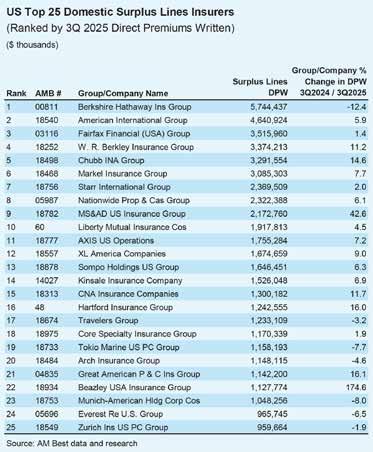
The U.S. excess and surplus lines market isn’t growing at the rate it has been, with the premium growth through September 2025 lower than the prior year.
According to a new report from insurance industry rating agency AM Best, years of consistent growth in the E&S space continues but “has shown signs of tapering off.”
Premium growth in the E&S market increased by 9.7% through the third quarter of 2025, compared with 13.5% for the same prior year period, thanks to competitive market pressures on certain lines of coverage such as cyber, commercial property, and directors and officers liability.
AM Best said surplus line market premium is expected to flatten over the near term but continue to handle a greater number of risks better suited for E&S.
“These changes have influenced both distribution and product strategies,” said David Blades, associate director, AM Best. “One such example is capacity for catastrophe-exposed property coverage, an area in which surplus lines carriers have been able to offer flexibility and
customization for those kinds of risks that no longer fit standard underwriting frameworks.”
Newer market entrants, especially fronting companies, have driven much of the E&S market growth in recent years. However, some of these entities may fall victim to adverse development in accident years 2021 through 2024, where fronting companies have reportedly been concentrated.
Nine of the top 10 E&S market participants grew direct premiums written, except for Berkshire Hathaway, which decreased DPW by 12.4% in Q3 2025
compared to the same quarter the prior year.




Foremost®, part of Farmers Insurance®, has a legacy of more than 70 years of industry leadership and excellent service. Built from decades of experience, we deliver customizable coverages for autos, homes, motorcycles, off-road vehicles and much more.
Your customers can live confidently knowing Foremost has dedicated claims team members who are there when you need them 24 hours a day, seven days a week. We’re here to help turn setbacks into comebacks.
$6.7B

84,000
The number of new residents who moved to North Carolina last year, the most of any state. The title was held by Texas in 2024 and Florida in 2022 and 2023. South Carolina had the highest overall growth rate last year at 1.5%, a distinction among states held by Florida in 2024, according to new U.S. Census Bureau figures. The appeal of Florida, the nation’s third most populous state, dimmed. It dropped to No. 8 for stateto-state migration.

The projected insured losses caused by Winter Storm Fern. The late-January winter storm brought snow, ice, wind, and a deep freeze that engulfed more than half of U.S. states, affecting about 200 million people starting on Jan. 23 and lasting until Jan. 27. The estimate comes from catastrophe modeler KCC and includes privately insured losses from damage to residential, commercial, and industrial properties.
6%
The amount the average yearly full-coverage auto premium fell in 2025 to $2,144, according to online insurance agent Insurify. The cost increased 46% from 2022 to 2024. Insurify said it expects a measured 1% increase in the average annual full-coverage premium in 2026 to $2,158, based on loss projections and the current rate environment.


$23 Million
The amount of revenue the Howden-driven talent war has cost Brown & Brown, according to J. Powell Brown, the broker’s president and chief executive officer. “As of today, approximately 275 of our former teammates have joined this startup, taking with them customers currently representing known annual revenues of $23 million,” Brown said during an analysts’ call on Jan. 27 to discuss the broker’s 2025 fourth-quarter and full-year results.


“The data center opportunity, it is unique; it has never been seen before; it is monumental. It also requires a level of response and complexity that’s beyond what the traditional industry has ever accomplished—just be clear about that.
This requires real, net new innovation around alternative forms of capital, how we think about risk, how we pool risk, all those pieces.”
— Aon Chief Executive Officer Greg Case during a call to discuss the broker’s Q4/ FY2025 results. Case said the global boom in the construction of data centers creates mid-single-digit or greater organic revenue growth opportunities for major brokers.

“Texas is on a trajectory for providing safe and legal access for responsible adult use and continuing to build out access for patients who benefit from this medicine through the compassionate use program.”
— Heather Fazio, director of the Texas Cannabis Policy Center, a nonprofit that advocates for greater access to cannabis and decriminalization. In a span of a year, those in the Texas THC industry witnessed the Texas Legislature expand the medical cannabis program, only to ban all THC products. Then Gov. Greg Abbott vetoed that ban. At Abbott’s direction, the Texas Alcoholic Beverage Commission and the Department of State Health Services are working together on industry rules and regulations.

“For years, insurers have wielded the bump-up exclusion to categorically deny coverage for settlements of litigation arising from corporate transactions...The Delaware Supreme Court has now made clear that the applicability of a bump-up exclusion to the settlement of shareholder litigation depends on the facts and policy language of each case and is not a one-sizefits-all proposition.”
— Orrie Levy, partner at Cohen Ziffer Frenchman & McKenna. The court ruled insurers failed to show the settlement represented an increase in what the shareholders claimed was an inadequate deal price—one of two requirements needed to invoke the exclusion.

“Insurance Savings Accounts are a sustainable way for Kansans to save state-tax free for their insurance costs. As the legislature works to address affordability, they should include this tool for Kansas families.”
— Kansas Insurance Commissioner Vicki Schmidt testifying in favor of a bill that would create an Insurance Savings Account (ISA). The bill will allow Kansas tax filers to open an ISA at a financial institution and make tax-free contributions up to a set amount, depending on their tax filing status. Account holders can then use the money contributed to pay for any property and casualty insurance expense, including home and auto insurance premiums and their associated deductibles.

“It is bad for FAIR Plan policyholders because it expands coverage through a plan that lacks the financial capacity to absorb the next major catastrophe. And it’s bad for all other Californians, who will inevitably be forced—yet again—to absorb the cost of future FAIR Plan shortfalls after the next major event.”
— Nicole Ganley, American Property Casualty Insurance Association assistant vice president for public affairs on Assembly Bill 1680, which enacts FAIR Plan reforms identified in the California Department of Insurance’s recent Report of Examination.

“This bill is aimed at things like decks, fencing, home improvements—not major construction projects,”
— Florida State Rep. Tiffany Esposito, R-Fort Myers, on a state bill that would bar local governments from requiring permits for work projected to cost less than $7,500 on a single-family home. Permits would still be allowed for structural, electrical, and plumbing work below that level, and contractors would need to keep records of their work. Current Florida permit requirements vary by county and city, with many jurisdictions mandating permits if work covers more than 120 square feet, even for fencing and outdoor sheds, or if heating and air conditioning work will cost over $5,000.

By L.S. Howard
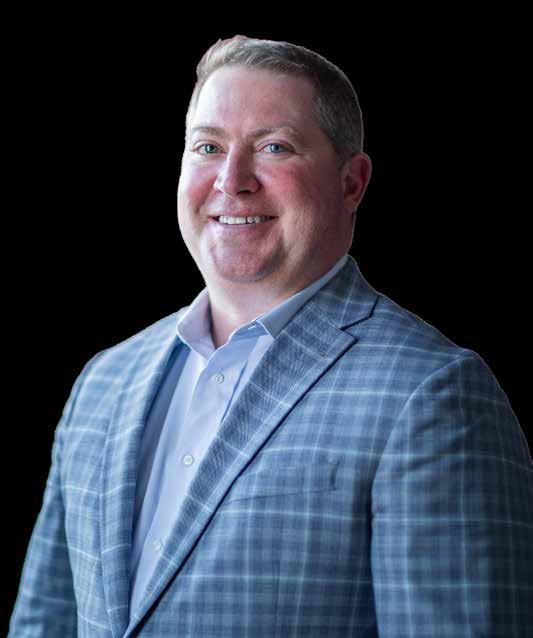
The Howden-driven talent war has cost Brown & Brown $23 million in revenue, according to J. Powell Brown, the broker’s president and chief executive officer.
“As of today, approximately 275 of our former teammates have joined this startup, taking with them customers currently representing known annual revenues of $23 million,” Brown said during an analysts’ call on Jan. 27 to discuss the broker’s 2025 fourth-quarter and full-year results.
“As we’ve done in the past, we will defend our rights in court and already have obtained an injunction,” he added.
Most of those former employees, he said, were not producers and were involved in the employee benefits area.
Howden launched its U.S. subsidiary in August 2025. In December, Florida-based Brown & Brown filed a lawsuit against Howden, joining legal actions from other brokers—Alliant, Aon, Marsh, and Willis Towers Watson—which are all seeking redress for Howden’s alleged poaching of their employees.
During the analysts’ call, Brown never referred to Howden by name, only as “the start-up.”
Brown emphasized that his company believes in competition. “That’s what makes great companies, great leaders, and great individuals. We also believe in integrity, honesty, loyalty, and trust,” Brown added.
“However, when a start-up U.S. broker conducts what appears to be a highly coordinated plan to lift entire teams from its competitors, taking information and customers in the process, it must be addressed.”

Brown confirmed that other U.S. brokers are also employing these aggressive hiring methods.
“…[T]he start-up firm [Howden US] is one of many that are aggressively looking to hire people. The question is how they’re doing it,” he said.
When Brown & Brown hires people from other firms, “we ask them to abide by the contracts, whatever those contracts are that they have. And so there is a difference in opinion with that particular start-up here in the states.”
Despite the revenue hit from the loss of employees, Brown described the company’s fourth-quarter results as
capping off “another year of strong top and bottom-line financial performance. For the full year, we grew our revenue by 23% through a combination of M&A, organic revenue growth and strong growth in our contingent commissions.”
“We expanded our margins materially and grew our cash flow from operations by nearly 24%. This strong performance was in spite of softening cat property rates and economies returning to more normal growth levels.”
He said a business highlight of the year was the purchase of Accession Risk Management—the broker’s largest-ever acquisition—a deal that was first announced in June and completed in August. Brown & Brown had a record year for M&A, adding approximately $1.8 billion of annual revenue from 43 acquisitions, with the largest being Accession.
For the fourth quarter ended Dec. 31, 2025, the company reported total revenues of $1.6 billion, increasing $423 million, or 35.7%, compared to the fourth quarter of the prior year, with organic revenue decreasing 2.8%.
The drop in organic revenue was described as “disappointing” in a market note from equities analyst Keefe, Bruyette & Woods (KBW). Brown said the drop in organic revenue was driven substantially by flood claims processing revenue recognized in the fourth quarter of last year.
Q4 net income attributable to the company was $264 million, increasing $54 million, or 25.7%, compared to the fourth quarter of the prior year.
For the 12 months ended Dec. 31, Brown & Brown reported total revenue of $5.9 billion, increasing $1.1 billion, or 22.8%, compared to 2024, with organic revenue increasing by 2.8%.
Full-year net income attributable to the company was $1.1 billion, an increase of $61 million, or 6.1%, compared to 2024.
New York, NY
Tuesday, May 12
Convene
•
•
•
•
•
Chicago, IL
Thursday, May 14 Recess Las Vegas, NV
Thursday, May 21 Encore Las Vegas

National
United Risk, headquartered in New York City, made additions to its leadership team.
Hayden Smith, who was promoted to CEO of United Risk worldwide, previously served as vice president of M&A at Enstar Group and earlier as head of Ceded Reinsurance for StarStone.
Andrew Lucas was appointed United Risk’s general counsel.
Gregg Holtmeier was appointed chief commercial officer (CCO).
Patrick Watson was appointed chief operating officer (COO).
Howden, the global insurance broker with headquarters in Miami, Florida, appointed Chris Aries as general counsel of its U.S. retail broking and advisory business. He most recently served as global strategy and execution leader at Aon Global Specialties.

Howden also appointed Elizabeth Neumann as executive vice president (EVP), financial lines claims leader. Neumann joins Howden from CAC Specialty.

leader. Mathews joined Marsh McLennan’s global insurance brokerage and risk advisory business, Marsh, in 2020.
Bryan Feitel joined Alliant Insurance Services, headquartered in Irvine, California, as vice president (VP) within its employee benefits group.

Demex, headquartered in New York City, promoted Michael Anderson to CEO following four years as chief growth officer.
Demex also promoted Matthew Coleman to president, reinsurance from chief risk officer; and Charlie Eadie from EVP, strategic partnerships and growth to chief growth officer.
Outgoing CEO Bill Clark will continue to serve on the company’s advisory board.
AXA XL, headquartered in New York City, promoted Matthew Stitham to chief underwriting officer, casualty, in the Americas. Based in San Francisco, California, Stitham assumes the regional underwriting management responsibilities previously held by Donnacha Smyth, who transitioned to global chief underwriting officer, casualty.
David Janis to group general counsel and senior vice presiden (SVP).
Andy Wood to Burns & Wilcox SVP, professional liability.
Kate Wright to Burns & Wilcox vice president (VP) and senior regional practice group leader.
Tom Carvalho to Burns & Wilcox VP and managing director.
Jeff Ditmar and Amy Felder to Atain VP.
Brad Nehring to RB Jones’ VP.
Travis Verdino, Aaron Pfister, and Justin Pressly to Burns & Wilcox associate vice president (AVP) and managing director.
Dario Nalli to Burns & Wilcox AVP, digital business.
Karen Preston to Burns & Wilcox managing director.
Patricia Sheridan to Burns & Wilcox managing director.
Mike Pernicano to senior director, audit.
Kyle Widerstedt to senior director, finance and corporate development.
Penn National Insurance, headquartered in Harrisburg, Pennsylvania, appointed Robert Brandon as CEO after over 30 years with the company, including more than five as president and CEO.
headquartered in East Providence, Rhode Island, hired John Zito as an account executive on the employee benefits team. Zito most recently served as an employee benefits producer at Hilb Group.
Patriot Growth Insurance Services LLC, headquartered in Fort Washington, Pennsylvania, appointed Darryl Siry as COO.
NFP, headquartered in New York City, named Adam Favale as EVP and head of mergers and acquisitions. Favale joined NFP in 2010, serving as a leader on the M&A team for over 15 years.

John Michael “JM” Edge, formerly of Amwins, joined Jencap Group LLC’s property and casualty (P&C) binding team as its manager for the Atlanta, Georgia; Charlotte, North Carolina; and Denver, Colorado teams. Jencap Group LLC is headquartered in New York City.
The Great Bay Insurance Group, headquartered in West Atlantic City, New Jersey, named Brian S. Schleider EVP and chief financial officer (CFO). Schleider joined the Group in March 2020 as CFO.

Marsh McLennan, headquartered in New York City, appointed Mike Mathews as global digital infrastructure
H.W. Kaufman Group, headquartered in Farmington Hills, Michigan, promoted 16 members of its executive and North American teams. Promotions include: Christine Tricoli to group chief HR Officer and EVP.
John Foster became president and joined the company’s board of directors. He will assume the CEO role following Brandon’s retirement in July.
Randal Mancini, currently VP of field operations, will be promoted to SVP of insurance operations.
Starkweather & Shepley Insurance Brokerage Inc.,
Great Bay Insurance Group also promoted Sharon Karlsson-Simons to SVP of business development for Great Bay Underwriting Services, a wholly owned affiliate of the group.
Karlsson-Simons joined Great Bay in 2020 as director of marketing.
Erie Insurance (ERIE), headquartered in Erie, Pennsylvania, named Todd Morrison and Chad Ackerman as branch managers for the company’s Roanoke and Richmond, Virginia, branches.
Keystone, headquartered in Mechanicsburg, Pennsylvania, will appoint Mike Walsh as president in the coming months.
Patrick Kinney will continue to serve as CEO during this period. Once the transition is complete, Walsh will assume the role of CEO, and Kinney will move to the Keystone board of directors.
Sheila Lowe joined Alliant Insurance Services, headquartered in Irvine, California, as a producer within its employee benefits group. Lowe is based in Portland, Maine.
Patriot Growth Insurance Services (Patriot), headquartered in Fort Washington, Pennsylvania, appointed Tom Rogers as chief sales officer.
Central Novatae Risk Group, headquartered in Dallas, Texas, the wholesale insurance business of World Insurance Associates, hired Walter Juergens as CFO.

Midwest Coterie Insurance, headquartered in Appleton, Wisconsin, appointed Mark Seich as chief revenue officer.

Justin Doss assumed the role of VP, personal lines underwriting at RLI Corp., headquartered in Peoria, Illinois.
CRC Group, headquartered in Charlotte, North Carolina, named Matt Blessing as office president in Kansas City, Missouri, where he will to lead select binding operations.

Roggenbaum joined the organization in 1987 and most recently led operations across the Midwest and Florida
The California Commission on Health and Safety and Workers’ Compensation (CHSWC) elected Commissioner Nicholas Roxborough as the chair of the commission for 2026. Roxborough is the managing partner of Roxborough, Pomerance, Nye & Adreani, LLP.
Aspire General Insurance Services, headquartered in Rancho Cucamonga, California, appointed April Moore as general counsel. Moore previously served as general counsel of USA Underwriters Insurance Company.
interim COO at EverPeak. She previously served a long tenure as CFO of Pinnacol Assurance.

Arrowhead Intermediaries, headquartered in San Diego, California, appointed Katie Davis as chief marketing officer. Davis will oversee the global marketing strategy across Arrowhead Intermediaries and its three divisions: Arrowhead Programs, Bridge Specialty Group, and Arrowhead Specialty.

Brown & Riding, headquartered in Dallas, Texas, hired Seth Fagan to its National Property Practice. He most recently served as a commercial property broker at CRC Group.
The Jacobson Group, headquartered in Chicago, appointed President Corey Pinkham as CEO. Current co-CEOs Gregory P. and Richard L. Jacobson will transition from day-to-day leadership to serve on the firm’s board, with Greg Jacobson assuming the role of chairman.
Cottingham & Butler, headquartered in Dubuque, Iowa, named Mike Hessling as president. Hessling joins Cottingham & Butler from Gallagher Bassett, where he served as CEO of North America.

Cowbell, headquartered in Pleasanton, California, appointed Simon Hughes as CCO. He previously served as senior vice president, Global Distribution & GM, UK.

Sara Owens joined Alliant Insurance Services as SVP, regional director within its Alliant Americas division. Ownes is based in Los Angeles, California.

Amerisure, headquartered in Farmington Hills, Michigan, named Doug Roggenbaum VP of strategic growth.
ICW Group, headquartered in San Diego, California, hired Travis Murnan as head of its new ICW Specialty business unit, Alternative Risk Transfer.

EverPeak Insurance, headquartered in Denver, Colorado, created a unified leadership team headed by insurance veteran Kathy Kranz Kranz most recently served as
CRC Group, headquartered in Charlotte, North Carolina, hired Joe DeJesus to its CRC Specialty Underwriting leadership team as an underwriting team leader, He is based in Sacramento, California.


Austin Woita joined CRC Specialty as an underwriting team leader, based in Denver, Colorado.

By Allen Laman
As farmers diversify their operations in the face of volatile markets and unpredictable weather conditions, an agribusiness insurance leader recently told Insurance Journal that he’s seen “meaningful growth” in national agritourism insurance demand.
From farm stays to pick-your-own-produce destinations, the most recent numbers from the USDA’s Census of Agriculture showed that U.S. farms and ranches generated about $1.26 billion from agritourism services in 2022. After adjusting for inflation, that marked a 12.4% increase from 2017. The same dataset shows about 57% of
U.S. counties reported some form of agritourism income.
When a farm expands into agritourism, insurance must be reviewed and expanded, said Jeremy Staun, vice president of farm sales and underwriting at Nationwide. These endeavors may start slow, but they can grow quickly—and so can their exposures.
“Across the country, I’d say we’re seeing a noticeable uptick in farmers turning to agritourism for something to stabilize their revenue strategy,” Staun said. “Especially with some economic pressures.”
Roughly a billion dollars of premium are rolled into Nationwide’s farm and ranch book. Staun said the insurer expects the U.S. agritourism market to grow more than
10% annually over the next five years. That aligns with what agents who place coverage with Nationwide and their clients are experiencing, he said.
So, what agritourism offerings seem to be becoming more popular? Some of the fastest-growing segments that Nationwide tracks fall under the umbrella of outdoor recreation.
“That would be things like sunflower trails, orchards, interactive farm operations and experiences,” Staun explained. “That’s a lot of what we’re seeing. We’re also seeing a lot of farm-to-table educational experiences, with consumers wanting to have a better understanding of where their food comes from … and
sustainability.”
Given the added risks these offerings introduce, it’s no surprise that most agritourism operations require a specialized agritourism or farm liability enhancement layered onto their standard farm policy.
When farmers welcome visitors onto their land for festivals, workshops, and other on-farm experiences, insurance exposures multiply. Staun pointed to increases in premises liability losses, animal contact incidents, and weather-related property risks tied to temporary event structures and equipment.
“Some of the common overlooked exposures that we see in this space are parking lot liability, temporary structures like those tents or stages, [and]
volunteers that aren’t always considered in risk planning,” he added.
What to Know About Agritourism Risk?
In a separate interview, Richard Bryant, chief underwriting officer of Prime Insurance Company, said that he couldn’t say with certainty whether most agritourism operations are properly insured or underinsured. He did note, however, that Prime often sees a naivety in how operators buy their agritourism insurance. Farmers are accustomed to buying very cost-effective insurance through farm mutual insurance companies, he explained, “and I think you need some expertise when it comes to writing this type of
business to be able to take care of the losses that are undoubtedly going to happen.”
‘Across the country, I’d say we’re seeing a noticeable uptick in farmers turning to agritourism for something to stabilize their revenue strategy.’
Based in Sandy, Utah, Prime Insurance is an excess and surplus lines company that writes policies in every U.S. state.
Bryant emphasized that losses will follow when farmers bring guests onto their property. “It’s just a question of how big those
losses are going to be,” he said. “Somebody’s going to slip and fall. Somebody’s going to fall off a hay bale. Somebody’s going to go home with a pathogen or allegation of one.”
The list goes on. From a market perspective, Staun said agritourism’s rapid expansion is creating new opportunities for insurers to innovate. At the same time, though, he said markets are becoming more disciplined in their underwriting.
Carriers are tightening terms around high-risk activities, Staun shared, including coverages for inflatables or motorized attractions, alcohol-related events, and weather-exposed structures.
“You’re seeing a lot of that tightening in that space as

the agritourism opportunities expand,” he said. “I would say what hasn’t changed, from an insurance perspective, is the appetite for well-managed operations.”
Farms that invest in safety protocols, signage, and structured and organized event planning continue to have access to broad and competitive coverage, Staun added. He encouraged agents and brokers to deeply think through the exposures that their clients’ agritourism operations could present.
“And really think about the claims,” he said. “Because that’s the bottom line. What type of claims or exposure could come from the realities of when you welcome the public into a farm environment?”



Some decisions are too precarious to take on alone; you need a partner to help you create the right solution for your client’s risk, while minimizing yours. And, it’s cost-effective. A Conning, Inc. analysis concludes that wholesale distribution does not increase the cost to the insured. That’s a safe decision.
By Andrea Wells
Today’s war for talent is not just a big broker dilemma. Almost any agency is at risk in today’s increasingly “free agent” world.
“It doesn’t matter if you’re a doctor or a lawyer or whatever profession you’re in, we’re just in more of a free market for talent, a free agency world than we’ve ever been before,” said Kevin Stipe, CEO and
partner of Reagan Consulting.
“People are more willing to switch employers relatively quickly, and that’s a cultural phenomenon that agents and brokers have to be responsive to,” he said.
Being responsive goes far beyond salary and compensation plans. There’s a combination of tactics that agencies must respond to in today’s hiring world, Stipe said. “You cannot be a place that people hate to work,” he said. That means building an agency culture—a real culture—that makes people look forward to coming to work, he said. “Because otherwise
you’re just swimming against a horrible current.”
Stipe advises agency owners to create an environment that people want to be a part of.
“And then you can check off the other boxes, including being competitive from a pay and benefit standpoint,” he said. “If you’re not creating an environment where people really want to be, then you’re going to have all kinds of problems in a world where people are increasingly free agency minded.”
“The best firms that I’ve ever seen from a performance standpoint over an extended period of time are the firms
that create a culture that people want to be a part of,” he said.
Stipe said as organic growth declines due to a stabilizing rate environment, profit margins are likely to get squeezed. That means independent agencies and brokerages should focus on driving new business growth while taking a closer look at their current sales talent and adding new sales talent when possible.
“Generally speaking, firms need to hire more salespeople than they’re hiring now,” Stipe told Insurance Journal last
fall. “Every study we’ve ever done shows that agencies tend to under-hire salespeople because they don’t really account for how many they need to reach the goals that they want to reach.”
Reagan’s most recent quarterly update of the insurance distribution marketplace showed that independent brokers posted overall organic growth of 7.4% in Q3 2025, marking the third consecutive quarter of declining organic growth. Reagan reported that Q3 2025’s results were also the lowest third-quarter results since Q3 2020.
The report showed that public brokers fared slightly worse than their privately owned counterparts, posting organic growth at just 5.0%, consistent with the prior two quarters.
“When organic growth slows, profit margins get squeezed,” Stipe said. “So, then what happens is that firms start realizing, ‘OK, we have got to be tighter with expenses,’ and compensation is the number one expense for any agency.”
That doesn’t mean pay cuts are coming, he added. But that does put pressure on agencies to get more productivity out of the employees who are already there.
“Agencies start trying to figure out how they can reduce compensation as a percentage of revenue without causing pain for people,” Stipe said. One way to do that is by using technology, AI tools, to help push productivity to do more, or better, work with less people, he added.
Mary Newgard, senior
partner at Capstone Search Group, said that pressure to do more with less can often push employees to consider making a job change in today’s competitive talent landscape.
According to Capstone
Search Group’s annual report on Insurance Agency Compensation Trends, which analyzed the firm’s independent insurance job placement data from 2017-2025, “dry promotions,” a term to define
giving more job duties or responsibilities to a person without a pay increase, are the leading cause motivating an agency employee to start a new job search.
continued from page 21
That trend is not surprising, Newgard said. “The added pressure bubbles to the surface in people who might be overwhelmed and feel that they are not being fairly compensated for their added work,” she explained. “You’re seeing folks doing the work of two people, sometimes more, and that wears on people over time.”
Newgard said “dry promotions” are not always purposeful. “Dry promotions sometimes become an innocent and natural evolution of agencies that are growing quickly,” she said.
But if agency leaders aren’t having conversations with their people about compensation satisfaction at all or only once a year during performance reviews, she said those conversations end up happening with job recruiters and other agencies looking to hire.
Art Betancourt, CEO and principal at AEBetancourt, another industry-focused recruitment firm, said the need for new talent in agencies across the nation hasn’t slowed down.
“Service roles still continue to have an extremely high demand, especially in the area of high net worth,” he said. While there’s always a need for great talent, Betancourt said that his firm alone has worked with close to 500 independent agencies on almost 900 job roles in the past three to four years alone.
“We’re still seeing a lot of the larger, national brokers, especially in select markets, paying significantly more than the independent, regional or local broker,” he added. “So, that has made things chal-
lenging for those independent firms to recruit talent, but it’s also made it challenging when they are potentially losing talent because of that as well.”
Betancourt also sees some hesitation with job candidates now about accepting roles with smaller brokers due to the heightened risk that they may get acquired by a larger, national broker. “They might see it as having less job stability,” he said.
Another challenge in hiring today is the unwillingness by some agency owners to offer flexibility for service roles, he added. “No flexibility for hybrid work, even if it’s just one day, makes a role difficult to fill,” he said.
Betancourt said the best job candidates today want more than the typical good benefit and PTO package. “They want clear outlines for performance bonuses, flexibility, and a modernized company, not outdated AMS systems that make somebody’s job harder than it has to be,” he said. “It’s not all just compensation, unless you’re pushing an eye-popping number.”
Betancourt advises agency owners to understand their employee value proposition (EVP). “That needs to be strong,” he said. Agencies need to ask what they are doing as an organization to invest in employees. That includes investing in technology and other tools that make employees’ jobs easier.
“Be able to answer the question of why a high performer would want to leave where they’re at currently and come work for you,” he said.
Building an EVP starts with asking current employees what truly keeps them there.
Identify what is real, differentiating, and valuable, he said. And be able to explain those benefits to candidates and show how this will improve their employee experience.
Al Diamond, president of Agency Consulting Group, agrees that improving the employee experience is critical not only to the employee but also to the agency owners.
“In my estimation, half of your evaluation every year should be a development plan for making you more valuable to the agency and paying you more for that,” Diamond said. “A compensation program isn’t just about salary and benefits; it’s how you progress,” he said. Employees should be in control of their own compensation, at least to some extent, he added.
Agencies should motivate employees to earn more through incentive pay, Diamond advocates. “We’re seeing more than ever incentive compensation programs coming into agencies instead of the standard 4% raise per year,” he said. Incentive programs help judge the productivity of employees in terms of revenue per employee, and what percentage of that should go back to the employees in terms of compensation,” he added.
“This is a very simple, straightforward way of telling your employees it’s your productivity that defines your value to the agency. Not how many people we have sitting in the office but how productive they are,” he said. “The better they do for the agency, the more they get paid.”
By Andrea Wells
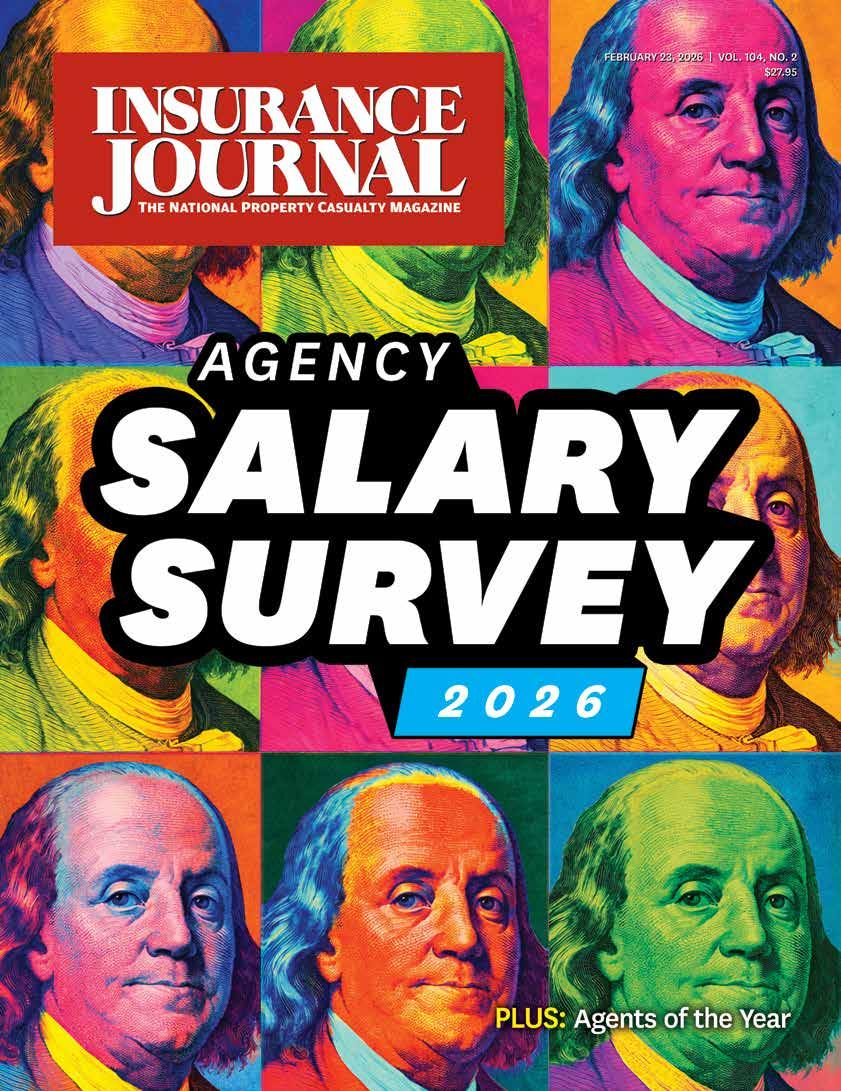
Insurance producers on average made more money in 2025, but agency owners and support staff reported declining total income and salary adjustments last year. Despite the slower pace in pay, satisfaction with compensation overall held steady, according to the latest Agency Salary Survey results, published annually by Insurance Journal.
Changes in overall salary and total income rose for producer/sales positions, the survey revealed, but that wasn’t the case for everyone. Management/agency owners/ principals and support staff/ CSR/account executive positions both saw decreases in total income change from 2024 to 2025. (See chart on page 21.)
Surprisingly, satisfaction with compensation rose for support staff/CSR/account exec
roles despite the declining pace of reported salary and total income changes, according to the survey’s results.
Satisfaction with compensation rose in this year’s survey to an average of 3.37 (2025) from 3.27 (2024) in last year’s survey. This is an increase in the average satisfaction index scores of 2023 (3.36) but still below the higher satisfaction scores in 2022 (3.61) and 2021 (3.41). (Note: The Agency Compensation Satisfaction Index is based on a scale of 1-to-5 where “5” equals “most satisfied.” See Agency Compensation Satisfaction Index chart, page 21.):
• Management/agency owners/agency principals reported a compensation satisfaction score of 3.75 in 2025, just
slightly lower than 2024’s score of 3.76.
• Producers/sales reported satisfaction of 3.20 in 2025, up from 2.96 in 2024.
• Support staff/CSR/account executives reported a satisfaction score of 3.15 in 2025, up from 3.08 in 2024.
The score for overall satisfaction was higher when agencies offered employee benefits—both hard benefits (such as group health, life/ disability, dental, profit sharing, 401(k) plans, ESOPs, IRAs, and flexible savings accounts) and soft benefits (such as child care/day care, education reimbursement, pet insurance, and paid family leave). (See Employee Benefit Satisfaction Index, page 24.)
Employee benefit satisfaction ranked highest when agencies offered added benefits, such as child care/ day care (3.92), pensions (3.81), profit sharing and education reimbursement (both 3.79), paid family leave (3.64), and IRAs (3.61). The survey found that in nearly all employee benefit categories queried, employee satisfaction with overall compensation rose when those benefits were offered. The exceptions this year were slight declines in satisfaction when offered ESOPs, stock options, and even pet insurance, perhaps due to limited options of this benefit among survey respondents.
As noted, the survey revealed an upward trend in total compensation for producers/sales positions this year and a slight downward trend for the two other categories. Producers/sales positions saw a 5% jump in total compensation, according to this year’s survey.
The 2026 Agency Salary Survey, based on nearly 500 responses nationwide, revealed that total income changes, which include salary plus additional compensation such as profit sharing, bonuses, and other income, were:
• Agency owners, principals, and management total income increased 16.8% for 2025,





compared to a 17.9% increase in total income in 2024.
• Producers/sales total income increased 25.3% in 2025, compared to a 20.8% increase in 2024.
• Agency support staff total income showed a 6.9% increase for 2025, compared to a 11.3% increase for 2024.
Salaries only (excluding bonus and incentive income), also rose again in 2025 for producer/sales roles but declined for management/owners and support staff, according to this year’s survey results:
• Salaries for agency owners, principals, and management rose 15.6% in 2025, compared





to 15.8% in 2024.
• Producers/sales reported average increases in salary of 21.0% in 2025, compared to 17.6% in 2024.
• Salaries for agency support staff rose 7.4% in 2025, compared to 11.0% in 2024.
Insurance Journal’s Agency Salary Survey collected about 500 responses from agency owners and employees nationwide via an online survey in January 2026. Paul Osbourne, senior analyst at Demotech Inc., assisted with analysis of this year’s survey results. For more information, contact Andrea Wells at: awells@ insurancejournal.com.





continued from page 21

















SPECIALTY CAPABILITIES
Monarch E&S is now SPG Wholesale | Specialty Program Group •



Alawsuit that targets companies that distribute computer code that facilitates the illegal manufacture of 3D printed ghost guns was filed by California Attorney General Rob Bonta and San Francisco City Attorney David Chiu.
The lawsuit filed in early February in San Francisco County Superior Court against Gatalog Foundation Inc. and CTRLPew LLC says the companies unlawfully distribute computer code for 3D printing ghost guns, machine gun conversion devices including “Glock switches,” illegal large-capacity magazines and other firearm-related products and components to people who are not licensed to manufacture firearms in California.

Vehicle thefts fell by 25% in Arizona in 2025 to the lowest rate in decades, and the third consecutive year of a decrease in the state, a new report shows.
The suit also seeks to hold the defendants held accountable for promoting and facilitating the unlawful manufacture of 3D printed firearms and machine guns.
According to the lawsuits, the defendants make files containing computer code and step-by-step instructions for 3D printing firearms, machine gun conversion devices and other firearm accessories available for download in California. They also provide guides for 3D printing firearms, sell merchandise and solicit donations, and they offer a platform for gun developers to test their 3D printing designs and submit them for approval and distribution, according to the lawsuit.
ACalifornia produce company was fined $6.7 million for wage violations affected more than 10,000 farmworkers.
The California Labor Commissioner’s Office reached the settlement with Santa Maria-based Alco Harvesting LLC (dba Bonipak Produce Inc.) for the wage and hour violations.
The LCO found that Alco Harvesting failed to provide farmworkers with written notices of paid sick leave and COVID-19 supplemental paid sick leave.
ing to the LCO.
In some cases, farmworkers who were believed to have COVID-19 were reportedly quarantined in crowded motel rooms provided by the employer. An ensuing investigation was launched in 2020 after the office received information that a farmworker living in housing provided by the employer died from COVID-19.

Early in the pandemic, workers who did not know about how much paid sick leave they had were effectively prevented from staying home when sick, which increased the risk of COVID-19 transmission, accord-
Investigators also found other reported labor law violations, which included unpaid transportation time, overtime and minimum wage.
The LCO says it will distribute $4.2 million directly to affected farmworkers and $1.5 million for minimum wage violations and paid sick leave. The settlement also included non-monetary relief, which includes required postings and notices to H-2A workers about paid sick leave.
Data from the Arizona Automobile Theft Authority’s Auto Crime Tracker database shows that 12,686 vehicles were stolen in 2025 compared with 17,010 stolen in 2024. The 2025 for vehicle thefts was the lowest since the AATA’s inception in 1992. The record low was 16,785 in 2015.
The Chevrolet Silverado remained as the top stolen vehicle with a reported 627 thefts. The Hyundai Elantra (418 thefts), the Hyundai Sonata (323), the Kia Soul (309) and the GMC Savana (278) rounded out the list of the top five vehicles stolen in the state in 2025.
The top model years stolen included 2017 models (690 thefts), 2024 (687) and 2019 (657) and 2016 (650).
The majority of thefts occurred in the state’s largest cities. Phoenix with 4,700 thefts took the top spot. Tucson (2,060), Glendale (737), Mesa (725) and Tempe (425) were the other cities where the most vehicles were stolen.
However, every city in the top 10 list of most vehicles stolen showed a significant decrease in thefts in 2025.

Market Detail: NARDAC, a specialist energy and infrastructure MGA, offers dedicated Excess of Loss (XOL) insurance coverage for operational and construction-phase solar projects impacted by severe convective storms and other named natural-catastrophe perils. The insurance program includes business interruption (BI) and delay in start-up (DSU) coverage, helping insureds manage long-tail financial impact with confidence.
Program highlights include excess of loss coverage and tailored protection for named NAT CAT perils, including hail and wind. Robust financial protection, including both business interruption and delay in start-up. Scalable to your risk profile. Open to all attachment points in excess of $10M. Project flexibility designed for both single-site and portfolio solar projects. Trusted security backed by AM Best “A”-rated, non-admitted London and Lloyd’s markets
Target clients include utility-scale renewable energy projects in the contiguous United States. Open to both portfolios and single sites.
Available Limits: Up to $20M of CAT limit per placement.
Carrier: London and Lloyd’s markets. Non-admitted. A rated.
States: All 50 states and the District of Columbia.
Contact: Harry Downes, harry.downes@ nardac.com, +44.7442.364960
Market Detail: Cluett’s Broad Appetite NEMT program is designed to accommodate a wide range of non-emergency medical transportation risks, including accounts that fall outside traditional underwriting guidelines.
Eligible risks may include smaller fleets, newer operations, mixed vehicle schedules, or accounts requiring underwriting flexibility. Available coverages may include commercial auto liability, auto physical damage, general liability, professional liability and workers’ compensation (where applicable).
Cluett leverages multiple insurance markets to provide placement solutions for non-standard NEMT risks.
Available Limits: Not disclosed.
Carrier: Rated A by AM Best.
States: Alabama, Arizona, Arkansas, Colorado, Connecticut, Delaware, Georgia, lllinois, Indiana, Iowa, Kansas, Kentucky, Louisiana, Maine, Maryland, Maine, Maryland, Michigan, Minnesota, Mississippi, Montana, Nevada, New Hampshire, North Carolina, Ohio, Oklahoma, Oregon, Pennsylvania, Tennessee, Texas, Utah, Virginia and Wisconsin.

lbs.). Business Classes Covered include last-mile delivery, retail/wholesale distribution and courier services.
Contact: Bruce Cluett, cluett@insurancemarketinfo.com 800-926-6771
Insurance
Market Detail: STAR Mutual RRG provides commercial auto liability coverage for last-mile and courier delivery operators. This program is tailored for fleets and independent drivers using cargo vans, sprinters, and box trucks under 26,000 lbs. to service wholesale, retail, and e-commerce distribution. STAR is rated “A” (Exceptional) by Demotech, Inc. and “B+” (Good) by A.M. Best, and is backed by “A+” (Superior) reinsurance carriers.
Program features include agency online portal with instant quoting and servicing, fast policy issuance and electronic document delivery, auto liability limits up to $1.5 million, high deductible options for fleets, state and federal filings available and dedicated claims support with transportation expertise
Additional Coverages include Uninsured/Underinsured Motorist (UM/ UIM), Personal Injury Protection (PIP) and Physical Damage (available through our partner, Reliable Transportation Association).
Vehicle classes covered include cargo vans, sprinters and box trucks (≤26,000
Discounts available for safe driving practice (qualified safety scores), business tenure discount (based on CDL and operating history), military discount program (for veterans: both business owners and drivers) and owner-operator discount and pay in full. Has pen.
Retail and wholesale agents are welcome to apply at https://starrrg.com.
Available Limits: Not disclosed.
Carrier: Non-admitted. Rated B+ by AM Best.
States: Arizona, Arkansas, California, Colorado, Connecticut, Delaware, Florida, Georgia, Idaho, Illinois, Indiana, Iowa, Kansas, Maine, Maryland, Minnesota, Mississippi, Missouri, Montana, Nebraska, Nevada, New, Jersey, North, Carolina, North, Dakota, Ohio, Oklahoma, Oregon, Pennsylvania, Rhode, Island, South, Carolina, South, Dakota, Tennessee, Texas, Utah, Vermont, Virginia, Washington, West, Virginia, Wisconsin and Wyoming. Contact: Agent Support, agents@starrrg. com, 855-569-7827

Acrisure is acquiring Vave, a managing general agent, from its parent Canopius. Terms of the deal were not disclosed. Vave will continue to operate under its brand name. The MGA will join Acrisure Underwriting, which operates independently of Acrisure’s distribution.
White Mountains sold a controlling interest in insurance distribution platform Bamboo to funds advised by CVC Capital Partners. Hamilton, Bermuda-based White Mountains bought a majority stake in Bamboo in January 2024 for about $300 million to enter the California homeowners’ insurance market. White Mountains said it continues to retain about 15% fully diluted equity stake in Midvale, Utah-based Bamboo.
Columbus, Ohio-based Nationwide entered into an agreement to acquire the renewal rights for surety and fidelity bonds issued by Main Street America Insurance, a unit of American Family Insurance. Terms of the deal were not disclosed. Nationwide said the acquisition expands its commitment to businesses and contractors, and that the addition of Main Street America's capabilities and employees creates new opportunities for growth and innovation.
The two companies expect to close the agreement by the end of the first quarter, subject to customary closing conditions.
Broker WTW acquired Newfront to expand WTW’s middle-market reach in specialties such as technology, fintech, and life sciences. San Francisco-based Newfront has built a broking platform supported by a growing producer base, proprietary client-facing technologies, and the use of advanced automation and agentic AI. The deal, worth up to $1.3 billion, was announced in December 2025.
Alkeme, Merritt Hall, Couch Braunsdorf Insurance Group, JXX Insurance Agency, Bellwether, Health Connect Insurance Agency
Brokerage ALKEME Insurance acquired five agencies over the last quarter. Terms of the deals were not disclosed. The acquired firms include:
Merritt Hall (Indianapolis, Indiana) – A P/C agency serving businesses and individuals in the greater Indianapolis area with risk management and insurance solutions.
Couch Braunsdorf Insurance Group (Liberty Corner, New Jersey) – A P/C insurance group with a presence in New Jersey and the broader Mid-Atlantic region, providing comprehensive coverage and advisory services.
JXX Insurance Agency (San Clemente, California) – A California-based P/C agency focused on delivering tailored insurance programs to clients throughout Southern California.
Bellwether (Deerfield Beach, Florida) – A P/C agency serving clients across Florida with a broad mix of commercial and personal lines solutions.
Health Connect Insurance Agency (Santa Ana, California) – A benefits-focused agency specializing in critical care, Affordable Care Act (ACA) plans and individual health coverage for employers and individuals in Southern California and beyond.
Marsh McLennan Agency, Robinson & Son
Marsh McLennan Agency (MMA) acquired Robinson & Son, a Hudson Falls, New York-based agency specializing in the maritime industry. Terms of the acquisition were not disclosed. The acquired agency, which offers both commercial and personal lines insurance, was founded in 2005. All employees, including James Robinson, co-founder and agency principal, will join MMA and continue to operate out of their existing office location.
World Insurance Associates, Jersey Coast Insurance
World Insurance Associates acquired the business of Jersey Coast Insurance of Margate City, New Jersey. Terms of the transaction were not disclosed. Jersey Coast Insurance offers personal and commercial lines of insurance, specializing in coastal homes, condominiums and flood risks. World Insurance, based in Iselin, New Jersey, serves clients from more than 300 offices across the U.S. and U.K.
Marsh+Sterling, Sidle Insurance
New York-based national insurance agency Marshall+Sterling acquired Sidle Insurance, an independent insurance agency based in Montour Falls, New York. Sidle Insurance will operate as Sidle Insurance, a division of Marshall+Sterling, during the transition period. Marshall+Sterling is a 100% employee-owned agency.
Schrager Hampson Aviation Insurance Group, Einstein Insurance Inc.
Schrager Hampson Aviation Insurance Group (SHAIG) acquired Einstein Insurance Inc., an aviation insurance agen-
cy based in New Castle, Delaware. Founder Dennis Einstein will continue with the firm following the acquisition, along with Salli Schoening. As part of the integration, Jessica Petrecz has joined SHAIG as an account executive to help serve Einstein Insurance clients.
SHAIGH is a family-owned and operated aviation insurance specialty brokerage licensed in all 50 states. Based in North Hampton, New Hampshire, with another office in Bedford, Massachusetts, the firm serves aircraft owners, charter operators, flight schools, airports, and aviation-related businesses nationwide.
Starkweather & Shepley Insurance Brokerage Inc., DiMatteo Insurance Brokers
Starkweather & Shepley Insurance Brokerage Inc. acquired DiMatteo Insurance Brokers, an independent insurance agency based in East Hartford, Connecticut. It is led by founder Angelo DiMatteo, who will join Starkweather & Shepley along with Trina Nicholson, vice president. The DiMatteo Insurance team will operate from Starkweather & Shepley’s Bristol, Connecticut office.
First Mid Insurance Group, Downs Insurance Agency
First Mid Insurance Group (FMIG) acquired Downs Insurance Agency in Decatur, Illinois. The acquisition supports FMIG’s continued growth strategy across central Illinois and expands its presence in the Decatur market. All employees of Downs Insurance will join First Mid Insurance Group.
WalkerHughes, Inman Insurance Agency, Clark Insurance Agency
WalkerHughes Insurance acquired Inman Insurance Agency in Salem, Missouri, and Clark Insurance Agency in Ballwin, Missouri. Inman Insurance Agency, led by owner Keith Inman, serves clients in Salem, Rolla, and Hartville. Mary Clark will remain on board at Clark Insurance agency to support the transition and ongoing client relationships.
Preston Insurance Agency, Ansay & Associates
Preston Insurance Agency, a full-service independent insurance agency with six locations across Illinois, forged a partnership with Ansay & Associates, marking the latter’s expansion into the Illinois market. Founded in 2008, Preston Insurance Agency has offices in Abingdon, Decatur, Mattoon, Pekin, Peoria, and Springfield.
Headquartered in Wisconsin, Ansay & Associates serves clients across Wisconsin, Minnesota, Upper Michigan and Florida.
The Baldwin Group, Obie
Florida-based global insurance broker
The Baldwin Group acquired Creisoft, Inc. and its subsidiaries, collectively known as Obie, a Chicago-based embedded insurance distribution business specializing in insurance solutions for landlords and real estate investors. Obie serves real estate investors through multiple distribution channels, including direct-to-investor digital experiences and integrated partner platforms.
Novacore, CP Insurance Associates
Novacore, the specialty insurance managing general agent (MGA) formerly the U.S. commercial division of NSM Insurance Group, entered into a definitive agreement to acquire CP Insurance Associates, a Texas-based insurance services agency specializing in lender-placed insurance, investor property, buy-here-pay-here programs and financial institutions.
Insurica, First Light Program Managers
Insurica acquired Florida-based First Light Program Managers, a wholesale brokerage and delegated underwriter specializing in trucking and marine coverage. The acquisition is the largest in the 67-year history of the Oklahoma-based Insurica. First Light is headquartered in Fort Lauderdale.
Warner Pacific, Brokers Holding Group
Warner Pacific, a California-based gen-
eral agency for brokers, acquired Brokers Holding Group, a South Carolina general agency specializing in health plans and alternative funding for employer groups.
Brokers Holding Group will continue to operate under its name. Scott Lee and Lee Long are co-owners. The 40-year-old Warner Pacific provides employee benefits, compliance, and human resources to brokers and agents in 12 states.
Trucordia acquired Florida Insurance Inc. in Dunedin, Florida.
Trucordia, based in Lindon, Utah, offers commercial and personal lines and employee benefits. The firm, led by CEO Felix Morgan, had acquisitions in several states in 2025, including Texas, Arkansas and New England.
Relation Insurance Services, PT Business Solutions
Relation Insurance Services acquired the assets of PT Business Solutions in South Pasadena, California. PT Business Solutions provides employee benefit, HR, payroll, workers’ compensation and group retirement plans.
Relation Insurance Services is an insurance brokerage and a privately held corporation backed by Aquiline Capital Partners, a private equity firm based in New York and London.
PrimeOne Insurance Company
Gryphon Holdings agreed to acquire PrimeOne Insurance Company, a privately held specialty commercial lines carrier.
PrimeOne will operate as a core underwriting platform under the Gryphon umbrella. The deal is expected to close in the first quarter and is subject to customary regulatory approvals. Gryphon is financed by Phoenix Merchant Partners.
PrimeOne is a specialty property/ casualty insurer supporting program administrators and managing general agents in niche markets. PrimeOne is domiciled in Texas and headquartered in Scottsdale, Arizona.

Matt Clark C3 Risk & Insurance Services

Welcome to Insurance Journal’s Agents of the Year report. This report features 26 agents who defined what it meant to be a successful independent agent in 2024. These agents are more than top sellers. While they have achieved impressive success in sales and demonstrated laudable business intelligence and entrepreneurial skills, they also have shown they have a passion for what they do and a commitment to professionalism and, in many cases, specialization. For them, being an insurance agent is more than a job. Insurance Journal’s Agents of the Year come from all regions of the country, live and work in cities or towns big and small, and know the importance of giving back. Information included in this report was voluntarily submitted online by agents and was supplemented by other public information sources. There are many more agents who deserve mention than are profiled. For more information, contact Andrea Wells at awells@insurancejournal.com.
San Diego, California
“I don’t try to be everything to everyone; instead, I focus on being exceptionally good for the right clients.”
Matt Clark, a partner at C3 Risk & Insurance Services, focuses on high-networth personal lines, helping to protect complex personal assets with a highly consultative, direct approach, particularly at renewal and during claims, said Clark, who has been in the industry for nearly 20 years.
He is known for building long-term client relationships and delivering thoughtful insurance solutions tailored to each client’s unique needs.
“What has helped me grow the most is a strong focus on relationships and consistently following through on what I commit to.”
“The most satisfying part of my job is helping clients when something goes wrong and knowing their coverage is solid because we planned carefully,” he said. “That’s when the work truly matters.”
Insurance is a relationship business first and a sales business second, Clark said.
“My proudest moments aren’t about a single deal; it is seeing clients stay with us year after year and refer their friends and family. That tells me I’m doing my job the right way.”
Chris Huebener Brightway Insurance Ponte Vedra Beach, Florida
Consistency may not be the flashiest path to success, but it’s what allows Chris Huebener and his team to go above and beyond.
“Keeping the client experience in mind with every phone call, every email, every text is how the business is able to grow consistently, because we do each step in a consistent manner, following the processes that have been set up,” Huebener said. “Be consistent every day. Each email/ text/call should have the same feel and process.”
Huebener’s previous career trained him in the agility and responsiveness he needed to succeed.
“I started in the insurance industry after a decade in the restaurant industry, which laid a foundation of fast-paced multitasking and ready-on-your-feet customer service!”
Within his first two years, he was named a top producer in the Brightway Network and was the number one agent for 13 years running.
Today, Huebener’s team is focused on the home-buying process, making the life-changing transaction as stress-free as possible for all parties.
“I have now become the principal agent of the office, and partner, where now I am helping train and grow our team of agents to build themselves and their own books,” he said.
“It is very satisfying to see my producers all winning with the same strategies that I have created over the years.”

Justin Failoni Acrisure
Miami Lakes, Florida
Justin Failoni likes to see a construction project through from beginning to end.
Failoni is a senior insurance broker with 18-plus years of experience. He specializes in complex construction and development risk, structuring and placing high-value, project-specific insurance programs.
Known for assisting clients with navigating complex coverage, claims, and contractual risk challenges, Failoni focuses on individual needs rather than rote, one-size-fits-all approaches. He leads the design and execution of sophisticated risk solutions for developers, owners, and contractors, including OCIPs, CCIPs, and Builders’ Risk programs on large-scale and high-profile projects.
Unique risks are inherent in major construction initiatives, and by serving as a senior insurance advisor throughout the full lifecycle of a project, Failoni provides direct accountability from early program design and placement through claims management and execution. His approach focuses on aligning insurance strategies with project delivery, budgets, and risk transfer objectives, with deep experience across residential, mixed-use, hospitality, and public sector developments. Construction comprises 90% of his book.
Failoni describes his approach as “relentless,” delivering top-quality service and excellent market products to his clients. His greatest satisfaction comes from helping protect clients who have spent most of their lives building their businesses from the risks they face.
Consistent excellence forges the path to success, he said. “Make sure you protect your reputation as it goes with you everywhere.”

Marcus Eagan
Higginbotham Insurance Metairie, Louisiana
As the fourth generation of insurance professionals at Eagan Insurance Agency, now a Higginbotham Insurance partner agency, Marcus Eagan has not just a history entwined with the industry but a long-standing tradition of hard work and ambition that drives his success.
“The best advice is that you get out what you put in,” Eagan said. “The business requires a tremendous amount of work ethic, and over time this work ethic will bear fruit.”
Eagan specializes in risk management and insurance placement with emphasis on large property risks, marine, and construction clients—coverage that is especially critical in southern Louisiana.
To better serve his clients, Eagan has pursued numerous accreditations, including earning the CIC (Certified Insurance Counselor) designation in 2004 and the Certified Risk Management (CRM) designation in 2008. He was selected by Insurance Business America as one of the Top Producers for 2017, 2018, 2019, 2020, 2021, and 2022. He was also named to IBA’s Hot 100 in 2018, 2019, 2020, and 2021. He is the past president of the board of the Independent Insurance Agents of Greater New Orleans (IIAGNO). He has grown his book roughly 15% compounded over the last 10 years.
“The reason for my success is due to the unbelievable team that I have the opportunity to work with,” Eagan said. “They are first class and bring expertise as well as raise the bar every single day.”

Jimmy Whitehair Commercial Insurance Associates
Nashville, Tennessee
Jimmy Whitehair considers himself less traditional broker and more risk architect—aligning operations, claims behavior, and capital strategy to create underwriting trust and sustainable leverage in the marketplace.
“The result is predictable outcomes for clients and a level of confidence from underwriters that consistently expands capacity rather than restricts it.”
Whitehair joined Commercial Insurance Associates as a principal 12 years ago, specializing in the sometimes volatile field of risk management and alternative risk financing solutions for the environmental, waste, and recycling industries.
The key to success is to master a problem, not a product, he said.
“Anyone can sell an insurance policy, but real growth comes from deeply understanding a client’s business, their risk drivers, and the financial consequences of those risks," said Whitehair. "When you focus on solving meaningful problems— and follow through on execution—trust and long-term relationships naturally follow.”
The most satisfying part of his job is seeing the direct, tangible impact that strong risk management has on his clients.
“When safety programs improve, claims are handled correctly, and risk is structured the right way, employees go home safely, organizations become more stable, and leadership teams gain confidence in their future,” Whitehair said.
“Knowing that our work protects livelihoods while also strengthening financial performance is incredibly rewarding—turning complex challenges into a clear blueprint for success.”

Claudia Valencia Valencia Insurance LLC
Nashville, Tennessee
Since opening its doors in 2014, Valencia Insurance Agency has been dedicated to serving and empowering the Latin community.
“As an immigrant, I understand firsthand how intimidating insurance can feel,” said owner Claudia Valencia. “That’s why I created an agency where people of all backgrounds feel welcomed, heard, and supported.”
The agency specializes in insurance solutions for the construction industry and small businesses in the Nashville area. Most agency business involves commercial general liability and related coverages, with annual premiums ranging from $5,000 to $50,000. Valencia has developed a strong niche serving local contractors, builders, and small business owners, ensuring they have the right protection to support growth and manage risk effectively.
“We focus on providing quality insurance protection for individuals and families throughout our region, helping them understand the benefits of insurance and how it can provide financial security when properly utilized,” Valencia said.
The agency’s motto, “Insurance for Everyone,” reflects a commitment to making insurance accessible, understandable, and supportive for people of all backgrounds.
“Sometimes I feel truly blessed to be part of an industry that allows me to make a real difference in people’s lives,” Valencia said. “Beyond helping clients protect what matters most, I take pride in being involved in my community, especially in supporting diverse populations and educating people about the value of insurance.”

Alec Roberts MFE Insurance Services
Los Angeles, California
Pick a lane. Master it. Don’t apologize for saying no to business that doesn’t fit.
That mindset enabled Alec Roberts to stop being everything to everyone and start building a defensible practice. Roberts credits specialization paired with service depth as the most helpful factor in growing his book of business.
“By committing to a defined niche, I’ve been able to understand my clients’ risks better than generalist competitors and provide solutions that extend beyond policy issuance,” he added. “This has resulted in strong retention, organic referrals, and consistent account expansion.”
At 39, Roberts already has nearly two decades of industry experience. He worked his way through every level of an agency: beginning his career as a CSR/ account manager before transitioning to a full-time producer. He discovered the entertainment insurance industry early in his career and, drawn to its complexity and fast-moving nature, dove in headfirst.
After seven years with the agency that hired him out of college, Roberts purchased his book of business and founded MFE Insurance. The firm has since grown at an average rate of 25% year over year, building a reputation for deep industry expertise, proactive servicing and risk management, and tailored insurance solutions for clients in creative and non-traditional industries.
“The most satisfying part of my job is seeing clients succeed in challenging environments, knowing their risk is properly structured and protected,” he said. “The best part as an agent is not tied to a single transaction but to the businesses that continue to rely on me year after year as they grow.”

North Risk Partners
Plymouth, Minnesota
Before beginning his nearly four-decade insurance career, Hokan Almstrom was born in Sweden and came to the United States on a tennis scholarship. He knew that immersing himself in American culture would be the best way to improve his English and to pursue a career in business.
Today, after years of growing his book, Almstrom continues to emphasize the importance of relationships in insurance as a partner and risk advisor at North Risk Partners. Prioritizing connection has motivated him to always make the effort to service accounts personally as much as possible and to take advantage of opportunities to connect and check in with clients.
“Building these relationships into something more than transactional leads to trust and loyalty from my clients, who then feel comfortable and confident referring me to business owners in their networks,” he said.
Almstrom wrote his first tribal business account in 1991, and over the years, he has developed a strong tie to the market. Today, 37% of his book’s revenue is generated by tribal business. He enjoys working with the leaders of tribes and appreciates the opportunity to help them flourish.
He firmly believes there is no substitute for hard work. His commitment to growing his book of business stems directly from this mentality.

Tom O’Brian
Huntington Insurance Columbus,
Ohio
Building a book of business the right way can be a long process, but long-term success can’t be rushed, said Tom O’Brian.
“Growing a personal lines book of business is tough and grinding,” O’Brian said. “Taking your time and building trust always helps in the personal lines space. If you do this over time, and you do it right, your book can only grow larger.”
O’Brian, a senior sales executive and producer, is solely focused on high-networth personal lines. He started in the industry 20 years ago with a team and a mentor who taught him patience.
“They always stressed the importance of being accurate and factual. They also offered their 100+ years of industry experience/knowledge at my disposal,” he said. “I learned on the fly by asking questions vs. rushing along sales.”
He extends the same diligence to every client in every interaction.
“When we do client reviews, I like to ask a lot of questions to learn more about each family member,” he said.
“Not every client is the same, so learning what’s important to each prospective client is huge. Building that trust and understanding of each client helps me come up with the best carrier and solution to protect their family.”
“There are so many agents out there winging it—offering savings vs. protection,” O’Brian said. “The ones that do it right will have referring business for years to come.”

Mike Mitchell ALKEME Insurance
Ladera Ranch, California
Solve problems before you sell coverage.
“Insurance is inherently about managing uncertainty,” said Mike Mitchell. “When you focus on understanding the client’s business objectives and risk exposures first, the right solutions naturally follow.”
Success relies on treating every interaction as an opportunity to listen, learn, and deliver beyond expectations, Mitchell said.
“Early on, I spent a lot of time learning the fundamentals, listening more than talking, and getting comfortable with the details of coverage so I could be a reliable resource, not just a salesperson.”
In 2021, his agency merged with several others to form ALKEME Insurance. The move allowed him to continue operating independently while gaining access to better markets, stronger carrier relationships, and more internal resources. That access played a significant role in his ability to grow, compete, and better serve clients.
Today, his book of business focuses on food manufacturing, agriculture, forestry, fishing and hunting, and residential building construction.
“For new agents entering the business, my advice is simple: Be relentlessly curious and genuinely helpful,” Mitchell said. “Ask questions that uncover real needs, follow up with meaningful insights, and always put your client’s interests first.”
“It’s relationships, not transactions, that build careers in this industry."

LaGrange, Georgia
The best advice Elizabeth Willingham has received is simple: Never stop learning.
Continuously learning about her clients’ business exposures and pain points helped her to master her craft and build lasting trust in the insurance industry. It also guided her to become the first partner in Mallory Agency’s 119-year history.
Willingham began her career working for a captive insurer in the mid-1980s. In 1994, she moved to an independent agency and shifted from a personal lines focus to a small commercial book of business.
She joined LaGrange, Georgia-based Mallory Agency in 1997. Today, as executive vice president and a principal, Willingham serves as the senior team lead on the CEO and producer’s books of business.
“Together, we form a dynamic team,” Willingham said. “He excels at building relationships and opening doors, while I bring technical expertise and strategic insight to the table. Our collaboration thrives because we recognize and leverage each other’s strengths.”
She encouraged women in the insurance industry to promote and challenge themselves throughout their careers.
Watching her mentees grow and knowing clients see her as a partner in their businesses are among the most rewarding aspects of her work.
“The best advice I would give to a new agent entering the business is to use a common-sense approach to everything first and then put the insurance technical knowledge to work,” Willingham said.

Gregg Knepper
Integrated Coverage Group Farmingdale, New York
After 15 years at a large, national brokerage, Gregg Knepper struck out on his own.
In 2012, he founded Integrated Coverage, which has since grown its book of business with a disciplined focus, specializing in complex workers’ compensation, with a distinct niche in cyber insurance.
“Rather than competing on price, we compete on expertise, responsiveness, and results,” Knepper said, adding that the agency is selective about its clients.
“I recognize that I cannot be all things to all people, so I focus on clients and businesses where I can provide the greatest impact through thoughtful risk management, coverage design, and proactive service.”
Cyber insurance expertise has helped set the agency apart.
“We believe every business should carry cyber coverage, and we work closely with our clients to identify and structure the most appropriate options based on their specific operations, data exposure, and risk profile, rather than taking a one-sizefits-all approach.”
Insurance brokerage business is highly competitive, and success rarely happens overnight, he added.
“If you are willing to work hard, build genuine relationships, and clearly differentiate yourself rather than blending in, this can be an incredibly rewarding career,” Knepper said.
“Those who focus on consistency, integrity, and delivering real value will separate themselves over time.”

Robert Holmes Spectrum Weather and Specialty Insurance Kearney, Missouri
Robert Holmes understands the disappointment of a rained-out event. He grew up showing 4-H projects at Minnesota’s Anoka County Fair, which started an appreciation for the role county and state fairs play in their communities.
In 2011, he launched Spectrum Weather and Specialty Insurance Inc. to educate fairs, festivals, and outdoor events on strategies to help protect themselves from the financial impact of extreme weather. Spectrum has grown into the largest independent weather insurance broker in the U.S., specializing in event cancellation coverage with a primary focus on fairs and festivals.
Holmes has become an innovator in the field, responding to client needs with the design and implementation of non-standard weather policies, including stepped rain coverage, rain-cancellation insurance, and, most recently, the development of a heat-index insurance policy.
Holmes has also been an active supporter of the fair industry through the International Association of Fairs and Expositions (IAFE) Security and Safety Committee and the Entertainment Committee and is a graduate of IAFE’s Institute of Fair Management. In 2023, he received the IAFE’s inaugural Associate of the Year award.
“The most satisfying part of my job has never been about policies or paperwork—it’s the people,” Holmes said. “What started as professional relationships have, in many cases, grown into genuine friendships.
"Knowing that people trust me not just with their insurance but as a friend is something I don’t take for granted.”

POWERS Insurance & Risk Management
St. Louis, Missouri
Rather than trying to serve everyone, Gio Favazza has built his practice by focusing deeply on the industries he knows best—particularly hospitality. This intentional specialization has become the biggest driver of his growth.
Approximately $700,000 of Favazza’s book is related to hospitality, and over the past year, he has emerged as one of POWERS Insurance’s top producers, surpassing $1 million in total premium.
“While his sales numbers tell a story of high production, the true measure of his success is the depth of his relationships,” his Agent of the Year application said. “He is deeply embedded in the industries he serves.”
Favazza joined POWERS Insurance & Risk Management in 2023 after spending four years at one of Texas’s largest brokerages. The opportunity to work at a second-generation, family-owned agency aligned perfectly with his values. He transitioned from personal lines to commercial lines, specializing in hospitality.
“Growing up in a restaurant family, Gio understands firsthand the challenges and risks business owners face,” his application said. “He puts himself in his clients’ shoes, asks the right questions, and designs coverage that aligns with how businesses operate.”
Favazza focuses on risk identification, claims advocacy, and long-term cost-of-risk planning. In addition to his agency production, he currently serves as president of the Missouri Restaurant Association, Greater St. Louis Chapter, allowing him to advocate for the industry at both the legislative and individual levels.

Kary Arnet
Estrella Insurance
Davie, Florida
Kary Arnet sees herself not just as an independent insurance agent but as a longterm partner invested in the success and well-being of the people and businesses in her community.
Arnet’s professional philosophy is centered on understanding risk, anticipating change, and delivering solutions that grow with her clients—whether they’re purchasing their first policy, expanding a business, or planning for the future.
“The best advice I’ve been given to grow as an agent is to focus on relationships, not transactions,” she said. “Insurance is a long-term business, and success comes from consistently doing the right thing for clients, educating them, and being dependable, especially when they need help the most.”
With nearly a decade of industry experience, Arnet has guided individuals, families, and business owners across both personal and commercial lines. Now at Estrella Insurance, she takes pride in educating clients, simplifying complex insurance decisions, and building longterm relationships.
“The most helpful factor in growing my book of business has been a consistent focus on building trust-based relationships and delivering dependable service,” she said. “By taking the time to truly understand each client’s needs, both personal and commercial, I’ve been able to provide tailored insurance solutions that lead to long-term retention and referrals.”
Arnet encourages new agents to be patient, disciplined, and committed to continuous learning. Take the time to understand coverage, ask questions, and listen more than you talk, she said.


Los Angeles, California
At just 16 years old, Natalie Lee could not have known that a part-time job at Paramount Exclusive Insurance Services Inc. would become the foundation of a lifelong career in insurance.
Since then, she’s built meaningful relationships and connections with the people who trust her for their insurance needs. Knowing that she has made a significant impact on their businesses is incredibly fulfilling and brings her true happiness.
“While many agents can secure competitive pricing, what truly sets me apart is the meaningful impact I can make on a client’s business,” she said. “My clients remember the positive changes I’ve helped implement and the problems I’ve solved when it comes to running a business, risk management, and protection.”
Lee’s book of business primarily serves the construction, transportation, agriculture, and home health sectors. She has experience across all lines of commercial insurance, including workers’ comp, general liability, and commercial auto.
Lee said this well-rounded approach to her business allows her to continually learn and deepen her expertise. She takes pride in offering extensive industry knowledge, hands-on experience, and exceptional service—whether it’s tailoring coverage solutions, assisting with claims, or building trust that lasts beyond the policy term.
“The advice I would give to a new agent is to be a problem-solver, not a policy seller,” she said. “Any agent can offer a low price, but what truly sets you apart is understanding the challenges a business faces and providing guidance from someone who genuinely understands risk and looks out for the company’s best interests.”
Josh Cavallin Oakbridge Insurance Alpharetta, Georgia
Escalating litigation, shrinking carrier appetite, increasingly restrictive exclusions and sustained premium pressure are just some of challenges that Josh Cavallin’s clients face.
The most satisfying part of his work is helping them regain a sense of control over those challenges.
Most of Cavallin’s practice at Oakbridge Insurance is centered on mid-market hospitality. He serves clients who range from single-property owners to large, multi-state hotel portfolios operating across multiple brands and management structures.
“In sectors like hospitality, many owners feel overwhelmed by an unforgiving insurance market and are resigned to continual increases and shrinking coverage,” he said. “Guiding them from uncertainty to confidence, through stabilized costs, stronger coverage, or long-overdue claims resolution, makes the work meaningful.”
Alongside that work, Cavallin maintains a strong secondary focus in manufacturing, particularly where workers’ comp exposure, safety performance, and operational risk intersect.
He frequently identifies root causes of loss, evaluates safety training and loss-control practices, restructures deductibles, improves claims management, and aligns programs with carriers that value proactive risk management. His goal is not only to reduce long-term insurance costs but also improve workplace safety and restore insurer confidence.
“Clients rely on me not only to secure coverage but to help them regain control of their risk over the long term, which is why my practice continues to grow through referrals and relationships,” he said.

Jeffrey DeMarey
Stonewall Insurance Group Inc.
Hampden, Massachusetts
If you’re wondering who has the coolest job in insurance, it may be Jeffrey DeMarey.
DeMarey focuses on coverage for specialty collectors and classic automobiles, including high-net-worth collectors, automotive museums, and restoration shops.
He’s deeply entrenched in the classic car culture, serving as a Master Judge with the Classic Car Club of America and in national and regional leadership roles within the collector-car community. He’s also the founder of the Springfield to Boston Education Foundation, a nonprofit focused on youth automotive education.
Specialization has been the biggest driver of growth, said DeMarey.
“By focusing on collector vehicles and the businesses around them—museums and restoration shops—I’ve been able to deliver expertise that generalists can’t.”
Adding to his cool cache, he launched Stonewall Insurance Group in 2007 as a technology-forward, fully virtual agency.
He started his career nearly 40 years ago, helping modernize and eventually purchase his father’s small agency. He later acquired a John Hancock office and became one of the youngest members of the John Hancock and Fireman’s Fund agent councils.
“Early on, I also adopted document imaging to build a paperless office. Over time, I built a national specialty book serving clients in all 50 states,” he said.

Justin Keats Keats Insurance Mineola, New York
Justin Keats grew up in the insurance business as the son of a former State Farm turned Nationwide Hall of Fame–level agent. That experience gives him special insights into all sides of the business, its potential, and its challenges.
As a producer at the family agency, Keats Insurance, Keats said his growth is driven by a process-oriented mindset.
“I’m constantly refining workflows; improving efficiency; and looking for small, repeatable ways to level up and stack wins over time,” he said. “I operate with the belief that clients are best served under my care, which creates long-term relationships rather than one-time transactions.”
This approach echoes advice he got from his insurance-minded father: Always continue to seek education.
“Not every meeting, loss, or opportunity will go perfectly, but if you can take even one lesson from each experience, you continue to grow.”
The agency focuses on residential real estate, specializing in home closing insurance.
Keats’ role includes ensuring that insurance is handled early, accurately, and without friction so closings stay on track. And there is always something more to learn.
“Stay curious, learn from every interaction, and focus on improving a little each day,” Keats advised. “Over time, those small lessons compound into better judgment, stronger relationships, and long-term success.”

Zach Marcus King Risk Partners Wethersfield, Connecticut
Zach Marcus’ great-grandfather founded a Connecticut insurance agency in 1941 without AI-optimized workflows or a robust online footprint.
Four generations later, Marcus is carrying his family’s legacy forward by leaning into what has worked for 85 years—and tapping into modern tools that enable him to deepen his relationship-first approach.
“Growing my book of business has come down to one core thing: relationships,” he said. “In a world where automation and AI are everywhere, people want to deal with a real person who knows them, answers the phone, and takes the time to explain things clearly.”
Marcus began his career by modernizing the agency’s digital presence, then became licensed and involved in growing the business. Two years ago, he led the agency through a successful acquisition by King Risk Partners.
Today, he serves as the agency’s regional personal lines leader for New England.
As customer service declines across many industries, Marcus said that accessibility, responsiveness, and being genuinely helpful have made a meaningful difference. That philosophy has led to strong retention, steady referrals, and organic growth over time.
He believes that balancing high tech and high touch is key to sustainable growth.
“I use technology and AI to become more efficient behind the scenes, not to replace the personal connection with clients,” Marcus said. “When administrative work is streamlined, it frees up time to proactively review coverage, anticipate needs, and be more present for clients when it matters most.”

Chikara Sakoda
Ori-gen Cypress, California
A few lines of advice have stuck with Chikara Sakoda throughout his nearly four-decade-long international insurance career.
Embrace challenges and take risks; growth comes from setbacks. Keep learning and making efforts to grow daily. Be patient; actual results take time. Be a good communicator. Never give up; your dream will come true.
Thirty-seven years after starting at the Fiji Fire and Marine Insurance Company, Sakoda continues to grow through his work. In his current position as managing director and head of Japan practice for Ori-gen, he established the organization’s new sales record in 2025.
He previously served as the executive vice president and head of insurance at Redac Advantage Insurance Services LLC and head of commercial operations at Coface Japan. Sakoda also worked as executive client director and national business development leader of Asian Corporate Solutions-AIG, which oversees AIG’s Asian businesses in the U.S.
Before joining AIG, Sakoda was the client executive and sales leader of Marsh Asia Client Services, which oversees Marsh’s Asian businesses on the West Coast. He is also a self-employed consultant with Sakoda Business Solutions.
He feels most proud when clients show their appreciation and happiness—and when he feels he is growing.
What does he plan to do in 2026? Expand pipelines, enhance relationships with prospects, hold insurance seminars and attend social events and seminars to expand his network.

Doreen Janssen
Ansay & Associates
Port Washington, Wisconsin
Insurance isn’t a one-time transaction, said Doreen Janssen.
“You get to know your clients, their families, their goals, and their worries,” Janssen said.
Janssen takes an integrated approach to every client, defining her career by a strong commitment to helping clients protect what matters most in their lives.
“Watching those relationships grow over years is incredibly rewarding.”
“My expertise extends far beyond sales,” she said. “I excel in marketing, client education, and service work—ensuring that every customer receives clear guidance, responsive support, and a personalized experience.”
Her ability to multitask and harmoniously integrate every element of service for her clients has fostered a consistent generation of new business across a wide range of insurance products.
Her agency awards a trip to a top producer each year, and Janssen has won the trip 10 years in a row. “I am very proud of that.”
Part of her success is a willingness to write “whatever comes (her) way.”
“It is hard for me to say no to people looking for quotes,” she said.
“Think about the last time you reached out to a company and didn’t hear back,” Janssen said. “It probably felt frustrating or dismissive. Our customers feel the same way. When we respond quickly, we show them they matter—and that’s what keeps them coming back.”
“The heart of my job isn’t paperwork or policies—it’s the impact I make on people’s lives.”

Jeremy Wittenbaum S P Agency Inc. Cincinnati,
Ohio
At 24, Jeremy Wittenbaum has already built a book of business of more than $250,000 in commission and been recognized as a star producer by Chubb for the Midwest region. He graduated summa cum laude—in three years—from Ohio State University with a degree in insurance and has earned multiple industry designations.
Being comfortable with being uncomfortable has guided his career’s trajectory.
“Put yourself out there,” he said when speaking of advice he received from his mentor at Berkley One. “Be the best version of yourself—even if it is an area you’re afraid of growing in. You’re only as strong as your weakest trait, and the worst someone can say is no.”
A high-net-worth insurance specialist, Wittenbaum’s personal lines book at S P Agency is filled with large and custom homes, high-value automobiles, boats, collectibles, and more. He has a proven record of solving complex insurance problems and building long-term relationships.
“The most satisfying part of my job is helping others,” Wittenbaum said, adding that he loves moving a prospect from a direct writer or a poorly written program to an HNW insurance program that fixes gaps, broadens coverage, and sometimes saves premium dollars.
He’s a third-generation advisor at S P Agency. He said he is lucky to work alongside his father, uncle, grandparents, and cousin—all of whom have instilled in him that “above all, we put our clients first and help them no matter what.”
The advice Wittenbaum would give to a new agent entering the business: Don’t be afraid to fail.

William Cheek Jr.
WBC RISK PARTNERS
Raleigh, North Carolina
“I find myself laughing often when I admit my nerdy passion for this industry,” said William “Will” Cheek Jr., founder of WBC Risk Partners.
More and more, it’s a passion that’s needed.
“With rising litigation, higher average claims cost and increasing coverage restrictions, agents have a duty to perform at a high level and deliver the whole picture to their insureds and not just compete on the game of finding low premiums,” Cheek said.
“At first glance, this sounds like common sense. But once you’ve seen the concessions some people in this business are willing to make with a client’s livelihood, you realize just how low the bar can be.”
Cheek, who started working for a local insurance agency while still in high school, still follows the advice he got early in his career: “Never lower your standards to compete solely on premium with another agency. Your job isn’t to be cheaper—it’s to be clearer. That clarity is why the customer came to you in the first place.”
Price can always be adjusted, while coverage, trust, and expectations cannot—at least not without consequences, he said.
“Cutting limits, stripping endorsements, or oversimplifying risk might win a quote, but it often costs the client when it matters most,” Cheek said. “When a client realizes that the hard conversations we had upfront spared them stress, financial loss, or regret, that’s when the job feels worth it.”

Steve Mayfield InsureCAL Insurance Agency Modesto, California
In 2023, Steve Mayfield faced a devastating professional loss: His lifelong friend and boss passed away, and he subsequently lost his book in the sale of his prior agency.
Despite this, Mayfield’s relationships spoke for themselves; he successfully retained approximately 90% of his book when transitioning to InsureCAL.
“Steve Mayfield should be considered a top agent because of his exceptional character, resilience, and unwavering dedication to his clients,” wrote his employee Dylan Newsome in his nomination.
Mayfield has spent the past 28 years as a dedicated independent insurance agent, building a career rooted in integrity, service, and long-term relationships. He works with individuals, families, and businesses to help them protect what matters most. Trust, transparency, and responsiveness have driven referrals and client retention throughout his career.
“His career has been defined by consistency, reliability, and a genuine commitment to his clients. Even through industry changes and personal challenges, Steve has remained a steady and trusted advisor, always putting his clients’ needs first,” Newsome said.
Mayfield is known for always picking up the phone, being available when clients need him most, and following through on his promises.
Retaining 90% of his book during his transition to a new agency is a testament to the trust his clients have in him, Newsome said.
“His success is not just measured in production but in people helped and relationships preserved.”

Mickey Matran Hyland Insurance Louisville, Kentucky
Mickey Matran got his start on the greens.
The former professional golf instructor was recruited to the insurance industry while teaching at a club in Baton Rouge, Louisiana. Many of the club’s members were insurance professionals, and one of them pitched the insurance industry to him during a lunch conversation.
“He spoke candidly about the rewards of the profession, both the opportunity to help people protect what matters most and the ability to build a strong income through hard work and genuine service,” Matran said.
The conversation sparked Matran to take the lessons he had learned over 20 years on the golf course and launch a successful insurance career in 2012.
“I approached the business the same way I had every role before, by pouring my heart into the work and outworking expectations.”
He joined Hyland Insurance as a partner in 2017 to help launch its employee benefits practice.
“Much of what I learned came from observing how they treated people and the genuine passion they had for helping others,” Matran said. “Every successful person I know has had someone who helped guide them along the way, and it is my goal to do the same for others.”
“Looking ahead, our future growth will be driven by continued investment in our people,” he said.
“The technical side of insurance can be learned, but building alignment around a shared mission is more challenging.”
As your company evolves, you’ll face growing pains and recruiting strategies that worked three to five years ago but might not hold up in today’s job market. Recurring issues often signal deeper problems within an agency’s recruiting process. If you encounter the same challenges repeatedly, it’s a good time to reassess your methods and consider significant changes in your approach.
Despite operating solely within the insurance sector, my team consistently receives applications from unqualified candidates. Do you experience the same thing? Job boards simplify the application process, which results in candidates applying without reading job descriptions. This influx of applications takes time away from connecting with genuinely qualified candidates.
To address this, revisit your job advertisements. Focus on crafting concise, clear, and direct posts rather than using the entire HR job description. Regularly rotate and recycle job postings to prevent “retread applications” and poor responses.
2. ‘Gotcha Moments’
and candidate management practices to ensure you’re asking the right questions and probing for essential details that are communicated in a clear and timely way with everyone on the hiring team.
Ghosting is a frustrating reality in today’s job market. My team experiences it just as I assume you do too. On average, if we
rather than share feedback about interview questions or situations that made them feel uncomfortable.

By Mary Newgard
Finally, ghosting goes both ways. An agency’s reputation for poor communication can severely hinder recruiting efforts. In an industry like insurance where people know one another, word travels fast about insurance agencies that fail to follow up with job seekers.

Unexpected revelations during interviews, such as discovering a candidate seeks a higher salary, has strict non-compete clauses, or holds other offers, throws a huge curveball into the hiring process. It also leads to feelings of frustration- specifically lost time, resources and confidencebetween hiring managers and candidates. Take “Gotcha Moments” seriously because even just a few indicate serious issues with a company’s due diligence and candidate management.
If you’ve had one too many surprises with candidates during the interview process, I recommend re-evaluating your intake process, interview follow-up,
have ten calls scheduled with job seekers about half follow through. The stunning part is these are people who reached out to us and are presumably actively in a job search. If you experience the same, there’s not much cause for alarm however it can still be a good chance to make sure you’re doing everything possible not to contribute to the problem. Double check the tone of your follow-up messages as well as the speed of your responses. Aim to reply to job applicants within 24 hours to avoid missed opportunities.
Ghosting farther into the interview process is less frequent, even compared to candidates that decline job offers or accept counteroffers. Having said that, if a candidate ghosts you during an interview, this should be taken very seriously. It may indicate something happened during an interview that drove them away. Candidates typically avoid confrontation
To prevent being part of the ghosting issue, you should implement structured steps within your interview process. Each step should have a specific timeline, such as conducting interview debriefs within 24 hours and providing final interview feedback within 48 hours. It’s crucial for hiring managers to be held accountable to ensure that each candidate receives timely feedback, whether they progress or not.
Recruiting can often feel like a daunting task. It’s not only time-consuming but also emotionally taxing. Each hiring scenario is unique for managers, and many insurance agencies encounter frustrations when things don’t go as planned. While perfection is unrealistic, streamlining the process to achieve consistency is a worthwhile goal.
Newgard is partner and senior search consultant for Capstone Search Group, a national recruiting firm dedicated to the insurance industry. Email: asktherecruiter@ csgrecruiting.com.
Irecently wrote a short article for my newsletter and LinkedIn about the ludicrous standard in most states that it is the insured’s duty to read and understand their policies. This is a ridiculous standard for many reasons, including the fact that these policies are written far above an 8th-grade reading level (the standard reading level for ordinary people to reasonably comprehend what they are reading). These are complex, legal documents written by attorneys, creating a very unequal playing field.

By Chris Burand
are selling. Agents must have a license, which gives the appearance of knowing what they’re doing. But if you have no requirement to understand what you are selling, no duty to advise clients of what they are buying, and no duty to assess whether what clients are buying is correct, then there is no reason agents need continuing education.
It makes ZERO sense for the party possessing the license to have a lower standard than the consumer. Should a patient have more knowledge than their doctor? How about the attorney? How about the pilot? How about any profession requiring a license?
densome it is for agents to help insureds determine their needs and inform them about what they are buying. Seriously? No one needs to pay 13% commission for no advice. That is why going direct is often cheaper.
My primary point was that this standard is 100% oxymoronic because agents have no requirement to understand what they
My point was absolutely not, as some commenters suggested, that insurance companies should make policies simple to read. Other comments described how bur-
Standards Vary by State Insurance agents’ standard of care varies materially by state; by how the agent presents themselves; and whether they are an independent agent, a captive agent, or a direct writer. In other words, many variables exist. For anyone who would like to learn more about these standards by state, I recommend reading the latest version of the Brownson-Norby, PLLC summary of “50 State Insurance Agent Standard of Care Update and Overview.”
Swiss Re often has a summary on its E&O

website by state, as well. Hassett Glasser, P.C., also publishes a compendium of the Standard of Care by State.
As the Brownson-Norby summary begins, “Order taker standard generally applied in most jurisdictions.” They then quote my favorite book on insurance law, “Understanding Insurance Law,” by Robert Jerry and Douglas Richmond: “No duty to give advice is created simply because the insurance intermediary becomes a person’s agent.” If I, as the agent, have no duty to advise, then I have no duty to know.
If the agent has no duty to advise, then where does that responsibility fall? It must then fall upon the insured to read and understand the policy so they can determine if their coverage is adequate. This also means the insured must understand their exposures.
To recap, agents must spend time and money to obtain and then maintain a license to sell insurance, but they don’t have to do anything with that knowledge, so they really don’t need the knowledge. This is why it is so easy to get 8 to 12 hours of CE in one hour for $149.
Another angle of the oxymoronic nature of this standard of care environment is typical E&O education. I suspect every E&O defense attorney and instructor most people have ever had has said, “Don’t tell people you’re an expert! Don’t create a special relationship!” A quote from one such program states, “Watch out for raising the standard of care with statements of: ‘Specialized’ or ‘Expert’ expertise.” Why should people buy insurance from someone who is not more expert than they are? Otherwise, why not buy insurance from a vending machine?
As a real-world example, I recently asked my agent for an umbrella policy and a new auto policy because I’ve moved to a new state. The account manager offered me an auto policy with one carrier and an umbrella with another. I asked her if the umbrella was a follow-form umbrella that would cover auto accidents without gaps in coverage. She got back to me later and advised the

umbrella would not likely cover my auto because the auto carrier she had recommended used a form the umbrella would not follow. How many regular consumers would have any idea whatsoever how to read those two forms and identify that problem? But in my state, the agent has no duty to advise.
If an agent has no duty to advise, continuing education should be eliminated. It’s simple: if an attorney has no duty to advise a client, they don’t need to know what they’re doing, and the client doesn’t need them. Insureds don’t need agents who don’t advise. The insurance industry is simply lucky that consumers don’t know they don’t need an agent who doesn’t provide advice.
I also understand that it takes a lot of time and energy to advise insureds. But this oxymoronic environment creates a fantastic opportunity.
During one of my very first consulting jobs, back in the '90s, I made a bet with a very successful agent. I bet him that if he made all his producers advise clients, he would make more money. I bet him his producers would make more money. And I bet him that his clients would demonstrably prefer his agency over his competitors, leading to more referrals and higher reviews. He was already a multi-millionaire, so the bet was far more
important to me than him. I’ll always be thankful he accepted the bet and was so gracious when he “lost.” He still won, of course. He was going to win regardless of the outcome.
Continuing education is oxymoronic for amateurs who have no duty to advise. It shifts the burden to consumers who have no background, no legal training, no insurance training, and no exposure training beyond simply common-sense things like fires and auto wrecks, to figure out for themselves what insurance they need and whether the insurance offered meets their needs. This means by default, they have a duty to read and understand their policies. And they have another duty to advise their agent of what changes must be made, such as I have no need for an umbrella that does not follow my auto policy.
Over the years and through many E&O audits, I have witnessed that 100% of the time, when agents properly advise clients, their revenues increase. When they use their knowledge and do their jobs correctly, they have sold more insurance policies, and their clients are better protected. Time and time again, a professional approach is more successful than a know-nothing approach.
Burand is the founder and owner of Burand & Associates LLC based in Pueblo, Colo. Phone: 719-4853868. E-mail: chris@burand-associates.com.

Ispend a fair amount of time on LinkedIn posting and reading about insurance.

By Bill Wilson
Not long ago, there was a discussion about Instacart’s announcement that it would discontinue the use of an AI-powered tool that enabled retailers to charge customers different prices for the same products, the apparent goal being to charge as much as possible to those willing to pay for it. In other words, maximize profits.
This was allegedly in response to investigations by at least two consumer organizations that claimed to have evidence that a number of well-known retailers were using, or at least testing, AI pricing systems. According to a CBS News report, one of the investigations found
that prices varied by as much as 23%— identical product, different customers.
The issue in this LinkedIn discussion revolved around the question of whether this practice is, or should or shouldn’t be, legal in the property/casualty insurance industry. Insurance pricing, beyond general anti-discriminatory practices that apply to virtually all industries (e.g., race, color, creed, national origin, religion, etc.), is more highly regulated than most other industries.
“Price optimization” is the term most often used to describe pricing variations of identical products among different individual customers. In a general sense, the term can be applied to pricing variations based on individual customer demand, competitive reasons, and varying or fluctuating costs with the goal being to maximize revenue and/or profits.
Most likely, everyone reading this
article has benefited or been a “victim” of price optimization. No one is happy if they believe the latter has occurred, but everyone loves a bargain if the former happens. Price optimization in one form or another has existed for decades in the travel industry by airlines, hotels, cruise ships, etc.
More recently it has become increasingly common in industries that provide cable TV, internet, and cell services. For example, every year without fail, our cable TV service increases our monthly fee. My wife then calls, complains, and the provider backs off the increase to prevent us from cancelling service, sometimes offering a “new customer” program with broader channels or even a reduced price. Many people probably never call and just accept the higher price. That’s price optimization.
Given the rapid development of data
and prescriptive analytics and artificial intelligence, absent any legislative or regulatory restrictions, we can likely expect the use of price optimization algorithms to increase in most industries.
This brings us specifically to the property/casualty insurance industry.
Insurance Journal began to cover this development as early as November 2014, reporting on Maryland becoming the first state to declare price optimization to be illegal in that state. On October 31, 2014, the Maryland Insurance Administration (MIA) issued Bulletin 14-23 “Unfair Discrimination in Rating: Price Optimization” advising insurers that the use of “price optimization” in Maryland was a violation of §27-212(e)(1) of the state insurance code.
The Maryland bulletin broadly defined price optimization to be essentially any practice of varying rates or premiums based on factors other than the risk of loss. The MIA cited a 1997 Maryland Court of Appeals case (Insurance Commissioner v. Engelman, 345 Md. 402, 413) to support its decision.
Perhaps the most distasteful form of price optimization arises from the application of a common economic principle called “price elasticity,” where a provider of a product or service charges the highest price the market will bear without losing business. When this practice is applied at the granular level to individual consumers or groups, it potentially triggers long-standing state insurance laws requiring that insurance rates not be unfairly discriminatory. What is “unfair” is determined by regulatory agencies and the courts.
The Maryland bulletin stated that, “If an insurer’s analysis indicates that a policyholder is likely to switch to another insurer, that policyholder will be charged a lower premium than a policyholder who is considered unlikely to switch to another insurer.”
The bulletin went on to describe one price optimization model that considered whether a policyholder had complained to the insurer. If so, this indicated that the policyholder was not likely to accept a premium increase. All other factors being
equal, this could mean that this policyholder could be charged a lower premium than a policyholder with identical risk of loss characteristics, a violation of unfair discrimination statutes.
‘Are all P/C product premiums, at the policyholder level, based exclusively on the risk of loss? Probably not.’
Less than three months later, the state of Ohio issued a similar bulletin that warned insurers against the use of price optimization that constitutes unfair discrimination in insurance pricing as it violates state law. Less than a month after that, California followed suit, as did New York a month later. In May of 2015, Florida became the fifth state to ban discriminatory price optimization. By my count, at least 18 states plus the District of Columbia have expressly banned price optimization as a rating or premium development tool.
Are all P/C product premiums, at the policyholder level, based exclusively on the risk of loss? Probably not.
Premiums cover insurer costs with some margin for profit for most insurers. Those costs include both risk-based loss costs and operational costs. Two insureds with identical risk exposures may have very different operational costs for the insurer, and accounting for such differences would
pretty much inarguably be proper and not unfair.
In addition, many rating plans allow for judgmental credits or debits within certain filed ranges. Is it possible that a credit may be applied to the premium of a prospective customer based more on the competitive or retention pleading of an agent or broker than on the real perception that they will be a profitable policyholder? Probably. Risk is not always quantifiable, but hopefully insurers will focus on pricing equity that complies with the spirit of anti-discriminatory pricing laws.
What do you think? If you’re reading this article online, hopefully you are aware that there is a Comments section where you can express your opinions and share tales from the trenches, even debate issues like this. If you’re reading this article in print, head to the online version and join the conversation. You may be surprised at how much you can learn from other Insurance Journal subscribers.
P.S. — If you are active on LinkedIn, feel free to connect with me. I will be posting and commenting considerably more this year on the LinkedIn platform, including a discussion on this specific topic with links to additional resources.
Wilson, CPCU, ARM, AIM, AAM is the founder and CEO of InsuranceCommentary.com and the author of six books, including “When Words Collide…Resolving Insurance Coverage and Claims Disputes,” which BookAuthority ranks as the #1 insurance book of all time. Email: Bill@InsuranceCommentary.com.

Teacher burnout is one of the most pressing challenges facing education today. With overwhelming workloads exacerbated by staffing shortages, many educators are struggling to maintain their mental health and job satisfaction. According to RAND’s 2025 State of the American Teacher survey, 53% of K–12 teachers report burnout. The driving factor is untreated and long-term or excessive stress. Working conditions that cause this stress can lead employees to severe mental, physical, and emotional exhaustion. Some signs of burnout may include:

By Ali Whitten
teachers feeling overworked and undervalued. Several other factors, including staff shortages, financial strain, and student behavior, are also contributing to teacher burnout.
In a report from College Transitions, 86% of school districts across the country report open positions, and 57% of schools in high-poverty areas are understaffed. Teachers are frequently asked to cover additional classes, manage extracurricular activities, and handle administrative tasks, all while morale declines.
• Feeling continually negative about work, coworkers, or students
• Feelings of cynicism or anxiety
• Loss of enthusiasm
• Poor performance
• Lack of focus
• Low sense of accomplishment
• Absenteeism
• Physical symptoms such as headaches, digestive issues, or frequent illnesses
Teachers who experience burnout may also notice that the weekends are not long enough for them to recover and return to work feeling like their batteries have been fully charged. While it is impacting the quality of work, with the right support and focus on teacher well-being, schools can reduce burnout and improve morale.
According to the National Education Association, schools across the country have become increasingly responsible for more than just educating 49 million public school students. In addition, mental health, social media problems, cyber issues, and financial stress have resulted in many of the 3.2 million classroom
Adding to K-12 educator stress, teachers are funding their own classrooms as schools cut budgets, and they often work second jobs to meet basic daily living standards. It is putting additional stress on teachers who care for children all day long.
can lead to increased risk of injury and workers’ compensation claims.
The Pew Research Center reports that half of teachers surveyed rank classroom behavior to be fair or poor. Teachers also say students are facing personal and mental health issues that impact their ability to learn. Nearly 53% of teachers say poverty is a major problem at their school, and 48% report that their students are affected by anxiety and depression.
Ignoring the problem is not going to make it go away. Districts that listen to and engage with teachers, and then respond with action, have an opportunity to drive systemic change.
Teachers say that when leadership agrees to address burnout and its causes, the problem gets better. Administrators can help by improving teacher retention strategies and staffing issues with creative solutions and active recruitment.
In addition, it is helpful when administrators foster a collaborative relationship between teachers and the community to connect local groups and businesses. Also, by providing meaningful and accessible professional support for skills development, especially for the newest or most concerning challenges, like emotional well-being or technology integration, school officials can help teachers feel supported.
Celebration and compensation also play a major role in reducing stress and improving morale. For example, increasing base pay and reducing the time to reach career-level salaries can help teachers struggling to buy classroom supplies. In addition, by recognizing staff successes with awards and sharing them with the community, administrators can elevate teacher optimism.
Also, contacting local organizations like parent-teacher organizations or government support services to supplement funding cuts or teacher supply needs can reduce financial stress for teachers and alleviate the need to find a second job.
Encourage Use of Employee Benefits
Employee Assistance Programs (EAPs) can provide support for some of the stressors that can lead teachers to experience burnout. EAPs typically offer:
• Confidential counseling
• Support for financial and personal issues impacting work
• Resources to reduce absenteeism and healthcare costs
• Digital apps and other resources to help with stress, anxiety, or insomnia

• Wellness programs to address nutritional needs and exercise
These benefits support employees during life challenges and can help reduce the stigma associated with mental health issues. In turn, school districts could see improved teacher engagement and less burnout.
Teachers report less job flexibility during the school year than other working adults, with 46% of teachers unable to enjoy their private life compared to 13% of similar working adults, according to RAND’s 2025 State of the American Teacher survey.
Employers can help by offering flexible schedules as well as paid personal leave to treat burnout.
In addition, they should consider team teaching, job sharing, and technology to alleviate workload pressures, as well as
provide resources for physical, mental, and financial well-being.
Recruitment and retention strategies are key to filling classrooms with talented staff. Districts should establish a talent pipeline with local colleges to encourage students to pursue education careers and visibly support the need to offer competitive salaries and benefits. School officials should also create pathways for professional growth and retention.
It is clear that teachers are struggling in a time when they feel immense pressure to be all things to all students. In fact, according to the Pew Research Center, 52% say they would not advise a young person starting out today to become a teacher. Without a commitment to systemic changes, the profession may only grow more challenging.
Teacher burnout is a complex issue, but by investing in educators’ well-being, schools can improve morale, reduce turnover, and ensure a healthier learning environment for students.
Persistent employee burnout can lead to increased risk of injury and workers’ compensation claims. Employers should partner with insurance carriers that offer benefits to help improve the well-being of educators and change the culture around mental health at work.
Employee benefits and other incentives such as recognition programs and awards are effective ways to show teachers and staff that their needs, both in and out of the classroom, are important. And that leads to better teaching and improved student success.
Whitten is education and healthcare industry practice lead at The Hartford.
The race to leverage the immense potential of AI has certainly created extraordinary opportunities and enhanced capabilities for organizations, but it also comes with risks and profound responsibility.
Rise of the AI Agent

By Lee Shavel
While this rapidly advancing technology is improving productivity and efficiency, it has understandably raised some public concerns over its appropriate place at work and in our lives. How we live, work, and even move around seems to be constantly changing as innovations reshape expectations, redefine industries, and challenge long-standing assumptions. As we navigate this dynamic landscape, we explore three key risks and their potential implications for insurers.
Automation has typically lent itself to work that entails clearly defined and repetitive steps. But AI agents, or agentic AI, are (in theory) changing that. These autonomous AI systems are built from large language models and are designed to automate various enterprise or organizational tasks. Unlike some GenAI chatbots, agents may not need multiple prompts to accomplish a goal: They may be given a single prompt and then attempt to arrive at a solution themselves.
When we consider the potential for AI to augment and automate human labor, agents often loom large in that discussion. AI agents may offer a variety of capabilities, including the ability to access the internet and manipulate web browsers; write and execute code; coordinate with other AI agents; and even strategize, decide, and act—what’s known as “goal
decomposition.”
Survey research suggests that a growing number of industries are either experimenting with or implementing AI agents across various business functions, from customer service and marketing to corporate strategy and human resources.
‘How we live, work, and even move around seems to be constantly changing as innovations reshape expectations, redefine industries, and challenge long-standing assumptions.’
While these AI innovations may prove beneficial for many businesses in the years ahead, several questions remain about the risk management protocols

being implemented by companies adopting such agentic large language models, and whether such advanced AI systems may be vulnerable to increasingly sophisticated forms of cyberattack. For insurers, there may be exposure in errors and omissions, cyber liability, and product liability concerning AI agents.
While electrified motorcycles are a niche market in the United States, globally, they are far more common. In 2021, for instance, more than 10 million electric two-wheelers were sold or registered globally, and an international automaker aims to sell 4 million electric motorcycles annually by 2030 and to make all its motorcycle brands carbon-neutral by the 2040s.

Enthusiasts say electric motorcycles are quieter, produce less air pollution, and are easier to maintain than motorcycles with internal combustion engines. Of course, they also come with lower fuel costs. On the other hand, critics point out the high upfront cost of electric motorcycles as well as their limited mileage range, which is a particularly difficult challenge for riders in the U.S., where EV charging stations are lacking and metropolises are sprawling.
Electric motorcycles typically generate more horsepower than their combustible engine counterparts and feature immediate, maximum torque typical of electric motors in general. This translates to faster acceleration, likely altering their risk profile compared to traditional motorcycles. And because they are relatively novel, electrified motorcycles may present greater exposure to theft as well as face issues with the availability of replacement parts should they require repair following a covered loss.
Fire risks associated with lithium-ion batteries used in modern electric motorcycles must also be taken into consideration. As we’ve come to understand with EVs, lithium-ion battery fires often burn hotter than combustion engine fires,
may reignite after they’ve been doused, and can leak toxic chemicals and fumes. But unlike EVs, motorcycles may not offer the same degree of physical protection against battery intrusion during a vehicular accident.
Price and maintenance may prove the most prohibitive for automakers looking to break through the motorcycle market in the U.S. For example, electric motorcycles tend to cost several thousand dollars more on average than a traditional motorcycle. At least one global automaker has committed to reversing this trend, aiming to bring the total cost of owning an electric motorcycle in line with that of an internal combustible engine model in three years.
The U.S. produces approximately 10 million metric tons of hydrogen each year, though largely for oil refinement and fertilizer production. Recent advancements in hydrogen fuel cell technology have, however, made this readily available element an appealing alternative energy option, holding the potential to power everything from automobiles to freight trains.
These electrochemical devices that convert hydrogen and oxygen into water, heat, and—crucially—electricity can be found in use across a variety of industries, powering commercial forklifts and person-
al vehicles in the California market.
Fuel cell electric vehicles (FCEV) have an EPA-estimated range between 300 and 400 miles and feature high-pressure hydrogen tanks that supply a fuel cell stack, where hydrogen reacts with oxygen to generate electricity.
The upfront cost of these vehicles, coupled with the current lack of a reliable hydrogen fuel infrastructure, has made the scalability of these vehicles more difficult than that of battery-powered electric vehicles. Additionally, hydrogen is highly flammable, raising concerns about potential fire risks if it is used in personal vehicles, for example.
These three technological trends represent evolving exposures for insurers. Agentic AI introduces new dimensions of cyber liability and operational risk, while electrified mobility and hydrogen fuel solutions raise questions around product safety, fire risk, infrastructure reliability, and long-tail liability. Insurers will need to deepen their understanding of these risks and analyze how they will impact their business.
Shavel is president and chief executive officer of Verisk, a data analytics and technology partner to the global insurance industry. He brings nearly 30 years of experience advising and leading publicly traded companies to Verisk.
If the firm’s business planning is not complete, this is a good time to plan by reflecting on how the agency operated over the past year. The holidays are over, and endof-year financial results are completed. Operations may need to be restructured to the way it should be run in the coming year, especially with a changing market. What better way to start this year than with a short and concise business plan? To help the agency’s planning efforts, here’s a formula for a one-page business plan that can be done in no time at all.
By Catherine Oak

Planning ahead requires an understanding of where you are now, how you got there, what works, and what does not work. Once the current status is defined, then a roadmap to the future can be drawn. The rule of this game is to keep it simple.
The objective is to review the agency’s performance and set future goals in five areas of primary focus: Book of Business; Sales; Financial Performance; Employee Productivity; and Market Relationships.
Using a single sheet of paper, draw a vertical line down the middle and two horizontal lines to split the page into six equal-size boxes. Prioritize the list of five areas of primary focus (Book of Business, Sales, etc.). Write the most important topics at the top of the top two boxes, the
next two topics at the top of the middle boxes, and the fifth topic at the top of the lower left box. Leave the lower right box blank at this point. Now start planning!
It is valuable to examine the composition of an agency’s book of business once a year. This is a great starting point since it defines the agency’s “personality.” The “personality” of an agency, in turn, will define what to expect in the other primary areas in the review process. For example, a large urban agency that sells only very large commercial accounts will have different expectations than a small-town agency that sells all lines of insurance. Start by finding out what the split of business is along each line: personal, commercial, life, group benefits and
program business, etc. Then calculate the average size of account for each line. Also, how much of the agency business comes from the top 10 accounts. Finally, analyze the distribution of business and identify the firm’s top five industries.
‘Planning ahead requires an understanding of where you are now, how you got there, what works, and what does not work.’
In the Book of Business box, vertically list the breakdown of the current book of business by line of business, top 10 accounts, and key industries. Write the current percentage of the overall book for that line of business, but leave room for goal setting. Is the mix of business healthy for the agency? This is a judgement call for the owners. Niche selling is usually more profitable, but it is also riskier. If the agency has a lot of small accounts, the procedures in place for selling and servicing them are critical to make a profit.

It is important to distance oneself from the book of business and objectively ask the question: “Is this book valuable enough the way it is, or should its composition be changed?” If it needs to be changed, what should the agency target? This depends on the expertise of the producers and service staff, as well as the appetite of the firm’s current markets. Write down those future targets next to the current composition. This thought
process is what separates the entrepreneur from the average person. Also, below that list write one or two actions that need to be accomplished to reach those goals.
It is important to review the new sales for the agency overall and for each producer. An experienced producer in a typical agency should generate at least $50,000 to $75,000 in new commission dollars each year, depending on their size of book. For large firms with large accounts, the amount could be much higher.
The hit ratio of each producer needs to be determined. Hit ratios that are less than 25% to 33% can cost the agency a lot of time and money. The technique of producers with low hit ratios needs to be checked and adjusted. Often, the producer fails to pre-qualify the prospect. Sometimes producers are just not approaching businesses that match up with the products the agency has expertise in writing, nor markets that are competitive for those classes of business. Use the successful producers as a model.
The agency may have tremendous sales, however, if there is loss of business through attrition, much of the effort for new sales is wasted. Calculate the attrition rate for the agency and each producer. The goal should be around 10% or less attrition
February 23, 2026
Aurora National Life Assurance Company 16600 Swingley Ridge Rd. Chesterfield, MO 63017
The above company has made application to the Division of Insurance to amend their Foreign Company License to transact Life, Accident, and Health Insurance in the Commonwealth of Massachusetts.
Any person having any information regarding the company which relates to its suitability for the license or authority the applicant has requested is asked to notify the Division by personal letter to the Commissioner of Insurance, 1000 Washington Street, Suite 810, Boston, MA 021186200, Attn: Financial Surveillance and Company Licensing within 14 days of the date of this notice.
for the typical property/casualty insurance agency. Higher attrition is usually an indication that the business the agency writes is transient and either the clients are price shopping or not good risks.
In the Sales box, vertically list the current overall hit ratio, average new business produced, and the average book of business in the agency. Write next to those numbers the target for next year. Below that list, write two or three actions that need to be accomplished to reach those sales goals.
February 23, 2026
Argonaut Insurance Company 1299 Farnam St., Ste. 940 Omaha, NE 68102
The above company has made application to the Division of Insurance to amend their Foreign Company License to transact Property and Casualty Insurance in the Commonwealth of Massachusetts.
Any person having any information regarding the company which relates to its suitability for the license or authority the applicant has requested is asked to notify the Division by personal letter to the Commissioner of Insurance, 1000 Washington Street, Suite 810, Boston, MA 021186200, Attn: Financial Surveillance and Company Licensing within 14 days of the date of this notice.
February 23, 2026
United Home Life Insurance Company 225 S. East Street Indianapolis, IN 46206
The above company has made application to the Division of Insurance to obtain a Foreign Company License to transact Life, Accident, and Health Insurance in the Commonwealth of Massachusetts.
Any person having any information regarding the company which relates to its suitability for the license or authority the applicant has requested is asked to notify the Division by personal letter to the Commissioner of Insurance, 1 Federal Street, Suite 700, Boston, MA 02110, Attn: Financial Surveillance and Company Licensing within 14 days of the date of this notice.
Stay tuned for part two of this two-part series on Business Planning, which will feature discussions on Financial Analysis, Productivity Analysis, and Market Relationships.
Oak is the founder of the consulting firm Oak & Associates, based in California & Oregon. The firm specializes in financial and management consulting for independent insurance agencies, including valuations, mergers, acquisitions, sales planning as well as perpetuation planning. She can be reached at 707-936-6565 or by e-mail at catoak@gmail.com.
February 23, 2026
Ascot Insurance Company 1251 Avenue of Americas, 43rd Floor New York, NY 10020
The above company has made application to the Division of Insurance to obtain a Foreign Company License to transact Property and Casualty Insurance in the Commonwealth of Massachusetts.
Any person having any information regarding the company which relates to its suitability for the license or authority the applicant has requested is asked to notify the Division by personal letter to the Commissioner of Insurance, 1 Federal Street, Suite 700, Boston, MA 02110, Attn: Financial Surveillance and Company Licensing within 14 days of the date of this notice.

By William (Steve) Smith
Human services organizations are the backbone of our local communities, providing essential services to vulnerable populations across health, education, housing, and more. These organizations often operate with limited resources and rely heavily on grant funding to sustain their programs. But the funding landscape is shifting—fast.
GrantExec found that between January and June 2025 alone, federal agencies canceled at least 690 grant programs, representing $19 billion in congressionally allocated funding. That’s more than 40% of the $48 billion federal grant market. For human services organizations, this isn’t just a budgetary concern but a strategic inflection point.
Funding cuts often prompt organizations to seek alternative ways to sustain their mission, such as diversifying services, launching fundraising campaigns, or forming new partnerships. But with every pivot comes a new set of risks that may not be covered by existing insurance programs.
When a human services organization shifts its operations—whether it adds new services, hosts events, or expands facilities—it’s not just

the mission that changes. The risk profile does, too.
Consider a nonprofit that receives a donated building to expand its soup kitchen. In an effort to attract new funding, it decides to open a homeless shelter in a portion of the building with unused space. It’s a noble move, but one that introduces residential exposures, potential abuse or molestation liabilities, and new regulatory requirements. Without a proactive insurance review, these risks could go unnoticed until it’s too late.
Or take the example of a special fundraising event. A 5K fundraiser might seem straightforward, but if the route includes public roads and a participant is injured, the organization could be held liable as the event organizer. These aren’t hypothetical scenarios; they’re real exposures that require thoughtful coverage strategies.
Experienced insurance agents add tremendous value by helping human services organizations anticipate and manage risks as they evolve. But they don’t do it alone. Carriers with specialized
underwriting teams and nonprofit-focused products are essential allies in building coverage that keeps pace with change.
Proactive communication between agents and their clients is key to building insurance programs that reflect the realities of a changing operational landscape. Through regular check-ins and open dialogue, agents can uncover shifts in services, funding, or partnerships that may introduce new risks. These insights not only strengthen agent-client relationships but also inform smarter collaboration with carriers, ensuring coverage solutions are aligned with the organization’s evolving needs.
Here are three things to look for in a solution to ensure it can evolve with your human services clients:
• Carrier expertise. Carriers with underwriters dedicated to the human services industry understand the sector’s unique challenges. They’re attuned to emerging trends, such as funding gaps and program diversification, and they ask the right questions at renewal.
• Proactively reviewing and updating coverage. Insurance
shouldn’t be static. As services evolve, so should coverage.
For example, if a nonprofit begins offering medical-related services, its professional liability coverage may need to be adjusted. If it acquires property or hosts events, general liability and abuse/molestation coverage should be revisited.
Emergency event management coverage is another key consideration, especially for organizations hosting onsite events. It’s critical to ensure these coverages are available and structured to support the organization’s changing operations and risk profile.
• Industry-tailored risk management programs. Carriers that specialize in human services open the door to risk management resources such as trainings, assessments, and expert consultation on mitigation strategies. That support can be as valuable as the coverage itself.
Supporting Human services organizations are doing some of the most important work in our communities. They’re resilient, resourceful, and deeply committed to their missions. But they’re also facing unprecedented challenges.
By understanding the pressures these organizations face and offering tailored guidance, agents and carriers together can build insurance programs that protect human services organizations as they continue serving those who need it most.
Smith is vice president, human services at The Hanover.







Specialty underwriting is as much art as analysis. These islands of risk demand bold expertise—where the unknown becomes knowable, and the impossible is nothing. Experience the confi dence only Applied delivers. Learn more at auw.com or call (877) 234-4450.