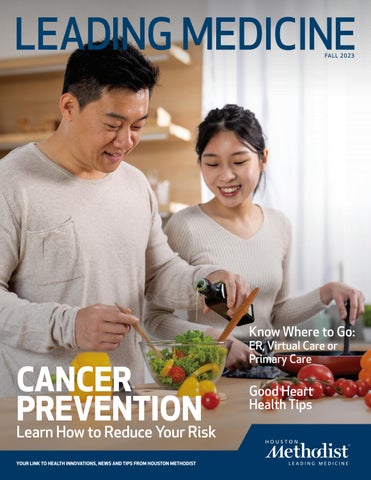
LEADING MEDICINE FALL 2023
Know Where to Go:
CANCER PREVENTION
ER, Virtual Care or Primary Care
Good Heart Health Tips
Learn How to Reduce Your Risk YOUR LINK TO HEALTH INNOVATIONS, NEWS AND TIPS FROM HOUSTON METHODIST
HMH-Fall-2023.indd 1
8/10/23 5:55 PM
Emergency Care, Virtual Urgent Care or Primary Care:
KNOW WHERE TO GO
We’ve all been there: you wake up feeling off, or you sustain an unexpected injury and the panic sets in. Should you rush to the emergency room (ER), make an appointment with your primary care provider, or access virtual urgent care? The uncertainty can be overwhelming.
EMERGENCY CARE Symptoms that generally signal an emergency include: Allergic reaction with trouble breathing, swelling or hives Chest pain or squeezing sensation in the chest Broken bones
It’s important to know where to go for care before you’re sick or experiencing an emergency. Knowing this can save you precious time, make sure you get the right care promptly and ultimately make a world of difference when it matters most.
•
PRIMARY CARE OFFICE VISIT
VIRTUAL URGENT CARE See our providers for nonemergency urgent care needs via video visits 24/7 for minor illnesses, such as:
Make an appointment with your primary care provider for the following:
Coughs, cold or flu
Minor health concerns
Constipation or diarrhea Preventive and routine care
Fevers Heartburn
Screenings and vaccinations
Head, neck or spine injury Intense pain, including severe headache or abdominal pain Loss of consciousness Major burns or electric shock Pregnancy-related issues, such as severe cramping or bleeding Poisoning or suspected overdose Shortness of breath or trouble breathing Sudden slurred speech, visual changes, or weakness on one side of the body Suicidal thoughts
Pink or red eyes Managing health conditions (diabetes, asthma, heart disease, etc.)
Sinus infections Sore throat or strep throat
Referrals to specialty care
Urinary tract infection (women only)
Care Where You Need Us To find emergency, virtual urgent care or primary care, visit houstonmethodist. org/find-a-doctor or call 713.790.3333.
Memorial
The Heights 10
Primary Care
610
Bellaire
59
Specialty Care
West University
45 Texas Medical Center
Southside Place
8
Breast Care Orthopedic Care Emergency Care Houston Methodist Hospital
Pearland
Uncontrolled bleeding
If you are experiencing a serious or life-threatening medical emergency, call 911.
2 LEADING MEDICINE FROM HOUSTON METHODIST
HMH-Fall-2023.indd 2
8/10/23 5:55 PM
KNOW WHAT TO DO WHEN
INJURY STRIKES Participating in your favorite activities, whether it’s playing sports, hiking, or even just gardening, is a great way to stay active and healthy. But even the most enjoyable activities can sometimes result Dr. Vijay Jotwani in painful mishaps. Dr. Vijay Jotwani, a primary care sports medicine physician at Houston Methodist Orthopedics & Sports Medicine, shares some tips on what to do when injuries strike. Preventing Injuries The key to avoiding injury is doing a variety of exercises in your routine. You should add strength training two to three times a week as it’s a good way to build muscle and balance. Be thoughtful about using household equipment appropriately and know your limitations. “If you feel uneasy doing something, asking for assistance to reach something is definitely better than doing it yourself and ending up with an injury that comes with medical visits and recovery afterward.”
WHAT TO DO AFTER AN INJURY
If you experience an injury, it’s important to let your body rest to allow time to heal and avoid further complications. Jotwani recommends taking an anti-inflammatory along with applying ice for 20 minutes will help reduce swelling and initial pain. “Ice is the better choice for inflammation while heat is better for loosening tight muscle,” said Jotwani. “When talking about an injury that has just happened, ice is usually preferred.” He also explained that if you are on blood
thinners or have kidney dysfunction, you need to forgo the anti-inflammatory and stick with rest and ice.
HOW SERIOUS IS IT?
How do you know if you have a minor injury that will heal on its own, or if you need further treatment from a doctor? “If the pain is long-standing with swelling or you notice it getting worse or keeping you up at night, that prompts the
need for an evaluation,” said Jotwani. Jotwani also warns that if you experience any of the following injuries, you should seek help immediately: ■ D eformity of the limb ■ Inability to bear weight ■ Persistent or worsening joint pain ■ Significant or rapid swelling ■ Weakness when moving a limb or muscle
•
HOME REMEDIES The RICE method is a simple self-care approach that can help reduce pain and speed up the healing process. If injury strikes, try these at-home approaches: ■ Rest. Rest of the injured limb or area for the first two days. Avoid all weight-bearing activities. ■ Ice. Apply ice to the injured area for up to 20 minutes to reduce pain, swelling and bruising. ■ Compression. Snuggly wrap the injured area with an elastic bandage wrap to prevent swelling. ■ Elevation. Use a pillow to raise the injured body part above the level of your heart to reduce pain, throbbing and swelling. Anti-inflammatory medications, such as ibuprofen, can help with pain relief and should be taken as directed, but do not use if you are on blood thinners or have kidney dysfunction. If after a day or two, home remedies aren’t relieving your symptoms, make an appointment to see an orthopedic specialist for evaluation.
Get Same-Day Care Houston Methodist Orthopedic Injury Clinic offers same-day appointments with an orthopedic specialist. When you need immediate orthopedic care, our knowledgeable doctors and staff can quickly evaluate and treat your injury to get you back to daily activities. To schedule an appointment, visit houstonmethodist.org/ortho-injury-clinics or call 346.238.5300.
CHECK OUT OUR DIGITAL MAGAZINE AT HOUSTONMETHODIST.ORG/NEWSROOM/NEWSLETTERS 3
HMH-Fall-2023.indd 3
8/10/23 5:55 PM
HEALTHY SOLUTIONS For Cancer Prevention Dr. Jun Zhang
Dr. Anaum Maqsood
We’ve all been impacted in some shape or form by cancer. It is one of the most prevalent health concerns in the U.S. According to the American Cancer Society, it is estimated that in 2023 alone, there will be over 1.9 million new cancer cases diagnosed in the country. While these numbers are overwhelming, there are ways you and your loved ones can fight back. The most common cancer types include:
■ Breast ■ Colorectal ■ Lung ■ Prostate ■ Skin “Knowledge is power when it comes to cancer prevention,” said Dr. Jun Zhang, a medical oncologist at Houston Methodist Cancer Center. “By learning your risk factors, you can make informed decisions and take proactive measures to protect yourself.”
YOUR BEST DEFENSE AGAINST CANCER
Detecting cancer in its earliest stages increases the chances of successful treatment and improves overall outcomes. It allows for a broader range of treatment options that are often less invasive and more effective. Plus, early detection improves the chances of
REDUCE YOUR RISK Between 30-50% of cancers are preventable by eliminating your risk factors and adding a healthy routine. It’s never too late to get proactive in your health. Reduce your risk with these simple lifestyle changes and promote your overall well-being.
complete recovery and long-term survival. Regular screenings with your doctor and being attuned to your body’s signals are vital to catching cancer at its earliest stages when it is most treatable. Know Your Body One of the most important steps you can take is to be familiar with your body’s normal patterns. Zhang advises paying attention to any changes or unusual symptoms that continue for an extended period. “You shouldn’t ignore signs and symptoms, such as unexplained weight loss, persistent fatigue, changes to your skin, unusual bleeding or discharge and lumps,” Zhang. “These can be potential indicators of cancer and should be evaluated by a health care professional.”
Limit Alcohol
Fewer drinks per week can lower a woman’s risk for breast cancer.
Don’t Smoke
Not just for your lungs but stop smoking for your overall health.
Exercise
Add movement by taking the stairs, parking farther away or gardening.
4 LEADING MEDICINE FROM HOUSTON METHODIST
HMH-Fall-2023.indd 4
8/10/23 5:55 PM
Stay Connected With Your Doctor Establishing a close relationship with a primary care provider (PCP) who understands your medical history and can guide you through screenings and exams is invaluable. “Regular checkups and open communication allow your doctor to monitor your health, address any concerns and recommend appropriate screenings based on your risk factors,” explained Dr. Anaum Maqsood, medical oncologist at Houston Methodist Cancer Center. Get Regular Screenings Routine screenings are crucial in detecting cancer early. Houston Methodist offers state-of-the-art screenings for various types of cancers — breast, cervical, colon and rectal, lung, ovarian, prostate, skin and uterine. When and what screenings you need vary depending on your age, gender, family history and other risk factors. “Your primary care provider is the gatekeeper of your health,” says Maqsood. “He or she will educate, screen and guide you on the path to optimal well-being. As a team, we ensure comprehensive care.” Be Your Advocate Take an active role in your health care by asking questions, sharing any changes or concerns, and discussing your family’s medical history with your doctor. Don’t hesitate to seek a second opinion. It’s important to gather different perspectives when facing a potential cancer diagnosis.
LUNG CANCER SCREENING CRITERIA: WHO SHOULD GET TESTED? Most health insurance plans cover lung cancer screenings, provided you meet the following criteria: ■ Between the ages 50-77 ■ A current smoker or have quit within the last 15 years ■ 20 pack years (multiply the number of packs per day by the number of years smoked) The screening costs $225 for noninsured or those not wishing to use insurance. Your doctor will need to order the screening.
First Stop: Your Primary Care Provider When it comes to discussing cancer prevention and which screenings may be right for you, your PCP is a good place to start. Your doctor can help guide you to cancer screening tests appropriate for your age and risk level. To find a PCP near you or schedule an appointment, visit houstonmethodist.org/pcg or call 346.699.5338.
Schedule an Appointment If you or a loved one has been diagnosed with cancer and would like to schedule an appointment, visit houstonmethodist.org/ cancer to find an oncologist at a Houston Methodist Neal Cancer Center near you.
•
Wear Sunscreen
Visit Your PCP
Protect your skin no matter how long you are in the sun.
Visit your doctor regularly.
Eat Healthy
Replace the chips or fries with fruit or vegetables.
Get Screened
Make sure you get screened regularly.
HOUSTONMETHODIST.ORG 5
HMH-Fall-2023.indd 5
8/10/23 5:55 PM
Guard Your Heart:
Good Heart Health Tips Your heart is the engine that keeps your body running. Keeping it healthy is essential for living a long, active life. Heart disease is the leading cause of death for people in the U.S. Prevention reduces your risk of future heart issues. “I often have patients who are fearful that they will experience a heart attack because it’s something their parent went through,” Dr. Kershaw Patel said Dr. Kershaw Patel, a preventive cardiologist with Houston Methodist Hospital. “Following a heart-healthy lifestyle is a great strategy to prevent future heart problems.” You can prevent heart disease by following these four essential habits: 1. Stop smoking. Smoking is a proven risk factor for heart attack, stroke and high blood pressure. Quitting smoking can reduce your risk of developing heart disease significantly. 2. Adopt a heart-healthy diet. Making nutritious foods a part of your diet can go a long way when it comes to preventing heart disease and managing cholesterol levels. Fill your plate with fruits, vegetables, whole grains, fish, lean proteins and healthy fats. 3. Get active. Exercise can improve blood flow, help maintain healthy blood pressure and reduce stress. Aim for at least 30 minutes of exercise five days a week. 4. Manage conditions. Monitoring your blood pressure and cholesterol levels to ensure they are within a healthy range is key. Also, there is also a strong correlation between cardiovascular disease and diabetes.
SIGNS AND SYMPTOMS
Some signs and symptoms are more serious and may require the expertise of a cardiologist, a physician that specializes in diseases
of the heart. They can administer and evaluate tests, manage risk factors and determine the best course of action for treatment and prevention. Signs and symptoms that may indicate it’s time for you to see a cardiologist: ■ Chest pain ■ Swelling in your legs ■ High blood pressure ■ Shortness of breath, dizziness or fainting ■ Abnormally fast or slow heart rate
MANAGE YOUR RISK
Family history, age, chronic kidney disease and modifiable risk factors, such as high alcohol consumption or obesity can also impact your risk level for heart disease. Be open with your doctor about your concerns or symptoms so the best treatment plan can be created to meet your health needs. “Sudden symptoms, such as chest discomfort, shortness of breath, discomfort or pain in the arm, shoulder, jaw, neck or back, require medical attention immediately, as these are the common heart attack warning signs,” said Patel. “Getting ahead of some of these signs and symptoms through prevention measures will give you the best chance of living a long and healthy life.”
•
Keep Your Heart Strong Houston Methodist has cardiovascular experts who can help prevent, diagnose, manage and treat an array of heart diseases. Visit houstonmethodist.org/ heart-vascular or call 713.DEBAKEY (332.2539) to schedule an appointment.
6 LEADING MEDICINE FROM HOUSTON METHODIST
HMH-Fall-2023.indd 6
8/10/23 5:55 PM
STRONG FROM THE INSIDE OUT: Prioritizing
Pelvic Health As women, we face unique challenges and concerns when it comes to our pelvic health. From postpartum to menopausal years and beyond, our bodies go through significant changes that can impact the health of our pelvic floor muscles. The pelvic floor includes muscles, ligaments and connective tissue that support Dr. Julie Stewart a woman’s pelvic organs, including the uterus, bladder and rectum. Sometimes the pelvic floor muscles and tissues become weak from age, surgery and childbirth, which can cause you to have incontinence or problems controlling your bladder and bowel. One of the most common pelvic health concerns for women is urinary incontinence — or uncontrollable bladder leakage — which can cause embarrassment and discomfort. While urinary incontinence is very common, it is not normal, and it is not something you have to live with. There are many treatment options available ranging from bladder training and pelvic floor muscle exercises, to minimally invasive surgical procedures.
TREATMENT OPTIONS AT POSTPARTUM AND BEYOND
Kegel exercises, also known as pelvic floor exercises, can be an effective treatment option to strengthen muscles after childbirth and beyond. These exercises involve contracting and relaxing the pelvic floor muscles to improve their strength and tone. According to Dr. Julie Stewart, a urologist at
Houston Methodist Hospital, “Kegels can help to strengthen the pelvic floor muscles and support the bladder and urethra, reducing the risk of urinary leakage.” She also said that Kegels must be done correctly to be effective, so it’s important to talk to your doctor about the exercises. Your doctor may recommend surgical options, such as sling procedures or urethral bulking agents. A sling procedure involves placing a supportive tape under the urethra to support it and prevent urinary leakage. There are several sling options, including placement of a synthetic sling or using your own tissue for the sling. Your doctor can help recommend the best choice of sling based on your needs. Another option is an injection of urethral bulking agents, a minimally invasive procedure that reduces the opening of the urethra to prevent urine leakage. “Most surgical treatments are minimally invasive with short recovery periods,” Stewart said. “After receiving treatment, most patients find that their quality of life improves dramatically. By speaking with your health care provider, you can find the best option for your unique needs to improve your pelvic health.”
•
Stop Waiting If you are experiencing pelvic floor issues, don’t let shame or embarrassment keep you from seeing a specialist. To book an appointment, visit houstonmethodist.org/crpm or call 713.441.9229.
HOUSTONMETHODIST.ORG 7
HMH-Fall-2023.indd 7
8/10/23 5:55 PM
NON PROFIT ORG.
US POSTAGE PAID HOUSTON, TX PERMIT NO. 4126
Houston Methodist Hospital 6565 Fannin St. Houston, TX 77030-2707 houstonmethodist.org
If you prefer to not receive future communication from Houston Methodist, please email optout@houstonmethodist.org or call 713.790.3333. IMAGES MAY BE FROM ©GETTY AND/OR ©HOUSTON METHODIST.
713.790.3599
LEADING MEDICINE IN GREATER HOUSTON
HOUSTONMETHODIST.ORG
Early Detection Starts With Your
The recommended age to start your annual mammogram is 40. Schedule yours today.
KI R BY DR.
ANNUAL MAMMOGRAM 610
ST .
69 FA
NI
N
Kirby
N
288
Texas Medical Center BELLAIRE BLVD.
At Houston Methodist Breast Care Centers, our board-certified experts use the latest imaging technology to provide you with cutting-edge breast screenings — such as 3D mammograms — to detect even the smallest lumps and abnormalities with accuracy. We offer: • Expanded hours available at most locations
• Online scheduling with readily available appointments
• Access to medical records and test results through MyChart
facebook.com/houstonmethodist
HMH-Fall-2023.indd 8
twitter.com/methodisthosp
8 CULLEN BLVD.
• 10+ convenient locations across Houston
SAM HOUSTON PKWY.
288
Pearland* W. BROADWAY ST.
*Pearland offers screening mammograms only
instagram.com/houstonmethodist
Scan the QR code, visit houstonmethodist.org/breast-care or call Kirby and Texas Medical Center at 713.441.PINK (7465) or Pearland at 713.363.8650 to schedule your mammogram today.
youtube.com/methodisthospitalhou
houstonmethodist.org/blog
8/10/23 5:55 PM