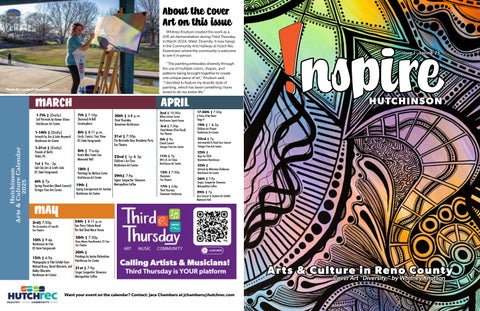

About the Cover Art on this issue
Whitney Knutson created this work as a LIVE art demonstration during Third Thursday in March 2024, titled: Diversity. It now hangs in the Community Arts Hallway at Hutch Rec Downtown where the community is welcome to see it in-person.
“This painting embodies diversity through the use of multiple colors, shapes, and patterns being brought together to create one unique piece of art,” Knutson said. “I decided to feature my doodle style of painting, which has been something I have loved to do my entire life.”
MARCH APRIL



Art “Diversity,” by Whitney Knutson
Photo by: Loribeth Reynolds

Building Community Through Refugee Resettlement

JK Vann
Human Relations
City Of Hutchinson
In 2022, the International Rescue Coalition’s (IRC) Wichita Branch presented Hutchinson with a grant opportunity for a co-sponsored refugee settlement initiative. This marked a pivotal moment for Hutchinson and Reno County, introducing a formalized program to integrate refugees into the community.
IRC Wichita, BowerComm, and independent consultants collaborated to develop the program and submit the grant application. Upon securing the grant, the Hutchinson Resettlement Project officially launched.
To support integration, a network of community allies and sponsors was mobilized to help refugees acclimate to life in the United States and establish routines for personal and professional success.
Despite challenges like language barriers and cultural differences, allies and sponsors formed strong, lasting relationships with our new neighbors, which continue to thrive today.
When I began working with the City of Hutchinson, I attended a meeting about the Resettlement Project.
By then, the initial grant phase had concluded, and 39 individuals from
nine families across five countries had successfully resettled.
It was evident that broader secondary support systems were needed for all individuals migrating to Hutchinson, not just refugees.
The success of refugee resettlement hinges on connections with the broader community.
To foster understanding and integration, we organized a “think tank” session with support families. This forum allowed participants to share successes and challenges constructively, without fear of failure.
Building on this momentum, we hosted a culturally inclusive dinner at the local zoo.
Each resettled family prepared a dish from their country of origin using gift cards provided. The event became a global feast, with music, dancing, and community bonding. Food, as a cultural symbol, transformed the dinner into a celebration of hospitality and unity.
Another highlight was a community soccer game, sponsored by the Human Relations Commission, Hutchinson Police Department, and Hutch Rec.
This inclusive event promoted cooperation across cultural lines, breaking down social barriers and fostering camaraderie. The spirited cheer section on the sidelines further reinforced the sense of unity.
These efforts laid the foundation for a stronger, more inclusive Hutchinson,

where diversity is celebrated. The initiative demonstrated that fostering unity requires creating shared experiences that transcend differences and promote understanding.
As new developments launch this summer, I encourage the community to remain engaged in advancing inclusivity and kindness.
Hutchinson’s beauty lies in its diverse populations and their unique experiences. By investing in mutual learning and support, we can build a community where all residents — regardless of origins — feel welcomed and have the opportunity to thrive.


How Cinema Shapes Culture and Bridges Divides Through The Lens:
Whether you realize it or not, cinema and society are intertwined. Movies act as both a mirror and a projector—some capture pockets of time to reflect history, while others invent new and foreign lifestyles. The concepts and ideologies presented on-screen can quickly influence a viewer’s perception of major topics, such as culture, human psychology and politics.
Whether drama or documentary, motion pictures preserve how people behave and interact. Each production serves as a unique cultural time capsule, depicting fashion, speech, literature, lifestyles and even something as mundane as the value of a dollar.
For example, movies made in 1950s America often emphasized family values, traditional gender roles and conformity to societal norms. A viewer can gauge social disparity through what is absent from a story. Older productions notably lack female leads and feature few people of color in favorable roles.
A more contemporary film like Crash (2004) explores racism, political angles and systemic pressures in the workplace. The contrast between the cinematic landscape of the 1950s and that of the 2000s is striking. As pop culture shifts throughout the decades, movies make the change visible—nearly tangible. When people and tough subjects are portrayed in a new light, how do our minds change?
Film is a psychological experience. Certain genres have unique methods to convey emotion and thought. Horror differs greatly from romantic comedy, but both portray and manipulate society’s collective fears, dreams and uncertainties. Movies explore human nature equally through a superhero’s inspirational feats and the
tragic flaws of villains or antiheroes. A story might ask viewers to empathize with strangers, suspend disbelief, challenge what they know or escape from reality to imagine something new. These imaginative exercises shape how people perceive each other and, in turn, themselves.
Political storytelling is particularly complex. Propaganda was normalized early in film history, and many modern governments maintain production budgets to influence citizens’ views on war, politics and national identity. In one of the most harmful uses, Nazi propaganda like Triumph of the Will (1935) glorified Adolf Hitler and promoted Nazi ideology. Political narratives often reinforce dogma but, conversely, may also challenge dominant power structures. A historical retelling may be altered in favor of a more dramatic narrative or a more satisfying “winner.” Some fictional political depictions are so captivating they begin to replace historical truth in social consciousness. Many people will watch The Hunger Games (2012) and side with the resistance but take no action against oppressive forces in their own lives. Self-reflection does not guarantee action.
Cinema presents many contradictions as an artistic medium, leading some viewers to assume movies are inherently divisive. People will have differing opinions on characters or actions, interpreting stories through their unique perspectives. However, for 90 minutes, all barriers have the potential to disappear into a shared experience.
Next time you go to the theater or see a discussion on social media about the latest release, join in. Engage in the conversation and make that connection. In this way, we all contribute to our cultural history.
Chucc Crumble Community Navigator United Way of Reno Co.
Photos by: Adam Stewart
Photos Provided by: JK Vann