FERMENTING URBAN FUTURES ANASTAIIA KIRICHENKO
DELFSHAVEN RING PARK - ROTTERDAM, THE NETHERLANDS
LANDSCAPE ARCHITECTURE STUDIES
ARTS UNIVERSITY BOURNEMOUTH - 2025/26
ROTTERDAM CONTEXT
INTRODUCTION
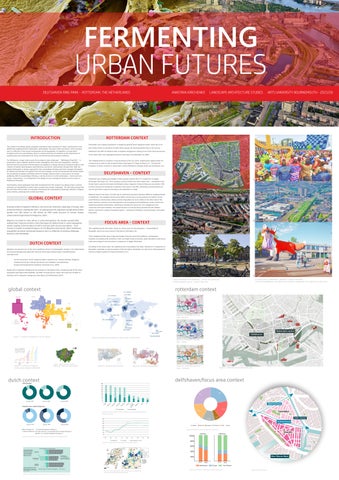
Rotterdam city's migrant population is shaped by general Dutch migration waves, while due to its This research-by-design project proposes innovative urban solutions for ethnic communities in the Delfshaven neighbourhood in Rotterdam, Netherlands. The area is often termed an “ethnic enclave” and is a reflection of the issues metropolises are facing globally. As migration is rising while ecological crises are exacerbating, there is a strong necessity for solutions at the intersection of spatial justice and urbanisation for social, environmental and economic resilience. For Delfshaven, a large-scale connective ecological urban landscape – “Delfshaven Ring Park” – is proposed to solve problems related to urban segregation and structural inequalities. Concepts derived from the processes of fermentation are applied in a design solutions framework based on the creation of shared value between autochthonous and ethnic communities through time. With the applied philosophy in design, approaches from assemblage thinking and three ecologies developed by Deleuze and Guattari are applied. Part of three ecologies, social, environmental and mental realms are recognised as deeply interlinked, where the design solutions have a strong focus on mental wellbeing. With the assemblage thinking, a variety of actors in urban landscapes – human and nonhuman, institutional – are recognised in the design of socio-ecological nexuses as focus areas in Delfshaven Ring Park. Emancipatory space typologies have been developed from this research-by-design project, and the solutions are transferable to other urban contexts with similar challenges. The next step arising from the outcomes of this study is to develop a framework for emancipatory landscape urbanism, bridging policy-making, landscape and architecture fields.
port history there is a presence of other ethnic groups not found anywhere else in the country. Delfshaven has 78% of residents with a migration background, making it one of the most diverse but, at the same time, most segregated districts (See figure 23) (AlleCijfers.nl, 2016).
The neighbourhood is situated in close proximity to the city centre, shaping both opportunities for reconnection as well as risks of gentrification (See figure 17). Maps on figures 14 – 16 show the formation of ethnic enclaves in urban fabric, where Delfshaven strongly stands out (Statistiek, n.d.).
DELFSHAVEN - CONTEXT Delfshaven has a higher percentage of ethnic groups outside the EU in comparison to bigger
4
Rotterdam (See figure 22). Ethnic groups could be divided into three major ones – immigrants from former Dutch colonies (Suriname & Antillean), labour migrants (Turkey & Morocco), and others. 53% of ethnic groups are comprised of migrants from waves in the 60s, indicating a strong presence of second-generation migrants (See figure 23) (AlleCijfers.nl, 2016).
1
Walking research has been a fruitful way to understand dynamics between different neighbourhoods
GLOBAL CONTEXT
in Delfshaven. The neighbourhood across Delft's channel has a strong presence of higher-income autochthonous communities, while economic disparities are most visible on the other side of the water channel. A variety of new developments are emerging around Delfshaven, some of which are displacing existing communities, indicating a necessity for spaces for civic engagement and
Existing trends in migration indicate a rise across all continents, especially in Europe, Asia
connection with new residents. The industrial area is currently being transformed into 'Makers
and North America (See figures 7 & 9). According to the UN, migration is projected to almost
District' and hosts a variety of temporal spaces – community initiatives, local businesses, and newly
double from 280 million to 200 million by 2050 solely because of climate change
built parks.
(International Organization for Migration, 2024). Migrants are drawn to cities, where, in some metropolises, the number exceeds 50%, making them 'majority-minority cities (See figure 8). Global trends in urban segregation remain, leading to the formation of ethnic enclaves with structural problems – from Toronto to Kuwait to Auckland (Figures 10-12) (Migration data portal, 2022). Delfshaven exemplifies the above-mentioned dynamics and is a reflection of existing challenges faced by cities worldwide.
5
FOCUS AREA - CONTEXT Two neighbourhoods have been chosen as a focus area for site evaluation – Tussendijken & Bospolder, which are most central in the district (See figure 25).
2
Those neighbourhoods have a high percentage of young unmarried residents; consequently, 400 m
residents are dealing with loneliness. There are higher levels of poverty, lower education levels and a
DUTCH CONTEXT
lower percentage of social housing in comparison to bigger Rotterdam. According to the social index, the neighbourhood Tussendijken has lower indicators in comparison to
Migration has become one of the most significant drivers of demographic change in the Netherlands
Bospolder, especially on general quality of life perception. Bospolder has had recent redevelopments
over the past decades (See figure 18). There are three major migrant types in the Netherlands
and has a higher quality of living environment (n.d.).
(See figure 20): -
EU free movement, driven largely by labour migrants (e.g., Poland, Romania, Bulgaria)
-
Citizens from former colonies (Suriname, the Caribbean, and Indonesia)
-
Asylum and humanitarian migration (Jennissen et al., 2023)
People with a migration background live primarily in the largest cities, comprising half of the urban population (See figure 19 & 22)(2019). By 2050, if trends persist, major cities will host 70-80% of residents with a migration background (See figure 21) (Netherlands, 2023).
3
6 4.Cultural event in Delfshaven - opening if ‘’Slavery monument’ 5.Aerial view Delfshaven and adjacent port industry 6.’Bosploder fox’ sculpture on main street
1. Map of Rotterdam and Delfshaven 2. Aerial view Delfshaven 3. Heemraadsplein square - artwork ‘Palm Tree’
global context
rotterdam context
Text - to be added Figure 14 . Rotterdam ethnicity map - Morocco
Figure 7 . Increase of migration in all UN regions.
Figure 8. Foreign born population in some major or world cities Figure 15 . Rotterdam ethnicity map - Turkey
500 m
Pacific Asian Maori European
Figure 9 . Increase of migration in UN regions between 1990-2020
Figure 10 . Ethnicity map London.
Figure 11 . Ethnicity map Torronto.
Figure 12 . Ethnicity map Auckalnd.
Figure 16 . Rotterdam ethnicity map - Suriname
Figure 17 . Rotterdam city & Delfshaven map
delfshaven/focus area context
dutch context
Mathenesserweg
Figure 20. Top 10 countries of origin of persons with a migrant background, by generation (×1000)
Delft’s channel Schiedamseweg Western
Moroccan
Carribean
Surinamese
Turkish
Other
Figure 23. Residents migration background - Delfshaven
Delfshaven
Rotterdam
100%
Figure 18. Composition of the Dutch population by origin in 1972, 1995 and 2018.
Figure 21. Immigration to the Netherlands 200-2040 (x1000)
80% 60% 40% River Nieuwe Maas
20% 2013
Netherlands
Figure 22. Spatial distribution of the proportion of the population with a non-western migration background Figure 19. yearly immigration and emigration rates in the four largest Dutch cities
2013
2024
Europe
Figure 24. Rotterdam vs. Delfshaven migration background
2024
Non-Westren Figure 25. Focus area map