Inspire(d)



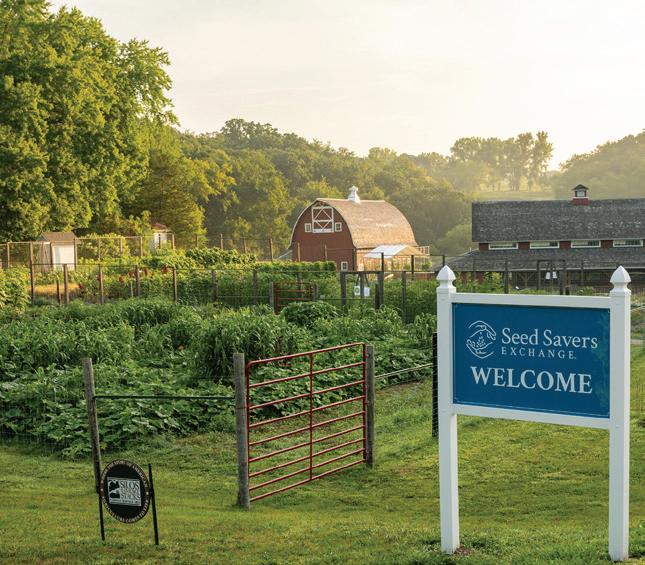
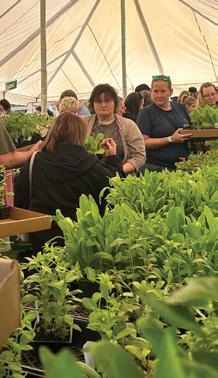

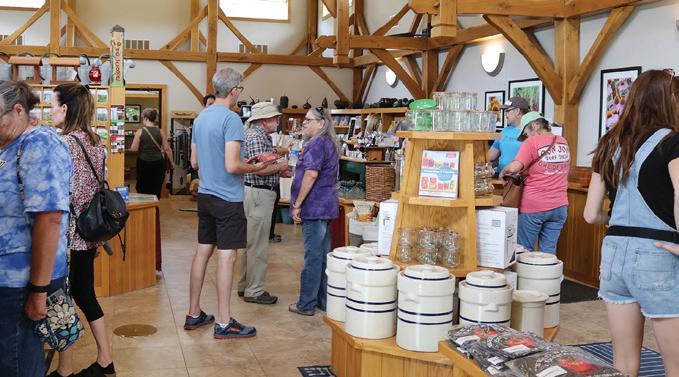

Photos courtesy Sweet Season Farm, Calmar, and Charlie Langton, Decorah.
decorah, iowa


PAPER
Inspire(d)
DRIFTLESS
AN EXPERIMENT IN POSITIVE NEWS

Aryn Henning Nichols / Editor-in-Chief + Designer
Benji Nichols / Head of Logistics + Advertising Sales
Renee Brincks / writer
Sara Walters / writer
Tallitha Reese / writer
Clara Wodny / writer
Greg Kirscher / writer
Olivia Lynn Schnur / mental health writer
Craig Thompson / conservation writer
Mary Thompson / conservation artist
Marge Loch-Wouters / Driftless hiking writer
Brian Gibbs / center spread photographer
Jen Opheim / cover artist
COMMUNITY PARTNERS FOUNDERS
Interested in becoming a contributor? Email work samples to Aryn at aryn@iloveinspired.com, and we’ll chat!
Charlotte Yu, Hazel Opheim, Frances Zielinski, Hudson Delaney, Olive Muggli-Toyloy / Future Focused submissions
Inspire(d) Driftless Magazine is headquartered & created in Decorah, Iowa. We cover communities located in the NE IA, SE MN, and W WI area of the Driftless Region. Email aryn@iloveinspired.com to learn about Community Partnership opportunities in the future - we’ve got some fun ideas!
JOIN THE POSITIVE NEWS MOVEMENT
1. Buy local - We couldn’t make this magazine without our amazing advertisers and partners. Visit or shop with one (or many) of our advertisers, and let them know you saw them in Inspire(d)!
2. Become an Inspire(d) Member at iloveinspired.com/membership
3. Sign up for our Positive News Newsletter by scanning the QR code here ----- :
4. Visit us online – website and social – and share with your friends and family!

G-Gnome is hiding somewhere in this magazine! The first five people (no previous winners please) to send us his page location through our contact form at iloveinspired.com/contact-inspired gets a free Inspire(d) 7-Year Pen in the mail!

iloveinspired.com
facebook.com/iloveinspired @iloveinspired


What’s the name mean?
Inspire(d) – pronounced in-spy-erd... you know: inspired – stands for inspire and be inspired. The idea is that person one inspires person two. That person is now inspired. Then that person inspires person three (or person one again), who is now inspired. Then the cycle continues! That’s what those arrows around the (d) are about! We’re here to remind folks that people are good! Our mission is, ultimately, to change the world… starting with our own community. We like to call it an experiment in positive news.
Inspire(d) Magazine is published quarterly by Inspire(d) Media, LLC, 412 Oak Street, Decorah, Iowa, 52101. This issue is dated Spring 2026, issue 84, volume 19, Copyright 2026 by Inspire(d) Magazine.
We want Inspire(d) to be accessible for all, which is why it is free on stands across the Driftless! But you can support Inspire(d) through Membership! We’ll send the magazine in the mail, to you or a loved one, for $35/year. Visit the Membership page at iloveinspired.com for details, or send a check for $35 to Inspire(d) Magazine, 412 Oak St., Decorah, Iowa 52101. Thank you for your support, and for joining the positive news movement!
Want to make a comment about something you read in the magazine? Email aryn@iloveinspired.com.
There is beauty in the world, even when it feels so dark we can’t possibly see it.
Radical inspiration – our theme for this issue – is about lighting a spark to shine in the darkness.
We are approaching two decades in business at Inspire(d). When we first began, I leaned into certain “tion” words to define our mission. Inspiration. Motivation. Education. Dedication. When I was brainstorming themes for 2026, I wanted to doubledown on our mission, refining each word to better reflect what we’re facing as a society right now. Radical Inspiration kicks it all off.
In general conversation, radical often means drastic or revolutionary. Slangily, it can mean cool or awesome. In math, it points to the root of something. And in botany, radical means new growth stemming directly from the root system.
That’s how I’m thinking about our themes for 2026. New growth, stemming from our roots.
We dive into Radical Inspiration in my infographic on page 37, and then further in Olivia Lynn Schnur’s mental health piece. Our hope is that you feel a tiny (or big) spark inside you to help create light in the world this spring.
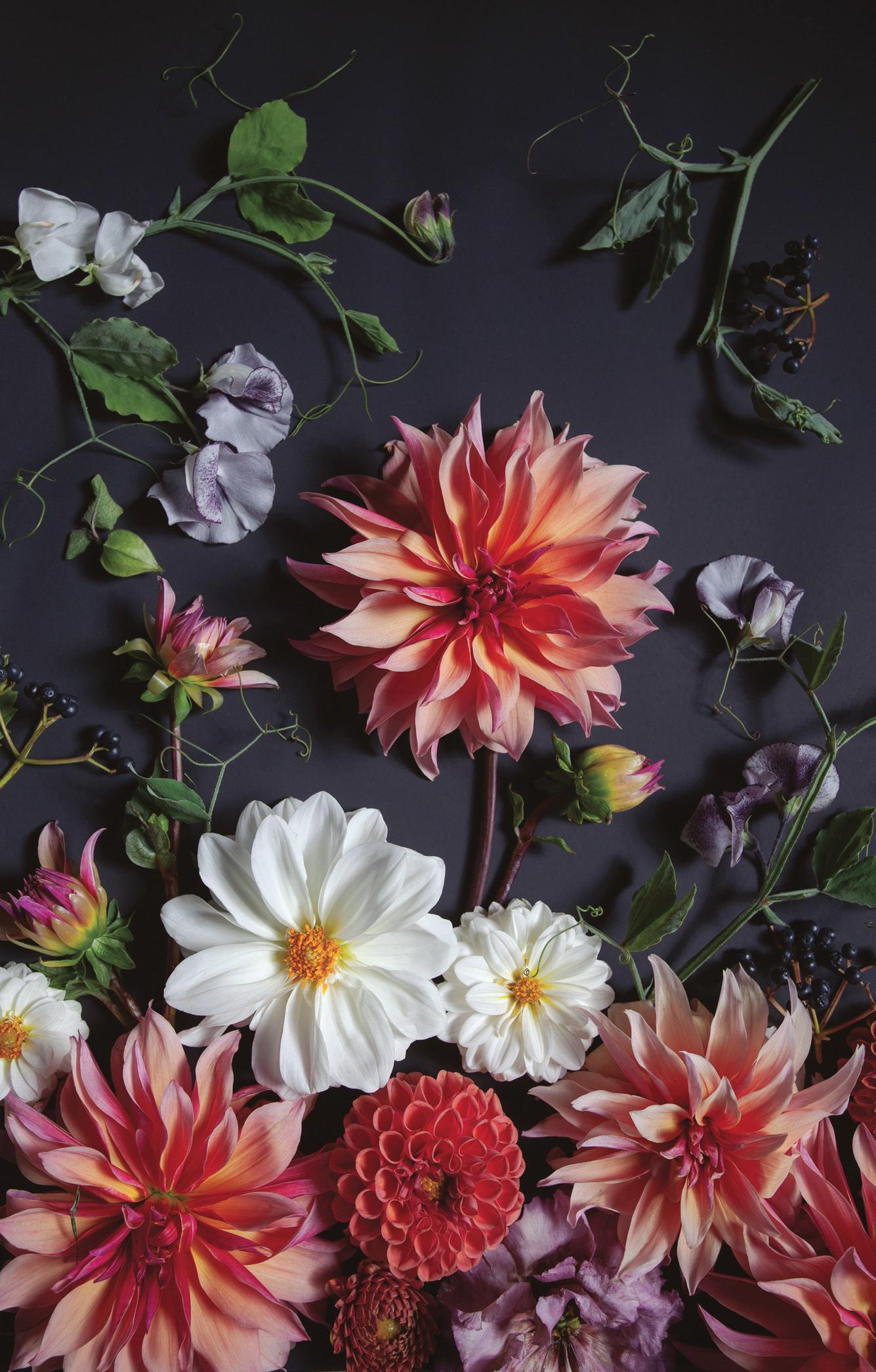
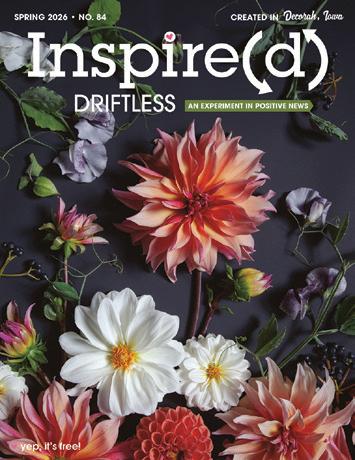
The stunning cover of this Spring Inspire(d) is filled with light, and created by one of my besties, Jen Opheim. She knows that, sometimes, when there is a big shift in life, new beauty is revealed.
Our community builders remind us that connection is a big part of inspiration. The crew at River Clean Up in La Crosse works together to make the Mississippi a cleaner place, one weekend at a time. Melodie Betts, in Fennimore, Wisconsin, opened The Lemon Door cafe to create a warm, welcoming space that visitors and residents alike could enjoy with ease. And finally, a group of Wisconsin residents went to North Carolina with Bethany Free Church, working under Samaritan’s Purse, to literally help build a community back up after Hurricane Helene devastated the area in late 2024.
Read about South Bear School’s long history of creating community and supporting others, and learn about their upcoming summer pottery workshop and celebrations of 50 years in its current location, like the Gays and Faes music festival May 29-31, 2026. Speaking of, Inspire(d)’s spring Paper Project, a fun egg-carton Flower Chain, was a collaboration with the organizer of Gays and Faes!
Sometimes, radical inspiration is a feeling of home, even when you’re not home. The spring Future Focused submissions explore this idea.
I laughed out loud one minute and then nodded my head in sage agreement the next when I read this issue’s Sum of Your Business Q&A with sisters Erica Thilges and Monica Thilges from New Generations of Harmony and Stardust Retro Revival. The “sister malls” make Harmony a real antiques destination, and we love a hunt for a good find!
If you’re looking for some delight, I suggest you immediately read Craig Thompson’s conservation piece about frogs. The words are utter loveliness and conjure up the magic that is a spring night when the frogs start singing.
Indeed, there is radical inspiration all over in nature. Marge Loch-Wouters is back with some tips to help make your spring hike extra inspiring (and she includes a great list of places to check out)!
We round out the issue with a great probit Q&A with long-time Decorah community member Georgie Klevar. What an inspiring woman!
(P.S. If you’d like to interview your neighbor, grandparent, parent, friend, etc., please reach out! We love these Q&As!)
Here’s to finding some Radical Inspiration this spring, friends!









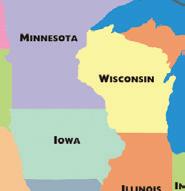
It’s a region in the Midwest – Northeast Iowa, Southeast Minnesota, Southwest Wisconsin, and a wee bit of Northwest Illinois – that was skipped by the glaciers in the last ice age, leaving the area “lacking glacial drift” – i.e. Driftless. The gist of that is we get to enjoy bluffs, valleys, coulees, and other fun geographical features that don’t typically occur in other parts of our states (the Mississippi River contributes greatly to the geography as well). It’s a lovely place to live and visit, and we’re happy you’re here!





























What We’re Loving right now
A LITTLE LIST OF WHAT WE THINK IS AWESOME IN THE DRIFTLESS REGION THIS SPRING...
YOU: OUR READERS!
More than 18 years ago, we had the idea for a localized positive news publication. We wanted to highlight all of the good things we could find in our region - in our world, not to ignore the bad, but to remember that there really is far more good in the world than bad. That wherever you go, people, in general, are good. And that neighbors doing good work to help neighbors creates ripples out into the world that sometimes cannot even be measured. Throughout the years here at Inspire(d) we have received some really nice mail - a card or note here and there with a membership, or people stopping us on the street or downtown saying “thanks for what you do,” but In late 2025 and early 2026, we have received more letters, emails, and inquiries than ever before (above is a small selection - the card is even homemade!). Let’s be honest - These are strange times in the world, and things can seem overwhelming vs. overly positive most days. But we are here to
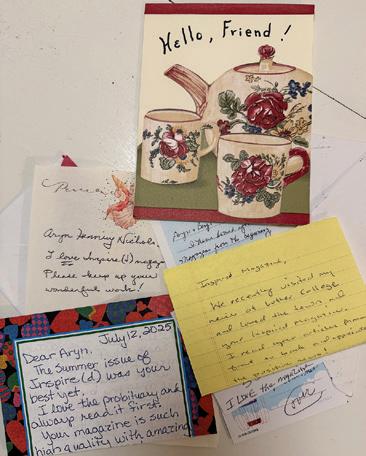
tell you that there are still heaps of good things happening in the world as well. Neighbors are still helping neighbors - friends are still making new friends, entire communities are coming together to make a positive difference in the places they live - and so can you.
We love you, dear Inspire(d) readers, card senders, email note droppers, and street stoppers. This “Experiment in Positive News” couldn’t happen without you! It also couldn’t happen without our amazing advertisers, many of whom have been with us since the beginning of Inspire(d) in 2007. At the end of the day, the way we pay for this whole thing (and make a living!) is through our advertisers, who are at the root of communities near and far. On the same note, you wouldn’t find us nearly as many places if it wasn’t for the incredible businesses and locations that allow us to offer Inspire(d) for free out in the world. From retail shops to coffee joints, and libraries to hotels across the three-state area, we are forever grateful for these partners who help us connect to readers. We truly thank all of them for everything they do to make our region a great place to live, work, and play.
We also couldn’t offer you these fun pages without our amazing contributors, many of which we have now worked with for years.

We are beyond lucky to have some of the most talented writers anywhere helping us bring a wide range of stories from across the Driftless (and beyond!).
Thank you for all of the notes, emails, and memberships this past year (you can join by scanning the code above or by going to iloveinspired.com). Not only do memberships also help us fuel these pages, but the notes remind us that Inspire(d) offers a different view - a reminder that there is good in the world, and we can create more of it together. Thank you, dear readers! We love you!
10,000 SMALL BUSINESSES
In 2022, Aryn participated in the Goldman Sachs 10,000 Small Businesses program (10KSB). 10KSB is a 12-week educational program for small businesses that helps owners plan for growth and efficiency. Participants gain practical skills in negotiation, marketing, and employee management that can immediately be put into action. In addition, they will receive the tools and professional support to develop a strategic and customized growth plan that will take their business to the next level. The curriculum, designed by Babson College, is taught from a network of business leaders, business advisors, and trained faculty. More than 17,000 business
Continued on next page





What We’
Loving right now
A LITTLE LIST OF WHAT WE THINK IS AWESOME IN THE DRIFTLESS REGION THIS SPRING...



owners from across the US have graduated from the program so far. Leaders at Goldman Sachs said that after they achieved 10,000 small business graduates, they decided they would just start in on the next

just started a program in 2025. If there isn’t a program in your state, you can apply to the National Cohort. There is generally a spring and a fall cohort each year. They accept applications on a rolling basis. Applications for the 10KSB Iowa Fall 2026 cohort are due by June 1. If you are thinking about applying, Aryn highly encourages you to go for it! The first and the last session are held in-person at the DMACC campus in Ankeny (most expenses covered by the program, including hotels and food during sessions), and the rest of the sessions are facilitated online via Zoom. This program is a partnership of ALL the community colleges in Iowa, and its resources are invaluable and extremely applicable. You workshop your own business throughout the entire program. It’s a lot of work, but so worth it. Plus, as an alum of the program you have a connection to other alumni across the nation, access to 10KSB national events and seminars, and options to learn from interesting (and free) educational and networking programs in perpetuity. Learn more about the Iowa program at iowa10ksb.com. To see if your state offers a program, check out 10ksbapply.com.






THE HIGHLANDS – (THANKS AASE HAUGEN!)
Aase Haugen was a young female immigrant from Eggedal, Norway, who, at age 13, came to the Midwest with her family in 1854. Through her adult life, she worked and cared for her entire family in the Decorah area, until their final days. In a tough reality, she ended up alone at age 42, with no living family members left. Being the last of her family line in America, she became a philanthropist until her death in 1910 at age 69. She left everything she owned to the Norwegian Lutheran Church to, “build a home for the aged in her name so that no one would ever die alone.” Her hope was to provide something else for others – a community to be at peace in. What a gift!
In 1915, 240 acres of family farm became the first location for the original Aase Haugen home and was governed by a board of directors from numerous congregations across the area. This organization has relocated (twice now!) and grown in response to community needs, offering skilled rehabilitation care, longterm nursing care, respite care, dementia care, assisted living, and independent living options to suit most any lifestyle.
In late 2025, staff, residents, and volunteers helped make the transition to a brand new facility, named The Highlands, just off of Locust Road near Decorah. Construction of the facility started in 2024, with planning and fundraising for the $18 million facility taking years to complete. The move alone required months of orchestration to keep residents prioritized, comfortable, and happy.
The facility sits directly across the street from the Vennehjem Independent Living Community, and also adjacent to Nabotunent homes, which offer independent living opportunities to seniors.
The Highlands is now positioned to care for the region’s next generations in a compassionate and modern way through later life, making sure that Aase Haugen’s original wish is fulfilled. Here’s to community, vision, and taking care of all! www.highlands.org
(Sidenote: Read about what’s happening these days at Aase Haugen’s original 240-acre property in a piece about South Bear School on page 44.)













What We’re Loving right now
GARDEN PLANNING FROM SEED SAVERS
If you’re like us, you know that spring doesn’t just bring life back to the region after months of freezing weather, but also the opportunity to figure out what to GROW in the coming sun filled months. Late winter finds Aryn dreaming of what flowers might fill in around the “yarden” at Inspire(d) HQ, while Benji knows that the hardy German garlic patch that was inherited with the house almost 20 years ago (still going!) will start to peek out again from fall planting as soon as the snow melts. Do you have favorite flowers or vegetables that you like to plant each year? Ever dream of sowing new seeds or starting a garden from scratch? No idea where to start? We got you, or, really: Seed Savers does! They’ve got lots of great tips for garden dreamers.
Top priorities: Think about the physical location of your garden (sunlight, water, soil), space (size, time, commitment), and region
– including your last frost date, generally early/mid May for our region. Even if you don’t have a yard or lots of space, you can still consider a small herb or container garden that can live in very tight spaces. It’s easy to jump into Spring with BIG GARDEN ideas, but take it from us, sometimes less is more (and less weeding!), with some good garden advance planning.
Some plants like garlic or tulips are best planted in fall to see good growth or encourage flowering. If you have a larger garden, it’s good to plan out different varieties that can benefit being grown together or in the same area both for weeding purposes as well as light or watering, etc (greens like lettuce require almost daily water in the summer while many varieties of vegetables can go a few days between watering).
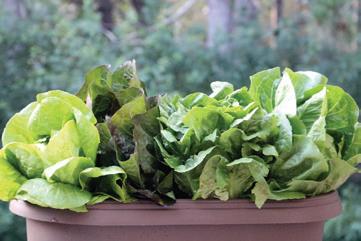
It doesn’t take a lot of expensive tools or knowledge to get started growing plants, flowers, and vegetables, although a couple decent hand tools will go a long way in keeping your garden growing. Patience and continual weeding are part of the process though, and generally speaking gardeners love to share their knowledge. Get a jump on your gardening with SSE’s Seed Starting Workshop March 28, and the annual Heirloom Plant Sale May 8-9 at Heritage Farm just north of Decorah. Also if you end up with an abundance of zinnias in August, just let Aryn know; she’ll happily help you enjoy them! seedsavers.org/learn/garden-planning










NICHOLAS C. ROWLEY COURTNEY ROWLEY DOMINIC PECHOTA LAURA THOMPSON KAREN ZAHKA
WOMEN’S WEEKEND OUT DECORAH!
Decorah’s Women’s Weekend Out (WWO), organized by a dedicated group of downtown business owners alongside the Decorah Area Chamber of Commerce, has become a signature spring tradition since its start in 2002. The three-day shopping, dining, and entertainment celebration is a fantastic way to welcome spring days, embrace time with friends, and support local businesses across more than a dozen walkable downtown blocks.
2026 Women’s Weekend

Out runs from Friday, April 10 through Sunday, April 12, with time to explore local boutiques, special promotions, dining experiences, and social events. Looking to stretch the weekend out? A special WWO Impact Trivia Night will kick the weekend off on Thursday, April 9.
The WWO committee encourages you and your friends to book lodging early and watch for ticketed special events. WWO Swag Bags will be available for purchase to the first 250 registrants (sales open March 1st).
Some notable events for Friday include a Sip & Shop event, with stores open until 7 pm, and live music / Bingo at Impact. Start Saturday off with brunch, then check out the new Live Window displays in shops along Water Street (with real people in the windows!). In the evening, get your tickets for a comedy show at T-Bock’s or a Paint and Sip night at Impact. End the weekend with another fabulous brunch in Decorah, or maybe a yoga class before you head home.
Find a complete list of participating shops and events at decorahareachamber.com/events. Whether you’re strolling more than a dozen downtown blocks or enjoying specials and tastings, Women’s Weekend Out continues to offer a vibrant way to support Decorah’s small businesses while celebrating spring with friends and family. See you in Decorah!
TO VESTERHEIM, AND BEYOND!
Regular readers will know that we love Vesterheim National Norwegian-American Museum in Decorah.
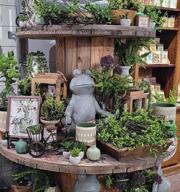
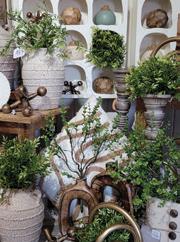
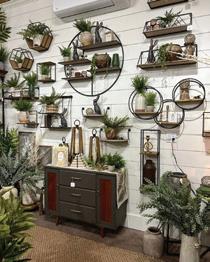
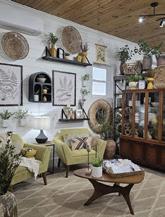
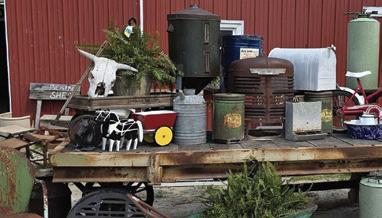
Come explore, get inspired, and find the pieces that feel like they were meant for you.


VISIT US AT 3220 HWY 52. JUST 9 MILES NORTH OF DECORAH, IA
OPEN HOURS: THURSDAY & FRIDAY: 10AM - 5PM
SATURDAY: 10AM - 4PM | SUNDAY: 11AM - 4PM

And while we’ll share the latest exhibits below, what we really want you to know about are some cool benefits of Vesterheim’s Membership program. Not only does a Membership get you unlimited admission to Vesterheim Museum, but it also offers amazing reciprocal entry programs to museums across the country via the North American Reciprocal Museum (NARM) benefit (for friend level and above) and across North American and beyond via the Reciprocal Organization of Associated Museums (ROAM) benefit (for supporter level and above). From Seal Harbor to San Francisco, having a NARM or ROAM reciprocal membership frequently allows one or more

From vintage treasures in The Pickin’ Shed to curated home décor, boutique favorites, and seasonal pieces at Market 52.
What We’re Loving right now
A LITTLE LIST OF WHAT WE THINK IS AWESOME IN THE DRIFTLESS REGION THIS SPRING...
free admission tickets (and often store discounts) at 1,000+ partner museums and cultural institutions. Additional perks may include private tours, group presentations, and educational programs, making membership a great value for frequent visitors and culture enthusiasts alike.
We’ve used our pass everywhere from Art Museums in Cedar Rapids and Palm Springs, to the Everglades Wonder Gardens in Bonita Springs, FL. (The Edison & Ford Winter Estates are also on the list!). Annual membership at Vesterheim connects you more deeply with the museum, with not only free admission, but also discounts on Folk Art School classes and in the Museum Store, invitations to member-only events, and a subscription to Vesterheim magazine.
Speaking of visiting Vesterheim, current exhibits include Pioneering Pages: Forming the New American Woman, a major special exhibit open through May 18, 2026 that explores the history

published by NorwegianAmerican sisters advocating education and equality. Women publishing magazines for education and equality? Heck, yes!
Also check out Red River Girl: From Telemark to Buffalo through May 25, 2026. This exhibit, which explores the stories of the Thortvedt family, from Fyresdal, Telemark, to Glyndon, Minnesota, and the many miles between, is a collaboration between the Historical and Cultural Society of Clay County and Vest-Telemark Museum. The Thortvedt family traveled more than 400 miles from Houston County to Clay County, Minnesota. As the Buffalo River Settlement sprang up around their farm, Levi Thortvedt and his daughter Orabel recorded their community’s history in drawings, paintings, photographs, letters, and journals. Illustrated with Orabel’s art, Red River Girl: From Telemark to the Buffalo is a book published by West Telemark Museum in Norway. It contributes to a richer understanding of America’s immigrant history, particularly our understanding of Norwegian immigration to the Red River Valley of the North.
Vesterheim’s campus includes a Museum Building with four floors of artifacts, a Heritage Park of 12 historic structures showing immigrant life, and the Hanson Vesterheim Commons – an awardwinning new visitor and gallery space. The museum’s collection of






more than 33,000 objects highlights the diversity of the American immigrant experience through traditional and contemporary Norwegian and Norwegian-American folk arts. vesterheim.org
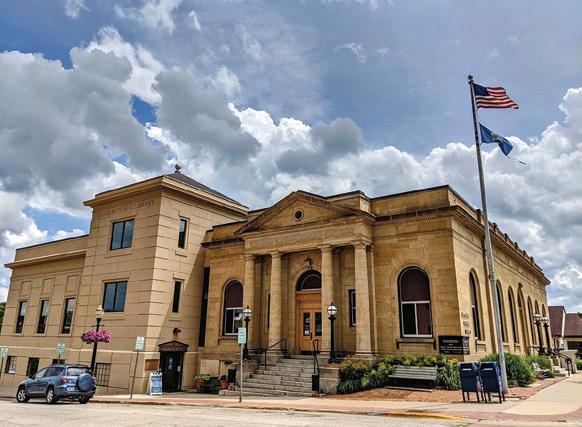
IT’S 2026 – PUBLIC LIBRARIES ARE STILL AWESOME…
Here at Inspire(d) HQ, it is likely of little surprise that we all do a tremendous amount of good ol’ fashioned reading, both for work and fun! Many years ago as new parents, we found many outlets and resources at our local public library, with opportunities to not only find books, but community with other parents, kids, and resources. Over a decade later, we continue to find new and awesome resources and ways to connect through not only the Decorah Public Library, but libraries across the region! Public Libraries are at the foundation of rural communities, offering so much more than books and reading materials, and reflect a commitment to community connection, literacy, education, and inclusive programming. From no cost opportunities for adults and seniors, to digital device technical assistance, book clubs, family programming, even State Park passes, and so much more – stop by and see what your local Public Library is up to this Spring!
The Decorah Public Library offers a wide range of services and regular programs for all ages: story times, after school activities, book discussion groups, and more. There are also community engagement programs like Hook and Loop Club, Coffee and Creativity (in partnership with ArtHaus), and Lunch & Learn that invite patrons of all ages to gather, create, learn, and socialize. Frequent technology and skill-building sessions (Android Device Basics, iPhone or iPad basics, and other digital-literacy classes) are popular as well, enhancing access to modern tools and information. For more info, check out decorahlibrary.org.
The McIntosh Memorial Library in Viroqua is another wonderful public resource with extra special twists. Ever found a library that allows patrons to borrow wood carving kits!? Housed right in the middle of downtown, this light-filled modern building offers programming like Toddler Play Time, Lego and Chess clubs, tween and teen offerings, and of course book clubs and opportunities for adults and seniors. Youth library garden club will even kick up this spring!
Join in for Books Unbanned: Freedom to Read hosted by the McIntosh Memorial Library Friday, April 24, 2026 at the Westby Performing Arts Center as a unique opportunity to engage with authors and discuss the role literature plays in society. For more info, check out mcintoshmemoriallibrary.org




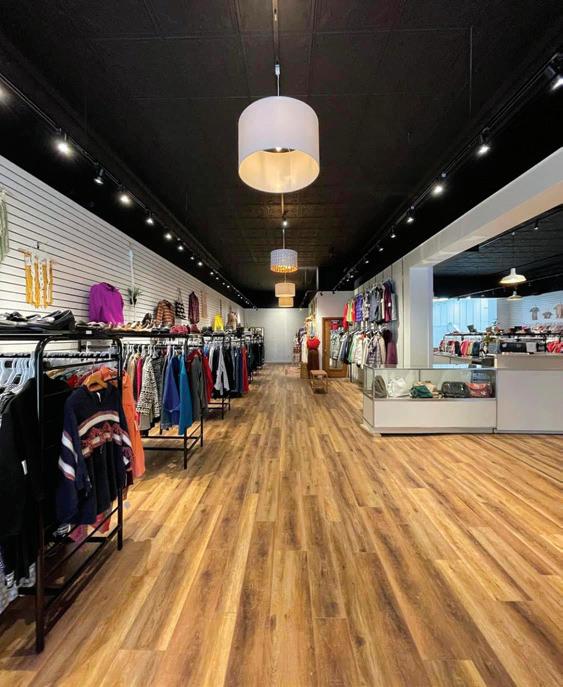







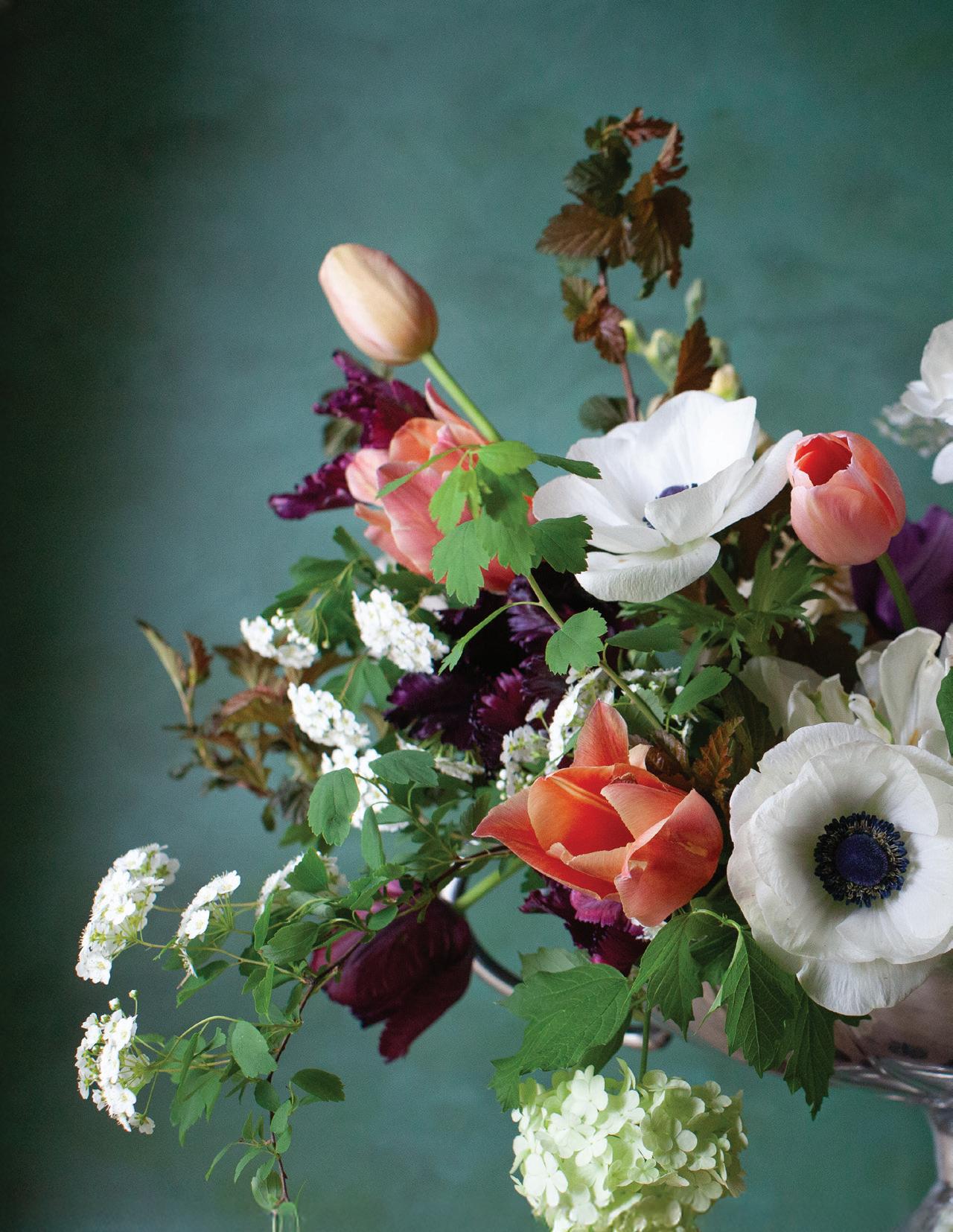
Photo by Jen Opheim





Bloom Flower Farm / Photo by Jen Opheim
A NEW LEAF



BY RENEE BRINCKS
Northeast Iowa artist and flower farmer Jen Opheim knows the power of new beginnings.
“I don’t sit still for very long,” she says. “I think when I was younger, I was afraid. I didn’t challenge myself the way I should have. There’s so much excitement in change for me, now.”
In 2017, she and her family took on a big change, moving to Decorah from Chicago so her husband could work on his family’s farm. Since then, Jen, already an accomplished graphic designer and photographer, launched Bloom Flower Farm, creating artful bouquets for a flower subscription service, floral design for weddings, and, occasionally, hands-on flower workshops for small groups.
Along the way, she photographed her designs, and in the last year, started creating those images with more focus on the resulting artwork. In December 2025, Jen held her first public art exhibition at The Perfect Edge in Decorah, to huge success.
The self-described “do-er and go-er” recognizes that momentum is about acting with intention while also being willing to experiment.
“All these little things that we do might not feel very successful at the time, but they all add up,’ she says. “For me, they’re the stepping stones that got me where I am now.”
BRANCHING OUT
Jen grew up in suburban Chicago and moved to Evanston, just north of the city, after studying graphic design in college. For more than a decade, she worked for a marketing and design firm. After being impacted by company layoffs shortly after the birth of her first child, Jen went back to school for web design. One of her classes focused on photography.
“It really changed everything for me,” she says. “I was completely obsessed.”
Thanks to a teacher who noticed her talent and enthusiasm, Jen started doing independent studies to learn more about lighting, composition, and other photography techniques. Along the way, she had a second child. She built a small business taking portraits for families. And one day, when Jen was on her laptop in a cafe, another patron asked what she was working on. He turned out to be the owner of a brand strategy and design firm.
“That one conversation landed me a job where I was then doing both design and photography,” she says.
In that role, Jen tackled brand development tasks and photographed everything from corporate professionals to architectural
to product










Close to Pulpit Rock Campground, Luther College & Downtown
Decorah
A Bloom design by Jen / Photo by Jen Opheim
She enjoyed the job, but her schedule was busy and her husband, Jason, was also putting in long days as a trader. They eventually moved to a western Chicago suburb, which increased their commutes and made it more difficult to connect with their children.
“We were thinking, ‘Oh, this suburb will be great.’ But it just took more time away from our kids. They were with babysitters until seven o’clock at night,” Jen recalls.
Jason, a Northeast Iowa native, had always talked about returning home to work on his family’s Postville-area farm. Though Jen had never imagined leaving Chicago, the idea started to make sense. So in November of 2017, they packed up and moved to Decorah, prepared for a new beginning.
PLOT TWIST
Jen considered starting a photography business after settling in Iowa, but the local market seemed saturated. So, she continued partnering with Chicago clients and sometimes traveled back to Evanston for projects. Over time, it got harder to leave her family, and Jason got busier on the farm.
“More and more, I felt like I would have to let go of Chicago a little,” Jen says. “Then, COVID hit.”
As the pandemic unfolded, her household started watching “Growing Floret.” The Emmy-nominated documentary series chronicles life on a family-run flower farm in the state of Washington. Seeing the founders spend time outdoors, working together in nature, sparked an idea.
“My husband was always trying to pull the girls and me into farming, but he didn’t quite know how. And then he said, ‘I think we could start a small flower farm,’” Jen remembers.
Though she had doubts about the suggestion, a seed had been planted. The family kept discussing the possibilities. They didn’t see a clear path for making it happen, until Henzler’s Garden Shop announced the closing of its long-standing Decorah business.
“It felt very serendipitous,” Jen says. “We were like, ‘Okay. We’re going to go and buy a greenhouse.’”
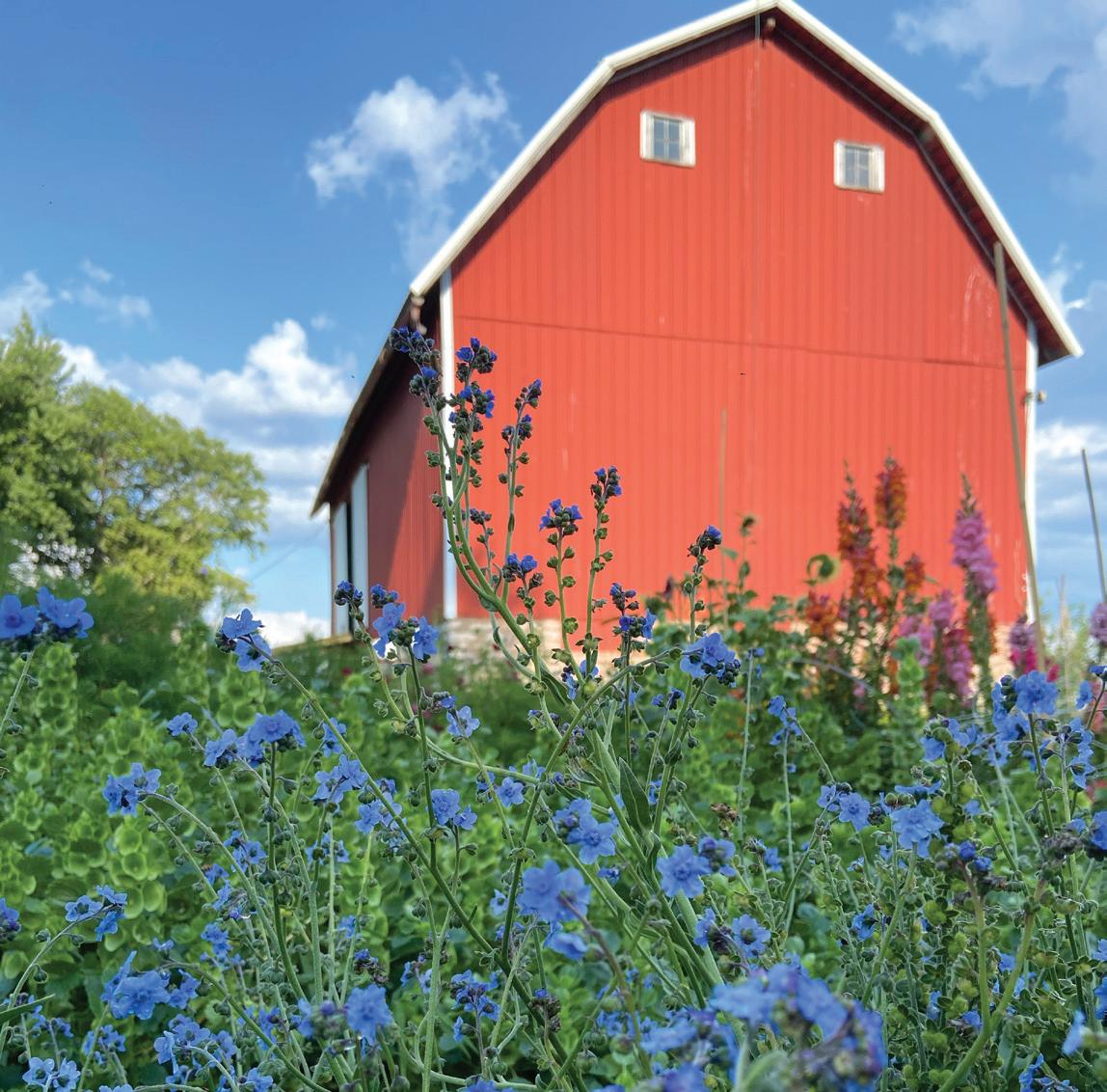
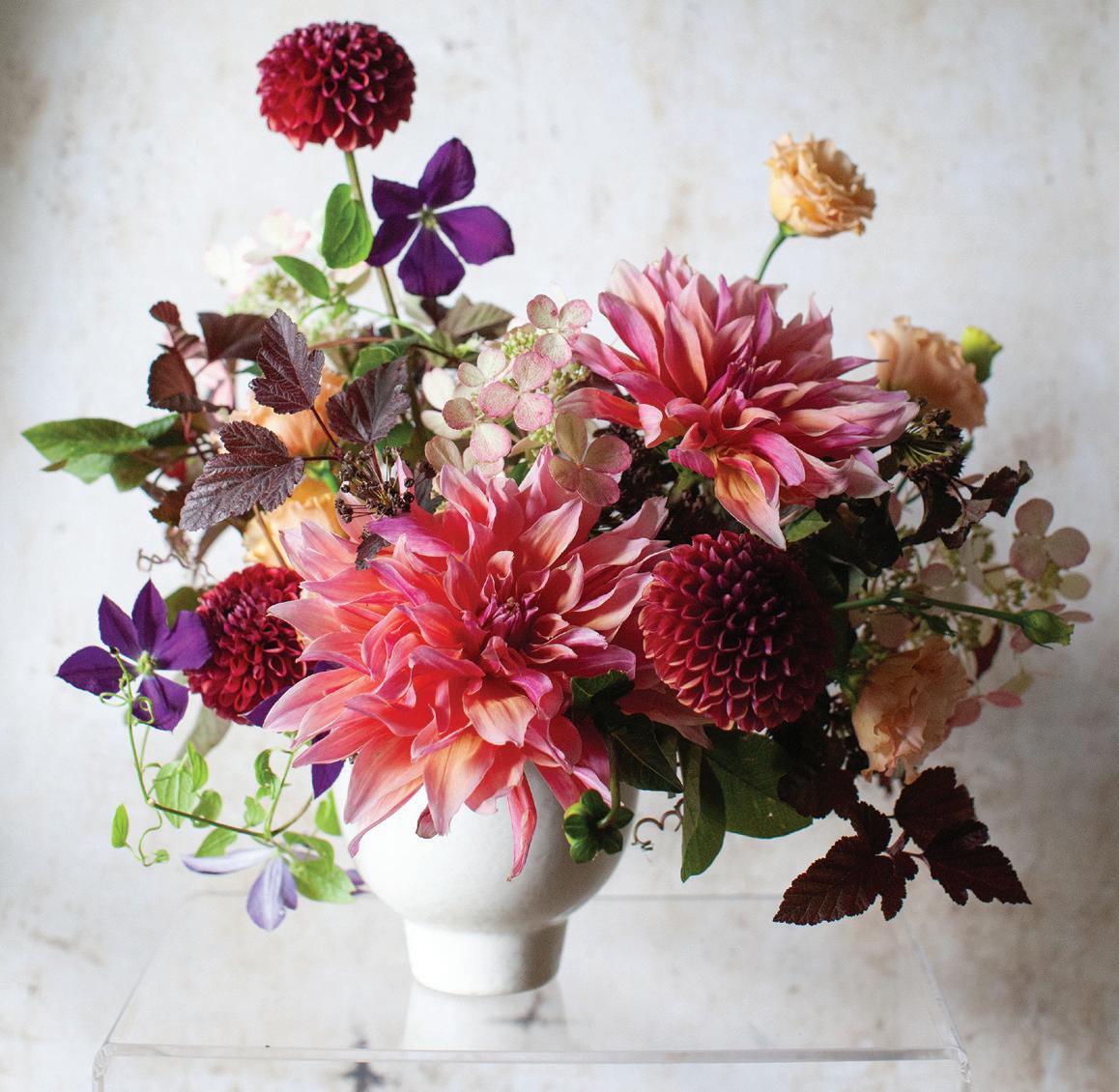
Friends helped the family reassemble the former Henzler’s greenhouse in rural Frankville. Though Jason had gardening experience, cultivating and caring for plants was new to Jen. She dug in. As she established Bloom Flower Farm, Jen experimented with various flowers to see what worked for the soil conditions and seasons. Now in her fifth growing year, she’s settled on a vibrant mix: elegant ranunculus and lisianthus blooms, brilliant lilies and snapdragons, playful daffodils, fragrant stock flowers, and dynamic, late-season dahlias, among others.
Continued on next page
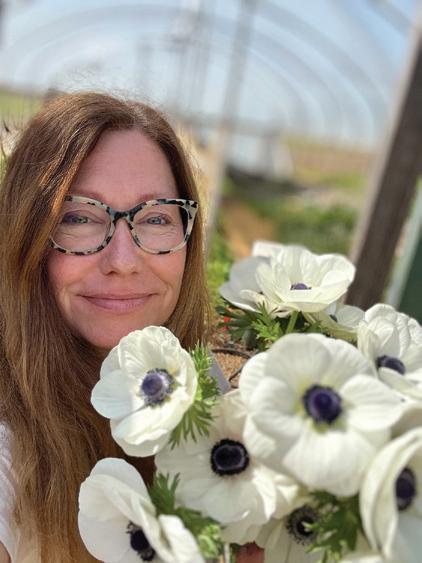
Jen + Flowers selfie
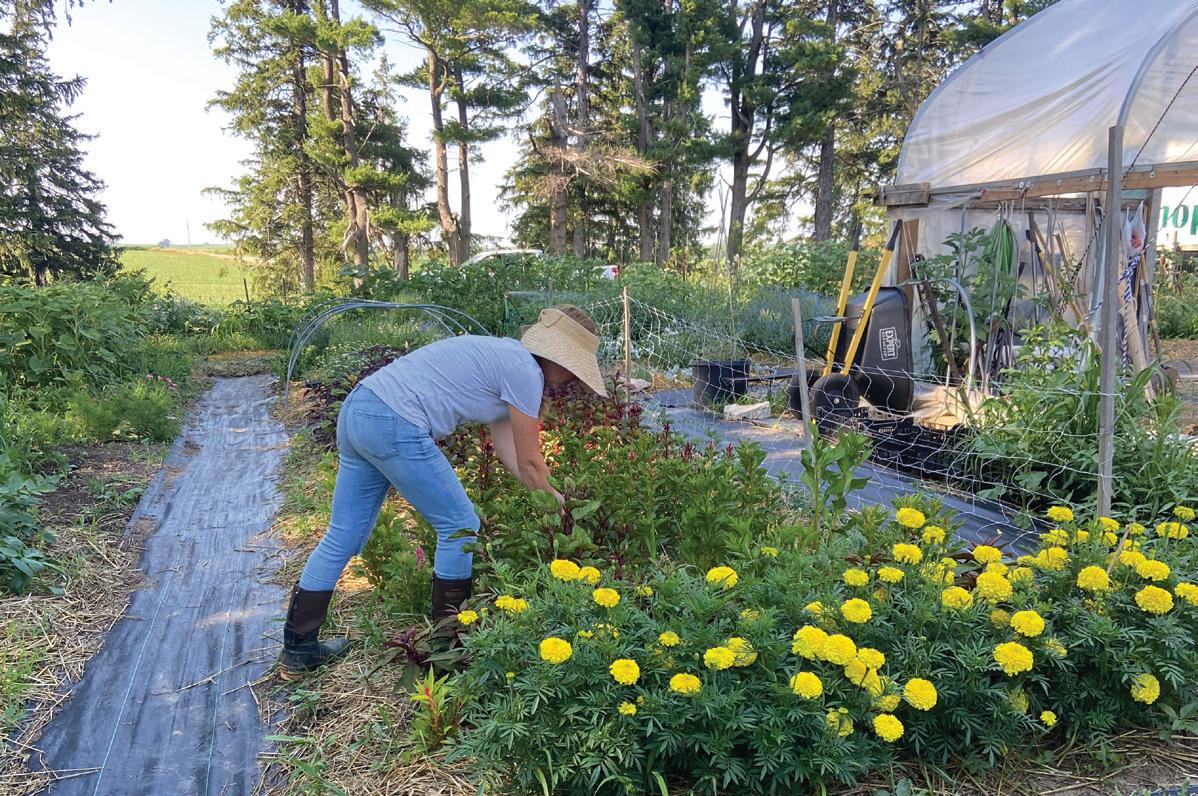
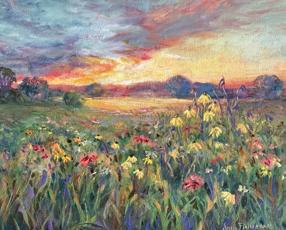
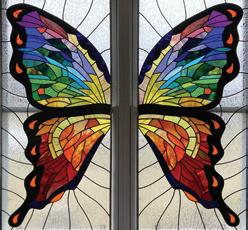




Jen working at Bloom Flower Farm. / Photo courtesy Jen Opheim
Through Bloom Flower Farm’s subscription program, customers receive fresh, colorful arrangements monthly or every other week throughout the growing season. Nancy Nelson’s children gifted her a subscription for Mother’s Day in 2025. She loved it so much that she requested a repeat for 2026.
“They aren’t just pretty arrangements. They are works of art that reflect the season, Jen’s knowledge of florals, and her unique creativity,” Nancy says.
She looks forward to chatting with Jen about the flower varieties included in her monthly deliveries. In her view, each arrangement is a piece of art that can be immediately put on display.
“It’s always a special surprise when they arrive, because you don’t order a specific flower. You just trust Jen’s decisions,” Nancy says.
IN FULL BLOOM
Creating memorable arrangements for subscribers has helped Jen refine her floral design skills. She enjoys putting a creative spin on classic design techniques.
“There is a formula, and over time, I have taken that formula and made it my own. A lot of my focus is on color and size and texture,” she says.
In addition to crafting beautiful creations for subscribers’ homes, Jen has put together pop-up floral exhibits for several Decorah stores. One caught the eye of Constance Johnson, a designer who specializes in historic preservation projects.
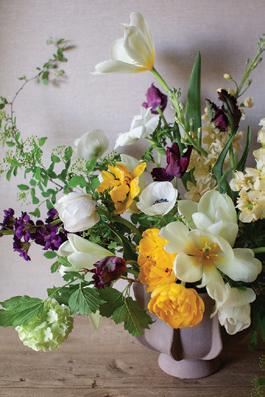

“It was spectacular. It was colorful. Her style, her use of scale, her use of composition – I decided I had to get to know this woman. So, I made a cold call and introduced myself,” she says.
The two became fast friends. When a client asked for design and flower support for a 2025 wedding, Constance insisted that Jen also be involved. That successful project set the stage for future collaborations. Constance now hires Jen for graphic design work, and she also encouraged Jen to assemble photos for her first public photography exhibition.
location!
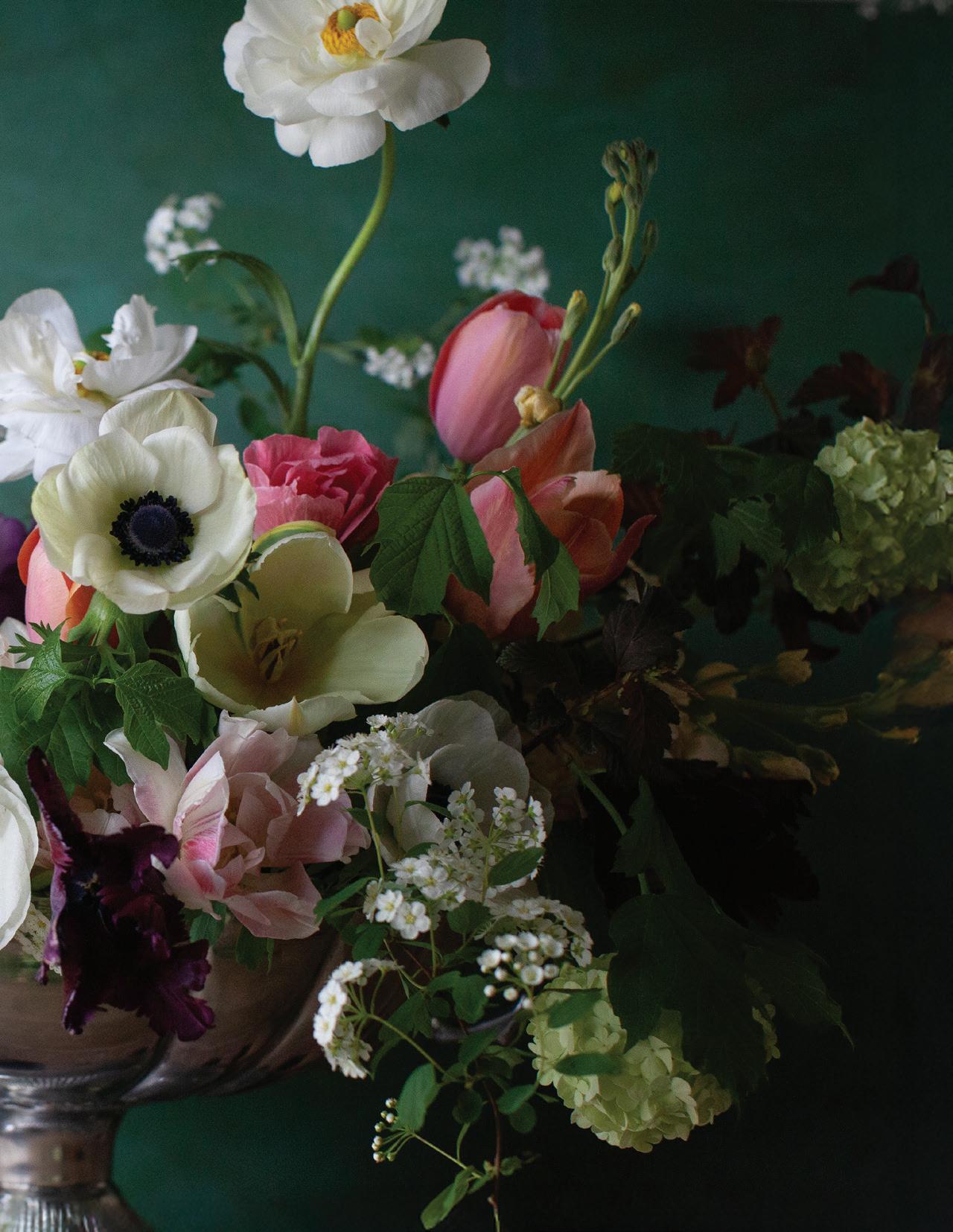
The Perfect Edge in Decorah hosted “Still Blooms” in early December 2025. Bridging floral design and photography, the exhibit featured still life-style images of flowers set against dark backgrounds and bathed in moody light.








Arrangement
photo by Jen Opheim
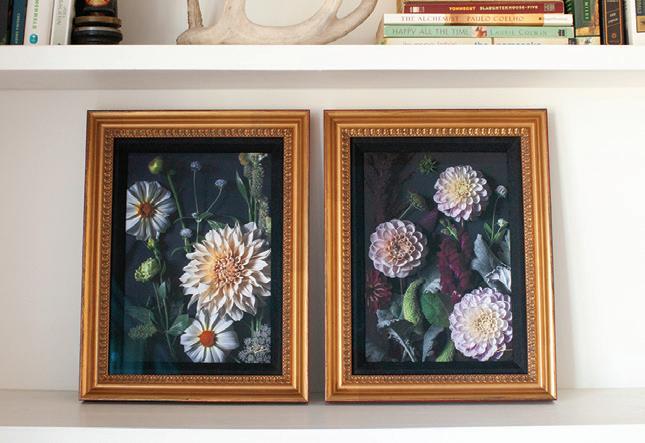
“It really struck me, when I first saw Jen’s work, that she has this very painterly, artistic vision. It’s Old World and Old Masters, in a way, with a new twist. It was just something I had never seen in the photography realm,” Constance says.
“I’m always looking for inspiration. I am always searching. I love new ideas, and I’m always moving forward. When I randomly decided to experiment with laying out flowers, I was basically trying to come up with different ways to set myself apart. There is a lot of sameness on social media, and I’m looking to not do the same,” Jen says. “In photography, you follow the light. Light is everything. When I started creating these, the light – the way that it hit the flowers and pushed the background back – that’s where the magic happened.”

Jen looks for magic and inspiration in her daily life, as well, whether she’s taking a break from chores to photograph flowers or discussing new projects with the friends she’s made in Decorah. Some of her closest ties are with other entrepreneurs who understand the importance of taking chances.
“I’m in a community that is unbelievable, and everyone is so supportive. Everyone wants to see you succeed,” Jen says.
That support was vital when Jen uprooted her life and moved to Iowa. Now, the friendships keep her grounded as she moves through different seasons of life and work.
“We’re naturally afraid of change. But when you go through hard things, you realize that you can move past whatever feels so big,” she says. “You make it what it is. Every challenge I’ve had could have been handled totally differently, but I choose to follow the things that I enjoy. I choose to keep growing and keep doing.”
Renee Brincks (reneebrincks.com) writes about travel, nature, nonprofits, and small businesses.
LEARN MORE


Visit Bloom Flower Farm at bloomflowerfarm.net to order a flower subscription, discuss wedding services, plan a custom floral workshop, or learn more about Jen’s photography. You can also purchase framed and unframed versions of Jen’s floral prints at The Perfect Edge, located at 107 West Water Street in Decorah, Iowa.





Jen’s flower photos in frames. / Photo courtesy Jen Opheim
River Clean Up
La Crosse, WI

TBY SARA WALTERS
he Mississippi River is not just a geographical boundary for the city of La Crosse, Wisconsin; it’s also its pride and joy. Boaters, paddlers, anglers, and bird enthusiasts visit La Crosse every year to enjoy its waters. Much of the community’s identity revolves around its natural beauty – a majestic landscape of bluffs and rivers.
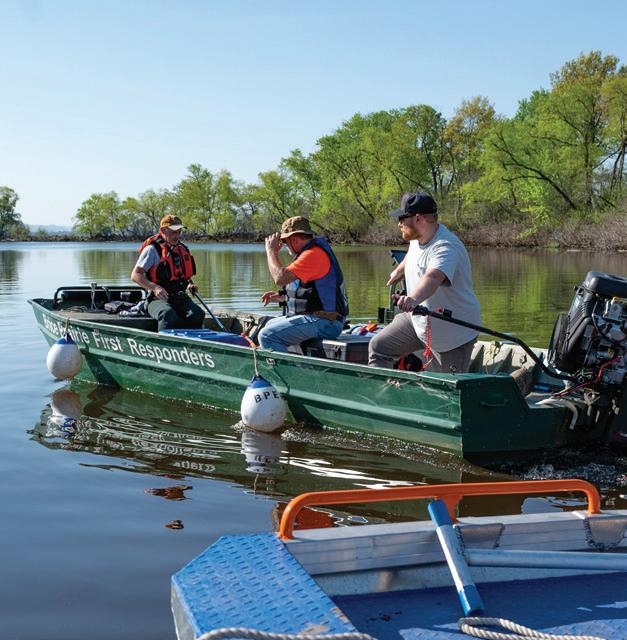
That’s why preservation of the Mississippi, and adjacent waterways, has become the mission of River Clean Up (RCU), a dedicated group of volunteers that has been cleaning area rivers for more than three decades RCU was co-founded in La Crosse by residents Russ Wilson and Wayne Ellefson. Russ, a former Wisconsin State Game Warden, was painfully aware of the pollution impacting the area’s rivers, destroying habitats and poisoning the water that plants and wildlife rely on. His first attempt at a group cleanup in 1992 drew only his colleagues. Afterward, Russ consulted with his friend, Wayne, who has a background in marketing, on how to make a bigger impact on the community. “I agreed to help him get the volunteers and the rest is history – going on 33 years!” says Wayne. “We wanted to make an event that volunteers would want to come to every year and tell their friends about.”
Continued on next page
About Community Builders
A community is defined as a unified body of individuals. You can build community in a neighborhood, city, region, state, nation… world, at any level. But it doesn’t have to be big to have a big impact. Building community is one of the most important things we can do in this life. Connecting with others helps us connect with our humanity and realize we’re all in this together. Read more Community Builder stories at iloveinspired.com, and send us a note if you know someone we should feature here in the future!
In 2025, more than 580 volunteers participated in River Clean Up’s two annual events.






RCU’s cleanup efforts have definitely grown, drawing helpers from across the community. In 2025, they had more than 580 volunteers participate in their two annual clean up events: Community River Clean Up Day (always the Saturday before Mother’s Day; 2026’s date is May 9), and Corporate River Clean Up Day.
“When a local company reached out, wanting to have their employees volunteer, we got the idea to start the annual corporate day clean up for businesses,” says Wayne, sharing that last year’s corporate day drew more than 200 volunteers from area businesses.
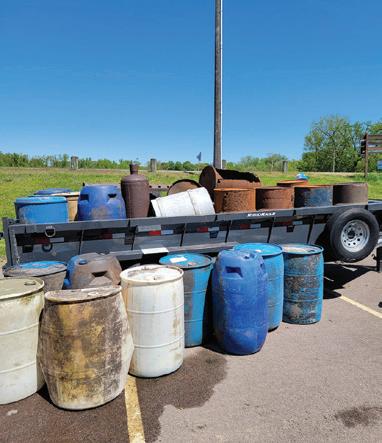
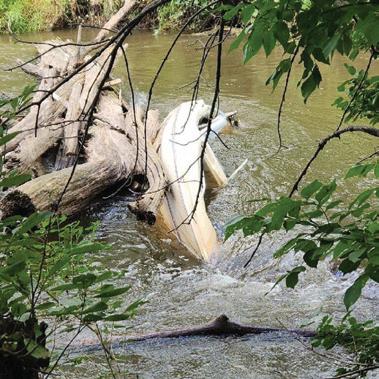
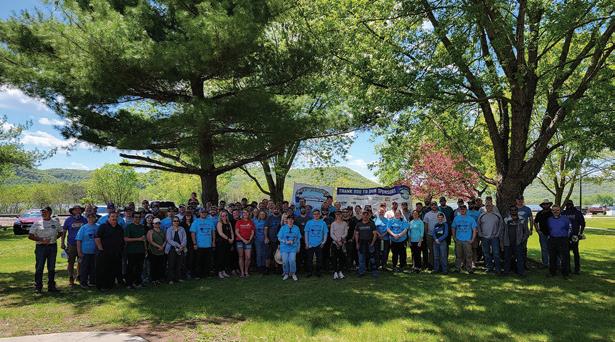
Since 1993, RCU has removed nearly 900,000 pounds of trash from area waterways, including many large, discarded items like appliances, tires, barrels, and even an occasional boat. / Photos courtesy RCU



Cleanup events are big undertakings, needing all those volunteers. Boaters and walkers remove trash from the water and shorelines, working along the main channel of the Mississippi, as well as the La Crosse River, Black River, the local marsh, and many backwaters. Volunteers are spread out among local landings (Clinton Street West Landing, 7th Street Landing, Goose Island West Landing, or Fred Funk Landing on Brice Prairie), given trash bags, and put to work. They return to their landing with the trash so it can be disposed of properly.
In the early days – when railroad traffic was more abundant –cleanup crews sometimes found containers of toxic waste in the river. Though this isn’t typical these days, RCU still finds a lot of large, discarded items such as appliances, barrels, tires, water heaters, propane tanks, bikes, car parts, and more. In 2025, they removed more than 30,000 pounds of trash, recycled more than 200 barrels and nearly 50 tires, and disposed of a massive amount of non-renewable plastic.“The secret to River Clean Up’s longevity is its narrow vision and wide impact,” says RCU committee member Sam Przywojski. “We gather 500+ of our closest friends for one weekend and reap the benefits all year long.”
Sam also attributes the success of the group to the community’s deep connection to the river and its local tributaries. “To live in this area is to benefit from the beauty, resources and economic benefit of these unique features of our planet,” he says. “Our community is located here because of the river, our families are here because of the river, and many businesses are supported by the river. There
batch Fresh Fudge
Soda Fountain • Homemade Ice Cream & Waffle Cones
is a natural inclination to reciprocate and RCU provides that opportunity for the people of the Coulee Region.”
Despite the large amount of work that goes into cleanup events, the organization is entirely volunteer-run. Currently, a small committee of five - David Abts, Wayne Ellefson, Chris O’Hearn, Sam Przywojski, Russ Wilson – oversees events and donations. RCU operates under the fiscal sponsorship of La Crosse Neighborhoods, Inc, a 501(c)3 public charity, and all donations go directly toward RCU operating costs: trash disposal, safety measures, Clean Up event logistics, and recycling fees.
prepared to clean up, even on your own. “Always have a trash bag in any boat you’re taking out on the river,” suggests Wayne. This simple act is an easy way to help with the pollution problem. And a problem it is. Since 1993, RCU has removed nearly 900,000 pounds of trash from area waterways. Wayne knows that overall enjoyment of the river is significantly increased because of these efforts. “Our local beaches are so much cleaner for everyone to enjoy,” says Wayne. He also knows that RCU’s work has improved life downstream, ensuring that this waste never traveled further south to impact the lives of those who enjoy life along the Mississippi. “That trash did not make it down river to spoil it for those people,” Wayne says.
RCU is also available on-call, and has helped clean up abandoned structures and watercrafts, too. For example, when they learned of a mess about 20 miles south of La Crosse, with docks and other materials left abandoned, RCU volunteers tracked down the family of the deceased owner, and a team was able to go in and remove the waste and debris. Another time, they were contacted by landowners to help coordinate the removal and disposal of a sunken boat.
It’s not just the clean up of large items that matters, though. One of the most important ways people can protect the Mississippi and its surrounding waters is to not litter, says Wayne. Another is to be
Even after 33 years, River Clean Up’s mission to keep local waterways clean, beautiful, and healthy is going strong. As committee member Sam says, “River Clean Up is a small but mighty force to preserve this area’s splendor.”
Sara Walters is based in La Crosse and has been a contributor to Inspire(d) since 2018.
The next Community Clean Up Day is planned for Saturday, May 9, 2026. Find details at rivercleanuplacrosse.com.





RCU cleanup crew from 2024. / Photo courtesy RCU

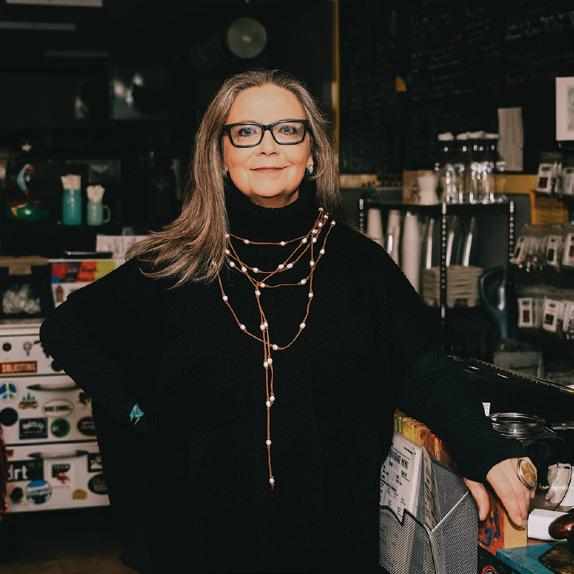
Melodie Betts
BY TALLITHA REESE
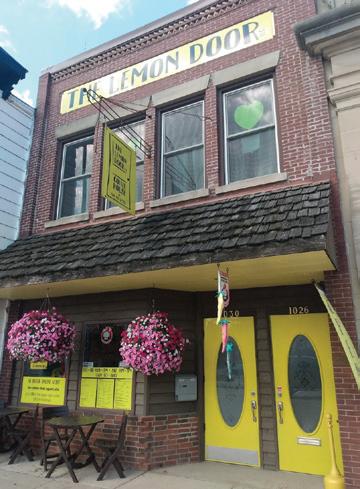
“Quirky and happy, that’s every day at The Lemon Door,” says Melodie Betts, owner of the eclectic coffee house located in Fennimore, Wisconsin, that offers fresh, fast fare, and elevated catering.
As an adult, Melodie lived primarily in Wisconsin, but moved to Montana, where she was born, to be close to relatives. She met and married her husband, but not long after, lost him to a mine accident.
“It was time for a change,” says Melodie. “Moving back to Wisconsin, with the encouragement of friends, helped me decide this is where I needed to be. I looked all over the state for the right property that ticked all the boxes.”
She found what she was looking for in a building in Fennimore and made the purchase in 2017. Over the next two years, Melodie slowly worked to remodel both the upstairs living space and the lower-level shop, although she was unsure what would occupy that space.
Over time, the idea for a coffee shop formed. Melodie saw a need in the community, and, having worked in the service industry on and off since she was 14, she decided to give it a go.
“At the time, there was no coffee shop on a highway for over a 50-mile radius,” Melodie says. “No one doing fresh sandwiches or salads that you could build your own, with locally sourced items. I vowed not to duplicate what anyone else was doing in the area. I worked with so many wonderful people to get the doors open.”
The Lemon Door, located on Lincoln Avenue, opened to the public in June of 2019. True to its quirk, the business name was inspired by a randomly assigned Yahoo password from the 90s.
Customers at The Lemon Door walk in, grab a menu, and then circle items they’d like on their sandwiches or salads, with many fresh and from-scratch ingredients.
“That way they get exactly what they want, so when people ask if we have specials, I tell them everything is, because you make it!” says Melodie.
Much of Melodie’s inspiration for her space came from The General Store in Spring Green, one of her favorite places in Wisconsin. Open since 1976, The General Store is half cafe, half general store, with lunch served Thursday-Sunday, and breakfast on the weekends. Melodie has fond memories of visiting for breakfast in the 1990s.
“The Sunday State Journal would be scattered with everyone reading and exchanging sections, making comments on what we’d read. I loved it and that memory stuck with me,” Melodie says.
Melodie Betts at her cafe, The Lemon Door. / Photo courtesy Melodie Betts
COMMUNITY BUILDERS

Melodie inherited an appreciation for all things food from her mother. Both her parents were born during the depression, and taught Melodie the basics early: Use everything, no wasting, and be creative. That creative, ingenious spirit shines through at The Lemon Door.
“I wanted it to be eclectic, full of color, kid friendly, and welcoming,” says Melodie, who also set up a tourist information counter and rack in the shop to help promote the Driftless area, with fun The Lemon Door branded stickers as well.
“There really isn’t anywhere to pick up information on the area. And every new person who comes in gets a sticker. If they are traveling, I give extra. Each year I give out 1000 stickers!”
The Lemon Door was met with an outpouring of community support when it opened in 2019. When COVID hit, Melodie, like everyone, was worried about the future. “I didn’t know what was going to happen, and the ugly crying of the day we closed had an uncertainty I’ve never felt before,” Melodie says.





The Lemon Door’s name was inspired by a randomly assigned password.
/ Photo courtesy Melodie Betts


But the community rallied. “People bought gift certificates, sent money, dropped off envelopes without names,” she says. “It was so unexpected, but they wanted to see me reopen.”
So The Lemon Door adopted an online ordering system, switched over from dishes to paper for curbside pickup, and got through a year in that manner. Melodie was grateful for the strong community ties of Fennimore.
“This community cares about each other without need for recognition,” Melodie says. “We reach out if someone is in need or has fallen on hard times and give what we can.”
Melodie also added another income source to get through those hard times then and in the future. She applied for grants, with the help of the local chamber and her bank, and was able to introduce a catering option.

offerings.

“I picked the type of catering that wasn’t offered in the area and ran with it,” Melodie says. “At holidays I offer cheeseballs, grazing boxes, and dip trios. Lots of grazing trays, party carry-outs, and build your own sandwich set ups.”
Melodie says her favorite part of building this business has been the people she’s met and bonded with over the years, coming in day after day to partake in The Lemon Door’s welcoming space. She also says her two part-time employees are a huge part of that warm environment.





“I don’t like the word ‘boss’, I tell them, ‘We work together, we are co-workers,’” she says. “I can’t do it without them. I have the best people ever. If they’re happy, so are the customers.”
And happy people are at the heart of what Melodie has built. She wants the community – and the travelers who pass through – to experience all the quirky fun that’s to be had at The Lemon Door in
Tallitha Reese is a freelance writer and content manager based in Cashton, WI. She owns Words By Reese and you can find out more about her and her work at www.wordsbyreese.com.


Catering opened up new ways to serve the community through The Lemon Door’s
Iced coffee is popular (once the weather warms up.) / Photos courtesy Melodie Betts
COMMUNITY BUILDERS

Bethany Free Church La Crosse, WI
The Rebirth of a Community
BY GREG KIRSCHER
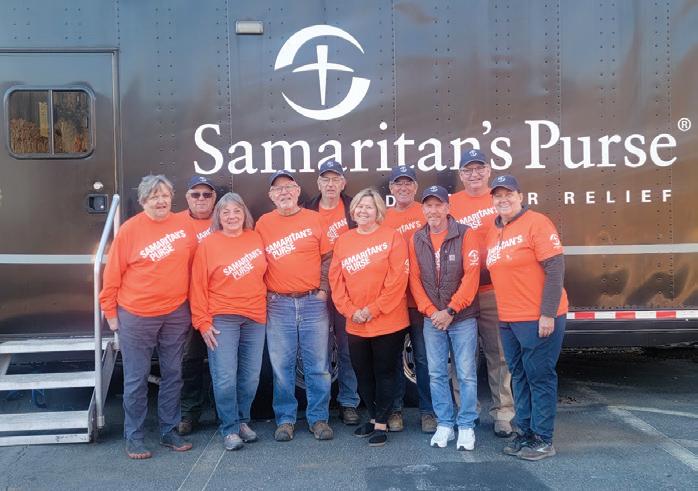
There was a sense of connection as Dan Christianson nailed the final pieces of siding to Miss Francis’ new house near Boone, North Carolina. Dan and his wife, Sherri, of West Salem, Wisconsin, were part of a 10-person relief team from Bethany Free Church of La Crosse that headed to storm-tossed western North Carolina in November of 2025. They spent one week helping with rebuilding efforts after Hurricane Helene devastated the area in the fall of 2024.
Floodwaters had ripped up huge chunks of road and tossed houses into the swirling morass like toys. Entire sections of towns had been swept away. The storm carved deep scars into the landscape as well as the hearts of its people.
But this had become a time of rebirth for these people and their communities. They proved to be strong and resilient, and waves of support and assistance poured in from across the nation. In fact, the outpouring was so great that Bethany Church, which had originally fielded four teams, had to wait almost six months for just one slot to open up.
“People were here from Texas, California – from all over,” says Dan, a veteran of over 14 relief missions including Hurricane Katrina in 2005 and the local Rushford, Minnesota flood of 2007. The last five years have found him in Bogota, Columbia, helping to build a children’s home with Bangor, Wisconsin-based Children’s Vision, and refurbishing a building at a Christian college in Colorado.
For Dan and his teammate, David Paudler of Brice Prairie, Wisconsin, this was their second trip to the stricken area. The first was just a few weeks after the hurricane tore through the state.
Continued on next page

Hurricane Helene relief volunteers Barb Wenzel, Dave Paudler, Jolene Williams, Doug Williams, Terry Torgerson, Sherri Christianson, Dan Christianson, Paul Cochlin, Brian Martz, Lisa Cochlin. / Photo courtesy Bethany Free Church




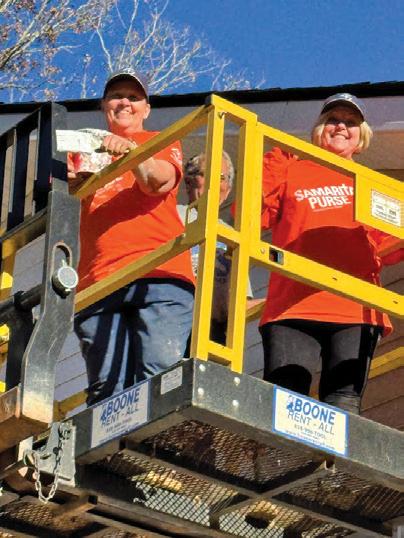
“Everywhere you looked you saw trees down,” says Dan, recalling that trip. “We drove along the river outside of Asheville and saw places where houses just weren’t there anymore.” Back then, the work required tree cutting, brush removal, and tarping roofs. David recalls people living in houses with buckets placed under holes in the roof.

In the immediate aftermath of the storm, Samaritan’s Purse, a Christian relief organization led by Franklin Graham and headquartered in Boone, North Carolina, coordinated much of the rescue activity. It organized the largest civilian airlift in U.S. history with well over 200 helicopter flights dropping supplies. Grieving survivors found comfort in the counsel and prayers from Samaritans Purse chaplains who accompanied relief teams. Now, the organization coordinates much of the rebuilding effort, which some estimate could take as long as five years.
Even a year later, when the Bethany Free Church team arrived, evidence of the storm was still visible, with cars and debris marking the riverbanks and huge, lumbering machinery restoring the roads. “It was eerie to see all the destroyed homes,” says Lisa Cochlin of Onalaska, who joined the Bethany group with her husband, Paul. “There’s no way to rebuild on some of these sites.”
“You just can’t understand what these people went through,” Paul adds. “You don’t realize what it means when your house is underwater.”
While in Boone, the Bethany team, with an average volunteer age of 68 years, slept at a local church and took meals from a mobile kitchen outside. Under the direction of Samaritan’s Purse, the group got to work quickly, tearing down sheds, cleaning up debris, and filling dumpsters before finally moving on to home repairs.
At Miss Francis’ worksite, Dan and Paul nailed siding while Sherri and Lisa taped off windows, washed mud from the house, and prepared the exterior for painting. This was a change for Sherri, who
Top: Samaritans Purse Foreman and Terry Torgerson survey storm damage. Bottom: Lisa Cochlin and Sherri Christianson painting from the bucket. / Photos courtesy Bethany Free Church
originally planned to volunteer as a cook, as she did with Hurricane Katrina relief. “I had to leave my comfort zone,” says Sherri. “I was not used to ladders. Then they would say, ‘go down to the stream and get a bucket of water to clean your paintbrush.’ I don’t normally do stuff like that.”
Brian Martz, along with Doug and Jolene Williams, all from Onalaska, worked with David Paudler at a different location where a young mother lived in a camper with her four children and grandma. Jolene was moved at the sight of most the family’s personal possessions still laying outside under a tarp. She connected with the young mom, helping with the difficult task of sorting through beloved family possessions.
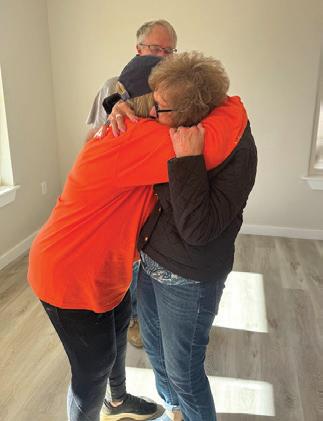
As the week progressed, the team found that volunteering with Samaritan’s Purse meant more than just clean up and construction. “Samaritan’s Purse rebuilds people as well as it rebuilds houses,” says Dan. “People come first,” echoes Sherri. “If anyone wants to talk, we stop and listen.”
So, when the 84-year-old Miss Francis recounted her story, they listened. Miss Francis had sheltered in her home when the storm hit. Initially rebuffing her brother’s suggestion to evacuate, she later acquiesced and he picked her up in his car. Then came the floods.

Afterward, when authorities allowed them to return, Miss Francis found that floodwaters reached several feet above her countertops. “She lost everything except for a few clothes,” says Sherri. “If she had stayed…,” her voice trailed off.
After the group finished work on the house, Paul led everyone in a final prayer for Miss Francis and her new home. “Miss Francis was very emotional, grateful and crying,” adds Lisa. “She must have given us 20 or 30 thank-yous.”
As the volunteers returned home, thoughts often turned to their own lives. “You hear about people going through trials and you learn compassion,” says Paul. “If we don’t have compassion and love, who are we?”
For Brian, the work felt really important. And the camaraderie and connection among the volunteers made an especially lasting impact. “There was a lot of bonding with other team members,” he says. And as he listened to retirees who volunteered regularly with Samaritan’s Purse, an idea took shape. “I’m getting close to retirement so I might do it more,” he says. “It gives me a reason for living.”
Greg Kirscher is a La Crosse based writer focusing mostly on faith issues and church events. He is also a photographer focusing mostly on his 14 grandchildren.
People interested in assisting or giving to Samaritans Purse can connect with them at samaritanspurse.org. Or helping through Bethany Free Church at bethanychurchlax.org

The newest senior living community of Aase Haugen Homes.
Aase Haugen Homes has been honored to serve our community— growing, adapting, and building services to meet the changing needs of older adults since 1915.
Today, we proudly introduce The Highlands, our newest senior nursing and assisted living community. Thoughtfully designed, beautifully built, and rooted in the same mission of care, compassion, and dignity that has guided Aase Haugen for generations.


Sherri hugs Miss Francis at her finished home. / Photo courtesy Bethany Church
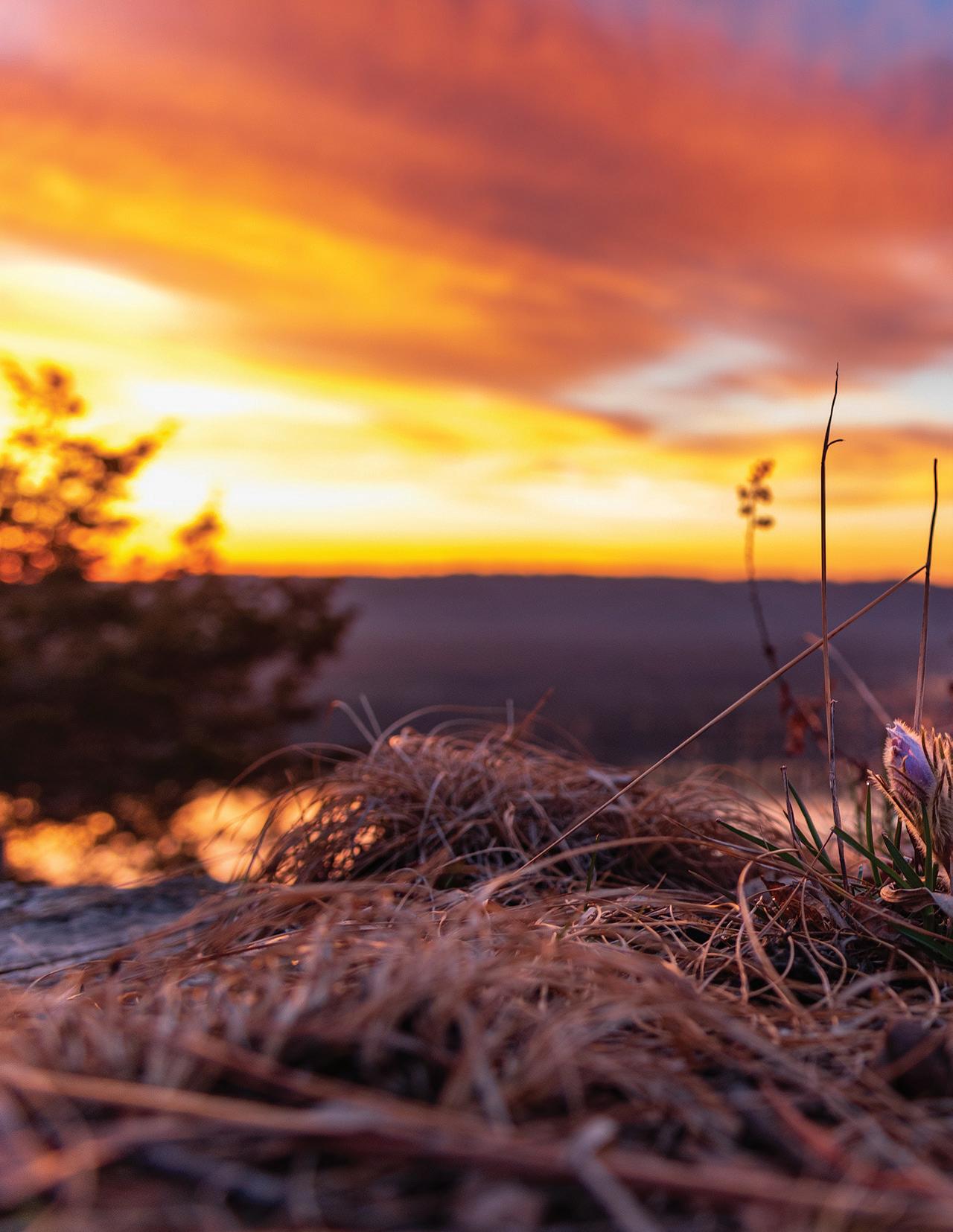
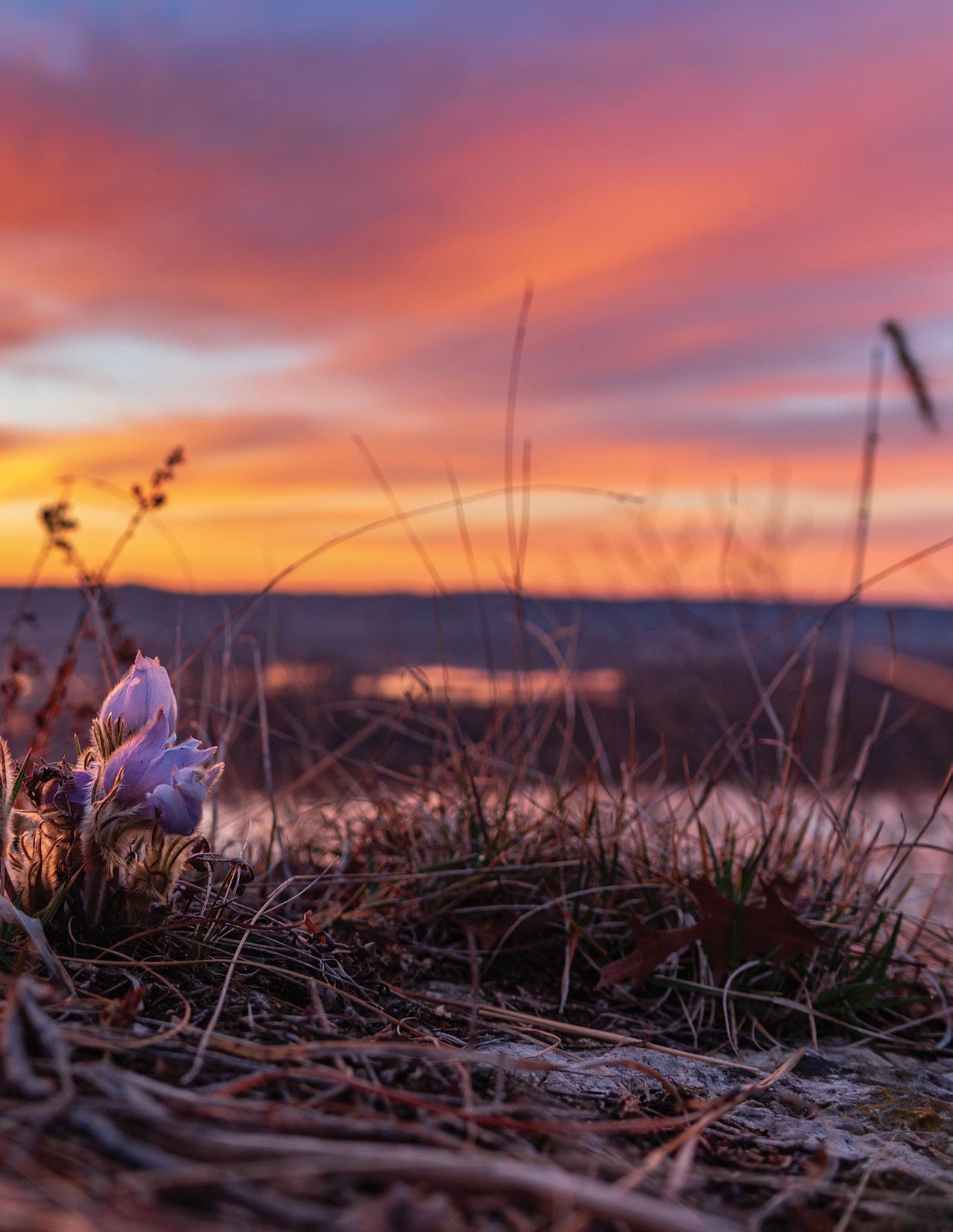
PHOTO BY BRIAN GIBBS
Brian writes: “In the spring, the most radical act to honor the season and myself, is solo hiking through the darkness, scrambling up 500-millionyear-old bluffs, and crawling on my stomach to meet a cliffside pasque flower, blooming in the first light of day over the Mississippi River.” See more of Brian’s photography at timberdoodlephotography.com.
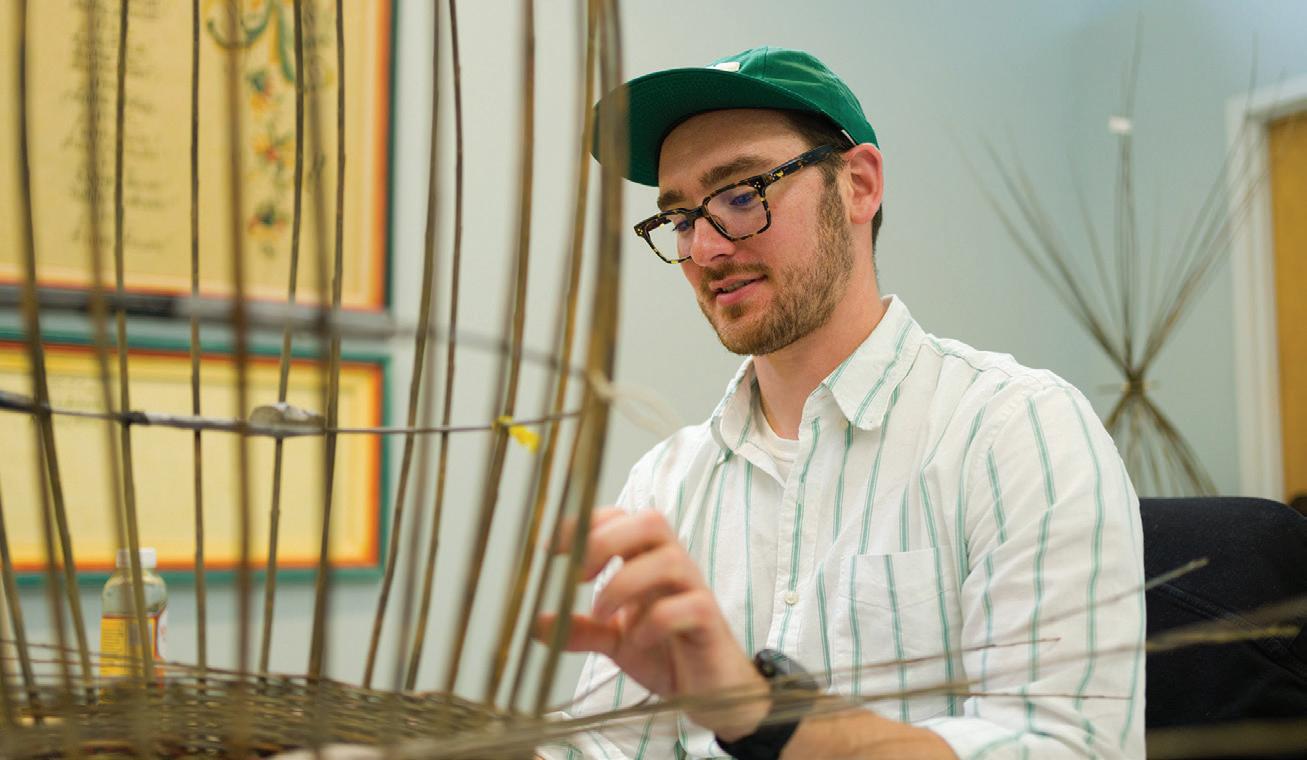
Registration is open for new classes through September 2026 at Vesterheim Folk Art School! Rosemaling, woodcarving, fiber arts, metalworking, language, Nordic cooking, and more! Sign up now at vesterheim.org/folk-art-school.

the Museum Store for all your Scandinavianinspired
and décor, one-of-a-kind folk art, jewelry, clothing, games, books, and folk art supplies.
in scenic Decorah, IA or online at store.vesterheim.org.
Scenic Decorah, Iowa (563) 382-9681
Beautiful things and terrible things exist simultaneously. Generosity and selfishness. Happiness and despair. Kindness and rage. Light and dark. One side does not negate the other. Unfortunately, though, the dark can weigh a lot heavier than the light, like a backpack of rocks as we climb our mountains each day. Occasionally, we need to be reminded to take in the bright spots, the lightness, the good… at least for a little while.
INSPIRATION Radical
Lighting a spar k in the dar kness
To me, radical inspiration is both the audacity of looking for light in a world that feels so dark, and also radically noticing all the things around us that could be providing inspiration already, if we just stop to notice. There is so much beauty in this world. In people, in communities, in nature. Finding moments of wonder can help to counterbalance those of dread, anger, or fear.
One of my favorite things about being a journalist is that I get to meet and sometimes become friends with the smart people I interview for stories. Dr. Jodi Enos-Berlage, whom I worked with on my Saving Our Soil story in the Fall 2025 Inspire(d), is one of those people. We had coffee this winter and she told me about the (totally freaking awesome) Hawaiian bobtail squid. This thumb-sized, nocturnal squid has long been studied for its symbiotic relationship with the bioluminescent bacteria, Vibrio fischeri, that live in its light organ (hello, cool! I’d like a light organ!). Vibrio fischeri bacteria create light, so the squid blends in with the moonlight, helping it



go into stealth mode to avoid predators and more easily hunt prey. But the bacteria are so smart, they know not to activate until the right number of bacteria are present to create enough light. This is called quorum-sensing (squee!)!
Jodi and I both exclaimed that we, the people, need to come together in order for our lights to be effective (“Unite like Vibrio fischeri” tees, anyone?). Emily Dickinson said, “Hope is the thing with feathers.” Well, I think inspiration is the thing with fire. It lights you up from within. I want readers to latch on to what ignites a spark within them, and then I want them to let it flame. With ferocity. Or with gentle warmth. Or even just as tiny embers. Whatever you need (or can hang on to) on that day. Start now. Don’t wait for a new week, a new month, a new year. Make your own new beginnings.
We all know how self-fulfilling prophecies work. When you expect something to happen, it often does. This is generally applied to expecting bad things to happen, but what if we put it toward manifesting the good? I believe in the power of the people. I believe we are smart enough, kind enough, and innovative enough to change the world for the better. We just have to find our light and shine it bright.
XOXO - Aryn




INTRO & INFOGRAPHIC BY ARYN HENNING NICHOLS

is the thing with feathers.” –
“Hope
Emily Dickinson
Find awe around you
The intricate design of a slowly unfurling fern
The deliciousness of a perfectly ripe strawberry
The moment the sun peeks over the bluff
Inspiration is the thing with fire.
Notice
Moments when you feel alive Things that bring you joy Activities that make you feel your absolute best Scenes that bring a smile
Inspiration can spark action & action can spark inspiration.
Be part of the cycle
Inspiration, hope, and optimism are contagious.
Practice gratitude for these things
INSPIRATION Radical
Lighting a spark in the darkness
Hang on to Hope
Hope helps us: See possibilities in current circumstances
Avoid overwhelm Problem-solve
Stay resilient & persistent Be more creative
Seek support
Vent, then...
Connecting with people you trust can help you feel calmer. Venting can help you release anger. Sharing your feelings with someone who understands is a reminder that you’re not alone on this journey. How will you be a light? Schedule a
the Fire
Do activities that require very little of you for one day so you can rest and replenish. The earth will continue to turn. Disconnect from technology. Just for a bit, at least. Find something offline that inspires you.
Engage in activities that ignite your passion, energy, and creativity. Learn about people who inspire you (or read/watch/listen to their books, movies, podcasts, etc.)
Burn up some rage with exercisegood for your mind and your body!
Set routines that support your goals and values, so that when it all feels like too much, your routines can handle the decisions.


FOR MEANINGFUL CHANGE BECOME RADICALLY INSPIRED
Mental health counselor
Olivia Lynn Schnur shares tips for finding radical inspiration.
OLIVIA SCHNUR, MA, LMHC, LPC, CYT-200
It can be a radical act to search for inspiration.
The word radical has multiple meanings. Present day, it often denotes an extreme change, but it originally derives from the Latin word, radicalis, relating to “roots,” according to the Merriam-Webster dictionary. Inspiration is defined as “the action or power of moving the intellect or emotions.”
When we put the two together, radical inspiration becomes a phrase that encourages us to explore areas in our lives that are ripe for change or movement. It’s about finding the things, big and small, that really light us up. Stopping. Noticing them. Letting them sink in. Radical inspiration can change us at our roots.
As we enter the transition from winter to spring, there can be a lot of cold, wet, or dreary days. Inspiration sometimes feels as elusive as the sunshine hiding behind the clouds. But even then, the sun hangs in the sky – bright and warm, despite its distance. And like the sun, bright spots and inspiration are always there, if we remember how to look for them.
RADICAL INSPIRATION FOR POSITIVE CHANGE
Sometimes, the pursuit of inspiration can feel impossible (or even selfish), because the world we live in is so unsettled. It might seem unfair to seek inspiration while others live in fear, war, and poverty.
We want to be useful, engaged, and aware; but how helpful can we be when we’re running on empty and filled with our own rage, fear, or cynicism?
Now more than ever, remaining soft, open, and inspired is a radical act. It is too easy to stay dialed in to the events of the world. Taking a pause is harder. Finding hope is harder still. If we want to stand for anything with conviction, we must first ensure we have the strength to withstand what’s ahead.
Take a moment to think of a political, religious, or even fictional hero. In many cases, before these heroes go into battle, give a speech, or lead a revolution, they take time to rest and reflect. They find a peaceful spot, free themselves of distractions, and allow their thoughts to flow as they prepare to take action for meaningful change. Just like our heroes, we are more useful to the world when we are well-rested and our minds are sharp.
The big picture today is still the same. Humanity has recovered from wars, recessions, pandemics, and natural disasters. In every instance of great devastation, we can also find stories of hope and inspiration. If we cannot see them now, it may just be time to take a step back and shift focus.
HOW TO TAKE A PAUSE
With all the distractions, electronics, hustle culture, and political turmoil in the world, taking a pause is a radical act of mental selfcare.
Give yourself one day. An intentionally open day – free of obligations, distractions, or guilt. Cancel your plans (or plan ahead by blocking a day off) and power down the distractions. Remind
yourself to let go of worry; there are very few circumstances when the world will not carry forward without your attention. Are you afraid? The idea of doing nothing can stir up fears – boredom, loneliness, falling behind, or being forced to face the thoughts and feelings you’ve pushed aside. Those feelings and experiences are temporary, and even necessary, to find inspiration on the other side.
Understand that boredom leads to mind-wandering. What if you just allowed yourself to follow those thoughts for a while? See where they take you. Exhale the tension from your body and settle into the quiet, and even doldrum day. Create space for new perspectives or just processing time. This is how we heal our nervous systems.
Build “nothing days” into your calendar the same way you might schedule a doctor appointment, therapy session, or a massage. Leaving space in our plans, to-do lists, and resolutions allows us to remain open to possibility, spontaneity, and inspiration.
SEEK POCKETS OF RADICAL INSPIRATION AROUND YOU
What if becoming radically inspired simply means waking up each day willing to look for small glimmers of hope? Perhaps, inspiration is that pocket of warmth where we sit with a loved one, a pet, or a cup of coffee. Could it be enough that each day is blessed with one small moment of gratitude for your life because you have slowed down the pace enough to notice it? What a radical act.
What if we started seeking out other pockets of radical inspiration daily, and everywhere? As you go about your day, notice the moments that make you want to stop and linger awhile. Are there people in your life whose stories inspire you? What have they overcome to get where they are today?
The people and places that spark your interest are ripe for inspiration. Take mental note of everything that brings you joy, energy, or purpose. Ask yourself why these things light a spark within you. When we slow down our movements and open up our minds, we can find the roots of inspiration in our lives.
BECOME RADICALLY INSPIRED BY YOUR PAST
To become radically inspired, we can also revisit our own history, focusing on heroes and hope rather than ruminating on regrets. Given enough time, we tend to have perspective, knowledge, and insight that our past-selves lacked. Many of our personal failures, setbacks, and even heartbreaks become great lessons and unexpected gifts. That doesn’t mean we would wish to relive them or wouldn’t change them if given the chance, but we can often see a great deal of growth in hindsight. Give yourself a moment to marvel at everything you have withstood and overcome.
Life can at times seem senseless and even hopeless. It is not always fair and almost never easy. Still, when we look back mindfully and intentionally, we can start to see patterns and meaning unravel. In therapy, this process is sometimes called a life review.












In a life review, therapists help clients walk through their life chronologically. They mine for moments of gold – happy childhood memories, big accomplishments, and life lessons. They also pause and reflect on the painful and traumatic memories. The goal here is to reframe these challenges into something worthwhile. Oftentimes, patterns and themes emerge. Clients come away with a deeper sense of connection to their values – a through line that carried them forward, often without conscious awareness.
In therapy, a life review is usually done with clients in their later years. However, it can be beneficial to reflect on our lives at any age. By looking back, we can gain greater clarity on how we want to move forward.
RADICAL INSPIRATION FOR THE FUTURE
We can spend a lifetime looking back, but history is meaningless unless we choose to learn from it. Perhaps, by looking back at both world events and events from our own lives, we can find hope, inspiration, and moments that changed everything.
But what if we do not find that hope or inspiration? Does it mean it does not exist? Well, if history has anything to say about it, it simply means we’re in the middle of living it. We may just be at the precipice of change. The good news is, we have a big hand in writing our own future. How do you want the story to end? If you knew everything would work out, what would you do right now?
A NOTE ON RADICAL INSPIRATION
Hope, optimism, and inspiration are not always easy to come by. Many mental health disorders can prevent us from experiencing these emotions. We all deserve to wake up feeling grateful to be alive and hopeful for the future. If you don’t, a mental health professional can help. Sometimes, our first act of inspiration comes from reaching out to others. Olivia Lynn Schnur

FINDING RADICAL INSPIRATION

Reflect on history – your own and the world’s – to find moments of radical inspiration.
RADICAL INSPIRATION IN THE WORLD
Pick a hero – political, historical, religious, fictional, etc. – and study their story. What values, life events, and circumstances led them to engage in meaningful change?
What do you have in common with your heroes?
Who are the political leaders, religious leaders, or activists that inspire you now? In what ways can you support or join their cause?
RADICAL INSPIRATION IN YOUR LIFE STORY
What are some of the bright spots in your life currently? Take a moment to write out what brings you joy, your happiest memories, and what you consider your greatest accomplishments.
Write about something you once thought of as a setback or failure. What lessons or redirections have come from this experience? Write about the good or the growth that has come out of it.
Think about something challenging you are currently experiencing. What might you do if you knew it would all work out in the end?
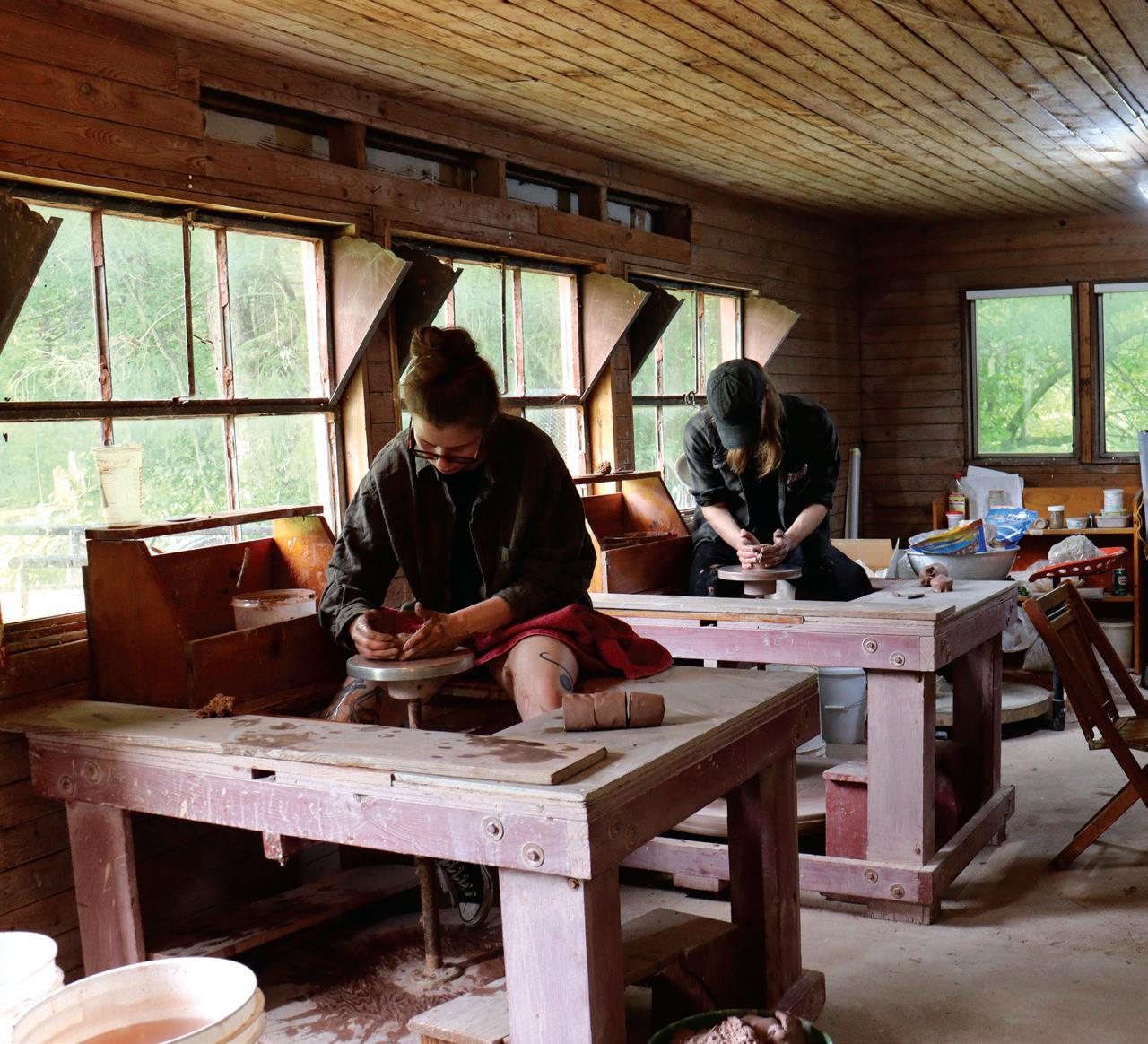
Dean Schwarz and Orville Running originally built somewhere around 30-40 wooden kickwheels together, which split time between Luther College and South Bear School, typically spending the school year at Luther and summers in the barn. Eventually, Luther sold about half of them, while 13 currently reside at South Bear School. The South Bear board has slowly been searching for more of these wheels which are still out in the world- recently, they were able to purchase one from Facebook Marketplace! / Photo courtesy South Bear School






Lukes Photography
THE STORIED PAST & REVITALIZATION OF SOUTH BEAR SCHOOL
BY CLARA WODNY
Rural Iowa has much more to offer than endless corn fields and gravel roads. Near Decorah, an unexpectedly vibrant source of creation and community lives at the convergence of creeks and pine forests: South Bear School.
The art school’s idyllic property features a small cottage, two barns, and a monumental 65-room main building, which originally hosted a senior living and nursing home community from 1915 to the early 1960s. Over the last six decades, it has become a new sort of “home,” one that has hosted hundreds of creatives, artists, and wanderers.
South Bear School, founded in 1970 by Decorah residents Dean and Geraldine Schwarz, alongside their friend Doug Eckhart, has undergone countless changes over time, including a nearly 40-year hiatus from hosting their hallmark summer workshops. What hasn’t changed, however, is the Schwarz family’s commitment to maintaining a community of like-minded folks who champion rural arts and authentic craftsmanship.
Revitalized in 2020 by Dean’s children and grandchildren, South Bear School is once again a lively hub for learning and development. Hosting two weeks of rustic pottery courses each summer, as well as periodic weekend workshops, meditation retreats, music festivals, and other events, this magical place is well on its way to re-asserting itself as a vital center-point in Decorah’s creative culture.
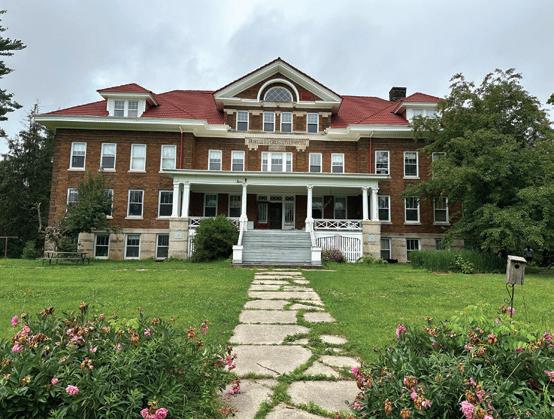
The historic original Aase Haugen Home became South Bear School in 1976. / Photo courtesy South Bear School
“My siblings and I were incredibly lucky to have been raised in an artistic fashion,” says Maggie Schwarz, Dean’s granddaughter and South Bear’s current Executive Director. “It’s always been a goal of mine to make that kind of community and experience available to other people.”
THE BIRTH OF SOUTH BEAR SCHOOL
The depth of South Bear’s historical tradition can be traced to 20th century Germany, where Marguerite Wildenhain, the first woman to be designated as a master potter, studied ceramics under the prominent Bauhaus school. After being forced to flee Germany during World War II, Wildenhain immigrated to northern California and started the Pond Farm artists’ colony, where she ran a rigorous and disciplined summer pottery workshop that helped kickstart a studio pottery movement across America.
Born in Cedar Rapids, Iowa, Dean Schwarz studied ceramics at Iowa State Teachers College, then served in the US Navy, before spending three summers at Pond Farm as Marguerite’s apprentice and teaching assistant. Dean and Gerry settled in Northeast Iowa in the mid-1960s, where Dean taught at Luther College. By 1970, the Schwarzes and fellow Luther art professor Doug Eckhart decided it was high time to bring Pond Farm’s Bauhaus model of apprenticeship and artistic community-building to the Midwest.
Before South Bear found its current home, it was situated 20 miles away, in Highlandville, Iowa, a tiny town of less than 30 people. Dean and Gerry had purchased an abandoned hospital house and got to work converting its 14-rooms into dormitories for students and instructors. The adjacent barn was turned into a studio for pottery, one of the core artistic disciplines upon which South Bear School, named for the small creek running through Highlandville, was built.
Throughout those first few summers, students traveled from near and far to experience the collaborative environment of a traditional folk-art community. Though centered around pottery, painting, and poetry, the subjects taught at South Bear varied widely, and students were encouraged to explore various modes of thought and multi-disciplinary methods of creation.






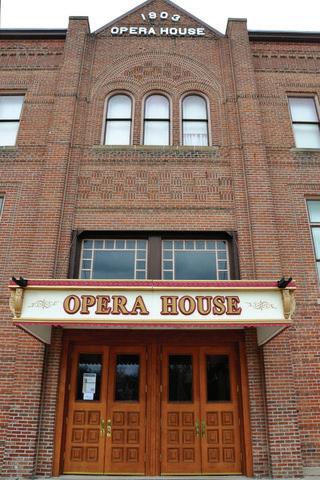

In 2011, founder Kate (Nelson) Rattenborg Scott opened the doors to Dragonfly Books in the heart of downtown Decorah, where it continues to thrive 15 years later. Taking over ownership and operations in 2026 are Kate’s daughters, Sarah Krammen of Decorah (R) and Rachel Rattenborg of Waukon (L).



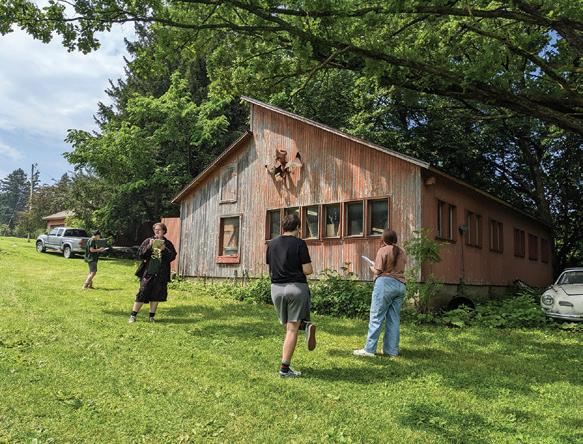
After six wonderful and fruitful years in Highlandville, it was time to expand. In 1976, South Bear moved into the then-vacated, historic Aase Haugen campus located in a rural spot five miles southwest of Decorah. This new space offered endless opportunities for expansion, including the addition of classes in areas such as Women’s Studies, Stone Carving, Philosophy, and more, all taught by artists and professors from across the region. For the next several years, South Bear School supported a community of more than 100 artists and students during its nine-week programs each summer.
THE FAMILY YEARS
Remarkably Charming

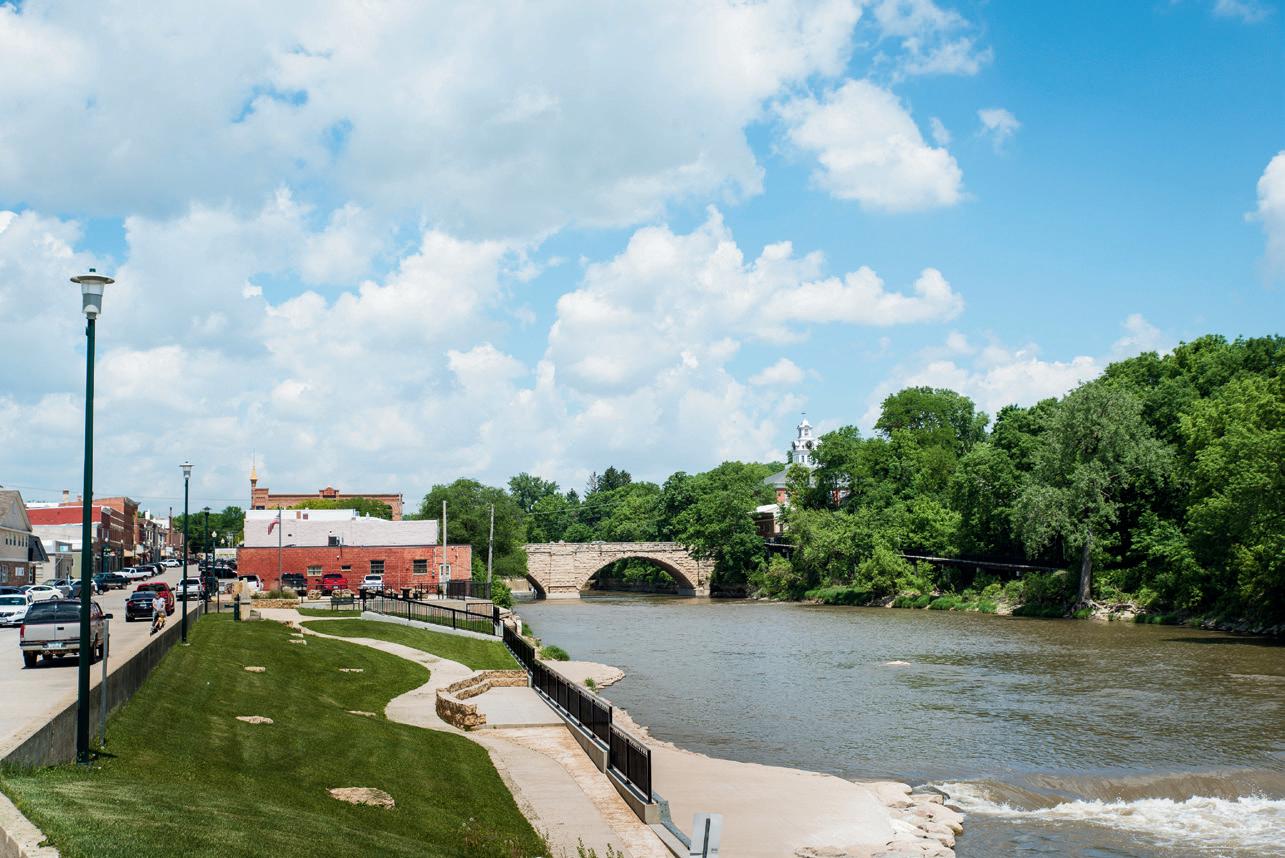
Though South Bear School summer programming ended in 1984, the connected, passionate spirit brought by the various cohorts of artists never left the property. When Maggie was born in 1999, there were four generations living in the historic main house, still carrying on the South Bear tradition of living and learning in community. By then, Dean had retired from Luther and was a full-time studio potter, working out of the basement studio in the winters and the chickenbarn-turned-studio in the summers.
“I didn’t realize how uncommon our upbringing was,” says Maggie. “We essentially lived in a museum, and our grandma hosted Sunday lunches every week for family, friends, and visiting artists. Experiencing this depth of artistic discussion as a child was deeply influential and made me want to facilitate similar opportunities for others, even if on a smaller scale.”
Around 2019, Maggie, and her siblings, Will and Sophie, as well as their father, Lane, began thinking about bringing some of the fondly remembered workshops back to life. After a couple years of reaching out to past students and building a social media presence and new base of interested students, the first official South Bear School pottery workshop under new tutelage was held in 2021.

“So far, a lot of our advertising has been through word of mouth, passed down from folks who have some connection to South Bear’s past, whether it be as a student themselves, or someone who had relatives and parents that studied with Dean,” says Maggie. “We’re excited to start welcoming new audiences, such as college students and those who might be unfamiliar with the world of pottery, and building a multi-generational community of folks that come from diverse backgrounds and experiences.”
SUMMER POTTERY WORKSHOPS
Currently, the summer pottery workshops are held for two consecutive weeks each year. While these workshops are heavily informed by and modeled after the original nine-week South Bear
The chicken-coop-turned-studio. / Photo courtesy South Bear School
School programs, they are also designed to be accessible for all who are interested in learning more about the history of pottery and the joy of independent craftsmanship. Students are encouraged to pick the length of time that works best for them, whether that be the full two weeks, one week, or the weekend workshop.
New for Summer 2026 is the option to purchase single-day passes, perfect for those who are interested in experiencing South Bear’s atmosphere and trying out a kickwheel without committing to a full workshop.
“We try to offer a variety of options, so everyone is able to join us in the act of creating, despite busy work and family schedules,” adds Maggie. “And with all of our instructors being volunteers who have their own separate careers and commitments, two weeks felt like a good place to start.”

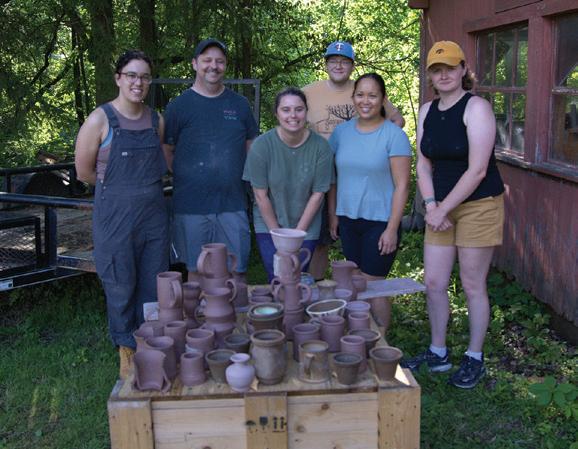
Held in the converted chicken barn, just down the hill from the main house, the workshops offer a rustic, authentic, and wellpaced approach to pot-making. Rather than using electric pottery wheels like many modern-day teaching studios, South Bear students learn the analog way – on custom, wooden kick wheels based on Marguerite Wildenhain’s original design and handcrafted by the late Orville Running, who was an accomplished local artist and Luther College professor.
Upon entering the Summer Workshop, you are met with a rhythmic thumping sound, a product of the potters kicking the wooden flywheels to power their wheel. Throwing pots on a kickwheel is a very grounding, meditative process, requiring the potter to focus on their breathing and to carefully sync each movement to the rhythm of the wheel.
“Students who have previously worked on electric wheels are often intimidated by the concept of having to spin the wheel yourself,” says Maggie. “We find they end up really enjoying the process – there’s something very special about connecting with that ancient human ability to make beautiful art out of simple, rudimentary materials.”












Featuring products from 200 local farmers and producers.
South Bear summer pottery students follow a 16-form progression, a workshop structure that originated from Germany’s guild system and was brought by Marguerite Wildenhain to Pond Farm in California. Apprentices work alongside Master-level craftsmen, learning first to imitate technique and craftsmanship, before creating their own unique work and designs.
The first form begins with the simple dog dish – which is not actually used for pets, but as a glaze-catcher for larger pots. Each subsequent form introduces a new throwing skill.



Some of the 2025 Weekend Workshop students with their creations. / Photo courtesy Maggie Schwarz

A large part of the Summer Workshop experience is spending time together and building relationships, both in and out of the studio. / Photo courtesy Maggie Schwarz
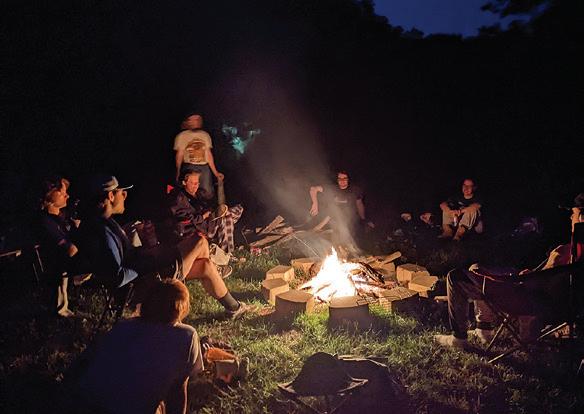
The second, the flower pot, teaches potters to throw a pot that gradually gets wider near the top; next comes the bowl, which requires smooth, gradual curves, and that special attention be paid to the pot’s rim. By form six, the potter will produce a pot that is taller than it is wide, and by form 13, they will be combining multiple forms, thrown separately, into one finished pot.
“Each step teaches you how to get to the next one,” explains Maggie. “The forms build upon each other, and over time, you develop the critical eye needed to start creating your own forms and finding ways to express yourself through the clay.”
CELEBRATING 50 YEARS OF SOUTH BEAR!
2026 marks 50 years since South Bear School, and the Schwarz family, first came to call the historic Aase Haugen property home. To mark this exciting milestone, the upcoming year is one of jubilant celebration, featuring concerts, workshops, and reunions that honor the legacy of South Bear and highlight what’s to come for this tightknit community.
Specific events to look forward to include the third iteration of Gays and Faes music festival, a 50th anniversary alumni gathering, and the annual Midsummer’s Eve party.
This year, the Summer Workshop will also see the revival of an integral part of South Bear’s foundation: the option to take shorter courses in a variety of artistic disciplines – such as printmaking, watercolors, and poetry – alongside the typical pottery instruction.
“Providing a learning environment that incorporates and encourages multiple disciplines is something we’re thrilled to begin offering again, as we grow,” says Maggie. “The goal is, and has always been, quite simple: to hold space for the learning and teaching of Bauhaus traditions that have been developed and passed down by humans for over six-hundred years.”
Clara Wodny is a 2025 graduate of Luther College, where she fell in love with the Driftless while studying English and Visual Communications. Currently residing up north in her hometown of Duluth, MN, she works in Aquatics Management at a YMCA and interns with LAMBDA Literary, a nonprofit organization whose mission is to nurture and advocate for LGBTQIA+ Writers.

Visit southbearschool.org for more info or to sign up for the Summer Workshop! Plus, save the date for these events: Gays and Faes Music Festival, May 29-31
Summer Pottery Retreat, June 8-19
50th anniversary reunion, June 20-21
Midsummer’s Eve Party, July 18
• Tree Pruning
• Tree Removal
• Stump Grinding
• Pest & Disease diagnosis & treatments
Drew Stevenson

Serving Decorah & SE Minnesota
Kaspar Health & Wellness LLC
Anne E. Kaspar, LMT
Enter the new health paradigm with Fascial Counterstrain & Quantum Biology. e application of these emerging sciences is the future to optimize health and longevity. Fascial Counterstrain is unique in its ability to impact and treat all of the body's fascial systems including the vascular, visceral, nervous & musculoskeletal systems. It's a therapeutic hands-on, multi-system approach to release spasm that impacts and treats the body. It's pu ing the body in a position of ease to release dysfunction. Gentle, powerful and long-lasting relief, Fascial Counterstrain changes lives, not just symptoms. Quantum Biology is working to reset your circadian rhythm and mitochondria health. Using natural sunlight, limiting nnEMFs, sleep, water, mindfulness, breathwork, fascia, electrons, earthing, Vitamin G and Vitamin D.
Coaching: Circadian Lifestyle • Mindfulness • Breath Work
319-202-1043 • www.vagaro.com/kasparhealthandwellness

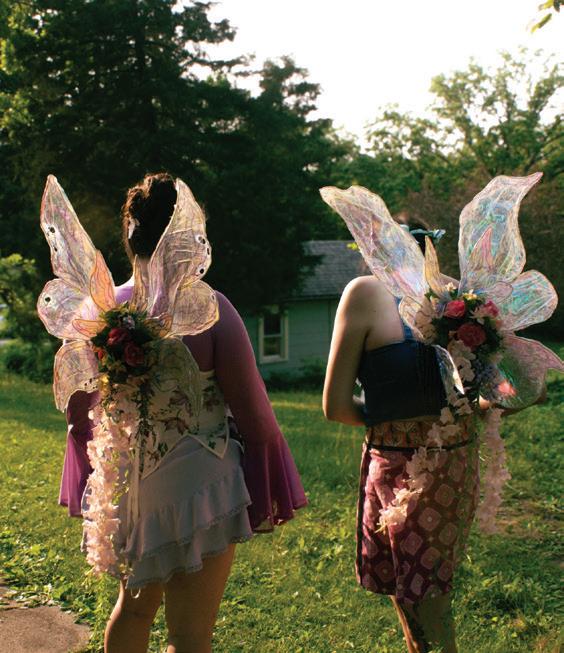
GAYS & FAES: MAY 29-31!
Thanks to the Gays and Faes team for their collaboration on this Spring Inspire(d)’s paper project - the flower chain at right! Learn more about Gays and Faes from the organizers themselves: Gays and Faes is more than a music festival – it’s a queer dreamscape brought to life. Set on the serene acres of South Bear School in rural Decorah from May 29-31, this DIY celebration invites attendees to step out of the ordinary and into a weekend devoted to art, community, liberation, and joy.

At its heart, Gays and Faes (G&F) is a celebration of authentic self-representation – built by and for queer people and their faerie friends. “Queer” is an inclusive, fluid term for anyone who falls outside of heterosexual or cisgender norms. It rejects rigid, traditional, or binary labels, such as solely “gay” or “straight,” favoring a flexible approach to identity in both sexuality and gender.
Rooted in creative expression, mutual care, and the radical act of gathering, this festival creates space for people to show up fully authentic. G&F features indie musicians from across the Midwest, highlighting both emerging and established artists. Genres span from intimate folk, dreamy pop, gritty punk rock, to lively DJ sets.
But music is only part of the story. The festival is a fully immersive experience, shaped by the rolling hills, limestone bluffs, and winding rivers of the Driftless. Forest clearings become stages, open fields invite frolicking, and onsite camping forms a temporary village beneath the stars.
By embracing play as a form of resistance and healing, this gathering encourages flamboyant costumes, abundant sparkles, and fantastical art installations. We invite you to reconnect with imagination and delight in a world that often tells people to shrink themselves.
Gays and Faes is proudly grassroots and community driven. Built by collaboration, volunteer labor, and local support, the festival prioritizes accessibility and intentionality over scale.
Scan the QR code or follow @gaysandfaes on Instagram to see the 2026 music lineup, get tickets, become a vendor, join the volunteer team, and check out photos from previous years.



These flower chains are perfect for manifesting spring vibes in your house (or for decorating at an early spring backyard get-together)! Give your egg cartons a whimsical second life with this fun paper project, created by the organizers of the Gays & Faes music festival!
step-by-step instructions at
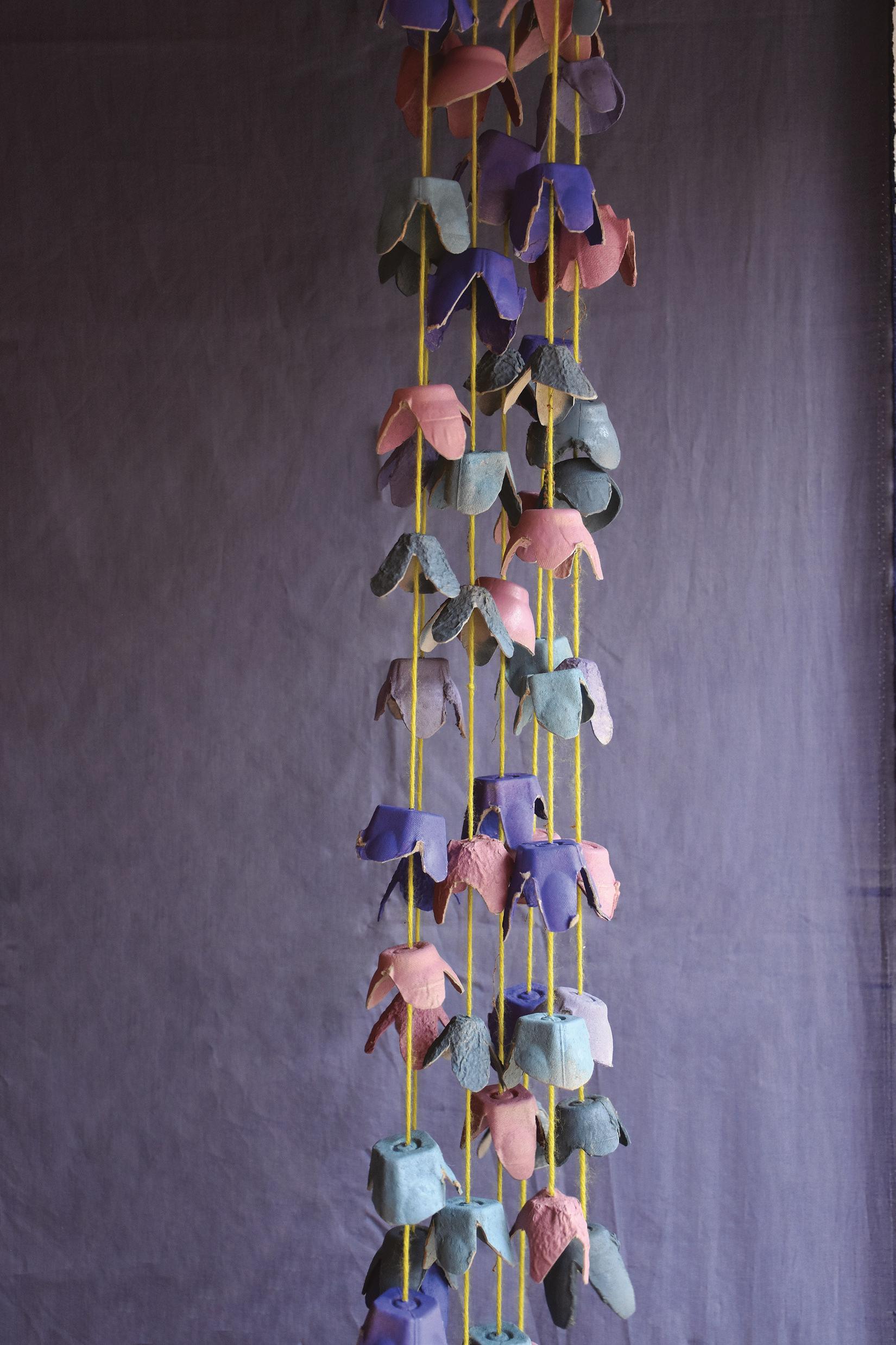

LISTENING TO THE NEXT GENERATION
HOME IS THE BOOK WITH LETTERS
BY CHARLOTTE YU, AGE 11
The melodic, sweet sound Of wrinkled pages flipping Is music to my ears.
Soaking up every word written On those torn, yellowed pages The musty scent of knowledge Filled my nostrils.
Emily Dickinson wrote “Hope is the thing with feathers.” Well, for me
Home is the book with letters.
Live a thousand lives
Walk millions of miles Return home after each day Full of adventure.
Hot tears slip down my cheeks Laughter bubbles in my throat Fear piles in my stomach
The world can swarm and blur All around me Into chaos
I couldn’t care less For it’s just me In a book Right at home.
Charlotte is a sixth grader who enjoys writing poetry as well as other creative writing. Her other favorite hobbies include ice skating, acting, playing saxophone and piano, and reading.
SMALL TOWN, BIG MEMORIES
BY HAZEL OPHEIM, AGE 13
First comes summer, Which is never a bummer, From rippling muddy waves, to sticky muddy caves, And rays of the hot sun that always misbehaves. Stinging burnt skin, But summer is always a win.
Next comes fall, And the winds’ new howling call, Big leafy piles, To raking for a while, Coughing smoke of billowing bonfires, And reading a magazine that “Inspires.” Chilly days, And sunny rays, But fall is always “just a phase.”
Then it’s winter, With firewood splinters, And a wish for warmth, With new coats soon to be set forth, Frostbite nips, To glove rips, But winter is just a trick.
Last is spring, An opening to a new “Thing,” Soggy wet mornings, And new fog warnings, Muddy feet, To new boots that now reek, Spring is never for the weak.
That is the Decorah life, With people who strive, Driftless stones, A place we call home.
Hazel Opheim is a seventh grader at Decorah Middle School. She enjoys doing art, drawing, writing, and horseback riding! She also enjoys hanging out with friends, baking, and much more!

We created Future Focused, a new Inspire(d) column written by pre-teens and teens, to help give the next generation an opportunity to share their voices. Partnering with Dana Hogan, the Extended Learning Program teacher at Decorah Middle School, we offered prompts around the idea, “What feels like home?” Students submitted some really great work, and five were chosen for this Inspire(d). You can read all the Future Focused pieces published so far at iloveinspired.com/category/future-focused. Here’s to Listening to the Next Generation! - Aryn

BY FRANCES ZIELINSKI, AGE 11
The harmony of the angelic voices, Break free from their cage. While the audience sits in awed silence, Of the touching tale, unfolding across the stage.
With memories of music, Of laughter, Of fun.
We fill a void space, With emotion and song. Leaping and prancing, And twirling along.
On stage is a truly remarkable place, But backstage, the magic happens too, With banter and with games, And endless hullabaloo.
To backstage then I leap, Spinning and singing, Chatting and bantering, Sending my jolly smile grinning.
Sparkles, and ruffles, and frills, Suits and heels, and ties, Shoes, and hats, and blazers, Oh my! Oh my! Oh my!




Costumes add charm to the dreariest of days, With wall-to-wall shimmers, And drawers full of sparkles Here, my day always glimmers.
Waltzing down the well-worn stairs. The scent brings back memories, Of mischief and of gossip. Welcome me to the lights and mirrors.
Home isn’t just a building, But it is a feeling, Of love, Of fun, Of learning, And of laughter.
Of all the happy things in the world, Here, I will never be alone. But it’s the people in the building, That truly makes it home.
Frances Zielinski is a sixth grader at Decorah Middle School. She enjoys making art, being in theater productions, playing instruments (including cello, voice, drumset, and piano), and spending time outdoors.
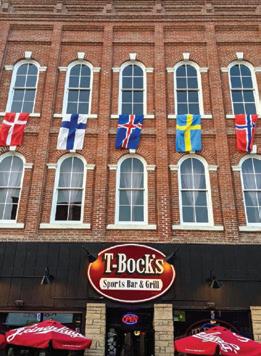

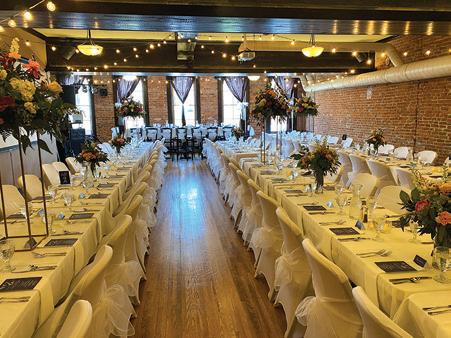


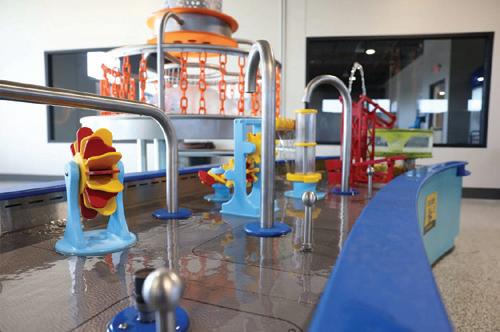



THE HIDDEN GEM
BY HUDSON DELANEY, AGE 13
A place where Iowa’s cornfields meet the bluffs, And ancient rock remembers glacial scuffs,
Lies the town of Decorah, a place of greens and golds, Where stories are whispered, centuries old.
A place where Dunning’s Spring spills a cold cascade, And where lush trees provide both fun and shade,
Trout Run Creek winds, a ribbon bright and clear, And where anglers seek solace, year after year.
So breathe the air where Norwegian ghosts reside, And feel the breath of this dear countryside,
Decorah, a place where history meets the green, A small town beauty, truly serene,
The towering bluffs now shiftless, That’s the hidden gem of the Driftless.
Hudson (Delaney) is in seventh grade and enjoys doing many things like running, singing, listening to music, designing, spending time with his family and friends, swimming, and participating in Mock Trial.



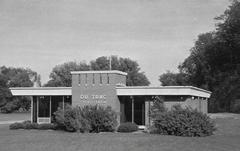
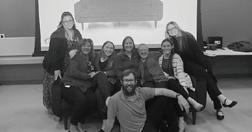


LISTENING TO THE NEXT GENERATION
WHAT BOREDOM TAUGHT ME
BY OLIVE MUGGLI-TOYLOY, AGE 11









Stepping into a place that I can be transported,
To a new world,
In all different types of books,
Tables and chairs glistening in the blinding sunlight,
Books with all interesting topics waiting on the shelves,
Inhaling the strong fragrance of hand sanitizer,
The light scent of books,
Gentle whispers echo through the building,
The sound of parents shushing their children,
Books being thoughtfully placed back onto the shelves,
Sitting in a comfortable chair to start a new book,
Flipping through the delicate pages,
The library taught me boredom,
Time spent there with nothing to do, Looking through all of the shelves, Waiting,
The thought of sitting in silence doesn’t seem entertaining,
But it gets me to pause,
To think about everything around me,
To realize that I don’t have to be at home
To feel at home.
Olive Muggli-Toyloy is a sixth-grade student at Decorah middle school. She enjoys reading, baking and cooking, and crafting. She also enjoys singing, listening to music, and playing piano and French horn.
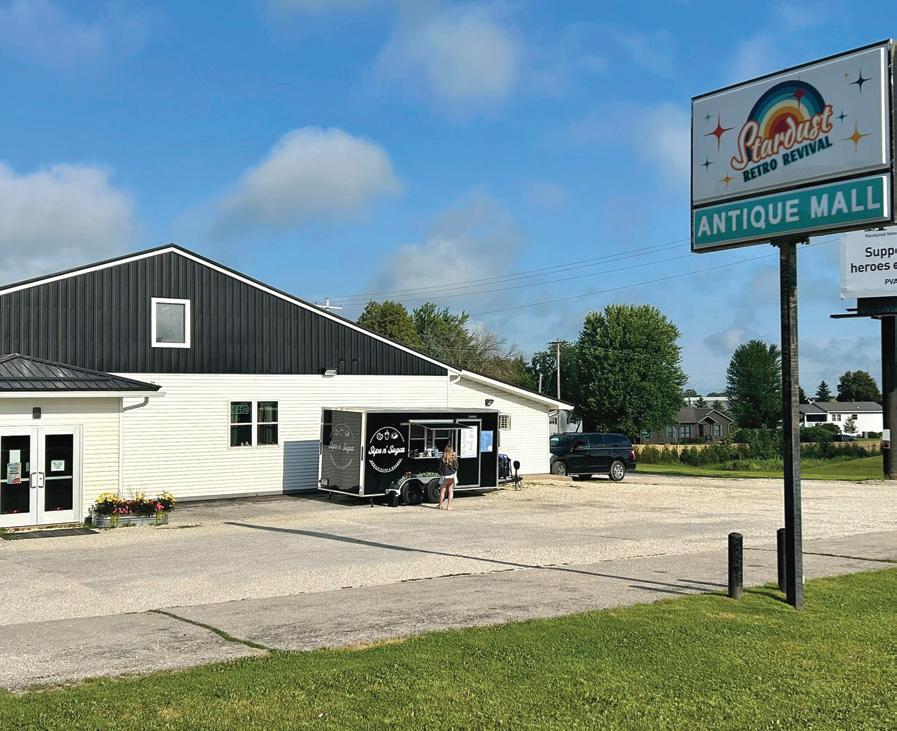
OF YOUR
ERICA THILGES of SUM BUSINESS
INSPIRING ENTREPRENEURS IN THE DRIFTLESS
ERICA & MONICA RUN ANTIQUE / VINTAGE ‘SISTER MALLS’ IN HARMONY, MINNESOTA
When your parents are entrepreneurs, it can often feel more realistic to become an entrepreneur yourself.
From childhood into adulthood, sisters Erica Thilges and Monica Thilges watched their parents create various businesses. Harlan and Joan Thilges, originally from north central Iowa, moved their family to Fairmont, Minnesota, in April of 1980 to open a decorating business. “They moved and opened the business the same weekend our younger brother, Jason was born!” says Erica. “At the time, I was two and a half years old, Monica was one and a half! I can’t imagine!”

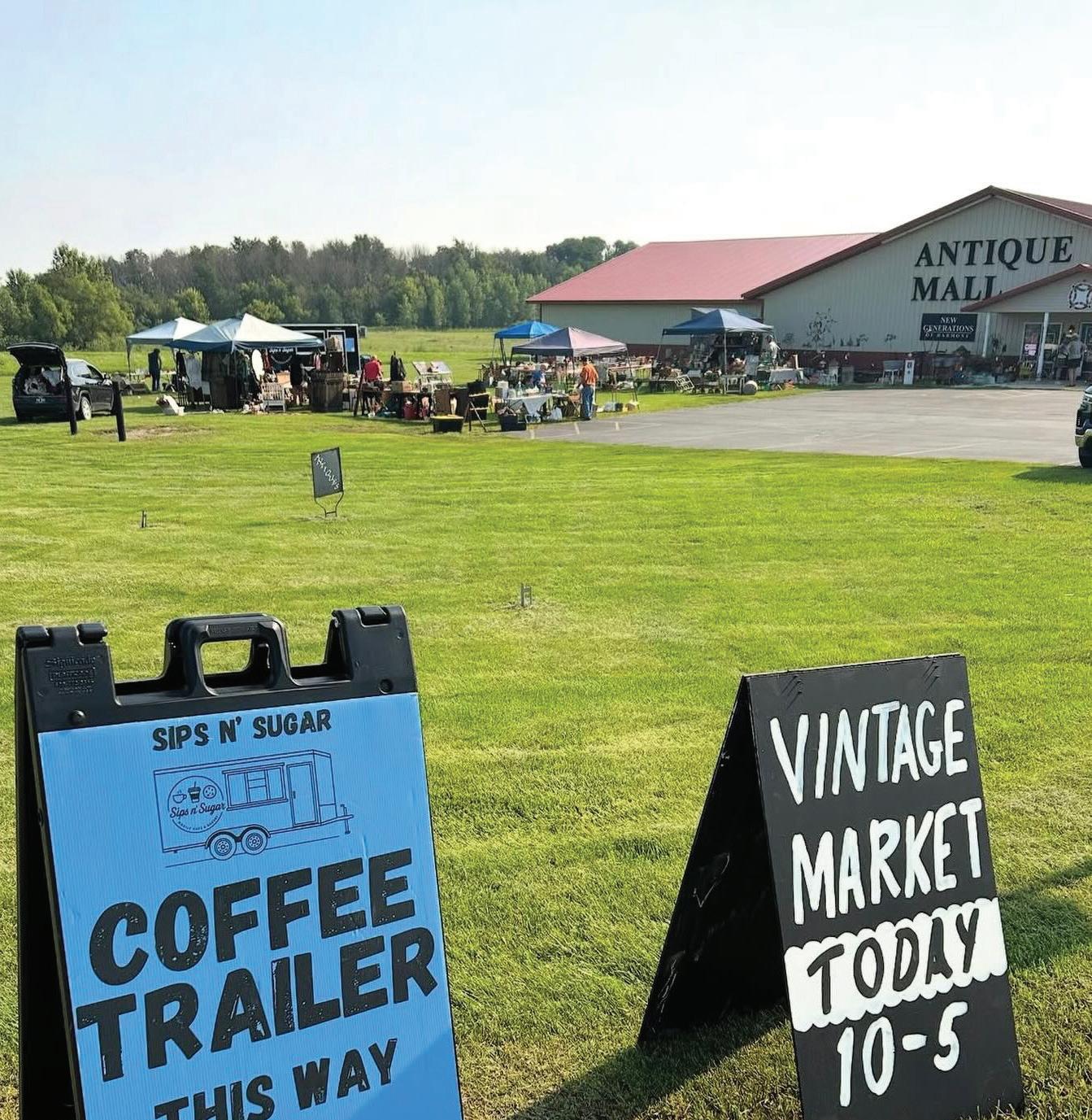
Harlan and Joan ran Fairmont Decorating, as well as partnering in a storage unit business, until they retired in 2012 and attempted to adjust to the new norm. “While our mom had loads of hobbies to keep her busy, our dad really missed the social interaction,” says Erica. So Harlan and Joan decided to move to Harmony, Minnesota, in 2015, purchasing an alreadyexisting antique mall, Generations. They rebranded it New Generations and ran it until in 2021, when they retired and Erica took over as coowner and manager.
Erica’s path led from Minnesota to Asheville, North Carolina, where she managed a bed and breakfast for more than a decade. After quarantining with Monica’s family in Madison during the pandemic, Erica decided to move to Harmony to learn the antiques and resale business from her parents.
Monica spent most of her early adulthood in Oregon and California.
Continued on next page
INTRO BY ARYN HENNING NICHOLS
The New Generations of Harmony logo is based on a quilt made by Erica and Monica’s paternal grandmother.
Stardust Retro Revival opened in March of 2025.
/ Photo courtesy Stardust Retro Revival
/ Photo courtesy New Generations of Harmony
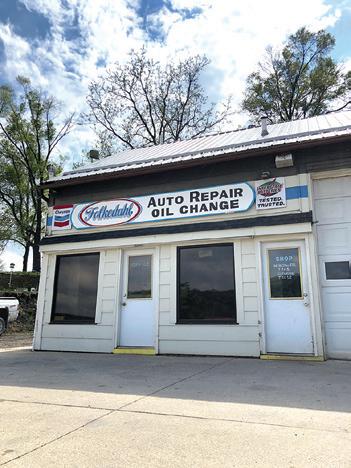



After she got married, they had a couple of kids and decided to move to Madison in 2017 to be closer to family. Then, in 2025, Monica and her family moved to Decorah. “I am really fortunate to be able to work remotely, which made the move to Decorah a lot easier because I was able to stay with the same company,” says Monica. It also made it easier for Erica and Monica to hatch a plan for Stardust Retro Revival, which opened in March of 2025. Monica is the owner, while Erica manages the day-to-day business. “I typically get out to Harmony a couple of times a month – the malls have proven helpful as we settle into our new home!”
New Generations of Harmony has 85 vendors and more than 130 spaces in the nearly 10,000-squarefoot antique mall.
Stardust Retro Revival has 125 vendors and more than 144 spaces in over 11,000 square feet.
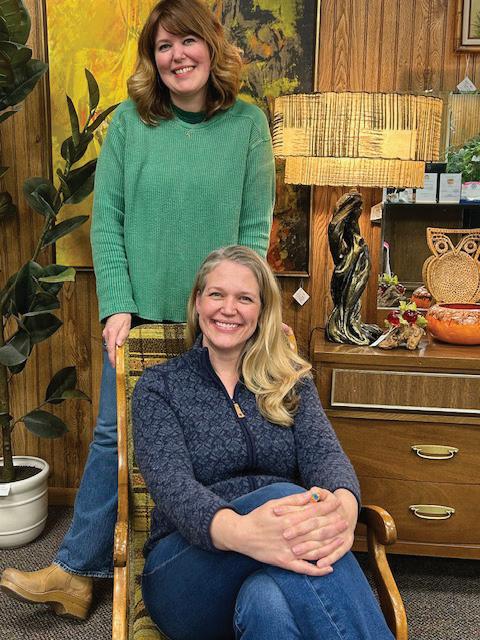

Both malls have a great mix of fun finds, but New Generations has more of an antiques focus and Stardust leans more toward vintage. “Our customers generally stop by both,” says Erica. “Having two malls so close together definitely makes Harmony an antiquing destination!”
Read on for insight into how these two fun, talented, and smart women run their “sister malls” in Harmony, Minnesota.


The Basics:
Name: Erica Thilges, Monica Thilges
Age: 48, 47
Businesses: New Generations of Harmony and Stardust Retro Revival
Year Business Established: 2008 and 2025
Business addresses:
New Generations of Harmony 50 Industrial Blvd NE Harmony, MN
Stardust Retro Revival 605 Main Ave. N. Harmony, MN
Websites: NewGenerationsOfHarmony.com • StardustRetroRevival.com
1. Tell us about the “leap” moment. When/how did you decide to jump in and become your own boss?
Erica: Our parents, Joan and Harlan Thilges, bought the New Generations Mall in 2015 as a semiretirement venture after decades of running small businesses in Fairmont, Minnesota. By 2021, they were ready to fully retire. In the summer of 2021, I was ready for a change, so I moved to Harmony to learn the business from our dad. It was a good fit from the start, and I now co-own the mall with them.
Monica: We were sitting around the table in spring 2024 when Erica floated the idea of me investing in a new mall. Given that I
Erica Thilges (standing) and Monica Thilges run their ‘sister malls’ in Harmony, Minnesota. / Courtesy photo
have zero retail experience, she also offered to run it for me and sold me on the fact that it would essentially be a copy/paste of the New Generations business model – and they had a three-page-long wait list of vendors at the time.
My day job is in environmental sustainability, so I was intrigued – antique malls give usable items a new home and keep them out of the landfill. Then Erica casually mentioned that there was a longvacant roller-skating rink just a half mile down the road from New Generations that might work. I am a sucker for a disco ball, and I really love the idea of saving a cool building that means something to a community, so I was hooked.
SPRING SERIES
The building needed significant work – the kind of work that would cost more than the property – so it took a lot of effort to get it figured out. After closing on the property in December 2024, a team of local contractors helped to transform it and we were able to open the doors two and a half months later, on March 1. It was seriously impressive.
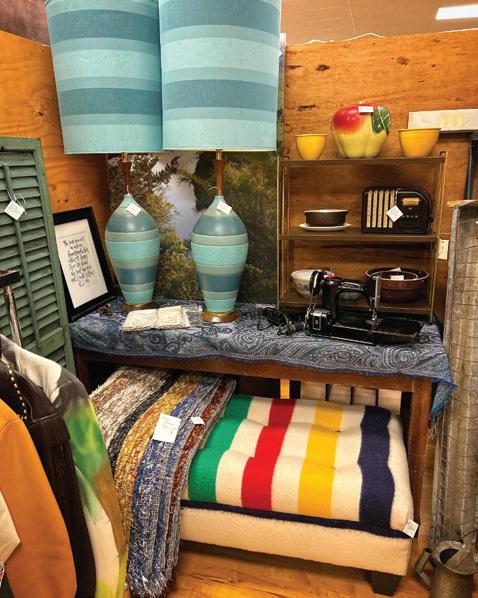
2. What’s the best thing about being your own boss?
Erica: For me, the best part about being my own boss is getting to evolve! If something isn’t working, we try something else!
Monica: Even though I technically own Stardust, I consider Erica to be the boss! She is so awesome at what she does.
3. How about the worst?
Erica: The worst part about running your own business is keeping up with the everchanging federal and state laws.
Monica: Paying back all of those pesky loans – I’ll be doing that for a loooooong time!
4. Was there ever a hurdle where you just thought, “I can’t do this?” How did you overcome it?
Erica: Honestly, having my sister to collaborate with takes so much pressure off. The clarity she provides has made all the difference for me. I am, however, not looking forward to the day New Generations needs new carpet… But we’ll figure that out too!
Monica: After the rink sat empty on the market for something like six years, someone else put in a higher bid on the same day we made an offer. I crunched the numbers and realized that I really couldn’t go any
Continued on next page




Vendors at Stardust Retro Revival lean a little more vintage. / Photo courtesy Stardust Retro Revival






higher, so I took a deep breath and let the dream go. Unfortunately for them, but fortunately for me, their offer fell through and I was able to get the building at the price that worked for this business. I think that it’s really important to know your financial limits when starting your own business, even if that means you have to walk away from it.
5. Did you both come up with the name Stardust Retro Revival?
Erica: Coming up with the business name was the hardest part! Of course, friends and family all had loads of suggestions. My favorite is still, ‘Sister Monica’s Retro Revival’, but Monica vehemently put the kibosh on that. It came down to the wire, but we’re both happy with where we landed.
Monica: It took sooooo long to find a name. In the end, we liked the alliteration, the vintage vibe and… obviously, the nod to David Bowie. IT’S WAY BETTER THAN SOME WEIRD NAME MY SISTER WANTED.
6. Any mentors/role models you look to/have looked to?
Erica: Our parents have been small business owners our entire lives, so I owe my work ethic to them. When I managed a bed & breakfast in Asheville, North Carolina, for 11 years, I worked for a lovely couple, Chris and Jim Muth. They taught me to manage with grace and understanding.
Monica: Ditto on what Erica said about our parents.
7. What’s the one thing you wish you had known before you started?
Erica: If I had known how welcoming and supportive this community is, I might have moved here sooner.
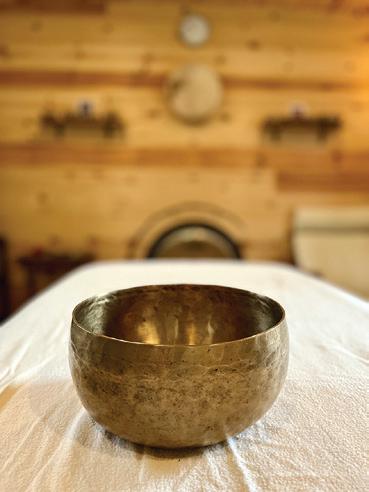

Monica: How to scrub really old and gross mystery things off of carpeted walls.
8. How do you manage your life/ work balance?
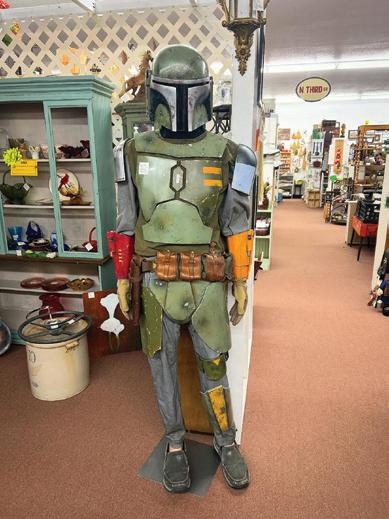
Erica: The life/ work balance can be tricky, for sure. The last few years, I’ve filled my life with a little too much volunteer work, but this year I’ve taken steps to reclaim my free time. I have some creative hobbies I’ve begun to reconnect with. Additionally, Monica and her family moved to Decorah a few months ago, so being surrounded by family is a welcome motivation to make time for living!
Harlan & Joan Thilges / Courtesy
New Generations of Harmony has a ton of fun finds. / Photo courtesy New Generations of Harmony
Monica: Moving my family from Madison to Decorah helped a lot, but I think it really comes down to two things for me:
1. Having a super competent business partner that I trust implicitly (it also helps that she does 99.9 percent of the work) – I would not do this with anyone other than Erica.
2. Finding joy in it – this business would often be super overwhelming and stressful if we were not having a ton of fun. I hope that vibe comes through when people walk through the doors!
9. What are some of your favorite things you’ve seen come through the doors of New Generations and Stardust?
Erica: For me, seeing how vendors are displaying their merchandise is almost as exciting as what they bring in. I love a good booth overhaul! Many of our vendors are keeping up with vintage trends via social media, so it’s been fun to see those hot items come into the malls and promptly go to their new homes. Personally, I’m a fan of the variety our vendors bring in, especially the unique stuff. There is absolutely something for everyone!
Monica: Man. So much fun stuff.
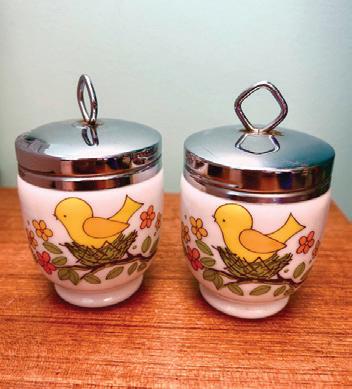

Empty Nest
There have been a lot of very cool vintage lamps, but I do love the kitsch. One of the first items I bought to resell at Stardust was particularly memorable – this really cute set of egg coddlers with little chicks on the front. I couldn’t get them open but didn’t think much of it. Well… when we finally got them open, we found the cremated remains of a guy named James. I promptly returned him (and the coddlers!) to the funeral home that cremated him and learned my lesson: Do not buy anything you can’t open.
10. What keeps you inspired? Any quotes that keep you going?
Erica: I do love the people but I’m also all about ‘connections’. I’m inspired by how much our vendors, staff, and customers connect with each other over shared interests and nostalgia in both antique malls. There is a real sense of community here which makes the malls feel like ‘home’.
Monica: “Go a little bit out of your depth. And when you don’t feel that your feet are quite touching the bottom, you’re just about in the right place to do something exciting.” – David Bowie
New Generations of Harmony and Stardust Retro Revival are both open 7 days a week, 10 am - 5 pm
Like us for details!

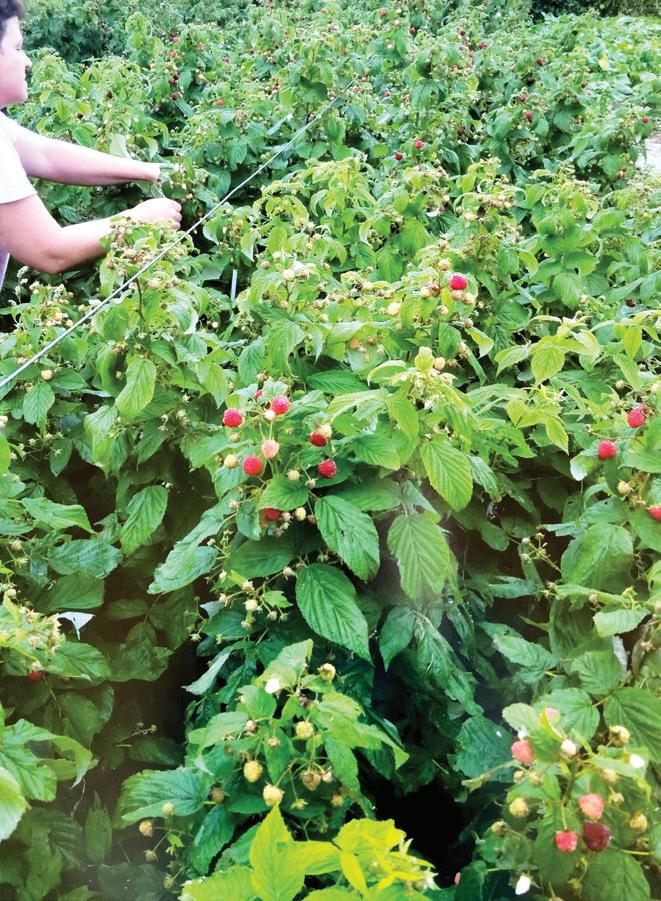
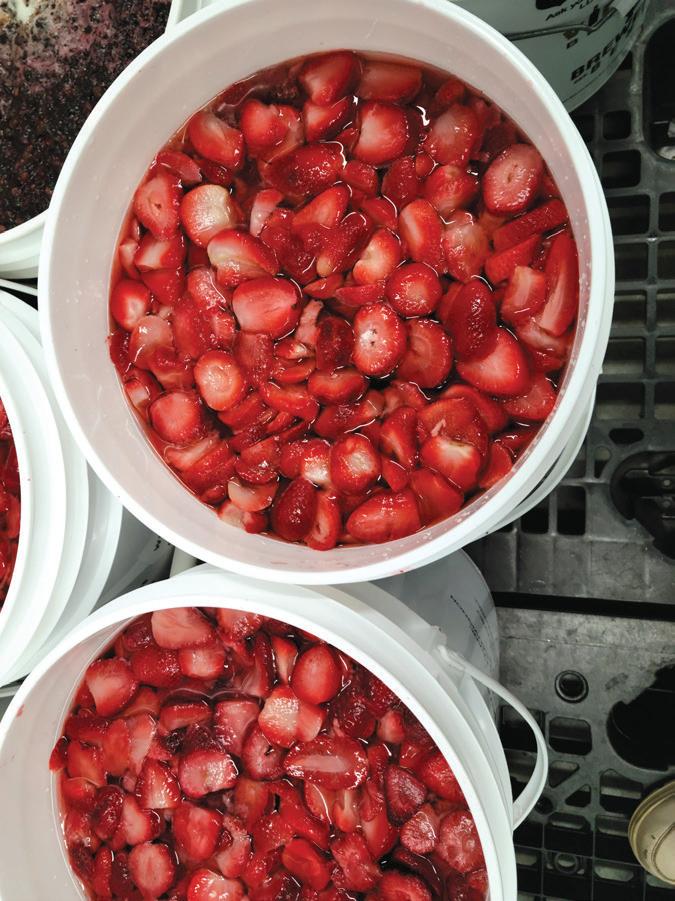
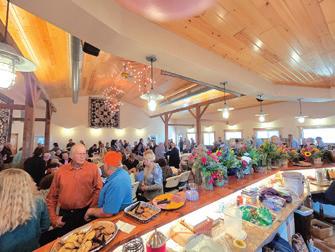
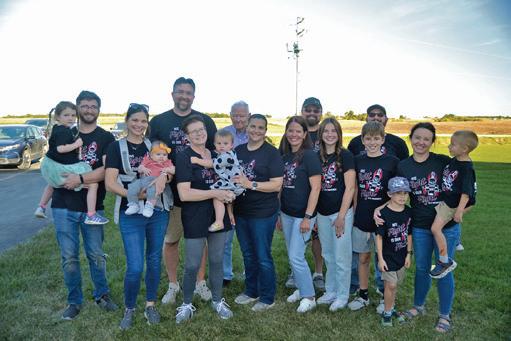
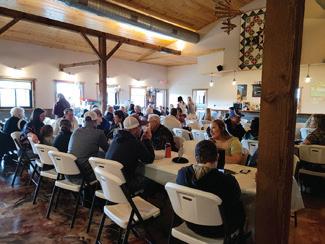

family-run business, from berries to bottle
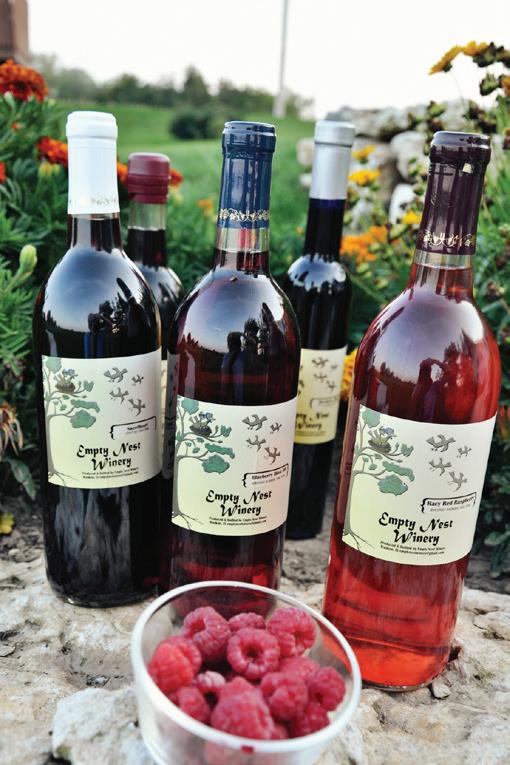
The egg coddlers that Monica returned to the funeral home. Below, books at New Generations. / Courtesy photos
A SOGGY SERENADE
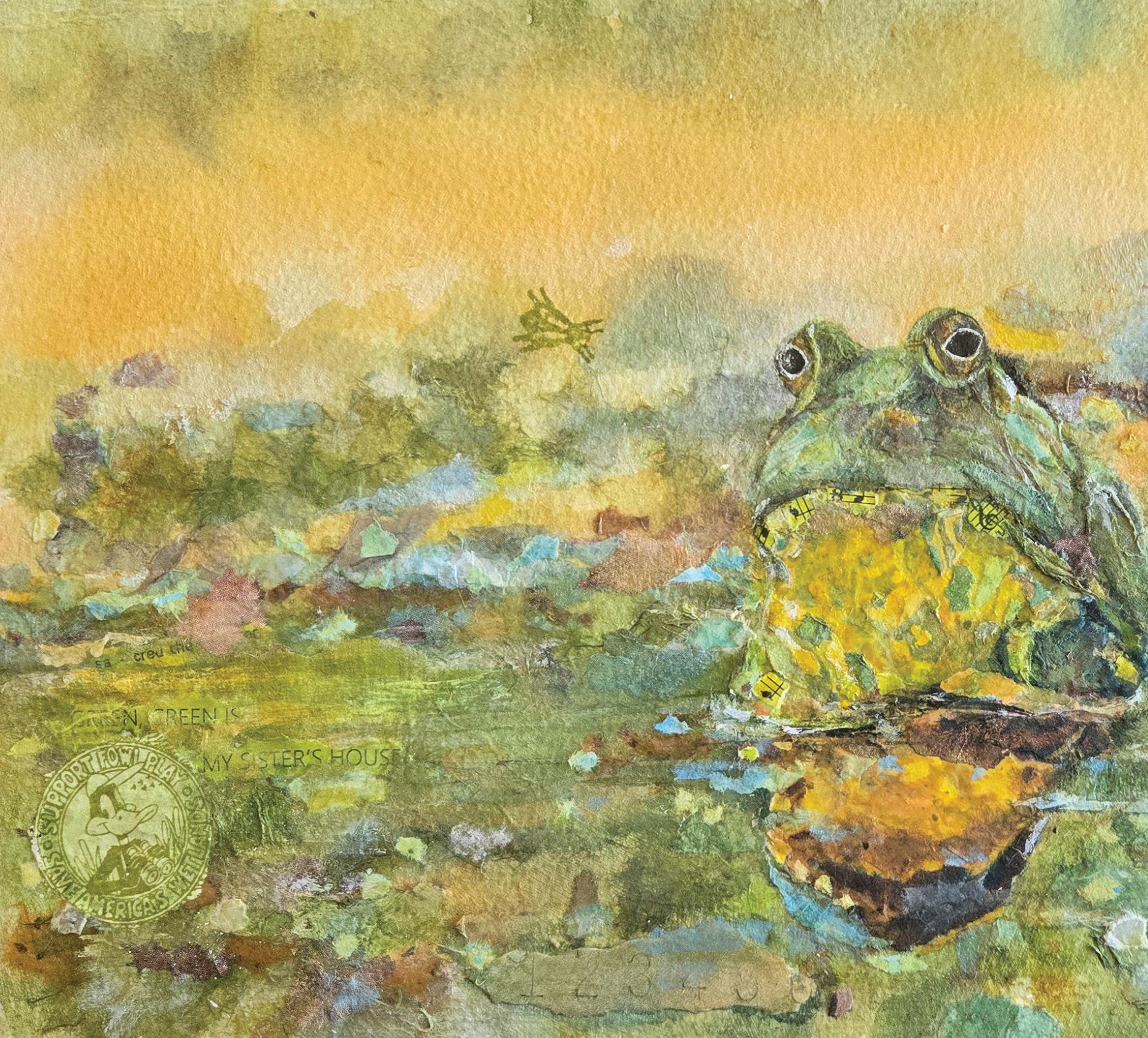
BY CRAIG THOMPSON • ARTWORK BY MARY THOMPSON
It’s not easy being green. - Kermit the Frog
In mid-March, as longer days herald the onset of spring, an aquatic miracle unfolds. Small ponds, buried for months under ice and snow, begin to thaw. When the water temperature hits 50 degrees, as if on cue, tiny frogs awaken and begin calling vigorously. It is the first scene of a three-act performance that spans months.
Three frog species brimming with bravado – spring peepers, boreal chorus frogs, and wood frogs – are the first to pierce cold spring air with signature vocalizations. The ching-ching-ching of sleighbells signals the presence of pint-sized spring peepers. If you hear what sounds like someone running a finger over the teeth of a
pocket comb, boreal chorus frogs have joined the concert. And when the low chuckling starts, perhaps in response to the vernal din, wood frogs have decided to add their two cents.
The web-footed recital has a purpose. Vocalizing males are competing for mates. The noisy commotion attracts female frogs who hop by to assess would be suitors. Think of it as a high decibel dating game with scores of itty-bitty competitors. Males with the loudest vocalizations typically win the romantic frenzy.
The hormone-fueled performance also attracts predators. As a rule, frogs are food for a variety of birds and mammals. To stay off the menu, they remain partially submerged when calling and go silent at the first hint of danger. If need be, a hasty retreat to the bottom of the pond offers temporary refuge. Eventually, one brave frog will surface, give the “all clear,” and re-ignite the chorus.
After a few weeks, the ponds’ first tenants conclude their froggy nuptials by depositing masses of tiny, gelatinous eggs in the water.

Tadpoles emerge from the eggs and ultimately metamorphose into shiny, new frogs, ensuring next year’s presentation.
By May, when the water temperature reaches 60 degrees, a new trio of performers gets down to business. Polka-dotted leopard frogs woo potential mates with a low vocalization that sounds like a wet finger being dragged slowly over an inflated balloon. Eastern gray treefrogs, renowned for their ability to climb vertical surfaces – including tree trunks – due to small suction cups on the tips off their toes, issue bright, staccato trills. Earth bound toads join the party en masse, sometimes traveling up to a mile from woodland hibernacula (their underground winter homes) to reach their favorite pond. Their sweet, prolonged trill drifting through open windows is redolent of early summer nights. Toads are somewhat less cautious than their frog cousins when calling. Large parotid glands behind their eyes can exude bufotoxin, a milky substance that renders them inedible to most predators.
As balmy days push the water temperature to 70 degrees, green frogs and bullfrogs step into the spotlight for the amphibian finale. A calling green frog is reminiscent of a plunked banjo string. The resonant “jug-orum” of bullfrogs, on the other hand, conjures images of a cellist tuning up. Together, they create a soundscape that signals arrival of the dog days of summer. Slowly paddling a Mississippi River backwater on a July evening while frogs perform is like having a front row seat in an aquatic amphitheater. It is a sensory experience not to be missed.
Frogs aren’t just charming little crooners. As amphibians, they are highly responsive to changes in water quality and climate and thus serve as important environmental barometers. Protecting Driftless wetlands is essential to their well-being. It is also the best way to ensure their soggy serenade continues to delight future generations.

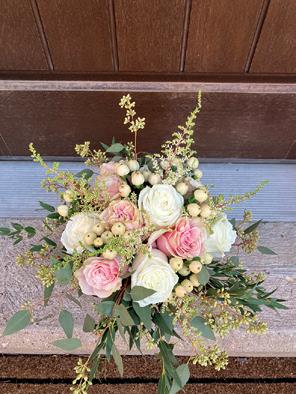



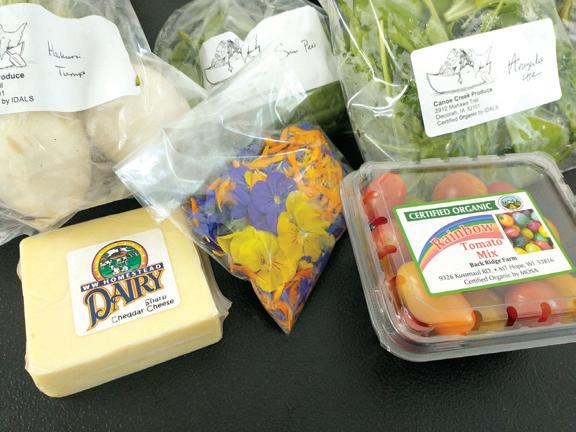
EXPERIENCE Amazing





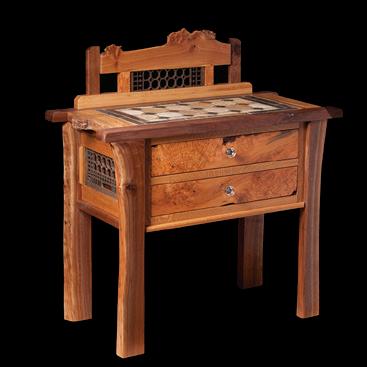
Mary and Craig Thompson live in the bluffs north of La Crosse. On occasion, they engage in ribbeting discussions about frogs and toads.
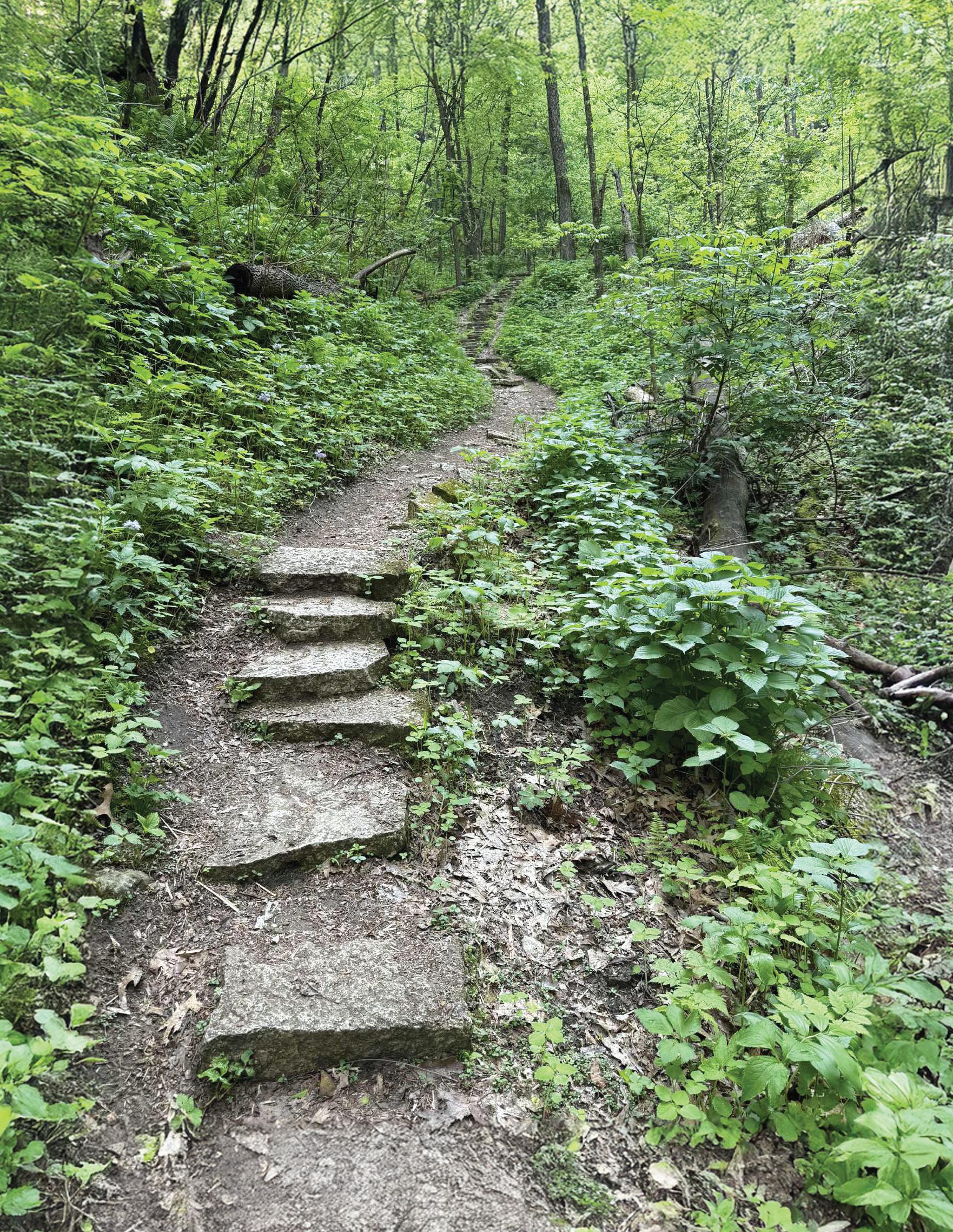
SPRING ONTO THE TRAILS
Spring woods, Perrot State Park, Trempeleau, WI
/ Photo by Marge Louch-Wouters
BY MARGE LOCH-WOUTERS
Spring is on its way! The sounds and sights of migrating warblers and other songbirds make it hard to stay inside. Once the ground is firmed up, you can hit the trails. Trails slicing through the Driftless Region’s woods are especially fun to explore in the early spring. The leafless trees allow more sunlight to hit the forest floor, so fleeting ephemerals can emerge before taller vegetation outcompetes them. The very earliest flower for sharp-eyed hikers appears in March –the Pasque flower. You need a good eye to spot their groundhugging blooms. Once found, you can reliably return to the same place annually to enjoy them.
Many ephemerals open only briefly to their pollinators and then die back to await the next spring. So you have to move fast to catch them! Look for spring beauty, Dutchman’s breeches, hepatica, rue-anemone, yellow and white trout lily, Virginia bluebell, bloodroot, Jack-inthe- pulpit, trillium, shooting star, hoary puccoon, prairie smoke, and bird’s foot violet as you hike. The best time to enjoy these flowers is late March through early June, depending on your latitude in the Driftless.
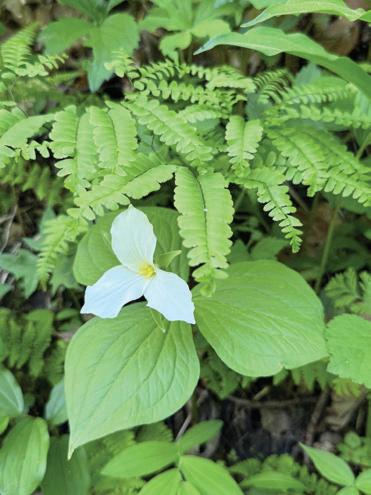
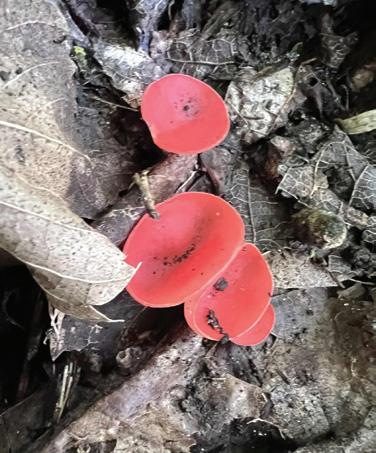
After a long winter of low sun and dampness, mushrooms and fungi start popping up in the wet forest as well. A first shot of spring color comes from the tiny, delicate scarlet elfin cup whose bright red color pops out on the trail. If you’re lucky and have the eye for it, morels lurk in the leaf litter for those who enjoy an earthy mushroom treat.
If you get impatient to see these early flowers and fungi – like I often do – consider trails located in the more southern parts of the Driftless area (like the ones in Northeast Iowa on the list on the next page) to get a jump on early bloomers.
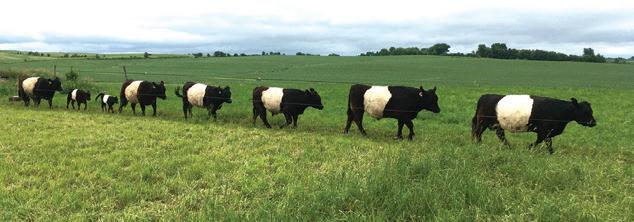






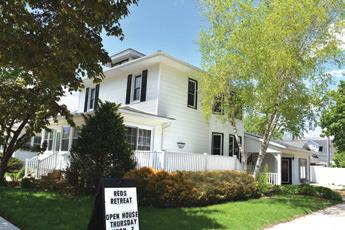












Trillium & ferns, Perrot State Park, Trempealeau, WI / Photo by Marge Louch-Wouters
Scarlet Elfin Cup mushroom along the trail. Yellow River state Park, Harpers Ferry, IA / Photo by Marge Louch-Wouters

TICK TIPS
Some might feel reluctant to hike in spring once temperatures hit 40 degrees due to the increased presence of ticks, especially in their nymph stage. It is right to be cautious with ticks, especially the Lyme disease carrying black-legged deer tick. But with the right gear and protection, anyone can enjoy the spring woods’ delicate and fleeting wildflowers worry-free.
Here are a few strategies I use to help avoid spring tick bites:
• Wear light colored clothing.
• Tuck pants into socks and spray boots and pants legs with a picaridin or DEET-containing insect repellent.
• For greater protection, invest in permethrin-infused gaiters (I like mine from Outdoor Research). Permethrin kills ticks on contact.
• Consider spraying a set of hiking clothes with permethrin spray. Renew the spray every six weeks or after six washes
• After hikes, toss hiking clothes into the dryer on high for a 10-minute spin to kill any ticks still on clothes.
• Check your body carefully for any tick action post-hike.
• Shower/wash hair. It usually takes time before a tick can transfer Lyme disease bacteria, so a good scrub can help dislodge them prior to attachment.
• If you do a lot of off-trailing like me, consider investing in a set of non-chemical RynoSkin protection underclothes (shirt, pants, socks). They are like ultralight long underwear with elasticized wrists and ankles.
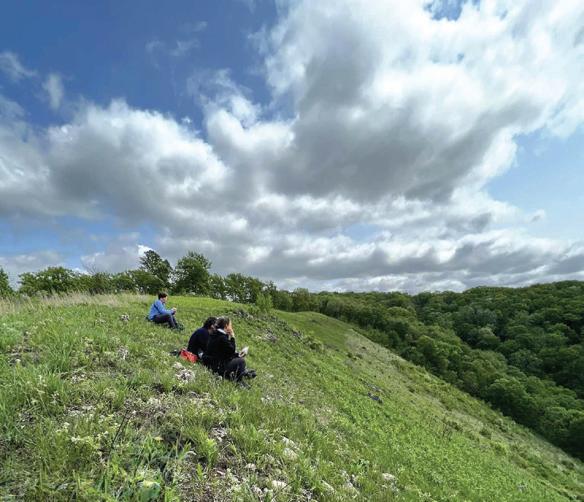
HERE ARE SOME FLOWER-FILLED SPRING HIKING TRAILS IN THE DRIFTLESS REGION:
Carley State Park (MN) – Large swaths of bluebells and wildflowers are prominent in May next to the Whitewater River. Nearby Whitewater State Park (19041 Hwy 74, Altura MN) is also a spring flower paradise. Carley State Park GPS: 44.109915, -92.169425
Yellow River Forest – Paint Rock Unit (IA) – Hiking alongside a steep ravine brings carpets of wildflowers to you at eye-level. At the top, you’ll find ponds, woods, fungi, more wildflowers, and spectacular Mississippi River views. Hwy 364 Rd, south of Harper’s Ferry IA. GPS: 43.175140, -91.175609 (just beyond the boat landing sign on the right)
Atop Sugar Creek Bluff, Ferryville, WI / Photo by Marge Loch-Wouters
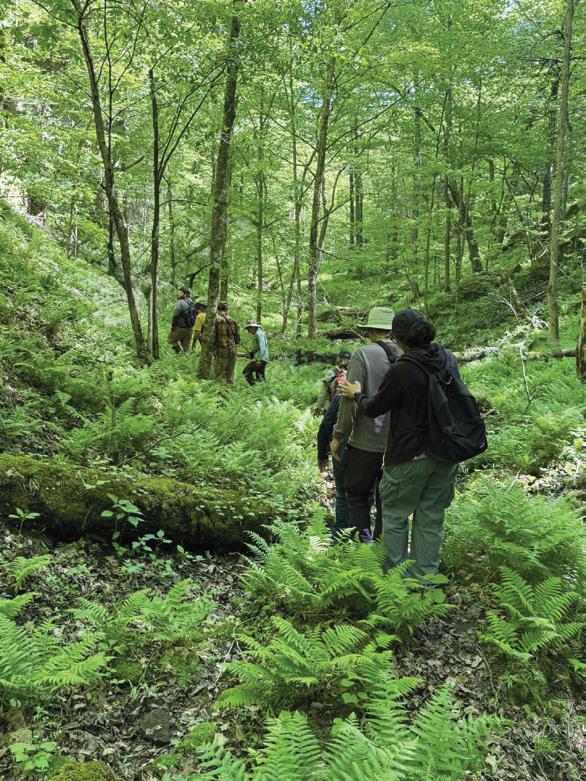
Whitewater Canyon Area – Lost Canyon Trail of 13 Caves (IA) – A great spot to find an area lush with early wildflowers – and searchable caves. Bring your headlamp for cave peeping. 29912 9th Avenue, Bernard, IA
Trempealeau National Wildlife Refuge (WI) – Hike along the Prairie Loop and Pine Creek trails for wetlands and dry sand prairie wildflower wonders. W228488 Refuge Road, Trempealeau, WI
Wildcat Mountain State Park (WI) – The Old Settlers trail hike brings you up and down a bluff and through wetlands giving you a huge variety of wildflowers, fungi, and birds along the way. E13660 Hwy 33, Ontario, WI
Vetsch Park (MN) – While the trails can be confusing, this city bluff park boasts copious wildflowers as you wander on bluffsides and atop the iconic Stoney Point. Check out the park’s wildflower guide online (tinyurl.com/44wsux8t). 722 N. 2nd St., La Crescent, MN
Marge Loch-Wouters is a Minnesota Master Naturalist living in La Crescent MN. Her Hiking the Driftless Trails blog encourages everyone to head out on the trails all year long, no matter your age or physical condition.
Scan this QR code to check out Marge’s blog and some great hiking trails in the Driftless!
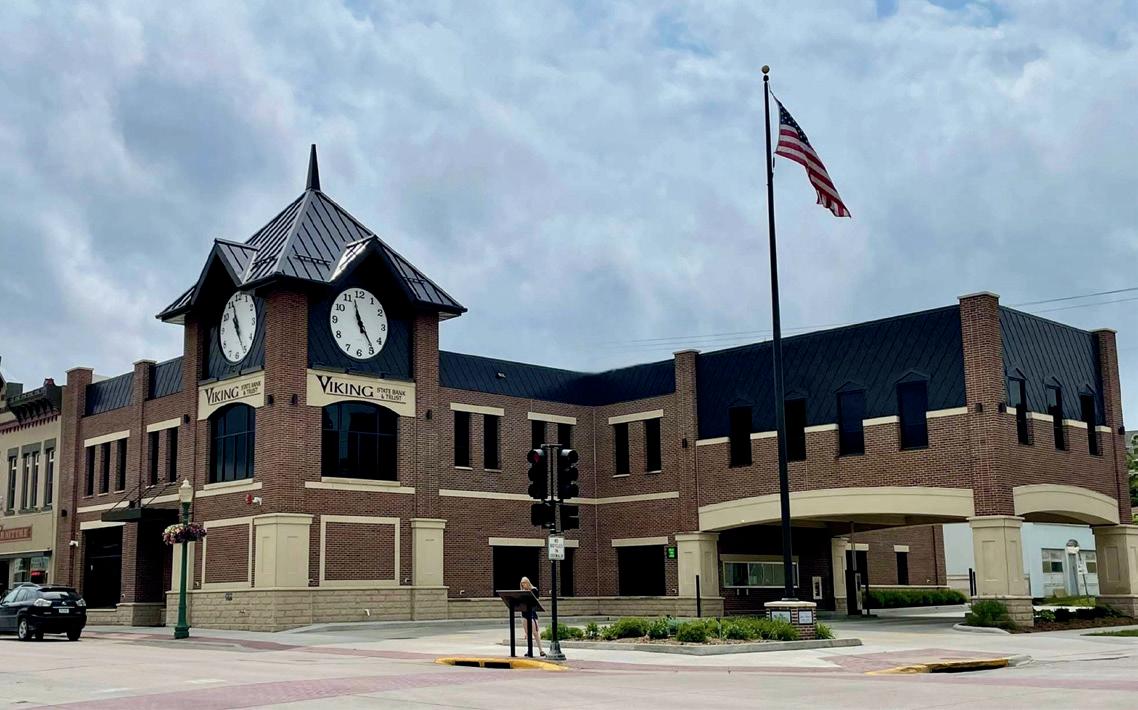


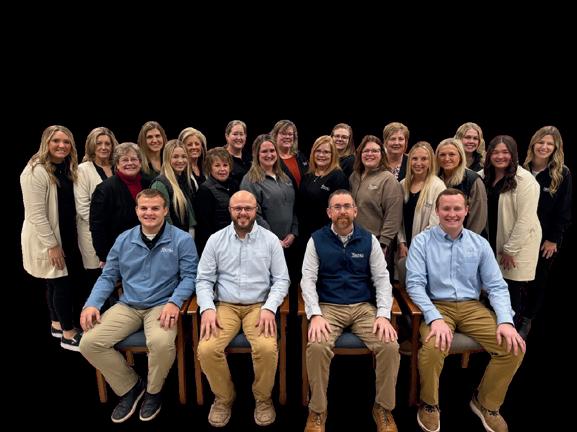
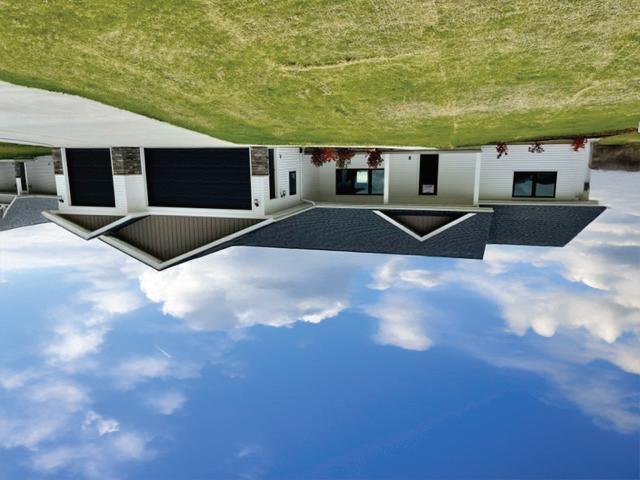



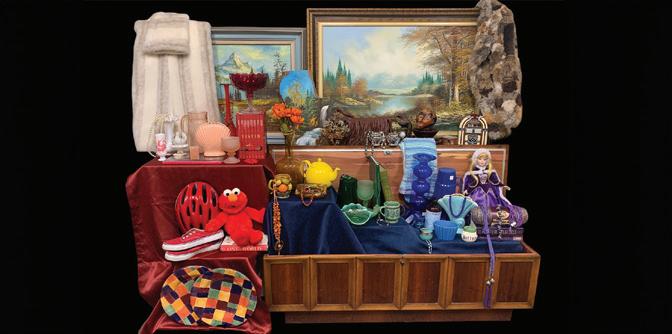

Hiking Bass Hollow SNA, Mauston, WI / Photo by Marge Louch-Wouters
Georgie Klevar
In 1970, Georgie Klevar moved from Minnesota to Decorah with her husband, Harvey, when he was offered a job at Luther College. While Harvey fulfilled his life’s work as a professor, Georgie filled the following 55+ years with countless work, family, volunteer, and public roles serving others in our region. “After we moved to Decorah, I heard about a group of women in Decorah who were giving out clothing to those in need, so I volunteered to help them and ended up on the first Depot Outlet Board,” she says. “When I returned to work, I had childcare, but there was another fantastic group that had talked about the need for childcare and we formed the first Sunflower (Child Care Center) at West Side School in the summer. There have been so many that have made this organization into what it is today.”
From her early days as a mom to Leah and Rachel, Georgie, now 84, did not shy away from being a valued part of countless boards and organizations, all while launching into a career of her own at NICC in adult education. As she “retired” from her professional career, her volunteer work with the boards of RSVP (Retired and Senior Volunteer Program), the Oneota Food Cooperative, Habitat for Humanity, the Decorah Food Pantry, Immigration Working Group, and more only increased. Giving back has been at the core of much of Georgie’s work, but she is very clear about one thing: “I’ve been in Decorah 55 years, and during that time I’ve been involved in several volunteer projects and serving people – but I’ve always received more than I’ve given. I’ve always worked alongside dedicated and caring people – never alone, and that reflects on the quality of people here.” And while she may have been a Minnesota girl from the start, she’s the first to tell you, “It turns out I couldn’t have been happier here.”
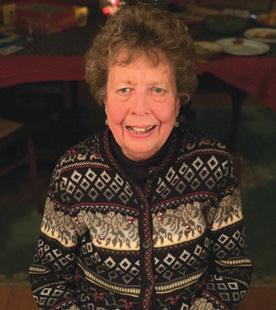
What’s the best advice anyone ever gave you?
It came from my dad, who didn’t exactly give advice – more directives. “I think you should be a teacher.”
How about the worst? Also from my dad, “You don’t need to take typing.”
What did you want to be when you grew up?
I assumed I’d be a mother and a homemaker, but I would teach a few years and then settle in. It turns out I did teach, and got married, had my first daughter but soon realized I still needed to be involved in the bigger world, and education was always my interest.
What do / did you do? I’ve always been involved in teaching of one kind or another. When I graduated from college, I got a job teaching at Regina High School in the Twin Cities – a Catholic Girls High School run by a group of very innovative nuns, and that group taught me how to be a great teacher. They mentored me and that’s how I really grew to love teaching. I taught all levels of high school history, and that really sparked my interest in American Government and History, and my love for Politics. Government functions through politics!
When we moved to Decorah I became a teacher at North Winneshiek, and then in 1972, I found an opportunity at NICC (then called Area 1) in adult education. I was responsible for hiring part time teachers to work with adults to attain their GED, via President Johnson’s war on poverty. We also then trained teachers to work with non-English speakers for the six-county area, and I learned a lot through that process. I taught the teachers, so to speak, and there were lots and lots of wonderful, dedicated part time teachers.
Through the years my supervisor encouraged me to get my masters in Adult Education, which I did, eventually becoming the community college’s Director of Continuing Education, supervising all sorts of non-credit activities from real estate to salon.
As it turns out, I retired in 2000 and became an almost full-time volunteer (and still needed to type!). Of the many things, I also began volunteer tutoring adults through the Immigration Working Group. Mostly what I figured out was that immigrants didn’t have time or childcare to go to classes, so I would sit at kitchen tables and help people study to get their GED or citizenship. I mention this not because of myself, but because this group has been so quietly caring for immigrants here in Northeast Iowa for many years.
If you were stranded on a desert island, what three things would you want with you?
A book written by a friend of ours – Dr. Joseph Everson, “The Vision of the Prophet Isaiah: Hope in a War-Weary World”.
Chocolate Covered Almonds.
A recording of Bob Dylan’s “Forever Young”.
Try to describe yourself in one sentence. Hard working, organized, and friendly.
If you could eat anything every day for the rest of your life, what would it be? Chocolate.
Name one thing you could not live without. Phone calls with my four wonderful grandkids.

Rehab and Return Home
Do you know someone you’d love to interview for this page? Let us know! aryn@iloveinspired.com

Protecting Young Vision for the Future